One Month before Venezuela’s Presidential Election Polls Show Huge Leads for Chávez
Venezuela Solidarity Campaign | September 18th 2012
With just one month left before Venezuelans go to the ballot box, a survey of recent opinion polls shows significant leads for Hugo Chávez in the race to be Venezuela’s next president.
The average of all 13 polls carried out in August and in the first week of September, saw Hugo Chávez on 51% and Henrique Capriles on 35% giving Chávez an average lead of 16% (See table 1).
Such a lead would translate into an advantage of more than two million votes for Hugo Chávez on October 7th.
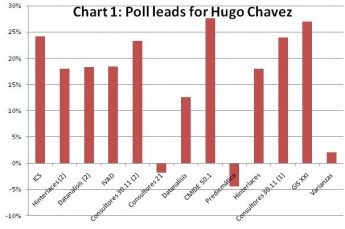 Of these 13 polls surveyed, 11 gave a lead for Hugo Chávez and just two put the main challenger, Henry Capriles Radonski, ahead. (See chart 1 to the right).
In the 11 polls putting Hugo Chávez ahead, all but one gives him a lead of between 13-28%. In contrast, the two polls that put Henry Capriles Radonski ahead gave him leads of just 2% and 4%. […]
Lee Brown who carried out the survey for the Venezuela Solidarity Campaign, said:
“Hugo Chávez clearly has a convincing lead according to the overwhelming majority of pollsters.
The evidence from looking at the full range of polls, rather than cherry picking, does not back up the claims of the campaign of Henrique Capriles Radonski that the race is close or that Capriles is ahead.
Nor is there any evidence that Capriles is making any real inroads into Chávez’s lead as they’ve also claimed.
Hopefully these statements from the right-wing opposition are just the kind of things that get said in the cut and thrust of a campaign.
But the bigger worry is that it’s part of an orchestrated claim by the opposition to give the impression of an impending victory and then to claim fraud on 7 October should they lose, as the polls suggest is very likely.”
Notes
1) The VSC analysis was based on the following poll results published in August and the first week of September, exactly one month before the election.
Related articles
- Hugo Chávez’s challenger and why he’s so confident (miamiherald.com)
- Chavez Rival Maintains Lead in August Consultores 21 Poll – Bloomberg (bloomberg.com)
Venezuelan Government Welcomes Colombian Peace Accord
By Tamara Pearson | Venezuelanalysis | September 5th 2012
Mérida – Yesterday in an official statement, President Hugo Chavez expressed his “happiness” at the announcement of a general accord between the government of Colombia and the Revolutionary Armed Forces of Colombia (FARC) which outlines dialogue steps towards ending the “long night of violence” Colombia has been subject to since the 1960s.
Colombian president Juan Santos confirmed yesterday that his government and the FARC signed the framework agreement, which is the result of six months of exploratory meetings in Havana, Cuba.
The schedule of meetings outlined in it will be accompanied by mediators from the Cuban and Norwegian governments, and Venezuela and Chile will also attend the process. Talks will begin in Oslo in early October, then move on to Havana. They will be centered on five key themes; rural development in order to guarantee land access, political participation, end to the armed conflict, drug trafficking, and rights of the victims.
“We have worked seriously and I should recognise that the FARC have also, they have respected everything agreed on till now,” said Santos. He also informed press today that Colombian ex-vice president Humberto de La Calle will be heading up the first negotiations between the government and the FARC, together with four others, including the Colombian head of police, and the president of Colombia’s business association. The five person negotiating teams will rotate with others for each meeting.
Chavez congratulated the governments of Cuba and Norway for their “successful management” and the Venezuelan government, in its statement, ratified its “total disposition to contribute, to the extent that the people of Colombia and their government deem it necessary, towards this brother country being able to put an end to the armed conflict and construct stable and lasting peace”.
Venezuela’s foreign minister Nicolas Maduro also said last night that Venezuela will assign one representative to accompany the dialogue process, and will announce that person in the coming days.
“It’s up to us to accompany and support Colombia in the construction of a new history of peace,” Maduro said, explaining that the accord would benefit Venezuela as much as Colombia, allowing them to develop economic zones together, strengthen their trade, education plans, cultural exchange, and the “construction of a border of shared life”.
The end of conflict would have even further consequences for Venezuela, according to analyst Sergio Rodriguez, speaking on Venezuelan public television last night. He said the large numbers of Colombians currently living in the country could return there, and the resources that Venezuela is currently forced to direct towards defence could instead go towards social projects and development. Further, the US “wants to involve us in the drug trafficking which originates in Colombia”, one of the key issues under discussion.
Yesterday both parties to the accord expressed appreciation for Venezuela’s role in peace efforts for Colombia. Santos said, “I want to thank the government of Venezuela for its permanent disposition to help at any time” and FARC spokesperson Rodrigo Londono also thanked Chavez for his offer of mediation.
Londono expressed his confidence in the dialogue process. “The FARC hold the most sincere desire that the [Colombian] regime won’t try to repeat the past,” he said. “We call on all of Colombia to … demand its participation or to assume it in the streets … another Colombia is possible”.
Related articles
- Colombia and FARC ready for peace talks with support from Cuba and Norway (alethonews.wordpress.com)
Democrats and U.S. Labor Delusional About Latin America
Diatribes and Curious Silences
By ALBERTO C. RUIZ | CounterPunch | September 4, 2012
The Democrats just put out their platform on Latin America, and it demonstrates only the loosest connection to reality. Thus, while praising the “vibrant democracies in countries from Mexico to Brazil and Costa Rica to Chile,” as well as “historic peaceful transfers of power in places like El Salvador and Uruguay,” the Democrats continue to point to Cuba and Venezuela as outliers in the region in which the Democrats plan “to press for more transparent and accountable governance” and for “greater freedom.” Of course, it is their Platform’s deafening silence on critical developments in the region which says the most about their position vis a vis the Region.
Not surprising, the Democrats say nothing about the recent coups in Honduras and Paraguay (both taking place during Obama’s first term) which unseated popular and progressive governments. They also say nothing about the fact that President Obama, against the tide of the other democratic countries in Latin America, quickly recognized the coup governments in both of these countries. Also omitted from the platform is any discussion of the horrendous human rights situation in post-coup Honduras where journalists, human rights advocates and labor leaders have been threatened, harassed and even killed at alarming rates.
As Reporters Without Borders (RWR) explained on August 16, 25 journalists have been murdered in Honduras since the 2009 coup, making Honduras the journalist murder capital of the world. In this same story, RWR mentions Honduras in the same breath as Mexico (a country the Democrats hold out as one of the “vibrant democracies” in the region) when speaking of the oppression of journalists and social activists, as well as the general climate of violence which plagues both countries. As RWR stated, “Like their Mexican colleagues, Honduran journalists – along with human rights workers, civil society representatives, lawyers and academics who provide information – will not break free of the spiral of violent crime and censorship until the way the police and judicial apparatus functions is completely overhauled.” And indeed, according to the Committee to Protect Journalists, 38 journalists have been killed in Mexico since 1992, and it has been confirmed in 27 of these cases that the journalists were killed precisely because they were journalists. Meanwhile, in Mexico, over 40,000 individuals have been killed due to the U.S.-sponsored drug war – hardly a laudable figure.
Of course, in the case of Honduras, and Paraguay as well, things are going fine for U.S. interests post-coup, with Honduras maintaining the U.S. military base which President Manuel Zelaya, overthrown in the coup, had threatened to close. Similarly, in Paraguay, one of the first acts of the new coup government was agreeing to open a new U.S. military base – a base opposed by Porfirio Lobos, the President (and former liberation Bishop) overthrown in the coup. The other act of the new coup government in Paraguay was its agreement to allow Rio Tinto to open a new mine in that country, again in contravention of the deposed President’s position. The Democrats simply do not speak of either Honduras or Paraguay in their Platform.
Instead, the Democrats mostly focus on their alleged desire to bring freedom to Cuba, saying nothing about the strides already made by Cuba itself where, according to a January 27, 2012 story in the Financial Times, entitled, “Freedom comes slowly to Cuba,” “there are currently no prisoners of conscience.” This is to be contrasted with Colombia, the chief U.S. ally in the region, which houses around 10,000 political prisoners and prisoners of conscience. The Democrats, shy about such unpleasant facts, simply say nothing about Colombia – this despite the fact that Colombia just announced historic peace talks with the guerillas which have been engaged in a 50-year insurgency in that country. Apparently, this does not deserve a mention amongst the Democrats’ anti-Cuba diatribe.
Meanwhile, the Democrats also single out Venezuela as a country which it is hoping to free from its alleged chains. What the Democrats fail to note is that Venezuela already has a popular, democratically President in Hugo Chavez who is making life better for the vast majority of Venezuelans, and who appears poised to receive the majority of the votes of the Venezuelan people in the upcoming October elections as a consequence. Thus, according to Oxfam, “Venezuela certainly seems to be getting something right on inequality. According to the highly reputable UN Economic Commission for Latin America and the Caribbean, it now has the most equal distribution of income in the region, and has improved rapidly since 1990.” Again, contrast this with the U.S.’s chief ally Colombia and with Mexico, the two countries with the worst problems of inequality in the region. As the Council on Hemispheric Affairs noted earlier this year, “both Colombia and Mexico suffer from some of the world’s most unequal distributions of wealth. In 1995, Colombia was ranked the fifth most unequal country (of those with available statistics), with a Gini coefficient of 0.57, while Mexico was ranked the eighth worst with a Gini coefficient of 0.52. Between 2006 and 2010, Colombia’s inequality ranked 0.58, while Mexico’s coefficient was 0.52, qualifying them as two of the lowest ranked countries in the world.” The Democrats, uninterested in such trivialities as social equality, simply ignore such inconvenient data.
For its part, U.S. labor, as represented (albeit very poorly) by the AFL-CIO’s Solidarity Center, continue to march in step with the U.S. government and the Democrats in their imperial delusions about the Region. Thus, while for some time simply hiding the fact that it has been working in Venezuela at all, the Solidarity Center, in response to pressure about this issue, has recently admitted on its website that it has been continuously working in Venezuela these past 13 years – i.e., to and through the coup in 2002 which the Solidarity Center aided and abetted by funneling monies from the National Endowment for Democracy (NED) to the anti-Chavez CTV union which was a major player in the coup.
Stinging from the just criticism over this, the Solidarity Center now claims — reminiscent of George W. Bush who fancied himself a “uniter” as opposed to a “divider” – claims that it is in Venezuela to unite the divided labor movement. Thus, the Solidarity Center states: “[g]iven the political fragmentation and divisions between unions in Venezuela, Solidarity Center activities work to help unions from all political tendencies overcome their divisions in order to jointly advocate for and defend policies for increased protection of fundamental rights at the workplace and industry levels. The Solidarity Center currently supports efforts to unite unions from diverse political orientations (including chavista and non-chavista, left and center) to promote fundamental labor rights in the face of anti-labor actions that threaten both pro-government unions and traditionally independent unions.” In its statement, the Solidarity Center says nothing about the progressive labor law which President Chavez just recently signed into law without any help from U.S. labor. This law, among other things, outlaws outsourcing and subcontracting, shortens the work week, increases minimum vacation time, increases maternity leave and requires employers to provide retirement benefits.
The Solidarity Center statement about Venezuela is laden with irony as well as hubris. The U.S. labor movement is itself greatly fragmented, with two competing houses of labor (the AFL-CIO and Change to Win) as well as divisions even within these two confederations. That the Solidarity Center would presume to be able to unite any union movement outside its borders is laughable. Indeed, only imagine the reception from the labor movement in this country if China’s labor confederation purported to intervene in the U.S. to help unite the labor movement here. Aside from wondering how exactly the Chinese unionists planned to do this, many would wonder about the ends to which such unity, once miraculously created, would be applied. And, one must wonder the very same about this in regard to the Solidarity Center’s role in Venezuela. First of all, the so-called “chavista” unions want nothing to do with the Solidarity Center, funded as it is by the NED and U.S.-AID, especially after the 2002 coup. Again, they would have to question what the Solidarity Center, which just received a massive grant of $3 million for its work in Venezuela and Colombia, would want to “unify” the Venezuelan union movement to do. The question appears to answer itself, and it is not a pretty one.
A modest proposal for the AFL-CIO and its Solidarity Center is to focus on uniting the labor movement at home in the U.S. to challenge the power that capital has on our political system; pressing for better U.S. labor law (on this score it could learn a lot from Venezuela and its labor movement); abandoning its labor paternalism (if not imperialism) and leaving it to the Venezuelans to unite their own labor movement. Similarly, the Democrats, instead of worrying about ostensibly bringing U.S.-style democracy (more like social inequality and militarism) to other countries in the Region, should spend more time trying to make this country less beholden to corporate and monied interests, and thereby more democratic in the process. But again, this is not what the Democrats are about. What the AFL-CIO is about, aside from blindly supporting the Democrats, is anyone’s guess.
Alberto C. Ruiz is a long-time labor and peace activist.
Related articles
The Sabotage Theory of the Explosion in Venezuela’s Amuay Refinery
AVN / YKVE Mundial | August 31st 2012
Venezuelanalysis.com note:
Last Saturday 25 August an explosion resulting from a gas leak occurred in Venezuela’s largest oil refinery Amuay, which at the time of writing has killed 48 people and injured over 100 more. It is one of the deadliest industrial accidents in the history of Venezuela’s oil industry. An official investigation has been launched into the tragedy.
While President Hugo Chavez urged for avoidance of speculation on the cause of the incident until conclusions are reached by the investigation, opposition politicians and media immediately launched claims that the explosion was due to lack of government investment and maintenance. Likewise, some journalists and commentators have alleged that the explosion could be the result of deliberate sabotage in order to damage the electoral campaign of Hugo Chavez ahead of presidential elections in October.
Here, Venezuelanalysis.com has translated an article from the Venezuelan News Agency (AVN) examining the circumstances before and after the tragedy that have been fuelling speculation over possible sabotage at Amuay. However, the official investigation over the disaster will likely take at least a month, according to Venezuela authorities.
The Most Unusual “Coincidences” of the Amuay Tragedy
By AVN / YKVE Mundial
This information was sent by the citizen J.W. Wekker Vega, collected from the social network Facebook. Below is the content of that information:
1. Luis Vicente Leon and Oscar Schemel [of private Venezuelan polling firms Datanalisis and Hinterlaces, respectively], despite being opposition supporters, have said in the last few months that Chavez’s victory [in the presidential elections on 7 October] would only be reverted by “catastrophic,” “extraordinary” events that generate “collective commotion” and politically affect Chavez.
2. An “amateur” with a professional camera, at 2:00am [on the night of the explosion], was alone in the surrounds of the Amuay refinery, unusual because people don’t pass through there; and he captured the first explosion, which was broadcast “exclusively” by Globovision [a pro opposition TV channel] in record time.
3. At the same time as the explosion at Amuay, three government websites were hacked, including the CADIVI [Venezuela foreign exchange commission] website.
4. The deaths of sixteen members of the National Guard, if well observed, aren’t explained in the media. The presence of sixteen National Guard members at the refinery at that time isn’t explained. And the reason the National Guard victims of the tragedy stayed up overnight in the refinery’s Guard Command was to guard the installations, given that an important number of sabotages in the refinery have been reported and denounced in recent years.
5. Only minutes after the tragedy, thousands of Blackberry instant messages were spread as much by users as by automatic senders (software), that placed information in emails and other media about the situation via spam.
6. The tragedy was immediately treated as a political issue, as many opposition leaders appeared in the public sphere to launch direct attacks on Chavez and PDVSA.
7. The portrayal of the event on an international scale is unprecedented. On few occasions has this type of coverage been seen for events like this.
8. A few hours after the tragedy, Blackberry instant messages and information circulated in media and social networks that generated uncertainty over the availability of fuel. People were incited to head en masse to fill up their tanks, and lack of supply is spoken of openly. This looks like a strategy to generate chaos, and a call for calm has been issued, as the country has other refineries and a good reserve of fuel stores.
Spanish language source: YKVE Mundial
Iran, Venezuela and Egypt, a possible peace troika to address the Syria situation
MercoPress | August 30, 2012
Venezuelan Foreign Minister Nicolas Maduro has welcomed Iran’s proposal for the formation of a troika committee on Syria consisting of Iran, Egypt, and Venezuela
Minister Maduro welcomed the proposal to keep “major powers from interfering in Syria’s internal affairs” Minister Maduro welcomed the proposal to keep “major powers from interfering in Syria’s internal affairs”
Maduro made the remarks in an interview with reporters from the Iranian media upon his arrival in Tehran on Wednesday to attend the XVI Summit of the Non-Aligned Movement (NAM), which opened in Tehran on Sunday and closes on Friday.
“Playing a role by regional countries in (resolving) the crisis reduces the interference of external powers in Syria,” the Venezuelan foreign minister stated, according to the Persian service of the Mehr News Agency.
“Before everything else, we call on the major powers to stop interfering in Syria’s internal affairs and allow the Syrian people to live in calm, peace, and independence.
“(Iran’s) proposal is a very good proposal (according to which) the major powers and foreign powers will stop interfering in the Syrian crisis with the involvement of the conflicting sides and regional countries to resolve the problem.
“The country of Venezuela welcomes the proposal because it will (help) the people of the country of Syria to achieve peace and true calm.”
Commenting on the NAM summit in Tehran, Maduro stated, “The summit is being held in a country whose people are diligent and are seeking progress and peace. One hundred and twenty countries have gathered together in Iran to step toward world peace.”
Venezuela Moves towards Completion of Land Demarcation Process for Indigenous Communities
By Ewan Robertson | Venezuelanalysis | 11th August 2012
Mérida – The Venezuelan government granted 27 land titles to indigenous peoples in Amazonas, Anzoátegui and Monagas states, to coincide with celebrations for International Indigenous Peoples Day on Thursday.
Venezuelan Vice-president Elias Jaua, who led an official ceremony to handover the land titles, confirmed that 467,000 hectares of land were being granted to benefit almost 9,000 people.
“Today we are handing over documents that judicially grant these communities their right to habitat where they have lived for years,” he said.
Thursday also marked eight years since the launch of the government’s Mission Guaicaipuro, a program aimed at guaranteeing the rights of indigenous peoples enshrined in the 1999 constitution.
One aspect of Mission Guaicaipuro is to work with indigenous people in the demarcation of ancestral land. Up to the present, almost 1,815,000 hectares of land have been granted to Venezuela’s indigenous peoples, covering 337 distinct communities and 31,526 people, according to Jaua.
In an interview on state television VTV on Tuesday, the minister for indigenous peoples, Nicia Maldonado, said that the government’s National Demarcation Commission is currently evaluating 34 other requests for territorial demarcation.
These are expected to be granted by September, upon which, “we would be declared a territory free of demarcation requests [from indigenous communities],” she confirmed.
On Thursday Vice-president Jaua also announced the granting of US $10.9 million (47 million bolivars) “for the transformation of the lives of indigenous peoples and communities”. Indigenous communities will be able to present development projects and request the funding through the Government Federal Council.
Jaua also highlighted President Hugo Chavez’s commitment to Venezuela’s indigenous peoples, as seen in the 1999 constitution, whose chapter eight recognises their multi-ethnic and pluri-cultural character, among other rights.
Indigenous Congress in Defence of Mother Earth
The land grants were made at the close of the V Great National Congress “Abya Yala” of Indigenous Peoples for the Preservation of Mother Earth, held in the Kavanayén indigenous community in the eastern Bolivar state.
The congress brought together 45 delegations from 20 countries to discuss the conservation of the environment and the strengthening of Latin American indigenous movements.
Commenting on the conference, Maldonado said “If indeed there’s still a lot to do, after 500 years of abandonment, what’s coming is the deepening of indigenous rights and their struggles”.
In their eighteen-point final declaration yesterday, the participants of the congress declared their support for the Venezuelan government’s policy of land demarcation, and the need to raise consciousness on the struggle of indigenous peoples in defence of the environment.
The document also called for the “generation of conscious criticism” to contribute toward “the deepening of indigenous-American socialism of the 21st century”. The declaration can be read in Spanish here.
Related articles
- “Sustainable” Development Locks Out Indigenous People (alethonews.wordpress.com)
With Venezuela Mercosur has become “a new pole of world power”

MercoPress | July 31, 2012
Argentine President Cristina Fernández said on Tuesday during a press conference held at the Mercosur extraordinary summit in Brasilia, that Venezuela’s entry to the bloc “strengthens the entire region” and creates a “new pole of power” at world level.
Argentina, Brazil and Uruguay made the incorporation act official at the special summit held in Brasilia with the attendance of the four leaders: Cristina Fernandez, Venezuela’s Hugo Chavez, Uruguay’s Jose Mujica and the host Dilma Rousseff.
The event started Tuesday morning in the Planalto Palace when the four presidents met and later had the family picture taken. This was followed by a press conference and a special lunch at the Brazilian Itamaraty chancery in honour of the presidents.
“This is a historic day that fills me with joy”, said the Argentine president adding that the inclusion of Venezuela “calls for the creation of the institutions for this new pole of power”.
Venezuela incorporation to Mercosur was decided at the mid year presidential summit in Mendoza, Argentina at the end of June when the other full member Paraguay was suspended because of the removal of Fernando Lugo from the presidency.
Following the three presidents agreed the inclusion of Venezuela as full member of the block, which had been pending because of the refusal of the Paraguayan Senate to have Hugo Chavez in the trade block. Chavez’ original request dates from 2006.
Venezuela’s swearing into the bloc makes it the first country to join the bloc since it was founded in 1991.
“I still remember the small minded sponsors who were against the inclusion of Venezuela”, and who argued that “it was not convenient to be part of Mercosur because Brazil would gobble us” given its size.
Cristina Fernandez then turned to Chavez and said that “your solitude was not personal or government solitude, it was political and cultural solitude from our region in South America” and immediately recalled that “Nestor Kirchner and Lula da Silva always dreamt of this happening”.
The Argentine president then criticized “developed countries” blaming them for the current global “financial insecurity”.
“I’ve read that the idea of capping the price of our commodities has resurfaced as if we were endangering global food security. Let us tell them to be at ease that we can provide food security because the world is in this condition not because of the soybeans, or because of wheat or corn, but rather because of the financial insecurity which those same developed countries generated”, said Cristina Fernandez.
She added that “we are going to produce more and better food, but what we are demanding is financial security, an end to fiscal havens, and end to double speech”.
With Venezuela Mercosur “closes the equation” in the regional block “because it is energy, food, minerals, knowledge, aggregate value, industrialization, know-how that we are now going to share”.
President Chavez said that with the incorporation of Venezuela “the new period of the accelerated history we are building has been opened”, which will mean “historic changes” for the region.
“We are where we should have always been, Venezuela’s inclusion in Mercosur was long overdue, but everything that is to happen has its moment”, said Chavez.
“We have come to Mercosur with all our wishes for a full integration” and to make this block “a mechanism of integration which goes beyond trade, which means social integration”, he added.
Finally Chavez said that Mercosur must be seen as “the largest locomotive to preserve our independence and to guarantee our integral development”.
“As of today Venezuela belongs to one of the most powerful blocks in the world which concentrates 300 million people and a GDP of over 3tn dollars,” rich in resources, energy and know-how.
Related articles
- Venezuela to join Mercosur on July 31 (alethonews.wordpress.com)
- China seeks free trade deal with Mercosur (alethonews.wordpress.com)
Venezuela formally joins Mercosur trading bloc
Press TV – July 31, 2012
Venezuela has become a full member of the Mercosur regional trading bloc following a six-year-long delay.
Venezuela’s President Hugo Chavez is now set to take part in a ceremony in Brasilia, which celebrates Caracas’ membership in the South American trade bloc.
The visit to Brasilia will be Chavez’s first official trip abroad in a year after his being diagnosed with cancer in June 2011 and his treatment process in Cuba.
Mercosur is an economic union and political agreement between Argentina, Brazil, Paraguay, and Uruguay founded in 1991. Its purpose is to promote free trade and the fluid movement of goods, people, and currency.
The bloc’s combined market encompasses more than 250 million people and accounts for more than three-quarters of the economic activity on the continent, or a combined GDP of USD 1.1 trillion.
Although the governments of Argentina, Brazil, Paraguay, and Uruguay had approved Venezuela’s admission into the bloc in 2006, the accession was delayed pending ratification by the Paraguayan congress.
This is while Paraguay has recently been suspended from the group over the controversial dismissal of President Fernando Lugo.
The lower house of the Paraguayan congress impeached Lugo on June 21. The senate opened his trial a day later and quickly reached a guilty verdict, ousting the president.
Mercosur’s leaders did not impose economic sanctions on Paraguay, but banned Paraguayan officials from participating in the bloc’s meetings.
Paraguay’s suspension created an opportunity for Venezuela to be incorporated into the bloc since the opposition in the Paraguayan congress was the only obstacle to Caracas’ membership.
Related articles
- Venezuela to join Mercosur on July 31 (alethonews.wordpress.com)
Featured Video
Macgregor: We Haven’t Seen the Worst of the Iran War Yet
or go to
Aletho News Archives – Video-Images
New Book
Breast Cancer: Before You Consent
A new Unbekoming paperback
Lies are Unbekoming | September 18, 2026
Peter Gøtzsche reviewed every randomised mammography screening trial ever conducted for the Cochrane Collaboration. Cochrane’s headline is that, assuming a 15% mortality reduction, one woman in 2000 avoids dying of breast cancer over ten years. Ten are overdiagnosed and treated. Two hundred experience false alarms.
But that headline assumes the reduction. When Gøtzsche looked only at the trials with adequate randomisation — the higher-quality ones — the reduction disappeared. No effect on breast cancer mortality. No effect on all-cause mortality.
This is the Cochrane finding, published in the establishment’s own database of systematic reviews.
No woman being asked to consent to a mammogram this week knows it.
That is why the new Unbekoming paperback exists. … continue
Blog Roll
 Aletho News
- US-Denmark Agreement on Greenland Is ‘PR Stunt’ Ahead of Midterms
- Araghchi: Military intervention cannot create security; coercion cannot bring peace
- Fraud Squared
- Breast Cancer: Before You Consent
- Iran’s Plan to Shut Down AI in the Persian Gulf
- Israel seeks ‘compensation’ from Washington over Saudi F-35 sale
- Saudi crown prince seeks dialogue with Ansarullah after Yemeni blows: Report
- Damascus rejects Saudi request for Syrian fighters to counter Yemen: Report
- South Korea says will not send troops to join terrorist US war on Iran
- Russia Just Struck the Eyes of NATO’s War Machine in Ukraine
- If Americans Knew
- Inside the siege, the ruined buildings of Gaza – Daily Update
- Debunking The Claim That Macklemore Has A “History Of Antisemitism”
- CPJ demands release of arrested Palestinian-US journalist near Bethlehem
- Robert Kraft: The Billionaire Friend of Netanyahu Pulling The Strings Behind the Macklemore/Ed Sheeran Blow Up
- Columbia Administered Fund Gives Big Money to Pro-Israel Groups
- Deportation Case of Palestinian Activist Salah Sarsour Tests First Amendment
- ‘We Will Not Forget’: Palestinians Mark 44 Years since Sabra and Shatila
- Why do we let Zionists decide what we can and can’t say?
- US welcomes Israeli, Iranian delegations to UN, but not Palestinians – Daily Update
- Biden’s Genocide Accomplices Targeted by New Accountability Campaign
- No Tricks Zone
- New Study: ‘Global Drought Shows No Detectable Recent Acceleration Under Climate Warming’
- Economic Masterminds: German Socialists Suggest Taxing Productivity Gains Stemming From Using AI
- The South China Sea Has Not Been Cooperating With The Climate Change Narrative
- Energy Crisis: Germany Enters Heating Season With Historically Low Gas Reserve Fill Levels
- New Study: The Antarctic Ice Sheet Gained Mass From 2020-2024 Due To Staggering Snow And Ice Accumulation
- Study: Ocean Heating Rates From Thousands Of Years Ago ‘Dwarf’ Modern Ocean Heating Rates
- Climate Extremists Target, Attack Large-Scale Power Grid Infrastructure In Germany!
- New Study: Antarctic Ice Melt Has Contributed Less Than 1 Centimeter To Sea Level Rise In The Last 30 Years
- Fear Of Debate: Alarmist German Climate Scientist Calls On Mainstream Media To Discredit Skeptic Voices
- End-Of-August Arctic Sea Ice Extent Hasn’t Fallen In 20 Years, Official Data Show!
 Aletho News