How Western press distorts Venezuela
By Aaron Benedek | Green Left | October 14, 2012
“Venezuela Elections ‘Free, But Not Fair’”, was Germany’s Spiegel Online headline on a piece about Venezuela’s October 7 presidential poll, won by socialist President Hugo Chavez by more than 55% of the vote. “Chavismo wins, Venezuela loses”, was The Wall Street Journal’s take.
Compared with such headlines, the Sydney Morning Herald’s reprint of a New York Times article “Socialist Chavez hangs onto Power in Venezuela” by William Neuman might seem a reasonably balanced report. It is not.
Note that politicians in Australia or the US get re-elected, but if you’re a socialist in Latin America you “hold onto power”.
Then there is the article’s very first clause, where we learn that Chavez is a “fiery foe of Washington”. Although no doubt a badge of honour for many, this language still paints Chavez as impassioned rather than considered.
This, along with the article’s other main Chavez descriptor of “polarising”, conveys an image of him being unreasonably confrontational and divisive in a way that the also accurate “a democratic leader who has withstood Washington orchestrated violence and sabotage” does not.
And then there is the assumption that the first thing to mention in an article about a Venezuelan election is Washington. The pitfalls of your reportage coming from the New York Times perhaps.
The article does convey a sense of joy on the street following Chavez’s re-election, but it’s always “his … revolution”, “his version of socialism”.
That a large section of the population feel some kind of ownership over the process of social transformation in Venezuela is never acknowledged. The Venezuelan people have agency in Neuman’s writing only if they’re part of the opposition.
Moreover, in selecting quotes and comments about Chavez “reigning forever”, “guns being fired into the air” and Chavez being a “former soldier”, some sense of violence and dictatorship is still conveyed. This comes straight after Chavez and his supporters once again peacefully won what in any other Western country would be referred to as a landslide electoral victory.
By contrast, we are informed of the opposition’s “democratic temperament” via the one full quote the re-elected president is afforded in the article.
What about a quote interpreting the election result and the future for Venezuela? Well there is one, just not from Chavez. It’s from Henrique Capriles, the opposition candidate who was resoundingly defeated.
After the election, we’re told Chavez is “ailing and politically weakened”, despite being re-elected for a fourth presidential term by 11 percentage points and holding a majority in the National Assembly.
It is said the opposition “raised the possibility that an upset victory was within reach”. To what extent the opposition relied on reprints of biased NYT articles about Venezuela to raise this sense of “possibility” is difficult to quantify.
Chavez, we’re told, will now move forward “even more aggressively … although his pledges were short on specifics”. For Neuman, the specifics detailed in the million or so copies of the 39-page plan for deepening popular participation and human-centred development over the next six years that were distributed for mass discussion, amendment and ratification by the Venezuelan National Assembly early next year do not count.
And how specific was the opposition’s plan? Capriles’ pledge to maintain the Chavez government’s social programs ― the same ones the opposition have violently opposed for a decade, but now pledge to improve.
We are informed, as always, that Chavez’s “health is a question mark”. Maybe he is going to die soon! And maybe the mainstream media will start showing some human decency and ease up on the celebrations when an elected leader gets cancer, but I would not hold my breath for either.
“Facing pressure from Mr Capriles,” Neuman says, “[Chavez] pledged to … pay more attention to the quality of government programs such as education.”
In reality, the popularity of the government’s social programs is such that Capriles had to publicly say the opposition was in favour of them, but leaked opposition documents revealed his plan to dismantle them.
Capriles had to pitch himself as a leftist and the opposition was forced to accept the election results due to the painstaking efforts to institute a transparent electoral system with unprecedented international supervision. But we are told it was Capriles who pressured Chavez.
And better still, the same opposition that denigrated the literacy and other mass education campaigns of the past decade is said to have forced the government “to pay attention to quality education”.
We are told Chavez spent much of the year insulting “Capriles and his followers” as “squalid good-for-nothings, little Yankees and fascists”. Left out is the opposition’s regular jibes about Chavez’s African facial features, his “common” way of speaking or his hilarious cancer-induced baldness.
And anyway, was it really the “Yankee and fascist” credentials of the opposition (that is, organising a fascist coup and getting funding from Washington) that “represented nearly half the electorate” as Neuman claimed? Or did those that voted for Capriles do so for a range of other reasons, not least among them that the private media sold him as a progressive left-wing candidate?
At any rate, Chavez’s insults, we’re told, “seemed to lose their sting” as the campaign went on (he can’t even insult effectively!) under the weight of the opposition’s growing “momentum”. The Chavez campaign filling Caracas’s seven major avenues with almost certainly the largest demonstration in Venezuela’s history three days before the vote clearly does not constitute momentum worth mentioning for Neuman.
Through selection of evidence, biased language, omission, and unsubstantiated claims, Neuman paints a false picture ― and this is an article that, by comparison with other Western media coverage, is relatively generous towards the Bolivarian process that has halved poverty in Venezuela.
Serious journalism regarding Venezuela requires covering the significant social achievements of the revolution and an informed discussion of its many shortcomings. Unfortunately, if Neuman’s article is anything to go by, the liberal corporate media will not provide you with either.
Related articles
- Chavez Wins Venezuelan Presidential Election with 54% of the Vote (alethonews.wordpress.com)
- A Hall of Shame for Venezuelan Elections Coverage (alethonews.wordpress.com)
New York Times Coverage of Venezuelan Election Was Poor
By Michael McGehee | NYT eXaminer | October 8, 2012
Hugo Chávez won his third straight presidential election this past weekend, and as the New York Times correspondent William Neumann put it in his latest article, “Chávez Wins New Term in Venezuela, Holding Off Surge by Opposition,”: “Though his margin of victory was much narrower than in past elections, he still won handily.” By more than 10 percent, Chávez defeated center-right candidate for the Justice First party, Henrique Capriles.
The problem with Neumann’s article, and his pre-election article “Fears Persist Among Venezuelan Voters Ahead of Election” is that he said nothing about Capriles’ campaign while providing considerable space to hearsay and accusations he, and Times editors, didn’t back up with examples. What resulted was clear cases of anti-Chávez hysteria and poor journalism.
In Neumann’s pre-election article he wrote that “polls diverge widely, with some predicting a victory for Mr. Chávez and others showing a race that is too close to call,” but he offers no examples of these “too close to call” polls. When the Center for Economic and Policy Research looked at available data they found that “Capriles [had] a 5.7 percent probability of winning the election.”
And just as Neumann doesn’t provide any examples of those who have “anxiety” about ”a new electronic voting system that many Venezuelans fear might be used by the government to track those who vote against the president” there are no examples provided of “[m]any government workers” whose names “were made public after they signed a petition for an unsuccessful 2004 recall referendum to force Mr. Chávez out of office” and subsequently ”lost their jobs.” This claim has been circulating for nearly ten years, and if Neumann has proof it occurred he should certainly share it. That would be more newsworthy than the unfounded fears of unknown persons.
The fearmongering does not stop there. Neumann also claims, without providing any supporting evidence, that “Government workers are frequently required to attend pro-Chávez rallies.” Despite having won three successive presidential elections by large margins, and whose voter base continues to grow, it seems Neumann cannot accept the fact that Venezuelans vote for and “attend pro-Chávez rallies” because they actually support the man and his policies.
Another problem with Neumann’s articles is that, on one hand of Neumann’s Anti-Chávez argument, Chávez has sown “fear” and rules by intimidation. This is why nearly eight million Venezuelans voted for him—an increase by more than half a million votes, or an almost ten percent gain in votes since the 2006 election. Then, on the other hand, we are told that Chávez rules by bribery. Neumann claims that the reason “it has been harder for Mr. Capriles to dent the strong support for Mr. Chávez in rural areas” is the government spending on poverty, which Neumann refers to as “the government largess [Mr. Chávez] doles out with abandon.”
In his post-election article Neumann continues with his bias, which would be more appropriate in the opinion section, when he offers advice to Capriles. Neumann warns that ”the opposition is a fragile coalition with a history of destructive infighting, especially after an election defeat,” and that “Mr. Capriles will have to keep this fractious amalgam of parties from the left, right and center together in order to take advantage of the new ground they have gained.”
While noting that “Mr. Chávez has trumpeted his programs to help the poor,” or the so-called “government largess” which Chávez “has pointed to a sharp reduction in the number of people living in poverty” as proof that he is delivering the goods, Neumann tries to explain this not so much as an actual agenda by Chávez but due to the fact that the president “has governed during a phenomenal rise in oil prices, which have soared from $10 in 1998, the year before he took office, to more than $100 in recent years and the high $80s now, pouring huge amounts of revenue into Venezuela.” When it comes to Neumann, Chávez can’t win for losing.
Neumann also spends an inordinate amount of time talking about Chávez’s health. In fact, he provides more coverage of that, as well as criticizing Chávez at every turn and giving voice to unqualified accusations, than he does talking about the actual campaigns of the candidates. While Neumann writes in his post-election article that Capriles “campaigned almost nonstop” he doesn’t say what Capriles campaigned on, and if he provided his readers with such information they might actually get a glimpse into why the opposition fared much better than the past two elections.
In an article published this past April, Reuters wrote that “Henrique Capriles defines himself as a center-left ‘progressive’ follower of the business-friendly but socially-conscious Brazilian economic model,” while Global Post wrote that “Capriles has based his campaign on improving education, which he sees as a long-term solution to the country’s insecurity and deep poverty,” and that ”Capriles’ methods are not to shout down Chavez — indeed, he praises many of the president’s ideas.” Far from being an “opposition” candidate, Capriles tried to appear as Chávez-lite.
New York Times coverage of the presidential election in Venezuela was bizarre, but typical. The political leanings of the “paper of record” are notorious for reflecting the views and interests of the political and economic establishment. And with Chávez not being an ally of the U.S. government and business community, and is instead encouraging the regional independence that has been unfolding for the past decade much to their ire, and with Chávez expected to and having “won handily,” it comes as no surprise that the Venezuelan election process, which former American president Jimmy Carter has hailed as the “best in the world,” would get picked over by the New York Times as being the results of intimidation and bribery.
Related articles
- Chavez Wins Venezuelan Presidential Election with 54% of the Vote (alethonews.wordpress.com)
- A Hall of Shame for Venezuelan Elections Coverage (alethonews.wordpress.com)
Why Hugo Chavez’s Re-Election Matters to the Arab World
By Jody McIntyre | Al Akhbar | October 10, 2012
Caracas – As crowds occupied the streets of Caracas, Venezuela on the evening of Sunday, October 7, to celebrate the successful re-election of President Hugo Chavez, a Lebanese flag was held aloft. As they poured into the grounds of Miraflores to hear him speak from the balcony of the Presidential palace, later that night, a Palestinian flag was also visible as it was waved above our heads. These symbols were not without meaning; the re-election of Chavez with 55 percent of ballots cast – eleven points ahead of his opponent, Henrique Radonski – will have repercussions not only across the continent of South America, but also in the Arab world.
On Tuesday, just two days after his electoral victory, Chavez reiterated his support for the Syrian government, about which he has been characteristically vocal over the last year. It is a far cry from the pre-election promises of Capriles, who was seen by many in Venezuela as the candidate of the United States and had pledged to develop “closer relations with Israel,” as well as re-thinking several areas of foreign policy. Chavez, on the other hand, took the step of expelling the Israeli ambassador in January 2009, during the bombing campaign of Operation Cast Lead in Gaza. It was not the first time he had taken such action, having ordered the US ambassador to leave in September 2008.
From the evidence of his first press conference since being re-elected, and particularly in regard to the Arab world, it is clear that re-thinking foreign policy is the last thing on Chavez’s mind. He described Assad’s as the “only legitimate government” of Syria, before continuing:
“[He] has made a huge effort to make concessions, constitutional changes, [and has] called for elections, but none of that is true for those who want to overthrow [the regime].”
Whilst speaking from the “People’s Balcony” of Miraflores at just before midnight on Sunday, Chavez called for reconciliation with the opposition at home. But he knows that his victory, although down from the 26 percent margin he won by in 2006, would be considered a landslide in many other countries and gives him a strong democratic mandate for the next six years of government. Foreign policy has often been a talking point during the last fourteen years of Chavez’s government, and his popularity, so pervasive amongst the poorest sections of Venezuelan society, has also spread as far as occupied Palestine, the south of Lebanon, and many parts of the Arab world.
Chavez vehemently denounced the NATO bombing of Libya earlier this year, which he described at the time as “imperial cynicism,” a “massacre” and a “madness” that had “destroyed” the country. On Tuesday, Chavez took the opportunity to mention former Libyan President Colonel Gaddafi, saying that “the way he died was a barbarity.”
Some western commentators have criticised Chavez’s support for what they see as dictatorial governments in Libya and now Syria, whilst recognising the democratic credentials of Venezuela itself. However, Chavez is particularly aware of what demonization of political leaders who challenge or question the dominant narrative – once referred to as the “Washington Consensus” but now struggling to retain one hand, let alone a “consensus” in Latin America – can lead to. The April 2002 coup d’etat against his government, which resulted in huge demonstrations and the re-instatement of Chavez after just forty-eight hours, was preceded by much hysterical commentary in both the US and in the privately-owned Venezuelan media, which routinely referred to Chavez as an “autocrat,” a “monkey” or even “Venezuela’s Hitler.”
Chavez is of the view that, whilst undoubtedly embroiled in turmoil, there are more forces at work in Syria than usually portrayed in the mainstream media. On Tuesday, he repeated his opinion in regards to Syria that “the US government is largely responsible for this disaster.”
There is no doubt that Chavez’s presence will be continue to be felt in the Arab world over the next six years. With a wave of pro-poor, anti-imperialist governments continuing to enjoy widespread popularity in Latin America – Rafael Correa in Ecuador, Evo Morales in Bolivia and Cristina Fernandez de Kirchner in Argentina – the question remains as to how Arab people will respond to this example of resisting subservience to foreign interests. Indeed, in a speech following his decision to expel the Israeli ambassador, Hugo Chavez made a proposal of his own:
“Every day, Latin America will be more united and more free. I hope that one day, Arabs will be the same way; united. United or dominated, you decide!”
Jody McIntyre is a journalist and political activist. Follow him on Twitter @jodymcintyre.
Related articles
- Chavez Wins Venezuelan Presidential Election with 54% of the Vote (alethonews.wordpress.com)
Chavez Beats the Devil, Again
A Black Agenda Radio commentary by Glen Ford | October 10, 2012
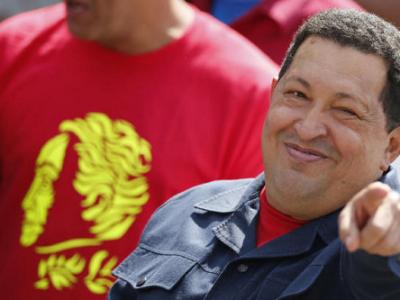
Venezuelan President Hugo Chavez won a resounding victory in last weekend’s elections. If you’ve been following U.S. corporate media coverage of the campaign, that may have come as a surprise to you. Chavez is routinely referred to as a “strongman” and other variations on “dictator” by the U.S. media when, in fact, he remains one of the most popular persons in all of Latin America. In the United States, his ten percent winning margin would be considered a landslide, but all the American media can talk about after Chavez’s latest victory at the polls is how much his lead has shrunk since the 2006 election, when he won by 25 percent.
Every time Chavez and his Bolivarian socialists win at the polls, the corporate media have to eat crow. One would think all that heartburn would force the U.S. press to finally admit that Chavez is the leader of oil rich Venezuela because large majorities of its citizens want him in the presidential palace, and are enjoying the fruits of his wealth distribution policies.
It is also impossible for American media, which are mouthpieces for their corporate owners and take their day-to-day cues from the State Department and the White House, to understand that most Venezuelans agree with Chavez when he denounces the imperialists in Washington. They knew what Chavez meant when he called President Bush “the devil” and said that he stank of sulfur, back in 2006. Venezuelans remembered how Bush backed a coup that almost toppled Chavez in 2002 – a coup that was reversed by a counter-rebellion of the people and loyal soldiers. They remember that the coup leaders’ first act was to abolish the Constitution and start drawing up lists of people to be thrown into prison, or worse. They remember the dark days when nearly all of Latin America was placed under the rule of generals allied with Washington, and the hands of the torturers and the death squads could reach into every family with impunity. They know who was the author of that nightmare: the United States.
That’s why Latin America is the corner of the world that has achieved the greatest success over the last 20 years in throwing off the dead weight of the North, by rejecting the so-called Washington Consensus. And that’s why, this time around, the Venezuelan opposition chose a candidate who pretended to be a leftist, himself. Challenger Henrique Capriles, a young state governor, styled himself as a protégé of former Brazilian president “Lula” da Silva, a more business-friendly type of leftwing politician. But Venezuela’s poor know who the opposition really are: affluent, mostly light-skinned people that live in swank neighborhoods and whose hearts dwell in Miami. The people who draw cartoons in opposition newspapers depicting Chavez as a monkey and openly sneer at his mixed race heritage – the heritage of most Venezuelans. They know what real democracy feels like, because they remember what living under the yoke of a rich white minority felt like. Democracy is having a government that’s not made up of those people whose hearts are in Miami. Democracy calls the top Yankee a devil, and the people cheer, and then the people vote.
Glen Ford can be contacted at Glen.Ford@BlackAgendaReport.com.
Related articles
- Chavez Wins Venezuelan Presidential Election with 54% of the Vote (alethonews.wordpress.com)
- A Hall of Shame for Venezuelan Elections Coverage (alethonews.wordpress.com)
Unasur praise for the reliability and transparency of Venezuelan electoral system
MercoPress | October 8th 2012
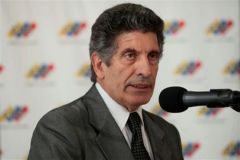 The head of the Unasur delegation sent to Venezuela to follow Sunday’s electoral process, Carlos Alvarez said that the country had given the world a lesson of democracy because of its extraordinary electoral system and the attitude of the opposition, among other positive elements.
“Venezuela has given the world a very important lesson because there were important sectors of the international community that had doubts or questioned the functioning of Venezuelan democracy”, said Alvarez during a press conference in Caracas.
On Sunday’s election, President Hugo Chavez won for the fourth consecutive time with a 54.84% support of ballots while the opposition leader Henrique Capriles managed 44.55% according to the official results from the Electoral Council having counted 95% of votes cast.
Alvarez admitted that many members of the international community “had doubts about how elections in Venezuela were won” and described as “ill-intended those who cast doubts over the functioning of the electoral system”, which he went on to describe as “excellent”.
“It’s an extraordinary lesson for the international community” and the fact that turnout was 80% is “a moving event” for a country were voting is not compulsory, and even more “if one looks back into history and remembers that only 25% to 30% of those registered use to vote”, underlined the former Argentine Vice-president and currently secretary general of the Latinamerican Integration Agency, Aladi.
“We have witnessed a process of excellence; the National Electoral council displayed an extraordinary job, parties and candidates admitted the results and we have accumulated a great experience for the creation of a South American Electoral Council”, said the head of the Unasur observers’ mission. “We came across a highly reliable electoral system and of technological excellence”.
Alvarez said that Unasur complied with all of its objectives and was present all over the Venezuelan territory, with forty delegates from ten different countries.
“It was a double challenge, we were one of the few organizations that came to follow the electoral process and at the same time the first such a mission was sent by Unasur. We are a technical mission, committed to transparency and the efficiency of the electoral systems of our countries”, pointed out Alvarez.
“I’m leaving on Wednesday after I present my report and I will with the satisfaction of the job accomplished, and the happiness of having been witness of the Venezuelan democratic festivity and of an historic event”, concluded Alvarez.
Related articles
- A Hall of Shame for Venezuelan Elections Coverage (alethonews.wordpress.com)
- Chavez Wins Venezuelan Presidential Election with 54% of the Vote (alethonews.wordpress.com)
A Hall of Shame for Venezuelan Elections Coverage
By Keane Bhatt | Manufacturing Contempt | October 8, 2012
Hugo Chávez, as a number of us expected, won the Venezuelan presidential election in yet another landslide yesterday: 55.1% to his opponent Henrique Capriles’s 44.2%.
To understand why Chávez’s electoral victory would be apparent beforehand, consider that from 1980 to 1998, Venezuela’s per capita GDP declined by 14%, whereas since 2004, after the Chávez administration gained control over the nation’s oil revenues, the country’s GDP growth per person has averaged 2.5% each year.
At the same time, income inequality was reduced to the lowest in Latin America, and a combination of widely shared growth and government programs cut poverty in half and reduced absolute poverty by 70%—and that’s before accounting for vastly expanded access to health, education, and housing.
However, the establishment media broadly anticipated that yesterday’s election would be a repudiation of the Chávez administration’s policies. Consider The Guardian headline, “Hugo Chávez: A Strongman’s Last Stand,” for example. To be sure, if Chávez were to win, the press explained, it could be chalked up to a climate of fear and repression or voter suppression. Even with a tight victory, his now-anemic support would still augur the beginning of the end to a failed, 14-year experiment.
Inconveniently for this narrative, over 19 million people in a country of 29 million were registered to vote, and any supposed intimidation did not prevent a historic turnout of 81%. With 96% of the votes counted, the country’s National Electoral Council has shown that Chávez has thus far received 1.5 million more votes than Capriles. And the electoral system’s credentials are sterling—Jimmy Carter, who received a Nobel Peace Prize for his democracy-promotion work with the Carter Center after his presidency, commended the record of Venezuela’s voting process a month before the elections:
Although some people have criticized the result—which is Hugo Chavez having won—there’s no doubt in our mind, having monitored very closely the election process, that he won fairly and squarely. As a matter of fact, of the 92 elections that we’ve monitored, I would say that the election process in Venezuela is the best in the world. They have a very wonderful voting system…
This, apparently, wasn’t as newsworthy as the inane question of whether Venezuela is a dictatorship. A LexisNexis search for all English-language news containing the terms “Jimmy Carter” and “Venezuela” between September 11, when Carter made those comments, and October 7, returned 45 results. In that same time period, 78 news items mentioning both the terms “Hugo Chavez” and “dictator” appeared. (To be fair, some of the 78 pieces refuted the notion that Chávez is a dictator, but even these articles are a reflection of the pervasiveness of the nonsensical topic.)
This contrast in the media’s priorities is symptomatic of the overwhelmingly disgraceful portrayal of Venezuela’s elections. The Hall of Shame that follows is a sampling of some of the most typical distortions, gratuitous slurs, and incorrect predictions that readers have been exposed to over the past few weeks:
• In a Saturday editorial, The Washington Post falsely attributed the question, “If Hugo Chavez is an autocrat, how could he be in danger of losing the Venezuelan presidency in an election on Sunday?” to economist Mark Weisbrot, “one of Mr. Chavez’s dwindling band of American supporters.” In fact, Weisbrot energetically argued, using statistical analysis of polling data, that there was virtually no chance that Chávez was in danger of losing. The editorial went on to compare Chávez to Putin and Ahmadinejad, incorrectly claiming that Chávez controls “most television channels.” In actuality, the BBC reported that “some 70% of Venezuela’s radio and TV stations are in private hands,” while “just under 5% are state-owned.” The Post misleadingly asserted that “many voters, too, are intimidated by high-tech polling machines that read their fingerprints; polls show that they suspect their votes will not be secret.” But whether these fears are well-founded was left unanswered. The editorial board ignored the Carter Center’s report on the technical features of Venezuela’s voting system, which concluded that “this concern has no basis…The software of the voting machines guarantees the secrecy of the vote.” Finally, the Post ended its editorial by conjuring up a menacing hypothetical scenario: “Venezuela’s neighbors, and the Obama administration, should be ready to react if [Chávez] attempts to remain in power by force.” Never mind that during the elections Chávez repeatedly said, “We will recognize the results, whatever they are,” and previously demonstrated this when, after losing a referendum vote in 2007, he publicly stated, “I congratulate my adversaries for this victory.”
• Jon Lee Anderson, writing for The New Yorker’s News Desk, erroneously declared that “Venezuela leads Latin America in homicides.” That distinction actually goes to Honduras, which leads the world in per capita homicides. But a mention of this would have been off message, as Honduras’s illegitimate post-coup regime receives $50 million a year in arms and training from the United States for its repressive security forces. And unlike in Venezuela, being an opposition activist in Honduras carries a significant chance of being disappeared or killed. Anderson continues by predicting that, irrespective of the election’s outcome, “this will probably represent the final eclipse of the long, heady reality show that his leadership has become.” Capriles “or someone else like him,” says Anderson, can “carry on with the task of making Venezuela a fairer and safer society.” His piece (originally titled, “The End of Chavez?,” but quietly revised to “Chavez The Survivor”) concludes with a quote from a journalist who ponders the prospect of a defeat for Chávez, while also using the term “autocrat” in reference to him—somehow, a ruler who by definition has absolute power can also be defeated in a competitive election. This is not the first time that Anderson has obscured the differences between democratically elected leaders and actual autocrats: he once lumped Haiti’s ousted president, Jean-Bertrand Aristide, with the country’s Duvalier dictators—in Anderson’s rendering, they were all “despots and cheats.”
Google result of Anderson’s title, now renamed “Chavez The Survivor”

• The New York Times, a day before the election, ran an op-ed with the instantly dated headline, “How Hugo Chávez Became Irrelevant.” Its author, Francisco Toro, offers a confused attempt to separate Latin America’s left into “radical revolutionary regimes”—Venezuela, Ecuador, Bolivia, Nicaragua and Cuba—and a “more moderate set of leaders”: Brazil, Uruguay, and Guatemala. In Toro’s account, apparently, Guatemalan President Otto Pérez Molina, a School of the Americas–trained special forces officer once in charge of counterinsurgency operations under military dictator Efraín Ríos Montt, is now one of the left-leaning Latin American leaders who do not turn “their backs on democratic institutions.” Toro also contends, without providing evidence, that “behind closed doors,” Brazilians “sneer” at Chávez. While it is impossible to refute such a claim, it is worth noting the effusiveness with which, at least publicly, former Brazilian president Lula Da Silva endorsed Chávez’s reelection bid in July. In a video statement, Da Silva said: “Chavez, count on me…Your victory will be ours… and thanks, comrade, for everything you have done for Latin America.”
• The Times also ran an October 5 news article by William Neuman, reporting that a young law student intended to vote for Chávez for fear that voting on a secret ballot for her preferred candidate, Capriles, would expose her to professional retribution. As the Center for Economic and Policy Research found, however, a quick search on Twitter showed that the law student had no qualms about publicly uploading a photo of herself kissing a poster of Capriles. (William Neuman might be remembered as the author of a Times piece on WikiLeaks founder Julian Assange, which bizarrely claimed that Assange “had refused to flush the toilet during his entire stay” at the Ecuadorian embassy in London. The sentence was later erased on the Times‘ website with no explanation.)
• And as a final example (even though there are countless more articles to criticize), one of the most glaring acts of journalistic misconduct within the mainstream press appeared in U.S. News & World Report. Other prominent media outlets have taken some small steps to veil their denunciations against Chávez. U.S. News & World Report was much more brazen: it published a news, not opinion, article by Seth Cline on October 1 that put Venezuela’s “fair and free elections” in quotation marks but offered no scare-quotes in its very first sentence, which introduces the reader to “President Hugo Chavez, the Venezuelan dictator.”
* Update (10-8):
Bloomberg Businessweek published a 994-word report by Charlie Devereux last evening on Bloomberg.com, following the election. Surprisingly, the piece included this paragraph:
Under Chavez, poverty fell to 31.6 percent at the end of 2011 from about 50 percent when he first took office, according to the national statistics institute. Extreme poverty declined to 8.5 percent from about 20 percent over the same period. Venezuela has the lowest level of inequality in Latin America and the Caribbean, according to the United Nations.
Today, however, a reworked 960-word article, now co-authored by Charlie Devereux and Alexander Cuadros, occupies the original hyperlink at Bloomberg.com. The segment above on poverty and inequality has been eliminated (although it can be still be found in a version republished on the website of the San Fransico Chronicle).
Keane Bhatt is an activist in Washington, D.C. He has worked in the United States and Latin America on a variety of campaigns related to community development and social justice. His analyses and opinions have appeared in a range of outlets, including NPR, The Nation, The St. Petersburg Times and CNN En Español. He is the author of the NACLA blog “Manufacturing Contempt,” which critically analyzes the U.S. press and its portrayal of the hemisphere. Follow his blog on Twitter @KeaneBhatt
Related articles
- Chavez Wins Venezuelan Presidential Election with 54% of the Vote (alethonews.wordpress.com)
Chavez Wins Venezuelan Presidential Election with 54% of the Vote
By Ewan Robertson | Venezuelanalysis | October 7th 2012
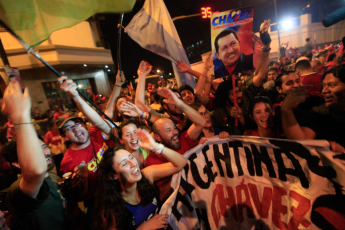
Mérida – Hugo Chavez has won the Venezuelan presidential election with 54.42% of the vote against 44.97% for opposition candidate Henrique Capriles Radonski. Chavez has made his victory speech, while Capriles has recognised his defeat.
The “first bulletin” results were announced by the president of the National Electoral Council (CNE), Tibisay Lucena, at around 10pm Venezuelan time, with 90% of the votes totaled, enough to give Chavez an irreversible victory.
The CNE president said, “Once again we’ve had a calm electoral process, without problems, with the joy of this people who decided to vote massively today”.
A spontaneous street party immediately kicked off in the centre of the Andean city of Merida, and a massive crowd of Chavez supporters began celebrating in front of the presidential palace, Miraflores, in Caracas.
“Venezuela will never return to neoliberalism and will continue in the transition to socialism of the 21st century,” Chavez declared to supporters from the “People’s Balcony” of the presidential palace, after his victory was confirmed.
“I want make a recognition to the whole Venezuelan people, the whole Venezuelan nation. Today the country of (Simon) Bolivar was reborn,” added the socialist president, while congratulating the country “for a civic and democratic day”.
The re-elected Venezuelan president also congratulated the Venezuelan opposition for recognising the CNE’s result, saying “they’ve recognised the truth, they’ve recognised the victory of the people”.
Meanwhile, Henrique Capriles, who was the candidate for the opposition Roundtable of Democratic Unity Coalition (MUD), recognised his defeat, stating to supporters “to know how to win, you need to know how to lose!”
He added, “We began the construction of a path and on it there are more than six million people who are looking for a better future…I’m convinced that this country can be better and I’m convinced that Venezuela is going to be better”.
Chavez received a total of 7,444,082 votes to 6,151,154 for his right-wing rival. He will govern for the 2013 – 2019 presidential term, his third constitutional term in office under the 1999 National Constitution.
Turnout was one the highest in Venezuela’s history, with 80.94% of the 19,119,809 registered voters in Venezuela participating in the election.
Venezuela Election Polls by “Respected” Consultores 21 Unreliable
By Erik Sperling | Venezuelanalysis | October 3rd 2012
With the Venezuelan presidential elections looming this Sunday, the U.S. press is dedicating increasing attention to the campaign between Hugo Chavez and opposition challenger Henrique Capriles. While nearly all polling companies, including the opposition-aligned Datanalisis, give double-digit leads for Chavez, many news organizations continue to give the impression that the race is a toss-up. Countless news agencies have focused heavily on polls conducted by Consultores 21, whose latest poll shows Capriles ahead 49.9 percent to 45.7 percent, to demonstrate that the contest is neck-and-neck.
Consultores 21 is “respected,” “reputable,” and “well-regarded,” according to the Wall Street Journal, ABC News, and Washington Post, respectively. Capriles himself has said “personally, I believe in Consultores. I’ve been looking at Consultores’ polls for many years.”
In a meeting with U.S. election monitors on Monday, influential opposition media figure Teodoro Petkoff said that Consultores is one of the only “serious” pollsters in Venezuela today (discounting Datanalisis as corrupt). It is entirely unclear how they come to this conclusion, however, as Consultores has an extremely poor record in previous Venezuelan electoral contests. For example: In the 2004 vote to recall Chavez mid-term, Consultores predicted a tie between those wanting Chavez to finish his term and those voting to recall. But the recall vote failed with Chavez garnering 60 percent of the vote.
In the 2006 presidential election between Chavez and opposition candidate Manuel Rosales, Consultores maintained that Chavez had just a 13% lead over his opponent. Chavez won that contest with a nearly 26 percent margin over Rosales (62.8% to 36.9%).
In the 2009 constitutional referendum to remove term limits for president, Consultores polls a month beforehand showed just 41.8 backing the referendum, with 56.20 opposed. The referendum passed with a 54 percent majority–almost a polar opposite result from the one predicted by Consultores.
Grave errors such as these by a polling company should have been more than enough to put them out of business. The continued existence of Consultores 21, despite their consistent lack of any semblance of accuracy, demonstrates its purpose as a mere campaign tool for opponents of Chavez. News organizations should be able to uncover and identify this type of blatant bias, and now must take steps to correct their misrepresentation of the status of the Venezuelan presidential election.
Related articles
- One Month before Venezuela’s Presidential Election Polls Show Huge Leads for Chávez (alethonews.wordpress.com)
- BofA Sees Chavez Re-Election Even as Lead in Polls Narrows – Bloomberg (bloomberg.com)
- Chavez Trails Rival Capriles for First Time in Poll (bloomberg.com)
- Chavez Rival Maintains Lead in August Consultores 21 Poll – Bloomberg (bloomberg.com)
Venezuelan Elections: a Choice and Not an Echo
By James Petras :: 10.04.2012
Introduction
On October 7th, Venezuelan voters will decide whether to support incumbent President Hugo Chavez or opposition candidate Henrique Capriles Radonski. The voters will choose between two polar opposite programs and social systems:
Chavez calls for the expansion of public ownership of the means of production and consumption, an increase in social spending for welfare programs, greater popular participation in local decision-making, an independent foreign policy based on greater Latin American integration, increases in progressive taxation, the defense of free public health and educational programs and the defense of public ownership of oil production. In contrast Capriles Radonski represents the parties and elite who support the privatization of public enterprises, oppose the existing public health and educational and social welfare programs and favor neo-liberal policies designed to subsidize and expand the role and control of foreign and local private capital. While Capriles Radonski claims to be in favor of what he dubs “the Brazilian model” of “free markets and social welfare”, his political and social backers, in the past and present, are strong advocates of free trade agreements with the US, restrictions on social spending and regressive taxation. Unlike the US, the Venezuelan voters have a choice and not an echo: two candidates representing distinct social classes, with divergent socio-political visions and international alignments. Chavez stands with Latin America, opposes US imperial intervention everywhere, is a staunch defender of self-determination and supporter of Latin American integration. Capriles Radonski is in favor of free trade agreements with the US, opposes regional integration, supports US intervention in the Middle East and is a diehard supporter of Israel. In the run-up to the elections, as was predictable the entire US mass media has been saturated with anti-Chavez and pro-Capriles propaganda, predicting a ‘victory’ or at least a close outcome for Washington’s protégé.
The media and pundit predictions and propaganda are based entirely on selective citation of dubious polls and campaign commentaries; and worst of all there is a total lack of any serious discussion of the historical legacy and structural features that form the essential framework for this historic election.
Historical Legacy
For nearly a quarter of a century prior to Chavez election in 1998, Venezuela’s economy and society was in a tailspin, rife with corruption, record inflation, declining growth, rising debt, crime, poverty and unemployment.
Mass protests in the late 1980’s early 1990’s led to the massacre of thousands of slum dwellers, a failed coup and mass disillusion with the dual bi-party political system. The petrol industry was privatized; oil wealth nurtured a business elite which shopped on ‘Fifth Avenue, invested in Miami condos, patronized private clinics for face-lifts and breast jobs, and sent their children to private elite schools to ensure inter-generational continuity of power and privilege. Venezuela was a bastion of US power projections toward the Caribbean, Central and South America. Venezuela was socially polarized but political power was monopolized by two or three parties who competed for the support of competing factions of the ruling elite and the US Embassy.
Economic pillage, social regression, political authoritarianism and corruption led to an electoral victory for Hugo Chavez in 1998 and a gradual change in public policy toward greater political accountability and institutional reforms which signaled a turn toward greater social equity.
The failed US backed military-business coup of April 2002 and the defeat of the oil executive lockout of December 2002 – February 2003 marked a decisive turning point in Venezuelan political and social history: the violent assault mobilized and radicalized millions of pro-democracy working class and slum dwellers, who in turn pressured Chavez “to turn left”. The defeat of the US-capitalist coup and lockout was the first of several popular victories which opened the door to vast social programs covering the housing, health, educational and food needs of millions of Venezuelans. The US and the Venezuelan elite suffered significant losses of strategic personnel in the military, trade union bureaucracy and oil industry as a result of their involvement in the illegal power grab.
Capriles was an active leader in the coup, heading a gang of thugs which assaulted the Cuban embassy, and an active collaborator in the petrol lockout which temporarily paralyzed the entire economy.
The coup and lockout were followed by a US funded referendum which attempted to impeach Chavez and was soundly trounced. The failures of the right strengthened the socialist tendencies in the government, weakened the elite opposition and sent the US in a mission to Colombia, ruled by narco-terrorist President Uribe, in search of a military ally to destabilize and overthrow the regime from outside. Border tensions increased, US bases multiplied to seven, and Colombian death squads crossed the border. But the entire Latin and Central American and Caribbean regions lined up against a US backed invasion out of principle, or because of fear of armed conflicts spilling beyond their borders.
This historical legacy of elite authoritarianism and Chavez successes is deeply embedded in the minds and consciousness of all Venezuelans preparing to vote in the election of October 7th. The legacy of profound elite hostility to democratic outcomes favoring popular majorities and mass defense of the ‘Socialist president’ is expressed in the profound political polarization of the electorate and the intense mutual dislike or ‘class hatred’ which percolates under the cover of the electoral campaign. For the masses the elections are about past abuses and contemporary advances, upward social mobility and material improvements in living standards; for the upper and affluent middle class there is intense resentment about a relative loss of power, privilege, prestige and private preferences. The right-wing elite’s relative losses have fueled a resentment with dangerous overtones for democracy in case of lost elections and revanchist policies if they win the elections.
Institutional Configuration
The right-wing elite may not control the government but they certainly are not without a strong institutional base of power. Eighty percent of the banking and finance sector is in private hands, as are most of the services manufacturing and a substantial proportion of retail and wholesale trade. Within the public bureaucracy, the National Guard and military the opposition has at least a minority actively or passively supportive of the rightwing political groups. The principle business, financial and landowners associations are the social nuclei of the right. The right-wing controls approximately one third of the mayors and governors and over forty percent of the national legislators. Major U.S. and EU petroleum multi-nationals have a substantial minority share in the oil sector.
The right-wing still monopolizes the print media and has a majority TV and radio audience despite government inroads. The government has gained influence via the nationalization of banks – a 20% share of that sector, a share of the mining and metal industry and a few food processing plants and a substantial base in agriculture via the agrarian reform beneficiaries.
The government has gained major influence among the public sector employees and workers in the oil industry, social services and the welfare and housing sector. The military and police appear to be strongly supportive and constitutionalist. The government has established mass media outlets and promoted a host of community based radio stations.
The majority of the trade unions and peasant associations back the government. But the real strength of the government is found in the quasi-institutional community based organizations rooted in the vast urban settlements linked to the ‘social missions’.
In terms of money power, the government draws on substantial oil earnings to finance popular long term and short term social impact programs, effectively countering the patronage programs of the private sector and the overt and clandestine “grass roots” funding by US foundations, NGOs and “aid” agencies. In other words despite suffering major political defeats and past decades of misrule and corruption, the right-wing retains powerful institutional bases to contest the powerful socio-economic advances of the Chavez government and to mount an aggressive electoral campaign.
Social Dynamics and the Presidential Campaign
The key to the success of the Chavez re-election is to keep the focus on socio-economic issues: the universal health and education programs, the vast public housing program underway, the state subsidized supermarkets, the improved public transport in densely populated areas. The sharper the national social polarization between the business elite and the masses, the less likely the right-wing can play on popular disaffection with corrupt and ineffective local officials. The greater the degree of social solidarity of wage, salaried and informal workers the less likely that the right can appeal to the status aspirations of the upwardly mobile workers and employees who have risen to middle class life styles, ironically during the Chavez induced prosperity.
The Chavez campaign plays to the promise of continued social prosperity, greater and continuing social mobility and opportunity, an appeal to a greater sense of social equality and fairness; and it has a bed rock 40% of the electorate ready to go to the barricades for the President. Capriles appeals to several contradictory groups: a solid core of 20% of the electorate, made up of the business, banking and especially agrarian elite and their employees, managers, and professionals who long for a return to the neo-liberal past, to a time when police, army and intelligence agencies kept the poor confined to their slums and the petrol treasury flowed into their coffers. The second group which Capriles appeals to are the professionals and the small business people who are fearful of the expansion of the public domain and the ‘socialist ideology’ and yet who have prospered via easy credits, increased clientele and public spending. The sons and daughters of affluent sectors of this class provide the “activists” who see in the downfall of the Chavez government an opportunity to regain power and prestige that they pretend to have had before the ‘revolt of the masses’. Capriles’ past open embrace of neo-liberalism and the military coup of 2002 and his close ties to the business elite, Washington and his right-wing counterparts in Colombia and Argentina assures the enraged middle class that his promise to retain Chavez social missions is pure electoral demagoguery for tactical electoral purposes.
The third group which Capriles does not have, but is vital if he is to make a respectable showing, is among the small towns, provincial lower middle class and urban poor. Here Capriles presents himself as a “progressive” supporter of Chavez social missions in order to attack the local administrators and officials for their inefficiencies and malfeasance and the lack of public security – Capriles, hyper-activity, his populist demagogy and his effort to exploit local discontent is effective in securing some lower class votes; but his upper class links and long history of aggressive support for right-wing authoritarianism has undermined any mass defection to his side.
Chavez on the other hand is highlighting his social accomplishments, a spectacular decade of high growth, the decline of inequalities (Venezuela has the lowest rate of inequalities in Latin America) and the high rates of popular satisfaction with governance. Chavez funding for social impact programs benefits from a year-long economic recovery from the world recession (5% growth for 2012), triple digit oil prices and a generally favorable regional political environment including a vast improvement in Colombian-Venezuelan relations.
The Correlation of Forces: International, Regional, National and Local
The Chavez government has benefited enormously from very favorable world prices for its main export-petroleum; it has also increased its revenues through timely expropriations and increases in royalty and tax payments, as well as new investment agreements from new foreign investors in the face of opposition from some US multinational corporations.
Washington, deeply involved in conflicts in oil rich Muslim countries, is in no position to organize any boycott against Venezuela one of its principle and reliable petrol providers; its last big effort at “regime change” in 2002-03, during the “lockout” by senior executives of the Venezuelan oil company backfired –it resulted in the firing of almost all US ‘assets’ and the radicalization of nationalist oil policy.
US efforts to ‘isolate’ the Chavez regime internationally have failed; Russia and China have increased their trade and investment, as have a dozen other European, Middle Eastern and Asian countries. The EU recession and the slowdown of the US and world economy has not been conducive to fostering any sympathy for any restrictions in economic ties with Venezuela.
Most significantly the rise of center-left regimes in Latin America, the Caribbean and Central America, has favored increasing diplomatic and economic ties with Venezuela and greater Latin American integration. In contrast Obama’s backing for the Honduran and Paraguayan coups and Washington-centered free trade agreements and neo-liberal policies have gone out of favor. In brief, the international and regional correlation of forces has been highly favorable to the Chavez government, while Washington’s dominant influence has waned.
One of the last Latin American bastions of US efforts to destabilize Chavez, Colombia, has sharply shifted policy toward Venezuela. With the change in regime from Uribe to Santos, Colombia has reached multi-billion dollar trade and investment agreements and joint diplomatic and military agreements with Venezuela, signaling a kind of ‘peaceful coexistence’. Despite a recent free trade agreement and the continuance of US military bases, Colombia has, at least in this conjuncture, ruled out joint participation in any US sponsored military or political intervention or destabilization campaign.
US political leverage in Venezuela is largely dependent on channeling financial resources and advisors toward its electoral clients. Given the decline in external regional allies, and given its loss of key assets in the Venezuelan military and among Colombian para-military forces, Washington has turned to its electoral clients. Via heavy financial flows it has successfully imposed the unification of all the disparate opposition groups, fashioned an ideology of moderate ‘centrist’ reform to camouflage the far right, neo-liberal ideology of the Capriles leadership and contracted hundreds of community agitators and ‘grass roots’ organizers to exploit the substantial gap between Chavez’s programatic promises and the incompetent and inefficient implementation of those policies by local officials.
The strategic weakness of the Chavez government is local, the incapacity of officials to keep the lights on and the water running. At the international, regional and national level the correlation of forces favors Chavez. Washington and Capriles try to compensate for Chavez regional strength by attacking his regional aid programs, claiming he is diverting resources abroad instead of tending to problems at home. Chavez has allocated enormous resources to social expenditures and infrastructure – the problem is not diversion abroad, it is mismanagement by local Chavista officials, many offspring of past clientele parties and personalities. The issue of rising crime and poor law enforcement would certainly cost Chavez more than a few lost votes if the same high crime rates were not also present in the state of Miranda where candidate Capriles has governed for the past four years
Electoral Outcome
Despite massive gains for the lower classes and solid support among the poor, the emerging middle class product of Chavez era prosperity, has rising expectations of greater consumption and less crime and insecurity; they look to distance themselves from the poor and to approach the affluent; their eyes look upward and not downward. The momentum of a dozen years in power is slowing, but mass fears of a neo-liberal reversion limits the possible electorate that Capriles can attract. Despite crime and official inefficiencies and corruption, the Chavez era has been a period extremely favorable for the lower class and sectors of business, commerce and finance. This year -2012- is no exception. According to the UN, Venezuela’s 5% growth rate exceeds that of Argentina (2%) Brazil (1.5%) and Mexico (4%). Private consumption has been the main driver of growth thanks to the growth of labor markets, increased credit and public investment. The vast majority of Venezuelans, including sectors of business will not vote against an incumbent government generating one of the fastest economic recoveries in the Hemisphere. Capriles’ radical rightist past and present covert agenda could provoke class conflict, political instability, economic decline and an unfavorable climate for international investors.
Washington is probably not in favor of a post-election coup or destabilization campaign if Capriles loses by a significant margin. The popularity of Chavez, the social welfare legislation and material gains and the dynamic growth this year ensures him of a victory margin of 10%. Chavez will receive 55% of the votes against Capriles 45%. Washington and their rightist clients are planning to consolidate their organization and prepare for the congressional elections in December. The idea is a “march through the institutions” to paralyze executive initiatives and frustrate Chavez’s efforts to move ahead with a socialized economy. The Achilles heel of the Chavez government is precisely at the local and state level: a high priority should be the replacement of incompetent and corrupt officials with efficient and democratically controlled local leaders who can implement Chavez’s immensely popular programs. And Chavez must devote greater attention to local politics and administration to match his foreign policy successes: the fact that the Right can turn out a half a million demonstraters in Caracas is not based on its ideological appeal to a ruinous, coup driven past, but in its success in exploiting chronic local grievances which have not been addressed – crime, corruption, blackouts and water shortages .
What is at stake in the October 2012 election is not only the welfare of the Venezuelan people but the future of Latin America’s integration and independence, and the prosperity of millions dependent on Venezuelan aid and solidarity.
A Chavez victory will provide a platform for rectification of a basically progressive social agenda and the continuation of an anti-imperialist foreign policy. A defeat will provide Obama or Romney with a trampoline to re-launch the reactionary neo-liberal and militarist policies of the pre-Chavez era – the infamous Clinton decade (of the 1990’s) of pillage, plunder, privatization and poverty.
Nicaragua approves LatAm oil refinery project
PressTVGlobalNews | September 25, 2012
The first of three phases of a mega project to build Central America’s largest oil refinery is well underway in Nicaragua. The $6 billion plus initiative was given the rubber stamp last week when it was authorized by the National Assembly.
Related articles
- Nicaragua negotiating satellite purchase with China (spacemart.com)
- Qatar backs investment in major Egypt refinery (kansascity.com)
Study: Venezuela’s Chavez 4th Most Popular President in the Americas
By Ewan Robertson | Venezuelanalysis | September 24th 2012
Mérida – Venezuelan President Hugo Chavez is the 4th most popular president in the Americas, according to a new study of presidential approval ratings in the region.
The study, by Mexican polling firm Consulta Mitofsky, gives President Chavez a “high” approval rating of 64%, gaining 6 percentage points since the firm’s last study and jumping up the table of presidential popularity levels.
The findings come less than two weeks before Chavez seeks re-election on October 7 against right-wing opponent Henrique Capriles Radonski.
According to the study, which measured the approval ratings of 20 leaders in the Americas by compiling public opinion polls from their respective countries, Ecuadorian president Rafael Correa is the most popular president in the Americas with an “outstanding” approval rating of 80%.
“Rafael Correa repeats his first place with 80% (a point less than his previous evaluation), maintaining the approval with which his presidency began almost five years ago,” the ‘Approval of Leaders: America and the World’ report stated.
He is followed by Maurico Funes of El Salvador and Guatemalan president Otto Perez, on 72% and 69% respectively.
Chavez and Correa are joined at the top of the popularity table by other presidents considered left or centre left, with Brazil’s Dilma Roussef on 5th with 62% approval, and Nicaraguan president Daniel Ortega on 7th place with a popularity of 59%.
Meanwhile, two months ahead of his re-election bid against Republican rival Mitt Romney, US President Barack Obama placed 10th in the study, receiving a “medium” approval rating of 49%. Canadian Prime Minister Stephen Harper was classed on a “very low” popularity of 37%, putting him down on 16th place.
The study highlights a north-south divide, with South American presidents enjoying an average approval of 50%, against 44% for leaders from the North of the hemisphere.
Many rightist presidents have dropped in popularity since the earlier 2012 study by Consulta Mitofsky, and find themselves on the bottom half of the table. Colombian president Juan Manual Santos still figures on the top half of the table with 54% approval, yet has dropped 13 percentage points and has lost his “high” approval rating.
Furthermore, Mexico’s Felipe Calderon placed 11th (46%), while Paraguayan President Federico Franco and Chilean President Sebastian Piñera share 17th place on 36%. Franco was came to power through an “institutional coup” in June by the Paraguayan Senate, and is less popular than deposed leftist president Fernando Lugo, who had 44% popularity in August 2011.
However, the findings aren’t all good news for South America’s “pink tide” governments, with 12th, 13th, and 14th places going to Argentina’s Cristina Fernandez (43%), Bolivia’s Evo Morales (41%) and Peru’s Ollanta Humala (40%) respectively.
The last places in the poll are occupied by the presidents of Honduras and Costa Rica, on approval ratings of 14% and 13%. The full study in Spanish can be accessed here.
Related articles
- Ecuador’s Correa and El Salvador’ Funes, leaders with the highest approval-rate (en.mercopress.com)
Venezuela Rejects Critical US Drugs Report
By Rachael Boothroyd | Venezuelanalysis | September 17th 2012
Caracas – The Venezuelan government has branded the Obama administration’s international policy as “abusive” after a drugs report issued by the White House on Friday stated that the Chavez administration had “failed” to adequately tackle the drugs trade.
The report, entitled the “Presidential Determination on Major Illicit Drug Transit or Major Illicit Drug Producing Countries”, places Venezuela on a list of countries, including Bolivia, which have not made sufficient progress in combating the international narcotics industry. The document also accuses Venezuela of having a “weak judicial system, inconsistent international counter-narcotics co-operation and generally permissive and corrupt environment”.
“Venezuela regrets that the United States government insists on undermining the field of bilateral relations with the publication of these kinds of documents,” said the country’s Foreign Minister, Nicolas Maduro on Saturday, who classified the report as “biased”.
The government also promptly issued a statement rejecting the document, describing it as “riddled with false statements” and confirming its own commitment to implementing a “sovereign and effective policy in the struggle against drugs trafficking”. The statement also places the blame for the continued strength of the drugs industry on the US, which it states has become “the world’s biggest market for drugs”.
“The U.S. government lacks the moral authority to judge the policies of other countries on the issue of the fight against drug trafficking… By tolerating the corruption that turns its borders into sites where illicit substances flow, and allowing money from drug trafficking to be laundered through its financial system, the U.S. government bears the most responsibility for this plague that wracks the whole world,” reads the statement.
The Venezuelan government’s criticism of the report was also echoed by Bolivian President, Evo Morales, who accused the US government of being hypocritical in its stance on the international drugs trade.
“There is no fight against the drugs trade in the United States, what there is is an attempt to take advantage of the fight against the drugs trade in some countries for their own [the US] political ends, so that there is more military funding and more military bases,” said Morales.
The Venezuelan government broke ties with the US Drug Enforcement Agency (DEA) in 2005 after DEA officials were accused of spying in the country. The government has continued to work with other international drugs monitoring bodies, such as those from France and Russia, and has stated that it has made more progress in the fight against drugs since DEA representatives were expelled.
In 2011 the government seized over 42 tonnes of drugs as part of its counter-narcotics operations and was ratified for the sixth year running as a territory free of illicit drug cultivation by the United Nations (UN).
Copy of the Venezuelan statement in full – http://venezuela-us.org/2012/09/15/venezuela-defends-its-effective-anti-drug-policies-after-false-accusations-by-u-s/
Related articles
- Bolivia, Venezuela Reject US Drug Criticism (informationliberation.com)
Featured Video
Macgregor: We Haven’t Seen the Worst of the Iran War Yet
or go to
Aletho News Archives – Video-Images
New Book
Breast Cancer: Before You Consent
A new Unbekoming paperback
Lies are Unbekoming | September 18, 2026
Peter Gøtzsche reviewed every randomised mammography screening trial ever conducted for the Cochrane Collaboration. Cochrane’s headline is that, assuming a 15% mortality reduction, one woman in 2000 avoids dying of breast cancer over ten years. Ten are overdiagnosed and treated. Two hundred experience false alarms.
But that headline assumes the reduction. When Gøtzsche looked only at the trials with adequate randomisation — the higher-quality ones — the reduction disappeared. No effect on breast cancer mortality. No effect on all-cause mortality.
This is the Cochrane finding, published in the establishment’s own database of systematic reviews.
No woman being asked to consent to a mammogram this week knows it.
That is why the new Unbekoming paperback exists. … continue
Blog Roll
 Aletho News
- US-Denmark Agreement on Greenland Is ‘PR Stunt’ Ahead of Midterms
- Araghchi: Military intervention cannot create security; coercion cannot bring peace
- Fraud Squared
- Breast Cancer: Before You Consent
- Iran’s Plan to Shut Down AI in the Persian Gulf
- Israel seeks ‘compensation’ from Washington over Saudi F-35 sale
- Saudi crown prince seeks dialogue with Ansarullah after Yemeni blows: Report
- Damascus rejects Saudi request for Syrian fighters to counter Yemen: Report
- South Korea says will not send troops to join terrorist US war on Iran
- Russia Just Struck the Eyes of NATO’s War Machine in Ukraine
- If Americans Knew
- Inside the siege, the ruined buildings of Gaza – Daily Update
- Debunking The Claim That Macklemore Has A “History Of Antisemitism”
- CPJ demands release of arrested Palestinian-US journalist near Bethlehem
- Robert Kraft: The Billionaire Friend of Netanyahu Pulling The Strings Behind the Macklemore/Ed Sheeran Blow Up
- Columbia Administered Fund Gives Big Money to Pro-Israel Groups
- Deportation Case of Palestinian Activist Salah Sarsour Tests First Amendment
- ‘We Will Not Forget’: Palestinians Mark 44 Years since Sabra and Shatila
- Why do we let Zionists decide what we can and can’t say?
- US welcomes Israeli, Iranian delegations to UN, but not Palestinians – Daily Update
- Biden’s Genocide Accomplices Targeted by New Accountability Campaign
- No Tricks Zone
- New Study: ‘Global Drought Shows No Detectable Recent Acceleration Under Climate Warming’
- Economic Masterminds: German Socialists Suggest Taxing Productivity Gains Stemming From Using AI
- The South China Sea Has Not Been Cooperating With The Climate Change Narrative
- Energy Crisis: Germany Enters Heating Season With Historically Low Gas Reserve Fill Levels
- New Study: The Antarctic Ice Sheet Gained Mass From 2020-2024 Due To Staggering Snow And Ice Accumulation
- Study: Ocean Heating Rates From Thousands Of Years Ago ‘Dwarf’ Modern Ocean Heating Rates
- Climate Extremists Target, Attack Large-Scale Power Grid Infrastructure In Germany!
- New Study: Antarctic Ice Melt Has Contributed Less Than 1 Centimeter To Sea Level Rise In The Last 30 Years
- Fear Of Debate: Alarmist German Climate Scientist Calls On Mainstream Media To Discredit Skeptic Voices
- End-Of-August Arctic Sea Ice Extent Hasn’t Fallen In 20 Years, Official Data Show!
 Aletho News