Israel’s all-seeing eye is the stealthiest cruelty of all in Gaza
Journalist Mohammed Mhawish describes how total surveillance is relentlessly controlling, often lethally, the violence is determined algorithmically.
By Connor Echols – Responsible Statecraft – December 16, 2025
Discussions of the war in Gaza tend to focus on what’s visible. The instinct is understandable: Over two years of brutal conflict, the Israel Defense Forces have all but destroyed the diminutive strip on the Mediterranean coast, with the scale of the carnage illustrated by images of emaciated children, shrapnel-ridden bodies, and flattened buildings.
But underlying all of this destruction is a hidden force — a carefully constructed infrastructure of Israeli surveillance that powers the war effort and keeps tabs on the smallest facets of Palestinians’ lives.
Few people understand this system more deeply than Mohammed Mhawish, a Palestinian journalist who fled Gaza in 2024 after being targeted by Israeli airstrikes for his reporting. In a recent essay for New York Magazine, Mhawish traced the contours of Israel’s surveillance system through the eyes of the Gazans who live through it every day.
RS spoke with Mhawish over email to get his insights about how this system of surveillance has powered the war in Gaza and created a culture of fear among Palestinians. The conversation also touches on Mhawish’s decision to leave Gaza — and how he knows that Israel tried to kill him for his journalism.
RS: In your piece, you mention a poll saying that “nearly two-thirds of Gazans believed they were constantly watched by the Israeli government.” How does this feeling of surveillance affect life in Gaza? How would you describe the feeling to those of us who have never experienced it?
Mhawish: In Gaza, surveillance actively structures daily life. It determines how people move, communicate, gather, and survive. Nearly everyone I spoke to understood themselves as data points inside a system that continuously observes, records, and evaluates them.
This awareness produces a constant state of constraint. Phones are treated with suspicion, even fear. People limit calls, change SIM cards, power down devices, avoid repeated routes, and hesitate before gathering with others. Parents instruct children not to linger in certain places. Journalists and medics described modifying their work because they knew patterns could be extracted and interpreted later. Surveillance works by narrowing the range of what feels safe for everyone there.
What distinguishes Gaza is that surveillance is both totalizing and opaque. People know they are being watched, but they don’t know how, by whom, or according to what criteria. There is no way to clarify a misunderstanding or correct a false assumption. The system does not explain itself. That uncertainty turns ordinary behavior into potential exposure.
For those who have never lived under it, they might need to imagine that every movement, call, or association could be logged and assigned meaning by an unseen authority, and that those judgments could lead directly to deadly consequences in real time. It is fear of being misclassified by a system that can not be challenged.
RS: Israeli officials often point to the fact that they withdrew from the Gaza Strip in 2006 as evidence of their benevolence. They argue Israel had essentially allowed Palestinians to have a territory that they could govern on their own, and Palestinians had wasted that chance by allowing Hamas to take power. How does your work complicate the narrative of Israeli disengagement from Gaza? What did surveillance look like before the war?
Mhawish: My reporting shows that Israeli “disengagement” from Gaza was never a withdrawal from control. It was merely a shift in how control was exercised. Physical presence was replaced with technological dominance.
Long before the current war, Gaza existed under constant aerial surveillance, communications interception, population registries, and data-driven monitoring. Israel controlled Gaza’s borders, airspace, coastline, electromagnetic spectrum, and civil registries. Movement in and out of the Strip, access to medical care, imports, and even family reunification were all mediated through Israeli databases informed by surveillance.
Surveillance allowed Israel to manage Gaza remotely and comprehensively. Intelligence sources and prior investigations describe systems that mapped neighborhoods, tracked social and familial networks, and analyzed behavioral patterns. Control did not require soldiers on every street, only access to required sensors, databases, and algorithms capable of rendering the population legible from afar.
This fundamentally undermines the idea that Gaza was ever allowed to govern itself. Governance without sovereignty is not autonomy. Surveillance ensured that Israel retained decisive authority over Gaza’s population while maintaining the fiction of withdrawal.
RS: Israel bombed your apartment in late 2023, destroying your home and injuring you and your family. What led you to conclude that this attack was a response to your journalistic work? Did other press colleagues have similar experiences?
Mhawish: The bombing of my apartment was a direct result of my reporting.
In the weeks leading up to the strike, I received multiple threats from the Israeli military in response to my journalistic work. These included direct communications warning me about my reporting. Eventually, I received a phone call informing me that my house would be bombed. Shortly afterward, it was.
My apartment was civilian. There was no military activity there. My family was inside. The strike destroyed our home and injured my family members.
What made this experience even more unmistakable was how common it was among Palestinian journalists. Colleagues told me a similar sequence: reporting, threats, warning calls, and then strikes on their homes rather than on them in the field. These attacks often targeted family residences, maximizing harm while sending a clear message.
This is part of a systematic effort to intimidate journalists by demonstrating that reporting carries consequences not only for them, but for their family. It collapses the distinction between professional risk and private life and makes journalism itself a punishable act.
RS: What do we know about the role of American companies in this surveillance regime?
Mhawish: American technology companies are not peripheral to Israel’s surveillance architecture. Israeli military and intelligence units rely on U.S.-based cloud infrastructure, data storage, data processing, and AI-related technologies to collect, analyze, and retain vast amounts of information on Palestinians.
This relationship is reinforced by the movement of personnel between Israeli intelligence units and major tech firms, creating a feedback loop in which military expertise informs commercial products and commercial tools enable military surveillance. While companies often claim neutrality, their technologies are embedded in systems that monitor, categorize, and target a civilian population under occupation.
Gaza demonstrates how commercial technologies developed for efficiency, scale, and optimization can be repurposed for population-level surveillance and warfare. The issue is [companies] are not willing to accept responsibility when their tools become foundational to systems of domination.
RS: How could this surveillance regime be used for the proposed system of only allowing “vetted” Palestinians to live in rebuilt communities on the Israeli-occupied side of the yellow line in Gaza?
Mhawish: The proposed vetting system is only possible because the surveillance infrastructure already exists. Israel has spent years building databases capable of assigning suspicion and risk scores to individuals based on opaque criteria derived from communications data, movement patterns, and social networks.
Applied to reconstruction, this system could determine who is allowed to return, who receives travel permits, who is denied treatment outside, and who is permanently excluded. Vetting does not follow a transparent legal process, because it’s based on an algorithmic judgment rendered without explanation or appeal.
This kind of system enables displacement without explicit expulsion. People would be filtered out quietly — through denied access, stalled applications, or unexplained rejections — while the underlying logic remains hidden. Surveillance becomes a mechanism for shaping the postwar population under the language of security.
In that sense, Israel’s surveillance of Palestinians in Gaza is about controlling who is allowed to exist, where, and under what conditions afterward.
Connor Echols is a reporter for Responsible Statecraft. He was previously the managing editor of the NonZero Newsletter.
The lobby is milking the Bondi Beach attack to silence critics of Israel’s genocide
By Jonathan Cook | December 15, 2025
I, for one, am struggling to stomach the spew of hypocrisy from pro-Israel groups like the Community Security Trust and its policy director, Dave Rich, in the wake of Sunday’s Bondi Beach attack.
Establishment media, on the other hand, appear to have a bottomless appetite for efforts by Israel apologists to exploit the genuine fear and grief of the Jewish community to advance a political agenda – one designed to silence criticism of Israel over its two-year slaughter and maiming of Palestinian children in Gaza.
Predictably, the supposedly liberal Guardian once again gave Rich a prominent slot in its comment pages, this time to spin the attack in Sydney into a demand for silencing opposition to Israel’s genocide.
Here are extracts from Rich’s piece in italics, followed by my observations. His all-too-obvious double standards and his glaring misdirection ploys should have disqualified this piece from publication. But the British media simply can’t get enough of this kind of bilge.

Rich: “The mobile phone footage of two gunmen calmly taking aim at families enjoying a Hanukah party is utterly chilling. It takes a special kind of dehumanisation, an ideology of pure hatred and self-righteous conviction, to do that.”
If Rich is so troubled by issues of dehumanisation, why has he remained so steadfastly mute about the long and utterly chilling dehumanisation of Palestinians by Israel and by its lobby groups, including his own organisation? Remember, Israeli leaders called the Palestinians “human animals”. It is decades of that kind of dehumanisation that laid the ground for Israel’s genocide. It is precisely because of such dehumanisation that the live-streamed horrors of the past two years made barely any impact on the Israeli public or on opinion among Israel’s supporters.
The truth is it is Rich and his fellow pro-Israel lobbyists who are the ones in the grip of an “ideology of pure hatred” – one that chooses to excuse the mass murder of children when they are Palestinian, blown to pieces and starved for months on end by the very state he identifies with.
Rich: “The whole basis of western liberal democracy, the belief in shared values within a diverse society, is endangered by these attacks.”
No, it’s not the Bondi Beach attack that has endangered “western liberal democracy”. That was irreversibly hollowed out when western leaders chose to actively collude in Israel’s genocide and defy the rulings of the world’s most respected legal institutions, the International Court of Justice and the International Criminal Court. Western liberal democracy was hollowed out when these leaders chose to side with Israeli prime minister Benjamin Netanyahu and prioritise his exterminationist agenda over the rule of law.
Rich: “Some people react as if this terrorism is akin to a natural disaster or unforeseen tragedy: blind hatred with no cause or purpose, and therefore no deeper explanation needed. But terrorism does not emerge from a vacuum. It is merely the most violent, lethal expression of a set of attitudes and beliefs that are much more widely held than just by those who wield the gun or the knife.”
How true! Terrorism does not occur in a vacuum. Rather, it is the weapon of the weak, and it feeds off a festering hatred that derives from having one’s community abused and a parallel, suffocating feeling of powerlessness to stop it. That doesn’t justify the Bondi Beach attack, but it does provide us with the “deeper explanation” Rich claims to be searching for.
But even before we read on, we know where he wants to take this.
Rich: “When it comes to antisemitic terror, the ideas that some take as justification for murder are popularised and normalised through the language of much of the anti-Israel movement that has marched up and down our city streets and through our university campuses these past two years.”
And sure enough, there it is. The “antisemites”, according to Rich and the rest of the pro-Israel lobby, are British families marching though their towns and cities to protest a genocide in which the British govermment is actively colluding. They are the criminals, not Israel’s genocide machine.
The “antisemites”, Rich wants you to believe, are those incensed by witnessing Israel slaughter children day after day for more than two years; those incensed at seeing Israel bomb the hospitals needed to treat those children; those incensed at hearing Israel and its supporters deny what we have all seen happening with our own eyes; and those incensed that our governments have not only failed to stop this horror show but have actively demonised their own populations for highlighting their complicity in these crimes.
Rich: “After rapper Bobby Vylan, one half of the group Bob Vylan, chanted “Death, death to the IDF” during a set at the Glastonbury festival in June, it became the rallying cry of anti-Israel protesters everywhere. It got Bob Vylan invited to the Irish parliament and Bobby Vylan on to Louis Theroux’s podcast. Far from a call for death putting the rapper beyond the pale, it made him a celebrity.”
It takes extraordinary chutzpah to exploit the blood spilled in Sydney by special pleading for an Israeli army that is recognised by all major human rights groups, the United Nations, the International Association of Genocide Scholars, and the International Criminal Court to have been routinely committing crimes against humanity in Gaza over the past two years.
If Dave Rich and the Community Security Trust are really so concerned about the dangers faced by Jews because of the many documented, and unpunished, crimes committed by the Israeli army, then maybe he should dedicate a little space to distancing himself and his organisation from that military rather than denying its criminality at every opportunity.
Rich: “Is there a connection between this embrace of a call for death in the name of Palestinian rights, and people inflicting actual death apparently in the name of the same cause? As soon as you ask the question, the answer seems obvious.”
Both sides can play this game. Is there a connection between the embrace of calls for genocide in the name of Jewish supremacy, and Israeli soldiers inflicting actual death in the name of that cause? Remember Israel’s head of the military said he would deny the people of Gaza food, water and fuel, supposedly in “self-defence”, and that’s exactly what Israel did. Remember Netanyahu himself described the people of Gaza as “Amalek”, a people condemned to genocide by God, and genocide is exactly what Israel did.
Indeed, as soon as you ask the question, the answer seems obvious. But in the case of Gaza, the death toll is many thousands of times greater than anything inflicted by two twisted gunmen in Sydney.
Rich: “The devastation in Gaza is real and lots of people involved in pro-Palestinian activism do not support antisemitic violence against Jews, whether in Britain or Australia. But like it or not, it seems this movement has generated and sustained a political culture in which violence is both conceivable and enacted.”
Even were this true, it cannot compare to the political culture generated by Rich and his pro-Israel lobbyists. That political culture has not only made violence against Palestinians conceivable but a daily reality for them decade after decade. It is years of dedicated work by the Israel lobby that has ensured the mass murder of Palestinians is viewed by governments, the media and parts of the Jewish community as entirely legitimate.
Rich: “This is now a global emergency of antisemitism, and it is the consequence of two years of turning a blind eye, taking the easy path and ignoring the warnings. Make no mistake: alongside the grief and the defiance, Jews are angry. And they have every right to be.”
No, that is not the global emergency. The real emergency is a rampant anti-Palestinian racism that has utterly normalised genocide and been given institutional support across the West. It is anti-Palestinian racism, not “antisemitism”, that is the consequence of “two years of turning a blind eye, taking the easy path and ignoring the warnings”. Make no mistake: alongside the grief and the defiance, people with a conscience are angry at the two-year genocide endorsed by our governments. And they have every right to be.
Villains of Judea: Ronald Lauder and his War on American Dissent
For Lauder, Israel always comes first.
José Niño Unfiltered | December 16, 2025
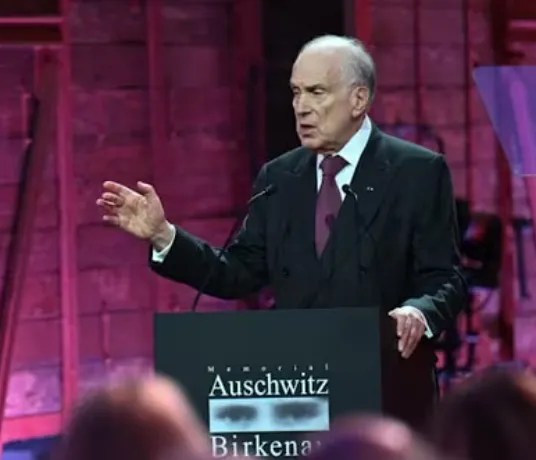
World Jewish Congress President Ronald Lauder likes to present himself as a civic minded elder statesman, a sober billionaire warning America about a rising tide of antisemitism.
At the Israel Hayom Summit on December 2, 2025, he framed the moment as a crisis of the West itself, calling it “a full-scale assault on truth, on democracy, and on the safety of Jewish people everywhere,” and insisting, “This is not normal. And it is not ‘just criticism of Israel.’ It is the world’s oldest hatred, once again wearing political clothing.”
Lauder was referring to the rise of antisemitism and anti-Israel sentiment worldwide in the wake of Israel’s 2-year bombing campaign in Gaza.
Then he sharpened the spear and aimed it at domestic enemies like Tucker Carlson, who has been one of the most vocal critics of Israel in the post-October 7 reality we live in. He told the audience, “Tucker Carlson is the Father Coughlin of our generation.” In the same speech he warned that complacency is over, because “antisemitism is rampant throughout our culture,” and he demanded a political and institutional counteroffensive.
That is the Lauder formula in its purest form. He wraps a totalizing political program in the language of safety and moral emergency, then treats America’s public life as territory to be reorganized around his crusade. The target is never merely hatred. The target is dissent, drift, and disobedience from the priorities he has chosen, priorities that consistently put Israel first.
Lauder did not arrive at this posture late in life. He was born into power in New York City in 1944, the heir to the Estée Lauder fortune, raised in elite institutions, and trained for international influence through business and foreign policy studies. He entered the family company early, then moved into government in the Reagan era, where he served at the Pentagon as Deputy Assistant Secretary of Defense for European and NATO policy.
Ronald Reagan then tapped him as U.S. ambassador to Austria in 1986. In Vienna, he did not behave like a neutral American emissary. He turned his diplomatic post into a stage for historical confrontation and political signaling. Lauder refused to attend the inauguration of Austria’s president Kurt Waldheim amid allegations of him being involved in or being aware of National Socialist atrocities in the Balkans during his service as a German army lieutenant in World War II. He also fired U.S. diplomat Felix Bloch for engaging in suspected espionage activities.
After government service, Lauder tried to convert his vast wealth into formal power at home. In 1989, he ran for mayor of New York City as a Republican, where he spent big bucks to get his name out and campaign to the right of Rudy Giuliani, only to lose the primary. Even in defeat, the pattern held. He treated politics as an arena where money does all the talking, and he kept looking for levers that could bend public life to his will.
He found one in term limits. During the 1990s he poured resources into imposing term limits on New York City officials, selling it as a democratic reform and a check on machine party politics. Yet in 2008, when Mayor Michael Bloomberg wanted a third term, Lauder reversed course and supported extending those limits, a turn that mainstream critics interpreted as a billionaire bargain dressed up as civic necessity. However, from the perspective of long-time observers of Jewish behavior, Lauder’s support for Bloomberg reflects a pattern of co-ethnic solidarity among Jewish power brokers.
While Lauder played these games in New York, his real career was consolidating leadership in the organized Jewish political world. Notably, Lauder was a member of the Mega Group—a mysterious network of Jewish oligarchs that worked behind the scenes to advance Jewish interests and strengthen pro-Israel bonds among Jews in America. Leslie Wexner, founder of The Limited and Victoria’s Secret, and the late Jewish sex criminal Jeffrey Epstein were among the most prominent members of this Jewish consortium. By 2007, Lauder had become president of the World Jewish Congress, a position that turned him into a roaming power broker who meets heads of state and treats international politics as a permanent lobbying campaign.
From that perch, he repeatedly framed Western security architecture as a vehicle for Israeli priorities. In 2011, he publicly argued that Israel should be admitted into NATO, insisting, “Israel needs real guarantees for its security,” and pressing NATO states to bring Israel into the alliance.
In 2012, he attacked European pressure campaigns on Israel with maximalist rhetoric. When Irish officials floated an EU ban on goods from Israeli communities in the West Bank, Lauder called boycott talk “cynical and hypocritical,” and declared, “Minister Gilmore is taking aim at the only liberal democracy in the Middle East while keeping quiet about those who really wreak havoc in the region: the Assads, Ahmadinejads and their allies Hezbollah and Hamas.” He added that the West Bank was “legally disputed and not illegally occupied.”
He carried the same posture with respect to Iran — enemy #1 for world Jewry at the moment. In 2013, as Western diplomats negotiated with Tehran, he mocked their perceived softness and conjured Munich analogies, warning, “Just as the West gave up Czechoslovakia to Hitler in Munich in 1938, we see what is happening again and the world is silent,” and boasting, “Frankly, only France stands between us and a nuclear Iran.” In 2015, he escalated again, attacking the nuclear deal with a moral curse, saying, “The road to hell is often paved with good intentions,” and arguing that the agreement could revive Iran economically without stopping long term nuclear ambitions.
The story kept darkening as his proximity to Israeli power deepened. In 2016, Israeli police questioned Lauder in connection with “Case 1000,” the Netanyahu gifts affair. Reports said investigators sought his testimony because of his closeness to Netanyahu and the broader allegations involving luxury gifts and favors. Lauder was not charged, but the episode revealed how near he operated to Israel’s governing circle, not as an outside friend, but as part of the broader, transnational Jewish network.
By 2023, he openly wielded donor money as a disciplinary weapon in American institutions. After the October 7 attacks and campus controversies, he warned the University of Pennsylvania that, “You are forcing me to reexamine my financial support absent satisfactory measures to address antisemitism.” The message was simple. If a prestigious American university fails to police speech and activism the way he demands, he will squeeze it financially until it complies.
In 2025, Lauder continued supporting Israel’s ethnic cleansing campaign in Gaza. He categorically rejected the idea that Israel bears any responsibility for ending the conflict, insisting, “The truth is simple: the war could end tomorrow if Hamas were to release the remaining hostages and disarm.” On education and propaganda, he stopped pretending the solution is persuasion alone. At the World Jewish Congress gala in November 2025, he argued that the education pipeline must be rebuilt from the ground up, declaring, “The entire education system — K-12 to college — must be retaught,” and adding, “It’s time we fight back with stronger PR to tell the truth.”
He also made the threat explicit. In a widely shared clip, he vowed, “Any candidate running for a seat… whose platform includes antisemitism, we will target them as they target us.”
Like most of the Israel First set, Lauder was ecstatic about the toppling of Bashar al-Assad’s government in Syria in late 2024. In September 2025, he met former al-Qaeda terrorist-turned Syrian President Ahmad al-Sharaa on the sidelines of the United Nations General Assembly and afterward said, “We had a very positive discussion about normalization between Israel and Syria.”
Seen in order, the picture is not complicated. Lauder builds influence through money, embeds himself in elite institutions, and uses both to steer policy and culture toward a relentless Zionist agenda. He does not talk like a man defending American sovereignty. He talks like an agent of world Jewry who expects America’s parties, schools, media, and alliances to function as enforcement arms for a foreign cause.
That is why his December 2025 sermon about antisemitism matters. It is not only a warning. It is a blueprint. When Lauder says “If we don’t tell our own story, others will rewrite it,” he is not describing a cultural debate. He is declaring ownership over the narrative, and claiming the right to punish anyone in American life who refuses to repeat it.
In the end, Ronald Lauder emerges not as a guardian of American civic life but as a disciplined enforcer of a foreign political creed, using wealth, intimidation, and moral blackmail to bend institutions to his will. What he calls a fight against hatred looks increasingly like a campaign to subordinate American sovereignty, speech, and policy to the imperatives of Israel and the transnational Jewish clique that sustains it.
Stop The Hate UK: The Shadowy Israel-Aligned Group Targeting MintPress staff & anti-genocide organizers
Mint Press News | December 9, 2025
In October, MintPress graphic designer and field photographer, Ibrahim Abul-Essad opened his door to find Patrick Sawer of The Daily Telegraph demanding answers.
A prolific writer who has penned 28 pro-Israel articles in the past two months alone, Sawer asked the British Palestinian journalist to respond to pro-Israel pressure group Stop The Hate U.K.’s campaign for him to be prosecuted for “anti-Semitic hate crimes.”
Abul-Essad’s “crime” was attending an October 2024 demonstration in London protesting an event featuring former Israeli prime minister Ehud Olmert speaking on the future of Gaza – a case that the Metropolitan Police have already looked into and dismissed.
Sawer has previous connections to Stop The Hate U.K. A 2024 Daily Telegraph article framing pro-Palestine marchers as racists, for instance, appears to have been based largely on intelligence gathered by Stop The Hate U.K., and features multiple images of protestors taken without their knowledge.
But who are Stop The Hate U.K.? And where did they come from? MintPress News explores the group’s rise, its agenda, and its scandalously close links to both the British and Israeli governments.
Israeli Front Group?
Stop the Hate U.K. was founded in early 2024, at the height of the Israeli attack on Gaza, in order to stymie and oppose the growing wave of support for Palestinian liberation across Great Britain. The group has attempted to equate support for human rights with terrorism.
As their official Twitter bio reads, “We stand in opposition to the hate marches that have swamped our country since the 7.10 massacre. We shall not be cowed. Terrorist supporters off our streets!” The organization has repeatedly pressured the British government to ban demonstrations, and condemned the police for their insufficient vigor in suppressing the movement.
Although it states that it is a non-profit organization, MintPress could find no registration of the group with the Charity Commission for England and Wales.
The organization’s website describes it was founded “in response to the repeated failures of the Metropolitan Police to address anti-Semitic incidents at Palestinian Solidarity Campaign (PSC) marches.”
This will be news to many in the U.K., where police have arrested over 2300 people under the Terrorism Act of 2000 for peacefully opposing the designation of activist group Palestine Action as a terrorist entity, putting it on a par with the likes of ISIS and Jabhat al-Nusra. So aggressive has British authorities’ repression of free speech been, that it was officially rebuked by Amnesty International as a grave breach of human rights.
Stop the Hate U.K. organizes their own demonstrations. However, they have not been successful in attracting mass participation. Unlike pro-Palestine marches that can draw in as many as one million Britons, an image posted by Stop The Hate U.K. of their recent protest in Brighton shows fewer than 40 attendees. They have, however, had more success disrupting solidarity events, filming or harassing protestors and pushing for their prosecution. In this role, The Canary notes, they serve as unofficial “police informants.” Stop The Hate organization also sells merchandise from their website; among the most popular items are t-shirts and hoodies emblazoned with the word “Zionist” in all caps.
While trying to expose the identities of pro-Palestine marchers, Stop The Hate U.K. appears to try to keep their own a secret. There is no information about their key members on their own website, only multiple egregious typos. For example, their “About Us” section offers little about their background, except that their organization is “is a call to action for a world without racism or anti-Semitism. Every voice counts in rejecting intolerance and fostering understandinWho We Are” (sic).
Nevertheless, pro-Israel outlet Jewish News identified two Israelis, Itai Galmudy and Yochy Davis, as among the founders. Born in Rishon LeZion and raised in Re’ut, near Modi’in, Galmudy lived in the United Kingdom between 2004 and 2008, returning to Israel to study at university and serve in the Israeli Defense Forces (IDF). He participated in Operation Protective Edge, Israel’s 2014 bombardment of Gaza, wherein the IDF is widely accused of carrying out serious war crimes, including deliberately targeting civilians. Images from Galmudy’s social media show him proudly in uniform, serving in what appears to be a tank brigade.
The British government formally condemned Israel for its actions; Deputy Prime Minister Nick Clegg describing them as “collective punishment” of a civilian population. Despite this, Galmudy himself was able to move back to London immediately after Operation Protective Edge, and works in the pub industry, where he proudly notes that he refuses to serve anyone wearing Palestinian clothing.
In 2024, he co-founded Stop The Hate U.K., a group that has gained plaudits from the Israeli government itself. Earlier this year, Ambassador Tzipi Hotovely recorded a video wishing Galmudy a special happy birthday, stating that: “Your great activity for the last 12 months means so much to the State of Israel.”
“It is concerning that a former Israeli soldier who represented a military which is being investigated for genocide responsible for killing 150 members of my family is part of an organization targeting me and other British citizens in the U.K. calling for a free Palestine,” Abul-Essad told MintPress.
Like Galmudy, Yochy Davis is from Israel; her Facebook profile identifying her as from Kiryat Motzkin, near Haifa. Describing herself as a “passionate” adherent of Zionism, Davis first came to public attention in 2023, when she and three other pro-Israel activists disrupted Roger Waters’ London show. The rock star is a high-profile supporter of progressive causes, including Palestinian statehood. Davis shouted at Waters, unfurling an Israeli flag and calling his views “disgusting.” The incident was well-covered in the British press, who appeared keen to undermine Waters’ message.
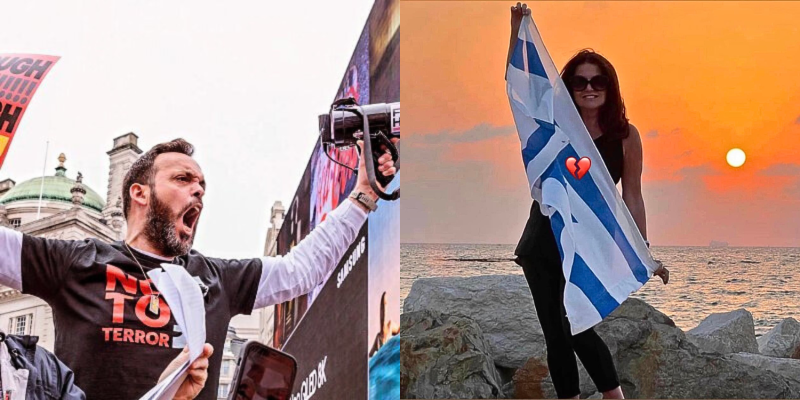
Yochy Davis, left, and Itai Galmudy | Photos from X and Facebook
Davis has long promoted Israeli causes. In 2019, for instance, she worked with Israeli organization, My Truth, to bring a squad of IDF soldiers to Britain to visit the Houses of Parliament and carry out a series of “educational” lectures promoting Israel and its military as benevolent forces.
Israeli charity website, Israel Gives, describes My Truth as “an educational organization that is comprised of Israeli Defense Force reservists that educate about the IDF operations and the moral standards it holds,” adding that:
’My Truth’ reservists speak up openly and with a firsthand perspective about their army experiences in response to those who attempt to slander Israeli soldiers in the name of so-called ‘full disclosure.’”
And like Galmudy again, Davis’ activism has earned her official praise from Israeli government officials. In 2019, former Shin Bet official and then-Minister of Justice, Amir Ohana, recorded a video expressing his deep gratitude, stating:
I want to tell Yochy Davis and the My Truth organization: thank you for providing justice. Thank you for providing truth to the world, and thank you for everything you are doing for the State of Israel and for the people of Israel. Thank you.”
Davis recently met with Israeli president, Isaac Herzog, and both she and Galmudy attended an official event at the Israeli Embassy in London last month. Earlier this year, the pair also traveled to Israel and the Golan Heights – Syrian territory illegally occupied by Israel – where they liaised with and took photos with IDF soldiers.
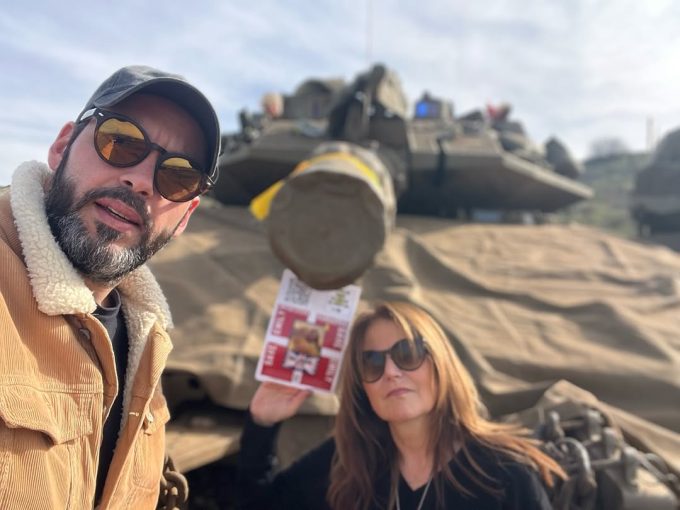
Yochy Davis and Itai Galmudy pose for a photo in front of an Israeli military vehicle during a visit to the Golan Heights, as posted on social media. (Instagram)
Stop The Plagiarism
The choice to name a pro-Israel advocacy group “Stop The Hate U.K.” clearly attempts to equate support for Palestine and opposition to genocide with anti-Semitism. Yet it has also caused significant confusion, as a well-known and respected charity, “Stop Hate U.K.” (SHUK) already exists.
SHUK was established in the wake of the Stephen Lawrence affair. Stephen Lawrence was a Black British teenager murdered in London in a racially motivated killing in 1993. The attack, and the subsequent inadequate response from the Metropolitan Police, made Lawrence a cause célèbre, the George Floyd of his day. An official inquiry found that the police force was “institutionally racist” and needed to be radically reformed. Since 1995, SHUK has carried out vital work challenging hatred and intolerance. Lawrence’s mother serves as its patron.
Pro-Israel group Stop The Hate U.K. is frequently misidentified as the more legitimate body, including in Sawer’s aforementioned Daily Telegraph article, where it attributes the intelligence provided to SHUK. It is eminently possible that this sort of confusion was deliberate, and Stop The Hate U.K. is trying to bask in the legitimacy of an established anti-racist charity. MintPress contacted SHUK for this investigation, but did not receive a response.
Gaza and the rise of Stop The Hate U.K. provokes a number of important questions. How is it that a pro-Israel pressure group, co-founded by two Israeli citizens, can have such an outsized effect on British public life? How can a former member of an army carrying out a massacre put such successful pressure on U.K. authorities to arrest journalists exposing the IDF’s crimes? And who gets to decide who and who is not a terrorist: British citizens or pressure groups allied to a foreign nation carrying out a genocide?
The Folly of Establishing a U.S. Military Base in Damascus
By José Niño | The Libertarian Institute | December 16, 2025
Recent reports indicate the United States is preparing to establish a military presence at an airbase in Damascus, allegedly to facilitate a security agreement between Syria and Israel. This development represents yet another misguided expansion of American military overreach in a region where Washington has already caused tremendous damage through decades of failed interventionist policies.
The United States currently operates approximately 750 to 877 military installations across roughly eighty countries worldwide. This staggering number represents about 70 to 85% of all foreign military bases globally. To put this in perspective, the next eighteen countries with foreign bases combined maintain only 370 installations total. Russia has just twenty-nine foreign bases, and China operates merely six. The American empire of bases already dwarfs every other nation combined, and the financial burden is crushing. Washington spends approximately $65 billion annually just to build and maintain these overseas installations, with total spending on foreign bases and personnel reaching over $94 billion per year.
These figures are not abstract accounting entries. They translate directly into American lives placed in volatile environments, as demonstrated by the recent insider attack in the ancient Syrian city of Palmyra, where a purported ISIS infiltrator embedded in local security forces turned his weapon on a joint U.S. Syrian patrol, killing two U.S. soldiers and one U.S. civilian during what was described as a routine field tour. The incident underscores how the sprawling U.S. basing network increasingly exposes American personnel to unpredictable and lethal blowback in unstable theaters far from home.
Syria itself already hosts between 1,500 and 2,000 American troops, primarily concentrated in the northeastern Hasakah province and at the Al Tanf base in the Syrian Desert. The Pentagon recently announced plans to reduce this presence to fewer than 1,000 personnel and consolidated operations from eight installations to just three. Yet now, despite this supposed drawdown, Washington reportedly plans to establish a new presence in Damascus itself, either at Mezzeh Air Base or Al Seen Military Airport. This contradictory expansion reveals the hollow nature of promises to reduce American military commitments abroad.
Since the fall of Bashar al Assad in December 2024, Israel has conducted hundreds of airstrikes on Syrian military and civilian infrastructure while occupying parts of southern Syria including Quneitra and Daraa. Israel has systematically violated the 1974 disengagement agreement and expanded control over buffer zones. These actions align disturbingly well with the Yinon Plan, a 1982 Israeli strategic document by Israeli foreign policy official Oded Yinon that envisions the dissolution of surrounding Arab states into smaller ethnic and religious entities. The plan explicitly calls for fragmenting Syria along its ethnic and religious lines to prevent a strong centralized government that could challenge Israeli interests.
A permanent American military presence in Damascus would effectively serve as a tripwire guaranteeing continued U.S. involvement in securing Israeli strategic objectives in the Levant. Rather than protecting American interests or enhancing national security, such a base would entrench Washington deeper into regional conflicts that have consistently proven disastrous for both American taxpayers and Middle Eastern populations.
The human cost of American intervention in Syria should give any policymaker pause. The Syrian Civil War has resulted in between 617,000 and 656,000 deaths, including civilians, rebels, and government forces. More than 7.4 million people remain internally displaced within Syria, while approximately 6.3 million Syrian refugees live abroad. This catastrophic toll stems partly from Operation Timber Sycamore, the CIA covert program that ran from 2012 to 2017 to train and equip Syrian rebel forces.
Timber Sycamore represented a joint effort involving American intelligence services along with Saudi Arabia, Jordan, Qatar, Turkey, and the United Kingdom. The CIA ran secret training camps in Jordan and Turkey, providing rebels with small arms, ammunition, trucks, and eventually advanced weaponry like BGM 71 TOW anti-tank missiles. Saudi Arabia provided significant funding while the United States supplied training and logistical support.
The program proved to be counterproductive. Jordanian intelligence officers stole and sold millions of dollars worth of weapons intended for rebels on the black market. Even worse, U.S.-supplied weapons regularly fell into the hands of the al Nusra Front, al-Qaeda’s Syrian affiliate, and ISIS itself. The program inadvertently strengthened the very extremists Washington was ostensibly fighting.
The failure of Timber Sycamore illustrates a fundamental problem with American interventionism in Syria. Washington has pursued regime change in Damascus in various forms for decades, yet these efforts have consistently backfired, creating power vacuums filled by jihadist groups and prolonging devastating conflicts. The current enthusiasm for establishing a military presence in Damascus suggests American policymakers have learned absolutely nothing from these failures.
The figure now leading Syria exemplifies the moral bankruptcy of this entire enterprise. Ahmed al Sharaa, better known by his nom de guerre Abu Mohammad al Julani, currently serves as president of Syria’s interim government. This represents a stunning rehabilitation for a man who founded al Nusra Front in 2012 as an al-Qaeda affiliate and later formed Hayat Tahrir al Sham (HTS) by merging various rebel factions. Under the name Abu Mohammad al Julani, he was designated a Specially Designated Global Terrorist by the United States on July 24, 2013, with a $10 million bounty maintained on his head.
Al Sharaa’s terrorist designation stemmed from his leadership of al Nusra Front, which perpetrated numerous war crimes including suicide bombings, forced conversions, ethnic cleansing, and sectarian massacres against Christian, Alawite, Shia, and Druze minorities. He fought with al-Qaeda in Iraq, spent time imprisoned at Camp Bucca between 2006 and 2010, and was dispatched to Syria by Abu Bakr al Baghdadi in 2011 with $50,000 to establish al Nusra. His close associates have faced accusations from the United States of overseeing torture, kidnappings, trafficking, ransom schemes, and displacing residents to seize property. The New York Times reported that his group was accused of initially operating under al-Qaeda’s umbrella.
Yet in November 2025, the United Nations Security Council adopted resolution 2799, removing al Sharaa and Interior Minister Anas Khattab from the ISIL and al-Qaeda sanctions list. The U.S. Treasury Department followed suit, delisting him from the Specially Designated Global Terrorist registry. This reversal came after the State Department revoked HTS’s Foreign Terrorist Organization designation in July 2025. Washington essentially decided that a former al-Qaeda commander who oversaw sectarian massacres was now a legitimate partner worthy of American military support. This absurd rehabilitation demonstrates how completely untethered American foreign policy has become from any coherent moral framework or strategic logic.
Critics rightly question whether al Sharaa has truly broken from his extremist roots or merely engaged in calculated political rebranding. The speed with which Washington embraced him as a legitimate leader suggests American policymakers care far more about advancing Israeli interests and maintaining regional influence than about genuine counterterrorism or protecting religious minorities.
The United States needs to pursue a fundamentally different approach to foreign policy. Rather than establishing yet another military base to advance Israeli strategic objectives in Syria, Washington should implement a comprehensive drawdown of overseas military commitments. The hundreds of foreign bases it maintains abroad represent an unsustainable burden that diverts resources from genuine national security priorities like border security and stability in the Western Hemisphere. American taxpayers deserve better than footing the bill for an empire that consistently fails to advance their interests while enriching defense contractors and serving foreign powers.
Syria offers a perfect case study in the futility of American interventionism. Decades of attempts at regime change through covert programs like Timber Sycamore and direct military presence have produced nothing but chaos, empowered jihadist groups, created millions of refugees, and cost hundreds of thousands of lives. The rehabilitation of a former al-Qaeda commander into Syria’s president illustrates how divorced American policy has become from any coherent strategy or values.
Rather than doubling down on failed policies, the United States should pursue strategic restraint, scale back its sprawling network of foreign bases, and allow regional powers to sort out their own affairs without American military involvement. That represents the path toward a more sustainable, affordable, and morally defensible foreign policy. The Damascus base proposal deserves to be rejected outright as yet another wasteful expansion of an already overextended military empire.
Will this documentary put Keir Starmer behind bars?
Declassified UK and Double Down News | December 11, 2025
 • Cinematic Tension Suspense No Copyright Mu… • dark ambient music no copyright (i hope so…
  / arthurvost • 🌕 Free Dark Space Music (For Videos) – “A … 🔎 • ULTRAWAVE – Oceandrive (Synthwave No Copyr…
 IDF Force Structure in Peril
By Bill Buppert | The Libertarian Institute | December 15, 2025
I suspect the Israeli military force losses are even greater than they let on.
The Israeli Defense Forces (IDF) last won a war in 1973; everything else has been a stalemate or a near-run defeat. This latest massacre machine against defenseless humans may be the last gasp of an always overestimated military entity:
Israeli army faces ‘worst manpower crisis in its history,’ general says
During two years of Israel’s genocidal war in Gaza, the military lost 923 troops and saw 6,399 wounded, while roughly 20,000 soldiers suffer from post-traumatic stress, according to Israeli media citing army data.
Under heavy military censorship, the army faces accusations of concealing higher losses to preserve morale.
Brik wrote that many officers sought immediate discharge and younger recruits refused to sign long-term contracts, creating a wide shortage of professional staff across the military.
The IDF is not the vaunted war machine they advertsie themselves as.
Israeli army shoots Jewish man in occupied West Bank
MEMO | December 15, 2025
The Israeli army shot a young Jewish man on Monday morning near the Kedumim settlement, east of Qalqilya, in the northern occupied West Bank, after initial reports of a stabbing incident.
Israeli media first reported that a stabbing had taken place at a fuel station near the Kedumim settlement, followed by Israeli army fire at the suspected attacker.
Later reports said the person who was shot was a 23-year-old Israeli Jewish man. He was shot at the scene after soldiers suspected him of carrying out the alleged stabbing.
Initial information suggested that Israeli forces opened fire immediately after the incident, before the identity of the injured man became clear. Further details about the circumstances were not immediately known.
Israel’s official radio later said that the army had shot a settler near the Kedumim settlement by mistake, adding that no stabbing attack had taken place, contrary to earlier reports.
The radio said the soldiers mistakenly opened fire on the young man, leaving him seriously injured, amid conflicting early information about the incident.
The Rise of the Isaac Accords: How Israel is Redrawing South America’s Political Landscape
This is not neutral cooperation. It is political conditionality.
By Freddie Ponton | 21st Century Wire | December 15, 2025
Foreign influence in the Global South rarely arrives in uniform. It comes disguised as ethics, stability, and shared values, only revealing its true cost once the rules are set. In Latin America, such a transformation is now underway. A new architecture of alignment is being quietly assembled, presented as moral course correction but functioning as a geopolitical filter. At its core lie the Isaac Accords, a project deliberately modelled on the Abraham Accords. Where the latter normalised Israel’s position in the Middle East through elite deals brokered by Washington, the Isaac Accords aim to reorder Latin American politics by locking governments, economies, and security institutions into Israeli and U.S. strategic orbit.
The Accords are not simply about Israel’s image or diplomatic isolation. They operate as a filter of legitimacy: governments that align are embraced, financed, and promoted; those that resist are marginalised, sanctioned, or framed as moral outliers. Venezuela, long aligned with Palestine and the broader Axis of Non-Alignment, sits squarely in the crosshairs.
This article examines how the Isaac Accords function in practice, why figures such as Javier Milei and María Corina Machado have become central to their rollout, and what this strategy reveals about Israel’s ambitions in South America, not as a neutral partner, but as an active geopolitical actor working in tandem with U.S. power.
The Isaac Accords: A Latin American Reboot of the Abraham Model
The Isaac Accords did not emerge in a vacuum. They are consciously modelled on the Abraham Accords, which rebranded Israel’s regional integration in the Middle East as “peace” while bypassing Palestinian self-determination entirely. The lesson Israeli and U.S. policymakers appear to have drawn is simple: normalisation works best when imposed from above, through elite alignment, financial incentives, and security integration.
The Accords are administered through a U.S.-based nonprofit, American Friends of the Isaac Accords, and financially seeded through institutions closely linked to Israeli state and diaspora networks. Their stated aim is to counter antisemitism and hostility toward Israel. Their operational requirements, however, reveal a far broader ambition.
Countries seeking entry are expected to:
- Relocate embassies to Jerusalem, recognising Israeli sovereignty over a contested city
- Redesignate Hamas and Hezbollah in line with Israeli security doctrine
- Reverse voting patterns at the UN and the OAS, where Latin America has historically voted in favour of Palestinian rights
- Enter intelligence-sharing agreements targeting Chinese, Iranian, Cuban, Bolivian, and Venezuelan influence
- Open strategic sectors: water, agriculture, digital governance, security, to Israeli firms
Israel’s own diplomats have described the Isaac Accords as a way to pull “undecided” Latin American states into Israel’s orbit at a moment when European public opinion has become less reliable. In other words, the Global South is being repositioned as Israel’s strategic rear guard.
The role of Javier Milei in Argentina illustrates how this model operates. Milei has not merely improved relations with Israel; he has embraced it as an ideological reference point. He has pledged to move Argentina’s embassy to Jerusalem, framed Israel as a civilisational ally, and positioned himself as the Isaac Accords’ flagship political figure.

Co-Founder and Chairman of The Genesis Prize Foundation Stan Polovets presents prize to 2025 Laureate Javier Milei on June 12 in Jerusalem. (Source: American Friends of Isaac Accords)

That role was formalised in 2025 when Milei became the Genesis Prize Laureate, an award frequently described as the “Jewish Nobel Prize.” The Genesis Prize is not politically neutral. It is explicitly awarded to figures who strengthen Israel’s global standing and its ties with the diaspora. Milei’s decision to donate the prize money directly back into the Isaac Accords ecosystem symbolised how moral recognition, political allegiance, and financing now operate as a single circuit.
This is alignment rewarded, visibly, materially, and publicly.
As reported by AP in August, the Isaac Accords are set to extend to Brazil, Colombia, Chile, and potentially El Salvador by 2026, as stated by the organizers, the American Friends of the Isaac Accords.
Recent New York Times reporting situates Brad Parscale’s involvement in the Honduran election within Numen, a Buenos Aires–based political consultancy he co-founded with Argentine strategist Fernando Cerimedo, highlighting how transnational firms operate beyond traditional regulatory scrutiny. Critics warn that Numen’s methods reflect a broader global political influence ecosystem that often draws on data-driven targeting, psychological profiling, and digital amplification techniques associated with Israeli-linked political technology and messaging firms that have operated in elections worldwide.
When combined with U.S. political endorsements, strategic pardons, and offshore consulting structures, this model raises serious concerns about how advanced data analytics and covert messaging infrastructures are used to shape voter behavior in vulnerable democracies, eroding electoral sovereignty while remaining largely insulated from accountability.
Venezuela, Palestine, and the Manufacturing of Illegitimacy
If the Isaac Accords require a moral antagonist, Venezuela fulfils that role perfectly.
Since Hugo Chávez severed diplomatic relations with Israel in 2009, in response to Israel’s assault on Gaza, Venezuela has positioned itself as one of Palestine’s most consistent supporters in the Western Hemisphere. Chávez, and later Nicolás Maduro, framed Palestinian resistance not as terrorism but as an anti-colonial struggle, aligning Venezuela with much of the Global South rather than the Atlantic bloc.
Under the Isaac Accords’ logic, this position is intolerable.
Opposition to Israel is no longer treated as a political stance but as evidence of extremism or antisemitism. Zionism and Judaism are deliberately conflated, allowing criticism of Israeli state policy to be reframed as hatred. This narrative provides the moral justification for isolation, sanctions, and, potentially, regime change.

Maria Corina Machado in Venezuela, Thursday, July 25, 2024. (Source: AP – Matias Delacroix)
Into this context steps María Corina Machado, the Venezuelan opposition figure most warmly received by Israeli and U.S. political networks. Machado’s alignment with Israel is not rhetorical or recent. In 2020, her party, Vente Venezuela, signed a formal inter-party cooperation agreement with Israel’s ruling Likud Party, led by Benjamin Netanyahu. The agreement committed both parties to shared political values, strategic cooperation, and ideological alignment.
This is a remarkable document. It ties a Venezuelan opposition movement directly to a foreign ruling party, well before any democratic transition, and signals how a post-Maduro Venezuela is expected to orient itself internationally.
DOCUMENT: Vente Venezuela signs cooperation agreement with Israel’s Likud party – Agreement signed by María Corina Machado and Eli Vered Hazan, representing Likud’s Foreign Relations Division (Source: Vente Venezuela)
Machado has since gone further, pledging to:
- Restore full diplomatic relations with Israel
- Move Venezuela’s embassy to Jerusalem
- Open Venezuela’s economy to privatisation and foreign investment
- Align Venezuela with Israel and the United States against Iran and regional leftist governments
Her narrative rests on a crucial claim: that Venezuela itself is not anti-Israel, only its government is. According to this framing, Venezuelans are inherently pro-Israel and pro-West, their “true” preferences suppressed by an illegitimate regime.
In a November interview with Israel Hayom, Machado asserted that “The Venezuelan people deeply admire Israel.”
This argument is politically useful and historically thin. Venezuelan solidarity with Palestine predates Maduro and reflects a wider Latin American tradition of identifying with colonised peoples. To erase that history is to deny Venezuelans their own political agency.
The Anti-Defamation League (ADL) has repeatedly accused the Venezuelan government of fomenting “anti-Israel” and anti-Semitic rhetoric. Yet, a closer look tells a different story. Caracas’ statements are largely expressions of solidarity with the Palestinian people and their right to self-determination, combined with pointed criticism of Israeli state policies. By framing these positions as attacks on Jews or Israel itself, the ADL distorts the narrative, turning principled political stances into a perceived moral failing. This tactic underscores a broader pattern in which international organizations can paint Global South governments as rogue actors whenever they resist the gravitational pull of Israeli and U.S. influence, subtly laying the groundwork for diplomatic pressure or intervention.
DOCUMENT: Mini report from the Anti-Defamation League (ADL), formerly known as the Anti-Defamation League of B’nai B’rith, accuses Venezuela of fuelling an incendiary anti-Israel and anti-Semitic environment.(Source (ADL)
Security, Economics, and the Cost of Obedience
Beneath the moral language of the Isaac Accords lies a familiar architecture of control: security integration, economic restructuring, and ideological discipline.
Israel is a leading exporter of surveillance technologies, border systems, cyber-intelligence platforms, and urban security tools, many developed under conditions of occupation and internal repression. In South America, these systems are marketed as solutions to crime and narcotrafficking, but their real function is often political: expanding state surveillance capacity during periods of transition.
Security cooperation creates dependency. Once intelligence-sharing, training, and doctrine are integrated, political autonomy narrows. Policy divergence, particularly toward China, BRICS, or non-aligned partners, becomes risky.
The economic dimension is equally strategic. Israeli firms are deeply involved in water rights, desalination, agrotechnology, digital governance, and infrastructure, sectors that determine long-term sovereignty. These investments are typically tied to privatisation, deregulation, and long-term concessions, transferring control of strategic resources away from the public sphere.
Venezuela is the ultimate prize. A post-sanctions transition would open one of the world’s most resource-rich economies to restructuring. Machado’s commitment to rapid privatisation aligns seamlessly with this vision, raising an unavoidable question: who benefits from “democracy” when it arrives pre-packaged with foreign economic priorities?
This strategy is inseparable from U.S. power. The Trump administration’s framing of global politics as a permanent war on terror and narcotrafficking, a framing echoed by figures like Marco Rubio, has provided cover for sanctions, covert operations, and extrajudicial violence across the Caribbean and Pacific. Israel’s partnership reinforces this logic, supplying both technology and moral framing.
Conclusion: The Global South and the Right to Choose
The Isaac Accords are not simply about Israel’s diplomatic standing. They are about reordering South America’s political horizon at a moment when the Global South is rediscovering multipolarity.
Israel’s role in this process is active, strategic, and consequential. Through political patronage, economic leverage, security integration, and narrative control, it is shaping which governments are deemed legitimate and which are disposable.
For South America, and the wider Global South, the warning is familiar. When alignment is framed as morality, dissent becomes deviance. When sovereignty is conditional, development serves external interests. When history is rewritten, intervention soon follows.
Non-alignment was never about isolation. It was about the right to choose. That very right, today, is being quietly renegotiated, and the cost of refusing may soon become very clear.
New York Times’ Bret Stephens Baselessly Blames Israel Critics For Bondi Terrorist Attack
The Dissident | December 14, 2025
The New York Times published an opinion article by the neo-con columnist Bret Stephens, where he baselessly blamed critics of Israel for today’s horrific terrorist attack targeting Jews while they were celebrating Hanukkah at Bondi Beach in Australia, killing 16 people and severely injuring at least 40.
Despite the fact that very little information has even emerged as to what the motivation of the attackers was, Bret Stephens jumped the gun and used the massacre of civilians to smear his political enemies.
Among the people Stephens blamed for the terrorist attack are:
- Green Party legislator Jenny Leong for her criticism of the Israel lobby.
- Australian Prime Minister Anthony Albanese, because he “recognized a Palestinian state and has been outspoken in its condemnation of Israeli actions in Gaza”.
- Palestinian protestors for saying “globalize the intifada”, “resistance is justified”, and “by any means necessary” while protesting the genocide in Gaza.
Stephens admits in the article that there is no evidence that the attack even had anything to do with Gaza or Israel and admitted that it was baseless speculation on his part, writing, “Though we’ll probably learn more in the weeks ahead about the mind-set of Sunday’s killers, it’s reasonable to surmise that what they thought they were doing was ‘globalizing the intifada.’”
Stephens blamed critics of Israel for the attack at Bondi, admitting that the people he slandered have a “political attitude in favor of Palestinian freedom rather than a call to kill their presumptive oppressors,” but added, “But there are always literalists — and it’s the literalists who usually believe their ideas should have real-world consequences. On Sunday, those consequences were written in Jewish blood.”
Stephens’ smear closely mirrors that of the Israeli Prime Minister Benjamin Netanyahu, who similarly weaponized the massacre to score political points, blaming Australia’s recognition of a Palestinian state for the attack, saying, “your call for a Palestinian state pours fuel on the antisemitic fire” and calling for more censorship of Israel-critical protests, saying, “Calls such as ‘Globalise the Intifada’, ‘From the River to the Sea Palestine Will be Free’, and ‘Death to the IDF’ are not legitimate, are not part of the freedom of speech, and inevitably lead to what we witnessed today.”
While Bret Stephens’ repetition of Netanyahu’s claim that opposition to Israel’s mass murder campaign in Gaza led to the senseless violence against civilians at Bondi is baseless-Bret Stephens has openly called for and cheered on the same mass violence against civilians he baselessly blames Israel’s critics for.
In March of 2024, Bret Stephens, in a New York Times article, said that “Israel Has No Choice but to Fight On” and called for the Biden administration to “help Israel win the war decisively” in reference to Israel’s genocide in Gaza, which included shooting children in the head and chest, opening fire on starving civilians at aid sites, bombing hospitals and targeting doctors, slaughtering journalists, mass raping and torturing detainees, bombing fertility clinics and setting refugee camps on fire, among other genocidal crimes.
In Ocotber of 2024, Stephens wrote another Op-Ed where he wrote that “We Should Want Israel to Win,” again referring to Israel’s genocide in Gaza, where even the IDF’s own internal data shows that at least 83 percent of people killed were civilians.
Similarly, in a 2023 article, Stephens wrote, “20 Years On, I Don’t Regret Supporting the Iraq War,” adding, “Readers will want to know whether, knowing what I know now, I would still have supported the decision to invade. Not for the reasons given at the time. Not in the way we did it. But on the baseline question of whether Iraq, the Middle East and the world are better off for having gotten rid of a dangerous tyrant, my answer remains yes”, in reference to the criminal U.S. invasion which killed 187,499 – 211,046 civilians.
Most recently, Stephens wrote an article titled, “The Case for Overthrowing Maduro”, cheering on the Trump administration’s slaughter of 80 people on boats in the Caribbean – who they admit they don’t know the identity of- and calling for more strikes on Venezuela in service of a regime change war.
Bret Stephens is using the massacre of civilians at Bondi Beach to smear opponents of the much larger-scale massacres of civilians that he openly supports.
For Israel, The Terrorist Attack At Bondi Is An Opportunity To Push For War With Iran
The Dissident | December 14, 2025
Today, a horrific terrorist attack was committed against Jewish Australians who were celebrating Hanukkah at Bondi Beach, killing 16 people and sending 40 to the hospital.
But for Israel, the terrorist attack is an opportunity to manufacture consent for a war with Iran.
There is no evidence that Iran has anything to do with the terrorist attack at Bondi Beach, and all evidence so far that has emerged shows that it almost certainly was not.
The Iranian foreign ministry condemned the attack, saying, “We condemn the violent attack in Sydney, Australia. Terror and killing of human beings, wherever committed, is rejected and condemned”, and evidence released so far suggests the attacker identified so far, Naveed Akram, was a follower of Wahhabi Salafist ideology, which is openly hostile to Shia Islam and Iran.
Despite the lack of evidence and evidence showing it was not Iran behind the attack, Israel is using the horrific terrorist attack to manufacture consent for war with Iran.
Israel Hayom, the mouthpiece of Israel lobbyist and pro-Iran war hawk Miriam Adelson, published an article quoting an anonymous “Israeli security official” who claimed -without evidence- that “there is no doubt that the direction and infrastructure for the attack originated in Tehran”.
The Israeli newspaper Times of Israel, reported that Australia is “investigating if Sydney attack was part of larger Iranian plot” at the behest of the Israeli Mossad.
Previously, Israel pressured Australia to repeat baseless claims from the Mossad that Iran was behind anti-Semitic attacks in Australia.
As veteran journalist Joe Lauria reported, in August “Australian intelligence said the Iranian government was behind the firebombing of a Jewish temple in Melbourne last year as well as other ‘anti-semitic’ attacks in the country”, “days after Israeli Prime Minister Benjamin Netanyahu publicly humiliated Australian Prime Minister Anthony Albanese in a post on X for being ‘a weak politician who betrayed Israel and abandoned Australia’s Jews’ after Albanese said Australia would follow several European nations and recognize the state of Palestine.”
As Lauria noted, “The Australian Security Intelligence Organisation (ASIO) did not provide any evidence to prove Iran’s involvement last December in the Adass synagogue attack, which caused millions of dollars of damage but injured no one. It simply said it was their assessment based on secret evidence that Iran was involved”.
Australia’s ABC News reported that, “The Israeli government is claiming credit for Prime Minister Anthony Albanese and intelligence agencies publicising Iranian involvement in antisemitic attacks on Australian soil,” adding that “in a press briefing overnight, Israeli government spokesperson David Mencer effectively accused Australia of being shamed into acting”.
Mencer boasted that “Prime Minister [Benjamin] Netanyahu has made a very forthright intervention when it comes to Australia, a country in which we have a long history of friendly relations”, implying that Israel pressured the Australian government to repeat their baseless claim about Iran being behind the attacks.
ABC reported that the move came days after, “Netanyahu labelled Mr Albanese a ‘weak’ leader who had ‘betrayed Israel and abandoned Australia’s Jews’” and “Israel announced it would tear up the visas of Australian diplomats working in the West Bank in protest against the Albanese government’s moves to recognise a Palestinian state”.
Israel’s evidence-free claims are already being used by the Trump administration to manufacture consent for war with Iran.
The Jerusalem Post reported that, “A senior US official told Fox News that if the Islamic Republic ordered the attack, then the US would fully recognize Israel’s right to strike Iran in response.”
Israel’s weaponisation of the terrorist attack in Bondi is reminiscent of how Benjamin Netanyahu weaponised the 9/11 attacks to draw America into Middle Eastern wars for Israel.
After the 9/11 attacks, Benjamin Netanyahu admitted that they were “very good” for Israel, because they would “strengthen the bond between our two peoples, because we’ve experienced terror over so many decades, but the United States has now experienced a massive hemorrhaging of terror”.
This, in effect, meant using 9/11 to draw the U.S. into endless regime change wars in the Middle East against countries that had no ties to Al Qaeda but were in the way of Israel’s geopolitical goals.
The top U.S. general, Wesley Clark, said that after 9/11, the U.S. came up with a plan to “take out seven countries in five years, starting with Iraq, and then Syria, Lebanon, Libya, Somalia, Sudan and, finishing off, Iran”.
Years later, on Piers Morgan’s show, Wesley Clark said that the hit list of countries came from a study that was “paid for by the Israelis”, which “said that if you want to protect Israel, and you want Israel to succeed… you’ve got to get rid of the states that are surrounding” adding that, “this led to all that followed” (i.e. regime change wars in Iraq, Libya, Syria etc.)
Yet again, Israel is weaponising a terrorist attack to manufacture consent for the final regime change war on their hit list.
Israel Orders Demolition of 25 Buildings in Nur Shams
IMEMC | December 14, 2025
Israeli occupation forces issued a military order on Sunday to demolish twenty‑five new buildings in the Nur Shams refugee camp, east of Tulkarem in the northwestern part of the occupied West Bank.
The decision has drawn sharp condemnation from Palestinian officials, who warn of escalating destruction and forced displacement in the area.
Governor of Tulkarem Abdullah Kamil urged the international community, human rights organizations, diplomatic missions, and embassies to intervene immediately to stop the order.
He described the military order as a continuation of Israel’s systematic campaign of demolition and collective punishment against the residents of Tulkarem and Nur Shams, stressing that it represents a flagrant violation of international law, humanitarian conventions, and human rights treaties.
Kamil emphasized that the measures are part of a deliberate policy of devastation targeting civilians and their property, resulting in widespread displacement.
The two refugee camps have already endured extensive destruction. Earlier this year, more than one hundred buildings and housing units were demolished in both Tulkarem and Nur Shams, in what residents say was an attempt to alter their geographic and social character.
The new order comes as Israeli forces maintain a prolonged siege: Nur Shams has been under siege for three hundred and nine consecutive days, while Tulkarem city and Tulkarem refugee camp have been under siege for three hundred and twenty‑two days.
Entrances remain blocked with earth mounds, concrete cubes, and iron gates, while heavy gunfire is reported daily inside the camps. Residents are barred from returning to their homes, and several houses have been seized and converted into military outposts.
The humanitarian toll has been devastating. More than five thousand families, amounting to over twenty‑five thousand residents, have been displaced from the two refugee camps.
More than six hundred homes have been completely destroyed, while more than two thousand five hundred others have been partially damaged, leaving vast areas uninhabitable.
The ongoing assault has killed fourteen Palestinians, including a child and two women, one of them eight months pregnant.
Dozens more have been injured or abducted, while widespread destruction has devastated infrastructure, homes, shops, and vehicles.
The demolition order in Nur Shams underscores the intensifying Israeli campaign of collective punishment in the occupied West Bank.
With prolonged sieges, forced displacement, and systematic destruction, Tulkarem and its refugee camps have been transformed into zones emptied of civilian life, in clear violation of international law.
Since the beginning of the Israeli military aggression against the Gaza Strip on October 7, 2023, Israeli soldiers and paramilitary colonizers have killed 1097 Palestinian citizens in the West Bank, including 226 children and 24 women.
In the Jenin governorate, 308 Palestinians have been killed, while 213 were killed in Tulkarem, 138 in Nablus, 105 in Hebron, 98 in Tubas, 81 in Ramallah, 60 in Jerusalem, 42 in Qalqilia, 32 in Bethlehem, 13 in Jericho and the Jordan Valley, and 7 in Salfit.
Featured Video
BRITAIN’S WARNING: PREPARE FOR WAR
or go to
Aletho News Archives – Video-Images
From the Archive
How Ukraine Tortured and Slaughtered Donbass
By Kit Klarenberg | Al Mayadeen | July 11, 2024
Almost immediately after the proxy war erupted, ISIS-tier footage of the torture and murder of Russians in Ukrainian custody emerged.
On July 6th, the New York Times published an astonishing investigation: In Ukraine, Killings of Surrendering Russians Divide an American-Led Unit. The article documents in grim detail how Chosen Company, an international volunteer battalion for Kiev, routinely executes Russian prisoners of war. It is the very first mainstream admission that this practice – a brazen breach of the Geneva Conventions, and a grave war crime – is widespread among Ukraine’s fighters, both foreign and homegrown. … continue
Blog Roll
 Aletho News
- Pentagon designates Chinese cultural centers national security threat
- Israel Demolishes Home Of Lebanese Journalist Whose Viral Film Exposed Pager Attack
- Record Oil, Empty Tanks: The UAE’s Miracle Recovery
- Burnham tackles Britain’s poverty with aggression in Yemen
- Peace in Ukraine: the easy way – or the hard way
- Trump & the Rrrrussians
- US taxpayer money laundered back through Ukraine – Musk
- Before COVID, an NIH lab chief proposed making a SARS-like bat virus more infectious
- Gates, Bourla on Trial in Netherlands Accused of ‘Great Reset’ Scheme at Vaccine Injury Hearing
- BRITAIN’S WARNING: PREPARE FOR WAR
- If Americans Knew
- An error has occurred; the feed is probably down. Try again later.
- No Tricks Zone
- Two New Studies Find Thwaites Glacier Melt Cannot Be Driven By Human Activity Or A Warming Ocean
- E-Cars Reduce CO2 Emissions By Only 41% Compared To Internal Combustion Engine Vehicles
- Predictions Made By Renowned Climate Professor Over Past Decades Have Been Proven To Be Poor
- New Study Suggests Large Regions Of The Pacific Ocean Have Been Cooling For The Last 80 Years
- Germany’s Green Energy Debacle: High Energy Costs Force Kahla Porzellan to Close After 182 Years!
- New Study: 50 Years Of The Most Aggressive ‘Net Zero’ Policies Can Only Affect The Global Climate By 0.03°C
- US September “Heat” Was No Record…Many Records Set Decades Ago
- Latest European Green Energy Debacle; Portugal’s Largest Flagship Solar Park Insolvent!
- Green Energy Debacle: German Expert Professor Fritz Vahrenholt Warns Of Severe Economic And Social Consequences
- Two More Paleo Reconstructions Affirm Meters-Higher Sea Levels Across Ireland, Brazil 7000-6000 Years Ago

