Al-Azhar University levelled in Gaza amid intensified Israeli strikes
MEMO | October 6, 2025
Israeli airstrikes on Sunday levelled Al-Azhar University in Gaza City as part of a wave of attacks across the besieged enclave, according to Palestinian sources. The strikes left several civilians injured and caused extensive damage to homes and infrastructure.
The Palestinian News Agency, citing local sources, reported that Israeli aircraft also targeted tents sheltering displaced people near Asdaa city, north of Khan Yunis, wounding multiple civilians.
Elsewhere, Israeli artillery shelled crowds waiting for humanitarian aid east of Wadi Gaza, while air raids pounded the Al-Sabra, Al-Jalaa, and Al-Thalathini neighbourhoods around Tayaran Junction, striking residential buildings and damaging nearby homes.
In central Gaza, Israeli aircraft hit the Maghazi refugee camp, leaving injuries and further destruction to civilian property.
The bombing of Al-Azhar University marked the most significant strike of the day, with the landmark institution reduced to rubble. It comes amid a broader campaign targeting Gaza’s infrastructure and civilian facilities.
Hamas official welcomes Arab-Islamic support for movement’s response to Trump plan
MEMO | October 6, 2025
Izzat al-Rishq, a member of Hamas’s Political Bureau, on Monday welcomed a joint statement issued by the foreign ministers of several Arab and Islamic countries, describing it as “important support” for efforts to end Israeli military operations in Gaza and advance negotiations toward a ceasefire.
Speaking to Quds Press, al-Rishq said the ministers’ declaration reinforced the Palestinian position in ongoing talks and could help secure a permanent ceasefire, the withdrawal of Israeli forces, and the entry of humanitarian aid, paving the way for reconstruction under a Palestinian administration backed by Arab and Islamic states.
“We look forward to further Arab and Islamic support to stop the aggression and genocide against our people in Gaza, to end the occupation, and to achieve the aspirations of our people for an independent state with Jerusalem as its capital,” he added.
In their joint statement, the foreign ministers of Jordan, the UAE, Indonesia, Pakistan, Turkey, Saudi Arabia, Qatar, and Egypt welcomed Hamas’s steps in response to US President Donald Trump’s proposal. The plan calls for ending the war in Gaza, releasing detainees on both sides, and launching immediate negotiations on implementation mechanisms.
The ministers also praised Hamas’s announcement that it is ready to hand over the administration of Gaza to a transitional Palestinian committee of independent technocrats. They stressed the urgency of moving forward on all elements of the proposal to end the humanitarian and political crisis in the enclave.
Oracle execs: Love Israel or maybe this isn’t the job for you
Employees who disagreed were reportedly referred to company mental health services
By Eli Clifton | Responsible Statecraft | October 3, 2025
TikTok’s impending sale to a group of U.S. investors led by Oracle was supposed to alleviate concerns about foreign influence over the popular social media platform. But a series of statements in Israeli media outlets by company executives including Executive Vice Board Chair and former CEO Safra Catz, reveal the company’s commitment to Israel is “unequivocal” and is not shy about squelching criticism of Israel internally.
These statements raise questions about how Oracle might exercise its impending ownership role at TikTok, a platform popular with young adults who are often critical of U.S. support for Israel’s war in Gaza and Israel’s killing of Palestinian civilians, which a U.N. commission recently characterized as a “genocide.”
In 2021, Catz visited Israel as her first trip outside the U.S. after the COVID-19 pandemic. Calcalist, an Israeli publication, reported on remarks by the Oracle CEO:
When asked about the protests against Israel organized by employees at Google and Apple, Catz said that “when you connect with Oracle you understand that we are committed to the U.S. and Israel. We are not flexible regarding our mission, and our commitment to Israel is second to none. This is a free world and I love my employees, and if they don’t agree with our mission to support the State of Israel then maybe we aren’t the right company for them. Larry (Ellison, co-founder of Oracle) and I are publicly committed to Israel and devote personal time to the country and no one should be surprised by that.”
In a 2024 interview with Calcalist, Catz emphasized that one of her first actions after the October 7th 2023 Hamas attack was to send the message to Oracle’s clients around the world – including, presumably, in many countries where Oracle holds government contracts – that the technology company prioritizes Israel. She said:
“So what we did was first sort of hug our employees, hug my Oracle employees by doing everything we could think of and put on our website ‘We stand with Israel’, not only on our Israeli website or even on our American website, but on our websites around the world in the local language. And as you know, we operate in a lot of countries. And it was very important for us to make sure we made a powerful message about how important Israel is and what the difference is between good and evil.”
Head of Oracle Israel Eran Feigenbaum reinforced the messages delivered by Catz in a 2023 interview with the Israeli publication Ynet. Feigenbaum said:
“I couldn’t fathom a global company offering more support to Israel than Oracle. It’s an incredible opportunity to lead the Israeli branch with the backing of a global powerhouse. Oracle’s leadership, including the fact that Larry himself has an Israeli origin, has consistently demonstrated unequivocal support for Israel. So much so, that employees not aligning with support for Israel may find Oracle isn’t the right fit.”
The message from higher ups at Oracle that anything less than total prioritization of Israeli interests is unwelcome behavior appears to be reinforced through the company’s human resources department. An anonymous Substack, Oracle For Palestine, written by a group of Oracle employees, claims that “our leadership’s unquestioning public support for Israel” has led to a failure of the company to address the one-sided political positions taken by top management and the discrimination faced by employees who don’t share the political views of management.
“In response to legitimate concerns, many of us have been referred to internal mental health resources rather than having those concerns addressed appropriately,” said the group in a post last year.
Catz’s comments as well as the anecdote about Oracle staff being referred to mental health resources were all celebrated in a Times of Israel blog post by Oracle employee Ivan Bassov.
“Oracle has been refreshingly clear and consistent under the leadership of our CEO, Safra Catz,” wrote Bassov. “She has repeatedly articulated both her personal commitment and Oracle’s commitment to Israel.”
Bassov appeared to corroborate the anonymous Substack’s claims and endorsed Oracle’s treatment of his “anti-Israel” colleagues, writing, “Well, if sending these ‘activists’ to therapy instead of resetting the company’s moral compass counts as ‘repression,’ then maybe the company’s judgment was sounder than they think.”
Earlier this week, Responsible Statecraft reported on a leaked email from the hacked email account of former Israeli Prime Minister Ehud Barak. “We have all been horrified by the growth of the BDS movement in college campuses and have concluded that we have to fight this battle before the kids even get to college,” said an email appearing to originate from Catz to Barak in 2015. “We believe that we have to embed the love and respect for Israel in the American culture.”
Sources familiar with the matter “could not confirm the authenticity of the email” and Oracle declined to comment about Catz’s statements. However, review of Catz’s public statements, as well as those from another executive at Oracle, reveal similar biases in favor of Israel and even clearer expressions of Oracle’s prioritization of Israel over any other countries or corporate interests.The track record of Oracle executives demanding commitment to Israel from staff around the world raises a number of questions:
How does Oracle address situations in which U.S. interests, or the interests of any other country in which the company operates, are in conflict with Israel’s interests?
Will these statements of unequivocal support for Israel translate into restrictions on speech critical of Israel on TikTok under Oracle’s ownership?
An Oracle spokesperson did not respond to these questions.
Eli Clifton is a senior advisor at the Quincy Institute and Investigative Journalist at Large at Responsible Statecraft. He reports on money in politics and U.S. foreign policy.
Trump, Hamas, and the future of Palestine
By Lorenzo Maria Pacini | Strategic Culture Foundation | October 6, 2025
The unprecedented statement
It is October 4, 2025: a few days before the second anniversary of the new war for the liberation of Palestine occupied by the Zionist entity Israel, the Hamas leadership has released a decisive statement regarding U.S. President Donald Trump’s plan for peace in the region.
Here is the full text:
In order to stop the aggression and war of extermination to which our steadfast people in the Gaza Strip are subjected, and in accordance with national responsibility, and to preserve the principles, rights, and supreme interests of our people, the Islamic Resistance Movement “Hamas” has conducted in-depth consultations with its leadership institutions, extensive consultations with Palestinian forces and factions, and consultations with mediators and fraternal friends, in order to arrive at a responsible position in dealing with the plan of U.S. President Donald Trump.
After thorough study, the movement has made its decision and delivered its response to the mediators as follows:
- The Islamic Resistance Movement Hamas appreciates the Arab, Islamic, and international efforts, as well as those of U.S. President Donald Trump, calling for an end to the war on Gaza, the exchange of prisoners, the immediate entry of aid, the rejection of occupation, and the rejection of the displacement of our Palestinian people.
- In this context, and in order to achieve a ceasefire and complete withdrawal from Gaza, the movement announces its approval for the release of all Israeli prisoners, dead or alive, according to the exchange formula included in President Trump’s proposal, provided that conditions on the ground allow for the exchange process.
- In this context, the movement confirms its readiness to immediately enter into negotiations through mediators to discuss the details.
- The movement also renews its approval of the handover of the administration of Gaza to a Palestinian body of independents (technocrats) based on Palestinian national consensus and with Arab and Islamic support.
- As for the other issues mentioned in President Trump’s proposal relating to the future of Gaza and the inherent rights of the Palestinian people, these are linked to an overall national position based on relevant international laws and decisions. They will be discussed within an overall Palestinian national framework, of which Hamas will be a part and to which it will contribute responsibly.
These words have shaken all those who support the struggle for the liberation of Palestine and the Axis of Resistance, but what exactly do they mean?
Behind the words
Hamas’ statement is very cleverly worded. At first glance, it may seem that the organization accepts Trump’s plan, but in essence this is not the case.
First, we must note that the wording of Hamas’ statement was chosen very carefully, with every word weighed. Thanking Trump, accepting the release of prisoners, even of bodies, accepting an independent technocratic government in Gaza, all seem at first glance to be a retreat on the part of Hamas; but if we look deeper, we see that all this is bound and conditioned by “conditions on the ground,” meaning that until Israel is ready to withdraw completely, there will in fact be no exchange.
Secondly, accepting the administration of Gaza by a technocratic government also seems like a retreat by Hamas, but if we pay attention, Hamas is talking about a collective Palestinian administration and, considering the predominantly Islamic and religious community in Gaza, a government of technocrats will not make sense and cannot really exist.
Third, Hamas has said it is ready and willing to accept the agreement, but issues relating to the future of Gaza, Palestinian rights, and the national framework must be examined at the national level, which means that even if Trump wanted to impose his totalitarian project, Hamas would oppose it as it would go against the terms of the agreement and jurisdiction, as these issues require general consensus.
Fourth, Hamas has not said it will leave, so its presence in Gaza’s political future is confirmed, and there is no mention of disarmament.
In fact, Hamas has very cleverly reformulated all its previous conditions on the negotiating table but, to use Trump’s own words, has returned the ball to Trump and left it in the American camp without giving any grounds for accusing Hamas of sabotaging the ceasefire, either in the media or in public opinion in Gaza.
Hamas responded to Trump’s plan with a response that is actually a conditional consent to put everything back in the blood-stained hands of the American Potus.
Looking at Trump’s plan
To better understand, let’s look at Trump’s plan. The national plan was to transfer the population of Gaza and transform the territory into a tourist area, a proposal clearly supported by the Zionist regime. However, in the new 20-point plan, Trump backtracked and accepted some decisive issues, such as those concerning the rights of the Palestinian population, reconstruction, the formation of a transitional government, a plan that even the American and Israeli media criticized as “difficult to sustain” even for Bibi Netanyahu.
The most important flaw in this plan, however, was that it completely ignored the key role of Hamas. Trump was trying to launch a “simulated peace” to save Netanyahu with the support of the collective West and even some compromised Arab countries, under strong public pressure, but the Sumud Flotilla incident exposed his plan and once again placed the regime at the center of global hatred. Therefore, Hamas’ response is also of great importance in terms of timing, as it demonstrates its political and media intelligence.
It should be reiterated that the statement issued by Hamas contains some key points:
- Accepting the ceasefire to demonstrate its opposition to war;
- Postponing the details to negotiations, thus leaving the final decision to Trump, which also means responsibility before the whole world;
- The absolute refusal to disarm;
- The future role in the Palestinian state.
An action that is perhaps the pinnacle of Hamas’ intelligence.
Hamas’ reaction explained by Hamas
Some senior Hamas leaders explained the response to the peace plan.
Musa Abu Marzouk explained the movement’s position on the proposed plan to end the Gaza war in an interview with Al Jazeera Qatar and outlined Hamas’ priorities in these negotiations, the first of which is to stop the massacre, stating: “Our priority is to stop the war and the massacre, and from this perspective, we have approached the plan in question with a positive attitude. We have examined the points of Trump’s plan directly related to the Hamas movement with a positive approach,“ adding that ”The implementation of the plan’s provisions requires details and understanding, and this plan cannot be implemented without negotiations. We will begin negotiations on all issues related to the movement and weapons.”
Describing part of the proposed plan as unrealistic, Abu Marzouk said, “The issue of handing over prisoners and bodies within 72 hours is theoretical and unrealistic in the current circumstances. The United States of America should look optimistically to the future of the Palestinian people.” Regarding the national agreement for the administration of Gaza, he said, “We have reached a national agreement on handing over the administration of Gaza to independent individuals (technocrats), and the authority for this administration will be the Palestinian National Authority. Outlining the future of the Palestinian people is a national issue that Hamas cannot decide on its own. We have agreed to the regional and international plan presented by Egypt, which includes answers regarding peace and the future.“
Marzouk also strongly reiterated that Hamas is a national liberation movement and that the definition of ”terrorism” contained in this plan cannot be applied to this movement under any circumstances: “We have agreed in principle and in general with the main points of the plan, but its implementation requires negotiations.”
This also has to do with the future of the weapons of resistance. The Hamas official specified that “We will hand over the weapons to the future Palestinian government, and whoever governs Gaza will have the weapons in their hands.” This line is consistent with what the Movement has always maintained.
Osama Hamdan, another senior official, told Al Arabi Channel that the Hamas movement is ready to immediately begin talks on the prisoner exchange operation, stressing that Hamas will not accept under any circumstances that a party outside Palestine take over the management of the Gaza Strip. The official also noted that the situation and facts on the ground regarding Israeli prisoners (both living and dead) must be taken into account in future negotiations. Hamdan added that the prisoner exchange process will take more than 72 hours and that this issue can only be resolved by reaching an agreement between the parties, reiterating that the entry of any foreign administration or force into Gaza is unacceptable under any circumstances.
Taher al-Nunu, media advisor to the head of Hamas’ political office, emphasized the movement’s full readiness to start immediate negotiations: “We are ready for immediate negotiations on prisoner exchange, ceasefire, and Israeli withdrawal from Gaza.”
These statements were made in the hours immediately following the official announcement.
This has nothing to do with “taking a step back” or, worse still, abandonment: we are witnessing a strategic move that forces the Zionist regime and the corrupt West to show their cards by making the first move.
Game. Set.
Mossad ‘in contact from very beginning’ with killers of Italian PM, reporter reveals
By Kit Klarenberg and Wyatt Reed | The Grayzone | October 5, 2025
A roving reporter who covered Italy’s top politicians explains to The Grayzone how his country was reduced to a joint US-Israeli “aircraft carrier,” and raises troubling questions about an Israeli role in the killing of Prime Minister Aldo Moro.
For years, Israel’s Mossad monitored and secretly influenced a violent communist faction that carried out the March 16, 1978 kidnapping and murder of Italian statesman Aldo Moro, veteran investigative journalist Eric Salerno has documented.
Having worked closely alongside multiple Italian heads of state during his 30-year career as a correspondent, Salerno published an expose of their secret relationship with Israeli intelligence in 2010 called Mossad Base Italy.
The reporter told The Grayzone that Moro, who was arguably Italy’s most important leader, became a thorn in the side of powerful forces who sought to keep his country firmly lodged in the pro-Western bloc. Salerno believes Italy’s long-term foreign policy would have developed differently if Moro had survived, adding, “that’s what they were afraid of in the United States.”
Moro was kidnapped in 1978 by the radical Brigate Rosse, or Red Brigades faction, in a daring and highly-professional daytime operation which left all but one of his bodyguards dead. He was executed two months later. The still-unresolved case shocked the nation, and remains a deeply unsettling chapter in the period of intelligence intrigues and political terrorism known by Italians as The Years of Lead.
For some of Italy’s most knowledgeable sources, the crimes bore strong similarities to those of Operation Gladio, a covert effort which saw the CIA, MI6 and NATO train and direct a shadow army of fascist paramilitary units across Europe that carried out false flag terror attacks, robberies, and assassinations aimed at neutralizing the socialist left.
Moro, who belonged to the progressive wing of the Christian Democrat Party and served five terms as prime minister, threatened to upend the traditional postwar order in Italy by forging a “compromesso storico” (historic compromise) with the Italian Communist Party. “It was something that probably part of the Italian political establishment was afraid of, even in his own party,” Salerno notes.
While this part of Moro’s history is well known among Italians, Salerno has documented a less understood aspect of his legacy: his arrangement with Palestinian resistance groups, likely mediated by Libyan President Moammar Gaddafi, which allowed the PLO and others to smuggle weapons and travel freely through Italy in exchange for the country itself being spared from terror attacks. That deal, which scholars consider to be an evolving and “dynamic process,” came to be known as the “Lodo Moro.”
The pact is widely believed to have been forged in 1973, during Moro’s tenure as foreign minister, when Italy secretly released a group of Palestinian fighters who sought to attack a plane belonging to Israel’s El Al airline as it departed from Rome’s Fiumicino airport. It was spurred in large part by Italy’s desire to maintain a level of independence from the US-led Western bloc, which was targeted by an oil embargo in retaliation for Washington’s support for Israel in the 1973 Arab-Israeli War.
While Salerno stopped short of alleging the Mossad directly ordered the abduction and execution of Moro, he told The Grayzone, “I think their idea was, ‘we’ll see what happens, and if it’s necessary, and we think it’s the right time, we can help one way or another.’”
For over a decade, the Lodo Moro deal insulated Italy from the violence that plagued other nations across the Mediterranean. These plots became increasingly commonplace in the region following the 1967 Six-Day War between Israel and a coalition of Arab states including Egypt, Syria, and Jordan.
But it was only a matter of time before the violence consumed Moro’s life as well.
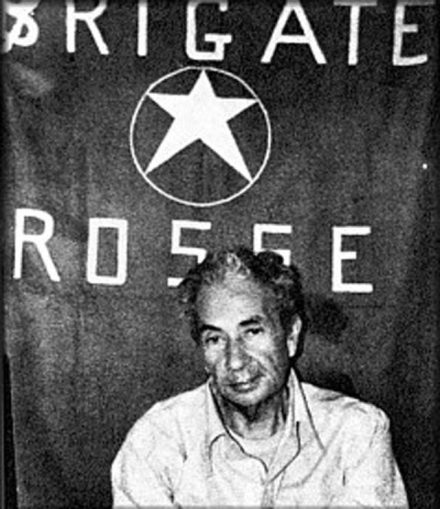
Italian Prime Minister Aldo Moro in Red Brigade captivity, 1978
Mossad Base Italy
Salerno’s book, Mossad Base Italy, is perhaps the most comprehensive chronicle of the intimate and ongoing relationship between Israeli intelligence and Italy’s political leadership. Published in 2010, the book remains almost completely unknown in the English speaking world.
Its author illustrates how the secret Israeli-Italian alliance predated the May 1948 creation of Israel, with Rome providing covert support to Zionist militias like the Haganah. Individuals affiliated with Benito Mussolini and neofascists within Italy’s post-war security apparatus supplied them with weapons and training to crush Palestinian resistance and assist their campaign of ethnic cleansing.
“The Israelis didn’t want Rome to become a satellite of the Soviet Union, and the US had the same position. The country was essentially the West’s front line against the Eastern bloc,” Salerno explained to The Grayzone. “Italy bordered Yugoslavia, was not far from Warsaw Pact nations, and support for Communism and the Soviet Union was strong in the wake of World War II. It was also a kind of aircraft carrier in the Mediterranean, which people would land on and go off to other places.” With nearly 5,000 miles of coastline, and just 90 miles separating the island of Sicily and Tunisia, Italy has often been described as the “gatekeeper” of the Mediterranean Sea.
Salerno concluded that every Italian administration since World War II has secretly aided Mossad and Israeli military intelligence. A review of his book by veteran Haaretz intelligence correspondent Yossi Melman noted, “Israeli espionage agents confirm that Italy’s intelligence services are among the friendliest in the world toward their Israeli counterparts.”
Salerno argues persuasively that both the Mossad and Israeli Air Force were effectively “born in Rome,” and reveals Tel Aviv entrusted Italian intel with conducting “extremely classified missions” on their behalf. Strikingly, his book has never been translated into English.
The reporter attributes the consistent pro-Israel bias of Italian intelligence to a combination of political expediency and lingering collective guilt over Rome’s complicity in the crimes against Jews during World War Two. Since then, Italy’s governments have largely “felt… that they had to help the Jews because the Jews had been suffering under the previous regime.”
“Objective evidence” Mossad downed Italian airliner
The traditional dynamic between Rome and Tel Aviv was challenged by the emergence of Italian Christian Democrat Party governments, including Moro’s. Within months, Israel began responding to this defiance with apparent acts of sabotage inside Italy, according to a variety of well-placed figures.
In late 1973, five members of the Black September Palestinian militant group were arrested thanks to a tipoff from the Mossad, which claimed they were preparing to shoot down an Israeli commercial airliner at Rome’s largest airport with ground-to-air missiles. However, Moro arranged for them to be released a month later, then transported to Libya.
The Black September members were first flown to Malta on an Italian transport plane known as Argo 16 — which was routinely used to ferry Operation Gladio operatives to a secret training base in Sardinia, and deliver CIA/MI6 weapons to secret depots dotted around the country. When Mossad observed the Palestinians there and realized they’d been freed, they became “very annoyed,” according to Rome’s then counterespionage chief, Ambrogio Viviani.
On November 23 1973, Argo 16 crashed shortly after taking off from Venice Airport, killing the entire veteran crew.
An initial probe concluded the tragedy was an accident, but the case was reopened by the Venice prosecutor’s office in 1986. That investigation faltered as well, when security and intelligence officials refused to testify, and began withholding evidence. However, the judge overseeing the case, Carlo Mastelloni, told Salerno there was no doubt, based on “objective evidence,” that the plane’s downing was Israel’s dirty work.
“It’s all tied to the famous ‘Moro agreement,’” Mastelloni asserted. Argo 16’s sabotage was not only “retaliation” for the release of the arrested Palestinians, but a “warning” over Italy’s “concessions” to “Tel Aviv’s enemies,” he stated. Still, Lodo Moro continued to hold despite the implicit threat of violence, which raises the question of whether Mossad felt the need to up the ante.
‘Mossad decided to transfer the Middle Eastern conflict to Italy’
Argo 16 was not the only fatal incident to take place during Italy’s Years of Lead which seemed to bear the Mossad’s fingerprints. When a hand grenade was lobbed at Milan’s police headquarters in May 1973, killing four civilians and injuring 45, the culprit presented himself as an anarchist following his immediate apprehension. However, subsequent investigations revealed the perpetrator, Gianfranco Bertoli, to be a longtime Italian military intelligence informant, as well as a member of numerous neofascist organizations, including the Gladio-linked Ordine Nuovo (New Order).
Bertoli had spent the two years leading up to the attack residing off and on in Kibbutz Karmiya in Israel, where he frequently hosted representatives of French far-right faction Jeune Révolution, while maintaining contact with French intelligence. Such incidents prompt Salerno to ask: “was the Mossad part of the strategy of tension?” This was the precise conclusion reached by Ferdinando Imposimato, an Italian magistrate who oversaw initial trials of Red Brigades operatives regarding Moro’s murder.
“It must be acknowledged the Israeli secret services had perfect knowledge of the Italian subversive phenomenon from its very beginning, engaging in it with constant ideological and material support,” Imposimato noted in 1983. “Mossad had decided to transfer the Middle Eastern conflict to Italy,” he concluded, “driven by the aim of political and social destabilization.” Israel’s purpose was “to induce America to see Israel as the only allied point of reference in the Mediterranean and thus gain greater political and military support,” he stated.
During his March 1999 testimony to a parliamentary inquiry into terrorism in Italy, Red Brigades fighter Alberto Franceschini stated the group was approached by the Mossad through an intermediary after the Red Brigades’ kidnapping of a magistrate named Mario Sossi in April 1974. According to Franceschini, the Mossad made a “disturbing” proposition to finance his group, stating that rather than seeking to control the Red Brigades, Israel sought only to ensure the group continued to operate:
“We don’t want to tell you what you have to do. That is, what you do is fine with us. We care that you exist. The very fact that you exist, whatever you do is fine with us.”
Describing “the political motivations” for Mossad’s position, Franceschini noted: “from the perspective of American relations… the more destabilized Italy was, the more unreliable it became, and the more Israel became a reliable country for all Mediterranean policies” from Washington’s perspective. In his final years, Franceschini revealed Israel “offered weapons and assistance” to the Red Brigade, declaring: “their stated goal was to destabilize Italy.”
As Salerno noted to The Grayzone, “in one of his last interviews,” Franceschini “confirmed to my colleague from Corriere della Serra that the Mossad had been in contact from the very beginning with the Red Brigades,” interactions which the correspondent stresses were “very normal in the way the Mossad acted with all kinds of, let’s call them subversive organizations, all over Europe.”
The notion of a potential Israeli hand in shaping the Moro plot — or hindering efforts to resolve it peacefully — is bolstered by statements from a number of influential Italian politicians, which also indicate Israel both “co-financed” and “influenced” the group which took credit for killing Moro. These disclosures have so far been universally ignored by mainstream English-language outlets.
In July 1998, Giuseppe De Gori, a lawyer who represented Moro’s Christian Democrat party in numerous trials related to the case, told a parliamentary commission on terrorism that Mossad “had always controlled” the Red Brigades, without formally infiltrating the group. He recorded how in 1973, a Mossad major and colonel “presented themselves” to the group, exposing infiltrators in their ranks, and offering “weapons and whatever they wanted as long as they pursued a different policy.”
While the Red Brigades refused, “from that moment on, it was clear Mossad” kept a close eye on the militant faction. De Gori testified that Israeli intel “hated” the “anti-Zionist” Moro, and began taking advantage of its ability to “smuggle” information to the Red Brigades, which could influence their actions.
As the lawyer explained, there was “no need” for the Mossad to directly penetrate the Red Brigades. De Gori hinted the group’s decision to kill Moro after almost two months in captivity resulted from such indirect Israeli intervention. While Italian government officials refused any negotiation with his kidnappers, at a private meeting on May 8, 1978, elements within the Christian Democrats proposed independently brokering a deal to secure Moro’s release.
“Moro was killed immediately afterward, so someone must have been there who reported this news,” De Gori testified. In 2002, the lawyer told author Philip Willan that Mossad made Moro’s execution a fait accompli by enlisting the services of a skilled forger to fabricate a letter from the Red Brigades to authorities in mid-April 1978. The communique claimed the statesman was already dead. “After that… Moro could no longer be saved,” De Gori stated.
Bargain with Palestinian resistance puts target on Moro’s back
De Gori is not the only well-placed source to blame Mossad for Moro’s death. In May 2007, Giovanni Galloni, former vice president of the Italian judiciary’s High Council, boldly proclaimed that “not all participants” in the premier’s abduction had been members of the Red Brigades. That conclusion was spurred by Moro’s bodyguards being executed with “just two weapons, used by exceptionally experienced men.” In addition to never being identified, these assassins displayed a level of shooting expertise no known Red Brigades operative seemed to possess.
Galloni strongly insinuated the killers were hired by Washington and/or Tel Aviv. He revealed that “a few months before his capture,” Moro confided to him that he was “worried” the US and Israeli “secret services had infiltrated the Red Brigades.” Moro reported this to Italy’s US ambassador, prompting an “ambiguous denial” from the State Department, to the effect Washington had always told Italian intelligence “everything we know.”
Galloni enquired: “Which secret services? The real ones, or the ones that were in their hands?” He was clearly referring to the parallel Anglo-American spying and terror nexus in Rome known as Operation Gladio.
Further evidence of an Israeli role in Moro’s murder can be found in testimony delivered to an Italian parliamentary committee in June 2017 by a former magistrate named Luigi Carli, who was intimately involved in the original investigation. Unnoticed in the English-speaking world, and unmentioned in the committee’s official reports, Carli claimed the Red Brigades had been “co-financed” by Mossad.
When asked why Israel would subsidize an armed communist faction in Italy, Carli stated that “several” former Red Brigades collaborators had told him the Mossad had agreed to “take care of co-financing the Red Brigades,” proposals which he considered “strange.”
They explained, however, that any efforts which ended up “weakening, or helping to weaken, Italy’s internal situation” would “enhance Israel’s prestige and authority” in the Mediterranean, Carli testified.
Highly illuminating interviews with former Italian president Francesco Cossiga, published by the Bulletin of Italian Politics in the wake of his death in August 2010, shed further light on Mossad’s motives for assassinating Moro, and for targeting Rome with mass casualty false flag bombings. Cossiga was the first Italian politician to acknowledge the existence of the Lodo Moro. Cossiga stated the US was “of course” aware of the agreement, while he himself and much of Italy’s political class were in the dark.
Cossiga recalled that while he was Prime Minister in November 1979, police in a coastal town intercepted a truck carrying a surface-to-air missile. He subsequently received a telegram from Popular Front for the Liberation of Palestine chief George Habbash admitting ownership of the missile, and reassuring the Italian premier it was not intended for use in Italy. Habbash thus demanded the weapon be returned and called for the driver’s release.
Habbash warned that any failure to comply would represent a violation of the PFLP’s “agreement” with Rome. “No one could tell me what this part meant,” Cossiga insisted. Only “many years later” did he learn of the Lodo Moro agreement.
At the time of Cossiga’s interviews, the Italian state reopened investigations into the August 1980 bombing of Bologna Centrale railway station, which killed 85 people and wounded over 200. The probe resulted in convictions in absentia for members of the neofascist, Gladio-tied Nuclei Armati Rivoluzionari. Several chief suspects, including a confirmed MI6 asset named Robert Fiore, escaped to London, where Britain refused to extradite them. The Bulletin of Italian Politics identified the missile seizure, and the existence of Lodo Moro itself, as key considerations in the new investigation.
One possibility explored by the inquiry was whether the Bologna bombing was “carried out by the US or Israel to punish Italy for its pro-Arab stance.” Having long complained that Rome “never really had space for its own foreign policy” due to its subservience to US interests, Cossiga acknowledged that Italy “pursued a national agenda” in the Middle East and “took certain liberties towards the Arab world and Israel.”
“People forget” the Christian Democrats were “always a pro-Arab party,” Cossiga stated, pointing specifically to Moro and his associate Giulio Andreotti, another former Italian head of state who famously exposed Operation Gladio in October 1990. Cossiga claimed, “Andreotti has always believed — though he’s never said it,” that the US caused him “judicial problems” over his Arab sympathies.
Though Salerno disputes the characterization of Andreotti as “pro-Arab,” describing him instead as “pro the rights of Arabs,” he told The Grayzone that the longtime Italian leader once personally declared to him: “if I was born in Gaza, I would be a terrorist.”
Moro rescue committee set up to fail
Throughout Moro’s 55 days in Red Brigades captivity, Italian officials declared that the “state must not bend” to “terrorist demands,” making it clear the Italian government would neither negotiate with the Red Brigades nor release any of its jailed members in return for the PM. The former Italian Prime Minister was subsequently bundled into a car trunk, shot 10 times, and left in the vehicle in central Rome for authorities to find.
Today, many Italians view Rome’s inflexible approach with deep suspicion, given the government’s willingness to negotiate with terrorists both before and after Moro’s murder. Magistrate Mario Sossi, whose kidnap by the Red Brigades purportedly prompted Mossad to approach the group, was released in 1974 after one month in captivity in exchange for some of the radical faction’s imprisoned members.
When the Red Brigades kidnapped Christian Democrat politician Ciro Cirillo in April 1981, Italian authorities bargained directly with his abductors, paying a ransom for his release. That December, when the Red Brigades abducted US General James Dozier, he was “located and freed in a blitz” by a joint US-Italian taskforce.
Former Italian general Roberto Jucci contrasted Dozier’s treatment with that of Moro in a 2024 interview. “One of them, they wanted to set free; I have my doubts about the other,” he stated. Jucci was among the few Italians in a position to judge, having been placed in charge of training a special forces squad at a base in Tuscany, which was ostensibly meant to rescue the abducted Prime Minister. Today, he believes “the real goal was to get me out of the way” and ensure Moro was never found. No raids were conducted during his 55 days in captivity.
Jucci told La Repubblica that the formal committee to rescue Moro was “advised by a man sent by the US,” and “composed largely” of representatives of fascist, Gladio-affiliated Masonic lodge P2. These individuals “wanted things to go in a different way from what all honest people were asking for,” and wished for Moro “to be destroyed politically and physically.”
Had Moro survived, “Italy’s politics would have developed differently.” Jucci believed the Italian leader could’ve “been freed if all the institutions had worked in this direction.” Declassified British Ministry of Defence files dating to November 1990 show officials in London were well-aware of the role played by P2 in sabotaging official efforts to rescue Moro. The Masonic lodge was described as just one “subversive” force in Rome, employing “terrorism and street violence to provoke a repressive backlash against Italy’s democratic institutions.”
Those documents further noted “circumstantial evidence” indicated “one or more of Moro’s kidnappers was secretly in touch” with Italy’s “security apparatus,” and investigators “deliberately neglected to follow up leads which might have led to the kidnappers and saved Moro’s life.”
Mossad continues Italian ops amid Gaza genocide
Today, there is little trace of any pro-Arab tendencies in mainstream Italian politics. According to Salerno, the US and Israel no longer have any need to “destabilize Italy” as the country is economically “weak.” Rome’s government now is for all intents and purposes “a continuation, even an extension, of the old fascist regime,” he says, adding, “there are people in the government that have statues of Mussolini in their houses.”
Prime Minister Giorgia Meloni has made clear she harbors little sympathy for the Palestinians, and little intention of recognizing a Palestinian state – even after it was revealed in November 2024 the Mossad had been employing a private Italian intelligence firm to target Meloni and her ministers. “I think that basically, the government that we have here in Italy at the moment is a government that would like to criticize many things that are happening,” but “it can’t criticize Israel too much because of what the Italian fascist regime did to the Jews during the war,” Salerno explains.
Regarding recent mass protests and strikes across Italy in support of Gaza, Salerno explains, “What is happening today in Palestine in Gaza is something exceptional.” But “as nothing has been taught or spoken about in Italy about the plight of Palestinians for many years… the great population of Italy and the governments of Italy” have “never done very much to really help the Palestinians.” Now, once again, “all of a sudden, we have discovered we have the Middle East and the Palestinian question.”
To this day, Mossad continues to carry out operations in Italy. The Italian-Israeli intelligence relationship was most recently highlighted in a bizarre incident in May 2023, in which a houseboat capsized in Italy’s Lake Maggiore, killing four people among the 23 aboard. Though legacy media initially framed the case as a tragic accident at a birthday celebration, it quickly became clear everyone on the boat — bar the captain and his wife — were Israeli and Italian spies.
The 10 surviving Israelis were hurriedly flown back to Tel Aviv on a military aircraft before they could be questioned by police, with the apparent blessing of Italian authorities. Subsequent investigations suggested the gathering was a joint intelligence operation into “Iranian non-conventional weapons capabilities,” aimed at either surveilling local industry or wealthy Russians living nearby who were suspected of helping Moscow obtain drones from Tehran.
A eulogy for the dead Israeli spy, whom Italian media named as Erez Shimoni, was personally delivered by Mossad director David Barnea, strongly suggesting he was a significant figure at the intelligence agency. While the captain of the ship has since been convicted of negligent homicide, Italy’s military police immediately announced they would not be investigating the activities of the spies on board.
FBI Breakup Ends SPLC and ADL Direct Influence
By Cindy Harper | Reclaim The Net | October 5, 2025
The FBI has officially ended its partnership with both the Southern Poverty Law Center (SPLC) and the Anti-Defamation League (ADL), following years of mounting concern over the influence of partisan organizations in shaping federal intelligence and domestic “extremism” policy, which has resulted in online censorship.
FBI Director Kash Patel condemned the SPLC’s direction, describing it as a “partisan smear machine” and calling its involvement in federal intelligence work unacceptable.
He pointed specifically to the group’s so-called “hate map,” which has long been used to label mainstream conservative and Christian organizations as equivalent to violent hate groups.
“Their so-called hate map has been used to defame mainstream Americans and even inspired violence,” Patel stated. “That disgraceful record makes them unfit for any FBI partnership.”
The bureau confirmed it no longer shares information or maintains any intelligence products from the SPLC.
It has also cut off contact with the ADL, a group that, while ostensibly focused on combating antisemitism, has frequently advocated for censorship of speech it deems problematic, particularly online.
Both organizations were previously consulted by the FBI in identifying and monitoring alleged extremist threats.
That practice came under fire after the bureau’s Richmond office cited the SPLC in a controversial 2023 memo suggesting that traditional Catholics could be tied to radical activity.
The document called for agents to cultivate informants within Catholic churches.
The backlash led Patel to publicly reject the use of ideologically driven outside groups in FBI operations.
“I made it clear that the FBI will never rely on politicized or agenda-driven intelligence from outside groups—and certainly not from the SPLC,” Patel said. “All ties with the SPLC have officially been terminated.”
Originally known for battling white supremacist groups through litigation, the SPLC has since shifted its focus toward labeling conservative advocacy organizations as dangerous.
Over time, its “hate map” has become a blacklist used by corporations, financial services, and online platforms to restrict access and support for those groups.
More recently, the group listed Turning Point USA shortly before the assassination of its founder, free speech advocate Charlie Kirk.
The SPLC has maintained that not all Christian groups are included in its listings. For years, it pointed to Focus on the Family as an example of one that was not. That changed in 2024 when Focus was added to the map.
The ADL supported the STOP HATE Act, which seeks to pressure online platforms to remove “disinformation” and what it calls “hate speech.” The bill’s language raises obvious concerns about vague definitions and potential abuse.
Both organizations have held sway not just over federal agencies, but also over powerful private institutions.
Amazon, Eventbrite, Hyatt Hotels, and PayPal have all relied on the SPLC’s hate designations to determine which groups can use their services.
The now-discontinued AmazonSmile program excluded organizations listed by the SPLC, while major charitable foundations have blocked funding to those targeted by the group.
Federal agencies under the Biden administration have also shown a willingness to coordinate with the SPLC.
In a 2021 donor meeting, the group’s then-president said that many agencies had proactively reached out to solicit its input on shaping domestic terrorism policy.
That cooperation continued even after the SPLC labeled the parental rights group Moms for Liberty a hate group in 2023, followed by a briefing with the Department of Justice.
Israel spending $4.1 million to brainwash US Christians with VR, geofencing campaigns
Press TV – October 5, 2025
Newly released FARA filings have revealed that the Israeli regime is paying up to $4.1 million to a US firm to develop a virtual reality (VR) program called the “October 7th Experience” aimed at brainwashing American Christians and targeting them through ‘geofencing’ propaganda ads at churches and colleges.
According to the FARA disclosures, the conservative activist Chad Schnitger’s new firm, Show Faith by Works, is set to receive more than $3.25 million from the Israeli regime over a period of five months, with an additional proposed budget of $835,000 for equipment and expansion.
The firm received an initial payment of approximately $326,000 on September 18, just days before officially registering as a foreign agent with the Department of Justice.
Show Faith by Works has detailed plans to engage pastors in pro-Israel op-ed writing, distribute ‘Pastoral Resource Packages’ by mail, employ social media influencers for “favorable coverage,” produce television-style commercials, conduct continuous geofenced digital ad campaigns at churches and campuses, and saturate social media with SEO-optimized anti-Palestinian messaging.
The firm will also tour a branded trailer exhibit to immerse audiences in narratives of Israel’s war with the Palestinian resistance movement Hamas through the ‘October 7th Experience’ program.
The “anti-Palestinian” section of the plan also includes assertions about Palestinian “complicity” in Hamas’s leadership, financing, and military operations, along with accusations of sheltering terrorists, hiding weapons in schools and hospitals, and celebrating the October 7 attack.
Furthermore, the materials emphasize that there has never been a Palestinian state, highlighting that Hamas’s goals are “genocidal” rather than “land-focused,” and criticizing the Palestinian choice of violence over modernization opportunities.
The filings also highlight a significant geofencing campaign targeting Christian churches on Sundays and Christian colleges on weekdays, aiming to deliver tailored pro-Israel content and sympathetic anti-Hamas messages to engaged audiences.
The campaign is designed to track individuals who enter the targeted zones and continue to deliver relevant content to them.
Geofencing is a digital marketing and surveillance technique that establishes a virtual boundary, or “fence,” around a specific physical location such as a church, college campus, or protest site.
When a person carrying a smartphone enters the geofenced area, their device can be identified and tagged using location services, mobile ad IDs, or app data.
Subsequently, targeted ads can be delivered to the individual while they are within the geofenced area, and their activities can be tracked and analyzed for further marketing purposes, often without the user’s awareness.
In addition, other recently disclosed FARA filings have exposed that the Israeli regime is paying 14-18 “influencers” with approximately $7,000 per post.
Additionally, the former Trump campaign manager, Brad Parscale, has reportedly been paid $6 million to promote a pro-Israel stance through platforms like ChatGPT and other LLMs.
International Committee for Breaking the Siege on Gaza chair responds to Israel defamation campaign
MEMO | October 4, 2025
Zahir Birawi, chair of the International Committee for Breaking the Siege on Gaza has today issued a press statement in response to an Israeli defamation campaign against international activists, solidarity organisations, and particularly those of us working to end the criminal siege of Gaza through the Freedom and Sumud flotillas.
Birawi says that his name has been cited in defamatory reports issued by Israeli ministries, notably on 30 September. “I state unequivocally: the allegations of terrorism levelled against me are false, fabricated, and politically motivated. They form part of a systematic strategy to criminalise peaceful solidarity work, intimidate international activists, and manufacture consent for Israel’s ongoing acts of piracy, including the kidnapping of hundreds of human rights defenders sailing to Gaza with humanitarian aid.”
The statement read: “Israel’s actions are not isolated but part of a state doctrine of defamation against those who challenge its apartheid and colonial rule. By branding activists as extremists, Israel attempts to neutralise opposition to its crimes, delegitimise solidarity networks, and shift attention away from its violations of international law.”
In light of the gravity of the allegations Birawi has asserted his right to pursue legal action against those responsible for the smear campaign. He wrote:
“I reserve my full right to pursue legal remedies against those who propagate these defamatory claims. This is not an empty threat. In 2021, I successfully sued World-Check, compelling the company to remove my name from its terrorism list and compensate me for the damage caused by its false classification. This legal precedent demonstrates both the falsity of these accusations and the accountability that can be demanded from those who spread them.”
Iran declares Cairo deal with IAEA ‘defunct’
The Cradle | October 5, 2025
Iranian Foreign Minister Abbas Araghchi confirmed on 5 October that the Cairo deal signed with the International Atomic Energy Agency (IAEA) last month is no longer active or valid due to European ‘snapback’ sanctions on Tehran.
“Experience has shown that there is no solution to Iran’s nuclear issue other than a diplomatic and negotiated one,” Araghchi said.
“The three European countries thought they could achieve results through the snapback mechanism, but that tool was ineffective and only made diplomacy more complicated. Diplomacy will always continue, but the form and the parties involved in negotiations have now changed. Undoubtedly, the role of the European countries in the upcoming talks has diminished, and their diplomatic justification for participating has weakened,” he added.
“In recent months, our discussions have been focused solely on the nuclear issue, conducted either directly or indirectly with the American side. In these exchanges, our proposals were completely transparent. Had they been taken seriously … reaching a negotiated and diplomatic solution would not have been out of reach. Even now, if the [opposing] parties act in good faith and consider mutual interests, the continuation of negotiations is possible.”
“Nevertheless, the situation following the military attack and the activation of the snapback mechanism has changed, and the upcoming negotiations will certainly be different from before,” he went on to say, adding that both the US-Israeli attacks on Iran in June and the activation of the ‘snapback’ mechanism have complicated matters.
“After several rounds of talks, this agreement was reached in Cairo. However, the Cairo Agreement no longer suffices under the new circumstances, including the activation of the snapback mechanism, and new decisions will be made.”
“To prove the peaceful nature of its nuclear program and its goodwill, the Islamic Republic of Iran has exhausted all diplomatic avenues, pursued consultations and cooperation, and presented constructive and balanced proposals. There is now no excuse left for Western countries to prevent Iran from cooperation or dialogue. Iran’s positions are fully legitimate and reasonable, and it is ready to pursue any solution that leads to confidence-building.”
The snapback sanctions took effect on 28 September. Washington welcomed the European decision.
Iran had previously warned that activating the sanctions would jeopardize the Cairo deal, reached on 9 September after Tehran resumed cooperation with the IAEA following a brief suspension as a result of the war.
Negotiations to prevent the return of the sanctions failed after the UN Security Council (UNSC) rejected a draft resolution to permanently lift sanctions against Iran. Russia, China, Pakistan, and Algeria voted to prevent the reintroduction of sanctions, while nine Security Council members voted against sanctions relief. Two countries abstained.
Tehran has recalled its envoys from Germany, France, and Italy.
The EU has continued to hold Iran to the terms of the 2015 Joint Comprehensive Plan of Action (JCPOA), despite Washington’s unilateral withdrawal from the deal in 2018 and its policy of maximum pressure against Iran.
Tehran is insisting on its right to maintain peaceful uranium enrichment.
Nuclear talks between Tehran and Washington have been halted since the US-backed Israeli war against Iran started on 13 June.
The US was aware that Israel was set to attack while continuing to pretend it was negotiating with Iran. In late June, Washington joined the war with a bunker-buster attack on Iranian nuclear sites.
Israel has publicly threatened to restart the war against Iran. Tehran has vowed to respond more harshly to any new attack.
Seyed M. Marandi: Peace Deal & Another War Against Iran
Glenn Diesen | October 5, 2025
I spoke with Seyed Mohammad Marandi in Sochi about the peace deal being imposed on Gaza, and the US/Israeli preparations for another war with Iran. Marandi is a professor at Tehran University and a former advisor to Iran’s Nuclear Negotiation Team.
The pirates of Israeli supremacy: The West’s favorite rogue state has done it again
By Tarik Cyril Amar | RT | October 2, 2025
The long-expected if perfectly criminal has happened again: Israel’s navy has intercepted the Gaza-bound Sumud Flotilla by force, stopping almost 50 boats and, in effect, kidnapping hundreds of their crews and passengers.
In terms of law – which, of course, are never really applied in practice to Israel – everything is exceedingly clear: The Sumud Flotilla was a volunteer operation to bring humanitarian aid to Gaza which has been subjected to Israeli genocide for now almost two years. Israel had a clear obligation to let that aid pass.
But then what to expect from the world’s most aggressive rogue state that is not “only” committing genocide, but also waging regional wars of aggression and running terrorist assassination campaigns in the face of the global public? And Israel has a well-established track-record of this kind of piracy, of course, having stopped several attempts to bring aid by sea since 2010, sometimes with casualties among the humanitarian activists.
Stopping the Sumud Flotilla wasn’t merely criminal but criminal in every regard lawyers can imagine, a typical Israeli super-whopper of legal nihilism: Israel attacked the flotilla ships in international waters where it has no jurisdiction. Even if the ships had gotten closer to the Gaza coast, they would, by the way, still not have been inside any Israeli territorial waters because there are no such waters off Gaza, over which Israel has no sovereignty as clearly confirmed by the International Court of Justice last year. What you find off the coast of Gaza, as a matter of fact, are Palestinian territorial waters.
The blockade of Gaza, which has lasted not “merely” for the duration of the current high-intensity genocide-ethnic cleansing campaign but for close to two decades now, is illegal. Because the blockade has been in place for so long, Israel is simply lying – surprise, surprise – when arguing it is a short-term measure covered by the San Remo rules, which summarize “International Law Applicable to Armed Conflicts at Sea.” And even if those rules applied, under them as well Israel would have to let humanitarian aid through.
Finally, as Israel has attacked ships and citizens belonging to over 40 countries, Israel has committed aggression under international law against all of them and, less obvious but a fact, also crimes under each of these countries’ domestic laws, because they apply on those ships.
So far for the law, but then again, Israel is de facto outside and above the law. That much we have known for a long time. Indeed, Israel could not exist without constantly breaking international law and getting away with it. For Israel, lawlessness and impunity are not luxuries but vital necessities.
The reason why it has been able to exist in this manner is well-known, too: It is protected by the West and, in particular, the US. The latter is Israel’s single worst co-perpetrator, facilitating its crimes like no other state on Earth. Soon, for instance, the recent war of aggression waged by America and Israel together against Iran will probably be followed by a second, even worse assault.
In this regard, what has happened to the Sumud Flotilla has been a test: Clearly, recent moves by various Western governments, including the UK, France, and Australia to “recognize” – in an extremely dishonest manner – a Palestinian state and add some cautious rhetorical criticism of Israel make no difference to their absolute deference in practice to both Israel and its backers in the US.
What seemed like a glimmer of hope for a moment, the appearance of warships from various nations to apparently escort the humanitarian flotilla, has turned into just another humiliation: the escort abandoned their charges well in time to allow Israel a free hand.
The same Western leaders responsible for this cowardly retreat cannot stop waffling about the need not to “reward the aggressor,” when dialing up the war hysteria against Russia, as they have been doing mightily again recently, from mystery drones to declaring unconstitutional states of “not-peace” to chatter of states of emergency.
What about, for once, not rewarding the genocider for a change? But that’s hard, isn’t it? Once all Western governments are accomplices of Israel.
The Sumud Flotilla will not have been the last attempt to break both Israel’s genocidal blockade and its aura of impunity. There is hope, because even in NATO-EU Europe and the US ever more people understand what Israel really is and what it really does: a settler-colonial apartheid state that won’t stop committing genocide and ethnic cleansing. Israel’s systematic campaigns of propaganda and information war are escalating in response, as the case of TikTok has just demonstrated. But even Israel and its American friends cannot reverse history and an experience that the whole world has made. The Gaza Genocide is a fact already. It will not be forgotten. The resistance to Israel will never end.
Tarik Cyril Amar is a historian from Germany working at Koç University, Istanbul, on Russia, Ukraine, and Eastern Europe, the history of World War II, the cultural Cold War, and the politics of memory.
The Met police chief proves he’s as dishonest and racist as the force he leads
By Jonathan Cook | October 4, 2025
Sir Mark Rowley claims he is worried about rising ‘community tensions’. But the only tensions he cares about are those belonging to an imaginary community he has created of a Jewish hive mind
Once again, the BBC laps up outright disinformation from Sir Mark Rowley, police commissioner of the institutionally racist and corrupt Met. Watch this short clip from the BBC News at Ten last night:
1. Rowley demands supporters of Palestine Action cancel or delay their protest today, after the Manchester synagogue attack, because the timing appears “antisemitic”.
How to untangle this nonsense?
a) The only possible way to interpret Rowley’s argument is that he believes every British Jew identifies and supports Israel’s mass slaughter of children in Gaza and therefore, out of respect for their grief at the Manchester attack, we ought not to protest against the slaughter in Gaza. That undoubtedly makes Rowley the antisemitic one.
b) Even were his deeply antisemitic idea true – that British Jews are an unthinking herd of genocidal monsters – Rowley assumes that we ought to be okay with this: we should just keep quiet about Israel murdering 100 or so Palestinians every day in Gaza, and starving and ethnically cleansing the rest of the population, because it would supposedly offend Britain’s Jewish community to do otherwise.
c) Rowley wants the protesters to take a time-out of a few weeks, even while Israel refuses to take any time-out on murdering Palestinians. Nor is the British government taking a time-out in arming Israel and providing it with intelligence to carry out the genocide. Rowley is suggesting we should simply quieten down for the next few weeks, even as 100 Palestinians are killed each day, before heading back to the streets. He thereby sends an unequivocal message that Palestinian life is worthless – and he does it while claiming we are the racist ones.
2. Rowley claims he wants this weekend’s protests stopped because of the danger they will raise “community tensions, which is my concern”.
And yet from everything he says, the only community’s “tensions” he appears to care about are those of an imaginary one he has created of a Jewish hive mind.
What about the tensions of Palestinian communities, of wider Muslim and Arab communities, of human communities, of those parts of the Jewish community opposed to Israel’s slaughter in Gaza, produced by watching children being torn to shreds by bombs Britain is helping to supply to Israel, by seeing world citizens – including British citizens – being abducted in international waters by Israel as they try to break Israel’s illegal starvation-siege of Gaza?
Does Rowley care about these communities and their tensions, tensions that will only heighten if they are denied their long-established democratic rights to go out on to the streets to protest – rights that have already been aggressively whittled away by successive British governments?
3. Rowley says he finds it “bewildering” why more than 1,000 people would want to get arrested for “supporting a terrorist organisation” – and berates them for taking up police resources at a time when those resources are needed elsewhere.
And yet, Rowley knows there is nothing “bewildering” about their protests. These thousands of British citizens, and millions behind them who are less courageous, are prepared to risk jail, and damage their careers and their futures, with a “terrorism” conviction. They are prepared to do so because they believe the proscription of Palestine Action – the first such proscription in British history for a direct-action group following in the tradition of the Suffragettes – is an assault on our fundamental right to protest, and to protest against the criminality of our own institutions, in this case institutions actively supporting a genocide in Gaza.
If Rowley does not believe he has the resources to arrest the 1,000-plus people who will be sitting quietly in Parliament Square today holding placards opposing the genocide, then he can simply let them be. The sky will not fall in. No one will get hurt. There will be no threat to either public or national security.
The true danger – the danger that Rowley and the government of Sir Keir Starmer really worry about – is that ever more people are beginning to understand that we are ruled by a gang of authoritarian, genocide-assisting criminals.
Featured Video
Elijah Magnier: Yemen’s strikes are shattering Saudi Arabia’s long-term strategy
or go to
Aletho News Archives – Video-Images
From the Archives
British weapons and personnel doing much of the killing in Yemen
Press TV – June 18, 2019
A detailed report published by the Guardian newspaper has shown how Britain is massively contributing to Saudi Arabia’s devastating war on Yemen as it suggests that London is not only supplying the bombs that fall on Yemenis, but it provides the personnel and expertise that keep the war going.
The comprehensive report by Arron Merat published on Tuesday showed that Britain was doing much of the killing in Yemen as the country continues to provide Saudi Arabia with everything it needs to turn its southern impoverished neighbor into a graveyard.
“Every day Yemen is hit by British bombs – dropped by British planes that are flown by British-trained pilots and maintained and prepared inside Saudi Arabia by thousands of British contractors,” said Merat in the report. … continue
Blog Roll
 Aletho News
- Racist Seinfeld Dances for Joy as Bibi Unveils His New Map
- A West Bank War for Netanyahu’s Election Campaign, Could It Backfire?
- Yemen denounces European Parliament’s ‘hypocritical’ push to blacklist Ansarullah
- Qalibaf: UAE’s UN bid aims to ‘clear the runway’ for ‘Greater Israel’, whitewash genocide
- Pakistan reopens Iran border after boosting security: Report
- Why are so many Brazilians voting for Flávio Bolsonaro?
- Democrats Put Anti-Russia Agenda Ahead of American Workers
- Elijah Magnier: Yemen’s Strikes Are Shattering Saudi Arabia’s Long-Term Strategy
- Pentagon designates Chinese cultural centers national security threat
- Israel Demolishes Home Of Lebanese Journalist Whose Viral Film Exposed Pager Attack
- If Americans Knew
- An error has occurred; the feed is probably down. Try again later.
- No Tricks Zone
- Sudden Stratospheric Warming, Powerful El Niño Combination May Lead To Extreme Europe Cold, Energy Crisis!
- Two New Studies Find Thwaites Glacier Melt Cannot Be Driven By Human Activity Or A Warming Ocean
- E-Cars Reduce CO2 Emissions By Only 41% Compared To Internal Combustion Engine Vehicles
- Predictions Made By Renowned Climate Professor Over Past Decades Have Been Proven To Be Poor
- New Study Suggests Large Regions Of The Pacific Ocean Have Been Cooling For The Last 80 Years
- Germany’s Green Energy Debacle: High Energy Costs Force Kahla Porzellan to Close After 182 Years!
- New Study: 50 Years Of The Most Aggressive ‘Net Zero’ Policies Can Only Affect The Global Climate By 0.03°C
- US September “Heat” Was No Record…Many Records Set Decades Ago
- Latest European Green Energy Debacle; Portugal’s Largest Flagship Solar Park Insolvent!
- Green Energy Debacle: German Expert Professor Fritz Vahrenholt Warns Of Severe Economic And Social Consequences

