Israel provoking Palestine factions with actions in Al-Aqsa Mosque
MEMO | May 5, 2022
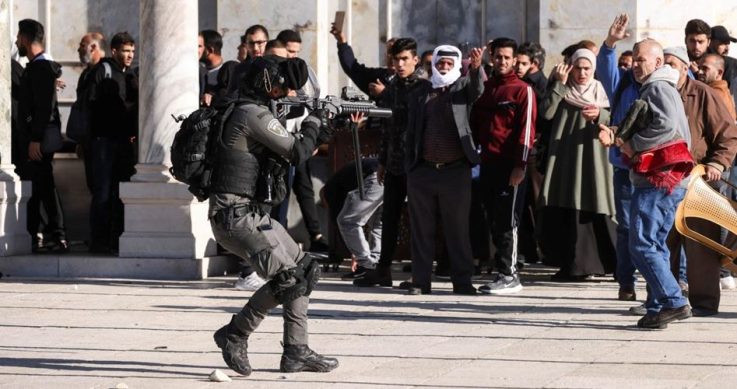
Israeli occupation authorities provoked Palestinian factions after allowing Jewish settlers to storm Al-Aqsa Mosque, statements issued yesterday said.
The Israeli government decided to allow Jewish settlers to storm Al-Aqsa Mosque today.
Hamas said: “Allowing Israeli settlers to storm Al-Aqsa Mosque is playing with fire and this could drag the region into a new escalation.”
“We renew our call for the Palestinian people to travel to Al-Aqsa Mosque and be on high alert in Jerusalem in order to defend their identity, religion and first Qibla.”
According to Hamas, “the Israeli occupation must know that all attempts aimed at dividing Al-Aqsa Mosque or Judaising Muslim holy sites will not pass and will not achieve its malicious goals.”
Meanwhile, spokesman of the Islamic Jihad in the West Bank, Tariq Izzedine, said: “The continuation of Israeli violations against Al-Aqsa Mosque is a violation of Palestinian redlines that needs an urgent movement to stop it.”
Fatah called on Palestinians to gather in Al-Aqsa Mosque today to thwart a “planned provocative Israeli plan to raise the Israeli flag and sing the Israeli anthem at the Palestinian holy site.”
Hamas hails Palestinian worshipers’ heroism
Palestine Information Center – May 5, 2022
 GAZA – Hamas Movement’s spokesman Hazem Qassem hailed the Palestinian worshipers’ heroism in confronting Israeli attacks on al-Aqsa Mosque on Thursday morning.
Israeli authorities are witnessing a state of confusion and panic in face of the Palestinian strong determination, he stressed.
Al-Aqsa Mosque was and will remain a pure Islamic and Arabic shrine, he added.
Earlier Thursday, dozens of Palestinian worshipers were injured after Israeli police forces violently stormed al-Aqsa Mosque in Occupied Jerusalem to clear the area for Jewish settlers’ break-ins that had been paused for the Muslim holidays.
The police forces fired rubber-coated bullets and teargas bombs, injuring dozens of Palestinians. At least 12 live-shot injuries were reported.
Ten worshipers were detained during the attack, including a French Muslim woman.
Three Israelis killed, others injured in stabbing incident
Palestine Information Center – May 5, 2022
OCCUPIED JERUSALEM – Three Israelis were killed while others were wounded in a stabbing incident in Elad area to the east of Tel Aviv on Thursday night.
Hebrew media reported that a number of those injured were in very serious conditions.
Preliminary reports indicated that the attacker used an axe and a knife in his attack before withdrawing from the area.
The Elad municipality asked citizens to remain indoors as the Israeli police forces set up barriers and launched a large-scale manhunt searching for the attacker with the help of choppers.
Israel Extends Detention of World Vision Gaza Director
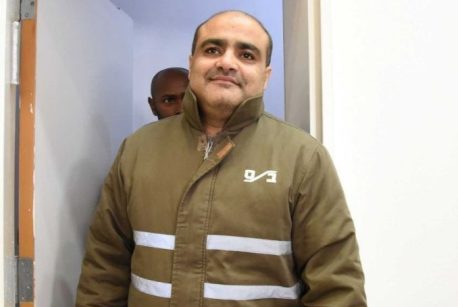
Mohammed Al-Halabi, World Vision’s Operations Manager in the Gaza Strip. (Photo: File)
Palestine Chronicle | May 3, 2022
Israel’s prosecution requested to extend the detention of Palestinian aid worker Mohammed al-Halabi nearly six years after Israel accused him of diverting tens of millions of dollars from an international charity to Hamas, The New Arab reported.
World Vision — a major Christian charity that operates around the world — as well as independent auditors and the Australian government, have found no evidence of any wrongdoing. Al-Halabi’s lawyer says he has rejected multiple plea bargains that would have allowed him to walk free years ago.
The prosecution has requested another hearing on Monday to extend his detention, he has yet to be convicted in an Israeli court and is still being held in detention.
Al-Halabi has consistently denied the accusations throughout his 167 court hearings. Israel hopes that in time and under duress, the father of five will confess under pressure, activists say.
After al-Halabi’s arrest, World Vision suspended its activities in Gaza, where over 2 million Palestinians live under a crippling 15-year Israeli blockade.
By redefining UNRWA, Washington destroys the foundation for a Just peace in Palestine
By Ramzy Baroud | MEMO | May 3, 2022
Palestinians are justifiably worried that the mandate granted to the United Nations Agency for Palestinian refugees, UNRWA, might be coming to an end. UNRWA’s mission, which has been in effect since 1949, has done more than provide urgent aid and support to millions of refugees. It was also a political platform that protected and preserved the rights of several generations of Palestinians.
Though UNRWA was not established as a political or legal platform per se, the context of its mandate was largely political, since Palestinians became refugees as a result of military and political events – the ethnic cleansing of the Palestinian people by Israel and the latter’s refusal to respect the Right of Return for Palestinians as enshrined in UN resolution 194 (III) of 11 December, 1948.
“UNRWA has a humanitarian and development mandate to provide assistance and protection to Palestine refugees pending a just and lasting solution to their plight,” the UN General Assembly Resolution 302 (IV) of 8 December, 1949 read. Alas, neither a ‘lasting solution’ to the plight of the refugees, nor even a political horizon has been achieved. Instead of using this realization as a way to revisit the international community’s failure to bring justice to Palestine and to hold Israel and its US benefactors accountable, it is UNRWA and, by extension, the refugees that are being punished.
In a stern warning on 24 April, the head of the political committee at the Palestinian National Council (PNC), Saleh Nasser said that UNRWA’s mandate might be coming to an end. Nasser referenced a recent statement by the UN body’s Commissioner-General, Philippe Lazzarini, about the future of the organization.
Lazzarini’s statement, published a day earlier, left room for some interpretation, though it was clear that something fundamental regarding the status, mandate and work of UNRWA is about to change. “We can admit that the current situation is untenable and will inevitably result in the erosion of the quality of the UNRWA services or, worse, to their interruption,” Lazzarini said.
Commenting on the statement, Nasser said that this “is a prelude to donors stopping their funding for UNRWA.”
The subject of UNRWA’s future is now a priority within the Palestinian, but also Arab political discourse. Any attempts at canceling or redefining UNRWA’s mission will pose a serious, if not an unprecedented challenge for Palestinians. UNRWA provides educational, health and other support for 5.6 million Palestinians in Jordan, Lebanon, Syria, the Gaza Strip and the West Bank, including East Jerusalem. With an annual budget of $1.6 billion, this support, and the massive network that has been created by the organization, cannot be easily replaced.
Equally important is the political nature of the organization. The very existence of UNRWA means that there is a political issue that must be addressed regarding the plight and future of Palestinian refugees. In fact, it is not the mere lack of enthusiasm to finance the organisation that has caused the current crisis. It is something bigger, and far more sinister.
In June 2018, Jared Kushner, son-in-law and advisor to former US President Donald Trump, visited Amman, Jordan, where he, according to the US Foreign Policy magazine, tried to persuade Jordan’s King Abdullah to remove the refugee status from 2 million Palestinians currently living in the country.
This and other attempts have failed. In September 2018, Washington, under the Trump administration, decided to cease its financial support of UNRWA. As the organization’s main funder, the American decision was devastating, because about 30 per cent of UNRWA’s money comes from the US alone. Yet, UNRWA hobbled along by increasing its reliance on the private sector and individual donations.
Though the Palestinian leadership celebrated the Biden Administration’s decision to resume UNRWA’s funding on April 7, 2021, a little caveat in Washington’s move was largely kept secret. Washington only agreed to fund UNRWA after the latter agreed to sign a two-year plan, known as Framework for Cooperation. In essence, the plan effectively turned UNRWA into a platform for Israel and American policies in Palestine, whereby the UN body consented to US – thus Israeli – demands to ensure that no aid would reach any Palestinian refugee who has received military training “as a member of the so-called Palestinian Liberation Army”, other organizations or “has engaged in any act of terrorism”. Moreover, the Framework expects UNRWA to monitor “Palestinian curriculum content”.
By entering into an agreement with the US Department of State, “UNRWA has effectively transformed itself from a humanitarian agency that provides assistance and relief to Palestinian refugees, to a security agency furthering the security and political agenda of the US, and ultimately Israel,” BADIL Resource Center for Palestinian Residency and Refugee Rights noted.
Palestinian protests, however, did not change the new reality, which effectively altered the entire mandate granted to UNRWA by the international community nearly 73 years ago. Worse, European countries followed suit when, last September, the European parliament advanced an amendment that would condition EU support of UNRWA on the editing and rewriting of Palestinian school text books that, supposedly, ‘incite violence’ against Israel.
Instead of focusing solely on shutting down UNRWA immediately, the US, Israel and their supporters are working to change the nature of the organization’s mission and to entirely rewrite its original mandate. The agency that was established to protect the rights of the refugees, is now expected to protect Israeli, American and western interests in Palestine.
Though UNRWA was never an ideal organization, it has indeed succeeded in helping millions of Palestinians throughout the years, while preserving the political nature of their plight.
Though the Palestinian Authority, various poltical factions, Arab governments and others have protested the Israeli-American designs against UNRWA, such protestations are unlikely to make much difference, considering that UNRWA itself is surrendering to outside pressures. While Palestinians, Arabs and their allies must continue to fight for UNRWA’s original mission, they must urgently develop alternative plans and platforms that would shield Palestinian refugees and their Right of Return from becoming marginal and, eventually, forgotten.
If Palestinian refugees are removed from the list of political priorities concerning the future of a just peace in Palestine, neither justice nor peace can possibly be attained.
US Diplomacy Continues to be Invisible
BY PHILIP GIRALDI • UNZ REVIEW • APRIL 26, 2022
Remember the Beatles’ song that went like this: “I read the news today, oh boy!”? To be sure there has not been much good news to savor recently, though notably, under the cover provided by the war in Ukraine’s domination of the news cycle, the Israel Lobby in the United States has been working harder than ever to promote the interests of the country that is most dear to its heart. It’s associated media arm has been ignoring the regular killing of Palestinians by Israeli security forces while also dismissing the ultra-violent incursion by the Jewish state’s police at one of Islam’s holiest sites, the al-Aqsa Mosque complex, during Ramadan prayers.
Recently, the Zionist focus has been most intense on one area: to kill the stalled negotiations over the renewal of US participation in the currently ineffective multiparty Joint Comprehensive Plan of Action (JCPOA) agreement with Iran to monitor its nuclear program and prevent its development of a weapon. Ironically, Israel, unlike Iran, already has an undeclared nuclear weapons arsenal that is even protected from exposure by US officials, who are not allowed to mention it in spite of the fact that its existence is widely acknowledged. Recently, Sam Husseini, a critic of the US pandering to Israeli interests, tweeted how “I recently contacted the offices of @IlhanMN, @AOC, @CoriBush, @RashidaTlaib, @SenSanders and 10 others asking if they would acknowledge that Israel has nuclear weapons. None would do so.” Not one of the fifteen, mostly describable as progressives, would even confirm that the Israelis possess such weapons, so terrified were they of even mentioning what the entire world knows to be true.
To be sure, the issue of what to do about Iran is certainly the number one foreign policy problem for Israel as it is the only regional opponent of the Jewish state that could reasonably be described as militarily formidable. For something like thirty years successive Israeli governments have been seeking to convince a number of gullible American presidents to treat the Islamic Republic as a serious international threat, which is ridiculous as Iran has neither the necessary resources nor a history of seeking to dominate even its own region. This Israeli persuasion has included manipulation of a bought and paid for Congress and media which support a steady flow of propaganda seeking to depict Iran in the most negative terms, intended to appeal to the American desire to frame its foreign policy in terms of “good versus evil” with the US/Israel always being good no matter what wartime atrocities they might commit.
One might reasonably observe that the pattern of “good versus evil” is also playing out with regard to Russia in Ukraine. Given such a faux ethically based worldview, the US rarely acts in terms of genuine national interests, witness the relationship with Jerusalem more generally speaking. Israel’s security service Mossad has as its motto “By Way of Deception Thou Shalt Do War.” With that in mind it has been hard at work fabricating “intelligence” that the Iranian leadership has initiated a secret nuclear proliferation program. A laptop that surfaced in 2004 through the dissident Iranian group MEK allegedly contained information regarding covert plans for an Iranian nuclear bomb. It was, however, revealed to be a clever Mossad forgery.
Israel has never quite convinced the White House to take the final step and make war directly against the Iranians, though it came close when a gullible Donald Trump ordered the assassination of senior Iranian general Qasem Soleimani, who was in Baghdad for peace talks in January 2020. But Israel has nevertheless managed to obtain what is apparently considerable covert CIA collaboration in its own semi-secret program to kill scientists and technicians that might be involved in nuclear research, while also hacking into and sabotaging Iranian computer systems and other infrastructure. Under Trump, CIA Director Mike Pompeo focused particularly on Iran, setting up a “special action group” to counter its presence and claimed “malign activities” in the Middle East. That task force presumably still exists under the current Director William Burns appointed by Joe Biden.
The Joe Biden Administration has long been dancing around re-joining the JCPOA, which was entered into under President Barack Obama in 2015. President Donald Trump withdrew from the agreement in 2018, convinced by his neocon and hardline advisers that it would only provide Iran cover to ramp up its secret program and produce a nuclear weapon. Trump’s associates argued that JCPOA would actually make eventual Iranian acquisition of a nuke inevitable.
As of right now, the discussions on JCPOA in Vienna are at a standstill and appear about to break down completely, though some reports alternatively claim that a new agreement is within reach. The Iranians believe that the US is not negotiating in good faith and is failing to take even relatively minor steps that could lead to a reasonable understanding without compromising the vital interests of any of the parties involved. Those steps could include removing the Iranian Revolutionary Guard Force from the US terrorist list and releasing some frozen Iranian assets, while also cutting back on sanctions. It appears that Biden would actually like to renew the agreement, but his own associates at the State Department, whose top three officials are Zionists, as well as the powerful Israel Lobby are pushing against such a course of action.
In reality the JCPOA is in the interest of the United States, pledged as it is to stop nuclear proliferation, since it permits unannounced inspection of virtually all Iranian research facilities by UN officials. It would make attempted proliferation by Iran extremely difficult, even if an elaborate deception operation were attempted. Nevertheless, a number of the usual journalists and self-proclaimed “experts” continue to push the Trumpean neocon derived argument that the agreement would actually accelerate an Iranian nuclear weapons program. Think tanks like the Foundation of Defense of Democracies (FDD) and the American Israel Public Affairs Committee (AIPAC) have been lobbying Congress and the White House assiduously, as have some conventionally conservative groups like the Heritage Foundation, which argues that reviving JCPOA would be a “dangerous mistake.” In a recent paper it maintains that “Reviving the deeply flawed Iran nuclear deal would reward and empower a hostile dictatorship by lifting sanctions and squandering US bargaining leverage. Iran never fully complied with the JCPOA and is currently in violation of it on several accounts. A much more restrictive agreement is necessary. A new agreement should include Iran’s ballistic missile program, disclosure of its past nuclear weapons efforts, and better protection for Israel and Arab allies.”
The Heritage paper is, of course, more speculative than fact-based and false in several respects, particularly the claim that Iran never fully complied with the agreement. Iran opened up to UN inspectors and it was the United States that continued with sanctions contrary to the intent of the original deal. If Iran were to abandon its missile program and provide “better protection” for Israel and select Arab states it would be basically surrendering its sovereignty in the area of national defense.
Another recent effort to attack JCPOA comes from an article written by two Israelis featured in The Atlantic magazine entitled “A Case Against the Iran Deal: Reviving the JCPOA will ensure either the emergence of a nuclear Iran or a desperate war to stop it.” One of the two authors is Michael Oren, until recently the Israeli Ambassador to the United States. The article’s title is self-explanatory and the argument it makes, largely based on what passes for Israeli “intelligence,” is that Iran has a secret weapons program and already has enough of enriched uranium to begin construction of a weapon within a few months. If its clandestine activities are in a sense shielded by a revived JCPOA, they will no doubt do just that, according to the authors.
Against the Israeli argument which, by implication, calls for war to disarm the Iranians, a sustainable inspection routine run by the UN would seem to be a preferable option but a number of Democratic Party Congressmen apparently do not agree and are pressuring President Biden to rethink his acceptance of the desirability of something like a rapprochement with Iran. Eighteen Democratic Congressmen, led by Josh Gottheimer and Elaine Luria, both of whom are Jewish, are pushing back against the Biden efforts, arguing that the agreement is flawed. Gottheimer added that “We need a longer and stronger deal, not one that is shorter and weaker. It’s time to stand strong against terrorists, protect American values and our allies.” Note the emphasis on protecting “our allies,” though one need not point out that there is only one ally in the region that matters to Washington politicians, particularly to folks like Gottheimer.
Republicans are also on board. They are expressing particular concerned because Russia is a signatory to the agreement and would be a guarantor of it, or at least that is what they are arguing to block any Biden effort to reengage. Pennsylvania Representative Brian Fitzpatrick, who is on the House Foreign Affairs Committee, remarked that he was very concerned about a new deal because “Russia should not be at any table with us right now. They’re committing egregious acts of terrorism and murder in a free democracy in Ukraine, in Europe right now.” That Fitzpatrick, on the Foreign Affairs Committee, should be so ignorant of actual US interests as well as regarding the nuances of the Russia-Ukraine conflict illustrates better than anything the abysmal level of ignorance that prevails in the federal government, leading to a collapse of what used to be called Diplomacy 101.
Finally, nothing better illustrates the disarray in US foreign and national security policy than a brief exchange that took place more than three weeks ago in Israel, where US Secretary of State Tony Blinken was trying in part to sell the possibility that the Biden Administration might actually re-enter the JCPOA. Israel of, course, strongly opposes that option, particularly if it involves any concessions to Iran, while Blinken’s State Department persists in repeating the Israeli line that Iran is the “world’s leading state sponsor of terrorism” while also asserting that “this administration’s commitment to Israel’s security is sacrosanct.” So, what did an obviously between a rock and a hard place Blinken do? He asked Israeli Prime Minister Naftali Bennett for suggestions of what might be arranged in lieu of an actual agreement. Naftali reportedly suggested harsher sanctions on Iran. When the US senior-most representative involved in crafting foreign policy feels compelled to ask the agenda-driven head of a rogue foreign government to tell him what to do, there is something very wrong in Washington.
Philip M. Giraldi, Ph.D., is Executive Director of the Council for the National Interest, a 501(c)3 tax deductible educational foundation (Federal ID Number #52-1739023) that seeks a more interests-based U.S. foreign policy in the Middle East. Website is councilforthenationalinterest.org, address is P.O. Box 2157, Purcellville VA 20134 and its email is inform@cnionline.org.
Russia warns about threats of Israeli settlement plans in Syrian Golan
Press TV – April 26, 2022
Russia’s Permanent Representative to the United Nations Vasily Nebenzya has once again denounced Israel’s occupation of the Golan Heights, stating that the regime’s plans for the expansion of its illegal settlements in the strategic region undermine regional stability.
He made the remarks during a UN Security Council session on the situation in the Middle East, including the Palestinian question in New York on Monday.
“Israel’s settlement plans in the occupied Syrian Golan threaten to undermine regional stability,” Nebenzya said.
In 1967, Israel waged a full-scale war against Arab territories, during which it occupied a large area of the Golan and annexed it fourteen years later – a move never recognized by the international community.
In 1973, another war broke out, and a year later, a UN-brokered ceasefire came into force, according to which Tel Aviv and Damascus agreed to separate their troops and create a buffer zone in the Heights. However, Israel has over the past several decades built dozens of illegal settlements in the Golan in defiance of international calls for the regime to stop its illegal construction activities there.
In a unilateral move rejected by the international community in 2019, former US president Donald Trump signed a decree recognizing Israeli “sovereignty” over the Golan.
Nevertheless, Syria has repeatedly reaffirmed its sovereignty over the Golan, saying the territory must be completely restored to its control.
The United Nations has also time and again emphasized Syria’s sovereignty over the territory.
Earlier this year, Deputy Russian Ambassador to the UN Dmitry Polyanskiy said Russia is concerned over Tel Aviv’s announced plans for expanding settlement activity in the occupied Golan Heights.
He said the move directly contradicts the provisions of the 1949 Geneva Convention.
“We stress Russia’s unchanging position, according to which we do not recognize Israeli sovereignty over the Golan Heights that are an inalienable part of Syria,” Polyanskiy said on February 23.
Last December, Israel announced that it intends to double the number of its illegal settlements in the Golan, despite an earlier resolution adopted by the UN General Assembly demanding the regime’s full withdrawal from the occupied territory.
Israeli-Russian relations have soured since the beginning of Moscow’s military operation in Ukraine. Observers had already predicted that the Russia-Ukraine crisis could put Israel in a difficult position, as the Tel Aviv regime has good relations with both Moscow and Kiev.
Earlier this month, the Israeli regime voted in favor of a United Nations General Assembly resolution suspending the Russian Federation’s membership in the UN Human Rights Council.
Reacting to the vote, the Russian foreign ministry called the resolution “unlawful and politically motivated.”
It also called the Israeli regime’s support for it “a thinly veiled attempt to take advantage of the situation around Ukraine in order to divert the attention of the international community from one of the oldest unresolved conflicts — the Palestinian-Israeli one.”
Russian President Vladimir Putin announced a “special military operation” in Ukraine on February 24, following Moscow’s recognition of self-declared Lugansk and Donetsk republics, collectively known as the Donbass. The two breakaway regions, located in eastern Ukraine, are largely populated by ethnic Russians.
Over 150 Palestinians injured as Israeli police storm Al-Aqsa

MEMO | April 15, 2022
More than 150 Palestinians were injured at dawn on Friday as the Israeli police stormed the courtyards of Al-Aqsa Mosque, Anadolu Agency reports.
The Palestinian Red Crescent said that 152 Palestinians were injured by Israeli police in the courtyards of the mosque.
The Palestinians were injured by rubber bullets, tear gas, and beaten by the Israeli police which also fired a barrage of stun grenades.
In a statement, the Islamic Endowment Department in Jerusalem, said that one of the mosque’s guards was hit in the eye by a rubber-coated metal bullet.
Eyewitnesses told Anadolu Agency that the Israeli police pursued the worshipers and beat them in the mosque’s courtyards.
For its part, the Israeli police announced in a statement that three of its members were slightly injured by stones thrown at them.
The police also noted in another statement that its forces removed the “rioters” in Al-Aqsa Mosque and arrested about 300 of them.
Thousands of worshipers were in the mosque where they were performing the morning prayer.
Palestine’s widening geography of resistance: Why Israel cannot defeat the Palestinians
By Ramzy Baroud | MEMO | April 12, 2022
There is a reason why Israel is insistent on linking the series of attacks carried out by Palestinians recently to a specific location, namely the Jenin refugee camp in the northern West Bank. By doing so, the embattled Naftali Bennett’s government can simply order another deadly military operation in Jenin to reassure its citizens that the situation is under control.
Indeed, on 9 April, the Israeli army had stormed the Jenin refugee camp, killing a Palestinian and wounding ten others. However, Israel’s problem is much bigger than Jenin.
If we examine the events starting with the 22 March stabbing attack in the southern city of Beersheba (Bir Al Saba’) – which resulted in the death of four – and ending with the killing of three Israelis in Tel Aviv – including two army officers – we will reach an obvious conclusion: these attacks must have been, to some extent, coordinated.
Spontaneous Palestinian retaliation to the violence of the Israeli occupation rarely follows this pattern in terms of timing or style. All the attacks, with the exception of Beersheba, were carried out using firearms. The shooters, as indicated by the amateur videos of some of the events and statements by Israeli eyewitnesses, were well-trained and were acting with great composure.
An example was the 27 March Hadera event, carried out by two cousins, Ayman and Ibrahim Ighbariah, from the Arab town of Umm Al-Fahm, inside Israel. Israeli media reported of the unmistakable skills of the attackers, armed with weapons that, according to the Israeli news agency, Tazpit Press Service, cost more than $30,000.
Unlike Palestinian attacks carried out during the Second Palestinian Intifada (2000-05) in response to Israeli violence in the occupied territories, the latest attacks are generally more pinpointed, seek police and military personnel and clearly aimed at shaking Israel’s false sense of security and undermining the country’s intelligence services. In the Bnei Brak attack, on 29 March, for example, an Israeli woman who was at the scene told reporters that “the militant asked us to move away from the place because he did not want to target women or children.”
While Israeli intelligence reports have recently warned of a “wave of terrorism” ahead of the holy month of Ramadan, they clearly had little conception of what type of violence, or where and how Palestinians would strike.
Following the Beersheba attack, Israeli officials referred to Daesh’s responsibility, a convenient claim considering that Daesh had also claimed responsibility. This theory was quickly marginalised, as it became obvious that the other Palestinian attackers had other political affiliations or, as in the Bnei Brak case, no known affiliation at all.
The confusion and misinformation continued for days. Shortly after the Tel Aviv attack, Israeli media, citing official sources, spoke of two attackers, alleging that one was trapped in a nearby building. This was untrue as there was only one attacker and he was killed, though hours later in a different city.
A number of Palestinian workers were quickly rounded up in Tel Aviv on suspicion of being the attackers simply because they looked Arab, evidence of the chaotic Israeli approach. Indeed, following each event, total mayhem ensued, with large mobs of armed Israelis taking to the streets looking for anyone with Arab features to apprehend or to beat senseless.
Israeli officials contributed to the frenzy, with far-right politicians, such as the extremist, Itamar Ben Gvir, leading hordes of other extremists in rampages in occupied Jerusalem.
Instead of urging calm and displaying confidence, the country’s own Prime Minister called, on 30 March, on ordinary Israelis to arm themselves. “Whoever has a gun license, this is the time to carry it,” he said in a video statement. However, if Israel’s solution to any form of Palestinian resistance was more guns, Palestinians would have been pacified long ago.
To placate angry Israelis, the Israeli military raided the city and refugee camp of Jenin on many occasions, each time leaving several dead and wounded Palestinians behind, including many civilians. They include the child, Imad Hashash, 15, killed on 24 August while filming the invasion on his mobile phone. The exact same scenario played out on 9 April.
However, it was an exercise in futility, as it was Israeli violence in Jenin throughout the years that led to the armed resistance that continues to emanate from the camp. Palestinians, whether in Jenin or elsewhere, fight back because they are denied basic human rights, have no political horizon, live in extreme poverty, have no true leadership and feel abandoned by the so-called international community.
The Palestinian Authority of Mahmoud Abbas seems to be entirely removed from the masses. Statements by Abbas reflect his detachment from the reality of Israeli violence, military occupation and apartheid throughout Palestine. True to form, Abbas quickly condemned the Tel Aviv attack, as he did the previous ones, making the same reference every time regarding the need to maintain “stability” and to prevent “further deterioration of the situation”, according to the official Wafa news agency.
What stability is Abbas referring to, when Palestinian suffering has been compounded by growing settler violence, illegal settlement expansion, land theft, and, thanks to recent international events, food insecurity as well?
Israeli officials and media are, once again, conveniently placing the blame largely on Jenin, a tiny stretch of an overpopulated area. By doing so, Israel wants to give the impression that the new phenomenon of Palestinian retaliatory attacks is confined to a single place, one that is adjacent to the Israeli border and can be easily ‘dealt with’.
An Israeli military operation in the camp may serve Bennett’s political agenda, convey a sense of strength, and win back some in his disenchanted political constituency. But it is all a temporary fix. Attacking Jenin now will make no difference in the long run. After all, the camp rose from the ashes of its near-total destruction by the Israeli military in April 2002.
The renewed Palestinian attacks speak of a much wider geography: Naqab, Umm Al Fahm, the West Bank. The seeds of this territorial connectivity are linked to the Israeli war of last May and the subsequent Palestinian rebellion, which erupted in every part of Palestine, including Palestinian communities inside Israel.
Israel’s problem is its insistence on providing short-term military solutions to a long-term problem, itself resulting from these very ‘military solutions’. If Israel continues to subjugate the Palestinian people under the current system of military occupation and deepening apartheid, Palestinians will surely continue to respond until their oppressive reality is changed. No amount of Israeli violence can alter this truth.
Biden, Zelensky and the Neocons

BY PHILIP GIRALDI • UNZ REVIEW • APRIL 5, 2022
There are many backstories surfacing from what is going on in Ukraine and Washington that have been largely ignored amid the drumbeat of casualty counts combined with claims and counter-claims from the two sides. Two stories that I believe have received insufficient attention are the US government’s three decades long obsession with weakening and de facto destroying the Russian state and the dominant neocon plus associate liberal democracy promoter role in what has become American foreign policy.
To be sure, anyone who doubts that the US is currently on a course to not only replace President Vladimir Putin but also to crash the Russian economy is delusional. Washington has been trying to deconstruct the former Soviet Union ever since 1991, beginning with President Bill Clinton’s expansion of NATO into Eastern Europe in spite of a pledge not to do so and his unleashing the oligarchs who looted the country’s natural resources under President Boris Yeltsin. The pressure continued under the beatified President Barack Obama, who appointed as Ambassador Michael McFaul, who saw his mission as connecting with dissidents and opposition forces inside Russia, a role incompatible with his promotion of US interests and protecting US persons.
And then we had the redoubtable President Donald Trump undoing confidence building agreements with Russia followed by the current disaster that is unfolding before our very eyes. One should not ignore the fact that the fighting in Ukraine came about largely because the Biden Administration refused to negotiate seriously regarding the mostly reasonable demands that the Kremlin was making to enhance its own security. Former US arms inspector Scott Ritter cites a reported comment by a senior Biden Administration official which sums up the current policy, such as it is: “The only end game now is the end of Putin regime. Until then, all the time Putin stays, [Russia] will be a pariah state that will never be welcomed back into the community of nations.”
Indeed, President Joe Biden’s recent disastrous trip to Europe can likely be characterized as one wishes to see it and the media has certainly done considerable spinning, but Biden left behind a legacy of various gaffes and lapsus linguae that made clear that the US is in the game to defeat Russia however long it will take to play out. And Biden has considerable support from brain dead congressmen like Republican Senator Lindsey Graham who has called for someone to murder Putin, lamenting “Is there a Brutus in Russia?”
On his trip, Biden revealed that he expects US combat troops to go to Ukraine’s assistance and he has also taken delight in denouncing Putin as a “killer,” a “thug,” a “murderous dictator” and a “man who cannot remain in power.” In so doing, he has openly called for Putin’s removal from office, i.e. regime change, while also opening the door to an obvious false flag operation in his unwillingness to reveal when questioned by a reporter how the US might respond if Russia were to use chemical weapons in Ukraine. That he has taken those positions means that it will be impossible to restore manageable relations with Moscow post Ukraine. It is a heavy price to pay for something that is little more than posturing.
The chemical weapon issue is particularly important as President Donald Trump bombed Syria with cruise missiles in the wake of a fabricated report that Bashar al-Assad had used such weapons in an attack on Khan Shaykhun in 2017. It turned out that the anti-regime terrorists who were occupying the city at the time had themselves staged the attack and deliberately blamed it on the Syrian government to produce an expected US response.
Based on what I am seeing and hearing, I would conclude that the neoconservatives and their liberal democracy promoting friends are working hard from the inside to make something like a war with Russia happen. Note in particular that we are talking about war with shooting and deaths, not just a reincarnation or extension of the Cold War of yore. News on April 1st, admittedly April Fools’ Day, suggests that Ukraine has staged helicopter launched missile attacks on a fuel storage depot inside Russia, which, if true, could produce a massive escalation from the Kremlin. It would be a typical neocon maneuver to dramatically increase the level of the fighting and draw the United States into the conflict.
In addition to that, I know I am not the only one who has noticed the pace and focus of Ukrainian President Volodymyr Zelenskys’ widely promoted appeals to groups and world governments to come to his country’s aid, to include establishment of a no-fly zone. The appeals are slick, convincing and carefully focused, with Zelensky being framed as a “hero” fighting valiantly against savage invaders. To put it mildly they are way beyond the capabilities and experience level of a former comedian, whose performances featured erotic dancing and playing a piano with his penis, corruptly placed on the presidential hotseat by a billionaire oligarch Israeli citizen.
The US media is, of course, lavishly praising Zelensky, but I would bet that he has a cadre of American and possibly Israeli neoconservatives working diligently behind him to get it right, coaching him on what to say and do. There might be US government players also in on the act, to include NED (National Endowment for Democracy), CIA information specialists, State Department media consultants and observers from the National Security Council. Indeed, there is as much a war going on over the airwaves and internet to influence thinking internationally as there is fighting taking place on the ground.
One should conclude that the CIA is playing the central role in the “Russia Project” because of its ability to shield what it is doing from scrutiny. Based on previous operations to overthrow governments in various places, one might assume that the so-called covert action approach is multi-level. It consists of media placements that are intended to sway opinion both inside and outside Russia and produce unrest, the identification and recruitment of Russian government officials when they travel overseas, and the support of dissidents both internally and externally who share a negative view of Moscow and its policies. A major component in the approach is to obtain Western liberal support for harsh sanctions and other repressive measures against the Kremlin based on the fraudulent proposition that Putin and his associates are out to destroy “democracy” and “freedom.” Ironically, Americans are less “free” and also poorer because of the actions of their own government since 2001, not because of Vladimir Putin.
As was the case with Iraq, Afghanistan and the long list of American interventions, it is the neocons who are in front demanding a powerful military response, both to Russia and, inevitably, to Iran. What is particularly noticeable is how the neocons and their liberal democracy promoting counterparts have in several areas dominated the foreign policies of both parties. Leading neocon Bill Kristol, who called the Biden speech “a historic call to action on par with Ronald Reagan[‘s] ‘Mr. Gorbachev, tear down this wall speech,’” recently also contributed “There would be no real prospect of an awakening in the United States and Europe were it not for the stand the Ukrainians have made. We would still be denying the threats we face. We would still be turning away from the urgency of the task we face. We would even, I daresay, still fail to appreciate the preciousness of the freedom and decency we have the obligation—and the honor—to defend. It is the Ukrainians who have shown us what free men and women can do, and what they are sometimes required to do, in defense of that freedom. It is the Ukrainians who have shown the world that we are in a new period of consequences. It is the Ukrainians who have given us the example of what it means today to fight back against brutality, and to fight for freedom.”
Kristol is, as so often, full of flag waving, chest puffing nonsense, peddling the notion that the United States has an obligation to police the world. Another leading neocon and regular Washington Post and The Atlantic contributor Anne Applebaum puts it this way and in so doing expands the playing field to include much of the world: “Unless democracies defend themselves together, the forces of autocracy will destroy them. I am using the word forces, in the plural, deliberately. Many American politicians would understandably prefer to focus on the long-term competition with China. But as long as Russia is ruled by Putin, then Russia is at war with us too. So are Belarus, North Korea, Venezuela, Iran, Nicaragua, Hungary, and potentially many others.”
It would be nice, for a change, to end an article on a high note, but high notes are hard to find these days. If there is anything beyond Ukraine to demonstrate the insanity of US foreign policy it would have to be, inevitably, recent news out of Israel. US Secretary of State Tony Blinken was recently in Israel trying in part to sell the possibility that the Biden Administration might actually come to a non-proliferation agreement with Iran over its nuclear program. Israel strongly opposes any such move and its lobby in the US led by various neocon think tanks has been working hard to kill any deal. So, what did Blinken do? He asked Israeli Prime Minister Naftali Bennett for suggestions of what might be done in lieu of an actual agreement. Naftali reportedly suggested harsher sanctions on Iran. Cut it any way you want, but the renewal of 2015’s Joint Comprehensive Plan of Action (JCPOA) is beneficial for both the United States and all of Iran’s neighbors, and here the US senior-most representative involved in the negotiations is asking the head of a foreign government to tell him what to do. Something is very wrong in Washington.
Philip M. Giraldi, Ph.D., is Executive Director of the Council for the National Interest, a 501(c)3 tax deductible educational foundation (Federal ID Number #52-1739023) that seeks a more interests-based U.S. foreign policy in the Middle East. Website is councilforthenationalinterest.org, address is P.O. Box 2157, Purcellville VA 20134 and its email is inform@cnionline.org.
UN Human Rights Council adopts resolutions against Israel’s human rights violations in Syria’s Golan
Press TV – April 2, 2022
The United Nations Human Rights Council has adopted a resolution denouncing Israel’s human rights violations against the people in Syria’s occupied Golan Heights, calling on the Tel Aviv regime to stop its repressive measures.
The Geneva-based council endorsed the resolution at its 49th regular session on Friday,urging Israel to comply with the relevant UN resolutions.
In a separate resolution, the council renewed its condemnation of illegal Israeli settlements in the occupied Palestinian territories, including East al-Quds, and Syria’s Golan Heights.
The UN body also called for an immediate end to Israel’s continued occupation and illegal settlement activities in the occupied Arab territories.
In another resolution on the right of the Palestinian people to self-determination, the council “reaffirmed the Palestinian people’s right to live in freedom, justice, and dignity and the right to their independent State of Palestine.”
During the session, Hussam Edin Aala, Syria’s permanent envoy to the UN in Geneva, said Israel continues its violations of international law and human rights with the full support of the United States.
He further called on the Human Rights Council to hold Israel responsible for these violations.
In 1967, Israel waged a full-scale war against Arab territories, during which it occupied a large swathe of Golan and annexed it four years later – a move never recognized by the international community.
In 1973, another war broke out; and a year later a UN-brokered ceasefire came into force, according to which Tel Aviv and Damascus agreed to separate their troops and create a buffer zone in the Heights. However, Israel has over the past several decades built dozens of illegal settlements in Golan in defiance of international calls for the regime to stop its illegal construction activities.
In a unilateral move rejected by the international community in 2019, former US president Donald Trump signed a decree recognizing Israeli “sovereignty” over Golan.
Last December, Israel announced that it intends to double the number of its illegal settlements in the Golan, despite an earlier resolution adopted by the UN General Assembly demanding the regime’s full withdrawal from the occupied territory.
Nevertheless, Syria has repeatedly reaffirmed its sovereignty over Golan, saying the territory must be completely restored to its control.
The United Nations has also time and again emphasized Syria’s sovereignty over the territory.
Israel also occupied East al-Quds, the West Bank and the Gaza Strip during the Six-Day Arab-Israeli War in 1967. It later had to withdraw from Gaza.
Nearly 700,000 Israelis live in illegal settlements built since the 1967 occupation of the Palestinian territories of the West Bank and East al-Quds.
All the settlements are illegal under international law. The United Nations Security Council has condemned the settlement activities in several resolutions.
Palestinians want the West Bank as part of a future independent state with East al-Quds as its capital.
Israeli forces shoot, kill 16-year-old Palestinian boy in Jenin

Sanad Mohammad Khalil Abu Atiya (Photo courtesy of the Abu Atiya family)
Defense for Children Palestine | March 31, 2022
Ramallah – Israeli forces shot and killed a 16-year-old boy with live ammunition in the northern occupied West Bank this morning.
Sanad Mohammad Khalil Abu Atiya, 16, was shot and killed with live ammunition by Israeli forces around 8:15 a.m. on March 31 in Jenin in the northern occupied West Bank, according to documentation collected by Defense for Children International – Palestine. An Israeli soldier shot Sanad as he approached Yazeed al-Saadi, 22, moments after al-Saadi was shot in the back of the head. The bullet struck Sanad in the right side of his chest and exited out his back, according to documentation collected by DCIP.
“Israeli forces frequently use live ammunition in unjustified circumstances, ignoring their obligation under international law to only resort to intentional lethal force when a direct, mortal threat to life or of serious injury exists,” said Ayed Abu Eqtaish, accountability program director at DCIP. “Systemic impunity has fostered an environment where Israeli forces know no bounds.”
Sanad was killed as Israeli forces were leaving the area after conducting a search and arrest operation in nearby Jenin refugee camp, Haaretz reported. Palestinian residents reportedly threw stones at the armored Israeli military vehicles as they withdrew from Jenin refugee camp towards Jenin’s Al-Zahra neighborhood, according to information gathered by DCIP.
An eyewitness reported that gunshots were fired from the refugee camp as the Israeli vehicles left the area. Palestinian residents who were throwing stones began to flee, as one of the armored Israeli military vehicles drove in reverse pursuing those who were fleeing, an eyewitness told DCIP.
An Israeli soldier exited the passenger side of the jeep, took a shooting position, and fired around 15 live ammunition rounds in quick succession, the eyewitness told DCIP. The soldier shot al-Saadi in the back of the head, and al-Saadi fell to the ground about two meters (six feet) from a car that Sanad and the eyewitness were hiding behind. Sanad was shot as he approached al-Saadi in an attempt to render aid, the eyewitness told DCIP.
Ambulances were able to reach Sanad a few minutes later, and he and al-Saadi were both transported to Ibn Sina hospital where they were pronounced dead, according to documentation collected by DCIP.
Under international law, intentional lethal force is only justified in circumstances where a direct threat to life or of serious injury is present. However, investigations and evidence collected by DCIP regularly suggest that Israeli forces use lethal force against Palestinian children in circumstances that may amount to extrajudicial or wilful killings.
Sanad is the fifth Palestinian child shot and killed by Israeli forces in 2022, according to documentation collected by DCIP. Nader Haitham Fathi Rayyan, 16, was killed by Israeli forces on March 15 outside the entrance of Balata refugee camp located southeast of Nablus on March 15. Israeli forces shot and killed Yamen Nafez Mahmoud Khanafseh in Abu Dis, east of Jerusalem on March 6. Israeli forces shot and killed 13-year-old Mohammad Rezq Shehadeh Salah on February 22 in Al-Khader, southwest of Bethlehem. An Israeli sniper shot and killed 16-year-old Mohammad Akram Ali Taher Abu Salah with live ammunition on February 13 while Israeli forces deployed in the village of Silat Al-Harithiya near Jenin in the northern occupied West Bank, according to documentation collected by DCIP.
2021 was the deadliest year for Palestinian children since 2014. Israeli forces and armed civilians killed 78 Palestinian children, according evidence collected by DCIP.
© 2022 Defense for Children Palestine
Israel to send military attache to Bahrain soon, says envoy after Negev summit with Arab states
Press TV – March 29, 2022
Israel will “soon” appoint a military attache to the US Navy’s Fifth Fleet headquarters in Bahrain, says the Israeli ambassador to Manama, as diplomats from the Persian Gulf country and three other Arab states attend a meeting in the Negev desert in occupied Palestine.
“This will happen soon – an attache to the fleet,” Eitan Naeh told Israel’s Army Radio. “It is in the midst of various bureaucratic processes. I reckon that, by the summer, we will have a fuller staff, along with other officials who will join the embassy.”
Last month, the Israeli minister of military affairs, Benny Gantz, visited the US fleet in Bahrain and met with its commander, Vice Admiral Brad Cooper, and Bahraini naval commanders.
Bahrain, a tiny island in the Persian Gulf and a former Iranian province, is some 300 kilometers to the south of the coastal Iranian province of Bushehr, which hosts a key nuclear power plant.
In Tehran, an Israeli presence so close to the Bushehr nuclear site is deemed a threat to the country’s national security, as the regime in Tel Aviv has in the past covertly carried out acts of sabotage against Iran’s nuclear facilities and assassinated Iranian scientists while overtly threatening to launch attacks on Iran’s nuclear program.
On Sunday, top diplomats from the United Arab Emirates (UAE), Morocco, Bahrain, Egypt, the United States, and Israel met in the Negev desert to press ahead with a US-brokered normalization of relations between the Arab states and the Israeli regime.
Egypt was the first Arab country to have diplomatic ties with Tel Aviv, while the UAE and Bahrain reached normalization agreements with Israel in 2020 through the mediation of former US President Donald Trump’s administration.
Morocco and Sudan later reached similar US-brokered deals, which have been roundly condemned by Palestinians as a brazen betrayal of their cause.
US, Israel launch naval exercise
Also on Sunday, the US Navy’s Fifth Fleet and the Israeli Navy launched a 10-day maritime exercise in the Red Sea.
The drill, dubbed Intrinsic Defender, focuses on maritime security operations, explosive ordnance disposal, health topics, and unmanned systems integration.
Over 300 American personnel as well as US Navy guided-missile destroyer USS Cole (DDG 67), dry cargo ship USNS Wally Schirra (T-AKE 8), and various unmanned vessels are also scheduled to participate in the exercise.
The drill comes amid Washington’s diminishing role in the region, including its withdrawal from Afghanistan and a change in its role in Iraq from military to advisory under the pressure of Iraqi resistance groups.
The US military is also expected to be expelled from Syria, where it has retained an illegal military presence throughout a foreign-sponsored conflict that began in 2011.
Observers believe Washington is scaling down its presence in the Middle East to focus on a large-scale confrontation with China, which is poised to soon overtake the US economically.
Israel’s balancing act in Ukraine is likely to backfire
By Ramzy Baroud | MEMO | March 24, 2022
Israel’s balancing act in the Russia-Ukraine war is likely to falter soon, simply because the resulting NATO-Russia conflict is expected to last for years, not weeks or months. Eventually, Israel would have to make a choice. Alas, whatever that choice may be, Israel will stand to lose.
From the first day of the war, Israel somehow became involved. Top Israeli officials, including the country’s Prime Minister Naftali Bennett, began calling their Ukrainian and Russian counterparts. Initially, some in the media surmised that Israel is concerned because of the large Jewish populations in both Ukraine and Russia.
However, the headlines quickly moved on, with terms such as ‘Israeli oligarchs‘, ‘Jewish oligarchs‘, and other combinations of Israel-friendly oligarchs dominating the news. Business interests quickly began replacing the supposed concern over the safety and welfare of ordinary Ukrainians.
The latter fact was demonstrated in a most tragic way when Israeli Channel 12 reported, on 10 March, that many Ukrainian refugees were “stuck at Ben Gurion Airport, facing cold and callous treatment”.
Israeli hypocrisy reared its ugly head once more on 26 February, when Israeli Minister of Aliyah and Integration, Pnina Tamano-Shata, said in a statement, “We call on the Jews of Ukraine to immigrate to Israel – your home.”
It is obvious that Israel does not care about the welfare of Ukrainians or, frankly, Ukrainian Jews either. After all, these newcomers to Israel would eventually be incorporated into the country’s illegal settlement enterprises. We know this from history and particularly from the history of the migration of Russian Jews to Israel, who arrived in their hundreds of thousands in the early 1990s. Not only do many of them now reside in illegal Jewish settlements, but to some extent, they also represent the backbone of some of Israel’s far-right political parties, the likes of Avigdor Lieberman‘s Yisrael Beiteinu.
Aside from the fact that a country moving its residents to an occupied territory is a stark violation of international law, it is also a violation of the rights of these vulnerable refugees, who will be expected to live in another war zone in the service of Israel’s Zionist ideology.
It is unfortunate, but typical that Israel finds opportunities to bolster its settler colonial model in occupied Palestine by exploiting the tragedies of other societies to its advantage. It has done so many times in the past: in Ethiopia, following the famine in 1984, in Russia, following the collapse of the Soviet Union, and in France, following the Paris terrorist attacks in 2015.
While France was still trying to fathom the enormity of its tragedy when 130 people were killed in broad daylight on 13 November, 2015, then Israeli Prime Minister Benjamin Netanyahu called on French Jews to move to Israel. “Of course, Jews deserve protection in every country, but we say to Jews, to our brothers and sisters: Israel is your home,” he said.
Shamelessly, Israel finds tragedies as political opportunities worth exploiting. While this quality is not unique to Israel – the Russia-Ukraine war has also exposed the opportunism of other countries around the world – Israel’s exploitation is doubly shameful as it hopes that war-torn Ukraine would help it sustain its own war waged against the Palestinian people.
However, serious cracks in the Israeli balancing acts are already on display. On 11 March, US Under-Secretary of State for Political Affairs, Victoria Nuland called on Israel to join sanctions against Russia. “We’re asking as many countries as we can to join us. We’re asking that of Israel as well,” she said.
Understandably, much of that pressure is coming from the Ukrainian government itself. Volodymyr Zelensky has repeatedly called on Israel to reciprocate for the Ukrainian support of Israel during its genocidal wars on the Palestinians. Indeed, Zelensky has taken every opportunity to express his solidarity with Israel in the past, even though Palestinians were the ones dying in their thousands.
“The sky of Israel is strewn with missiles. Some cities are on fire. There are victims. Many wounded. Many human tragedies,” the Ukrainian President tweeted on 12 May, 2021. Even during his inauguration speech in May 2019, Zelensky did not forget to bring Israel into his budding political discourse. “We must become Icelanders in soccer, Israelis in defending our land, Japanese in technology,” he said.
Still, aside from the occasional lip service, Israel insisted on remaining largely neutral. Analysts have explained the Israeli position in terms of Israel’s concern over Russia’s possible retaliation in Syria, for example, by allowing Iran greater geopolitical access to Syria that may compromise Israel’s ‘security.’ Others cited Israel’s deep financial interests, especially through the aforementioned oligarchs. Whatever the reasons may be, pressure is mounting on Israel to completely abandon its interests in Russia in favour of fully supporting Ukraine.
On 20 March, Zelensky upped the ante when he gave a speech at the Israeli Knesset. Not only did the Ukrainian President ask for Israel to provide Ukraine with an Iron Dome similar to the one that Tel Aviv uses to intercept Palestinian resistance rockets, he went much further, by infusing the Holocaust, an extremely sensitive discourse that only Israeli officials are allowed to use – and, indeed, manipulate – to silence any criticism of Israel internationally.
“The Nazis called this ‘the final solution to the Jewish question,'” Zelensky said. “And now, in Moscow, (…) they’re using those words, ‘the final solution’. But now, it’s directed against us and the Ukrainian question.”
For the Ukrainian President, although himself Jewish, to dare strike such a historical parallel to serve his country’s interests outraged many Israelis. “I admire the Ukraine president and support the Ukrainian people in heart and deed, but the terrible history of the Holocaust cannot be rewritten,” Israeli Communications Minister, Yoaz Hendel, tweeted. Many others joined in, in Israel and the US, attacking Zelenky’s supposed audacity.
Aside from its fear that injecting the Holocuast as part of Ukraine’s anti-Russian discourse could deprive Israel from its monopoly over the use and misuse of that historic tragedy, the Israeli official response to Zelensky also further exposed Israel’s stance on the war as defensive, suspicious and uncertain.
As the war rages on, Israel’s balancing act is becoming increasingly unsustainable. By allying fully with Ukraine, Israel could find itself at risk of losing Russia’s somewhat tolerant position pertaining to Israel’s ‘security’ in Syria and throughout the Middle East. Israel could also likely find itself at odds with Russia’s allies and semi-allies in China, India and other Asian countries. However, taking Russia’s side, a less likely scenario, means a break up of Israel’s historic alliance with its main benefactors in Washington and other European capitals.
As the world is likely to splinter among various power camps, Israel will find itself torn between its interests in the West, on the one hand, and the massive, emerging markets in the East, on the other. Though the West’s margin for tolerance when it comes to Israel by far exceeds its patience with other countries, it is only a matter of time before Israel will be expected to make a clean break from Russia and its economic, political and military interests that are tied to Moscow. When that happens, the geopolitical balance of power in the Middle East will likely shift against Israel, a scenario that would become even more difficult for Tel Aviv, if Iran manages to negotiate a return to the nuclear deal with the US and its western allies.
Though from the onset, Israel attempted to exploit the Russia-Ukraine war to its advantage, future scenarios are quite bleak for Tel Aviv.
Featured Video

Houthis Don’t Have to Conquer Saudi Arabia to Make It Pay
or go to
Aletho News Archives – Video-Images
From the Archives
A Lesser “Grade” of Human
By Michael Hoffman | Revelation of the Method | January 3, 2024
Will the more than 100 Iranians killed by terrorist bombs today be mourned in the West as victims of terrorism? Certainly not. Allied doctrine has it that the killing of Israeli or American civilians is a crime of cosmic proportions, while shedding the blood of “enemy” women and children is perfectly acceptable; indeed commendable.
The West does not memorialize the hundreds of thousands of civilians bombed by the U.S. in Serbia, Iraq, Afghanistan and every major German city 1943-1945. America’s fire-bombing of the city of Tokyo by General Curtis LeMay in March 1945 was followed by Harry Truman’s atomic incineration of Hiroshima and Nagasaki in August of that year. Truman never had a moment of doubt or regret over the murder of more than a 100,000 Asian children, mothers and non-combatant boys and men. It was business as usual for the “noble” Allies during the “Good War.”
In the West human rights signifies passionate concern only for civilians designated as truly human: Israelis first, then Americans and British, followed by their satraps.
This inhumanity is the legacy of Talmudic ideology, beginning with tractate Sanhedrin 57a from 400 A.D., concerning liability for capital punishment: “If a Jew murders a gentile, he is exempt.”
This teaching of contempt was reiterated in the dogma of Chabad Lubavitch founder Rabbi Shneur Zalman in the 18th century. … continue
Blog Roll
 Aletho News
- Houthis Don’t Have to Conquer Saudi Arabia to Make It Pay
- MOE: Nearly 22,000 Students and Education Workers Killed
- Guterres in Islamabad: Genocide, cowardice, and the cage of Imran Khan
- Johnson, Marandi say Yemen holds upper hand over Saudi Arabia
- False flags won’t save aggressors, Iran FM spokesman says
- The Makkah Pact Enters Into Force: The End of American Dominance or Its New Form?
- NATO’s top generals gather in Kiev
- EU’s continuing expansion – greater threat to Russia
- US Senator Murphy says Pentagon denied him entry to US base in Qatar
- Israel expands “incitement” charge to target Palestinian education and memory
- If Americans Knew
- Three Years of Genocide: How America’s Israel-First Media Filtered Out the Truth
- Israeli war chief briefs ministers on potential war against Palestinian Authority
- New Report: Israel Killed nearly 21,000 Palestinian Students and Education Workers in Past Three Years
- Israel’s flailing chatbot army
- Five Palestinians Killed, Others Injured by Israeli Fire in Gaza
- Israel is rewriting the Palestinian curriculum in East Jerusalem to erase Palestinian identity
- Three years of genocide: Israel turned prisons into killing grounds and torture sites
- Three years of genocide. Words fail. Daily Update
- ‘I’d rather die than go back’: A Palestinian teen’s 10-month nightmare in Israeli jail
- How Jared Kushner’s firm’s investment in an Israeli company could be a major conflict of interest
- No Tricks Zone
- US September “Heat” Was No Record…Many Records Set Decades Ago
- Latest European Green Energy Debacle; Portugal’s Largest Flagship Solar Park Insolvent!
- Green Energy Debacle: German Expert Professor Fritz Vahrenholt Warns Of Severe Economic And Social Consequences
- Two More Paleo Reconstructions Affirm Meters-Higher Sea Levels Across Ireland, Brazil 7000-6000 Years Ago
- New Study: Earth And Venus Surface Warmth Largely Explained By Convection And Lapse Rate, Not CO2 Or Radiation
- 2025 Nature Paper Claiming Worsening Global Drought Gets RETRACTED …Heavily Flawed
- New Study: ‘Global Drought Shows No Detectable Recent Acceleration Under Climate Warming’
- Economic Masterminds: German Socialists Suggest Taxing Productivity Gains Stemming From Using AI
- The South China Sea Has Not Been Cooperating With The Climate Change Narrative
- Energy Crisis: Germany Enters Heating Season With Historically Low Gas Reserve Fill Levels

