Beyond Gaza: The expanding geography of displacement
By Dr Oroub El-Abed | MEMO | May 29, 2026
The War on Gaza continues and has not stopped. It is even expanding to wider geography of displacement and has been unfolding across the Eastern Mediterranean. The Zionists are empowered to widen their gradual restructuring of the land: depopulating borderlands, fragmenting societies, erasing cultural landscapes, and normalising permanent instability across the whole of Palestine, southern Lebanon, and southern Syria.
This week, the Israeli military ordered the immediate evacuation of the ancient Lebanese city of Tyre. Tyre A city that carries thousands of years of Mediterranean history, Phoenician heritage, trade, memory, and civilization was suddenly reduced to a military target. Residents were ordered to move north of the Zahrani River as Israeli bombardment intensified across southern Lebanon despite the language of a “ceasefire.” Entire communities were once again placed on the road during Eid, carrying children, blankets, medicine, and fragments of home while others elsewhere exchanged sweets and celebratory visits.
The symbolism of Tyre matters. Cities like Tyre are archives of human civilization. Their ports, neighbourhoods, cemeteries, mosques, churches, markets, and coastal life embody centuries of coexistence and cultural production. When such places are emptied, bombed, or transformed into militarized zones, the damage extends beyond physical destruction. A civilization itself becomes vulnerable to erasure.
The same logic that devastated Gaza is now visibly extending outward. In Gaza, entire archaeological sites were destroyed. Urban landscapes have been flattened under the justification of war. Universities, hospitals, archives, schools, libraries, bakeries, agricultural lands, and refugee camps have been systematically destroyed. The assault has targeted the infrastructure of Palestinian life itself, it has dismantled the social, cultural, and demographic foundations necessary for collective survival.
In the occupied West Bank, Palestinians continue to face settler violence, military raids, land confiscation, and forced displacement. Villages are emptied through intimidation, checkpoints fragment movement, and economic suffocation deepens dependency and precarity. Yet the expansionist vision articulated through biblical and historical claims is now stretching beyond Palestine.
Now southern Lebanon and southern Syria are being pulled into the same spatial planning.
Reports and online campaigns promoting land acquisition in areas near Daraa and southern Syria reveal a deeply alarming trend: the normalization of territorial expansion beyond internationally recognized borders. References to ancient “Davidic routes” or biblical entitlement are increasingly integrated into public discourse, settlement imaginaries, and strategic military narratives. The danger lies in transforming expansion into something culturally acceptable and politically negotiable.
This is occurring at the very moment Syrian refugees are being pressured to return “home” after years of displacement with many Global North countries issuing deportation regulation letters against them. Governments and international actors increasingly speak of refugee return as though Syria has become stable enough for repatriation. But what does “return” mean if homes are destroyed, lands fragmented, economies collapsed, and territories themselves vulnerable to new forms of Zionist militarization and external control? Refugees are told to go back while the geography they once belonged to is simultaneously being reconfigured.
The contradiction
The publicised initiatives presented under the language of “peace” and “reconstruction” now stand exposed as hollow political theater. Donor fatigue deepens. Funding commitments evaporate. Humanitarian systems are collapsing under both political paralysis, Israeli persist with insolence to continue the attacks against Palestinians and deliberate underfunding. Gaza’s Peace Board, created by Trump remains largely unfunded while displacement spreads regionally. The promise of rebuilding has become another mechanism for managing headlines with peace illusions rather than protecting people.
Meanwhile, millions remain displaced across the region. In Lebanon alone, over a million people have reportedly fled their homes since the escalation intensified. Entire southern communities now live between temporary shelters, schools, relatives’ apartments, or overcrowded Beirut neighbourhoods.
Families displaced during Eid navigate trauma while attempting to preserve dignity amid uncertainty. The contrast is painful: festive tables offering ka’ek and chocolate exist alongside families searching for mattresses, medication, and safety.
This widening geography of displacement reveals a deeper transformation underway in the Middle East. Forced migration is becoming a governing logic of regional order. Populations are uprooted, contained, redistributed, or rendered permanently precarious while territorial realities are reshaped through military violence and demographic engineering.
Tyre should alarm the world not only because people were forced to flee, but because an ancient city carrying human civilization is being drawn into a broader architecture of destruction. Southern Syria should alarm the world not only because of geopolitical tensions, but because territorial expansion is increasingly discussed openly while refugees themselves remain disposable. Gaza should alarm the world not only because of death tolls, but because the destruction of an entire society is unfolding in front of global institutions that are unable or unwilling to stop it.
What is happening today exceeds the boundaries of a single conflict. It is the expansion of a political project that treats land as empty once people are displaced from it, culture as expendable, and civilian existence as negotiable. The fear is that this geography of displacement may continue and widen far beyond Gaza, unless confronted with nationalist power and regional unity.
Fars sources dispute Trump claims on proposed Iran agreement
Al Mayadeen | May 29, 2026
Fars News Agency cited informed sources rejecting recent claims by US President Donald Trump regarding a potential agreement with Iran, saying his remarks are “a mixture of truths and lies” aimed at portraying a “fabricated victory.”
According to the report, the proposed agreement, drafted under the framework of “commitment in exchange for commitment,” is currently in the final stages of approval in Iran, though no final decision has yet been made.
The sources said Trump, whom they said is unable to withdraw from the agreement process, made statements that contradict the actual provisions of the text while simultaneously claiming that the US would immediately end the blockade against Iran.
Distortions in Trump’s remarks
The report said Trump falsely claimed that Iran would be required to open the Strait of Hormuz without imposing transit fees. According to the sources, no such clause exists in the agreement.
Iran, they said, has stressed that once the blockade is lifted, the strait would reopen according to arrangements determined by Tehran, including possible ship monitoring, inspections, maritime services, and security measures. The report added that Iran is currently preparing the infrastructure for implementing those procedures.
Fars also dismissed Trump’s claim that Iran would dismantle or destroy its nuclear materials, saying informed sources confirmed that the memorandum of understanding contains no such provision and that the allegation is “entirely baseless.”
Key provisions omitted
According to the report, one of the most important terms ignored in Trump’s statements is the immediate payment of $12 billion from frozen Iranian assets.
The sources said the agreement requires the payment to be carried out immediately and stipulates that Iran will not proceed to further stages of negotiations until the transfer is completed. Failure to fulfill this obligation would constitute a violation of US commitments under the deal, the report added.
The report also stated that another key component of the proposed agreement involves establishing a full ceasefire in Lebanon in line with Hezbollah’s position.
According to the sources, only after these issues are resolved would Iran move to the next phase of talks concerning the lifting of all sanctions and the nuclear issue, in accordance with Tehran’s “red lines.”
Iranian officials also stressed that any final agreement would be based on the principles and red lines of the Islamic Republic and formulated with “complete distrust” toward the US, ensuring that any breach of commitments would trigger an immediate reciprocal response.
Israel Is Arming ISIS Linked Gangs With Military Drones To Help Carry Out Further Ethnic Cleansing In Gaza
The Dissident | May 28, 2026
Israel is going forward with its plan to force Gaza’s Palestinian population to flee to make way for Israeli annexation.
Israel Katz, Israel’s defence minister, said last week, “the voluntary emigration plan from Gaza will be implemented” , “everything at the right timing and in the right manner”, “voluntary emigration” being a euphemism for the complete ethnic cleansing of Gaza.
Benjamin Netanyahu has since stated that he ordered IDF militants to occupy 70 percent of the Gaza Strip, in violation of the so-called “ceasefire”.
Benjamin Netanyahu said , “At this point, we are fully in control of 60% of the territory of the Gaza Strip… and my directive is to get to… 70%”.
Netanyahu implied the end Israeli goal is to occupy all of Gaza, saying, “First 70%. We’ll start with that” in response to calls from audience members to occupy “100 percent”.
To aid in this genocidal campaign of ethnic cleansing and annexation, Israel has again tasked its criminal proxies in Gaza.
The Times of Israel reported that:
In the remainder, some armed groups backed by Israel continue to challenge Hamas’s dominance as the territory’s governing power.
A militia led by Ashraf al-Mansi, which works against Hamas in northern Gaza with Israeli backing, published footage on Thursday showing one of its members operating a heavy military drone.
The footage appeared to be the first of its kind released by an anti-Hamas militia, which until now have primarily been seen using light weapons.
It added:
A statement published on al-Mansi’s Facebook page said that “the People’s Army led by Ashraf al-Mansi in northern Gaza announces the successful introduction of advanced drones into operational use.”
Brig. Gen. Ghassan Dehini, who is considered the commander of various militias in Gaza, announced that “several successful operations” had been carried out using the new drones.
Referring to the drones, the Times of Israel noted “given Israel’s military and logistical support for the militias, it is likely they were transferred from Israel”.
For context, the so-called “popular forces”, currently led by Ghassan Dehini and which Ashraf al-Mansi is a part of, is a group of ISIS-linked criminals who became Israeli proxies after the start of the Gaza genocide.
These criminal gangs during the Genocide in Gaza, looted humanitarian aid in Gaza with support from Israel.
This was carried out both to continue the genocidal blockade on Gaza, and as a false flag to falsely blame Hamas.
By tasking its proxy gangs to carry out false flag aid lootings, Israel falsely accused Hamas of being behind the aid lootings, in order to justify the “Gaza Humanitarian Foundation” sites, the U.S./Israeli backed fake aid sites used to lure and massacre starving Palestinians.
The former Israeli Defense Minister Avigdor Lieberman revealed in early 2025 that “Israel is providing weapons to a Jihadist group in the Gaza Strip affiliated with ISIS,” referring to the Israeli-backed criminal gangs behind the false flag aid lootings led by Yasser Abu Shabab, who the Financial Times described as “Gaza’s most notorious gangster”.
Soon after, the Israeli newspaper Haaretz reported that “The IDF and Shin Bet security service are using Gaza-based militias to carry out military operations in exchange for pay and control over territory in the enclave,” adding, “Each militia consists of dozens of armed men, most from prominent Gaza clans, including the Abu Shabab family.”
One IDF official told the paper, “They’re given more missions in densely populated zones. It’s no longer just the menial work we gave them in the beginning. Now they’re conducting major operations,” and another said, “They train for missions right in front of us, We’ve seen them in groups of five to ten armed men. Sometimes it even alarms our forces because no one bothers to update us.”
The so-called “popular forces” last year faced an internal coup, with militant members killing Yasser Abu Shabab and replacing him with Ghassan al-Duhaini, who similarly previously joined the Army of Islam, or Jaysh al-Islam, “a Gaza-based Salafi jihadist group with a similar ideology to al-Qaeda that declared its allegiance to ISIS in 2015”.
The Jerusalem Post noted that Ghassan al-Duhaini “was a commander in a terrorist group in Gaza that was associated with al-Qaeda”.
In an interview with the Middle East Forum, Ghassan al-Duhaini said he “adopted Salafi jihadism” and “affiliated with a faction that was close to Jabhat al-Nusra (the Syrian Al Qaeda branch) during the war in Syria” .
Now, Israel is yet again backing this ISIS-linked criminal network, even arming it with military drones to help carry out the “final solution”to the Gaza genocide.
Congress quietly moves to integrate US and Israeli militaries
By Ben Freeman | Responsible Statecraft | May 29, 2026
At a time when the American public is expressing unprecedented levels of distrust in the Israeli government, Congress just proposed tying the U.S. to the Israeli military more than ever before.
Buried in the House’s version of the 2027 National Defense Authorization Act (NDAA) released on Tuesday, is section 224, entitled “United States-Israel Defense Technology Cooperation Initiative.” The provision would arguably do more to intertwine the U.S. military with the Israeli military than the more than $200 billion (inflation adjusted) in military assistance Israel has received from the U.S. since its founding in 1948.
Section 224 lays the groundwork for bilateral research and development, co-production of weapons, joint ventures, licensing agreements, and seemingly every manner of U.S.-Israeli military-industrial complex cooperation. The U.S. and Israel already work together heavily on missile defense, but this provision would greatly expand coordination to seemingly every area of defense tech, including AI, quantum, autonomous systems, directed energy, cyber, biotech, and many more. It also proposes “network integration” and “data fusion.” In other words, the U.S. military’s data could soon be the Israeli military’s data.
If fully enacted, this proposal would provide a higher level of military-industrial integration than the U.S. has with any other country in the world. To be sure, the U.S. has worked closely with its NATO partners on co-production and shared supply chains, most notably via the Defence Production Action Plan. And, as the number one arms dealer in the world, the U.S. provides weapons to militaries across the globe. But that is mostly a one-way street, with the U.S. providing weapons to foreign buyers who only occasionally make parts for those weapons themselves, as in the case of the F-35’s global supply chain.
Section 224 would be a different beast entirely. It would fuse the U.S. and Israeli defense sectors in multiple areas vital to the battlefields of the future, like autonomous systems and cyber. It would also bring extraordinary Israeli influence to the U.S. beyond what it already has through the Israel lobby and its robust network of social media influencers. It would give the Israeli government the opportunity to greatly expand one of the most powerful levers of influence in U.S. politics: jobs in the U.S. By expanding or starting new co-production facilities like it already has in Mississippi and Arkansas, the Israeli government could boast of providing jobs on U.S. soil, thereby securing allies among members of Congress who represent the districts where those jobs lie.
The result could well be a U.S. political system even more susceptible to the whims of an Israeli government that seemingly has no qualms about drawing the U.S. into military conflicts in the Middle East.
This unprecedented level of U.S.-Israeli military integration stands in stark contrast to the traditional aid model of defense cooperation, in which Israel already stood out as the top recipient of U.S. military assistance. As laid out in a recent Quincy Institute brief, authored by Steven Simon, this shift from an aid model to a military integration model has troubling implications, namely:
The shift will strip away the political and diplomatic oversight mechanisms that make the relationship publicly accountable, moving it from a visible annual aid vote into the opaque machinery of defense acquisition, where oversight is limited and political accountability is minimal. The result would be a defense relationship that is simultaneously deeper and less transparent.
This all comes at a time when the Israeli military has repeatedly used U.S. weapons in strikes that have violated international humanitarian laws in Gaza, and as Israel has repeatedly violated ceasefires (as has the U.S. itself) in the Trump administration’s unnecessary war with Iran.
The enormous gulf between what most Americans want and what the president is doing when it comes to Israel and what Congress is proposing here should not be ignored. Just 30% of respondents to a New York Times/Sienna poll from mid-May believe Trump made “the right decision” to go to war with Iran, with 64% saying it was wrong. An Institute for Global Affairs poll released earlier this week dove even deeper into the American psyche when it comes to arming Israel, finding that “Just 16 percent say the United States should keep supplying Israel with weapons without new restrictions. Thirty-eight percent want to stop supplying weapons entirely, and another 24 percent want weapons conditioned on how they’re used.”
Yet, mainstream leadership in both parties remains largely pro-Israel and continues to shape the base legislative text before amendments and broader congressional debate open it to the full body, as is the case with this NDAA provision.
Though slowly, tides within both parties are shifting as more and more members speak out against the growing divide between Israel’s actions and America’s interests. For example, Sen. Chris Van Hollen (D-Md.) wrote in The New York Times on Tuesday that, “The Democratic Party has provided reflexive and unconditional support to Israeli governments, even as their actions have increasingly undermined American interests and values.” On the Republican side of the aisle, Rep. Thomas Massie (R-Ky.) and former Rep. Marjorie Taylor Green (R-Ga.) have openly decried the Israel lobby’s corrosive influence — a stance that may have, at least partially, cost both of them their seats in Congress.
What can other members of Congress who are concerned about Israel’s destabilizing actions do right now? Stop the Israeli-U.S. military-industrial merger in its tracks. Lawmakers should reject Section 224 from the NDAA to avoid deep integration with Israel’s military at a time when a growing number of Americans oppose Israel’s actions in the region.
Ben Freeman is Director of the Democratizing Foreign Policy program at the Quincy Institute and the author of “The Trillion Dollar War Machine: How Runaway Military Spending Drives America into Foreign Wars and Bankrupts Us at Home” (2025).
Israel Relaunches, Rebrands Online Propaganda Campaign
By Harrison Berger | The American Conservative | May 21, 2026
Israel has relaunched and rebranded Act.IL, an online campaign originally designed by Israeli intelligence officials at the Ministry of Strategic Affairs to harass and intimidate American critics of Israel. Such operations are generally referred to as “troll farming,” though the forces behind Act.IL use softer, more highfalutin language.
Rebranded as RiseApp, the program is operated by Israel’s Reichman University (IDC Herzliya) and, according to the project’s website, aims to mobilize Act.IL’s existing database of more than 40,000 pro-Israel online operatives to counter what it describes as “antisemitism” and “misinformation.”
The Reichman University website describes RiseApp as delivering “fact-checked, expert-led responses” for users to deploy in “social media debates and public forums,” in order to engage in “proactive advocacy” on behalf of Israel. A “dual purpose,” of the app, Reichman says, is that it allows users to flag and “identify emerging adversarial narratives” while “alerting partner organizations” to “develop tailored responses.”
A presentation for the forthcoming app’s interface, posted to the Reichman website, pitches the platform as “empowering and uniting the Jewish community” and includes tabs for “The Useful Idiots” and “Genocide Claims.” The latter would seem to provide users with arguments to combat the consensus of human rights organizations that Israel committed genocide against Palestinians in Gaza.
RiseApp’s predecessor Act.IL was launched in 2017 as a joint project of Reichman Institute and the Israeli-American Council (IAC)—the U.S.-based Israel lobby group founded by casino billionaire Sheldon Adelson and run by Adam Milstein (Tuvia Milsztein), who was convicted in 2008 for his involvement in the Spinka tax fraud ring involving Orthodox Jewish charity fronts—and was operated by Yarden Ben-Yosef alongside other current and former Israeli intelligence officials.
“We work with the Ministry of Foreign Affairs and the Ministry of Strategic Affairs, consult with them and manage joint projects.” Act.IL director Ben-Yosef said in a 2018 interview with Forbes Israel. In an interview with The Forward a year earlier, he said of Act.IL’s relationship with Israeli spy agencies: “We talk with each other. We work together.”
As The Forward described the app in 2017, Act.IL would gather “high school students and adult mentors” who complete “social media ‘missions’ assigned out of a headquarters in Herzliya, Israel,” including pressuring social media platforms to censor content supportive of the Boycott Divestment and Sanctions (BDS) movement and critical of Israel, with users getting “points” for each mission they complete.
That propaganda and troll campaign was part of a broader Israeli government operation orchestrated by Gilad Erdan’s Ministry of Strategic Affairs called Concert, whose purpose was to create third party-operated surveillance, censorship, and propaganda firms that could hide all Israeli government links to their operations, which at the time were directed against the BDS movement in North America.
“Ambiguity is part of our guidelines,” the Israeli intelligence officer and director-general of the Ministry of Strategic Affairs Sima Vaknin-Gil explained in a leaked 2016 video recording featured in the suppressed Al Jazeera documentary The Lobby, telling a private audience of Adelson’s IAC activists that Israel has established “a civil intelligence unit that collects, analyzes, and acts upon” Israel’s enemies, using data from “campuses… and labor unions, and churches,” calling the program “Israel Cyber Shield.”
Israel Cyber Shield was eventually expanded into a much larger Israeli propaganda program which cycled through the names Kela Shlomo (Solomon’s Sling), Concert, and finally Voices of Israel. It is now housed under Amichai Chikli’s Ministry of Diaspora Affairs.
The rebranding of controversial hasbara operations is a documented pattern of the Israeli government and its intelligence services. Before Act.IL launched, Israeli company Psy-Group , also staffed by former Israeli spies and affiliates of Reichman University, ran “Project Butterfly” to infiltrate and destabilize BDS chapters on college campuses using fake identities, later pitching their social media manipulation services to Trump’s 2016 presidential campaign. Psy-Group founder Joel Zamel met Donald Trump Jr. at Trump Tower in August 2016, along with the businessman Erik Prince and a man named George Nader who presented himself as an emissary of the UAE and Saudi Arabia, while a senior campaign aide, Rick Gates, had separately solicited proposals from the Israeli spy-staffed firm for a covert influence campaign targeting Republican convention delegates and Hillary Clinton. When special counsel Robert Mueller’s Russiagate investigators closed in on those meetings, Psy-Group simply shut down and relaunched as Percepto International, while the Israel Lobby insinuated that Mueller was antisemitic for looking into Psy-Group’s Israeli interference efforts.
The relaunch of Act.IL as RiseApp follows the Israeli Knesset’s approval of the country’s largest ever budget for foreign propaganda operations, or hasbara, quintupling funding from 2025 to a total of $730 million. That scaled-up expenditure comes amid surveys showing declining support for Israel across party lines in the United States, a trend Israel correctly perceives as an existential threat to the unconditional funding and diplomatic protection their country depends on.
Harrison Berger is a correspondent at The American Conservative. He has contributed to Drop Site News, The Nation, and Responsible Statecraft. Previously, he was a researcher and producer for System Update with Glenn Greenwald. His work focuses on civil liberties and U.S. foreign policy. He studied Political Science and Russian Studies at Union College (NY).
German politician blasts ‘totalitarian madness’ of sanctions on pro-Palestinian journalist
RT | May 29, 2026
Germany’s implementation of EU sanctions against a pro-Palestinian journalist whom Brussels has accused of fueling discord on Russia’s behalf has descended into “totalitarian madness,” German opposition politician Sahra Wagenknecht has said.
Wagenknecht has called for financial restrictions imposed on Huseyin Dogru and his Berlin-based family to be lifted. On Tuesday, Dogru said Comdirect bank had frozen the assets of his elderly mother, citing what it described as a “control relationship over the funds by [her] son.” His wife’s bank account was targeted in March, while his father is reportedly under investigation by the authorities.
“This is how dictatorships treat opposition figures,” the left-wing BSW party founder told Berliner Zeitung on Thursday.
“The EU’s scandalous overreach against a German journalist and the German government’s complicity in breaking the law and collective punishment must finally stop,” she added. “If the Federal Office for the Protection of the Constitution were doing its job, this totalitarian government extremism would actually be a case for them.”
EU portrays pro-Palestinian advocacy as serving Russia
Dogru is a Turkish-German journalist who previously worked with the media outlet Redfish, which received funding from Ruptly, a video agency Western governments have labeled as being part of Russia’s “propaganda” infrastructure.
The EU imposed personal sanctions on Dogru in May 2025, accusing him of “systematically spreading false information about politically controversial topics, with the intention of sowing ethnic, political and religious discord” in Germany and claiming that his work aligned with Russian objectives.
Dogru says Brussels and Berlin are targeting him over his pro-Palestinian activism. Even Council of Europe Human Rights Commissioner Michael O’Flaherty criticized Germany over the issue, warning in April that “freedom of expression has been restricted disproportionately, regarding debates on Palestinian rights or legitimate criticism of the Israeli government.”
‘Civil death’ without charges
The German financial restrictions severely limit what Dogru, a father of three young children, can legally do to support his family. He is barred from carrying out donation-funded journalism or accepting solidarity aid, as the government considers such payments an attempt to circumvent sanctions. His assets have been frozen, with only around €500 ($590) per month permitted for expenses. His travel has also been restricted.
Dogru’s supporters say he has effectively been subjected to a “civil death” despite no formal charges being filed against him. A campaign urging the EU to lift the sanctions was launched last week on the anniversary of their introduction.
Wagenknecht is among the signatories of the petition, which argues that Dogru is facing state censorship in violation of the German constitution and EU laws.
After Western governments made combating what they call “Russian disinformation” a major policy priority, Moscow argued that the campaign reflected an attempt to preserve narrative control amid the rise of alternative online media.
Avoiding Catastrophic Failure in Cuba
SONAR21 | May 28, 2026
ALERT MEMORANDUM FOR: The President
FROM: Veteran Intelligence Professionals for Sanity (VIPS)
SUBJECT: Avoiding Catastrophic Failure in Cuba
Dear President Trump:
We are deeply concerned that the current U.S. approach to Cuba makes an ugly humanitarian disaster – for which the U.S. will be responsible – increasingly likely. We also believe that any military option will draw us into a losing war.
Cuba is not Venezuela. U.S. relations with Cuba have never been good, even before Fidel Castro’s rise in 1959. Washington has never grasped Cubans’ deep national pride and yearning for sovereignty, nor their culture of respect for institutions. Whether we like it or not, the government has residual legitimacy, and even Cubans wanting significant change will rally behind the flag if there is an attack from outside.
The Cuban people are indeed suffering, but reports alleging broad popular support for U.S. sanctions and even military intervention are heavily colored by people who are in the pay of the USG. Given the false choice between living under the current government with U.S. “maximum pressure” sanctions and living under a new system, some Cubans would indeed opt for change. But their protests aren’t about blaming the government, and even those who want major change in Cuba do not trust the U.S. The 65-year embargo and the ongoing oil blockade are sources of deep, if latent, suspicions toward us.
The language in Executive Orders dated 29 January and 1 May, alleging that “the policies, practices, and actions of the Government of Cuba constitute an unusual and extraordinary threat” to U.S. national security, suggests confusion between reality and politically motivated allegations. These narratives are mostly fake.
- Cuba does seek ways to evade U.S. sanctions – as any country would to survive – and several countries help it, albeit at steadily declining levels. Such efforts can hardly be called a “threat” to the United States. While ideally the Cuban military business conglomerate, GAESA, would operate more transparently, it’s cynical of us not to see their need for its secrecy in the face of aggressive U.S. intelligence operations and sanctions.
- Since at least 1992, the USG has had no evidence of Cuba providing any operational, logistical, or training support to any terrorist organization. Stretching the definition of “terrorist” to include a couple of fugitives from U.S. law appears disingenuous.
- A careful review of the intelligence surrounding the tragic, unnecessary shootdown of the two Cuban-American aircraft as they departed Cuban airspace on 24 February 1996 shows clearly that the indictment of former President Raúl Castro last week is not fact-based.
- Neither does the USG have evidence that China and Russia are operating signals intelligence “spy bases” in Cuba directed against the U.S. As the Intelligence Community knows well, Russia abandoned its main facilities after the collapse of the USSR, and there has never been any indication of a Chinese facility pointed at the U.S.
- While debate over the alleged “sonic attacks” or “microwave attacks” against U.S. personnel continues to rage in some quarters, no evidence has been uncovered in the past nine-plus years to support the accusation of a Cuban role in such attacks on the island and in China, Europe, and the U.S.
- The covert operations under U.S. “democracy promotion” or regime-change programs generate information that supports the views of the U.S. constituency that controls them, so the resulting picture is deceptive. We recommend that you review these covert activities closely. If you decide to approve them, sign onto them in a Presidential Finding and official Congressional Notification. The record shows that covert action planners misled President Kennedy about the prospects for the Bay of Pigs operation, and CIA analysts were kept in the dark.
Administration statements, aggressive airborne intelligence collection, and ship movements around Cuba suggest preparations for military action. The Cuban military is weak and lacks even basic supplies, and Cuba’s doctrine of “War of All the People” may seem naïve to us. Cuba will react with what conventional hardware it has and can attain, perhaps even drones, in defense of its leadership and sensitive facilities.
But U.S.-driven “regime collapse” and occupation or imposition of a government of our choosing will fail badly. The same people who keep ’57 Chevrolets on the road with a coat hanger will wreak havoc against a foreign-imposed regime. Administration declarations show a wise tendency to keep U.S. boots off the ground, but it’s also important to know that swarms of Cuban nationalists will silently undermine any system that we impose. The implications of any of these scenarios for migration pressures would be catastrophic.
Press reports indicate that the U.S. is in some kind of “negotiation” with a grandson of former president Raul Castro, who holds no official position in Cuba. In any case, our experience with conflicts worldwide leads us to point out that talks with a gun at one’s temple are not a true negotiation. U.S. coercion against Cuba hasn’t worked for more than six decades. A negotiation without blockades, guns pointed at leaders’ heads, and political indictments can work much better.
FOR THE STEERING GROUP, VETERAN INTELLIGENCE PROFESSIONALS FOR SANITY (VIPS)
- Fulton Armstrong, former National Intelligence Officer for Latin America (ret.)
- Marshall Carter-Tripp, Foreign Service Officer (ret.); Division Director, State Department Bureau of Intelligence and Research
- Philip Giraldi, former C.I.A., Operations Officer (ret.)
- Matthew Hoh, former Capt., USMC, Iraq & Foreign Service Officer, Afghanistan (associate VIPS)
- Larry Johnson, former C.I.A. Intelligence Officer & State Department Counter-Terrorism Official (ret.)
- John Kiriakou, former C.I.A. Counterterrorism Officer and former senior investigator, Senate Foreign Relations Committee
- Karen Kwiatkowski, former Lt. Col., U.S. AF (ret.); at Office of Sec. of Defense watching the manufacture of lies on Iraq, 2001-03
- Ray McGovern, former U.S. Army infantry/intelligence officer & C.I.A. analyst; C.I.A. Presidential briefer (ret.)
- Elizabeth Murray, former Deputy National Intelligence Officer for Near East, National Intelligence Council; C.I.A. political analyst (ret.)
- Scott Ritter, former MAJ., USMC, former chief UN Weapon Inspector, Iraq
- Coleen Rowley, F.B.I. Special Agent and former Minneapolis Division Legal Counsel (ret.)
- Lawrence Wilkerson, Colonel (USA, ret.), Distinguished Visiting Professor, College of William and Mary (associate VIPS)
- Sarah G. Wilton, CDR, USNR, (ret.)/D.I.A., (ret.)
- Robert Wing, former Foreign Service Officer (associate VIPS)
- Ann Wright, Col., U.S. Army (ret.); Foreign Service Officer (resigned in opposition to the war on Iraq)
Trump Administration’s DOJ Filing in Supreme Court ‘Sharp Betrayal’ of Religious Freedom
By Jefferey Jaxen | May 27, 2026
In a stunning reversal the Department of Justice under President Trump has filed a brief urging the U.S. Supreme Court to deny review in John Doe et al. v. Kathy Hochul, No. 24-1015. The case involves former New York healthcare workers fired for refusing COVID-19 vaccination on religious grounds under the state’s now-repealed Section 2.61 mandate, which allowed medical exemptions but barred religious ones.
The move is in stark contrast to the COVID-era legal momentum across the board seeing courts rule in favor of employees fired for religious vaccine refusals.
The Second Circuit upheld the employers’ refusal to accommodate, citing “undue hardship.”
The DOJ’s Call for the Views of the Solicitor General (CVSG) brief argues the petition is a poor vehicle for review—no circuit split, a repealed law, and petitioners who sought only a full exemption rather than alternatives like reassignment—while defending the policy’s consistency with Title VII of the Civil Rights Act.
This position, however, draws sharp criticism for weakening core protections against religious discrimination. Aaron Siri, a leading litigator who has represented numerous affected healthcare workers, called out the filing in an X post stating:
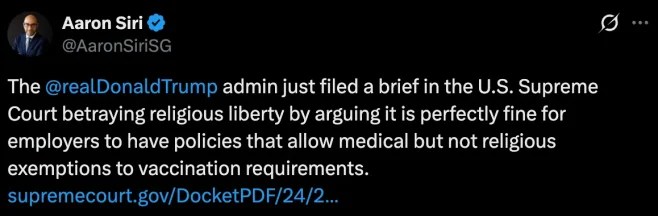
The brief’s analysis hinges on semantics and procedural technicalities. It acknowledges that petitioners claimed New York’s mandate conflicted with Title VII by foreclosing reasonable religious accommodations. Yet it frames their requests as demands for an “exemption” prohibited by state law, rather than the “accommodation” federal law requires.
Siri dismantled this in a follow-up post:
“Instead of defending these wrongfully terminated workers, the DOJ nonsensically and shamefully plays word games to characterize their requests as seeking an ‘exemption’ (which New York law prohibited) instead of an ‘accommodation’ (an option federal law requires). It then relies on this semantic nonsense to argue that the Supreme Court should not review the Second Circuit’s holding that a policy providing for medical but not religious exemptions is legal.”
Siri, who is perhaps the most experienced lawyer defending Americans who experienced COVID-era oversteps of basic liberties and freedoms, described the practical outcome bluntly: the mandate “permitted only a medical exemption and did not include a religious exemption.”
Healthcare workers with sincere religious objections were fired en masse. He continued,
“Having dealt with scores of religious employees in New York that lost their jobs under this policy, the Trump administration’s position is a sharp betrayal. The DOJ should have simply argued the obvious – that Section 2.61 foreclosed any religious exemption and hence should not stand under federal law. Period. That would have taken one or two pages. Instead, it spends over 20 pages creating a word salad of nonsense to justify New York’s and the DOJ’s unjustifiable position.”
This approach is dangerous because it normalizes differential treatment: medical exemptions are permissible, but religious ones trigger “undue hardship” claims tied to state penalties. Under Title VII, as clarified in Groff v. DeJoy (2023), employers must accommodate religious practice unless it imposes substantial increased costs. Yet the DOJ’s brief effectively blesses a regime where religious belief is disfavored, allowing employers to hide behind preempted state rules.
If a law bars religious accommodations outright, Title VII should preempt it—yet here the filing accepts a policy that functionally did exactly that while claiming otherwise.
The stakes extend far beyond healthcare. A Supreme Court denial, influenced by this brief, could embolden employers nationwide to impose vaccine or other medical mandates while dismissing religious objections as unreasonable.
It undermines the free exercise principles reinforced in cases like Fulton v. City of Philadelphia and signals that post-COVID religious liberty battles remain unwinnable in court. Workers facing future mandates—for flu shots, boosters, or novel therapies—would find their faith subordinated to bureaucratic convenience.
Siri’s critique highlights a missed opportunity for the administration that campaigned on restoring freedoms eroded during the pandemic. By playing procedural games instead of forcefully defending Title VII’s mandate to accommodate sincere religious practice, the DOJ risks setting precedent that treats faith as second-class. As Siri warned, this is no minor technical brief; it is a “sharp betrayal” that could erode religious freedom for millions. The Supreme Court must recognize the broader threat and take the case to reaffirm that no employer or state can lawfully force a choice between livelihood and conscience.
Russia warns US against sending more troops to its borders
RT | May 28, 2026
Russia has warned that deploying additional US troops near its borders would be “unacceptable,” after Washington pledged to send more soldiers to Poland.
Russian Foreign Ministry spokeswoman Maria Zakharova said at a press briefing on Thursday that reducing the number of US personnel stationed in Europe would be a “rational, justified, and long-overdue” step toward stabilizing what she described as an “imbalanced” security situation created by NATO policies.
Deploying more American troops in the region, on the other hand, would place them within striking distance, Zakharova added.
She said such a move would only increase tensions in Europe and compel Russia to respond with “military-technical measures.” Zakharova accused NATO of pushing the continent toward a “suicidal” conflict.
Around 10,000 American service members are currently stationed in Poland, most of them on a rotational basis, while roughly 80,000 are deployed across Europe overall. Poland shares a border with Russia’s Kaliningrad Region, an exclave on the Baltic Sea.
Last week, US President Donald Trump unveiled plans to send 5,000 additional troops to Poland, one of the most vocal supporters of Ukraine in its conflict with Russia. The announcement came after the Pentagon said it would delay the rotation of 4,000 troops, which Vice President J.D. Vance later downplayed as a “standard delay.”
Trump has frequently accused NATO members of failing to spend enough on defense and recently announced the withdrawal of 5,000 troops from Germany amid a dispute with Berlin over the war with Iran.
Russian President Vladimir Putin has said Moscow has no intention of attacking NATO members unless Russia itself is attacked first. Russian officials have accused the West of “reckless militarization” and cited NATO’s eastward expansion as one of the causes of the Ukraine conflict.
On Thursday, Sergey Naryshkin, head of Russia’s Foreign Intelligence Service, said NATO was “de facto preparing for a large-scale military conflict in the east.”
Dead Silence: UN, OSCE Ignore Russian Appeals Over Ukraine’s Slaughter at Starobelsk
Sputnik – 28.05.2026
MOSCOW – There has been no response from the UN, the Organization for Security and Cooperation in Europe (OSCE), or other international organizations to Russia’s appeals regarding the Ukrainian strike on Starobelsk, Russian Human Rights Commissioner Yana Lantratova told Sputnik.
Lantratova previously reported that she had sent letters to the UN High Commissioner for Human Rights, the OSCE Secretary General, the President of the UN Human Rights Council, and other international organizations regarding the Ukrainian strike on a college and dormitory in the Lugansk People’s Republic (LPR).
“We sent letters immediately after the tragedy occurred. We have not yet received any response. We are awaiting it, and hope for an objective assessment of these events by the international public… We hope for a response, and moreover, we will send [letters] to all our counterparts in various countries around the world so that people know the truth,” Lantratova said.
On May 22, Ukrainian forces attacked an academic building and a dormitory of the Starobelsk Professional College of Lugansk State Pedagogical University. Twenty-one people were killed and 44 others wounded.
The US Military Keeps Blowing Up Small Boats in the Caribbean and Pacific
By Adam Dick | Peace and Prosperity Blog | May 28, 2026
Suppose a Latin American nation’s military kept blowing up private American small boats in the Caribbean Sea and Pacific Ocean, killing nearly all the United States citizens on them in the process. The Donald Trump administration and a horde of US Congress members would be shouting about terrorism and supporting major responsive military actions. However, the actual perpetrator of the blowing up of small boats in the Caribbean and Pacific since early September has been the US government and the victims have been mainly residents of Latin American nations, so the destruction and killing just keeps going on with little pushback from politicians in Washington, DC.
At The Intercept, Nick Turse is keeping a tally of the ongoing slaughter at sea. He counts, relying on information derived from US government sources, 60 strikes killing 197 people. The number of survivors of the strikes is just six.
This is a killing spree, not an ordinary drug interdiction effort.
The blowing up of small boats started in conjunction with the movement toward a regime change war against Venezuela. The small boats were claimed by the Trump administration, though never with convincing argument, to be part of a supposed grand threat of “narco-terrorism” from the South American country. Even if that argument had some credibility, discerning observers asked: Why were the small boats being summarily destroyed and everyone on board killed instead of more typical actions being taken, such as stopping and searching boats and detaining and arresting people on board?
Come January 3, the US military invaded Venezuela and carried off its president to America. The Trump administration has since been imposing demands on the nation’s government. The war justifying rationale for the US government blowing up small boats had thus come to an end. But, the slaughter at sea has continued nonetheless. The latest strike included in Turse’s tally was on Wednesday. It was the fifth such strike this month in the Pacific and Caribbean. The continuation of attacks on boats and the people on them seems to be either a macabre demonstration of the tendency of a government program to continue even after the reason for its creation is gone or part of the preparation for further intervention abroad.
Featured Video
Seyed M. Marandi: US-Iran War Inevitable: Kuwait and Bahrain May Fall
or go to
Aletho News Archives – Video-Images
From the Archives
USS Liberty Massacre: A Pivotal Moment in the Hostile Takeover of America
By Kevin Barrett | Crescent | Dhu al-Qa’dah 24, 1445
In corporate America, hostile takeovers are commonplace. They occur when an aggressor—a larger corporation or rich individuals—seizes control of a smaller corporation without asking permission.
What few recognize is that the United States itself has been subjected to a hostile takeover. Since the aggressor, the illegitimate settler colony known as “Israel,” is much smaller than the US, the takeover has necessarily been surreptitious.
As of June, 2024, Israel’s gradual takeover of the US has become obvious and undeniable—a proverbial “elephant in the living room.” … continue
Blog Roll
 Aletho News
- Seyed M. Marandi: US-Iran War Inevitable: Kuwait and Bahrain May Fall
- Leaders Condemn Ansarallah Attack on Saudi Arabia While Ignoring Illegal War Against Yemen
- Leaked: Britain’s Covert Iraqi Psyops Network
- Yemeni Armed Forces Warn Airlines Against Using Saudi Airports, Exempt Mecca and Medina
- Iran security chief says powers greater than US tried to conquer Iran but ended in ‘dustbin of history’
- Europe’s mounting social chaos… chickens coming home to roost for proxy war against Russia
- US-Russia Diesel Deal Becomes Massive Defeat for Ukraine
- Hormuz and the Looming Economic Catastrophe
- Dhubab offensive, media blitz and the rapid unraveling of Saudi-backed coalition’s new gambit
- Putin Conveys to Trump Iran’s Vision on Possible Conflict Resolution – Kremlin
- If Americans Knew
- Gaza: Ceasefire Anniversary Marks Year of Failed Promises
- The American Conservative: Mike Huckabee Should Resign
- A C-Section in Shackles: A Palestinian Woman’s Harrowing Birth in Israeli Detention
- ‘He’s Desperate’: AIPAC Begins Spending Against Abdul El-Sayed to Boost Mike Rogers:
- Trump, Hormuz, and the Looming Economic Catastrophe
- For three years, Israel has killed a child in Gaza every 71 minutes – Daily Update
- Israeli forces kill another child in Gaza – Daily Update
- Gaza ceasefire exists in name only, say more than 100 organizations
- Nearly 2 Million in Gaza Need Urgent Shelter Assistance as Winter Looms: IOM Chief Warns
- Suppressing Palestinian resistance: US charity under fire for AI monitoring of Gaza classrooms
- No Tricks Zone
- Germany’s Green Energy Debacle: High Energy Costs Force Kahla Porzellan to Close After 182 Years!
- New Study: 50 Years Of The Most Aggressive ‘Net Zero’ Policies Can Only Affect The Global Climate By 0.03°C
- US September “Heat” Was No Record…Many Records Set Decades Ago
- Latest European Green Energy Debacle; Portugal’s Largest Flagship Solar Park Insolvent!
- Green Energy Debacle: German Expert Professor Fritz Vahrenholt Warns Of Severe Economic And Social Consequences
- Two More Paleo Reconstructions Affirm Meters-Higher Sea Levels Across Ireland, Brazil 7000-6000 Years Ago
- New Study: Earth And Venus Surface Warmth Largely Explained By Convection And Lapse Rate, Not CO2 Or Radiation
- 2025 Nature Paper Claiming Worsening Global Drought Gets RETRACTED …Heavily Flawed
- New Study: ‘Global Drought Shows No Detectable Recent Acceleration Under Climate Warming’
- Economic Masterminds: German Socialists Suggest Taxing Productivity Gains Stemming From Using AI

