A Nation of Suspects
By Andrew P. Napolitano | Ron Paul Institute | May 28, 2026
Some of the recent legal challenges to the use of surveillance by the Department of Homeland Security upon Americans have resulted in the revelation of truly terrifying behavior by the government, in direct defiance of the Fourth Amendment to the Constitution. We now know that the federal government spies on innocent Americans without suspicion and without warrants.
The spying seems to fall into several categories. The National Security Agency, which is in the Department of Defense, employs about 60,000 domestic spies. These are the folks who want us to believe that they go through the trouble of making applications to the Foreign Intelligence Surveillance Court for warrants to spy on foreigners.
Actually, from time to time they do go to this court, but their travels there — where judges are frisked upon entering and leaving the courthouse by the NSA agents who appear before them — serve as fig leaves for their massive warrantless spying on Americans. The FISA Court is unconstitutional because it issues warrants based on probable cause of communicating with a foreign person, rather than on probable cause of crime as the Fourth Amendment requires.
The courts have ruled consistently since the 1960s that spying — surveillance, as the feds call it — is a search, and the capture of data from a surveillance is a seizure.
The Fourth Amendment protects all persons in America — not just Americans — from warrantless searches and seizures of their “persons, houses, papers, and effects.” There are some well-recognized exceptions to this constitutional baseline, such as evidence that will quickly vanish or be seriously degraded, but those exceptions do not apply here as the NSA captures in real time all keystrokes on all digital devices and all fiber optic data transmitted into, out of and within the United States.
The judges of the FISA Court surely know that the Department of Justice lawyers and NSA agents who appear before them are going through a charade, and the court has been made a part of it. The charade is the pretense that all spying is done pursuant to the warrants that FISA Court judges issue. Former NSA agents have revealed publicly that this is hardly the case.
Nevertheless, the lowered standard from probable cause of crime to probable cause of communicating to a foreign person was crafted by Congress — in another of its many moments heedless of the Constitution. After a few years of this, the FISA Court began to issue warrants for spying on the Americans who communicate with foreigners, out to the sixth degree. A sixth grader can do the math, as this leads to hundreds of millions of Americans whose communications are captured.
A second category of spying is employed by the DHS. The DHS — now a 250,000-person strong federal police department nowhere countenanced by the Constitution — has sophisticated software that can read fingerprints at 15 feet and irises at 15 inches. So, if you wave goodbye or good riddance to an ICE agent, and he holds up his mobile phone, and you are in the federal system for any benign reason, he has captured your bank, health, legal and commercial records on the spot. If he talks to you in your car and is within 15 inches of your face, he can capture the same data.
As if all this were not enough, the feds and local police use a device called a Stingray, which mimics the signal sent to all mobile devices as if the device were being used to communicate. But the communication is just one way, as the Stingray will tell the government where the person possessing the mobile device is at any given moment. This, too, is a seizure of private personal information — the contents of the computer chip in your mobile device — which the Fourth Amendment characterizes as an “effect.”
And then there is the FBI, which now uses zero-click software. This permits agents without warrants or even approval of their superiors to engage in computer hacking without having to trick the hacked victim into clicking on a link. Computer hacking is a felony.
All of this surveillance is unconstitutional, dangerous and commonplace. It consists in the use of surveillance and law enforcement tools without articulable suspicion.
For 600 years, articulable suspicion — the lowest evidentiary standard we have — has been the baseline for all government behavior that targets an individual. Articulable suspicion is the fact-based ability to state why a person — not a group — should be targeted and for what crime. This is the same standard that must be met when police stop someone in public.
Anything less than articulable suspicion is a fishing expedition; stated differently, a general warrant. General warrants — which were used by British agents on American colonists — permitted the agents to stop anyone, to search anywhere and to seize anything without articulable suspicion. The Fourth Amendment outlawed them.
How did we get from a Constitution that assumes that the individual is sovereign, our rights are natural and inalienable, and the government may only legally do what the governed have affirmatively authorized it to do to where we are today? The answer is fear. Fear is the great tool for authoritarians — fear of foreigners, fear of war, fear of crime, fear of drugs, fear of terror. When people are afraid, they will allow the government to take liberty in return for a promise of safety.
Of course, liberty once surrendered is never returned. But liberty is individual, not collective. You can surrender your liberty and your neighbors can surrender theirs, but none of you can surrender mine. These values are what animated Thomas Jefferson in the Declaration and James Madison in the Bill of Rights. Those animations seem like ancient history today. On the eve of America’s 250th anniversary, the Founders would not recognize this country of no values where everyone is a suspect.
To learn more about Judge Andrew Napolitano, visit https://JudgeNap.com.
COPYRIGHT 2026 ANDREW P. NAPOLITANO
DISTRIBUTED BY CREATORS.COM
The Popular Scapegoats: How Israel Is Pushing Its New ‘Bad Apples’ Hasbara Strategy
By Robert Inlakesh | Palestine Chronicle | May 28, 2026
A revived attempt to scapegoat a handful of Israeli officials for the crimes of its entire regime structure has again taken off, especially in light of the recent diplomatic fallout over Israeli Security Minister Itamar Ben-Gvir’s public humiliation of Gaza aid flotilla activists. The idea behind this Hasbara campaign is to normalize Israel’s actions.
When Itamar Ben-Gvir posted the video of him mocking the brutal treatment that foreign activists were being subjected to – after being kidnapped in international waters – entitling it “welcome to Israel”, it understandably triggered a diplomatic firestorm. However, the Western leaders who summoned their envoys in response haven’t dared to address the treatment of the activists, including their own citizens, since.
All of this begs the question as to how much authenticity came along with these stances. One point of note is that even Israeli Prime Minister Benjamin Netanyahu joined in with the chorus of condemnation, as did his Foreign Minister Gideon Sa’ar and others. Since that time, at least 15 activists who were part of the latest Global Sumud Flotilla have accused the Israeli military of committing different forms of sexual assault against them, including rape.
The widespread weaponization of sexual violence by the Israeli military and security forces is no new phenomenon, yet it has occurred at a markedly higher frequency over the past few years, and it is something that has solely occurred to international peace activists. Instead, the Israelis have been proven to have implemented a systematic campaign of sexual violence against Palestinians, in particular those who are held hostage in military detention centers and civilians who have been detained in Gaza.
UN and human rights reports, eye witness testimonies, victim accounts, even video and photographic evidence, have all been presented to support the conclusion that sexual violence, including rape, has been used in unprecedented ways against the Palestinian civilian population. Despite all of this, the only mainstream corporate media outlet in the West that dared report on the issue was the New York Times, in a piece that addressed the issue years too late.
These same Western governments have not followed up the summoning of their envoys with any solid action, nor have they made a deal about the testimonies of sexual assault against activists who were kidnapped in international waters. Now, a coordinated media push, within which the Israeli President, Isaac Herzog, has recently participated, seeks to play the “bad apples” public relations strategy.
Smotrich and Ben-Gvir have become popular scapegoats, used to hide a society behind them that supports almost everything they do, even if they seek to be more well hidden. The overwhelming majority of the Israeli public supported their military committing genocide.
In fact, things are so bad that the 10 Israeli soldiers who were accused of gang raping a Palestinian hostage have now become celebrities in their society. Israeli comedians make jokes about the rape of Palestinians with dogs, Israeli politicians openly defend such despicable behavior, and there were even the infamous “right to rape” protests when soldiers were temporarily detained for the acts they committed.
The gang rape incident was not just alleged; it was caught on film and leaked. In the end, all of the Israeli soldiers who committed the violent rape got off scot free. The Israeli military’s top lawyer, who had leaked the video of the incident, something that forced the arrest of the perpetrators, ended up getting arrested herself, resigning from her job, and then made at least two suicide attempts following a string of death threats.
Itamar Ben-Gvir did not sexually assault those 15 activists; it wasn’t Bezalel Smotrich who convinced Israeli society to turn gang rapists into heroes and place them on public television shows. Israel has a citizen army and is a society built around a military culture.
When others try to scapegoat Benjamin Netanyahu, something that you will hear from Western liberals and mainstream Democrats, this, too, is disingenuous. According to polling data, a plurality of Israelis dislike the current Premier, which means it isn’t him that is to blame for the vast majority of Israeli citizens supporting the genocide in Gaza, or even worse, advocating publicly for even harsher means of dealing with Palestinian civilians.
It’s also not only Netanyahu that has openly supported the notion of achieving the “Greater Israel” project, his so-called “moderate” opponent, Yair Lapid, has himself publicly advocated the exact same policy– the only difference is that the opposition leader seeks to be more strategic about stealing territory all the way up to and including Iraq.
The reality is, these Western leaders are fully complicit with the Israelis. They only withdrew their summoned diplomatic envoys because Ben-Gvir’s video embarrassed them, robbing them of the ability to lie and cover up Israel’s blatant crimes against the international activists. It took no courage and it would have been more genuine of them to have endorsed the Israeli Security Minister’s actions.
Why? Because many of these nations that summoned their envoys are openly part of the so-called “Civil Military Coordination Center” (CMCC) that was set up to enforce the Gaza ceasefire and prevent violations of it. Instead, these nations have joined a center that watches Israeli war crimes – including the mass murder of over 900 Palestinians during the ceasefire – in real time, refusing to even leave the center in protest, let alone take any action. They are all directly complicit in the genocide.
What this whole ordeal has proven is just how low Western governments and their stenographers in the media will go in order to cover up the crimes of the Israeli regime. No matter what, they refuse to take a stand. If they had grown a backbone, it could have deterred many of the horrors we see playing out today.
– Robert Inlakesh is a journalist, writer, and documentary filmmaker. He focuses on the Middle East, specializing in Palestine.
IRGC targets US military base in response to attack on Bandar Abbas
Al Mayadeen | May 28, 2026
Iran’s Islamic Revolution Guard Corps (IRGC) issued a stern warning on Thursday following a US military violation and aggression near the Bandar Abbas Airport, stressing that any further aggression “will not go unanswered.”
In a statement released by its public relations office, the IRGC said the US military launched aerial projectiles at a location on the outskirts of Bandar Abbas before dawn. It added that Iran responded by targeting the US air base from which the attack originated at approximately 4:50 am.
The operation comes as a “serious warning,” the IRGC said, adding that the response was intended to demonstrate that any aggression against Iran would be met with retaliation, warning that any repeat attack would provoke “a more decisive response.”
“The responsibility for the consequences lies with the aggressor,” the statement added.
At the same time, the Kuwaiti military confirmed that “air defense systems are confronting missile and drone attacks.”
During the war, Iran repeatedly warned that any US military base used to launch attacks against its territory would be considered a legitimate target, stressing that while it maintains friendly relations with neighboring countries, it would not hesitate to strike the source of any aggression.
US attacks Bandar Abbas
This comes after the US military targeted the “scorched earth” areas surrounding the city of Bandar Abbas, as explosions were heard across the area without any reported casualties or material damage, according to an Iranian military source cited by Tasnim News Agency.
Shortly after, Iranian media outlets reported hearing three explosions east of Bandar Abbas, with air defense systems activated.
Meanwhile, Reuters quoted a US official as saying that the US military had carried out fresh strikes on an Iranian military site near the Strait of Hormuz and allegedly intercepted several Iranian drones that were deemed “a threat to US forces.”
Similarly, on Monday, the US launched an aggression on alleged missile sites in southern Iran and targeted boats allegedly attempting to lay naval mines in the area, according to the US Central Command.
US tanker forced to retreat from Hormuz following Iranian intervention
In a related escalation, a US oil tanker attempted to cross the Strait of Hormuz overnight after disabling its radar system, but was forced to retreat after the Iranian navy responded swiftly and opened fire on the vessel, Tasnim reported, citing an Iranian military source.
Washington’s continued violations have raised fresh concerns over the stability of the current ceasefire and prospects for a broader regional agreement, with the US yet again bombing Iran in the middle of talks.
Just yesterday, Tasnim reported that progress has been made in talks, particularly on the release of Iran’s frozen assets in Qatar. However, reaching a final formulation of the memorandum of understanding between Washington and Tehran requires resolving outstanding differences, as per the same sources.
They emphasized that the mechanism for announcing the memorandum must be joint, warning that any unilateral announcement by the United States could be “not entirely accurate.”
The initial framework of the proposed understanding includes ending the aggression on all fronts, releasing Iran’s frozen assets, lifting the maritime blockade, and reopening the Strait of Hormuz.
The sources further indicated that, following the implementation of this initial phase, a 60-day negotiation period, extendable, would be allocated to address Iran’s nuclear file.
Strategic rebound: How Iran turned military aggression and economic siege into lasting leverage
By Mohammad Molaei | Press TV | May 27, 2026
The US military aggression and economic strangulation ended in a ceasefire, not because of American goodwill, but because the war objectives failed and the aggression backfired.
This outcome reflects a new strategic reality that emerged during the war itself.
Facing the biggest military assault in its history, with Western and Arab countries complicit in arming and supporting the enemy across multiple fronts, Iran not only avoided strategic collapse but imposed a new balance of power on the battlefield.
Against overwhelming odds and coordinated pressure, Iranian resistance transformed what was meant to be a war of submission into a demonstration of enduring national strength.
What has emerged now is far more than the end of a military aggression against the Islamic Republic. It is the failure of a campaign designed to weaken Iran, isolate it from other nations, drain its economic strength, and ultimately force it into strategic retreat.
Military lessons of the war
In terms of the military, the most telling and self-evident lesson from the war is that the idea of “shaping Iran to crumble quickly” was misguided from the outset. Even after multiple claims by the enemy that Iran’s missile infrastructure, command centers, and launch capabilities had been destroyed, Iran continued its regular military activity, hitting the enemy at will.
Missile and drone operations were carried out multiple times every day during the war. The continuity of launch waves will one day become one of the most compelling pieces of evidence that the backbone of Iran’s strategic missile program has remained completely intact.
This revealed a critical wrong assumption made by both Americans and Zionists: the true extent of Iran’s underground military infrastructure, its depth, dispersion, and survivability.
Much of Iran’s arsenal of rockets, along with the necessary underground launching, storage, and escape facilities, is located in hardened bunker networks built over decades to resist common aerial attacks. Some of the most effective US bunker-penetration munitions are thought to be severely restricted by these heavily fortified facilities.
Operational philosophy: Restraint as strength
Also significant was the implementation of Iran’s operational philosophy during the war. Data has shown that Iran was not as aggressive in its use of its most advanced missiles as is often believed. Several systems discussed for years in military circles were either underutilized or not used at all. This has reinforced assessments that Iran deliberately relied more heavily on older missile stockpiles while carefully managing the timing and intensity of launches.
This has led to reports that Iran deliberately kept some of its strategic missiles in reserve while using older arms with calibrated firing patterns. This approach enabled Tehran to maintain its escalation edge while simultaneously proving sustainability.
Moreover, recent reports and analyses of military forces in the region suggest that systems for launching newer solid-fuel ballistic missiles with dual-stage capsules were not widely deployed, though they could greatly boost launch density in future operations.
Iran mounted extended attacks without fully testing its more sophisticated launch architecture. The size and intensity of future attacks could be far greater than anything seen so far.
The naval dimension: Anti-access and area denial
The naval dimension of the war also revealed a major shift in regional deterrence equations. US carrier groups operated well off Iranian waters on opposite shores, a remarkable caution given the overwhelming power of the American navy.
It has become clear that as Iran has matured its anti-access and area-denial (A2/AD) doctrine, derived from the use of anti-ship ballistic missiles, long-range cruise weapons, drones, and multi-tiered coastal defense systems, the country has imposed a new caution on American operational decisions.
The Khalij Fars and Hormuz missiles, along with newer generations of anti-ship missiles, pose a serious threat to large naval assets in the confined waters of the Persian Gulf and the Gulf of Oman. Notably, these systems were not used during the recent war, indicating that Iran kept its deterrent capacity largely unused – yet visible enough to alter enemy behavior. This restraint sends its own message: what remains in the arsenal is far more capable than what was shown.
Strategic failure: The unraveling of the pressure campaign
Strategically, the most significant event of the third imposed war has been the complete failure of the original political goal behind the military pressure campaign. What its planners envisioned was a war that would trigger internal instability within Iran’s borders, fracture its command structure, undermine its regional cooperation, and ultimately isolate Tehran as a matter of strategy. Prolonged military pressure, they believed, would achieve what decades of illegal and crippling sanctions could not.
Not a single one of these goals was realized. The Iranian state machinery was not fractured. Continuity of command was maintained. Regional ally networks remained not only intact but operationally effective. In fact, the war produced the opposite effect on multiple fronts.
The war reinforced Iran’s broader strategic narrative across the region that military pressure alone cannot force Tehran into capitulation.
Diplomatic implications: A unified front that never formed
The results carry significant implications for diplomacy as well. Perhaps the most obvious fact to emerge from the war is that Iran successfully thwarted the establishment of any unified international body arrayed against it.
Despite a heavy Western political and military campaign coordinated with Israeli objectives, large portions of the Global South refused to align with the escalation drive against Tehran.
Several regional governments actively worked to defuse the crisis rather than escalate it. Major powers like China and Russia remained opposed to wider international isolation measures. Even among Western allies, growing concerns emerged regarding the risks of uncontrolled regional escalation, energy disruption, and maritime insecurity.
This deep division inhibited Washington from fashioning the kind of new global pressure architecture against Iran that it has typically pursued during past crises – from nuclear non-proliferation to regional security frameworks. The coalition that was meant to isolate Iran found itself isolated instead.
Economic dimension: Sanctions undermined, energy leverage preserved
The economic goal of the unprovoked war was another expected outcome that was not met. During the war, the economic disruption that many external observers had anticipated became totally muted. Iran continued exporting energy and maintaining its internal markets and logistics throughout the war, despite pressure on infrastructure and the weight of sanctions.
Remarkably, the US-Israeli aggression and Iranian retaliation revealed the fragile nature of the global energy system when it comes to instability involving Iran. The mere threat of escalation at the Strait of Hormuz triggered an immediate reaction from the international community, precisely because of the waterway’s critical importance to global oil supply.
Tehran’s inability to be isolated without sparking international ramifications was reaffirmed by the facts, not least of which are Iran’s deep ties to the region’s energy landscape and its central role in maritime security.
Industrial adaptation: War as a catalyst for expansion
The swift pace of the industrial adaptation process was another crucial factor in the recent war. Based on domestic sources and analyses from military-affiliated institutions, the rate of missile production had already dramatically increased after the 12-day war in June last year, and the recent war only accelerated and extended it even further.
Iran possesses a widespread defense industry, and even if aggressors succeed in targeting its production facilities, these are interdependent in such a way that they can localize supply chains and establish underground production lines.
Far from halting production and launch capabilities, the latest war has spurred strategic investments in survivability, redundancy, and high-volume output.
Political triumph: The narrative that collapsed
Among the more significant political considerations, this war represents a significant triumph for Iran, given the failure of the central narrative that Tel Aviv and Washington had been aggressively pushing for decades.
Their premise was that continued military, economic, and diplomatic pressure would eventually bring Tehran to the end of its rope, forcing it to “sit at the table” to negotiate strategic concessions.
Instead, the war proved to be another confirmation of the reverse: Iran under pressure continues to function, possesses the capacity to retaliate, and maintains domestic and governmental strength and unity. Most importantly, it has survived the encounter with its ability to influence regional affairs completely intact.
This is not to suggest that Iran was unaffected or bore no costs. Wars come with severe costs. But strategic results are not determined solely by the scale of damage. They are determined by the ultimate success or failure of political and military objectives.
The new regional reality
In this respect, there is growing evidence that Iran’s opponents found themselves baffled by the outcome. A campaign designed to diminish Iranian deterrence ended up confirming much of it.
A policy aimed at isolating Iran was met by a pressure strategy that ultimately promoted de-escalation with Tehran and prevented tensions from proliferating across the region.
What emerged instead were increased challenges and the risk of direct confrontation with a long-established regional power armed with deep missile stockpiles, rugged supply chains, and a mature asymmetric warfare doctrine.
The lessons that have become clear on the battlefield, in regional negotiations, and in energy calculations leave Iran poised to enter the post-war era with strategic gains and enhanced leverage.
Empire with a Humanitarian Face: Democrats Rebrand
By Matt Wolfson | The Libertarian Institute | May 27, 2026
American political successions in recent years happen counterintuitively: implicit hand-offs between two nominally opposing sides. This strange reality is where we derive our notion of “the uniparty” and the media its notion of “partisanship.” Through the “partisan” lens favored by media, our politics appears divided between a party, the Republicans, in hock to Israel, the “big five” weapons contractors, real estate, Wall Street, and Silicon Valley; and a party, the Democrats, in hock to powerful “progressive” or “Left” nonprofits like ActBlue, the Southern Poverty Law Center, the Center for American Progress, and the Open Society Foundations.
But the “uniparty” theory of the case shared by many politically disenfranchised Americans is a more accurate read of our political reality. Indeed, Democrats are as in hock to corporate and military interests as Republicans, and the newer “New Democratic” Party they are promising as a replacement to Donald Trump is his mirror image—there to serve the same interests under a different and deceptive cultural guise. Tracing the development of the modern Democrats from the late 1980s and early 1990s, and how that development shapes them today, shows that every sector of the party—from “neoliberals” to “progressives” to the Left—is de facto arbitered by military corporate interests which determine its policies and propaganda.
The initial cooption of Democrats by the military-corporate complex forty years ago is a familiar story, but largely one told by the political Left which is loyal to those economic groups left behind by this cooption, and largely unfamiliar to Americans at large. The story, which I have traced in part in past reports for the Libertarian Institute and elsewhere, goes something like this. In the 1970s and the 1980s, financiers used their influence to underwrite philanthropic ventures in New York City that gave them access to institutional and then political power at the expense of unions and activists—a top-down model of consolidating authority that they then transferred to the Democratic Party at large. During these years, what the scholar Dylan Gottlieb calls “a new generation of politicians and donors — people like Gary Hart, Chuck Schumer and Bruce Wasserstein,” took over the mantle of Democratic politics. In 1992, Michael Steinhardt and Al From at the Democratic Leadership Council and Martin Peretz and Leon Wieseltier at The New Republic along with David Geffen and Jeffrey Katzenberg in Hollywood created the platform for Bill Clinton. In 2008, Penny Pritzker, George Soros, and House Speaker Nancy Pelosi, with help from sympathetic media like S.I. Newhouse’s and David Remnick’s New Yorker, created the platform for Barack Obama.
These financial and political and journalistic and policy operators quietly refocused the Democratic Party to depend on corporations, so that “Goldman Sachs employees and their families donated more to Bill Clinton’s…campaign than any other firm” and “Barack Obama…raise[d] more money from Wall Street lawyers and law firms than any presidential candidate in history.” During both administrations, government largesse flowed accordingly. Under Clinton, the fifty major weapons contractors were condensed, based on Pentagon pressure, into the “big five,” with a lock on government contracts, and under Clinton and Obama these companies made their bones off of a spate of interventions or proxy fights abroad: in Bosnia, Kosovo, Afghanistan, Iraq, Libya, and Syria.
Under Clinton, Wall Street investment banks and Silicon Valley technology companies also consolidated based on government backing and thrived off alleged “deregulation.” And under Obama these corporations further concentrated, so that 2015, the penultimate year of Obama’s presidency, was “the biggest year ever…in worldwide dealmaking…not just for the total value of the deals but for the number of so-called mega-deals, which refers to any deal that exceeds $5 billion.” The structural legacy of the Democratic Party since the end of the Cold War, then, is political dependency on those very military corporate networks which Democratic rhetoric would seem to belie.
A surprising and instructive place to begin tracing these networks and their priorities as well as their distance from Democratic rhetoric is the pages of The Wall Street Journal, which has recently become a favorite gathering space for neoliberal or “business-friendly” Democrats. This is surprising because it was not thirty years ago that the Journal’s op-ed pages were leading the crusade for the impeachment of Bill Clinton. It is instructive because today some of Clinton’s most prominent allies are appearing in them. Indeed, on three days at the end of April (20th, 22nd, and 23rd), the pages ran op-eds by Clinton’s defender during his impeachment as well as Jeffrey Epstein’s close friend, Alan Dershowitz (“Why I’m Becoming a Republican); by Clinton’s Secretary of Housing and Urban Development, Andrew Cuomo (“Trump is on the Right Track in Renewing Penn Station”); and by Clinton’s Deputy Chief of Staff and a possible contender for the Democratic presidential nomination in 2028, Rahm Emanuel (“Trump’s research cuts play into China’s Hands”). These op-eds nicely encapsulate the three political pillars of Democrats’ military corporatism as they have practiced it since the 1990s: reshaping their key voting constituency; funding monopolist development projects; and hinging America’s future on conglomerates’ relationship to China.
Dershowitz assigns his move to Republicans to what he calls Democrats’ abandonment of both Israel and of “moderation,” both of which he hopes the party re-finds:
“… perhaps they’ll wise up and move back to the center, where I (and others) could rejoin [them].”
This “center” was a concept first successfully articulated via the Democratic Leadership Council and Bill Clinton’s 1992 campaign platform the “New Covenant” or the “New Choice” or the “Third Way.” Whatever its name, it was a platform which, thanks to the ministrations of the political strategists Stanley Greenberg and James Carville, “redrew our political map” by “help[ing] to shift the Democratic Party away from the unions, Black Americans and urban bosses of the New Deal coalition and toward the interests of metropolitan professionals.” The political economic focus of this “New Democratic” Party adjusted accordingly, based off the urban development ethos of Michael Steinhardt, now embraced by Cuomo in his Wall Street Journal op-ed. It was Steinhardt along with a roster of other financiers and Steinhardt’s protégé Michael Bloomberg who, as I reported for the Libertarian Institute in October, used government largesse towards financiers and philanthropy to change the landscape of New York City with real estate development and “public spaces” funded by private money. It was this development which made this city and imitators like Miami and San Francisco playgrounds for tech operators and tourists, while driving out productive industry and the middle class.
This was the most tangible expression of a broader pattern: power percolated to the top of society while alienating the middle and working class and the people at the bottom. And the underwriting engine for these elite operators’ growing power—what kept politically dissatisfied Americans politically inactive in the 1990s and early 2000s even as power slowly concentrated behind the scenes—was a seemingly prosperous economy of low consumer costs based on America’s relationship with China, which Rahm Emanuel in The Wall Street Journal makes the linchpin of our development today. The difference is that, where Clinton did this in the 1990s in the name of importing consumer products and exporting American media, Emanuel does it in the 2020s in the name of government investment in Silicon Valley to compete with China. In the end, these different forms of Chinese-centric policy enrich the same groups via lowering production costs or incentivizing government investment: financiers, technologists, and “the metropolitan professionals” who work for them.
The clearest articulation of the Democratic project of the 1990s as repackaged for 2026 is the “Abundance Agenda”: the brainchild of Ezra Klein, the columnist and podcaster at The New York Times; and Derek Thompson of The Atlantic. The “Abundance Agenda,” as I have reported in the past, is monopolist corporatism dressed up as small government practicality. It is a series of proposals to weaken public and regulatory oversight of tech and urban development projects, from Google’s Waymo cars to Michael Bloomberg’s public parks to various real estate schemes helmed by a small rotating band of connected developers. This is not deregulation for the small business owner; it is deregulation for corporate welfare at the expense of local government, and it is being embraced most energetically by Democratic politicians backed by corporate interests.
These include Daniel Lurie, the Mayor of San Francisco, who is relying on philanthropy from Silicon Valley to “fix” the city; and Ritchie Torres, the self-identified “progressive” congressman from New York. Congresspeople Elissa Slotkin (D-MI), Jake Auchincloss (D-MA), Marie Gluesenkamp Perez (D-WA), Tom Suozzi (D-NY), and Jared Golden (D-ME) are also Abundance supporters. Rising Democratic politicians linked to Abundance or its supporters include U.S. Representatives from New York and California Pat Ryan and Jimmy Panetta; Governors of Virginia and New Jersey Abigail Spanberger and Mikie Sherrill; and former Deputy Secretary of the Air Force and current San Antonio mayor Gina Ortiz Jones. Ryan, Panetta, Spanberger, Sherrill, Ortiz Jones, and Slotkin are former intelligence officers; and Spanberger, Sherrill, and Slotkin are eager adapters of Rahm Emanuel’s defense-tech-friendly policies towards China.
Almost all of these players, along with nationally “electable” Democrats in “red” or “purple” states like Senator Ruben Gallego (D-AZ), Senator Michael Bennet (D-CO), Miami Mayor Eileen Higgins, and Texas senatorial nominee James Talarico, are members of Majority Democrats. According to The New York Times, Majority Democrats is “a new group of elected officials from all levels of government [with] outsized ambitions to challenge political orthodoxies and remake the party” whose “structure resembles that of the Democratic Leadership Council, the once-influential group that successfully pushed the party to the middle in the Clinton era.” One of its strategists is Seth London, who, in a post-2024 election memo, recommended that the Democratic Party should imitate the Democratic Leadership Council and referenced as crucial to the party’s coming success the Abundance Agenda. London’s CV, not surprisingly, is peppered with financial connections, and so is Abundance: among them Michael Bloomberg, Reid Hoffman, James and Kathryn Murdoch, and the Walton Family, along with the lesser-known but influential operators Rob Granieri, Edward Fishman, Mark Heising, and David Nierenberg.
But why is a political economic agenda of billionaires outlined in The Wall Street Journal the most powerful agenda-setter for purportedly “progressive” Democrats? The reason is straightforward. The most powerful constituency of the new Democratic Party as shaped by funders like Michael Steinhardt, George Soros, Penny Pritzker, and Michael Bloomberg is the one constituted of “metropolitan professionals,” or, in the scholar Dylan Gottlieb’s words, “Yuppies,” who staff the corporate conglomerates these operators own. Though the Yuppie constituency does not share the Journal’s cultural values, it does share the Journal’s economic interests; and, at the hands of strategists like Stanley Greenberg and David Axelrod and David Plouffe, this fact has functioned to create a new progressive Democratic definition of “dispossessed.” At their hands, protecting the dispossessed has come to mean expanding “equal opportunity” to various minority groups or ideological interests that might appeal to Democrats’ Yuppie constituents: in other words, combating injustice in ways that do not affect the political economic structures on which Yuppies or their underwriters rely.
Early moves in this direction came with Martin Peretz’s and David Geffen’s push for gay rights before and during the Clinton administration, but the decisive shift came at the hands of David Axelrod and David Plouffe in the run-up to Barack Obama’s 2012 reelection campaign. As the scholars K.C. Johnson and Stuart Taylor explain, “the Democratic defeat in the 2010 midterm elections focused Obama’s attention on how identity politics could rally his base,” and so “the administration took high-profile positions in favor of marriage for same-sex couples, permitting ‘dreamers’ to remain in the United States and mandating contraceptive coverage in Obamacare.” After Obama’s victory in the 2012 election, an overtly identitarian strategy emerged from Obama’s success. In the words of Bill Clinton’s strategist Stanley Greenberg, in his 2018 book RIP GOP: How the New America is Dooming the Republicans, an America that is “secular, racially diverse, and fueled by immigration,” and filled with “non-traditional family structures,” independent women, and “dynamic cities” means the “[Republican] party’s imminent demise.”
Rhetoric on this register reinforced the perception of moral and political stakes at play, even as the reality was politics-as-usual. Indeed, the groups’ progressivism courted were disproportionally upper-middle class (white collar beneficiaries of affirmative action; college-educated women; gay rights campaigners) or they were groups which benefited the upper-middle class (illegal immigration provided cheap labor). And initiatives to help these groups were undertaken predominantly through regulations and lawsuits, empowering administrative agencies, courts, and single-issue nonprofits. Progressivism’s overall effect, then, was to add regulations to the military corporate complex (more bureaucrats at the Pentagon; racial sensitivity training and eco-friendly policies in administrative agencies; formal or informal partnerships between those agencies and the Southern Poverty Law Center or the Open Society Foundations) without diminishing its power. Its unintended effect was to provide Donald Trump fuel against Democrats and Democrats fuel against Donald Trump, since much of Donald Trump’s second term has been devoted to sweeping away these regulations, particularly when it comes to Trump’s ostentatiously deregulated approach to ICE, Israel and AI.
The senior members of the group of Democratic politicians who use progressivism as their spear against Trump are lawyers like Senator Adam Schiff (D-CA) and Representative Jamie Raskin (D-MD). Their “rising stars” include Senator Brian Schatz (D-HI), who is Senate Minority Leader Chuck Schumer’s choice as Schumer’s successor as party leader. Their newer members include Alex Bores, a candidate running on a platform of AI regulation in New York’s 12th Congressional District. And their presidential contenders are Governors J.B. Pritzker of Illinois and Gavin Newsom of California. Schiff, Raskin, Schatz, Pritzker, and Newsom have heavy ties to defense technology and financial industries and (in Newsom’s and Schatz’s cases) to the Abundance Agenda, while Bores is running for U.S. Congress in a district which encompasses much of Manhattan and is home to Michael Steinhardt, Michael Bloomberg, and a number of their allies. All of them oppose the current policies of ICE and Israel, but none of them target the consolidated structures of corporate-government power on which ICE and Israel depend.
It might be supposed that an effective counterbalance to the neoliberal and progressive sectors of the Democratic Party comes from the Left since they seem to focus on questions of political economy like redistribution and antitrust. Indeed, Senator Bernie Sanders (I-VT) put the Left’s program best in 2025 when he said that aggressive promotion of identity politics was “what the liberal elite [tries to do].” In Sanders’s summing up of his own view, “Is every gay person brilliant or wonderful or great? No, of course not, everyone’s a human being. The issue is: what do you stand for? And that gets you back to the issue we discussed earlier: class politics.“ This class-over-lifestyle approach seems like a fairly defined brief for mobilizing poor, working, and middle class voters demonstrably shortchanged by a system run on corporate finance underwritten by government. But the exercise of often decisive military corporatist influence extends even to the most viable standard-bearer of Sanders’s revived Left, New York City Mayor Zohran Mamdani, and candidates running in the 2026 congressional elections on Mamdani’s platform.
Mamdani’s chief political strategist, and the chief political strategist of senatorial candidates Graham Platner in Maine and Dan Osborne in Nebraska, is Morris Katz, whose early political contact, thanks to an introduction from his father, a well-known movie director in Tribeca, was Melissa DeRosa, Andrew Cuomo’s closest aide. Since this initial introduction, Katz has moved away from pure establishmentarianism to combativeness with that establishment over issues like welfare and antitrust, but he and his candidates have not changed their rhetoric, which is reliably universalist. Namely, an appeal to concepts like “politics of humanity” or “dreaming and hope” that vacuum out the political economic context of any situation in the name of “pious uplift.” In the words of Susan Sontag, this perspective “systematically denies the determining weight of history—of genuine and historically embedded differences, injustices, and conflicts” by “purporting to show that human beings are born, work, laugh, and die everywhere in the same way” to suggest “a world in which everybody is…immobilized in mechanical…identities and relationships” that make politics “irrelevant.”
Nowhere is the language of universalism more visible than at the Open Society Foundations, the project of George Soros which, as I have also reported for the Libertarian Institute, spent the 1990s and 2000s reliably “piggybacking” on military interventions executed by Democratic presidential administrations in the name of “universal ideals.” The Foundation’s former Director, Patrick Gaspard, is a close adviser to Zohran Mamdani and the former director of the Center for American Progress or CAP. CAP is funded in part by the Soroses, and it is the brainchild of John Podesta, the influential adviser to Bill and Hillary Clinton. Hillary Clinton is famously the mentor of Huma Abedin, who is now married to Alex Soros: George Soros’s son who now directs the Open Society Foundations.
Based on these connections alone, much of what is said in public by progressive players like Mamdani and Katz begins to seem less relevant: plays in a game to parlay with those Zionists who have a lock on Democratic institutions rather than to meaningfully combat them. And, along these lines, it is not necessarily a coincidence that Zohran Mamdani seems to be embracing aspects of the Abundance Agenda. This may alienate portions of his base (labor unions, environmental groups, anti-gentrification activists) but it appeals to New York’s institutional arbiters. Namely, Governor Kathy Hochul; Congressman Ritchie Torres; The New York Times editorial board; as well as New York City’s police commissioner Jessica Tisch; Tisch’s close friends Ivanka Trump and Jared Kushner, a real estate developer; and President Donald Trump, whose control over federal largesse is necessary for Mamdani’s welfare agenda. Despite differences over welfare policy and rhetoric, the distance from The Wall Street Journal to the pages of the democratic socialist magazine Jacobin, a key supporter of Mamdani’s, is not always so far as it may seem. This criticism is shared by some Leftists themselves: people like the Seattle activist Kshama Sawant, who sees Mamdani courting the universalist and globalist establishment to the detriment of his base in the working class.
There is a particular intellectual style shared across the sectors of this newer New Democratic Party; and its function if not its intent is to distract from questions of who has power and how they are using it. Its guiding concept, a cousin of universalism, is “reason”: in the definition of a recent article in David Remnick’s New Yorker, “to accept that one’s deepest convictions may fail to command assent from others who are no less sincere or thoughtful, and then to propose terms of political coöperation that others can appreciate.” Interestingly, The New Yorker locates its model for public reason in the place most Democrats seem to be locating their new politics:
“Bill Clinton’s… ‘triangulation,’ Tony Blair’s Third Way, and Barack Obama’s insistence on being the most reasonable person in the room.”
These leaders were, indeed, known for their rhetoric, which relied on concepts like “complexity” and “pragmatism.” In practice this meant all-night “grapplings” with “tough issues” of morality or peace; or else detail-heavy and sometimes hyperkinetically minute proposals for “reforming” government, a tactic Rahm Emanuel, an acknowledged master of it in the Clinton White House, has reanimated today. All of this complexity and pragmatism existed under a universalist philosophical veil: the notion that “reasonable people” who all believe in the same undefined abstractions (“human rights” and “democracy,” “hope and change”) can “set aside their differences” and “find common ground” through discussion and debate.
There is a lot of this talk occurring in Democratic circles today. In Morris Katz’s words, politics means “an increased fluency and understanding that we can disagree while being agreeable.” For Rep. Ritchie Torres, it means that “everyone should have a seat at the table, everyone’s voice should be heard, but no one’s gonna have veto power.” For Adam Kirsch in The Atlantic, “the essence of democracy” is “rational discourse” and “thoughtful back-and-forth argument.” For Ezra Klein in The New Yorker, democracy means “building political coalitions around disagreement.” What “reason” or “pragmatism” stands for in this variant is not the formation of public opinion, which as conceived by James Madison would play itself out at the local level on various issues then form a rough consensus throughout the republic based on the free flow of information and debate. What reason or pragmatism stands for in this variant, instead, is elites speaking to elites: a kind of senior debate society of the powerful which functions to elide questions of what actual interests they functionally serve.
Indeed, very few people attuned to Bill Clinton’s or Tony Blair’s or Barack Obama’s administrations would describe them as committed to public reason. Clinton and his political strategists James Carville and Stanley Greenberg were recognized experts at covering electoral bases using stealth emotional triggers, playing to white voters with one hand and black voters with another and splitting the baby on gay rights, while quietly reallocating power to corporate conglomerates and administrative agencies under the aegis of “pragmatism.”
Obama, aided by David Axelrod and David Plouffe, was instrumental in upping the emotional ante of government via identity politics. Gavin Newsom has taken this essentially manipulative approach to an even higher register. He has begun to traffic in criticisms of Republicans using slang like “gay” which is deeply offensive to progressive LGBTQ+ voters but which attracts white men who support Trump, even as he claims to be using this language to “bait” Republican opponents. All the while he is strongly supporting LGBTQ+ rights but making an exception for men’s participation in women’s sports. This is textbook triangulation of a Clintonian kind.
Another Clintonian practitioner is U.S. Senator from Georgia Jon Ossoff, who manages to triangulate between neoliberal center, progressive, and Left. He “supported the Laken Riley Act, an immigration bill written by congressional Republicans that calls for the detention of undocumented immigrants if they are arrested for minor crimes”; he “condemns Trump’s antidemocratic and racist tendencies in a way that excites party activists”; and he “uses Bernie Sanders–like rhetoric to…slam corporations and the super-wealthy. “
What will be the result of a “newer” Democratic Party run along these tried-and-true models? What the last thirty years suggest is an endless bait-and-switch. There has been domestic militarization at home (on black crime and white nationalism) in the name of national security. There have been military interventions abroad (Bosnia, Kosovo, Libya, Ukraine) in the name of human rights. There has been government investment in corporations (the Gramm-Leach-Bliley Act; “free trade” and outsourcing to China; monopolist real estate projects that displace the working and middle class) in the name of “growth.” And there has been “redistribution” (Obamacare, multiple stimulus packages) in the name of human rights and minority advancement. What there has not been is any redistribution of power to legislatures or small business associations or private sector unions or local politics; or an investment in working and middle class independence and productivity. This is a system for institutional “winners,” run by institutional “winners” that operates with the stick of monopolist development and the carrot of government welfare.
An instructively stark lens through which to consider what this system might look like going forward in America comes from “Liberal” Israelis’ Democratic-underwritten policy toward Palestine—not by coincidence, since many of the operators behind America’s modern Democratic Party are Jewish Zionists who, as I have investigated for the Libertarian Institute and elsewhere, succeeded WASPs as arbiters of American institutions forty years ago. In 1993, a year after Clinton’s “triangulation” had won him the White House, he presided over the Oslo Accords between Israel and Palestine. This was arguably the Democrats’ first massive military corporate development project, begun by Clinton and continued by Obama, under the guise of reasoned attention to detail and a commitment to “universal” human rights.
According to Palestinian historian Rashid Khalidi, after the Oslo Accords and despite widespread “euphoria” about them among Palestinians, “conditions grew much worse for all but a very small number of individuals whose economic or personal interests were intertwined with the Palestinian Authority”: what the anti-Zionist Jewish scholar Norman Finkelstein calls “collaboration-building to facilitate a burden-free Israeli occupation.” Under this system, “there were consistent denials of permission to travel and move goods from one place to another as a labyrinthine system of permits, checkpoints, walls, and fences was created.” This was part of a larger process of severing Gaza from the West Bank, which was itself severed from Jerusalem, effectively cleaving the Palestinian territory in thirds. But this was a process partially concealed by a raft of Israeli nonprofits and Israeli corporations that made a presence in the Palestinian territories in the name of “development” and “peace.” Indeed, it was in these years that progressive outlets funded by Soros and Pritzker and other Israeli-linked financiers expanded their commitment to amalgamating Palestinian rights with human rights and LGBTQ+ and women’s rights. This was a version of Yuppie progressivism for the Levant that was put in place even as Palestinians’ sovereignty was being effectively dismantled underneath them.
The overall aim of this process was articulated by Israel’s Liberal Zionist Prime Minister Shimon Peres, who “express[ed] a vision for transforming the Gaza Strip” into a version of the techno-authoritarian city-state of Singapore based on “trade, tourism, and technology.” And now, with the Netanyahu government having spent fourteen years of blockade and three years of genocide strangling Palestinians’ effort at sovereignty via Hamas, Peres’s are exactly the “values” being expressed by Jared Kushner for “remaking” Gaza today. Essentially, Peres’s and Kushner’s plan for Gaza is the Abundance Agenda applied abroad. Its endpoint is the current population being either displaced or forced to turn to low-level service work for corporations underwritten by government in the name of “progress,” “aspiration,” and “enlightenment.” And where America will end up under Democrats is not too different, in broad strokes, than where Gaza will end up under “liberal” Israelis: a techno-corporate “utopia” underwritten by government where uplifting progressive rhetoric and an occasional welfare program disguises the power imbalances underneath. This is not, in any sense, a real alternative to the overt military corporatism of Republicans under Donald Trump. It is military corporatism with a universalist, humanitarian, progressive face.
Defining Dissent: How the Federal Crackdown on Anti-Semitism Redefines the Boundaries of Speech
The Lancaster Patriot | May 21, 2026
A dual-track federal offensive aimed at combating anti-semitism is rapidly altering the landscape of American public discourse, civil rights enforcement, and immigration policy.
The strategy is unfolding simultaneously across both the executive and legislative branches. On May 19, 2026, the Department of Justice (DOJ) Task Force to Combat Anti-Semitism officially launched a 15-city “National Awareness & Action Tour.” Concurrently, Senators Jacky Rosen (D-NV) and James Lankford (R-OK) introduced the bipartisan Jewish American Security Act, a comprehensive bill that seeks to mandate strict Title VI frameworks on college campuses, boost nonprofit security funding to $1 billion, and force social media platforms to disclose their moderation algorithms.
At the core of this sweeping nationwide push is a highly controversial legal mechanism: the codification of the International Holocaust Remembrance Alliance (IHRA) “working definition” of anti-semitism into federal civil rights investigations. By linking this specific definition to Title VI of the Civil Rights Act, federal agencies are increasingly treating political criticism of the State of Israel as potential instances of unlawful discrimination.
The Executive Foundation: EOs 13899 and 14188
The DOJ’s new 15-city tour serves as the public enforcement rollout of two pivotal executive actions spanning two administrations: Executive Order 13899, signed in 2019, and Executive Order 14188, signed on January 29, 2025.
Together, these orders dictate how the federal government defines, monitors, and punishes anti-semitism. EO 13899 explicitly instructs federal departments—including the Department of Education and the DOJ—to “consider” the IHRA definition when adjudicating discrimination complaints. EO 14188 escalated these measures by ordering agencies to utilize “all available and appropriate legal tools” to prosecute violators and aggressively targeted campus protests.
Crucially, EO 14188 directs federal agencies to leverage immigration laws (specifically 8 U.S.C. 1182(a)(3)) to investigate, block entry, or initiate deportation proceedings against foreign students and visa holders who “endorse or espouse terrorist activity” during political demonstrations. It also tasks universities with actively monitoring and reporting the activities of non-citizen students and staff to federal authorities.
The Litmus Test: What Now Counts as a Civil Rights Violation?
Because the IHRA framework is now the operational standard for federal civil rights compliance, public scrutiny has shifted heavily toward the specific “contemporary examples” of anti-semitism outlined in the text.
Under this framework, actions and statements that historically fell under protected political speech, theological debate, or historical revisionism are now systematically flagged for federal review. The specific criteria include:
1. The Nazi Comparison Ban
The IHRA framework explicitly classifies “drawing comparisons of contemporary Israeli policy to that of the Nazis” as an act of anti-semitism.
- The Impact: In practice, this guideline establishes a unique legal standard for the State of Israel. While political commentators, historians, and activists routinely draw analogies between various global governments and 20th-century authoritarian regimes (such as comparing U.S., Russian, or Chinese policies to Nazi or fascist systems), doing so specifically in reference to Israeli military or domestic policy can now trigger a federal civil rights investigation, risking a university’s federal funding.
2. The “Racist Endeavor” Test
The definition labels anti-semitic any claim that “the existence of a State of Israel is a racist endeavor.”
- The Impact: This standard directly intersects with academic and political discussions regarding the geopolitical founding of modern states. Under this rule, analyzing or criticizing the historical displacement of populations during the 1948 foundational period of Israel, or arguing that the state’s structural laws inherently favor one ethnic group over another, transitions from a matter of political theory into a potential violation of federal civil rights law.
3. Placing Historical Atrocities Outside Normal Inquiry
The framework flags “accusing the Jews as a people, or Israel as a state, of inventing or exaggerating the Holocaust.”
- The Impact: The inclusion of the word “exaggerating” introduces an unprecedented legal boundary around historical analysis. Scholars note that every major historical event—including wars, genocides, and revolutions—is subject to ongoing demographic debates, revisions of casualty numbers, and critiques regarding how governments politically leverage historical trauma. Under the federal framework, subjecting this specific historical atrocity to standard revisionist or critical analysis can be interpreted as a civil rights offense.
4. The Codification of Theological Interpretation
The IHRA definition includes “using the symbols and images associated with classic antisemitism (e.g., claims of Jews killing Jesus or blood libel) to characterize Israel or Israelis.”
- The Impact: This provision brings traditional Christian theology and historical textual interpretation into the crosshairs of federal oversight. For centuries, various Christian denominations have maintained specific theological positions regarding the New Testament accounts of first-century Jewish authorities and the rejection of Jesus Christ. If a religious group or individual applies these traditional covenantal critiques or biblical interpretations to the actions of the modern, secular State of Israel, those statements can now be legally categorized as anti-semitic harassment.
5. The “Double Standard” Mandate
The definition includes “applying double standards by requiring of [Israel] a behavior not expected or demanded of any other democratic nation.”
- The Impact: Legal experts have pointed out the extreme ambiguity of this clause. Because there is no objective legal metric to determine whether a protest group or political candidate is demanding “more” from Israel than they do from other nations, this clause gives federal investigators vast discretion to classify selective foreign policy criticism as a discriminatory act.
The Chilling Effect on Domestic Dissent
The combination of the DOJ’s 15-city tour and the newly introduced Jewish American Security Act marks a systemic shift in how the state monitors local communities. The stated objectives of the DOJ tour include “increasing reporting of antisemitic incidents by local officials” and embedding federal oversight directly into K-12 public schools and teacher unions.
Critics from across the ideological spectrum—ranging from civil liberties lawyers to anti-war activists—warn that these measures create a de facto speech code. By utilizing the machinery of the state to insulate a foreign government, its lobbying apparatus, and billions of dollars in annual U.S. foreign aid from severe public criticism, the federal government has effectively created a protected political class under the guise of civil rights enforcement.
How Israel’s Resettlement Demands Shifted Toward Europe
By Jose Nino | Occidental Observer | May 25, 2026
Long before Israel declared independence, Zionist leaders openly discussed what they termed “transfer,” the organized removal of the Palestinian Arab population. David Ben-Gurion, who would become Israel’s first prime minister, stated as early as 1937, “The compulsory transfer of the Palestinians from the valleys of the proposed Jewish state could give us something we never had.” He added, “With compulsory transfer we would have a vast area for settlement. I support compulsory transfer. I don’t see anything immoral in it.”
These pre-state declarations established the ideological foundation that would resurface throughout Israeli political history, eventually extending from proposals to relocate Palestinians within the Middle East to explicit demands that Western nations absorb them.
The 1948 war resulted in the displacement of 750,000 to 1 million Palestinians. Ben-Gurion’s government directed and facilitated this displacement as part of constructing a Jewish-majority state. While the primary expulsion pushed Palestinians into neighboring Arab countries, Western resettlement schemes also emerged during this period.
While serving as Deputy Foreign Minister under Prime Minister Yitzhak Shamir, Netanyahu spoke at Bar-Ilan University on November 16, 1989 and called for mass expulsions of Palestinians: “Israel should have exploited the repression of the demonstrations in China [Tiananmen Square], when world attention focused on that country, to carry out mass expulsions among the Arabs of the territories.” He told the students the government had failed to exploit “politically favourable situations in order to carry out ‘large-scale’ expulsions at times when ‘the damage would have been relatively small.’” He added: “I still believe that there are opportunities to expel many people.” Netanyahu denied the remarks on November 21, claiming he had been misunderstood.
Avigdor Lieberman, then leader of the Yisrael Beiteinu party, first proposed his “Populated-Area Exchange Plan” in 2004. The plan would redraw Israel’s borders to transfer hundreds of thousands of Arab-Israeli citizens, particularly those in the Galilee Triangle region, out of Israel and into a Palestinian state, stripping them of Israeli citizenship. Lieberman reiterated this plan at the UN General Assembly in September 2010, describing it as a “population and territory swap.”
As Foreign Minister in 2014, Lieberman received a classified legal opinion from Foreign Ministry legal adviser Ehud Keinan arguing that a population transfer plan would be legal under international law provided it was consensual. First reported by Haaretz’s Barak Ravid, the document was entitled “Territorial Exchange: Transfer of Sovereignty over Populated Areas” and proposed transferring approximately 300,000 Palestinian citizens of Israel living in the Triangle region—a densely populated area along the Green Line—to Palestinian Authority control in exchange for Israeli annexation of large West Bank settlement blocs.
The ideas Lieberman had spent two decades pushing from the political fringe entered the mainstream of Israeli official discourse after October 7. The Hamas attack on October 7, 2023 triggered an unprecedented wave of Israeli official statements calling for the resettlement of Palestinians outside Gaza, with several explicitly naming Europe and the West as destinations.
In a cross-party op-ed in The Wall Street Journal titled “The West Should Welcome Gaza Refugees,” Danny Danon—the former Israeli Ambassador to the United Nations—and Ram Ben-Barak—the former deputy director of Mossad—called on “countries around the world to accept limited numbers of Gazan families who have expressed a desire to relocate.” They urged Western nations to create “well-structured and internationally coordinated relocation programs” and suggested that “even if countries took in as few as 10,000 people each, it would help alleviate the crisis.” The op-ed explicitly invoked European and American precedents of accepting refugees from prior wars.
Responding to the Danon and Ben-Barak op-ed the following day, Finance Minister Smotrich endorsed the idea in a Facebook post, writing: “I welcome the initiative of members of Knesset Ram Ben-Barak and Danny Danon on the voluntary immigration of Gaza Arabs to the countries of the world. This is the right humanitarian solution for the residents of Gaza and the entire region.” He argued that a “cell with a small area like the Gaza Strip without natural resources and independent sources of livelihood has no chance to exist independently, economically and politically in such a high density for a long time.” At the time, the U.S. State Department condemned the statements from both Smotrich and National Security Minister Itamar Ben-Gvir, with spokesman Matthew Miller calling them “inflammatory and irresponsible.”
In a similar vein, shortly after October 7, Intelligence Minister Gamliel called on the international community to promote “the voluntary resettlement of Palestinians in Gaza, for humanitarian reasons, outside of the Strip.” She argued, “Instead of funneling money to rebuild Gaza or to the failed UNRWA [The United Nations Relief and Works Agency for Palestine Refugees], the international community can assist in the costs of resettlement, helping the people of Gaza build new lives in their new host countries.” She described this as “a win-win solution: a win for those civilians of Gaza who seek a better life and a win for Israel.”
Similar calls came from elsewhere in the Netanyahu cabinet. National Security Minister Ben Gvir called for promoting “a solution to encourage the emigration of Gaza’s residents,” calling it “a correct, just, moral, and humane solution.” He stated, “The emigration of hundreds of thousands from Gaza will allow Israeli settlers to return and live in security.”
After the U.S. State Department condemned these statements, Smotrich doubled down, claiming “more than 70 percent of the Israeli public supports” encouraging emigration, and arguing that Israel “cannot afford a reality where four minutes away from our communities there is a hotbed of hatred and terrorism where two million people wake up every morning with aspiration for the destruction of the State of Israel.” Pushing back on the US State Department, Ben Gvir posted on X, “The migration of hundreds of thousands from Gaza will allow the residents of the [Gaza] envelope to return home and live in security … with all due respect, we are not another star in the American flag.”
The rhetorical positions soon hardened into operational planning at the highest levels of the Israeli defense establishment. Defense Minister Israel Katz announced on February 6, 2025: “I have instructed the IDF to prepare a plan that will allow any resident of Gaza who wishes to leave to do so, to any country willing to receive them.” He explicitly named Spain, Ireland, Norway, and Canada as target destinations, stating: “Countries such as Spain, Ireland, Norway, and others, which have falsely accused Israel over its actions in Gaza, are legally obligated to allow Gazans to enter their territory. Their hypocrisy will be exposed if they refuse.” He separately singled out Canada, noting that it “has a structured immigration program” and had “previously expressed willingness to take in residents from Gaza.” Spain’s Foreign Minister José Manuel Albares rejected the suggestion directly, saying “Gaza is the land of Gazan Palestinians and they must stay in Gaza,” and Ireland similarly rejected Katz’s comments.
Despite the European rebuffs, Netanyahu and the Israeli security establishment pressed forward. In February 2025, Netanyahu endorsed the Trump plan to relocate Gaza’s population, calling it a “remarkable idea,” and told Fox News, “The actual idea of allowing first Gazans who want to leave to leave — what is wrong with that?” The following month the Israeli security cabinet formally approved a proposal from Defense Minister Katz to facilitate “voluntary transfer” for Gaza residents.
In July 2025, Mossad Director David Barnea traveled to Washington to meet with US special envoy Steve Witkoff and formally requested US assistance in convincing countries to accept “hundreds of thousands” of Palestinians from Gaza. He told Witkoff that Ethiopia, Indonesia, and Libya had expressed openness, and asked the US to offer incentives to those countries. The White House was described as non-committal and reportedly told Israeli officials that if Netanyahu wanted to pursue the plan, Israel would need to find willing host countries itself. A few months later Netanyahu discussed plans for “voluntary emigration” at a meeting with senior defense officials and cabinet members. A Defense Ministry plan would allow Gazans to leave by air and sea starting in October 2025.
Other figures in the Israeli right pushed the same logic well beyond Gaza. At a vineyard near Ramallah, presenting his “Colonisation 2030” campaign platform ahead of elections, Smotrich declared, “Destroy the idea of an Arab terror state; finally, formally and practically cancel the cursed Oslo Accords and get on the path of sovereignty, while encouraging migration both from Gaza and from Judea and Samaria. There is no other long-term solution.” This marked the first time a senior minister explicitly extended the emigration demand to the West Bank.
These statements have drawn uniform international condemnation. The US State Department explicitly condemned the January 2024 statements by Smotrich and Ben Gvir as “inflammatory and irresponsible,” stating that “Gaza is Palestinian land and will remain Palestinian land.” Saudi Arabia, the EU, Netherlands, Slovenia, and other states joined in that condemnation. Spain, Ireland, and Norway rejected Katz’s February 2025 demand that they accept Gazans. Human rights organizations including Amnesty International, Human Rights Watch, and BADIL have characterized these plans as constituting ethnic cleansing or forced displacement under international law. While the post-2023 statements frame resettlement as “voluntary” and “humanitarian,” critics and legal experts note that mass displacement carried out under conditions of war and siege cannot meaningfully be called voluntary.
Taken together, these resettlement schemes represent the logical culmination of a long-standing Jewish policy designed to make the world safe for Jewish supremacy, where the systematic exploitation of Western capital and influence serves the dual purpose of clearing the land of Palestine while accelerating the permanent transformation and destabilization of the traditional European heartlands.
How Can the Small Island of Cuba Threaten a Nuclear Superpower? – Cuban FM
Sputnik – 27.05.2026
Cuban Foreign Minister Bruno Rodríguez Parrilla slammed US propaganda portraying Cuba as a threat to the United States, exposing the absurdity of Washington’s narrative.
“Well, just imagine Cuba is a small island, 100,000 square kilometers and 10 million inhabitants. Based on what logic, what would be the common sense behind the idea that Cuba could threaten a nuclear superpower?” Rodríguez Parrilla said.
He also blasted US Secretary of State Marco Rubio for “lying on and on regarding this issue.”
For months, Washington has pressured Cuba’s fuel lifelines — targeting shipments, threatening supply routes, and using economic collapse as a regime-change tool.
Rubio earlier claimed there is “no oil blockade on Cuba,” even though US President Donald Trump bragged that Cuba had “no oil,” “no money,” and “no anything” under the US embargo.
US, Israel root cause of insecurity in region, have no place in its future: Iranian official
Press TV – May 27, 2026
The vice secretary of Iran’s Supreme National Security Council has denounced hostile measures by the United States and the Israeli regime as the root cause of insecurity in West Asia.
Ali Bagheri-Kani made the remarks in a Wednesday meeting with head of the International Security Division at Switzerland’s Federal Department of Foreign Affairs, Gabriel Luchinger, on the sidelines of the 14th International Meeting of High Representatives Responsible for Security Issues in the Russian capital, Moscow.
Bagheri-Kani said the root cause of insecurity and instability in the region is the Israeli regime’s and the United States’ aggressive measures, emphasizing they will have no role in its future.
For his part, Luchinger expressed his deep condolences over the assassination of former secretary of Iran’s Supreme National Security Council Ali Larijani in an Israeli airstrike on March 17, stating that Bern is prepared to cooperate with Tehran to resolve regional and international issues.
The two officials further discussed and exchanged viewpoints on regional and international developments, particularly the fallout of the US-Israeli war of aggression against the Islamic Republic of Iran.
Earlier, Bagheri-Kani met and held talks with Iraqi National Security Adviser Qasim al- Araji.
Bagheri-Kani arrived in Moscow on Tuesday to take part in the international security conference. Besides giving a speech at the event, the Iranian official is expected to meet with several Russian political and security leaders.
The International Security Forum is taking place in Moscow from May 26 to 29, aimed at fostering practical collaboration among nations and facilitating a non-political, thorough dialogue on urgent security challenges.
The forum also features the 14th International Meeting of High Representatives Responsible for Security Issues, a variety of thematic sessions (academic conferences, roundtables, briefings, presentations), as well as bilateral and multilateral meetings and exhibits that display specific projects from relevant Russian agencies and organizations.
Iran TV shows details of unofficial preliminary US-Iran MoU framework
Al Mayadeen | May 27, 2026
The Iranian state television has unveiled a preliminary and unofficial draft memorandum of understanding between Iran and the United States, outlining potential arrangements on maritime activity and regional security.
The draft framework, as per the broadcaster, suggests that the United States would commit to lifting a maritime blockade on Iran. In return, Iran would agree to restore commercial shipping through key maritime routes to pre-escalation levels within one month.
The reported arrangement does not apply to military vessels.
The report also said the draft includes provisions placing the management and regulation of maritime transit routes under Iranian oversight, in coordination with the Sultanate of Oman.
Military base troop status remains unresolved
In detail, the unofficial draft stipulated that the United States would agree in principle to withdraw military forces from areas surrounding Iran, including recently deployed regional assets. However, it added that the status of forces already stationed at established military bases would remain subject to further negotiation.
The Iranian state television further revealed that the draft proposes that, if a final agreement is reached within 60 days, it could be submitted for adoption as a binding United Nations Security Council resolution.
The Iranian state broadcaster added that the understanding reportedly reached in Islamabad remains unresolved and non-final, stressing that Iran would not take any steps without verifiable and tangible confirmation of implementation measures.
US-Iran MoU delayed amid disputes over final wording: CNN
CNNreported earlier on Wednesday that a proposed memorandum of understanding (MOU) between the United States and Iran remains uncertain despite earlier signs of broad consensus among negotiators.
According to diplomats familiar with the discussions, officials involved in the talks still do not know when or where the agreement could be formally signed, even after key language in the draft was reportedly finalized over the weekend.
The report said expectations had risen Saturday after US President Donald Trump held calls with Gulf leaders while negotiators considered the text effectively “locked in”. Regional sources cited by CNN said the understanding was viewed as a potential opening toward ending the war, reducing tensions in the Strait of Hormuz, and paving the way for broader negotiations on Iran’s nuclear program and other disputes.
However, progress appears to have stalled over unresolved wording disputes.
Fragile negotiations
US Secretary of State Marco Rubio said Tuesday that negotiations still required “a couple of days” to settle “disagreements” over a “word or sentence.”
Speaking during a visit to India, Rubio said talks were continuing in Doha and remained centered on “specific language in the initial document,” while insisting that an agreement could still be reached within days despite renewed military escalation.
“The president’s expressed his desire to make it. He’s either going to make a good deal or no deal,” Rubio said, referring to Trump.
The report noted that delays have increased concerns among regional actors who fear the talks could collapse in a manner similar to previous failed diplomatic efforts between Washington and Tehran.
CNN also cited tensions during earlier contacts involving US Vice President JD Vance in Pakistan last month, when Iranian negotiators reportedly accused Washington of altering agreed terms after discussions had advanced.
Mounting pressure
The ceasefire framework underpinning the negotiations has meanwhile entered its eighth week amid mounting regional strain, including renewed instability in the Strait of Hormuz, Iranian warnings of retaliation following recent US attacks, and escalating Israeli aggression against Lebanon.
The latest tensions come after US Central Command confirmed that American forces carried out strikes in southern Iran on Tuesday, claiming the attacks were conducted “in self-defense” during the ongoing ceasefire period.
At the same time, tensions surrounding the Strait of Hormuz have continued to intensify after Iran moved to restrict traffic through the strategic waterway in response to US-Israeli aggression.
The report added that international and regional pressure to secure the agreement and prevent further escalation continues to intensify as energy markets and shipping routes remain exposed to the risk of wider conflict.
“A few words or sentence even on a ‘locked in’ MOU is unlikely to give him everything he wants,” CNN wrote, referring to Trump’s efforts to present the agreement as a diplomatic breakthrough.
India-Israel-UAE: An Alliance of Many Anxieties
By Salman Rafi Sheikh – New Eastern Outlook – May 27, 2026
The I2U2 — that much-heralded “West Asian Quad” of India, Israel, the UAE, and the United States — is gathering dust. Launched with fanfare in July 2022 and billed as a transformative framework for regional integration, it has produced little of consequence since its inaugural summit.
Progress stalled through 2024, and its April 2025 revival dialogue in New Delhi was notably described as the first convening of the group in almost two years. Without sustained American engagement, the scaffolding has simply collapsed. What remains, however, is something more durable and more troubling: an informal troika of Israel, the UAE, and India, joined not by shared ambition but by a shared phobia.
Three States, One Obsession
Strip away the diplomatic pleasantries, and the organic glue binding Jerusalem, Abu Dhabi, and New Delhi is strikingly similar: each government perceives political Islam — in its domestic and regional expressions — as a foundational threat to its survival. For the UAE, the enemy has a name: the Muslim Brotherhood. Abu Dhabi under Mohammed bin Zayed has treated Brotherhood-affiliated movements as an existential menace to dynastic stability. The Emirati government’s sweeping crackdown on al-Islah, the Brotherhood’s local affiliate, was driven by the calculation that political Islam of any kind is fundamentally threatening to government security. The UAE formally designated the Muslim Brotherhood a terrorist organisation in 2014, backed the military coup in Egypt, led the 2017 blockade of Qatar, and as recently as January 2025, blacklisted eleven individuals and eight UK-based organisations linked to Brotherhood networks. This is not counterterrorism policy in any conventional sense; it is a preemptive war on political pluralism dressed in security language.
India’s version of the same anxiety plays out along the Hindu-Muslim fault line. Anti-Muslim sentiment has intensified systematically since 2014. India’s 200 million Muslims — the world’s third-largest Muslim population — have faced demolitions of homes, discriminatory citizenship legislation, and a political atmosphere. The BJP government has systematically reframed domestic Muslim political life as a security threat, deploying counterterrorism law against peaceful dissent. If the UAE fears a Brotherhood-style capture of the state, India fears the democratic agency of its own largest minority.
Israel’s specter is Palestine. More precisely, it is the impossibility of indefinitely suppressing Palestinian political self-determination without a cost to legitimacy. For all three governments, the language of “counterterrorism” functions as a tranquilizer: it sedates domestic dissent, silences international criticism, and transforms political opponents into security threats. This shared grammar of repression is the true foundation of the troika.
While tackling these internal and regional threats remains a key imperative, the most recent push to revive the alliance, even without Washington being a formal member, is Iran and the still ongoing Iran war.
From Phobia to Alliance: Iran as the Accelerant
If political Islam is the ideological glue, Iran is what has now hardened this informal troika into something resembling a war coalition. Following the US-Israeli strikes on Iran that began on February 28, 2026, the theoretical alignments of the Abraham Accords era became operational reality. Iran retaliated by targeting Gulf infrastructure, firing some 550 ballistic and cruise missiles and more than 2,200 drones at the UAE, making it the most targeted country in the region, including Israel. In response, Israel did something unprecedented: it deployed an Iron Dome battery, Israeli troops to operate it, and reportedly also its cutting-edge Iron Beam laser defence system and Spectro surveillance technology to Emirati soil. The Financial Times reported that Israeli military personnel on the ground in Gulf states were “a not insignificant number”. Emirati officials, reflecting on who came to their defence, reportedly said: “It was a real eye-opening moment. To see who our real friends are.”
The Abraham Accords, signed in 2020, were partly motivated by a shared perception of the Iranian threat. What the 2026 conflict has done is strip away all residual ambiguity about what that means in practice. The UAE allowed its territory and airspace to be used by Israeli and American forces for strikes on Iran, according to Iranian officials. The Israeli Air Force carried out strikes in southern Iran during the war to neutralize short-range missiles threatening Gulf states. Abu Dhabi and Jerusalem are no longer strategic partners in aspiration; they are military partners in fact. The dream project of dismantling Iran as a regional power, long whispered in the corridors of both capitals, is now an open agenda.
It is in this context that Prime Minister Modi’s May 15, 2026 visit to Abu Dhabi — his eighth trip to the UAE in twelve years — must be read. The visit produced a raft of agreements: $5 billion in Emirati investment pledges, a long-term LPG supply deal, ADNOC access to India’s strategic petroleum reserves, and — most significantly — a formal Framework for the Strategic Defence Partnership covering defence industrial collaboration, cybersecurity, intelligence sharing, maritime security, and joint military exercises. Modi also chose to publicly condemn the Iranian attacks on the UAE and pledged India’s support in maintaining regional peace — a significant departure from the studied neutrality New Delhi had maintained for years. The visit came one day after India had hosted Iranian Foreign Minister Abbas Araghchi, who had openly accused the UAE of being “directly involved” in the US-Israeli war on Iran. The juxtaposition was not accidental; it was a signal about the direction of India’s foreign policy.
Silence Is No Longer a Strategy
For years, India’s position in this triangular relationship was one of studied ambiguity. New Delhi deepened ties with Israel and the UAE while maintaining functional relations with Iran and nominally adhering to the principle of strategic autonomy. That posture is now collapsing under the weight of events.
The contradiction at its heart is Chabahar. In May 2024, India signed a ten-year agreement to operate the Shahid Beheshti terminal, committing $120 million with a further $250 million credit line. This was to be New Delhi’s only viable overland and maritime gateway to Afghanistan and Central Asia that bypasses Pakistan. Iranian Foreign Minister Araghchi has called it a “golden gate” for India’s connectivity ambitions. Yet the US ended its special sanctions waiver for Chabahar in September 2025, and India has been reduced to exploring a temporary transfer of its stake back to Iran to avoid American penalties. Strategic autonomy, it turns out, survives only on American sufferance. Meanwhile, any Indian military technology that reaches the UAE now enters a security ecosystem that includes Israel — meaning India’s new defence partnership with Abu Dhabi is, in practice, an indirect alignment with Tel Aviv.
India now faces a reckoning that its political class has been deferring for years. As the region moves from cold confrontation to hot war, the space for equidistance evaporates. Every arms deal, every investment pact, every public statement condemning Iranian strikes while maintaining silence on Gaza and the West Bank narrows the gap between partnership and complicity. The troika that fear built has a peculiar logic: states drawn together by what they dread at home — Muslim political power in its various forms — will inevitably be pulled toward a shared agenda abroad. For India, the path ahead is less a clear choice than a delicate negotiation — with its own pluralistic traditions, with its new partners in the Gulf and Israel, and with a neighbourhood that offers no easy answers. What happens next will depend not on grand declarations, but on the quiet, unglamorous work of balancing interests without losing sight of the human cost at home.
Salman Rafi Sheikh is a research analyst of international relations and Pakistan’s foreign and domestic affairs.
Featured Video
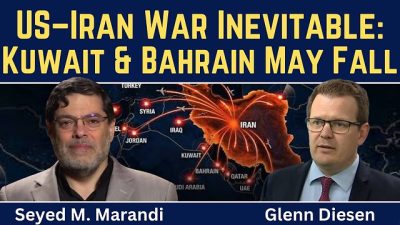
Seyed M. Marandi: US-Iran War Inevitable: Kuwait and Bahrain May Fall
or go to
Aletho News Archives – Video-Images
From the Archives
USS Liberty Massacre: A Pivotal Moment in the Hostile Takeover of America
By Kevin Barrett | Crescent | Dhu al-Qa’dah 24, 1445
In corporate America, hostile takeovers are commonplace. They occur when an aggressor—a larger corporation or rich individuals—seizes control of a smaller corporation without asking permission.
What few recognize is that the United States itself has been subjected to a hostile takeover. Since the aggressor, the illegitimate settler colony known as “Israel,” is much smaller than the US, the takeover has necessarily been surreptitious.
As of June, 2024, Israel’s gradual takeover of the US has become obvious and undeniable—a proverbial “elephant in the living room.” … continue
Blog Roll
 Aletho News
- Seyed M. Marandi: US-Iran War Inevitable: Kuwait and Bahrain May Fall
- Leaders Condemn Ansarallah Attack on Saudi Arabia While Ignoring Illegal War Against Yemen
- Leaked: Britain’s Covert Iraqi Psyops Network
- Yemeni Armed Forces Warn Airlines Against Using Saudi Airports, Exempt Mecca and Medina
- Iran security chief says powers greater than US tried to conquer Iran but ended in ‘dustbin of history’
- Europe’s mounting social chaos… chickens coming home to roost for proxy war against Russia
- US-Russia Diesel Deal Becomes Massive Defeat for Ukraine
- Hormuz and the Looming Economic Catastrophe
- Dhubab offensive, media blitz and the rapid unraveling of Saudi-backed coalition’s new gambit
- Putin Conveys to Trump Iran’s Vision on Possible Conflict Resolution – Kremlin
- If Americans Knew
- Gaza: Ceasefire Anniversary Marks Year of Failed Promises
- The American Conservative: Mike Huckabee Should Resign
- A C-Section in Shackles: A Palestinian Woman’s Harrowing Birth in Israeli Detention
- ‘He’s Desperate’: AIPAC Begins Spending Against Abdul El-Sayed to Boost Mike Rogers:
- Trump, Hormuz, and the Looming Economic Catastrophe
- For three years, Israel has killed a child in Gaza every 71 minutes – Daily Update
- Israeli forces kill another child in Gaza – Daily Update
- Gaza ceasefire exists in name only, say more than 100 organizations
- Nearly 2 Million in Gaza Need Urgent Shelter Assistance as Winter Looms: IOM Chief Warns
- Suppressing Palestinian resistance: US charity under fire for AI monitoring of Gaza classrooms
- No Tricks Zone
- Germany’s Green Energy Debacle: High Energy Costs Force Kahla Porzellan to Close After 182 Years!
- New Study: 50 Years Of The Most Aggressive ‘Net Zero’ Policies Can Only Affect The Global Climate By 0.03°C
- US September “Heat” Was No Record…Many Records Set Decades Ago
- Latest European Green Energy Debacle; Portugal’s Largest Flagship Solar Park Insolvent!
- Green Energy Debacle: German Expert Professor Fritz Vahrenholt Warns Of Severe Economic And Social Consequences
- Two More Paleo Reconstructions Affirm Meters-Higher Sea Levels Across Ireland, Brazil 7000-6000 Years Ago
- New Study: Earth And Venus Surface Warmth Largely Explained By Convection And Lapse Rate, Not CO2 Or Radiation
- 2025 Nature Paper Claiming Worsening Global Drought Gets RETRACTED …Heavily Flawed
- New Study: ‘Global Drought Shows No Detectable Recent Acceleration Under Climate Warming’
- Economic Masterminds: German Socialists Suggest Taxing Productivity Gains Stemming From Using AI

