Al Jazeera Claims The US-Iran Deal is Done… Not So Fast
By Larry C. Johnson | SONAR21 | May 27, 2026
Notwithstanding the Al Jazeera report, there are still significant areas of disagreement that make a deal between Iran and the US unlikely. The Pakistan-Qatar mediation channel toward a possible memorandum of understanding remains active. But “active” does not mean “settled.” The unresolved center of gravity remains sequencing. The following is based on information I received from a knowledgeable source with access to the negotiations. It mirrors my analysis.
Washington and Israel want Iranian concessions first, while Tehran wants tangible, front-loaded economic and security relief before it gives ground on anything that matters. That is the heart of the present deadlock.
Iran’s position is not theatrical. It is rooted in a clear strategic doctrine: after decades of sanctions, pressure, assassinations, sabotage, and military threats, Tehran will not trade hard leverage for verbal assurances or a memorandum of understanding.
Promises are not enough. Mechanisms matter. Sequencing matters. Asset movement matters. Enforcement matters. The central judgment is this: Iran is not blinking.
Tehran is not operating from weakness, confusion, or desperation. It is executing a highly disciplined strategic posture: firmness on the fundamentals, flexibility on the margins, and careful use of its available leverage across the nuclear file, the Strait of Hormuz, regional alliances, frozen assets, and the Pakistan-Qatar mediation channel.
This is not the behavior of a state preparing for unconditional surrender. Nor is it the behavior of a state recklessly lurching toward total war. It is the behavior of a state converting pressure into leverage — and leverage into economic and security guarantees.
The Nuclear File: Sovereignty Is the Red Line
According to a knowledgeable source, enrichment is not a negotiable bargaining chip. Tehran views enrichment as three things simultaneously:
- A sovereign right;
- A deterrence instrument;
- A domestic legitimacy anchor.
No meaningful quantity of enriched uranium will leave Iranian territory under the present framework. That line is firm.
On weaponization, the assessment is more nuanced. Iran is not presently building a bomb. But it is deliberately preserving the capability to move toward one if it concludes that its survival is at stake.
The phrase “all bets are off” should not be read as an announcement of imminent weaponization. It should be read as doctrine: if Iran faces an existential assault, it will not leave any strategic option permanently closed. That is virtual deterrence — and, at least for now, it is working.
Strait of Hormuz: Tehran’s Non-Nuclear Strategic Lever
The Strait of Hormuz is Iran’s most powerful non-nuclear instrument. The logic from Tehran is blunt: the United States cannot freeze Iranian assets, sanction Iranian exports, suffocate Iranian banking channels, and then expect unconditional maritime passage as though nothing has happened.
Iran’s emerging posture appears tiered and deliberate. Friendly states receive passage. Neutral states are handled selectively. Hostile or adversary-linked shipping will face interdiction, delay, or denial. This is not simply military posturing. Tehran is attempting to convert maritime geography into a regional security architecture based on reciprocity: if Iran’s economy is strangled, the economic arteries of others will not remain entirely immune.
The reported MOU framework involving the Strait appears real: Iranian de-escalation in exchange for sanctions relief, asset movement, and restoration of commercial access. But the sequencing dispute remains unresolved. Iran wants assets released before surrendering maritime leverage. Washington wants compliance in the Strait before releasing assets. As I write this (Tuesday evening eastern time) this issues remains unresolved.
The Drone and Air-Defense War: Contested Skies, Real Costs
The airspace over Iran, the Persian Gulf, and adjacent maritime corridors has become a live drone and air-defense battlespace. Iran’s message is clear: it may not dominate the air domain, but it can make aerial operations expensive, politically visible, and operationally imperfect. Every drone interdicted, every platform forced down, every failed or disrupted operation adds friction. That friction shapes how Washington and Tel Aviv assess the real cost of escalation.
This is deterrence by attrition. Not absolute deterrence. Not total denial. But enough to complicate operational planning and raise the political price of continued pressure.
Frozen Assets: The Economic Core of the Negotiation
The frozen-assets file is not peripheral. It is central. According to a knowledgeable source with access, Iran is demanding immediate movement on approximately $12 billion held through Qatar-linked channels, within a much larger claim that Tehran places at more than $100 billion in frozen overseas assets.
This is the economic heart of the negotiation. Tehran wants asset release as a precondition for meaningful concessions. Washington wants asset relief conditioned on Iranian performance first. Until this is resolved in a concrete, enforceable way — not with vague language or aspirational language — no MOU is likely to hold. Iran is leery of any verbal assurances from the West and does not trust a MOU having been burned previously on this issue after signing the JCPOA.
For Tehran, this is not merely about money. It is about proof of seriousness. If Washington cannot or will not move assets, Tehran will conclude that the negotiation is designed to extract concessions without delivering relief.
Lebanon and Hezbollah: The Detonator Built Into the System
Lebanon remains the most dangerous variable in the entire equation. The diplomatic architecture now being constructed contains a structural flaw, and that flaw runs directly through Beirut. Lebanon is not a side theater. It is the tripwire.
Israel wants continued freedom of operation in southern Lebanon. Iran views Hezbollah as a central pillar of its regional deterrence architecture. From Tehran’s perspective, Hezbollah is not a disposable card. It is non-negotiable. Hezbollah has not agreed to disarm. Israel has not abandoned its operational doctrine. Iran has not agreed to separate the Lebanese file from its broader regional deterrence posture.
The American formula — that if Hezbollah behaves, Israel will behave — is not a guarantee. It is an aspiration dressed up as a diplomatic condition. This means that even a signed MOU between Washington and Tehran could be blown apart by one Israeli operation in Lebanon, or one Hezbollah response, that crosses a threshold neither side can fully control. In fact, Israel has renewed its offensive in Lebanon on Tuesday, but apparently acceded to Donald Trump’s demand to halt bombings of Beirut.
The ground war in southern Lebanon, however, is back on in its full fury, with Israel trying to push beyond the Yellow Line while Hezbollah is scoring major hits on Israeli forces, tanks and vehicles. Netanyahu is facing major pressure from Ben Gvir and Smotrich to expand military operations
Abraham Accords and the Pakistan Variable
Iran’s rejection of the Abraham Accords is categorical. Tehran views the Accords as a U.S.-backed normalization architecture designed to entrench Israeli regional legitimacy while hollowing out the Palestinian cause. Any attempt to fold that architecture into an Iran settlement cuts directly against Tehran’s strategic and ideological position.
The Pakistan dimension is especially sensitive. Islamabad is functioning as a key mediation channel between Washington and Tehran. But pressuring Pakistan to join or support the Abraham Accords while simultaneously relying on Pakistan to carry messages to Tehran creates a structural contradiction. Pakistan understands this. Its public rejection of forced linkage is not diplomatic boilerplate. It is the condition under which Islamabad preserves credibility with Tehran and keeps the mediation channel alive.
Saudi Arabia remains in its established position: no normalization without a credible path to Palestinian statehood. In the current environment, that condition cannot be met.
Three Triggers That Could Blow This Up
The negotiations remain alive because both sides understand the danger of uncontrolled escalation. But there is no strategic trust. The situation remains combustible and highly sequenced. One operational incident could change the trajectory very quickly.
The three most dangerous triggers are:
1. Failure of the frozen-asset transfer mechanism
If Tehran concludes that Washington is blocking relief while extracting concessions, the entire diplomatic framework could collapse.
2. An Israeli operation in Lebanon that crosses Iran’s response threshold
This could force Hezbollah into a major confrontation and pull Iran back into a harder regional posture.
3. Renewed US strikes during the ceasefire or negotiation window
If Iran reads such strikes as negotiation under fire, it is likely to conclude that diplomacy is merely cover for coercion.
Col Doug Macgregor NO DUST NO DEAL, Seems Like We’re Closer to Hot War w/Iran
Daniel Davis / Deep Dive – May 26, 2026
Meet the Convicted Jewish Felon Who Scammed Floyd Mayweather

José Niño Unfiltered | May 26, 2026
Floyd Mayweather Jr., the undefeated boxing champion who retired with a perfect 50-0 professional record and earned over $1 billion in career purses, filed a bombshell lawsuit in May 2026 against his former investment manager Jona Rechnitz, alleging a multi-year scheme to divert approximately $175 million from his accounts. The case has placed renewed scrutiny on Rechnitz, a convicted felon and former federal cooperating witness with documented connections to Orthodox Jewish political and charitable networks.
Mayweather’s complaint, filed in New York state court by attorney Leo Jacobs, names Rechnitz, associate Ayal Frist, Frist Apex Ventures—a Florida-based real estate and investment firm—and Manhattan attorney Alexander Seligson as defendants. The core allegation is that Rechnitz, who began cultivating Mayweather’s trust around 2017 and by 2024 had embedded himself as his investment manager, real estate adviser, and banking liaison, systematically redirected funds to accounts tied to himself and Frist. Mayweather alleges he did not know at the time that Rechnitz had previously pleaded guilty in federal court to honest-services wire-fraud conspiracy, or that a civil judgment in excess of $17.7 million had been entered against Rechnitz in a separate case.
Mayweather alleges that a $7.5 million wire on July 1, 2024 for a 12-month investment to Frist Apex Ventures produced no investment and the money was never returned. The complaint further alleges that $15 million in real estate settlement proceeds were diverted to Frist Apex at Rechnitz’s direction without Mayweather’s authorization— with Seligson allegedly verbally admitting to causing that transfer— that over $8.8 million of a $16.4 million loan on four of Mayweather’s properties was sent to Frist Apex with only $2.5 million reaching Mayweather Promotions, and that $2.1 million of an $8.2 million refinance of a Las Vegas property was directed to Frist Apex without authorization.
The lawsuit also details smaller but equally brazen diversions. Rechnitz allegedly diverted a $1 million deposit Mayweather agreed to pay on a New York property, sending it to a New York jeweler instead, causing the property deal to collapse. Nearly $100 million in Mayweather’s jewelry was allegedly pledged to 2 Miami jewelers for only $13 million, with a substantial portion of the jewelry still in the jewelers’ possession. Mayweather also claims he signed a bill of sale for his Gulfstream jet at Rechnitz’s suggestion with the buyer’s name left blank, and he does not know who purchased the aircraft or where the proceeds went.
Rechnitz’s attorney Morris Missry pushed back forcefully, calling the claims “utterly baseless and refuted by substantial documentary evidence including Mr. Mayweather’s own correspondence.” The defense also threatened to expose Mayweather’s own financial issues, stating that “Mr. Mayweather’s gambling issues, prolific spending habits, monies owed to third party creditors and IRS tax liens and levys, as well as other unseemly behavior will be exposed.”
The relationship between the two men dates back several years. Rechnitz first approached Mayweather at a basketball game, presenting himself as a celebrity jeweler and courtside regular. By 2021, Rechnitz was considered part of the “Money Team”, Mayweather’s entourage, wearing black T-shirts and TMT baseball caps. The relationship deepened through the Mayweather vs. Logan Paul exhibition fight in June 2021, in which Rechnitz organized ticket sales and introduced the EthereumMax cryptocurrency promotion. As recently as May 2025, Mayweather had publicly defended Rechnitz, stating he trusted him.
Long before he entered Mayweather’s orbit, Rechnitz had grown up in a world far removed from boxing. Jona Rechnitz was born into a wealthy, politically connected Orthodox Jewish family based in Los Angeles, California. He attended Yavneh Hebrew Academy, a prestigious private Jewish school, and graduated from Yeshiva University Los Angeles High School in the same class as conservative pundit Ben Shapiro. He later attended Yeshiva University in New York.
His family represents a broader web of Orthodox Jewish political power. His father Robert Rechnitz served as former chair of the West Coast region of American Friends of Likud, the U.S. nonprofit that promotes Benjamin Netanyahu’s political party. Robert also chaired the Iron Dome Congressional Tribute held at the U.S. Senate on February 27, 2013, and served as national finance co-chair for Senator Lindsey Graham’s 2016 presidential campaign. His cousin Shlomo Yehuda Rechnitz is an ultra-Orthodox philanthropist who operates a large nursing home network in California and was identified by the Forward as one of the largest donors to Netanyahu’s reelection campaign in December 2014.
Rechnitz began his career at the U.S. branch of Africa Israel Investments, the international real estate empire owned by Israeli billionaire Lev Leviev—the so-called “King of Diamonds”—where Rechnitz rose to Director of Acquisitions. He then founded his own real estate firm, JSR Capital, and settled on Manhattan’s Upper West Side.
His entire business and social infrastructure was built on Orthodox Jewish community networks. In New York, he partnered with Jeremiah Reichberg, a liaison between the NYPD and the Orthodox Jewish community in Borough Park, Brooklyn. His diamond dealer relationships in Los Angeles were largely within the tight-knit Orthodox diamond industry.
The defining scandal of Rechnitz’s career is the NYPD corruption case. From approximately 2008 to 2016, Rechnitz and Reichberg ran a systematic bribery operation targeting senior NYPD officials. The scheme involved chartering private jets to fly police officials to Las Vegas for a Super Bowl watch party in February 2013—the $60,000 jet included a prostitute as entertainment—paying hotel costs for police officers’ family vacations to Rome, buying expensive watches, and funding home renovations. They arranged for an NYPD counterterrorism squad to provide security for a midtown synagogue following the 2015 Paris attacks outside proper authorization channels. They also arranged for police to shut down part of the Lincoln Tunnel for Israeli billionaire Lev Leviev. In exchange, the officials provided gun license processing favors, parking perks, security details, and general influence within the department.
In 2016, Rechnitz pleaded guilty to conspiracy to commit honest services wire fraud. He became a cooperating government witness whose testimony prosecutors described as “without exaggeration, one of the single most important and prolific white collar cooperating witnesses in the recent history of the Southern District of New York.”
His testimony led to multiple convictions. Norman Seabrook, president of the Correction Officers’ Benevolent Association, was convicted on bribery charges after Rechnitz delivered $60,000 in cash inside a Ferragamo handbag in exchange for Seabrook directing $20 million in union pension money into hedge fund Platinum Partners. Murray Huberfeld, founder of Platinum Partners, was sentenced to 30 months. Jeremy Reichberg was convicted on bribery and related charges and sentenced to 4 years.
Simultaneously, Rechnitz was a major fundraiser for NYC Mayor Bill de Blasio’s 2013 campaign. He testified that he and Reichberg raised over $100,000 for de Blasio’s favorite causes expecting political favors in return. Rechnitz also admitted to doctoring emails from Mayor de Blasio and forwarding them to friends to exaggerate his own importance and influence.
At his December 2019 sentencing, Judge Alvin Hellerstein sentenced Rechnitz to 5 months in prison and 5 months of house arrest, far less than the 20 years he faced, and ordered him to repay up to $10 million to the COBA union. He did not serve a single day in prison for nearly a decade after his 2016 guilty plea. By March 2026, he was re-sentenced to the same 5-month term with a surrender date of May 8, 2026, but has been fighting even that sentence.
After relocating to Los Angeles, Rechnitz’s luxury jewelry business Jadelle faced at least 13 lawsuits from jewelers and creditors. Jewelers Peter Voutsas and Ira Rovinsky filed a joint suit claiming Rechnitz had stolen jewelry worth $7 million that had been consigned to them, pawning it for a fraction of its value. Real estate investor Victor Noval alleged Rechnitz borrowed $2.9 million using diamonds as collateral—diamonds that were allegedly not his to pledge—and then issued checks that bounced. Jeweler Oved Anter, who had consigned $2.8 million in jewelry to Jadelle, alleged fraud in a separate suit, describing Rechnitz’s operations as “one of Jona Rechnitz’s blazing trail of Ponzi scheme frauds.” The FBI investigated the alleged theft or taking by fraud of millions of dollars in diamonds while on consignment with Jadelle, per a U.S. attorney filing.
In 2021, Rechnitz played a central role in the promotion of EthereumMax, a cryptocurrency alleged to be a pump-and-dump scheme. According to a class action lawsuit, Rechnitz provided EthereumMax insiders access to high-profile celebrities willing to promote the token in exchange for payments, allegedly making hundreds of thousands of dollars by liquidating his EMAX tokens when he knew celebrity promotions would temporarily inflate the price. One confidential witness in the lawsuit alleged that Rechnitz “confirmed to CW1 that EthereumMax was a scam.” Celebrity co-promoters included Kim Kardashian, Floyd Mayweather, and Paul Pierce.
Separate from EthereumMax, Rechnitz allegedly organized a ticket resale scheme around the Mayweather vs. Logan Paul fight in June 2021 and subsequent boxing events. Rechnitz solicited a $1.4 million investment from neighbor and landlord Joe Englanoff, promising up to 10x returns from ticket markups, then repeatedly delayed payment and reinvested without authorization into successive fights. In a striking detail documented by the Atavist, Robert Rechnitz placed his hand on a Torah scroll to personally guarantee payment—which never came. Englanoff filed a 2022 lawsuit against both Rechnitz and Mayweather for $15 million in breach of contract.
The Mayweather lawsuit against Rechnitz is the latest in a decade long pattern. Rechnitz has faced lawsuits from jewelers, real estate investors, boxing event organizers, and now Mayweather himself, all alleging similar schemes of gaining trust, redirecting funds, and failing to pay back victims. Despite pleading guilty in 2016, being sentenced in 2019, and re-sentenced in March 2026, he has still not begun serving his sentence.
This uncanny legal immunity underscores the formidable institutional protections that shield figures embedded in Jewish networks. Mayweather spent a lifetime mastering the art of the bob and weave, yet he proved utterly defenseless when faced with the machinations of a Jewish schemer like Jona Rechnitz. Despite his vocal support for Israel and attempts to curry favor with the Jewish establishment, Mayweather found that in this high-stakes game, the house always wins and the age-old axiom holds true: with Jews, you lose.
Ex-Mossad chief threatened ICC prosecutor over Israel war crimes probe
Press TV – May 26, 2026
Former chief prosecutor of the International Criminal Court (ICC), Fatou Bom Bensouda, says former head of the Israeli spy agency Mossad, Yosef Meir Cohen, had threatened her over her investigation into Israeli war crimes against Palestinians.
Bensouda, who served as the ICC’s chief prosecutor from 2012 to 2021, revealed on Tuesday that Cohen pressured her to abandon a war crimes investigation targeting leaders of the occupying regime.
She stated that between 2017 and 2021, Cohen met with her twice, once in Munich and once in New York City, where he explicitly demanded that she halt the probe.
According to Bensouda, Cohen subjected her to “threats and pressure,” which also extended to members of her family.
She added that she did not receive sufficient support from ICC member states to withstand Israel’s pressure. The situation later escalated, she said, to include indirect threats against her family, including the tracking of her husband and the collection of information about him in an attempt to influence her decisions.
Bensouda reported the Israeli threats to Dutch authorities but said she did not receive adequate protection.
She stressed that the ICC must continue its work despite pressure from the United States and Israel, insisting that justice should not be shaped by political interests.
On November 21, 2024, the ICC issued arrest warrants for Israeli prime minister Benjamin Netanyahu and former war minister Yoav Gallant over war crimes and crimes against humanity committed against Palestinians during the regime’s genocide in Gaza, which began on October 7, 2023.
On February 6, 2025, the administration of US President Donald Trump sanctioned several ICC officials over the court’s investigations into war crimes committed by US forces in Afghanistan between 2001 and 2021, as well as war crimes committed by Israel in Gaza since October 2023.
Trump advances his Arctic strategy
Washington will have many difficulties implementing its plans for the Arctic
By Lucas Leiroz | May 26, 2026
US interests in the Arctic continue to pose a significant threat to the European security architecture. Washington continues to advance its plans to expand its military and economic presence in the Arctic, despite the proven inability of the current American naval apparatus to conduct operations in the region efficiently. In practice, the irresponsibility with which the US conducts its Arctic policy could lead to a serious escalation of tensions in the near future.
According to recent reports, the US and Denmark are finally reaching an understanding on the Greenland issue. The Danish government has allegedly given permission for the US to proceed with a plan to build two military bases on Greenlandic territory. This will allow Washington to control specific territorial zones in the region, expanding its influence in the Arctic without having the burden of a formal annexation of Greenland.
The measure, if confirmed by Danish authorities, will certainly face strong opposition from the local population. The current situation of Greenland is unpopular among native Greenlanders, who do not want their homeland administered by a European country – nor by the US. Without the political power necessary to fight for independence, the locals end up having their future defined in negotiations between Europeans and Americans, in which they do not participate.
However, despite the disapproval of the local people, it is likely that the US will be able to impose its presence in the region in a reasonably peaceful manner. Local citizens do not have sufficient political power to prevent these moves, leaving them only with formal disapproval. Furthermore, regardless of how this process unfolds in practice, the final result will be the expansion of the American military presence in the Arctic zones, which will bring an atmosphere of tension and insecurity to the Greenlandic people.
Still, Greenland is just one of the regions where the US plans to enter in order to increase its Arctic presence. Washington is also reportedly planning to occupy the Norwegian island of Svalbard, which would have even more significant impacts on regional security. Despite Norwegian sovereignty, the island is regulated by an international treaty that guarantees Russia the right to economic exploration of the region, which is why, even today – despite sanctions – Moscow maintains activities in Svalbard.
Militarizing Svalbard would be a terrible move, as well as a violation of international law. The treaty regulating the island prohibits its militarization, and there is a historical Russian presence that cannot be ignored. Furthermore, even if the US does not use the island for public military purposes, the mere expansion of the American presence in a European Arctic region – so close to Russia – would be enough to substantially escalate regional tensions.
However, in both Greenland and Svalbard, the US will face the same problem: its logistical weakness in Arctic environment. Washington has historically ignored the Arctic, focusing on other regions of the world for its military and economic expansion. The result has been a significant lag in US Arctic technologies. The country does not have a significant icebreaker fleet, which severely diminishes its ability to operate in the Arctic. For decades, the Arctic has been seen by American experts as an inhospitable region of low strategic value, leading the country to not give due attention to its military and economic potential.
In recent military exercises in the Arctic, the US has proven incapable of conducting complex operations due to the low quantity and quality of its icebreakers. While the country is attempting to rehabilitate its Arctic strategy and produce high-quality equipment for the region, it is practically impossible for the US to achieve any status as an “Arctic superpower” in the near future. In practice, Washington is only beginning to take an interest in the region, but its possibilities for action are extremely limited.
In fact, instead of seeking to expand its Arctic presence aggressively and unilaterally, the US should simply engage in joint peaceful cooperation projects in the Arctic – especially with Russia, which is the country that currently possesses the most advanced Arctic technology in the world. Unfortunately, warmongering and pro-hegemonic sectors have gained considerable influence in the Trump administration in recent months, which explains his irresponsible decisions on several recent issues.
If Trump manages to regain control of his own government and contain the pressure from pro-war sectors, the US may in the future engage in fruitful international cooperation in the Arctic. Without this, however, the Americans will remain unable to explore the economic and strategic potential of the region for a long time.
Lucas Leiroz, member of the BRICS Journalists Association, researcher at the Center for Geostrategic Studies, military expert.
You can follow Lucas on X (formerly Twitter) and Telegram.
Senior MP reveals Russia’s strategy for strikes on Kiev
RT | May 26, 2026
The Russian military will begin targeting bunkers used by Ukrainian military commanders and leadership in response to Kiev’s continued terrorist attacks on civilians, senior MP Andrey Kartapolov says. Ukraine’s parliament – the Verkhovnaya Rada – and Vladimir Zelensky’s office are not on the target list, he told Parliamentskaya Gazeta on Tuesday.
In the wake of the deadly Ukrainian drone attack on a college in the Lugansk People’s Republic, Moscow announced a new strategy, pledging to systematically hit assorted targets across the Ukrainian capital in retaliation. The strike killed at least 21 people, mostly teenage girls sleeping in a dormitory, in what the Russian Foreign Ministry characterized as the manifestation of “the Nazi and terrorist nature of the Kiev regime.”
Russia’s “patience has run out,” Kartapolov said, commenting on the tragedy. Kiev’s tactics have spiraled into “blatant terrorism against our civilians,” the head of the State Duma Defense Committee stated, adding that Moscow would now abandon its self-imposed commitment not to target Ukraine’s capital.
When asked about potential targets, the lawmaker stated that neither the Verkhovnaya Rada building nor Zelensky’s office counts as a “decision-making center.” Ukrainian MPs do not control the troops, and Zelensky himself does not even visit his office any longer, the MP stated.
“Decision-making centers [are] underground fortified [military] command and control centers,” as well as bunkers used by the Ukrainian security services and leadership, said Kartapolov, himself a retired colonel general and former deputy defense minister.
Earlier, the Russian Foreign Ministry urged foreigners to leave the Ukrainian capital and warned locals to stay away from military, industrial, and government sites. Foreign Minister Sergey Lavrov discussed the issue with US Secretary of State Marco Rubio as well.
The EU has openly dismissed the warnings, accusing Moscow of “unacceptable escalation.” The bloc’s foreign policy spokeswoman, Anitta Hipper, said on X on Tuesday that Brussels summoned the Russian Charge d’Affairs over the ministry’s call and stated that “the EU delegation stays in Kiev.”
The Russian military maintains that it never targets purely civilian sites in Ukraine and focuses on military or dual-use installations.
Germany Embarked on Unprecedented Military Buildup – Expert
Sputnik – 26.05.2026
Germany is carrying out total militarization at all levels and on a scale unprecedented in the country’s history, Reiner Braun, an expert and former co-chair of the International Peace Bureau (IPB), told RIA Novosti.
“We are witnessing the total militarization of the country. This isn’t just a crazy arms buildup in terms of spending money. We are seeing the militarization of absolutely every aspect of society: from healthcare and civil defense to schools and environmental programs. We have reached a completely new level of war preparation. What is happening now is on a scale never before seen in the history of Germany,” Braun stated.
According to Braun, part of German society opposes militarization. Polls show that approximately 35% of the population is critical of the current military policy.
“Nevertheless, we must objectively assess reality and acknowledge that the concept of ‘war preparedness’ and the associated construction of an enemy image in Russia have taken root in German society and enjoy a certain level of support,” he added.
The expert noted that fear of Russia was a powerful tool in contemporary German politics that should not be underestimated.
“This fear clouds reason, creates mental chaos, distracts people from many other pressing issues, and, what’s more, it is built entirely on lies,” Braun added.
German Defense Minister Boris Pistorius earlier presented Germany’s first-ever independent military strategy and armed forces development plan, under which Germany plans to deploy the most powerful conventional army in Europe by 2039. The new strategy officially identifies Russia as the main threat to Germany’s security and the entire Euro-Atlantic area.
Moscow demands release of Russian Orthodox bishop detained by NATO state
RT | May 25, 2026
Moscow has demanded the Czech Republic immediately release Metropolitan Bishop Hilarion detained in the country, branding the incident a “fabricated persecution” of the senior Russian Christian Orthodox hierarch.
The bishop was detained by Czech police on Sunday while traveling in a car from his parish church of Saint Peter and Paul in the resort town of Karlovy Vary. According to Hilarion’s press service, the law enforcement did not provide any solid reasoning behind the traffic stop, proceeding to search the car instead. The law enforcement recovered “four small containers with white substance” from the car’s trunk, believed to be illicit drugs.
“I have never had any connection to the illegal drug trade. Since I’m a clergyman, the very suggestion of such a thing is utterly false. I insist on a full, independent, and procedurally impeccable investigation of what happened,” the bishop said in a statement.
According to the hierarch’s legal team, his car was searched without proper procedure, including witnesses and video recording. The law enforcement officers also allegedly went straight for its trunk and did not search the personal belongings of Hilarion and his driver.
The Russian Foreign Ministry has strongly condemned the detaining of the bishop, accusing the Czech authorities of “fabricating” the drug claims and staging a “provocation” against the bishop and the Russian Orthodox Church as a whole. The ministry will lodge a formal protest over the incident and summon the Czech ambassador, Russian Foreign Ministry spokeswoman Maria Zakharova has said.
The Russian Orthodox Church has issued a similar statement, suggesting the incident was a part of a broader “intimidation” and “rabid spy mania” campaign against it waged by the Czech authorities.
Bishop Hilarion has long held senior posts within the church hierarchy, including leading the Hungarian and Budapest Metropolises from June 2022 to late 2024. The hierarch was stripped down from the post amid sexual misconduct and lavish lifestyle allegations circulated by some media outlets at the time. While none of the claims were proven or led to any legal consequences, the Holy Synod of the Russian Orthodox Church formally reprimanded Hilarion over “the discrepancy between the nature of his relationships with his immediate circle and his way of life with the image of a monk and a clergyman.”
When Our Word is No Longer Good
By Ron Paul | May 25, 2026
The pattern of media reports – based on White House leaks – that an agreement with Iran is almost completed has become predictable. Where once the markets fluctuated wildly (and some insiders made huge profits with the information), each time we hear that the deal is almost complete only to see it fall through, the markets barely move.
It is dangerous to have a US Administration that no one in the US or the rest of the world believes. When White House “sources” claim a deal is in sight only to have President Trump post another AI graphic of the US military – or himself – firing missiles at Iran, the futility of engaging with the United States becomes reinforced to the rest of the world.
This is not projecting strength. It is signaling moral and ethical bankruptcy. And it is dangerous. In a world where no other country sees value in negotiating to end disputes with the US government, the only solution is to prepare to use force against it.
A US government whose word is no good will soon find a world that refuses to speak with it.
That is what we have seen with the Iranian response to the US surprise attacks of last June and this February 28th. Two times the US used lies and deception that we were negotiating as an honest partner as cover for a pre-planned attack. How can any country negotiate in such circumstances?
There is a word for this: nihilism. It is the belief that there is no truth. Only the convenient lies and deceptions to force one’s will. Governmental nihilism leads to bankruptcies both financial and moral. Nearly $40 trillion in debt demonstrates the former bankruptcy, while our foreign policy of war and aggression demonstrates the latter.
A world that sees force as the only way to negotiate with the United States may not attack us immediately. But it will prepare to do so. That is what Iran has done for the past four decades. That is what our “rivals” China and Russia have done. Others are following suit.
The government and its neocon mouthpieces continue to propagandize the American people that we have the strongest military in the history of the world. And while it is true that we have a powerful military, more expensive than most others combined and capable of projecting force worldwide, it is also irrelevant.
Despite the relentless propaganda of “War Secretary” Hegseth, we are slowly learning the truth about the US war of aggression against Iran. Just a few weeks of fighting has nearly depleted our arsenal while barely denting that of Iran. Despite the US Administration’s initial claims that 90 percent or more of Iran’s military was destroyed, we now know that the opposite is the case: nearly 90 percent of Iran’s military remains intact.
What we should have learned from 20 years wasted in Afghanistan – that a nation fighting for its homeland has an immense advantage – has still not been learned.
Having the “most powerful military in the world” is irrelevant if the US continues to pursue a global military empire. There will never be a military strong enough for that. It is a lesson we have just learned in Iran.
If the American people are not willing to demand that their elected officials uphold the Constitution and restore our good name as honest brokers, I am afraid the future consequences of our current nihilism will be grave.
‘Unacceptable’: Islamabad won’t normalize with Israel, defense minister says despite Trump’s push
Press TV – May 26, 2026
Pakistan’s Defense Minister Khawaja Asif has asserted opposition to his country’s normalizing relations with the Israeli regime after US President Donald Trump called on regional states to enter rapprochement deals with Tel Aviv.
Speaking to Pakistani broadcaster Samaa TV on Monday, Asif said Pakistan should not support agreements that conflict with the country’s “fundamental ideologies.”
Asif made the remarks after being asked about the possibility of Pakistan’s joining the so-called Abraham Accords – a set of Washington-facilitated détentes that have normalized relations between some regional countries and Tel Aviv – following reported pressure from Trump.
Questioning engagement with the regime, the Pakistani defense minister added, “How will you sit down with those people whose word cannot be trusted even for a single day?”
He also reiterated Islamabad’s longstanding position regarding the regime. “We have a very clear stance that this is not acceptable to us,” Asif said.
Referring to Pakistan’s passport policy, he added, “And secondly, on our passports, we are the only country whose passports don’t even include Israel’s name.”
Trump pushes for expansion of Abraham Accords
The remarks came as Trump called for more countries to follow the example of such states as the United Arab Emirates and Bahrain that have entered rapprochement deals with Tel Aviv.
He suggested that those countries join the “Abraham Accords” before conclusion of any agreement between Iran and the United States aimed at ending the cycle that has arisen out of Washington’s unprovoked aggression against the Islamic Republic.
Trump said expansion of the accords “should start with the immediate signing by Saudi Arabia and Qatar, and everybody else should follow suit.”
He also said that during discussions with leaders of Muslim and Arab countries, he stressed that “all of these Countries, at a minimum, simultaneously, [should] sign onto the Abraham Accords.”
He said “it should be mandatory” for those states to join the normalization deals “after all the work done by the United States to try and pull this very complex puzzle together.”
The US president did not clarify further, but observers commenting on his remarks said he was either trying to condition any agreement with Iran on realization of such détentes or portray a favorable picture of regional normalization with the occupying regime and Washington’s role in it.
Trump described the accords as beneficial for participating countries.
“The Abraham Accords have proven to be, for the Countries involved (The United Arab Emirates, Bahrain, Morocco, Sudan, and Kazakhstan), a Financial, Economic, and Social BOOM, even during this time of Conflict and War, with the current Members never even suggesting leaving, or taking so much as even a pause,” he wrote.
Reports, including those provided by Francesca Albanese, UN special rapporteur on the occupied Palestinian territory, have shown how the countries in question, especially the UAE, have been deriving economic benefits from the normalization accords even as the Israeli regime would sustain its campaign of occupation and aggression against Palestinians, including its war of genocide on the Gaza Strip.
Palestinians and their supporters have vociferously denounced the accords, condemning their regional signatories for their betrayal of the Palestinian cause of confronting Israeli atrocities.
The Disasters of War. Trump’s “Peace Through Strength” Doctrine Conducive to Worldwide Famines…
By Manlio Dinucci | Global Research | May 26, 2026
The White House announced:
“The Trump Administration’s doctrine of peace through strength has strengthened alliances and established America as an indispensable force for global stability.
As these achievements mount up, we have unequivocally entered a Golden Age of American Greatness, which promises even greater opportunities and security for the future”.
Adhering to the “peace through strength” doctrine, the Trump Administration increased US military spending from $860 billion in the 2025 financial year to $1.45 trillion in the 2027 financial year. This figure is further increased by $488 billion allocated to the Department of Veterans Affairs and other military appropriations, bringing the US’s annual military spending to over $2 trillion — more than a quarter of the Federal Government’s total public expenditure. Official budgets vastly underestimate the true cost of wars: the Pentagon claims that the war against Iran has so far cost $29 billion, but Forbes magazine estimates the cost at nearly $200 billion.
The blockade of the Strait of Hormuz, which the United States continues to enforce by using its warships to block the entrance to the Gulf of Oman, prevents Asian countries in particular from receiving the oil and gas they need from Iran and other countries in the Persian Gulf. These resources are increasingly being supplied to Asian countries by the United States at much higher prices. The rise in energy prices has led to a rise in the prices of agricultural products, with disastrous consequences.
The World Food Programme predicts that rising food prices will reduce access to food for poor households that were already barely able to afford a minimum diet before the conflict. For the 53 countries for which data is available, the number of people suffering from acute hunger is expected to rise by 45 million – compared with a pre-conflict baseline of 318 million – if the conflict continues into the second quarter of this year.
Overall, more than 360 million people could face severe food insecurity by 2026. This means that millions of people could go hungry. In this way, the war is causing far more casualties than those caused by the bombings. Others will die from the effects of pollution caused by US and Israeli bombing of Iranian oil refineries. An oil slick has reached Shidvar, an Iranian island in the Persian Gulf, surrounded by crystal-clear turquoise waters that provide a refuge for endangered sea turtles and dolphins. It is one of Iran’s most important protected nature reserves. Large dark streaks of oil now snake along the white sandy beaches. Birds, turtles and crabs can be seen trapped in piles of tar.
At the same time, the risk of nuclear war is increasing, both in the Middle East – where Israel, the only country in the region to possess nuclear weapons, could use them in a war against Iran – and in Europe, where the United States has deployed nuclear weapons aimed at Russia. Finland has stated its intention to lift the restrictions prohibiting the presence of nuclear weapons on its territory, in order to align the country with NATO’s ‘deterrence’ policy following its accession to the Alliance in 2023. This means that US nuclear weapons – such as the new B61-12 nuclear bombs already deployed in Italy and other European countries – could be deployed in Finland, close to St Petersburg and other major urban centres. The Kremlin has warned that nuclear weapons in Finland would pose a very serious threat to Russia. It therefore conducted nuclear exercises from 19 to 21 May, involving 64,000 military personnel and 7,800 nuclear-capable missile launchers.
West planning to use former ISIS militants against Iran – FSB chief
RT | May 26, 2026
Western spy agencies are intending to use Syrian militants as a proxy force against Iran, Russian Federal Security Service chief Aleksandr Bortnikov has said.
The jihadists, who fought for Islamic State (IS, formerly ISIS) and other terrorist groups, are being moved from their detention facilities in Syria to special camps in Iraq, Bortnikov said during a meeting of the security chiefs from the Commonwealth of Independent States (CIS) in Russia’s Irkutsk Region on Tuesday.
“The history of Islamic State began with similar Iraqi prison complexes under the protection of Western coalition intelligence agencies,” he stressed.
The CIS was established in 1991, following the dissolution of the Soviet Union, to promote economic, political and security cooperation between members. It currently includes nine nations: Armenia, Azerbaijan, Belarus, Kazakhstan, Kyrgyzstan, Russia, Tajikistan, Moldova, and Uzbekistan.
The actions of Western spy agencies also pose a danger to the members of the organization as the released militants, “include individuals from CIS countries who fought in the Islamic State and other terrorist groups and later ended up in Syrian prisons,” Bortnikov warned. They can be used not only across the Middle East, but also in their home countries, he added.
“Undoubtedly, the escalation of the Iranian conflict and the involvement of an increasing number of parties in it is threatening to destabilize the entire Islamic world,” the FSB chief stressed.
Indirect negotiations are currently ongoing between the US and Iran amid a fragile truce, which was established in early April after a month of intense hostilities initiated by the Americans and the Israelis. Meanwhile, Tehran continues to prevent the ships of Washington’s allies from sailing through the Strait of Hormuz, which accounts for some 25% of the global crude oil trade, while the US maintains its own blockade of Iranian ports.
On Monday, Iran’s top negotiator Mohammad Bagher Ghalibaf and Foreign Minister Abbas Araghchi reportedly arrived in Doha for talks with Qatar’s prime minister on a potential peace deal with the US.
However, both sides downplayed hopes of a swift breakthrough, with US Secretary of State Marco Rubio saying that Washington was willing to give diplomacy a chance before deciding whether to deal with Iran in “another way.”
Iranian Foreign Ministry spokesman Esmaeil Baghaei said on Monday that the fact that the sides were able to reach common ground on some issue “does not mean that the signing of an agreement is imminent.”
Featured Video
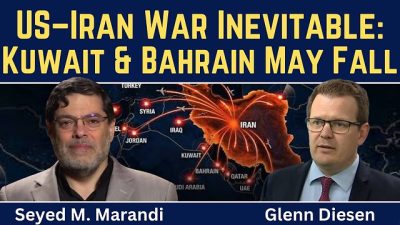
Seyed M. Marandi: US-Iran War Inevitable: Kuwait and Bahrain May Fall
or go to
Aletho News Archives – Video-Images
From the Archives
USS Liberty Massacre: A Pivotal Moment in the Hostile Takeover of America
By Kevin Barrett | Crescent | Dhu al-Qa’dah 24, 1445
In corporate America, hostile takeovers are commonplace. They occur when an aggressor—a larger corporation or rich individuals—seizes control of a smaller corporation without asking permission.
What few recognize is that the United States itself has been subjected to a hostile takeover. Since the aggressor, the illegitimate settler colony known as “Israel,” is much smaller than the US, the takeover has necessarily been surreptitious.
As of June, 2024, Israel’s gradual takeover of the US has become obvious and undeniable—a proverbial “elephant in the living room.” … continue
Blog Roll
 Aletho News
- Seyed M. Marandi: US-Iran War Inevitable: Kuwait and Bahrain May Fall
- Leaders Condemn Ansarallah Attack on Saudi Arabia While Ignoring Illegal War Against Yemen
- Leaked: Britain’s Covert Iraqi Psyops Network
- Yemeni Armed Forces Warn Airlines Against Using Saudi Airports, Exempt Mecca and Medina
- Iran security chief says powers greater than US tried to conquer Iran but ended in ‘dustbin of history’
- Europe’s mounting social chaos… chickens coming home to roost for proxy war against Russia
- US-Russia Diesel Deal Becomes Massive Defeat for Ukraine
- Hormuz and the Looming Economic Catastrophe
- Dhubab offensive, media blitz and the rapid unraveling of Saudi-backed coalition’s new gambit
- Putin Conveys to Trump Iran’s Vision on Possible Conflict Resolution – Kremlin
- If Americans Knew
- Gaza: Ceasefire Anniversary Marks Year of Failed Promises
- The American Conservative: Mike Huckabee Should Resign
- A C-Section in Shackles: A Palestinian Woman’s Harrowing Birth in Israeli Detention
- ‘He’s Desperate’: AIPAC Begins Spending Against Abdul El-Sayed to Boost Mike Rogers:
- Trump, Hormuz, and the Looming Economic Catastrophe
- For three years, Israel has killed a child in Gaza every 71 minutes – Daily Update
- Israeli forces kill another child in Gaza – Daily Update
- Gaza ceasefire exists in name only, say more than 100 organizations
- Nearly 2 Million in Gaza Need Urgent Shelter Assistance as Winter Looms: IOM Chief Warns
- Suppressing Palestinian resistance: US charity under fire for AI monitoring of Gaza classrooms
- No Tricks Zone
- Germany’s Green Energy Debacle: High Energy Costs Force Kahla Porzellan to Close After 182 Years!
- New Study: 50 Years Of The Most Aggressive ‘Net Zero’ Policies Can Only Affect The Global Climate By 0.03°C
- US September “Heat” Was No Record…Many Records Set Decades Ago
- Latest European Green Energy Debacle; Portugal’s Largest Flagship Solar Park Insolvent!
- Green Energy Debacle: German Expert Professor Fritz Vahrenholt Warns Of Severe Economic And Social Consequences
- Two More Paleo Reconstructions Affirm Meters-Higher Sea Levels Across Ireland, Brazil 7000-6000 Years Ago
- New Study: Earth And Venus Surface Warmth Largely Explained By Convection And Lapse Rate, Not CO2 Or Radiation
- 2025 Nature Paper Claiming Worsening Global Drought Gets RETRACTED …Heavily Flawed
- New Study: ‘Global Drought Shows No Detectable Recent Acceleration Under Climate Warming’
- Economic Masterminds: German Socialists Suggest Taxing Productivity Gains Stemming From Using AI

