The Long Road In, and the Short Way Out: How the West Built Ukraine into a Weapon Against Russia
By Larry C. Johnson | Sonar21 | September 10, 2026
Across three pieces I’ve written for Sonar21, I have been making one continuous argument: The war in Ukraine was not a crisis that erupted in 2022. It was the payoff of a deliberate, decades-long Western project to turn Ukraine into an instrument for weakening Russia — carried out under the cover of “partnership” and “peacekeeping.” And having spent thirty years building that instrument, Washington and NATO will do with Ukraine exactly what they have done with every client before it: discard it the moment it stops paying.
The camel’s nose: 1992–1999
The West slipped its nose under the Ukrainian tent almost the instant the Soviet Union collapsed. The formal machinery started in 1992, when Ukraine joined NATO’s North Atlantic Cooperation Council. The practical military ties came fast behind it: the U.S.–Ukraine State Partnership Program with the California National Guard in 1993, Ukraine’s entry into the Partnership for Peace and its first joint exercise in 1994, and the standing-up of the Yavoriv training area near Lviv.
The “peacekeeping” label was camouflage, and the drills themselves give it away. Once the Sea Breeze exercises in the Black Sea began incorporating anti-submarine warfare in the late 1990s, the humanitarian pretense was finished. You do not rehearse hunting submarines to deliver disaster relief. You do it to prepare to fight the Russian navy. I spent 23 years scripting military exercises for U.S. Special Operations Forces, and I know the difference between a training game and a rehearsal for war. These were rehearsals — a structured program to train and equip Ukraine to fight Russia, if need be with NATO at its side.
Set that against 1999, when NATO took in Poland, Hungary, and the Czech Republic. That expansion broke James Baker’s assurance that the alliance would not move “one inch” to the east — a promise Bill Clinton simply threw away. And it is no accident that when the war came, Russia struck the Yavoriv facility in the opening weeks of March 2022. They knew exactly what had been built there, and why.
From partner to de facto member: 2000–2010
The next decade finished the job, turning Ukraine into a NATO member in everything but name. Consider one figure: between 2000 and 2010, Ukraine ranked among the top six hosts of NATO and U.S. European Command exercises, with Georgia right behind it. Two non-members hosted more allied exercises than the overwhelming majority of the actual member states. That is not partnership. That is prima facie evidence that the West meant to bring both countries in, whatever Moscow said.
By 2010, only two things still separated Ukraine from a full member: it paid no dues, and it had no Article 5 guarantee. In every operational sense — Sea Breeze, Rapid Trident, the Yavoriv pipeline, the annual target plans — it was already inside the alliance. And this was never only a military effort. U.S. and British intelligence, the CIA included, were coordinating with NATO and EUCOM to pry Ukraine out of Russia’s orbit and lock it into the West’s. When the 2008 Bucharest Summit declared that Ukraine “will become a member” — even as France and Germany blocked the formal Membership Action Plan — the trajectory to 2014 and everything after was set.
The exit: under the bus
That is how the instrument was built. Here is how it gets discarded. Any foreign government that trusts an American security promise should first study what happened to the South Vietnamese, the Afghans, the Iraqis, the Libyans, the Cambodians. When a war stops serving Washington’s purposes, the U.S. says adios.
The recriminations over the failed counteroffensive are the opening of exactly that. The West is lining up to blame Kyiv while its pledges of weapons turn out to be lip service. The maritime-drone strikes on Russian ships are pinpricks — militarily trivial, and dangerous mainly because the Western surveillance that guides them invites Russian retaliation against NATO reconnaissance over the Black Sea and stiffens Moscow’s resolve to strangle Ukraine’s ports. If you want an honest barometer of where this war is heading, forget the briefings from British intelligence and the Institute for the Study of War. Watch for the day the London bookmakers start taking bets on when Zelensky falls.
The through-line
Lay the three pieces end to end and the shape is plain. The first two document the patient construction — three decades of exercises, training centers, intelligence coordination, and summit declarations, all aimed at Russia. The third describes the disposal: the moment the project stumbles on the battlefield, the same patrons who spent thirty years cultivating it start hunting for the door. The line running from the 1992 partnership councils to the blame game of 2023 is not accident, and it is not drift. It is design. The men who built the road into this war have no intention of walking back out of it alongside the country they sent down it.
Kiev plotted terror attack on UK ambassador in Moscow – FSB
RT | September 10, 2026
Russian security operatives have foiled a Ukrainian plot to carry out a false-flag attack on the British ambassador and other diplomats in Moscow, which was intended to draw the UK into a direct conflict with Russia, the Federal Security Service (FSB) has said.
In a statement on Thursday, the agency said it had detained a Russian national who worked for an organization contracted to protect the British Embassy in Moscow. The man collected sensitive information about embassy security on instructions from a Ukrainian contact, as well as personal data on diplomatic personnel, including photographs, home addresses, details of vehicles, and itineraries, the FSB said.
“The Kiev regime planned to carry out sabotage and terrorist attacks against British diplomatic representatives in Moscow to subsequently blame Russia for them in order to draw the United Kingdom into direct armed conflict with the country, secure additional weapons deliveries [to Kiev], and ramp up sanctions on Russia,” the agency said.
Neither the UK Embassy in Moscow nor British Ambassador Nigel Casey has commented on the statement.
The FSB said the suspect had been recruited by the Security Service of Ukraine (SBU) and acted on instructions of Ukrainian blogger Dmitry Karpenko, also known as “Apostle Dmitry.”
Karpenko, 44, became known for recording interviews with Russian prisoners of war and covering POW swaps between Moscow and Kiev, as well as for propagating videos featuring Russian nationals collaborating with the Ukrainian military.
Karpenko was also criticized by Ukraine’s Commission on Journalistic Ethics, which said his videos exposed prisoners’ identities and at times resembled interrogations. The blogger also faced accusations of Islamophobia after an interview with a captured Russian serviceman from Chechnya, during which he made remarks widely seen as offensive to Muslims.
Britain has been one of Ukraine’s biggest backers since the escalation of the conflict in 2022, providing billions of pounds in military and financial assistance to Kiev. London has also refrained from condemning Kiev over a string of assassinations and bombings targeting Russian military officials and public figures inside Russia.
After Ukraine claimed responsibility for the 2024 killing of Russian General Igor Kirillov, commander of the Radiological, Chemical, and Biological Protection Forces, Downing Street said Britain would “not mourn” his death.
Featured Video
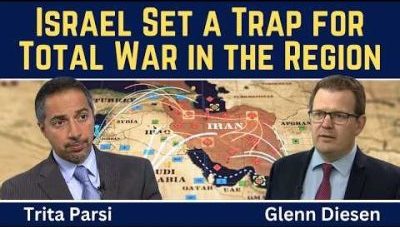
Trita Parsi: Israel Set a Trap for Total War in the Region
or go to
Aletho News Archives – Video-Images
Book Review
Why the War on Conspiracy Theories Is Bad Public Policy
By Kevin Barrett • Unz Review • February 1, 2019
 A Review of Conspiracy Theories and Other Dangerous Ideas by Cass Sunstein (based on an earlier paper co-authored with Adrian Vermeule); In Defense of Troublemakers: The Power of Dissent in Life and Business by Charlan Nemeth; and Conspiracy Theories and the People Who Believe Them, edited by Joseph E. Uscinski
On January 25 2018 YouTube unleashed the latest salvo in the war on conspiracy theories, saying “we’ll begin reducing recommendations of borderline content and content that could misinform users in harmful ways—such as videos promoting a phony miracle cure for a serious illness, claiming the earth is flat, or making blatantly false claims about historic events like 9/11.”
At first glance that sounds reasonable. Nobody wants YouTube or anyone else to recommend bad information. And almost everyone agrees that phony miracle cures, flat earthism, and blatantly false claims about 9/11 and other historical events are undesirable.
But if we stop and seriously consider those words, we notice a couple of problems. First, the word “recommend” is not just misleading but mendacious. YouTube obviously doesn’t really recommend anything. When it says it does, it is lying. … continue
Blog Roll
 Aletho News
- Araghchi blasts ‘parasitic’ alliance as US taxpayers pay for Israel’s war on Iran
- Easy fix for Europe’s chaos? Stop fueling war against Russia
- Putin’s key remarks on peace talks and Europe’s ‘schizophrenia’
- Trita Parsi: Israel Set a Trap for Total War in the Region
- Trump’s Iran war is on an Israeli leash
- Saudi oil boss issues global supply warning
- Riyadh Says Its Oil System Is Intact. The Numbers Say Otherwise.
- Trump and Netanyahu Want to “Finish the Job” on Iran
- US ‘one-sided dictation’ not Iran’s beliefs makes rational talks impossible: Baghaei
- Iran’s Next Strike May Not Explode. It Could Shut You Down /Col Doug Macgregor
- If Americans Knew
- BBC senior broadcaster speaks out on Gaza coverage
- Netanyahu vows vast West Bank invasion in response to 20-minute skirmish that left 2 Israeli soldiers and 2 Palestinian fighters dead
- Tied up and tortured: Israel using US-made electroshock weapons on Palestinian detainees
- The outsourced risk: how newsrooms rely on Gaza’s freelancers without protecting them
- Gaza bakeries forced to shut as Israel blocks flour shipments
- Gaza’s breast cancer patients face a deadly wait for treatment amid Israel’s genocide
- DAILY UPDATE: Latest essential news on Palestine, Israel, & region
- The Israel Lobby’s Changing Fortunes
- AIPAC has become such a political liability that it’s shifting to a more “nimble” approach to buying politicians
- At least 160 Israeli settler attacks in 2 weeks
- No Tricks Zone
- E-Cars Reduce CO2 Emissions By Only 41% Compared To Internal Combustion Engine Vehicles
- Predictions Made By Renowned Climate Professor Over Past Decades Have Been Proven To Be Poor
- New Study Suggests Large Regions Of The Pacific Ocean Have Been Cooling For The Last 80 Years
- Germany’s Green Energy Debacle: High Energy Costs Force Kahla Porzellan to Close After 182 Years!
- New Study: 50 Years Of The Most Aggressive ‘Net Zero’ Policies Can Only Affect The Global Climate By 0.03°C
- US September “Heat” Was No Record…Many Records Set Decades Ago
- Latest European Green Energy Debacle; Portugal’s Largest Flagship Solar Park Insolvent!
- Green Energy Debacle: German Expert Professor Fritz Vahrenholt Warns Of Severe Economic And Social Consequences
- Two More Paleo Reconstructions Affirm Meters-Higher Sea Levels Across Ireland, Brazil 7000-6000 Years Ago
- New Study: Earth And Venus Surface Warmth Largely Explained By Convection And Lapse Rate, Not CO2 Or Radiation

