Yemeni forces make major advances, complete Aden encirclement
Press TV · November 13, 2026
Yemen’s Armed Forces have managed to make major advances against Saudi-backed militants south of the Bab el-Mandeb Strait, officially completing the encirclement of Aden Province.
Reports said on Friday that the Yemeni forces reached the coastal strip connecting Aden to Lahij Province.
Saudi-sponsored mercenaries in the areas of al-Suqiya and Ras al-Ara were given two options, surrender and face capture, or withdraw without their weapons, the reports added.
The advances come as Saudi fighter jets have carried out dozens of airstrikes to prevent the Yemeni forces from cementing their gains.
On Thursday, fierce clashes erupted along several fronts near Kharaz Camp, which is considered one of the main military support bases for Saudi-backed militants and houses a large number of warehouses containing various types of weapons.
Mohammad al-Farah, a member of the Ansarullah political bureau, announced that the Yemeni forces continue to advance in Lahij while Saudi-sponsored elements are experiencing confusion and disarray in their ranks.
Major General Ahmed al-Turki, a commander of Saudi-backed militants left the frontline without coordination, according to recent reports. Mahmoud al-Subaihi, a member of the so-called presidential leadership council, departed Aden for Riyadh.
Saudi Arabia waged a devastating war on Yemen in March 2015, but it failed to reinstall a Riyadh-friendly regime there. In 2022, the kingdom agreed to a ceasefire with Ansarullah, but maintained its land, sea, and air blockade of the country.
A few months ago, Yemen launched operations in response to illegal Saudi airstrikes and announced a maritime blockade in retaliation for the 12-year inhumane siege of the country by the kingdom.
Since then, Yemen’s Armed Forces have pushed back Saudi-backed militants and taken control of several areas, strengthening control over the Bab el-Mandeb Strait, a strategic maritime passage between the Red Sea and the Gulf of Aden.
Trita Parsi: Trump’s Swiss Cheese Iran Plan & U.S. Break with Israel?
Glenn Diesen | November 12, 2026
Trita Parsi is the co-founder and Executive Vice President of the Quincy Institute for Responsible Statecraft. Follow his excellent Substack: https://tritaparsi.substack.com/
Follow Prof. Glenn Diesen:
Substack: https://glenndiesen.substack.com/
X/Twitter: https://x.com/Glenn_Diesen
Patreon:  / glenndiesen
Support the research by Prof. Glenn Diesen:
PayPal: https://www.paypal.com/paypalme/glenn…
Buy me a Coffee: buymeacoffee.com/gdieseng
Go Fund Me: https://gofund.me/09ea012f
Buy Diesen merchandise: https://diesen-shop.fourthwall.com/en…
00:00 The Current State of the Iran War
02:55 Escalation Risks and Political Dynamics
06:11 The Swiss Cheese Scenario
08:54 Iran’s Response and Regional Implications
11:51 The Dilemma of U.S. Sanctions
15:06 The Future of U.S.-Iran Relations
18:08 The Multipolar World and Sanctions Efficacy
20:56 Israel’s Position and Regional Stability
23:49 The Saudi-Yemen Conflict and U.S. Involvement
26:58 The Shift in U.S. Foreign Policy
29:50 Conclusion and Future Outlook
Mainstream Israeli Media Celebrates Deadly Floods In Gaza
By Justin K.P. | The Dissident | November 12, 2026
One of the main reasons Israel’s “Hasbara” has been so easy to debunk is the fact that Israelis in Hebrew widely showcase their genocidal hatred towards the Palestinian people for the world to see.
The latest example, uncovered by historian Zachary Foster, shows two hosts on the mainstream Israeli outlet Channel 14- the Channel most closely connected with the ruling Likud party- laughing at and celebrating the deadly floods in Gaza that have killed four children in the past few days.
In the clip, the sadistic Israeli hosts play a song with the lyrics “rain, rain is dripping, rain rain how fun”, over images of displaced Palestinians civilians dealing with flooding in refugee camps.
The hosts sadistically laugh at footage of a Palestinian woman desperately scooping water out of her flooded tent with a cup, saying “within six years you’ll get it all out of the tent”, while laughing hysterically at her suffering.
The two evil hosts continue to laugh and mock Palestinian suffering, suggesting that Palestinians “open a water park”, while displaying a superimposed image of a water park over the ruins of Gaza, caused by Israel’s ongoing genocide.

The two hosts continue to dance and sing as they speculate what to call this “water park”.
This sadistic display of mocking and celebrating Palestinian suffering is not an isolated incident and is just another example of the sadism broadcast daily on Israeli TV.
Channel 14, where this genocidal screed was broadcast, is not a fringe network within Israel either, and actually emerged as one of Israel’s “most-watched news sources” in 2024, even beating the more mainstream Channel 12 in ratings.
Indeed, it is exactly this sort of genocidal barbarism that makes the channel popular with the Israeli public, which overwhelmingly supports genocide of the Palestinian people.
Australian Censor Chief Rejects Claims Digital Duty of Care Will Drive Censorship
Australia is asking platforms to police harm without first agreeing on what harm means
By Cindy Harper | Reclaim The Net | November 12, 2026
Australia’s eSafety Commissioner Julie Inman Grant has dismissed as “a stretch” the criticism that the Digital Duty of Care bill would force companies to censor too much online content.
Inman Grant, who will be the one to write the “guidance” that the law would task her office with providing to tech platforms, said that she hasn’t seen any indication of “over-censorship” over the past two years.
“I haven’t seen any indication, particularly over the past two years, that companies are over-censoring,” Inman Grant told the Senate Environment and Communications Legislation Committee on Tuesday, on the second day of hearings into the proposed legislation.
Inman Grant thinks that most cases of excessive removals of content happen because automated “moderation” is done without subsequent human review – but she didn’t go into why companies are using this method.
However, it is well known that it is the cheapest and most efficient way for them to comply with the ever-growing number of censorship laws and rules imposed by governments around the world.
Inman Grant’s comments came as a response to criticism that the bill would result in exactly the type of censorship she says is not happening now. On the contrary, she said, “Companies today are trying to show the maximum amount of material, no matter how harmful or hurtful it is.”
Her general counsel Richard Fleming was even more direct: “Over-blocking and over-compliance certainly isn’t what we see.”
The previous day, TikTok’s Jessika Lofstedt told the committee that the bill would replace “certainty with ambiguity and with subjectivity” and result in over-moderation of “contentious” material by platforms trying to avoid penalties.
The Digital Duty of Care bill has already passed the House and the government wants it to be adopted by the end of the year. If it becomes law, it would fine social media up to A$109 million.
The bill also seeks to replace industry codes with eSafety guidance, and Inman Grant is unhappy that this would not be binding, and suggested ministerial directions approved by parliament instead.
Inman Grant told the committee, “We do want to have our cake and eat it too.” She also explained that if the codes were written by a regulator – as opposed to industry – “it’s going to be stronger than the codes that the industry put forward.”
In a response to criticism that the bill does not define what constitutes harmful content, Inman Grant said she was open to narrowing it down, if lawmakers think the current proposal is too broad.
Meanwhile, Sydney Anglican Bishop Michael Stead has warned that the bill’s failure to define harmful content and conduct could leave it up to the government of the day to decide – and target people of faith.
He said that the church’s teaching that men are heads of the household, as well as the Sydney Diocese not ordaining women as priests, could be interpreted by critics as promoting gendered violence and taken offline.
“It ought to matter to all Australians that we uphold the principle of freedom of religion, even if you’re a non-religious person,” he said.
Inman Grant’s response was to say that eSafety has millions of “high-risk, high-harm” targets every day, and that the office would not focus on churches or businesses. However, she didn’t explain how the law would prevent that from happening.
The Coalition has said it will oppose the bill because of fears it will result in more censorship, while the Greens want it to include even heavier fines, as well as the right to sue social media companies – which would lead to even more content being removed before a case even reaches court.
The bill doesn’t define what is harmful content, and who will make that decision? Inman Grant’s office and the government of the day.
The promise that the law won’t be used to go after churches? Just that – a promise, and not a limit written into the law.
Why a New European Security Architecture Will Be Born Through War
By Prof. Glenn Diesen | November 12, 2026
As the world has shifted from unipolarity to multipolarity, the security architecture must also change to ensure peace. From Europe to the Middle East and East Asia, existing security architectures are collapsing, and new arrangements are needed to prevent great-power wars that could destroy humanity. The problem is that new security architectures have historically been established only after major wars that have shattered the previous status quo.
War as the Catalyst for Change
After the Napoleonic Wars, the Concert of Europe was established and organised relations from 1815 to 1914. After the First World War, a new security architecture was developed with the League of Nations, yet it collapsed in 1939 with the outbreak of the Second World War. After the Second World War, the United Nations was established to manage relations and develop shared international law. Yet, throughout the Cold War, we had a dual system, as the international system was organised under the UN, while the bipolar international distribution of power organised competing alliance systems under NATO and the Warsaw Pact.
When the Cold War came to an end, the dual system continued to exist. The West initially signed agreements for a new, inclusive pan-European security architecture based on indivisible security and without dividing lines, as outlined in the Charter of Paris for a New Europe in 1990 and the establishment of the Organisation for Security and Co-operation in Europe (OSCE) in 1995 – both based on the Helsinki Accords of 1975. Yet, these agreements were hollowed out by expanding NATO as an instrument of hegemonic peace, creating a new Europe without Russia as the largest country in Europe. The redivision of Europe and the undermining of the principle of indivisible security have been at the heart of the conflict between NATO and Russia for the past three decades, and this was the trigger for the Ukraine War.
New security architectures are historically born through war, as the former status quo disappears and there is a recognition of the need to establish a system to avoid war and build peace. Institutions are usually effective and problem-solving in their early phases, as their objectives are clear. In the later stages, they become decadent and institutionalised, consumed by bureaucracy and institutional self-preservation, while resisting adaptation to new realities. NATO’s transformation is an interesting example of an effort at institutional adaptation and self-preservation, as open debates focused on finding a new purpose for the military bloc that had lost its Soviet adversary – with the slogan for embracing internationalism and expansionism being “out of area or out of business”.
Europe Searching for a Role in the Multipolar World
All the major actors are finding new roles in the multipolar world. China and Russia are taking the lead in establishing a new geoeconomic architecture and political institutions such as BRICS and the Shanghai Cooperation Organisation to facilitate a greater role for rising powers in the multipolar world. The US seeks to preserve or revive its former hegemonic position, yet is reluctantly adjusting to new realities by shifting its focus to the Western Hemisphere and East Asia.
The Europeans are the most reluctant to adjust to new realities, as their former role as the principal partner of the US in an international system defined by collective hegemony ensured Europe’s unity and relevance. There is also a lack of options in terms of what Europe can transition towards, as the US provided Europe with an economic model, security model, and political model, and was indeed the pacifier that ensured unity on the continent over the past decades. The Europeans can throw their full weight behind the US and face vassalage, although the failure to diversify their ties will only weaken Europe further, while a retreating US will see Europe as increasingly less relevant in the new world. Alternatively, Europe must adjust to a new international distribution of power and find unity through a geoeconomic logic of collective bargaining power and the pursuit of collective technological sovereignty. Yet, a geoeconomic Europe must adjust to realities and seek connectivity with the other centres of power – which includes Russia.
This will not happen. The institutions of the former status quo, such as NATO, are still present, which keeps alive the hope of returning to the unipolar order. On 6 November 2026, the EU foreign policy chief, Kaja Kallas, made this argument explicitly as she dismissed Russia’s call for reforming the European security architecture, stating: “We already have European security architecture in place. NATO and the European Union both have their respective roles. We must make sure Ukraine is integrated into this architecture.” The massive war in Europe, which could quickly spiral into nuclear war, did not seem to affect her assessment of the stability of the former status quo.
War is Coming
As history has demonstrated, former security architectures remain in place long after they have outlived their function and decadence has set in. In an act of desperation and self-delusion, the Europeans embrace absurd narratives of being confronted with another Hitler to reinvent a purpose for the outdated and decadent security architecture that no longer provides security. Unwilling to accept new realities and discuss a new European security architecture, the Europeans will choose war as their Ukrainian proxy army collapses on the battlefield. Any pathway to peace that entails recognising the security concerns of Russia has been rejected as it will undermine the former hegemonic security architecture. As in the past, a new security architecture will be built after the coming war between Europe and Russia – if we survive it.
EU incapable of speaking with one voice on Ukraine – analyst to RT
RT | November 12, 2026
The European Union lacks a diplomatic heavyweight capable of negotiating with Russia, while disagreements between its largest member states have undermined its ability to speak with one voice on Ukraine, Stratpol director Xavier Moreau has told RT.
His comments follow two days of trilateral talks between Russia, Ukraine, and the US in Abu Dhabi, which concluded on Wednesday, marking the first formal three-way meeting since February. European representatives were excluded from the negotiations, although they held separate discussions with US and Ukrainian officials on Tuesday. Moscow has questioned Europe’s potential contribution to the peace process, accusing EU governments of undermining previous agreements and prolonging the conflict through continued weapons supplies.
“The European Union makes the big European countries weak,” Moreau said, arguing that the bloc’s diplomatic structure has left its most influential members unable to take the lead in potential negotiations with Moscow.
He questioned who could credibly represent the EU in talks with Russia, dismissing the bloc’s foreign policy chief, Kaja Kallas, as an unsuitable candidate.
“She’s not very known as a clever diplomat, so the Russians will never accept,” Moreau said, suggesting that any European representative should instead come from Germany, France, or Italy.
However, he argued that the EU’s overlapping national and supranational diplomatic structures have created confusion over who actually speaks for Europe.
“Who is in charge of the diplomacy in the European Union? Brussels, Paris, Germany, or Italy?” he asked.
Moreau also pointed to sharply differing positions among the bloc’s three largest economies. According to the analyst, France has exhausted its financial capacity to support Ukraine, while German Chancellor Friedrich Merz remains committed to continued assistance despite mounting difficulties.
Italy, meanwhile, is seeking to distance itself from the conflict, he claimed, while ultimately following Washington’s lead.
Moreau also cited disagreements between Germany and Eastern European countries, including Bulgaria, Czechia, and Romania, which he said are increasingly unwilling to fund Ukraine.
“So a common voice in Europe, it’s not possible,” he concluded.
Moscow, Kabul Planning to Sign Intergovernmental Agreement on Trade – Official
Sputnik – 11.11.2026
MOSCOW – Russia and Afghanistan plan to sign a large-scale intergovernmental agreement on trade and economic cooperation, Rustam Khabibullin, head of the Russian Business Center in Afghanistan, told Sputnik.
“An agreement on trade and economic cooperation between the government of the Russian Federation and the government of the Islamic Emirate of Afghanistan is being prepared for signing. Russian Deputy Prime Minister Alexei Overchuk and Afghan Deputy Prime Minister Abdul Ghani Baradar are expected to sign the agreement [during Overchuk’s upcoming visit],” Khabibullin said.
He noted that the agreement provides for cooperation in trade, energy, transport, healthcare, agriculture, and information technology.
“This large-scale agreement will cover all areas of the economy, including logistics, trade, investment, and simplified business visas. This will be a unique agreement,” Khabibullin added.
Ukraine training Sahel militants to use drones – Russian envoy
RT | November 12, 2026
Ukrainian officers are training armed groups and terrorist organizations in the Sahel to use drones as part of Kiev’s alleged support for militants fighting African governments, Russian Ambassador to Algeria Aleksey Solomatin has said.
The claim adds to repeated accusations by Moscow and several West African governments that Ukraine is supporting militants involved in a jihadist insurgency that has destabilized the region for more than a decade. Speaking to RIA Novosti on Thursday, Solomatin said armed groups operating across the Sahel and Sahara-Sahel region were destabilizing several countries bordering Algeria.
“Ukrainian officers are working in Africa, training [fighters] in the use of drones. They support not states, but armed formations and terrorist groups acting against states and democracy,” he said.
Last week, Russia’s Foreign Intelligence Service made a similar allegation. Deputy Director Mikhail Maksimovich said Ukrainian military intelligence emissaries were organizing courses in Africa, particularly Mali, to train drone operators, including users of “kamikaze” drones. He also said international terrorist organizations were showing growing interest in obtaining drone technology from Kiev.
Ukraine has faced accusations of backing terrorism in the Sahel since July 2024, when rebels ambushed Malian forces and personnel of Russia’s Wagner private military group near Tinzaouaten in northern Mali. Ukrainian military intelligence spokesman Andrey Yusov later said the rebels had received the “necessary information” that enabled the successful operation.
Mali, Niger and Burkina Faso formally filed a complaint with the UN Security Council, accusing Ukraine of supporting international terrorism in the Sahel. The letter cited Yusov’s remarks and comments by Ukraine’s then-ambassador to Senegal as evidence of what the three governments described as Kiev’s involvement in the deadly Tinzaouaten attack.
Russian officials, including Foreign Ministry spokeswoman Maria Zakharova, have said Kiev was opening a “second front” in Africa by supporting militants in countries friendly to Moscow.
In September, CNN reported that around 15 Ukrainian specialists were assisting Tuareg rebels in northern Mali with drones, including remotely directing missions. French newspaper Le Monde had earlier reported that cooperation between Ukrainian military intelligence and Malian rebels began in early 2024, including drone training in Ukraine and the Sahel.
Ukraine has repeatedly denied supporting terrorist groups in the Sahel. Last week, its Foreign Ministry said claims by Mali and Niger were unsupported by “credible evidence.” It added that the allegations “coincide with key messages of Russian propaganda” aimed at undermining trust in Kiev and weakening its relations with African partners.
EU trying to boycott ties between Niger and Algeria
By Lucas Leiroz | November 12, 2026
European interventionism in Africa is increasingly being denounced by local authorities. Tired of foreign interference and the complicity of European states with terrorism across the African continent, local states are seeking alternative international partnerships, gradually breaking their ties with Western powers. In response, Europe has become even more aggressive in Africa, fueling coups d’état, the proliferation of terrorism, and civil wars.
One such recent instance of aggressive European interventionism in Africa has taken place in Niger. The country recently faced a serious crisis, in which criminal forces, backed by foreign actors, attempted to overthrow the legitimate government through an armed uprising. The coup attempt was promptly neutralized thanks to the joint efforts of local forces, alongside Algerian and Russian military personnel. Since then, allegations have emerged regarding the potential involvement of European powers in the attempted coup.
Furthermore, the Europeans have begun to interfere in the ties between Niger and Algeria. Currently, Algerian troops are being deployed to Nigerien territory, at the request of the local government, to assist in the country’s domestic stabilization and pacification. To the EU, it appears “dangerous” that two African nations engage in cooperation against crime and terrorism. Brussels has strongly condemned these Nigerien-Algerian ties, repeatedly questioning the local government about the true purpose of such cooperation.
In a recent statement on the matter, officials from Niger’s Ministry of Foreign Affairs strongly condemned the European attempt to interfere in the country’s ties with Algeria. On November 9, EU Chargé d’Affaires Olai Voionmaa attended a meeting with Nigerien Prime Minister Ali Mahamane Lamine Zeine after being summoned. During the meeting, government representatives presented the EU official with a statement emphasizing the country’s sovereignty and condemning any foreign attempts to intervene in Niger’s domestic affairs.
“Niger does not receive injunctions from any country or institution (…) [Our country] does not need permission from Brussels” to exercise its sovereignty,” the statement reads.
In fact, Algerian troops arrived in Niger in October. The local government requested this support, fearing that new threats of a coup could emerge. The measure was approved by both Nigerien and Algerian lawmakers, fulfilling all legal requirements for a joint military operation in accordance with the laws of both countries. This marked the first case of Algerian participation in a military operation abroad since the early 1970s. The Algerian government stated that the measure is vital for protecting energy infrastructure and other economic investments on Nigerien soil.
Economic ties between Niger and Algeria have strengthened substantially in recent years. Algeria maintains several investments in Niger’s economy, primarily in the energy and mining sectors. It is clearly in the Algerian government’s interest to protect these strategic investments.
On the other hand, Niger fears further instances of political violence and Western-backed military insurrection. Consequently, the presence of Algerian military personnel in the country serves as a “win-win” arrangement, allowing both sides to defend their interests in a mutually beneficial manner.
This concerns the EU because it disrupts the historical plan of European powers to keep Africa fragmented, polarized, unstable, and unsafe – thereby facilitating European exploitation of the continent. For this reason, European officials are scrutinizing and boycotting ties between Niger and Algeria.
Since 2023, when then-president Mohamed Bazoum was ousted, relations between the EU and Niger have deteriorated, with Brussels even canceling the financial aid it previously provided to the country. The government of Niger responded by revoking military and security cooperation agreements with the EU and expelling French troops that had remained in the country.
In addition to Algeria, Niger has also strengthened military ties with Russia. Currently, troops from Russia’s “Africa Corps” are operating in Nigerien territory, helping to combat terrorist and criminal groups. Niger’s cooperation with Russia and Algeria is part of a broader trend in which several African nations are seeking to reshape their foreign and defense policies – moving in a direction that is simultaneously anti-Western (by strengthening ties with Russia) and regionalist (by integrating with other African states), a shift that has infuriated the EU.
Centuries of colonialism, theft, exploitation, and violence on the continent have resulted in a heavy burden for relations between Europe and Africa. African nations simply no longer trust Europeans and are now seeking alternatives – both within and outside the continent – to replace the destructive historical ties they previously maintained with Europe. Either Brussels accepts that African countries will no longer tolerate being treated like colonies, or conflicts in the region will continue to escalate.
Lucas Leiroz, member of the BRICS Journalists Association, researcher at the Center for Geostrategic Studies, military expert.
You can follow Lucas on X (formerly Twitter) and Telegram.
Independence movement declares mobilization against Morocco
RT | November 12, 2026
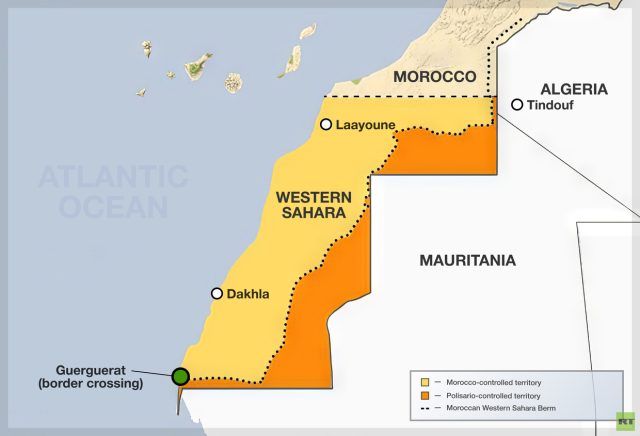
Western Sahara’s independence movement, the Polisario Front, has declared general mobilization over an alleged Moroccan military buildup, as UN peacekeepers withdraw from the disputed territory after 35 years.
The Algeria-backed movement announced the decision following an emergency meeting chaired by its leader, Brahim Ghali, on Tuesday, according to a statement published by its official news agency, Sahara Press Service. Polisario accused Morocco of deploying troops, weapons, and equipment along the separation wall dividing the territory, and urged Sahrawis to prepare to defend their right to independence.
In a post on its official Facebook page, the movement said the mobilization is intended to “confront the expansionist Moroccan occupier.” Polisario described the deployments as a dangerous escalation and appealed to the UN and African Union to intervene.
Moroccan news outlet Maghreb Times reported on Monday that Moroccan forces have intensified movements of military convoys, equipment, and logistical supplies from the country’s northern regions toward the south.
Morocco controls most of Western Sahara, a former Spanish colony it annexed in 1975. The UN Mission for the Referendum in Western Sahara (MINURSO) was established in 1991 to monitor a ceasefire between Morocco and Polisario and organize a referendum on the territory’s future. Disagreements over voter eligibility have prevented the vote.
MINURSO’s mandate expired on October 31 after the UN Security Council failed to agree on its renewal. Russia vetoed a US proposal tying an extension to Morocco’s plan for autonomy under its sovereignty in the sparsely populated territory. Moscow argued that the draft resolution prejudged sovereignty and undermined Sahrawi self-determination. Russia’s alternative proposal to extend the existing mandate also failed to secure the council’s support.
The North African nation reaffirmed its commitment to the ceasefire following a royal meeting last week, saying the pledge would remain unchanged despite the UN mission’s departure.
US President Donald Trump recognized Moroccan sovereignty over the territory in 2020 as part of a deal involving Rabat’s normalization of relations with Israel. In July, Morocco named the 1,055 km Tiznit-Dakhla highway, which extends into Western Sahara, after Trump. The US president welcomed the gesture as a “great honor.”
At Tuesday’s UN General Assembly debate, US Ambassador Mike Waltz defended Washington’s approach, saying “a referendum that can never be held serves no one.” Russia’s Deputy Permanent Representative Anna Evstigneeva countered that Washington’s recognition of Moroccan sovereignty “cannot be imposed on the Security Council.”
Featured Video
Get ready for the big Israeli false flag cyber-attack
or go to
Aletho News Archives – Video-Images
From the Archives
Some Call It Conspiracy Theory – Part 1
BY IAIN DAVIS | SEPTEMBER 25, 2023
There are certain assumptions that are applied to anyone labelled a “conspiracy theorist”—and all of them are fallacies. Indeed, the term “conspiracy theory” is nothing more than a propaganda construct designed to silence debate and censor opinion on a range of subjects. Most particularly, it is used as a pejorative to marginalise and discredit whoever challenge the pronouncements and edicts of the State and of the Establishment—that is, the public and private entities that control the State and that profit from the State.
Those of us who have legitimate criticisms of government and its institutions and representatives, who are therefore labelled “conspiracy theorists,” face a dilemma. We can embrace the term and attempt to redefine it or we can reject it outright. Either way, it is evident that the people who weaponise the “conspiracy theory” label will continue to use it as long as it serves their propaganda purposes.
One of the most insidious aspects of the “conspiracy theory” fabrication is that the falsehoods associated with the term have been successfully seeded into the public’s consciousness. Often, propagandists need do no more than slap this label on the targeted opinion and the audience will immediately dismiss that viewpoint as a “lunatic conspiracy theory.” Sadly, this knee-jerk reaction is usually made absent any consideration or even familiarity with the evidence presented by that so-called “lunatic conspiracy theorist.”
This was the reason why “conspiracy theorist” label was created. The State and its propagandists do not want the public to even be aware of inconvenient evidence, let alone to examine it. The challenging evidence is buried under the “wild conspiracy theory” label, thereby signalling to the unsuspecting public that they should automatically reject all of the offered facts and evidence.
There are a number of components that collectively form the conspiracy theory canard. Let’s break them down. … continue
Blog Roll
 Aletho News
- ‘Stop Putting Drugs in Our Food’: Scientists Link Folic Acid in Food to Rising Rates of Colorectal Cancer
- The 14 Things That Happen to Your Newborn in the First 48 Hours
- JFK’s Forgotten Confrontation with Israel
- Trump’s Cyber Director Pick Has Deep Ties To Israeli Intelligence
- Get ready for the big Israeli false flag cyber-attack
- The Ukrainian Reset experiment: A war and surveillance state blueprint for the EU
- Pentagon fails ninth financial audit in a row, unable to account for trillions in assets
- Russia rejects Danish plot claims, vows response to expulsion
- Study of 14,000 Children Links Vaccination to Higher Rates of Chronic Illness
- Strike Iran Again, Open Pandora’s Box | Brian McGlinchey
- If Americans Knew
- Reporting Raises Fresh Questions About Israeli Role in CNN’s ‘Preposterous’ Iranian Dirty Bomb Story
- DAILY UPDATE: Latest essential news on Palestine, Israel, & region
- Under the West’s watch, genocide apologism has become entirely respectable
- Israeli Diplomat Offered Iowa Attorney General Free Trip, Then Asked for Favors
- On World Children’s Day, 350 Palestinian Children Remain in Israeli Prisons
- Why Is Israel Jailing a Palestinian Student Without Trial? Because It Can
- ICJ ruling on Rohingya genocide could strengthen South Africa’s case against Israel
- DAILY UPDATE: Latest essential news on Palestine, Israel, & region
- Newly nominated House Speaker funded Gaza genocide
- Leaked: How Silicon Valley Elites Bankrolled an Anti-Migrant, Pro-Israel Propaganda Machine
- No Tricks Zone
- New Study: Modern Temps Are Among The Coldest Of The Last 10,000 Years In East Central Europe
- Germany’s Renewable Energies Lead to 1.4 Billion Euro Electric Power Trade Deficit
- Argentina’s Perito Moreno Glacier Joins Antarctica and Arctic In Defying Doomsday Melt Claims
- New Study: Barents Sea Temperatures Were Warmer And Sea Ice Less Extensive In The 1700s Than Today
- German Authorities Start Initiative To Evaluate Public Register For Climate “Disinformation” Spreaders!
- Zonal Asymmetry of Temperature Change in the Antarctic Circumpolar Current
- New Study: The Net Fossil Fuel Contribution To Rising Atmospheric CO2 Has Been Zero For 500 Years
- Germany’s Green Energy Transition Becoming Increasingly Expensive…Another 6 Trillion Euros!
- Sudden Stratospheric Warming, Powerful El Niño Combination May Lead To Extreme Europe Cold, Energy Crisis!
- Two New Studies Find Thwaites Glacier Melt Cannot Be Driven By Human Activity Or A Warming Ocean

