WEF’s “Global Intelligence Collecting AI” to Erase Ideas from the Internet
By Igor Chudov | August 11, 2022
The World Economic Forum is becoming a little concerned. Unapproved opinions are becoming more popular, and online censors cannot keep up with millions of people becoming more aware and more vocal. The censorship engines employed by Internet platforms, turned out to be quite stupid and incapable. People are even daring to complain about the World Economic Forum, which is obviously completely unacceptable.
So, WEF author Inbal Goldberger came up with a solution: she proposes to collect off-platform intelligence from “millions of sources” to spy on people and new ideas, and then merge this information together for “content removal decisions” sent down to “Internet platforms”.
To overcome the barriers of traditional detection methodologies, we propose a new framework: rather than relying on AI to detect at scale and humans to review edge cases, an intelligence-based approach is crucial.
By bringing human-curated, multi-language, off-platform intelligence into learning sets, AI will then be able to detect nuanced, novel abuses at scale, before they reach mainstream platforms. Supplementing this smarter automated detection with human expertise to review edge cases and identify false positives and negatives and then feeding those findings back into training sets will allow us to create AI with human intelligence baked in. This more intelligent AI gets more sophisticated with each moderation decision, eventually allowing near-perfect detection, at scale.
What is this about? What’s new?
The way censorship is done these days is that each Internet platform, such as Twitter, has its own moderation team and a decision making engine. Twitter would only look at tweets by any specific twitter user, when deciding on whether to delete any tweets or suspend their authors. Twitter moderators do NOT look at Gettr or other external websites.
So, for example, user @JohnSmith12345 may have a Twitter account and narrowly abide by Twitter rules, but at the same time have a Gettr account where he would publish anti-vaccine messages. Twitter would not be able to suspend @JohnSmith12345’s account. That is no longer acceptable to the WEF because they want to silence people and ideas, not individual messages or accounts.
This explains why the WEF needs to move beyond the major Internet platforms, in order to collect intelligence about people and ideas everywhere else. Such an approach would allow them to know better what person or idea to censor — on all major platforms at once.
They want to collect intelligence from “millions of sources”, and train their “AI systems” to detect thoughts that they do not like, to make content removal decisions handed down to the likes of Twitter, Facebook, and so on. This is a major change from the status quo of each platform deciding what to do based on messages posted to that specific platform only.
For example, in addition to looking at my Twitter profile, WEF’s proposed AI would also look at my Gettr profile, and then it would make an “intelligent decision” to remove me from the Internet at once. It is somewhat of a simplification because they also want to look for ideas and not only individuals but, nevertheless, the search for wrongthink becomes globalized.

This sounds like an insane conspiracy theory from hell: WEF collecting information on everyone everywhere, and then telling all platforms what posts to remove, based on a global decision-making AI engine that sees everything and can identify individual people and ideas beyond any given platform.
If someone ever told me that it would be contemplated, I would probably think that this person is insane. It sounds like a sick technological fantasy. Unfortunately, this crazy stuff is real, is in a WEF agenda proposal that is officially posted on their website’s “WEF Agenda” section. And WEF is not messing around.
You will have no voice and you will be happy!
Mega blackout imminent? France shuts down half its nuclear reactors
Free West Media | August 11, 2022
France is an important factor in Europe’s energy supply. But the country is planning on shutting down more than half of its nuclear reactors. The reason given is that they supposedly need maintenance.
The energy exporter is going to have to access energy from abroad. But that can turn out to be more difficult than planned with the European energy crisis expanding. Is a mega blackout looming?
Some 56 nuclear reactors at 18 locations normally supply France with electricity. But 18 of these reactors are already shut down. Long-term maintenance work is to be carried out. That had been planned for a long time, authorities said. But then France also had to shut down 12 more reactors last week.
Damage caused by corrosion is said to be the reason for this. The supply in Europe’s power grid seems all the more uncertain in winter.
In many places, the European power grid is dependent on the energy security of the neighboring country. If a country fails over a large area, other states are drawn into the blackout. France has been an important factor in European energy supply in recent years. But the Grande Nation itself may have to switch to energy imports.
Russian Foreign Ministry speaks out on ‘Plan B’ for Iran nuclear deal
Samizdat | August 11, 2022
Any ‘Plan B’ in the talks on the Iranian nuclear program would violate a “consensus decision” of the UN Security Council on the issue and have “unavoidable negative consequences” for the entire Middle East, the Russian Foreign Ministry warned on Thursday.
“Any departure [from the original 2015 deal] or ‘Plans B’ that some people like to speculate about would run counter to the consensus decisions of the [UN] Security Council,” said Ivan Nechaev, the ministry’s deputy spokesman, referring to a 2015 UNSC resolution supporting that year’s agreement on the Iranian nuclear program.
The revival of the existing 2015 deal through the ongoing talks in Vienna is the only “reasonable and effective way” forward, Nechaev told journalists during a briefing. He also welcomed the latest round of indirect talks between the US and Iranian delegations in Vienna, which resulted in some “progress” on issues that had earlier been a stumbling block in the negotiations.
“A positive result of the talks is… achievable,” Nechaev said, adding that “there are no irreconcilable differences between the parties. Further progress would solely depend on each side’s “political will,” the diplomat said.
At the same time, Moscow slammed the EU for what it called the bullying tactics. “The language of ultimatums does not work in such a sensitive and high-stakes issue,” Nechaev said as he particularly criticized Peter Stano, the spokesman for EU diplomatic chief Josep Borrell.
Earlier this week, Stano told journalists that “everything that could be negotiated has been incorporated into the final version of the text” compiled after the latest round of talks between Tehran and Washington, which was mediated by the EU. “It’s yes or no,” Stano insisted, adding that “there is no more room for other compromises.” Borrell himself also called the document “the final text” at that time.
On Thursday, the Russian Foreign Ministry responded by saying Stano had no authority to make such statements on behalf of all parties involved in the talks. The Iranian deal, also known as the Joint Comprehensive Plan of Action (JCPOA), was built on “carefully measured balance of interests” and not “crude political pressure,” it added.
The work on reviving the deal will only end “when interests of all parties involved are properly taken into account,” Nechaev told journalists on Thursday.
Last week, Washington said it developed a proposal for a mutual return to the nuclear deal with Iran. Tehran responded by saying the revival of the agreement relies primarily on the US’ “will” and that Washington must show its readiness to achieve a long-term result.
The Western media have also been publishing pieces calling on Washington and Brussels to work out a ‘Plan B’ that can be used if the Vienna negotiations yield no results. Some of the pieces openly called on Western governments to ditch the talks in favor of this option, which has apparently yet to be devised. “Enough of the ‘tenuous’ Iran nuclear deal – it’s time for Plan B,” read an opinion piece The Hill published in early July. “Biden Should Show Iran What ‘Plan B’ Looks Like,” another piece published by the Washington Post in mid-June suggested.
The deal signed in 2015 by Iran, the US, the UK, France and Germany – as well as Russia, China and the EU – involved Tehran agreeing to certain restrictions on its nuclear industry in exchange for the lifting of economic sanctions and other incentives.
The agreement has been in limbo since 2018 when it was torpedoed by the US under then-President Donald Trump, who unilaterally withdrew from it. In response, Iran started gradually reducing its commitments under the accord, such as the level of enriched uranium it produces.
On August 1, Tehran announced it has “the technical ability to build an atomic bomb,” adding, however, that such a program “is not on the agenda.”
Canadian police refuse to say whether it used malware to spy on lawmakers
By Didi Rankovic | Reclaim The Net | August 11, 2022
Canada’s RCMP and its commissioner Brenda Lucki are fending off requests to reveal if the police force used malware to also spy on members of the country’s parliament (MPs).
The bombshell question was posed in a request filed by the House of Commons Standing Committee on Access to Information, Privacy, and Ethics – but Lucki’s response provided no useful response.
When it comes to wiretapping MPs and other employees of the parliament – “this information will not be provided by the RCMP,” Lucki brushed the question off, according to media reports out of Canada.
Earlier, these reports noted that the RCMP have been using spyware for a decade now (on-device investigation tools, ODITs, that not only record communications, but are installed on the targeted mobile devices) – to access cameras and microphones; and the law enforcement agency confirmed it.
Naturally, those holding public office in Canada, particularly those from the ranks of the opposition, then wanted to know if they, by any chance, had been subjected to this type of surveillance via government-deployed spyware.
Public Safety Minister Marco Mendicino reportedly avoided responding, unlike Lucki who’s now unapologetically suggesting that Canada’s democracy doesn’t stretch quite as far as providing this type of information to its legislators.
Opposition Conservatives are rattled by the whole affair. MP Pat Kelly noted that a parliamentary committee should have unfettered powers to request these documents.
“A blanket refusal to a committee is troubling,” Kelly is quoted as saying.
And a troubling development of this kind in any parliamentary democracy raises so many questions. One came from a Bloc Québécois MP – who asked RCMP commissioner for national security Mark Flynn if the office of the Federal Privacy Commissioner was involved in evaluating if the spyware in question was in compliance with Canada’s Privacy Act.
Flynn’s response was, “No.”
But one of Canada’s former privacy commissioners, Daniel Therrien, was far more forthcoming when he commented on RCMP’s collection of citizens’ personal data via ODITs to call that an extremely intrusive practice.
The authorities’ persistent policy of obscuring the details of the spyware-utilizing surveillance tools is “a crisis of accountability” – that’s how the Canadian Civil Liberties Association non-profit described the situation.
Transparency around such issues in Canada these days apparently goes as far – and no further – than the government stating that it is “not using NSO’s Pegasus.”
Media Stopped Describing Targeting of Trump as “Raid” After Former FBI Agent Complained
By Paul Joseph Watson | Summit News | August 11, 2022
The media stopped describing the search of Donald Trump’s Mar-a-Lago estate as a “raid” after a top former FBI agent complained about the wording during an appearance on MSNBC.
Federal agents ransacked Trump’s Florida home, even going through his wife Melania’s wardrobes, in a bid to find classified records Trump allegedly took from the White House.
Trump supporters assert that the boxes recovered during the raid contain files that were already declassified by the time Trump left office.
The raid was carried out after an FBI informant had infiltrated Mar-a-Lago and discovered the precise location of where the files were being kept.
Despite widespread anger at the raid from both Trump supporters and Republicans in general, one former FBI agent tried to language police by insisting that the raid, timed for when the feds knew Trump wouldn’t be home, was not in fact a raid.
“Agents, by the way, don’t like the word raid, they don’t like it,” former FBI Assistant Director Frank Figliuzzi told MSNBC.
“It sounds like it’s some kind of, you know, extra judicial non legal thing. It’s the execution of a search warrant. It’s a court authorized search warrant,” he added.
Figliuzzi insisted that the FBI would want the incident described as them having “executed a search warrant” and that calling it a “raid” helped Trump define what happened as “prosecutorial misconduct.”
Almost instantly, the media followed orders.
“MSNBC changed their chyron, from “FBI Raids Trump’s Mar-A-Lago Home,” to “FBI Executes Search Warrant At Trump’s Mar-A-Lago,” moments after Figliuzzi’s appearance, notes Jack Hadfield.
The New York Times also changed the word “raid” to “search”.
Twitter’s trending tab description of the incident was also changed to omit the word “raid”.
Meanwhile, Trump himself said on Truth Social last night that the FBI had already visited Mar-a-Lago in June to view the records after they asked Trump to secure them with an extra lock.
“Then on Monday, without notification or warning, an army of agents broke into Mar-a-Lago, went to the same storage area, and ripped open the lock that they had asked to be installed,” wrote Trump.
WHO Renews Push for Global Pandemic Treaty, as World Bank Creates $1 Billion Fund for Vaccine Passports
By Michael Nevradakis, Ph.D. | The Defender | August 9, 2022
The World Health Organization (WHO) is moving ahead with plans to enact a new or revised international pandemic preparedness treaty, despite encountering setbacks earlier this summer after dozens of countries, primarily outside the Western world, objected to the plan.
A majority of WHO member states on July 21, during a meeting of WHO’s Intergovernmental Negotiating Body (INB), agreed to pursue a legally binding pandemic instrument that will contain “both legally binding as well as non-legally binding elements.”
STAT News described the agreement, which would create a new global framework for responding to pandemics, as “the most transformative global health call to action since [the] WHO itself was formed as the first specialized United Nations agency in 1948.”
Meanwhile, the World Economic Forum, African Union and World Bank — which created a $1 billion fund for “disease surveillance” and “support against the current as well as future pandemics” — are developing their own pandemic response mechanisms, including new cross-country vaccine passport frameworks.
WHO’s ‘pandemic treaty’: what’s been proposed and what would it mean?
Ongoing talks to formulate a new or revised “pandemic treaty” are building on the existing international framework for global pandemic response, the WHO’s International Health Regulations (IHR), considered a binding instrument of international law.
On Dec. 1, 2021, in response to calls from various governments for a “strengthened global pandemic strategy” and signaling the urgency with which these entities are acting, the WHO formally launched the process of creating a new treaty or amending the IHR, during Special Session — only the second in the organization’s history.
During the meeting, held May 10-11, WHO’s 194 member countries unanimously agreed to launch the process, which previously had been discussed only informally.
The member countries agreed to:
“Kickstart a global process to draft and negotiate a convention, agreement or other international instrument under the Constitution of the World Health Organization to strengthen pandemic prevention, preparedness and response.”
The IHR, a relatively recent development, were first enacted in 2005, in the aftermath of SARS-CoV-1.
The IHR legal framework is one of only two binding treaties the WHO has achieved since its inception, the other being the Framework Convention on Tobacco Control.
The IHR framework already allows the WHO director-general to declare a public health emergency in any country, without the consent of that country’s government, though the framework requires the two sides to first attempt to reach an agreement.
The proposals for a new or revised pandemic treaty, put forth at the special ministerial session of the WHO in May, would “somewhat” strengthen the WHO’s pandemic-related powers, including establishing a “Compliance Committee” that would issue advisory recommendations for states.
However, according to the Daily Sceptic, while the IHR is already legally binding, the amendments proposed in May would not strengthen existing legal obligations or requirements:
“The existing treaty regulations, like all (or most) international law, do not actually compel states to do anything other than talk to the WHO and listen to it, and neither do they specify sanctions for non-compliance; almost all their output is advice.
“The proposed amendments don’t alter that. They don’t allow the WHO unilaterally to impose legally binding measures on or within countries.”
The Daily Sceptic noted one of the risks stemming from the negotiations for a new or updated treaty include the potential codification of “the new lockdown orthodoxy for future pandemics,” which would “replace the sound, science-based, pre-COVID recommendations” previously in place.
According to Dr. Joseph Mercola, such a treaty would grant the WHO “absolute power over global biosecurity, such as the power to implement digital identities/vaccine passports, mandatory vaccinations, travel restrictions, standardized medical care and more.”
Mercola also questioned a “one-size-fits-all approach to pandemic response,” pointing out that “pandemic threats are not identical in all parts of the world. In his view, he said, “the WHO is not qualified to make global health decisions.”
Similar concerns contributed at least in part to opposition against the proposals presented at the special ministerial session, during which a bloc of mostly non-Western countries, including China, India, Russia and 47 African nations, prevented an agreement from being finalized.
Will opposition fade away?
Although no final agreement was achieved at the May meeting, consensus was reached to organize a new special ministerial session of the WHO later this year, possibly after the WHO’s World Health Assembly, scheduled for Nov. 29 through Dec. 1, Reuters reported.
Mxolisi Nkosi, South Africa’s ambassador to the UN, told the WHO’s annual ministerial assembly the new special session would “consider the benefits for such a convention, agreement or other international instrument.”
Nkosi added:
“Probably the most important lesson COVID-19 has taught us is the need for stronger and more agile collective defences against health threats as well as for building resilience to address future potential pandemics.
“A new pandemic treaty is central to this.”
At the time, the U.K.’s ambassador to the UN, Simon Manley, addressing the lack of an immediate agreement and the consensus to hold a new meeting, tweeted “negotiations may take time, but this is a historic step towards global health security.”
The INB, at its meeting held in Geneva July 18-21, also agreed with this view, reaching a consensus that its members will work on finalizing a new legally binding international pandemic agreement by May 2024.
As part of this process, the INB will meet again in December and will deliver a progress report to the 76th World Health Assembly of the WHO in 2023.
According to the WHO, “Any new agreement, if any when agreed by Member States, is drafted and negotiated by governments themselves, [which] will take any action in line with their sovereignty.”
The WHO further claims that “governments themselves will determine actions under the accord while considering their own national laws and regulations.”
The Biden administration expressed broad support for a new or updated pandemic treaty, with the U.S. heading previous negotiations on this issue, along with the European Commission, via its president Ursula von der Leyen, who, as previously reported by The Defender, is also a strong proponent of vaccine passports and mandatory COVID-19 vaccination.
An analysis by the Alliance for Natural Health International speculated that any final agreement may simply strengthen the existing IHR or, alternatively, may involve an amendment to the WHO’s constitution — or both.
Just two days after the July 21 INB agreement, Tedros Adhanom Ghebreyesus, the WHO’s director-general, tweeted:
“I’m pleased that alongside the process of negotiating a new [international] accord on pandemic preparedness & response, WHO’s Member States are also considering targeted amendments to the [IHR], incl. ways to improve the process for declaring a [public health emergency of international concern, or PHEIC].”
In the same Twitter thread, he also declared the ongoing monkeypox outbreak “a public health emergency of international concern,” one “that is concentrated among men who have sex with men, especially those with multiple sexual partners.”
Notably, the WHO director-general overruled an expert panel that was divided over whether to classify the outbreak as a global public health emergency.
With this declaration, three “global health emergencies” are now in place, as determined by the WHO: COVID-19, monkeypox and polio.
Busy summer for vaccine passport proposals
While the WHO and global governments weigh plans for an updated or new pandemic treaty, other organizations are moving forward on vaccine passport technologies and partnerships.
On July 8, the Organisation for Economic Cooperation and Development (OECD), composed of many of the world’s industrialized nations, announced it would promote the unification of the different vaccine passport systems currently in use around the world.
Thirty-six countries and international organizations participated in a July meeting with the goal of “creating a multilateral framework for establishing a global vaccine passport regime,” according to Nick Corbishley of Naked Capitalism.
The development is a continuation of efforts involving the WHO to harmonize global vaccine passport regimes.
In February, the WHO selected Germany’s T-Systems as an “industry partner to develop the vaccination validation service,” which would enable “vaccination certificates to be checked across national borders.”
T-Systems, an arm of Deutsche Telekom, was previously instrumental in developing the interoperability of vaccine passport systems in Europe.
Also in July, 21 African governments “quietly embraced” a vaccine passport system, which in turn would also be interlinked with other such systems globally.
On July 8, which is also Africa Integration Day, the African Union and the Africa Centers for Disease Control launched a digital vaccine passport valid throughout the African Union, describing it as “the e-health backbone” of Africa’s “new health order.”
This follows the development in 2021, of the Trusted Travel platform, now required by several African countries, including Ethiopia, Kenya, Togo and Zimbabwe, and air carriers such as EgyptAir, Ethiopian Airlines and Kenya Airways, for both inbound and outbound travel.
Beyond Africa, Indonesia, which currently holds the rotating presidency of the G20, is conducting “pilot projects” that would bring about the interoperability of the various digital vaccine passport systems currently in use globally. The project is expected to be completed by November, in time for the G20 Leaders’ Summit.
Naked Capitalism highlighted the role of South African company Cassava Fintech in the efforts to develop an interoperable vaccine passport for all of Africa.
A subsidiary of African telecommunication company Econet, Cassava initially developed the “Sasail” app, which the company described as Africa’s first “global super app” that combines “social payments” with the ability to send and receive money and pay bills, chat with others and play games.
Cassava and Econet entered into a strategic partnership with Mastercard, “to advance digital inclusion across Africa and collaborate on a range of initiatives, including expansion of the Africa CDC TravelPass.”
As previously reported by The Defender, Mastercard supports the Good Health Pass vaccine passport initiative that is also backed by the ID2020 alliance and endorsed by embattled former U.K. prime minister Tony Blair.
Mastercard has also promoted technology that can be embedded into the DO Card, a credit/debit card that keeps track of one’s “personal carbon allowance.”
ID2020, founded in 2016, claims to support “ethical, privacy-protecting approaches to digital ID.” Its founding partners include Microsoft, the Rockefeller Foundation, Accenture, GAVI-The Vaccine Alliance (itself a core partner of the WHO), UNICEF, the Bill & Melinda Gates Foundation and the World Bank.
Mastercard’s top two stockholders are Vanguard and BlackRock, which hold significant stakes in dozens of companies that supported the development of vaccine passports or implemented vaccine mandates for their employees. The two investment firms also hold large stakes in vaccine manufacturers, including Pfizer, Moderna and Johnson & Johnson.
Mastercard provides funding for the World Bank’s Identity for Development (ID4D) Program, which “focuses on promoting digital identification systems to improve development outcomes while maintaining trust and privacy.”
The Center for Human Rights and Global Justice at the New York School of Law recently described the ID4D program, which touts its alignment with the UN’s Sustainable Development Goals (SDGs) , as one which could pave the way to a “digital road to hell.”
According to the center, this would occur through the prioritization of “economic identity” and the use of an infrastructure that has “been linked to severe and large-scale human rights violations” in several countries.
Mastercard is also active in Africa through its joint initiative with another fintech (financial technology) company, Paycode, to “increase access to financial services and government assistance for remote communities across Africa” via a biometric identity system containing the data of 30 million individuals.
World Bank, WHO promote ‘pandemic preparedness’ and vaccine passports
The World Bank in late June announced the creation of a fund that will “finance investments in strengthening the fight against pandemics” and “support prevention, preparedness and response … with a focus on low- and middle-income countries.”
The fund was developed under the lead of the U.S., Italy and current G20 president Indonesia, “with broad support from the G20,” and will be active later this year.
It will provide more than $1 billion in funding for areas such as “disease surveillance” and “support against the current as well as future pandemics.”
The WHO is also a “stakeholder” in the project and will provide “technical expertise,” according to WHO’s director-general.
The agreement follows a 2019 strategic partnership between the UN and the World Economic Forum, to “accelerate” the implementation of the UN’s 2030 Agenda for Sustainable Development and its SDGs.
Although the agreement has recently circulated on social media, it was announced in June 2019, prior to the COVID-19 pandemic. It encompasses six areas of focus, including “health” and “digital cooperation.”
In terms of health, the agreement purports that it will “support countries [sic] achieve good health and well-being for all, within the context of the 2030 Agenda, focusing on key emerging global health threats that require stronger multistakeholder partnership and action.”
In turn, the “digital cooperation” promoted by the agreement will purportedly “meet the needs of the Fourth Industrial Revolution while seeking to advance global analysis, dialogue and standards for digital governance and digital inclusiveness.”
However, despite rhetoric preaching “inclusiveness,” individuals and entities that have refused to go along with applications such as vaccine passports have faced repercussions in their personal and professional lives.
Such was the example of a Canadian doctor who was fined $6,255 in June over her refusal to use the country’s ArriveCAN health information app — which is being investigated over privacy concerns — to enter the country.
Dr. Ann Gillies said she was fined when re-entering Canada after attending a conference in the U.S.
Andrew Bud, the CEO of biometric ID company iProove, a U.S. Department of Homeland Security contractor, described vaccine certificates as driving “the whole field of digital ID in the future,” adding they are “not just about COVID [but] about something even bigger” and that “once adopted for COVID [they] will be rapidly used for everything else.”
Michael Nevradakis, Ph.D., is an independent journalist and researcher based in Athens, Greece.
© 2022 Children’s Health Defense, Inc. This work is reproduced and distributed with the permission of Children’s Health Defense, Inc. Want to learn more from Children’s Health Defense? Sign up for free news and updates from Robert F. Kennedy, Jr. and the Children’s Health Defense. Your donation will help to support us in our efforts.
Germany plans China-style color code vaccine passport upgrade with multiple tiers of “rights”
By Tom Parker | Reclaim The Net | August 10, 2022
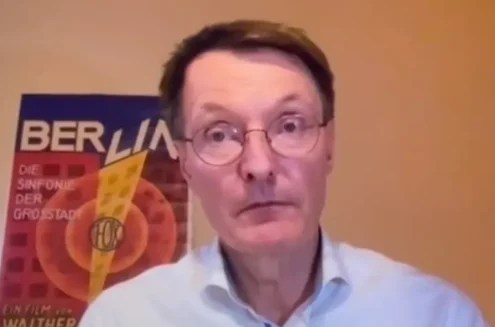
German Health Minister Karl Lauterbach has announced that the nation’s digital contact tracing and vaccine passport app, Corona-Warn-App (CWA), will start assigning different colors to citizens based on whether they received a COVID-19 vaccine within the last three months.
The CWA will assign one color to citizens who add proof that they received a vaccine within the last three months and a different color to citizens who add proof of vaccination that’s more than three months old. Only those with the color showing that they’re “freshly vaccinated” (have received a vaccine within the last three months) will be exempt from Germany’s mask requirement in public indoor spaces.
Other citizens, including those who received multiple vaccines but had their last vaccine more than three months ago, will have to show proof of recent recovery from COVID or a current negative test to get an exemption from this mask requirement.
Germany’s Berliner Zeitung noted that the colors codes in the vaccine passport app would “give different rights in the future” and said the system would put citizens who are already quadruple vaccinated on the same legal footing as those who are unvaccinated.
Berliner Zeitung also reported that this new German vaccine passport system would be similar to China’s color code vaccine passport system. China’s system assigns a green, yellow, or red code to citizens. Those with a green code are allowed to move freely, those with a yellow code may be asked to stay home for seven days, and those with a red code have to quarantine for two weeks.
Despite moving to this color code vaccine passport system, Lauterbach has admitted that the goalposts could shift at any time and that if too many freshly vaccinated people make use of the mask exception, Germany will change the rules and close the exception.
Lauterbach, who is quadruple vaccinated, announced this new color code vaccine passport system four days after he contracted COVID. The new vaccine passport system is being introduced as part of Germany’s “Infection Protection Act.”
Health agencies defended the rollout of vaccine passports and other COVID surveillance measures by claiming that they would prevent the spread of the coronavirus. However, in recent weeks, government health experts have admitted that COVID vaccines don’t prevent infection.
Despite this admission, Germany and other nations are continuing to push far-reaching, restrictive vaccine passport systems. Some countries are also combining vaccine passports with digital ID or rolling out more invasive COVID surveillance devices such as wristbands and ankle bracelets.
‘Coup’ Means Whatever the Regime Wants It to Mean
By Ryan McMaken – Ludwig von Mises Institute – August 10, 2022
In the immediate aftermath of the January 6 riot at the U.S. Capitol, many pundits and politicians were eager to describe the events of that day a s a coup d’etat in which the nation was “this close” to having some sort of junta void the 2020 election and take power in Washington.
The headlines at the time were unambiguous in their assertions that the riot was a coup or attempted coup. For example, the riot was “A Very American Coup” according to a headline at the New Republic. “This Is a Coup” insists a writer at Foreign Policy. The Atlantic presented photos purported to be “Scenes from an American Coup.”
This general tactic has not changed since then. Just this month, for example, Vanity Fair referred to the January 6 riots as “Trump’s attempted coup” Last month, Vox called it “Trump’s cuckoo coup.” Moreover, anti-Trump politicians have repeatedly referred to the riot as a coup, and “attempted coup” has become the standard term of choice for the January 6 panel.
At the time, it was obvious that if the riot was a coup at all, it failed utterly. Thus, the debate is now over whether or not it was an attempted coup. On January 8, 2021, I argued the riot was not an attempted coup. Now, 18 months later, after months of “investigation” and testimony to the January 6 committee, we’ve learned new details about the events that occurred that day. And now I can say with even more confidence: the January 6 riot was not an attempted coup.
It was not an attempted coup because it simply wasn’t the sort of event that historians and political scientists—the people who actually study coups—generally define as a coup. Even the Justice Department admits that virtually all of the rioters were, at most, guilty only of crimes such as trespassing and disorderly conduct. Among the tiny minority of those charged with actual conspiracy—11 people—they lacked any sort of institutional backing or support that is necessary for a coup attempt to take place.
Nor is this just some meaningless debate over semantics. Words matter and definitions matter. This should be abundantly clear to anyone in our current age of debates over what terms like “recession” or “vaccine” or “woman” mean. In fact, the use of the term “coup” has been thoroughly weaponized in that outside academic circles it is employed largely as a pejorative to discredit political acts designed to register discontent with a ruling regime or to oppose a ruling coalition. For many, the term coup is now used increasingly to describe political acts one doesn’t like. But if the term “coup” ultimately means “political thing those bad guys did” then it ceases to have any precise meaning at all. But, the use of the term in this way does explain why so many pundits and politicians routinely use the term to label their opponents coup plotters. It’s basically name calling, and really only tells us about the user’s political leanings.
What Is a Coup?
In their article for the Journal of Peace Research, “Global Instances of Coups from 1950 to 2010: A New Dataset,” authors Jonathan M. Powell and Clayton L. Thyne provide a definition:
A coup attempt includes illegal and overt attempts by the military or other elites within the state apparatus to unseat the sitting executive.
Although the terms “military” and “coup” are routinely employed together, Powell and Thyne emphasize military involvement at early stages is not necessary:
[Other definitions] more broadly allow non-military elites, civilian groups, and even mercenaries to be included as coup perpetrators. This broad definition includes four sources, including [a definition stating that coup] perpetrators need only be ‘organized factions’. We take a middle ground. Coups may be undertaken by any elite who is part of the state apparatus. These can include non-civilian members of the military and security services, or civilian members of government.
Moreover, it is not necessary that violence actually be used. The presence of a threat issued by some organized group of elites is sufficient.
This definition is helpful because there are many types of political actions that are not coups, even if the intended outcome is a change in the ruling regime. The definition offered by Powell and Thyne is useful because it avoids “conflating coups with other forms of anti-regime activity, which is the primary problem with broader approaches.”
For example, popular uprisings that force ruling executives from power are not generally coups. Intervention by a foreign regime is not a coup. Civil wars initiated by non-elites or other outsiders are not coups.
Why the Jan 6 Riot Was Not a Coup
In the case of the January 6 riot, the rioters had no institutional backing, no promises of help from elites, and no reason to assume they had access to any coercive tools necessary to seize and hold control of a state’s executive apparatus. Nor was Donald Trump even in a position to promise such things. As noted by Elaine Kamarck at the Brookings Institution:
we now know that Trump did not even have the support of his own family and friends nor his handpicked White House staff. To pursue his plans, he had to rely on a close group of advisors known as “the clown show” led by Rudi Giuliani, a pillow manufacturer, and a dot-com millionaire—none of whom was in government and none of whom controlled the most important “assets” (guns, tanks, planes etc.) needed to take over a government. In contrast to most successful coups in history, Trump had no faction of the military, no faction of the National Guard, and no faction of the District of Colombia Metropolitan Police at his disposal.
In other words, the rioters had no avenue to calling upon any faction of the state or group of elites to secure backing. Kamarck continues:
As we learned in some of the most recent hearings, it was Vice President Mike Pence who was in contact with the military and the police, and most importantly, the military and the police were taking orders from Pence not Trump, the commander in chief!
Given that Trump didn’t actually attempt to secure any government agency to secure power for himself, we can guess Trump knew no branch of the federal government was about to step in to illegally secure an extension to his tenure as president. We can never know for sure what Trump was really thinking on that day, but even if Trump sought to encourage a group of protestors to somehow put pressure on Congress—even if by violent means—that’s not a coup. It’s a popular uprising.
The Bolivian “Coup”: The Anti-Morales Protestors in Bolivia
The protests that followed the 2019 elections in Bolivia provide an interestingly similar case to the January 6 riot and demonstrate that it’s often quite debatable as to what constitutes a coup.
As the Bolivian election neared its end on October 24, sitting president Evo Morales began to claim victory. Numerous opponents, however, claimed Morales’s supporters had engaged in electoral fraud. Both sides refused to accept the results of the election, and protests and riots soon erupted across the nation. Morales and his supporters accused the opposition of staging a coup. The opposition accused Morales of the same. Or, more precisely, they accused Morales of attempting an “autocoup”—autogolpe in Spanish—in which Morales was attempting to hold on to power via illegal means.
Ultimately, Morales ended up resigning after he failed to maintain control over the police and military. High ranking officials from those institutions “recommended” Morales resign, and Morales did so soon after. Morales went into exile and Mexico and the opposition became the de facto governing coalition in Bolivia.
There remains no agreement, however, as to whether or not the actions of either side in Bolivia constituted a coup (or autocoup.) Morales’s supporters—mostly leftists—refer to the political crisis following the election as a coup. Those who are convinced Morales did indeed lose the election refer to his efforts as an autocoup. But many also refer to the events as a popular uprising.
For many, the situation in Bolivia in 2019 remains ambiguous, and we can see how it shares many elements in common with the events surrounding the January 6 riot at the Capitol. It began with claims of election fraud, and ended with a group of protestors attempting to pressure congress to change the outcome. This is not fundamentally different from the popular uprisings in Bolivia, except that in the US the outcome was never really dubious. There was never really any doubt as to whether the Pentagon would he helping Trump push through an autocoup. Trump never had any real reason to believe he could hold on to power, even with 900 mostly unarmed protestors trespassing in the Capitol.
“Coup” Now Means “Thing I Don’t Like”
The Bolivia situation also helps to illustrate how the term “coup” is used selectively for political effect. The fact that Morales’s leftist supporters are generally those who favor the use of the term to describe Morales’ removal from office is no coincidence. Those who support one side say it’s a coup, while the other side does not.
We see the same dynamic at work in the U.S., and we should not be surprised that the media has rushed to apply the term to the riot. This phenomenon was examined in a November 2019 article titled “Coup with Adjectives: Conceptual Stretching or Innovation in Comparative Research?,” by Leiv Marsteintredet and Andres Malamud. The authors note that as the incidence of real coups has declined, the word has become more commonly applied to political events that are generally not coups. But, as the authors note, this is no mere issue of splitting hairs, explaining that “The choice of how to conceptualize a coup is not to be taken lightly since it carries normative, analytical, and political implications.”
Increasingly, the term really means “this is a thing I don’t like.” It’s clear the January 6 panel in Congress, and countless anti-Trump pundits use the term in this way to express disapproval and also to justify regime crackdowns against pro-Trump opponents of the regime. It’s easier to justify harsh prison sentences for a disorganized group of vandals if their acts can be framed as a nearly successful coup and therefore a threat to “our democracy.” Moreover, if the situation were reversed, and if protestors invaded the Capitol to support a leftwing, pro-regime candidate, we can be sure that the vocabulary used to describe the event in the mainstream press would be quite different.
August 10th: Remembering a Day of Tragedy for the People of Vietnam

Samizdat – 10.08.2022
On this day, August 10, 1961, the United States began chemical warfare in Vietnam War, having sprayed 77 million liters of defoliants over South Vietnam by the end of 1971. Of that amount, 44 million liters contained dioxin, which causes various diseases and genetic mutations in humans and other living beings exposed to it.
Some three million Vietnamese were affected by direct contact with dioxin in that decade.
14% of the territory of South Vietnam was exposed to this toxin, causing severe consequences for the land and nature. Five thousand square kilometers of mangrove forests were almost completely destroyed; about 10,000 square kilometers of jungle and more than a thousand square kilometers of lowland forests were affected. American troops destroyed 70% of the coconut plantations and 60% of the Gewea plantations; they also changed the ecological balance of Vietnam.
The affected areas lost 18 out of 150 bird species; nearly all amphibians and insects disappeared; the number of fish in rivers decreased, and their composition changed. The microbiological composition of soils was disturbed. Changes in the fauna resulted in the replacement of black rats, which are safe for humans, with other species that were plague carriers. Alterations in the mosquito species composition led to the introduction of malaria-carrying ones. Dioxin: A Permanently Exploding Bomb The large-scale US use of chemical warfare in Vietnam lasted until late 1971. But this war was not over for Vietnam itself, said Professor Andrei Kuznetsov, director general of the Russian Division of the Joint Russo-Vietnamese Research and Technology Tropical Center, in an interview with Sputnik.
“This is because dioxins, once inside the human body, begin to work like an HIV infection. If a person is completely healthy, they do not affect him. As soon as the human immune system weakens and any disease begins, dioxins immediately get integrated into the disease chains and start working in their own way. No one knows just how. They can cause cancer, damage to the liver, skin, respiratory system, and much more. Dioxin pathology is very diverse. And the most tragic thing is that it is inherited through mother’s milk. More than a million and a half Vietnamese in the three postwar generations have suffered from it. For an extremely long time, for many generations, dioxins will continue to be passed on from women to their children. Moreover, there is no minimum permissible dose for dioxins,” says Andrei Kuznetsov.
Today, Vietnam faces the ever-present threat that children will be born with a wide variety of defects. To this day, several villages there are closed to the public, where children are born into families with various deformities. There are several specialized boarding schools where children with genetic defects live. Scientists from different countries have been studying the effects of dioxin on soil for a long time, but only in temperate and northern climates. No one has studied its impact in the tropics. There have been no studies on what happens when dioxin molecules enter the soil under tropical conditions, continued Professor Kuznetsov.
“The Joint Russo-Vietnamese Research and Tropical Technology Center is the first and only one to address this issue. It was commonly believed that dioxin molecules were insoluble. Supposedly, humus binds them and they remain in the top layer of the soil. One could bulldoze or even shovel it and burn it. But it turns out that things are different in the tropics. Dioxin molecules bind with various acids in the soil, forming new dioxin-containing molecules that become water-soluble and water-permeable. They mix with rainfall streams, sink into the soil, get transported by subsurface water, and subsequently enter wells, lakes, rivers, and seas hundreds of kilometers away from where they were sprayed. This situation persists in Vietnam to this day. There are several ‘hot spots’; places where, during the aggression, the Americans stored barrels with chemical agents. When they left Vietnam, they shot these barrels with large-caliber machine guns and left them there. For example, this happened in Da Nang, which was one of the largest US military bases. And the same happened at the US military base in Bien Hoa. These two former bases are still the largest and scariest hotbeds of contamination,” said Andrei Kuznetsov.
The expert also noted that the Americans recently have conducted a demonstrative action in Da Nang – and have now begun it in Bien Hoa – to decontaminate the soil to a depth of two meters in those places where barrels with warfare agents were stored. But they don`t check the level of dioxin contamination even within the radius of 200-300 meters from the storage sites. Meanwhile, subsurface water transports pesticides far beyond those limits.
The Mission of Joint Tropical Center The Joint Russo-Vietnamese Research and Technology Tropical Center has been studying the consequences of the US chemical war in Vietnam since its founding. In fact, it was established precisely for this work, noted Professor Kuznetsov.
“We were tasked with determining whether contact with dioxin leads to genetic changes in humans and has a detrimental effect on soil, flora, and fauna. Our conclusion – yes, it does. The results of our work were published and reported to the leadership of Vietnam’s Ministry of National Defense and Ministry of Health, together with our scientific and practical recommendations on combating various dioxin-related effects. At the same time, we noted that the most effective, global way to prevent dioxins from damaging people is to take maximum care of their health. That is, Vietnam needs to invest much more in health care than countries that have not been exposed to this toxic chemical. We cannot yet say when the effects of US chemical warfare will cease in Vietnam. After all, Vietnam is the first and only country to have been exposed to such massive amounts of poisonous substances,” Kuznetsov concluded.
Featured Video

Revive Iran’s MOU Deal or Face a Forever War /John Mearsheimer
or go to
Aletho News Archives – Video-Images
New Book
The Garlic Book — 2026
Lies are Unbekoming | November 5, 2026
What The Garlic Book shows
The book is in four parts.
 Part One, The Record, treats the history of garlic as evidence. From the clay garlic bulb placed in an Egyptian grave nearly six thousand years ago, through the Ebers Papyrus, through Hippocrates, Dioscorides, Pliny and Galen, the Arab physicians under Avicenna, the medieval herbals, Culpeper, and the plague years, to the last era in which Western physicians prescribed garlic as a matter of course, which ran from 1850 to 1945. It closes with the living traditions that never stopped using it, and with the folklore of charms, vampires and the evil eye.
Part Two, The Chemistry and the Evidence, sets out what is known about why a clove has no smell until it is cut, and why the order of crush, rest and heat changes the medicine. It then reads the clinical evidence against the historical record — bacteria, blood and vessels, cancer epidemiology, metals and fatigue — and names the trials that went against garlic as directly as the trials that went for it, including the 2007 Stanford trial funded by the US National Institutes of Health which found that raw garlic, garlic powder and aged garlic extract moved LDL cholesterol no more than placebo did. It then turns to onion, garlic’s closest relative, and reads the newer evidence published since 2015, before closing with the whole of the record through the terrain lens.
Part Three, Why Medicine Set It Aside, asks the question directly. One chapter contrasts the pharmaceutical model of isolating a single active compound with the folk model of combining whole plants, and reports what the garlic evidence says about which model works better. One chapter examines the economics of research on a plant that cannot be patented. One chapter — Fire Cider — tells the story of a folk preparation whose name was taken into a United States trademark by a Massachusetts company in 2012, and won back by three herbalists in 2014 who documented forty years of prior use through Rosemary Gladstar and her students into the older tradition.
Part Four, Garlic in Practice, is the working manual — the kitchen pharmacy, traditional uses by body system, a full chapter on safety and interactions, and a complaint-by-complaint practical guide. The book closes with The Trial That Was Never Run — a one-chapter reading of the whole evidential architecture.
At the back: two appendices (a traditional list of uses, and a preparation quick-reference), a full bibliography, and a live index.
Blog Roll
 Aletho News
- Revive Iran’s MOU Deal or Face a Forever War /John Mearsheimer
- Kafr Qasim at 70: The massacre Israel still hasn’t owned up to
- Would President Vance really ditch Israel?
- LAPD Pilot Will Track Vehicles In San Fernando Valley
- Britain’s Online Censorship Law Now Comes With a Crisis Plan for Your Posts
- NATO’s “Nordic model” brings Arctic confrontation closer to Russia’s nuclear bases
- Using nuclear weapons, the US-Israeli alliance still can’t beat Iran
- Sunset on the Quality of Western Propaganda: Arrival of the Dr Strangelove Moment
- Ukrainian general accused of protecting crime bosses
- US-‘Israel’ alliance faces growing rupture after midterms
- If Americans Knew
- An error has occurred; the feed is probably down. Try again later.
- No Tricks Zone
- New Study: The Net Fossil Fuel Contribution To Rising Atmospheric CO2 Has Been Zero For 500 Years
- Germany’s Green Energy Transition Becoming Increasingly Expensive…Another 6 Trillion Euros!
- Sudden Stratospheric Warming, Powerful El Niño Combination May Lead To Extreme Europe Cold, Energy Crisis!
- Two New Studies Find Thwaites Glacier Melt Cannot Be Driven By Human Activity Or A Warming Ocean
- E-Cars Reduce CO2 Emissions By Only 41% Compared To Internal Combustion Engine Vehicles
- Predictions Made By Renowned Climate Professor Over Past Decades Have Been Proven To Be Poor
- New Study Suggests Large Regions Of The Pacific Ocean Have Been Cooling For The Last 80 Years
- Germany’s Green Energy Debacle: High Energy Costs Force Kahla Porzellan to Close After 182 Years!
- New Study: 50 Years Of The Most Aggressive ‘Net Zero’ Policies Can Only Affect The Global Climate By 0.03°C
- US September “Heat” Was No Record…Many Records Set Decades Ago

