Massive turnout in Syria election was loud shout of victory over terrorists, their sponsors, says analyst

Press TV – May 28, 2021
A political commentator has lauded the massive voter turnout in Syria’s presidential election as an outstanding sign and loud cry of victory notched up by people in the war-stricken Arab nation over Takfiri terrorist groups and their sponsors.
“Voters turned out in stunning numbers. Millions are said to have cast their votes. They were gleeful; the atmosphere was triumphant. The massive turnout was a shout of victory over foreign terrorists and the powers that backed them,” Richard Black, a former Republican member of the Virginia State Senate told Press TV in an exclusive interview on Friday.
He added that the election allowed Syrians to symbolically reject the horrors imposed on them by the United States, United Kingdom, France and their regional allies, stressing the latter have been relentlessly seeking to intimidate the Syrian nation by waging a reign of terror for more than a decade.
“The US, the UK, and France have been the unwavering supporters of al-Qaeda-linked terrorists since the moment that the war began [in Syria in March 2011]. To this day, they have been supporting terrorists controlling [Syria’s northwestern] Idlib Province,” the pundit said.
Black went on to dismiss criticism of Syria’s president election, stating that Western powers did not let voters in militant-held parts of Syria head to the polls and cast ballots because “they do not really care about elections or about freedom. Their objective is terror and conquest.”
“The occupying powers never gave a thought to holding elections, because their puppets would have been ousted. They are much too busy looting the wealth of Syrian people than to worry about elections in the areas they rule,” he pointed out.
The analyst also stated that Washington can by no means denounce Syria’s May 26 presidential election, as a large percentage of Americans believe that the 2020 US presidential poll was fraudulent and invalid.
He rejected as “ludicrous” demands by the United States and a number of European nations that Syria’s election should have been convened under UN supervision.
“If the UN needs to conduct elections in Syria, why shouldn’t they supervise them in the US, the UK, France, Germany, and Italy? By what authority does the UN run the internal affairs of sovereign nations?
“It is ironic that nations working to overthrow Syria’s government with a naval blockade, brutal sanctions, and armies of terrorists are now trying to tell Syrian people how to vote,” Black argued.
He underscored that Syria was in a much better position to hold presidential poll compared to the last round of election in 2014.
“During the 2014 election, foreign powers did everything possible to block Syrians from voting. Just before the election, many countries closed down Syrian embassies to prevent expatriates from expressing their will. The closure of the embassies was orchestrated by the US, which feared that an overwhelming vote in favor of Bashar al-Assad would embarrass the State Department and undermine its campaign against Syria,” the political analyst said.
Black concluded that Syrians have now driven out foreign-backed terrorists from most of their cities and towns, and could vote this time without having to brave explosives sent by Western powers to disrupt their election.
The Syrian parliament announced on Thursday that President Assad won his fourth seven-year term in the 2021 presidential race.
Hamoudeh Sabbagh, the parliament speaker, said that Assad won 95.1 percent of the vote as opposed to 88.7 percent in the 2014 election.
He said that about 14 million of the estimated 18 million eligible voters inside and outside Syria cast their votes, with a turnout rate of 78.64 percent.
Assad’s competitors, former Deputy Cabinet Minister Abdallah Saloum Abdallah and head of a Syrian opposition party, Mahmoud Ahmed Marei, won 3.3 and 1.5 percent of the vote respectively.
Press TV’s website can also be accessed at the following alternate addresses:
Tanks and Think Tanks: How Taiwanese Cash is Funding the Push to War with China
By Alan Macleod | MintPress News | May 22, 2021
TAIPEI — At MintPress, we have been at the forefront of exposing how Middle Eastern dictatorships and weapons contractors have been funneling money into think tanks and political action committees, keeping up a steady drumbeat for more war and conflict around the world. Yet one little-discussed nation that punches well above its weight in spending cash in Washington is Taiwan.
By studying Taiwan’s financial reports, MintPress has ascertained that the semi-autonomous island of 23 million people has, in recent years, given out millions of dollars to many of the largest and most influential think tanks in the United States. This has coincided with a strong upsurge in anti-China rhetoric in Washington, with report after report warning of China’s economic rise and demanding that the U.S. intervene more in China-Taiwan disputes.
These think tanks are filled with prominent figures from both parties and have the ears of the most powerful politicians in Washington. It is in their offices that specialists draw up papers and incubate ideas that become tomorrow’s policies. They also churn out experts who appear in agenda-setting media, helping to shape and control the public debate on political and economic issues.
Twenty years ago, a group of neoconservative think tanks like the Project for a New American Century, funded by foreign governments and weapons manufacturers, used their power to push for disastrous wars in the Middle East. Now, a new set of think tanks, staffed with many of those same experts who provided the intellectual basis for those invasions, is working hard to convince Americans that there is a new existential threat: China.
A fistful of dollars
In 2019, the Taipei Economic and Cultural Representative Office in the United States (TECRO) — for all intents and purposes, the Taiwanese embassy — donated between $250,000 and $499,999 to the Brookings Institute, commonly identified as the world’s most influential think tank. Taiwanese tech companies have also given large sums to the organization. In turn, Brookings Institute staff like Richard C. Bush (a former member of the National Intelligence Council and a U.S. national intelligence officer for East Asia) vociferously champion the cause of Taiwanese nationalists and routinely condemn Beijing’s attempts to bring the island more closely under control.
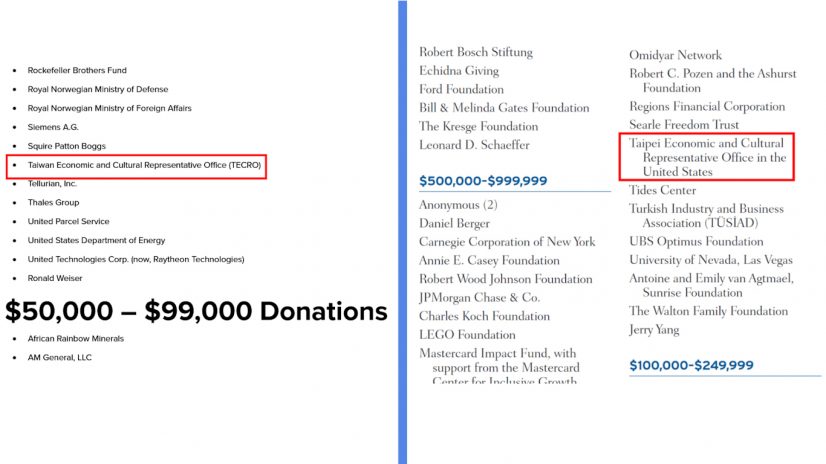
TECRO featured prominently among myriad defense interests on the donor rolls for both the Atlantic Council, left, and Brookings Institute
Last week, Brookings held an event called “Taiwan’s quest for security and the good life,” which began with the statement that “Taiwan is rightly praised for its democracy. Elections are free, fair, and competitive; civil and political rights are protected.” It went on to warn that the “most consequential” challenge to the island’s liberty and prosperity is “China’s ambition to end Taiwan’s separate existence.”
According to another organization’s latest financial disclosure, TECRO also gave a six-figure sum to the Atlantic Council, a think tank closely associated with NATO. It is unclear what the Atlantic Council did with that money, but what is certain is that they gave a senior fellowship to Chang-Ching Tu, an academic employed by the Taiwanese military to teach at the country’s National Defense University. In turn, Tu authored Atlantic Council reports describing his country as a “champion [of] global democracy,” and stating that “democracy, freedom and human rights are Taiwan’s core values.” A menacing China, however, is increasing its military threats, so Taiwan must “accelerate its deterrence forces and strengthen its self-defense capabilities.” Thus he advises that the U.S. must work far more closely with Taiwan’s military, conducting joint exercises and moving towards a more formal military alliance. In 2020, the U.S. sold $5.9 billion worth of arms to the island, making it the fifth-largest recipient of American weaponry last year.
Other Taiwan-employed academics have chided the West on the pages of the Council’s website for its insufficient zeal in “deter[ring] Chinese aggression” against the island. “A decision by the United States to back down” — wrote Philip Anstrén, a Swedish recipient of a fellowship from the Taiwanese Ministry of Foreign Affairs — “could damage the credibility of U.S. defense guarantees and signal that Washington’s will to defend its allies is weak.” Anstrén also insisted that “Europe’s future is on the line in the Taiwan Strait.” “Western democratic nations have moral obligations vis-à-vis Taiwan,” he added on his blog, “and Western democracies have a duty to ensure that [Taiwan] not only survives but also thrives.”
The reason this is important is that the Atlantic Council is an enormously influential think tank. Its board of directors is a who’s-who in foreign policy statecraft, featuring no fewer than seven former CIA directors. Also on the board are many of the architects of the wars in Iraq and Afghanistan, including Colin Powell, Condoleezza Rice and James Baker. When organizations like this begin beating the war drums, everybody should take note.
Perhaps the most strongly anti-Beijing think tank in Washington is the conservative Hudson Institute, an organization frequented by many of the Republican Party’s most influential figures, including former Secretary of State Mike Pompeo, former Vice-President Mike Pence and Arkansas Senator Tom Cotton. The words “China” or “Chinese” appear 137 times in Hudson’s latest annual report, so focused on the Asian nation are they. Indeed, reading their output, it often appears they care about little else but ramping up tensions with Beijing, condemning it for its treatment of Hong Kong, Taiwan and Uyghur Muslims, and warning of the economic and military threat of a rising China.
Over the years, Hudson’s efforts have been sustained by huge donations from TECRO. The Hudson Institute does not disclose the exact donations any sources give, but their annual reports show that TECRO has been on the highest tier of donors ($100,000+) every year since they began divulging their sponsors in 2015. In February, Hudson Senior Fellow Thomas J. Duesterberg wrote an op-ed for Forbes entitled “The Economic Case for Prioritizing a U.S.-Taiwan Free Trade Agreement,” in which he extolled Taiwan’s economy as modern and dynamic and portrayed securing closer economic ties with it as a no-brainer. Hudson employees have also traveled to Taiwan to meet and hold events with leading foreign ministry officials there.
The Hudson Institute also recently partnered with the more liberal Center for American Progress (CAP) to host an event with Taiwanese President Tsai Ing-wen, who took the opportunity to make a great number of inflammatory statements about the “ever more challenging threats to free and democratic societies” China poses; applaud the U.S.’ actions on Hong Kong; and talk about how Taiwan honors and celebrates those who died at the Tiananmen Square massacre. TECRO gave the CAP between $50,000 and $100,000 last year.
It is the Center for Strategic and International Studies (CSIS), however, that appears to receive the most Taiwanese money. According to its donor list, Taiwan gives as much money to it as the United States does — at least $500,000 last year alone. Yet all of the Taiwanese government money is put into CSIS’s regional studies (i.e., Asia) program. Like Hudson employees, the CSIS calls for a free trade agreement with Taiwan and has lavished praise on the nation for its approach to tackling disinformation, describing it as a “thriving democracy and a cultural powerhouse.” Although acknowledging that the reports were paid for by TECRO, CSIS insists that “all opinions expressed herein should be understood to be solely those of the authors and are not influenced in any way by any donation.” In December, the CSIS also held a debate suggesting that “[w]ithin the next five years, China will use significant military force against a country on its periphery,” exploring what the U.S. response to such an action should be.
Like the Atlantic Council, the CSIS organization is stacked with senior officials from the national security state. Its president and CEO is former Deputy Secretary of Defense John Hamre, while Henry Kissinger — former secretary of state and the architect of the Vietnam War — also serves on its council.
The CSIS accepts money from the Global Taiwan Institute and the Taiwan Foundation for Democracy (TFD) as well. The former is a rather shadowy pro-Taiwanese group that appears not to disclose its funding sources. The latter is a government-funded organization headed by former Taiwanese President You Si-kun. Every year, the TFD publishes a human rights report on China, the latest of which claims that “the Chinese Communist Party knows no bounds when it comes to committing serious human rights violations” — accusing it of “taking the initiative” in “promoting a new Cold War over the issue of human rights” and trying to “replace the universal standing of human rights values around the world.” Ultimately, the report concludes, China “constitutes a major challenge to democracy and freedom in the world.”
The TFD has also been a major funder of the Victims of Communism Memorial Foundation, a far-right pressure group that insists that Communism has killed over 100 million people worldwide. Last year, the Victims of Communism Memorial Foundation added all global COVID-19 fatalities to the list of Communist-caused deaths on the basis that the virus started in China. The Foundation also employs Adrian Zenz, a German evangelical theologian who is the unlikely source of many of the most controversial and contested claims about Chinese repression in Xinjiang province.
In the past 12 months, TECRO has also donated six-figure sums to many other prominent think tanks, including the German Marshall Fund of the United States, the Center for a New American Security, and the Carnegie Endowment for International Peace. MintPress reached out to a number of these think tanks for comment but has not received any response.
“It would be naive to believe that Taiwan’s funding of think tanks is not pushing them to take pro-Taiwan or anti-China positions,” Ben Freeman, the director of the Foreign Influence Transparency Initiative at the Center for International Policy, told MintPress, adding:
After all, why would Taiwan keep funding think tanks that are critical of Taiwan? There’s a Darwinian element to foreign funding of think tanks that pushes foreign government funding to think tanks that write what that foreign government wants them to write. Taiwan is no exception to this rule.”
TECRO is not just sponsoring American think tanks, however. It has also given funds to the Australian Strategic Policy Institute (ASPI), a hawkish and controversial group described as “the think tank behind Australia’s changing view of China.” The country’s former ambassador in Beijing described ASPI as “the architect of the China threat theory in Australia” while Senator Kim Carr of Victoria denounced them as working hand-in-hand with Washington to push “a new Cold War with China.” ASPI was behind Twitter’s decision last year to purge more than 170,000 accounts sympathetic to Beijing from its platform.
“We must be ready to fight our corner as Taiwan tensions rise,” ASPI wrote in January, having previously castigated the West for being “no longer willing to defend Taiwan.”
ASPI — like Brookings, the Atlantic Council and others — are directly funded by weapons manufacturers, all of whom also have a direct interest in promoting more wars around the world. Thus, if the public is not careful, certain special interests might be helping move the United States towards yet another international conflict.
While the situation outlined above is concerning enough, the Foreign Influence Transparency Initiative’s research has shown that around one-third of think tanks still do not provide any information whatsoever about their funding, and very few are completely open about their finances. Freeman maintains that, while there is nothing inherently wrong with foreign governments funding Western think tanks, the lack of transparency is seriously problematic, explaining:
This raises a lot of questions about the work they’re doing. Are their secret funders saying what the think tank can do in a pay-for-play scheme? Are the funders buying the think tanks silence on sensitive issues? Without knowing the think tank’s funders, policymakers and the public have no idea if the think tank’s work is objective research or simply the talking points of a foreign government.”
Freeman’s study of the Taiwanese lobby found that seven organizations registered as Taiwan’s foreign agents in the U.S. Those organizations, in turn, contacted 476 Members of Congress (including almost 90% of the House), as well as five congressional committees. House Speaker Nancy Pelosi was their most frequent contact, the Californian being contacted 34 times by Taiwanese agents. Pelosi has been a great supporter of Taiwanese nationalists, successfully promoting pro-Taiwan legislation and proudly announcing that the U.S. “stands with Taiwan.”
Foreign agents working on behalf of Taiwan also made 143 political contributions to U.S. politicians, with former Alabama Senator Doug Jones the lead recipient (Pelosi was third).
Losing China, regaining Taiwan?
The reports listed above understand the dispute as purely a matter of Chinese belligerence against Taiwan and certainly do not consider U.S. military actions in the South China Sea as aggressive in themselves. That is because the world of think tanks and war planners sees the United States as owning the planet and having a remit to act anywhere on the globe at any time.
To this day, U.S. planners bemoan the “loss of China” in 1949 (a phrase that presupposes the United States owned the country). After a long and bloody Second World War, Communist resistance forces under Mao Tse-tung managed to both expel the Japanese occupation and overcome the U.S.-backed Kuomintang (nationalist) force led by Chang Kai-shek. The United States actually invaded China in 1945, with 50,000 troops working with the Kuomintang and even Japanese forces in an attempt to suppress the Communists. However, by 1949, Mao’s army was victorious; the United States evacuated and Chang Kai-shek retreated to Taiwan.
The Kuomintang ruled the island for 40 years as a one-party state and remains one of the two major political groups to this day. The war between the Communists and the Kuomintang never formally ended, and Taiwan has now lived through 70 years of estrangement from the mainland. Polls show a majority of Taiwanese now favor full independence, although a large majority still personally identify as Chinese.
While many Taiwanese welcome an increased U.S. presence in the region, Beijing certainly does not. In 2012, President Barack Obama announced the U.S.’ new “Pivot to Asia” strategy, moving forces from the Middle East towards China. Today, over 400 American military bases encircle it.
In recent months, the United States has also taken a number of provocative military actions on China’s doorstep. In July, it conducted naval exercises in the South China Sea, with warships and naval aircraft spotted just 41 nautical miles from the coastal megacity of Shanghai, intent on probing China’s coastal defenses. And in December, it flew nuclear bombers over Chinese vessels close to Hainan Island. Earlier this year, the head of Strategic Command made his intentions clear, stating that there was a “very real possibility” of war against China over a regional conflict like Taiwan. China, for its part, has also increased its forces in the region, carrying out military exercises and staking claims to a number of disputed islands.
A new Director of National Intelligence (DNI) report notes that China is the U.S.’ “unparalleled priority,” claiming that Beijing is making a “push for global power.” “We expect that friction will grow as Beijing steps up attempts to portray Taipei as internationally isolated and dependent on the mainland for economic prosperity, and as China continues to increase military activity around the island,” it concludes.
In an effort to stop this, Washington has recruited allies into the conflict. Australian media are reporting that their military is currently readying for war in an effort to force China to back down, while last week President Joe Biden met with Japanese Prime Minister Yoshihide Suga to shore up a united front against Beijing vis-a-vis Taiwan.
In February, the Atlantic Council penned an anonymous 26,000-word report advising Biden to draw a number of red lines around China, beyond which a response — presumably military — is necessary. These included any military action or even a cyber attack against Taiwan. Any backing down from this stance, the council states, would result in national “humiliation” for the United States.
Perhaps most notably, however, the report also envisages what a successful American China policy would look like by 2050:
[T]he United States and its major allies continue to dominate the regional and global balance of power across all the major indices of power;… [and head of state Xi Jinping] has been replaced by a more moderate party leadership; and … the Chinese people themselves have come to question and challenge the Communist Party’s century-long proposition that China’s ancient civilization is forever destined to an authoritarian future.”
In other words, that China has been broken and that some sort of regime change has occurred.
Throughout all this, the United States has been careful to stress that it still does not recognize Taiwan and that their relationship is entirely “unofficial,” despite claiming that its commitment to the island remains “rock solid.” Indeed, only 14 countries formally recognize Taiwan, the largest and most powerful of which is Paraguay.
Along with a military conflict brewing, Washington has also been prosecuting an information and trade war against China on the world stage. Attempts to block the rise of major Chinese companies like Huawei, TikTok and Xiaomi are examples of this. Others in Washington have advised the Pentagon to carry out an under-the-table culture war against Beijing. This would include commissioning “Taiwanese Tom Clancy” novels that would “weaponize” China’s one-child policy against it, bombarding citizens with stories about how their only children will die in a war over Taiwan.
Republicans and Democrats constantly accuse each other of being in President Xi’s pocket, attempting to outdo each other in their jingoistic fervor. Last year, Florida Senator Rick Scott went so far as to announce that every Chinese national in the U.S. was a Communist spy and should be treated with extreme suspicion. As a result, the American public’s view of China has crashed to an all-time low. Only three years ago, the majority of Americans held a positive opinion of China. But today, that number is only 20%. Asian-Americans of all backgrounds have reported a rise in hate crimes against them.
Cash rules everything around me
How much of the United States’ aggressive stance towards China can be attributed to Taiwanese money influencing politics? It is difficult to say. Certainly, the United States has its own policy goals in East Asia outside of Taiwan. But Freeman believes that the answer is not zero. The Taiwan lobby “absolutely has an impact on U.S. foreign policy,” he said, adding:
At one level, it creates an echo-chamber in D.C. that makes it taboo to question U.S. military ties with Taiwan. While I, personally, think there are good strategic reasons for the U.S. to support this democratic ally — and it’s clearly in Taiwan’s interest to keep the U.S. fully entangled in their security — it’s troubling that the D.C. policy community can’t have an honest conversation about what U.S. interests are. But, Taiwan’s lobby in D.C. and their funding of think tanks both work to stifle this conversation and, frankly, they’ve been highly effective.”
Other national lobbies affect U.S. policy. The Cuban lobby helps ensure that the American stance towards its southern neighbor remains as antagonistic as possible. Meanwhile, the Israel lobby helps ensure continuing U.S. support for Israeli actions in the Middle East. Yet more ominously with Taiwan, its representatives are helping push the U.S. closer towards a confrontation with a nuclear power.
While Taiwanese money appears to have convinced many in Washington, it is doubtful that ordinary Americans will be willing to risk a war over an island barely larger than Hawaii, only 80 miles off the coast of mainland China.
Alan MacLeod is Senior Staff Writer for MintPress News. After completing his PhD in 2017 he published two books: Bad News From Venezuela: Twenty Years of Fake News and Misreporting and Propaganda in the Information Age: Still Manufacturing Consent, as well as a number of academic articles. He has also contributed to FAIR.org, The Guardian, Salon, The Grayzone, Jacobin Magazine, and Common Dreams.
Switch to Remote Learning Caused Large Increases in School Dropout and Learning Losses in Brazil
By Noah Carl • Lockdown Sceptics • May 28, 2021
Back in April, I wrote about a study published in Proceedings of the National Academy of Sciences, which found that Dutch students made “made little or no progress while learning from home”. Now researchers have reported a similar finding in Brazil.
As in the Dutch study, the researchers used rigorous methods to gauge the impact of remote learning on student outcomes. In other words, they didn’t just compare outcomes in 2020 to those the year before.
In São Paulo State (where the study was based) state schools switched to remote learning only at the end of the first quarter, and they continued to teach remotely thereafter. This allowed the researchers to compare the change in outcomes between the first and last quarters of 2020 to the change in outcomes between the same two quarters of 2019.
They looked at two different outcomes: high dropout risk (i.e., whether the student had any math and Portuguese grades on his school record in the relevant quarter), and standardised test scores.
When comparing the change in 2020 to the change in 2019, the researchers found large increases in school dropout and learning losses.
Furthermore, they exploited a natural experiment to gauge the impact of switching back to in-person learning. In the fourth quarter of 2020, some municipalities allowed high-schools but not middle-schools to switch back. This allowed the researchers to compare middle- and high-schools in those municipalities with respect to the change in 2020 versus the change in 2019.
Consistent with the previous result, they found that switching back to in-person learning was associated with higher standardised test scores.
In the authors’ own words, their results show that “the societal costs of keeping schools closed in the pandemic are very large”. As such, they argue that “the public debate should move from whether schools should be open or not to how to reopen them safely”.
Shocking! – Latest update on adverse reactions to the Covid Vaccines in the USA released by CDC
THE DAILY EXPOSE • May 23, 2021
The number of reported adverse reactions to the Covid vaccines in the USA surpassed 200,000 according to data released by the Centers for Disease Control and Prevention (CDC). The data comes directly from reports submitted to the Vaccine Adverse Event Reporting System (VAERS).
VAERS is the primary government-funded system for reporting adverse vaccine reactions in the U.S. Reports submitted to VAERS require further investigation before a causal relationship can be confirmed.
Every Friday, VAERS makes public all vaccine injury reports received as of a specified date, usually about a week prior to the release date. The latest data shows that between the 14th December 2020 and the 14th May 2021, a total of 227,805 total adverse events were reported to VAERS, including 4,201 deaths — an increase of 144 over the previous week — and 18,528 serious injuries, up 1,338 on the previous week.

This data also showed 943 total adverse events, including 23 rated as serious, among 12- to -17-year-olds.
In the U.S., 268.4 million COVID vaccine doses had been administered as of May 14. This includes 115 million doses of Moderna’s vaccine, 144 million doses of Pfizer and 9 million doses of the Johnson & Johnson (J&J) COVID vaccine. […]
The latest VAERS data shows:
- 20% of deaths were related to cardiac disorders.
- 54% of those who died were male, 44% were female and the remaining death reports did not include gender of the deceased.
- The average age of death was 74.7 and the youngest deaths reported include two 15-year-olds (VAERS I.D. 1187918 and 1242573 ) and a 16-year-old (VAERS I.D. 1225942). There were other reported deaths in children under 16 that could not be confirmed or contained obvious errors.
- As of May 14, 1,140 pregnant women reported adverse events related to COVID vaccines, including 351 reports of miscarriage or premature birth.
- Of the 2,275 cases of Bell’s Palsy reported, 51% were reported after Pfizer-BioNTech vaccinations, 42% following vaccination with the Moderna vaccine and 192 cases, or 10%, of Bell’s Palsy cases were reported in conjunction with J&J.
- There were 195 reports of Guillain-Barré Syndrome with 40% of cases attributed to Pfizer, 38% to Moderna and 26% to J&J.
- There were 65,854 reports of anaphylaxis with 38% of cases attributed to Pfizer’s vaccine, 51% to Moderna and 11% to J&J.
- There were 3,758 reports of clotting disorders and other related conditions. Of those, 1,468 reports were attributed to Pfizer, 1,093 reports to Moderna and 1,093 reports to J&J.
There have also been 822,845 adverse reactions to the Covid vaccines in the UK alongside 1,180 unnecessary deaths, you can read our latest analysis of the UK report here.
Vax Passports: Where Your State Stands
Alliance for Natural Health | May 27, 2021
As more Americans get vaccinated against COVID-19, and vaccination recommendations extend to younger and younger Americans, we are starting to see more efforts to require vaccination as a condition of receiving services, as we’ve seen at American universities. This endangers autoimmune patients who are more at risk of serious adverse events following COVID vaccination. States can take a stand for medical freedom and privacy rights. To prevent de facto vaccine mandates that endanger millions of patients, we must encourage state leaders to take action to protect our health.
Ten states, so far, have taken steps to restrict or ban the use of vaccine passports, electronic applications that display an individual’s vaccination status or COVID lab test results. Many have done so through executive orders signed by the governor: Arizona, Florida, Texas, South Carolina, South Dakota, Montana, and Idaho. Three states have passed legislation along similar lines, including Utah, Indiana, and Arkansas.
These policies have important differences. In Florida and Montana, executive orders prevent businesses, in addition to state institutions, from requiring patrons to provide proof of vaccination to gain entry or service from the business. In Idaho, Arizona, South Dakota, Utah, South Carolina, Arkansas, Indiana, and Texas, the ban on vaccine passports is generally limited to entities of the state government or (in the case of Texas) any business that receives state funds.
Legislation is pending in the following states to prevent discrimination based on vaccination status and/or to prevent the use of vaccine passports: FL, NC, OK, HI, OR, RI, TX, WI, PA, and VT.
Texas State Senator Bob Hall, one of the sponsors of a bill preventing discrimination in Texas, had eloquent words to share about vaccine passports: “[My bill] aims to give Texans the peace of mind of knowing that their ability to navigate, participate, and function without being required to undergo an experimental medical procedure as a condition of that engagement is protected by law.”
Some governors have made positive statements, though have not yet taken action to prevent vaccine passports. Georgia Governor Brian Kemp tweeted, “I do not and will not support any kind of state-mandated vaccine passport… the decision to receive the vaccine should be left up to each individual.” Governor Pete Ricketts of Nebraska said “Nebraska will not participate in any vaccine passport program. This concept violates two central tenets of the American system: freedom of movement and healthcare privacy.” Tennessee Governor Bill Lee announced “I oppose vaccine passports. The COVID-19 vaccine should be a personal health choice, not a government requirement.”
Some states are moving in the other direction. Hawaii is allowing fully vaccinated Hawaiians to travel between islands without quarantine and other testing rules, with plans in the works to launch a vaccine passport system. New York has already launched the Excelsior Pass, a voluntary app that allows people to upload negative COVID-19 test results or proof of vaccination. Governor Ned Lamont of Connecticut said he expects “some type of passport or validation … probably led by the private sector,” and that more planning will occur once vaccinations are open to everyone. Governor Roy Cooper of North Carolina said his administration is exploring the development of vaccine passports.
We’re already seeing how this can play out. In Israel, for example, the government issues “green passes” allowing access to social, cultural, sporting events, gyms, restaurants, etc., to individuals who have either recovered from COVID or have had the vaccine. Green passes must be renewed every six months.
We are all eager for life to return to “normal” following extended lockdowns and isolation. But vaccine passports are not the answer. We cannot deny rights and privileges to those, such as autoimmune patients, who choose not to receive a medical procedure due to a legitimate medical concern.
Action Alerts!
- Florida and Montana residents, thank your legislators for banning vaccine passports. Take Action!
- If you live in a state that banned vaccine passports only in state institutions (AZ, AR, ID, IN, SC, SD, TX, and UT), thank lawmakers for taking action but urge them to extend the ban on passports to businesses in the state. Take Action!
- All other states: urge your lawmakers to take action to ban vaccine passports in your state. Take Action!
YouTube deletes video of Georgia mom’s testimony against mask mandates for kids
By Didi Rankovic | Reclaim the Net | May 27, 2021
YouTube has once again deleted a video showing Courtney Ann Taylor speaking out against the mask wearing mandate imposed on children in schools in the US state of Georgia.
This time, the viral video recorded during a school board meeting got taken down from the YouTube channel of Grabien, Tom Elliot’s distributed news prep service.
Elliot revealed in a thread on Twitter that YouTube censored the video for a violation of community guidelines and medical misinformation rules.

However, Elliot, who unsuccessfully appealed the decision, believes not only that parents should have the right to voice their opinion on whether their children wear masks – but that Taylor’s comments did not actually violate YouTube’s policy quoted in the removal notice.

YouTube insists that its coronavirus-related moderation and censorship is based on the position of health authorities, most notably the WHO, yet not even this organization recommends that children must wear masks.
Elliot links to the WHO website where the topic of children and masks is discussed, with the UN agency concluding that there is no scientifically-based reason to make children wear masks.
Even though this is the argument Elliot used in his appeal, YouTube remained steadfast in its intention to prevent users from seeing the video, insisting that it does violate the medical misinformation policy, and justifying this as the need to be “a safe place for all.”
For those wondering what Taylor said and how it might be interpreted as spreading Covid misinformation, he provided a link to the Grabien website that has the video, uploaded on another platform, and a transcript.
Taylor is heard urging the school board to end the mandatory wearing of masks by children as unjustified, considering not only the availability of vaccines for adults, but also the fact that the virus does not affect young children. Taylor then shares that her 6-year-old had asked her to tell the school that she doesn’t want to wear a mask any longer.
Previously, YouTube deleted the same video uploaded by journalist Kyle Becker, but left it on large corporate channels like CBS and Fox, once again affirming the trend of catering to this type of users over independent creators.
Life Insurance and Covid-19; Something Doesn’t Make Sense
By Jeff Harris | Ron Paul Institute | May 26, 2021
You would think that during the worst Pandemic since the 1918 Spanish Flu life insurance companies would be hedging their bets to avoid major losses from Covid-19. I haven’t written a life policy for several years so I was wondering what was going on? I called one of the brokers I deal with that interacts with hundreds of big life insurers to get an inside look into how the Covid crisis has changed their business.
Imagine my surprise when she said it was pretty much business as usual! Last year when the hysteria was just getting ramped up she did say the companies temporarily tightened up underwriting and reduced the amount of coverage they would offer. But as time went by and the hard data came rolling in those same companies went back to business as usual.
I asked her specifically if life insurers wanted a Covid test as part of the underwriting process and she said none that she was aware of. Hmm, that’s pretty interesting isn’t it? The most lethal pandemic in decades descends on the globe with deadly mutations taking millions of innocent lives and the life insurance companies couldn’t care less.
I also asked if the cost per thousand of coverage had increased due to Covid and again she said no. Rates were pretty much the same as they were before the Covid Pandemic ravaged the earth. Life Insurance companies are very risk adverse. They don’t like losing money to unnecessary claims. The fact they’re treating Covid as a nonevent should be an indicator that something is very wrong with the whole narrative.
Copyright © 2021 by RonPaul Institute
No going back to Open Skies, US tells Russia ahead of Biden-Putin summit
RT | May 27, 2021
The US State Department has communicated to Moscow that the Biden administration has no intention of rejoining the Open Skies treaty, which was one of the topics expected to come up at the Geneva summit in June.
Deputy Secretary of State Wendy Sherman sent the message to her Russian counterpart Deputy Foreign Minister Sergei Ryabkov on Thursday, AP reported, citing US officials speaking on condition of anonymity. Russia’s Ministry of Foreign Affairs has confirmed receiving the message.
It was a rare case of President Joe Biden not reversing a decision made by his predecessor Donald Trump, who had taken the US out of the treaty in May 2020.
The US officially left the treaty in November, but when Biden came to power he ordered a review of the decision, holding out the possibility that Washington might rejoin. The subject was expected to come up at the June 16 meeting between Biden and Russian President Vladimir Putin in Geneva.
Earlier in the day, Kremlin spokesman Dmitry Peskov had told reporters that time to salvage the arms control agreement was running out fast.
“This topic can surely be touched upon somehow, but time is running out fast. We are already carrying out procedures for leaving the treaty, and the US has little time to change its previous decisions,” Peskov said.
Last month, Moscow announced it would begin the procedure of withdrawing from the treaty, concerned that the US has continued to receive intelligence through overflights conducted by other NATO members still party to it.
With the US definitely out, further presence of Russia in Open Skies no longer makes sense, Russian Senator Andrey Klimov – who sits on the foreign relations committee – told RIA Novosti following the announcement from Washington.
The Open Skies treaty was intended to build trust between Russia and the West following the Cold War. Signed in 1992 and going into effect in 2002, it allowed signatories to openly fly unarmed surveillance planes over the territory of other participants. More than 1,500 such flights have taken place since.
Russia Laments Washington’s Failure to Strictly Adhere to New START Treaty Provisions
By Henry Batyaev – Sputnik – 26.05.2021
Russia is calling on the United States to keep their end of the bargain with respect to the New START Treaty after Moscow found that the United States had converted some of its strategic offensive arms, making it impossible to verify whether they can be now used to carry nuclear weapons.
The representative of the Russian Foreign Ministry, Maria Zakharova, said on Wednesday that Moscow will continue to demand that Washington comply with the terms of the treaty.
She added that Moscow is closely monitoring US efforts to modernise its strategic offensive arms, including through the increase of funding.
According to the New START Treaty, the sides must notify each other on the elimination of treaty‑accountable systems or conversion to non‑nuclear or non‑accountable status.
In February, Russia and the United States agreed to extend the New START treaty for five more years without renegotiating any of its terms. The treaty, now set to expire on February 5, 2026, is the only arms control agreement between two countries that is still in force.
From Here On, Palestine Calls the Shots
By Taxi | Plato’s Guns | May 27, 2021
From rocks to rockets. This is now the recorded evolution of the armed Palestinian Resistance. From throwing Intifada rocks that barely scratched occupation tanks, to lobbing rockets that can now reach anywhere in Israel: this is presently the undeniable status of the Palestinian Resistance. Hard, therefore, not to deduce that some impressive progress has been achieved by the armed Palestinian Resistance in Gaza, despite Gaza being under a severe land, sea and air siege. Right under the very noses of the bulky Israeli military and its lauded hi-tech Intel, the Palestinian Resistance has managed to arm itself in a significant way – and indeed, it continues to improve its arsenal, undetected. Of course, Israel’s weaponry remains by far more superior to that of the Palestinians, but this superiority in arms became meaningless during the recent ‘Sword of Jerusalem’ combat: a small war that found the Israeli forces unilaterally withdrawing from the battlefield after only some ten days. In normal military parlance, this would be defined as a defeat, yet this defeat is being referred to in the West as a ‘ceasefire’. Well, semantics aside, the simple takeaway is that Israel’s mighty military lost to pitiful Gaza rockets. The biblical story of David and Goliath repeated itself right before our modern eyes. And from here on, the hulking Israeli military will be powerless to protect Israeli Jews and their properties in the holy land.
In 1948, Zionism had promised the Jews of Israel two vital services: security and prosperity. Indeed, it had kept good on its promise for some 73 years. But now, in 2021 and post the ‘Sword of Jerusalem’ war, it can no longer provide either. From here on, Zionism cannot guarantee either security or prosperity for its Jewish population – not with Gaza rockets now permanently looming and ready to disrupt daily Jewish life in the holy land. It used to be that the Israeli military was the one capriciously disrupting the security and prosperity of Palestinians, but overnight, the success of the ‘Sword of Jerusalem’ has turned the tables on Israel. From here on, Palestine calls the shots. From here on, Israel will pay a very heavy price for any significant aggression against the suffering, occupied Palestinian people. This equation is now fixed; immovable. This is the new status quo.
Moreover, Zionism, appealing specifically to Jewish zealots, had also promised the total Judeofication of Jerusalem. A project that is contrary to International Law. A project that entails illegal land theft and the total ethnic cleansing of native Palestinians from their ancestral homes. Now, this project has come to a total standstill, with Hassan Nasrallah announcing recently that his resistance army, Hezbollah, as well as the armies of other members of the Axis of Resistance, will from here on militarily involve themselves in defending Jerusalem from this Judeofication project. Therefore, what we have now is Gaza’s improved rocketry checking Israel from within, and from without, we have several million Axis of Resistance fighters and their immense arsenal standing by, all ready to liberate Jerusalem at a moment’s notice. “Jerusalem for regional war,” was Nasrallah’s succinct warning to Israel. A regional war that will in fact be an existential war for Israel. A regional war that even the staunchest Israeli supporters are deathly fearful of because it will completely destroy modern Israel and cost tens of thousands of Jewish lives.
With Israel’s Zionism now unable to fulfill any of its fundamental promises, where does all this leave Zionism but collapsing before the very eyes of Jews themselves.
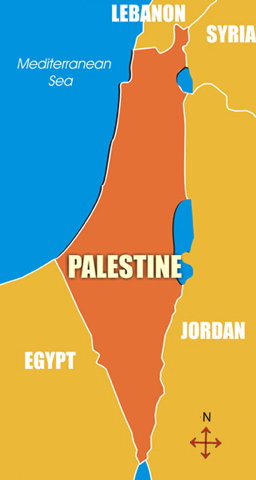 It is now simply impossible for Israel to reverse its sinking fortune without igniting a suicidal, regional war. No power on earth, not even mighty US powers can reverse this track. All the US and other Western friends of Israel can do now is delay the inevitable destruction of Israel with the use of a proverbial band aid here and a band aid there. Blinken, who is currently visiting the holy land is offering nothing but band aids to both sides. Other Western leaders will soon enough also come to Tel Aviv and to Ramallah with offers of more band aid. In reality, no one has anything else to offer Israel but band aid, because everything else has already been gifted to Israel in the past, and Israel appears to have squandered and abused, instead of used these gifts wisely for its longevity’s sake. There is no more that the West can do for Israel, save for actually sending their troops to the holy land to die for the Jews. An unlikely and most controversial move to now send democratic Western troops to die for ‘Apartheid Israel’, especially in the current depressive economic state that the whole world finds itself in. And Even if some Western nation was foolish enough to send its troops to fight for Tel Aviv, these troops will not be able to stop the intensive waves of Resistance precision missiles and rockets already poised to saturate Tel Aviv and the rest of Israel proper. Here, even geography is against Israel.
The ‘Sword of Jerusalem’ has irreversibly weakened Israel, not just on the home front, but the world over too. Overnight, Israel’s universal image went from its traditional ‘victim State’, straight to ‘Apartheid state’. Now, in the minds of the majority of the world, Israel is believed to be an Apartheid state. And in this new Apartheid definition of Israel, the so-called holocaust violin and begging bowl are nowhere to be found. The world is no longer interested in considering the sentimental holocaust when it comes to Israel. All the world can see now are the numerous and unconscionable Crimes Against Humanity that Israel has wantonly engaged in against the Palestinians – numerous crimes that israel has committed without a single instance of accountability. The world is no longer prepared to remain silent on this, or to accept the status of Israel as eternal victim.
So very much has been shattered within the Zionist machinery by the ‘Sword of Jerusalem’. And there are no spare parts to be found anywhere to replace them. Not even a false flag operation by Israel will return it to the victim chair. The whole gaggle and cackle of Jewish deceptions are by now also known and exposed to global populations. What in the past used to work in favor of Israel, is no longer working. The apple has lost its shine.
And another major victim of the ‘Sword of Jerusalem’ is the Deal of the Century. At this stage of the game, with Jerusalem currently being a focal and highly emotive topic deluging Arab world medias, it is impossible for any corrupt Arab leader to now sign up anew to the Deal of the Century. And who in their right mind would sign a highly controversial deal with a sinking nation that can offer nothing in return? Mindful here too that two out of the four Arab nations that have already normalized with Israel under the Deal of the Century, did so purely for personal and not ideological reasons. These two nations are Sudan that signed the Deal in exchange for the removal of its name from the US’s terrorism list; and Morocco that signed the Deal in exchange for US support in Morocco’s illegal land claims over the Western Sahara. We can therefore safely say that out of 22 Arab nations, only two despotic Arab dictatorships are ideologically aligned with Israel: the UAE and Bahrain. These petite Zioninst-Arab nations cannot save Israel from even a single Gaza rocket, let alone from the combined weapons of the Axis of Resistance that now surround Israel: all coiled and waiting for Israel to miscalculate. Kushner’s attempt at wiping out the Palestine cause from the Arab world by creating a normalization program has utterly and completely failed. The Palestine cause has never been stronger in the Arab mind than it is now. The Deal of the Century has become the Tomb of the Century.
Moreover, an even more important pro Israel project has also collapsed at the swipe of the ‘Sword of Jerusalem’: The Oslo Agreement. No longer are the Palestinians happy with just a pitiful ‘crumb of land with no autonomy’ offered to them by Israel under Oslo, they are now unanimously demanding the return of all their land ‘from the river to the sea’. Their supporters worldwide are backing this notion by loudly chanting ‘from the river to the sea’ at all their mass protests. The ‘Sword of Jerusalem’ has veritably stabbed Oslo in the heart. The Two State Solution is dead. The One State Palestine Solution has grown massive wings.
Indeed, with Palestine now demanding all its land back ‘from the river to the sea’, Zionism appears to have symbolically lost all the land it acquired by force of arms since 1948. This symbolism will now become a reality in the next war between Israel and the Axis of Resistance. And war is coming. Plans and maps for the final War 0f Liberation remain very much on the table. Over the past 7 decades, Israel had stridently rejected numerous calls by friend and foe alike to surrender to the Levant’s historic culture of equitable coexistence between religions; rejected blending into the local scenery, opting instead to war against all its neighbors so as to assert itself as a vastly dominant power beyond reproach. Now it finds itself with many missed opportunities for peace and with its jugular bleeding: cut by no less than an over-zealous, blunt Zionist knife. War is coming to the holy land because Zionism has relentlessly expressed itself as a supremacist ideology that is fundamentally incapable of compromise, incapable of equality and justice, incapable of making real and genuine peace with any of its non Jewish neighbors. Through unchecked savagery, through arrogance and overreach since its inception, Israel has now become impotent in the face of the real existential threat it faces today. Apartheid policies and land-kleptomania will only get you so far. The Jews should have learned this lesson from the now defunct Apartheid South Africa.
Israel and its Jewish population now find themselves in an unsustainable and untenable position. They have now but two choices: depart from the Jewish colony in peace and physically intact, or from here on face a daily life of fear of Palestinian rockets and whatnot, followed eventually by a violent death when the big war breaks out.
Addressing Israeli Jews in his speech yesterday, Nasrallah stated: “We see how Muslim and Christian holy places are these days under dangerous attacks by you. When you destroy homes and people in Palestine: we leave this to the internal Palestinian Resistance to address. But we as the Axis of Resistance cannot stand idly by when you violate the sanctity of Muslim and Christian holy places in Jerusalem. Any further violations of Jerusalem by you will lead to regional war.”
Will Israeli civilian and military societies listen to Nasrallah’s warning, or will they, in their traditional arrogance, dismiss his words as being mere empty threats?
The Axis of Resistance now has all its war ducks lined up. The much longed for and necessary Palestinian unity is now a reality. All the needed weapons for victory are a reality. Global moral support for Palestinian liberation is now a reality. The War of Liberation is but one single step away. And the timing of this war will be triggered when Israel foolishly violates Jerusalem again. And violate it will, in its attempt to put oxygen back in the collapsing lung of Zionism. After all, violation is the only method that Israel knows. Violation is the definitive Israeli MO.
Will the Jews of Israel now risk life and limb and continue clinging to and supporting a shattered Zionism that can no longer deliver them its promised goods? Or will their survival instinct kick in and have them packing suitcases and returning back to their European, Russian and American origins?
A combination of both, I suspect. Some Jews will leave Israel. Some won’t. The die-hard Zionists are pathologically deluded enough to remain: believing that present conditions are militarily reversible. They’re not. Not anymore. Not ever. All that the Zionist Israeli government can do now in the aftermath of the ‘Sword of Jerusalem’ is ease up a small measure of pressure on the Palestinians and on the city of Jerusalem: buying itself time to come up with a solution that would be acceptable to both Israeli Jews on one hand, and Palestinian Muslims and Christians on the other. But Zionism, by its own definition does not allow for equitable co-existence with non-Jews. Sober minds on both sides do not believe that a win-win solution is available, or feasible. They estimate that this too-little-too-late path of Israel releasing some pressure on Jerusalem will lead to nowhere, and at some point en route, the Israeli government will become insensible with frustration to the point of miscalculation. Indeed, it will be Israel’s very last miscalculation.
We shall soon enough see a costly but heroic and historic return of the nation of Palestine: from the river to the sea.
No stopping now the winds of change that favor the suffering Palestinians.
Pakistan rejects US request for military bases
By Javed Rana | Press TV | May 27, 2021
Islamabad – As the US is negotiating with countries in Central and South Asia to set up its military bases in the region to carry out possible airstrikes on Afghanistan after later this year withdrawal from the country, Pakistan says it won’t ink any similar agreement with the US once again.
The US is fast pulling out its troops from Afghanistan under a peace deal with Afghan Taliban. However, before completing its withdrawal by September 11 this year, Washington is desperately negotiating with regional countries in Central and South Asia to set up military bases to retain its political clout in this part of the world.
The US used Pakistan’s military bases for years to carry out over 57,000 sorties on Afghanistan which killed tens of thousands of Afghan civilians. Similarly as many as 4,000 Pakistani civilians were killed in the bordering region with Afghanistan in US drone attacks most of which were carried out from the secret southern locations of Pakistan.
Not long ago, under public pressure Pakistan shut down the US military bases. Now the US is once again struggling hard to be allowed to have military bases in this part of the world.
Prime Minister Imran Khan’s government, which won the 2018 general elections partially exploiting anti-American sentiments, has vowed not to allow the US to have military bases again in Pakistan.
Earlier the Foreign Office denied the presence of any US military or air base in Pakistan, stating that any speculation is “baseless and irresponsible” and should be avoided.
If nothing works, the Pentagon says it can use its aircraft carriers already stationed in the West Asia and Persian Gulf to carry out any possible airstrike on Afghanistan in future.
Despite shutting down the US military bases in Pakistan, the Pentagon continues to use air corridors of Pakistan to support its shrinking military presence in Afghanistan. And Pakistan has yet to clarify on whether or not it would allow the US to retain its air space facility for any possible airstrike in Afghanistan after the US completely exits from Afghanistan later this year.
Featured Video

Iranians Want Revenge /Sulaiman Ahmed
or go to
Aletho News Archives – Video-Images
From the Archives
Only a Beginning… Charles Malik’s vision of an emergent Pax Judaica
By David Miller | Tracking Power | November 12, 2026
In August 1949, three months after Israel joined the United Nations, Lebanon’s envoy in Washington sent his government a long report. Charles Malik, no firebrand, had signed the UN Charter and helped draft the Universal Declaration of Human Rights. His Report on the Present Situation lay largely unread until Dar An-Nahar printed it in 2002. … continue
Blog Roll
 Aletho News
- Independence movement declares mobilization against Morocco
- Only a Beginning… Charles Malik’s vision of an emergent Pax Judaica
- Iranians Want Revenge /Sulaiman Ahmed
- ‘Israel’ bombs Nasser Medical Complex in Khan Younis, killing 5
- The beginning of the end: Israel at the heart of America’s political civil war
- US-Israeli war on Iran cost Persian Gulf states nearly $1T in damage, lost growth: Report
- Congress probe could put ‘Israel’ in dock over Iran war: Israeli media
- Spanish public prosecutor backs US demand to extradite pro-Palestine philanthropist Fergie Chambers
- Zelensky spent over 740 days outside Ukraine while West serves as his real home
- Indian captain of Russian ‘shadow fleet’ tanker faces 10-year jail term in UK
- If Americans Knew
- These Democrats Are Bringing a Christian Case Against Israel’s War to Congress
- Netanyahu calling Trump ‘every day’ to push for renewed war on Iran
- What will big wins by Democrats actually mean for Palestine?
- What is Section 219 of the US defense bill, and what would it mean for Israel?
- Hegseth dodges impeachment after using troops and vets for cover
- Israel Bombs Lebanon’s Churches
- Israel Targets U.S. Conservatives in New Influence Operation
- Declassified FBI Files Reveal Early U.S. Counterintelligence Probe into Israeli Espionage and Smuggling Networks
- Israelis perpetrated 1,182 arson attacks in the West Bank in past 3 years
- DAILY UPDATE: Latest essential news on Palestine, Israel, & region
- No Tricks Zone
- German Authorities Start Initiative To Evaluate Public Register For Climate “Disinformation” Spreaders!
- Zonal Asymmetry of Temperature Change in the Antarctic Circumpolar Current
- New Study: The Net Fossil Fuel Contribution To Rising Atmospheric CO2 Has Been Zero For 500 Years
- Germany’s Green Energy Transition Becoming Increasingly Expensive…Another 6 Trillion Euros!
- Sudden Stratospheric Warming, Powerful El Niño Combination May Lead To Extreme Europe Cold, Energy Crisis!
- Two New Studies Find Thwaites Glacier Melt Cannot Be Driven By Human Activity Or A Warming Ocean
- E-Cars Reduce CO2 Emissions By Only 41% Compared To Internal Combustion Engine Vehicles
- Predictions Made By Renowned Climate Professor Over Past Decades Have Been Proven To Be Poor
- New Study Suggests Large Regions Of The Pacific Ocean Have Been Cooling For The Last 80 Years
- Germany’s Green Energy Debacle: High Energy Costs Force Kahla Porzellan to Close After 182 Years!

