Britain’s Nuclear Weapons: Money for Nothing
By Brian Cloughley | Strategic Culture Foundation | October 27, 2020
On 19 October the BBC reported that “A Royal Navy officer has been sent home from the U.S. after reporting to take charge of a submarine’s Trident nuclear missiles while unfit for duty. Lt Cdr Len Louw is under investigation at Faslane naval base in Scotland amid reports he had been drinking. Colleagues raised concerns when the weapons engineering officer arrived for work on HMS Vigilant last month.”
It must be made clear that there was no possibility this officer or any other single person could in some way commit the submarine to despatch of its weapons. It simply could not happen. But the squalid little incident did draw attention to the fact that a British nuclear submarine was in the United States for some reason and although the UK’s over-staffed and infamously incompetent Ministry of Defence condescendingly announced that “the Royal Navy does not comment on matters related to submarine operations” it was apparent that the boat was in port at the U.S. submarine base in Kings Bay, Georgia, probably to update and recalibrate technical devices and to load a number of Trident II D5 nuclear missiles.
The UK keeps insisting it has an independent nuclear weapons capability, so it has to be asked why the Royal Navy needs to send submarines to the U.S. to pick up missiles. But as with so many defence matters the government tries to keep the British public in the dark as much as possible. According to the U.S. Naval Institute, “Vigilant is one of four U.K. Vanguard-class boomers that the Royal Navy maintains as part of the British nuclear deterrent force. While the MoD maintains its own nuclear warheads, British and U.S. submarines share a common stockpile of Trident II D5 missiles stored at Kings Bay.”
It can also be asked why the United Kingdom government thinks the country needs nuclear weapons at all.
London’s reluctance to provide information to the public about nuclear weapons is likely based on the government’s desire to disguise the vast expenditure involved. When it is demanded by law that information be provided, it is released on a carefully timed basis. The public relations operators have it all planned, and choose a day when more exciting news can be either expected or manipulated, rather like the FBI’s notification of the preposterous allegations that “Iran and Russia Seek to Influence Election in Final Days” that — surprise, surprise! — were headlines on the same day that former President Obama gave a speech in support of presidential candidate Joe Biden.
But the Brits didn’t succeed in one particular case concerning vast expenditure on systems to replace the existing Trident nuclear missiles on its four submarines. It had been stated in the annual update to Parliament by the Ministry of Defence in December last year that “Work also continues to develop the evidence to support a government decision when replacing the warhead” and there matters rested — until in February Admiral Charles Richard, commander of U.S. Strategic Command, “told the Senate defence committee that there was a requirement for a new warhead, which would be called the W93 or Mk7. Richard said ‘This effort will also support a parallel replacement warhead programme in the United Kingdom’.”
The disclosure forced the underhand of the UK government, and on February 25 Defence News reported Defence Secretary Ben Wallace as stating that “To ensure the Government maintains an effective deterrent throughout the commission of the Dreadnought Class ballistic missile submarine we are replacing our existing nuclear warhead to respond to future threats and the security environment” which is a weasel-worded admission that did not mention the colossal sums of money involved.
(But then, Ben Wallace is no stranger to large sums of money, and during the 2009 revelations by the UK’s Daily Telegraph concerning fiddling and greed on the part of politicians it was revealed that in 2008 he had the fourth highest expenses of any Member of Parliament, claiming £175,523 (on top of his £63,000 salary), including £29,000 a year to employ his wife as a part-time research assistant.)
The cost of replacing Trident missiles by the “life extension programme” of the warheads is not known, as the only estimate available, given in a 2006 government paper on ‘The Future of the United Kingdom’s Nuclear Deterrent’, is £250 million which is obviously a small fraction of the true amount.
Not only is the UK committing massive sums to replace the weapons systems of existing nuclear submarines, it has embarked on an enormous programme to build four new ones to replace the Vanguard class vessels. A House of Commons research briefing of June 2020 (produced by the House Library whose researchers are not influenced by sleazy political fandangos) states that the programme involves “design, development and manufacture of four new Dreadnought class ballistic missile submarines (SSBN) that will maintain the UK’s nuclear posture of Continuous at Sea Deterrence” and that “the cost of the programme has been estimated at £31 billion, including defence inflation over the life of the programme.”
The United Kingdom is in a parlous economic state. The International Monetary Fund assesses that the effects of the Covid-19 pandemic will hit Britain’s economy much harder than much of the rest of the world, and while nobody can forecast what will befall the UK if it abandons trade negotiations with the European Union, it is certain that there can be no economic benefit from its current policies.
The last thing the UK needs to do is to commit billions of pounds to nuclear weapons. (Although its Members of Parliament do count the pennies on occasions. They’ve just been told they are to get a pay increase of over 3,000 pounds a year, and on October 21 voted overwhelmingly to reject a plan for poor children to receive midday school meals during school holidays in this period of extreme financial insecurity. They’re all heart.)
At the moment, UK nuclear policy is that “we are committed to maintaining the minimum amount of destructive power needed to deter any aggressor” and as noted by Scientists for Global Responsibility, “The UK’s nuclear warheads are carried on Trident missiles – leased from the USA – in nuclear-powered submarines. Currently, eight missiles can be fired, carrying 40 x 100kT warheads, with a few hours’ notice from a submerged submarine. The UK’s total nuclear weapons arsenal consists of 195 warheads.”
There is no doubt that 195 warheads would destroy enormous areas, but there is no point in going into detail, because if the submarines fired off any nuclear weapons at Russia (the only conceivable target), retaliation would ensure that the UK would cease to exist.
Just who does London imagine is being deterred by its expensive nuclear missiles? America is the only western country that would commit to firing nuclear weapons, and there is no possibility that Washington would consult London about its decision. Once Washington went to nuclear war, all that the UK could do would be to pop off its missiles to pile destruction on destruction. That’s not deterrence, and Britain would be well advised to refrain from spending countless billions on a new set of nuclear toys and commit its resources to betterment of its citizens.
Russia Rejects US Proposals on New START Verification, Ryabkov Says
By Irina Acheeva – Sputnik – 27.10.2020
Last week, Russian President Vladimir Putin suggested extending the last arms control agreement between the United States and Russia for another year without any conditions, stressing that a world without the New START would be worryingly vulnerable.
Moscow maintains active dialogue on the New Strategic Arms Reduction Treaty (New START), but will not make any other concessions, Deputy Foreign Minister Sergey Ryabkov said.
Ryabkov further elaborated that Moscow does not accept the US proposal for verification within the framework of the New START.
“We have the full impression that the Americans do not need any agreements, they only need verification. And verification, in the way proposed by them, is, basically, to establish external control over the most sensitive elements of ensuring the entire systems of our national security. This is unacceptable for us”, the deputy minister said.
According to Ryabkov, Russia “cannot agree to such a proposal for higher reasons”.
“We said and continue to say that any agreement in this area is possible only where both interests are balanced, as a certain compromise. We are ready for this but see no indication that the US side is prepared to compromise. Therefore we conclude that attaining basic agreement in the present segment is, to put it mildly, doubtful”, the diplomat noted.
He added that Moscow is disappointed by the signs it sees from the US regarding an extension of the New START.
“We are having vigorous talks with the US on these issues. The signs we are getting from them disappoint us. The Americans do not seem to understand that we cannot implement proposals, when the US, rather than making requests, keeps piling on demand after demand”, Ryabkov said.
The statement comes after Russian Ambassador to the United States Anatoly Antonov said that Russia is urging the US to stop trying to bargain for benefits in the last days of the New START. Antonov also pointed out that Washington has bluntly rejected to prolong the treaty as it was signed without any conditions.
On 22 October, Russian President Vladimir Putin said “nothing bad will happen” if the New START gets extended for one year, as it would provide both sides with more time to find a compromise. US National Security Adviser Robert O’Brien has commented on Putin’s proposal calling it a “non-starter“.
The United States had previously suggested prolonging the treaty for one year if Moscow and Washington froze the number of their nuclear warheads during that period.
The New START that is set to expire in February 2021, is the last arms control agreement between the United States and Russia.
Leaked papers: UK ran secret training & PR op for Syrian militants costing millions, despite knowing risks
By Kit Klarenberg | RT | October 27, 2020
A swath of what appear to be secret Foreign & Commonwealth Office documents outline a multimillion-pound British effort to train rebel fighters in Syria via private companies, knowing but brushing off the risk of jihadist hijack.
The documents released by the hacktivist collective Anonymous appear to expose a variety of covert actions undertaken by the UK government against the Syrian state over many years.
The overriding objective behind them all, the papers suggest, was to destabilise the government of Bashar Assad, convince Syrians, Western citizens, foreign governments, and international bodies that the Free Syrian Army (FSA) was a legitimate alternative, and flood media the world over with pro-opposition propaganda.
The dimensions of the assorted information warfare operations implied in the papers, some of which have been detailed by the Grayzone Project, were vast. In a representative example, “social enterprise” firm ARK, founded by veteran Foreign & Commonwealth Office (FCO) operative Alistair Harris, “rebranded” the Syrian Military Council, “softening the Free Syrian Army’s image” in order to “distinguish it from extremist armed opposition groups and establish the image of a functioning, inclusive, disciplined and professional military body.”
Training ‘credible and effective’ militants
At least one cog in this cloak and dagger connivance was overtly militant in nature. From August 2016, a consortium of private contractors ran a programme for the FCO, through which “training, equipment, and other forms of support” was provided to the FSA’s ‘Southern Front’ coalition, to “foster a negotiated political transition, support moderate structures and groups in opposition held areas of Syria, counter violent extremism and prevent the establishment of a terrorist safe-haven.”
Under its clandestine auspices, up to 600 belligerents were trained every year the operation ran, an indeterminate total – the endeavour was dubbed MAO B-FOR (Moderate Armed Opposition Border Force Capability Project), and forecast to cost the FCO £15,767,599.
B-FOR’s ‘statement of requirements’ document sets out in succinct detail Whitehall’s objectives in pursuing the project.
“The aim… is to generate pressure on the Assad regime and on extremists, in the south the country… If MAO border groups are better able to secure and maintain control of specific areas of responsibility across liberated near-border communities along Syria’s southern border with Jordan… the MAO will demonstrate its tangible value to the local and international community as an effective security actor… This will reinforce perceptions that there is a credible and effective moderate opposition able to provide support for an alternative pathway to political transition,” the project tender states.
In practical terms, fighters in “international borders under MAO control” and “areas bordering MAO control under the control of another entity or under no control” – the Jordan-Syria border being the FCO’s “current priority area” – were intended to be “better able to control their AOR [areas of responsibility] through effective use of relevant tactics, operations, equipment, infrastructure, and ability to react to a changing tactical situation.”
To this end, the UK government provided a “dedicated training site” in Jordan “at no cost” to project contractors. The site is situated 45 minutes from the Jordanian capital, Amman, according to an annotated Google Earth snapshot found among the leaked papers. The 600-acre expanse comprised “accommodation, ablution, dining, classrooms, driving track, outside rural environment areas, and open space for equipment storage solutions.” In particular, trainees were to be tutored in the effective use of AK-47s, PK machine guns, and pistols, with 175 fighters able to be accommodated on-site at a time, four weeks the maximum period they could be tutored there continuously.
Contractors were also asked to ensure the project took into account, among other things, Whitehall’s “policy toward gender” – a reflection, just like the tender’s references to “reinforcing perceptions,” of B-FOR’s strong psychological component.
‘Kill, Burn and Loot’
In response, global advisory firm Adam Smith International (ASI) apparently submitted an extensive proposal to the department, offering to head a consortium of contractors, comprised of Pilgrims Group, Kellogg Brown & Root (KBR), Oakas, and GlenGulf.
We have reached out to the companies for comment.
In terms of project roles, ASI – which according to the proposal had been operating in Syria since early 2013, and boasted “well over” 100 field staff in the country – was to provide “strategic stakeholder engagement, project management, project leadership positions, conflict research and analysis and monitoring and evaluation functions.” Pilgrims Group – said to have “supported a large number of media organisations operating in Ukraine” – was tasked with “training delivery, initial military skills assessment, training programme design.”
KBR – which has reaped untold millions from a variety of US conflicts, been embroiled in numerous high-profile scandals, and was reportedly nicknamed “Kill, Burn & Loot” by US marines during the Iraq War – had responsibility for “manning procurement and logistics functions,” including providing the facility’s “quartermaster, storemen and a liaison officer at the key port of entry for imported goods.” Oakas was to offer “bespoke training for MAO command elements (‘battle staffs’) on decision making and planning,” and GlenGulf the “provision of training to officers and commanders on human intelligence gathering and management.”
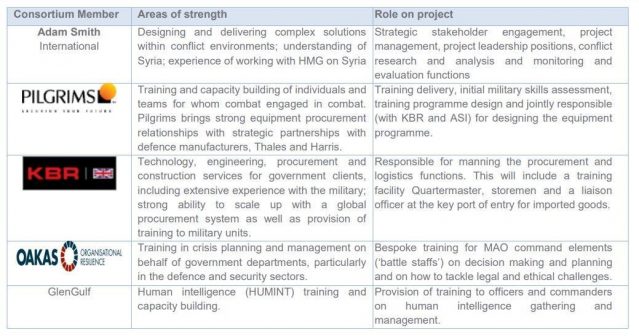
Excerpt from alleged ASI document
Accompanying project staff CVs reveal many individuals involved in B-FOR were senior UK military veterans, who all received sizeable three-figure per diem fees for their participation. For instance, its ranks included a former senior British military advisor to US Central Command, experience ASI claims granted him “in-depth knowledge” of the Syrian “context.”
US-backed rebel front collapses
Part of that context at the time would’ve been the virtual collapse of Southern Front as a serious fighting force. Formed in February 2014 at the behest of the US Military Operations Command (MOC) in Jordan, the Front was a coalition of 50-60 rebel groups. As ASI’s proposal notes, its constituent factions were “given various types of support from the MOC,” including “small arms, artillery, anti-tank guided missiles, ammunition, vehicles, communications equipment, and uniforms,” the Command also paying fighters’ salaries.
Washington’s largesse was fundamental in the Front scoring a series of victories over government forces throughout 2014 and the first half of the next year. In the process, it became the largest rebel umbrella organization in southern Syria, comprising 25-30,000 fighters, and challenging the political and military dominance of Salafist Al-Nusra, the region’s then-largest jihadist group. The mainstream media widely promoted the Front as Western leaders’ best hope of achieving a “moderate” Syrian “revolution” – despite many of its units frequently cooperating and collaborating with Al-Nusra.
However, an over-ambitious attempt by the Front to wrest the city of Deraa’s northern and eastern districts from government control in June 2015 ended in embarrassing failure. The cataclysm led to almost total cessation of MOC support, which in turn meant the Front lost much of its operational capabilities and many of its fighters, who defected in droves to other rebel groups offering salaries. Saudi Arabia subsequently stepped in to provide weapons and fresh funding to the ailing force – B-FOR represented London’s illicit contribution to keeping it functional, and ASI’s proposal makes clear the consortium well-understood the many risks attached to the project.
Risks known, responsibility offloaded
A lengthy section of ASI’s proposal – ‘oversight and management of threats and risks’ – details some of these myriad hazards, along with their likelihood and impact. It was considered highly probable, for instance, groups such as Al-Nusra and ISIS would interfere in the program, “due to perceptions of an ‘international political agenda’” – as a result, extremists “may seek to prevent trainees from joining or inhibit them from fulfilling their functions once trained via kidnap, assault and theft of equipment.”
The possibility that the consortium’s curated fighters may choose or be forced to join other, non-border force Southern Front operations, in turn “[leading] to a weakening of the border capability and perception of UK support to active military operations,” was rated as “medium.” Border force trainees collaborating with extremist actors and/or committing human rights abuses, in the process compromising “the legal and reputational viability of the programme,” was likewise considered of “medium” likelihood and impact.
ASI’s proposed method of dealing with these and other dangers was almost invariably to simply “transfer” responsibility for “owning and managing” the problem to the FCO itself, even suggesting the UK government must simply “tolerate” failings such as the loss of equipment “to a reasonable degree.”
It seems the FCO either acquiesced to shouldering the inherent burdens, or was intensely relaxed about such issues, for the consortium was duly awarded the B-FOR contract, judging by other papers found in the leak.
Non-Disclosure Agreements signed June 10, 2016 by the firms involved indicate they were obliged to adhere to the stringent confidentiality requirements of the 1911 and 1989 Official Secrets Acts, forbidding them from “disseminating any information related to the project to any third party.” Meticulous instructions for disposing of ‘secret’, ‘restricted’, and ‘confidential’ FCO communications were also included.
‘Jihadis You Pay For’
It’s uncertain how many years, or perhaps months, B-FOR endured. Its ‘statement of requirements’ forecast the project would “cover a period until 31st March 2019 with a clause for a breakpoint at the end of each financial year.”
However, in February 2017, a report by Parliament’s international development committee found ASI staff had submitted fake testimonials from aid recipients to a House of Commons inquiry into its activities, set up in response to allegations the firm had been seeking improper financial benefit from UK aid spending.
In response, DfID blocked the company from bidding on future government contracts, and the next month, ASI’s three founding executives resigned. Even more damningly, in December that year, a BBC Panorama documentary (Jihadis You Pay For) exposed how FCO cash ASI distributed in Syria had ended up in extremists’ pockets.
The investigation focused on the FCO’s Access to Justice and Community Security (AJACS) program, under which ASI funded and trained the Free Syria Police, an unarmed civilian force set up to re-establish law and order in opposition-controlled areas.
It found ASI had identified links between several FSP stations and sharia courts run by Al-Nusra and not ended its funding of the stations, or compelled them to sever all connections with the courts – FSP officers in theoretical receipt of FCO funds via ASI had also been present when women were stoned to death. Troublingly, ASI’s B-FOR pitch states its “experience and knowledge” of running AJACS will be “leveraged” to ensure optimal delivery of the border project.
Whether B-FOR was quietly shelved or simply handed over to other contractors in response to these damaging exposures is unknown. In any event, in July 2018, the Front was comprehensively crushed by pro-government forces, its surrendering fighters either agreeing to reconciliation deals or fleeing to Idlib.
It’s also unknown how many fighters trained via the program went on to join jihadist groups, and how much equipment was “lost” over the course of its operation, ending up in the hands of extremists and used to slaughter and maim innocent civilians. The companies running the operation, much less the UK government, certainly weren’t keeping count.
Kit Klarenberg is an investigative journalist exploring the role of intelligence services in shaping politics and perceptions. Follow Kit on Twitter @KitKlarenberg
Will US continue to further implement RAND Corporation’s strategy in relation to Russia?
By Lucas Leiroz | October 27, 2020
The recent conflicts in the Russian zone of influence have attracted attention around the world. But little has been said about the possibility that such conflicts are part of a single common plan, designed to geopolitically destabilize Russia. This possibility is what we can deduce when we recall some recent writings of the renowned think tank RAND Corporation, which, in 2019, openly defended the adoption of a series of measures to weaken Moscow, exploiting its vulnerabilities. Among such measures in the economic sphere the document proposed the manipulation of oil and gas prices that affect the Russian defense budget, as well as the imposition of increasingly rigid sanctions and in the political sphere – the spread of regional conflicts in its “periphery” which could perfectly include Nagorno-Karabakh, Kyrgyzstan and others.
Several of the points highlighted in the RAND’s document entitled “Overextending and Unbalancing Russia”, in its more than 350 pages, have been implemented so far, especially in the “immediate periphery”. The recent Belarusian political crisis itself, for example, highlights the role of external agents interested in the destabilization of this historic Russian ally – something that is openly defended in such a document which proposes a colorful revolution in Belarus. In addition, the incitement of conflicts in the Caucasus and Central Asia, the deterioration of the Syrian and Ukrainian situations, among others, are also strategic points raised by the dossier.
RAND’s goal is to define the areas where the US can compete most effectively, providing reports and proposals based on concrete data. Such reports must accurately define the vulnerabilities in the economic and military spheres of each nation against which the United States is competing, helping Washington to create its strategies. Several of the policies adopted by the US are the result of advices from RAND’s analysts. In this sense, RAND’s analysis about Russia and its draft strategy for a competition between the US and Russia today proposes that the best way to weaken Moscow is through a siege of conflicts in its territorial proximities. Obviously, it is not proposed to attack Russia, but to create wars along its entire border, destabilizing international security in the region – a scenario from which many other possibilities arise.
Despite all the complex political and military strategy, in the RAND document it is highlighted that the biggest Russian weakness in a dispute with the US is the economic issue. The think tank’s proposal focuses on heavy investment in energy production, mainly renewable energy, as well as encouraging domestic production of such energy sources in countries allied to the US, with the aim of reducing Russian exports – which would strongly affect Russian defense budgets. The central role of the US in the boycott against the construction of the Nord Stream 2 pipeline is a clear example of how such strategies are being put into practice.
Another type of measures that RAND recommends is in the ideological and informational spheres. The Corporation advises a vigorous pro-Western information campaign aimed at highlighting aspects allegedly present in the Russian regime, such as endemic corruption. In any case, RAND considers this disinformation strategy to be “risky”, as it would encourage Moscow to highlight the weaknesses of Western democracies, leading to a new ideological war through disinformation campaigns.
Interestingly, Russia is constantly accused of interfering in the American electoral process through campaigns of disinformation and cyber war since the rise of Donald Trump four years ago. Now, with the new elections, the tendency is for such accusations to grow exponentially, showing a strategy of mass disinformation meticulously planned by strategists with clear goals.
In fact, there is no doubt about the power of influence of RAND Corporation’s analysis in the construction of US foreign policy strategies. The siege that is being proposed in the document gradually materializes, with strategies of economic suffocation, disinformation and inciting regional conflicts, but it remains to be seen what the consequences for the US domestic scenario will be. The RAND report had no way of predicting the emergence of a global tragedy such as the new coronavirus pandemic. In the context of more than 220,000 deaths due to the virus in the US, popular rebellions and inflamed racial tensions across the country and in the midst of a decisive electoral process, will Washington be able to maintain such a siege strategy? Is it sustainable for the US to stir up conflict in the vicinity of Russia when its internal bases are crumbling?
Perhaps the strategies designed by RAND last year are absolutely useless today. The pandemic structurally changed the dynamics of world geopolitics and currently the idea of an American siege against Russia is not conceivable. The tendency is that all conflicts will diminish as no major military power will intervene. The situation in Nagorno-Karabakh shows how the tendency is for conflicts to gradually stabilize. On the contrary, within the US, everything just tends to get worse. Perhaps Washington is taking a step beyond its reach. Or perhaps the interests of strategists at RAND Corporation and the American Deep State do not exactly imply what is best for the US.
Lucas Leiroz is a research fellow in international law at the Federal University of Rio de Janeiro.
The Anniversary of Gaddafi’s Death and the Current Reality in Libya
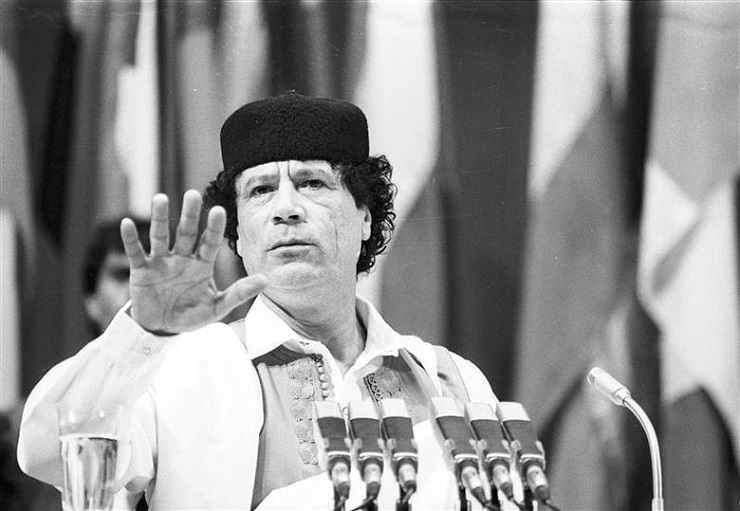
By Yuriy Zinin – New Eastern Outlook – 26.10.2020
“Security problems, political discord, oil blockades, corruption, and Libya’s foreign debt, which has reached 270% of its GDP, all torpedo economic life,” said Central Bank of Libya governor Sadiq al-Kabir. Oil revenues in Libya have plummeted, from $53 billion in 2012 to near zero this year, he added.
These words, spoken on the eve of another anniversary of the assassination of Libyan leader M. Gaddafi on October 20, 2011, do in fact serve to illustrate what the country has come to over the past nine years of its history, since the collapse of the previous regime.
Having come to rule with massive outside support from NATO, the new forces, although they inherited huge financial reserves and the potential following the era of the previous leader, became dependent on the various militias that brought them to power. Along with that, these “brothers-in-arms” soon turned into implacable enemies. The country fell into an abyss of civil strife and, since the summer of 2014, has been divided into two military and political camps, with one pole of power in Tripoli and the other in Tobruk. Because of this turmoil, Libya’s development has come to a standstill, and GDP is dropping. In comparison with previous times, it has slid backwards in many respects.
The oil sector has become hostage to conflicts in society, a source of funding for diverse groups that act in opposition to national interests. However, there is plainly a growing shadow economy, flourishing of currency fraud, the smuggling of goods, illegal emigrants, etc.
The dependence of the Libyan authorities on external forces, both regionally and globally, has increased. At the same time, the intra-Libyan conflict does not have a clearly defined bloc “tutelage”. The aspirations of the “stakeholder forces” have many different thrusts. Their desire to resolve their differences by taking to the Libyan field is often seen, and that, among other things, is fraught with the likelihood of collisions occurring between them.
Since 2015, the UN has been initiating efforts to reconcile the opposing poles in Libya. Delegates from the warring parties participate nonstop in different series of negotiations, sometimes under the auspices of the UN, sometimes hosted by major powers, or as part of the efforts put forth by various neighboring states and the African Union. These kinds of conferences and meetings, including those between the leaders of the two camps, were held in no less than a dozen cities on three continents, including Moscow.
The efforts by various mediators have not turned the tide, or yielded any decisive results. No new constitution has been adopted, and no presidential elections, or elections for a new parliament have been held.
It is encouraging that so far the opposing sides have been honoring the decision they made on August 21 this year for a ceasefire. A number of local and foreign observers have pinned their hopes on three tracks for the negotiation process, all of which are now going on simultaneously.
For example, at talks in the Moroccan city of Bouznika under the auspices of the UN Support Mission in Libya, they reached “a mutual understanding on the transparency of the standards and mechanisms” used to allocate key positions in the government, and throughout other echelons.
In the Swiss city of Montreux, the participants agreed that for the duration of a comprehensive resolution of the intra-Libyan crisis, Sirte, which effectively divides the North African country, will become the seat of the executive and legislative bodies.
In the Egyptian city of Hurghada, Libyan representatives talked about building on the peaceful respite, and restructuring the armed forces.
Libyan experts note that there is a long distance between the decisions that were announced, and the mutual understanding that was reached, to realizing them. From circles close to the governing bodies and military authorities in Tripoli and Tobruk, criticism is spilling forth about the agreements that are progressing on these tracks.
At the same time, it cannot be said that there is absolutely no ground for agreements or compromises. First, the balance of power in Libya does not allow either of the two poles to achieve final victory by military means.
Second, Libya today is divided by the parties into peculiar areas of responsibility, but along with that none of them is economically self-sufficient. For example, most of the fields, pipelines, and oil terminals are in the sphere of influence of the authorities in Tobruk. But normal operations for the entire economic infrastructure under its control are impossible without interacting with the other component present in the Libyan conflict. In matters concerning producing oil, selling it, and earning revenue from it, the key role is still played by the state acting as a rentier, and in which economics and politics are fused in a union of marriage.
These issues for the opposing sides can serve as a starting point for moving towards each other. Among everything else, the Libyan public is putting pressure on top officials. In August this year in Tripoli and Benghazi, the largest cities for both poles of power, there were demonstrations by residents who were tired of political instability and socioeconomic hardship.
Libya since the fall of Gaddafi represents a tragic example of how a country that used to be stable, and which is rich in oil reserves, can be bled dry not only by outside intervention, but from internal conflict as well.
Yury Zinin is a Leading Research Fellow at the Moscow State Institute of International Relations.
Britain’s Labour Party reprimands MP for occupation ‘crime’ comment
MEMO | October 26, 2020
Labour Party MP Stephen Kinnock has reportedly been given a “dressing down” after saying that profiting from illegal settlements in the Israeli-occupied West Bank is “tantamount to profiting from the proceeds of crime.”
Party leader Keir Starmer was said to be furious at Kinnock’s impassioned speech calling for international law to be upheld. Complaints were made by various pro-Israel groups, including the Board of Deputies of British Jews, who raised concerns with Shadow Foreign Secretary Lisa Nandy and demanded “clarification”.
Kinnock made his speech in the House of Commons on 24 September, raising concerns about the increasing number and size of Israeli settlements built on Palestinian land. All of Israel’s settlements, official and “outposts”, are illegal under international law.
“The Government must ban all products that originate from Israeli settlements in the occupied territories,” insisted Kinnock, the son of former Labour leader Neil Kinnock. “Profiting from such products is tantamount to profiting from the proceeds of crime, and it must stop. When we trade with these settlements, we are essentially telling the world that international law does not matter, and such trade legitimises and facilitates the existence and expansion of the settlements.”
He went on to criticise the “deal of the century”: “President [Donald] Trump and Prime Minister [Benjamin] Netanyahu have come forward with their so-called deal of the century. This is not a deal. It is not a plan. It is not even a starting point for talks. It is a proposal that is fundamentally flawed because it has no basis in law. It is a land and power grab that would mean Israel seizing around 40 per cent of the West Bank, with full military and security control over the Palestinian people and their resources.”
Starmer previously sacked left-leaning socialist MP Rebecca Long-Bailey for sharing an interview on social media with actress Maxine Peake in which she spoke about the Israeli Army’s role in training American police forces. Peake’s comments in the wake of the George Floyd murder were deemed to be “anti-Semitic” by the Labour hierarchy, despite it being a fact that Israel has trained hundreds of US police officers on restraint and other techniques.
Chile vote is a blow to corporate Canada and Trudeau
By Yves Engler · October 26, 2020
With Chileans voting overwhelming to rewrite the country’s Pinochet era constitution it’s a good moment to reflect on Ottawa’s support for his coup against Salvador Allende. It’s also worth looking at Canadian companies’ opposition to the popular uprising that lead to the referendum on reforming the dictatorship’s neoliberal constitution.
On Sunday nearly 8 in 10 Chileans voted to rewrite the country’s Augusto Pinochet era constitution. The vote was the culmination of months of antigovernment protests that began against a hike in transit fares last October and morphed into a broader challenge to economic inequality and other injustices. The dictatorship’s constitution entrenches pro-capitalist policies and was widely seen as contributing to the country’s large economic divide.
The Pierre Trudeau government was hostile to Allende’s elected government and predisposed to supporting Pinochet’s dictatorship. Days after the September 11 1973 coup against Allende, Andrew Ross, Canada’s ambassador to Chile cabled External Affairs: “Reprisals and searches have created panic atmosphere affecting particularly expatriates including the riffraff of the Latin American Left to whom Allende gave asylum … the country has been on a prolonged political binge under the elected Allende government and the junta has assumed the probably thankless task of sobering Chile up.” Thousands were incarcerated, tortured and killed in “sobering Chile up”.
Within three weeks of the coup, Canada recognized Pinochet’s military junta. Diplomatic support for Pinochet led to economic assistance. Just after the coup Canada voted for a $22 million Inter American Development Bank loan “rushed through the bank with embarrassing haste.” Ottawa immediately endorsed sending $95 million from the International Monetary Fund to Chile and supported renegotiating the country’s debt held by the Paris Club. After refusing to provide credits to the elected government, on October 2nd, 1973, Export Development Canada announced it was granting $5 million in credit to Chile’s central bank to purchase six Twin Otter aircraft from De Havilland, which could carry troops to and from short makeshift strips.
By 1978, Canadian support for the coup d’etat was significant. It included:
- Support for $810 million in multilateral loans with Canada’s share amounting to about $40 million.
- Five EDC facilities worth between $15 and $30 million.
- Two Canadian debt re-schedulings for Chile, equivalent to additional loans of approximately $5 million.
- Twenty loans by Canadian chartered banks worth more than $100 million, including a 1977 loan by Toronto Dominion to DINA (Pinochet’s secret police) to purchase equipment.
- Direct investments by Canadian companies valued at nearly $1 billion.
Prominent Canadian capitalists such as Peter Munk and Conrad Black were supporters of Pinochet.
When the recent protests began against billionaire president Sebastián Piñera in October, Trudeau supported the embattled right-wing leader. Two weeks into massive demonstrations against Piñera’s government, the PM held a phone conversation with the Chilean president who had a 14% approval rating. According to Amnesty International, 19 people had already died and dozens more were seriously injured in protests. A couple thousand were also arrested by a government that declared martial law and sent the army onto the streets for the first time since Pinochet. A Canadian Press story on the conversation noted, “a summary from the Prime Minister’s Office of Trudeau’s phone call with Pinera made no direct mention of the ongoing turmoil in Chile, a thriving country with which Canada has negotiated a free trade agreement.”
Rather than express concern about state-backed repression in Chile, the Prime Minister criticized “election irregularities in Bolivia” during his October conversation with Piñera. The false claims of “election irregularities” were then being used to justify ousting leftist indigenous president Evo Morales.
Amidst the massive demonstrations against Piñera in October, Trudeau also discussed Venezuela. In another phone conversation with Piñera two months ago Trudeau again raised “the situation in Venezuela”, according to the official readout, as he did in February 2018 and previously.
Chile is the top destination for Canadian investment in Latin America at over $20 billion. Over 50% of Chile’s large mining industry is Canadian owned and Canadian firms are major players in the country’s infrastructure. Scotiabank is one of the country’s biggest banks.
A number of stories highlighted Scotiabank’s concerns about the protests against inequality that ultimately lead to Sunday’s constitutional referendum. The Financial Post noted, “Scotiabank’s strategic foray into Latin America hits a snag with Chile unrest” and “Riots, state of emergency in Chile force Scotiabank to postpone investor day.” The CEO of the world’s 40th largest bank blamed the protests on an “intelligence breakdown” with people outside Chile “that came in with an intention of creating havoc.” In a January story titled “Why Brian Porter is doubling down on Scotiabank’s Latin American expansion”, he told the Financial Post that Twitter accounts tied to Russia sparked the unrest against Piñera!
Canadian companies, with Ottawa’s support, have led a number of environmentally and socially destructive projects in Chile. In the mid 2000s Toronto-based Brookfield Asset Management led a consortium, with US $700 million invested by the Canadian Pension Plan and British Columbia Investment Management Corporation, pushing to build a massive power line and dams in Chile’s Patagonia region, one of the planet’s greatest environmental treasures. “This kind of project could never be implemented in a full-fledged democracy,” explained Juan Pablo Orrego, a prominent Chilean environmentalist, to the Georgia Straight. “Our country is still under a constitutional, political, and financial checkmate to democracy which was put in place during the [Pinochet] military dictatorship and empowers the private sector.”
Sunday’s referendum is a blow to Canadian corporations operating in Chile and the Trudeau government’s alliance with right-wing governments in the Hemisphere.
‘Pseudo-expert’: College dropout billionaire Bill Gates attacks Trump adviser Dr. Scott Atlas over Covid-19 stance
RT | October 26, 2020
Self-styled Covid-19 authority and Microsoft billionaire Bill Gates has weaponized media demands to “trust the science” to tear into Trump adviser (and actual medical doctor) Scott Atlas for not backing stricter Covid policies.
“We now have a pseudo-expert advising the president,” Gates snarled during an interview at Yahoo Finance’s All Markets Summit on Monday, denouncing Atlas – who, unlike the billionaire software tycoon, completed both college and medical school – as an “off the rails” bad influence on the Trump administration.
“The most malign thing is where you start to attack your own experts and suggest that maybe politicians know better than disease experts,” Gates continued. The billionaire is neither a politician nor a medical doctor, despite the vast sums he has spent through his Bill and Melinda Gates Foundation and its affiliates in an effort to vaccinate the developing world. Atlas, on the other hand, has a medical degree from the University of Chicago and has taught healthcare policy at Stanford University’s Hoover Institute.
While Gates’s words might seem to apply to his own denunciation of Atlas, the billionaire meant them as a condemnation of the Trump administration over its alleged line-by-line tweaks to health guidelines issued by the Centers for Disease Control and Prevention in May. He has bemoaned the “politicization” of both the CDC and the Food and Drug Administration (FDA) for months, blaming the White House for both their loss of public trust and unspecified yet “very unfortunate” setbacks to the rollout of a Covid-19 vaccine.
However, medical experts have insisted for years that both institutions were co-opted long ago by the pharmaceutical industry, of which Gates is both a significant funder and a well-remunerated beneficiary.
Yahoo (and other media organizations, many of which have received and avoided disclosing funding from Gates’ foundations) have almost universally backed the avuncular software tycoon in his dispute with Atlas, suggesting it is the trained medical expert who stepped out of his place in dissenting from prevailing orthodoxy. Forbes even called Atlas a “bad scientist” for not deferring to Gates’ favorite expert, US corona czar Dr. Anthony Fauci.
Atlas has long been seen as a thorn in the side of Gates and his ideological cheerleaders for his refusal to toe the lockdown line, however. A tweet “falsely” downplaying the effectiveness of masks and an article warning the US’ pandemic-related economic shutdowns will have lasting consequences far worse than the deaths thus far attributed to the virus have been held up as proof Atlas knows not of what he speaks – even as experts in other countries have echoed his economic concerns and the science remains far from settled on masks.
Since the beginning of the Covid-19 pandemic, Gates has been hailed by the media as a venerable expert on viral outbreaks for a 2015 Ted Talk in which he bemoaned the lack of epidemic preparedness among the world’s governments. However, Gates was far from the only person to predict a pandemic (or the societal upheaval it would trigger).
The Rockefeller Foundation, along with the Global Business Network, predicted in a 2010 “scenario” that a devastating viral outbreak would bring about an authoritarian crackdown, devastating entire industries while making totalitarianism palatable to the populations of previously democratic countries. And Fauci himself predicted in 2017 that Trump’s administration would be faced with a deadly pandemic it was unprepared for. The US military and private sector partners have also run several simulations of major pandemics, each time finding (yet never doing much to fix) that the government is woefully unprepared.
WHO Taps ‘Anti-Conspiracy’ Crusader to Sway Public Opinion on COVID Vaccine
By Jeremy Loffredo | Children’s Health Defense | October 23, 2020
An outspoken proponent of government-led tactics to influence public opinion on policy and to undermine the credibility of “conspiracy theorists” will lead the World Health Organization’s (WHO) efforts to encourage public acceptance of a COVID-19 vaccine, Children’s Health Defense has learned.
Last week, WHO’s general director, Dr. Tedros Ghebreyesus, tweeted that he was glad to speak with the organization’s Technical Advisory Group (TAG) on Behavioural Insights and Sciences for Health to “discuss vaccine acceptance and uptake in the context of COVID-19.”
In his next tweet Ghebreyesus announced that Cass Sunstein, founder and director of the Program on Behavioral Economics and Public Policy at Harvard Law School, will chair the advisory group, which was created in July.
Sunstein was former President Barack Obama’s head of Office of Information and Regulatory Affairs where he was responsible for overseeing policies relating to information quality.
In 2008, Sunstein wrote a paper proposing that governments employ teams of covert agents to “cognitively infiltrate” online dissident groups and websites which advocate “false conspiracy theories” about the government. In the paper, Sunstein and his co-authors wrote:
“Our principal claim here involves the potential value of cognitive infiltration of extremist groups, designed to introduce informational diversity into such groups and to expose indefensible conspiracy theories as such.”
The government-led operations described in Sunstein’s paper would work to increase faith in government policy and policymakers and undermine the credibility of “conspiracists” who question their motives. They would also maintain a vigorous “counter misinformation establishment” to counter “conspiracy” groups opposed to government policies that aim to protect the common good.
Some of this would be accomplished by sending undercover agents, or government-paid third parties, into “online social networks or even real space groups.”
Sunstein also advocated in 2008 that the government pay “independent experts” to publicly advocate on the government’s behalf, whether on television or social media. He says this is effective because people don’t trust the government as much as they trust people they believe are “independent.”
WHO has already contracted the public relations firm, Hill + Knowlton. The PR giant, best known for its role in manufacturing false testimonies in support of the Gulf War, was hired by WHO to “ensure the science and public health credibility of the WHO in order to ensure WHO’s advice and guidance is followed.”
WHO paid Hill + Knowlton $135,000 to identify micro-influencers, macro-influencers and “hidden heroes” who could covertly promote WHO’s advice and messaging on social media, and also protect and promote the organization’s image as a COVID-19 authority.
There’s no evidence that WHO has yet implemented any “cognitive infiltration” policies similar to what Sunstein advocated in 2008. If the organization were to adopt such a strategy, and use it to convince hesitant populations to take a COVID vaccine, it would raise questions of legality.
As put forward in a report by the Congressional Research Service, illegal “publicity or propaganda” is defined by the U.S. Government Accountability Office (GAO) to mean either (1) self-aggrandizement by public officials; (2) purely partisan activity; or (3) “covert propaganda.” By covert propaganda, GAO means information which originates from the government but is unattributed and made to appear as though it came from a third party.
Because WHO is a multinational organization and not a U.S. Government agency, covert “cognitive infiltration” policies could fall into a gray area, or even be considered legal.
Dr. Margaret Chan, former general-director of WHO, once stated that the organization’s policies are “driven by what [she called] donor interests.”
According to a 2012 article in Foreign Affairs, “few policy initiatives or normative standards set by the WHO are announced before they have been casually, unofficially vetted by Gates Foundation staff.” Or, as other sources told Politico in 2017, “Gates’ priorities have become the WHO’s.”
WHO’s current general director, Ghebreyesus, was previously on the board of two organizations that Gates founded, provided seed money for and continues to fund to this day: GAVI, the Vaccine Alliance, a public–private global health partnership focused on increased access to vaccines in poor countries, and the Global Fund, which says it aims to accelerate the “development, production and equitable global access to safe, quality, effective, and affordable COVID-19 diagnostics, therapeutics and vaccines.”
If, as Politico put it, “Gates priorities have become the WHO’s,” and if WHO’s policies are driven by “donor interests,” this raises questions as to what online groups, people and websites would be targeted by such covert programs.
The idea of government agents carrying out psychological operations on social media is not far fetched. Earlier this year the head of editorial for Twitter’s Middle East and Africa office was outed as an active officer in the British Army’s psychological warfare unit, known as the 77th brigade, which specializes in online behavioral change operations.
© 2016-2020 Children’s Health Defense® • All rights Reserved
Maduro Says Venezuela Found 100% Effective Medicine Against COVID-19
Sputnik – 26.10.2020
CARACAS – The Venezuelan Scientific Research Institute (IVIC) discovered a medicine that contains molecule DR10 to combat COVID-19, Venezuela’s President Nicolas Maduro said on national channel Venezolana de Television, stating that the medicine can eliminate 100 percent of the coronavirus infection.
“Venezuela has created a medicine that eliminates 100 percent of the coronavirus, as the six-month studies by the Venezuelan Scientific Research Institute have demonstrated, and this study has been consequently certified by the experts,” Maduro said on Sunday.
Maduro added that the molecule that eliminates COVID-19 is DR10, which is already used in the treatment of such diseases as hepatitis C, Ebola and human papilloma.
Maduro hopes that the World Health Organisation (WHO) will ratify the results obtained by the IVIC and Venezuela will be able to prepare the mass production of this molecule as a cure for COVID-19 and provide it worldwide with the necessary international collaboration.
Since the beginning of the pandemic, Venezuela has registered 89,565 positive cases, including 83,947 patients who have recovered and 773 people who died.
Featured Video

They Double Down on BLOOD PRESSURE Guidelines!
or go to
Aletho News Archives – Video-Images
From the Archives
The Ten Commandments of War Propaganda
By Michael Feldman · The Dissident · November 22, 2022
While researching World War I censorship for a larger project a few years ago, I stumbled upon a fascinating analysis of war propaganda.
In 1928, Baron Arthur Ponsonby published Falsehood in Wartime: Propaganda Lies of the First World War. Although Ponsonby’s book was eye-opening and remains relevant to media propaganda today, another work inspired by Ponsonby really caught my attention.
In 2001, Belgian historian Anne Morelli published Principes élémentaires de propagande de guerre (Basic Principles of War Propaganda). Based on Ponsonby’s writings, Morelli identified ten principles, often known as the Ten Commandments of War Propaganda:
1. We don’t want war. We are only defending ourselves!
2. Our adversary is solely responsible for this war!
3. Our adversary’s leader is inherently evil and resembles the devil
4. We are defending a noble cause, not our particular interests!
5. The enemy is purposefully committing atrocities; if we are making mistakes, this happens without intention
6. The enemy makes use of illegal weapons
7. We suffer few losses; the enemy’s losses are considerable
8. Recognized intellectuals and artists support our cause
9. Our cause is sacred
10. Whoever casts doubt on our propaganda helps the enemy and is a traitor
What’s most fascinating is that Morelli’s principles are based on a 73-year-old book, yet the commandments ring true today. You can pick just about any war, especially those in the twenty-first century, and see the commandments in action. … Full article
Blog Roll
 Aletho News
- Who pays for the war on Iran? The Gulf states had an answer in 1991
- New Congress… Same Old Wars!
- The Big Three: A Milestone in History
- The Death of Academic Freedom in Norway
- Another EU member revolts against €100 bn funding for Ukraine
- More Cigars Near the Powder Keg
- Russia Unearths Major New Reserves of Gold, Nickel, Copper, and Natural Gas
- I’M SO BLOODY FURIOUS: They Double Down on BLOOD PRESSURE Guidelines!
- The Israeli Nuclear Doctrine and the Turning Point of the Kennedy Assassination
- Striking Matches Near the Powder Keg
- If Americans Knew
- An error has occurred; the feed is probably down. Try again later.
- No Tricks Zone
- New Study: Modern Temps Are Among The Coldest Of The Last 10,000 Years In East Central Europe
- Germany’s Renewable Energies Lead to 1.4 Billion Euro Electric Power Trade Deficit
- Argentina’s Perito Moreno Glacier Joins Antarctica and Arctic In Defying Doomsday Melt Claims
- New Study: Barents Sea Temperatures Were Warmer And Sea Ice Less Extensive In The 1700s Than Today
- German Authorities Start Initiative To Evaluate Public Register For Climate “Disinformation” Spreaders!
- Zonal Asymmetry of Temperature Change in the Antarctic Circumpolar Current
- New Study: The Net Fossil Fuel Contribution To Rising Atmospheric CO2 Has Been Zero For 500 Years
- Germany’s Green Energy Transition Becoming Increasingly Expensive…Another 6 Trillion Euros!
- Sudden Stratospheric Warming, Powerful El Niño Combination May Lead To Extreme Europe Cold, Energy Crisis!
- Two New Studies Find Thwaites Glacier Melt Cannot Be Driven By Human Activity Or A Warming Ocean

