History as Warfare: The ‘1619 Project’ and the Plot to Destroy the Republic
By Matthew Ehret | Strategic Culture Foundation | October 4, 2020
“Repression is the only lasting philosophy. The dark deference of fear and slavery, my friend, will keep the dogs obedient to the whip, as long as this roof shuts out the sky.”
– Marquis St. Evrémonde (from Dickens’ Tale of Two Cities)
A major cultural fight has broken out between Donald Trump’s recently announced 1776 Commission and the NY Times’ 1619 Project.
While Trump’s commission designed to “promote patriotic history” naively paints over some glaring hypocrisies of American history by placing figures like Hamilton, Jackson, Jefferson and Lincoln in the same boat (thus keeping a bit too much bathwater along with the baby), it does represent an important major cultural battle over the soul of America which is now sitting precariously upon a new civil war, military coup threat and total disintegration.
In his recent Sept. 17 speech attacking the 1619 Project and announcing his 1776 Commission, Trump said quite rightfully:
“Whether it is the mob on the street, or the “cancel culture” in the boardroom, the goal is the same: to silence dissent, to scare you out of speaking the truth, and to bully Americans into abandoning their values, their heritage, and their way of life.
“We are here today to declare that we will never submit to tyranny. We will reclaim our history and our country for citizens of every race, color, religion, and creed.
“The radicals burning American flags want to burn down the principles in our founding documents, including the bedrock principle of equal justice under law. In order to radically transform America, they must first cause Americans to lose confidence in who we are, where we come from, and what we believe…. The left-wing cultural revolution is designed to overthrow the American Revolution.”
Attacking the underpinnings of Critical Race theory which attempts to assert that belief in rational thought, hard work and the nuclear family were the result of “whiteness”, Trump invoked Martin Luther King saying:
“where children are not judged by the color of their skin but by the content of their character. Critical Race Theory, the 1619 project, and the crusade against American history, are toxic propaganda, ideological poison that, if not removed, will dissolve the civic bonds that tie us together. It will destroy our country.”
What is the 1619 Project?
The New York Times’ 1619 Project, which was unveiled in June 2019 by Nikole Hannah-Jones, attempts to smear the entirety of American history as simply a slave-promoting fraud from the moment the first slave arrived in Jonestown in 1619.
During its short existence, this “project” has quickly won over thousands of academics, and in spite of its proven fallacies (which it had to secretly cover up in Orwellian fashion), Jones was still awarded the Pulitzer Prize legitimizing the fraud in the minds of countless school administrators, policy-makers and academics.
If one truly accepts the claims of the 1619 Project which have become turned into a Pulitzer curriculum and already embedded in 4500 U.S. schools, then America’s dissolution would be no great loss to the world. In fact, one would have to conclude that since the republic was always built upon the defense of slavery (going so far as to paint the British Empire as an anti-slavery bastion which the founding fathers broke away from only due to their fear of having their slaves removed), then America was always… evil.
The First Paradox
If it were true that the creation of the American republic was just driven by a desire to protect the institution of slavery from the abolition-loving British then it should be asked: why did every American state shut down the African slave trade by 1793??”
Don’t believe me? Let the facts speak for themselves.
By 1784, six states in the new nation had voted to totally abolish slavery (Rhode Island in 1774, Vermont in 1777, Pennsylvania in 1780, Massachusetts in 1781, New Hampshire in 1783 and Connecticut in 1784), while the importation of all new slaves was banned by every other state by 1793. The important Northwest Ordinances passed in the 1787 Continental Congress ensured that no slavery would be permitted in the immense North West Territories (giving rise to the later addition of Ohio, Indiana, Illinois, Michigan and Wisconsin as free states). This agreement was established during the 1774 Continental Congress where a non-importation act was signed by all colonies stating: “That we will neither import, nor purchase any slave imported, after the first day of December next; after which time, we will wholly discontinue the slave trade, and will neither be concerned in it ourselves, nor will we hire our vessels, nor sell our commodities or manufactures to those who are concerned in it.”
Another Paradox
If Britain was threatening to end the slave trade as the 1619 Project authors teach, then why did the Empire override dozens of petitions from the colonies between 1650-1765 demanding an end to slavery? Rather than oppose slavery, the British Royal Africa Company, under the direction of the Privy Council, and Board of Trade enforced the mass important of 8 million African slaves into the Americas during the 18th century alone! These same organizations constantly strove to destroy all efforts to establish manufacturing within the colonies from 1630-1765 which everyone knew was the only effective pathway to liberating a society from reliance on slave labor.
Additionally, IF it were true that the 1776 revolution were driven by the intent to protect the slave economy from the freedom-loving British Empire, then why did England only ban slavery in 1807 and why did they wait until 1833 to begin extending this ban across their colonies?? Did the founding fathers have a crystal ball and act on events that would occur only 65 years in the future? If the British truly hated slavery so much, then why did the empire maintain a global system of subjugation, famine and exploitation across Asia, Ireland and beyond for so many generations?
So what happened? Was the British Empire seriously pushing an anti-slavery agenda? Why did America’s anti-slave trajectory fall apart so soon after the revolution and why did the rot spread to the point of necessitating a Civil War by 1861?
How to proceed with a serious investigation?
The Matter of Money
Since one of the most effective keys to understanding history starts with the question of “who controls the money”, economics is a good place to start.
Approaching the matter this way will cause the inquiring mind to confront the battle between two opposing paradigms of statecraft which defined the world in which the American revolution arose as part of an international phenomenon involving leaders from Russia, France, Germany, Ireland, Spain, India and Morocco.
The battle over what sort of system of economics would govern America after political independence was achieved in 1783 will here become a very valuable question.
Where certain players of that age believed that “value” should be locked into rules of money-worship and profit (which all people desired since money bought pleasure and helped us avoid pain), others disagreed and believed value should be looked for elsewhere. These others believed that value transcended matters of pleasure/pain and touched upon something less transient and more universal… but what?
Introducing Ben Franklin
During the 18th century, these latter forces centered themselves around the figure of America’s “father of founding fathers” Benjamin Franklin who drafted some of the most important policies that led to the sovereign control over currency from his 1729 On the Necessity for a Paper Currency, onwards. Franklin used his powerful printing presses to spread both sovereign banking and anti-slavery pamphlets, books and treatises for decades before the revolution itself was declared in 1775. One of the most powerful anti-slavery books printed by Franklin was the influential 1737 ‘All Slave Keepers Who Keep the Innocent in Bondage’ by Benjamin Lay which argued that any Christian keeping slaves was an offense against God.
Lay wrote: “No greater sin Hell can invent than to prophane and blaspheme the pure and Holy Truth, which is God all in all, and remove God’s creatures made after his own image, from all the comforts of life and their country… and bring them into all the miseries that dragons, serpents, devils and hypocrites can procure and think of”.
In the mind of Franklin and his co-thinkers these issues (economics and slavery) represented two sides of the same fight.
Franklin argued in his many writings that “value” originated in what you create that satisfies the needs of humanity, and not what “things” you possess or wish to consume. Since a society of creators/producers requires sovereign manufacturing to generate real wealth and constant internal improvements of infrastructure to coordinate the development of all parts of a nation under a unified intention, Franklin recognized clearly that the production generated by “slave labor” is a chimera and actually represented a form of “anti-value”. Like heroine consumption today, anti-value simply means any form of “momentary profits” that might even be measurable as GDP and generate money flows, but actually represents a destruction of that society’s ability to sustain its own existence over time. (1)
The reason for this is simple.
Slavery destroys the creative powers of mentation in both the laboring slave who is valued only for their animal labor, and also the decadent slave master who’s potential for creativity becomes narrowly defined by ways to keep the slave under control.
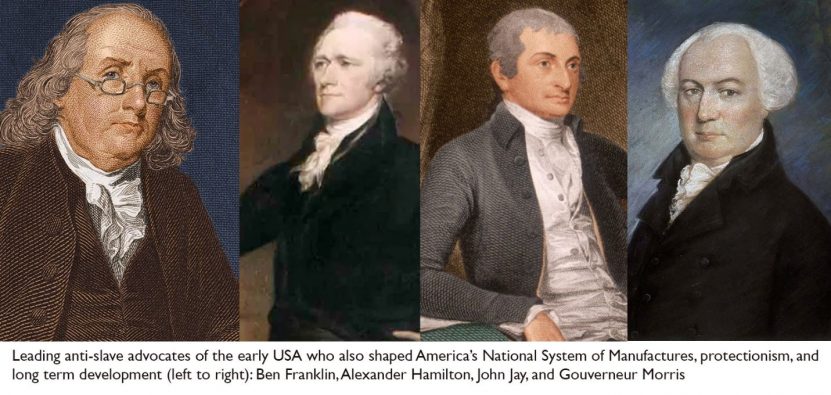
It is thus no coincidence that Franklin also created the anti-slavery alliance in the 1760s and later founded the 1785 Society for Promoting the Manumission of Slaves” alongside several of his devoted proteges. These proteges included the figures of Alexander Hamilton, John Jay, and Gouvernor Morris who all happened to become the creators and leaders of the “American System of political economy” premised on the use of a national bank, productive credit, protective tariffs, and large scale manufacturing to promote the economic sovereignty of the new nation. I introduced some of this in my recent essay How to Save a Dying Republic: Hamilton’s Genius.
When Jefferson took control of the Presidency from 1801-1809, a major victory was won for the pro-slavery oligarchs of America who saw immense profits to be gained by spreading their peculiar form of society under a perverse form of Manifest Destiny.
Admittedly, these oligarchs would have been much happier with the victory of Aaron Burr to the presidency in 1801 since an immediate dissolution of the union would have occurred between slave and free states as early as 1804 (to be discussed in a future essay). Unlike Burr, Jefferson was at least against breaking up the Union into northern and southern confederacies (with the free states merging with Canada and the slave states becoming their own nation), and that is why Hamilton (Jefferson’s political nemesis) ironically organized aggressively for his victory winning the fatal ire of Burr.
Sadly, Jefferson’s devout belief in agrarianism, hate for manufacturing, love of slavery, and British enlightenment thinking still made him an instrument for the slave power’s cancerous growth during his terms in office.
The British Empire’s Global Game
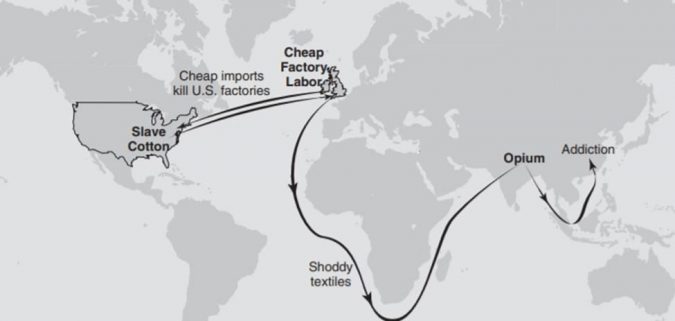
By destroying Indian textiles and subduing the “Chinese dragon” with a program of mass opium consumption that would stain the 19th century, the City of London quickly took control of world textile manufactures which created a primary export market for southern slave plantation cotton and a new set of addictions began: the addiction to the easy money derived from cheap slave labor. This proto globalization established a global closed system of controls onto all nations through cash cropping, free trade, speculation and drugs.
By 1840 over 20% of the British population was employed in textiles under such anti-human conditions that Charles Dickens described in his Tale of Two Cities and other writings.
The Best of Times and Worst of Times
With the 1804 murder of Hamilton, and undermining of America’s national credit system between 1804-1836, British free trade grew as protective tariffs were taken down, and credit towards infrastructure projects like the Erie Canal, roads, rail, etc shriveled up. Speculation ran rampant whenever this monetarist system was unleashed driven by booms and busts and the rise of “state-rights” programs that superseded all national initiatives. This process was taken directly from classic divide to conquer tactics which I outlined in my last essay Lincoln and the Greenbacks.
An astute Whig economist looking upon this bipolar process in America (while comparing it to the depressingly stagnant Canadian economic situation of 1791-1850) stated in 1853:
“Though the ratio of the increase of the population has been greater in Canada than in the United States, yet their increase of wealth has barely kept pace with the population, and they are as poor as they were half a century since. They have enjoyed the blessings of Free Trade with England all the time, we have only a part of the time. Whenever we have attempted to supply ourselves by our own industry, with the comforts and necessaries of life, we have improved our condition as a people; and during the intervals of Free Trade and large importations of foreign goods, we have relapsed again into a condition bordering on bankruptcy; while the Canadians have been constantly exhausted, and kept so poor by Free Trade, as to be unable to get sufficient credit to have even the ups and downs of prosperity and bankruptcy in succession.” (2)
The Slave Power Spreads
By 1836, the 2nd National Bank was officially killed after a mass propaganda campaign convinced a duped mob that it was an instrument of tyranny in America, and over the coming 6 decades, the only five presidents who would make any serious effort towards reviving America’s nationalist system would end up dead while in office (Harrison in 1841, Taylor in 1850, Lincoln in 1865, Garfield in 1880, and McKinley in 1901). The man who is today celebrated for having “killed the bank” and “paying Americas debts” was in reality a force of pure destruction. Jackson “paid the debt” by cutting all infrastructure projects and unleashing mass speculation which resulted in a devastating 1837 bank panic that drove the nation into discord and depression. An unrepentant racist, Jackson also gave enormous assistance to the slavocracy by emptying the southern lands of Cherokee in the genocidal “Trail of Tears” and giving the land over to cotton planting oligarchs loyal only to their profits, “way of life” and the British Empire.
This story is told in all of its ugly detail in historian Michael Kirsch’s groundbreaking 2012 study “How Andrew Jackson Destroyed the United States”.

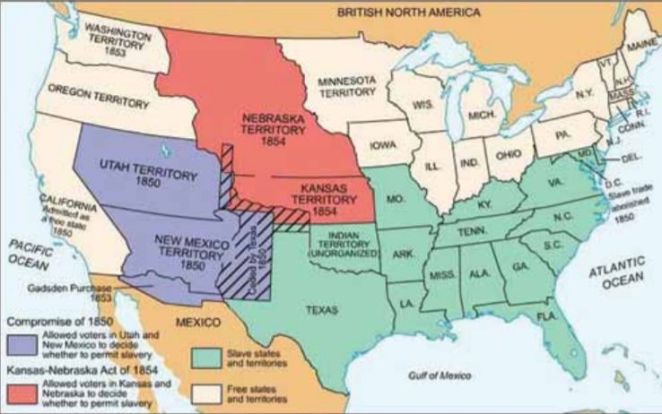
Between 1801 to 1840, southern cotton exports exploded from 100,000 bales/year to 1 million bales/year with 80% of the exports going to Britain. The City of London-Wall Street-New Orleans triangle dominated the world system with New Orleans representing over 12% of all U.S. banking capital. The southern slave states grew to represent the world’s fourth biggest economy through the support of the British Empire both financially and also in the logistical support needed to import mass slavery into the Americas. This degeneration proceeded slowly until the presidencies of Jackson and his handler Martin van Buren, but after this, cotton exports increased to 4 million bales/year by 1860 and the slave power grew immensely under the Kansas-Nebraska Act of 1854 that ensured the spread of slavery west of Mississippi.
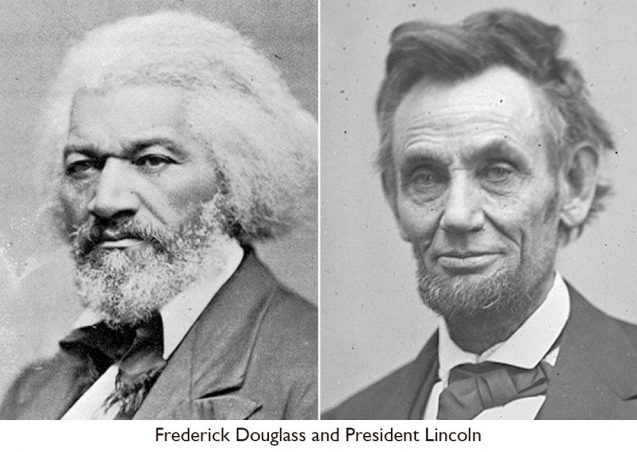
While many radical abolitionists in the USA and British Canada then advocated the dissolution of the union as an alternative to civil war, stronger souls like Frederick Douglass recognized the higher historic fight at hand. As a lesson to modern anarchists who believe in the 1619 Project and feel no sorrow at the burning of America under a new civil war today, Douglass took the time to research history, and broke with William Lloyd Garrison (the leader of the abolitionist movement) defending the Constitution in 1852:
“I differ from those who charge this baseness on the framers of the Constitution of the United States. It is a slander upon their memory… In that instrument [the U.S. Constitution] I hold there is neither warrant, license, nor sanction of the hateful thing; but interpreted, as it ought to be interpreted, the Constitution is a Glorious Liberty Document. Read its preamble, consider its purposes. Is slavery among them? Is it at the gateway? or is it in the temple? It is neither. While I do not intend to argue this question on the present occasion, let me ask, if it be not somewhat singular that, if the Constitution were intended to be, by its framers and adopters, a slaveholding instrument, why neither slavery, slaveholding, nor slave can anywhere be found in it”.
This higher understanding of history and the principles of the Constitution caused Douglass to ally himself with Lincoln where he worked with all his might to recruit 200,000 black soldiers to the cause. Later in life, Douglass attacked British free trade and “cheap labor” in defense of the Nationalist system writing in 1871:
“Cheap Labor, is a phrase that has no cheering music for the masses. Those who demand it, and seek to acquire it, have but little sympathy with common humanity. It is the cry of the few against the many. When we inquire who are the men that are continually vociferating for cheap labor, we find not the poor, the simple, and the lowly; not the class who dig and toil for their daily bread; not the landless, feeble, and defenseless portion of society, but the rich and powerful, the crafty and scheming, those who live by the sweat of other men’s faces.”
The British Hand Behind the Civil War
During the entirety of the Civil War, the British Empire’s guiding hand could always be felt, from supplying the south with battle ships, weapons and finances to providing logistic and diplomatic support internationally. Even British Canada was given over to the Confederacy’s intelligence headquarters which deployed spying, money laundering, and terrorist operations against the Union during the entire war.
Speaking to the British Parliament, Lord Robert Cecil (Marquis of Salisbury) expressed Britain’s logic succinctly when he said in 1861:
“The Northern States of America never can be our sure friends because we are rivals, rivals politically, rivals commercially…. With the Southern States, the case is entirely reversed. The population are an agricultural people. They furnish the raw material of our industry, and they consume the products which we manufacture from it. With them, every interest must lead us to cultivate friendly relations, and when the war began they at once recurred to England as their natural ally.”
A future installment will tackle the role of British operations in Canada that organized the murder of Lincoln, sabotaged the industrial reconstruction of the South, and undid the internationalization of Lincoln’s system around the world during the 19-20th centuries. This sabotage of potential created the foundations for the creature embedded within America now organizing a new Civil War and dissolution of the republic once and for all.
The author can be reached at matt.ehret@tutamail.com
(1) In the minds of those dirigistes like Franklin (including the Colbertist school of France, and its international leaders like Jonathon Swift, Daniel Dafoe, and Cotton Mathers in America who all wrote pamphlets supporting manufacturing over slave labor), a machine produced by the creative mind of man can accomplish the work of 100 laborers- thus liberating those laborers from the demands of the material forces of nature and freeing them to develop their powers of mind.
(2) Ezra Champion Seaman, Essays on the Progress of Nations (1853), p. 599
Israel constantly meddled in Yemen’s internal affairs under slain dictator: Army spokesman
Press TV – October 4, 2020
The spokesman for Yemeni Armed Forces, Brigadier General Yahya Saree, says Israel constantly intervened in the internal affairs of the Arab country during the reign of slain dictator, Ali Abdullah Saleh.
Speaking at a press conference broadcast live from the capital Sana’a on Sunday evening, Saree highlighted that the Yemeni nation is confronting a Saudi-led military aggression, which seeks to accomplish the desired objectives of the Tel Aviv regime.
“Yemen has long been at the main target of US-Israeli plots and the ongoing onslaught clearly proves this. The Armed Forces call upon Yemenis from all walks of life to raise their awareness about the real intentions of foreigners. Our struggle is nothing but a fateful battle for liberation and independence,” he said.
Saree noted that there were secret relations between Saleh’s government and Israel, which dated back to the year 2000, stating that there were even mutual visits between officials from both sides.
The high-ranking Yemeni military official then showed a number of documents indicating that Israeli authorities wished to control not only the strategic Bab-el-Mandeb strait, which connects the Red Sea to the Gulf of Aden, Yemeni islands and the port of Hudaydah, but also wanted to be in charge of Yemen’s economic, cultural, agricultural, security and military sectors.
Saree added that Saleh’s regime started to normalize ties with the Israel many years ago, and reached a high level of communication and coordination with Israel at various arenas in 2007.
“On July 14 of that year, Israeli diplomat Bruce Kashdan arrived in Sana’a according to available documents on an unannounced visit, which lasted 48 hours. During that trip, the Israeli official met with Yemeni military and security top brass who are relatives of Saleh,” Saree underlined.
He added, “The Israeli official left Sana’a International Airport on July 16, 2007. The visit had been arranged by Yemeni officials, and the United Arab Emirates (UAE) played the leading role in it. The Israeli diplomat had earlier visited Yemen on February 2, 2005.”
Saree noted that the visits to Sana’a were not simply aimed at normalization between Yemen and Israel, but sought close trade cooperation, entry of Israeli products into the Yemeni market and their promotion, as well as discussion on the implementation of joint projects.
One of the most important discussions in the field of civil aviation was an agreement that would allow Israeli airliners to cross Yemen’s airspace, Saree pointed out.
The top military official went on to say that an Israeli parliamentary delegation paid a visit to Sana’a in early March 1996, and that the delegates enjoyed a remarkable reception and met with several high-ranking political and security officials.
“On March 30, 2000, Ali Abdullah Saleh confirmed that he had met with Israeli President Ezer Weizman. The Israeli media broke the news of the meeting only ten minutes afterwards, putting the former Yemeni president to shame.
“Before that, specifically on January 31, 1997, Saleh confirmed to an Arab official that there were visits by Israeli officials to Yemen,” Saree commented.
The spokesman for the Yemeni Armed Forces then warned against Israel’s plan to naturalize tens of thousands of Yemeni-born Jews, emphasizing that such scenarios pose a grave threat to Yemen’s national security.
Yemeni people have strongly condemned the UAE and Bahrain over signing contentious US-mediated normalization deals with Israel.
Israeli Prime Minister Benjamin Netanyahu signed the deals with Emirati Foreign Minister Sheikh Abdullah bin Zayed Al Nahyan and Bahrain’s Foreign Minister Abdullatif Al Zayani during an official ceremony hosted by US President Donald Trump at the White House on September 15.
Palestinians, who seek an independent state in the occupied West Bank and Gaza, with East Jerusalem al-Quds as its capital, view the deals as betrayal of their cause.
Palestinian President Mahmoud Abbas protested the normalization deals with Israel, saying they will be fruitless as long as the United States and Israel do not recognize the rights of the Palestinian nation and refuse to resolve the issue of Palestinian refugees.
Will Lebanon be the next US-NATO humanitarian war?
By Steven Sahiounie | Mideast discourse | October 2, 2020
The waters off Lebanon are the scene of a gathering Armada of French and American naval ships. What appeared at first to be a humanitarian response to the devastating Beirut Port explosion on August 4, is now feared to be the prelude of the next US-NATO humanitarian war.
French President Emmanuel Macron blamed Hezbollah and all of the Lebanese politicians Sunday and warned of a new civil war. “I’m ashamed of the Lebanese political leaders. Ashamed,” Macron repeated.
He accused them of “collective betrayal” while putting their parties and personal greed above the needs of the Lebanese people.
Some political observers now believe that Lebanon may well be going the way of Somalia, as evidenced by the characteristics of a failing state, such as lack of governance, corruption and incompetence, chronic humanitarian problems, and persistent social tensions.
Prime minister-designate Moustapha Adib stepped down September 26, and Lebanon’s Central Bank reserves may soon dry up and the government would no longer be able to subsidize basic goods such as fuel, medicine, and wheat.
Macron has been pressing Lebanese politicians to form a Cabinet made up of technocrats that can work on urgent reforms, and Macron has traveled twice to Beirut since August 4, while making it a personal mission to try to repair the devastated country, which some see as a neo-colonial farce.
Macron criticized the Lebanese system of sectarian politics, “as if competence was linked to religious confession.”
He lambasted Hezbollah demanding to know its characteristics and identity, and he criticized Lebanese political leaders from all parties and dynasties. Each Lebanese faction has found a foreign godfather and has ended up as a pawn in a regional and international chess game. Tens of billions of dollars have reportedly been looted by politicians and deposited in European and American banks.
US-NATO Humanitarian wars
In 1999 NATO updated its ‘Strategic Concept’ to allow members to defend not only other members but also conduct ‘non-Article 5 Response Operations’. It would be under this mechanism that a US-NATO military operation, along with an Arab Gulf coalition, would be used to attack, invade and defeat Hezbollah in Lebanon.
Since 2002, it was agreed that NATO forces could be sent “wherever they are needed,” regardless of the location, and in 2006 the NATO Response Force (NRF) of 25,000 troops has been fully operational.
US President Bill Clinton and NATO waged the humanitarian war on the former Yugoslavia, which broke a larger nation into ‘bite-sized’ pieces.
Critics of the US-NATO bombing of Yugoslavia have argued that certain attacks forming part of the campaign violated international humanitarian law. Noam Chomsky argued that the main objective of the US-NATO war was to force Yugoslavia into the Western economic system since it was the only country in the region that stood alone in defiance of the US world domination.
Hezbollah targeted by US-NATO war machine
Hezbollah’s prominence in the Lebanese government caused foreign donors and investors to stay away, because of US sanctions targeted on anyone with ties to the group, based on their designation as a terrorist group.
Hezbollah’s leader, Sayyed Hassan Nasrallah, said on Tuesday, “We welcomed President Macron when he visited Lebanon and we welcomed the French initiative, but not for him to be judge, jury and executioner, and ruler of Lebanon.”
Nasrallah has headed the group since 1992 as Secretary-General; however, its military wing is considered as a terrorist organization in 21 countries, as well as by the Arab League and the European Union.
Hezbollah’s 1985 manifesto listed its objectives as the expulsion of “the Americans, the French and their allies definitely from Lebanon, putting an end to any colonialist entity on our land”.
In 2008, the Lebanese government unanimously recognized Hezbollah’s existence as an armed organization and guarantees its right to “liberate or recover occupied lands”.
Hezbollah is an armed resistance group, as well as a political party that has seats in Parliament through free and fair elections. Their ally in Parliament is the ‘Amal Movement’, and together they hold the majority of Parliamentary seats. In a democracy, the majority rules and this is why recently Hezbollah and Amal insisted on choosing the Finance minister, which became a conflict point in the view of Macron.
Hezbollah is resisting the Israeli occupation of Shebaa Farms, an area in the far south of Lebanon. Moreover, Hezbollah also is resisting the Israeli occupation of Palestine. At one time, all of the Arab world demanded the rights for the Palestinian people, who have lived under brutal military occupation since 1948, and the UN has ratified resolutions calling for a 2-state solution, where Palestine would be given the land of the 1967 borders, and both Israel and Palestine would live side by side in peace.
In 2017, Ron Prosor, former Israeli ambassador to the UN said Hezbollah was then “10 times as strong now as it was in 2006, and its military infrastructure permeates Lebanon.” He added that Lebanese President Michel Aoun has also “embraced” Hezbollah’s arsenal as “a principal element of Lebanon’s defense.”
Many critics tried to blame Hezbollah for the Beirut Port blast on August 4, but the Lebanese officials and locals admitted that Hezbollah had no access to the Port, or authority over it. Even officials known to be antagonistic of Hezbollah admitted that the blame would not plausibly stick on Hezbollah. The exact cause is not known, but it may have been an accident borne of corruption and ineptitude, or it could be sabotage, according to President Michel Aoun. MP Machnouck, member of the Sunni-led ‘Future Party’ stated he was convinced Israel was responsible.
The elimination of Hezbollah is Israel’s top priority
A former director of Israel’s Counter-Terrorism Bureau, Brig. Gen. Nitzan Nuriel, said that another war between Israel and Hezbollah was “only a question of time.”
Hezbollah is the only force that Israel has faced that has caused the Israeli Defense Forces to retreat without success. Defeating Hezbollah is a top Israeli priority.
Under the Obama Administration’s Middle Eastern policy, Iran became a negotiations partner, while pressuring Israel to conclude a peace agreement with the Palestinians.
Netanyahu recently gave a virtual speech to the UN Security Council, in which he displayed a detailed map of Beirut, and he predicted the location of where a future explosion would occur, and he blamed Hezbollah for having a weapons factory and warehouse at the location, which was a residential area. During the Netanyahu speech, Nasrallah was also giving a live televised speech in Lebanon and was told what Netanyahu had claimed. He immediately invited all media to go to the location that Netanyahu portrayed in his map, and inspect for themselves if there were any weapons or warehouse present. Later, the media arrived, and live local TV coverage showed that in fact, the location was a cooking gas canister factory. This confirmed the Israeli accusation was false and led experts to assume a direct connection between the Port blast, and the Israeli proposed blast in Netanyahu’s map.
The Israeli occupation of Lebanon
Israel occupied the south of Lebanon for 23 years, during which men, women, and children were imprisoned in Khiam Prison, where they were routinely tortured, abused and many died. Hezbollah aligned with many other Lebanese resistance groups, who resisted the occupation vociferously until Israel gave up and left in 2000. The south of Lebanon is populated by both Shite Muslims and Christians. The steadfastness of Hezbollah is remembered by those Lebanese citizens. However, the North of Lebanon was never occupied and lived free of fear, oppression, and intimidation which may have influenced many Lebanese citizens to either support or reject Hezbollah. As they say, “Your view depends on where your seat is.”
Using ISIS as ground troops by US-NATO
Recently, the Lebanese Army fought fierce battles against Radical Islamic terrorists near Tripoli in the north, in the area of Wadi Khalid.
In 2016, Efraim Inbar, an Israeli scholar, and the director of the Begin-Sadat Center for Strategic Studies wrote, “The continuing existence of ISIS serves a strategic purpose,” and added that ISIS “can be a useful tool in undermining” Iran, Hezbollah, Syria, and Russia and should not be defeated. He wrote, “Stability is not a value in and of itself. It is desirable only if it serves our interests,” and stressed that the West’s “main enemy” is not ISIS; it is Iran.
Saudi Arabia part of the Coalition against Hezbollah
The King of Saudi Arabia rarely gives speeches; however, he made a televised speech in which he accused Hezbollah of the Beirut Port blast, apparently unaware that that accusation has been debunked. This is the same King who summoned Prime Minister Saad Hariri from Lebanon to be kidnapped and forced to resign in Saudi Arabia. It was President Macron who personally negotiated Hariri’s freedom.
It appears that Saudi Arabia will be among the first Arab countries to send support for a US-NATO attack on Lebanon to eliminate Hezbollah.
Steven Sahiounie is an award-winning journalist and political commentator.
US Bipartisan Bill Would Allow Israel Veto on Arms Sales to Arab Countries
Palestine Chronicle | October 4, 2020
Lawmakers at the US House of Representatives introduced a bipartisan bill on Friday that could allow the occupying state of Israel to veto any American arms sales to the Arab countries.
The proposed bill “would require the President to consult with the Israeli government to ensure [qualitative military edge] concerns are settled” in respect to weapons sales to Middle Eastern countries, read a statement by the office of lead sponsor Representative Brad Schneider.
The proposed legislation also asks the US President to inform the Congress of the potential impact of the planned deal on Israel’s military superiority in the region, no later than 60 days after receiving a request to sell arms and military equipment to countries in the Middle East.
Most of the sponsors are members of the Democratic Party, including Jewish lawmakers Schneider, Elaine Luria, Max Rose, Josh Gottheimer, Ted Deutch and Debbie Wasserman Schultz.
The bill came in the aftermath of the UAE-Israel normalization deal on August, under which the UAE would purchase cutting-edge weaponry such as F-35 fighter jets.
Russian Envoy Says Moscow Has No Problem Selling Iran S-400
Al-Manar | October 4, 2020
Russia’s ambassador to Iran said Moscow is open to the delivery of S-400 air defense missile system to Tehran.
In an interview with Resalat daily, Levan Jagarian said Russia has no problem in delivering S-400 missile system to Iran.
The envoy emphasized that the US’ threats would “by no means affect” Russia’s arms cooperation with Iran, according to Tasnim news agency.
“As already announced by the Russian deputy foreign minister, Moscow is not afraid of Washington’s threats, honors its commitments, and is prepared to carefully consider Iran’s proposals for arms purchases after October 18,” Jagarian stated.
He was referring to the date when the UN arms embargo on Iran is going to terminate under the 2015 nuclear agreement and the UNSC Resolution 2231.
Earlier in August, the United Nations Security Council rejected a proposal to indefinitely extend the arms embargo on Iran.
The embargo on conventional arms is due to expire on October 18 under the terms of the Iran nuclear deal, signed in July 2015 and officially known as the Joint Comprehensive Plan of Action (JCPOA).
Twitter is Blocking Access to OffGuardian’s Content
By Kit Knightly | OffGuardian | October 3, 2020
Twitter is blocking all links to OffGuardian with an incredibly vague and highly dishonest “warning”, they have been doing it for weeks and we have never received any notice or explanation. It is a blatant attempt at censorship, and it needs to stop.
Any of you who follow us on social media have probably become more than familiar with this screen:
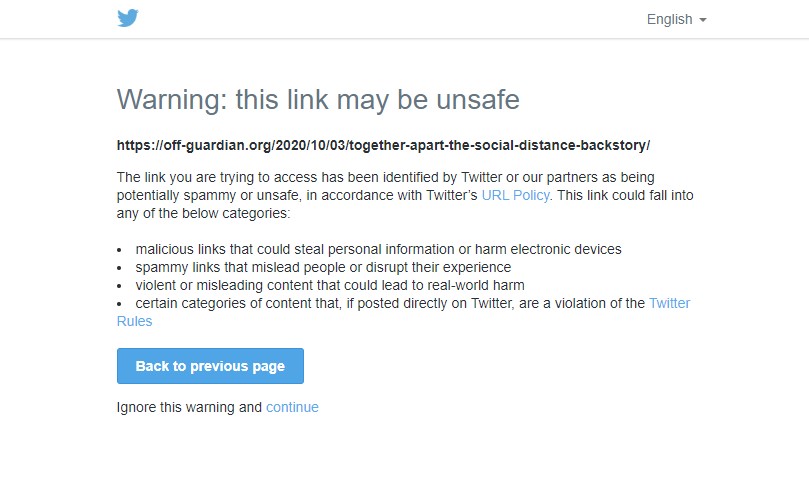
… it appears every time you click on any of our articles on twitter.
Note the vague language – “potentially spammy”, “could fall into”. They don’t even definitely say there is anything wrong, let alone what it actually is.
Since we can obviously rule out malicious software, phishing, spam and “violent content”, the only thing we can concluded is that we supposedly “violated” one of twitter’s rules. Since they don’t see fit to tells us which of their rules we’ve broken, let’s just inspect them all. They are right here in black and white and are fairly predictable:
- No child exploitation or child pornography
- No promotion of illegal practices
- No violence or promotion of violence
- No hate speech or threats
- No posting private information without consent
- No abuse or harassment
- No hacking, spam or fraud
- No plagiarism or copyright infringement
It’s all very basic stuff, and anyone even passingly familiar with our site could tell you we have never come close to breaking any of those rules. (We would be happy to argue this with anyone who comes forward to accuse us of anything specific).
Of course, none of this is accidental – the vagueness is entirely intentional. They don’t accuse us of anything specific, because then we cannot give a specific refutation (youtube does the same thing all the time, they will say your video “violated our community guidelines”, but they will never say how.)
This is actually even more dishonest than youtube – which is a hell of a thing to say – because twitter is going further, implying we have engaged in borderline illegal behaviour.
The most revealing details here are actually buried deep with the rabbit-warren of “help pages” on twitter.
First, there’s the way they “surface links” (meaning identify URLs which might be “dangerous”). Their methods include [our emphasis]:
Collaborative information sharing with industry peers and trusted NGO partners
They don’t say who their “trusted NGO partners” are, but we can probably guess…and we really don’t need to know the specifics to see how potentially corrupt that is.
Second, there’s this quote from the section headed “about links that have warning notices” [again, our emphasis]:
In some instances, Twitter will introduce a warning that the link may be unsafe. The warning notice can be clicked through if you wish to proceed to the third-party site. When a link has been categorized by Twitter as meeting the criteria for a warning notice, it will also have limited visibility on Twitter.
“Limited visibility” means twitter is actively hiding our content. Specifically – they are concealing it on people’s timelines and suppressing in search results.
To sum up:
- Twitter is suppressing our content in searches and blocking links to our articles.
- This decision was informed by unnamed third party “partners” – perhaps including unknown NGOs – and based on unspecified criteria.
- They have been doing it for months, without ever notifying us, or giving us any option for appeal or review.
- We don’t know of what we are accused and we have been given no method or avenue for defending ourselves.
This is authoritarian censorship, pure and simple.
But, as the saying goes, “When you’re taking flak you know you’re over the target”
The Time of Troubles in Transcaucasia – Part 2
By M. K. BHADRAKUMAR | Indian Punchline | October 3, 2020
Part-1 of the three-part essay is here.
The German Chancellor Angela Merkel said in Berlin on October 2 that the European Union seeks a “constructive dialogue and a positive agenda” with Turkey. She had just returned to the German capital after a 2-day summit meeting of the EU countries in Brussels. Germany played a key role at the summit in steering the EU-Turkey relationship away from a confrontationist path to which it was drifting lately. (See my blog EU marks distance from Indo-Pacific strategy.)
Merkel said, “We had a very long, detailed discussion about our relations with Turkey. We came to the conclusion that we would like to enter into a constructive dialogue with Turkey, we want to have a positive agenda,” adding that the Brussels summit had opened a “window of opportunity” for closer cooperation with Ankara.
Merkel disclosed that talks for closer cooperation between the EU and Turkey in the coming months would focus on migration issues, trade, modernising the Customs Union, and liberalised visa regime. In effect, Merkel has made a huge case for Turkish President Recep Erdogan at a particularly sensitive juncture for the latter when there is growing criticism in Europe regarding his regional policies.
In particular, there has been a nasty incident recently involving the Turkish and French navies in the Eastern Mediterranean. It was a rare, if not unprecedented, incident involving two NATO powers in the 7-decade old history of the western alliance.
Again, the US recently strengthened its military bases in Greece and has repeatedly called for restraint on the part of Turkey over its maritime disputes with Greece and vowed to intervene both politically and militarily in the tensions in the Eastern Mediterranean.
Turkey and France support opposite sides in the Libyan civil war, while the US is aligned with militant Kurdish groups in Syria whom Turkey regards as terrorists. And as conflict erupted in Nagorno-Karabakh, Turkey witnesses the US, France and Russia swiftly drawing close in a phalanx to push back at Erdogan’s robust backing for Azerbaijan, including pledges of military help.
To be sure, Merkel spoke with great deliberation. Before leaving for Brussels, Merkel had addressed the German Parliament where she referred to complaints against Turkey’s human rights records, but went on to praise Turkey’s “amazing and remarkable” performance in hosting refugees, highlighting that Turkey is hosting four million refugees.
Interestingly, Merkel compared Greece to Turkey in a poor light. “We have to weigh very carefully how to resolve the tensions and how to strengthen our co-operation on refugees and on the humane treatment of refugees,” she said and proceeded to condemn the manner in which Turkey’s archetypal enemy Greece is handling the migrant camp in Lesvos (Greece).
With biting sarcasm, Merkel noted, “in recent days we have seen horrible images regarding the treatment of refugees. And not from Turkey, I would like to emphasise, but from Lesvos (Greece), from an EU member state.”
Without doubt, Germany has stood up to be counted as Turkey’s friend at a time when the latter faces growing isolation within the NATO and from the EU.
Seminal events
The well-known American professor at Harvard University’s John F. Kennedy School of Government, Stephen Walt once penned an essay titled Great Powers Are Defined by Their Wars where he pointed out that explaining a great power’s foreign policy is a perennial question for scholars of international politics. He argued that major wars have powerful and long-lasting effects on a nation’s subsequent foreign or military policy.
Prof. Walt explained that wars are seminal events from which a great power’s subsequent behaviour follows, independent of its relative power, regime type or its leadership. In his words, “Those who fight in these wars are often scarred by the experience, and the lessons drawn from victory or defeat will be etched deeply into the nation’s collective memory. The experience of past wars is central to most national identities… If you want to understand the foreign policy of a great power, therefore (and probably lesser powers as well), a good place to start is to look at the great wars it has fought.”
Isn’t it a poignant historical memory for Berlin that the Ottomans were Germany’s allies in two world wars when it was hopelessly isolated by the the western powers?
On the other hand, take Russia and Turkey. Russia fought a series of twelve wars with the Ottoman Empire between the 17th and 20th centuries — one of the longest series of military conflicts in European history — which ultimately ended disastrously for the latter and led to its decline and eventual disintegration.
Russia had often fought the Ottomans at different times, often in alliance with the other European powers. Importantly, these wars helped to showcase the ascendancy of Russia as a European power after the modernisation efforts of Peter the Great in the early 18th century. In the Turkish Muslim psyche, however, Russia has figured as a protagonist which had played an historical role in the weakening of the Ottoman Empire in Central Europe, the Balkans and Transcaucasia.
The Russian conquest of the Caucasus mainly occurred between 1800 and 1864. In that era the Russian Empire expanded to control the region between the Black Sea and Caspian Sea, the territory that is present-day Armenia, Azerbaijan and Georgia (and parts of today’s Iran and Turkey) as well as the North Caucasus region of modern Russia. Multiple wars were fought against the local rulers of the regions as well as the Ottoman Empire until the last regions were brought under Russian control by 1864 with the expulsion to Turkey of several hundred thousand Circassians.
Then followed the Russo-Turkish War (1877-78) when Russia seized the the province of Kars and the port of Batumi on the Black Sea. In World War I, aligned with Germany, the Ottomans pushed against Russia as far east as Baku (capital of Azerbaijan) but then withdrew, lacking the strength to advance further, and subsequently in the post-war confusion, somehow contrived to regain Kars.
Suffice to say, in 1991 following the collapse of the former Soviet Union, when Transcaucasia became independent as the states of Georgia, Armenia and Azerbaijan, a lot of blood-soaked history involving Russia and Turkey provided the backdrop. Incidentally, Erdogan’s family originally hailed from Rize Province in the eastern part of Turkey’s Black Sea region (where he grew up as a child), which was a site of battles between the Ottoman and Russian armies during the Caucasus Campaign of World War I and was occupied by Russian forces in 1916-1918, to be finally returned to the Ottomans under the Treaty of Brest-Litovsk in 1918. The Soviet Union returned Rize to Turkey in 1921.
‘Past is never dead’
Amidst all this, an interesting feature of the flow of history has been that from the days of the Roman Empire, Transcaucasia was usually a borderland between Constantinople (Istanbul) and Persia. Areas would shift from one empire to the other, their rulers would have varying degrees of independence and were often vassals of one empire or the other, depending on the size and proximity of the suzerain’s army. By around 1750 the area was divided between the Turkish and Persian vassals. The western two thirds were inhabited by Georgians, an ancient Christian people, and the eastern third mostly by Azeris, Turkic Muslims. And Russia of course was pushing close to the Black Sea and the Caspian against the Ottoman and Persian empires.
Professor Walt in his essay cited a famous quote from the American novelist William Faulkner, “The past is never dead. It’s not even past.” Indeed, for Russia, Turkey or Iran, the current developments in Transcaucasia form part of a vast collective event that shapes their perceptions of danger and definitions of heroism, sacrifice, and even their identity.
In fact, the current line-up in the developing situation around Turkey speaks for itself: Germany voices sympathy for Turkey and offers an enhanced partnership; France lambasts Turkey and seeks EU sanctions against Turkey; France alleges Ankara’s dispatch of Syrian fighters to Nagorno-Karabakh; Germany appreciates Turkey’s big hand in addressing the refugee crisis gripping Europe; France coordinates with Russia at the highest level of leadership to pressure Turkey over Nagorno-Karabakh; the North Atlantic Treaty Organisation (NATO) and the US join Russia and France’s call for cessation of fighting in Transcaucasia; Iran maintains neutrality and suggests a joint effort with Turkey and Russia to resolve the conflict between Armenia and Azerbaijan.
Meanwhile, Moscow has shed its initial ambivalence and is stepping into the arena on the side of Armenia, expressing “serious concern in connection with incoming information about the involvement in hostilities of gunmen from illegal armed units from the Middle East” — plainly put, censuring Turkey’s backing for Azerbaijan. And President Vladimir Putin underscores that he is voicing a common stance along with “the presidents of the countries co-chairing the OSCE Minsk Group” (Russia, France and the United States). Simply put, Russia’s “competitive rivalry” with Turkey is surging.
Interestingly, Turkish President Recep Erdogan has openly drawn attention to the broader regional and geopolitical context in which the various unnamed powers are jockeying and covertly coordinating to encircle Turkey. Erdogan said on October 2, “If we connect the crises in the Caucasus, in Syria and in the Mediterranean, you will see that this is an attempt to surround Turkey.”
It doesn’t require much ingenuity to figure out the identity of the foreign powers he would have had in mind who are attempting to “surround” Turkey — France, the US and Greece (all NATO powers) and Russia, the scourge of the Ottoman Empire.
Is the UK heading toward medical martial law?
We are hearing frequent calls for the UK’s coronavirus “pandemic” response to become a military operation
OffGuardian | October 2, 2020
On the 28th September Tobias Ellwood, Tory MP for Bournemouth East, stood up in Parliament and suggested that the British Army and the Ministry of Defense be in charge of distributing and administering “millions of doses” of the Sars-Cov-2 vaccines, as well as issuing “vaccination certificates” which will “allow travel”.
And that’s just the highlights, there’s a lot more vaguely sinister language, camouflaged in his rather drab monotone voice. (You can watch the whole speech here, go to 20:24).
This is a concerning development, one very much worth keeping an eye on. The BBC don’t think so, of course, because the call for what would easily amount to medical martial law didn’t even make it into their “Today in Parliament” programme.
This is not new behaviour for Ellwood. He has always been a consistent voice for use of the military in response to the “pandemic”. On the 18th of September he requested the Prime Minister make “greater use of our fine armed forces”.
He specifically mentions “managing the narrative”, which is no surprise considering his role as a former Army officer, a current reserves officer, and his known affiliation with the 77th Brigade. For those who don’t know: The 77th is the British army’s team of “facebook warriors”. An information warfare unit whose job is to “counter misinformation”, “manage the narrative” and generally corral and control the internet conversation.
That’s not a “conspiracy theory”, their existence is readily acknowledged by both the government and the mainstream media. Considering they’re currently employed “countering covid misinformation“, they will likely be in the comments of this post (Hi guys!).
Other countries around the world have already moved on to this “war footing”, and the UK is likely not far behind.
Police find ‘no evidence’ of brutal racist attack on Wisconsin woman, but won’t press charges for false report
RT | October 2, 2020
Madison police found no evidence to corroborate Althea Bernstein’s claim four white men tried to set her on fire during a night of riots in the Wisconsin capital in June, but will not charge her with filing a false report.
Bernstein, 18, had claimed that four white men sprayed her with lighter fluid through the open window of her car as she sat at a red light in downtown Madison, then threw a flaming lighter at her while yelling racial slurs. She suffered burns on her neck and face and had them treated at a local hospital.
Her case had attracted national attention, with federal and state investigators joining local police in probing it as a hate crime. Bernstein called for Americans to “support black lives” in response.
On Friday, however, the US attorney’s office in Madison announced the investigation was closing without any charges being filed, after investigators found no evidence that the attack actually took place.
Madison Police Department detectives were unable to “locate evidence consistent with what was reported,” acting chief Vic Wahl said in a statement. The department released a 150-page report into the investigation, showing that Bernstein’s car had indeed stopped at a red light, but there was no one else near it. She was in the right lane of the street, not the left as she told investigators, and her window had been closed.
Nor was she in downtown Madison, but Middleton – a suburb about 15 minutes away, according to both traffic cameras and GPS data from her cell phone.
NEW: An 18 year old girl said in June that four racists in Wisco. lit her on fire. She went on Good Morning America, got a call from Meghan Markle, and now has her name on NFL helmets Authorities today said there’s no evidence the incident ever occurred https://t.co/6eGsBAG4gZ
— Brent Scher (@BrentScher) October 2, 2020
An arson dog found no traces of a lighter or other incendiary device in her car, which was not damaged. Bernstein’s clothes did have traces of lighter fluid, and her medical records did show she was treated for burns that night. Absent any alternative explanation from Bernstein, the authorities decided to close the case without charging anyone.
“Althea Bernstein and her family appreciate the detailed investigative efforts by all involved in this case,” said a statement released through the Madison police. “Althea’s injuries are healing and the support of our community has been invaluable in that regard. We continue to maintain our family privacy and will not be granting interviews at this time.”
During the night Bernstein alleged she had been attacked, rioters protesting the arrest of an African-American man toppled several statues in downtown Madison – including the one of a Norwegian immigrant who died fighting against the Confederacy during the Civil war.
State Senator Tim Carpenter, a Democrat, was punched and kicked when he tried to take a photo of the protest. Rioters also vandalized cars, smashed storefronts, and set fire to several buildings.
On the same day Bernstein made her allegation, NASCAR driver Bubba Wallace insisted to CNN that a pull rope on the door of his garage was indeed a noose. A team of 15 FBI agents sent to Talladega Raceway in Alabama had concluded that the garage-door opening mechanism was not in fact a hate crime, after someone from the African-American driver’s entourage made the allegation.
While neither Bernstein nor Wallace faced legal repercussions for their claims, actor Jussie Smollett has not been so lucky. He has been charged by special prosecutors with six counts of making a false police report, over the February 2019 claim that he was a victim of a racist attack in Chicago. Two ethnic Nigerians later told the police they were paid to stage the incident, involving bleach, a rope, and hats with ‘Make America Great Again’ slogan used by President Donald Trump.
Daniel Korski: The Intelligence-Linked Mastermind Behind the UK’s Orwellian Healthtech Advisory Board

By Johnny Vedmore |
Unlimited Hangout| October 1, 2020
As a futuristic, hi-tech dystopia increasingly takes shape around us, the concept of the Panopticon is more relevant than ever as it functions as the underpinning of the ever-growing mass surveillance grid.
For those who are not so familiar with 18th century social philosophy, a Panopticon was originally the design of a prison building by an English philosopher named Jeremy Bentham. The Panopticon prison’s architecture would allow one guard in a central guard tower to observe every inmate without those prisoners knowing that they were being observed, and so those incarcerated were left to assume that they were actually being observed all of the time. This prison would, in theory, allow that singular guard to maintain order over every inmate.
Much later, in the 20th century, the famous French philosopher, Michel Foucault, would use the concept of Bentham’s original Panopticon as a way to describe and explore “disciplinary power”. According to Foucault’s work, disciplinary power had been successful due to its utilisation of three technologies; hierarchical observation; normalising judgment; and examinations. Hierarchical observation refers to the fact that the observer in a Panopticon can be of any hierarchical position within the observing body, meaning that a prison guard, supervisor, or a governor could be the person viewing the inmates. Foucault would also insist that the normalisation of judgement is imperative for disciplinary power to exist. The final principle, the examination, is used to combine the first two principles of the observations and the resulting judgements to help decide on whether further actions should be taken or punitive measures be applied.
Among the most notable of Foucault’s analyses of the utility of the Panopticon is the following quote from his book Discipline and Punish: “The major effect of the panopticon is to induce in the inmate a state of consciousness and permanent visibility that assures the automatic functioning of power.” In other words, the uncertainty of whether or not an individual is being constantly watched induces obedience in that individual, allowing only a few to control the many.
In addition to Foucault, the concept of the Panopticon has been vigorously studied over the past few centuries and it has special relevance in understanding modern forms of mass surveillance. The aim of many of the modern day state surveillance apparatus function under a similar doctrine to the original ideology behind the invention of the Panopticon.
The British GCHQ, the US’s NSA, the Israeli’s Unit 8200, among many others, are the all seeing eyes of national intelligence agencies who have longed for a way to watch their populations remotely, i.e. online, without their citizens knowing whether or not they’re actually being observed. One man has striven to be at the center of the growing global Panopticon, from his base in the Panopticon’s birthplace — Britain. His name is Daniel Korski.
The Creator
When I first came upon the NHS Healthtech Advisory Board, a body created in 2018 to “advise” the UK’s Health and Social Care Secretary Matt Hancock, its members opened my eyes to some of the darker actors involved in designing our tech-guided futures. One of the panelists on Matt Hancock’s team of tech pioneers, who are seeking “to transform technology in the NHS [National Health Service],” was Nicole Junkermann.
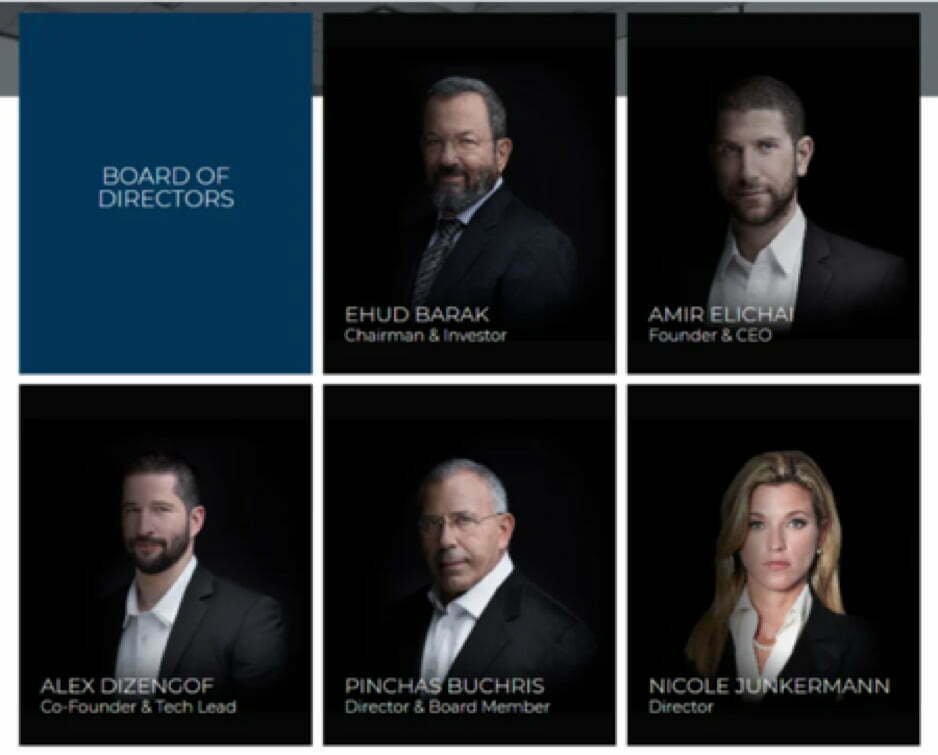
The Israeli Intelligence-Linked Team behind Carbyne911 (including Nicole Junkermann)
Junkermann’s multiple links with Jeffrey Epstein, which appear to have begun around 2002, exposed her as someone who couldn’t be trusted with the future direction of the UK’s healthcare system. Furthermore, Junkermann’s connections with Ehud Barak, Peter Thiel, and Jeffrey Epstein via her investment in the Israeli intelligence-linked surveillance company Carbyne911, made her entry into the United Kingdom’s government advisory panel very problematic for everyone involved. But she was not the only interesting character intimately involved in this particular government project.
While the Healthtech Advisory Board has been hailed since its creation as the brainchild of Matt Hancock, he was actually guided to the project by the man who was, and is, the real mastermind behind the board’s founding, a man who has been helping to quietly write the history of Britain from behind the scenes for the last two decades. He is somebody you’ve probably never heard of, even though his impact on public policy is felt not only in the United Kingdom, but globally.
This man has been a senior advisor to the US State Department, an advisor to Hamid Karzai in post-invasion Afghanistan, the team leader of the Basrah Reconstruction Team in post-invasion Iraq, the Head of Political-Military Affairs for the Office of the High Representative to Bosnia-Herzegovina, and a Committee Specialist for the House of Commons Defence Committee. If that weren’t enough, he was also a founding member of the European Council on Foreign Relations, an advisor to the Vice President of the European Commission, a special advisor to UK Prime Minister David Cameron, deputy head of policy at 10 Downing Street. Yet, even these are just some of the public offices he has held. This man’s name is Daniel Korski and he should be notorious.
Described as a “Foreign Policy Writer” and a “Post Conflict Expert”, Daniel Korski is currently only in his early forties and yet his experience is vast. How does one get the opportunities which have been afforded to Mr Korski? Do you need to be a member of a special club from a very young age? Everything about Korski points to military intelligence, so to find him on the same advisory board as a Mossad-linked Epstein associate isn’t too much of a shock, but it does deserve further scrutiny.
This is especially true now that Daniel Korski has left public office and set up a venture capital firm which specifically funds government-related tech startups. While Korski wants to publicly appear to have left government work, it is pretty clear that, upon further inspection, he hasn’t drifted too far from the authorities. So, let us look at Mr Korski’s history in more detail and work our way forward towards his more current projects. In doing so, I truly believe that you will not be able to deny his continuing role as an intelligence operative. You will also be shown evidence of his dystopian side projects and connections to one of the largest growing, government-backed mass surveillance projects in the world. This is an introduction to Daniel Korski, one of the creators of the current digital panopticon.
Daniel Korski’s Curious Past
Henryk Korski, grandfather of Daniel Korski eluded the Nazi’s whilst living in Poland in the 1940s. After the war, he would join the Polish Communist Party and by the mid-to-late 60s he was working in the Ministry of Foreign Trade. But a decade later, when his grandson Daniel was born, the whole family had already relocated to Copenhagen. If you were to go by Daniel Korski’s Wikipedia page then you would be told that his family were expelled from Poland in the late 1960s. But, if you were to look behind the scenes at Korski’s Wikipedia pages history then you’d discover that someone disagreed with that description of events.
On 21st April 2013 someone edited this part of Daniel’s Wiki page. This editor wanted people to know: “Korski is the son of Polish Jewish refugees, who fled persecution.” I decided to see if I could trace the I.P. Address of the person who made this change. I managed to track the computer to Brussels in Belgium and the edit was made while Daniel Korski was living in the Belgian capital when working as an advisor to the Vice President of the European Commission. It’s also just before he left that post and headed off to become a special advisor to the then Prime Minister of the United Kingdom, David Cameron. It seems that Daniel Korski wanted everyone to believe that his parents had fled persecution in Poland, but was this true?
Daniel Korski himself would eventually head to Twitter to show people the evidence that his parents were Jewish refugees fleeing persecution. He would post two images of official court documents sealed in plastic sleeves and describe it as evidence of a pogrom. For those who are unaware, a pogrom is described as “an organized massacre, especially of Jews”. But do the documents supplied by Daniel Korski provide any evidence of a massacre of Jewish people? The straight answer is a definite no. The court papers Korski so proudly presents on Twitter do not mention Judaism at all, but they do mention Henryk Korski’s stance on the war between Israel and Egypt. The documents, which were written in Polish, relate to a court case involving Henryk Korski and his employer.
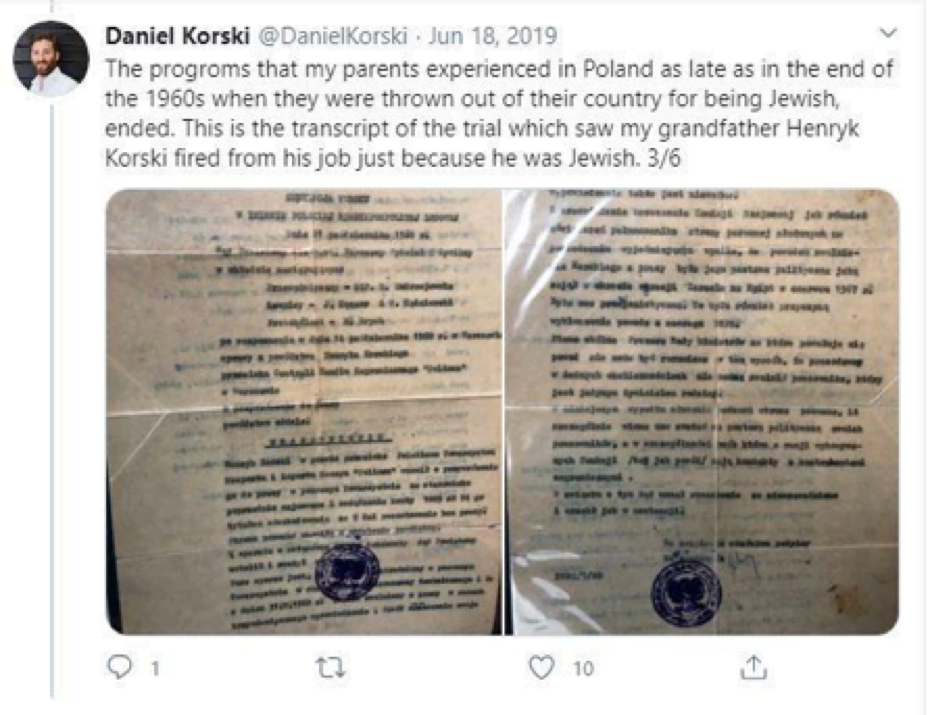
Henryk demanded to be reinstated into his previously held position in the Polish Ministry of Foreign Trade and compensation to be paid for the wages he had been denied. The court refused Mr. Korski’s application and the Korski family would soon move to Denmark, a decision which Henryk himself said turned out to be a lucky move. There is no massacre of Jews in Poland at this time and there is no pogrom involving Korski’s family either. In fact the last recorded pogrom happened in 1946. Instead, Daniel Korski is caught misleading the public in an attempt to appear as though his parents were Jewish refugees fleeing the threat of death in communist Poland. Is it any wonder then that in the same year as Daniel Korski was making up parts of his family’s history, he would also be appointed as vice president of the United Kingdom’s Jewish Leadership Council.
Daniel Korski grew up in Denmark, so how did he become such an important part of the British government? Korski didn’t start studying for his degree until 1997 when he was 20 years old. He would attend the London School of Economics and Political Science (LSE) and would later attend Cambridge University for his Masters. He was either well connected or very talented, maybe even both, as by the age of 25 he was working for ex-Liberal Democrat leader Paddy Ashdown as Head of Political-Military Affairs while Ashdown was serving in the office of High Representative for Bosnia-Herzegovina. Korski would hold that position between 2002 until 2004 and he would then go on to be the Committee Specialist for the UK House of Commons Defence Committee. That short term position would be followed by his first official role overseas on behalf of the British government. In 2005, Korski would be in Kabul, Afghanistan, where he was officially advising the Karzai government on counter-narcotic operations. He would also soon become part of the UK Government’s “Stabilisation Unit” for the war-torn country.
His next appointment, in 2007, was a move to Iraq as the team leader for the Basrah Provincial Reconstruction Team and during this work in Afghanistan and Iraq, Korski became a senior advisor to the US State Department. With all this experience, we are able to see that Daniel Korski, who was still only 30 years old, had very clear intelligence connections. So it will come as no surprise that in 2009 Daniel Korski helped to found the European Council on Foreign Relations where he would also be named a “Senior Policy Fellow”. Korski would, soon after the creation of the European CFR, become an advisor to the vice president of the European Commission, Catherine Ashton, also referred to as Baroness Ashton of Upholland.
In 2013, Korski would return to the UK as a special advisor to the David Cameron government. In May 2015, he would take up the position as deputy head of policy at 10 Downing Street and would stay in that position until Cameron stood down following his defeat in the EU referendum. The Brexit defeat hit everyone involved in the Cameron administration like a hurricane. Many of the politicians who orchestrated the lacklustre campaign for Britain remaining part of the EU immediately stepped down and some went into hiding.
Quite amazingly for any advisor to a Conservative government, Daniel Korski had managed to get through almost 15 years in leading Whitehall positions without being involved in a single sex scandal; at least that’s what he thought. Yet, on 14th November 2017, the Telegraph, in an article entitled “David Cameron aide denies groping television writer at Downing Street event,” the paper named Daniel Korski as the man who allegedly groped producer Daisy Goodwin. The article states:
“Daniel Korski, who left his post as special adviser following the Brexit vote, admitted that he had met the TV producer in Number 10 on two occasions, but said that any accusation of inappropriate behaviour was “not only totally false but also totally bizarre”
Ms Goodwin, 55, has claimed that she was “summoned” to Downing Street to discuss a proposed TV show when Mr Cameron was Prime Minister and an official told her she looked like a Bond girl before putting his hand on her breast as she went to leave.” Korski, by the time the sexual assault accusation had been made public, had started his own venture capital firm called simply “Public” or Public.io. Even though he was officially outside government at the time, Korski’s capitalist venture would specifically focus on tech startups designed for government applications. They set up base at an address in 1 Horseguards Avenue, Westminster, just opposite the HQ for the UK Ministry of Defence. Public.io also owns Eva Health Technology, previously named Microtest Ltd, which supplies patient management systems for healthcare professionals, including everything from simple customer booking software through to documentation software for vaccines.
In 2018, Korski would become Chairman and Co-Founder of the Govtech Summit, which is planned to be held each year in Paris and is a global stage to pitch next-generation technologies to governments from around the world. Govtech is a place where Daniel Korski and his Public.io business partner, Alexander de Carvalho, can introduce the world to such tech startups as Ehud Barak’s Carbyne, a company frequently advertised by Public.io and Govtech even though they are not direct investors in the Israeli firm. It was also in 2018 that the Healthtech Advisory Board, supposedly the idea of Matt Hancock, was formed and began to bring together such people as Nicole Junkermann and Daniel Korski to help create the future blueprint for the hi-tech “transformation” of the UK’s public health sector.
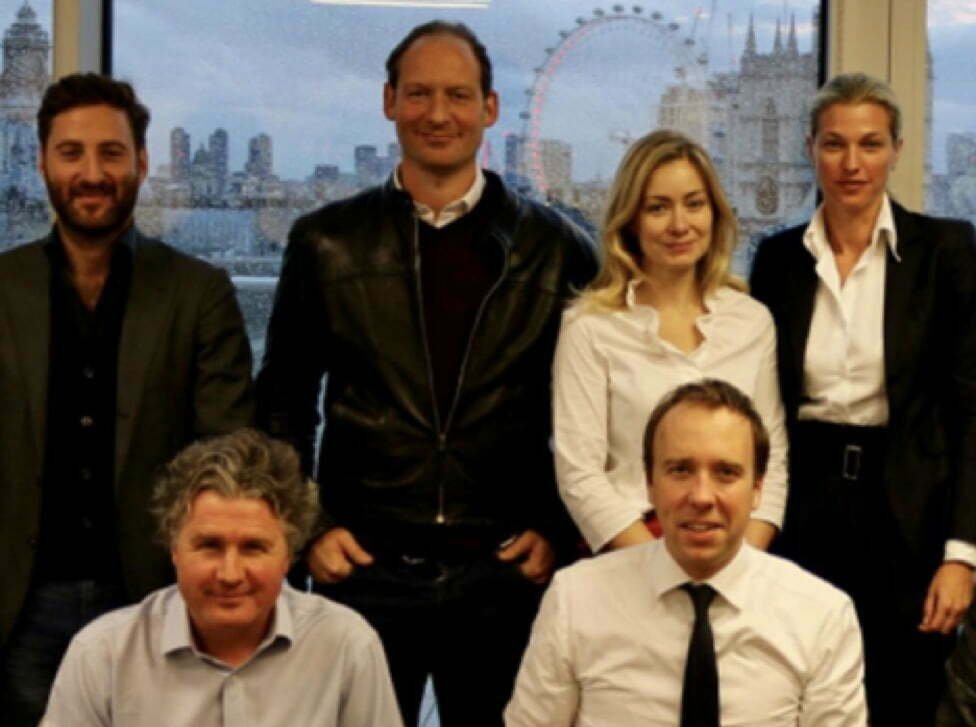
Some members of the Healthtech Advisory Board, (Rear) Daniel Korski, Parker Moss, Nicola Blackwood, Nicole Junkermann (Front) Dr Ben Goldacre and Matt Hancock
But Korski, since leaving official government employment, has been involved in other activities too. One of his other enterprises is with a man who already has a foothold in the mass surveillance business via a government application and who intends to repeat his early successes on a global scale, as well as many other interesting characters. Please, take your predesignated seats, strap yourself in and welcome to Daniel Korski’s Panopticon.
Enter the Panopticon
Nicole Junkermann and Daniel Korski have many common interests in the big tech sector. In 2017 and 2018, they both began to invest in and focus on mass surveillance technology and future healthcare-related tech with great intensity. If one didn’t know any better, one might come to the conclusion that both Junkermann and Korski had inside knowledge of a coming healthcare crisis, such as a pandemic. Conveniently for Korski’s and Junkermann’s investment portfolios, the current pandemic has become an excuse for government to take away our current civil liberties and implement widespread mass surveillance technologies on an unwitting public.
While Junkermann was personally investing with Epstein and Thiel in Ehud Barak’s Carbyne911, Korski was supporting similar projects in the UK. On 26 March 2018, Daniel Korski became the director of the UK registered company Panopticon Technologies Limited. If you were to go to their previous website, Panopticon.Tech, then you’d be met by a dead link, but the Wayback Machine captured their original site twice in 2018.
The founding team at Panopticon Technologies included:
- Sir Mark Rowley QPM who is described as “one of the most respected and decorated police leaders in the UK”. Rowley had led the national police counter terrorism effort as Assistant Met Commissioner in the UK.
- Alastair Aitken CBE, who helped restructure the Army in the UK, informed by his three decades of experience in the UK military. He was also heralded as helping to redesign US military strategy and was involved in every complicated war zone over the last three decades.
- Mark Austin, a former global board member of PricewaterhouseCoopers and senior executive at IBM. An expert in finance, technology and corporate governance.
- Dale Murray, a partner in the digital strategy consultancy Founders Technology. She was a co-founder of Omega Logic as well as being another advisor to David Cameron on the “Business Taskforce”.
- Max Chambers, who is also part of Korski’s Public.io and was a former senior advisor to David Cameron. He was principal adviser on all aspects of home affairs policy, including security, immigration, counter-extremism, policing and criminal justice.
There are two other important players who also played major parts in the creation of Panopticon Technologies. One is Mike Iiams, the CEO and President of Alcohol Monitoring Systems Inc., one of the leading electronic monitoring companies globally. The second is a man named Alasdair James Eli Truett. These last two men should be examined in greater detail.
SCRAM Systems and Mike Iiams
Alcohol Monitoring Systems Inc. was founded in Colorado by Michael Leonard Iiams among others. Iiams would go on to be a very successful President and CEO of Alcohol Monitoring Systems/SCRAM for almost 20 years. His name would also be on the patent as one of the inventors of the SCRAM Systems Bracelet, a useful technology designed specifically for use by professional law enforcement. America has a well-developed law enforcement technologies industry and it also has plenty of problem drinkers. Police departments all over the country are equipped with some of the most state-of-the-art equipment available. One of the first successful forms of police technology to be widely adopted by many states was an alcohol detection system, which was used to track problematic drinkers who would commit offences while under the influence. This system was a simple tool in dealing with crimes related to alcohol abuse.
In 1985, Dr. Daniel J. Brown of Indiana University School of Medicine published studies on the subject of measuring volatile substances through the skin including sensing alcohol in sweat. By 1991, the first patent was filed for the Secure Continuous Remote Alcohol Monitor (SCRAM) System. In 2005, the SCRAM system was monitoring 1,700 offenders a day and the program was active in 30 states. Over the following decade and a half, improvements in technologies have seen the addition of further functions on top of the capabilities of the original device. By the rollout of the 4th generation of this technology, it had reduced in size and included the introduction of GPS tracking that would also allow the police to monitor people on house arrest.
Today, this technology has developed into a multifaceted tracking bracelet that allows officers to monitor suspects via a tablet or a mobile phone and it is being rolled out globally. Mike Iiams inclusion into Korski’s Panopticon Technologies came just before SCRAM Systems tagging technology won UK Home Office backing for its use in tackling Britain’s problem drinkers. In 2020, national rollouts were announced in Wales, England, and the Netherlands with the intention to continue its expansion into other countries. According to Public Health England, alcohol-related crime costs the UK economy more than £21.5bn a year and the Ministry of Justice has declared that the Alcohol Abstinence Monitoring Requirement (AAMR) can be imposed by courts in accordance with community-based orders, which allows for the use of these “next-generation” SCRAM Systems bracelets, referred to in the UK as “peace tags”.
Although Mike Iiams is not listed as a director of Panopticon Technologies in the official UK companies database, he is listed as someone with significant control of the company with shares of over 25%. Iiams has also worked for the accounting firm Peat, Marwick, Mitchell & Co. in Alaska, during the building of the TransCanada pipeline, and has been in a senior executive role with JD Edwards, which is now part of Oracle.
Alasdair James Eli Truett
The other person of significance, who was at one point a director at Panopticon Technologies alongside Korski, is Alasdair Truett. Truett’s involvement in the project makes for a fascinating addition to PT, as his background is in military intelligence. Truett’s LinkedIn shows him simply as an officer in the British Army for over 20 years between 1997 and 2017, but the title of officer seriously understates Lt Col Alasdair Truett MBE’s experience.
In the British Army, “Alasdair was advising, planning and executing domestic and overseas intelligence and security policy and operations,” as described on the homepage of Cerebra Global Strategy. His profile goes on to tell us:
“He has operated at the political, strategic and tactical levels for national intelligence, national influence, small and large scale wars and counter-terrorism. Since 2017, Alasdair has provided advice and commercial services to leaders in governments and corporates on a spectrum of matters to do with national, corporate and personal intelligence, security and leadership.”
Truett was not just your average garden variety grunt with a gun on the British Army payroll, Lieutenant Colonel Alasdair Truett was in fact a very focused specialist in the field of military intelligence. Truett claims to have only been at Panopticon Technologies for its first 7 months of operation, afterwards he would found both Fortisat, followed by Cerebra Global Strategy Ltd.
In a Cyber Unplugged podcast entitled Social Engineering: The Threat Is Coming From Inside The House, Truett describes Fortisat as “a national security advisory and business intelligence company that looks at ‘human network intelligence’ and offers advice to governments on emerging technologies that will enhance their national security.”
Flash in the Pan(opticon)
So, why has Panopticon Technologies recently gone dark? Although it is still an active company, the pulling of the Panopticon.Tech website seems to suggest that the enterprise is on hold, or about to be abandoned. But these data hungry lobbyists for government mass surveillance often work in the shadows.
What do we know about Panopticon Technologies? They described themselves as “a new, ethical, tech-enabled UK security company” and have stated that “we are passionate about new technology and providing immigration, police, intelligence and probation officers with high quality hardware and software to enhance their day-to-day work in monitoring offenders and protecting the public.” But their method, described as using “new behavioural and compliance models powered by cutting-edge analysis,” may have been too much for supporters to bear after the Cambridge Analytica scandal.
Korski and his Public.io, led by Max Chambers, may have been rash to launch PT so publicly in the first place. For a Panopticon to be successful, the inmates must know that there is the potential for them to be observed and that is very much the society we find ourselves in today. In this vast cyber-Panopticon, the masses are being observed by the few, and people like Daniel Korski, Alasdair Truett, Nicole Junkermann, Ehud Barak, and Mike Iiams lobby governments to expand and normalise their own homeland mass surveillance programmes. It only takes one government to agree to private companies being responsible for the mass surveillance of their populations for this trend to begin to take a permanent place in our societies. Now, with Covid-19, there are many excuses to implement panopticonic technologies to further the observation power of the few over the many.
Korski has positioned himself to be one of the most influential players in the modern UK government tech sector. He has used his many UK government connections to benefit himself financially and has been eager to remain publicly affiliated with the ruling UK Conservative government since leaving Whitehall. Korski’s Public.io venture capital firm is located at the heart of the UK MoD and is just a stone’s throw away from the UK Parliament. His entry into military intelligence at such a young age suggests he was recruited by an intelligence agency before attending university. He would start studying for his first degree later than most, at the age of 20, leaving us with a small two year gap in his timeline.
Before he’d even reached his thirties, and with no obvious experience in fighting the war on drugs, Korski would become a counter-narcotic operations advisor to the relatively recently installed Afghani leader, Hamid Karzai. Karzai’s brother, Wali Karzai, would later be revealed to have been on the payroll of Western intelligence agencies and also one of Afghanistan’s most prominent, and notorious drug traffickers. His drug trafficking activities were allegedly protected by his brother’s government and his CIA benefactors.
Korski was also heavily involved in the UK government’s stabilisation and reconstruction projects in both Afghanistan and Iraq. He was even acting as a senior advisor to the US Department of Defense just before he would help create the European Council on Foreign Relations. His intelligence links led him to become one of the most important advisors during the David Cameron government.
His links with military intelligence have become clearer since he’s officially left the halls of power, with Korski’s Panopticon Technologies bringing some of the leading advocates for government overreach who also have deep links to military intelligence. Alasdair Truett, Alastair Aitken, Mark Rowley and Max Chambers have all had leading roles in the creation of the modern intelligence networks in the UK for both homeland security and global intelligence strategies. Korski’s work on the Govtech summit has been keenly supported by French President Emmanuel Macron, former UK Prime Minister Tony Blair and Matt Hancock. Korski’s work has also been a vehicle for the normalisation of the use of public big data by private companies.
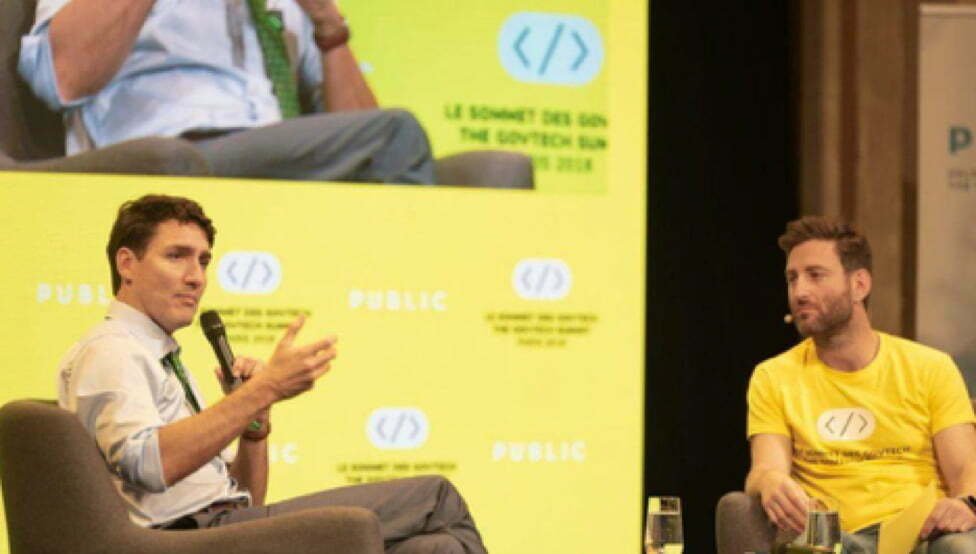
Daniel Korski listens to Canadian PM Justin Trudeau at Govtech Summit 2019
The NHS Healthtech Advisory Board gives us a brief glimpse inside the on-going creation of the modern digital panopticon. It let us see some of the intelligence-linked tech sector giants vying for opportunities to gain access to mass national databases. Junkermann’s Carbyne911 and Korski’s Panopticon Technologies are the monsters lurking in the shadows of the big tech world. They are constantly circling the part of the public sector that they see as soft targets, because control over the data from the public sector means access to every piece of private information from every citizen. Korski and Junkermann may have beautiful smiles and a charming way about them, but they are simply cogs in a machine leading us towards a dystopian future.
So, who is Daniel Korski actually working for? His deep love and support for the European Union suggests that his whole-hearted allegiance is to the European project. But with his globalist back story, his establishment connections, and his association with both public and private intelligence agencies, Daniel Korski would be a useful asset for any power with a similar agenda of creating a digital Panopticon.
Johnny Vedmore is a completely independent investigative journalist and musician from Cardiff, Wales. His work aims to expose the powerful people who are overlooked by other journalists and bring new information to his readers. If you require help, or have a tip for Johnny, then get in touch via johnnyvedmore.com or by reaching out to johnnyvedmore@gmail.com
Mercenaries from Sudan, Senegal arrive on Yemen’s Socotra
MEMO | October 2, 2020
Sudanese and Senegalese troops have arrived on the Yemeni Island of Socotra, reported the Yemen Press Agency yesterday. A batch of some 600 soldiers from the two African countries turned up on the island amid earlier reports that the UAE had requested forces belonging to the Southern Transitional Council (STC) return back to Aden on the mainland, with others moving onto the Hadramaut province.
At the start of the year Sudan announced it had begun reducing the number of its troops deployed in Yemen. Senegal, a Sunni Muslim majority country is the only non-Arab country to be involved in the US-backed, Saudi-led coalition and – along with Sudan – has been since the formation of the coalition in 2015.
According to a local source, Socotra Post reported that an Emirati ship has arrived at a port of the island, carrying an unknown cargo, two weeks after the arrival of a “suspicious Emirati ship” suspected of unloading military and communications equipment. It is speculated that the shipments may be used to complete the construction of a military and intelligence base on the island. There are already concerns that Israel, which has normalised relations with the UAE and is growing closer to Sudan is working with the UAE to set up a spy base on the Yemeni island.
The Post also reported that 21 local and three international lawyers have joined a human rights group in working to file a lawsuit against the internationally recognised Yemeni government over its failure in fulfilling its duty to protect the sovereignty of the Socotra Archipelago as the UAE consolidates its influence on the island.
Arrest of Hamas co-founder by Israeli security forces denounced as attempt to undermine Palestinian reconciliation
RT | October 2, 2020
Israeli security forces have arrested senior Hamas leader Hassan Youssef. The two rival Palestinian groups, Hamas and Fatah, have both condemned the move as being politically-charged and a bid to ruin their reconciliation talks.
Youssef was taken at his home in Ramallah in the occupied West Bank on Friday morning. While Israeli authorities have not provided any official information about the move, local media reported that the Hamas co-founder was detained over alleged “renewed” activity by the group.
After helping to found Hamas in the late 1980s, Youssef was repeatedly arrested by the Israeli authorities and spent years behind bars. Hamas has always maintained he was only involved in its political activities, and not associated with its military wing.His arrest was condemned by both Hamas and its rival, Fatah. Hamas claimed the arrest was a politically-motivated move, designed to destabilize the ongoing reconciliation process between the two groups.
“We hereby affirm that the arrest of Sheikh Hassan Youssef by the occupation will not stop the path of unity for which he worked for the past two months,” Hamas said in a statement.
Fatah has voiced a similar opinion on Youssef’s arrest, with the group’s Secretary-General Jibril Rajoub accusing Tel Aviv of “tampering” with the reconciliation talks and attempting to “influence the achievement of national unity.”
“This arrest is a continuation of the occupation’s approach to arresting dozens of our Palestinian people every day, and a continuation of the continuous aggression against our people for decades,” Rajoub stated.
Featured Video

Penguins, Polar Bears and Sea Ice
or go to
Aletho News Archives – Video-Images
Book Excerpt
Measles and Mortality
Informed with Aaron Siri| November 19, 2026
Given the news coverage around measles and mortality, I decided to share the section of my book, Vaccines, Amen, that covers precisely this topic. Help me spread a bit of reality into the media hysteria around this issue. Here is that section of the book… continue
Blog Roll
 Aletho News
- Argentina’s Perito Moreno Glacier Joins Antarctica and Arctic In Defying Doomsday Melt Claims
- ‘Chinagate’ Is Here
- Iran, four other countries condemn US plans to deploy weapons in outer space
- US media brings back the Iraq war playbook and why it won’t work
- Zakharova schools German FM on history basics
- Germany to produce drones for Ukraine
- Merz takes a swipe at Merkel over Ukraine’s NATO bid
- Measles and Mortality
- New York State Demands Amish Adopt Its Beliefs or Leave
- Saudi Arabia turns to South Korea, Ukraine to bolster air defenses
- If Americans Knew
- An error has occurred; the feed is probably down. Try again later.
- No Tricks Zone
- Alarmist Climatologists In Shock! 2026 Atlantic Hurricane Season Sees Lowest Count In 101 Years
- New Study: Modern Temps Are Among The Coldest Of The Last 10,000 Years In East Central Europe
- Germany’s Renewable Energies Lead to 1.4 Billion Euro Electric Power Trade Deficit
- Argentina’s Perito Moreno Glacier Joins Antarctica and Arctic In Defying Doomsday Melt Claims
- New Study: Barents Sea Temperatures Were Warmer And Sea Ice Less Extensive In The 1700s Than Today
- German Authorities Start Initiative To Evaluate Public Register For Climate “Disinformation” Spreaders!
- Zonal Asymmetry of Temperature Change in the Antarctic Circumpolar Current
- New Study: The Net Fossil Fuel Contribution To Rising Atmospheric CO2 Has Been Zero For 500 Years
- Germany’s Green Energy Transition Becoming Increasingly Expensive…Another 6 Trillion Euros!
- Sudden Stratospheric Warming, Powerful El Niño Combination May Lead To Extreme Europe Cold, Energy Crisis!

