How USA and Turkey Plunder and Loot Syria with Impunity
By Rick Sterling | Dissident Voice | September 16, 2020
While President Trump lashes out at rioting and looting in Portland and Kenosha, half way around the world, the USA and Turkey are plundering and looting Syria on a vastly greater scale with impunity and little publicity.
Turkey Loots Syria, then Disrupts Safe Water Supply
Turkey has been plundering the Syrian infrastructure for years. Beginning in late 2012 and continuing through 2013 some 300 industrial factories were dismantled and taken to Turkey from Aleppo, the industrial capital of Syria. “Machinery and goods were loaded on trucks and carried off to Turkey through the Cilvegozu and Ceylanpinar crossings. Unfortunately, ‘plundering’ and ‘terror’ have become permanent parts of the Syrian lexicon when explaining their saga.”
In October 2019 Turkish forces invaded Syria and now occupy a strip of land in north east Syria. The area is controlled by the Turkish military and pro Turkish militia forces misnamed the “Syrian National Army”. Turkish President Erdogan dubbed the invasion “Peace Spring” and said the goal was to create a “safe zone”. The reality was that 200 thousand Syrians fled the invasion and over 100 thousand have been permanently displaced from their homes, farms, workplaces and livelihoods.
The industrial scale looting continues. As reported recently in the story headlined Turkish-backed factions take apart power pylons in rural Ras Al-Ain: “Reliable sources have informed SOHR that Turkish-backed factions steal electricity power towers and pylons in ‘Peace Spring’ areas in Ras Al-Ain countryside.”
Turkey now controls the border city of Ras al-Ain and the nearby Allouk water treatment and pumping station. This is the water station supplying safe water to the city Hasaka and entire region. The Turkish forces are using water as a weapon of war, shutting down the station to pressure the population to be compliant. For over two weeks in August, with daily temperatures of 100 F, there was no running water for nearly one million people.
With no tap water, civilians were forced to queue up for hours to receive small amounts from water trucks. Unable to buy the water, other civilians took their chances by drinking water from unsafe wells. According to Judy Jacoub, a Syrian journalist originally from Hasaka, “The residents of Hasaka and its countryside have been pushed to rely on unsafe water sources ….Many residents have been suffering from the spread of fungi, germs and dirt in their hair and bodies as a result of using well water that is not suitable for drinking and personal hygiene. The people of Hasaka remain vulnerable to diseases and epidemics because of the high temperatures and spread of infectious diseases. If the situation is not controlled as soon as possible, the spread of Corona virus will undoubtedly be devastating.” A hospital medical director says many people are getting sick from the contaminated water.
Judy Jacoub explains what has happened most recently: “After Syrian and international efforts exerted pressure on the Turkish regime, 17 wells and three pumps were started . The main reservoirs were filled and pumping was started toward the city neighborhoods. However, despite the Turkish militia’s resumption of pumping water again, there is great fear among the citizens.”
USA Loots Syrian Oil and Plunders the Economy
The USA also has occupying troops and proxy/puppet military force in north east Syria. The proxy army is misnamed the “Syrian Democratic Forces” (SDF). How they got that name is revealing. They took on this name as they came under the funding and control of the US military. As documented here, US Army General Ray Thomas told their leadership, “You have got to change your brand. What do you want to call yourselves besides the YPG?’ Then, he explained what happened: “With about a day’s notice they declared that they are the Syrian Democratic Forces. I thought it was a stroke of brilliance to put democracy in there somewhere.”
There are numerous parties and trends within the Syrian Kurdish community. The US has been funding and promoting the secessionist element, pushing them to ally with Turkish backed jihadists against the Damascus government. The violation of Syrian sovereignty is extreme and grotesque.
Prior to the war, Syria was self-sufficient in oil and had enough to export and earn some foreign revenues. The primary oil sources are in eastern Syria, where the US troops and proxy forces have established bases. It is desert terrain with little population.
To finance their proxy army, the US has seized control of the major Syrian oil pumping wells. It is likely that President Trump thinks this is brilliant bold move – financing the invasion of Syria with Syrian oil.
In November 2019 President Trump said, “We’re keeping the oil… The oil is secure. We left troops behind only for the oil.” Recently, it was revealed that a “Little known US firm secures deal for Syrian oil“. Delta Crescent Energy will manage and escalate the theft of Syrian oil.
What would Americans think if another country invaded the US via Mexico, set up bases in Texas, sponsored a secessionist militia, then seized Texas oil wells to finance it? That is comparable to what the US is doing in Syria.
In addition to stealing Syria’s oil, the US is trying to prevent Syria from developing alternate sources. The “Caesar sanctions” on Syria threatens to punish any individual, company or country that invests or assists Syria to rebuild their war damaged country and especially in the oil and gas sector.
The US establishment seems to be doing everything it can to undermine the Syrian economy and damage the Syrian currency. Due to pressure on Lebanese banks, plus the Caesar sanctions, the Syrian pound has plummeted in value from 650 to 2150 to the US dollar in the past 10 months.
North east Syria is the breadbasket of the country with the richest wheat and grain fields. There are reports of US pressuring farmers to not sell their wheat crops to the Syrian government. One year ago, Nicholas Heras of the influential Center for New American Security argued “Assad needs access to cereal crops in northeast Syria to prevent a bread crisis in the areas of western Syria that he controls….Wheat is a weapon of great power in this next phase of the Syrian conflict.” Now, it appears the US is following this strategy. Four months ago, in May 2020, Syrian journalist Stephen Sahiounie reported, “Apache helicopters of the US occupation forces flew low Sunday morning, according to residents of the Adla village, in the Shaddadi countryside, south of Hasaka, as they dropped ‘thermal balloons’, an incendiary weapon, causing the wheat fields to explode into flames while the hot dry winds fanned the raging fire.
After delivering their fiery pay-load, the helicopters flew close to homes in an aggressive manner, which caused residents and especially small children to fear for their lives. The military maneuver was delivering a clear message: don’t sell your wheat to the Syrian government.”
To better loot the oil and plunder the Syria economy, in the past weeks the US is sending more heavy equipment and military hardware through the Kurdish region of Iraq.
In the south of Syria, the US has another base and occupation zone at the strategic Al Tanf border crossing. This is at the intersection of the borders of Syria, Iraq and Jordan. This is also the border crossing for the highway from Baghdad to Damascus. The US controls this border area to prevent Syrian reconstruction projects from Iraq or Iran. When Syrian troops have tried to get near there, they have been attacked on their own soil.
Meanwhile, international funds donated for “Syrian relief” are disproportionately sent to support and assist the last strong-hold of Al Qaeda terrorists in Idlib on the north west border with Turkey. The US and its partners evidently want to sustain the armed opposition and prevent the Syrian government from reclaiming their territory.
Flouting International Law and the UN Charter
The USA and Turkey have shown how easy it is to violate international law. The occupation of Syrian land and attacks on its sovereignty are being done in broad daylight. But this is not just a legal issue. Stopping the supply of safe drinking water and burning wheat fields to create more hunger violate the most basic tenets of decency and morality.
With supreme hypocrisy, the US foreign policy establishment often complains about the decline in the “rule of law”. In actuality, there is no greater violator than the US itself.
In his speech to the UN Security Council, Syrian Ambassador Ja’afari decried this situation saying “international law has become like the gentle lamb whose care is entrusted to a herd of wolves.”
• Author’s note: To see good political and military maps of Syria, go to southfront.org
Rick Sterling is an investigative journalist who has visited Syria several times since 2014. He lives in the SF Bay Area and can be reached at rsterling1@gmail.com.
Russian Clouds Over Turkish-Backed Jihadi Paradise In Idlib
South Front | September 17, 2020
On September 16, hundreds of protesters gathered near those Turkish military positions in Greater Idlib, which are surrounded by the Syrian Army, demanding the full withdrawal of the Turkish Army from Syria.
The largest protests took place near Turkish observation posts at Murak and Alsurman. Both these posts were surrounded by Syrian troops during the military operation against Turkish-backed al-Qaeda terrorists in southern Idlib. A majority of the protesters who took part in the event were from the nearby towns and villages, including Murak, Alsurman and Tell Touqan.
In the best traditions of Turkish ‘democracy’, Turkish soldiers from the Murak observation post responded to the protesters with tear gas.
Later on the same day, the Turkish government claimed that the observation posts had become the target of provocations and even individual attacks fomented by the ‘Assad regime’. According to the Turkish side, Turkish forces successfully repelled the provocation.
Meanwhile, Russian-Turkish military consultations on the conflicts in Syria and Libya have been ongoing in Ankara. According to Russian state media, Moscow proposed that the Turkish military reduce the number of observation posts in Greater Idlib, but the proposal was rejected. Nonetheless, Russian state media reported, citing their own sources, that Turkey had agreed to reduce the number of troops deployed in Idlib.
Currently, Ankara has almost 10,000 troops and thousands of pieces of military equipment, including battle tanks and artillery, in northwestern Syria. If the media reports are true, the formal and widely-promoted withdrawal of a dozen Turkish military trucks with several dozen troops will not change the situation strategically. Ankara has repeatedly demonstrated that it is not interested in a real fight against terrorism in Syria and that it in fact uses Idlib terrorist groups to promote its own agenda. This posture could be changed only under the increasing pressure of circumstances and regular friendly reminders from Turkey’s ‘strategic partners’.
As one such reminder over the past few days, the Russian Aerospace Forces conducted more than a hundred airstrikes on infrastructure and positions of the Turkish-backed terrorists. These strikes started last weekend and as of the morning of September 17, it does not seem that they will be fully halted anytime soon. Clouds have once again gathered over the jihadi paradise, which is being created by the Erdogan government in northwestern Syria.
European Parliament calls for international probe into alleged Navalny poisoning & suspension of Nord Stream 2 gas pipeline
RT | September 17, 2020
The European Parliament has pushed to halt construction of the Nord Stream 2 gas pipeline between Germany and Russia, and for an international investigation into the alleged poisoning of Russian opposition figure Alexey Navalny.
A resolution passed on Thursday called on European Union member states to “continue to isolate Russia in international forums,” encouraging the European Council “to prioritize the approval of the EU Magnitsky-style human rights sanctions” against what it called “the Russian regime.” The ‘Magnitsky’ sanctions are named after a Russian tax auditor, and associate of American-turned-British billionaire Bill Browder, who died in a Moscow prison in 2009.
532 MEPs voted for the resolution, 84 were against and 72 abstained. A total of 688 out of the registered 705 MEPs took part in the voting. It’s important to note that the measure is advisory and not legally binding, but rather intended as an advisory for EU governments.
The European Parliament also reiterated its “previous position to halt the Nord Stream 2 project.” This is a gas pipeline set to connect Germany directly to Russian energy supplies.
“It is necessary to immediately start an international investigation, with the participation of the EU, United Nations, Council of Europe and the Organisation for the Prohibition of Chemical Weapons,” the resolution states. It names Alexey Navalny as “a leading Russian opposition politician, lawyer, blogger and anti-corruption activist” who has become “one of the few effective leaders of the Russian opposition.”
The vote on Thursday took place without a debate – there had been discussion on Tuesday in the parliament.
Earlier this month, European Commission President Charles Michel condemned “in the strongest possible terms the attempt to silence opposition leader (sic) Navalny.”
Sanctions against the Russian authorities have been rumored ever since news of Navalny’s alleged poisoning first broke. In late August, US Deputy Secretary of State Stephen Biegun explained that Washington was prepared to take strong measures against Moscow, which would make sanctions related to the 2016 US presidential election “pale in comparison.”
Relations between Pakistan and Saudi Arabia in crisis
By Lucas Leiroz | September 17, 2020
In early August, the diplomatic crisis between Pakistan and Saudi Arabia increased considerably when Pakistani Chancellor Shah Mehmood Qureshi officially criticized the Arab country for its lack of support for Islamabad’s interests in the dispute with India over Kashmir. According to the Pakistani government, there should be greater cooperation between both countries due to the fact that they share religious ties, and this is not happening.
Qureshi recently said during an interview that Islamabad expects the Organization of Islamic Cooperation (OIC) to convene a meeting soon to discuss the issue of Kashmir. Furthermore, he said that if the OIC does not convene such a meeting, Pakistan itself will be obliged to organize a meeting of Islamic countries in order to obtain support in the dispute for Kashmir. Qureshi’s words were immediately received by the Saudis as a threat of conspiracy against the OIC for the creation of a new bloc, led by Islamabad.
There are three countries that unconditionally support Pakistan on the issue of Kashmir, which are Turkey, Iran and Malaysia. These countries, in December 2019, met at the Kuala Lumpur Summit, where they discussed various topics related to the entire Islamic world. Since then, Saudi Arabia sees the alliance of these countries as a threat to its interests and to the role of hegemony it exercises over the OIC. So, if Pakistan convenes a meeting with such countries, a major step will be taken towards the creation of a new group of Islamic nations.
Qureshi’s comment was made to warn the Saudis, but the consequences were disastrous. Riyadh immediately refused to give a third of the 3 billion dollars loan it had granted Pakistan in 2018, and the 3.2 billion dollars oil credit line that was also part of the 2018 deal has not been renewed.
Until now, Pakistan and Saudi Arabia have shared close ties, forming an important alliance in Asian geopolitics. Both countries have shared strategic ties of mutual interest for decades and on several occasions have supported each other diplomatically, economically and militarily. Examples of this shared interest can be seen in events such as the placement of Pakistani troops in the Saudi territory, joint military exercises, oil supply by Saudi Arabia amid sanctions on Pakistan due to its nuclear tests and several other cases of economic aid and diplomatic support.
But, occasionally, the interests of both countries have collided. There were reprisals after Pakistan’s refusal to send troops within the Saudi-led coalition in the 2015 Yemen war, for example. Interestingly, in Yemen Iran and Saudi Arabia face each other in a proxy war. Iran supports Pakistan in Kashmir, while the Saudis hesitate on this issue. Certainly, the cases are related, but that is not enough to explain the current crisis.
The geopolitics of the Islamic world is changing completely. The Arab countries’ peace agreements with Israel, mediated by the US, are becoming a strong trend. Saudi Arabia has already denied the possibility of entering into such an agreement, but the precedent set by Bahrain and the United Arab Emirates is significant and it is very likely that, over time, pro-Western Arab nations will gradually join peace with Israel. Such Arab nations have not changed their views on Palestine, but the current situation in the region has become too dangerous for them. These countries fear the advance of the Muslim Brotherhood supported by Turkey, which grew a lot in the Syrian War. And, above all, the rivalry with Iran cannot be ignored, especially when Tehran and Ankara progressively tighten their ties.
With Pakistan trying to get closer to the Kuala Lumpur Group – which includes Iran and Turkey – the tendency is for the Saudis to not only distance themselves increasingly from Islamabad, but also to carefully consider the possibility of joining peace with Israel, which, indeed, is the only condition for the kingdom to continue to receive the Western support it currently receives.
This “schism” in the Islamic world will be costly for Pakistan, which has always received great economic support from the Saudis. Currently, Saudi Arabia is home to around 2.5 million Pakistani expatriates, whose remittances contribute highly to Islamabad’s economy. Remittances abroad represent about 86% of Islamabad’s foreign reserves. Of these, 30% are inflows from the Saudi kingdom. In addition, Pakistan imports about a quarter of its oil from Saudi Arabia. In 2019, 74% of their bilateral trade, totaling 1.7 billion dollars, was due to oil imports. In addition, there are latent cultural issues. Saudi Arabia has in its territory the sacred sites of Mecca and Medina, where about 500,000 Pakistanis travel each year on pilgrimage.
However, economic and cultural issues tend to be overlooked when topics involve national security, defense and risks of war. A new bloc of Islamic nations is likely to emerge, rivaling the OIC, opposing Iran, Turkey and Pakistan against the Saudis. Interestingly, such a split will lead to an ethnicization of the geopolitics of the Islamic world, considering that Turkey, Iran, Pakistan and Malaysia are not Arab nations, and this may be another focus of tensions in the future.
Lucas Leiroz is a research fellow in international law at the Federal University of Rio de Janeiro.
Discrediting the Russian Vaccine: The Small Shady Deal of Big Politics
By Irina Alksnis – Sputnik – 17.09.2020
For the West, Russia’s leadership in the creation of a vaccine against the coronavirus has become not just an unpleasant surprise, but a shocking call-out, not only politically but financially as well.
On the one hand, ‘backward, deeply undemocratic Russia’ simply lacks the right to carry out such breakthroughs in complex scientific and technologically advanced fields. On the other, there is a jackpot at stake so astronomical in size that the mere idea that it might elude Western pharmaceutical giants is cause for heartburn. For example, think of what the news of an agreement between Moscow and Delhi on the supply of a hundred million doses of Sputnik-V to India alone is worth.
It’s not surprising that Russia has faced numerous attempts to discredit the results of the work of its scientists: big politics means big money.
However, next to the sharks one will always find sucker fish, who regularly get a snack from their masters’ dinner. That’s exactly what happened when the results of Sputnik-V testing were announced by The Lancet, one of the oldest and most prestigious medical journals in the world.
The article was torn apart by critics with lighting speed. The ‘loudest’ of these criticisms spread by world media was the open letter by Enrico Bucci, a biology professor at Temple University in Philadelphia, who expressed fears about the mistakes ‘possibly made by Russian researchers’. Bucci’s letter received the support of over two dozen other Western scientists.
The Lancet invited the developers of Sputnik-V to answer the questions they had, and this was done. The Gamaleya Center presented the publication with the full-length clinical protocol of its study of the Sputnik-V vaccine.
Kirill Dmitriev, the head of the Russian Direct Investment Fund, published a column in which he commented in detail on the main claims made by critics, while at the same time urging them to look out for the ‘plank in their own eyes’, and dispelling any doubts inside Russia itself about the ongoing developments.
Meanwhile, the problem in this case is not only a purely scientific one, on which the Russian researchers have focused.
The fact is that Dr. Bucci is himself a rather remarkable person. The BBC’s Russian service calls him a “famous fighter against pseudoscience”. However, it would be more appropriate to describe him as a “businessman representing science.”
In 2016, Bucci founded Resis Srl, a company specialising in the verification, fact-checking and validation of scientific papers. This is a trendy topic in modern science. Too often in recent years, researchers have been caught making mistakes, including major ones, in articles they’ve published. And it’s not necessarily a matter of abuses or fraud. Often it’s a matter of honest mistakes, which, when exposed, nevertheless affect the reputation of scientists and even entire scientific institutions.
It is precisely to avoid such problems that authors and research institutions often turn to firms like Bucci’s to carry out an independent audit of their texts before publication. For example, Bucci’s company was hired for this purpose by Germany’s Fritz Lipmann Institute, which was impacted by a major scandal some time back due to crude mistakes in its published materials. A detailed article on that scandal appeared in Nature in late 2019.
The subtle point worth noting here is that businesses like Bucci’s are obliged to follow certain ethical restrictions, something the professor knows perfectly well. In an article appearing in Nature in December 2019 which he coauthored, which is dedicated to integrity and conscientiousness in published work, it was honestly pointed out that people like Bucci have a conflict of interest. Simply put, when an owner of a commercial company speaks publicly about the activity in which he specialises, it essentially becomes an advertisement for his firm.
Of course, when it comes to ‘discrediting’ the Russian vaccine, such trifles are no longer important. Western countries used Bucci’s open (and by definition self-promoting) letter to ‘strike another blow against’ Russian scientists in the hopes of undermining or at least temporarily weakening their leading position. Meanwhile, the professor himself has received free PR of a scale and magnitude that he could not have even dreamed about under any other circumstances. This is called “riding the wave of hype”, and is a principle according to which hundreds of thousands of media personalities operate.
There’s no doubt that doing so will pay off for Bucci in the form of very attractive new commercial contracts. Catching hype in the troubled waters of big politics can be very profitable. But this has nothing to do with science generally, or medicine in particular, or the saving of hundreds of thousands of lives around the world.
Why Bob Woodward’s ‘Rage’ is a lie built on a lie, and what Trump vs ‘Military Messiah Syndrome’ really is about
By Scott Ritter | RT | September 16, 2020
Bob Woodward’s new insider account of the Trump administration, ‘Rage’, details the multi-faceted controversies surrounding President Trump’s approach to governance – none more so than his relationship with the military.
Bob Woodward is a legendary reporter whose talent for getting insiders to speak about the most sensitive matters in government dates back to Watergate and the Nixon presidency. His most recent presidential expose, ‘Rage’, touches on a wide range of controversies, from the coronavirus pandemic to issues relating to war, and the promise of war.
It is Trump’s tortured relationship with the military that stands out the most, especially as told through the eyes of former Secretary of Defense Jim ‘Mad Dog’ Mattis, a retired marine general. It is clear that Bob Woodward spent hours speaking with Mattis – the insights, emotions and internal voice captured in the book show a level of intimacy that could only be reached through in-depth interviews, and Woodward has a well-earned reputation for getting people to speak to him.
The book makes it clear that Mattis viewed Trump as a threat to the US’ standing as the defender of a rules-based order – built on the back of decades-old alliances – that had been in place since the end of the Second World War.
It also makes it clear that Mattis and the military officers he oversaw placed defending this order above implementing the will of the American people, as expressed through the free and fair election that elevated Donald Trump to the position of commander-in-chief. In short, Mattis and his coterie of generals knew best, and when the president dared issue an order or instruction that conflicted with their vision of how the world should work, they would do their best to undermine this order, all the while confirming to the president that it was being followed.
The military is trapped in an inherited reality divorced from the present
This trend was on display in Woodward’s telling of Trump’s efforts to forge better relations with North Korea. At every turn, Mattis and his military commanders sought to isolate the president from the reality on the ground, briefing him only on what they thought he needed to know, and keeping him in the dark about what was really going on.
In a telling passage, Woodward takes us into the mind of Jim Mattis as he contemplates the horrors of a nuclear war with North Korea, and the responsibility he believed he shouldered when it came to making the hard decision as to whether nuclear weapons should be used or not. Constitutionally, the decision was the president’s alone to make, something Mattis begrudgingly acknowledges. But in Mattis’ world, he, as secretary of defense, would be the one who influenced that decision.
Mattis, along with the other general officers described by Woodward, is clearly gripped with what can only be described as the ‘Military Messiah Syndrome’.
What defines this ‘syndrome’ is perhaps best captured in the words of Emma Sky, the female peace activist-turned adviser to General Ray Odierno, the one-time commander of US forces in Iraq. In a frank give-and-take captured by Ms. Sky in her book ‘The Unravelling’, Odierno spoke of the value he placed on the military’s willingness to defend “freedom” anywhere in the world. “There is,” he said, “no one who understands more the importance of liberty and freedom in all its forms than those who travel the world to defend it.”
Ms. Sky responded in typically direct fashion: “One day, I will have you admit that the [Iraq] war was a bad idea, that the administration was led by a radical neocon program, that the US’s standing in the world has gone down greatly, and that we are far less safe than we were before 9/11.”
Odierno would have nothing of it. “It will never happen while I’m the commander of soldiers in Iraq.”
“To lead soldiers in battle,” Ms. Sky noted, “a commander had to believe in the cause.” Left unsaid was the obvious: even if the cause was morally and intellectually unsound.
This, more than anything, is the most dangerous thing about the ‘Military Messiah Syndrome’ as captured by Bob Woodward – the fact that the military is trapped in an inherited reality divorced from the present, driven by precepts which have nothing to with what is, but rather by what the military commanders believe should be. The unyielding notion that the US military is a force for good becomes little more than meaningless drivel when juxtaposed with the reality that the mission being executed is inherently wrong.
The ‘Military Messiah Syndrome’ lends itself to dishonesty and, worse, to self-delusion. It is one thing to lie; it is another altogether to believe the lie as truth.
No single general had the courage to tell Trump allegations against Syria were a hoax
The cruise missile attack on Syria in early April 2017 stands out as a case in point. The attack was ordered in response to allegations that Syria had dropped a bomb containing the sarin nerve agent on a town – Khan Shaykhun – that was controlled by Al-Qaeda-affiliated Islamic militants.
Trump was led to believe that the 59 cruise missiles launched against Shayrat Airbase – where the Su-22 aircraft alleged to have dropped the bombs were based – destroyed Syria’s capability to carry out a similar attack in the future. When shown post-strike imagery in which the runways were clearly untouched, Trump was outraged, lashing out at Secretary of Defense Mattis in a conference call. “I can’t believe you didn’t destroy the runway!”, Woodward reports the president shouting.
“Mr. President,” Mattis responds in the text, “they would rebuild the runway in 24 hours, and it would have little effect on their ability to deploy weapons. We destroyed the capability to deploy weapons” for months, Mattis said.
“That was the mission the president had approved,” Woodward writes, clearly channeling Mattis, “and they had succeeded.”
The problem with this passage is that it is a lie. There is no doubt that Bob Woodward has the audio tape of Jim Mattis saying these things. But none of it is true. Mattis knew it when he spoke to Woodward, and Woodward knew it when he wrote the book.
There was no confirmed use of chemical weapons by Syria at Khan Shaykhun. Indeed, the forensic evidence available about the attack points to the incident being a false flag effort – a successful one, it turns out – on the part of the Al-Qaeda-affiliated Islamists to provoke a US military strike against Syria. No targets related to either the production, storage or handling of chemical weapons were hit by the US cruise missiles, if for no other reason than no such targets could exist if Syria did not possess and/or use a chemical weapon against Khan Shaykhun.
Moreover, the US failed to produce a narrative of causality which provided some underlying logic to the targets that were struck at Khan Shaykhun – “Here is where the chemical weapons were stored, here is where the chemical weapons were filled, here is where the chemical weapons were loaded onto the aircraft.” Instead, 59 cruise missiles struck empty aircraft hangars, destroying derelict aircraft, and killing at least four Syrian soldiers and up to nine civilians.
The next morning, the same Su-22 aircraft that were alleged to have bombed Khan Shaykhun were once again taking off from Shayrat Air Base – less than 24 hours after the US cruise missiles struck that facility. President Trump had every reason to be outraged by the results.
But the President should have been outraged by the processes behind the attack, where military commanders, fully afflicted by ‘Military Messiah Syndrome’, offered up solutions that solved nothing for problems that did not exist. Not a single general (or admiral) had the courage to tell the president that the allegations against Syria were a hoax, and that a military response was not only not needed, but would be singularly counterproductive.
But that’s not how generals and admirals – or colonels and lieutenant colonels – are wired. That kind of introspective honesty cannot happen while they are in command.
Misleading the American public
Bob Woodward knows this truth, but he chose not to give it a voice in his book, because to do so would disrupt the pre-scripted narrative that he had constructed, around which he bent and twisted the words of those he interviewed – including the president and Jim Mattis. As such, ‘Rage’ is, in effect, a lie built on a lie. It is one thing for politicians and those in power to manipulate the truth to their advantage. It’s something altogether different for journalists to report something as true that they know to be a lie.
On the back cover of ‘Rage’, the Pulitzer prize-winning historian Robert Caro is quoted from a speech he gave about Bob Woodward. “Bob Woodward,” Caro notes, “a great reporter. What is a great reporter? Someone who never stops trying to get as close to the truth as possible.”
After reading ‘Rage’, one cannot help but conclude the opposite – that Bob Woodward has written a volume which pointedly ignores the truth. Instead, he gives voice to a lie of his own construct, predicated on the flawed accounts of sources inflicted with ‘Military Messiah Syndrome’, whose words embrace a fantasy world populated by military members fulfilling missions far removed from the common good of their fellow citizens – and often at conflict with the stated intent and instruction of the civilian leadership they ostensibly serve. In doing so, Woodward is as complicit as the generals and former generals he quotes in misleading the American public about issues of fundamental importance.
Scott Ritter is a former US Marine Corps intelligence officer and author of ‘SCORPION KING: America’s Suicidal Embrace of Nuclear Weapons from FDR to Trump.’ He served in the Soviet Union as an inspector implementing the INF Treaty, in General Schwarzkopf’s staff during the Gulf War, and from 1991-1998 as a UN weapons inspector. Follow him on Twitter @RealScottRitter
Poland accuses Russian air traffic controllers of DELIBERATELY crashing president’s plane, seeks their arrest
RT | September 16, 2020
Polish prosecutors are now seeking the arrest of three Russian air traffic controllers at the Smolensk-Severny airport, accusing them of deliberately causing the crash that killed President Lech Kaczynski in 2010.
Investigators have “applied to the district court of the Warsaw-Mokotow region with a motion for the temporary arrest” of the three men, Ewa Bialik, spokesperson for the Prosecutor General’s Office, told reporters on Wednesday.
“The charges brought against the air traffic controllers relate to the deliberate provocation of a plane crash that resulted in the death of many people,” she added.
Kaczynski and his wife were among the 96 people on board the Polish Air Force Tu-154M that crashed outside Smolensk on April 10, 2010, while attempting a landing in thick fog. Initial investigations by both Polish and Russian officials found no technical problem with the aircraft, and blamed pilot error.
However, the president’s twin brother Jaroslaw has insisted ever since that the crash was caused by some kind of Russian perfidy. His claim seems to have gained traction in Polish public opinion, as a survey published earlier this year showed 44 percent of Poles considered the plane crash the major “current issue” standing between Warsaw and Moscow.
While he holds no elected office at the moment, Jaroslaw Kaczynski chairs the ruling Law and Justice (PiS) party, which has been in power since 2015. The current charges against Russian air traffic controllers are based on the claim by Polish investigators from 2018 that traces of explosives were found in the wreckage. However, no such traces were found during the original probe, nor in the soil samples collected at the time.
The Smolensk crash was a massive blow to attempts at patching up Polish-Russian relations. Kaczynski was supposed to attend a commemoration of the Soviet killing of Polish soldiers in Katyn Forest during WWII, an issue that has troubled relations between Moscow and Warsaw ever since.
Under PiS rule, Poland has repeatedly clashed with Russia on the diplomatic level, while urging fellow NATO states to permanently station troops on its territory. However, Warsaw has also fought numerous political battles with the EU, which has objected to PiS policies that conflicted with values officially embraced by Brussels.
Bill Gates doubts FDA & CDC can be trusted on Covid & vaccines. Sure, let’s trust a non-doctor billionaire who pays media instead
By Helen Buyniski | RT | September 16, 2020
As plutocratic philanthropist Bill Gates urges Americans to reject government regulators and embrace private-sector vaccine developers – which he both funds and profits from – it’s worth asking why people still trust this man.
Gates bemoaned the decline of the Food and Drug Administration and the Centers for Disease Control, the US’ two chief health regulatory agencies in charge of monitoring drug safety, in a pair of interviews on Tuesday, insisting they’d become politicized servants of the Trump administration. Instead, he argued, Americans should trust private-sector pharmaceutical companies – specifically Pfizer – to save the day with a Covid-19 vaccine, possibly even before the year’s end!
Like much of the advice Gates has spouted during the Covid-19 pandemic, his dismissal of the regulators was self-serving and unsupported by medical expertise or evidence. Worse, it was reported uncritically by the media establishment, many of whom neglected to disclose the money they receive from the Gates Foundation alongside their fawning coverage of its founder.
As a major investor in the pharmaceutical sector who has shoveled millions of dollars into development of seven different vaccines for the novel coronavirus alone, Gates stands to make trillions if one of “his” jabs eventually “wins.” He has made no secret of his desire to vaccinate the entire population of the earth, a mind-bogglingly expensive project that would presumably be paid for by the same hapless governments that have been bullied into assuming all the liability for the rushed jab’s side effects.
With the US and other countries already inking multiple high-dollar deals for hitherto-untested (and in a few cases, clearly unsafe) vaccines, the only potential obstacles to the biggest payday in pharmaceutical history are the regulators, which – though largely defanged and domesticated by a muscular pharmaceutical lobby – still require a few basic safety requirements to be met in order to roll out a new shot. After a patient in AstraZeneca’s vaccine trial was left with serious spinal cord damage, it was the FDA that voiced concerns about resuming the trial – even as British regulators merrily green-lighted potential further harms. Every regulatory roadblock is more money Gates has to shell out to eventually recoup his investment.
There’s good reason to be cautious. Pandemrix, the last rush-developed vaccine rolled out under the watch of the man in charge of the Trump administration’s vaccine gold rush – former GlaxoSmithKline vaccine director Moncef Slaoui – left hundreds of children ill, including brain damage, and cost the UK government millions of pounds in restitution payments.
Gates can perhaps be forgiven for his ignorance of the Pandemrix saga. After all, the Microsoft founder is not a doctor. He never even graduated college, let alone attended medical school. But his staggering financial success has been used to distract from his total lack of expertise, and especially since the pandemic began, he’s been carted out to speak on topics about which he knows next to nothing. From the utility of lockdowns (he loves ‘em) to hydroxychloroquine treatment (evil, bad, wrong) to conspiracy theorists (censor them), there’s no subject on which Gates’ word isn’t treated as gospel.
But it’s easy to see the conflicts of interest here, too. A population locked down for an extended period is much more likely to accept a vaccine as a condition for regaining their freedom, no matter how untested or unsafe. An effective, low-cost treatment for Covid-19 – which many doctors swear hydroxychloroquine is when administered alongside zinc and an antibiotic – would completely scuttle his universal vaccination plan. And given how many of those so-called conspiracy theorists are speculating about Gates’ real motivations (hint: the man who wants to surveil the entire surface of the earth from space and talks about digital “certificates” to show who’s had Covid-19 or been vaccinated is probably not doing this out of a love for humanity), he has every reason to want them silenced.
Indeed, the conflicts of interest in the vast majority of Gates’ public statements are so obvious they wouldn’t even bear mentioning – except that not one mainstream media article worshipfully reprinting his “words of wisdom” mentions them. With so few reasons to trust Gates, why is he still trotted out as an expert on every topic?
The Bill and Melinda Gates Foundation hands out millions of dollars every year to news outlets to “inform and engage communities,” and most well-known English-language media are on their list of grantees. In addition to titles like the Guardian, Financial Times, National Public Radio, and NBCUniversal, the very entities supposedly tasked with guarding journalistic integrity are in Gates’ pocket. Groups like the Poynter Institute, the Bureau of Investigative Journalism, the Center for Investigative Reporting, and the Pulitzer Center on Crisis Reporting have all benefited from the vaccine magnate’s largesse. And by donating to entities like the New Venture Fund, Gates can funnel money to other media outlets without explicitly declaring where the money is going.
While representatives of the Gates Foundation have hotly denied their donations pay for loyalty (or, in the case of the fact-checkers who reflexively defend the billionaire against any and all unsavory claims, for selective truth-telling), a recent report by the Columbia Journalism Review found Gates had basically bought the most trusted names in news. More disturbingly, it found evidence that the Gates Foundation had in at least one case gone over the heads of reporters to pressure their editors to quash stories critical of it. Money talks, especially in the perpetually cash-strapped journalism industry.
It’s easy to see, then, why the media establishment hangs on Gates’ every word. But perhaps all the other millions of people to whom he’s presented with everything short of a halo over his head should step back and re-examine whether they trust Big Brother in a sweater vest to decide their future.
Helen Buyniski is an American journalist and political commentator at RT. Follow her on Twitter @velocirapture23
Venezuela Arrests ‘CIA Spy’ on Oil Refinery ‘Stakeout’
By Paul Dobson | Venezuelanalysis | September 14, 2020
Mérida – Venezuelan authorities have charged a US citizen with terrorism after he was arrested on a “stakeout” near the country’s largest oil refinery complex.
According to the police investigation, Matthew John Heath is a former US marine who served as a communications operator in a “secret CIA base” in Iraq between 2006 and 2016, where he was hired by Virginia-based private security contractor MVM. MVM services include offering “secret agents […] primarily to the US government.”
Heath was detained by the Bolivarian National Guard (GNB) on Thursday afternoon in Falcon State alongside three Venezuelans, including a GNB sergeant major and an army soldier.
The four men were reportedly collating information about the nearby Amuay and Cardon refineries, and were caught in possession of “specialised weapons,” including an AT4 84mm grenade launcher, an UZI 9mm submachine gun, four blocks of C4 explosives, large amounts of US dollars, and a satellite phone, which Heath has reportedly refused to unblock. The former marine was allegedly arrested without a passport, but in possession of photos of the refineries and Venezuelan military installations, as well as a badge which “connects him to the CIA.”
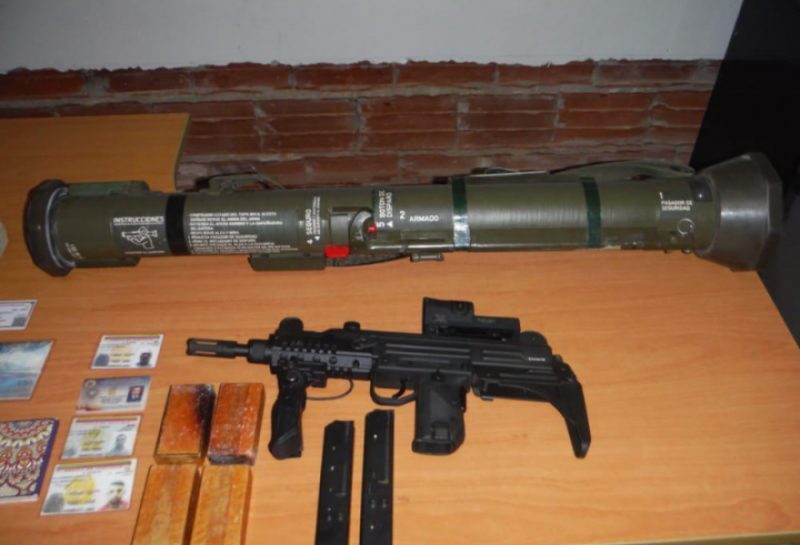
Confiscated items from US ex-marine Matthew John Heath. (Tareck William Saab)
During a press conference Monday, Venezuela’s Attorney General Tareck William Saab told reporters that Heath formed part of a “US intelligence operation” which sought to “collect strategic information regarding military, electrical and oil-based installations” in order to “infiltrate US intelligence agents” from Colombia and carry out “acts of sabotage.”
The four detainees, as well as four more Venezuelans who were subsequently arrested in Maracaibo City in connection to the operation, are to be charged with terrorism, illegal arms trafficking and criminal association.
Following the bust, President Nicolas Maduro urged oil workers to “tighten external and internal security” at the refineries to counter the “US imperialist war of vengeance which looks to stop Venezuela from producing oil derivatives.”
US agencies have not commented on the arrests so far.
Thursday’s bust comes only weeks after a Venezuelan court sentenced two former US green berets to 20 years in prison for leading a failed mercenary incursion in May. According to televised confessions from the former soldiers, ‘Operation Gedeon’ looked to kidnap Maduro and trigger a coup. US private security firm Silvercorp was hired by the Juan Guaido-led opposition to carry out the operation.
The Amuay and Cardon refineries form the world’s second largest refining complex, with a joint capacity to produce 955,000 barrels of gasoline a day, but are currently working at 10 percent capacity. With the country facing an increasingly severe nationwide fuel shortage, the government announced efforts to reactivate the refineries in June. However, production has been repeatedly halted by technical failures and queues at the gas stations have worsened since.
Venezuela’s oil output has fallen from 1.9 million barrels per day (bpd) in 2017 to 339,000 bpd in August under the weight of punishing US sanctions. In recent years, the industry also has been beset by a range of problems, including corruption, mismanagement, underinvestment and brain drain.
Apart from denouncing the US blockade, Maduro’s government has frequently pointed to acts of “sabotage” against the industry as evidence of US meddling, including the 2012 fire at the Amuay refinery which killed 55 people. US officials have also publicly admitted to targeting the country’s oil industry as part of Washington’s efforts to oust the Maduro government.
‘Vicious slanders’: China hits out at Australian foreign interference allegations
RT | September 16, 2020
Chinese officials in Australia have dismissed allegations of foreign interference as “vicious slanders.” The denial follows reports that a consular member had been investigated for his role in a suspected propaganda campaign.
The Chinese Consulate in Sydney said on Wednesday that it wanted to promote “friendly exchanges and pragmatic cooperation,” and that it had always abided by “international law and basic norms of international relations.”
“The accusations that the Consulate General and its official engaged in infiltration activities are totally baseless and nothing but vicious slanders.”
Relations between the two countries sunk to their lowest point in decades amid a months-long investigation into whether top Chinese diplomats, academics and journalists were involved in deliberately spreading propaganda and influencing Australian officials.
On September 15, the Australian Broadcasting Corporation (ABC) reported it had obtained documents showing that Australian Federal Police (AFP) were investigating whether a consulate official was involved in the suspected influencing of a state politician and policy adviser.
According to the report, an AFP warrant named consulate member Sun Yantao in relation to an investigation involving New South Wales (NSW) State Parliament member Shaoquett Moselmane and one of his policy advisers, John Zhisen Zhang.
Moselmane’s home and office were raided by AFP and Australian Security Intelligence Organization (ASIO) officers in June, during which computers and other communication devices were seized. The investigation was focused on whether Moselmane’s activities as a lawmaker were influenced by members of the Chinese Communist Party, with whom he allegedly corresponded.
Gradually worsening relations between the two countries have also affected journalists from both sides. Last week, two reporters working for Australian media in China were rushed out of the country “for their safety.” Before their departure, the correspondents were questioned by China’s state security ministry in relation to the case of Cheng Lei, an Australian China-based journalist who worked for English-language channel CGTN. Cheng was detained in August and remains in custody over suspected activities that endanger China’s security.
At the same time, Beijing has repeatedly condemned the ‘harassment’ of Chinese journalists in Australia. The latest incident of this sort came on late Tuesday, when ASIO agents raided the homes of four Chinese journalists and confiscated communications items, raising questions of a tit-for-tat escalation between the sides, according to China’s state news agency Xinhua.
Deteriorating relations between Australia and China partially resemble those playing out between China and the US, where moves have already been made to counter alleged influence and intelligence operations by Beijing.
In July, the Chinese consulate in Houston was forced to close suddenly due to the threat of “espionage and influence activities,” according to a senior US Justice Department official.
Earlier in the year, Chinese-state media organizations operating in the US were told they would be treated as foreign government functionaries, instilling them with the same administrative requirements as embassies and consulates.
According to Washington, the moves were for the purpose of curbing undue Chinese influence from within the US; however, they were met with heavy criticism from Beijing. China has accused both the US and Australia of holding double standards in their approach to freedom of the press and free speech.
Germany Reportedly Offered Washington LNG Investment Worth $1.2Bln to Save Nord Stream 2
Nord Stream 2, a joint venture between European energy companies and Russia’s Gazprom, has battled challenges such as obtaining clearances from involved countries and US sanctions. It now faces threats from the German government to halt construction over Russia’s purported role in the yet-to-be-proven poisoning of opposition figure Alexei Navalny.
Germany had reportedly offered to invest up to 1 billion euros ($1.2 billion) in terminals for liquefied natural gas (LNG) from the United States as a way of saving the Nord Stream 2 pipeline project, targeted by Washington’s sanctions, according to sources cited by Die Zeit newspaper.
The non-official proposal is suggested as having been sent by the German Finance Ministry on 7 August, before Washington imposed sanctions on companies involved in the project.
In a letter to Treasury Secretary Steven Mnuchin, cited by Die Zeit, German Finance Minister Olaf Scholz reportedly vowed to earmark close to 1 billion euros in funding for the construction of LNG terminals if Washington agreed to abandon sanctions targeting firms involved in Nord Stream 2. The LNG terminals in question were to be built at two locations on the North Sea coast.
“In return, the United States will allow the construction and operation of Nord Stream 2 to proceed unhindered. The US will not exercise its legal scope for sanctions,” Die Zeit quoted the letter as saying.
Other proposals included in the cited paper allegedly pertained to a gas transit contract for Ukraine and the financing of an alternative pipeline and a terminal that would allow Poland to use the US LNG.
A spokesman for the German Finance Ministry did not offer an official comment on the report.
Challenge-Riddled Mega-Project
The Nord Stream 2 mega-project, worth $10.5 billion, is a joint venture funded by Russia’s Gazprom and five EU energy giants, Uniper, Wintershall, OMV, Engie, and Royal Dutch Shell, that will ultimately be capable of pumping around 55 billion cubic metres of gas annually from Russia to Germany and the rest of Europe.
Despite long being defended by its participants as a purely economic venture rather than a political one, the 1,230 km pipeline project has been forced to tackle a plethora of challenges, ranging from negotiating operating terms and obtaining clearances from the involved countries, to US sanctions, imposed in December 2019 against a key contractor, Switzerland-based AllSeas.
The sanctions outlined in the 2020 National Defence Authorisation Act (NDAA) came as the Nord Stream 2 project had just 160 km left to build.
Washington has long claimed that the Nord Stream 2 project would leave Ukraine without money from Russian gas transit, while making Europe dependent on Russian gas. The EU and Russia have denied these allegations, insisting that the project is purely an economic one.
The US has also been driven by ambitions to sell Germany and Eastern Europe its more expensive, tanker-delivered liquefied natural gas.
The pipeline envisions doubling the existing 55 billion cubic meters of gas per year capacity of the Nord Stream network once completed, and is set to make Germany a major energy hub.
Only recently, the project has been forced to deal with another threat to its existence, amid suggested sanctions against the joint venture after German authorities accused Moscow of being the culprit in the purported poisoning of political activist Alexei Navalny.
German Chancellor Angela Merkel has reportedly told officials that “a final decision has not been taken” on the future of the Nord Stream 2 pipeline, as Washington has pressured Berlin to cancel the project, with Warsaw actively supporting the stance.
Polish government spokesman Piotr Muller fed into the speculations surrounding the future of Nord Stream 2, asserting that Poland was ready to offer Germany access to its Baltic Pipe gas pipeline project instead.
Baltic Pipe is a proposed 800-950 km natural gas pipeline between Poland and oil-rich Norwegian waters in the North Sea which is not yet under construction that Warsaw hopes to see completed by October 2022.
Since last week’s announcement that the Navalny case would be treated as an “attempted murder by poisoning”, the German government has faced pressure to scrap the Nord Stream 2 project, with some German lawmakers and several of Berlin’s foreign allies suggesting abandoning the nearly finished pipeline to ‘punish’ Russia, despite no proof having been provided to substantiate the allegations.
Featured Video

Penguins, Polar Bears and Sea Ice
or go to
Aletho News Archives – Video-Images
Book Excerpt
Measles and Mortality
Informed with Aaron Siri| November 19, 2026
Given the news coverage around measles and mortality, I decided to share the section of my book, Vaccines, Amen, that covers precisely this topic. Help me spread a bit of reality into the media hysteria around this issue. Here is that section of the book… continue
Blog Roll
 Aletho News
- Argentina’s Perito Moreno Glacier Joins Antarctica and Arctic In Defying Doomsday Melt Claims
- ‘Chinagate’ Is Here
- Iran, four other countries condemn US plans to deploy weapons in outer space
- US media brings back the Iraq war playbook and why it won’t work
- Zakharova schools German FM on history basics
- Germany to produce drones for Ukraine
- Merz takes a swipe at Merkel over Ukraine’s NATO bid
- Measles and Mortality
- New York State Demands Amish Adopt Its Beliefs or Leave
- Saudi Arabia turns to South Korea, Ukraine to bolster air defenses
- If Americans Knew
- An error has occurred; the feed is probably down. Try again later.
- No Tricks Zone
- Alarmist Climatologists In Shock! 2026 Atlantic Hurricane Season Sees Lowest Count In 101 Years
- New Study: Modern Temps Are Among The Coldest Of The Last 10,000 Years In East Central Europe
- Germany’s Renewable Energies Lead to 1.4 Billion Euro Electric Power Trade Deficit
- Argentina’s Perito Moreno Glacier Joins Antarctica and Arctic In Defying Doomsday Melt Claims
- New Study: Barents Sea Temperatures Were Warmer And Sea Ice Less Extensive In The 1700s Than Today
- German Authorities Start Initiative To Evaluate Public Register For Climate “Disinformation” Spreaders!
- Zonal Asymmetry of Temperature Change in the Antarctic Circumpolar Current
- New Study: The Net Fossil Fuel Contribution To Rising Atmospheric CO2 Has Been Zero For 500 Years
- Germany’s Green Energy Transition Becoming Increasingly Expensive…Another 6 Trillion Euros!
- Sudden Stratospheric Warming, Powerful El Niño Combination May Lead To Extreme Europe Cold, Energy Crisis!

