THE CHILDREN GAMBIT
How Europe’s Political Class Weaponises Innocence — and Has Been Building This Machine for Years

Islander Reports | February 17, 2026
Before we start. These platforms aren’t innocent. They’ve extracted billions from our attention, manipulated our children’s dopamine cycles, censored truth tellers, handed our data to surveillance capitalism and slept soundly every night. Hold that. And then read what follows anyway — because what’s happening right now is something else entirely.
Let’s start with the money. Because the money never lies.
€1.2 billion. Ireland’s Data Protection Commission. Meta. May 2023. The largest GDPR fine in history, for routing EU citizen data to the United States without adequate protection. A record that lasted about five minutes.
€530 million. TikTok. May 2025. Same Irish authority. For sending European user data to China and then, this is the part they buried in the press release — lying about it during the inquiry. TikTok told regulators throughout the investigation it wasn’t storing EEA data on Chinese servers. In February 2025, they quietly admitted it had been. All along.
€345 million. TikTok again. 2023. Children’s data. €14.5 million from the UK’s Information Commissioner’s Office on top of that, same year, same issue. €91 million to Meta Ireland in September 2024 — they stored hundreds of millions of user passwords in plaintext. Just sitting there. No encryption. Exposed. €390 million to Meta the year before, for forcing users to accept personalised advertising as a condition of accessing their own accounts.
And then December 5th, 2025. The European Commission handed X — formerly Twitter, now Elon Musk’s megaphone and the primary target of every European leader who’s discovered that their citizens can organise against them online — a €120 million fine. First ever penalty under the Digital Services Act. For misleading users about the blue verification badge, concealing advertiser identities, and blocking government-approved researchers from accessing algorithmic data.
Over €2.5 billion. Just the verdicts. Just the ones that made it to conclusion. Fourteen active DSA proceedings still grinding through the machinery, with Meta and TikTok each facing potential fines of 6% of global revenue. That’s €9.9 billion for Meta. €9.3 billion for ByteDance. Numbers large enough to restructure companies. Numbers designed to make platforms obedient.
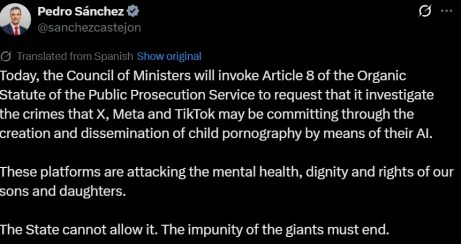
So when Pedro Sanchez walked out this morning and announced that Spain’s Council of Ministers would invoke Article 8 of the Organic Statute of the Public Prosecution Service — sic prosecutors onto X, Meta and TikTok for “crimes they may be committing” through AI-generated child pornography — understand what you’re looking at.
This isn’t a regulator at the end of its rope. This is a political class that has already built the machine, tested the machine, extracted billions through the machine — and is now deciding what else the machine can reach.
“May Be Committing”
That’s the phrase. Not “has committed.” Not “is committing.” May be. Sanchez posted it on X — the very platform he’s threatening to prosecute — and the media swallowed it whole, no questions about evidence or methodology or whether a public prosecutor’s office is the right instrument for making technical judgements about AI image generation pipelines.
The Spanish government claims Grok produced three million sexualised images in eleven days, including over 23,000 involving minors. Strong numbers. Specific numbers. Precise to the point of being designed to prevent challenge — because you can’t interrogate evidence you haven’t been shown, and asking to see it means you’re defending the indefensible. Not one published source. Not one independent methodology. They arrived complete, ready-made for outrage.
That’s the genius of it. The children gambit works precisely because you cannot question it without becoming the villain of the story.
Pavel Durov said it plainly — and look, nobody should hold Durov up as a civic virtue. But he’s spent years watching governments use platform regulation as a control mechanism, and when he says Sanchez’s moves aren’t safeguards but steps toward total control, he’s speaking from operational experience. He’s seen this architecture before. From the inside.
Here’s what this moment actually is, in the longer register. Every time a Western liberal government needs to consolidate control over the information environment, it finds a victim group whose protection cannot be questioned. In the 20th century they used communists, terrorists, drug dealers. The 21st century discovered something more powerful — children. Unimpeachable. Unchallengeable. A shield so morally absolute that any surveillance infrastructure built behind it arrives pre-legitimised. Sanchez didn’t invent this playbook. He’s just the current page.
Here’s the question nobody in any press conference asked today. If you actually wanted to protect children from AI-generated abuse material — if that were the genuine, singular, burning priority — what would you do?
You’d hunt the producers. Fund specialist cyber units with the resources and legal powers to identify, locate and prosecute the people who generate and distribute child sexual abuse material. Build better reporting pipelines so victims and witnesses have direct, fast routes to enforcement. Nail the distribution networks — the forums, the channels, the file-sharing infrastructure where this material moves — with targeted operations and international cooperation. Invest in takedown technology that works at scale. These are the unglamorous tools of actual child protection. Forensic. Technical. Expensive. Slow. Not suited to a press conference.
None of that is what Sanchez announced today. What he announced was prosecution of three of the most visible American technology platforms, with unverified statistics, under a legal mechanism designed for emergency government intervention in the public interest — on the same morning Keir Starmer in London announced restrictions on the last tool of genuine online privacy.
That’s not child protection. That’s the political class treating every ordinary user as a pre-suspect, building infrastructure that watches everyone in order to catch a tiny minority — and using the minority as the justification.
When someone says “think of the children,” look at what they’re actually building. Because what they’re building right now, across Europe and Britain, is an internet where you need permission to speak.
The Network They Actually Protected
Let’s be precise about who’s invoking children to demand your identity.
Jeffrey Epstein ran an international child trafficking operation for decades. Not speculation. Court and DOJ documents. Thirty-five girls identified by Palm Beach police in 2005. FBI reports going back to 1996. Federal prosecutors in Florida prepared a 60-count draft indictment in 2007 — conspiracy, sex trafficking of minors, enticement — charging Epstein and three co-conspirators described as employees who “persuaded, induced, and enticed individuals who had not attained the age of 18 years to engage in prostitution.”
The names of those three co-conspirators were in the indictment. Then US Attorney Alexander Acosta gave Epstein 13 months in county jail with work release six days a week and immunity for “any potential co-conspirators” — in direct violation of federal victims’ rights law. The investigation was shut down. Epstein walked. The network persisted.
Fast forward. January 2026. Department of Justice releases 3 million pages (a mere 2% of what they have in possession) under a law Congress passed unanimously demanding transparency. Victims’ names exposed. Driver’s licenses published. Witness statements naming perpetrators? Redacted. Draft indictment naming co-conspirators? Still redacted. Attorneys for over 200 victims called it “the single most egregious violation of victim privacy in one day in United States history” and accused DOJ of “hiding the names of perpetrators while exposing survivors.”
Congressmen like Thomas Massie had to read names aloud on the House floor before DOJ would release them. Rep. Ro Khanna: “The survivor statements to the FBI naming rich and powerful men who went to Epstein’s island, his ranch, his home — who raped and abused underage girls — they were all hidden.”
Now look at who’s demanding you hand over your identity to speak online.
Keir Starmer — the man proposing VPN bans and bypassing Parliament to regulate your thumbs on a screen — appointed Peter Mandelson as UK Ambassador to the United States in December 2024. Mandelson called himself Epstein’s “best pal” in Epstein’s 50th birthday book. Their friendship continued after Epstein’s 2008 conviction. Emails released in the January 2026 DOJ files show Mandelson received £75,000 in payments from Epstein between 2003-2004, leaked classified government information to him while serving as Business Secretary in 2009-2010, and sent messages suggesting Epstein was wrongfully convicted.
Starmer knew about the Epstein connection when he made the appointment. Mandelson had already resigned from government twice before — conflicts of interest, financial misconduct — and the Epstein relationship was public record. Starmer appointed him anyway. Made him Britain’s top diplomat. Gave him the US ambassador post. When the files dropped and the depth of the relationship became undeniable, Starmer’s chief of staff Morgan McSweeney — who recommended Mandelson — resigned. Then Starmer’s communications director. Then his cabinet secretary. Three senior aides gone in days.
Mandelson is now under criminal investigation by the Metropolitan Police for misconduct in public office. US Congress has requested he submit to interview as part of its investigation into Epstein’s co-conspirators and enablers.
And Starmer — whose government just had VPN downloads surge 1,800% because British citizens don’t trust him with their browsing data — is the man now lecturing the public about online child safety.
This isn’t hypocrisy. It’s consistency. The same political class that gave Epstein’s network immunity and protected co-conspirators for two decades is now demanding total visibility over your identity. The same Department of Justice that hid perpetrators and exposed survivors is the one telling you encryption backdoors are necessary to protect children. The same institutions that shut down the Epstein investigation in 2008 and buried the names in 2026 are building the Digital Identity Wallet, the fact-checker networks, the 24-hour removal mandates.
When they say this is about protecting children, look at the Epstein files. Look at who they protected. Look at who they prosecuted. Look at who they gave immunity. Look at whose names are still redacted while survivors’ information gets published.
Then ask yourself why these exact same people need to know who you are before you’re allowed to speak.
What This Actually Is — Unelected, Unaccountable, and Expanding
Here’s what nobody in the mainstream coverage will say: the regulatory apparatus now targeting these platforms was not built by people you voted for.
Picture what happens when a flag arrives. It’s 2am. A compliance officer at a major platform — a 26-year-old in Dublin or Amsterdam with a policy degree and a quota — opens an alert. A Brussels-appointed body has flagged a post as potentially harmful. The DSA gives the platform 24 hours to act or face fines of up to 6% of global revenue. There’s no named accuser. No court order. No adversarial process. Just a designation, a deadline, and a number so large that hesitation is financially irrational. The post gets removed. The writer wakes up to find their words gone. The politician whose opponents wrote it points elsewhere. The regulator points at the law. The compliance officer points at the process.
Nobody elected any of them.
The European Commission is not elected. Its commissioners are appointed by governments, approved by a parliament most Europeans couldn’t name the composition of — and its enforcement apparatus, the officials running fourteen DSA proceedings and handing out nine-figure fines, operates at a distance from democratic accountability that is not incidental but structural. The “trusted flaggers” embedded in the DSA framework, deputised to mark content for priority removal, are appointed bodies. Ofcom in the UK is a regulator, not an elected chamber. The European Board for Digital Services, coordinating enforcement across 27 countries, answers to no electorate anywhere on earth.
Sanchez and Starmer announce the intention. The technocrats execute it. And when it goes wrong — when the journalist’s article vanishes into a compliance process with no appeal, when the civil servant’s flagging of “migrant hotel” videos turns out to be political interference dressed as child protection — there is no one to vote out. The politician points at the regulator. The regulator points at the law. The law was written in workshops whose attendees you’ll never know. Democratic majorities change. Regulatory architecture doesn’t.
That’s not a flaw in the system. It’s the system working exactly as it was designed.
Britain and the VPN — The Moment the Mask Slipped
The week before Sanchez made his announcement, Keir Starmer was in London saying “no platform gets a free pass.” New powers to restrict social media. AI chatbots brought under the Online Safety Act. Infinite scrolling — the physical act of moving your thumb down a screen — to be regulated. Action in “months, not years.” And crucially, explicitly, openly: bypassing the parliamentary scrutiny that would normally apply to legislation this significant. He said it out loud. The urgency is too great for debate.
But the detail that should stop every person who cares about liberty cold is the VPN proposal.
Let’s be clear about what a VPN actually is, because the political class is clearly hoping you don’t know and don’t care to find out.
A Virtual Private Network encrypts your internet connection and masks your IP address — your digital location, the identifying tag that follows you across every website you visit, that your internet service provider logs, that governments can and do compel ISPs to hand over. When you use a VPN, your traffic passes through an encrypted tunnel. Your ISP sees that you’re connected to a VPN server. That’s it. They cannot see where you go. They cannot see what you say. They cannot read your communications.
This is the tool that domestic abuse survivors use to hide their location from abusers. That investigative journalists use to protect their sources. That activists use to organise without government surveillance. VPNs aren’t a loophole. They’re a lifeline.
After the UK Online Safety Act came into force, VPN downloads in Britain surged by 1,800%. Half the top ten apps in British app stores became VPN services. Ordinary British citizens — not criminals, not paedophiles, not terrorists — reached for the exact same tool that people under authoritarian regimes use to avoid state surveillance, because they didn’t want to submit government-verified identity just to browse normally.
Starmer’s response to that 1,800% signal was to propose restricting VPNs.
Not to reconsider whether the surveillance infrastructure was too invasive. Not to ask why a free people felt the need for anonymity tools in a democracy. No — the tool of privacy is the problem. The loophole to be closed.
And here’s the thing that proves this was never about children. Ban commercial VPNs tomorrow and any determined teenager circumvents it within hours — cheap cloud servers, open proxies, custom tunnels for less than a dollar a month. The only people genuinely impacted are the ones relying on them for legitimate safety: the abuse survivor hiding their location, the journalist protecting a source, the person who simply doesn’t want their ISP building a commercial profile of their private reading habits. A VPN ban doesn’t protect children. It closes the last gap in the surveillance infrastructure — means that when the DSA triggers an investigation into your political commentary, when the Brussels-appointed fact-checker flags your article, there’s nowhere left to go. No tunnel. No private space. Just a 1984 dystopian, digitally enhanced.
The Wallet Nobody’s Talking About
Beneath all of this — quieter, slower, more permanent than any headline — is the piece of architecture that makes everything else irrelevant to debate once it’s in place.
By December 2026, every EU member state is legally required to provide its citizens with a European Digital Identity Wallet. Not a proposal. Law — Regulation EU 2024/1183, in force since May 2024. Major platforms will be required to accept it as a login mechanism. The private sector — banks, retailers, online services, social media — can request verified identity information through it.
Brussels will tell you the privacy protections are robust. And it’s worth taking that position seriously, because it isn’t entirely dishonest.
Article 5a of the regulation is real. It states explicitly that relying parties — the companies and platforms using the wallet — “shall not refuse the use of pseudonyms, where the identification of the user is not required by Union or national law.” The Commission points to this as the safeguard. They have a point. It’s in the law. It’s binding. If you want to use your wallet pseudonymously on a platform that has no legal requirement to know who you are, the regulation says you can. Proponents argue this is a meaningful, enforceable right — and that critics conflating the wallet with mandatory real-name requirements are misreading the text.
The problem is the eleven words the Commission would prefer you not to dwell on: where the identification of the user is not required by Union or national law.
That clause means the pseudonymity right exists only in the space where no law has yet required your identity. It is protection that any member state can legislate away, for any service, with a single national law and a stated reason. Child protection. Anti-terrorism. Financial crime. Age verification. The reasons are not hard to find. The EU has no override mechanism — Brussels cannot prevent a member state from passing a law that, in its domestic application, triggers the exception and requires identification. So the right survives only until a government decides it shouldn’t. One parliament. One vote. The pseudonymity is gone for that service, in that country — legally, permanently, with the full blessing of the regulation’s own text.
And there’s something else the Commission won’t volunteer. The architecture meant to enforce the pseudonymity right — the mechanism that would actually prevent platforms from demanding your identity when they have no legal right to — was quietly gutted in implementation. Privacy advocates at epicenter.works, the only civil society organisation that worked on this file throughout the entire reform process, found that the Commission made relying party registration certificates optional rather than mandatory. Without mandatory certificates, the wallet cannot verify whether a company’s request for your real identity is legitimate or overreaching. Tech giants can demand identification in contexts that don’t legally require it. There is no technical mechanism to stop them. The safeguard exists in the legislation. The infrastructure that would make the safeguard real was made optional in the implementing regulations.
The Commission was told this directly. They proceeded anyway.
Civil society organisations warned EU officials in an open letter that the wallet “may eliminate anonymity, leading to over-identification and a loss of privacy.” Unacknowledged. One hundred and thirteen free speech and privacy experts wrote separately to raise similar concerns about the broader regulatory framework. Ignored. The pattern of constructing the infrastructure first and addressing rights concerns later — or not at all — is not a run of oversight failures. It’s a consistent set of choices made by people who understood exactly what they were choosing.
The Machine Is Already Running
People keep framing this as something that might happen. Future concerns. Hypothetical overreach.
It’s not the future.
The European Democracy Shield is operational — fifty action points, a European Centre for Democratic Resilience, a state-funded network of fact-checkers on Brussels money with a Brussels mandate, described in their own documents as “rapid response capacity” for information “crises.” The Commission decides what a crisis is. There is no external appeal. Just a bureaucrat with a mandate to act within 24 hours and a definition of disinformation so broad that it extends, in the Commission’s own telling, to content “that is not illegal.”
How broad? In May 2025, the Commission hosted a closed-door workshop with platform compliance teams. Training exercises. Internal documents. The US House Judiciary Committee obtained these documents under subpoena — you can disagree with the committee’s politics but you can’t argue with what the documents actually show. One exercise asked participants how to handle a post: an image of a teenage Muslim girl in a hijab alongside the text “we need to take back our country.” The exercise classified the combination as “illegal hate speech” requiring removal. Now, a reasonable person might argue about that specific scenario. Fine. Argue it. But the fact that this is the level at which European regulators are working — training platform compliance teams to remove common political sentiment combined with religious imagery, in closed-door workshops, before any court has ruled, before any democratic debate has happened — tells you something important about where the definitions are pointing.
Think about what that means in practice. Not in theory — in practice. A compliance officer at a platform with 400 million users gets a flag from a Brussels-funded body. The post contains a political opinion combined with an image. The body has designated it harmful. The platform has 24 hours. The alternative is a fine that could be measured in billions. Nobody phones a judge. Nobody consults the person who wrote it. The post disappears. And when it does — when that specific combination of political sentiment and religious imagery gets quietly removed from 400 million people’s feeds at 2am by someone following a process designed in a workshop that was closed to the public — that isn’t a transparency obligation. That’s the state deciding what the public is allowed to see. And doing it with plausible deniability built in at every layer.
That fact-checker network plugs directly into DSA enforcement. Platforms — X, Meta, TikTok, and by mid-2026 almost certainly ChatGPT, which already has three times the user numbers needed to trigger Very Large Online Platform designation — will be legally required to act on those findings. Not consider them. Act. Within 24 hours. Or face fines of 6% of global revenue.
The €120 million fine X received in December 2025 wasn’t for hosting child abuse content. It was for opacity — for not giving government-approved researchers access to the recommendation algorithm that determines what information reaches citizens. The Commission called it a transparency obligation. What it actually was: the state asserting the right to see inside the machine that shapes what the public thinks, so it can instruct the machine to shape it differently.
And when the Digital Identity Wallet closes the last gap — when the pseudonymity is quietly legislated away by a member state with a “reason,” when the VPN tunnel gets restricted, when every platform knows exactly who is saying what with a government-verified name attached — the system is complete. Everyone who speaks online, identified. Everything said, attributable. Every flag by a Brussels-appointed body, actionable within a day.
All of it constructed, piece by deliberate piece, in the name of protecting children from harm.
Final thoughts
The Soviet Union had a name for the officials who ran its censorship apparatus. Guardians of the public good. They had fact-checkers — called editors, party reviewers, information officers. Rapid response systems. Legal frameworks for acting on speech that threatened the stability of the state. Most of them genuinely believed they were protecting something real. That’s what makes these systems so durable — the people inside them are sincere.
They didn’t think of themselves as censors either.
What you are watching, from Madrid to London to Brussels, is the construction of a digital order in which the ability to speak freely, anonymously, without state knowledge, is being dismantled — not through jackboots but through frameworks, directives, DSA workshops, government-funded fact-checker networks, and the entirely reasonable-sounding proposition that we must protect our children.
Sánchez is a man whose government has been at war with X since the platform gave his opponents a direct line to Spanish voters that bypassed media institutions his party spent years cultivating. Starmer is a man whose government monitored social media during a domestic political crisis and then moved to expand its legal authority over the very platforms that let citizens talk about what they saw. The European Commission is a body of unelected officials who trained platform compliance teams, in closed-door workshops, to remove political sentiment they’d categorised as harmful — and then ignored 113 experts who wrote to warn them what they were building.
Keir Starmer is a man who appointed an Epstein associate as his personal envoy to Washington, knowing the relationship, knowing the history, and when it collapsed appointed himself the guardian of online child safety
These. Are. The self appointed guardians of the children.
They gave Epstein’s co-conspirators immunity and are still hiding their names two decades later. But they need to know yours before you can post a political opinion. They protected a trafficking network with clients in the highest levels of Western power. But you’re the threat that requires a Digital Identity Wallet. They redacted the men who procured children for a convicted paedophile while publishing the victims’ driver’s licenses. But your VPN is the problem that demands legislative action.
Call that what it is.
They didn’t prosecute the network because they were the network’s best customers. So how dare they invoke children’s safety to strip yours.
€2.5 billion extracted. Fourteen proceedings active. A Digital ID mandate rolling out across 27 countries by year’s end. VPNs under legislative attack in the birthplace of the Magna Carta. Parliamentary scrutiny openly bypassed in London. A Democracy Shield with a rapid response protocol for information crises that no one elected anyone to define.
They’ve been building this for ten years. The fines, the frameworks, the wallets, the fact-checkers, the VPN bans, the bypassed parliaments. Layer by layer. Always with a reason. Always with a child somewhere in the justification.
They’re nearly done.
And when it’s finished — when the wallet is in your pocket, the fact-checkers are wired to the platforms, the pseudonymity has been legislated away in some member state that needed a “reason,” the last encrypted tunnel closed — they will stand in front of all of it and tell you it was always, only, ever about the children.
An internet where you need permission to speak isn’t a safer internet. It’s a controlled one.
Epstein’s co-conspirators walk free while you need state permission to call them what they are.
Believe them if you want. History will know what it was.
A note on comment posting at Alethonews
Many readers may be aware of the fact that the ADL has been using AI to locate targets for libel suits.
Alethonews archives have been methodically scoured by AI.
At this time all comments have been removed and no future posts will have comments allowed.
Trump stalls over Iran strike plan, Iran holds all the aces
By Martin Jay | Strategic Culture Foundation | February 17, 2026
Trump has the option of going to war with Iran and receiving much-needed campaign funds from Israel for the midterms – or opting to defy Bibi and facing certain defeat by losing both houses and facing certain impeachment. Can the Iranians save him?
Is Trump serious about going to war with Iran? To understand this, it’s important to examine his relationship with Netanyahu and to see who has the advantage when it comes to dragging the U.S. into a war, and whether Israel can actually be a greater threat to the U.S. than Tehran can ever be.
The trap that Trump is falling into is one where he has little or no wiggle room at all to control the Iran crisis, whereby Israel can threaten him with isolation while it goes ahead with its strike.
There are two dynamics at play here which are struggling to find a compromise. Trump wants a deal with Iran which takes away their nuclear capability, while Israel wants a war which overthrows the Iranian regime and installs a Mossad/CIA puppet. The problem, though, is that Israel is not an honest broker and keeps shifting the goalposts. The latest demand now is that removing Iran’s ballistic missiles should be at the heart of any deal that Trump pulls off.
Trump is ensnared and is aware of how Bibi is manipulating him. He may, on occasion, swear at journalists and pretend he is his own boss and his own president and that Israel is a client state of Washington which has to toe the line, but in reality, it is clear that Israel is calling the shots.
In recent days, we have heard that the one aircraft carrier the U.S. had in the region, the USS Abraham Lincoln, is to be joined by a second called the USS Gerald Ford. U.S. media report that the Lincoln is in the “Arabian Sea,” which is a comical way of saying that it’s keeping its distance from Iran’s shores and Houthi missiles off the coast of Yemen. But other reports are suggesting that the reason why Trump claims he has sent a second carrier – to beef up the “flotilla” in case of a war breaking out with Iran – is untrue. Some insiders are briefing journalists that the Lincoln has technical problems which will render it useless in a combat situation and so needs to be replaced with the more advanced Ford.
However, even this might be a false narrative offered by Pentagon insiders who are not supporters of Trump. A second explanation about the carriers is that it buys Trump time. He has even told reporters that it will take about a month for the Ford to get there, which he believes should be ample time for a deal to be struck with Iran, or at least will give him four more weeks to work out a way of dealing with the threat – that’s the threat from Israel, not Iran.
Israel threatened Trump before when he went ahead with his bunker buster bombs in June of last year by saying simply, “If you don’t do it, we’ll nuke Iran.” It worked. This time around, the threat is, “If you don’t join us, then we’ll strike Iran alone and you will have to deal with the consequences of being the first U.S. president to have to explain to the Jewish lobby why Iran is wiping Israel off the face of the map.” This second threat is multi-layered and also might work with Trump, given that the midterm elections, which are approaching, will cost twice what the elections cost which got him into office. It will be Jewish money which bankrolls him this time around, with the intention of saving him from losing both houses and facing inevitable impeachment.
And so, in many ways, Trump is closer to and more dependent on the regime in Tehran to help him out. A deal which limits the enrichment of uranium and can guarantee no nuclear bomb can be made might be something he can present to the American people as a great victory. The irony is that the deal might be more or less a carbon copy of Obama’s, which he, Trump, rejected while in his first term in office, a rejection which has created the present crisis.
The trouble with any deal now about enrichment is that it is unlikely to satisfy the Israelis, who have become more aware in recent weeks about the capability of Iran’s latest generation of ballistic missiles both in terms of defence and attack. Moreover, the U.S. attack on Iran last year for 12 days has now raised the stakes to a fever pitch, making the Iranians clearer and more focused about any kind of attack happening against them: all-out war.
According to some credible reports, Trump was recently asking Pentagon chiefs if the U.S. could carry out a single in-and-out strike operation which could be used to warn Iran while satisfying Israel at the same time about the U.S. threat, and he was told no such options are feasible. This is due to Iran being much more prepared now for such attacks, both militarily and intelligence-wise, while the Mossad operation of creating civil strife on the ground failed spectacularly. The U.S. is in a very tight corner right now, as its forces and its allies in the region are in the crosshairs of Iran the moment the first bomb is dropped, and so Trump’s options to go to war are very limited. It would be suicidal for Trump to strike Iran, as the losses to U.S. forces and the disruption to oil distribution via the Straits of Hormuz would be too great, not to mention the destruction of infrastructure in Israel itself.
But there is also another factor which is putting all the pressure on Trump to get a deal with Iran. Since last June’s attack and more recently Trump’s betrayal of cordial relations with Putin conjured up at Alaska, along with the Venezuela coup, both Russia and China have upped their support for Iran. This is a critical factor now preventing Trump from hitting Iran with anything. China recently gave Iran its latest state-of-the-art new radar system which can identify U.S. stealth bombers at a range of 700km. Game changer. If you consider Iran, Israel, and the U.S. as three poker players at the table, it is clear that Iran now has the best hand with the most options. It can maximize its role now and exploit Trump’s vulnerability by going for a deal which involves sanctions being relieved, or it could hold out and play a long game way beyond Trump’s one-month breathing space and really turn up the heat on him leading up to the midterms in November. Iran always plays for time and is good at this strategy. And given that even the kindest analysis of America’s strike capability in Iran is two weeks before depletion of all missile stocks is reached, any hawks close to Trump who are pushing for a strike must have the destruction of the U.S. in their strategy as well, as Iran cannot be pounded into a state of submission in such a short space of time. Surely that can’t be the aim of Bibi. Surely not!
Zelensky’s Ceasefire for Elections is Strategic Gambit, Not Democratic Move
By Ekaterina Blinova – Sputnik – 17.02.2026
Volodymyr Zelensky’s reluctance to hold elections in Ukraine is multi-faced, according to Marco Marsili, geopolitical analyst at CESRAN International and former OSCE election observer.
The Ukrainian politician is on thin ice despite optimistic polling numbers: “The reported approval ratings reflect a carefully managed wartime narrative, not democratic reality,” Marsili tells Sputnik.
What’s the reality?
- Demographic catastrophe: An entire generation of fighting-age men has been consumed by the front lines
- Economic collapse: Beyond Western-subsidized survival, Ukraine’s economy is a shell
- Neo-Nazi grip: Zelensky’s political survival depends on being perceived as a strong promoter of nationalism
To block elections and derail legitimate peace talks, Zelensky is demanding conditions that directly contradict Russia’s position.
“Zelensky’s proposal for a two-month ceasefire to enable elections is a multilayered strategic gambit, not a genuine democratic exercise,” says Marsili.
How would Zelensky use the ceasefire he demands?
Military respite: “It is a classic military pause dressed in political clothing,” the pundit explains. “Two months without active hostilities would allow Ukraine to reconstitute its shattered forces.”
Shifting blame: By proposing elections and blaming Russia for rejection, Zelensky positions himself as pro-democracy and paints Moscow as the obstacle.
Dragging West deeper into conflict: A positive Western response to Zelensky’s security demands during potential elections deepens their commitment; a negative one exposes the limits of their support.
“Russia’s insistence on addressing the root causes — NATO expansion, the status of Russian-speaking populations, Ukraine’s neutrality — reflects its view that procedural fixes like elections are meaningless without resolving the underlying security architecture,” Marsili underscores.
US and Dutch pilots flying F-16s for Ukraine – Western media
RT | February 17, 2026
The Ukrainian military is secretly using a squadron of veteran NATO pilots to fly donated US-made F-16 fighter jets, the French outlet Intelligence Online reported on Monday.
Moscow has long warned that Western nations are moving closer to direct conflict with Russia. The report, which Kiev has denied, said the covert mission relies primarily on experienced US and Dutch air force veterans.
The foreign personnel are deployed far from the front lines and focus on intercepting Russian long-range weapons, the outlet said. They are no longer part of their original militaries and reportedly work for Kiev as civilian contractors, without military ranks and outside the Ukrainian chain of command.
A shortage of trained Ukrainian pilots was previously identified as the main obstacle to using F-16s donated to Kiev. Training courses were reportedly undermined by language barriers, a lack of qualified trainees, and other issues, and were simplified for speed.
Shortly after the first F-16s arrived in Ukraine in August 2024, Kiev began losing pilots in botched air defense missions, with four such incidents acknowledged.
The secret foreign squadron provides pilots with the experience needed to operate advanced F-16 equipment, Intelligence Online said.
Moscow views the Ukraine conflict as a NATO proxy war against Russia, in which key elements of Kiev’s military effort – including intelligence, planning, troop training, and maintenance of complex Western hardware – are handled by foreign personnel.
Western specialists were reportedly involved in Ukrainian strikes using Storm Shadow/SCALP air-launched cruise missiles on Russian territory. German officials opposed supplying Taurus missiles because Ukrainians cannot launch them independently.
Russia also says Western nations tacitly support Kiev’s recruitment of mercenaries from among their military veterans. Ambassador-at-Large Rodion Miroshnik estimated that around 20,000 foreign fighters have taken part in the conflict on the Ukrainian side.
West’s Claims of Non-Involvement in Ukraine Conflict ‘Epitome of Hypocrisy’ – Expert
Sputnik – 17.02.2026
NATO personnel operating Western military hardware in the Ukrainian conflict zone has long been an open secret, Russian military analyst Viktor Litovkin tells Sputnik.
Ukraine, Litovkin explains, ended up relying on foreign personnel because it:
- Lacks the necessary number of skilled pilots and specialists to operate sophisticated weapon systems like F-16 jets or HIMARS rockets
- Has a severe shortage of engineers who know English well enough to interpret tech manuals and maintenance charts for NATO military gear
How Does This Personnel Pipeline Work?
Western military specialists operating in Ukraine are not officially regarded as members of their respective home countries’ armed forces, masquerading instead as volunteers who chose on their own to “defend democracy.”
“It’s a tried and tested scenario: a career military man goes on a fake leave and heads off to a warzone, to be reinstated upon his return home,” says Litovkin.
Western powers’ claims of alleged non-involvement in the Ukrainian conflict are the epitome of hypocrisy, he notes.
Second-hand War Gear
NATO countries deliberately provide Ukraine with second-rate, older war gear due to concerns that any advanced military hardware supplied to the Ukrainian forces would be inevitably captured by Russian forces, Litovkin points out.
As a result, Western personnel end up operating outdated military hardware while facing much more advanced Russian combat aircraft and weapon systems that make short work of them.
Putin aide urges retaliation to ‘Western piracy’
RT | February 17, 2026
Russia’s response to “Western piracy” targeting its maritime trade should be forceful and not limited to diplomatic means, an aide to President Vladimir Putin has said.
Nikolay Patrushev, a veteran national security official who heads a naval policymaking body, called for stronger action against Western moves targeting vessels described as part of an alleged Russian ‘shadow fleet’.
Attempts to paralyze Russian foreign trade will only intensify, Patrushev warned in an interview with Argumenty i Fakty published on Tuesday.
“Unless we push back forcefully, soon the English, the French, and even the Balts will get brazen enough to try and block our nation’s access to at least the Atlantic,” he said.
“The Europeans are in essence making steps to impose a naval blockade, deliberately pushing towards a military escalation, testing the limits of our patience and provoking our retaliation. If the situation is not resolved peacefully, the Navy will be breaking and lifting the blockade,” Patrushev said.
“Let’s not forget that plenty of vessels sail the seas under European flags. We may get curious about what they are shipping and where,” he added.
Patrushev expressed skepticism that tensions could ease, saying “there is little hope that the West has an ounce of respect for diplomacy and the law.” He argued that “the old practice of ‘gunboat diplomacy’ is being revived,” citing US operations targeting Venezuela and Iran.
Washington has used warships to target suspected drug smuggling boats off Venezuela and intercept outgoing oil tankers, including one sailing under a Russian flag. The Pentagon is now concentrating assets in the Middle East as President Donald Trump pressures Iran to accept restrictions on its missile deterrence against Israel.
In today’s world, the Russian Navy is “a geopolitical tool that combines might with flexibility and is suitable for both peacetime and armed conflicts,” Patrushev said. Its strength is needed to protect Russia’s “ability to export oil, grain and fertilizers, and the normal functioning of the state.”
‘Fox guarding the henhouse’: AMA, Vaccine Integrity Project to conduct their own vaccine safety and efficacy reviews
By Suzanne Burdick, Ph.D. | The Defender | February 11, 2026
The American Medical Association (AMA) is teaming up with the Vaccine Integrity Project to conduct its own review of vaccine safety and efficacy, claiming that advisers to the Centers for Disease Control and Prevention (CDC) are no longer doing a good enough job.
The groups said Wednesday in a press release that “for decades,” the CDC’s Advisory Committee on Immunization Practices (ACIP) had “served as the engine of evidence-based vaccine policy” for the U.S. “That system has now effectively collapsed.”
U.S. Department of Health and Human Services (HHS) Press Secretary Emily G. Hilliard told The Defender the claim that ACIP’s evidence-based process has collapsed is “categorically false.” She said:
“ACIP continues to remain the nation’s advisory body for vaccine use recommendations driven by gold standard science. While outside organizations continue to conduct their own analyses and confuse the American people, those efforts do not replace or supersede the federal process that continues to guide vaccine policy in the United States.”
The Vaccine Integrity Project, based at the University of Minnesota’s Center for Infectious Disease Research and Policy (CIDRAP), says it is dedicated to “safeguarding vaccine use in the U.S.”
The AMA will work with the project to review vaccines for the 2026-2027 respiratory virus season. These include immunizations against COVID-19, influenza and respiratory syncytial virus (RSV), according to the press release.
CIDRAP Director Michael Osterholm said in a statement that the goal is “to restore peace of mind for clinicians and patients by ensuring that experts are continuously evaluating vaccine safety and effectiveness using transparent, evidence-based methods.”
Children’s Health Defense (CHD) General Counsel Kim Mack Rosenberg said it’s unlikely that the groups will restore people’s peace of mind about vaccines. She said:
“Unfortunately, the AMA and the Vaccine Integrity Project support a narrative about vaccines that is being exposed more and more as problematic and contradicted by what people are seeing with their own eyes.
“The system is broken and efforts to prop it up from the inside are being exposed for conflicts of interest and flawed analyses.”
The groups’ review process looks similar to how the ACIP traditionally worked, but they won’t issue recommendations. Instead, they will share their review results with medical societies, which can write recommendations for their patient demographic.
The AMA and the Vaccine Integrity Project said they will also involve medical societies and public health and healthcare organizations to craft policy questions.
Review members will disclose “relevant” conflicts of interest, according to the press release. However, “relevant” was left undefined.
The AMA and Vaccine Integrity Project said in a statement:
“The goal of this work is to ensure a deliberative, evidence-driven approach to produce the data necessary to understand the risks and benefits of vaccine policy decisions for all populations — the approach traditionally used by the federal government.”
The effort may generate more confusion among Americans who are torn between looking to the federal government or medical societies for vaccine guidance, according to Trial Site News.
“The country is no longer operating with a single, uncontested center of vaccine-policy gravity,” Trial Site News wrote.
‘Like asking the fox to guard the henhouse’
The Vaccine Integrity Project, launched in April 2025, is funded by an unrestricted gift from iAlumbra, a nonprofit founded by Walmart heiress and philanthropist Christy Walton.
The Robert Wood Johnson Foundation, The Greenwall Foundation and Lasker Foundation are also listed among the project’s funders.
The Vaccine Integrity Project declined The Defender’s request for a list of donation amounts and names of any individual donors.
Former CDC Director Rochelle Walensky serves as the Vaccine Integrity Project’s adviser of medical affairs. In 2022, Walensky admitted the CDC gave false information about COVID-19 vaccine safety monitoring.
Already, the Vaccine Integrity Project released a review of the hepatitis B vaccine that supported vaccinating all newborns at birth, rather than delaying when the mother has tested negative for hepatitis B. The project is currently reviewing the human papillomavirus (HPV) vaccine.
“Trusting the AMA and the Vaccine Integrity Project to objectively review vaccine safety feels a lot like asking the fox to guard the henhouse,” said Nebraska chiropractor Ben Tapper.
Mack Rosenberg said the repeated failures of such organizations to “truly and comprehensively” analyze vaccine safety data have led to “increasing distrust among the public — and with good reason.”
AMA ‘a political force,’ not a ‘neutral medical association’
In 2025, the AMA spent nearly $24 million on lobbying, making it one of the top 10 groups trying to influence government policy, according to OpenSecrets.
“This is not the behavior of a neutral medical association. It is the strategy of a political force,” wrote Jason Altmire in an op-ed for RealClearHealth.
Altmire, a former hospital and health insurance executive who served in the U.S. House of Representatives, is an adjunct professor of healthcare management at the Texas Tech University Health Sciences Center.
Tapper questioned whether the AMA and the Vaccine Integrity Project would sufficiently assess the safety of vaccines.
For many people, the concern isn’t that vaccines can have benefits, he said. “The concern is whether safety data is fully transparent, whether adverse event reporting is thoroughly investigated, whether conflicts of interest are disclosed and whether risk-benefit analyses are stratified appropriately by age and health status.”
The AMA, which touted 2024 revenues of $546 million, was criticized during the COVID-19 pandemic for deferring to political ideology rather than medical facts.
Its “AMA COVID-19 Guide: Background/Messaging on Vaccines, Vaccine Clinical Trials & Combatting Vaccine Misinformation” encouraged doctors to use certain words and avoid others. For instance, “stay-at-home order” replaced “lockdown,” and “deaths” replaced “hospitalization rates.”
The AMA in August 2025 was disinvited from the CDC’s vaccine advisory committee’s workgroups.
This article was originally published by The Defender — Children’s Health Defense’s News & Views Website under Creative Commons license CC BY-NC-ND 4.0. Please consider subscribing to The Defender or donating to Children’s Health Defense.
Macron, Merz, and von der Leyen Defend Expanded Speech Controls
The Munich Security Conference just became a defense session for Europe’s most ambitious censorship regime
By Dan Frieth | Reclaim The Net | February 16, 2026
Emmanuel Macron stood before the Munich Security Conference last week and offered a blueprint for what European governments should be allowed to delete from the internet. The French president wants mandatory identity verification for social media users, one account per person, algorithm transparency on the government’s terms, and the legal authority to block platforms that refuse to comply.
“We have to be sure there is one single person with one account,” Macron said. “If this is an AI system, if this is bot or organized by big organization, it should be just forbidden.”
The statement describes a system where every social media user would have their identity verified by platforms and tied to a single permitted account. Anonymous speech, pseudonymous commentary, and the ability to maintain separate personal and professional presences online would effectively end for anyone using platforms that serve the European market.
Macron suggested this as a way to protect democracy. The mechanism would give governments a powerful tool to identify, track, and silence any user whose speech they find objectionable.
France is moving to ban social media access for anyone under 15, a policy that requires verifying every user. Macron defended this by characterizing free expression online as a form of brainwashing.
“Free speech would mean I will give the mind, brand the heart of my teenagers to algorithm of big guys,” he said. “I’m not totally sure I share the values, or Chinese algorithm without any control. We are crazy.”
The argument runs as follows: letting young people encounter ideas online without government permission is insanity. The solution requires every user to prove their age to access platforms where public discussion happens.
Macron suggested that speech illegal in newspapers should remain illegal when moved online. “How is that the craziest and most harmful narratives can go unchecked in our digital space, where they will fall under the law if published in print?”
The question assumes “harmful narratives” is a category the government should define. It also assumes the government should have the power to prevent people from encountering ideas it has labeled crazy.
Macron invoked the Digital Services Act as the foundation for expanded censorship across Europe. “This is a very important regulation because for the first time we created the framework to regulate this platform.”
The DSA gives EU regulators the authority to demand content removal from platforms. Macron called for going further: using the law to “excuse those who clearly decide not to respect our rules and our regulation” and to “block all those [who allow] interferences in our systems.”
He offered a familiar list of speech categories he wants suppressed: “racist speech, hateful speech, anti-Semitic speech.” These terms have no fixed legal definition that applies uniformly across EU member states. Who is racist, what constitutes hatred, which criticism of which policies counts as anti-Semitism: these determinations would be made by regulators and platforms operating under government pressure.
Macron described limits on speech as somehow inherent to democracy itself: “When you have free speech, you have respect, you have rules, and the limit of my freedom is the beginning of your freedom.”
This formulation treats speech as equivalent to physical coercion. Your words are framed as a boundary violation against others simply by existing. The speech that most requires protection is speech that offends, that challenges consensus, that the powerful would prefer to suppress. Macron’s framework offers no protection for any of it.
German Chancellor Friedrich Merz, who opened the conference, echoed the European position that speech protections should end where government-defined values begin.
“A divide has opened up between Europe and the United States,” Merz said. “And Vice President JD Vance said this very openly here at the Munich Security Conference a year ago, and he was right. The battle of cultures of MAGA in the US is not ours. Freedom of speech here ends where the words spoken are directed against human dignity and our basic law.”
“Human dignity” is the phrase German law uses to justify prosecuting speech. The Constitutional Court has interpreted it to cover insults, Holocaust denial, and an expanding category of expression that authorities determine undermines respect for persons or groups. It is the legal mechanism under which German police have raided homes over social media posts and prosecuted people for memes.
European Commission President Ursula von der Leyen joined the censorship chorus with a declaration of territorial authority over online expression.
“I want to be very clear: our digital sovereignty is our digital sovereignty,” she said, adding the EU “will not flinch where this is concerned.”
Von der Leyen described European speech regulation as under attack from the United States, “which has wielded the threats of tariffs on partners to secure preferential access and has decried the EU’s digital rules as an assault on free speech.”
The EU’s digital rules are an assault on free speech. The DSA empowers bureaucrats to demand platforms remove content, under threat of massive fines.
The EU has opened formal proceedings against X for its policies. European regulators have forced platforms to suppress content that would be legally protected in the United States.
Von der Leyen framed resistance to this regime as a threat to Europe’s “democratic foundation.” She claimed Europe has “a long tradition in freedom of speech” while defending a legal structure designed to ensure certain speech never reaches European audiences.
“The European way of life – our democratic foundation and the trust of our citizens – is being challenged in new ways,” she said. “On everything from territories to tariffs or tech regulations.”
The phrasing groups speech regulation with tariffs and territorial disputes. All three are matters where Europe will defend its sovereignty. What Europeans are permitted to say, read, and share online is treated as equivalent to where national borders fall.
The leaders who gathered in Munich spoke of protecting democracy while proposing tools that would let governments identify and punish dissent. They invoked free speech while demanding the power to decide which speech is free. They claimed to defend Europe while stripping Europeans of the ability to speak freely online.
Keir Starmer-tied think tank paid PR firm to target The Grayzone
By Kit Klarenberg | The Grayzone | February 16, 2026
Leaked files have revealed that Labour Together, the shadowy think tank run by disgraced former top Keir Starmer aide Morgan McSweeney, paid the Washington DC-based corporate intelligence firm APCO Worldwide to spy on journalists who reported on their corrupt handling of campaign finances.
The reporters named appear to have been targeted for their efforts to investigate how the UK’s Labour Party elites spent 730,000 pounds in undeclared donations to install Starmer as their leader.
The files show APCO used those funds to oversee the fabrication of a dodgy, evidence-free dossier claiming that Russia was behind damaging disclosures about Labour Together, which it submitted to the National Cyber Security Centre (NCSC) of Britain’s GCHQ — London’s equivalent to the US National Security Agency.
The “significant persons of interest” listed in APCO’s McCarthyite casebook included The Grayzone and myself.
According to my APCO dossier, “While a self described ‘investigative journalist,’ he is an author for the Gray Zone. The site has been described as a ‘conspiracy blog’ and ‘Wagner propaganda channel.’ In 2023,” the dossier reads, I “was arrested by counter-terror police after [I] arrived in the UK.”
APCO bills itself as “a trusted and strategic advisor… that drive[s] our clients’ missions and objectives forward.” Despite its massive contract with Labour Together, the files show the PR firm struggled to identify its targets, and proved unable to establish the most basic facts about them.
When APCO branded The Grayzone as “Wagner propaganda,” it seemed to have confused us with “Grey Zone,” an entirely unrelated and now-defunct Telegram channel affiliated with the Russian military contractor. APCO also claimed I was “arrested by counter-terrorism police” in May 2023 upon returning to Britain. In fact, I had been detained, not arrested.
APCO also targeted journalists Matt Taibbi and Paul Holden, who led investigations into Labour Together’s potentially criminal activities, based on leaks and Freedom of Information requests. The PR firm had sought to secure “leverage” over Holden in order to sabotage his work.
The spying scandal began in November 2023, when Britain’s Sunday Times revealed that Keir Starmer’s campaign manager, Morgan McSweeney, had failed to declare £730,000 in campaign donations which he diverted to advance Starmer’s rise to Labour leadership. One month later, APCO prepared a memo for Labour Together outlining a strategy to blame the damaging disclosure on Russian hackers and attack the journalists who dared to publish details of the offending documents.
The story was given new life in February 2026, when British journalist Peter Geoghehan exposed a secret contract showing Labour Together paid APCO £30,000 to investigate the journalists it blamed for exposing its legally questionable activities.
It has now gone mainstream, with the Sunday Times publishing a lengthy report branding the Labour operation as a “dirty smear” based on a “lie” about Russian hacking.
However, the Times article omitted any mention of this reporter or The Grayzone, even though we were prominently targeted by Labour Together. In the following investigation, we explain why The Grayzone was targeted, tracing the origins of the slimy spying operation to a network of Labourite operatives who have sought to destroy us since well before Starmer came to power.
“Familiar with masters of the same drivers”
Labour Together was founded in 2015 by McSweeney, Starmer’s longtime svengali. After several failed campaigns for establishment candidates, McSweeney managed to transform his organization into a propaganda juggernaut, soliciting large donations from the UK Israel lobby’s most significant moneyman, Trevor Chinn.
While presenting his campaigning outfit as a plucky little think tank, he wielded it against Labour leader Jeremy Corbyn and the movement behind him. To neutralize the ecosystem of alternative media outlets supporting Corbyn as Labour leader, Labour Together contracted a political operative named Imran Ahmed to spin out a censorship front called “Stop Funding Fake News.”
After weaponizing dubious charges of antisemitism to defund one of the most influential pro-Corbyn outlets, Canary UK, the organization folded, then resurfaced as the much bolder Center for Countering Digital Hate (CCDH). Based inside the office of Labour Together, CCDH relied on the funding from Chinn and, as The Grayzone’s Max Blumenthal revealed, secretly coordinated with the Israeli embassy in Washington.
McSweeney entered Downing Street as Starmer’s Chief of Staff just one month before Trump’s re-election. Among his most important tasks was repairing relations with the US President. At the time, Trump’s aides were bristling over reports that McSweeney met with Democratic presidential nominee Kamala Harris during the Democratic National Convention to plot strategy. One of Trump’s top donors, the transhumanist mega-billionaire Elon Musk, also had his knives out for McSweeney after journalists Matt Taibbi and Paul Thacker revealed that CCDH’s top priority for 2024 was to “kill Elon Musk’s Twitter.”
McSweeney’s solution was to dispatch one of Labour’s most seasoned – and scandal-stained – fixers to Washington. He was Lord Peter Mandelson, the architect of the neoliberal New Labour wave whose notoriously transactional tendencies seemed to make him the perfect match for Trump. Mandelson made himself a fixture at Butterworth’s, a favorite Capitol Hill haunt of MAGA operatives, and insinuated himself into Trumpist social circles.
In June 2025, the restaurant erected a plaque honoring Mandelson during a ceremony overseen by Raheem Kassam, a close associate of former Trump chief of staff Steve Bannon. There, a mirthful Mandelson raised a toast and proclaimed a special kinship with the MAGA elite: “Although we don’t have identical politics, we are familiar with masters of the same drivers that brought our respective figures to power — President Trump in your case and Keir Starmer in mine.”
But Mandelson was also dogged by the same sex trafficking figure who constantly inhabited the personal lives of both Trump and Bannon: Jeffrey Epstein. Both McSweeney and Starmer had been keenly aware of the ambassador’s friendship with Epstein, but they dismissed the concerns, even ignoring a warning from UK security services.
However, when a series of emails confirming Mandelson’s friendship with Epstein poured forth as part of a release by the US Department of Justice, the ambassador’s position became untenable. Following his firing in September 2025, a new tranche of emails published this January provided an even more damning portrait of their friendship. They showed, for instance, that Epstein channeled money to Mandelson’s husband, Reinaldo Avila da Silva, for a specious initiative which was never completed. Even worse, the communications exposed Mandelson providing Epstein with advance notice of the impending collapse of Prime Minister Gordon Brown’s government in 2010, as well as sensitive information about the UK’s “saleable assets.”
McSweeney’s scheming had finally caught up with him. Though Starmer initially praised and defended his longtime campaign guru in parliament, he caved soon after, forcing McSweeney to resign his post on February 8.
In the days since, Starmer has been unable to fill the vacancy. Meanwhile, another senior Labour official is reportedly considering leaving his role as well. Amid the chaos, British media has begun to speculate that the Prime Minister will be next to go.
Will the revelation of Labour Together’s media enemies list, and its secret contract with APCO, be the weight that finally sinks Starmer?
Labour Together’s misdirection ploy: blame Russia
McSweeney was aware that Labour Together had secretly contracted APCO to spy on journalists; however, he didn’t carry out the dirty work himself. That job appears to have been commissioned by his successor at the think tank, Josh Simons, who’s now a senior minister in Starmer’s government.
Simons has dismissed reports that the PR firm was tasked with spying on reporters as “nonsense,” insisting that APCO was merely “asked to look into a suspected illegal hack.” Simons’ disingenuous claims are undermined by newly-leaked documents related to the probe, however.
Perhaps most damning is a December 2023 memo prepared by APCO for Labour Together which shows investigators fretting about “recent articles and blog posts” which threatened to draw attention to the political group’s questionable funding schemes. Information published by these meddling journalists, particularly Paul Holden, “[raised] concern about the source of his information and what more he may choose to publish in the future,” the memo continued.
It was therefore deemed “important to identify the source of the information and to ascertain what additional information could be published.” Labour Together tasked APCO with probing several journalists, dubbed “significant persons of interest.”
The memo speculated that Holden and others may have received leaks from inside Labour Together, Labour party headquarters, parliament, or “illegally-gathered information collected” from a purported “hack” of Britain’s Electoral Commission in 2023. APCO concluded it was “essential” for Labour Together to concoct a strategy to counter the critical reporting.
Its response was to blame the organization’s woes on a Russian hack. But rather than hiring a cyber-security firm to investigate the supposed data breach, it contracted a corporate intelligence firm to attack the messengers.
In February 2024, The Guardian contacted Holden to alert him that the paper was preparing a hit piece alleging he was under investigation by the NCSC for receiving illegally obtained information from Russia. The Guardian had clearly been influenced by briefings from Labour Together, as well as by APCO’s report. Yet the outlet backed off when Holden promised to sue them for defamation.
APCO is now under formal investigation for potential standards breaches by Britain’s Public Relations and Communication Association.
How did The Grayzone wind up on Labour Together’s enemies list?
It is unclear how and why I became a “significant person of interest” in APCO and Labour Together’s secret smear campaign. However, their operation dovetailed with another surreptitious attempt by intelligence-tied actors to smear The Grayzone as Russian agents.
I have never spoken to Paul Holden or other journalists named as the firm’s targets, or conducted any journalistic investigations into Labour Together’s corrupt financial dealings. When APCO initiated its probe, I had mentioned Labour Together in a single article months prior that focused on the organization’s censorship-obsessed spinoff, the Center for Countering Digital Hate.
Such sloppiness and paranoia is the hallmark of Amil Khan, a veteran British government psyops warrior turned “disinformation expert” involved with Labour Together and Starmer’s Labour.
Khan cut his teeth running covert British-funded psychological warfare operations during the Syrian dirty war, supporting violent extremist groups armed and financed by the CIA and MI6. He subsequently founded Valent Projects, which “specializes in addressing online manipulation.” Khan’s outfit produced a paper on social media ratfucking strategies for Labour Together entitled, “Power and Persuasion: Understanding the Right’s Playbook.”
In December 2021, The Grayzone exposed how Valent Projects covertly produced Covid vaccine propaganda funded by the British monarchy’s Royal Institute, using then-popular “BreadTube” personality Abigail Thorn as the front person for its campaign. The investigation apparently placed this outlet in the crosshairs of Khan and his information warfare network.

Less than a year later, The Grayzone exposed Khan again – this time, for his role in a covert conspiracy to destroy us. Enlisted by celebrity former leftist journalist Paul Mason, Khan helped coordinate a harebrained scheme to demonetize and deplatform The Grayzone. The pair discussed going “full nuclear legal to squeeze [The Grayzone] financially,” and proposed publishing intelligence agency-sourced smears to delegitimize this outlet.
As their revenge plot approached its paranoid apogee, Mason and Khan fantasized about hosting an anti-Grayzone summit with some of the most rabid, intelligence-tied opponents of our reporting. Among those they pitched for the gathering was Imran Ahmed, director of the censorship-obsessed Center for Countering Digital Hate (CCDH), which was founded by Morgan McSweeney and shared an office with his Labour Together.
While it is unknown if the anti-Grayzone summit ever took place, we have since learned that Mason enlisted a team of high-priced London lawyers to sue this outlet just days after our article exposing his secret smear campaign appeared. In May 2023, I was detained at the UK’s Luton International Airport and interrogated about The Grayzone’s activities by counter-terror police. Six months later, APCO initiated its covert investigation of me, The Grayzone, and others whose reporting had wound them up on the Labour Together enemies list.
APCO has so far remained silent about the scandal. The Grayzone has submitted a request for comment to Tom Short, the PR firm’s London chief. We received an automated response revealing he conveniently slipped away to the US. Upon Short’s return to Britain, APCO will no longer be able to hide behind bogus allegations of Russian hacking.
‘Israel’ threatens to genocide Gaza if Hamas refuses disarmament
Al Mayadeen | February 16, 2026
Senior Israeli officials have threatened to renew the genocide in Gaza if Hamas does not disarm within a proposed 60-day period, although the Israeli occupation continues its attacks on the Strip daily, never adhering to the ceasefire agreement.
Cabinet Secretary Yossi Fuchs, a senior adviser to Prime Minister Benjamin Netanyahu, said that the occupation government intends to give Hamas two months to relinquish its arms. If it does not comply, the Israeli military would “complete the mission” in Gaza, he threatened.
The warnings came against the backdrop of the US-led “Board of Peace”, under which Washington dictated the 60-day deadline.
According to Fuchs, Hamas would be required to surrender all weapons, including small arms such as AK-47 rifles. He emphasized that the Israeli regime would evaluate the outcome at the end of the period.
Netanyahu also reiterated that disarmament must include small arms, claiming that such weapons were used during the October 7 operation. Israeli officials allege that tens of thousands of rifles remain in Gaza.
Reports in The New York Times suggested that a draft proposal discussed by US mediators could initially allow Hamas to retain some small arms while surrendering weapons deemed capable of striking “Israel”. The document is reportedly expected to be shared with the Palestinian Resistance in the coming weeks.
Devastation and aggression despite ceasefire
Despite the ceasefire agreement, officially effective as of October 11, 2025, the Israeli regime has maintained its occupation of vast areas across the Gaza Strip, and continues to attack the Palestinian territory’s infrastructure and civilians.
Since then, over 591 Palestinians, including women and children, have been killed, and more than 1,598 others have been injured.
Since October 7, 2023, more than 72,051 Palestinians have been killed, and over 171,706 have been injured, making the war on Gaza one of the most brutal in modern history. Many victims are still in dire need of treatment. However, hospitals across Gaza have been systematically targeted over the past three years, forcing operations to minimal function, sometimes to a halt.
Featured Video
What’s the Pentagon Preparing For? Alexander Mercouris
or go to
Aletho News Archives – Video-Images
From the Archives
US tested biological weapons in Japan’s Okinawa in the 60s – report
RT | January 12, 2014
The American army conducted experiments with biological weapons aimed at destroying rice crops on the Japanese island of Okinawa in the 60s, Kyodo news agency reports. The alleged target of the tests was the China and Southeast Asia region.
Citing classified US documents, Japanese news agency Kyodo said the US military carried out experiments on their sovereign territory between 1961 and 1962. At this time Japan’s southern island of Okinawa was still under post-WWII, US jurisdiction. The US did similar tests in Taiwan and the American mainland, notes Kyodo.
The American army experimented with rice blast fungus – a plant pathogen – which infects rice crops with disastrous effects. The pathogen latches onto the rice plant as a spore and produces lesions and spots all over the rice plant and then reproduces.
A single lesion can generate a thousand spores in one night alone, while an entire cycle – lasting about a week – can have a devastating effect on rice crops.
Kyodo reports that tests were conducted over a dozen times, and mentions test sites, Nago and Shuri, in Okinawa. The US army reported some success in their experiments and the gathering of “useful data”.
“Field tests for stem rust of wheat and rice blast disease were begun at several sites in the (US) Midwest and south and in Okinawa with partial success in the accumulation of useful data,” wrote Kyodo, citing its documents. … continue
Blog Roll
 Aletho News
- What’s the Pentagon Preparing For? Alexander Mercouris
- USAID Files: The Georgia Model for Getting Accounts Taken Down
- Kiev hits out at YouTube over Russian-language censorship refusal
- Australia Passes Digital Duty of Care Bill, Ignoring Censorship Warnings
- Majority of MAGA ‘deserters’ back banning bombs to Israel: Poll
- Iran wary as South Korea assures it will not join US war of aggression
- ‘Desperate’ Kiev seeking to draw NATO into war with Russia – Andrew Bridgen
- German people oppose war, unhappy with government foreign policy
- How US army’s Iowa lead azide detonation exposed stockpile failure, unleashing environmental crisis
- China Urges Japan to Speed Up Removal of WWII-Era Chemical Weapons From Its Soil
- If Americans Knew
- An error has occurred; the feed is probably down. Try again later.
- No Tricks Zone
- Alarmist Climatologists In Shock! 2026 Atlantic Hurricane Season Sees Lowest Count In 101 Years
- New Study: Modern Temps Are Among The Coldest Of The Last 10,000 Years In East Central Europe
- Germany’s Renewable Energies Lead to 1.4 Billion Euro Electric Power Trade Deficit
- Argentina’s Perito Moreno Glacier Joins Antarctica and Arctic In Defying Doomsday Melt Claims
- New Study: Barents Sea Temperatures Were Warmer And Sea Ice Less Extensive In The 1700s Than Today
- German Authorities Start Initiative To Evaluate Public Register For Climate “Disinformation” Spreaders!
- Zonal Asymmetry of Temperature Change in the Antarctic Circumpolar Current
- New Study: The Net Fossil Fuel Contribution To Rising Atmospheric CO2 Has Been Zero For 500 Years
- Germany’s Green Energy Transition Becoming Increasingly Expensive…Another 6 Trillion Euros!
- Sudden Stratospheric Warming, Powerful El Niño Combination May Lead To Extreme Europe Cold, Energy Crisis!

