Ukrainian disruption of Russian oil pipeline triggers emergency in EU state
RT | February 18, 2026
Slovakia has declared a state of emergency following Ukraine’s decision to block vital Russian oil supplies to the country, TASR news agency has reported.
The state of emergency will be in effect from Thursday until September 30 at the latest, it added, citing Kiev’s refusal to transit Russian oil to the country and the ongoing blockade of the Druzhba pipeline network.
The Slovak government will release strategic oil reserves to ensure one month of operation for the country’s only refinery, in Bratislava, the agency wrote on Wednesday.
Slovakia will also import oil via Croatia’s Adria pipeline, an alternative route bypassing Druzhba, although that supply could take up to 30 days to reach the facility.
Slovak Economy Minister Denisa Sakova said the Czech government was also examining possibilities for supplying oil to Bratislava.
Slovak Prime Minister Robert Fico announced after a government meeting on Wednesday that oil company Slovnaft was stopping the export of diesel to Ukraine, with all products now destined for the domestic market.
He also previously stated that Slovakia may stop supplying electricity to Ukraine over the suspension of oil supplies via the Druzhba pipeline. According to him, Ukraine’s Vladimir Zelensky is refusing to cooperate on the issue.
While Ukraine has claimed the transit halt was caused by a Russian attack in late January, Slovakia and neighboring Hungary have insisted the pipeline is operational, but oil is not flowing due to a political decision in Kiev.
Fico said on Sunday that Kiev had delayed the restart of oil flows in order to pressure Budapest to drop its veto on Ukraine’s future EU membership. Orban has vowed to block any accelerated accession, warning that admitting the country would drag the bloc into direct conflict with Russia.
Hungary and Slovakia are heavily dependent on Russian crude and hold exemptions from EU sanctions allowing them to import Russian crude by sea if pipeline transit becomes impossible. On Monday, Budapest announced plans to invoke the temporary exemption and import seaborne Russian crude via Croatia.
Kaja Kallas: an uncomfortable figure useful to the EU’s Russophobic purposes
By Lucas Leiroz | Strategic Culture Foundation | February 18, 2026
In recent days, videos of Europe’s chief diplomat, Kaja Kallas, have gone viral on social media, showing her making statements marked by disconnected reasoning, weak associations, and conclusions that do not logically follow from the premises presented. At the same time, she delivered yet another of her “unusual” speeches, declaring that Europe would demand a reduction in the size of the Russian Army – an assertion made without any reference to legal, logistical, or strategic foundations to support such a measure, making the inconsistency of her position evident.
This statement highlights not only the European diplomacy’s disconnect from geopolitical reality, but also the symbolic function of certain figures who maintain positions of international visibility. Kallas, whose political trajectory was consolidated in Estonia with a strongly anti-Russian discourse, has become a piece of ideological rhetoric: she plays the role of a “watchdog” of European Russophobia and does not seem to mind being seen as “foolish” for her irrational public statements.
Beyond this aspect, there is also a practical function in this dynamic. Domestically, Kallas faced considerable political wear in Estonia: her family circle maintained commercial ties with Russia, and nationalist sectors criticized her for economic policies that allegedly weakened the country’s economic stability. In this sense, her promotion to the head of European diplomacy served as a convenient solution – removing a worn-out figure from the domestic scene while at the same time making use of her “angry” stance toward Moscow to sustain the anti-Russian narrative at the continental level.
Kallas’s performance, however, does not represent strategic autonomy. The European Union’s foreign policy is centralized in the presidency of the European Commission, under the leadership of Ursula von der Leyen. In this context, Kallas essentially fulfills the role of spokesperson and executor of guidelines defined by the bloc’s hard core, which coordinates sanctions, defense policies, and alignment with NATO and the United States. The contrast between her performative statements and her real decision-making capacity reflects a strategy that prioritizes confrontational rhetoric over political pragmatism.
From a geopolitical perspective, the idea of unilaterally reducing Russian military personnel is unrealistic. Moscow interprets the current conflict as part of a structural dispute over NATO expansion and the strategic containment promoted by the West. Symbolic pressure or European public declarations, devoid of negotiation mechanisms or concrete coercive instruments, produce no practical effect and, on the contrary, tend to reinforce Russian defensive positions, consolidating the perception of permanent hostility.
Moreover, the recent tensions between Kallas and von der Leyen are telling. Kallas reportedly calls her a “dictator” for centralizing power in the Commission – as if the entire EU bureaucratic structure were not designed precisely to maintain that kind of centralization. It appears that von der Leyen represents the transnational elites that control Europe, while Kallas is merely a disposable piece on this chessboard – without any real right to opinion or participation in the bloc’s decision-making process.
Ultimately, Kallas remains, in the racist European view that she herself evokes, a “peripheral” figure of Soviet origins, with a Finno-Ugric native language – hardly “European” in the strict sense, no matter how much she tries to “Europeanize” herself by hating Russia. For Europeans, she is an uncomfortable figure who nonetheless serves a useful purpose: escalating tensions with Russia, which greatly benefits von der Leyen’s “anonymous bosses.”
In this scenario, Kallas embodies a structural tension: her peripheral origins and aggressive posture make her useful as a representative of a confrontational narrative, while also exposing the superficiality of certain European political decisions. The bloc maintains tough rhetoric and ideological mobilization but lacks a realistic strategy capable of dealing with the balance of power in Eurasia – where Europe is a weak and declining pole, not a “superpower,” as Kallas often claims.
If the EU truly intends to preserve its strategic autonomy and contribute to continental stability, it will need to abandon performative declarations and understand that any rearrangement of European security depends on direct negotiations with Moscow, recognition of military and geopolitical realities, and the formulation of measures that combine firmness with pragmatism. Unilateral demands – such as reducing Russian military personnel – are nothing more than symbolic rhetoric, incapable of altering the real dynamics of the conflict.
This dynamic also reveals the hidden side of European politics: the use of peripheral figures, often marginalized or viewed with prejudice, to materialize maximalist discourses that consolidate a narrative of confrontation, while decision-making remains concentrated in a small core of power, far removed from the media statements that go viral and capture public attention.
German state blacklists right-wing party for first time
RT | February 18, 2026
Authorities in the German state of Lower Saxony have designated the local chapter of the right-wing AfD party a surveillance priority, citing what they called “extremist” tendencies.
Founded in 2013, Alternative for Germany (AfD) espouses a tough stance on migration and opposes Berlin’s support for Ukraine. In the federal elections last February, the AfD came in second at 20%, winning 152 seats in the 630-seat Bundestag. However, the party has been excluded from coalition talks and government formation as part of a policy known as the ‘firewall’ in German politics.
The AfD’s popularity has since grown further regardless, with recent polls indicating that it is supported by around 25% of Germans, on par with Chancellor Friedrich Merz’s ruling CDU/CSU.
Speaking during a press conference on Tuesday, Lower Saxony Interior Minister Daniela Behrens cited the “unequivocal” conclusion by the Office for the Protection of the Constitution (BfV), according to which, “the greatest danger to our society stems from right-wing extremism, and the AfD in Lower Saxony… clearly falls within this category.”
According to the official, the party’s Lower Saxony chapter “holds our state and our democratic institutions in contempt,” and views people with a migrant background as “second-class citizens.”
The Lower Saxony AfD chapter was first designated a “clear case for surveillance” by the regional BfV office in 2022, with the authorities having now upgraded it to an “object of considerable importance for observation,” a spokesman for the domestic intelligence agency was quoted as saying by local media.
Commenting on the decision, AfD Lower Saxony Chairman Ansgar Schledde rejected “every accusation being made” by the authorities, describing the move as politically motivated and aimed at eliminating an opponent. He vowed to challenge the designation in court.
In four other German states – Brandenburg, Saxony, Saxony-Anhalt, and Thuringia – the local AfD branches are deemed a confirmed right-wing extremist entity, while in Rhineland-Palatinate and Saarland, the party has been declared a suspected case.
Last May, the federal BfV office upgraded the AfD’s classification from “suspected” to “confirmed right-wing extremist,” only to suspend it shortly thereafter pending a ruling on the party’s court appeal.
Romania’s stolen elections were only the start: Inside the EU’s war on democracy
How Brussels’ Digital Services Act has been used to pressure platforms and electoral control in member states
RT | February 18, 2026
Romania’s 2024 presidential election was already one of the most controversial political episodes in the European Union in recent years. A candidate who won the first round was prevented from contesting the second. The vote was annulled. Claims of Russian interference were advanced without public evidence.
At the time, the affair raised urgent questions about democratic standards inside the EU. Newly disclosed documents reviewed by RT Investigations go further. They indicate that the annulment of the Romanian election was accompanied by sustained efforts to pressure social media platforms into suppressing political speech – efforts coordinated through mechanisms established under the EU’s Digital Services Act.
What appeared to be a national political crisis now looks increasingly like a test case for how far EU institutions are willing to go in intervening in the political processes of member states.
The Russian narrative. Again.
On February 3, the US House Judiciary Committee published a 160-page investigation into how the EU systematically pressures social media companies to alter internal guidelines and suppress content. It found Brussels orchestrated a “decade-long campaign” to censor political speech across the bloc. In many cases, this amounted to direct meddling in political processes and elections of members, often using EU-endorsed civil society organizations. The report features several case studies of this “campaign” in action in EU member states, the gravest example being Romania.
It was around the November 2024 Romanian presidential election, the committee found, that the European Commission“took its most aggressive censorship steps.” In the first round, anti-establishment outsider Calin Georgescu comfortably prevailed, and polls indicated he was en route to win the second by landslide. However, on December 6, Bucharest’s constitutional court overturned the results. While a court-ordered recount found no irregularities in the process, a new election was called, in which Georgescu was banned from running.
By contrast, Romania’s security service alleged Georgescu’s victory was attributable to a Russian-orchestrated TikTok campaign. The allegation was unsupported by any evidence whatsoever. Romanian President Klaus Iohannis went to the extent of claiming this deficit was inversely proof of Moscow’s culpability, as the Russians supposedly “hide perfectly in cyber space.” Despite the BBC reporting that even Romanians “who feared a president Georgescu” worried about the precedent set for their democracy by the move, that narrative has been endlessly reiterated ever since.
The US House Judiciary Committee report comprehensively disproves the charge of Russian meddling in the Romanian election. Documents and emails provided by TikTok expose how the platform not only consistently assessed Moscow “did not conduct a coordinated influence operation to boost Georgescu’s campaign,” but repeatedly shared these findings with the European Commission and Romanian authorities. This information was never shared by either party. But the contempt of Brussels and Bucharest for democracy and free speech went much further.
Digital Services Act in action
The committee found Romanian officials egregiously abused the EU’s controversial Digital Services Act before the 2024 election “to silence content supporting populist and nationalist candidates.” Bucharest also repeatedly lodged content takedown requests outside of the formal DSA process, using what committee investigators call “expansive interpretations of their own power to mandate removals of political content.” This amounted to a “global takedown order,” with authorities perversely arguing court demands to block certain content for local audiences were “mandatory not only in Romania.”
This was no doubt a ploy to prevent outsiders, in particular the country’s sizable diaspora, from accessing content featuring Georgescu. His “Romania First” agenda proved quite popular with emigres, numbering many millions due to mass depopulation since 1989. Perhaps not coincidentally, his diaspora supporters have been widely maligned by Western media as fascist enablers. Still, even critical mainstream reports admit they and the domestic population have legitimate grievances, due to Romania’s crushing economic decline in the same period.
Bucharest would clearly stop at nothing to ensure the ‘correct’ candidate prevailed in the first round. Removal demands were plentiful, and on the rare occasions that legal justification was provided, it was based on a “very broad interpretation” of the election authority’s power. For example, TikTok was ordered to remove content that was “‘disrespectful and insults the PSD party’” – a left-wing political faction that was part of the country’s ruling coalition at the time. TikTok twice sought further details of the grounds for this request, but none was forthcoming.
Once Georgescu prevailed, and before the election was annulled, Romanian orders became even more aggressive. Regulators told TikTok that “all materials containing Calin Georgescu images must be removed,” again without any legal basis whatsoever. This proved a step too far for the platform, which refused to remove the posts. It wasn’t just naked political pressure to which TikTok refused to bend. Brussels and Bucharest were assisted first in electoral fraud, then autocratic annulment of the vote’s legitimate result, by local EU-sponsored NGOs.
These were organizations “empowered by the European Commission to make priority censorship requests – either as [EU Digital Service Act] Trusted Flaggers or through the Commission’s Rapid Response System.” Despite their supposed neutrality, the NGOs “made politically biased content removal demands.” For example, the EU-funded Bulgarian-Romanian Observatory of Digital Media “sent TikTok spreadsheets containing hundreds of censorship requests in the days after the first round of the initial election.” The committee characterized much of the flagged content as “pro-Georgescu and anti-progressive political speech.”
This included posts related to “Georgescu’s positions on environmental issues and Romania’s membership in the Schengen Area, and the EU’s system of open borders.” In other words, this was content espousing standard, popular conservative viewpoints, which are absolute anathema to Brussels and Bucharest’s pro-EU elite. Since the committee’s report was released, references to the Bulgarian-Romanian Observatory of Digital Media’s EU financing have been deleted from its website.
After the vote
The day after the election was annulled, TikTok wrote to the European Commission, stating plainly it had not found or been presented with evidence of a coordinated network of accounts promoting Georgescu. Undeterred by TikTok’s denials and scarcely bothered by the lack of material evidence, the European Commission pressed forward and demanded information about TikTok’s political content moderation practices and enquired about “changes” to its “processes, controls, and systems for the monitoring and detection of any systemic risks.”
The European Commission also used the “still-unproven narrative” of Russian meddling “to pressure TikTok to engage in more aggressive political censorship.” In response, the platform informed the commission that it would censor content featuring the terms “coup” and “war” – clear references to the perception that democratic processes had been undermined in Romania – “for the next 60 days to mitigate the risk of harmful narratives.” But this was still insufficient for the censorship-crazed commission.
On December 17, 2004, the European Commission opened a formal investigation into TikTok over a “a suspected breach of the DSA” – in other words, failing to sufficiently censor content before and after the first round of Romania’s presidential election. The platform was accused of failing to uphold its “obligation to properly assess and mitigate systemic risks linked to election integrity” locally. EU efforts to bring the platform to heel didn’t end there, either.
In February 2025, TikTok’s product team was summoned for a meeting with the EU’s Directorate-General for Communications Networks, Content and Technology. There, they were lectured over the platform’s supposedly “deceptive behavior policies and enforcement” and “potential[ly] ineffective” DSA “mitigation” measures. The US House Judiciary Committee found that the European Commission’s decision to meet TikTok’s product team, “rather than the government affairs and compliance staff whose job it was to manage TikTok’s relationship with the Commission, indicates the European Commission sought deeper influence over the platform’s internal moderation processes.”
Georgescu and the many Romanians who wished to elect him president were punished even more severely. Two weeks after TikTok was threatened by the European Commission, the upstart hopeful was arrested in Bucharest en route to registering to run in the new election that May. Georgescu was charged with “incitement to actions against the constitutional order.” Since then, he has been accused by authorities of plotting a coup and involvement in a million-euro fraud.
When Georgescu’s case finally reached trial this February, these accusations were dropped. He is instead charged with peddling “far-right propaganda.” A report on his prosecution from English-language news website Romania Insider repeated the fiction he owed his first-round victory to a “targeted social media campaign,” managed by “entities linked to Russia.” In the meantime, establishment-preferred candidate Nicusor Dan won the presidency. No doubt satisfied with the integrity of the democratic process given Georgescu was barred from participating, Romania’s Constitutional Court quickly validated the result.
Beyond Romania
Per the US House Judiciary Committee, Romania’s stolen 2024 presidential election is the most extreme example of the EU and member state authorities conspiring to subvert democracy and trample on popular will. But it is just one of many. Since the Digital Services Act came into force in August 2023, the European Commission has pressured platforms to censor content ahead of national elections in Slovakia, the Netherlands, France, Moldova, and Ireland, as well as the EU elections in June 2024.
“In all of these cases… documents demonstrate a clear bias toward censoring conservative and populist parties,” the committee concluded. Ahead of the EU elections, TikTok was pressured into censoring over 45,000 pieces of purported “misinformation.” This included what the report deemed “clear political speech” on topics such as migration, climate change, security and defense, and LGBTQ rights. There is no indication Brussels has been deterred from its quest to prevent the ‘wrong’ candidates being elected to office in member states, or citizens expressing dissenting opinions.
In fact, we can expect these efforts to ramp up significantly. For one, the US committee’s bombshell report generated almost no mainstream interest, indicating Brussels can and will get away with it again. Even more urgently, in April, Hungary goes to the polls. Already, the narrative that ruling conservative Viktor Orban intends to rig the vote to secure victory is being widely perpetuated. And the EU’s censorship apparatus stands ready to validate that narrative, regardless of truth, and popular will.
Hawaii bills would allow gov’t to quarantine people, enter property without permission, seize firearms, and suspend laws
HB 2236 and SB 2151 make the governor the “sole judge” of an emergency, allow sweeping powers based on a perceived threat alone.
By Jon Fleetwood | February 18, 2026
The Hawaii Legislature is advancing companion legislation that would formally codify sweeping emergency powers for the governor and county officials—including authority to quarantine individuals, enter private property without consent, suspend laws, and seize control of infrastructure—under the justification of preparing for future disasters and disease outbreaks.
House Bill 2236 and Senate Bill 2151, both titled “Relating to Emergency Management,” were introduced in January and February 2026 and are now moving forward through both chambers.
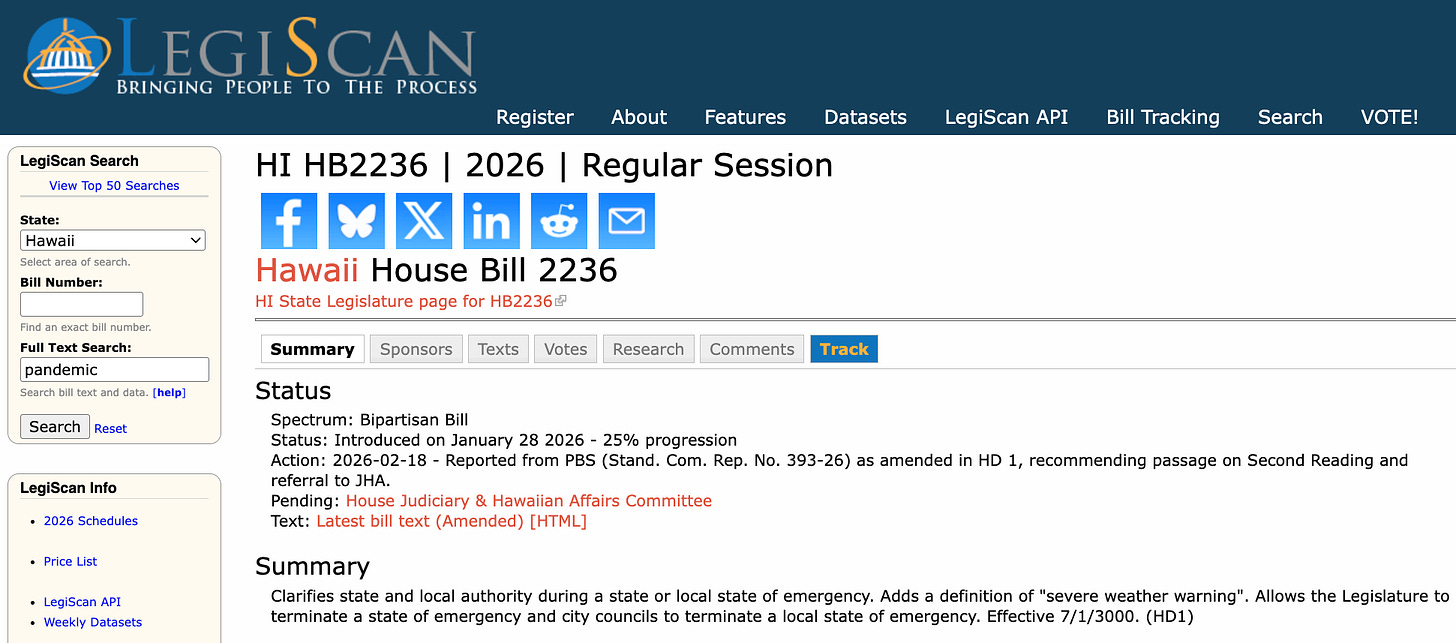
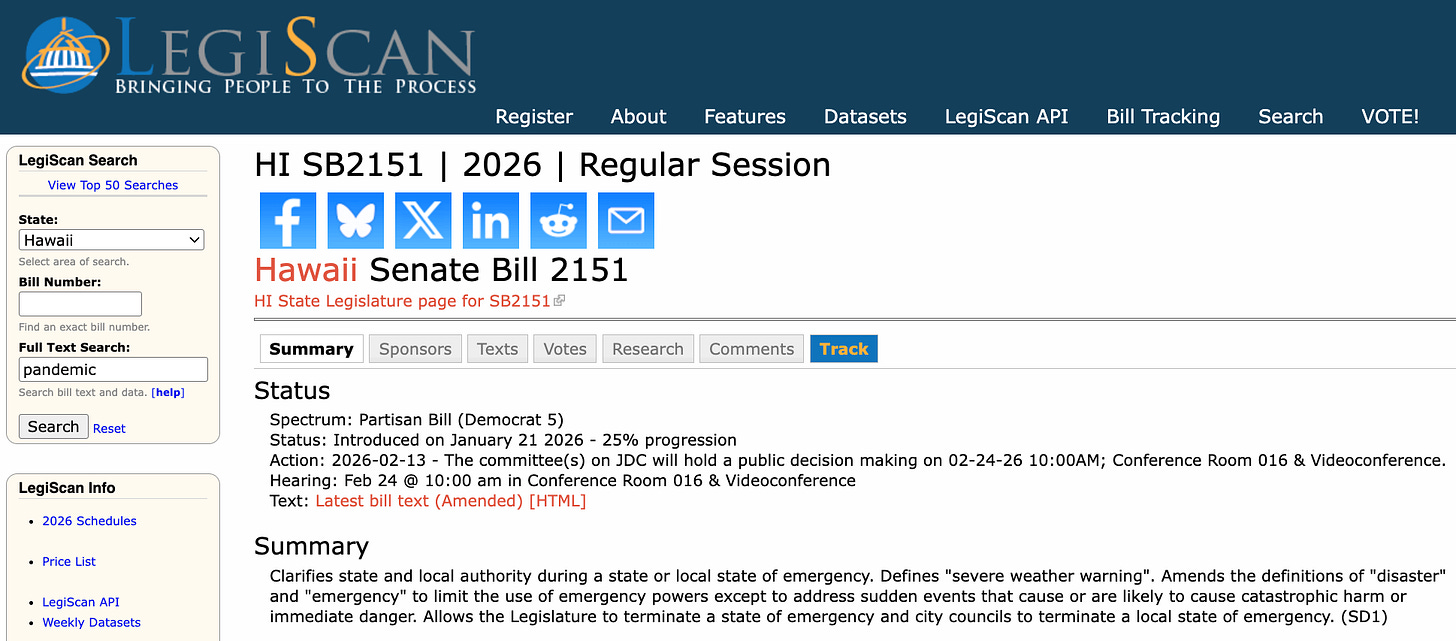
Legislative records show the bills are formally linked, with each designated as “Same As/Similar To” the other, confirming that Hawaii’s full legislature—not just one chamber—is advancing the emergency powers framework.
The legislation explicitly cites COVID-19 as justification for strengthening emergency authority, stating:
“The COVID-19 pandemic highlights the importance of clear legal frameworks for state and county emergency management to ensure that the State and counties are ready for any type of emergency.”
You can see which state legislators are backing these bills further down in this article.
Governor Authorized to Quarantine Residents & Enter Private Property Without Permission
Governor Authorized to Quarantine Residents & Enter Private Property Without Permission
One of the most consequential provisions would formally authorize forced quarantine and government entry onto private property.
The bill states that Hawaii Governor Josh Green (D) may:
“Require the quarantine or segregation of persons who are affected with or believed to have been exposed to any infectious, communicable, or other disease…”
It further grants authority to:
“Authorize without the permission of the owners or occupants, entry on private premises for any of these purposes.”
This authority applies not only to confirmed infections but also to individuals merely “believed to have been exposed.”
The legislation also allows the government to order the destruction of property deemed hazardous:
“Authorize that public nuisances be summarily abated and, if need be, that the property be destroyed by any police officer or authorized person.”
Governor Can Suspend Laws, Licensing Requirements, & Regulatory Protections
The bills explicitly empower the governor to suspend existing laws during an emergency, including medical, licensing, and regulatory protections.
The legislation states the governor may:
“[Suspend] the laws, in whole or in part… including licensing laws, quarantine laws, and laws relating to labels, grades, and standards.”
It also authorizes suspension of any law deemed to impede emergency operations:
“Suspend any law that impedes or tends to impede… emergency functions.”
Crucially, the legislation allows such suspensions to continue beyond the official emergency period:
“Any suspension of law… may continue beyond the emergency period…”
Government Authorized to Take Control of Private Infrastructure & Utilities
The legislation further empowers the governor to assume control of critical infrastructure, including privately owned facilities.
The bill states the governor may:
“Assure the continuity of service by critical infrastructure facilities, both publicly and privately owned… by taking over and operating the same.”
Additional provisions allow the government to:
- Shut off utilities
- Control distribution of goods
- Regulate or prohibit commerce
- Impose rationing
Specifically, the governor may:
“Regulate or prohibit… the storage, transportation, use, possession, maintenance, furnishing, sale, or distribution thereof, and any business or any transaction related thereto.”
Authority to Regulate Firearms & Seize Property
The legislation also grants authority to regulate firearms and confiscate property during emergencies.
It authorizes the governor to prohibit firearm possession during emergencies, meaning firearms that are normally legal could become unlawful to possess under emergency orders and subject to seizure.
The bill states the governor may:
“Regulate or prohibit the storage, transportation, use, possession… of firearms, and ammunition… and authorize the seizure and forfeiture.”
Governor Retains Sole Authority to Declare Emergencies
Under the proposed framework, Governor Green retains broad discretion to declare emergencies, including based on perceived threats.
The bill states:
“The governor… shall be the sole judge of the existence of the danger, threat, or circumstances giving rise to a declaration.”
Emergencies may be declared based on:
“Imminent danger or threat of an emergency or a disaster.”
This allows activation of emergency powers before an actual disaster occurs.
Legislature Adds New Definition of Disaster Including Disease Outbreaks & Bioterrorism
The Senate version expands the legal definition of “disaster” to explicitly include:
“Disease or contagion outbreaks, bioterrorism, terrorism, or incidents involving weapons of mass destruction.”
This codifies infectious disease emergencies as triggers for the expanded powers.
The move comes as President Donald Trump and Congress have already committed $5.5 billion toward preparing for a future influenza pandemic, while the World Health Organization vows such a pandemic is inevitable, U.S. scientists continue gain-of-function influenza experiments, and the administration launches its $500 million Operation Gold Standard influenza vaccine initiative.
Legislature Advances Bills Through Both Chambers
Legislative tracking records show both bills are progressing simultaneously:
- HB2236 was introduced January 28, 2026, and has already passed committee review in the House.
- SB2151 was introduced January 21, 2026, and is scheduled for further committee action February 24, 2026.
The bills are formally cross-linked, confirming coordinated legislative advancement.
Legislature Frames Bills as Clarification of Emergency Authority
Lawmakers describe the purpose of the legislation as clarifying and strengthening emergency management authority.
The bill states its purpose is to:
“Clarify state and county emergency management authority, ensure effective and adaptable emergency responses…”
The measures also allow the legislature to terminate emergency declarations by a two-thirds vote.
Which Legislators Are Backing the Bills
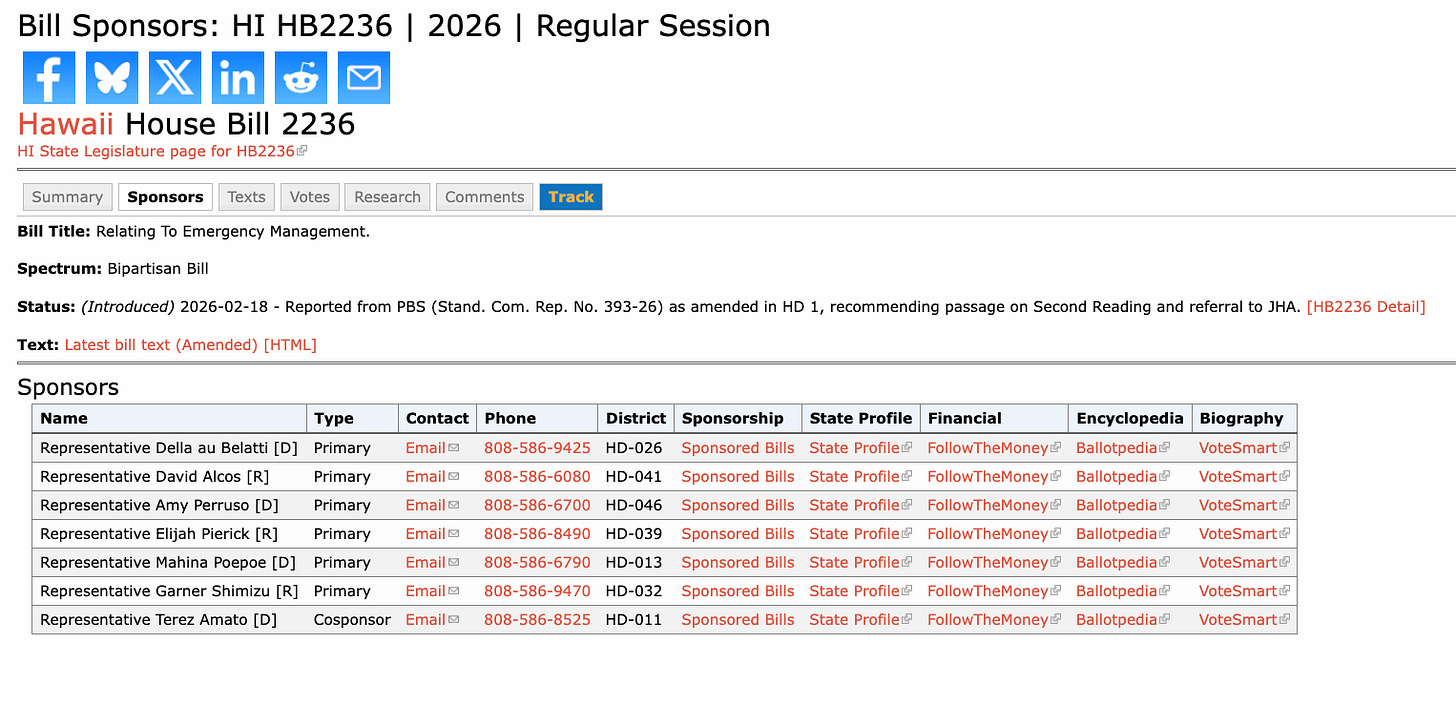
You can see which Representatives are backing HB2236 here.
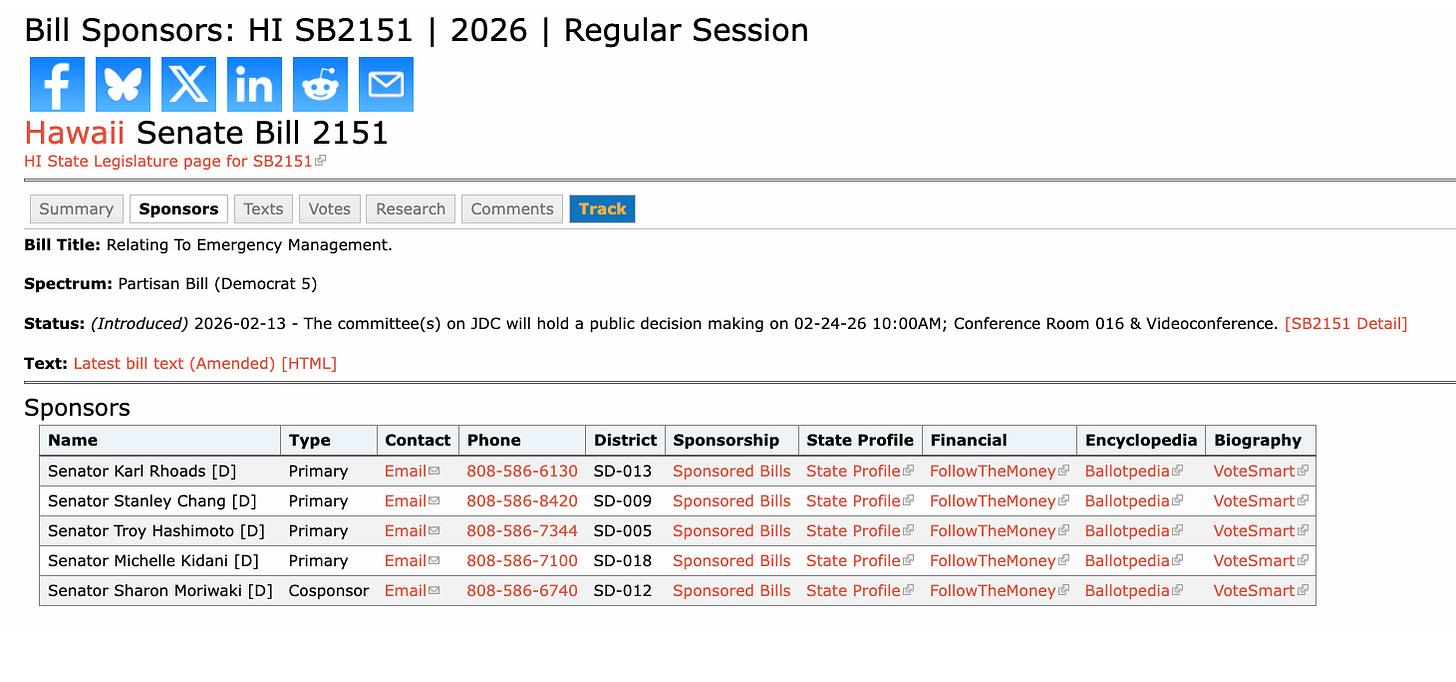
You can see which Senators are backing SB2151 here.
Bottom Line
HB2236 and SB2151 would lock into permanent Hawaii law the authority to quarantine residents based on suspected exposure, enter private property without permission, suspend existing laws, prohibit firearm possession under emergency orders, and take control of private infrastructure and economic activity—all under an emergency declaration the governor has broad discretion to issue, including based on a perceived “threat.”
The legislation is advancing as the federal government pours billions into influenza pandemic programs, conducts gain-of-function experiments designed to alter influenza viruses, and builds out large-scale vaccine deployment initiatives intended for rapid rollout once a pandemic is declared.
At the same time, Congress, the White House, the Department of Energy, the FBI, the CIA, and Germany’s Federal Intelligence Service (BND) have confirmed that the COVID-19 pandemic was likely the result of lab-engineered pathogen manipulation.
That overlap creates a profound conflict-of-interest question: the same government and scientific establishment involved in creating and manipulating pandemic-capable pathogens is also expanding the legal authority to impose quarantines, override constitutional protections, restrict property rights, and control economic life if one of those pathogens triggers the next declared emergency.
If passed, Hawaii’s bills would ensure those powers are not improvised in the moment, but already written into law—allowing sweeping restrictions on residents to be activated immediately, the moment the next pandemic or declared threat emerges.
Epstein files may contain ‘crimes against humanity’ – UN
RT | February 18, 2026
Abuses carried out by convicted sex offender Jeffrey Epstein could meet the definition of crimes against humanity, the UN has claimed, while demanding accountability for the suspected perpetrators.
The UN Human Rights Council (UNHRC) released a statement in response to the millions of files released by the US government related to criminal investigations into the late financier.
The files reveal instances of “sexual slavery, reproductive violence, enforced disappearance, torture, inhuman and degrading treatment, and femicide,” reads the document penned by a group of independent experts and published on Monday.
“So grave is the scale, nature, systematic character, and transnational reach of these atrocities… that a number of them may reasonably meet the legal threshold of crimes against humanity,” it states.
Epstein, who according to the authorities died by suicide in jail in 2019, moved in circles that included figures from politics, entertainment, and business. He faced criminal investigations in the US over allegations that he operated a system to recruit and sexually exploit young girls.
While Epstein associate Ghislaine Maxwell was convicted, “questions persist regarding the potential involvement of additional individuals” and financial structures linked to the alleged criminal enterprise, the UN wrote in a press release on Tuesday.
The UNHRC has urged the US and other countries to prosecute those implicated in the scandal, stating that “resignations alone” are not enough.
“It is imperative that governments act decisively to hold perpetrators accountable. No one is too wealthy or too powerful to be above the law,” they state.
The release of the Epstein files, totaling over 3.5 million pages, has triggered a wave of resignations across several countries. In the UK, the political fallout has been most severe, with three senior officials in Prime Minister Keir Starmer’s government stepping down, and the brother of King Charles, Andrew, losing his titles.
In the US, a top Wall Street law firm chairman and a prominent New York arts school chair have resigned. In Europe, national security advisers in Slovakia and Norway have stepped down, along with the president of the Swedish UNHCR and a former French culture minister.
UK Government Plans to Use Delegated Powers to Undermine Encryption and Expand Online Surveillance
Delegated powers mean the specific rules (what gets scanned, what gets flagged) get written by a minister, not Parliament.
By Ken Macon | Reclaim The Net | February 18, 2026
The UK government wants to scan people’s photos before they send them. Not just children’s photos. Everyone’s.
Technology Secretary Liz Kendall spelled it out on BBC Breakfast, floating a proposal to “block photographs being sent that are potentially nude photographs by anybody or block children from sending those.” That second clause is the tell. Blocking “anybody” from sending potentially nude images requires scanning everybody’s messages. There’s no technical path to that outcome that doesn’t involve reading content the sender assumed was private.
Kendall said the government is conducting a consultation on “whether we should have age limits on things like live streaming” and whether there should be “age limits on what’s called stranger pairing, for example, on games online.” The consultation, she said, will look at all of these. That list now covers messaging apps, photo sharing, gaming, and live streaming. Any feature that lets you share an image with another person potentially falls inside it.
This is how the mandate grows. The government announced a push for new delegated powers on February 16, framing them around age verification for social media and VPNs.
What Kendall described in broadcast interviews goes well beyond that framing. The official press release mentioned consulting on how companies might “safeguard children from sending or receiving” nude images. Kendall’s BBC comments dropped the qualifier about children entirely, proposing to block “potentially nude” images sent by anyone.
The mechanism matters here. The government plans to introduce these new authorities as amendments to the Children’s Wellbeing and Schools Bill, which has already cleared the House of Commons and the House of Lords and sits in its final stage. Amendments introduced this late receive less parliamentary scrutiny than standard legislation.
Delegated powers allow a minister or department to issue secondary legislation without returning to Parliament for a full vote. That secondary legislation isn’t subject to the same debate as the original Act. The government gets to decide the specific rules, on its own timeline, with limited opportunity for challenge. Kendall told Good Morning Britain that the government plans to push new “online safety rules” every year through this mechanism.
The bill already contains amendments requiring age verification for VPNs (amendment 92) and for “user-to-user” services (amendment 94a). User-to-user covers most online platforms where people share content: social media, messaging apps, forums, and gaming services. Email and SMS are exempt. Most everything else isn’t.
A charitable reading of why the government wants delegated powers: it needs flexibility to update technical standards for age verification as the technology changes, and only if Parliament first approves the underlying requirements. The less charitable reading, and the more plausible one: the government wants the ability to impose VPN and social media age verification even if those amendments fail. It’s building a back door to bypass the outcome of the parliamentary vote it’s currently trying to win.
The House of Lords previously considered and rejected an amendment that would have required constant client-side scanning on most smartphones and tablets to detect child sexual abuse material. The Lords declined to adopt it. That rejection happened through the full parliamentary process.
The government is now signaling it may pursue functionally identical surveillance through delegated powers, bypassing the scrutiny that killed the first attempt. Kendall’s photo-scanning proposal and the failed Lords amendment work the same way technically. Both require software installed on your device to examine content before it leaves. The Lords’ amendment targeted CSAM via client-side scanning. Kendall’s proposal targets “potentially nude” images via client-side scanning. The mechanism is identical. The content category is different.
End-to-end encryption means the service provider can’t read your messages. Client-side scanning, which has already proven to be a disaster in Germany, means your device reads them first, before encryption activates, and reports back. The encryption remains technically intact. The privacy it’s supposed to provide doesn’t. This is the same architecture that Apple proposed and then abandoned in 2021 after security researchers explained what it actually meant for private communication.
The government hasn’t acknowledged that its photo-scanning proposal requires dismantling the privacy guarantee that makes encrypted messaging meaningful. It’s describing the outcome it wants, not the infrastructure required to deliver it.
Photo scanning that flags “potentially nude” images requires training a model to identify what nudity looks like, running that model continuously on a device, and reporting matches somewhere. The system built for that purpose can be retrained or repurposed. A scanner that identifies nudity can be adjusted to flag political content, protest coordination, or anything else a future government decides warrants detection.
The delegated powers structure means those future decisions don’t require new primary legislation. They require a minister, a statutory instrument, and limited parliamentary review.
Prime Minister Keir Starmer’s February 16 Substack noted that “private chats” are supposedly harming children without proposing to target them specifically. The official press release didn’t mention messaging apps at all. What Kendall said on television this week went further than either document. The consultation hasn’t launched yet. The powers to act on its findings, at speed, with reduced oversight, are already being written into law.
Epstein Files Expose Israeli Occupation of America
MSM grudgingly admits Pizzagaters were on to something
By Kevin Barrett | February 18, 2026
On January 30, the US Department of Justice released what it called “3.5 million responsive pages” in compliance with the Epstein Files Transparency Act spearheaded by Rep. Thomas Massie. Though more than a month late, redacted in bizarrely non-compliant ways, and representing only about half of the Epstein files (the other half are still being illegally withheld) the DOJ document dump provided abundant, irrefutable evidence that the “antisemitic conspiracy theorists” have been right all along: The United States of America is occupied by a Jewish supremacist crime ring based in Israel.
The documents show that when then-United States Attorney for the Southern District of Florida Alex Acosta gave convicted sex criminal Jeffrey Epstein a sweetheart plea deal in 2008 because Epstein “belonged to intelligence,” he was referring to Israeli intelligence. According to FBI files, Acosta’s source was Alan Dershowitz, Epstein’s lawyer, who himself represented Israeli intelligence.
Epstein should have gone to prison for years or decades, as would any other criminal convicted of the same charges. But the notorious sex trafficker got a work-release wrist slap. Since when can a foreign intelligence agency tell a US Attorney not to do his job?
The latest document dump confirms that Epstein, who was groomed as a sexual blackmailer by Les Wexner’s MEGA group of billionaire Mossad spies, was “trained as a spy by (Israel’s former military intelligence chief and Prime Minister) Ehud Barak,” who visited Epstein’s New York mansion on dozens of occasions. Barak and Epstein teamed up not only to blackmail American political, economic, and cultural leaders, but also to funnel huge sums of money to politicians in various nations—bribes in return for those politicians following Israel’s orders.
The new document dump reveals that Epstein worked with Israel to support their Ukrainian asset Zelensky, and to try to overthrow Russia’s Vladimir Putin and replace him with an Israeli stooge named Ilya Ponomatov. Epstein, we also learn, was involved in the overthrow of Libya’s Gaddafi. The Mossad blackmailer helped cultivate Israel’s relations with separatists in the imaginary nation of “Somaliland” (which only Israel recognizes). He brokered Israel’s ties with India’s Prime Minister Modi, and maintained close relationships with top UK leaders including Tony Blair and Peter “love the torture video” Mandelson.
These and other revelations prove that Epstein was not just a sexual blackmailer. Since his job was to establish compromising personal relationships with the world’s most powerful people, Epstein was also used by Israel as a high-level international power broker. “I represent the Rothschilds,” Epstein wrote to Peter Thiel, referring to the banking dynasty that created Israel.
The DOJ files show how Israeli/Rothschild agent Epstein lured his blackmail targets into a cesspool of depravity. The files contain many references to torturing, raping, and murdering children. FBI files cite testimony that Epstein’s crime ring would “birth babies for black market use.” Those who thought Pizzagate was an unproven conspiracy theory may be surprised to learn that the Epstein emails include more than 900 references to “pizza” as a likely code for child sex slaves. There are also 673 suspicious references to “ice cream” and countless uses of “grape soda” presumably referring to black prostitutes or sex slaves. Mainstream media are twisting themselves into contortions trying to insist that even though most of these food code words are obviously what they seem–code words for child sex slaves–though possibly a few could be interpreted as references to actual food! New York Magazine opines:
Admittedly, some of the pizza-related material seems pretty weird. An April 2018 message from a redacted sender says, “lets go for pizza and grape soda again. No one else can understand. Go kno.” Cryptic! Some of it is scrutable: “Go kno” appears to be a rendering of go know, an English derivative of the Yiddish expression geh vays, which is roughly equivalent to “go figure.” The claim that “no one else can understand,” on the other hand, is a creepy element that echoes Donald Trump’s allusion to “wonderful secrets” in his infamous letter on the occasion of Epstein’s 50th birthday…
“Pizza and grape soda” belongs to the latter category, and it appears frequently in Epstein’s emails and texts. In a 2018 exchange with his urologist, Harry Fisch (who erroneously appears in Epstein’s contacts as “Harry Fish”), the two seem to discuss refilling Epstein’s prescription for erectile-dysfunction medication. Fisch later texts, “After you use them, wash your hands and lets [sic] go get pizza and grape soda.” This proposal seems odd. There are many things you can do after your Viagra kicks in, and getting a slice with your doctor is not near the top of the list…
… Remember when only unreasonable people thought like this? The idea that pizza could be a code word for illicit sexual activities was laughable in 2016, when the so-called Pizzagate conspiracy captured the imaginations of what might charitably be called the internet’s most enthusiastic users…At the time, the assumption that pizza was code for sex with children seemed obviously arbitrary and extravagant, a violation of the principle that the simplest explanation is usually the right one. This heuristic, Occam’s razor, is often a handy way to differentiate ideas and people we should take seriously from ones we can safely dismiss — people who are frustrated that they’ve misplaced their keys tend to be more credible than those who think their keys have been stolen. Except with this Epstein pizza thing, the somebody-stole-my-keys contingent seems to have been suddenly, disastrously vindicated…
…Occam’s razor has comparatively little to tell us about grape soda. Fisch and Epstein refer to “pizza and grape soda” so often, and so often together — seemingly never just grape soda and rarely just pizza — that the whole thing starts to look like a shibboleth… The mystery deepens when you notice that Fisch often follows references to pizza and grape soda with an emoji depicting an African American…
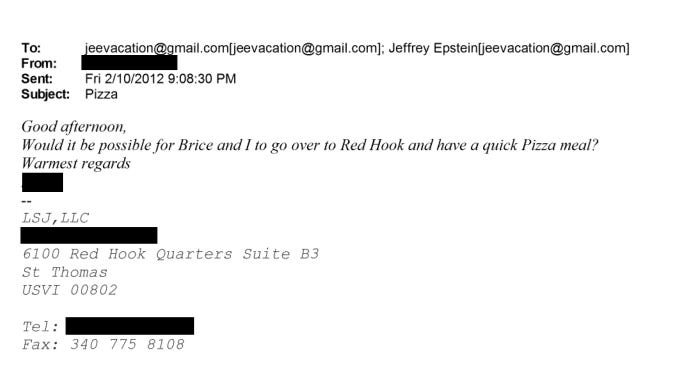
The sender’s name has been redacted, and the identity of “Brice” is unclear, but a former New Zealand Army chef named Brice Gordon co-managed Epstein’s New Mexico ranch and was interviewed by the FBI in 2007. Red Hook is an unincorporated town in the U.S. Virgin Islands — the least-populated such place, according to the 2020 census, consisting mostly of marinas. There is, as it turns out, a pizza restaurant there. But why would someone need Epstein’s permission to have a “quick pizza meal” to which the financier was not invited? It’s enough to drive a sensible person to speculation.
From the mainstream media’s perspective, the problem is not that we are ruled by genocidal Israeli-Mossad-empowered Jewish supremacist psychopathic billionaire perverts. It is that someone might notice that we are ruled by genocidal Israeli-Mossad-empowered Jewish supremacist psychopathic billionaire perverts. That would mean that the “antisemitic conspiracy theorists” were right all along. Oy vey! Double-plus ungood!
Though the mainstream media professes to hate racism, they are covering up Epstein’s virulent racism against non-Jews. The emails are full of disparaging references to “goys,” a term for non-Jews that roughly parallels other racial slurs including the N-word. Epstein and his supremacist cronies loved to degrade non-Jewish children and teens, but never targeted their fellow “chosen people.”
For many Americans, the most disturbing revelations in Epstein files involve President Donald J. Trump. Prior to the files’ release, we already knew that Trump flew on Epstein’s jet at least eight times, was referred to by Epstein as his “best friend,” sent a birthday drawing to Epstein depicting a barely pubescent naked girl alluding to their “secret,” and has been accused of raping 13-year-old “Katie Johnson” in 1994 at an Epstein party and then threatening to kill the girl and her family. The first Epstein dump also contained FBI witness reports that Trump was present when a baby was drowned in Lake Michigan, and was implicated in the rape and murder of a certain Dusty Rhea Duke in 2000.
The new Epstein files release includes FBI witness reports that Trump was involved in murdering three girls who were buried at Mar-a-Lago and threatening the witness with a similar fate. Witnesses also told the FBI that Trump auctioned underage girls from his swimsuit contests, measuring their vulvas and rating them for tightness. Trump is also accused of forcing oral sex and other abuses against 13 and 14 year old girls.
Meanwhile the mainstream media chant in unison: “President Trump has not been accused of wrongdoing.” Will they change their tune, and suddenly discover the FBI files, if and when Trump stops following Israel’s orders?
A shorter version of this article was published in last week’s American Free Press. -KB
Stripe is Substack’s only processor and they debanked me, so you can no longer pay me through Substack. Now I am posting everything on Substack free and asking people to sign up for recurring donations at my Paypal donation page… or better yet, the free speech platform SPdonate. Alternately you can Paypal or Zelle to truthjihad[at]gmail(dot)com. Note that Zelle, unlike other methods, doesn’t charge any fees.
The Mandelson Molecule: Exposing the Architecture of Cross-Border Political Suppression

By Freddie Ponton | 21st Century Wire | February 18, 2026
The resignation of Peter Mandelson as UK ambassador to Washington in February 2026 revealed more than a scandal—it exposed the architecture of a parallel governance system operating through deniable channels. The Epstein files, the Center for Countering Digital Hate (CCDH) censorship apparatus, and the Mandelson intelligence pipeline are not separate stories. They are component parts of a transatlantic mechanism that converts private access into public control, with enforcement mechanisms that now reach across sovereign borders to silence American citizens.
Jeffrey Epstein was a convicted sex offender with deep ties to political and financial elites on both sides of the Atlantic. Peter Mandelson is a former UK power‑broker and ambassador to Washington, now under investigation for secretly sharing government information with Epstein. This article shows how their relationship connects to a wider system of online censorship and private global‑health finance.
The Intelligence Pipeline: Real-Time Treasury Briefings to a Convicted Sex Offender
The Mandelson-Epstein correspondence reveals something far more systematic than indiscreet friendship. It documents a private intelligence channel operating at the highest levels of UK and US financial policy.
In December 2009, while serving as Business Secretary, Mandelson forwarded Treasury positions on the bankers’ bonus tax to Epstein within hours of receiving them, with Epstein requesting advance notice “before Jes” and Mandelson replying simply: “Treasury”. By March 2010, the pattern had escalated—Mandelson forwarded notes from a meeting between UK Chancellor Alistair Darling and US Treasury Secretary Larry Summers to Epstein within five minutes, followed by his own meeting with Summers the next day. Those notes were forwarded within two minutes.
The content was market-moving intelligence: Dodd-Frank implementation, hedge fund taxation, derivatives regulation, and Bank of England quantitative easing strategy during the credit crunch. Mandelson advised Epstein that JPMorgan’s CEO should “mildly threaten” Chancellor Darling over policy. This systematic extraction of live government intelligence for private financial advantage can hardly be construed as incidental corruption.
DOCUMENT: Peter Mandelson leaked No 10 documents to Epstein, who then helped him pursue multi-million dollar jobs (Source: Tax Policy Associates)
The Censorship Architecture: From Anti-Corbyn Operations to American Deplatforming
The same censorship machine that produced the Biden White House’s authoritarian campaign against the so-called “Disinformation Dozen” in 2021 had emerged from the notorious Room 216, Brixton, where Israeli loyalist and architect of Keir Starmer’s rise to power, Morgan McSweeney, along with Imran Ahmed, built the “Labour Together” operation to dismantle Jeremy Corbyn. It was a CCDH list of 12 named individuals, which the White House then pushed Facebook to censor. The March 2021 “Disinformation Dozen” report was not independent research—it was unequivocally the identical playbook redeployed. The Biden White House directly cited CCDH’s report to pressure Facebook into censoring American health publishers, with internal documents showing the platform’s “secretly demoted” users, including alleged “anti-vaxxers”, and Twitter accounts of targeted individuals. When Facebook pushed back that the “majority of the accounts in question were not spreading misinformation,” the White House persisted.
Among those branded the “Disinformation Dozen” by the CCDH in March 2021: Robert F. Kennedy Jr. (Children’s Health Defense), physician Joseph Mercola, and Sayer Ji—whose investigative work exposing the Mandelson intelligence pipeline appears later in this report.
The method was documented in internal strategy papers: cultivate “seemingly independent voices to generate and share content to build up a political narrative,” infiltrate opposition spaces to extract decontextualised content, and feed narratives to sympathetic media. The “antisemitism crisis” that destroyed UK Labour Party leader Jeremy Corbyn was, as Labour Party files confirm, instrumentalised by this same faction.
Morgan McSweeney was CCDH’s founding director and subscriber for 18 months, operating from the same Brixton office that produced Labour’s anti-Corbyn operation. When he resigned in April 2020 to become Starmer’s chief of staff, Ahmed inherited an apparatus already proven effective at demonetising political opposition.

Morgan McSweeney, founding director of the CCDH, and former British Prime Minister Keir Starmer’s Chief of Staff. (Source: The Edge | Business news)
The March 2021 “Disinformation Dozen” report was not independent research—it was unequivocally the identical playbook redeployed. The Biden White House directly cited CCDH’s report to pressure Facebook into censoring American health publishers, with internal documents showing the platform “secretly demoted” affiliated accounts and Twitter accounts of targeted individuals. When Facebook pushed back that the “majority of the accounts in question were not spreading misinformation,” the White House persisted.
Project Molecule: The Financial Infrastructure of Private Governance
The August 2011 JPMorgan “Project Molecule” blueprint reveals the financial architecture that made this system durable. The $150 million fund Epstein pitched to JPMorgan CEO Mary Erdoes was designed to operate “across sovereign borders, into specific countries, for specific biological interventions”—with no elected officials, no treaty obligations, and no public accountability beyond its own audit committee.
DOCUMENT: JPMorgan “Project Molecule” blueprint (Source: DOJ Epstein File Library | EFTA01301114)
Epstein operated as Bill Gates’s representative under a written agreement, with the explicit purpose of securing “additional money for vaccines” while creating a “permanently governed, privately controlled, transnational system”. The budget allocated $40M for polio vaccines in Afghanistan, $40M in Pakistan, $20M specifically for “financing the surveillance network in Pakistan,” and $30M for rotavirus vaccines in Latin America.
This is the governance model: private intelligence (Mandelson-Epstein), private finance (Project Molecule’s offshore vaccination funds), and private enforcement (CCDH’s deplatforming operations) operating in substitutional parallel to democratic institutions.
The Enforcement Layer: Cross-Border Suppression of American Speech
What transforms influence operations into censorship is enforcement. The original investigation documents the apparatus reaching into foreign legal proceedings against American journalists—cross-border enforcement without due process, extradition treaties, or congressional oversight.
The pattern is now confirmed by US government action. In December 2025, Secretary of State Marco Rubio barred Imran Ahmed from entering the United States, citing his role in “leading organised efforts to coerce American platforms to punish American viewpoints they oppose”. Ahmed was one of five Europeans sanctioned under a visa policy targeting foreigners responsible for censoring protected speech in America.
The CCDH is now reportedly under DOJ investigation for potential violations of foreign agent registration laws, given its coordination with UK Labour operatives while targeting US political speech. Labour’s deployment of approximately 100 operatives to US swing states during the 2024 election—conducted by McSweeney’s network—has generated formal FEC complaints alleging direct electoral interference.
After days of parliamentary theatre about “transparency,” Westminster has craftily moved to bury the Mandelson-Epstein papers—not in open sunlight, but inside the Intelligence and Security Committee, a body three of whose members have already stuffed with cash from pro-Israel lobbyists.
In Britain, Downing Street originally wanted veto power over anything “prejudicial to national security”, but the documents will now be reviewed by the Parliament’s Intelligence and Security Committee (ISC). Critics argue that this allegedly independent oversight body could be compromised. In effect, three sitting members—Deputy Chair Sir Jeremy Wright, Sir John Hayes, and Labour’s Derek Twigg—have all taken money from the pro-Israel lobby, which by some estimates bankrolls roughly a quarter of British MPs. This can be verified in the excellent Declassified UK report published in June 2024.
The bottom line is that the Epstein file, which details how Mandelson piped classified Treasury intelligence to a convicted sex offender, and how British power brokers and Wall Street criminals traded backroom briefings, will now be “vetted” by politicians on the take from foreign influence networks. Forget transparency—it was never on the table.
The Architecture of Manufactured Consensus
The critical insight is structural: these networks exploit the gap between formal democratic institutions and actual governance. Mandelson’s Treasury briefings to Epstein occurred through informal channels. Project Molecule’s sovereign surveillance programs were designed to operate offshore. CCDH’s censorship operations, though effective at capturing White House policy, occurred through a nonprofit rather than state agencies. According to reports, George Soros is said to have donated $250,000 to the CCDH, which is working to censor conservative news outlets and to undermine Musk’s Twitter.
When the same personnel (McSweeney as CCDH founder, then Starmer’s chief of staff), the same infrastructure (Brixton operations), and the same methods (crisis amplification, media laundering, financial pressure) appear across Corbyn’s destruction, COVID censorship, and US electoral operations, we are not observing a coincidence. We are witnessing a system.
The switchboard is not the scandal. The switchboard is the system, and it is now being dismantled by the very government it sought to influence.
The Original Investigation
This synthesis builds upon the groundbreaking investigative work of Sayer Ji, founder of GreenMedInfo and author of the Switchboard series—including the first publication to connect the Mandelson-Epstein intelligence pipeline to the CCDH censorship apparatus. Ji’s research, conducted under direct legal and professional pressure from the very networks he was exposing, documented how British political operatives built a cross-border enforcement mechanism capable of weaponising foreign courts against American journalists.
His original reporting on Room 216, the Brixton operations, and the emergence of “disinformation” as a tool for political suppression predates mainstream coverage by years, and has now been validated by the Epstein disclosures, the Rubio sanctions against Ahmed, and the DOJ’s investigation into CCDH’s foreign agent activities.
Read the complete investigation series and supporting documentation at Sayer Ji Substack…

Sayer Ji reports on Substack…
The Switchboard: From Epstein to Mandelson to McSweeney to Ahmed — How a British Machine Became America’s Censorship Engine
How the Epstein Files Reveal the Architecture Behind Censorship, Crisis Finance, and What Happened When I Investigated It – Part 3 in a Series
Peter Mandelson, “the Prince of Darkness,” Keir Starmer’s hand-picked ambassador to Washington, the most powerful unelected figure in British politics, resigned from Parliament this week, one step ahead of legislation to eject him. The Metropolitan Police opened a criminal investigation. The Prime Minister apologised to Jeffrey Epstein’s victims for believing Mandelson’s lies.
The press is treating this as a story about a politician’s downfall. It is not. It is a story about what he was connected to — and what was built to make sure you never found out.
Key Findings:
- The censorship machine that targeted American speech during COVID was built inside a Labour Party factional operation. Morgan McSweeney and Imran Ahmed created the Center for Countering Digital Hate (CCDH) from the same office, using the same staff, and the same dark-money infrastructure they used to destroy Jeremy Corbyn — then redeployed the identical playbook against U.S.-based health publishers and independent media.
- CCDH’s founder and political patron is a protégé of Peter Mandelson, who was simultaneously routing confidential UK and U.S. government intelligence to Jeffrey Epstein. Mandelson forwarded Treasury readouts on the Volcker Rule, Dodd-Frank, and derivatives regulation to Epstein within minutes of receiving them — intelligence worth billions to Epstein’s Wall Street clients. The same political culture of deniable backroom operations that made the Epstein network functional also produced CCDH.
- Epstein’s network was not just criminal — it was architectural. Project Molecule, a $150M JPMorgan blueprint produced the same month Epstein sketched a private global health fund, reveals the institutional machinery: offshore vaccination funds, sovereign biological surveillance programs, and governance structures designed to bypass elected oversight entirely.
- The enforcement layer is not theoretical — it has already been deployed against named individuals. CCDH’s “Disinformation Dozen” list led directly to platform deplatforming. In at least one documented case, CCDH-originated material was entered into foreign legal proceedings to seek an ex parte arrest warrant against a U.S.-based journalist for lawful American speech — cross-border enforcement with no due process, no extradition treaty, and no congressional oversight.
- The same network is now the subject of a formal FEC complaint alleging direct electoral interference. McSweeney — Mandelson’s protégé, CCDH’s political architect, and now Starmer’s chief of staff — was named in a formal FEC complaint for dispatching approximately 100 Labour operatives to U.S. swing states during the 2024 presidential election. The censorship pipeline and the electoral interference pipeline share the same personnel, the same infrastructure, and the same assumption: that British political operatives can shape American outcomes without accountability.
The U.S. Sanctions Cuban Journalist For Reporting On The U.S. Blockade
The Dissident | February 17, 2026
The U.S. has recently cut off Cuba’s source of oil from Venezuela and Mexico, with the intention, as Trump recently admitted , of creating a “humanitarian threat” in hopes it will lead to regime change, boasting that because of the blockade, “There’s no oil. There’s no money. There’s no anything.”
As Cuban-based journalist Marc Frank reported , due to the blockade, “Prices are soaring, power outages are increasing, and gas lines are growing. Public and private transportation are disappearing. Produce at markets is dwindling, and all but emergency surgeries have been canceled. The fear that the quality of life will quickly deteriorate is palpable”.
The U.S. is now taking this a step further and placing targeted sanctions on Cuban journalists doing critical reporting on the blockade.
A Miami-based pro-regime change outlet called CiberCuba reports that the U.S. has “imposed visa restrictions” on Cuban journalist Pedro Jorge Velázquez, known as El Necio, accusing him of “involvement in harassment campaigns against American diplomats in Cuba”.
In response, El Necio wrote , “I am an ordinary young Cuban. Five years ago, I began doing my work through social media and collaborating with press outlets. I have no employment ties whatsoever to the Cuban government: currently, I do not work in press media or state institutions.”
He noted that the accusation of “harassment” is in reference to his “ latest journalistic investigation” where he uncovered, “ the purchase of fuel (gasoline) by US diplomats in Havana: the very same fuel that they block from Cuba, only to consume it themselves afterward.”
He noted that while the “sanction is irrelevant to me” noting that, “I have never had, nor have I ever requested, a visa to enter the US” he added that, “we do need to denounce this serious violation of press freedom” adding, “this is not a personal attack, but a precedent for censorship and coercion against every young Cuban who speaks out against the blockade on Cuba or who practices journalism that does not please the Trump administration.”
The U.S. sanctions against El Necio for reporting on the U.S. blockade on Cuba mirror U.S. sanctions on Francesca Albanese, the UN’s special rapporteur for Palestine, in retribution for a report she published exposing U.S. corporations’ complicity in the Gaza genocide.
Similarly, to justify the sanctions, the U.S. accused Albanese of “writing threatening letters to dozens of entities worldwide, including major American companies across finance, technology, defense, energy, and hospitality”, in reference to her writing letters to companies fueling the genocide in Gaza, informing them of their violation of international law and participation in war crimes.
The sanctions also mirror the EU sanctions placed on the former Swiss army colonel Jacques Baud, in retribution for his criticism of the proxy war in Ukraine.
From Cuba to Palestine to Ukraine, sanctions are more often being used as a tool to silence and intimidate those exposing and critiquing Western foreign policy.
Israeli firms transform cars into intelligence devices: Reports

Al Mayadeen | February 17, 2026
Modern vehicles have evolved into internet-connected digital ecosystems, a transformation that is reshaping the global intelligence market, with “Israel” paying special attention to this rising domain, according to a new investigation by Haaretz.
In intelligence circles, information harvested from vehicles is known as “CARINT,” short for car intelligence. Today’s vehicles function as “computers on wheels,” equipped with built-in SIM cards, GPS systems, Bluetooth connectivity, and multimedia platforms that continuously transmit data.
The report reveals that at least three Israeli companies are operating in this expanding sector, developing tools that enable government clients to track vehicle movements in real time, cross-reference vast databases, and identify specific targets among thousands of cars on the road.
Industry sources cited in the investigation described the use of AI-powered “data fusion” systems that combine vehicle telemetry, roadside camera feeds, advertising data, and cellular metadata to construct comprehensive intelligence profiles. Rather than directly hacking a device, agencies are increasingly assembling what sources describe as a surveillance mosaic from legally or commercially available data streams.
The case of Toka
Among the companies identified is Toka, co-founded by former Prime Minister Ehud Barak and former Israeli military cyber chief Yaron Rosen.
According to documents and industry sources cited by Haaretz, Toka developed a product capable of infiltrating a vehicle’s multimedia system, pinpointing its location, and remotely activating microphones or dashboard cameras. The system was reportedly approved by “Israel’s” Security Ministry for presentation and eventual export.
The company said that as part of its 2026 product roadmap, it no longer sells the hacking tool.
Experts noted that exploiting vehicle vulnerabilities remains technically complex, as each manufacturer employs distinct digital architectures. However, the possibility of remote access to in-car microphones and cameras has raised acute privacy and security concerns.
Another Israeli firm, Rayzone, has reportedly begun selling vehicle-tracking tools through its subsidiary TA9. Unlike offensive hacking products, Rayzone’s system focuses on aggregating and cross-referencing data, including SIM-card tracking, Bluetooth signals, and license-plate recognition feeds.
The investigation suggests that the intelligence industry is gradually shifting away from high-profile phone-hacking technologies associated with firms such as NSO Group and toward large-scale, AI-enabled data analytics platforms.
In the United States, companies such as Palantir Technologies analyze license plate databases and vehicle registries, integrating them into broader intelligence systems. Israeli firm Cellebrite also works extensively with US law enforcement agencies in extracting and processing digital evidence, including vehicle-related data.
Vehicle intelligence expanded post Oct. 7
The Haaretz investigation further highlights that in the aftermath of Operation al-Aqsa Flood, Israeli authorities, with support from the private sector, developed advanced capabilities to locate vehicles stolen from army bases and border communities. According to the report, these tools were later integrated into military systems.
The article also points to China’s longstanding regulatory framework requiring domestic car manufacturers to transmit vehicle data to state authorities. It further notes that the Israeli Occupation Forces imposed restrictions on certain Chinese electric vehicles entering military facilities, citing security concerns.
Security analysts warn that the accelerating digitization of vehicles not only expands surveillance capabilities but also increases cybersecurity risks. Ethical hackers have previously demonstrated, in controlled environments, the ability to manipulate steering systems or disable engines remotely. Industry sources cited in the investigation indicate that some government clients are increasingly expressing interest in remote vehicle-disabling technologies.
At global intelligence exhibitions such as ISS World, often referred to as the “Wiretapper’s Ball”, artificial intelligence and real-time data fusion dominate discussions. AI systems now enable the rapid processing of millions of disparate data points, including vehicle telemetry, audio streams, and video feeds, transforming them into actionable intelligence with unprecedented speed.
Industry insiders argue that as vehicles become more connected, they will inevitably play a more central role in intelligence gathering. Privacy advocates, however, caution that the same connectivity that enhances consumer convenience may also underpin a powerful and potentially intrusive surveillance infrastructure.
The Haaretz investigation concludes that while directly hacking individual vehicles remains technically complex, AI-driven aggregation of vehicle-generated data could make such intrusions increasingly unnecessary, raising significant questions about privacy, regulation, and the future of digital mobility.
Palantir, Dataminr help build Gaza AI-Driven digital prison system
A +972 Magazine investigation reveals that US firms Palantir and Dataminr are embedded in the US-Israeli post-war plan for Gaza through the Civil-Military Coordination Center (CMCC), a US-run hub coordinating Trump’s 20-point plan. A Palantir “Maven Field Service Representative” tied to Project Maven has been assigned to the center, integrating battlefield AI into Gaza’s future control structure.
Project Maven fuses satellite imagery, drone feeds, intercepted communications, and metadata into an AI platform described as “optimizing the kill chain.” Rights groups argue these AI-enabled systems have accelerated the genocide in Gaza, scaling up killings with minimal human oversight. UN figures show nearly 70% of verified fatalities are women and children, with entire families wiped out in strikes allegedly guided by AI systems.
Palantir has expanded cooperation with Israeli occupation forces since 2024, doubling its Tel Aviv presence and supporting war-related missions. Amnesty International lists the company among firms whose services helped facilitate genocide and starvation in Gaza. Dataminr, specializing in real-time social media surveillance, has also been integrated into the framework, feeding AI-driven threat intelligence into the evolving security architecture.
Under the so-called “Alternative Safe Communities” model, Palestinians would be forcibly relocated into fenced, heavily monitored compounds under US-Israeli control. Within these zones, AI systems would track phones, movements, and online activity, flagging individuals as “security risks,” effectively turning Gaza into an AI-driven digital prison and kill-list system.
This architecture has been compared to Nazi concentration camps in its logic of isolating, surveilling, and managing an entire population as a security threat, reducing civilians to data points under total algorithmic control.
Zionist-controlled companies to surveil British citizens

Press TV – February 17, 2026
The implications of the British state using technology produced by Zionist-controlled companies to surveil British citizens are beyond belief.
The cornerstone of a sovereign nation is the absolute control over its own justice, its own data, and its own watchmen. Yet today, the very machinery of British law enforcement is being quietly and systemically outsourced.
The British government has allowed the digital and physical infrastructure of the state to become a high tech extension of a foreign power, driven by the pernicious influence of Zionism, an ideology that prioritizes the expansion of a foreign entity over the rights of people in the UK.
This is not merely a matter of procurement. It is a surrender of independence.
By embedding Zionist-linked firms into the heartbeat of British society, the government is importing a surveillance philosophy rooted in the subjugation of one people and applying it to their own subjects.
These are combat-proven technologies forged in the fires of the Gaza genocide, and they are now the primary eyes and ears of the metropolitan police.
The police use Israeli intelligence firm Cellebrite to unlock the phones and private lives of their own citizens. They also use BriefCam to track people’s movements through video synopsis.
BriefCam is a company co-founded by Gideon Ben-Zvi, a veteran of the IOF elite unit 8200 Intelligence Corps, who openly admits to using unit 8200 criteria to lead his ventures.
The reach of foreign intelligence into the streets is even more direct through Corsight AI, which provides facial recognition throughout the country.
Born as a subsidiary of Cortica, it was founded by Igal Raichelgauz, another alumnus of the Zionist military intelligence apparatus.
When our faces are scanned by software overseen by the architects of the occupation of Palestine, can we truly say that the British public is being policed by British consent?
But the intrusion goes deeper than software. It reaches the very hands of our officers on the front lines.
ISPRA, an Israeli specialist in riot control, has historically supplied the crowd management munitions used to police the streets.
When the tools used to suppress dissent in the UK are manufactured by a firm specializing in the containment of occupied territories, the line between domestic policing and foreign military occupation begins to blur.
Furthermore, Motorola Solutions, a company listed by the United Nations for its links to illegal settlements, is now deep inside our research projects.
Through initiatives like CREST and Connections, they’re building predictive policing tools designed to monitor the social media content and online lives of the British public.
When a company that facilitates surveillance in the West Bank is the same one mapping the future crimes of Londoners, we have fundamentally compromised our domestic integrity.
Links between Zionist movement and Lionel Idan
Lionel Idan is a key British prosecutor serving as the Chief Crown Prosecutor for the CPS and also the National Hate Crime Lead Prosecutor.
He’s currently being heavily lobbied by a network of powerful Zionist groups.
We’re not just talking about casual meetings.
Idan has held repeated engagements with the Israeli embassy and Zionist lobby groups, the board of Deputies of British Jews and the Community Security Trust, CSD, an organization headed by convicted fraudster Gerald Ronson.
The objective is clear, to ensure the Crown Prosecution Service, CPS, fully adapts the IHRA definition of anti-semitism, a definition weaponized against anti-Zionists, as we saw during the attacks on Jeremy Corbyn and the Labour Party.
Lionel Idan has not hidden these alliances. In an op-ed for the Jewish News, he boasted that the CPS sits on the anti-semitism Working Group alongside the CSD and the Jewish leadership council.
He confirmed that lobby groups, the CSD and the Antisemitism Policy Trust, are now core members of the CPS External Consultative Group on Hate Crime.
Perhaps most concerning is that the national prosecution guidance is being shaped by these very groups. Idan has admitted that their involvement helps the CPS define the line where anti-Zionism becomes a criminal offense.
When the person overseeing London’s prosecutions attends Israel lobby annual dinners to celebrate new security task forces, where is the independence of the UK legal system?
It should be demanded that the CPS remain an impartial body free from the influence of political lobbyists and foreign interests.
Featured Video
What’s the Pentagon Preparing For? Alexander Mercouris
or go to
Aletho News Archives – Video-Images
From the Archives
US tested biological weapons in Japan’s Okinawa in the 60s – report
RT | January 12, 2014
The American army conducted experiments with biological weapons aimed at destroying rice crops on the Japanese island of Okinawa in the 60s, Kyodo news agency reports. The alleged target of the tests was the China and Southeast Asia region.
Citing classified US documents, Japanese news agency Kyodo said the US military carried out experiments on their sovereign territory between 1961 and 1962. At this time Japan’s southern island of Okinawa was still under post-WWII, US jurisdiction. The US did similar tests in Taiwan and the American mainland, notes Kyodo.
The American army experimented with rice blast fungus – a plant pathogen – which infects rice crops with disastrous effects. The pathogen latches onto the rice plant as a spore and produces lesions and spots all over the rice plant and then reproduces.
A single lesion can generate a thousand spores in one night alone, while an entire cycle – lasting about a week – can have a devastating effect on rice crops.
Kyodo reports that tests were conducted over a dozen times, and mentions test sites, Nago and Shuri, in Okinawa. The US army reported some success in their experiments and the gathering of “useful data”.
“Field tests for stem rust of wheat and rice blast disease were begun at several sites in the (US) Midwest and south and in Okinawa with partial success in the accumulation of useful data,” wrote Kyodo, citing its documents. … continue
Blog Roll
 Aletho News
- What’s the Pentagon Preparing For? Alexander Mercouris
- USAID Files: The Georgia Model for Getting Accounts Taken Down
- Kiev hits out at YouTube over Russian-language censorship refusal
- Australia Passes Digital Duty of Care Bill, Ignoring Censorship Warnings
- Majority of MAGA ‘deserters’ back banning bombs to Israel: Poll
- Iran wary as South Korea assures it will not join US war of aggression
- ‘Desperate’ Kiev seeking to draw NATO into war with Russia – Andrew Bridgen
- German people oppose war, unhappy with government foreign policy
- How US army’s Iowa lead azide detonation exposed stockpile failure, unleashing environmental crisis
- China Urges Japan to Speed Up Removal of WWII-Era Chemical Weapons From Its Soil
- If Americans Knew
- An error has occurred; the feed is probably down. Try again later.
- No Tricks Zone
- Alarmist Climatologists In Shock! 2026 Atlantic Hurricane Season Sees Lowest Count In 101 Years
- New Study: Modern Temps Are Among The Coldest Of The Last 10,000 Years In East Central Europe
- Germany’s Renewable Energies Lead to 1.4 Billion Euro Electric Power Trade Deficit
- Argentina’s Perito Moreno Glacier Joins Antarctica and Arctic In Defying Doomsday Melt Claims
- New Study: Barents Sea Temperatures Were Warmer And Sea Ice Less Extensive In The 1700s Than Today
- German Authorities Start Initiative To Evaluate Public Register For Climate “Disinformation” Spreaders!
- Zonal Asymmetry of Temperature Change in the Antarctic Circumpolar Current
- New Study: The Net Fossil Fuel Contribution To Rising Atmospheric CO2 Has Been Zero For 500 Years
- Germany’s Green Energy Transition Becoming Increasingly Expensive…Another 6 Trillion Euros!
- Sudden Stratospheric Warming, Powerful El Niño Combination May Lead To Extreme Europe Cold, Energy Crisis!

