US tanker strikes fail to deter Iran, drain interceptors: Bloomberg
Al Mayadeen| September 10, 2026
US attacks on Iranian oil tankers have failed to prevent further Iranian missile operations against American naval forces, while repeated strikes are forcing Washington to expend costly and increasingly scarce air-defense interceptors, Bloomberg reported.
The report examined the limits of Washington’s policy of attacking Iranian tankers in response to operations targeting US warships, noting that the strategy has so far failed to establish the deterrence sought by the Trump administration.
US Central Command claimed it destroyed eight Iranian tankers over recent days following two Iranian missile attacks against US Navy vessels.
Washington has presented the attacks on the tankers as a punitive measure aimed at raising the cost of targeting US forces. Analysts cited by Bloomberg, however, said the calculation may favor Tehran, particularly as Iran can continue threatening vastly more expensive US naval assets while forcing American vessels to consume large quantities of defensive missiles.
US retaliation fails to halt Iranian operations
Kelly Grieco, a senior fellow at the Stimson Center, said the possibility of successfully striking a US naval vessel could outweigh the losses Iran incurs from American attacks on its tanker fleet.
“A successful hit would send the message that US naval forces cannot operate with impunity, giving Tehran something it could portray both domestically and internationally as a success,” Grieco said. “Losing the tankers certainly hurts, but Tehran may well think it is worth it.”
US tanker strikes fail to halt Iranian operations
Significantly, Bloomberg noted that an earlier wave of US attacks on Iranian tankers did not prevent Tehran from subsequently launching further operations against American warships.
The latest confrontations are unfolding amid Washington’s continued naval blockade targeting Iranian oil exports and renewed tensions over navigation through the Strait of Hormuz following the expiration of the previous ceasefire arrangement.
Iran has sought to enforce restrictions on maritime traffic through the strategic waterway as the United States continues its campaign aimed at choking off Tehran’s oil revenues.
Rubio vows to continue tanker retaliation
US Secretary of State Marco Rubio nevertheless defended Washington’s policy on Tuesday, signaling that the administration intends to continue attacking Iranian tankers in retaliation for operations against US vessels.
“When they try to hit US naval ships, they will get hit themselves,” Rubio told reporters. “The back and forth is pretty straightforward. For every time they do that, or try to do that, they’re going to lose tankers.”
Meanwhile, Bloomberg stressed that Iran can still impose substantial costs on the US Navy even when incoming missiles are intercepted.
Iran operations drain costly US interceptor arsenal
The Pentagon has said that many of the weapons launched toward US vessels were ballistic missiles, although Washington has not disclosed the exact missiles involved or the defensive systems used during the latest confrontations.
American warships depend on several layers of missile defenses, including SM-3 Block IIA interceptors, SM-6 missiles, and short-range Rolling Airframe Missiles.
According to Bloomberg, a single SM-3 interceptor produced by Raytheon costs roughly $15 million, while each SM-6 costs around $5 million.
Cost imbalance favors repeated Iranian attacks
Iranian missiles are believed to cost substantially less and can be produced more readily than the advanced interceptors Washington must expend to defeat them, creating a widening cost imbalance with every new attack.
Becca Wasser, defense lead for Bloomberg Economics, said repeated missile operations can therefore benefit Tehran even without producing a direct hit on a US vessel.
The same challenge previously emerged during US naval confrontations with Yemen’s Ansar Allah. Wasser said the Yemeni Armed Forces launched around 480 relatively basic cruise missiles toward US Navy vessels between November 2024 and January 2025, compelling Washington to expend billions of dollars’ worth of defensive weapons.
US struggles to replenish interceptor stockpiles
Heavy interceptor consumption during the ongoing US war on Iran has further compounded the problem, with Washington and its allies already struggling to replenish air-defense stockpiles.
“The sheer amount of air-defense interceptors consumed in every attack continues to be unsustainable,” Wasser said. “The US risks running bare, and the continued costs on US stockpiles may lead Washington to reevaluate its approach.”
The assessment highlights a broader vulnerability facing US naval forces: Tehran does not necessarily have to penetrate American defenses in order to inflict strategic costs.
Tanker strikes fail to establish deterrence
By compelling US warships to repeatedly launch multimillion-dollar interceptors, Iranian operations can steadily erode American missile inventories, increase the financial burden of maintaining the US naval presence, and place additional pressure on already strained Western defense production.
Meanwhile, Washington’s destruction of Iranian tankers has yet to demonstrate that it can prevent Tehran from continuing operations against US forces, raising further questions over the sustainability of the Trump administration’s attempt to impose deterrence through attacks on Iranian maritime assets.
Yemeni Official Underlines Safety of Navigation after Expelling of Pro-Saudi Mercenaries from Coastal Areas
Al-Manar | September 10, 2026
The head of the national negotiating delegation, Mohammad Abdulsalam, confirmed that freedom of navigation and the flow of international trade in the Red Sea and the Bab al-Mandab Strait are safe and smooth, urging everyone not to be concerned.
In a statement, Abdulsalam explained that the ongoing operations have specific targets as previously announced and fall within a defensive framework. He noted that once the aggression against Yemen stops and the blockade is lifted, current operations will cease. He pointed out that the actions taken by the Yemeni Armed Forces in some coastal areas were a national operation aimed at enforcing Yemeni sovereignty and addressing challenges and ambitions that threaten internal peace.
He highlighted that a true, just, and honorable peace was and will remain their strategic choice, emphasizing that everyone must realize that choosing peace with Yemen is the least costly and shortest path toward reorganizing relations based on the principles of good-neighborliness, mutual respect, and shared interests.
He also stressed that the Republic of Yemen harbors no ambitions against any neighboring, Arab, Islamic, or other country worldwide, and has not aggressed against any state; rather, it is the party that was attacked in a manner contrary to Islamic and Arab brotherhood.
For his part, the Deputy Minister of Foreign Affairs and Expatriates, Abdulwahed Abu Ras, confirmed that maritime navigation is safe. In a statement to the Yemeni News Agency (SABA), Abu Ras said: “Maritime navigation is safe, and navigational security has no connection to the skirmishes that were quelled in the West Coast districts.”
Additionally, the Humanitarian Operations Coordination Center (HOCC) in Yemen announced to all international shipping companies that navigation in the Red Sea is safe for all companies, with the exception of the previous ban on Saudi vessels.
Yemeni forces recapture strategic port city of Mokha from Saudi-backed troops
The Cradle | September 10, 2026
The Ansarallah-led Yemeni Armed Forces (YAF) captured the southwestern port city of Mokha on 10 September, in a lightning advance that comes after heavy losses were inflicted by the YAF on Saudi Arabia and its proxies inside Yemen.
Reuters cited sources as saying that Mokha fell to YAF troops on Thursday.
Al Jazeera’s correspondent in Sanaa also reported that Ansarallah-led YAF forces have “achieved a stunning victory against the internationally recognized Yemeni government forces.”
“The city has been taken. [Internationally recognized, Saudi-backed] government forces have fully withdrawn all of their military divisions,” local sources told the correspondent.
The YAF now has “full advantage to prevent ships from crossing Bab al-Mandab and also … the ability to cut off three main supply lines to the government in the south of the country,” according to Al Jazeera’s correspondent.
Ansarallah-led forces lost Mokha in 2017 in battles against Saudi and Emirati-backed forces.
The recapture comes after a major YAF mobilization that began earlier this year, aimed at expelling Saudi-backed forces and what remains of Emirati-supported militias.
It also follows major losses inflicted on Saudi-backed troops in Yemen, belonging to the Saudi-backed, Aden-based Presidential Leadership Council (PLC).
President of Yemen’s Sanaa government Mahdi al-Mashat released a statement hours before the recapture of Mokha, vowing amnesty for all Saudi-backed fighters who lay down their arms.
A statement on YAF official media, released early on Thursday, said Mashat issued “a presidential amnesty for all those who were deceived into fighting on the Western Coast fronts, provided they lay down their arms and return to their senses.”
The statement directed “the local authorities in the governorates of Hodeidah and Taiz to make the necessary arrangements to implement the amnesty.”
A day earlier, new Yemeni missile strikes hit Saudi military and energy infrastructure inside the kingdom. These sites have been under heavy Yemeni attacks in recent days.
Sanaa’s recent escalation of retaliatory operations was prompted by Saudi Arabia’s July attack on Sanaa International Airport, which has been under blockade by the kingdom for more than a decade since Riyadh launched its brutal war on Yemen in 2015 at the head of an Arab coalition.
A 2023 Saudi–Yemeni peace process nearly resulted in an agreement between the two sides.
The peace talks stalled but prevented a major escalation from erupting. Yet the kingdom has continued attacks for years and its illegal and deadly blockade of Yemeni ports and airports.
Sanaa has been heavily mobilizing and has vowed to expel the Saudi-led coalition from Yemen.
“The continued Saudi aggression against Yemen will not go unanswered or unpunished. The Saudi enemy must bear the consequences of its crimes against the Yemeni people,” Yemeni army spokesman Yahya Saree said on Monday following several military operations.
Algeria cuts ties with UAE over interference, destabilization
The Cradle | September 10, 2026
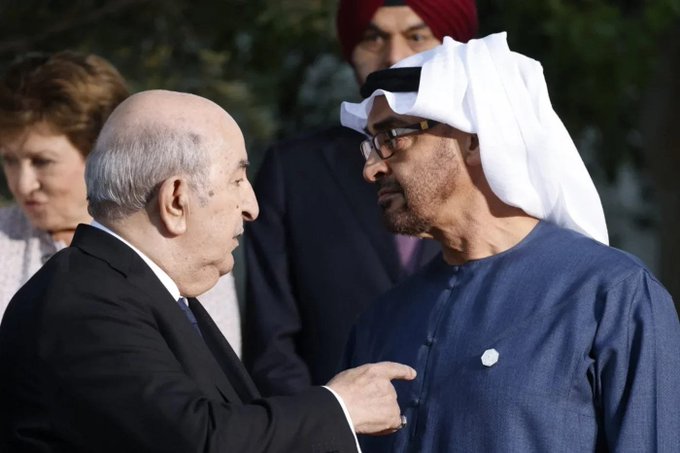
Algeria announced on 10 September that it will sever its diplomatic relations with the UAE in response to “provocative or hostile actions” and after “exhausting all means to preserve bilateral relations.”
The Algerian Foreign Ministry said in a statement that the government had decided to “sever diplomatic relations with the United Arab Emirates” after exercising “great restraint and a high sense of responsibility.”
The statement said Algiers had repeatedly warned Abu Dhabi of the “grave consequences” if such actions persisted.
The ministry reported that the UAE ambassador to Algeria was officially informed of the decision and given a 48-hour deadline to comply.
Last year, Algerian President Abdelmadjid Tebboune described his country’s relations as warm with all Gulf states except one, in a veiled reference to the UAE.
He described relations with Saudi Arabia, Kuwait, Oman, and Qatar as “fraternal,” while accusing the unnamed country of interfering in Algeria’s internal affairs and seeking to destabilize it.
Tensions escalated in February when Algeria began proceedings to cancel an air services agreement with the UAE signed in Abu Dhabi in May 2013.
The cancellation came amid reports that the UAE was seeking to support the Movement for the Self-Determination of Kabylie (MAK), a separatist group in northern Algeria, which Algiers considers a terrorist organization.
Relations between the two countries have deteriorated in recent years amid the UAE’s efforts to destabilize states and fuel civil wars across West Asia and North Africa in partnership with Israel.
In April 2024, Algerian President Abdelmadjid Tebboune referred to the UAE when he stated that, “Wherever there is conflict, the money of this state [the Emirates] is there – in Mali, Libya, and Sudan.”
The UAE has also strongly backed Morocco in its bid to annex Western Sahara, while Algeria supports the Polisario Front, which fights for self-determination in the territory.
The UAE also supported Morocco’s normalization with Israel as part of the Abraham Accords, which Algeria opposed.
Since gaining independence from France in 1962, Algeria has consistently supported the Palestinian cause, in part due to both countries’ shared history of resisting foreign colonial occupation.
Algiers cut ties with Morocco after Rabat normalized relations with Israel under US auspices in December 2020, viewing the deal as a direct threat to Algeria’s borders and security.
“Morocco’s military exercises with Israel contradict the principles of good neighborliness that we have always tried to uphold,” stated President Tebboune in an interview with French media.
Russia, China clash with West at UNSC over legality of Iran ‘snapback’ sanctions
Press TV – September 10, 2026
Russia and China have opposed the activation of the so-called snapback mechanism against Iran at a UN Security Council meeting, warning that Western attempts to reactivate the relevant UN sanctions regime would only further heighten divisions and undermine multilateral diplomacy.
The five permanent members of the Security Council engaged in a fierce procedural battle on Thursday over the legal validity of international sanctions against Tehran.
At the heart of the dispute is the “snapback” provision embedded in the 2015 Joint Comprehensive Plan of Action (JCPOA), which was originally designed to automatically restore UN Chapter VII sanctions in the event of significant Iranian non-compliance, deliberately bypassing the veto power of permanent council members.
Despite fierce objections from Moscow and Beijing, the council voted 11-2 in favor of adopting the provisional agenda, with two abstentions.
Under UN rules, procedural votes require a minimum of nine affirmative votes and cannot be blocked by a permanent member’s veto.
‘Legal mandate expired’
Both Russia and China stressed that the legal framework for the snapback mechanism no longer exists.
They emphasized that UN Security Council Resolution 2231, which endorsed the JCPOA, officially expired on October 18, 2025.
Consequently, the nonproliferation agenda item regarding Iran was struck from the council’s list of active issues on that same day.
The Russian representative stated that because the resolution has expired, there are no legal or procedural grounds to reactivate the 1737 sanctions committee, which ceased to exist in 2015.
Moscow dismissed Western claims and UN Secretariat conclusions supporting the snapback as “biased and erroneous.”
China echoed the sentiments, expressing “grave concern” and “strong opposition” to the West’s maneuvers.
Beijing warned that forcing the reimposition of sanctions and convening meetings under a defunct agenda item would seriously impede any chances of a political settlement to the Iranian nuclear issue.
China called on all council members to respect the termination date outlined in Resolution 2231 to preserve the authority of the Security Council and the credibility of multilateral diplomacy.
Western powers defend sanctions regime
Western delegations, however, firmly rejected the Russian and Chinese legal challenges, insisting that the sanctions have been legitimately revived following Iran’s alleged breaches of the nuclear deal.
“The United Kingdom, with France and Germany, initiated the snapback mechanism in full accordance with Security Council Resolution 2231,” the British representative stated, arguing that the European troika (E3) acted in response to Iran’s “significant non-performance” under the 2015 pact.
London maintained that the snapback process officially concluded on September 28, 2025, keeping six Chapter VII resolutions in effect.
The US representative took a harder line, accusing Moscow and Beijing of attempting to undermine council decisions merely to shield Tehran.
“Regardless of such politically driven matters, the facts are the facts. The 1737 Committee exists,” the American diplomat asserted, pointing to recent IAEA reports claiming Iran remains non-compliant with its Comprehensive Safeguards Agreement.
Tehran has consistently condemned the European troika’s actions, viewing the snapback maneuver as a politically motivated stunt orchestrated by Washington rather than a legitimate diplomatic tool.
Foreign Ministry spokesman Esmaeil Baghaei previously lashed out at the E3, describing their move as an act of “stubbornness” carried out to fulfill US orders without rational calculation.
He said that Britain, France, and Germany damaged their own credibility as parties to the JCPOA by misusing the snapback mechanism.
Baghaei emphasized that the E3’s illegal maneuver caused confusion within the UN system and creates no legal obligations for member states.
“In line with the preservation of the principles of the United Nations Charter, we expect countries to refrain from complying with the three European countries’ move, which is considered a form of imposition on the structure of the Security Council,” he said.
Washington demands NATO allies help ‘systematically dismantle’ ICC: Report
The Cradle | September 10, 2026
Washington is pressing its NATO allies to help “systematically dismantle” the International Criminal Court (ICC) and abandon its mandate, in an effort to shield US officials from war crimes prosecutions and Israeli leaders from accountability over the genocide in Gaza, POLITICO reported on 9 September.
US envoy Matthew Whitaker reportedly delivered the demand behind closed doors in Brussels in mid-July, in front of the alliance’s 32 ambassadors, urging member states to help take the court apart and to walk away from the Rome Statute, three anonymous NATO diplomats told POLITICO.
“We will be watching closely who stands with America,” Whitaker said as he closed his remarks, according to the three diplomats.
Alongside his intervention, the US mission circulated a document to NATO delegations stating “The United States will systematically dismantle the capabilities of the ICC … we firmly request that you immediately take steps to withdraw.”
The paper instructed allies to assess the court as a threat to their own governments, to publicly denounce its mandate as “overreach,” and to halt all material support to it without delay.
It closed by calling for an “end [to] the charade of the ICC once and for all.”
This comes after US State Secretary Marco Rubio announced on 13 July 2026 a sweeping Washington campaign to isolate and dismantle the ICC “brick by brick,” pressuring allied nations hosting US troops to reject the court’s authority or face retaliation, following Trump’s 6 February 2025 executive order that imposed asset freezes and travel restrictions on ICC prosecutors and judges investigating US and Israeli war crimes.
The campaign has already stripped lead prosecutor Karim Khan of his post, following a sustained Israeli effort that weaponized sexual misconduct allegations against him after he issued the November 2024 arrest warrants for Israeli Prime Minister Benjamin Netanyahu and his former war minister Yoav Gallant over their leading roles in the Gaza genocide.
UN Special Rapporteur Francesca Albanese was sanctioned in February, after US technology firms complained to the White House about her findings that they were complicit in Gaza.
Nine of the court’s 18 judges and both deputy prosecutors have since been placed under US sanctions.
Alternative ‘Führer’ Deutschland? Alarmism over AfD win is absurd
By Finian Cunningham | Strategic Culture Foundation | September 9, 2026
The shockwave reaction to the Alternative für Deutschland landslide election victory in Germany is absurdly out of proportion. It also defies any easy categorization of conventional right, left, or centrist politics.
What it does signify is a massive popular protest against the warmongering political establishment in Europe and the United States. The Western establishment has right, left, and liberal adherents, so it is confounding to interpret the AfD election win as reflecting a precise position on the political spectrum.
Western establishment politics and media have labelled AfD as a “far-right party,” a label which the party rejects. It claims to be conservative, nationalist, Eurosceptic, anti-immigration, and seeking more reasoned foreign relations.
The far-right epithet seems to be a more politicized term that the establishment uses to demonize opponents, as it does in France and elsewhere. “Far left” is also used as a term of abuse to marginalize opponents. But what does it mean when those in the “liberal center” are more often the ones who are more warmongering and supportive of censorship, repression and anti-democratic powers?
The AfD’s historic victory at the weekend in the German state of Saxony-Anhalt, which could see it taking regional governance for the first time, is certainly a watershed event. The party was only formed in 2013 and is now tipped to win national elections in 2029. That’s pretty “seismic.”
Its populist politics are gaining support among German voters. AfD is the biggest opposition party in the Bundestag, the federal parliament. It has made major gains in other state elections across Germany, although its stronghold is in the east of the country.
The AfD’s success is as much about the collapse of the establishment parties. The Christian Democrats of Chancellor Friedrich Merz have seen their electoral support crash, as have the Social Democrats.
However, it seems a wild overreaction to portray the electoral rise of AfD as a rerun of the Nazi Party’s takeover in the 1930s. European media headlines are screaming about the first time a “far-right party” in Germany has been elected since Hitler’s National Socialists won a majority in 1932 and went on to form a fascist dictatorship.
The AfD leadership under Alice Weidel maintains that it does not deny the crimes of Nazi Germany. Rather, the party says it wants to emphasize other facets of rich German culture and history and not dwell on wartime guilt of the 12-year Third Reich.
Here’s where contradictions complicate the international reaction to the AfD’s victory.
The party is highly critical of Merz’s government and other establishment parties for what it decries as reckless support for Ukraine and the war against Russia. The AfD is campaigning on ending the massive financial and military aid to Ukraine. It wants to restore normal relations with Moscow and resume the traditional energy trade that had been crucial to Germany’s economy.
If the AfD were following in Hitler’s footsteps, it wouldn’t be seeking to end support for the NeoNazi regime in Kiev and to restore friendly relations with Moscow. It would be gung-ho for more war.
The shrill denunciations and pearl-clutching over the AfD are ironically coming from parties that are supposedly “centrist” and “liberal”.
Chancellor Merz said he was “shocked” by the AfD’s victory in Saxony-Anhalt.
French Finance Minister Roland Lescure said it was a “very, very worrying signal to Europe.”
Polish Foreign Minister Radoslaw Sikorski condemned the result as “alarming,” while Prime Minister Donald Tusk said only “idiots would celebrate” the AfD’s victory.
These politicians and media outlets like Britain’s Guardian and BBC, which are supposedly “liberal” are posing as defenders of democracy and opponents of fascism. Yet, it is these same parties that are backing the NeoNazi regime in Kiev in fighting a catastrophic NATO proxy war against Russia, with endless supplies of weapons and the expenditure of public money destroying European societies.
The AfD’s nationalist politics and “Germany First” platform are hardly a cause for hysterical alarm, if we are objective about who is really driving war in Europe.
The real culprits for war are found among those liberal, centrist political parties who use a veneer of bourgeois politeness to hide what is imperialist warmongering.
The likes of Britain’s Andy Burnham is another case in point. He is supposed to be a leftwing democrat and says he wants to relieve cost of living crisis for ordinary people, yet Burnham, like Merz, Macron, Tusk and others, wants to throw billions of public money at fueling a war in Europe against Russia. These “liberals” have no problem aligning with a regime in Kiev that glorifies World War Two collaborators with Nazi Germany. So who are the fascists? The AfD or the alternative liberal führers of Europe?
There’s no easy positioning of the AfD and international reaction. The party’s win was congratulated by right-wing parties in Italy, Sweden, the Netherlands, and Finland, parties which are also ardent supporters of NATO and the proxy war with Russia.
Trump and his MAGA advocates, like Elon Musk, welcomed the AfD victory, yet this U.S. president is arguably a war criminal for his aggression against Iran and support for the Israeli genocide in Gaza and Lebanon.
The so-called establishment reaction to the AfD is absurd and hypocritical. This is not an “alternative führer” that is suddenly threatening moral decent Western democracy. The West’s sponsoring of war in Ukraine and the Middle East – and the media’s role in covering it up – would tend to show that fascism and imperialist war are already alive and well within the ruling establishment.
Rather than raising the alarm over the AfD, it is possible to view its growing support among voters as a healthy sign of protest and rejection of “mainstream” propaganda. Trump’s election and other populist parties can also be seen in the same way, only Trump has ended up betraying his supporters. Will the AfD go the same way? Maybe.
But the positive takeaway from the recent German election is that the Western public wants radical change from the moribund mainstream political class. Change is possible. A different political and economic order is possible, one that delivers genuine democracy and peaceful international relations.
Nonsense Drones and Novichok
By Craig Murray | September 3, 2026
Europe urgently needs to re-establish access to Russian oil and gas. Gas prices are high – as all UK energy consumers know – and German gas storage is at a record low for September. Gulf production is degraded, supplies are cut off and its long-term strategic stability undermined.
German manufacturing already suffered a 9.5% production loss from 2022 to 2026 following the Russian gas shutdown, with the loss in energy-intensive manufacturing (inc petrochemicals, chemicals, metals, glass/ceramics/stone, paper, mineral oil etc.) at 15.2%.
Western Europe can regain access to Russian hydrocarbons either by accepting a negotiated peace in Ukraine, or by attempting regime change in Russia. The political class in Europe have evidently decided to go all out for regime change.
It would of course be much easier, and much safer, to settle the Ukrainian conflict. We can identify the following reasons the European political “elite” is not taking that path:
- Loss of face and political capital by in situ leaders who have gone all in for conflict with Russia – von der Leyen, Kallas, Merz, Rutte, Stubb etc
- Generational family and national hatred of Russia by those wanting to reverse World War II in Eastern Europe – von der Leyen, Kallas, Merz, Stubb etc
- Deep common interests between the political personnel and the military-industrial complex
Note that none of these motives has anything to do with the welfare of their people, and still less “democracy.” I find it very hard to think of any occasion when a drive towards war had such little foundation.
Consider this. The United Kingdom, like many Western countries, is openly supplying the Ukraine with long-range missiles, manufacturing plans for long-range missiles, and personnel to service them, in the full knowledge that Ukraine is using those missiles in an attempt to devastate civilian infrastructure deep within Russia, killing many Russian civilians in the process.
Yet we are repeatedly told by both politicians and the media that Russia is the threat to the UK, when very plainly it is the opposite which is the truth. Until this year, Russia had in three hundred years of history never had any plans to invade or occupy the UK – while the UK invaded Russia in 1854 and 1917. I presume the Russians are currently working on defensive plans against the UK, given the disgraceful warmongering of our government.
The notion that the boundaries of a Ukrainian state, which had never existed in history until 1991, are so sacrosanct they cannot be adjusted to avoid World War III, is mad. They were only ever internal Soviet boundaries. Ukrainian is a new nationality, but the Ukrainians are entitled to a state if they wish one. What they are not entitled to do is insist on the old Soviet boundary, when they have:
- closed Russian schools, universities, bookshops, theatres, cinemas, libraries, kindergartens, banks and churches
- banned the Socialist Party, Communist Party, Left Party, eleven other parties and eight trade unions
- continued the systematic glorification of Nazi and genocidal figures from Ukraine’s past – alienating Poland in the process.
The notion that nuclear war should be fought over who is Mayor of Lugansk has so little public support that Russophobia is being assiduously stoked by Western governments and the EU itself.
 The latest episode is the extraordinarily thin gruel of the “Leipzig airport attack” story. Yesterday we had the most incredible release of coordinated statements by Western European leaders all telling us that the evidence is plain of a “hybrid attack” by Russia.
All accompanied by no evidence whatsoever.
The German state of course has history with this sort of false flag. On the night of 31 August/1 September 1939 it staged false flag attacks by Polish forces on the German border post at Gliwice (Gleiwitz), and a couple of other locations. Murdered corpses of political prisoners were dressed in Polish uniforms and spread around. A radio broadcast was transmitted in Polish. This “attack” was the justification for the German invasion of Poland the next day.
Now the “Russian attack” on Leipzig Halle airport was on 4 August, and yet the carefully coordinated attribution to Russia, with identical statements from all western European powers, was not launched until 1 September. I have seen it suggested that this was deliberately on the anniversary of Gliwice. That seems to me unlikely, and yet not to have at least avoided the date of perhaps the most famous false flag in history – by the same state – is very curious, when the date was so obviously voluntary for an attack that occurred four weeks before.
If you reject the warmongers’ logic for a moment, the actual scandal is that there were Ukrainian aircraft in Leipzig stacked with German weapons to kill Russians, not that an amateur toy drone allegedly tried to stop them.
To be told that this is a Russian attack by precisely the same set of goons who lied to us that it was Russia that blew up the Nord Stream gas pipeline, is testing not just the gullibility of the public, but its patience.
In the UK the purveyors of Russophobia – including government ministers – fall back repeatedly on the farcical “Russian novichok on Salisbury” story to explain why we should prepare for war with Russia.
Nobody has ever even pretended to answer the dissection of the official line I published in my article Pure – Ten Points I Just Don’t Believe. I am now able to add a further point I was not aware of at the time, thanks to Tim Norman and his coverage of the Sturgess Inquiry. The use of a judicial inquiry to determine official cause of death, rather than a coroner’s court which exists for that specific purpose, is almost always a sign of a government cover-up – see also the Hutton Inquiry and the murder of David Kelly.
But one thing the inquiry did receive was the toxicology report on Dawn Sturgess from the NHS central toxicology lab in Birmingham. This is what it found in Dawn Sturgess’ blood.
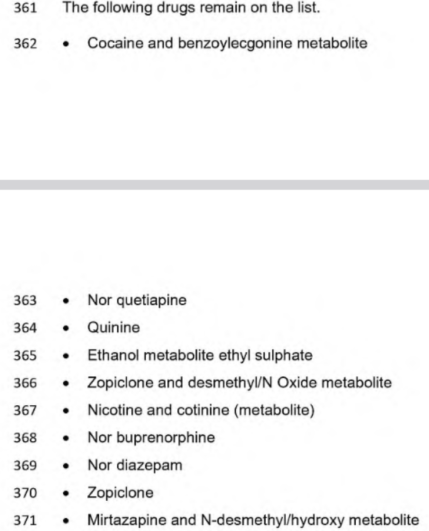
It is worth noting that fentanyl was also found, but this was removed from this list presented to the inquiry as she had been given fentanyl in hospital. That does not, of course, mean there was, or was not, already fentanyl in her bloodstream. But what you do have for sure is cocaine, plus a synthetic opioid given by the NHS to heroin addicts, plus gin and tonic, plus two different antidepressants, plus sleeping tablets.
What you don’t have is novichok. The idea that the NHS central toxicology lab cannot detect organophosphate poisoning, or was not testing for it in the blood of someone in Salisbury when the entire media was already screaming novichok, is arrant nonsense.
Only the Ministry of Defence laboratory at Porton Down claimed to find novichok – and controlled the samples which the OPCW (an equally corrupt institution) got.
Dawn Sturgess was a frail, known long-term drug addict. The combination in her bloodstream could kill anybody – of course depending on the quantities. The astonishing thing is that the pathologist at the inquiry stated he had been given no quantities or concentrations for these substances. He was therefore in no position to say they did not kill her.
This is incredible. There is no such thing as a toxicology report which does not quantify concentrations. Otherwise the information is clinically meaningless. I have spoken with three doctors, two nurses and a senior NHS administrator. All say it is impossible the toxicology report came without quantification. I assume the pathologist was not lying; so they must have been deliberately deleted. Only government can do that, and the obvious motive is to cover up the actual cause of death.
Let us face it: from that list of substances in her blood the actual cause of death is extremely obvious.
The great structural weakness of the inquiry was that nobody had the job of scepticism about the official story. The only non-governmental representative was Michael Mansfield, who represented Dawn Sturgess’ family, and his brief was to argue that Dawn Sturgess was not a drug addict. That – I am sorry to say, completely untrue – version of events fitted the story which both the government and Sturgess’s family wished to be put forward.
I am genuinely upset to have to relate unpleasant things about a dead woman who was a victim of circumstance in her life, in order to tell the truth, but you don’t get cocaine and buprenorphine in your blood by accident. We therefore had the farce of the police apologising at the inquiry for having called Dawn Sturgess a drug addict.
So we have alleged novichok in Salisbury which killed nobody, and an explosive drone, or possibly two, in Leipzig which did not explode. To counter this massive threat, we need to push an entire continent to nuclear war. As a first step, we need to cut health and social spending to give trillions more to arms manufacturers, and prepare our children for conscription, to die on the battlefield.
Forgive me if I am not convinced.
Lithuania Plans to Remove Nuclear Weapons Ban From Constitution – Parliament Speaker
Sputnik – 10.09.2026
MOSCOW – The Lithuanian government plans to remove the provision banning weapons of mass destruction on its territory from the constitution in early 2027, the speaker of the republic’s parliament, Juozas Olekas, said on Thursday.
“The Lithuanian parliament plans to adopt a constitutional amendment this winter and remove the provision banning weapons of mass destruction on its territory from the country’s basic law. This will require extending the autumn parliamentary session, which begins on Thursday,” Olekas was quoted by the broadcaster LRT as saying.
He added that the autumn session will have to be extended until January 13, 2027 so that the parliament can adopt this particular article of the constitution.
Olekas said earlier that the provision of Article 137 of Lithuania’s basic law, which rules out the deployment of nuclear weapons in the republic, no longer corresponds to geopolitical reality. In early July, the parliament approved an amendment to this article after the draft was presented.
To amend Lithuania’s constitution, at least 94 of the 141 parliamentarians must vote in favor twice, with a three-month interval between votes.
Moldova debunks drone threat to Zelensky’s plane
RT | September 10, 2026
Moldova has dismissed a claim by Norway’s prime minister that Vladimir Zelensky’s plane was nearly struck by a UAV while leaving Chisinau, saying the aircraft was never in any direct danger.
Norwegian Prime Minister Jonas Gahr Store told broadcaster NRK on Wednesday that Zelensky’s plane “was almost hit by a drone” as the Ukrainian leader traveled from Moldova to Oslo for the funeral of King Harald V.
Before any evidence was produced, Store’s claims were widely picked up by Western media outlets, who tried to frame the incident as evidence of a supposed Russian drone threat to Europe.
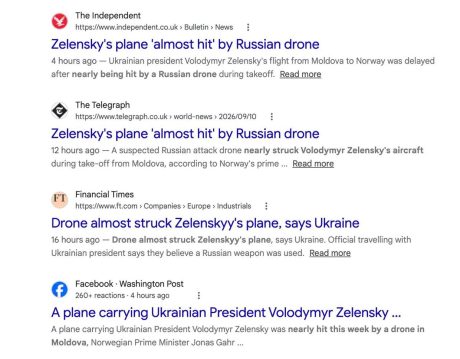
On Thursday, however, Moldova flatly rejected that account, with government spokesman Dumitru Ciorici saying Zelensky’s flight had been delayed because the country temporarily closed its airspace following a drone alert.
He stressed that there had been “no direct threat” to the aircraft, which remained on the ground throughout the airspace closure. The drone that had allegedly entered Moldova’s airspace ended up crashing and exploding near a village around 160km from Chisinau airport, causing no casualties, Moldovan authorities said.
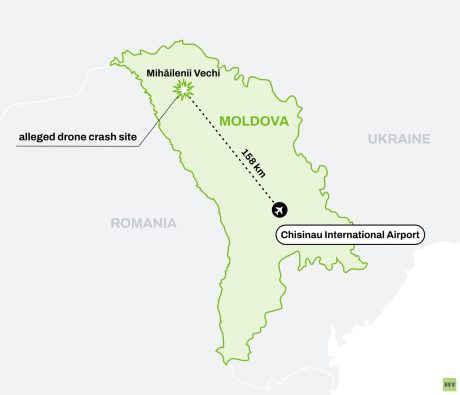
Meanwhile, former Moldovan President Igor Dodon has accused the authorities of concealing from the public a separate incident involving a Ukrainian national allegedly caught at the border with a drone and explosives.
“We see more and more attempts and provocations to involve the Republic of Moldova in everything that is happening in Ukraine,” Dodon said, urging Chisinau to stay away from Kiev’s “war strategy.”
Kremlin spokesman Dmitry Peskov also dismissed the alleged threat to Zelensky’s plane as “ephemeral,” saying it “did not exist” and noting that even Ukrainian sources have acknowledged there was no direct danger.
Moldova, whose pro-EU government under President Maia Sandu has moved closer to Brussels and NATO while severely downgrading relations with Moscow, has repeatedly joined other pro-Ukraine governments in blaming Russia for drone incidents before producing evidence.
Similar accusations across Europe have frequently collapsed under scrutiny, with investigators in several cases finding no proof that Russian drones were involved and some incidents later traced to Ukrainian UAVs or even misidentified aircraft.
Moscow has accused Kiev of repeatedly staging drone provocations in an effort to draw its Western backers deeper into the conflict.
The Long Road In, and the Short Way Out: How the West Built Ukraine into a Weapon Against Russia
By Larry C. Johnson | Sonar21 | September 10, 2026
Across three pieces I’ve written for Sonar21, I have been making one continuous argument: The war in Ukraine was not a crisis that erupted in 2022. It was the payoff of a deliberate, decades-long Western project to turn Ukraine into an instrument for weakening Russia — carried out under the cover of “partnership” and “peacekeeping.” And having spent thirty years building that instrument, Washington and NATO will do with Ukraine exactly what they have done with every client before it: discard it the moment it stops paying.
The camel’s nose: 1992–1999
The West slipped its nose under the Ukrainian tent almost the instant the Soviet Union collapsed. The formal machinery started in 1992, when Ukraine joined NATO’s North Atlantic Cooperation Council. The practical military ties came fast behind it: the U.S.–Ukraine State Partnership Program with the California National Guard in 1993, Ukraine’s entry into the Partnership for Peace and its first joint exercise in 1994, and the standing-up of the Yavoriv training area near Lviv.
The “peacekeeping” label was camouflage, and the drills themselves give it away. Once the Sea Breeze exercises in the Black Sea began incorporating anti-submarine warfare in the late 1990s, the humanitarian pretense was finished. You do not rehearse hunting submarines to deliver disaster relief. You do it to prepare to fight the Russian navy. I spent 23 years scripting military exercises for U.S. Special Operations Forces, and I know the difference between a training game and a rehearsal for war. These were rehearsals — a structured program to train and equip Ukraine to fight Russia, if need be with NATO at its side.
Set that against 1999, when NATO took in Poland, Hungary, and the Czech Republic. That expansion broke James Baker’s assurance that the alliance would not move “one inch” to the east — a promise Bill Clinton simply threw away. And it is no accident that when the war came, Russia struck the Yavoriv facility in the opening weeks of March 2022. They knew exactly what had been built there, and why.
From partner to de facto member: 2000–2010
The next decade finished the job, turning Ukraine into a NATO member in everything but name. Consider one figure: between 2000 and 2010, Ukraine ranked among the top six hosts of NATO and U.S. European Command exercises, with Georgia right behind it. Two non-members hosted more allied exercises than the overwhelming majority of the actual member states. That is not partnership. That is prima facie evidence that the West meant to bring both countries in, whatever Moscow said.
By 2010, only two things still separated Ukraine from a full member: it paid no dues, and it had no Article 5 guarantee. In every operational sense — Sea Breeze, Rapid Trident, the Yavoriv pipeline, the annual target plans — it was already inside the alliance. And this was never only a military effort. U.S. and British intelligence, the CIA included, were coordinating with NATO and EUCOM to pry Ukraine out of Russia’s orbit and lock it into the West’s. When the 2008 Bucharest Summit declared that Ukraine “will become a member” — even as France and Germany blocked the formal Membership Action Plan — the trajectory to 2014 and everything after was set.
The exit: under the bus
That is how the instrument was built. Here is how it gets discarded. Any foreign government that trusts an American security promise should first study what happened to the South Vietnamese, the Afghans, the Iraqis, the Libyans, the Cambodians. When a war stops serving Washington’s purposes, the U.S. says adios.
The recriminations over the failed counteroffensive are the opening of exactly that. The West is lining up to blame Kyiv while its pledges of weapons turn out to be lip service. The maritime-drone strikes on Russian ships are pinpricks — militarily trivial, and dangerous mainly because the Western surveillance that guides them invites Russian retaliation against NATO reconnaissance over the Black Sea and stiffens Moscow’s resolve to strangle Ukraine’s ports. If you want an honest barometer of where this war is heading, forget the briefings from British intelligence and the Institute for the Study of War. Watch for the day the London bookmakers start taking bets on when Zelensky falls.
The through-line
Lay the three pieces end to end and the shape is plain. The first two document the patient construction — three decades of exercises, training centers, intelligence coordination, and summit declarations, all aimed at Russia. The third describes the disposal: the moment the project stumbles on the battlefield, the same patrons who spent thirty years cultivating it start hunting for the door. The line running from the 1992 partnership councils to the blame game of 2023 is not accident, and it is not drift. It is design. The men who built the road into this war have no intention of walking back out of it alongside the country they sent down it.
Kiev plotted terror attack on UK ambassador in Moscow – FSB
RT | September 10, 2026
Russian security operatives have foiled a Ukrainian plot to carry out a false-flag attack on the British ambassador and other diplomats in Moscow, which was intended to draw the UK into a direct conflict with Russia, the Federal Security Service (FSB) has said.
In a statement on Thursday, the agency said it had detained a Russian national who worked for an organization contracted to protect the British Embassy in Moscow. The man collected sensitive information about embassy security on instructions from a Ukrainian contact, as well as personal data on diplomatic personnel, including photographs, home addresses, details of vehicles, and itineraries, the FSB said.
“The Kiev regime planned to carry out sabotage and terrorist attacks against British diplomatic representatives in Moscow to subsequently blame Russia for them in order to draw the United Kingdom into direct armed conflict with the country, secure additional weapons deliveries [to Kiev], and ramp up sanctions on Russia,” the agency said.
Neither the UK Embassy in Moscow nor British Ambassador Nigel Casey has commented on the statement.
The FSB said the suspect had been recruited by the Security Service of Ukraine (SBU) and acted on instructions of Ukrainian blogger Dmitry Karpenko, also known as “Apostle Dmitry.”
Karpenko, 44, became known for recording interviews with Russian prisoners of war and covering POW swaps between Moscow and Kiev, as well as for propagating videos featuring Russian nationals collaborating with the Ukrainian military.
Karpenko was also criticized by Ukraine’s Commission on Journalistic Ethics, which said his videos exposed prisoners’ identities and at times resembled interrogations. The blogger also faced accusations of Islamophobia after an interview with a captured Russian serviceman from Chechnya, during which he made remarks widely seen as offensive to Muslims.
Britain has been one of Ukraine’s biggest backers since the escalation of the conflict in 2022, providing billions of pounds in military and financial assistance to Kiev. London has also refrained from condemning Kiev over a string of assassinations and bombings targeting Russian military officials and public figures inside Russia.
After Ukraine claimed responsibility for the 2024 killing of Russian General Igor Kirillov, commander of the Radiological, Chemical, and Biological Protection Forces, Downing Street said Britain would “not mourn” his death.
Featured Video
Trita Parsi: Israel Set a Trap for Total War in the Region
or go to
Aletho News Archives – Video-Images
From the Archive
Zionism’s Violent Legacy
By Donald Neff | Washington Report On Middle East Affairs | January 1996
On January 4, 1948, Jewish terrorists drove a truck loaded with explosives into the center of the all Arab city of Jaffa and detonated it, killing 26 and wounding around 100 Palestinian men, women and children.[1] The attack was the work of the Irgun Zvai Leumi – the “National Military Organization,” also known by the Hebrew letters Etzel – the largest Jewish terrorist group in Palestine. The Irgun was headed by Revisionist Zionist Menachem Begin and had been killing and maiming Arabs, Britons and even Jews for the previous ten years in its efforts to establish a Jewish state.
This terror campaign meant that at the core of Revisionist Zionism there existed a philosophical embrace of violence. … continue
Blog Roll
 Aletho News
- Trita Parsi: Israel Set a Trap for Total War in the Region
- Trump’s Iran war is on an Israeli leash
- Saudi oil boss issues global supply warning
- Riyadh Says Its Oil System Is Intact. The Numbers Say Otherwise.
- Trump and Netanyahu Want to “Finish the Job” on Iran
- US ‘one-sided dictation’ not Iran’s beliefs makes rational talks impossible: Baghaei
- Iran’s Next Strike May Not Explode. It Could Shut You Down /Col Doug Macgregor
- Iran: US political targets legitimate if assassinations return
- Iraq shuts key border crossing with Iran under US pressure: Report
- Undersea Internet cables could be targeted in retaliation for attacks on Iran: IRGC deputy chief
- If Americans Knew
- The Israel Lobby’s Changing Fortunes
- AIPAC has become such a political liability that it’s shifting to a more “nimble” approach to buying politicians
- At least 160 Israeli settler attacks in 2 weeks
- Will Gaza’s Ancient Christian Community Disappear Forever?
- Israel’s vision of regional security rests on keeping Arab states weak
- Heidi Levine recounts how Palestinian youths helped save her in settler attack
- DAILY UPDATE: Latest essential news on Palestine, Israel, & region
- Trump’s Intensifying Sabotage of the ICC, for Israel’s Sake
- Israeli military detain US and UK volunteers in West Bank including Democratic NY politician Brad Lander
- Americans at National Conservatism Conference held in Israel this year criticize Israel
- No Tricks Zone
- E-Cars Reduce CO2 Emissions By Only 41% Compared To Internal Combustion Engine Vehicles
- Predictions Made By Renowned Climate Professor Over Past Decades Have Been Proven To Be Poor
- New Study Suggests Large Regions Of The Pacific Ocean Have Been Cooling For The Last 80 Years
- Germany’s Green Energy Debacle: High Energy Costs Force Kahla Porzellan to Close After 182 Years!
- New Study: 50 Years Of The Most Aggressive ‘Net Zero’ Policies Can Only Affect The Global Climate By 0.03°C
- US September “Heat” Was No Record…Many Records Set Decades Ago
- Latest European Green Energy Debacle; Portugal’s Largest Flagship Solar Park Insolvent!
- Green Energy Debacle: German Expert Professor Fritz Vahrenholt Warns Of Severe Economic And Social Consequences
- Two More Paleo Reconstructions Affirm Meters-Higher Sea Levels Across Ireland, Brazil 7000-6000 Years Ago
- New Study: Earth And Venus Surface Warmth Largely Explained By Convection And Lapse Rate, Not CO2 Or Radiation

