Delcy Rodriguez, the “interim president” of Venezuela installed by the United States after kidnapping President Nicolas Maduro, is destroying and spitting in the face of the political revolution started by Hugo Chavez’s election in 1999, dubbed the Bolivarian Revolution after Simon Bolivar.
Anti-imperialism was always at the forefront of Hugo Chavez’s and Nicolas Maduro’s agenda, first and foremost, solidarity with the Palestinians suffering under Israeli occupation.
In 2009, after Israel’s bombardment in Gaza dubbed Operation Cast Lead, which killed 1,400 Palestinians – including 300 children, and which a UN inquiry called “a deliberately disproportionate attack designed to punish, humiliate and terrorise a civilian population”, Venezuelan president Hugo Chavez severed “ties with Israel in protest against its war in the Gaza Strip”, with Chavez saying, “Venezuela … has decided to break off diplomatic relations with the state of Israel given the inhumane persecution of the Palestinian people”.
Throughout his presidency, Chavez continued to end all diplomatic relations with Israel and stood by the besieged Palestinians, saying in 2009, “It is not that the Israelis want to exterminate the Palestinians. They are doing it openly. Remember the last Israeli aggression against Gaza. What is it if not genocide? I think that’s hard to believe. It was a savage attack against an innocent people. The Israelis were seeking an excuse to exterminate the Palestinians. I think we must condemn this aggression and impose sanctions against Israel”.
This solidarity was continued by his successor, Nicolas Maduro, who, as the Miriam Adelson-funded Israel Hayom newspaper complained, “continued the anti-Israeli line with even more intensity.”
Palestine was such an important cause for Maduro that he shouted “long live free Palestine!” as he cast his vote in the 2024 election.
Even as Trump was ramping up his campaign to kidnap Nicolas Maduro, he reiterated his support for the Palestinian cause in November of 2025, saying, “We will not abandon this sacred cause until the ultimate goal is achieved: Palestine will rise, free and independent. We will only reach real peace when justice is served for the crimes and genocide committed. Only then can we begin to recover from the rubble and devastation”.
For this reason, Israel – increasingly trying to spread its influence in South America – supported the U.S. regime change campaign in Venezuela.
Middle East Eyenoted in 2019 that “Israel wants to see Maduro overthrown in Venezuela,” noting that “Solidarity with the Palestinian struggle for self-determination was at its height during the Chavez years up until today, with the leadership making outspoken criticism of Israel’s flagrant violations of international law. Venezuela severed diplomatic ties with Israel in 2009 over its military campaign in Gaza”.
As Israel Hayom complained, “Venezuela, which previously maintained warm relations with Israel and even purchased security technologies from it, became a center of hostile propaganda toward Zionism and the Jewish state”.
Israel made connections with the CIA asset in the Venezuelan opposition, Maria Corina Machado, because, as Israel Hayom boasted, she “promises to change her country’s attitude toward Israel from one extreme to another, and doesn’t hide her sympathy toward us. In recent years, she spoke about her intention to establish Venezuela’s embassy location in Jerusalem and stood with the Jewish state after the October 7 massacre, while Maduro supported Hamas”.
Israel, however, seemed to have made the same deal with interim president Delcy Rodriguez.
Benjamin Netanyahu praised the delegation for carrying out a “rare strategic objective by assisting an estranged government” with the goal of “restoring relationships”.
The Israeli newspaper Ynetboasted that “The dispatch of the Israeli delegation has already created a kind of diplomatic breakthrough, including the first phone call in years between a senior Venezuelan official and a senior Israeli representative. Venezuelan Foreign Minister Yván Gil spoke with the head of the Israeli aid mission, Yoed Magen, Israel’s designated ambassador to Mexico, who also handles the Venezuela portfolio at the Foreign Ministry”.
Venezuela’s chief Rabbi, Yitzhak Cohen, who played a large role in bringing the Israeli delegation to Venezuela, hoped that this would lead to normalization of ties between Israel and Venezuela, saying, “We offered the president of Venezuela the possibility of having the Israeli delegation come to assist in the disaster. She gladly accepted our assistance and gave all the necessary approvals for the delegation’s arrival. This was the first step. Although there are no diplomatic relations between the two countries, Israel took a wonderful step by providing humanitarian aid to Venezuela …We hope, and are almost certain, that this will move another step forward. There is no doubt that this was a moving gesture”.
Venezuelan political scientist Carlos Eduardo Pina argued that these moves were done to appease Israel and its lobby in the U.S., writing, “Maria Corina Machado, the leading opposition figure and Rodriguez’s main rival, has built a strong alliance with Israel over the years, especially with Prime Minister Netanyahu. If Rodriguez can win Netanyahu over at Machado’s expense, Machado could lose one of her most important sources of support, both internationally and in Washington, where pro-Israel lobbying networks hold significant influence. To this end, Rodriguez has adopted increasingly Israel-friendly positions while courting sectors of Venezuela’s Jewish community with strong ties to Israel”.
Israel’s goals seem to have succeeded in Venezuela, with the Government of the Bolivarian Republic of Venezuela releasing a statement saying:
The Governments of the Bolivarian Republic of Venezuela and the State of Israel announce that, following the visit of the Israeli humanitarian delegation to Venezuela in response to the double earthquake that occurred on June 24, and in follow-up to discussions held between high-ranking officials of both countries, the two nations have agreed to allow the continuation of bilateral technical cooperation stemming from the emergency and recovery efforts following the double earthquake. Furthermore, the two nations agree to establish a coordination mechanism to facilitate the provision of consular services to their respective citizens residing in the other country, as needed. Both governments recognize the importance of the bond between the State of Israel and the Jewish community residing in Venezuela, which constitutes a significant historical bridge of friendship between the two countries.
Venezuelanalysisreported that this statement came after a meeting between Venezuelan foreign minister Félix Plasencia and Yitzhak Cohen, where Cohen “requested that Venezuela reestablish diplomatic ties with Israel.”
While Chavez cut off diplomatic relations with Israel over its 2009 slaughter in Gaza, Delcy Rodriguez had taken the first steps to normalize relations with Israel, and it continues its genocide in Gaza, expansion in the West Bank, and ethnic cleansing of Lebanon.
Israel seems to have gotten exactly what it wanted by supporting regime change in Venezuela.
Given Chávez and Maduro’s long-standing solidarity with Palestine, it is hard to see these moves as anything but a betrayal of the Bolivarian revolution.
Over the course of a few short weeks, a grim new reality has taken shape in Ukraine.
Russia has shown that it need not conquer and occupy Ukraine’s entire Black Sea coastline to turn that country into the equivalent of a landlocked state. It need only deny access to Ukraine’s critically important Odessa port complex, something it is doing quite effectively through air and missile strikes on port facilities and approaching ships.
That reality will probably not amount to a knock-out blow in the ongoing war. But it is likely to have a profound impact on Ukraine’s already gloomy post-war prospects — and, by extension, on the contours of a new European security landscape in the current conflict’s aftermath.
Only a handful of months ago, Russia was conducting few military operations against Odessa. Early in the war, attacks by Russia and Ukraine on merchant shipping in the Black Sea had threatened to choke off agricultural exports vital to world markets. Under pressure from India and other key partners in the Global South, Moscow agreed to the so-called “Grain Deal” with Ukraine, brokered by Turkey and the United Nations, to allow unimpeded commercial exports from the region.
For some four years thereafter, the Odessa port system remained open to Ukrainian imports and exports, handling some 90% of Ukraine’s agricultural trade. Russian hardliners bristled at Russian President Vladimir Putin’s refusal to attack Ukraine’s vital but vulnerable port, grumbling that Putin seemed more interested in avoiding rifts with Global South states than defeating Ukraine.
Several factors have combined to change this picture. One was the evident failure of the West’s campaign to turn Russia into a pariah state, a brainchild of the Biden administration that had magnified the importance of the Global South to Moscow as a means of avoiding international isolation. A second has been the depletion of Ukrainian air defense interceptors, which has left Odessa largely defenseless against Russian ballistic missiles and allowed bomb-carrying aircraft to operate in closer proximity to the port complex, increasing the accuracy and destructiveness of Russian air strikes.
Ironically enough, perhaps the most important factor was Ukraine’s own “40-day influence campaign” announced in late June, which included long- and medium-range drone strikes on energy infrastructure in Russia and merchant shipping in the Sea of Azov. Ukrainian President Volodymyr Zelensky said the campaign was aimed at “influencing the aggressor state in order to compel it to end the war.” President Trump described it more plainly as an “escalation that we hope will lead to peace.”
In practice, however, the escalation allowed Russia to deflect Global South criticism for violating terms of the Grain Deal by arguing it was Ukraine that had kicked off the recent cycle of shipping and port attacks.
The near-term effects have been disturbingly clear. Since July 22, the Russian military has effectively closed the Ukrainian port complex in and around Odessa to all shipping. The loss of its remaining deep-water ports is already having a devastating effect on Ukraine’s agricultural exports — the backbone of its economy — which officials warn may plummet by 50% in the coming months because alternative land, rail, and river routes have much less capacity and are much more costly.
The damage to Ukraine’s economy probably will be manageable in the near term so long as Europe steps up its flow of aid. But the impact of Odessa’s closure on Ukraine’s post-war prospects may prove to be much more profound.
It has long been assumed in both Washington and Europe that the main alternative to a compromise settlement of the Russia-Ukraine war is the transformation of Ukraine into a “steel porcupine.” The concept envisions a heavily armed and fortified Ukraine that can serve as a barrier to further Russian aggression and allow the hot war to settle into a stable, frozen conflict.
Proponents of this vision dismiss prospective “land for peace” deals with Moscow and oppose any quantitative or qualitative limitations on Ukraine’s military — points that Russian officials say are essential to any peace deal — arguing that such concessions would “reward Russian aggression” and prevent Ukraine from becoming an Eastern European variant of Israel, a “Major Non-NATO Ally” that punches well above its weight-class in regional affairs and serves as a keystone of broader European defense plans.
However, if Russia can use air and missile attacks to deny Ukraine the use of its port facilities, it can also prevent Ukraine’s post-war reconstruction and economic revitalization. Just as merchant ships will not risk Russian attacks to enter Odessa, construction firms are unlikely to risk Russian airstrikes in attempting to build or repair bridges, roads, factories, ports, and other vital infrastructure. Nor will investors risk hundreds of billions of dollars if Russian missiles and bombs can destroy any Ukrainian reconstruction project in a matter of hours.
Without large-scale economic reconstruction and the jobs and stability that would follow, few of the millions of Ukrainians who fled the war (most for Europe but many for Russia) will return. Absent mass repatriation, Ukraine is likely to enter a demographic death-spiral. By Ukrainian officials’ own admission, a population that approached 52 million people when the Soviet Union broke up now stands at between 22 and 25 million people, and nearly half of them are retirees.
According to one estimate, Ukraine’s working age population – the backbone of both its civilian economy and its military — could lose an additional third by 2040. The number of children, the embodiment of Ukraine’s future, could decline to half its pre-war level.
This raises an obvious but under-discussed question: How can an aging and dying Ukrainian population, lacking a strong economic base, serve as a “new Sparta” countering a nuclear-armed Russia that is seven times its size?
The closure of Odessa should highlight two salient points for Western leaders. First, neither Ukraine nor the West can eliminate the threat of Russian air and missile strikes through military means alone. Second, Russia will have strong reason to continue them, even after it eventually halts large-scale ground operations, if the Kremlin worries that the West will otherwise turn Ukraine into a safe haven for threatening Russian security.
As a result, the alternative to an uncomfortable compromise settlement of the war will not be a steel Ukrainian porcupine. It will be a weak and dysfunctional rump state that ill-serves Ukrainians and undermines Europe’s broader security.
George Beebe is the Director of Grand Strategy for the Quincy Institute. He spent more than two decades in government as an intelligence analyst, diplomat, and policy advisor, including as director of the CIA’s Russia analysis and as a staff advisor on Russia matters to Vice President Cheney. He is the author of “The Russia Trap: How Our Shadow War with Russia Could Spiral into Nuclear Catastrophe” (2019).
Seven US Navy personnel have reportedly been killed and several others wounded in a violent clash aboard the USS Abraham Lincoln, as growing unrest among the carrier’s crew has exposed mounting pressure inside the US military amid a prolonged deployment.
The incident erupted after an adviser to US Central Command (CENTCOM) chief Brad Cooper boarded the carrier to address mounting complaints from crew members following protests by their families over the ship’s prolonged deployment, according to Tasnim News Agency, citing an informed military source.
The adviser was reportedly met with boos and had water bottles thrown at him while addressing a gathering of personnel.
The confrontation subsequently escalated into a fight among crew members involving knives and other bladed weapons, leaving seven personnel dead and several others wounded, according to the source.
The atmosphere aboard the carrier remains tense and unsettled, Tasnim reported.
The Abraham Lincoln has been deployed for 263 days and is currently operating in the Indian Ocean, where its primary mission is to enforce an illegal naval blockade against Iran.
The carrier has spent 208 consecutive days at sea, the longest continuous deployment of any US aircraft carrier in the modern era, apart from a brief stop in Oman in July.
The reported violence comes amid growing concerns over the living and working conditions facing the roughly 5,000 sailors and Marines aboard the carrier.
Personnel have reportedly protested inadequate food supplies, with meals reduced to as little as half a cup of rice and two pieces of meat. The carrier’s laundry facilities have also been out of service for two weeks, while mold in shower areas has caused fungal infections among crew members.
Military families have raised concerns about exhaustion, mental health and the impact of the prolonged operational tempo on the crew’s ability to safely perform their duties.
At a meeting in San Diego on Thursday, around 200 relatives confronted acting US Navy Secretary Hung Cao over conditions aboard the carrier and the lack of a clear date for the crew’s return home.
The reported deaths aboard the Abraham Lincoln follow another serious incident involving the USS Gerald R. Ford. On March 12, 2026, a fire broke out in living quarters housing around 600 crew members, leaving 200 personnel injured.
The Gerald R. Ford subsequently took the injured to a naval facility on the Greek island of Crete before being forced to return to the United States.
An Israeli drone strike on the city of Nabatieh wounded two civilians, the Emergency Operations Center of Lebanon’s Ministry of Public Health announced.
The strike was carried out in two successive rounds, with the second targeting an ambulance team from the Islamic Health Authority, Islamic Message Scouts Association, and other medical personnel that had arrived at the scene to evacuate the wounded. The strike damaged an ambulance.
The Ministry renewed its condemnation of the continued Israeli targeting of ambulance crews, describing it as an unacceptable violation of international humanitarian law and all international norms.
Lebanese health authorities have reported multiple “double-tap” and “triple-tap” Israeli airstrikes targeting emergency medical and civil defense crews in southern Lebanon. The secondary and tertiary strikes reportedly hit rescuers as they arrived at the scene to evacuate and treat people wounded in earlier attacks.
Israeli strikes targeted Nabatieh, other areas in southern Lebanon
Earlier today, Al Mayadeen’s correspondent in southern Lebanon reported that Israeli occupation forces carried out a powerful mass demolition in the town of Majdal Zoun, southern Lebanon.
The IOF also dropped explosive materials on the al-Dabsha area in the Nabatieh district, causing raging fires.
Meanwhile, an Israeli drone reportedly dropped explosive and incendiary materials near the University District on the outskirts of Kfar Rumman.
The town of Zawtar al-Sharqiyah was also subjected to intermittent artillery fire, alongside machine-gun fire from invading Israeli units toward residential areas. At dawn, Israeli artillery shelled Wadi al-Hujeir and the Ali al-Taher Heights.
This comes amid continued Israeli attacks across southern Lebanon, including the demolition and destruction of homes, the leveling of cemeteries, the burning of wooded areas, as well as artillery shelling and drone strikes.
The Israeli aggression has persisted despite a framework agreement and direct negotiations between the Israeli occupation and Lebanese governments.
The US government has quietly sold two oil tankers seized following its military aggression against Venezuela to Dubai-based vessel recycler Global Marketing Systems (GMS), with the vessels set to be dismantled in India.
The two tankers, the Era and Lileo, were purchased by GMS last month for an undisclosed sum, Lloyd’s List reported on Monday.
Both vessels had been seized by US authorities in January 2026 amid Washington’s military campaign against Venezuelan oil shipments.
The Era, formerly known as Marinera and Bella 1, and the Lileo, previously named Galileo and Veronica, are now due to be scrapped at shipbreaking yards in India.
“The US government has sold them to us and there was a court order authorizing the sales, but there are complexities, not least the fact that we weren’t really sure who previously owned them,” GMS CEO Anil Sharma told Lloyd’s List.
The sale comes amid a broader series of US military operations to intercept and seize oil tankers linked to Venezuelan oil shipments, actions that Caracas and other governments have condemned as acts of maritime piracy.
Venezuela formally complained to the UN Security Council following the seizure of a tanker in December 2025, noting that US forces boarded the vessel on the high seas, subduing and detaining its crew, and seizing a shipment of Venezuelan oil.
Iran has also condemned the US actions. Its embassy in Caracas described the seizure of a Venezuelan oil tanker as “piracy in the Caribbean Sea” and said the action violated international law, including the principles governing freedom of the seas and navigation.
US Secretary of War Pete Hegseth, who faces mounting scrutiny from legal experts over potential war crimes during Washington’s military campaign in Latin America, oversaw the seizure of one of the oil tankers.
The Era was seized in January 2026 after US Coast Guard and military personnel intercepted the Russian-flagged tanker in waters south of Iceland, following a weeks-long pursuit across the Atlantic. The vessel had previously evaded a US maritime blockade in the Caribbean aimed at restricting Venezuelan oil exports.
The Lileo was also seized in January, this time in the Caribbean Sea, as part of Washington’s broader campaign to intercept Venezuelan oil shipments following its military intervention in Venezuela.
US authorities seized as many as 10 oil tankers in the aftermath of the operation, according to reports.
The subsequent sale of the Era and Lileo for scrap means the vessels will not return to commercial service and will instead be dismantled at shipbreaking yards in India.
A Financial Times investigation published in July estimated that Washington has collected more than $13 billion from Venezuelan oil exports since taking control of the country’s oil sales in January, following the abduction of President Nicolas Maduro Moros.
The investigation found that only one transfer, worth $300 million, has been publicly recorded on a Venezuelan government website established to monitor oil revenues controlled by the United States.
The first proposed Trump-class battleship now has a price tag: $23 billion.
This cost, as assessed by the Congressional Budget Office, will garner a lot of attention. But the primary concern for policymakers and citizens alike should be the complexity of the ship’s design.
The U.S. Navy has a poor shipbuilding record in the 21st century. The Zumwalt-class destroyer, the Littoral Combat Ship, and the Constellation-class frigate have been complete failures. The final verdict of the Ford-class aircraft carrier is not yet in, but when the ship’s crew can’t even rely on the sewage system to work properly, the case isn’t looking too good.
It becomes clear reading through the CBO’s report that Navy officials in Washington have learned nothing over the past 25 years from their shipbuilding mistakes. In typical Washington fashion, the new ship is being touted as “the fastest, the biggest, and by far 100 times more powerful than any battleship ever built,” as President Donald Trump put it. In practical terms, the ship will be armed with “antiair, land-attack, and antiship missiles, hypersonic missiles, nuclear cruise missiles, large lasers, and a rail gun (a weapon that uses electromagnetic energy to fire nonexplosive projectiles at hypersonic speeds),” according to the CBO.
All of these systems will require a tremendous amount of electrical power to operate. To meet this challenge, the new ship will also be nuclear-powered. The addition of a nuclear reactor will dramatically increase both the cost and complexity of the ship’s construction.
The original sin of all the Navy’s 21st century shipbuilding failures is a lack of design discipline. The architects of each program attempted to incorporate every gadget the technologists could imagine, several of which (including cutting-edge rail guns) remain unproven to this day. Excess complexity drives up costs and delays delivery, often by years.
Officials compounded that essential mistake when they began building ships before the underlying technology had been developed. The practice of beginning construction before the development process ends is known as concurrency. When the overlap between manufacturing and development is too great, as it has been with acquisition programs like the Littoral Combat Ship and the USS Gerald R. Ford, costs rise and schedules slip because it becomes more difficult to incorporate the new technology into work that has already been completed.
A glance at America’s shipbuilding capacity suggests that the construction timeline for the battleship program is also unrealistic. Navy leaders plan to buy 15 of the new ships between 2028 and 2056. But naval construction is already years behind schedule.
The next Ford-class aircraft carrier, for example, is already five years late, yet the Pentagon hopes to assemble the new battleships at the same Newport News shipbuilding dock used to build aircraft carriers. The Navy’s current fleet of 289 ships is already far short of the legally required 355 ships. Attempting to build the largest and most complex surface warship in nearly a century hardly seems like the proper course of action to expand the fleet and alleviate the strain on the Navy’s already harried sailors.
The size of the fleet matters because it directly impacts the quality of life and service of the nation’s sailors. The U.S. Navy has played an integral role in maintaining freedom of navigation around the globe since the end of World War II. Having fewer ships in the fleet means that the existing ships and their crews must work longer and harder to meet the Navy’s operational demand. Since leaders in Washington show few signs of reducing the number of missions the Navy must perform, adopting a shipbuilding plan that will see the fleet continue to shrink for the foreseeable future makes little sense.
The fact that the battleship program is projected out over the next 30 years also deserves scrutiny. Instituting a warship program of this size to span three decades at a time when uncrewed vessels and anti-ship missiles are proliferating means that officials today believe a large surface warfare ship will remain viable throughout that timespan. That is a bold assumption to make. It is doubtful many people in 1996 would have anticipated the Ukrainians effectively denying the Russian fleet the use of the Black Sea with uncrewed vessels and shore-based missiles. A $23 billion American battleship will be an inviting target for submarines, anti-ship missiles, and hypersonic weapons.
The current National Security Strategy released in November 2025 calls for the United States to concentrate on defending the Western Hemisphere. Building the largest surface combatant ship since World War II, armed with conventional, hypersonic, and nuclear-tipped missiles, is hardly necessary to defend the seas close to home. Such a ship is designed specifically to project military power around the globe. The battleship plan provides more evidence that the national security establishment will do precisely what it wants to do, no matter what defense strategy the government adopts.
Dan Grazier is a senior fellow and program director at the Stimson Center. He is a former Marine Corps captain who served tours of duty in Iraq and Afghanistan. His assignments in uniform included tours with 2nd Tank Battalion in Camp Lejeune, North Carolina, and 1st Tank Battalion in Twentynine Palms, California.
When U.S. Treasury Secretary Scott Bessent told an interviewer this weekend that the Strait of Hormuz would “become irrelevant” within two years — with more than half the energy now crossing it rerouted through underground pipelines — he was indulging a pipe dream. Bessent fails to grasp that Iran’s ability to use the Strait of Hormuz as geopolitical leverage is not going to vanish if the Gulf arabs quickly build oil pipelines. It is true that capital hates chokepoints, and Gulf producers are indeed racing to build around one. Saudi Arabia is expanding its East-West Petroline, the UAE has leaned harder on its Fujairah bypass, and Iraq is dusting off long-dormant overland export corridors. Chevron is even studying a revived Haditha–Baniyas line from Iraq to the Syrian Mediterranean.
Although Bessent ‘s oil pipeline proposal sounded like a nifty way to neuter Iran, he fails to grasp the true economic importance of the Persian Gulf and the leverage that Iran will continue to have for years to come. Bessent’s framing treats Hormuz as an oil problem, and a pipeline network — however ambitious — solves an oil problem. But Hormuz is not merely the world’s most important oil chokepoint. It is the sole maritime exit for a cluster of specialized commodities that cannot be pumped through a pipe, cannot be quickly re-sourced elsewhere, and whose disruption is already inflicting measurable economic damage across food, semiconductors, and heavy industry. Building a crude bypass and declaring the strait “irrelevant” mistakes one throughput for all of them.
The evidence for that is not hypothetical. It is the record of the past five months.
The oil bypass math is already the easy part — and it still doesn’t close
Start with the commodity the pipelines are meant to address. Even here the substitution is incomplete. Roughly 20 million barrels per day of crude, condensate, and products normally transit Hormuz — about a fifth of global petroleum consumption. Existing bypass capacity totals somewhere around 4.7 million barrels per day. Closing that gap requires not one flagship pipeline but an entire redundant network, built through active or recently active conflict zones, over a period of years. Bessent’s own two-year horizon is optimistic against that backdrop, and it is the most favorable case, because crude is the one Hormuz cargo that pipelines are actually designed to carry.
Everything else produced in the Gulf are not cargo that can be carried by a pipeline, and these are critically important to the global economy.
LNG: No pipe runs from Ras Laffan to Tokyo
About a fifth of the world’s liquefied natural gas trade moves through Hormuz, overwhelmingly from Qatar, the second-largest LNG exporter on earth. When Iranian strikes damaged Qatar’s Ras Laffan complex — the single largest LNG export facility in the world — and QatarEnergy declared force majeure in early March, roughly 10 billion cubic feet per day of supply, about 20% of globally traded LNG, went offline. Kpler tanker data showed no laden LNG vessel crossing the strait for nearly two months.
The consequences landed fast and far from the Gulf. The World Bank’s natural gas price index jumped 24% in a single month. Europe’s benchmark is now projected to climb roughly 25% across 2026, because LNG frequently sets the marginal price there; Asia, which takes the overwhelming majority of Qatari cargoes, was hit hardest as buyers scrambled to replace contracted deliveries on the spot market.
Here is the part a pipeline cannot fix: LNG has no overland route out of Qatar. Liquefied gas is a seaborne product by definition — you liquefy it precisely because you cannot pipe it across oceans to Japan, South Korea, or India. And the one producer large enough to plug the gap, the United States, cannot. New American liquefaction terminals take years and billions to build; the EIA expected U.S. exports to rise by only a small fraction of the missing Qatari volumes, with meaningful new capacity trickling in through late 2026 at best. A crude bypass does nothing for the LNG buyer in Osaka. There is no bypass to build.
Urea and ammonia: the fertilizer shock that reaches every farm
The Gulf is not just an energy hub. It is one of the planet’s great fertilizer factories, and Hormuz is how those fertilizers reach the fields that depend on them. The Middle East supplies close to a quarter of global urea exports; by some measures roughly a third of world seaborne fertilizer trade was put at risk when the strait closed. Iran halted ammonia production; Qatar suspended urea, ammonia, and sulphur output after the Ras Laffan damage.
The price response was violent. Urea climbed above $850 per metric ton in April — up around 80% from February and the highest level since 2022. World urea prices roughly doubled at the peak. Ammonia jumped nearly 40% in weeks, and about 24% of all global ammonia trade normally passes through Hormuz. Fitch raised its 2026 ammonia and urea forecasts by around a quarter and warned nitrogen fertilizers would be the hardest hit of any product category.
And unlike a price chart, the downstream damage compounds. India — which sources roughly 80% of its ammonia from the Gulf — saw ammonia-based domestic production stall and lost hundreds of thousands of tons of monthly urea output as industrial gas was rationed. American farmers absorbed the shock at the worst possible moment, entering spring planting with fertilizer costs spiking and diesel above $5 a gallon. Because natural gas is around 80% of the cost of nitrogen fertilizer, the LNG disruption and the fertilizer disruption feed each other — a second-order effect no crude pipeline touches. When fertilizer gets scarce and expensive, the eventual bill is measured in crop yields and food prices, in countries that never bought a barrel of Gulf oil.
Sulphur and DAP: the quiet input behind the phosphate chain
Sulphur rarely makes headlines, which is exactly why its disruption is instructive. It is a byproduct of Gulf gas processing and a critical input for phosphate fertilizers and countless industrial processes. With Qatari sulphur output suspended and regional supply choked, prices roughly doubled since the start of the year. That fed straight into diammonium phosphate (DAP): DAP prices rose more than 10% in April on tightening supply and higher sulphur costs, compounded by China moving to restrict its own exports — China relies on the Middle East for roughly half its sulphur imports.
This is the pattern worth noticing. Hormuz disruption does not produce one clean shortage; it produces a cascade through interlinked chemistry — gas into ammonia, ammonia and sulphur into finished fertilizer, export bans stacked on top of physical shortfalls. A pipeline that moves crude oil intersects none of these chains.
Helium: the commodity with no substitute and no alternative exit
Helium is the sharpest illustration of Bessent’s blind spot, because for helium the pipeline argument does not merely fall short — it is categorically inapplicable.
Qatar supplies roughly a third of the world’s helium, extracted as a byproduct co-located with LNG processing at Ras Laffan. The March strikes and the strait’s closure took an estimated 30% of global helium production offline, with damage assessments suggesting some infrastructure could take years — not weeks — to fully restore. US distributors invoked force majeure, began rationing, prioritized healthcare customers, and layered on surcharges; spot prices spiked.
Helium cannot be synthesized. It is a finite, non-renewable gas with no substitute in its critical uses: semiconductor fabrication, advanced chip packaging, MRI machines, and the sealed interior of every high-capacity hard drive at a moment when AI-driven data-center demand is surging. Seagate and Western Digital reported full-year allocations and 20–30% price increases; South Korean chipmakers were reported to be running on roughly six months of inventory.
And every gram of Qatari helium leaves the country the same way: by ship, through Hormuz. There is no pipeline alternative, no overland route, no bypass — helium’s only exit from the world’s second-largest production hub is that one 33-kilometer-wide waterway. A network of crude pipelines could be completed tomorrow and it would not move a single liter of helium to a chip fab in Taiwan.
Why the framing matters
None of this means the bypass pipelines are a bad idea. Reducing the world’s dependence on a single crude chokepoint is prudent, and market-driven redundancy is exactly what one would want. Bessent is right that capital routes around risk, and that Tehran has accelerated its own strategic marginalization by weaponizing the strait.
But the claim that “the Strait of Hormuz will become irrelevant” is grossly misleading. The waterway’s true strategic weight comes from its role as the shared export gate for a bundle of commodities — LNG, urea, ammonia, sulphur, helium — that are seaborne by physics, concentrated in a handful of Gulf facilities, and impossible to re-source at speed. Each has been disrupted in the real world over the past five months, and each disruption has produced price shocks and downstream damage that a crude pipeline is powerless to prevent.
The current market underlines the point. As of early August, Brent was trading in the mid-$80s and climbing on Hormuz headlines, with a war-risk premium that has refused to deflate through months of on-again, off-again negotiation — the US Strategic Petroleum Reserve has been drawn down to its lowest level since the 1980s in the process. That premium reflects traders pricing the whole basket of what the strait carries, not just its barrels of crude. Until there is a plan for the LNG tanker, the ammonia cargo, the sulphur shipment, and the helium flask — none of which fits in a pipeline — Hormuz will remain very far from irrelevant.
A pipeline can carry crude. It cannot carry the rest of what Hormuz moves. And it is the rest that is quietly reshaping the global economy right now.
Investigation into clinical trial documents reveals the FDA used statistical sleight of hand to make a serious safety signal in Moderna’s flu vaccine disappear
When the FDA licensed Moderna’s new mRNA flu vaccine last week, legacy media coverage focused almost exclusively on efficacy.
The pivotal trial reported that the vaccine was “26.6% more effective” than a conventional flu vaccine at preventing protocol-defined influenza-like illness.
What received far less scrutiny was a much more serious problem in the trial data published in The New England Journal of Medicine—much of it relegated to an appendix behind a paywall.
An analysis of that appendix alongside the FDA’s own briefing document exposes clear regulatory malfeasance.
A statistically significant safety signal from the pivotal trial was systematically diluted until it disappeared from the official story.
The safety signal
Moderna’s pivotal Phase 3 trial (P304) enrolled roughly 40,000 adults aged 50 and older, randomised 1:1 to either the company’s mRNA-1010 vaccine or a traditional trivalent flu vaccine.
This study evaluated an “optimised” version of Moderna’s vaccine after earlier versions produced disappointing efficacy results.
Even with this updated formulation, the headline “26.6% relative efficacy” figure was misleading. In absolute terms, the vaccine reduced the risk of illness by just 0.8%.
Most concerning, however, were the serious adverse event (SAE) data.
The six-month data show that 449 participants in the mRNA group experienced at least one SAE, compared with 389 in the conventional group—an excess of 60 people.
So, while the pivotal trial showed there were 4 fewer influenza hospitalisations in the mRNA group, 60 additional people experienced an SAE.
SAEs are not mild events—they are usually severe enough to require hospitalisation, threaten life, cause significant disability, or result in death.
The imbalance of SAEs in Moderna’s pivotal trial was statistically significant—meaning it was unlikely to be a random fluke.
Yet in the briefing documents presented to the FDA’s advisory committee, VRBPAC, the agency characterised SAEs as “balanced.”
So how did the FDA make the SAE imbalance disappear?
Making serious adverse events disappear
The short answer is that the FDA used pooled data that obscured the safety signal.
Specifically, the agency relied on Moderna’s own “Integrated Safety Summary,” which combined data from four separate Phase III trials (P301, P302, P303 and P304), involving nearly 72,000 participants.
Once the pivotal trial P304 was combined with the other trials, the SAE rate became 3.1% in the mRNA group versus 2.9% in the comparator group—allowing the FDA to state that the rates were “balanced.”
Pooling data across clinical trials is common when regulators are looking for rare events. But the four trials Moderna pooled were very different in many aspects.
They tested different mRNA vaccine formulations against different flu vaccines—standard-dose and high-dose, quadrivalent and trivalent—across different age groups and countries, with follow-up ranging from six months to a year.
When these disparate trials were combined into a single analysis, the safety signal that stood out in the large pivotal trial was diluted.
The FDA accepted the approach—despite being aware of the problem.
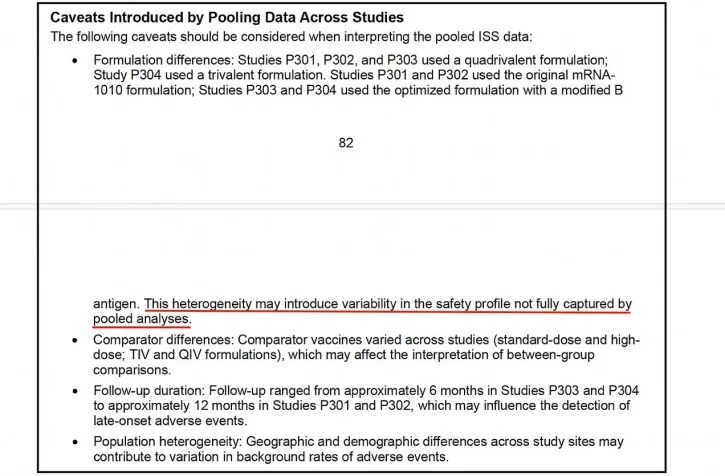
In an appendix to its own briefing document, the FDA acknowledged that differences between the trials could produce safety variations “not fully captured by pooled analyses”—but proceeded anyway.
Table 6 of the FDA’s own review makes the switch even clearer (see below).
For the first 28 days after vaccination, when serious adverse events were still balanced between the groups, the agency reported safety results from the pivotal P304 trial alone (purple box).
But as more SAEs accumulated over the following months, a statistically significant imbalance emerged.
Instead of reporting those longer-term results from P304 in the same way, the FDA switched to Moderna’s pooled analysis (red box), where the signal was diluted enough for the agency to continue describing the rates as “balanced.”
The pooled analysis also obscured a concerning pattern in all-cause mortality.
In the pivotal trial P304, there were 40 deaths in the mRNA arm versus 34 in the comparator arm.
In the preceding trial P303, deaths were consistently higher across all three mRNA sub-studies:
Sub-study 1 (mRNA vs Standard Trivalent): 5 deaths in the mRNA-1010 arm vs. 1 death in the comparator arm (5 vs 1).
Sub-study 2 (mRNA vs High-Dose Trivalent): 3 deaths in the mRNA-1010 arm vs. 2 deaths in the comparator arm (3 vs 2).
Sub-study 3 (mRNA vs Standard Quadrivalent): 3 deaths in the mRNA-1010 arm vs. 1 death in the comparator arm (3 vs 1).
Notably, in Sub-study 1, Moderna’s own trial investigators assessed one of the five deaths in the mRNA group as caused by the vaccine—the same product that has now been licensed.
Together, these numbers raise serious concerns about a possible excess in mortality in the mRNA groups—a pattern the FDA failed to highlight.
One rule for efficacy, another for safety
The FDA’s handling of efficacy reveals an even more striking double standard.
For efficacy, the agency relied strictly on study P304—the large pivotal trial testing the exact formulation submitted for licensure.
Earlier trials of Moderna’s vaccine had produced weaker efficacy results—and in at least one case, negative efficacy. Had the FDA pooled those trials for efficacy, the “26.6% efficacy” figure would almost certainly have been substantially lower.
But, as noted above, when the pivotal trial produced an unfavourable safety result, the FDA did the opposite—it pooled the data.
One approach maximised the efficacy. The other diluted the safety concerns.
Who is protecting the public?
On the surface, the FDA says Moderna’s flu mRNA vaccine is “safe and effective.”
Dig deeper, and the pivotal trial shows a statistically significant excess of participants experiencing SAEs.
Dig deeper still, and you discover the statistical trickery Moderna used—and the FDA accepted—to make the SAE signal disappear.
This brings us back to a fundamental question I have raised over years of reporting on regulatory failure.
When the FDA accepts the manufacturer’s trial design, adopts its data analyses, and rubber-stamps statistical methods that dilute a safety signal, who is actually protecting the public from harm?
Iran believes it has fundamentally altered the balance of power with the United States and now has a narrow opportunity to convert its position into lasting strategic and economic gains, Johns Hopkins University Professor Vali Nasr argued in an interview on Switzerland with Tom Switzer.
Speaking alongside University of Chicago political scientist John Mearsheimer, Nasr said Washington has struggled to accept how dramatically its position has changed following the prolonged war on Iran, particularly as Tehran retains leverage over the Strait of Hormuz. The interview was conducted by host Tom Switzer, who introduced Nasr as a leading Iran expert and Mearsheimer as a political scientist.
“There’s a consensus that they have defeated the superpower, at least put it on its heels,” Nasr said of the view inside Iran, arguing that Tehran sees little reason to moderate its position while it holds the advantage.
Iran sees narrow window to press advantage
Nasr rejected arguments circulating in Washington that Tehran is “overplaying its hand,” saying such assessments reflected disbelief at the extent to which the balance had shifted.
“In reality, Iran is not overplaying its hands. It’s just playing its hand,” he said.
According to Nasr, Iranian policymakers believe they have a limited period in which to secure the maximum possible strategic advantage.
“They think they have a narrow window to get the maximum amount of strategic advantage from having turned the table on the US,” he said, adding that Iranian leaders would consider it a major mistake not to press their advantage while Washington remains on the defensive.
That calculation extends to sanctions relief, frozen Iranian assets, compensation, and Iran’s position in the Strait of Hormuz. Nasr described Tehran’s approach as accepting immediate economic hardship in exchange for potentially much greater long-term gains.
Mearsheimer: US has ‘no choice’
Mearsheimer offered an even sharper assessment, arguing that Washington no longer possesses an effective means of forcing Tehran to abandon its position over the Strait.
Asked why US President Donald Trump would accept an arrangement under which Iran exercises substantial control over passage through Hormuz, Mearsheimer replied, “It’s very simple, Tom. He has no choice. He lost the war. This is a devastating defeat for the United States.”
He added that Trump “has no cards here,” arguing that Washington’s principal threat — further military escalation — had become increasingly difficult to carry out.
According to Mearsheimer, the United States faces both depleted munitions stocks and resistance from Gulf allies fearful that another escalation would trigger Iranian attacks on oil infrastructure, desalination facilities, and other critical installations.
Weapons shortages expose limits of US campaign
Nasr similarly argued that Washington’s weapons shortages had sharply reduced its ability to continue the campaign.
“It’s clear that the US doesn’t have the munitions, either offensive munitions or defensive munitions to keep bombing Iran,” he said, arguing that another month of fighting ultimately left Iran stronger and Washington weaker.
Mearsheimer said US military leaders had warned Trump before the war about limited stocks and the dangers of a prolonged confrontation. He argued that a major factor behind the end of the 40-day air campaign was that Washington was “running out of munitions.”
Nasr said the implications reach beyond West Asia, arguing that China and Russia would draw conclusions from the United States’ difficulty rapidly replacing sophisticated weapons during a prolonged war.
He cited Trump’s withdrawal from the 2015 nuclear agreement in 2018, attacks launched while negotiations were underway, and what Tehran viewed as Washington’s failure to uphold subsequent understandings.
Trump has created “such distrust about himself with Iranians” that even accepting Tehran’s terms might no longer be enough without guarantees that Washington would implement an agreement, Nasr said.
That distrust, he argued, explains why Iran wants concessions delivered upfront rather than postponed to future negotiations.
The earlier June 17 memorandum had envisaged reopening the Strait, lifting oil sanctions, and establishing a ceasefire that also covered Lebanon, while wider sanctions, reparations, and frozen assets would be addressed later.
Nasr said Tehran concluded that Washington subsequently undermined that arrangement, including its provisions related to Lebanon, reinforcing the view that Iran should secure tangible benefits before relinquishing leverage.
Mearsheimer described the result as a “humiliating defeat” for Washington before adding, “I believe it’s an even bigger defeat for Israel.”
He argued that Israeli officials were reluctant to acknowledge “the extent to which Iran has defeated not just the United States, but Israel,” predicting that both “Israel” and its supporters in Washington would seek to undo any agreement favorable to Tehran in the future.
Nasr later argued that Israeli Prime Minister Benjamin Netanyahu had “overreached in Lebanon and Iran,” describing them as wars “Israel” could not win and saying “Israel” had been “strategically defeated”.
For Nasr, the larger consequence is a regional order increasingly different from the one Washington sought to impose. Iran, he argued, now sees an opportunity not simply to end the current confrontation, but to use the outcome to reduce the US military threat around its borders, ease its economic isolation and consolidate its position as a major regional power.
Ukraine must compensate Iran for a deadly attack on one of its cargo vessels in the Caspian Sea, as Kiev has failed to convince Tehran that the strike was unintentional, the Iranian Foreign Ministry has said.
The ship was hit in a Ukrainian strike last month, killing one sailor. Tehran condemned the attack as “reckless.” Kiev initially defended its actions, saying Iran has “no standing to pretend to be a victim,” but later described the attack as a mistake and said it did not seek an escalation with Tehran.
Foreign Ministry spokesman Esmail Baghaei said on Monday that Tehran heard Kiev’s account of the strike but did not consider the matter resolved.
“We heard what they had to say, but given the admission by senior Ukrainian officials that such an attack took place, they must certainly compensate us,” Baghaei said at a press briefing. He added that if Kiev does not provide compensation, Tehran will pursue the matter itself.
Following the attack, Zelensky praised the “very strong results” of strikes on vessels he claimed were involved in transporting military cargo. He said Ukraine does not want to open a “new front” with Iran, but accused it of attacking his country by supplying Russia with Shahed drones and related technology.
Ukraine’s ambassador to Israel also claimed that the vessel, Anna, was carrying components for drones and missiles. Tehran said the ship and its cargo were entirely civilian.
Iran stated in 2022 that it delivered a “small number” of Shahed-136 kamikaze drones to Russia, but said the deliveries took place months before the escalation of the Ukraine conflict. Moscow has maintained that its Geran-2 drones, which are believed to be based on the Iranian design, are produced domestically.
Kiev has actively sought to become involved in the Middle East conflict triggered by the US-Israeli attack against Iran earlier this year. The Ukrainian leadership claimed that it secured agreements with Gulf states to provide specialists and technology to counter Iranian drones, and said it hopes to obtain additional air defense systems and munitions in return.
The Israeli Shin Bet has apparently forcibly disappeared Artyom Kirpichonok, a Russia-based historian with Israeli citizenship who has been critical of Zionism.
According to friends of Kirpichonok, “Kirpichonok arrived in Israel last week on a flight from Yerevan, the capital of Armenia, to attend an event to which he had been invited. After landing, however, he did not contact any of them and has not been heard from since. Reports indicate he arrived at Ben Gurion Airport from Yerevan on Aug. 2.”
Ynet noted that, he , “was born in St. Petersburg and immigrated to Israel in the 1990s. He graduated from the Hebrew University of Jerusalem and returned to live in Russia about 15 years after moving to Israel. He later adopted a strongly critical stance toward Israel and frequently wrote against the country and Zionism.”
Apparently, Artyom Kirpichonok’s disappearance was due to an arbitrary arrest and detention by the Israeli Shin Bet.
The former Russian lawmaker Daria Mitina alleged that “Our worst fears have been confirmed… Artem Ivanovich Kirpichenok is in prison, in the hands of the Israeli secret police Shabak”.
One friend and colleague of Artyom Kirpichonok, Nika Dubrovsky, wrote in Counterpunchthat “What we know is that he was arrested by the Shin Bet, Israel’s secret police. There has been no contact with him since. There has been no official reason for his detention.”
According to Dubrovsky, “On August 2nd, Kirpichenko landed in Tel Aviv. A lawyer hired by his friends has since confirmed that he is being held by the Shin Bet — Israel’s internal security service” adding , “it’s so obvious he posed no danger to the authorities whatsoever: he wasn’t a member of any party, he never took any practical action on anything — partly because he was an extremely impractical person.
His only crime was his opinion on various political questions. A thoughtcrime, in other words: ‘the essential crime that contained all others in itself,’ as Orwell wrote.”
She added that many had attacked his blog posts critical of Israel, including “Ukrainian and Russian expats, former Soviet citizens living in Israel, who apparently couldn’t leave his blog alone”.
The researcher Volodymyr Ishchenko raised the possibility that Artyom Kirpichonok was even lured to Tel Aviv by the Shin Bet under the guise of a “fake invitation to an event”.
What is clear is that the Israeli Shin Bet disappeared a historian with Israeli citizenship simply because he was critical of Zionism.
Almost immediately after the proxy war erupted, ISIS-tier footage of the torture and murder of Russians in Ukrainian custody emerged.
On July 6th, the New York Times published an astonishing investigation: In Ukraine, Killings of Surrendering Russians Divide an American-Led Unit. The article documents in grim detail how Chosen Company, an international volunteer battalion for Kiev, routinely executes Russian prisoners of war. It is the very first mainstream admission that this practice – a brazen breach of the Geneva Conventions, and a grave war crime – is widespread among Ukraine’s fighters, both foreign and homegrown. … continue
This site is provided as a research and reference tool. Although we make every reasonable effort to ensure that the information and data provided at this site are useful, accurate, and current, we cannot guarantee that the information and data provided here will be error-free. By using this site, you assume all responsibility for and risk arising from your use of and reliance upon the contents of this site.
This site and the information available through it do not, and are not intended to constitute legal advice. Should you require legal advice, you should consult your own attorney.
Nothing within this site or linked to by this site constitutes investment advice or medical advice.
Materials accessible from or added to this site by third parties, such as comments posted, are strictly the responsibility of the third party who added such materials or made them accessible and we neither endorse nor undertake to control, monitor, edit or assume responsibility for any such third-party material.
The posting of stories, commentaries, reports, documents and links (embedded or otherwise) on this site does not in any way, shape or form, implied or otherwise, necessarily express or suggest endorsement or support of any of such posted material or parts therein.
The word “alleged” is deemed to occur before the word “fraud.” Since the rule of law still applies. To peasants, at least.
Fair Use
This site contains copyrighted material the use of which has not always been specifically authorized by the copyright owner. We are making such material available in our efforts to advance understanding of environmental, political, human rights, economic, democracy, scientific, and social justice issues, etc. We believe this constitutes a ‘fair use’ of any such copyrighted material as provided for in section 107 of the US Copyright Law. In accordance with Title 17 U.S.C. Section 107, the material on this site is distributed without profit to those who have expressed a prior interest in receiving the included information for research and educational purposes. For more info go to: http://www.law.cornell.edu/uscode/17/107.shtml. If you wish to use copyrighted material from this site for purposes of your own that go beyond ‘fair use’, you must obtain permission from the copyright owner.
DMCA Contact
This is information for anyone that wishes to challenge our “fair use” of copyrighted material.
If you are a legal copyright holder or a designated agent for such and you believe that content residing on or accessible through our website infringes a copyright and falls outside the boundaries of “Fair Use”, please send a notice of infringement by contacting atheonews@gmail.com.
We will respond and take necessary action immediately.
If notice is given of an alleged copyright violation we will act expeditiously to remove or disable access to the material(s) in question.
All 3rd party material posted on this website is copyright the respective owners / authors. Aletho News makes no claim of copyright on such material.