
Moscow refused to join issue with the US State Department’s strident statement on Sunday blaming Russia for the renewed violence in the Donbass region of eastern Ukraine. Washington had stressed that it was “imperative” that the “combined-Russian separatist forces” in Donbass halted their attacks and “immediately” observe the ceasefire.
The Russian reaction came on Monday at the level of the presidential spokesman Dmitry Peskov who was dismissive of the US allegation but wouldn’t be drawn into the blame game, either, and instead would call on Washington to be “more attentive in judging the situation.” Peskov said he’s reiterating for “a hundredth time” that Russia is not party to the conflict in Ukraine. It was a restrained reaction, albeit a rebuttal of the US charge – and just stopped short of offering Russia’s helping hand.
This puts Washington in a quandary: What next? The point is, the Donald Trump administration is still to put on track a Russia policy. Ukraine is a potential crisis on Europe’s doorstep which demands that Trump has a one-on-one with President Vladimir Putin as early as possible. But then, the Trump administration must also know what to discuss with Moscow.
Meanwhile, the Donbass situation is developing in a way that Washington needs to contend with newer and newer facts on the ground. Moscow announced a week ago its “humanitarian” move to recognize identity documents issued in the separatist-held areas of eastern Ukraine. This followed a blunt statement by Moscow that “We’re not returning our territory, Crimea is part of Russian Federation” (which in turn was provoked by a remark by the White House press secretary that Trump had been taking a tough line on Russia and that he expected Moscow to withdraw from Crimea, which it occupied after a “full-scale invasion” in 2014.)
Putin ordered last week that the Russian government will temporarily recognize identification, education and qualification documents and other certificates as well as car licence plates issued in the self-declared “people’s republics”, ie., parts of the Donetsk and Lugansk regions that are not under the control of Kiev.
Europe is unsure whether or not see the Russian move as a warning shot by the Kremlin – although it will be a rush to judgment that Moscow is heading in the direction of granting recognition to the self-declared “people’s republics” in Donbass. Moscow maintains with a straight face that the move aims at facilitating travel and allowing Donbass residents to work and study in Russia and that it has a “strict temporary limit – until the implementation of the Minsk agreements.”
On Monday, Russian media reported that another new fact on the ground is struggling to be born in Donbass. This time around, the Lugansk “People’s Republic” has reportedly announced that from March 1, Russian Ruble will become the region’s official currency. Now, things are becoming serious, aren’t they?
And all this is unfolding against the backdrop of the far-right Ukrainian nationalist groups imposing a blockade for the past month on the movement of coal from Donbass to western Ukraine, which threatens serious economic dislocation. These “neo-Nazi” elements also captured a water purification plant with the intent to cut off water supplies to the Donetsk region under separatist control. The authorities in Kiev cannot or will not crack down on the far-right groups.
Pressure is mounting on Kiev from multiple sides. Importantly, President Petro Poroshenko doesn’t know where exactly he stands in the US foreign policy calculus in the Trump era. The popular mood in Ukraine is increasingly disenchanted with all that happened in the country through the 3-year period since the regime change following the ouster of the elected president Viktor Yanukovych in a “colour revolution” in February 2014.
A recent poll by the Kiev International Sociology Institute shows that in retrospect, a majority of people now see the 2014 “colour revolution” as more of a western coup d’etat and blame Kiev (rather than Moscow) for the lackadaisical implementation of the Minsk agreements. Evidently, the ground is shifting beneath the feet of the “pro-US” set-up installed in power in Kiev by the Barack Obama administration. Popular discontent is cascading with three-quarters Ukrainians estimating that living conditions have only worsened. The most worrisome factor is of course the ascendancy of the far-right groups – and they happen to be well-armed and include ex-servicemen.
With Europe preoccupied with own problems and the US caught up in a civil war – Trump told Fox News last night that he saw Obama’s hidden hand behind the media leaks and protests against him – the West is not paying attention to the dangerous drift in Ukraine. The point is, the Ukrainian political process is steadily becoming violent, threatening the country’s stability. Russia’s cooperation becomes a must to salvage the situation.
However, engagement with Russia is possible only if the Trump administration musters the steam to override the formidable resistance from the US foreign-policy and security establishment (and the US Congress), which is not going to be easy. What Obama visualized as his finest foreign-policy legacy in “post-Soviet” Eurasia is turning out to be a can of worms for the West. Read an overview of the developing crisis featured in The Duran.
February 28, 2017
Posted by aletho |
Aletho News | Donald Trump, Donbass, Russia, Ukraine, United States |
Leave a comment
Vitaly Churkin was one of the wisest voices in international diplomacy. His voice will no longer echo in the halls of the United Nations. Articulate, polite yet commanding, wise yet affable, he oversaw some of Russia’s and the world’s most important events in a position he occupied since 2006.
Churkin had to face a great deal of hostile criticism from both the Bush and Obama administrations during his time at the UN, but he always did so with grace. He never failed to explain the Russian position with the utmost clarity.
Standing next to some of his colleagues, he often looked like a titan in a room full of school children.
His death, a day before his 65th birthday, is a tragedy first and foremost for his family, friends and colleagues. It is also a deeply sad day for the cause of justice, international law and all of the principles of the UN Charter which Churkin admirably upheld in the face of great obstacles.
His death however raises many uncomfortable questions…
Here are 5 things that must be considered:
1. A Macabre Pattern Has Emerged
Beginning in 2015, there were several deaths within the Russian Diplomatic corps and a special Russian Presidential adviser.
–LESIN
First there was Russia’s RT founder and special adviser to President Putin, Mikhail Lesin. He died in November of 2015 in his hotel room. Reports said that he appeared discombobulated during his last sighting before he died. Later it emerged that he died of a blunt head trauma. Drinking was blamed, but many questions were left unanswered.
–MALANIN
Earlier last month, Andrei Malanin, a Senior Russian Diplomat to Greece was found dead in his bathroom. The causes of death remain unknown.
–KADAKIN
Just last month, Russia’s Ambassador to India, Alexander Kadakin, an always prestigious role, died of a heart attack, although no one was aware of any previous health issues.
–KARLOV
In December of last year Russia’s Ambassador to Turkey was assassinated by a lone jihadi gunmen in an art gallery. There was no effective security as the killer simply walked up to Ambassador Andrei Karlov and shot him multiple times in the back.
–CHURKIN
Vitaly Chirkin is the highest profile member of Russia’s diplomatic corps to die in recent years.
2. A Motive For Foul Play?
Each of the recently deceased Russian Ambassadors were high profile targets for miscreants and criminals, whether state actors, mercenaries or fanatics.
Lesin was instrumental in the creation of RT, a news outlet which has come under constant attack from the western establishment.
Malanin had overseen a period of warming fraternal relations between Greece and Russia at a time when Greece is feeling increasingly alienated from both the EU and NATO.
Karlov is said to be responsible for helping to facilitate the rapprochement between Presidents Erdogan and Putin.
Kadakin oversaw a period of renewed tensions between India and Pakistan at a time when Russia was trying to continue its good relations with India whilst building good relations with Pakistan.
On the 31st of December, 2016, Churkin’s resolution on a ceasefire in Syria passed in the UN Security Council after months of deadlock. The resolution is still in force.
Anyone who wanted to derail the diplomatic successes that the aforementioned men achieved for Russia would have a clear motive to extract vengeance.
3. Who Stands To Gain?
In the matter of Karlov, any derailment of restored Russo-Turkish relations would be good for those happy for Turkey to continue her support of jihadists in Syria rather than moving towards accepting a Russian and indeed Iranian brokered peace process which respects the sovereignty of Syria as Russia and Iran always have, but Turkey has not.
In the case of Lesin, anyone wanting ‘vengeance’ for RT’s popularity would be able to say that a kind of former media boss was taken down.
For Malanin, many fear that if ‘Grexit’ happens, Russia will become an increasingly important partner for Greece. The EU would not like one of its vassal states enjoying fruitful relations with Russia, a country still under sanctions from Brussels.
For Kadakin, it is a matter of interest for those wanting Pakistan to continue favouring western powers and not wanting Russia to be able to mediate in conflict resolutions between New Delhi and Islamabad.
Churkin had come to dominate the UN in ways that his counterparts on the Security Council simply could not. No one really stood a chance in a debate with Churkin. His absence leaves open the possibility for a power vacuum that would makes other peoples’ jobs easier.
4. Where The Deaths Took Place
Each death took place on foreign soil. Mr. Karlov’s killing in particular, exposed the weakness of his security contingent. If security was that weak in a comparatively volatile place like Turkey, it goes without saying that security in states considered more politically stable would be even more lax.
Again it must be said that a non-biased detective might say that the only pattern which has emerged is that many people in the Russian diplomatic corps and related institutions have heart attacks. Maybe they eat fatty foods every day and drink and smoke too much. But if this was this case, why are the heart attacks all on foreign soil?
If all of the former Ambassadors except Karlov were really in bad health, is it really just a coincidence that none of these men had a health scare on Russian soil? Again, a pattern has emerged.
5. The Ethics of Speculation?
Many will say that it is too early to suspect foul play. Indeed, I must make it clear that this is simply speculation based on a pattern of tragic and at times unexplained events, combined with the objective reality that because of Russia’s recently elevated profile as a born-again geopolitical superpower, Russia is a bigger target for international criminals than it was in the broken 1990s or the more quiet early 2000s.
When such events happen, one’s duty is to speculate so that better health and safety precautions are taken to ensure the well-being of Russia’s important diplomats. Furthermore, if foul play is a factor, it means that such seemingly unrelated events must be investigated more thoroughly.
Russia has historically suffered from invasion, revolution and more recently from immense international pressure. The Russian people, like Russia’s ambassadors are entitled to the peace and long lives deserved by any member of a country that has suffered for too long.
February 21, 2017
Posted by aletho |
Aletho News | Russia, United Nations |
Leave a comment
Vitaly Churkin, who served as Russia’s permanent representative to the United Nations since 2006, “died suddenly” in New York, the Russian Foreign Ministry announced.
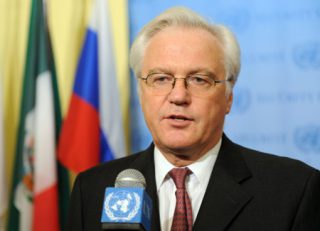 Churkin would have turned 65 on Tuesday.
The announcement “of the untimely passing away of Ambassador Vitaly Churkin this morning” was met with shock when it was delivered during a session at the UN headquarters.
“He was a dear colleague of all of us, a deeply committed diplomat of his country and one of the finest people we have known,” a UN official who delivered the news to her colleagues said.
The moment of silence in Churkin’s memory was announced at the UN.
President Putin has expressed his condolences to Churkin’s family and to all Russian diplomats.
“He was an outstanding person. He was brilliant, bright, a great diplomat of our age,” Russian Foreign Ministry spokeswoman Maria Zakharova told RT, adding that the news of Churkin’s death was “completely shocking.”
Churkin fell ill in his office at Russia’s UN mission and was taken to Columbia Presbyterian Hospital, where he died Monday, AP reported, citing Russia’s deputy UN ambassador, Vladimir Safronkov. The cause of death wasn’t immediately known, the agency reported.
“He has been such a regular presence here that I am actually quite stunned. Our thoughts go to his family, to his friends and to his government,” Farhan Haq, deputy spokesman for the UN secretary-general’s office said, as quoted by Reuters. […]
“He was a strong-willed, resolute, and dutiful person, who was admired by his colleagues and envied by his enemies,” Russian Deputy Foreign Minister Sergey Ryabkov told RT.
Russia’s UN Ambassador spared no effort and devoted his life and strength “to the fight for a brighter future for this world,” Ryabkov said, adding that Churkin’s death is “a great loss not only for diplomacy, but for the country in general.”
The profession of a diplomat “has become much more hectic than it used to be in the past,” Churkin said earlier this month in an interview with RT, which was one of his last. “It is stressful,” he said.
“Unfortunately, the world has not become more stable than it used to be,” Churkin told RT’s Aleksey Yaroshevsky.
Before he was appointed to represent Russia at the UN in May 2006, the diplomat served as ambassador to Belgium, ambassador to Canada, and liaison ambassador to NATO and the Western European Union (WEU).
In the 2000s he was ambassador at large at Russia’s Foreign Ministry, while in the early 1990s he served as the special representative of the Russian president to the talks on the former Yugoslavia.
February 20, 2017
Posted by aletho |
Aletho News | Russia, United States, Vitaly Churkin |
Leave a comment
MOSCOW – Pyongyang’s latest ballistic missile launch aims to enhance security on the Korean Peninsula, North Korean Ambassador to Russia Kim Hyun Joong said Thursday.
On Sunday, North Korea carried out a successful test of its Pukguksong-2 intermediate-range ballistic missile. The Pukguksong-2 can carry a nuclear payload, and has an estimated operational range of up to 2,000 km (1,200 miles).
“The successful test launch… is a measure aimed at enhancing the country’s sovereignty, as well as the peace and security of the Korean Peninsula, in connection with the growing nuclear threat from the US,” Kim said.
Speaking at an event organized to commemorate the 75th birth date of the late leader Kim Jong Il, the North Korean diplomat said Pyongyang intended to “further strengthen our defense capacity, strengthen the nuclear forces as long as the US nuclear threat and blackmail continues.”
February 16, 2017
Posted by aletho |
Aletho News | North Korea, United States |
Leave a comment
John McCain, a hawkish US Senator known for his anti-Russia position, has called for boosting US deterrent posture in Europe after reports emerged alleging Moscow has secretly deployed nuclear-tipped ground-launched cruise missiles in violation of the 1987 Intermediate-Range Nuclear Forces (INF) Treaty.
The administration of President Donald Trump must immediately respond to Russia’s alleged deployment of nuclear-tipped ground-launched cruise missiles, McCain said in a press release.
The news comes as US media reported that Russia deployed ground-based nuclear cruise missiles in violation of the 1987 Intermediate-Range Nuclear Forces (INF) Treaty.
The Pentagon supported the review of alleged the INF Treaty violations.
The treaty prohibits the development, deployment or testing of ground-launched ballistic or cruise missiles with ranges between 300 and 3,400 miles. It was implemented by 1991 with inspections carrying on until 2001.
“Russia’s treaty violation requires a meaningful response,” McCain stated in the release on Tuesday. “In light of the most recent developments, it is time for the new administration to take immediate action to enhance our deterrent posture in Europe and protect our allies.”
McCain claimed Russia’s violation of the INF treaty is a significant threat to US forces in Europe and its NATO allies, the release stated.
The United States should continue to modernize its nuclear forces and ensure NATO’s nuclear deterrence forces are prepared to counter Russian nuclear doctrine, which calls for the first use of nuclear weapons, McCain added.
Russia has rejected the accusations, and said that the United States deploying its Europe-based missile defense system violates the INF treaty.
RT | February 15, 2017
Top Russian officials have rejected accusations that Moscow violated an arms control treaty by deploying cruise missiles, saying that the people spreading the rumors were targeting the possible thaw in Russia-US relations.
Kremlin press secretary Dmitry Peskov said on Tuesday that Russia was observing all its international obligations and that none of its partners had accused Moscow of breaching any treaties.
“Russia has been and remains committed to its international commitments, including to the treaty in question,” Peskov told reporters. “Nobody has formally accused Russia of violating the treaty,” he said.
The comments came after US media reported that unnamed officials in the Trump administration had allegedly accused Moscow of deploying ground-launched cruise missiles in violation of the 1987 Intermediate-Range Nuclear Forces (INF) Treaty.
The head of the Russian upper house Committee for International Relations, Senator Konstantin Kosachev, said on Tuesday that such media leaks were part of a wider information war being waged against Russia and everyone who supported the normalization of Russia-US relations.
“The main objective of this campaign is to prevent the new president [Trump] from making a U-turn over the Atlantic, I mean, to prevent him from reconsidering the transatlantic policies of the United States that are set at establishing the monopolar model of the world order,” the senator told reporters.
He added that in his opinion those behind the strategy were sure that US politicians and the general public must be kept in a state of constant fear from an imagined external threat. … Full article
February 15, 2017
Posted by aletho |
Aletho News | INF treaty, John McCain, NATO, Russia, United States |
Leave a comment
The United States will build its strategy concerning North Korea based on the principles of deterrence, US President Donald Trump’s adviser Stephen Miller said on Sunday.
“We will reinforce and strengthen our vital alliances in the Pacific region as part of our strategy to deter and prevent the increasing hostility that we’ve seen in recent years from the North Korean regime,” Miller said in an interview with the Fox News channel.
Earlier in the day, North Korea launched a ballistic missile from the country’s North Pyongan province. The missile plunged into the Sea of Japan after flying some 310 miles. Japan said that the missile fell outside of the country’s exclusive economic zone and did not inflict any damages.
Following the launch, South Korea and Japan held emergency meetings of the countries’ National Security Councils and both called the launch a provocative action threatening international security. Other countries, as well as the United States and the European Union, have condemned the launch.
February 12, 2017
Posted by aletho |
Aletho News | Donald Trump, United States |
Leave a comment
The situation with peace talks on Syria is currently “more favorable” for things to really get better in the war-torn country, Russia’s FM Sergey Lavrov has said. Obama’s team slowed down the process, but under Trump things might improve, according to the diplomat.
“We are currently in the situation… that is much more favorable to start working on a real settlement of the crisis. We were close to it in September last year, but the Americans failed to implement an agreement which had been coordinated with us earlier, which once more confirmed the Obama’s administration inability to negotiate on many issues,” Russia’s foreign minister said in an interview with Russian television channel NTV.
“They took an agreement, and then couldn’t do anything [within it],” Sergey Lavrov said, adding that “largely because of Obama’s reluctance to have an argument with some countries in the region,” a settlement through the UN’s participation “turned to [result in] zero progress.”
Moscow could no longer rely on such dragging partnerships, Russia’s top diplomat said, adding that a decision has been made to take action in other ways, such as through Russian-Turkish relations.
“We know that Turkey has influenced and continues to influence a very considerable number of field commanders,” Lavrov said, noting that Moscow’s cooperation with Ankara resulted in a ceasefire agreement in Syria in late December last year.
“I want to make it clear: we’ve already said on different levels that we are not trying to undermine UN’s efforts [in resolving the Syrian crisis]. Although our initiative was largely based on [others’] inaction, we understand that many more sides should be involved in peace talks than those currently working on Astana [negotiations],” Lavrov told NTV. There should be more participants both from Syria and “players from the outside,” he added.
Parallel to the Astana peace process, Moscow is preparing for talks under the auspices of the United Nations, the minister said, adding that so far such a meeting has been confirmed for February 20.
Talking of Moscow’s expectations of those talks, Lavrov said that the “whims” of some Syrian opposition groups’ leaders, “especially of those who have long been living outside Syria,” should not be taken into consideration. “If it once again becomes a hindrance to hold UN talks, then the organization’s reputation will be seriously damaged,” Lavrov said.
Meanwhile, Russia has been actively involved in meetings on Syria in Astana, where talks with the participation of Ankara and Tehran have recently finished. The sides have generally agreed details on cease fire monitoring, the minister said, adding that the agreements reached “will soon be implemented.” Efforts to summon more fighting groups in Syria to join in talks with the Syrian government are also in the works, he added.
Saying that US representatives were present at the first meeting in Astana as monitors, Lavrov confirmed that an invitation has been sent to Washington to take part in the talks once a new team on the Middle East and Syria is formed under the incoming Trump administration.
Moscow is fully aware that relations between the US and Iran have deteriorated with Trump’s arrival in the White House, Lavrov said, but added that Russia “stands for common sense.”
“If US President Trump’s main priority on the international arena is fighting terrorism, then it should be admitted that in Syria not only the Syrian army supported by Russian Air Force are fighting ISIL [Islamic State terrorist group, IS, formerly ISIS/ISIL], but also Hezbollah groups supported by Iran [are involved in the anti-terrorist fight],” Lavrov said. “There’s a choice of priorities here.”
The minister added that while Americans are known for their “pragmatic” policies, it “wouldn’t be pragmatic to just precariously exclude Iran from the anti-terrorist coalition.” Russia, on its side, “always treats any country’s stance with respect,” he said, having expressed Moscow’s willingness to discuss any ways to solve the crisis, “even those that absolutely contradict” Russia’s views.
“I am sure that Donald Trump is absolutely sincere when he every time confirms his determination to defeat IS. We are ready to cooperate with him,” Lavrov said, having expressed hopes that cooperation between the Russian and American military in Syria “will soon start to form again.”
READ MORE:
Moscow mediates talks between Assad & Syrian Kurds – Russian FM
‘US-Iran tensions could be defused during Putin-Trump meeting’
Russian FM Lavrov expects to talk to US counterpart Tillerson soon on Ukraine & bilateral relations
February 12, 2017
Posted by aletho |
Aletho News | Hezbollah, Obama, Syria, Turkey, United States |
Leave a comment
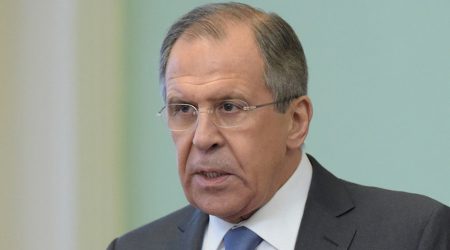
Russian Foreign Minister Sergey Lavrov has confirmed that Moscow has been mediating talks between Damascus and the Syrian Kurds to help maintain Syria’s sovereignty and statehood, in an interview with Russia’s Izvestia daily.
Russia “makes efforts to establish a common understanding between the Syrian government and the Syrian Kurds for the sake of a united Syria,” the minister told Izvestia in an interview he gave ahead of Diplomat’s Day, a Russian holiday celebrated on February 10.
Lavrov went on to say that four rounds of negotiations, brokered by Russia and including direct contact between the Damascus delegation and “representatives of the political and public structures of the Syrian Kurds,” had already taken place between June and December in 2016. In addition, the gatherings also involved indirect talks between the two sides.
The Russian foreign minister also confirmed that the Syrian government had held talks with the leaders of the Syrian Kurds’ armed militia units, the YPG.
“We believe that such intra-Syrian dialog is useful,” Lavrov said, stressing that there is “significant potential for reaching agreements” between Damascus and the Kurds, as the sides have found many areas of common interest and their negotiations are developing positively.
Lavrov emphasized that “the Kurdish issue” is one of the “key” factors in maintaining Syrian statehood and contributing to the stabilization of the situation in the entire Middle East. He also drew attention to the fact that Russia is continuing its efforts to find compromises between various ethnic and religious groups in Syria, as it is interested in restoring peace and stability in the warn-torn country and defeating international terrorist organizations entrenched in some areas there.
Regarding Syria’s potential federalization, Russia’s top diplomat neither denied nor confirmed that the issue was discussed during the talks between the Syrian government and the Kurds.
The minister’s statements come as Russia also seeks to launch a peace process between the Syrian government and the armed opposition groups together with Turkey and Iran.
In December 2016, a nationwide ceasefire came into force in Syria. It was brokered by Moscow and Ankara and endorsed by the UN Security Council. While in late January, negotiations took place between official representatives from Damascus, Russia, Iran and Turkey, as well as a delegation from the Syrian opposition in the Kazakh capital, Astana. However, the Syrian Kurds were not represented at the talks.
During the gathering, Russia submitted a draft document to serve as a “guide” for the Syrian constitution. The paper stressed that Syria’s territory is “inviolable and indivisible,” suggesting that restructuring of internal borders and proclaiming autonomous regions within Syria should be done only with respect to the country’s own laws. The rights of minorities were another key element of the draft.
In his interview with Izvestia, Lavrov also discussed other pressing issues in modern international politics. He once again criticized the NATO military buildup on Russian borders but expressed hope that Western politicians would eventually understand that Russia “poses no direct threat to NATO” and is a “peaceful country.”
Russia seeks “immediate de-escalation of the military and political situation in Europe” but is ready to defend its borders, Lavrov stressed.
He also went on to express his regret over the recent escalation of the conflict in eastern Ukraine and urged Kiev to implement the Minsk Agreements, noting that there is no other way to resolve the crisis.
Touching upon the issue of US-Russian relations, Lavrov again confirmed that Russia is ready to work with the administration of new US President Donald Trump on a broad range of issues, yet “on the basis of mutual respect.”
February 9, 2017
Posted by aletho |
Aletho News | Iran, Russia, Syria, Turkey, YPG |
Leave a comment
 The scope of various cyber operations carried out by different state players has recently become the cause of increasing tension amid international relations. For instance, at the end of 2016, the United States accused Russia of hacking the servers of the US Democratic National Committee, which resulted in the introduction of sanctions against a number of Russian intelligence services that were described as offenders in this recent incident. However, Washington to date, hasn’t presented any evidence to back up its claims.
At the same time, a considerable number of Western media sources, including Foreign Policy, have openly admitted Moscow was not accused of anything in America’s last election that Washington itself has not done elsewhere in the world.
Curiously enough, distinguished historian Marc Trachtenberg, professor emeritus at UCLA, has already stressed that this alleged interference is a type of behavior that the United States helped establish; since meddling in other countries’ politics has been an American specialty for decades. The Washington Times seems to be convinced too that America’s record of meddling in other countries and of leaders who have lied to Washington puts it in the position where it must tread carefully to avoid hypocrisy.
Those who complain about alleged Russian offenses must certainly know that the US government eavesdrops, as a matter of course, on the private communications of many people around the world. The National Security Agency, whose job it is to do this kind of eavesdropping, has a budget of about 10 billion dollars, and, according to an article that came out in the Washington Post a few years ago, intercepts and stores “1.7 billion e-mails, phone calls and other types of communications” everyday.
In terms of the development of so-called cyber armies – highly specialized units that can use cyberspace for both military or intelligence purposes – Russia may indeed be found in the top 5 states in the world in this domain, however, it’s lagging behind the US, China, Britain and South Korea. In general, such armies exist officially in a several dozen countries, as for the unofficial numbers, there’s hundreds of those, since the scope of information warfare operations has been increasing rapidly over the years.
It goes without saying that US cyber forces has been the most powerful in the world, with over 9,000 trained professionals in its ranks. As for the UK, the so-called Government Communications Headquarters (GCHQ) has been providing employment to over 6,000 servicemen. Out of this number, according to individual media reports, more than 2,000 servicemen are engaged in cyber warfare.
Additionally, it should be noted that cyber squads can be found in a number of armies around the world, but those are not “military hackers”, those are security specialist that are tasked with protecting digital assets and IT infrastructure, at least officially. Off of the top of one’s head one can name such units in South Korea, Israel, Iran and Estonia.
The question of whether or not these hackers are capable of influencing political processes and, in particular, one’s presidential campaign, has been broadly discussed at the latest 9th International Forum on Cybersecurity (FIC), which was held last January in the French city of Lille. For the first time the forum was held in 2007, following an initiative of the National Gendarmerie, and every year it has collected public authorities, private sector representatives, experts and civil society figures. In 2017, the forum aimed at discussing the issue of providing “reasonable security for IT assets.”
France’s Minister of Internal Affairs, Bruno Le Roux has stressed in his opening speech at the forum that IT systems are regularly becoming the target of attacks originating from criminal organizations and even from foreign states, which are showing great ingenuity.
But we must not forget that more often than not, it’s not foreign hackers that play the role of a destabilizing factor in the political life of any given society, but the hackers hired by opposition political parties of these very states. And the United State exemplifies this statement better that any, with Donald Trump announcing his concern over the leakage of the details of his telephone conversations with foreign political figures.
According to White House spokesman Sean Spicer, the Trump administration will have to exercise damage control after the leakage of the details of the discussions that Trump had over the phone with the leaders of Mexico and Australia. “This is a very disturbing fact,” – said Spicer in his recent statement. AP has allegedly acquired these tapes, so it now reports that Trump allegedly said in a conversation that the Mexican government is incapable of dealing with the “bad guys”. For sure, the Mexican Foreign Ministry has claimed that those reports are false, but what other choice did it have?
In addition, Trump has also been denying the claims distributed by the Washington Post that he had a very “bad talk” with the Australian Prime Minister Malcolm Turnbull. “Thank you to Prime Minister of Australia for telling the truth about our very civil conversation that FAKE NEWS media lied about ” – Trump wrote in his Twitter.
Jean Périer is an independent researcher and analyst and a renowned expert on the Near and Middle East.
February 7, 2017
Posted by aletho |
Aletho News | CIA, France, GCHQ, NSA, UK, United States |
Leave a comment
Within days of the flawed roll-out for Trump’s Executive Orders regarding Border Security and Immigration Enforcement Improvements and Enhancing Public Safety in the Interior of the United States, the President’s promises on the campaign trail and his Inaugural Address that the US would not pursue regime change or initiate new foreign interventions and that his administration would pursue a new foreign policy based on engagement, have been called into question.
The week began with President Trump praising, as a success, the administration’s first attack on al Qaeda in Yemen which inexplicably included special ops from UAE. Reports state that the group of Navy Seals unexpectedly walked into an hour long fire fight which contained elements of an ambush including hand grenades and a certain amount of panic with indiscriminate gunfire; leaving one Navy Seal dead with several injured, at least a dozen civilians dead including an eight year old girl and destroyed a $75 million Osprey – you might say the raid was more of the same kind of failure with which the US military has some long-standing familiarity. Black Hawk Down in 1993 comes to mind.
Described by Trump press secretary Sean Spicer as a “very, very well-thought out and executed raid”, the mission began on November 7 when the Pentagon presented President Obama with a plan. From there, the proposed raid went through all the necessary channels arriving in front of Trump Defense Secretary James Mattis on January 24th. Mattis approved and forwarded the plan to the White House for the President’s approval which he gave the next day at a dinner which included several key staff members including special assistants to the White House Jared Kushner and Steve Bannon and after consulting with National Security Advisor General Michael Flynn.
All of the reviews and approvals, however, did not guarantee success as there is reason to believe that the alQ stronghold was expecting an American raid with armed female and AQ snipers on a rooftop. After the raid, anonymous U.S. military officials told Reuters that “Trump approved his first covert counterterrorism operation without sufficient intelligence, ground support or adequate backup preparations.” In addition, Reuters quoted three unnamed US military officials that “the attacking SEAL team found itself dropped into a reinforced al Qaeda base defended by landmines, snipers, and a larger than expected contingent of heavily armed Islamist extremists.” This does not sound like a surprise raid but more like a disaster waiting to happen.
These unprecedented ‘leaks’ indicate an undercutting of the Administration by anonymous military officials who are in direct contradiction to the timeline as presented by Spicer that the entire plan had been appropriately vetted by the government’s foreign policy structure – with the exception of Rex Tillerson who had not yet been confirmed as Secretary of State.
It has been said that the mission needed to receive a green light to take advantage of a Moonless night and that the mission was to acquire certain computer hard drives with speculation that there was some urgency of obtaining the intel contained potentially embarrassing data regarding the interconnections between the terrorists and certain foreign nations which support terrorists. In any case, it was a botched mission that was poorly planned and executed and appears to have a major security problem given the unauthorized disclosures by anonymous military officials who disagreed about what the public has been told about the raid. So which is it – was the raid properly vetted and the right questions asked – or was it insufficiently vetted?
US CommCentral released the clip that they say was obtained from a series of videos during the raid which shows a black hooded individual giving instructions on how to make a do-it-yourself bomb. The clip, which has no audio and its written instructions are written in perfect English, is now reported to be a decade old AQ training video [sourced from SITE]. It is assumed that the President’s Monday trip to Central Command and Special Ops in Florida was not just a get-to-know-you visit.
As if that were not enough faux pas for the week, General Flynn took an unprecedented place on center stage at a press conference sounding like the Commandant of Stalag 19, stridently warning Iran and spouting old, worn out rhetoric that the “Trump administration condemns such actions by Iran that undermines security, prosperity and stability throughout and beyond the Middle East which places American lives at risk. As of today, we are officially putting Iran on notice.”
The accusations came after Iran reportedly fired a test of a medium-range ballistic missile on February 1st with Iranian Defense Minister Hossein Dehghan stating that “The test did not violate the nuclear deal or (U.N.) Resolution 2231″ and that “… we will not allow foreigners to interfere in our defence affairs,” striking a chord with Trump’s Inaugural statement that “it is the right of all nations to put their own interests first.”
On the heels of Flynn’s rant, the Trump administration quickly announced economic sanctions on twenty five Iranian individuals and entities that have unnecessarily escalated tensions with:
“The Islamic Republic of Iran is the world’s leading state sponsor of terrorism and engages in and supports violent activities that destabilize the Middle East.”
“The Trump Administration will no longer tolerate Iran’s provocations that threaten our interests. “
“The days of turning a blind eye to Iran’s hostile and belligerent actions toward the United States and the world community are over.”
The Flynn/Trump obsession against Iran has little basis in rational thought and is not the kind of nation-building and “forming of new alliances” that the President promised in his Inaugural address. Flynn may be myopic on the subject of Iran since Iran supported the insurgents in Iraq during the US invasion in 2003 but he may also be blowing smoke with the realization that the administration must know that any serious effort to eliminate ‘radical Islamic terrorists’ will be dependent upon Iran’s participation.
As Ron Paul has repeatedly suggested, Iran has every reason to want its own nuclear capability, if only as a defensive mechanism to protect itself from Israel and the US. A spokesperson for the EU foreign policy chief in Brussels said that the “Iranian ballistic missile program was not part of the 2015 nuclear pact and hence the tests are not a violation of it.”
On February 3rd, President Trump tweeted “Iran is playing with fire – they don’t appreciate how “kind” President Obama was to them. Not me!” to which Iranian Foreign Minister Javad Zarif tweeted “We will never, I repeat never, use our weapons against anyone, except in self-defense. Let us see if any of those who complain can make the same statement.”
If the Trump Administration believes Iran is in violation of the Plan, they have the option to initiate a dispute resolution process or to engage the International Atomic Energy Agency (IAEA) which has regular access to all Iranian nuclear facilities to verify that Iran is in compliance. Iran says it will impose its own sanctions and release its own list of US-related ‘entities’ entwined with supporting terrorists.
With an imminent visit to the US, it is not outside the realm of possibility that all this Tough on Iran talk is to impress Bibi Netanyahu who hailed Flynn’s statement with “Iranian aggression must not go unanswered” which sounds reminiscent of Sen. John McCain. As if to tone down the US inflammatory reaction, new Defense Secretary James Mattis said he sees ‘no need to increase number of troops in the Middle East” in response to the Iranian missile crisis.
Of special interest will be how Trump deals with whatever demands Netanyahu has in his pocket and how Trump’s high regard for Israel may be affected, assuming that he is already apprised of Israel’s role in funding ISIS in Syria and its support and participation in fomenting terrorist actions throughout the Middle East. If Flynn/Trump are concerned with who is causing instability in the Middle East, they have no further to look than Saudi Arabia and Israel. It is difficult to image that Trump does not already have an appreciation for Netanyahu’s expectation to continue to run the show otherwise known as US foreign policy.
As if the Trump foreign policy objectives had not already experienced a week of upsets, contradictions and overall confusion, UN Ambassador Nikki Haley’s diatribe against Russia was stunning in its vitriolic attack on Russia alleging “aggressive actions of Russia” and “dire situation in eastern Ukraine is one that demands clear and strong condemnation of Russian actions.” In addition, Haley asserted, in contradiction to President Trump’s previous position on Crimea that “The United States continues to condemn and call for an immediate end to the Russian occupation of Crimea” and that “Crimea is a part of Ukraine. Our Crimea-related sanctions will remain in place until Russia returns control of the peninsula to Ukraine.”
In his February 3rd press conference, Trump press secretary backed up Haley with “I think Ambassador Haley made it very clear of our concern with Russia’s occupation of Crimea. We are not — and so I think she spoke very forcefully and clearly on that.”
Russia’s UN Ambassador Vitaly Churkin responded that ‘the belligerent rhetoric toward Moscow over the Ukrainian crisis is nothing new” and that “it is Kiev that has escalated the situation there”. He also cited “OSCE reports and surveillance data which places the blame squarely on the Ukrainian government and not the rebel forces.”
After the initial shock at Haley’s level of hostility, an immediate reaction was that as a former Republican Governor of South Carolina, Haley had to have a working relationship with Senator Lindsay Graham (R-SC), the alter ego of Sen. John McCain who remains an irrational proponent of intervention wherever possible around the globe and that her maiden speech before the Security Council had somehow gone askew as a more combative, divisive script found its way into her file.
However, U.N. ambassador Nikki Haley, met with her Ukrainian counterpart “to reaffirm the United States’ support for the sovereignty and territorial integrity of Ukraine,” according to a statement.
In view of another pending humanitarian disaster as a result of US intervention in Ukraine, the best that the State Department could do, prior to Tillerson taking office, was to issue a statement calling for a ceasefire and return to implementation of the Minsk Agreement.
It is reported, though unconfirmed, that soon after her speech, Haley visited Russian Ambassador Churkin at his home, presumably to reassure him that there was a bureaucratic snafu and that US policy toward Russia was not accurately reflected in her introductory remarks.
As a result of a week of significant snafus, the Trump Administration has either caved in to neo-con pressure like Eliot Abrams (convicted of lying to Congress during Iran-Contra) who is currently vying for the Deputy Secretary position at the State Department or they are dealing with repeated staff blunders and turmoil that are seriously threatening any hope of credibility for Trump’s oft-stated foreign policy goals.
Renee Parsons has been a member of the ACLU’s Florida State Board of Directors and president of the ACLU Treasure Coast Chapter. She has been an elected public official in Colorado, an environmental lobbyist and staff member of the US House of Representatives in Washington DC. She can be found on Twitter @reneedove31
February 6, 2017
Posted by aletho |
Aletho News | Iran, Sanctions against Iran, Saudi Arabia, UAE, United States, Yemen |
Leave a comment
President Donald Trump’s administration has scrapped the previous administration’s plan to take Raqqa, the de facto capital of the Islamic State (IS) group. The plan proposed a strategy of training Kurdish forces, providing them with new equipment, and helping them retake the city.
US-supplied armored vehicles have only been delivered to the Syrian Arab Coalition (a part of the Syrian Democratic Forces – SDF), which is made up of militants predominantly from local Arab areas. The Kurdish components of SDF have been denied the aid not to spoil the US relations with Turkey.
According to the Washington Post, the officials said they were dismayed that there was no provision for coordinating operations with Russia and no clear political strategy to address Turkey, a country that would be angered by the US cooperation with the Kurds, and the lack of a plan B in case the Kurdish offensive failed. They also said the plan lacked specifics on the number of troops needed for the operation.
The operation Euphrates Anger was launched by US-backed SDF in November 2016. Obviously, President Trump sets much store by cooperation with Moscow in the fight against terrorists. He faces the problem of getting Turkey on board. Russia and the US could join together as intermediaries to facilitate talks between the Kurds and Turkey.
Turkey has excellent relations with the Iraqi Kurds who could also join in any mediation effort. If progress is achieved, Washington will not let down the Syrian Kurds, cooperating with Ankara. Since January 18, Russia and Turkey, a US NATO ally, have been engaged in a joint operation to retake Al Bab.
No success is achievable without sufficient ground forces. The Kurdish formations are not enough and there is a basis for joining together – the US and Turkey see eye to eye on the idea to create safe zones in Syria. Russia has agreed to discuss the issue in principle. It’s important that the Trump team is not as adamant as the previous administration about making Syrian President Assad resign.
Michael T. Flynn, Donald Trump’s new National Security Adviser, has always been critical of Obama’s Syria policy calling it inconsistent. He has supported the idea of the US and Russia cooperating in the fight against the IS. «We have to work constructively with Russia. Whether we like it or not, Russia made a decision to be there (in Syria) and to act militarily. They are there, and this has dramatically changed the dynamic», Flynn told Der Spiegel in an interview.
President Donald Trump has stated that regime change in Syria would only cause more instability in the region. He thinks that shoring up President Assad is the most efficient way to stem the spread of terrorism. According to Mr. Trump’s statements, he would weigh an alliance with Russia against Islamic State militants.
On January 28, the president ordered military leaders to give him a report in 30 days that outlines a new strategy for defeating the IS. The document is expected to include recommendations on changes to military actions, diplomacy, coalition partners, mechanisms to cut off or seize the group’s financial support and a way to pay for the strategy.
The president charged Defense Secretary James Mattis with developing a plan with the help of the secretaries of State, Treasury and Homeland Security, the director of national intelligence, the chairman of the Joint Chiefs of Staff, the assistant to the president for national security affairs and the assistant to the president for homeland security and counterterrorism.
The order was signed hours after speaking to Russian President Vladimir Putin on the phone – the first call between the leaders since Donald Trump took office. Mr. Putin emphasized that «for over two centuries Russia has supported the United States, was its ally during the two world wars, and now sees the United States as a major partner in fighting international terrorism».
With Donald Trump in office, a deal on coordinating activities is reachable. Joint operations to retake Raqqa would be a good start. The zones of influence and mutual obligations could be defined. Russia is ready to cooperate with the US during the operation to retake Raqqa. Last October, it was reported that Moscow planned to discuss the issue with the US officials.
Joining together, the parties could gradually move forward within the framework of Astana process and the UN-brokered talks to be revived in Geneva this month. The cooperation between Russia and the US is key to achieving progress in the Syria’s crisis management. It could spread to other areas of the bilateral relationship.
Actually, an offensive to liberate Raqqa is impossible without coordinating activities with Moscow. Russia, the US and Turkey are the pivotal actors in the conflict. The operation to retake Raqqa must be conducted with the consent of Syria’s government. It is hard to imagine the US and Turkey discussing the issue with the government of Bashar Assad. Russia is perfectly suited to be a mediator.
And what comes next after Raqqa is retaken? Who and under what authority will govern? With the pertinent actors involved in the conflict holding different, even opposite, visions of the country’s future, there will have to be international presence and agreement on what to do next.
The cooperation between Russia, the US and Turkey during the battle for Raqqa could become a start of wider process with diplomacy given a chance. It could also become a start of Russia-US cooperation in Syria and other countries where the IS has presence.
February 5, 2017
Posted by aletho |
Aletho News | Donald Trump, Islamic State, Obama, Russia, Syria, Turkey, United States |
Leave a comment
Though the White House has not yet published on its website a readout of US President Trump’s telephone conversation on Saturday with Ukrainian President Poroshenko, it is clear that it did not contain the strong support for Ukraine Poroshenko must have been looking for.
The conversation took place against the backdrop of intense fighting between the Ukrainian military and the eastern Ukrainian militia around the town of Avdeevka in eastern Ukraine.
The White House is reporting that Trump said to Poroshenko the following
We will work with Ukraine, Russia, and all other parties involved to help them restore peace along the border
This comment contains no criticism of Russia, it does not accuse Russia of initiating the fighting, and it makes no reference to “Russian aggression”. Nor does it make any strong statement of support for Ukraine.
This has been the consistent pattern of Donald Trump’s statements to European leaders since he became US President.
Donald Trump has now met with British Prime Theresa May and German Vice-Chancellor Sigmar Gabriel, and he has had telephone conversations with German Chancellor Angela Merkel and French President Francois Hollande.
If the White House readouts of these these conversations are to be believed, in not one of them has he said anything about Russia committing aggression in Ukraine. His most substantive discussion of Ukraine with any European leader was his one with German Chancellor Merkel. Here is the White House’s summary of the conversation
President Trump and Chancellor Merkel today held an extensive telephone conversation covering a range of issues, including NATO, the situation in the Middle East and North Africa, relations with Russia, and the Ukraine crisis. Both leaders affirmed the importance of close German-American cooperation to our countries’ security and prosperity and expressed their desire to deepen already close German-American relations in the coming years.
Not only does this summary separate the issue of the “Ukraine crisis” from the question of “relations with Russia” – an idea that totally overturns the Western foreign policy orthodoxy of the last three years – but it lumps the “Ukraine crisis” – supposedly (according to Western leaders) the biggest crisis in Europe since the end of the Second World War – with those of the Middle East and North Africa, whilst mentioning it last in a way that seems to give it the least priority.
Contrary to what many are saying, I do not see any significant difference between Trump and other US officials on this issue.
In the hours following President Trump’s conversation with Poroshenko, Vice President Pence – often regarded as an anti-Russia hawk – appeared on ABC News’ “This Week”. Here is how Bloomberg sums up what he said
We’re watching,” Pence said on ABC. “And very troubled by the increased hostilities over the past week in eastern Ukraine.”
Pence noted that Trump spoke about Ukraine with Russian President Vladimir Putin on Jan. 28. He said the question of whether sanctions on Russia remain in place if it continues to violate the cease-fire in Ukraine will depend on Russia’s actions and the opportunity to work together on matters such as defeating Islamic State.
“It just simply all depends on whether or not we see the kind of changes in posture by Russia and the opportunity perhaps to work on common interests
(bold italics added)
Again this is scarcely a resounding denunciation of Russia – such as might once have been expected from Obama administration officials – and it even appears to link the possibility of lifting the sanctions to Russia’s cooperation in fighting the Islamic State.
What of the statement made by US ambassador Nikki Haley to the UN Security Council, which is being widely reported as contradicting Donald Trump’s position, and which is supposed to have contained a stern denunciation of Russia?
In my opinion this interpretation is wrong, and to show why I herewith provide Nikki Haley’s full statement, which I shall then analyse
Thank you, Mr. President. Thank you, Under-Secretary-General Feltman, Under-Secretary-General O’Brien, and Ambassador Apakan for your useful and comprehensive briefings today.
This is my first appearance in this chamber as the Permanent Representative of the United States. It is an immense honor for me to sit behind the United States placard and to follow in the footsteps of so many giants of American diplomacy. It is humbling to be part of a body whose responsibility is nothing less than maintaining international peace and security. I look forward to working closely with each of you on this Council. The United States is determined to push for action. There is no time to waste.
I consider it unfortunate that the occasion of my first appearance here is one in which I must condemn the aggressive actions of Russia. It is unfortunate because it is a replay of far too many instances over many years in which United States Representatives have needed to do that. It should not have to be that way. We do want to better our relations with Russia. However, the dire situation in eastern Ukraine is one that demands clear and strong condemnation of Russian actions.
The sudden increase in fighting in eastern Ukraine has trapped thousands of civilians and destroyed vital infrastructure. And the crisis is spreading, endangering many thousands more. This escalation of violence must stop.
The United States stands with the people of Ukraine, who have suffered for nearly three years under Russian occupation and military intervention. Until Russia and the separatists it supports respect Ukraine’s sovereignty and territorial integrity, this crisis will continue.
Eastern Ukraine, of course, is not the only part of the country suffering because of Russia’s aggressive actions. The United States continues to condemn and call for an immediate end to the Russian occupation of Crimea. Crimea is a part of Ukraine. Our Crimea-related sanctions will remain in place until Russia returns control over the peninsula to Ukraine. The basic principle of this United Nations is that states should live side by side in peace.
There is a clear path to restoring peace in eastern Ukraine: full and immediate implementation of the Minsk agreements, which the United States continues to support. For the people in eastern Ukraine, the stakes are high. With each passing day, more people are at risk of freezing to death, or dying from a mortar blast.
The United States calls on Russia and the combined Russian-separatist forces to fulfill their commitments in the Minsk agreements and fully restore and respect the ceasefire. The Minsk agreements require the disengagement of forces and withdrawal of heavy weapons from both sides of the contact line. This is the formula for a sustainable ceasefire. Pulling back forces and taking heavy weapons out of this area will save lives. The Organization for Security and Cooperation in Europe Special Monitoring Mission must also be granted full, unfettered access. The presence of OSCE monitors can help calm tensions.
Cooperation on this issue is possible. Earlier this week, both Russia and Ukraine supported this Council’s unanimous call to return to a ceasefire. It was the first time in years that this Council was able to come together on Ukraine. The parties on the ground should heed this signal and hold their fire. The United States expects that those who can influence the groups that are fighting – in particular, Russia – will do everything possible to support an end to this escalation of violence. Thank you.
(bold italics added)
This is a very different statement from the one which might have expected from someone like Samantha Power.
It says that the US wants better relations with Russia. It does not say that Russia or the eastern Ukrainian militia started the latest fighting. It calls for full implementation of the Minsk Accords, which (as everyone knows) Ukraine is not implementing. Lastly it calls for heavy weapons to be removed from “both sides of the contact line”, when everyone knows it was Ukraine’s decision to violate this provision by moving heavy weapons into the buffer zone (which includes Avdeevka) which caused the latest fighting.
As for the criticisms of Russia, not only do these have a ritual quality – with Haley simply repeating what is still official US policy – but she actually says she regrets having to do it. Moreover it is difficult to avoid reading Haley’s comment about her having to do it being “unfortunate because it is a replay of far too many instances over many years in which United States Representatives have needed to do that” as being anything other than a veiled reference to Samantha Power, with the clear implication being that Haley wants to be different from her.
Lest anyone think that I am alone in reading Haley’s statement in this way, I should say that no less a person than Vitaly Churkin, Russia’s ambassador to the UN, who was physically present in the Security Council chamber when Haley read her statement, is of the same view.
Immediately following the UN Security Council meeting on Thursday where Haley read out her statement, Churkin said that he had noted “a tangible change of tone”, and said that he found Haley “friendly enough, with the allowances for the circumstances and the subject.”
Churkin and Haley then met on the following day. Interestingly, it was Haley who went to see Churkin, not the other way round. The report of the meeting provided by the Russian news agency TASS reads as follows
Russia’s UN envoy Vitaly Churkin has held the first meeting with his newly-appointed US counterpart Nikki Haley. As the Russian missions’ spokesman Fyodor Strzhizhovsky said, Churkin and Haley agreed to maintain close cooperation in accordance with Moscow’s and Washington’s intentions. “The Russian envoy received Nikki Haley at his residence. Both sides expressed the intention to cooperate tightly within the United Nations in accordance with their respective capitals’ intentions,” he said.
(bold italics added)
The talk about “close” and “tight” cooperation “within the United Nations” suggests discussion about jointly sponsored Resolutions aimed at defeating Jihadi terrorism and ISIS, which is quite clearly the new administration’s priority.
Of course this is all very tentative. The difficulties in the way of a detente between the US and Russia are so great they may prove insurmountable. The opponents of such a detente are legion, and they have not gone away. Besides it is far from clear upon what terms Trump wants such a detente, and whether they are terms the Russians feel able to concede to him.
However it is wrong to say that on this subject the new administration is not speaking with one voice. On the contrary all its senior officials – including of course most importantly President Trump himself – are saying they want a detente with Russia, and all the administration’s statements – including Trump’s in his telephone call with Poroshenko, and Haley’s in her statement to the UN Security Council – suggest the new administration wants to put the Ukrainian crisis behind it so that it can concentrate on the fight against Jihadi terrorism and ISIS, for which it obviously feels it needs Russia’s help.
February 5, 2017
Posted by aletho |
Aletho News | Donald Trump, Russia, Ukraine, United States |
Leave a comment

 Aletho News