Russia will intervene in Ukraine
BY M. K. BHADRAKUMAR | INDIAN PUNCHLINE | JANUARY 23, 2022
The US-Russia talks in Geneva in the last two successive weeks could not produce a breakthrough. Fundamentally, there is a contradiction that cannot be resolved easily. Russia sees in existential terms the NATO’s advance into its immediate western neighbourhood. But for Washington, it’s geopolitics, stupid!
Russia cannot tolerate any longer such NATO presence on its western border. Ukraine’s induction into the Western alliance system would mean that the US missiles could hit Moscow in 5 minutes, rendering Russian air defence systems ineffectual and obsolete.
NATO deployments in the Baltic and the Black regions further deprive Russia of buffer in the west. Considering that all major decisions and most minor decisions in the NATO are taken in Washington, Moscow perceives all this as an American strategy to encircle it, erode its strategic autonomy and independent foreign policies.
The US, on the contrary, refuses to countenance any NATO rollback. It insists that Russia has no say in the alliance’s decisions. At best, Washington would discuss certain confidence-building measures, while NATO enlargement since 1997 — contrary to assurances given to Mikhail Gorbachev by western leaders in 1990 during the reunification of Germany — is a fait accompli that Russia should live with.
Basically, the US has gained the high ground through sustained efforts through the past three decades since the Bill Clinton administration put into effect a concerted strategy in anticipation of a resurgent Russia in a matter of time. Now that the US has gained the upper hand, it is loathe to give it up.
From Washington’s viewpoint, this is a key template of the geopolitical struggle unfolding over the new world order after China’s rise and the shift in power dynamic from the West to the East. Cutting down Russia to size and to be able to intimidate it is a pre-requisite of the situation before the US tackles China comprehensively. Suffice to say, Ukraine has become a battleground where a titanic test of will is playing out.
Ukraine is in all practical sense a US surrogate and its transformation as an anti-Russian state that began following the regime change in Kiev in 2014 is already at an advanced stage. Although Ukraine is not yet a NATO member, the alliance has established a significant presence in the country militarily and politically.
In the information war, the US portrays Russia as aggressor against a weak neighbour. In reality, though, it is a situation of ‘Heads I win tails you lose’. If Russia doesn’t do anything, it might as well resign to the inevitability of Ukraine being inducted into NATO and Russia having to live with the enemy at the gates. Of course, that would shift the global strategic balance for the first time in history in favour of the US.
On the other hand, if Russia acts militarily to prevent the NATO’s march in Ukraine, Washington will play rough. Washington is all set to pillory President Vladimir Putin personally and to impose “sanctions from hell” on Russia, with a vicious game plan to wound that country’s economy lethally and stifle its capacity to be a global player.
In the US estimation, Putin personally will have to bear a heavy political cost if living conditions deteriorate within Russia between now and 2024 when the next Russian presidential election is due, and he may be compelled to relinquish power. From the American perspective, there’s nothing like it if a Boris Yeltsin II were to succeed Putin.
Make no mistake, part of what is going on today is a demonisation Putin’s political personality to erode his towering popularity (65%), which forecloses the rise of a pro-western politician in Russia for a foreseeable future. All attempts by the US intelligence to create a “liberal” platform in Russian politics have failed so far. The fact of the mater is that the majority of Russian people dread the return of the “liberal” order of the 1990s.
The Washington Post, which is linked to the US security establishment, featured a scurrilous report last Wednesday under the byline of a noted knave titled House Republicans aim sanctions at Putin, his family and his mistress. It says, “The Biden administration’s carefully crafted mix of diplomacy and threats of additional sanctions doesn’t seem to be deterring Russian President Vladimir Putin from invading Ukraine and starting a war. Now, a large group of House Republicans is pushing President Biden to ramp up the pressure on Putin directly by going after him and his entourage for their long and well-established corruption.” Evidently, Washington will go to any extent to create dissensions among Russia’s elite and undermine the country’s political stability.
What lies ahead?
Without doubt, Russia is acutely conscious of its limitations. Moscow too made some serious miscalculations. It was betting that Ukraine was not going to join the NATO and in due course, better sense would prevail in Kiev under a realistic and pragmatic leader who would give up on the “Ukrainisation” agenda, repair ties with Russia (especially in the economic field) and importantly, accommodate the aspirations of the ethnic Russian eastern regions. But as it turned out, “Ukrainisation” is only being galvanised with tacit American support. Moscow has sensed that time is no longer on its side.
Moscow expects something concrete from the American side, as its vital security interests are in jeopardy. The Kremlin leadership, including Putin, has starkly outlined Russia’s “red lines.” Washington, on the other hand, is simply kicking the can down the road. It estimates that time is on its side anyway. From the Russian viewpoint, this is not acceptable, since a point of no return is arriving as regards Ukraine’s Nato membership.
Arguably, President Biden doesn’t want to move in the direction of accommodating Russia’s legitimate interests, given the pulls and pushes from the domestic scene in America and the divergent opinions among European allies, but primarily because the encirclement of Russia with pro-Western states has been a strategic objective of Washington’s policies toward Russia under successive administrations since Bill Clinton, and today it happens be expedient too, being a “cause” that enjoys rare bipartisan support in the Beltway at a juncture when American opinion is deeply divided.
In the present situation, wittingly or unwittingly, Washington has also tied its hands by committing that it won’t negotiate over Ukraine’s head. All factors taken into consideration, therefore, the probability is very high that Russia will intervene in eastern Ukraine with a view to create new facts on the ground to secure its national security interests while aiming at a political settlement for the medium and long term.
What does it entail?
Clearly, Russia is not seeking annexation of Ukrainian territory. Its preference will be to restrict its intervention in eastern Ukraine largely to the Russian populated regions and to create a buffer zone. Some American analysts have estimated that, broadly, any Russian intervention will be restricted to the territory upto the Dnepr river flowing through Belarus and Ukraine to the Black Sea. This seems plausible.
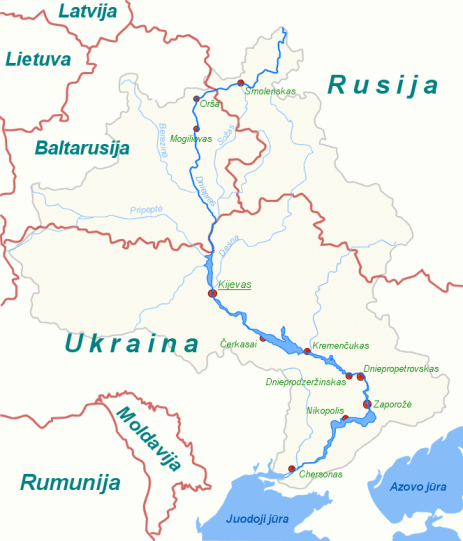
Of course, there are variables in any emergent military situation. Russia will firmly react to any form of Western intervention in Ukraine — although Washington has ruled it out. (In any case, the US’ capability to fight a massive continental war at such short notice is questionable.) The Russian military operations will be decisive with huge firepower and advanced weaponry on multiple fronts, with the intention to realise the political objective in the shortest time possible.
The US journalists have written about “resistance” but that is a load of rubbish. The Russian operation will be short and decisive. The Ukrainian moral fibre today is such that the demoralised forces and the disillusioned people will simply cave in. In all this, what needs to be remembered is that despite the heavy dollops of US indoctrination, Ukrainian people have profound civilisational affinities with Russians that lie submerged just below the surface.
Most important, the pervasive corruption in that country gives ample scope to buy off loyalties — in fact, there may not be much actual fighting at all in many sectors. It also needs to be factored in that the political situation in Kiev is highly unstable, as the latest sedition charges against former president Petro Poroshenko testify.
Zelensky won his mandate as president in 2019 on the basis of his promise to work for rapprochement with Russia. Today, he is a thoroughly discredited figure. People feel betrayed. A crushing military defeat will mean the end of the road for Zelensky.
The ensuing political turmoil within Ukraine is the “X” factor in the Russian intervention. American analysts deliberately sidestep this. Simply put, Russians have a deep understanding of the eddies of Ukrainian politics and the country’s power brokers due to the shared history, culture, politics and societal links.
The ultimate Russian objective will be a federated Ukraine through constitutional reform with the country’s sovereignty, national unity and territorial integrity intact while the regions enjoy autonomy. Europe may welcome this as the best way to stabilise the situation and remove the potential for future conflict.
Indeed, Russia’s expectation will be that such a Ukraine can never become a part of NATO once constitutional underpinnings are put in place to ensure that all major policies pursued in Kiev would be based on national consensus.
The bottom line is that as Russia sees it, the only way out of this crisis is that Ukraine regains its national sovereignty and stops looking to Washington for navigating its destiny. That requires that the American operatives in Kiev who take the decisions for Ukraine go home and Ukrainians are once again the masters of their house, which ceased to be the case once the US intelligence usurped power in February 2014 disregarding the pledge given by then (elected) president Viktor Yanukovich to hold fresh elections before deciding on Ukraine’s EU membership.
Clearly, all this is not going to be as easy as it sounds and the outcome may turn out to be no better than an attempt to unscramble the omelette. But the good part is that there are signs already that Europe is sceptical about blindly tagging along with the US any further on Ukraine.
The probability of discord in the transatlantic relationship is rising. NATO itself has never really been the robust united alliance that was made out to be. Polish President Andrzej Duda’s decision to attend the Winter Olympics in Beijing is a harbinger of things to come. (Incidentally, Putin will also be in Beijing at that time.) Germany opposes not only the removal of Russia from Swift but also the supply of weapons by NATO countries to Ukraine as well as Lithuania’s move (under US advice) to switch ties to Taiwan!
US made a strategic blunder to have encouraged a deeper NATO imprint in Ukraine. Making half-promises thereby to a non-NATO country is going to damage the US’ credibility in the downstream of a Russian intervention. But it is impossible for Washington to backtrack now, as the loss of credibility will be even more.
What remains to be seen, equally, is how the European Union survives this moment. The ardent Atlanticists in the European Commission in Brussels led by Ursula von der Leyen and the Russia-hater Josep Borrell are unilaterally setting the EU agenda currently, ignoring the glaring divergences of opinion among the member states. With Angela Merkel’s departure, a vacuum has appeared which these Eurocrats hope to fill in.
But this is clearly unsustainable. Addressing the European Parliament in Strasbourg last week, French President Emmanuel Macron has urged Europe to invest in its own collective security framework and called for a “frank” EU dialogue with Russia. By the way, neither the EU nor France was involved in the direct talks between the US and Russia in Geneva.
Much is being made out of the threat of sanctions against Russia. But such threats won’t deter Moscow. For a start, even draconian sanctions have proved to be a weak coercive tool. Indeed, US sanctions had a poor coercive track record in North Korea, Cuba, Iran, Venezuela, Vietnam, etc.
Russia is a big power. It has huge reserves, which currently stand at a record $638.2 billion — the fourth largest in the world. Russia’s credit position is good and it owns much of its debts. It has no critical need of US investors. Russia is in no desperate need to sell its currency.
Having gone through four traumatic shocks previously in its 30-year post-cold war history, Russia knows how to absorb shocks. Therefore, while Russia may take a big hit and there could be currency volatility causing outflow of capital initially following the sanctions, its reserves give it a big cushion.
At any rate, how far the Europeans will want to go on the sanctions path remains to be seen. Germany has voiced reservations about Washington’s famous “nuclear option”, namely, the expulsion of Russia from the Swift payment system. To be sure, any disruption in Russian energy supplies will hurt the European economies.
A little known fact is, Russia sells gas at very low prices to Europe, whereas, any LNG supplies from the US to make up for Russian supplies will mean exorbitant prices jacking up the cost of industrial production. Central European countries depend on Russia for 100 percent of their energy needs. Germany has a 40% dependency.
According to reports, a highlight of Putin’s forthcoming visit to Beijing will be the signing of the agreement of the mammoth Power of Siberia-2 gas pipeline project to construct an additional route to send gas to China gas from Siberia’s Yamal Peninsula, where Russia’s biggest gas reserves are, via Mongolia. The capacity of the pipeline is expected to be 60 billion cubic meters of natural gas annually (which exceeds the capacity of Nord Stream 2.)
Significantly, trade turnover between China and Russia has reached a record $146.88 billion in 2021, up 35.8% from the previous year. Most certainly, the standoff between Russia and the West over Ukraine, which could bring new sanctions against Moscow, is likely to tighten the Kremlin’s bond with Beijing even more. The two countries have vowed to raise their trade turnover to $200 billion by 2024. Recent economic trends alone suggest the countries are likely to reach that goal.
The rising geopolitical tensions would add momentum to this effort by making stronger trade ties with China a necessity for the Kremlin. Moscow will need to increase sourcing capabilities elsewhere because of US sanctions, and China will be one major avenue. The big picture is that on its part, China too cannot afford to see Russia going down under US pressure.
Evidently, the US hasn’t thought through the escalatory ladder. The Kremlin has threatened Washington with a complete break in relations if push comes to shove. Trust Moscow to hit back. Russia conducted an anti-satellite test in May by taking out a satellite. Possibly, it was a signal that Russia has the capability to interfere with the GSP constellation in non-military fields, which can affect key sectors of the US economy.
Above all, any “sanctions from hell” will inevitably turn into a morality play on the world stage. There’ll be increasing blowback in the world economy as countries get concerned about Washington’s weaponisation of the dollar. Some may even feel prompted to harden their economy. This can impact the international financial market. Washington backtracked previously when such situations arose. (Washington chose not to impose sanctions against India under CAATSA for its purchase of the S-400 missile system from Russia.)
Paradoxically, thanks to wave after wave of Western sanctions since 2014, Russia has become much more autarchic. Today, it needs no inputs from the West for its defence industry to develop new weapon systems. Pentagon officials have admitted that Russia has taken the lead in cutting edge technology such as hypersonic missiles, and catching up may take three to five years — that is, assuming that the Russian defence industry is resting its oars.
UKRAINE CRISIS: US ‘Toolboxes’ Are Empty
By Scott Ritter | Consortium News | January 22, 2022
U.S. Secretary of State Antony Blinken met with his Russian counterpart, Sergei Lavrov, in a hastily scheduled, 90-minute summit in Geneva yesterday, after which both sides lauded the meeting as worthwhile because it kept the door open for a diplomatic resolution to the ongoing crisis in Ukraine. What “keeping the door open” entails, however, represents two completely different realities.
For Blinken, the important thing appears to be process, continuing a dialogue which, by its very essence, creates the impression of progress, with progress being measured in increments of time, as opposed to results.
A results-oriented outcome was not in the books for Blinken and his entourage; the U.S. was supposed to submit a written response to Russia’s demands for security guarantees as spelled out in a pair of draft treaties presented to the U.S. and NATO in December. Instead, Blinken told Lavrov the written submission would be provided next week.
In the meantime, Blinken primed the pump of expected outcomes by highlighting the possibility of future negotiations that addressed Russian concerns (on a reciprocal basis) regarding intermediate-range missiles and NATO military exercises.
But under no circumstances, Blinken said, would the U.S. be responding to Russian demands against NATO expanding to Ukraine and Georgia, and for the redeployment of NATO forces inside the territory of NATO as it existed in 1997.
Blinken also spent a considerable amount of time harping on the danger of an imminent military invasion of Ukraine by Russian forces said to be massing along the Ukraine-Russian border. He pointed out that any military incursion by Russia, no matter what size, that violated the territorial integrity of Ukraine, would be viewed as a continuation of the Russian “aggression” of 2014 and, as such, trigger “massive consequences” which would be damaging to Russia.
Blinken’s restatement of a position he has pontificated on incessantly for more than a month now was not done for the benefit of Lavrov and the Russian government, but rather for an American and European audience which had been left scratching their collective heads over comments made the day before by President Joe Biden which suggested that the U.S. had a range of options it would consider depending on the size of a Russian incursion.
“My guess is he [Russian President Vladimir Putin] will move in, he has to do something,” Biden said during a press briefing on Wednesday. While presenting a Russian invasion as inevitable, Biden went on to note that Putin “will be held accountable” and “never have[sic] seen sanctions like the ones I promised will be imposed” if Russia were, in fact, to move against Ukraine. Biden spoke of deploying additional U.S. military forces to eastern Europe, as well as unspecified economic sanctions.
Biden then, however, hedged his remarks, noting that the scope and scale of any U.S. response would depend on what Russia did. “It’s one thing,” Biden said, “if it’s a minor incursion and we end up having to fight about what to do and not do.”
Almost immediately the Washington establishment went into overdrive to correct what everyone said was a “misstatement” by Biden, with Biden himself making a new statement the next day, declaring that he had been “absolutely clear with President Putin. He has no misunderstanding, any, any assembled Russian units move across the Ukrainian border, that is an invasion,” and that there should be “no doubt at all that if Putin makes this choice, Russia will pay a heavy price.”
And just in case the President was not clear enough, Blinken reiterated that point following his Friday meeting with Lavrov.
Immutable
The U.S. narrative about Russia and Ukraine was immutable; Russia was hell bent on invading, and there would be massive consequences if Russia acted out on its intent. This was no idle threat, Blinken said, but rather represented the unified position of the United States and its allies and partners.
Or was it? In a telling admission, CNN’s White House correspondent, John Harwood, stated that the “minor incursions” statement by Biden was harmless, because (Harwood said) Putin already knew through sources that this was, in fact, the U.S. position. As for Europe and Ukraine, their collective confusion and outrage was merely an act, a posture they had to take for public consumption, since the optics of Biden’s statement “sounds bad.”
In short, the lack of an agreed-upon strategy on how to deal with a Russian incursion/invasion of Ukraine was an open secret for everyone except the U.S. and European publics, who being fed a line of horse manure to assuage domestic political concerns over being seen as surrendering to Russian demands.
Biden and his administration are old hands at lying to the American public when it comes to matters of national security. One only need look to Biden’s July 23, 2021, phone call with Afghan President Ashraf Ghani for a clear precedent into this inability to speak openly and honestly about reality on the ground. “I need not tell you,” Biden told Ghani, “the perception around the world and in parts of Afghanistan, I believe, is that things are not going well in terms of the fight against the Taliban. And there is a need,” Biden added, “whether it is true or not, there is a need to project a different picture.”
This, in a nutshell, is the essence of the posture taken by the Biden administration on Ukraine. Blinken has indicated that the U.S. has a toolbox filled with options that will deliver “massive consequences” to Russia should Russia invade Ukraine. These “tools” include military options, such as the reinforcement of NATO’s eastern flank with additional U.S. troops, and economic options, such as shutting down the NordStream 2 pipeline and cutting Russia off from the SWIFT banking system. All these options, Blinken notes, have the undivided support of U.S. European allies and partners.
The toolbox is everywhere, it seems—Biden has referred to it, as has White House Press Secretary Jen Psaki. Blinken has alluded to it on numerous occasions.
There’s only one problem—the toolbox, it turns out, is empty.
While the Pentagon is reportedly working on a series of military options to reinforce the existing U.S. military presence in eastern Europe, the actual implementation of these options would neither be timely nor even possible. One option is to move forces already in Europe; the U.S. Army maintains one heavy armored brigade in Europe on a rotational basis and has a light armored vehicle brigade and an artillery brigade stationed in Germany. Along with some helicopter and logistics support, that’s it.
Flooding these units into Poland would be for display purposes only—they represent an unsustainable combat force that would be destroyed within days, if not hours, in any large-scale ground combat against a Russian threat.
The U.S. can deploy a second heavy armored brigade to Poland which would fall in on prepositioned equipment already warehoused on Polish soil. This brigade would suffer a similar fate if matched up against the Russian army. The U.S. can also deploy an airborne brigade. They, too, would die.
There are no other options available to deploy additional U.S. heavy forces to Europe on a scale and in a timeframe that would be meaningful. The problem isn’t just the deployment of forces from their bases in the U.S. (something that would takes months to prepare for), but the sustainability of these forces once they arrived on the ground in Europe. Food, ammunition, water, fuel—the logistics of war is complicated, and not resolved overnight.
In short, there is no viable military option, and Biden knows this.
Empty Sanctions Too
The U.S. has no sanctions plan that can survive initial contact with the enemy, which in this case is the collective weakness of the post-pandemic economies of both Europe and the U.S.; the over-reliance of Europe on Russian-sourced energy, and the vulnerability of democratically elected leaders to the whim of a consumer-based constituency. Russia can survive the impact of any sanctions regime the U.S. is able to scrape together—even those targeting the Russian banking system—far longer than Europe can survive without access to Russian energy.
This is a reality that Europe lives with, and while U.S. policy makers might think hard-hitting sanctions look good on paper, the reality is that whatever passes for U.S.-European unity today would collapse in rapid order when the Russian pipelines were shut down. The pain would not just be limited to Europe, either—the U.S. economy would suffer as well, with sky-high fuel prices and a stock market collapse that would put the U.S. into an economic recession, if not outright depression.
The political cost that would be incurred by Biden and, by extension, the Democrats, would be fatal to any hope that might remain for holding onto either house of Congress in 2022, or the White House in 2024. It would be one thing if Biden and his national security team were honest and forthright about the real consequences of declaring the equivalent of economic war on Russia. It is another thing altogether to speak only of the pain sanctions would cause Russia, with little thought, if any, to the real consequences that will be paid on the home front.
Americans should never forget that Russia has been laboring under severe U.S. sanctions since 2014, with zero effect. Russia knows what could be coming and has prepared. The American people wallow in their ignorance, believing at face value what they are told by the Biden administration, and echoed by a compliant mainstream media.
Propaganda About ‘Propaganda’
One of the great ironies of the current crisis is that, on the eve of the Blinken-Lavrov meeting in Geneva, the U.S. State Department published a report on Russian propaganda, decrying the role played by state-funded outlets such as RT and Sputnik in shaping public opinion in the United States and the West (in the interest of full disclosure, RT is one of the outlets that I write for.)
The fact that the State Department would publish such a report on the eve of a meeting which is all about propagating the big lie—that the U.S. has a plan for deterring “irresponsible Russian aggression”—while ignoring the hard truth: this is a crisis derived solely from the irresponsible policies of the U.S. and NATO over the past 30 years.
While a compliant mainstream American media unthinkingly repeated every warning and threat issued by Biden and Blinken to Russia over the course of the past few days, the Russian position has been largely ignored. Here’s a reminder of where Russia stands on its demands for security guarantees: “We are talking about the withdrawal of foreign forces, equipment, and weapons, as well as taking other steps to return to the set-up we had in 1997 in non-NATO countries,” the Russian Foreign Ministry declared in a bulletin published after the Lavrov-Blinken meeting. “This includes Bulgaria and Romania.”
Blinken has already said the U.S. will reject this.
The toolbox is empty. Russia knows this. Biden knows this. Blinken knows this. CNN knows this. The only ones who aren’t aware of this are the American people.
The consequences of a U.S. rejection of Russia’s demands will more than likely be war.
If you think the American people are ready to bear the burden of a war with Russia, think again.
Is The TAPI Pipeline Finally Ready To Go?
Zero Hedge | January 19, 2022
Submitted by James Durso, Managing Director of Corsair LLC, a supply chain consultancy.
The Turkmenistan–Afghanistan–Pakistan–India (TAPI) natural gas pipeline has been long aborning, but its prospects recently got a shot in the arm.
The 1100-mile, $10 billion project has seen numerous delays since the pipeline consortium was announced in late 2014, though the project was first mooted in 1991. Construction started in early 2018 with a projected in-service date of 2021, but halted later that year after workers clearing the route were killed by unknown assailants. Also, the project’s $10 billion cost estimate is a decade old, and an update may cause further delay to the Asian Development Bank-funded effort that is now slated to resume work in September 2022. Turkmenistan will loan Afghanistan the funds for its share of the project, to be repaid from gas transit revenues.
Representatives of the government of Tajikistan recently met officials in Afghanistan, and the Taliban announcement that it will dedicate 30,000 troops to pipeline security may motivate the parties to start construction.
The completed pipeline will allow Turkmenistan to reduce its reliance on its biggest gas customer, China, which has recently taken most of Turkmenistan’s gas exports, though in 2021 the country doubled its gas exports to Russia, which used to be the biggest importer of Turkmen gas until it was displaced by China in 2010. The pipeline will generate additional income that Ashgabat can use to improve services to citizens, a priority after the recent unrest in neighboring Kazakhstan.
But there may be competing opportunities. For example, Iran, Azerbaijan, and Turkmenistan recently signed a trilateral gas swap deal for up to 2 billion cubic meters (bcm) per year. It’s not a large amount – Turkmenistan exports about 40bcm to China every year – but it’s another income stream that should be managed with an eye to future growth. Then there’s the possibility of a connection to the proposed Trans-Caspian Pipeline (TCP) to supply Europe via the Southern Gas Corridor (SGC). Connecting to the SGC would require a 200-mile subsea pipe between Baku and Türkmenba?y, but may face opposition from Iran and Russia on (probably spurious) environmental grounds. Once the politics are resolved, the project would likely be cheaper and carry less of a security burden than the overland TAPI route, and build on the January 2021 agreement between Baku and Ashgabat to jointly develop the Dostluq (“friendship”) oil and natural gas field in the Caspian Sea.
For Afghanistan, the project would provide transit fees of about $500 million per year, along with an annual share of 500 million cubic meters of gas for the first ten years, ultimately increasing to 1.5 bcm per year.
For the Taliban government, a successful project would: demonstrate it can be a reliable partner in a major infrastructure project, employ demobilized Taliban troops so they don’t defect to the Islamic State or Al-Qaeda, earn revenue to pay for electricity imports (the country relies on imports for 78% of its power), demonstrate to China it is safe to invest in Afghanistan, and be an opportunity for cooperation with Pakistan despite the dispute over their shared border.
Of course, Kabul will have to figure out what to do with that natural gas, in addition to its one trillion cubic feet of reserves. The U.S.-driven development plan for the country emphasized renewables, like solar and wind, and the U.S.-funded $335 million Tarakhil Power Plant near Kabul, which relied on expensive, imported diesel fuel, is now used as a back-up facility when hydropower and imported power aren’t available. An International Finance Corporation-sponsored 59-megawatt gas-to-power plant in Mazar-i-Sharif would have boosted the country’s current total domestic generation by up to 30 percent, but can it be revived under the Taliban?
And time is of the essence as Uzbekistan recently reduced its power exports by 60%, possibly due to increased domestic demand as winter sets in, possibly to nudge Kabul (or the UN) to start paying the $90 million owed to power suppliers in Uzbekistan, Tajikistan, Turkmenistan, and Iran.
For Pakistan, the pipeline would help solve the country’s persistent energy shortfalls, such as the deficit between current gas production of 4 Billion Cubic Feet per Day (BCFD) against demand of 6 BCFD. By 2025, gas production is expected to fall to less 1 BCFD due to depletion of gas reserves while demand increases to 8 BCFD.
And Pakistan won’t have to wait to 2025 for an economic impact: Between 2008 and 2012, 40 percent of Pakistan’s textile sector moved to Bangladesh, one reason being the uneven supply of gas and electricity.
Then there’s Pakistan’s view of its regional interests and its endless search for “strategic depth.” The pipeline would be an independent source of revenue for Afghanistan, just when Pakistan feels the Taliban government should be beholden to it. And India would be able to increase the share of gas in its energy mix from 6.5% to 15%, possibly encouraging more trade between Kabul and New Delhi. To Islamabad, it will add to an already bad outcome: the ungrateful Taliban still aren’t helping Pakistan isolate the Tehreek-e-Taliban Pakistan, while India is expected to be the world’s fastest growing economy in 2022, according to the World Bank.
They say “all politics is local” and that may be the case here. One Pakistani observer, Hina Mahar Nadeem, noted the country’s gas shortfalls have a silver lining – for the interests that control the import of expensive liquefied natural gas (LNG). Accordingly, TAPI and the much-delayed (mostly by U.S. sanctions on Iran) Iran-Pakistan gas pipeline are a threat to their economic and political power.
In late 2020, Pakistan and Russia signed a deal to complete the 700-mile Pakistan Stream Gas Pipeline, to move LNG from Port Qasim (Karachi) to Kasur, in the Punjab. Pakistan may be treating with Russia to balance against China, or maybe the deal was decided on strictly dollars-and-cents terms. Regardless, this project may crowd out attention and funding for Pakistan’s phase of TAPI.
A richer energy mix and pipeline transit revenues would strengthen Pakistan as it negotiates new efforts with China under the umbrella of the China–Pakistan Economic Corridor. Pakistan’s leaders will need to strengthen their position vis-à-vis China while demonstrating to Beijing they are a reliable partner that will develop energy resources that can accommodate China’s projects. But first, those leaders must take on entrenched business and national security interests to successfully support TAPI, despite the economic benefits to its neighbors. But this assumes the country’s leaders aren’t captive (willing or otherwise) to their business confederates and the securicrats.
For India, TAPI would add to the country’s energy mix, propelling its impressive economic growth. India is the world’s third-largest energy consuming country, and has doubled energy use since 2000, with 80% of demand still being met by coal, oil and solid biomass. TAPI gas would allow India to use less coal, helping it meet its COP26 carbon emission goal, and satisfy increased energy demand by 2030 of 25% to 35% according to the International Energy Agency.
India has built a connection for TAPI at Fazilka at the Indo-Pakistan border in the Punjab region, a location on the border with Pakistan that may be subject to cross-border attacks by Pakistan-affiliated groups. Will Pakistan or its proxies be able to resist attacking such a key piece of infrastructure if India-Pakistan relations fail to improve?
For India, the best approach may be “wait and see” if the U.S. threatens sanctions against TAPI partners, whether the Taliban can prove they know how to govern and secure the country against the Islamic State and Al-Qaeda, and how serious is the announced Russia-Pakistan pipeline deal.
Where does this leave Turkmenistan?
It, too, should take it slow. It is no longer 2014, and it now has opportunities for increased swaps with Iran and Azerbaijan, and further opportunities with Iran may blossom if Tehran and Washington can secure a nuclear deal. The opportunity to connect to Europe via the TCP/SGC may present more revenue with fewer security concerns, or iffy partners like Pakistan and Afghanistan. Also, Washington needs to clear the way regarding sanctioned officials in Kabul, though the acting minister of defense, Mullah Muhammad Yaqub, who declared “I am directly responsible for and overseeing the security of the TAPI project” hasn’t been sanctioned by Washington… yet.
Washington might get behind TAPI in the wake of the recent deployment of Collective Security Treaty Organization peacekeeping troops to Kazakhstan, which has increased Russia’s clout in Central Asia. Increased revenue for Ashgabat that can be directed to services for its citizens may prevent the public unrest that gave Moscow an opening to intervene, and Turkmen leader Gurbanguly Berdimuhamedow may not need much convincing in this regard.
But it may serve Ashgabat well to ask Washington for a blanket sanctions exemption for all project principals and suppliers, and any government officials in the mix, to make it clear who bears responsibility if the project again fails to launch. If this happens, it will be a shabby way to treat ally India, and in Pakistan it will be interpreted as U.S. revenge against the country for supporting the Taliban.
The “push” of increased regional influence for Moscow and the “pull” of clean energy for ally India will hopefully make Washington green-light (or get out of the way of) the long-delayed project.
What War With Russia Would Look Like
By Scott Ritter | Consortium News | January 10, 2022
If ever a critical diplomatic negotiation was doomed to fail from the start, the discussions between the U.S. and Russia over Ukraine and Russian security guarantees is it.
The two sides can’t even agree on an agenda.
From the Russian perspective, the situation is clear: “The Russian side came here [to Geneva] with a clear position that contains a number of elements that, to my mind, are understandable and have been so clearly formulated—including at a high level—that deviating from our approaches simply is not possible,” Russian Deputy Foreign Minister Sergei Ryabkov told the press after a pre-meeting dinner on Sunday hosted by U.S. Deputy Secretary of State Wendy Sherman, who is leading the U.S. delegation.
Ryabkov was referring Russian President Vladimir Putin’s demands to U.S. President Joe Biden in early December regarding Russian security guarantees, which were then laid out by Moscow in detail in the form of two draft treaties, one a Russian-U.S. security treaty, the other a security agreement between Russia and NATO.
The latter would bar Ukraine from joining NATO and rule out any eastward expansion by the trans-Atlantic military alliance. At the time, Ryabkov tersely noted that the U.S. should immediately begin to address the proposed drafts with an eye to finalizing something when the two sides meet. Now, with the meeting beginning on Monday, it doesn’t appear as if the U.S. has done any such thing.
“[T]he talks are going to be difficult,” Ryabkov told reporters after the dinner meeting. “They cannot be easy. They will be business-like. I think we won’t waste our time tomorrow.” When asked if Russia was ready to compromise, Ryabkov tersely responded, “The Americans should get ready to reach a compromise.”
All the U.S. has been willing to do, it seems, is to remind Russia of so-called “serious consequences” should Russia invade Ukraine, something the U.S. and NATO fear is imminent, given the scope and scale of recent Russian military exercises in the region involving tens of thousands of troops. This threat was made by Biden to Putin on several occasions, including a phone call initiated by Putin last week to help frame the upcoming talks.
Yet on the eve of the Ryabkov-Sherman meeting, U.S. Secretary of State Tony Blinken simply reiterated these threats, declaring that Russia would face “massive consequences” if it invaded Ukraine.
“It’s clear that we’ve offered him two paths forward,” Blinken said, speaking of Putin. “One is through diplomacy and dialogue; the other is through deterrence and massive consequences for Russia if it renews its aggression against Ukraine. And we’re about to test the proposition of which path President Putin wants to take this week.”
It is as if both Biden and Blinken are deaf, dumb, and blind when it comes to reading Russia.
Ryabkov has alluded to a fact already made clear by the Russians—there will be no compromise when it comes to Russia’s legitimate national security interests. And if the U.S. cannot understand how the accumulation of military power encompassed in a military alliance which views Russia as a singular, existential threat to its members’ security is seen by Russia as threatening, then there is no comprehension of how the events of June 22, 1941 have shaped the present -day Russian psyche, why Russia will never again allow such a situation to occur, and why the talks are doomed before they even begin.
As for the American threats, Russia has given its response—any effort to sanction Russia would result, as Putin told Biden last month, in a “complete rupture of relations” between Russia and those countries attempting sanctions. One need not be a student of history to comprehend that the next logical step following a “complete rupture of relations” between two parties that are at loggerheads over matters pertaining to existential threats to the national security of one or both is not the peaceful resumption of relations, but war.
There is no mealy-mouthed posturing by Foggy Bottom peacocks taking place in Moscow, but rather a cold, hard, statement of fact—ignore Russia’s demands at you own peril. The U.S., it seems, believes that the worst-case scenario is one where Russia invades Ukraine, only to wilt under the sustained pressure of economic sanctions and military threats.
Russia’s worse-case scenario is one where it engages in armed conflict with NATO.
Generally speaking, the side that is most prepared for the reality of armed conflict will prevail.
Russia has been preparing for this possibility for more than a year. It has repeatedly shown a capability to rapidly mobilize 100,000-plus combat-ready forces in short order. NATO has shown an ability to mobilize 30,000 after six-to-nine-months of extensive preparations.
What would a conflict between Russia and NATO look like? In short, not like anything NATO has prepared for. Time is the friend of NATO in any such conflict—time to let sanctions weaken the Russian economy, and time to allow NATO to build up sufficient military power to be able to match Russia’s conventional military strength.
Russia knows this, and as such, any Russian move will be designed to be both swift and decisive.
First and foremost, if it comes to it, when Russia decides to move on Ukraine, it will do so with a plan of action that has been well-thought out and which sufficient resources have been allocated for its successful completion. Russia will not get involved in a military misadventure in Ukraine that has the potential of dragging on and on, like the U.S. experience in Afghanistan and Iraq. Russia has studied an earlier U.S. military campaign—Operation Desert Storm, of Gulf War I—and has taken to heart the lessons of that conflict.
One does not need to occupy the territory of a foe in order to destroy it. A strategic air campaign designed to nullify specific aspects of a nations’ capability, whether it be economic, political, military, or all the above, coupled with a focused ground campaign designed to destroy an enemy’s army as opposed to occupy its territory, is the likely course of action.
Given the overwhelming supremacy Russia has both in terms of the ability to project air power backed by precision missile attacks, a strategic air campaign against Ukraine would accomplish in days what the U.S. took more than a month to do against Iraq in 1991.
On the ground, the destruction of Ukraine’s Army is all but guaranteed. Simply put, the Ukrainian military is neither equipped nor trained to engage in large-scale ground combat. It would be destroyed piecemeal, and the Russians would more than likely spend more time processing Ukrainian prisoners of war than killing Ukrainian defenders.
For any Russian military campaign against Ukraine to be effective in a larger conflict with NATO, however, two things must occur—Ukraine must cease to exist as a modern nation state, and the defeat of the Ukrainian military must be massively one-sided and quick. If Russia is able to accomplish these two objectives, then it is well positioned to move on to the next phase of its overall strategic posturing vis-à-vis NATO—intimidation.
While the U.S., NATO, the EU, and the G7 have all promised “unprecedented sanctions,” sanctions only matter if the other side cares. Russia, by rupturing relations with the West, no longer would care about sanctions. Moreover, it is a simple acknowledgement of reality that Russia can survive being blocked from SWIFT transactions longer than Europe can survive without Russian energy. Any rupturing of relations between Russia and the West will result in the complete embargoing of Russian gas and oil to European customers.
There is no European Plan B. Europe will suffer, and because Europe is composed of erstwhile democracies, politicians will pay the price. All those politicians who followed the U.S. blindly into a confrontation with Russia will now have to answer to their respective constituents why they committed economic suicide on behalf of a Nazi-worshipping, thoroughly corrupt nation (Ukraine) which has nothing in common with the rest of Europe. It will be a short conversation.
If the U.S. tries to build up NATO forces on Russia’s western frontiers in the aftermath of any Russian invasion of Ukraine, Russia will then present Europe with a fait accompli in the form of what would now be known as the “Ukrainian model.” In short, Russia will guarantee that the Ukrainian treatment will be applied to the Baltics, Poland, and even Finland, should it be foolish enough to pursue NATO membership.
Russia won’t wait until the U.S. has had time to accumulate sufficient military power, either. Russia will simply destroy the offending party through the combination of an air campaign designed to degrade the economic function of the targeted nation, and a ground campaign designed to annihilate the ability to wage war. Russia does not need to occupy the territory of NATO for any lengthy period—just enough to destroy whatever military power has been accumulated by NATO near its borders.
And—here’s the kicker—short of employing nuclear weapons, there’s nothing NATO can do to prevent this outcome. Militarily, NATO is but a shadow of its former self. The once great armies of Europe have had to cannibalize their combat formations to assemble battalion-sized “combat groups” in the Baltics and Poland. Russia, on the other hand, has reconstituted two army-size formations—the 1st Guards Tank Army and the 20th Combined Arms Army—from the Cold War-era which specialize in deep offensive military action.
Even Vegas wouldn’t offer odds on this one.
Sherman will face off against Ryabkov in Geneva, with the fate of Europe in her hands. The sad thing is, she doesn’t see it that way. Thanks to Biden, Blinken and the host of Russophobes who populate the U.S. national security state today, Sherman thinks she is there to simply communicate the consequences of diplomatic failure to Russia. To threaten. With mere words.
What Sherman, Biden, Blinken, and the others have yet to comprehend is that Russia has already weighed the consequences and is apparently willing to accept them. And respond. With action.
One wonders if Sherman, Biden, Blinken, and the others have thought this through. Odds are, they have not, and the consequences for Europe will be dire.
Scott Ritter is a former Marine Corps intelligence officer who served in the former Soviet Union implementing arms control treaties, in the Persian Gulf during Operation Desert Storm, and in Iraq overseeing the disarmament of WMD.
Neocolonialism haunts Horn of Africa
BY M. K. BHADRAKUMAR | INDIAN PUNCHLINE | JANUARY 5, 2022
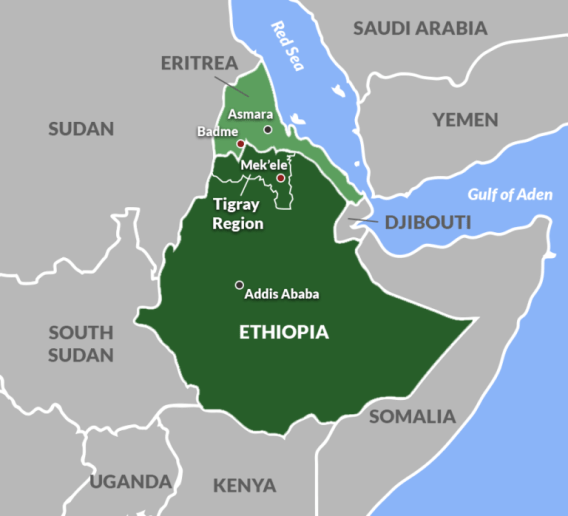
Chinese foreign ministers have traditionally marked the new year by visiting the African continent. Wang Yi’s 2022 African tour begins with Eritrea against the backdrop of the US strategy in the Horn of Africa to gain control of the strategically vital Red Sea that connects Indian Ocean with the Suez Canal.
Eritrea and China are close friends. China was a supporter of the Eritrean liberation movement since the 1970s. Eritrean President Isaias Afewerki, the veteran revolutionary who led the independence movement, had received military training in China. More recently, Eritrea was one of the 54 countries backing China’s Hong Kong policy (against 39 voicing concern in a rival Western bloc) at the UN General Assembly in October 2020.
Last November, Eritrea signed an MoU with China to join the Belt And Road Initiative. Neighbouring Djibouti is already a major participant in the BRI. So is Sudan along the Red Sea coastline.
Central to regional cohesion in the Horn of Africa is the relationship between Ethiopia and Eritrea. It has been a conflict-ridden troubled relationship but China, which also has close ties with Ethiopia, is well-placed to meditate reconciliation.
One common view is that Ethiopian Prime Minister Abiy Ahmed pulled off a stunning victory in the conflict with US-backed Tigray Peoples Liberation Front (TPLF) with the help of armed drones supplied by the United Arab Emirates, Turkey and Iran. But civil wars are won on the ground. And the politico-military axis between Ethiopia and Eritrea to take on the TPLF proved to be the decisive factor. China encouraged the rapprochement between Addis Ababa and Asmara.
Effectively, the two leaderships understood that they have a congruence of interests in thwarting the TPLF which is an American proxy to destabilise their countries and trigger regime changes. (Read the analysis in CounterPunch titled Ethiopia Conflict by US Design.)
Washington is mighty displeased that China’s influence in Djibouti is on the rise and resents that the Marxist regime of Isaias Afewerki keeps the US at arm’s length.
The Horn of Africa is of great strategic importance, and Ethiopia sits at its heart. Destabilise Ethiopia and impact the whole region; install a dictatorial expansionist ethnocentric regime (TPLF); sow division and poison the atmosphere of mutual understanding and cooperation that is being built within the region — this is the neocolonial agenda.
President Uhuru of Kenya, speaking at Ethiopian Prime Minister Abiy Ahmed’s inauguration had said, “Ethiopia is the Mother of African independence… for all of us on the continent, Ethiopia is our Mother… As we know, if the Mother is not at peace, the family cannot be at peace.”
The US is going for the jugular veins of the Mother of post-colonial Africa. An analogy would be destabilising India to gain control of the South Asian region, the difference being that Ethiopia is the only African country never to have been colonised.
The widespread revulsion among Afghans all over the continent is palpable over the US using its TPLF proxy to destabilise Ethiopia. Their collective cry is “No more” — no more colonialism, no more sanctions, no more disinformation, no more lies by the CNN, BBC, etc. The cry resonates widely amongst the Ethiopians, Eritreans, Sudanese, Somali, Kenyan, and friends of Ethiopia.
The paradox is, Ethiopia today has a democratically elected government after decades of thuggery under the TPLF that ruled with an iron fist for over 30 years with US backing. The Tigray people actually add up to only 5% of Ethiopia’s population but such details were irrelevant to Washington so long as the government in Addis Ababa obeyed its diktat.
There is also a religious sub-text. The Tigray people are Christians whereas the largest ethnic group in Ethiopia is the Oromo, native to the region of Ethiopia and Kenya. They are a Cushitic people who have inhabited the East and Northeast Africa since at least the early 1st millennium. The Oromo people have a glorious history of forced resistance to religious conversion, primarily by European explorers, Catholic Christians missionaries.
Broadly, the resistance ideology is embedded in the Oromo collective memory. Abiy Ahmed is the first ethnic Oromo to become prime minister. Nobel laureate Abiy Ahmed is an extraordinary politician, far-sighted and deeply committed to his country’s plural identity national sovereignty.
In geopolitical terms, Washington would see many advantages in the destabilisation of Ethiopia as it would trigger a multi-vector regional conflagration, as happens when multi-ethnic nations unravel — such as the former Yugoslavia or today’s India or Russia. And neighbouring countries would be inevitably sucked into ethnic wars such as Sudan, Eritrea, Djibouti, Somalia and Kenya — and even Egypt and Persian Gulf states.
The fact that the UAE, Turkey and Iran — improbable allies — are supporting Abiy’s desperate effort to preserve Ethiopia’s sovereignty and national cohesion and helped boost his military campaign to ward off another attempt by the US-backed TPLF to capture power speaks volumes.
In this matrix, while the US aims to dominate the hugely strategic Horn of Africa, “Plan B” will be to be the spoiler by throwing the region into turmoil so that China is also a loser. The point is, the Western world has no answer to China’s BRI.
China and Ethiopia have a strong political affinity and deep economic bonds, and Ethiopia is one of China’s top five investment destinations on the African continent. Beyond investment, relations extend to trade, infrastructure finance and other areas. Economic engagement with China has provided Ethiopia with many opportunities.
Curiously, even prior to the advent of the BRI, China was already a major financier of Ethiopia’s infrastructure. Chinese investment in the manufacturing sector — incidentally, one of the Abiy government’s focus areas currently — has contributed to the country’s economic transformation and diversification and to job creation.
A recent report by the well-known London-based global think-tank ODI titled The Belt and Road and Chinese Enterprises in Ethiopia estimates that China’s BRI “has the potential to open up new development pathways through infrastructure development, stimulating investment and job creation and promoting economic transformation… BRI can be an engine for growth and development. However, this is not a given…”
The ODI report, dated August 2021, concludes, “Chinese investors are concerned regarding economic and political uncertainty in Ethiopia. Political uncertainty has to do with domestic conflict and political instability, which may affect not only investors’ profitability, but also their personal safety and the safety of their assets. The economic challenges relate to high production and transport costs and the difficulties of accessing foreign exchange, which is a problem for virtually all Chinese businesses in the country. The challenges identified by Chinese investors could pose a threat to the sustained development of China–Ethiopia economic cooperation.”
Simply put, if there is mayhem in Ethiopia, the locomotive of China’s BRI in the vast regions of the Horn of Africa and East Africa can be potentially slowed down if not derailed. That is the least the US can do faced with the grim prospect that it has no alternative offer to make to the African nations to counter the BRI.
If the BRI locomotive chugs along unimpeded, the entire Western neocolonial project in Africa in the 21st century is threatened with extinction. The existential angst shows in the Biden Administration’s announcement on New Year’s Eve terminating Ethiopia’s access to the US duty-free trade program under the U.S. African Growth and Opportunity Act (AGOA “amid the widening conflict in northern Ethiopia.”
President Biden had threatened in November already that Ethiopia would be cut off from the AGOA because of alleged human rights violations in the Tigray region. Biden spoke up in sheer despair in anticipation of Wang Yi’s working visit to Ethiopia on December1!
Evidence that Omicron causes mild disease, and evidence that hype about pediatric hospitalizations is hogwash
By Meryl Nass, MD | December 28, 2021
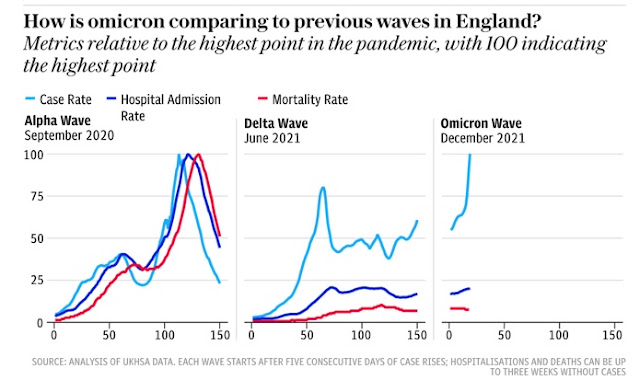
This graph is from the Telegraph 2 days ago, and it shows that hospitalizations and deaths have not paralleled the rise in cases for Omicron, as they did for earlier waves.
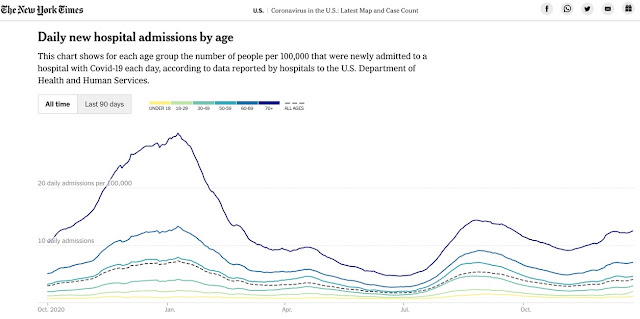
The second graph shows hospitalizations [with Covid] over time by age from today’s NY Times. The yellow line is pediatric ages. While I have not posted a “cases” graph, cases have shot up, while hospitalizations and deaths have not shot up proportionately, as happened in the US with prior waves.
The tide is turning: former pro-vax PhDs are now refusing the booster
Want to know what changed their minds?
By Steve Kirsch | December 12, 2021
People are starting to wake up.
Recently, I received news that top researchers at multiple highly respected institutions (including Harvard) who had earlier been publicly promoting the vaccine have now changed their minds and are privately refusing to get the booster.
How is that possible? Did we finally convince them with the data? Most of my truthteller friends have been censored and/or deplatformed. So what is causing these people to shift their views so quickly?
The credit for the attitude shift goes our best convincer: the vaccine itself.
These researchers are seeing first hand how dangerous the vaccine is because they are involved in studies in hospitalized and/or outpatients and they see the numbers first hand.
Of course, they can’t say anything officially since they would be fired or have their funding taken away.
I just wanted you to know that people are finally waking up to what is really going on here.
First Comply, Then We’ll Grant You Some Rights
BY STACEY RUDIN | BROWNSTONE INSTITUTE | DECEMBER 5, 2021
More and more people feel like something is “off” about our response to the “Covid” pandemic. This pandemic is claimed by political establishment prophets to be the first time in history that we need universal, worldwide “vaccination” to dissipate a respiratory pathogen. The proffered “vaccines” do not provide sterilizing immunity; rather, they lead to regular “breakthrough” infections. Yet we are directed to “mix and match” them as we like, on a regular basis, in order to eat in restaurants and attend events.
Having recovered from the disease itself does not suffice to maintain your rights. The ability to prove that you are not susceptible to the pathogen due to inherent good health does not suffice. To maintain freedom of movement, you must submit to the injections.
Something is off. They want us to take these “vaccines” very badly. They want to build a QR/tracking infrastructure on this “safety” premise very badly. One must ask: did they ever have a legitimate basis to lead us to this point? Did they really believe they could “save grandma” with a lockdown?
By picking apart the superficially flawed justification they gave to the terrified world population for first imposing universal house arrest, we can see that they did not. Both the WHO and the Imperial College modeler Neil Ferguson called for lockdowns specifically based on China’s Wuhan lockdown of January 2020. They admitted that “lockdown” was something no one previously believed would work. When “Xi Jinpeng succeeded,” they abruptly reversed course 180 degrees, calling for the entire world to “copy China.”
“It’s a communist one party state, we said. We couldn’t get away with it in Europe, we thought… and then Italy did it. And we realised we could…If China had not done it, the year would have been very different.” — Neil Ferguson
Six weeks after the discovery of the first case, the WHO, during a press conference, sold the world on lockdown by claiming that “Wuhan’s curve is flatter” compared to other regions of China. The data it used to make this case — a case that it knew would devastate world economies and any individual human who could not earn money by sitting in front of a computer screen— was presumably provided via the communist dictator.
“So here’s the outbreak that happened in the whole country on the bottom. Here’s what the outbreak looked like outside of Hubei. Here are the areas of Hubei outside of Wuhan. And then the last one is Wuhan. And you can see this is a much flatter curve than the others. And that’s what happens when you have an aggressive action that changes the shape that you would expect from an infectious disease outbreak. This is extremely important for China, but it’s extremely important for the rest of the world . . .
The Chinese government and the Chinese people have used the non-pharmaceutical measures (or the social measures) [to] effectively change […] the course of the disease, as evidenced by the epidemic curves… In the report we have recommended this method to the international community.”
This superficially pleasing explanation — one easily accepted by a trusting scared person — raises huge red flags on closer analysis. First, how was the testing in the various regions conducted? Was it randomized throughout the population, or were only those who presented at clinics or hospitals tested? How many tests were conducted per capita? Was that number standard throughout the regions? How can we be sure “asymptomatic” cases were captured?, and so forth. In short, each curve could simply have depicted testing protocol — the tester could quite literally have compiled any curve it wanted.
Even worse, there is a logical flaw so breathtaking that it is impossible to believe it could have been overlooked by all lockdown-imposing world governments. Of the thousands of national, state, and local political and media actors cheering on the lockdowns, at least one must have noticed that while the curve may have been “flatter in Wuhan,” the disease still went away in all of China. The supposed “flatter” curve in Wuhan had zero net benefit. The residents there suffered through the pain of lockdown, neighboring regions did not, and they all ended up at the same point.
China has not reported any Covid cases in nearly four months. Prior to that, its cases were flatlined for fifteen months, since March 2020. China’s disease “curve” would be comedic if the rest of the world had not given up democracy and precious constitutional rights to “fight the virus”:
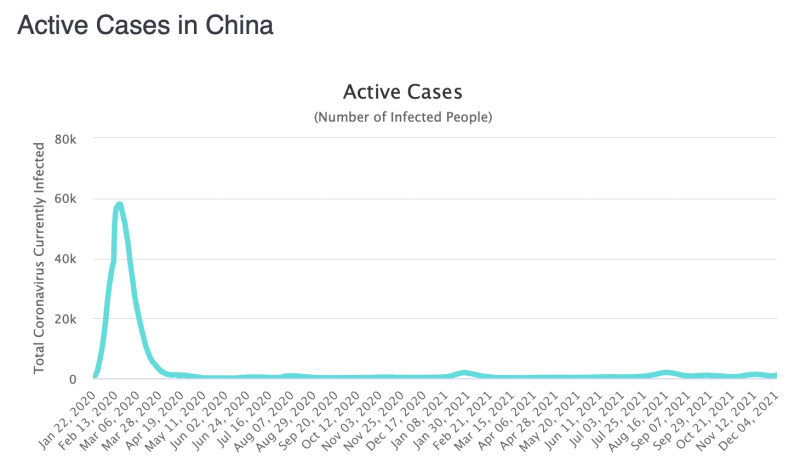
Contrast this with the rest of the world — particularly the countries that tried the hardest to replicate the Chinese example — such as Peru, Israel, Australia, Singapore, New Zealand, and Canada. All of them have reported multiple “waves” of Covid despite all of the pain of lockdown. Even mass vaccination has not “stopped” waves of cases. China is the only country with a perfectly flat “curve,” and it did that with a single-city lockdown, despite reporting the presence of the virus in many other regions. Magic.
World governments clearly know about this. They do not trust the communist dictator. If they really believed the disease was serious and China underreported cases, they would not be firing doctors and nurses who refuse the “vaccine” after working safely with covid patients for 18 months. Rather, they know that the rules have no effect. The disease curves rise and fall, rise and fall — it would be absurd and perverse to conclude the rules work sometimes and fail at other times.
Yet they keep imposing rules. The population complies, conditioned to an illusion of control; a superstitious belief that “because we did something, it must have had an effect.” But facts are facts: even the “vaccines” have not stopped the virus, there are “breakthrough infections.” Desiring to be “good people,” everyone stays unthinkingly on the track that started with Wuhan’s lockdown.
They are trying to save grandma, but grandma’s fate is sealed. What is actually happening is they are paving the way to routine universal mandatory vaccination. The political establishment intends to make “the unvaccinated” second-class citizens, to dehumanize them and deny them basic rights many generations have taken for granted. This conditions the population to movement restrictions based on behavior. Compliance gets you rights, like a dog earning treats.
In this system — which is steadily getting underway in country after country — a person who weighs 350 pounds, is completely sedentary, and eats a steady stream of Big Macs is considered “healthy” and accepted in society. The decisive factor is obedience: he dutifully takes all of the “boosters.” By contrast, a world-class athlete such as Novak Djokovic cannot play tennis at the Australian Open. He is deemed an “infection risk” because he insists on maintaining his body using eastern-style health practices, the same ones that made him into the greatest tennis player of all time. (The establishment would rather he copy the Big Mac devotee described above, because it earns them — not him —more profits).
The political establishment is so devoted to this cause that it is hard to see how we can extricate ourselves. Accepting the first lockdown was the decisive point. We sacrificed our rights due to fear, and nearly two years later, we still don’t have them back. It was as obvious then as it is now: power is never seized and then voluntarily returned.
Australia now has “quarantine camps.” “Unvaccinated” Canadians cannot use mass transit. Austrians who refuse the jab cannot leave their homes. It bears repeating: world governments are holding law-abiding adults in house arrest for refusing to take an injection. This is not a drill.
Combine this real-life dystopia with the twisted “logic” used to launch the lockdowns, and it is hard to ignore the sinking feeling that lockdown was a preconceived pathway to where we are now: staring down the barrel at permanent, regular, mandatory adult vaccination — your immune system is now a subscription service — and corresponding movement “passports.”
Why do they want to inject us so badly? Certainly not for our own good. They act in their own self-interest, under cover of fake, “grandma-saving” goodwill. They are stealing from us — from you. How much more will you let them take?
Stacey Rudin is an attorney and writer in New Jersey, USA.
Greece plans to send troops to the Sahel
By Lucas Leiroz | December 2, 2021
In a recent statement, the Greek government confirmed Athens’ interest in sending troops to cooperate with the French armed forces in the African Sahel. The project is still under consideration but tends to be approved due to the strong pressure that Greece receives from Paris to “compensate” French efforts to protect Greek territorial integrity in tensions with Turkey. The move sounds truly anti-strategic for Greece, considering that the country will have enemies it previously did not have and will enter conflicts that have nothing to do with Greek geopolitical interests.
In a recent press conference, Greek Defense Minister Nikos Panagiotopoulos said that his country’s political and military leaders are currently discussing the feasibility of sending troops to Africa, where soldiers will join French military bases in order to assist in the Paris-led campaign against insurgent groups that are proliferating in the Sahel and across the region between the Sahara Desert and the West Coast.
These were some of his words: “We are considering sending a group of combat soldiers to Sahel. These are not military advisers, we already have such in the area, these are permanent combat members of the Armed Forces (…) If Turkey tries to attack and we ask for help from France, based on the military agreement we have signed, then the French forces will be there, they must be there (…) We are for them and they are for us”.
When talking about this possibility of mutual assistance, Panagiotopoulos is mentioning the recent bilateral defense cooperation agreement signed by both countries in October, which determine a series of measures to be implemented in order to strengthen the Franco-Greek military partnership. The agreement establishes that both countries must cooperate militarily with each other in conflict scenarios and also enumerates forms of commercial cooperation through measures such as, for example, the requirement that the Greek State buy frigates produced by the French naval industry.
Panagiotopoulos categorically states that sending Greek troops to Africa is a strategic measure for Greece, since, as a way of complying with the agreement signed with Paris, it would create a favorable precedent in bilateral relations and compel the French to repay the kindness, in case tensions escalate with Turkey in the future. However, Panagiotopoulos’ premise is absolutely wrong. It is not Greece that is setting this type of condition, but France. Athens is not freely proposing to send its soldiers to the Sahel – it is France that is demanding it, so there is no reason to consider this type of maneuver profitable in any way for the Greeks.
In the same sense, this type of cooperation would never benefit Greece for the simple fact that there is no military equivalence between both countries. France is one of the greatest military powers in the world, with high combat power and even nuclear weapons, maintaining an active expansionist policy in Africa and the Mediterranean, in addition to occupying a leading and prominent role in the European Union. The current situation of the Greek State is that of a country with very low military capacity, which is under constant pressure from an insurgent and expansionist power (Turkey) and which seeks alliances with France in order to defend its territorial integrity in the face of imminent threats. For France to demand “retribution” from Greece for its support on the Turkish issue is truly absurd, considering that Greece already has enough problems and difficulties just in its tensions with Turkey. Sending soldiers to Africa will significantly weaken Greece’s defense potential and leave the country even more vulnerable in its regional conflicts. So, Paris is acting abusively by requesting Greek troops in the Sahel.
Obviously, if both countries already have an agreement, this must be accomplished – or vetoed. The attitude that most benefits Greek strategic interests would be to find non-direct ways of cooperating with France on the Sahel, perhaps with logistical or intelligence support, but renouncing active military participation. If France continued to demand the deployment of troops, Athens would simply have to abandon the bilateral agreement and find another, less abusive way to establish partnerships. The current situation seems unsustainable. France will be weakening Greece with the demand for troops in African territory, and there is no sense for Athens to continue in a military agreement, whose objective is to strengthen the defense.
For years, France has maintained troops in the Sahel without any success in controlling the region. Paris is unable to maintain an occupation policy throughout the Sahel due to the immensity of the territory, which makes the area vulnerable to occupation by insurgent groups. Clandestine militias – some of them terrorists – currently control much of the Sahel zone and French troops are failing to pacify the region.
Furthermore, it is necessary to remember that in recent months a wave of indignation has started on the part of African communities against the French occupation. The main cities of West Africa are experiencing demonstrations in favor of the expulsion of the French armed forces due to the chaos and widespread, inefficient violence while being unable to contain the spread of terrorism in the region. In fact, it has become increasingly complicated for France to maintain its expansionism on African soil and now Paris seems interested in handing over to Athens a part of the responsibility of managing the chaos created by the French in the Sahel.
The Greek government has nothing to gain by engaging in civil wars on another continent that have absolutely nothing to do with Athens’ geopolitical interests. France is acting abusively by delegating the responsibility for this conflict to the Greeks. It is up to the Greek government to act prudently and avoid further conflicts, seeking to strengthen the country to face the current problems.
Lucas Leiroz is a research fellow in international law at the Federal University of Rio de Janeiro.
First Meeting of WHO Body to Discuss New Pandemics Treaty to Be Held on 1 March: Tedros
Sputnik – December 1, 2021
Director-General of the World Health Organization (WHO) Tedros Adhanom Ghebreyesus said on Tuesday that the first meeting of the organization’s commission to discuss a new treaty on the COVID-19 pandemic will take place on 1 March 2022, and its final document will be presented in 2024.
“I welcome your commitment to hold the first meeting of the INB [intergovernmental negotiating body] no later than the first of March 2022, and to submit its outcome for consideration to the World Health Assembly in 2024. And I give you my commitment that the Secretariat will support this process,” Tedros said at the end of the WHO assembly special session.
He also expressed his support for the the decision to establish a negotiating body to discuss a WHO convention on the COVID-19 pandemic response.
“I welcome the decision you have adopted today, to establish an intergovernmental negotiating body to draft and negotiate a WHO convention, agreement or other international instrument on pandemic prevention, preparedness and response,” Tedros said.
Opposition candidate Xiomara Castro claims election victory in Honduras

Xiomara Castro of the opposition Liberty and Refoundation Party (Libre) and vice presidential candidate Salvador Nasrala after the closing of the general election, November 29, 2021. (Photo: Reuters)
Press TV – November 29, 2021
Leftist opposition candidate, Xiomara Castro, has claimed victory in Honduras’ presidential election, with preliminary results putting her in pole position against the ruling party candidate.
With 38% of the voting tally complete, the Liberty and Refundation Party (LIBRE) candidate is in the lead with over 53 percent votes. Her main rival, Nasry Asfura of the ruling conservative National Party, currently has nearly 34% of the vote, according to the National Electoral Council (CNE).
If Castro holds on to the lead, she would become the first female president of the Central American country, ending the conservative party’s 12-year stint in power.
“We win! We win!” Castro, 62, told cheering party supporters on Sunday evening. “Today the people have made justice. We have reversed authoritarianism.”
In a brief victory address, Castro vowed to form a government of “reconciliation,” and to strengthen direct democracy with referendums, adding that “there will be no more abuse of power in this country.”
“We can’t stay home. This is our moment. This is the moment to kick out the dictatorship,” said Castro, who is making third bid at the presidency. She is the wife of former President Manuel Zelaya, whose government was toppled by a civilian-military alliance in 2009.
The outgoing President, Juan Orlando Hernandez, was accused by a US court of having ties to powerful drug trafficking gangs. However, he has denied the allegations.
Hernandez has faced stiff opposition in Honduras since he claimed a second term in a highly-divisive election at the end of 2017, which sparked widespread protests after both sides declared victory.
Unlike Hernandez, who was a conservative US ally, Castro has said that she would have diplomatic relations with China.
According to the electoral council, the voting saw a historic turnout of more than 68 percent.
The election is the latest political flashpoint in Central America, a major source of growing US-bound migrants fleeing chronic poverty, unemployment and persecution.
The spiraling crisis of hunger and homelessness in Honduras has placed it among the world’s most violent countries.
Alongside the presidency, the country’s 128-member Congress, and officials for some 300 local governments, are also being voted in these elections.
Are NHS scaremongers using out-of-date Covid figures?
By Will Jones | TCW Defending Freedom | November 29, 2021
THE Sunday Times has added its authority to the Guardian’s unsubstantiated claims about hospitals being deluged with unvaccinated Covid patients.
ICU is full of the unvaccinated – my patience with them is wearing thin | Anonymous | The Guardian
It published an article yesterday stating that intensive care beds are ‘filled with unvaccinated Covid patients’. The paper quotes Professor Stephen Powis, the National Medical Director of NHS England, saying: ‘Data shows that the overwhelming majority of people admitted to intensive care with Covid are not fully vaccinated. Since July one in four critical beds have been consistently occupied by a Covid patient, with the latest statistics available showing three quarters of them are unvaccinated.’
What ‘data’ and ‘latest statistics’ is Powis referring to? The Sunday Times article containing his quote doesn’t say, but if you click on the words ‘overwhelming majority’ it takes you to another piece in yesterday’s paper, this one by Dr Rachel Clarke. The subhead of that article is ‘Some 75 per cent of those suffocating in intensive care with the coronavirus are unvaccinated’ and she repeats this claim in her piece, stating: ‘Of the Covid patients treated in intensive care in recent months, the majority – nearly 75 per cent according to the latest data – have chosen not to be vaccinated.’
Daily Sceptic editor Toby Young asked Rachel Clarke on Twitter if she could point him towards the ‘data’ she’s referring to and she replied by citing the latest Intensive Care National Audit & Research Centre (ICNARC) report.
Is this the data both she and Professor Powis are referring to or just Dr Clarke? A similar tweet from Toby Young to Stephen Powis went unanswered, but it’s not unreasonable to assume they’re both citing the latest ICNARC report, not least because it includes for the first time a breakdown of vaccinated and unvaccinated patients receiving critical care in English NHS hospitals. (Clarke refers to separate NHSE data showing the same thing, but I can’t find anything on the internet.)
Now there’s a slight problem with the ICNARC data Clarke cites, which is that it only covers the period May 1 to July 31.
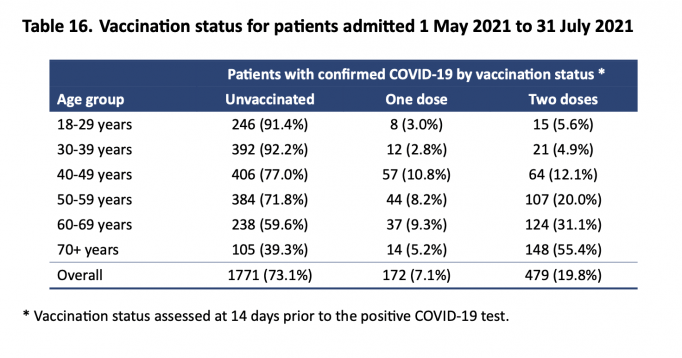
So is the data for May 1 to July 31 what Professor Powis means by ‘since July’ and what Dr Clarke means by ‘recent months’?
The problem with extrapolating from this ICNARC data to make sweeping statements about the current ratio of unvaccinated to vaccinated Covid patients in ICU – as the Sunday Times subhead and Dr Clarke do, and Professor Powis appears to – is that it stops before the Delta wave gets properly under way and before the surge in infections in the vaccinated over the summer, when the epidemic became dominated by vaccinated people.
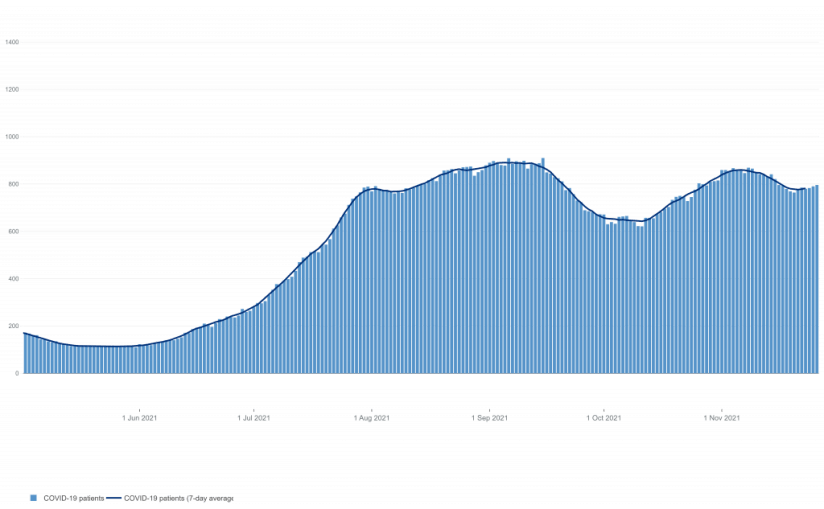
Covid ICU patients in England (UK Government)
If this is what’s going on, it’s reminiscent of the ‘sleight of hand’ by NHS England chief Amanda Pritchard earlier this month, when she claimed that: ‘We have had 14 times the number of people in hospital with COVID-19 than we saw this time last year.’ It quickly turned out that by ‘this time last year’ she was referring to August rather than October or November, and was widely ridiculed for such an obviously incorrect and scaremongering statement when Covid hospital admissions at the time were plainly lower than in autumn 2020. She never apologised and instead tried to make it look as if she was misunderstood, which, if Powis’s latest intervention is of a similar kind, suggests there may be no intention in the upper echelons of the health service to communicate clearly and accurately about the current risks posed by the virus.
In fact, given the data from UKHSA over the autumn showing a higher proportion of Covid hospitalisations and deaths in the vaccinated (67 per cent and 82 per cent respectively in the week 46 report), it seems most unlikely that three-quarters of Covid ICU patients in the same reporting period were unvaccinated. Why, though, do we not have data in the public domain more recent than July so we can see for ourselves rather than having to extrapolate and speculate? We have up-to-date data on hospitalisations and deaths by vaccination status, so why doesn’t the UKHSA add a column to its table for ICU admissions as well?
The biggest problem with Powis’s statement is not that it appears to be a misleading way of communicating statistics, but that it is being used against the unvaccinated in what seems to be a concerted effort to turn them into scapegoats and pariahs. ‘These are beds that would have historically been used to provide life-saving surgeries for the most seriously ill patients,’ he says. This echoes the words of the anonymous medic in the Guardian last week: ‘If everyone got vaccinated, hospitals would be under much less pressure; this is beyond debate. Your wait for your clinic appointment/operation/diagnostic test/A&E department would be shorter. Your ambulance would arrive sooner. Reports of the pressure on the NHS are not exaggerated, I promise you . . . Most of the resources that we are devoting to Covid in hospital are now being spent on the unvaccinated.’
This is an ugly and dangerous road. Not only is there currently no publicly available data to back up these assertions – at least, nothing more recent than July 31 – but even if there was it would be no excuse to demonise and delegitimise the minority who, for whatever reason, remain unvaccinated. Our health service chiefs, and the journalists who report on their comments, need to do better than this.
A longer version of this article appeared in the Daily Sceptic on November 28, 2021.
Featured Video

Macgregor: We Haven’t Seen the Worst of the Iran War Yet
or go to
Aletho News Archives – Video-Images
New Book
Breast Cancer: Before You Consent
A new Unbekoming paperback
Lies are Unbekoming | September 18, 2026
Peter Gøtzsche reviewed every randomised mammography screening trial ever conducted for the Cochrane Collaboration. Cochrane’s headline is that, assuming a 15% mortality reduction, one woman in 2000 avoids dying of breast cancer over ten years. Ten are overdiagnosed and treated. Two hundred experience false alarms.
But that headline assumes the reduction. When Gøtzsche looked only at the trials with adequate randomisation — the higher-quality ones — the reduction disappeared. No effect on breast cancer mortality. No effect on all-cause mortality.
This is the Cochrane finding, published in the establishment’s own database of systematic reviews.
No woman being asked to consent to a mammogram this week knows it.
That is why the new Unbekoming paperback exists. … continue
Blog Roll
 Aletho News
- US lawmaker blocks $2.8 billion weapons sale to Israel: Report
- Yemeni army claims responsibility for strikes on sensitive sites in Saudi capital, Aramco facilities in Yanbu
- Iran Judiciary issues indictments against 159 US, Israeli officials for assassination of Leader, commanders
- Turkiye revokes Iranian bank license under US sanctions campaign
- US-Denmark Agreement on Greenland Is ‘PR Stunt’ Ahead of Midterms
- Araghchi: Military intervention cannot create security; coercion cannot bring peace
- Fraud Squared
- Breast Cancer: Before You Consent
- Iran’s Plan to Shut Down AI in the Persian Gulf
- Israel seeks ‘compensation’ from Washington over Saudi F-35 sale
- If Americans Knew
- Inside Gaza’s death trap of collapsing, bombed-out buildings
- The everyday items Israel bans from Gaza every day
- Inside the siege, the ruined buildings of Gaza – Daily Update
- Debunking The Claim That Macklemore Has A “History Of Antisemitism”
- CPJ demands release of arrested Palestinian-US journalist near Bethlehem
- Robert Kraft: The Billionaire Friend of Netanyahu Pulling The Strings Behind the Macklemore/Ed Sheeran Blow Up
- Columbia Administered Fund Gives Big Money to Pro-Israel Groups
- Deportation Case of Palestinian Activist Salah Sarsour Tests First Amendment
- ‘We Will Not Forget’: Palestinians Mark 44 Years since Sabra and Shatila
- Why do we let Zionists decide what we can and can’t say?
- No Tricks Zone
- New Study: ‘Global Drought Shows No Detectable Recent Acceleration Under Climate Warming’
- Economic Masterminds: German Socialists Suggest Taxing Productivity Gains Stemming From Using AI
- The South China Sea Has Not Been Cooperating With The Climate Change Narrative
- Energy Crisis: Germany Enters Heating Season With Historically Low Gas Reserve Fill Levels
- New Study: The Antarctic Ice Sheet Gained Mass From 2020-2024 Due To Staggering Snow And Ice Accumulation
- Study: Ocean Heating Rates From Thousands Of Years Ago ‘Dwarf’ Modern Ocean Heating Rates
- Climate Extremists Target, Attack Large-Scale Power Grid Infrastructure In Germany!
- New Study: Antarctic Ice Melt Has Contributed Less Than 1 Centimeter To Sea Level Rise In The Last 30 Years
- Fear Of Debate: Alarmist German Climate Scientist Calls On Mainstream Media To Discredit Skeptic Voices
- End-Of-August Arctic Sea Ice Extent Hasn’t Fallen In 20 Years, Official Data Show!
 Aletho News