Azerbaijan won the war in Nagorno-Karabakh but reduced its sovereignty
By Paul Antonopoulos | February 1, 2021
Although Azerbaijan won the war against Armenia, both countries have in fact lost part of their sovereignty.
Azerbaijan won the war and expanded territorially after it captured or received the districts surrounding Nagorno-Karabakh proper that Armenian forces captured in the first war (1988-1994). The status of Nagorno-Karabakh proper remains undetermined but is protected by Russian peacekeepers and is still governed by Armenians.
Despite this territorial expansion, Azerbaijan has in fact partly lost its sovereignty. During the war, reports began emerging that Azerbaijani military leaders were becoming increasingly frustrated with the level of control that Turkey had over their fighting forces. These reports were quickly dismissed and denied by Azerbaijan as Armenian attempts to create division through misinformation. But if this was just misinformation, then there would be no risk of division to begin with, meaning it would not be worth giving attention to, suggesting there was certainly an element of truth to it.
Azerbaijan’s military success lays with two key factors: the Armenian political and military incompetency and lack of will, and Turkey’s contribution with drones, special forces, intelligence and transfer of Syrian jihadists.
Armenian Prime Minister Nikol Pashinyan never truly committed to the war effort as Armenian forces were never fully mobilized, powerful Iskander missiles infrequently used, the Armenian Air Force mostly grounded, Armenian diaspora and foreign volunteers rejected from fighting, and local Armenian militias not equipped with enough ammunition, maps and communication devices, nor were the militias assigned commanders – yet this was supposedly a “war for survival,” as Pashinyan termed it.
None-the-less, despite the incompetency of the Armenian leadership, Azerbaijan’s rapid success in Nagorno-Karabakh would not have been possible without significant Turkish support. Even Azerbaijan’s success is limited as it did not achieve its main war aim – the capture of Nagorno-Karabakh.
More importantly, Ankara’s footprint in the country massively expanded through the deployment of more Turkish troops to Azerbaijan, control of more military bases, and the establishment of a joint observation center with Russia in the Agdam region.
As said, reports circulated during the war that divisions in the Azerbaijani military and political circles were emerging between a pro-Turkish faction and another faction in opposition to Turkey’s dominant role in the war effort. These reports have only intensified in recent days as Turkish troops are now deployed in Azerbaijan. Azerbaijani politicians and military leaders are beginning to worry about Ankara’s strong influence in the country, with critics commenting that Azerbaijan has become the 82nd province of Turkey. Although Azerbaijan now controls most of the formerly Armenian-held territory, it cannot exercise control over it without Turkish and Russian oversight.
In fact, even Iran has greater opportunities to influence Azerbaijan that it was not able to do before the war. Azerbaijan’s capture of the districts to the south of Nagorno-Karabakh proper means that it shares external borders with only Armenia and Iran. Effectively Iran has great opportunities to be one of the leading foreign investors in the region as Armenia and Azerbaijan have not normalized their relations. Iranian Foreign Minister Mohammad Javad Zarif visited the Nakhichevan exclave of Azerbaijan, the region wedged between Armenia, Turkey and Iran, to boost regional cooperation through new railroad and transportation routes.
In turn, it will be inevitable that Iran will attempt to gain influence through pan-Shi’ism, but this may prove difficult to gain a foothold as pan-Turkism has become the dominant ideology of Azerbaijan because of Turkey’s own soft power manoeuvers. Russia will utilize its influence through its peacekeepers in the region, and also soft power through economic exchanges.
Although Azerbaijani President Ilham Aliyev will relish his country’s long-awaited victory after his father Heydar Aliyev signed a humiliating ceasefire in May 1994 to conclude the First Nagorno-Karabakh War, the long-term repercussion means that Turkey dominates the Azerbaijani military and wields great political influence over Baku. Also, there is limited Azerbaijani governance in the territories it controls because of Russia’s watchful eye through the deployment of peacekeepers. And finally, we can see much stronger Iranian influence as it aims to penetrate the region through economic and religious means.
Azerbaijani flags may be flying over the captured territories, but it certainly has come at the price of reduced sovereignty – militarily, economically, politically, and perhaps even religiously and culturally.
Paul Antonopoulos is an independent geopolitical analyst.
The dark side of the Kurdish militias revealed in Qamisli stand-off
By Steven Sahiounie | MIDEAST DISCOURSE | January 27, 2021
North East Syria is the scene of a stand-off between the Syrian Arab Army (SAA), based in Damascus, and the Syrian Defense Forces (SDF), who are militarily led by the People’s Protection Units (YPG), a Kurdish militia founded in October 2015, and supported by the US.
The North East corner of Syria has become like a patchwork-quilt, with patches of soil controlled by opposing sides, and various international players in the proxy war in Syria. The Syrian conflict is approaching 10 years, and was a US-NATO attack on Syria for ‘regime change’. Their plan failed, but succeeded in destroying the country and infrastructure, and scattering millions around the world as refugees and economic migrants.
Some in the west have rooted for the Kurds to establish a ‘homeland’ in North East Syria, but they fail to acknowledge that the region is not inhabited by only Kurds. While the Syrian Kurds represent some 10% of the population, they are a sizeable minority; but in a democracy the majority rules.
The Russian military recently sent reinforcements to the Qamishli airport in an effort to stabilize the tense situation in the area. The Russian military was invited to Syria by the Damascus government in 2015, and since then the government has regained control over the majority of the Syrian territory, with the exception of Idlib, which is under occupation by an Al Qaeda affiliate, HTS, and the North East region which is a conflict zone including the US, Russia, Turkey, the Kurdish militia YPG and the SAA. The Russians have continued negotiating with the Kurds for a peaceful resolution.
The Turkish Army invaded Syria in 2020 and recently shut down the Alouk water station, which supplies the city of Hasaka. After a one-week siege on the city residents, the Turks reopened the water on January 23.
The Internal Security Forces, a division of the YPG, sent reinforcements to the battle zone at Qamishli, in the neighborhood of Halko, where pitched battles erupted between the YPG and the SAA on January 23.
Previously, the YPG had prevented Syrian civil servants of the Hasaka water department in Al Azizia neighborhood from going to their office, and had kidnapped three of its staff.
The YPG had prevented doctors and staff from entering the Al-Qamishli National Hospital, a Syrian government hospital, for several days.
Yesterday, large reinforcements were sent to the area by both sides. The YPG are surrounding Qamishli neighborhoods and the airport. The area is populated by Syrians, who are not ethnically Kurds, is controlled by Damascus, and the YPG cut off bread supplies and water to them.
The Kurds have been blamed for starving non-Kurds, such as the indigenous Syrian Christian population, which is a sizeable group referred to as Syriani.
Wheat, other grains, and crude oil have been smuggled to Turkey from Syria by the SDF/YPG and sold on the black market in Turkey, which is controlled by Turkish President Erdogan’s son and his relatives.
Rojava, which translates to ‘west’ in Kurdish, is the name given to the North East region of Syria, by the Communist revolutionaries of the SDF.
The YPG and affiliated groups are designated as terrorist organizations by Turkey and Qatar. Both Turkey and the United States consider the PKK to be a terrorist organization, and yet the SDF and YPG are aligned with the PKK, who was led by the jailed Abdullah Ocalan. On June 4, 2020 Turkey asked the US to designate the YPG as a terrorist organization.
Residents recently fled from areas near Hasaka for fear of expected clashes after reports surfaced the SDF were storming the security zone in Hasaka city, which spurred people to flee from the market.
Some families living near the frontlines between the cities of Hasaka and Qamishli, started to leave their homes for fear of expected clashes between the SAA and the YPG, and the ongoing siege imposed by YPG.
The YPG has continued to prevent food and goods from entering the security zone in Hasaka city and has extorted money from violators.
Dozens of civil servants of the Syrian government staged a demonstration outside the justice building in the city of Hasaka, in protest against the continued siege imposed by YPG for the fifth day in a row on the neighborhoods controlled by Damascus, which prevent the entry of goods and food.
The current tensions may be tied back to January 10, when the YPG and the SAA stationed at the airport of Qamishli city, after the YPG kidnapped three senior SAA officers and some soldiers. Residents in the city were informed to stay away from security checkpoints and windows, and the market of Qamishli city was closed due to the escalating security tensions and clashes which left four SAA soldiers injured, while YPG snipers were stationed on roof-tops.
Qamishli is mostly under the control of the SDF, and the YPG, that has been a major US partner. The Syrian government forces; however, have a significant military presence on the southern outskirts of the city and control its international airport.
“A few weeks ago, the YPG arrested a major Syrian government intelligence official and his son while they were coming to Qamishli from the city of Hasaka,” said Ivan Hasib, a reporter based in Qamishli.
“(Syrian) Government troops at the time responded by arresting several YPG officers,” he told Voice of America, adding that, “the Russians swiftly mediated between the two sides and for a while an informal truce was largely holding.”
A US military convoy of 40 trucks and armor vehicles entered Syria from Iraq on December 17, in Hasaka province, near the border with Turkey, and was followed up with some 200 US troops who arrived on helicopters. The troops deployed to the nearby oilfields. Trump had ordered the US military to guard the oil fields, while allowing the plundered oil revenues to support the SDF and YPG.
The Syrian Democratic Council (SDC) is the political-wing of the SDF and YPG. Their media outlets have detailed kidnappings, murder, abuse and arbitrary arrests in the region by the mercenaries under the control of the Turkish occupation forces.
These mercenaries are called the Syrian National Army (SNA) and they are terrorists following Radical Islam, which is a political ideology. Erdogan of Turkey leads a Muslim Brotherhood party, the AKP. The SNA were brought into Syria by the Turkish military invasion, which was green-lighted by Trump. The terrorists are responsible for massacres, abuse of human rights and overall oppression in the region, and consist of groups like the Sultan Murad division, the Hamza division, Jaysh-al Islam, Ahrar al-Sham and are often described as ‘moderate rebels’ in the US media, which tries to clean the image of these terrorists to sell regime change.
The patchwork quilt of North East Syria is fraying on the edges, and coming unstitched altogether. Opposing sides, and opposing international players are holding the Syrian people hostage. Now more than ever, the peace talks need to result in some changes on the ground.
Biden regime’s coercive Iran policy threatens serious new regional crisis
BY GARETH PORTER · THE GRAYZONE · JANUARY 25, 2021
A close analysis of recent statements by members of President Joseph Biden’s foreign policy team indicates his administration has already signaled its intention to treat negotiations with Iran as an exercise in diplomatic coercion aimed at forcing major new concessions extending well beyond the 2015 nuclear agreement. The policy could trigger a renewed US-Iran crisis as serious as any provocation engineered by the Trump administration.
Although the Biden team is claiming that it is ready to bring the United States back into the Joint Comprehensive Plan of Action (JCPOA) if Iran comes into full compliance first, it is actually planning to demand that Iran give up its main source of political leverage. Thus, it will require Iran to cease its uranium enrichment to 20 percent and give up its accumulated stockpile of uranium already enriched to that level before the United States has withdrawn the economic sanctions that are now illegal under the JCPOA deal.
Meanwhile, the Biden team is planning to hold on to what it apparently sees as its “Trump card”— the Trump administration’s sanctions against Iran oil exports that have gutted the Iranian economy.
But the Biden strategy faces a serious problem: Iran has already demanded all sanctions imposed after the JCPOA took effect must be ended before Iran would return to compliance. Iran expects the United States, as the party which initially broke the agreement, to come into compliance first.
The new Biden coercive strategy
The Biden administration is banking on a scenario in which Iran agrees to cease its enrichment to 20% and reverse other major concessions Iran made as part of the 2015 agreement.
The Biden team then states it would start a new set of negotiations with Iran, in which the United States would use its leverage to pressure Iran into extending the timeline of its major commitments under the deal. Further, Tehran will be required to accept a modification in its missile program, as European allies have urged.
The Biden team’s Iran strategy was not hastily cobbled together just before inauguration. National Security Adviser Jake Sullivan outlined it in an interview last June with Jon Alterman, the Middle East program direct at the Center for Strategic and International Studies. “You can get some early wins on the nuclear program but tie long-term sanctions relief to progress on both [nuclear and other issues] files,” Sullivan explained.
Sullivan made it clear the primary goal of his proposed strategy was to constrain Iran by imposing extended restraints on its nuclear program. The idea, he explained, was “to see, is it possible to get a short term win on the nuclear file to basically get Iran back into compliance with the JCPOA and to then put the longer term disposition of Iran’s nuclear program on a negotiating track.”
Biden’s future NSC director implied that US sanctions would be exploited to draw Iran into talks with Israel and Saudi Arabia on missiles and other issues, but not at the expense of U.S. aims on the nuclear issue. The assumption that the US would maintain its coercive leverage on Iran is at the center of the policy. As Sullivan said, summarizing an article he co-authored for Foreign Affairs, “the U.S. should say, ‘We are going to be here applying various forms of leverage, including economic leverage as well as military dimensions, apart from whether we have 20,000 more troops or 10,000 less troops there’.”
At the heart of Biden’s strategy is the demand for Iran to return immediately to full compliance with the nuclear agreement. Before Iran rejoins the pact, the new administration expects it to reverse the moves it made to increase the level and the speed of enrichment in response to Trump’s withdrawal.
The Biden administration’s demand ignores the fact Iran scrupulously observed all of the JCPOA’s provisions for two years after the Trump administration had withdrawn from the agreement. It was only after the Trump administration reintroduced old sanctions outlawed by the agreement and introduced crushing new sanctions aimed at preventing Iran from exporting oil that Iran began enriching uranium at higher levels.
By piling up onerous demands while offering few concessions of its own, the new administration conveys the clear message that it is in no hurry to return to the JCPOA. Secretary of State of Tony Blinken stated in his confirmation testimony that the Biden administration was “a long way” from returning to the deal and said nothing about reversing any of the sanctions that were introduced or reintroduced by the Trump administration after it quit the agreement.
Robert J. Einhorn, a key Obama policymaker on the Iran nuclear issue as State Department Special Adviser on Arms Control and Proliferation who has maintained contacts with Biden insiders, has provided an explanation for that ambiguous message. He suggested that the Biden administration aims to press Iran for a deal falling well short of full restoration of the JCPOA — an “interim agreement” involving “rollback” of part of Iran’s current enrichment activities and going beyond the JCPOA in return for “partial sanctions relief.”
That relief would include “some” of the revenues from oil sales that have been blocked in foreign bank accounts. Einhorn appeared to confirm that the new Biden strategy would be based in holding on to the leverage conferred by Trump sanctions against Iran’s oil and banking sectors, which have crippled the country’s economy.
Learning the wrong lesson from Obama’s coercive diplomacy
Biden’s foreign policy team is comprised largely of Obama administration officials who either initiated nuclear deal talks in 2012-2013 or who were involved in the later stages of the negotiations. NSC Director Sullivan and CIA Director William Burns were key figures in the early talks with Iran; Blinken oversaw the later phase of the negotiations as Deputy Secretary of State, and Undersecretary of State Wendy Sherman was in charge of day-to-day negotiations with Iran on the JCPOA until the final round in Vienna in 2015.
So it should be no surprise that the Biden team is pursuing an Iran strategy similar to the one that the Obama administration followed in its negotiations with Iran on the JCPOA itself. The Obama administration proudly claimed success in increasing Iran’s “breakout time” for obtaining enough enriched uranium for a single bomb from two or three months to a year through the pressure of heavy sanctions. It believed it had secured a winning diplomatic hand in 2012 when it got European allies to buy into its coercive strategy of oil and banking sanctions that would cut deeply into Iran’s foreign currency earnings.
But Iran’s enrichment efforts before negotiations on the nuclear deal began in 2012 tell a very different story. As the IAEA reported at the time, between late 2011 and February 2013, Iran enriched 280 kg of uranium to 20 percent, which would have placed it well over the level regarded as sufficient for “breakout” to a bomb. Meanwhile, Iran roughly doubled the number of centrifuges capable of 20 percent enrichment at its Fordow enrichment facility.
Instead of storing the total amount of uranium enriched to 20 percent for a possible bomb, however, Iran did exactly the opposite: it immediately converted 40 percent of its total capacity of enriched uranium to power Iran’s reactor. What’s more, it did not take steps to make the new centrifuges at Fordow capable of enrichment.
Iran was clearly amassing its stockpile and enrichment capability as bargaining chips for future negotiations. During a September 2012 meeting with EU officials in Istanbul, Iran confirmed the strategy by offering to suspend its 20 percent enrichment in return for significant easing of Western sanctions.
The Obama administration believed its sanctions weapon would prevail over Iran’s diplomatic chips. But Iran persisted in asserting its right to more than a token enrichment program. In the very last days of the negotiations in 2015, Secretary of State John Kerry sought to retain language that would allow the United States to reimpose sanctions deep into the implementation of the agreement, as an Iranian official told this writer in Vienna. But Iran held fast, and Obama needed to get an agreement. Kerry ultimately gave up his demand.
Blinken, Sullivan and the other Biden administration officials who worked on Iran during the Obama administration seem to have forgotten how Iran used 20 percent enrichment to get the United States to drop its sanctions. In any case, they are so enamored with the Trump sanctions and their role in stifling Iranian oil sales that they believe they will have the upper hand this time around.
In its bid to coerce a state that is fighting for its most basic national rights into submission, the Biden administration has exhibited a stubborn refusal to acknowledge the limits of U.S. power. The Trump administration’s “maximum pressure” campaign has already prompted Iran to establish military capabilities that it previously lacked.
If the Biden administration refuses to relent on its coercive diplomacy and provokes a crisis, Iran can now inflict serious costs on the United States and its allies in the region. Yet Biden’s foreign policy team appears so far to be oblivious to the serious risks inherent in its current path.
Gareth Porter is an independent investigative journalist who has covered national security policy since 2005 and was the recipient of Gellhorn Prize for Journalism in 2012. His most recent book is The CIA Insider’s Guide to the Iran Crisis co-authored with John Kiriakou.
UK Labour’s recent hire shows ‘complete submission to Zionist lobby’, rights group says
MEMO | January 25, 2021
The UK Labour Party’s decision to appoint a former Israel spy to work in his social media team demonstrates its leaders “complete submission to the Zionist lobby”, a UK-based human rights group has said.
The Arab Organisation for Human Rights in the UK (AOHR UK) criticised the appointment of Assaf Kaplan, who worked as an analyst and officer in Unit 8200 of the Israeli Military Intelligence between 2009-2013, where he monitored, collected, and analysed information on all Palestinians, regardless of their status.
“Unit 8200 constantly breaches international laws and conventions, as it dates back to the period before the establishment of Israel when it was known as Shin Mem 2, which worked on collecting information for Zionist gangs that committed massacres against the Palestinians,” AOHR UK said.
“In September 2014, 43 officers published a letter revealing the filthy role of this unit and how the information it gathered led to the killing of thousands of innocent Palestinians, especially during the wars on the Gaza Strip.”
AOHR UK confirmed that Kaplan’s CV, as well as the past and present of this unit, are known to officials in the British Labour Party, thus raising many questions about the reasons behind his employment given the risks he poses to the security of the party
AOHR UK explained that as a result of his work, Kaplan should be in “prison, not the British Labour Party.”
The rights group went on to call on the leaders of the Labour Party and its supporters to reject this appointment.
The Unwelcome Return of the Real Purveyors of Violence
By Ron Paul | January 18, 2021
With the mainstream media still obsessing about the January 6th “violent coup attempt” at the US Capitol Building, the incoming Biden Administration looks to be chock full of actual purveyors of violent coups. Don’t look to the mainstream media to report on this, however. Some of the same politicians and bureaucrats denouncing the ridiculous farce at the Capitol as if it were the equivalent of 9/11 have been involved for decades in planning and executing real coups overseas. In their real coups, many thousands of civilians have died.
Take returning Assistant Secretary of State Victoria Nuland, for example. More than anyone else she is the face of the US-led violent coup against a democratically-elected government in Ukraine in 2014. Nuland not only passed out snacks to the coup leaders, she was caught on a phone call actually plotting the coup right down to who would take power once the smoke cleared.
Unlike the fake Capitol “coup,” this was a real overthrow. Unlike the buffalo horn-wearing joke who desecrated the “sacred” Senate chamber, the Ukraine coup had real armed insurrectionists with a real plan to overthrow the government. Eventually, with the help of incoming Assistant Secretary of State Nuland, they succeeded – after thousands of civilians were killed.
As we were unfortunately reminded during the last four years of the Trump Administration, the personnel is the policy. So while President Trump railed against the “stupid wars” and promised to bring the troops home, he hired people like John Bolton and Mike Pompeo to get the job done. They spent their time “clarifying” Trump’s call for ending wars to mean he wanted to actually continue the wars. It was a colossal failure.
So it’s hard to be optimistic about a Biden Administration with so many hyper-interventionist Obama retreads.
While the US Agency for International Development (USAID) likes to sell itself as the compassionate arm of the US foreign policy, in fact USAID is one of the main US “regime change” agencies. Biden has announced that a top “humanitarian interventionist” – Samantha Power – would head that Agency in his Administration.
Power, who served on President Obama’s National Security Council staff and as US Ambassador to the UN, argued passionately and successfully that a US attack on the Gaddafi government in Libya would result in a liberation of the people and the outbreak of democracy in the country. In reality, her justification was all based on lies and the US assault has left nothing but murder and mayhem. Gaddafi’s relatively peaceful, if authoritarian, government has been replaced by radical terrorists and even slave markets.
At the end of the day, the Bush Republicans – like Rep. Liz Cheney – will join hands with the Biden Democrats to reinstate “American leadership.” This of course means more US overt and covert wars overseas. The unholy alliance between Big Tech and the US government will happily assist the US State Department under Secretary of State Tony Blinken and Assistant Secretary of State Nuland with the technology to foment more “regime change” operations wherever the Biden Administration sees fit. Finish destroying Syria and the secular Assad? Sure! Go back into Iraq? Why not? Afghanistan? That’s the good war! And Russia and China must be punished as well.
These are grave moments for we non-interventionists. But also we have a unique opportunity, informed by history, to denounce the warmongers and push for a peaceful and non-interventionist foreign policy.
Copyright © 2021 by RonPaul Institute
Chinese health experts call to suspend Pfizer’s mRNA vaccine for elderly after Norwegian deaths
By Zhang Hui | Global Times | January 15, 2021
Chinese health experts called on Norway and other countries to suspend the use of mRNA-based COVID-19 vaccines produced by companies such as Pfizer, especially among elderly people, due to the vaccines’ safety uncertainties following the deaths of 23 elderly Norwegian people who received the vaccine.
The new mRNA vaccine was developed in haste and had never been used on a large scale for the prevention of infectious disease, and its safety had not been confirmed for large-scale use in humans, a Chinese immunologist said.
The death incidents in Norway also proved that the mRNA COVID-19 vaccines’ efficacy was not as good as expected, experts said.
As of Thursday, Norway has reported 23 deaths in connection with vaccination.
“So far, 13 of these have been assessed. Common side effects may have contributed to a severe course in frail elderly people,” the Norwegian Medicines Agency said on its website.
All the deaths have occurred in frail, elderly patients in nursing homes. All are over 80 years old and some of them over 90, Norwegian media NRK reported.
Two COVID-19 vaccines, Comirnaty, from BioNTec/Pfizer, and Moderna, are used in Norway. The vaccines have been developed on mRNA technology and have received temporary approval in the EU, according to the agency.
Norway launched a mass vaccination campaign at the end of December, with the very oldest citizens and residents of nursing homes being offered vaccination first, including those over the age of 85.
The Norwegian Medicines Agency admitted that the studies that form the basis for the temporary approval of the vaccine included very few people over the age of 85, and there is little known about how any side effects will affect these age brackets, but it said, “we assume that the side effects will largely be the same in the elderly as in those over 65 years of age.”
Chinese experts said the death incident should be assessed cautiously to understand whether the death was caused by vaccines or other preexisting conditions of these individuals.
Yang Zhanqiu, a virologist from Wuhan University, told the Global Times on Friday that the death incident, if proven to be caused by the vaccines, showed that the effect of the Pfizer vaccine and other mRNA vaccines is not as good as expected, as the main purpose of mRNA vaccines is to heal patients.
The mRNA vaccines teach human cells to make a protein to trigger an immune response; then, the immune response can protect people from getting infected if the real virus enters the body.
Meanwhile, toxic substances may be developed throughout the process of mRNA vaccinations; thus, the safety of vaccines cannot be fully ensured, Yang said.
But that’s not the case for inactivated vaccines in China, which have more mature technology, Yang said.
A Beijing-based immunologist, who requested anonymity, told the Global Times on Friday that the world should suspend the use of the mRNA COVID-19 vaccine represented by Pfizer, as this new technology has not proven safety in large-scale use or in preventing any infectious diseases.
Older people, especially those over 80, should not be recommended to receive any COVID-19 vaccine, he said.
He said that people over 80 years old have a weaker immune system and are more prone to adverse effect; thus, they should be recommended to take medicines to improve their immune system, he said.
China has started vaccination for people aged between 18 and 59, as statistics on people aged 60 years and over and people aged 18 years and below were relatively small during clinical trials of the vaccines. Thus, we cannot fully identify the efficacy and side effects for these two groups, a Beijing-based health expert who requested to be anonymous, told the Global Times.
Venezuela Rejects ICJ Ruling, Reaffirms Claim Over Essequibo Strip
By Ricardo Vaz | Venezuelanalysis | January 8, 2021
Mérida – The Venezuelan government has taken actions to defend its claim over the disputed Essequibo region.
President Nicolas Maduro held a meeting with the country’s National Defense Council and State Council on Thursday to address the territorial dispute between Venezuela and neighboring Guyana.
The Venezuelan government rejects a recent decision by the United Nations’ International Court of Justice (ICJ). On December 18, with a 12-4 majority, the ICJ judges ruled that the court has jurisdiction to settle a claim brought forward by the Guyanese government arguing that the border was established by a controversial 1899 arbitration agreement in which no Venezuelan negotiators were present.
In response, the Maduro government reaffirmed its rejection of the 1899 ruling and its adherence to the UN-brokered Geneva Agreement signed by all parties in 1966 as the only binding international framework.
“This is a cause uniting an entire nation to fight against the dispossession of a territory that always belonged to Venezuela,” the Venezuelan president said in the televised meeting.
Maduro added that the Geneva Agreement stipulates that the border dispute must be settled by direct negotiations between the two countries and that his administration would send a letter to UN Secretary General Antonio Guterres to defend Caracas’ claim over the Essequibo.
“We believe your good will and efforts are more needed than ever to restart direct talks between Guyana and Venezuela in order to achieve a peaceful and mutually beneficial agreement,” the letter reads.
The Venezuelan government will likewise address a letter to ICJ President Abdulqawi Ahmed Yusuf, arguing that the Hague-based court has no jurisdiction to rule on a unilateral Guyanese suit and demanding that Venezuela be allowed to defend its territorial claim. Maduro went on to denounce “suspicious” efforts to rush the hearings, which are set for January 25 after the Caribbean nation allegedly objected to the original January 15 date.
Earlier on Thursday, the newly-seated National Assembly (AN) unanimously approved a nine-point motion rejecting the ICJ ruling and defending the 1966 Geneva Agreement.
The AN document endorsed the government’s diplomatic efforts and the reopening of direct talks with Venezuela’s eastern neighbor. The legislative body also formed a special commission, headed by lawyer Hermann Escarra, to focus on the Essequibo claim.
The diplomatic quarrel over the 160,000 square kilometer, sparsely populated strip of land, which was taken by the British colonial regime in the late 19th century, recently came to the fore following the discovery of an estimated 15 billion barrels of oil in the Essequibo’s maritime waters.
Caracas has repeatedly voiced its opposition to Guyana’s decision to allow US multinational Exxon Mobil to drill in the disputed area, claiming that it violates the 1966 accords. For its part, Washington has backed Georgetown’s claim to the strip and pledged to execute joint military drills.
U.S. Experienced Below-Average 2020 Tornado Year, Continuing Long-Term Trend
By Anthony Watts | ClimateRealism | January 8, 2021
The United States in 2020 experienced fewer tornadoes than average, continuing a long-term trend of fewer of the deadly, extreme-weather events.
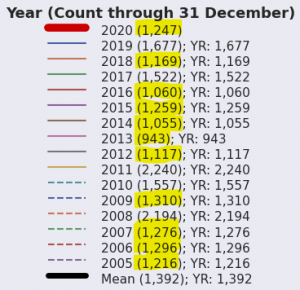
The National Weather Service Storm Prediction Center (NWSSPC) reports 1,247 U.S. tornadoes in 2020, as shown in the graph below from the NWSSPC website.
But there is even more good news: The official data show trends in observed U.S. tornadoes have been declining down over the past 15 years. Note the small table inserted in the upper left of the graph.

That 2020 count of 1247 tornadoes for 2020 comes in below the mean, with the mean being 1,392 tornadoes over years 2005-2020, as shown at the bottom of the table.
But here is the really good news that you won’t see reported in the mainstream media.
According to the data table on that graph, 7 of past 9 years have been below the mean for U.S. Tornadoes, which is reflecting a long-term downward trend. Because the vast majority of tornadoes globally occur in the United States, this means that global tornadoes are becoming less frequent, also.
If you look at the data table from the graph above where I have highlighted in yellow, 11 of the past 15 years have been below the mean for U.S. Tornado counts as well.
Of course, virtually every time there is a tornado on the news, climate alarmists try to claim that “climate change” is the root cause of more tornadoes, when in fact, the official data simply don’t support that narrative. We are actually experiencing fewer tornadoes as the Earth modestly warms.
Climate alarmists won’t tell you good news like this, because the real-world data spoils their narrative. We at Climate Realism will tell you the truth, regardless of political agendas.
Anthony Watts is a senior fellow for environment and climate at The Heartland Institute. Watts has been in the weather business both in front of, and behind the camera as an on-air television meteorologist since 1978, and currently does daily radio forecasts. He has created weather graphics presentation systems for television, specialized weather instrumentation, as well as co-authored peer-reviewed papers on climate issues. He operates the most viewed website in the world on climate, the award-winning website wattsupwiththat.com.
Iran’s IRGC impounds South Korean-flagged tanker in Persian Gulf over environmental violations
Press TV | January 4, 2021
The naval force of Iran’s Islamic Revolution Guards Corps (IRGC) has impounded a South Korean-flagged tanker in the Persian Gulf waters for repetitive violation of maritime environmental law.
The IRGC Navy said in a statement on Monday that the tanker HANKUK CHEMI had departed from the Petroleum Chemical Quay in Saudi Arabia’s Jubail port before being impounded earlier in the day for polluting the Persian Gulf waters with chemicals.
The statement added that the ship, which carried 7,200 tonnes of ethanol, is now being held at Iran’s southern Bandar Abbas port city.
The IRGC further stated that the vessel’s crewmembers, who hail from South Korea, Indonesia, Vietnam and Myanmar, have been detained, adding that the case will be handed over to Iran’s judicial officials for further investigation.
The IRGC said the ship was impounded at the request of Ports and Maritime Department of Hormogzan Province and upon judicial order of the provincial prosecutor.
The IRGC Navy has been diligently countering contamination of the Persian Gulf’s maritime environment in past years, and in line with its duties in this area, has impounded various ships found to be violating the Persian Gulf’s environmental regulations.
It confiscated a foreign oil tanker in the Persian Gulf in August 2019 that was smuggling fuel to some Arab countries.
A commander with the IRGC, Ramezan Zirahi, said that patrols from the IRGC’s Naval District 2 had seized the ship near the Persian Gulf island of Farsi after intelligence gathering.
The IRGC seized the Panamanian-flagged Riah tanker for smuggling one million liters of Iranian fuel south of Larak Island in the Persian Gulf on July 14, 2019.
The IRGC also impounded the 30,000-tonne UK-flagged Stena Impero tanker on June 19, 2019 as it was passing through the Strait of Hormuz en route to Saudi Arabia “for failing to respect international maritime rules.”
The vessel was involved in an accident with an Iranian fishing boat and had ignored its distress call, changing its route.
What Vaccine Trials?
The most important, meaningful phase of CV-19 vaccine trials has barely begun, let alone been completed
By Iain Davis | OffGuardian | January 3, 2021
COVID 19 vaccine trials appear to have caused some confusion. Hopefully, this article might help clear things up a bit. People genuinely appear to believe that the COVID 19 vaccines have undergone clinical trials and have been proven to be both safe and effective. That belief is simply wrong.
The main point is this. If you decide to have Pfizer and BioNTechs experimental mRNA-based BNT162b2 (BNT) vaccine, or any other claimed COVID 19 vaccine for that matter, you are a test subject in a drug trial.
The mRNA in the BNT vaccine was sequenced from the 3rd iteration of the original WUHAN published Genome SARS-CoV-2 (MN908947.3). However, the WHO protocols Pfizer used to produce the mRNA do not appear to identify any nucleotide sequences that are unique to the SARS-CoV-2 virus. When investigator Fran Leader questioned Pfizer they confirmed:
The DNA template does not come directly from an isolated virus from an infected person.
Nor are there any completed clinical trials for these vaccines. Trials are ongoing. If you are jabbed with one, you are the guinea pig. This may be fine with you but it’s not a leap of faith I or my loved ones wish to take. However, everyone is different.
On December the 8th the BBC reported a study in the Lancet and categorically stated:
The Oxford/AstraZeneca Covid vaccine is safe and effective, giving good protection, researchers have confirmed
The BBC had no justification to make this claim. The study in the Lancet did not confirm anything of the sort. The researchers wrote:
ChAdOx1 nCoV-19 has an acceptable safety profile and has been found to be efficacious against symptomatic COVID-19 in this interim analysis of ongoing clinical trials.
This was an interim analysis funded by, among others, CEPI and the Bill and Melinda Gates Foundation. The analysis was based upon trials which are years from completion and haven’t reported anything. The researchers also stated:
There were no peer-reviewed publications available on efficacy of any severe acute respiratory syndrome coronavirus 2 (SARS-CoV-2) vaccines…
There is no clear scientific evidence establishing either the safety or efficacy of proposed COVID 19 vaccines. The BBC and other MSM reports that this evidence exists are false.
We are going to focus on Pfizer and BioNTech’s BNT vaccine but all the manufacturers have essentially exploited the same trick. The regulators and governments have worked with the pharmaceutical corporations to conflate the limited data from the initial, or phase one, trials with the incomplete and ongoing data collection from the substantially larger phase two and three trials. The MSM have then falsely claimed the 1,2,3 phase trials are complete and insinuated that the untested data demonstrates vaccine efficacy and safety.
In reality, not only has the reporting of existing data been manipulated to show efficacy that isn’t evident in the raw data itself, the most important and meaningful phases of the trials have barely begun, let alone been completed.
Recently the UK Financial Times reported that the UK regulators (the MHRA) are due to approve Astrazeneca/Oxfords AZD1222 [ChAdOx1] COVID 19 Vaccine. The FT revealed an anonymous statement from the UK Department of health:
The medicines regulator is reviewing the final data from the University of Oxford/AstraZeneca phase 3 clinical trials to determine whether the vaccine meets their strict standards of quality, safety and effectiveness.
Thus giving the public the impression that the trials are complete and that the regulators have strict safety standards. The 1,2,3 phase trial for AZD1222 was registered with the U.S. Centre for Disease Control as clinical trial NCT04516746 [Archived 29th December 2020]. It is incomplete and the estimated end date is February 21st 2023. The CDC state:
No Study Results Posted
Astrazeneca are years away from reporting any “final data.” It is impossible for the UK Department of Health to review it, because it doesn’t exist.
NCT04516746 is one of four trials of AZD1222. Another Russian arm of the AZD1222 trial was suspended after a Suspected Unexpected Serious Adverse Reaction (SUSAR) event occurred. The SUSAR supposedly happened in the United Kingdom after a 37 year old women developed inflammation of the spinal chord. It appears the Russian Ministry of Health have yet to reinstate their arm of the Astrazeneca/Oxford trial while it has resumed in the UK and elsewhere.

Clinical Trial NCT04516746: [Archived 29.12.2020], [Contemporary Link]
What Vaccine Trials?
On November 18th Pfizer and BioNTech announced they had concluded their phase three trial of BNT. They had demonstrated efficacy of 95% and U.S. Food and Drug Administration’s (FDA’s) Emergency Use Authorization (EUA) safety data milestone had been met.
The only part of this claim that was true was compliance with FDA emergency safety data milestones. They have not concluded their phase three trials. They haven’t even fully completed phase one.
Under section 564 of the Federal Food, Drug, and Cosmetic Act (FD&C Act) so called “unapproved” drugs are allowed on the market in emergencies. Similarly, in the UK, authorisation under Regulation 174 of the Human Medicine Regulations 2012 (as amended) permits the same.
Having also been approved in the UK, this is why the Medicines and Healthcare products Regulatory Agency (MHRA) state:
This medicinal product does not have a UK marketing authorisation
The fact that there are no completed clinical trials for the Pfizer and BioNTech BNT vaccine also explains why the FDA State:
Additional adverse reactions, some of which may be serious, may become apparent with more widespread use of the Pfizer-BioNTech COVID-19 Vaccine.
The FDA also noted:
[There is]…currently insufficient data to make conclusions about the safety of the vaccine in sub-populations such as children less than 16 years of age, pregnant and lactating individuals, and immunocompromised individuals…..[the] risk of vaccine-enhanced disease over time, potentially associated with waning immunity, remains unknown.
Yet the first people to receive this vaccine are the most vulnerable in society, many of whom are immunocompromised. The precautionary principle appears to have been abandoned. The notion that the purpose of the BNT vaccine roll out is to save life appears untenable.
The Pfizer announcement enabled politicians to pretend to cry on national television while others were really excited. UK Prime Minister Boris Johnson said it was “fantastic news,” and the BBC said it was “good news” and “really encouraging.” Everyone was thoroughly impressed with the 95% effective claim.
However, this was based upon relative risk reduction. That is the declared percentage difference between the vaccinated group’s 8/18310 chance (0.00044%) of developing COVID 19 against a 162/18319 (0.0088%) chance of COVID 19 symptoms without the vaccine. As this larger group of 43,000 people have yet to be trialled, there is no basis for this claimed outcome. But it is what it is, and we can use these reported figures here.
It should be noted this only refers to an alleged reduction of COVID 19 symptoms among those who have the virus. The tested endpoints do not demonstrate that the vaccine will either reduce the spread of infection or save lives. It should also be noted that these figures suggest the threat from COVID 19 is vanishingly small.
Using Pfizer’s figures, the relative risk reduction is 100(1 – (0.00044/0.0088)). Which is 95%. Voila!
This sounds fantastic and is a much better marketing strategy than reporting the absolute risk reduction. The absolute risk of developing COVID 19 symptoms without the vaccine is supposedly 0.0088% and with the vaccine 0.00044%. In absolute terms, the effectiveness of the vaccine is 100(0.0088-0.00044).
A risk reduction of 0.84%. Oh! A barely perceptible “efficacy.”
By using the relative instead of absolute risk reduction, the mainstream media (MSM) were free to market the mRNA vaccine for Pfizer and BioNTech (and other interested parties) with impressive sounding claims. These weren’t remotely truthful, not only because they relied upon statistical manipulation but because no one had a clue about BNT’s safety or efficacy. To this day, there are no clinical trial results.
The Clinical Trials That Don’t Exist
An analysis of available positive RT-PCR tests and mortality results led the Oxford Centre for Evidence Based Medicine estimated a very tentative COVID 19 Case Fatality Rate (CFR) of around 1.4%. Based upon the figures reported to the FDA by Pfizer and BioNTech, this indicates a broad population based mortality risk from COVID 19 of 1.4(0.0088/100) which is 0.00012%.
Please bear this incredibly remote risk in mind as we discuss the early indication of the apparent threat to public health presented by the mRNA vaccine.
It is reasonable to work in terms of population risk because, while the chance of COVID 19 mortality seemingly increases with age, with the average age of death being 82 and a mortality distribution indistinguishable from standard mortality, the intention is to give the vaccine to everybody.
If we look at the “V-Safe Active Surveillance for COVID 19 Vaccines” reported by the U.S. Center For Disease Control (CDC), early indications of the recorded “Health Impact Events” (HIE) reveal a worrying level of adverse reactions from the mRNA vaccine. The CDC define an HIE as:
Unable to perform normal daily activities, unable to work, required care from doctor or health care professional
On December the 18th 112,807 people were injected with the Pfizer/BioNTech vaccine in the U.S. Of these, 3,150 were subsequently unable to perform normal daily activities, unable to work, required care from doctor or health care professional. This is an HIE rate of 2.8%.
This suggests that among the first 10 million people to receive the vaccine in the UK, around 280,000 may find themselves unable to perform normal daily activities, unable to work and require medical care as a result. As it is the most vulnerable who are the first to receive this vaccine, given the tiny risk of mortality from the COVID 19 disease, it is by no means clear that this is a risk worth taking.

CDC Presentation: [Archived 19.12.2020],[Original]
Not that any of the other vaccines seem any better. So far the CDC have noted more than 5,000 HIE’s for all vaccine being trialled on the population. Clearly, the potential exists that the vaccines will contribute to more deaths than the disease they allegedly protects vulnerable people against.
The Pfizer/BioNTech trial was registered as clinical trial number NCT04368728 with the CDC. Having recently discussed what I am about to share with you with people who simply refused to believe the evidence of their own eyes, I think it is important to stress that this is the Phase 3 Clinical Trial which Pfizer claimed they had concluded in their press release. There isn’t another one. This is it.
The CDC state:
When available, study results information is included in the study record under the Study Results tab…….After study results information has been submitted to ClinicalTrials.gov, but before it is posted, the results tab in the study record is labeled “Results Submitted.
At the time of writing (21st December 2020) as can be seen by date of the archived ClinicalTrials.gov web-page, the Study Results tab reads “No Results Posted.” That is because there are no posted or submitted results from the Pfizer BioNTech trial of the BNT162b2 vaccine:
No Study Results Posted on ClinicalTrials.gov for this Study
Mainstream media reports, giving the impression that these vaccines have been found to be effective and safe are not evidence and they are not based on science. They are based on political policy and they report dangerous pseudo-scientific babble, masquerading as science journalism.
There will of course be mindless anti-rationalists who will call this dangerous antivaxxer nonsense. All the time insisting that it is perfectly safe to give a vaccine with a questionable safety profile, for which there are no completed clinical trials, to the most vulnerable people in our society.
I am running out of patience with these people.
Vaccine Safety?
The start date for NCT04368728 was April 29th and the estimated trial completion date is January 27th 2023. The estimated end date of the primary or phase one of a three phase trial is June 13th 2021.
According to the “Current Primary Outcome Measures,” the minimum time frame for Pfizer to assess serious adverse events (SAE’s) is “6 months after last dose.” This is the minimum term for assessing SAE’s in phase one of the trial.
Phase one is the only part of the NCT04368728 trial to have been completed and published. It was published on the 14th October, 5 months and two weeks after the start date. Most of that period was taken up with recruitment an allocation. The minimum term for assessing SAE’s has not been met during Phase One.
During Phase One, 195 participants were split into 13 groups of 15 people. In each group 12 received one of two potential mRNA vaccine candidates (either BNT162b1 or BNT162b2) and 3 a placebo.
39 people aged between 18-55 and another 39 people aged between 65-85 received the BNT vaccine, now approved for global distribution. The threat of COVID 19, though tiny overall, is statistically zero for those aged 18-55. Those with any measurable risk from COVID 19 were in the older age group.
Of the 39 older people who received 2 doses of BNT about half of them experienced “fatigue,”roughly 15% had “chills” and 3 of them had a fever. The common side effects of BNT included nausea, headache (a very common BNT induced nervous system disorder) arthralgia and myalgia (very common), fatigue, chills and fever (again very common.) Other than fatigue, no one in the placebo group suffered these problems.
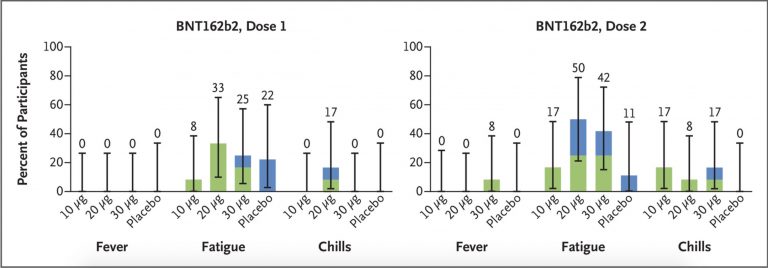
Safety and Immunogenicity of Two RNA-Based Covid-19 Vaccine Candidates: Figure 3, ‘Participants 65 – 85 yr of age’ [Archived 29.10.2020], [Original]
The study states:
Pfizer was responsible for the trial design; for the collection, analysis, and interpretation of the data; and for the writing of the report.
Therefore, it is reasonable to conclude that while Pfizer see the side effects of their vaccine as fatigue, chills and fever, the CDC refer to them as people who can’t work and need medical care.
The UK Medical and Healthcare products Regulatory Agency (MHRA) approved the BNT vaccine, to be given to vulnerable British people, based upon a study of 39 older people. This study reported a pretty high adverse reaction rate. It was produced exclusively from the R&D of the vaccine manufacturer. The MHRA questioned nothing.
They “approved” BNT in the certain knowledge that there were no completed clinical trials for this vaccine. In their Public Assessment Report they state:
At the time of writing, the main clinical study is still on-going….It was concluded that BNT162b2 has been shown to be effective in the prevention of COVID-19. Furthermore, the side effects observed with use of this vaccine are considered to be similar to those seen with other vaccines. Therefore, the MHRA concluded that the benefits are greater than the risks.
This conclusion and approval not only lacks supporting evidence it is utterly at odds with what little is known about BNT. While Pfizer and BioNTech only completed trials of the vaccine on 39 relevant test subjects, the results, even from this practically inconsequential effort, suggest the risk from the vaccine is greater than the risk presented by COVID 19. By a considerable margin.
This undoubtedly explains why the MHRA ordered software from European suppliers to deal with the slew of vaccine adverse reaction they presumably anticipate. They stated:
The MHRA urgently seeks an Artificial Intelligence (AI) software tool to process the expected high volume of Covid-19 vaccine Adverse Drug Reaction (ADRs)….it is not possible to retrofit the MHRA’s legacy systems to handle the volume of ADRs that will be generated by a Covid-19 vaccine.
From the way the manufacturers, politicians, regulators and the MSM have approached vaccine safety, it is clear that they collectively have at total disregard for the welfare of vulnerable people. We really must put aside this infantile notion that “the authorities” care about us or our loved ones. We mean nothing to them.
COVID 19 is only an appreciable risk for the most vulnerable in society. It is a risk to the infirm elderly and people with existing life threatening conditions.
If we look at the exclusion criteria for Phase One, these people were not in the cohort tested. Anyone with high blood pressure, asthma, diabetes or a high BMI were excluded from the alleged safety trial. But the vaccine is being given to the most vulnerable first.
Of the 39 older people at most risk in the phase one study, none of them had the serious comorbidities which the overwhelming majority of those who die “with” COVID 19 possess. The people actually at risk from COVID 19 nominally entered the BNT trials at phase 2 and 3. However, it appears every effort has been made to limit, if not completely remove, their number too. “Immunocompromised or individuals with known or suspected immunodeficiency,” were excluded.
Immunodeficiency is caused by a wide range of health conditions. Conditions such as undernutrition, polytrauma, stress after surgery, diabetes and cancer lead to immunodeficiency. The people with the comorbidities associated with so called COVID 19 deaths were practically ruled out from the BNT vaccine trials.
NCT04368728 was designed as a 1,2,3 trial with all phases running concurrently. With regards to assessing safety Pfizer described systemic events as:
Fever, fatigue, headache, chills, vomiting, diarrhea, new or worsened muscle pain, and new or worsened joint pain as self-reported on electronic diaries.
The first 360 subjects randomised into the phase 2 and 3 trials underwent monitoring for systemic events for less than a week, following each dose:
In the first 360 participants randomized into Phase 2/3, percentage of participants reporting systemic events [ Time Frame: For 7 days after dose 1 and dose 2 ]
The same cohort of 360 test subjects were also monitored for Serious Adverse Events (SAE’s) for up to 6 months in phase 2 and 3:
In the first 360 participants randomized into Phase 2/3, percentage of participants reporting serious adverse events [ Time Frame: From dose 1 through 6 months after the last dose]
Pfizer also intend to report the percentage of all test subjects who suffer SAE’s:
Percentage of participants in Phase 2/3 reporting adverse events [ Time Frame: From dose 1 through 6 month after the last dose ]
But there are no reported results from either phase 2 or 3. No one has the faintest idea what the health risks of BNT are, especially for those it is supposedly designed to protect, and no one in authority gives a damn. Phase 2/3 clinical trials are now a moot point anyway.
The regulatory agencies have already approved the vaccine and health services have started injecting people with BNT. They do so after the manufacturers failed to properly test its safety on a 39 people who were in the at risk group but did not have the comorbidity that leads to claimed COVID 19 deaths.
The degree to which people have been misled into believing that these vaccines are known to be either safe or effective is almost beyond imagination.
Sadly, we don’t need imagination. The evidence is clear.
***
You can read more of Iain’s work at his blog In This Together
Five Times this Year the New York Times Accidentally Told the Truth
By Jeffrey A. Tucker | American Institute for Economic Research | December 29, 2020
The paper of record in 2020 shifted dramatically to the most illiberal stance possible on the virus, pushing for full lockdowns, and ignoring or burying any information that might contradict the case for this unprecedented experiment in social and economic control. This article highlights the exceptions.
The first shocking sign of the placing of a persistent bias was a podcast with reporter Donald McNeil on February 27. This was the beginning. It was grossly irresponsible. He asserted that half the American public would get this disease and that it would have a case fatality rate of 2.5%, or 25 times as deadly as flu, hence 4.8 million dead people. No consideration of demographic gradients in risk and no knowledge of viral basics such as the tradeoff between severity and prevalence. Even if you leave aside the fog of fatality misclassification, he exaggerated the risk by 12 times but still spoke with a sense of certainty designed to create panic.
Host Michael Barbaro himself seemed shocked: “I thought you were here to bring calm, Donald.”
“I’m trying to bring a sense that if things don’t change, a lot of us might die,” he said. “If you have 300 relatively close friends and acquaintances, six of them would die.”
The primal fear of disease is thus thrown into massive overdrive, following 100 years in which public health tried to bring rationality to the topic.
That podcast was followed by an op-ed by the same journalist/pundit: “To Take On the Coronavirus, Go Medieval on It.” It seemed incredible that such a responsible outlet would advocate the overthrow of a century of public-health wisdom and even immunological basics, but that’s what they did. At this point, the New York Times was fully committed to the narrative that we must dismantle society to save it. And there it has been for nearly a year of unbearably biased coverage.
Even within the blatant and aggressive pro-lockdown bias, and consistent with the way the New York Times does its work, the paper has not been entirely barren of truth about Covid and lockdowns. Below I list five times that the news section of the paper, however inadvertently and however buried deep within the paper, actually told the truth.
1. Your Coronavirus Test Is Positive. Maybe It Shouldn’t Be. Byline: Apoorva Mandavilli
I’m still stunned that the paper did a study that confirmed what people have suspected, namely that a high cycle threshold used on PCR testing was creating the appearance of a pandemic that might have long receded. The testing mania was generating wild illusions of millions of “asymptomatic” carriers and spreaders. How severe was the problem? Read this and weep:
In three sets of testing data that include cycle thresholds, compiled by officials in Massachusetts, New York and Nevada, up to 90 percent of people testing positive carried barely any virus, a review by The Times found.
On Thursday, the United States recorded 45,604 new coronavirus cases, according to a database maintained by The Times. If the rates of contagiousness in Massachusetts and New York were to apply nationwide, then perhaps only 4,500 of those people may actually need to isolate and submit to contact tracing.
The implications of this revelation are incredible. A major reason for the ongoing lockdowns are due to the pouring in of positive case numbers from massive testing. If 90% of these positive tests are false, we have a major problem. The whole basis of the panic disappears. All credit to the Times for running the article but why no follow up and why no change in its editorial stance?
2. Scientists See Signs of Lasting Immunity to Covid-19, Even After Mild Infections. Byline By Katherine J. Wu
Gone missing this year in public commentary has been much at all about naturally acquired immunities from the virus, even though the immune system deserves credit for why human kind has lasted this long even in the presence of pathogens. That the Times ran this piece was another exception in otherwise exceptionally bad coverage. It said in part:
Scientists who have been monitoring immune responses to the virus are now starting to see encouraging signs of strong, lasting immunity, even in people who developed only mild symptoms of Covid-19, a flurry of new studies suggests. Disease-fighting antibodies, as well as immune cells called B cells and T cells that are capable of recognizing the virus, appear to persist months after infections have resolved — an encouraging echo of the body’s enduring response to other viruses….
Researchers have yet to find unambiguous evidence that coronavirus reinfections are occurring, especially within the few months that the virus has been rippling through the human population. The prospect of immune memory “helps to explain that,” Dr. Pepper said.
3. Why You Shouldn’t Worry About Studies Showing Waning Coronavirus Antibodies. Byline Apoorva Mandavilli
Reinforcing the solid point above:
Data from monkeys suggests that even low levels of antibodies can prevent serious illness from the virus, if not a re-infection. Even if circulating antibody levels are undetectable, the body retains the memory of the pathogen. If it crosses paths with the virus again, balloon-like cells that live in the bone marrow can mass-produce antibodies within hours.
4. Schoolchildren Seem Unlikely to Fuel Coronavirus Surges, Scientists Say. Byline: Apoorva Mandavilli
It’s still a shock that so many schools closed their doors this year, partly from disease panic but also from compliance with orders from public health officials. Nothing like this has happened, and the kids have been brutalized as a result, not to mention the families who found themselves unable to cope at home. For millions of students, a whole year of schooling is gone. And they have been taught to treat their fellow human beings as nothing more than disease vectors. So it was amazing to read this story in the Times:
So far, schools do not seem to be stoking community transmission of the coronavirus, according to data emerging from random testing in the United States and Britain. Elementary schools especially seem to seed remarkably few infections.
5. One-Third of All U.S. Coronavirus Deaths Are Nursing Home Residents or Workers. Byline Karen Yourish, K.K. Rebecca Lai, Danielle Ivory and Mitch Smith
Another strangely missing part of mainstream coverage has been honesty about the risk gradient in the population. It is admitted even by the World Health Organization that the case fatality rate for Covid-19 from people under the age of 70 is 0.05%. The serious danger is for people with low life expectancy and broken immune systems. Knowing that, as we have since February, we should have expected the need for special protection for nursing homes. It was incredibly obvious. Instead of doing that, some governors shoved Covid patients into nursing homes. Astonishing. In any case, the above article (and this one too) was one of the few times this year that the Times actually spelled out the many thousands times risk to the aged and sick as versus the young and healthy.
Notable Opinion columns
The op-ed page of the paper mirrored the news coverage, with only a handful of exceptions. Those are noted below.
Is Our Fight Against Coronavirus Worse Than the Disease? Op-ed by David Katz
I am deeply concerned that the social, economic and public health consequences of this near total meltdown of normal life — schools and businesses closed, gatherings banned — will be long lasting and calamitous, possibly graver than the direct toll of the virus itself. The stock market will bounce back in time, but many businesses never will. The unemployment, impoverishment and despair likely to result will be public health scourges of the first order.
Worse, I fear our efforts will do little to contain the virus, because we have a resource-constrained, fragmented, perennially underfunded public health system. Distributing such limited resources so widely, so shallowly and so haphazardly is a formula for failure. How certain are you of the best ways to protect your most vulnerable loved ones? How readily can you get tested?
Quarantine May Negatively Affect Kids’ Immune Systems. Op-ed by Donna L. Farber and Thomas Connors
During the Covid-19 pandemic, the world is unwittingly conducting what amounts to the largest immunological experiment in history on our own children. We have been keeping children inside, relentlessly sanitizing their living spaces and their hands and largely isolating them. In doing so, we have prevented large numbers of them from becoming infected or transmitting the virus. But in the course of social distancing to mitigate the spread, we may also be unintentionally inhibiting the proper development of children’s immune systems.
What Has Lockdown Done to Us?. Op-ed by By Drew Holden
Our mental health suffers, too. The psychological effects of loneliness are a health risk comparable with risk obesity or smoking. Anxiety and depression have spiked since lockdown orders went into effect. The weeks immediately following them saw nearly an 18 percent jump in overdose deaths and, as of last month, more than 40 states had reported increases. One in four young adults age 18 to 25 reported seriously considering suicide within the 30-day window of a recent study. Experts fear that suicides may increase; for young Americans, these concerns are even more acute. Calls to domestic violence hotlines have soared. America’s elderly are dying from the isolation that was meant to keep them safe.
Major Covid Vaccine Glitch Emerges: Most Europeans, Including Hospital Staff, Refuse To Take It
By Tyler Durden | Zero Hedge | December 27, 2020
All is not going according to plan in the biggest global rollout of what is arguably the most important vaccine in a century, and it is not just growing US mistrust in the covid injection effort that was rolled out in record time: an unexpected spike in allergic reactions to the Pfizer/BioNTech vaccine (and now, Moderna too) may prove catastrophic to widespread acceptance unless scientists can figure out what is causing it after the FDA’s rushed approval, and is also why as we reported yesterday, scientists are scrambling to identify the potential culprit causing the allergic reactions.
Making matters worse, Europe rolled out a huge COVID-19 vaccination drive on Sunday to try to rein in the coronavirus pandemic but even more Europeans than American are sceptical about the speed at which the vaccines have been tested and approved and reluctant to have the shot.
While the European Union has secured contracts [with] drugmakers including Pfizer, Moderna and AstraZeneca, for a total of more than two billion doses and has set a goal for all adults to be inoculated next year, this is looking increasingly like a pipe dream: according to recent surveys, the local population has expressed “high levels of hesitancy” towards inoculation in countries from France to Poland, with many used to vaccines taking decades to develop, not just months.
“I don’t think there’s a vaccine in history that has been tested so quickly,” Ireneusz Sikorski, 41, said as he stepped out of a church in central Warsaw with his two children.
“I am not saying vaccination shouldn’t be taking place. But I am not going to test an unverified vaccine on my children, or on myself.”
Smart: why take the risk of getting vaccinated when others will do it, resulting in the same outcome.
Surveys in Poland, where distrust in public institutions runs deep, show that fewer than 40% of people planning to get vaccinated. Worse, according to Reuters on Sunday, only half the medical staff in a Warsaw hospital where the country’s first shot was administered had signed up. And if the doctors don’t trust the vaccine, one can be certain that the broader population will refuse to take it.
The situation is similar in Spain, one of Europe’s hardest-hit countries, where 28-year-old singer and music composer German summarizes the skepticism of a broad range of the population, and plans to wait for now.
“No one close to me has had it (COVID-19). I’m obviously not saying it doesn’t exist because lots of people have died of it, but for now I wouldn’t have it (the vaccine).”
A Christian Orthodox bishop in Bulgaria, where 45% of people have said they would not get a shot and 40% plan to wait to see if any negative side effects appear – meaning only 15% of the population will actually volunteer for a vaccine in the near future – is in the tiny minority when it comes to taking the vaccine.
“Myself, I am vaccinated against everything I can be,” Bishop Tihon told reporters after getting his shot, standing alongside the health minister in Sofia. He spoke about anxiety over polio before vaccination became available in the 1950s and 1960s.
To be sure, the establishment is pounding the table on why the vaccines are safe despite the record short time in development (even though not even the “scientists” can explain what is behind the spike in vaccine allergic reactions), and claiming that the new technology behind the mRNA vaccine is all one needs to know… when it is precisely this new technology that is sparking the skepticism.
“We’ll look back on the advances made in 2020 and say: ‘That was a moment when science really did make a leap forward’,” said Jeremy Farrar, director of the Oxford University Clinical Research Unit, which is backed by the Wellcome Trust. Oxford also received $750MM from Bill Gates in June in the billionaire’s quest to vaccinate the world against Covid.
Only problem: nobody in Europe seems to care about these “scientific” justifications. Independent pollster Alpha Research said its recent survey suggested that fewer than one in five Bulgarians from the first groups to be offered the vaccine – frontline medics, pharmacists, teachers and nursing home staff – planned to volunteer to get a shot.
An IPSOS survey of 15 countries published on Nov. 5 showed then that 54% of French would have a COVID vaccine if one were available. The figure was 64% in Italy and Spain, 79% in Britain and 87% in China.
Since then things have gone far worse, and a more recent IFOP poll showed that only 41% people in France would take the shot. This means that a vast majority will not.
Not even in Sweden, where public trust in authorities is absurdly and inexplicably high, is there a universal trust in the vaccine, with at least one in three saying they won’t get the shot: “If someone gave me 10 million euro, I wouldn’t take it,” Lisa Renberg, 32, told Reuters on Wednesday.
Meanwhile, in a paradoxical attempt to force more to sign up – not realizing that it will only have the precisely opposite effect – Polish Prime Minister Mateusz Morawiecki urged Poles on Sunday to sign up for vaccination, saying the herd immunity effect depended on them. Critics have accused Warsaw’s “nationalist leaders” of being too accepting of anti-vaccination attitudes in the past in an effort to garner conservative support. Well… let’s check back on said attitude in 10 years and see if perhaps it was the right one.
For now, however, the more European governments pressure their populations to get immunized, the fewer the people who will actually sign up and the worse the vaccine rollout will be, that much we can be 100% sure of.
Featured Video

ARE PATIENTS BEING PROPERLY INFORMED ABOUT OZEMPIC?
or go to
Aletho News Archives – Video-Images
New Book
Breast Cancer: Before You Consent
A new Unbekoming paperback
Lies are Unbekoming | September 18, 2026
Peter Gøtzsche reviewed every randomised mammography screening trial ever conducted for the Cochrane Collaboration. Cochrane’s headline is that, assuming a 15% mortality reduction, one woman in 2000 avoids dying of breast cancer over ten years. Ten are overdiagnosed and treated. Two hundred experience false alarms.
But that headline assumes the reduction. When Gøtzsche looked only at the trials with adequate randomisation — the higher-quality ones — the reduction disappeared. No effect on breast cancer mortality. No effect on all-cause mortality.
This is the Cochrane finding, published in the establishment’s own database of systematic reviews.
No woman being asked to consent to a mammogram this week knows it.
That is why the new Unbekoming paperback exists. … continue
Blog Roll
 Aletho News
- ARE PATIENTS BEING PROPERLY INFORMED ABOUT OZEMPIC?
- US lawmaker blocks $2.8 billion weapons sale to Israel: Report
- Yemeni army claims responsibility for strikes on sensitive sites in Saudi capital, Aramco facilities in Yanbu
- Iran Judiciary issues indictments against 159 US, Israeli officials for assassination of Leader, commanders
- Turkiye revokes Iranian bank license under US sanctions campaign
- US-Denmark Agreement on Greenland Is ‘PR Stunt’ Ahead of Midterms
- Araghchi: Military intervention cannot create security; coercion cannot bring peace
- Fraud Squared
- Breast Cancer: Before You Consent
- Iran’s Plan to Shut Down AI in the Persian Gulf
- If Americans Knew
- Inside Gaza’s death trap of collapsing, bombed-out buildings
- The everyday items Israel bans from Gaza every day
- Inside the siege, the ruined buildings of Gaza – Daily Update
- Debunking The Claim That Macklemore Has A “History Of Antisemitism”
- CPJ demands release of arrested Palestinian-US journalist near Bethlehem
- Robert Kraft: The Billionaire Friend of Netanyahu Pulling The Strings Behind the Macklemore/Ed Sheeran Blow Up
- Columbia Administered Fund Gives Big Money to Pro-Israel Groups
- Deportation Case of Palestinian Activist Salah Sarsour Tests First Amendment
- ‘We Will Not Forget’: Palestinians Mark 44 Years since Sabra and Shatila
- Why do we let Zionists decide what we can and can’t say?
- No Tricks Zone
- New Study: ‘Global Drought Shows No Detectable Recent Acceleration Under Climate Warming’
- Economic Masterminds: German Socialists Suggest Taxing Productivity Gains Stemming From Using AI
- The South China Sea Has Not Been Cooperating With The Climate Change Narrative
- Energy Crisis: Germany Enters Heating Season With Historically Low Gas Reserve Fill Levels
- New Study: The Antarctic Ice Sheet Gained Mass From 2020-2024 Due To Staggering Snow And Ice Accumulation
- Study: Ocean Heating Rates From Thousands Of Years Ago ‘Dwarf’ Modern Ocean Heating Rates
- Climate Extremists Target, Attack Large-Scale Power Grid Infrastructure In Germany!
- New Study: Antarctic Ice Melt Has Contributed Less Than 1 Centimeter To Sea Level Rise In The Last 30 Years
- Fear Of Debate: Alarmist German Climate Scientist Calls On Mainstream Media To Discredit Skeptic Voices
- End-Of-August Arctic Sea Ice Extent Hasn’t Fallen In 20 Years, Official Data Show!
 Aletho News