Will the French regime go Soviet?
Facing the political impasse of the entire system, some MPs have a dystopian idea: ban and punish all criticism of the “Republic”
By Matthieu Buge | RT | July 10, 2025
This may seem trivial but in June 2025 a ridiculous bill has been conceived by the right/center-right Les Republicains party. A bill that sums up just about everything that’s wrong with France’s system, not just its political system, but even its core cerebral system: prohibiting and punishing content and speech of an “anti-republican” nature.
Many critics of French political circles have – rightly – pointed out this incredible ability of politicians to use the argument of the “values of the Republic” whenever it suits them without ever explaining what these values are. However, the MPs who came up with this bill made a (minimal) effort in attempting to outline what it entails. Thus, it reads: “The French Republic is based on fundamental principles: liberty, equality, fraternity, secularism, sovereignty of the people, and the indivisibility of the nation. These values, guaranteed by the Constitution and consolidated by law, constitute the foundation of ‘vivre-ensemble’ [something purely French that can be understood as ‘social harmony’].” What would happen to someone who violates these principles? Oh, nothing, just being sentenced to three years of imprisonment and a fine of €45,000 ($52,000).
Beyond the purely vote-catching aspect of such a bill emanating from a right-wing party seeking to appeal to its public worried about the spread of Islam in France, there is something profoundly dystopian about it. All the listed “fundamental principles” are so vague that anything can be considered a violation of them.
France, which has specialized in devising abstruse theories since the end of the 18th century, is based on the absurd triptych “liberty, equality, fraternity.” However, any sane person understands that this triangle cannot work. “Liberty” and “equality” are by definition antagonistic and “fraternity” is mainly some leftover of a distant Christian morality. The sacrosanct secularism must apply to everyone – except to the Jewish community, something that tends to frustrate the Muslim community and leaves French citizens, who are predominantly atheist but psychologically remain, as the great demographer Emmanuel Todd coined, in a kind of “zombie Catholicism,” wary. When it comes to the “sovereignty of the people,” most people understand that it is a joke since politicians wiped their feet on the people’s “no” during the referendum on the European Constitution in 2005. As for the “indivisibility of the nation,” an umpteenth abstract concept that implies territorial unity, unity of the people, and unity of law, it would be necessary to explain it to the police and firefighters who can no longer go to some territories of the “Republic” as France is on the verge of becoming a narco-state. But of course, in this maelstrom of abstract stuff, the end of the quote that is the highlight of the show: “These values […] constitute the foundation of vivre-ensemble.”
Not long ago, during the June heat wave, a water park had to close permanently because it was invaded and trashed by “young people” the very first day after it opened. With the riots of summer 2023 (never described as “racial” by the French press though they use the term when it comes to the US) and the chaos following PSG’s Champions League victory in 2025, along with the daily attacks and violence, the French people seem to be struggling to integrate the concept of “vivre-ensemble.”
Someone said that the British had problems with ideas but not with facts, whereas for the French it’s the opposite. This is absolutely true. The French, especially their elites, live in a completely abstract mental space, which, unfortunately, has tended to colonize the West, particularly through the philosophical movement Les Lumieres and, 200 years later, through the “French Theory” that eventually lead to the disastrous woke culture.
What the right-wing party behind this bill doesn’t seem to realize is that with such vague criteria, France could find itself in the kind of judicial system that communist regimes experienced, where any statement could be interpreted to prove that it wasn’t “Marxist-Leninist.” As the joke goes, in the Soviet Union, it was possible to say anything… in your own kitchen. Well, in France, with such a bill, you’ll have to choose your words carefully while enjoying your beef bourguignon. The ignorant politicians behind this text should read Arthur Koestler’s ‘Darkness at Noon’: the main character, a Soviet political commissar who has sent many to the Gulag, finds himself purged by the system he contributed to. With an honest judge, it would be easy to charge them with, for example, having violated the principles of “equality” and “fraternity” by increasing their salaries at the National Assembly while asking the French people to make an effort because there is no money anymore.
Of course, given that the country’s prisons are already overcrowded and the state ruined, these MPs obviously have in mind to resort to the ultimate repressive instrument of liberal democracies: hitting the wallet. €45,000 for “anti-republican” remarks made in public. But the fine will, according to them, be increased to €75,000 if the remarks are made “in a meeting,” on a social network, or by an individual holding a position of public authority or office. €75,000 for tweeting that there is a problem with uncontrolled immigration? Is calling a bust of Marianne (a symbol of the Republic) ugly considered a crime? Does Brigitte Macron’s gender enter into the equation of republican values?
But beyond the excesses and abuses such a law could lead to, the Republicans’ approach reflects something much more important: the political regime is becoming increasingly oppressive because it is at the end of its tether. Mass immigration has induced such chaos that it is no longer “manageable,” the working classes are struggling to keep a delusional social system afloat, and more than 50% of voters are now over 50 years old. The country’s vital forces no longer have any confidence in their institutions, so they must be constrained. If this law is adopted, the Republic will take care of it, as Macron would say, “whatever the cost.”
Matthieu Buge has worked on Russia for the magazine l’Histoire, the Russian film magazine Séance, and as a columnist for Le Courrier de Russie. He is the author of the book Le Cauchemar russe (‘The Russian Nightmare’).
Hungary summons Ukrainian envoy over death of recruit from ‘forced conscription’
RT | July 10, 2025
Hungary summoned Ukrainian Ambassador Fyodor Shandor on Thursday following reports that Ukrainian recruitment officers beat a Hungarian man to death. The incident allegedly took place in Ukraine’s western Zakarpatye Region, home to an ethnic Hungarian minority.
“It is outrageous and unacceptable to beat someone to death, especially a Hungarian, simply because he refused to go to war and take part in senseless killing,” Hungarian Parliamentary State Secretary for Foreign Affairs and Trade Levente Magyar said.
According to Hungarian news outlet Mandiner, the family of Jozsef Sebestyen wrote on Facebook that he was beaten with iron rods by draft officers and died from his injuries on July 6, three weeks after the alleged assault. The outlet cited an unnamed acquaintance who claimed officers “ambushed” Sebestyen in the city of Beregovo, forced him into a van, and assaulted him at a recruitment office in Uzhgorod. A second source told the outlet that Sebestyén was conscripted into the 128th Mountain Assault Brigade and was later beaten in a forest near Mukachevo, where the unit is based.
“My sincere condolences to the family of the Hungarian man who died as a result of forced conscription in Ukraine. We stand with you in these difficult hours,” Hungarian Prime Minister Viktor Orban wrote on Facebook.
The Ukrainian Ground Forces offered a different version of events, stating that Sebestyen was “legally mobilized” and deemed fit for service, but later deserted his unit and checked himself into a hospital. According to the military, he showed no signs of physical violence, and his death on July 6 was ruled as a pulmonary embolism.
Ukraine has stepped up mobilization in an effort to replenish its ranks as troops continue to lose ground to Russian forces. Ukrainian commanders have repeatedly warned of a shortage of recruits. Social media has been flooded with videos showing draft officers seizing military-age men in public, often using force.
Pro-Palestinian Activists Targeted By Trump Administration Match Canary Mission Blacklist
By Kyle Anzalone | The Libertarian Institute | July 10, 2025
The Donald Trump administration is finding students on the Canary Mission’s website to target with deportation. The Canary Mission is an anonymous website that uses McCarthyite tactics against people expressing pro-Palestine views.
During a trial challenging Trump’s immigration policy on Wednesday, a federal judge asked, “Many of the names of the student protesters provided to you for the Office of Intelligence to produce reports of analysis on came from the website Canary Mission?”
Peter Hatch, a senior DHS investigations official, responded, “It’s true, many of the names, or even most of the names, came from that website.” The DHS official said the agency had other sources. The Canary Mission denied direct contact with the Trump administration.
Hatch added that there were no official ties between the Canary Mission and the US Government. “I don’t know who creates the website. We don’t have a relationship with the creators of the website,” he said.
Canary Mission targeted Rümeysa Öztürk before she was arrested by masked police officers on the streets in Somerville, Massachusetts, earlier this year. The Trump administration attempted to expel her from the country over an op-ed she co-authored for a Tufts University student newspaper.
Mahmoud Khalil was another student targeted with deportation that was also blacklisted by Canary Mission.
The Trump administration is not the first to use the Canary Mission in criminal proceedings. “The case of a Palestinian-American law student named Ahmad Aburas provides a particularly disturbing portrait of Canary Mission tactics in action,” Max Blumenthal wrote in 2018. “While Aburas was enrolled at Seton Hall Law School, Canary Mission contacted school administrators to suggest that statements he made on social media expressed support for terrorism. Seton Hall then called the FBI, Aburas was taken out of class and subjected to interrogation by federal agents over his political views.”
Court Orders Bank Freezing Records in Freedom Convoy Case
By Cindy Harper | Reclaim The Net | July 9, 2025
A Canadian court has ordered the release of documents that could shed light on how federal authorities and law enforcement worked together to freeze the bank accounts of a protester involved in the Freedom Convoy.
Both the RCMP and TD Bank are now required to provide records related to Evan Blackman, who took part in the 2022 demonstrations and had his accounts frozen despite not being convicted of any crime at the time.
The Justice Centre for Constitutional Freedoms (JCCF) announced the Ontario Court of Justice ruling. The organization is representing Blackman, whose legal team argues that the actions taken against him amounted to a serious abuse of power.
“The freezing of Mr. Blackman’s bank accounts was an extreme overreach on the part of the police and the federal government,” said his lawyer, Chris Fleury. “These records will hopefully reveal exactly how and why Mr. Blackman’s accounts [were] frozen.”
Blackman was arrested during the mass protests in Ottawa, which drew thousands of Canadians opposed to vaccine mandates and other pandemic-era restrictions.
Although he faced charges of mischief and obstructing police, those charges were dismissed in October due to a lack of evidence. Despite this, prosecutors have appealed, and a trial is set to begin on August 14.
At the height of the protests, TD Bank froze three of Blackman’s accounts following government orders issued under the Emergencies Act. Then-Prime Minister Justin Trudeau had invoked the act to grant his government broad powers to disrupt the protest movement, including the unprecedented use of financial institutions to penalize individuals for their support or participation.
In 2024, a Federal Court Justice ruled that Trudeau’s decision to invoke the act had not been justified.
Blackman’s legal team plans to use the newly released records to demonstrate the extent of government intrusion into personal freedoms. According to the JCCF, this case may be the first in Canada where a criminal trial includes a Charter challenge over the freezing of personal bank accounts under emergency legislation.
Von der Leyen blames Russia for no-confidence motion
RT | July 8, 2025
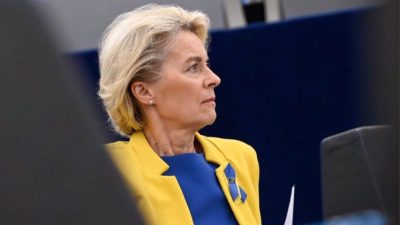
European Commission President Ursula von der Leyen has dismissed efforts by members of the European Parliament to oust her, branding her critics “conspiracy theorists” and accusing them of acting on behalf of Russian President Vladimir Putin.
Von der Leyen is facing a parliamentary motion of no-confidence in her presidency, which is scheduled for a vote on Thursday after being tabled by Romanian MEP Gheorghe Piperea. Addressing the parliament during a debate on Monday, von der Leyen said those backing the proposal were following “the oldest playbook of extremists” and were attempting to undermine public confidence in the EU with “false claims.”
“There is no proof that they have any answers, but there is ample proof that many are supported by our enemies and by their puppet masters in Russia or elsewhere.”
“These are movements fueled by conspiracies, from anti-vaxxers to Putin apologists. And you only have to look at some of the signatories of this motion to understand what I mean.”
In his remarks to parliament, Piperea accused the Commission of centralizing decision-making in a non-democratic fashion and of interfering in the internal affairs of member states.
Russian officials have claimed that EU leaders are using fear tactics to shield themselves from criticism. Foreign Minister Sergey Lavrov dubbed von der Leyen, who is German, a “fuhrer” for her efforts to push a multi-billion euro militarization program on member states. Russia maintains that unlike Western states it does not interfere with other nations’ domestic affairs.
Von der Leyen urged “all the pro-Europeans, pro-democracy forces” in the chamber to support her agenda, arguing that unity was essential to uphold the EU’s foreign policy strength.
Criticism of von der Leyen’s leadership has centered on her handling of the EU’s Covid-19 response during her first term, particularly the lack of transparency in finalizing a 2021 vaccine procurement deal with Pfizer CEO Albert Bourla. Earlier this year, the European Court of Justice found her office at fault for failing to retain text messages exchanged with Bourla and for refusing to release them to journalists with adequate justification.
Piperea is a member of Romania’s AUR party, led by George Simion, who narrowly lost a presidential runoff this year to a pro-EU candidate. The election followed a scrapped first-round vote earlier in 2024, in which outsider Calin Georgescu emerged as the frontrunner. The country’s Constitutional Court annulled the results, citing government allegations of Russian interference. Critics of the EU claim the episode reflects a broader anti-democratic trend allegedly enabled by Brussels.
Protesters in London defy ban to rally in support of Palestine Action

Palestine Action supporters outside London’s High Court in London, July 4, 2025. (Reuters)
Press TV – July 5, 2025
In a direct challenge to the British government’s new ban, protesters have gathered in central London to show solidarity with the pro-Palestinian campaign group, Palestine Action.
The group, which uses direct action against Israeli weapons factories in the UK and their supply chain, was officially designated a “terrorist organization” after a late-night legal bid to delay the move failed on Friday. The proscription came into force on Saturday.
Under the new legislation, membership of or public support for the group is now a criminal offense in the UK, punishable by up to 14 years in prison.
Protesters on Saturday gathered at Parliament Square, defying a warning from the Metropolitan Police, who said expressing support for the group “is a criminal offence.”
The demonstration, organized by campaign group Defend Our Juries, however, saw protesters holding signs and chanting in support of the pro-Palestine group.
Pictures from the rally showed protesters holding placards reading, “I oppose genocide, I support Palestine Action” in Westminster.
Police had warned that chanting slogans, wearing clothing, or displaying flags and signs in support of the group could lead to arrest under the Terrorism Act.
The Met said more than 20 people have been arrested in London.
In a letter addressed to Home Secretary Yvette Cooper, protesters said that they “refuse to be cowed into silence by your order.”
Palestine Action has focused much of its campaign on Elbit Systems UK, which it accuses of manufacturing and supplying weapons to the Israeli military amid the regime’s genocidal war on Gaza.
In its most recent action, activists stormed Guardtech, a subcontractor the group says provides “essential clean room services” to Instro Precision—a subsidiary of Elbit Systems, Israel’s largest arms producer.
Protesters blocked the company’s only entrance on Wednesday and covered it in red paint, symbolizing the blood shed by the Israeli regime in the Gaza Strip.
Palestine Action says Instro Precision cannot operate without Guardtech’s services, which are used to maintain the controlled environments necessary for producing radar kits and targeting systems.
Reacting to the ban on the group, a spokesperson for Palestine Action said, in a statement, “While London is rushing through Parliament absurd legislation to proscribe Palestine Action, the real terrorism is being committed in Gaza.”
It said that the activist group “affirms that direct action is necessary in the face of Israel’s ongoing crimes against humanity of genocide, apartheid and occupation, and to end British facilitation of those crimes.”
60% of Parents Support Review of CDC Childhood Vaccine Schedule, New Poll Shows
The Defender | July 1, 2025
Only 30% of U.S. voters oppose revisiting the CDC’s childhood vaccine schedule, according to an independent poll conducted June 24-25 — the same week a new panel of CDC vaccine advisers announced plans to study the cumulative effects of the childhood vaccine schedule.
Nearly half — 49% — of voters said they support reexamining the vaccine schedule, and 21% said they were undecided.
Parents with young children showed even stronger support for reviewing the schedule (60%).
Children’s Health Defense (CHD) commissioned the poll of 1,006 national voters. John Zogby Strategies, an independent polling and market research company, conducted the poll, which had an overall margin of sampling error of +/- 3.2 percentage points, with subgroups having higher margins.
On June 25, the Centers for Disease Control and Prevention’s (CDC) new advisory committee announced the formation of a new work group to study the Childhood and Adolescent Immunization Schedule, which recommends a minimum of 70 doses of 15 different vaccines from birth to age 18.
The committee’s new chair, Martin Kulldorff, Ph.D., said in his opening remarks:
“The number of vaccines that our children and adolescents receive today exceeds what children in most other developed nations receive — and what most of us in this room received when we were children.
“In addition to studying and evaluating individual vaccines, it is important to evaluate the cumulative effect of the recommended vaccine schedule. This includes interaction effects between different vaccines, the total number of vaccines, cumulative amounts of vaccine ingredients, and relative timing of different vaccines.”
Kulldorff cited a 2013 National Academy of Medicine report that called for more research on this topic. “It is now time to evaluate that new research,” he said during the June 25 committee meeting.
The committee’s announcement triggered a cascade of criticism from mainstream news organizations and groups like the American Academy of Family Physicians, American Academy of Pediatrics, American College of Physicians and the Infectious Diseases Society of America.
But according to CHD CEO Mary Holland, the latest poll numbers show mainstream media are out of touch with the public’s concerns about the schedule. She said:
“This data clearly shows that the mainstream media, medical establishment and many politicians fail to hear the serious concerns of half of Americans on these vital issues.
“The constant fearmongering and shaming tactics aimed at anyone questioning vaccine safety are not only ineffective but backfiring. Our message and support for the right to make informed medical choices are beginning to shift more perceptions and empower individuals across the nation.”
According to the poll, the public is nearly evenly divided on requiring vaccination for public school students. Forty-three percent of Americans support public schools mandating the CDC vaccine schedule for attendance.
Meanwhile, 39% believe that students should have access to free public education regardless of their vaccine status.
The survey also asked about the National Childhood Vaccine Injury Act of 1986, which grants legal immunity to vaccine manufacturers. Forty-eight percent of survey respondents supported pursuing legal action in case of vaccine injury, compared to 34% who preferred maintaining the current law.
Liberals are nearly evenly divided, with 42% supporting legal action and 37% favoring continued protection of vaccine manufacturers.
For the poll, secure invitations were sent to a random sample of our nationwide panel, totaling approximately 15 million U.S. adults utilizing email, text-to-web, and API to distribute the invitations to the panelists.
Survey participants were screened for age, likelihood of voting in the next national election, and party identification. Slight weights were applied to ensure the sample represented the population’s age, education, gender, race, region, and party identification. Subgroups had a higher margin of error.
For more information about the poll, please visit this link.
This article was originally published by The Defender — Children’s Health Defense’s News & Views Website under Creative Commons license CC BY-NC-ND 4.0. Please consider subscribing to The Defender or donating to Children’s Health Defense.
HHS to ‘Revolutionize’ Vaccine Injury Compensation, RFK Jr. Tells Tucker Carlson
By Suzanne Burdick, Ph.D. | The Defender | July 1, 2025
Health Secretary Robert F. Kennedy Jr. sat down yesterday with Tucker Carlson to share an update on his mission to end the skyrocketing rate of autism in U.S. kids.
By the end of their nearly 90-minute conversation, the two had covered a slew of topics, including pharmaceutical ads on TV, increasing compensation for the vaccine-injured, and the need for a “truth commission” to uncover who and what caused the COVID-19 pandemic.
Carlson, who last year left FOX News after being the network’s “most popular host,” now runs “The Tucker Carlson Show.” He broke his interview with Kennedy into five “chapters”:
- Uncovering the Reason for Skyrocketing Rates of Autism
- Is It Possible to End the Corrupt Relationship Between Big Pharma and Corporate Media?
- Will There Be Compensation for the Vaccine-Injured?
- RFK’s Firing of So-Called “Experts”
- The Real Reason Fauci Got a Pardon
Below are highlights from each.
HHS will do honest, open research on autism and vaccines
In the past, the Centers for Disease Control and Prevention (CDC) failed to honestly and adequately research the possible link between vaccines and autism, Kennedy said.
The CDC ignored recommendations from the Institute of Medicine to do a “litany” of studies to get at the issue, Kennedy said, including animal models, observational studies, bench studies and epidemiological studies.
“But what we’re going to do now,” he said, “is we’re going to do all the kinds of studies that the Institute of Medicine originally recommended.”
The National Institutes of Health (NIH) in April announced a new research program to study what causes autism and why autism diagnoses are on the rise.
NIH will make data from Medicare and Medicaid available to independent scientists for analysis. Data from the Vaccine Safety Datalink — a huge repository for health records — will also be used, Kennedy said.
Raw data will be made available to the public whenever possible, Kennedy said.
“Something new that we’re bringing in is that every study will be replicated,” he added.
Big Pharma ads fail to benefit patients and doctors
Sens. Bernie Sanders (I-Vt.) and Angus King (I-Maine) last month introduced federal legislation to end direct-to-consumer prescription drug advertising.
Kennedy didn’t reference the bill or say he supported a ban on such ads. However, he outlined several reasons why pharmaceutical marketing on mainstream media is bad for public health.
Many ads are misleading, he told Carlson. “Even the music and the video, the photos that they show … it’s sending a message that if you take this drug, you’re going to be riding jet skis and playing volleyball and water skiing and have a great-looking spouse.”
Meanwhile, the ads feature the most expensive version of the drug rather than the generic version.
“They’re not going to advertise the generics because they’re not making any money,” Kennedy said. “So they’re advertising the ones that are the highest profit margins for them.”
Plus, the U.S. taxpayer bears the brunt of the cost while the drug company profits. Kennedy explained:
“Normally, if you see an advertisement on TV like for Coca-Cola, you then have a choice to go get that and you’re paying out of your pocket for it.
“When somebody buys a pharmaceutical drug, it’s Medicaid and Medicare that are paying for it … it’s the taxpayer. … And we’re paying for the ads because they’re tax-deductible.”
When a patient sees the ad and asks a doctor for the drug, the doctor — who is told by a “corporate bean counter” to limit time with a patient to only 11 minutes — has to choose whether to use the time trying to talk the patient out of the drug, Kennedy said. But if the doctor does that, the patient likely goes away unsatisfied.
Or the doctor could just say, “All right, you want this prescription? I’ll write it for you.” Then the patient will be satisfied and come back, Kennedy said. “The doctors hate it. … And nobody thinks that this is good for public health. It is hurting us.”
Kennedy said the censorship of vaccine-related information on social media is also a problem.
The U.S. Supreme Court yesterday denied Children’s Health Defense’s (CHD) petition to hear its censorship case against Meta, the parent company of Facebook.
CHD sued Meta in August 2020 and filed an amended complaint in November 2020, alleging that government actors partnered with Facebook to censor CHD’s speech — particularly speech related to vaccines and COVID-19 — that should have been protected under the First Amendment. The company deplatformed CHD from Facebook and Instagram in August 2022 and has not reinstated the accounts.
Censorship of scientific results that are critical of vaccines is also a problem, Kennedy added.
Kennedy’s plans to expand vaccine injury compensation program
The National Childhood Vaccine Injury Act of 1986, which granted legal immunity to vaccine makers and created the National Vaccine Injury Compensation Program, also made it difficult for anyone injured by a vaccine to obtain compensation.
“We just brought a guy in this week who is going to be revolutionizing the [National] Vaccine Injury Compensation program,” Kennedy said.
“We’re looking at ways to enlarge the program so that COVID vaccine-injured people can be compensated … we’re looking at ways to enlarge the statute of limitations,” Kennedy told Carlson.
It’s currently limited to three years. “A lot of people don’t discover their injuries till after that,” Kennedy said.
The program has other flaws, including that it has no discovery process, no rules of evidence and historically had corrupt leadership.
“We’re going to change all that,” Kennedy said. “I’ve brought in a team this week that is starting to work on that.”
Kennedy also said HHS will use AI (artificial intelligence) to track vaccine injuries more effectively. The agency plans to use AI in other ways, too, such as speeding up drug approval processes and detecting fraud.
Why CDC vaccine advisory committee needed a clean sweep
Kennedy defended his recent move to fire all members of the CDC’s vaccine advisory panel, saying the board had become “a sock puppet for the industry that it was supposed to regulate.”
On June 11, Kennedy named eight researchers and physicians to the Advisory Committee on Immunization Practices (ACIP), two days after removing all 17 of the previous ACIP members.
“This was a long time coming, Tucker,” Kennedy said. He gave an example to illustrate the kind of financial conflict of interest that had plagued the board for years.
Years ago, the committee approved adding a rotavirus vaccine to the childhood immunization schedule, he said.
Four of the five committee members had “direct financial interest in the rotavirus vaccine,” Kennedy said. “They were working for the companies that made the vaccine, or they were receiving grants to do clinical trials on that vaccine.”
Within a year, that specific rotavirus vaccine was linked to “disastrous” disease in kids and pulled from the market. It was replaced by a different rotavirus vaccine that then-committee member Dr. Paul Offit had helped develop.
“Then [Offit] and his business partners, Dr. Stanley Plotkin, and a couple of other people, sold that vaccine to Merck for $186 million,” Kennedy recalled.
According to Kennedy, Offit told Newsweek that he won the lottery. “It’s been said of him that he voted himself rich, so that kind of conflict was typical on that committee.”
Could a ‘truth commission’ hold Fauci accountable?
Carlson and Kennedy discussed the origins of COVID-19 and the possible reasons for Dr. Anthony Fauci’s presidential pardon.
Just before leaving office, former President Joe Biden preemptively pardoned Fauci. The pardon, retroactive to Jan. 1, 2014, addresses “any offenses” Fauci committed during this period, including in his former capacities as director of the National Institute of Allergy and Infectious Diseases, member of the White House COVID-19 Response Team and chief medical adviser to Biden.
When Carlson pressed Kennedy to comment on Fauci’s motivations for funding coronavirus research in China, Kennedy said he tried to avoid speculation.
That’s why in his book, “The Real Anthony Fauci,” he reports only what Fauci did, not Fauci’s possible motivations, he said.
Carlson said, “It sounds like Fauci is beyond the reach of the law at this point.”
Kennedy responded, “Yeah, I think generally, unless there was a truth commission, you know, which they did in South Africa. They did it in Central America after the 1980s wars there, and they were very, very helpful to those societies. I think we should probably do something like that now.”
Kennedy explained how a truth commission works:
“You have a commission that hears testimony on what exactly happened. Anybody who comes and volunteers to testify truthfully is then given immunity from prosecution. But so that at least the public knows who did what. …
“People who are called and don’t take that deal and perjure themselves, they then can be prosecuted criminally.”
This article was originally published by The Defender — Children’s Health Defense’s News & Views Website under Creative Commons license CC BY-NC-ND 4.0. Please consider subscribing to The Defender or donating to Children’s Health Defense.
“Why Can’t We Talk About This?”
Rainey Media TV | June 4, 2025
Please Support Our Film via: E-Transfer: dean_rainey@yahoo.ca
PAYPAL: deanrainey@raineymedia.com
Buy My A Coffee: https://buymeacoffee.com/raineymedia
SNAIL MAIL: Rainey Media, PO Box 5, Delhi PO Main, ON, N4B 2W8 Canada
To book your own screening: deanrainey@raineymedia.com
“Why Can’t We Talk About This?” delves into the life of a man grappling with the aftermath of a COVID-19 vaccine injury, weaving his personal struggle into a broader examination of why such experiences are rarely discussed.
To help Michael via support: https://www.gofundme.com/f/benefit-fo…
We’ve made this film easily accessible for everyone because the information it contains and the discussion it starts is just too important. This film had no funding and was made without sponsorship. All costs were paid out of my own pocket. My team and I spent over a year and a half making this film. Any support you give will go towards expenses incurred making and marketing the movie. (Even sending the price of a movie ticket would help.) Once we cover those costs, we will be providing Michael with a share of the proceeds.
To order DVDs of this film, visit: https://raineymedia.com/video-store/
Also available on Rumble.
Ofcom seeks powers to preemptively block viral content, censor potentially illegal speech, and mandate broad Digital ID
By Cam Wakefield | Reclaim The Net | July 1, 2025
The UK’s increasingly controversial Office of Communications, Ofcom, is charting a path that could reshape the internet as we know it, and not for the better.
Under the banner of the Online Safety Act, the regulator is proposing a sweeping expansion of its authority that, if enacted, would hand it unprecedented influence over what we see, share and say online.
Part of Ofcom’s plan is the goal of preventing illegal content from gaining traction.
Platforms would be required to block material that even appears to be unlawful from being recommended by algorithms until it’s reviewed by a human moderator.
The idea, on paper, is to stop harmful content from “going viral.”
In practice, it risks creating a system where lawful speech is caught in digital limbo, held back by automated systems that err on the side of caution.
Ofcom frames these proposals as a necessary response to modern online threats.
It talks about “highly effective age assurance,” a term that sounds innocuous enough but points toward invasive digital ID checks.
The aim is to ensure that children aren’t exposed to harmful material, but the solution would come at the cost of privacy and anonymity for everyone, two pillars of an open internet.
This new regime would compel tech firms to act as frontline enforcers of ill-defined standards of legality, long before a court has had a chance to weigh in.
In times of crisis; riots, terror attacks, or other major incidents; platforms would be under pressure to throttle spikes in content rapidly.
That effectively puts Ofcom in the position of deciding, in real-time, what the public is allowed to see.
One of the more troubling proposals targets livestreaming; a tool that has become vital for journalists, activists, and artists.
All of it would be wrapped in tighter age verification systems that threaten to chill participation and expression.
The regulator also wants to see wider deployment of technologies like perceptual hash matching and automated tools; not just for known illegal content, but for material that might be illegal or harmful.
That includes everything from suicide-related posts to fraudulent schemes. While the intent is understandable, the risk of overreach is significant.
Without proper safeguards, lawful speech could be swept into censorship systems, and surveillance could become embedded in the core of our digital infrastructure.
Oliver Griffiths, who leads Ofcom’s Online Safety Group, summed up the regulator’s stance: “We’re holding platforms to account and launching swift enforcement action where we have concerns.”
It’s a statement that highlights how determined Ofcom is to push these changes through, no matter the consequences.
The public has until 20 October 2025 to respond to Ofcom’s consultation.
Given the political climate, the proposals seem likely to pass with little resistance.
But if they do, the UK’s online environment may come to be defined not by the free exchange of ideas, but by cautious, preemptive censorship and intrusive oversight; all in the name of safety.
Moldovan Authorities Using Gutsul’s Trial to Intimidate Opposition – Gagauzia leader

Sputnik – 02.07.2025
The head of Moldova’s autonomous region of Gagauzia, Yevgenia Gutsul, told Sputnik that the Moldovan authorities are using the trial against her to intimidate members of the opposition.
Criminal cases have been opened against Gutsul in Moldova for allegedly violating the rules for managing electoral funds during the 2023 autonomy elections, illegally financing the banned Sor party, and forging documents. On Tuesday, Moldovan prosecutor Ghennadi Epure said that the prosecutor’s office was asking a Chisinau court to sentence Gutsul to nine years in prison and ban her from holding public office for five years.
“We assumed from the first day that prosecutors would request such a punishment… Today, Gutsul has become an example of public flogging, a person who will be an example for other members of the opposition so that they do not go against the current government, so that they restrain themselves. We know that the opposition is really strong and sees the problems and gaps that have been created over four years by the current government,” Gutsul said.
She thanked the judge for allowing journalists to attend the hearing and personally observe the “show” that was taking place in court.
The Moldovan authorities have used repressive measures against people who oppose the official course of Chisinau. Gutsul was detained at the Chisinau airport in March. A Chisinau court arrested her for 20 days on charges of violating campaign finance rules and falsifying documents. On April 9, the court placed Gutsul under house arrest for 30 days. Later, Gutsul’s house arrest was extended for another 30 days, until June 13, but on June 11, the measure was prolonged for the third time.
Moldova’s current government, led by President Maia Sandu, is pursuing a consistent course towards rapprochement with the European Union, setting a strategic goal – the country’s accession to the EU by 2030 – but public opinion is deeply divided. In the referendum held in October 2024, EU integration barely scraped by with 50.46% support, largely thanks to votes from Moldovans abroad. Inside the country, only about 46% of voters supported European integration, highlighting the nation’s sharp divide.
Featured Video
Matt Bracken: Hezbollah Re-Arming With Massive Help From Iran
or go to
Aletho News Archives – Video-Images
From the Archives
Examples of hate speech by Israel against Palestine
1. “There is a huge gap between us (Jews) and our enemies, not just in ability but in morality, culture, sanctity of life, and conscience. They are our neighbors here, but it seems as if at a distance of a few hundred meters away, there are people who do not belong to our continent, to our world, but actually belong to a different galaxy.” Israeli president Moshe Katsav. The Jerusalem Post, May 10, 2001
2. “The Palestinians are like crocodiles, the more you give them meat, they want more”…. Ehud Barak, Prime Minister of Israel at the time – August 28, 2000. Reported in the Jerusalem Post, August 30, 2000
3. ” [The Palestinians are] beasts walking on two legs.” Menahim Begin, speech to the Knesset, quoted in Amnon Kapeliouk, “Begin and the Beasts”. New Statesman, 25 June 1982.
4. “The Palestinians” would be crushed like grasshoppers … heads smashed against the boulders and walls.” Isreali Prime Minister (at the time) in a speech to Jewish settlers New York Times April 1, 1988
5. “When we have settled the land, all the Arabs will be able to do about it will be to scurry around like drugged cockroaches in a bottle.” Raphael Eitan, Chief of Staff of the Israeli Defence Forces, New York Times, 14 April 1983.
6. “How can we return the occupied territories? There is nobody to return them to.” Golda Maier, March 8, 1969.
… Continue
Blog Roll
 Aletho News
- Voters Don’t Want the Old GOP
- Former US officials who resigned over Gaza urge 2028 presidential candidates to reject architects of Biden-era policy
- Wired for War Crimes: Israeli spy-tech firm targeted Starlink users – researchers
- There is cautious optimism about ending the Ukraine war
- Here are the Bills Pushing Forward Authoritarian Control in Canada
- The accession of Ukraine could signal the collapse of the EU
- Italy puts Ukraine weapons package on hold – media
- US kills 5 in Pacific as unproven drug smuggling claims persist
- Iran Respects International Law, US & Israel are Rogue States
- Russia Helping Build a New Middle East /Trita Parsi
- If Americans Knew
- Majority Of Jewish Schools In The UK Teaching Kids To “Love Israel”
- Eisenkot or Netanyahu: No matter who forms government, democracy is dead
- Six Palestinians Killed In Gaza In 24 Hours
- Israel’s election: The battle between change and anti-Palestinian sentiment
- Voters Don’t Want the Old GOP
- Netanyahu Is Down but Not Out. That’s Dangerous
- AIPAC-Aligned Groups Gift Doris Matsui a $785k Blitz of Last-Minute Attack Ads
- DAILY UPDATE: Latest essential news on Palestine, Israel, & region
- Israel blocks international visitors from West Bank – what is it trying to hide?
- ‘There are no dreams here’: How Israel’s outgoing gov’t remade the West Bank
- No Tricks Zone
- Germany’s Green Energy Transition Becoming Increasingly Expensive…Another 6 Trillion Euros!
- Sudden Stratospheric Warming, Powerful El Niño Combination May Lead To Extreme Europe Cold, Energy Crisis!
- Two New Studies Find Thwaites Glacier Melt Cannot Be Driven By Human Activity Or A Warming Ocean
- E-Cars Reduce CO2 Emissions By Only 41% Compared To Internal Combustion Engine Vehicles
- Predictions Made By Renowned Climate Professor Over Past Decades Have Been Proven To Be Poor
- New Study Suggests Large Regions Of The Pacific Ocean Have Been Cooling For The Last 80 Years
- Germany’s Green Energy Debacle: High Energy Costs Force Kahla Porzellan to Close After 182 Years!
- New Study: 50 Years Of The Most Aggressive ‘Net Zero’ Policies Can Only Affect The Global Climate By 0.03°C
- US September “Heat” Was No Record…Many Records Set Decades Ago
- Latest European Green Energy Debacle; Portugal’s Largest Flagship Solar Park Insolvent!

