Health research is based on trust. Health professionals and journal editors reading the results of a clinical trial assume that the trial happened and that the results were honestly reported. But about 20% of the time, said Ben Mol, professor of obstetrics and gynaecology at Monash Health, they would be wrong. As I’ve been concerned about research fraud for 40 years, I wasn’t that surprised as many would be by this figure, but it led me to think that the time may have come to stop assuming that research actually happened and is honestly reported, and assume that the research is fraudulent until there is some evidence to support it having happened and been honestly reported. The Cochrane Collaboration, which purveys “trusted information,” has now taken a step in that direction.
As he described in a webinar last week, Ian Roberts, professor of epidemiology at the London School of Hygiene & Tropical Medicine, began to have doubts about the honest reporting of trials after a colleague asked if he knew that his systematic review showing the mannitol halved death from head injury was based on trials that had never happened. He didn’t, but he set about investigating the trials and confirmed that they hadn’t ever happened. They all had a lead author who purported to come from an institution that didn’t exist and who killed himself a few years later. The trials were all published in prestigious neurosurgery journals and had multiple co-authors. None of the co-authors had contributed patients to the trials, and some didn’t know that they were co-authors until after the trials were published. When Roberts contacted one of the journals the editor responded that “I wouldn’t trust the data.” Why, Roberts wondered, did he publish the trial? None of the trials have been retracted.
Later Roberts, who headed one of the Cochrane groups, did a systematic review of colloids versus crystalloids only to discover again that many of the trials that were included in the review could not be trusted. He is now sceptical about all systematic reviews, particularly those that are mostly reviews of multiple small trials. He compared the original idea of systematic reviews as searching for diamonds, knowledge that was available if brought together in systematic reviews; now he thinks of systematic reviewing as searching through rubbish. He proposed that small, single centre trials should be discarded, not combined in systematic reviews.
Mol, like Roberts, has conducted systematic reviews only to realise that most of the trials included either were zombie trials that were fatally flawed or were untrustworthy. What, he asked, is the scale of the problem? Although retractions are increasing, only about 0.04% of biomedical studies have been retracted, suggesting the problem is small. But the anaesthetist John Carlisle analysed 526 trials submitted to Anaesthesia and found that 73 (14%) had false data, and 43 (8%) he categorised as zombie. When he was able to examine individual patient data in 153 studies, 67 (44%) had untrustworthy data and 40 (26%) were zombie trials. Many of the trials came from the same countries (Egypt, China, India, Iran, Japan, South Korea, and Turkey), and when John Ioannidis, a professor at Stanford University, examined individual patient data from trials submitted from those countries to Anaesthesia during a year he found that many were false: 100% (7/7) in Egypt; 75% (3/ 4) in Iran; 54% (7/13) in India; 46% (22/48) in China; 40% (2/5) in Turkey; 25% (5/20) in South Korea; and 18% (2/11) in Japan. Most of the trials were zombies. Ioannidis concluded that there are hundreds of thousands of zombie trials published from those countries alone.
Others have found similar results, and Mol’s best guess is that about 20% of trials are false. Very few of these papers are retracted.
We have long known that peer review is ineffective at detecting fraud, especially if the reviewers start, as most have until now, by assuming that the research is honestly reported. I remember being part of a panel in the 1990s investigating one of Britain’s most outrageous cases of fraud, when the statistical reviewer of the study told us that he had found multiple problems with the study and only hoped that it was better done than it was reported. We asked if he had ever considered that the study might be fraudulent, and he told us that he hadn’t.
We have now reached a point where those doing systematic reviews must start by assuming that a study is fraudulent until they can have some evidence to the contrary. Some supporting evidence comes from the trial having been registered and having ethics committee approval. Andrew Grey, an associate professor of medicine at the University of Auckland, and others have developed a checklist with around 40 items that can be used as a screening tool for fraud (you can view the checklist here). The REAPPRAISED checklist (Research governance, Ethics, Authorship, Plagiarism, Research conduct, Analyses and methods, Image manipulation, Statistics, Errors, Data manipulation and reporting) covers issues like “ethical oversight and funding, research productivity and investigator workload, validity of randomisation, plausibility of results and duplicate data reporting.” The checklist has been used to detect studies that have subsequently been retracted but hasn’t been through the full evaluation that you would expect for a clinical screening tool. (But I must congratulate the authors on a clever acronym: some say that dreaming up the acronym for a study is the most difficult part of the whole process.)
Roberts and others wrote about the problem of the many untrustworthy and zombie trials in The BMJ six years ago with the provocative title: “The knowledge system underpinning healthcare is not fit for purpose and must change.” They wanted the Cochrane Collaboration and anybody conducting systematic reviews to take very seriously the problem of fraud. It was perhaps coincidence, but a few weeks before the webinar the Cochrane Collaboration produced guidelines on reviewing studies where there has been a retraction, an expression of concern, or the reviewers are worried about the trustworthiness of the data.
Retractions are the easiest to deal with, but they are, as Mol said, only a tiny fraction of untrustworthy or zombie studies. An editorial in the Cochrane Library accompanying the new guidelines recognises that there is no agreement on what constitutes an untrustworthy study, screening tools are not reliable, and “Misclassification could also lead to reputational damage to authors, legal consequences, and ethical issues associated with participants having taken part in research, only for it to be discounted.” The Collaboration is being cautious but does stand to lose credibility—and income—if the world ceases to trust Cochrane Reviews because they are thought to be based on untrustworthy trials.
Research fraud is often viewed as a problem of “bad apples,” but Barbara K Redman, who spoke at the webinar insists that it is not a problem of bad apples but bad barrels if not, she said, of rotten forests or orchards. In her book Research Misconduct Policy in Biomedicine: Beyond the Bad-Apple Approach she argues that research misconduct is a systems problem—the system provides incentives to publish fraudulent research and does not have adequate regulatory processes. Researchers progress by publishing research, and because the publication system is built on trust and peer review is not designed to detect fraud it is easy to publish fraudulent research. The business model of journals and publishers depends on publishing, preferably lots of studies as cheaply as possible. They have little incentive to check for fraud and a positive disincentive to experience reputational damage—and possibly legal risk—from retracting studies. Funders, universities, and other research institutions similarly have incentives to fund and publish studies and disincentives to make a fuss about fraudulent research they may have funded or had undertaken in their institution—perhaps by one of their star researchers. Regulators often lack the legal standing and the resources to respond to what is clearly extensive fraud, recognising that proving a study to be fraudulent (as opposed to suspecting it of being fraudulent) is a skilled, complex, and time consuming process. Another problem is that research is increasingly international with participants from many institutions in many countries: who then takes on the unenviable task of investigating fraud? Science really needs global governance.
Everybody gains from the publication game, concluded Roberts, apart from the patients who suffer from being given treatments based on fraudulent data.
Stephen Lock, my predecessor as editor of The BMJ, became worried about research fraud in the 1980s, but people thought his concerns eccentric. Research authorities insisted that fraud was rare, didn’t matter because science was self-correcting, and that no patients had suffered because of scientific fraud. All those reasons for not taking research fraud seriously have proved to be false, and, 40 years on from Lock’s concerns, we are realising that the problem is huge, the system encourages fraud, and we have no adequate way to respond. It may be time to move from assuming that research has been honestly conducted and reported to assuming it to be untrustworthy until there is some evidence to the contrary.
Richard Smith was the editor of The BMJ until 2004.
Competing interest: RS was a cofounder of the Committee on Medical Ethics (COPE), for many years the chair of the Cochrane Library Oversight Committee, and a member of the board of the UK Research Integrity Office.
July 20, 2021
Posted by aletho |
Corruption, Deception, Science and Pseudo-Science, Timeless or most popular |
Leave a comment

One commonly used trick in drug trials is to exclude any group that might make the drug look worse, such as those that are more likely to experience side effects. A good recent example of this is the covid vaccine trials, which largely excluded people with auto-immune diseases (more likely to develop an auto-immune disease after vaccination), people with allergies (more likely to have an allergic reaction to the vaccine), and, of course, the elderly (less likely to develop immunity after getting the vaccine, and more likely to become seriously sick from it).
These three groups are all frequently excluded from trials, and the exclusion is particularly galling when it comes to the elderly, because they are a big segment of the population, and they are also usually the most likely to end up actually using the drugs being tested.
When drug companies have gotten a drug approved, and move on to market the drug, they will studiously avoid mentioning the fact that large segments of the population were excluded from the trials. When drug reps show their flashy powerpoints to gatherings of doctors, say for a new drug to lower blood pressure, they will always present impressive looking graphs of benefit, and they will of course point out how safe their drug was shown to be in the trials. Not once will they mention that the groups of patients the doctors will primarily be prescribing the drug to weren’t even included in the trials.
The doctors will then happily go off and prescribe the drug to multi-morbid 90 year olds, which might explain why prescription drugs are now the third leading cause of death in the western world.
The manipulation of who is included in trials is probably one of the main reasons why findings of side effects always end up being much higher in reality than in clinical trials. It might explain, for example, why muscle pain is a massively common side effect of statins in the real world, while being vanishingly rare in the statin trials (as Dr. Malcolm Kendrick has written about in detail).
A study recently published in the Lancet Healthy Longevity sought to estimate the extent to which drug trials underestimate side effects. It was funded by the UK Medical Research Council and the Wellcome Trust. The study chose as its particular focus people being treated for high blood pressure with a certain class of blood pressure lowering drugs known as RAAS blockers (which includes all drugs with names ending in -pril and all drugs with names ending in -sartan). The advantage with looking at this particular class of drugs is that there are a ton of trials. Every major pharmaceutical company has its own RAAS-blocker. It should therefore be possible to draw relatively broad conclusions about the results – whatever they show, they apply to the entire pharmaceutical industry, not just to a few specific companies. It’s also reasonable to think that the results apply to other classes of drugs too – there’s no reason to think trials of RAAS-blockers have been done differently than trials of other drug classes.
What the study sought to do more specifically was compare the rate of serious adverse events in clinical trials of RAAS-blockers with the rate observed in the real world. A serious adverse event is any event that is potentially life threatening or that results in death, hospitalization or lasting disability. If a trial has been designed in such a way that it is representative of reality, then the rate of serious adverse events in the trial should largely mirror that seen in the real world.
110 trials of RAAS-blockers were identified by the researchers. Of these, 11 were specifically designed to look at older people (i.e. didn’t recruit anyone under the age of 60). The data on serious adverse events from these 110 trials was extracted and compared to real world data on deaths and hospitalizations taken from a UK government funded database of 55,000 people living in Wales, who were being treated with RAAS-blockers. Deaths and hospitalizations are not exactly the same thing as serious adverse events (which as mentioned above also include “life threatening events”, and could for example include someone who is treated in an emergency department after a fall but not admitted to the hospital), but they’re close enough to allow a reasonable comparison.
So, what were the results?
Let’s begin with comparing the trials of older people with the “standard” trials. The relative rate of serious adverse events in the trials of older people was 76% higher than the rate in the standard trials. This shows the importance of including elderly people in drug trials – they are much more likely to experience adverse events of all kinds (including those actually caused by the drug being tested), and excluding them will therefore likely underestimate side effects.
Considering that many of the drugs in common use show marginal benefits at best (statins have, for example, only been shown to prolong life by a few days on average), this is important information. Why? Because a drug that is beneficial, on balance, to a fifty year old, who has a fully functioning kidney and liver, and is therefore unlikely to suffer side effects, could easily be harmful, on balance, to an 80 year old.
That’s why drug studies done on younger people should not be used to guide treatment of older people. No shock there. Everyone already knows that we shouldn’t be extrapolating results from one group to another (even though it happens all the time, as we’ve seen most recently with the covid vaccine trials).
Next we come to the more important, and perhaps more shocking finding.
The real world patients were between 300% and 400% more likely to experience a serious event than the participants in the trials! That is in spite of the fact that the trials, as mentioned above, were using a broader definition of what constituted a serious event. If the trials were representative of reality, then they should have a higher rate of events than is seen in the real world data. Instead they have a rate that is several times lower!
Interestingly, the trials of older people were just as far from the real world results as the trials of younger people. Clearly, doing trials on the elderly is not enough on its own to produce trials that are representative of reality. What’s happening here exactly?
There are three possible explanations, as far as I can see. The first explanation is that the trials are representative of reality, but that the Welsh die and are hospitalized at a rate that is several times higher than people in the countries where the studies were conducted. Many of the trials were conducted in the US, not in Wales. But Wales has a higher life expectancy than the United States, so that seems unlikely. I think we can discount that explanation.
The second explanation is that the trials are unrepresentative in so many different ways that just correcting the age issue doesn’t make a noticeable difference. That’s probably part of the explanation. The average age even in the trials of “older people” was 73, which isn’t very old from my perspective. And those 73 year olds included in the trials were probably at the healthier end of the spectrum.
The third, more sinister explanation, is that the pharmaceutical companies are hiding serious adverse events… But wait a minute, the trials are randomized and blinded, so the people running the drug trials have no way of knowing if someone experiencing a possible side effect is in the treatment group or the placebo group, right?
Yes, that’s right, so the easiest solution, if you want to avoid finding nasty side effects, is to not report them, regardless of which treatment group the participant is in. That will cut down on total adverse events in both groups, which will make any difference between the groups that does exist smaller in absolute terms, and also less likely to reach the level of statistical significance. Voila – the treatment group and the placebo group end up having similar rates of side effects, and the drug company can conclude that the drug is completely safe.
Is that what’s happened here? Are the pharmaceutical companies hiding adverse events? Well, it’s very strange that the real world data shows a rate of serious adverse events that is several times higher than is found in the trials. It’s hard to see how that massive difference could be explained in any other way.
So, how big a problem is this?
Big. Very big. It should shake the very foundations of evidence based medicine. If the drug trials and the real world data show such wildly different rates of adverse events, then it really begs the question how much we can trust the trials at all. It would be perfectly reasonable in this situation to say that all “evidence” produced by pharmaceutical companies is so suspect that it should be dismissed out of hand, and that only independently funded trials should be used as a basis for medical treatment decisions.
The problem with that is that it would mean saying goodbye to most of the trials that form the basis of modern medical treatment, and there is not much to replace them with. This issue could be solved over the longer term through large tax payer funded investments in new independent trials. But there’s no quick fix.
The problem is most acute when it comes to the many drugs in common use that only show marginal benefits, such as statins. If the rate of side effects is actually 300% to 400% higher than seen in the trials, then the harms of these drugs could easily outweigh the benefits. In other words, the cost-benefit calculation could shift entirely for many of the most commonly used drugs.
Ok, let’s wrap this up. What can we conclude?
Drug trials do no accurately represent rates of adverse events. It is likely that the true rate of side effects is often many times higher than that seen in drug trials.
July 19, 2021
Posted by aletho |
Corruption, Deception, Science and Pseudo-Science, Timeless or most popular |
Leave a comment

WITH an estimated fortune of $128.9billion, Bill Gates is the fourth richest man in the world, after Amazon’s Jeff Bezos, Bernard Arnault and Elon Musk, according to Forbes.
He’s stepped back from the day-to-day running of Microsoft, the company he founded in 1975, and focuses on his so-called philanthropy through the Bill & Melinda Gates Foundation (GF), and is best known for his worldwide vaccination and anti-malaria programmes.
Less widely known is that he has spent hundreds of millions bankrolling news outlets, in the process turning the GF into one of journalism’s main gatekeepers. According to Tim Schwab of Columbia Journalism Review, by last June more than $250million had gone to news operations including the BBC, NBC, Al Jazeera, ProPublica, National Journal, the Guardian, the Financial Times, Univision, Medium, the Atlantic, the Texas Tribune, Gannett, Washington Monthly, Le Monde, and the Center for Investigative Reporting; and to charitable organisations affiliated with news outlets, like the BBC’s Media Action and the New York Times’s Neediest Cases Fund.
As I reported in Part One of this investigation, most of this funding comes under the fine sounding GF heading of Global Policy and Advocacy, of which the BBC is a major beneficiary. Little wonder that there is little that is dispassionate about its reporting on Covid-19 vaccination or climate change.
It’s not just the BBC that the GF manipulates through these means. Between 2016 and 2020, the Financial Times received $2.3million from the GF, including $1.3million to fund ‘global health awareness’. The Guardian is another recipient of Mr Gates’s largesse. Like the BBC, it sports a ‘Global Development’ site, the common root being GF funding. Its claimed editorial independence is contradicted by its stated sole campaigning purpose to provide special focus on the Millennium Development Goals, eight targets set in 2000 by the United Nations Millennium Declaration. The Guardian has bought into this to the extent that it operates mainly as a deferential PR channel for both the UN and the GF.
The collaboration with the GF to ‘help focus the world’s attention on global development’ goes back 11 years. This is a sophisticated propaganda exercise to convince the public of the beneficial nature of Gates’s investments in a multitude of global development projects including vaccines and solutions for climate change. It helps ensure that any alternative narrative or critique is unlikely to see the light of day in any of the outlets to which he extends his munificence.
Since August 2011, the GF has given the Guardian $12.2million towards this, the latest grant being almost $2million last September. The Guardian has not only busily promoted the Millennium Development Goals, but also its spawn, the UN 2030 Agenda for Sustainable Development, yet another dishonest scheme to take guilt money from Western taxpayers and give it to the world’s despots and dictators, all in the name of climate change.
Yet, as I have previously set out: ‘Very little information is available on exactly how the money is invested and who benefits from it. No information is offered to indicate if it has been cost-effective and beneficial to the economies and welfare of the 193 countries signed up to it.’
The British public have been drip-fed this propaganda for years through various GF-funded MSM mouthpieces such as the BBC. Yet it’s the economically fragile West which pays for the 2030 Agenda and its climate change ‘remedies’, draining it of even more of its resources while authoritarian regimes like China benefit financially and increase their dominance over the UN. The MSM barely protests.
The worry is that the GF has not only captured the Left-wing media in Britain: it has also made inroads into the so-called Centre and Right. The Telegraph accepted $3.4million from the GF in November 2017 to ‘raise awareness’ of global health issues. The London Evening Standard was awarded money in the same year too, receiving $20,000 to spread the GF propaganda on the ‘global health crisis’.
The growing financial dependence of the MSM on a combination of Government advertising and GF largesse has already put its impartiality in jeopardy. This is threatened further by the GF’s funding of a global network of young ‘journalists’. This project, called the International Centre of Journalists, has been given $20.4million to promote ‘public awareness’ around global health. Based in the US, the organisation finances activists to promote ‘better governments’ and make ‘communities safer and healthier’, amongst other woke ideals. Their 2020 annual review predictably emphasises the need to highlight racial injustice and climate change, and combat ‘disinformation’ about Covid-19.
As Robert Kennedy Junior says, Gates’s press bribes have paid off. ‘During the pandemic, bought and brain-dead news outlets have treated Bill Gates as a public health expert despite his lack of medical training or regulatory experience.’
Gates also funds an army of independent fact checkers including the Poynter Institute and Gannett which, Kennedy points out, use their platforms to silence detractors and to debunk as ‘false conspiracy theories’ and ‘misinformation’ charges that Gates has championed and invested in sinister endeavours like biometric chips, vaccine passports and satellite systems.
Yet all the evidence is available at a click of a mouse button. Last March, Gates began his vaccine passport campaign. The GF-funded Guardian and the BBC have unquestionably cheered on this digital slavery. In 2018, Gates gave a satellite start-up $1billion to build a system which broadcasts real-time videos globally. What better way to ensure that the little people are behaving themselves than by funding a satellite system to monitor us all? Despite the vehement denials of the GF funded ‘fact checkers’, Gates has built his Covid-19 vaccine factories, and seemingly now seeks a return on his investments.
Many lament the decline of journalistic standards in our New Dark Age. Of those responsible for turning a once-brilliant British media into an uncritical disseminator of propaganda, the GF must be placed centre stage. Now the MSM, like the Government, are often nothing more than useful idiots for the GF and its destructive policies, mindlessly chanting the GF narrative on development, climate change and Covid-19; and whose ‘solutions’ to these are destroying the free and prosperous West.
Don’t expect our MSM journalists to protest: they have long since been bought, paid for and brainwashed.
July 16, 2021
Posted by aletho |
Corruption, Mainstream Media, Warmongering, Science and Pseudo-Science | UK |
Leave a comment
The notorious case of former top Mexican official wanted in connection with the torture, abduction and murder of 43 students, and for embezzling $50 million of state funds, has become mired in a diplomatic tussle between Israel and Mexico over the occupation state’s treatment of Palestinians.
Tomás Zerón de Lucio, the former director of Mexico’s equivalent of the FBI, fled to Israel following the opening of an investigation into his role in the 2014 Iguala mass kidnapping, which continues to cause a storm in Mexico to this day. Zeron headed the criminal investigation, but his report was discredited after it was discovered that crucial testimony was obtained under torture, evidence was mishandled and promising leads ignored.
Zeron has dismissed the charges and has been seeking political asylum in Israel, where he has lived for nearly two years. Mexican officials say that Zeron has connections to powerful Israeli companies that helped him flee Mexico.
Allegations against the former official also include the embezzlement of $50 million worth of state funds. While in office, Zeron is said to have authorised the purchase of tens of millions of dollars in surveillance systems from private Israeli intelligence firms including the notorious Pegasus software developed by Israel’s NSO Group. The software has been used to target journalists, lawyers and activists in several countries around the globe. It’s claimed that in some cases the intelligence gear purchased by Zeron were never delivered.
Mexico has demanded the extradition of Zeron. Israel however has not acted on either the extradition request or the asylum claims and is said to be looking for ways to squeeze diplomatic concessions out of the highly sensitive case.
Senior Israeli officials were cited in the New York Times saying that Zeron’s extradition case was being slow-walked as “tit-for-tat diplomacy” against Mexico, which has supported United Nations inquiries into allegations of Israeli war crimes against Palestinians. “Why would we help Mexico?” the official said, speaking on condition of anonymity to offer a candid view of a diplomatic dispute.
The senior Israeli official said that the current Mexican government has repeatedly supported resolutions criticising Israel at the UN Human Rights Council in Geneva, including decisions to investigate Israel’s killing of Palestinian protesters in Gaza in 2018 and the killing of civilians in the besieged enclave during the occupation state’s latest onslaught.
July 16, 2021
Posted by aletho |
Civil Liberties, Corruption | Human rights, Israel, Mexico, Palestine |
Leave a comment
Yesterday we reported evidence given to the German-led international Corona Investigative Committee on Friday July 9 by Dr David Martin, who runs a US company monitoring innovations relevant to financial interests. He said a review of more than 4,000 patents issued around the SARS (Severe Acute Respiratory Syndrome) coronavirus had led to the dramatic conclusion: ‘We made SARS’. Today we continue an account of his evidence, of which the live-streamed video is here.
THE United States has a federal law known as the RICO Act. It sounds friendly, but is aimed at something deadly: Racketeer Influenced and Corrupt Organisations. It was introduced due to the complexity of bringing successful charges against organised crime gangs.
Dr David Martin told the Corona Investigative Committee that in April 2003, a US drug company applied for a patent on anti-viral agents, treatment, and control of infections by coronavirus, just three days after the Centres for Disease Control sought to patent the SARS coronavirus itself – in a supposedly secret application. The first SARS outbreak had occurred in February that year in China.
His description led the inquiry committee chairman, German lawyer Reiner Fuellmich, who specialises in exposing corporate swindles, to comment: ‘This could well blow up into a RICO case ultimately.’
Martin replied: ‘Not could blow up – it is a RICO case. And the RICO pattern which was established in April 2003 for the first coronavirus was played out to exactly the same schedule when we see SARS-COV-2 show up.’
He claimed that Moderna (originally ModeRNA) were given the genetic sequence for the spike protein that forms the basis of their Covid vaccine by phone from the vaccine research centre at the National Institute of Allergy and Infectious Diseases even before the novel subclade of the virus had been defined. ‘How do you treat a thing before you actually have the thing?’ he asked.
Moderna (originally ModeRNA Therapeutics) is a Massachusetts-based company founded in 2010 by a team of investors to develop RNA (ribonucleic acid) technology, thought to hold huge promise in harnessing the power of RNA code to make new medicines inside our bodies.
Another important date, Martin said, is June 5, 2008. This was around the time when the Defence Advanced Research Programme (DARPA) in the US took an interest in coronavirus as a biological weapon. It was also the date when a drug company, now part of the Paris-based pharma giant Sanofi, filed a series of patents targeting genes that 12 years later are said to be the novel features of SARS-COV-2 that make it a health hazard for humans.
From 2008 onwards, patent filings from numerous organisations identified ‘every attribute’ of the virus, as it eventually came to be described. The reference paper routinely used to identify it, published in March 2020, claimed to show that the novel features had come about in nature, and that the virus ‘originated from multiple naturally-occurring recombinant events among those viruses present in bats and other wildlife species’.
Martin said: ‘Unfortunately, if you actually take what they report to be novel, you find 73 patents, issued between 2008 and 2019, which have the elements which are allegedly novel in SARS-COV-2. So – there was no outbreak of SARS, because we had engineered all of the elements of that.’
The supposedly new virus had been said since 2016 to be poised for human emergence. But ‘it was not only poised for human emergence, it was patented for commercial exploitation – 73 times,’ Martin said. ‘Any assertion that this pathogen is somehow unique or novel falls apart on the actual gene sequences, which are published in the patent record.’
Researchers at the University of North Carolina at Chapel Hill (who collaborated with the laboratory in Wuhan, China, in the coronavirus ‘gain of function’ work) along with the National Institute of Allergy and Infectious Diseases and Moderna, began the sequencing of a spike protein vaccine in November 2019, a month before the Wuhan outbreak happened.
Martin also challenged the idea that injecting people with the RNA sequence for the spike protein is a true vaccine. The theory behind it is that by teaching the immune system to recognise the protein, which in itself has toxic effects, the body will be better equipped to deal with the toxin when exposed to the virus.
‘The illusion that we continue unfortunately to see very well-meaning people get trapped in, is conversations about whether we are having a vaccine for a virus. The fact is, we’re not. We are injecting a spike protein RNA sequence, which is a computer simulation of a sequence which has been known and patented for years. It’s not derived from nature.
‘The ludicrous nature of the story that this is somehow prophylactic or preventative flies in the face of 100 per cent of the evidence, because the evidence makes it abundantly clear that there has been no effort by any pharmaceutical company to combat the virus. This is about getting people injected with the known-to-be harmful spike protein.’
The reason for doing that, he argues, is to get people ‘addicted’ to a pan-coronavirus vaccine. There had been a decade-long, pan-influenza vaccine mandate, ‘desperately, desperately, desperately promoted by governments around the world. They failed. And they decided if influenza doesn’t deliver, on the public promise of getting everybody to get an injection, let’s change the pathogen.
‘You need to create the illusion of a demand, and there is nothing right now that does a better job of creating the illusion of demand than the urgency of an event you have manufactured.
‘Here’s the sad and sober irony: I raised these issues in 2002, after the anthrax scare, and the tragedy is we are now sitting in a world where we have hundreds of millions of people who are being injected with a pathogen-stimulating computer sequence which is being sold under what the Patent Office, the medical profession, and the FDA (Food and Drug Administration) in its own clinical standards would not suggest is a vaccine. But by using the term, we are now subjecting hundreds of millions of people to what was known by 2005 to be a biological weapon.’
The video of Martin’s live-streamed evidence is already receiving tens of thousands of views. At the very least, the data he presents surely should put to rest the idea of the virus as a product of nature that just happened to develop the capacity to jump from animals to humans.
This in itself has enormous implications. For one thing, why should we believe the claims by the Coalition for Epidemic Preparedness (CEPI), launched in 2017 with a huge cash infusion from the Gates Foundation, that a proposed 3.5billion-dollar quest for a universal coronavirus vaccine to ‘contain SARS-COV-2 and its variants’ is either a desirable or an achievable goal?
Urging support for the plan, co-founder Bill Gates said ‘CEPI has helped the global science community do something incredible: develop Covid-19 vaccines in less than a year.’ That claim sounds more than hollow in the light of the 20-year patent trail revealed by Martin.
What’s more, Martin spelled out a case that even the alleged SARS ‘variants’ of the coronavirus are artificial, representing the identification of different gene fragments rather than genuine variations.
‘It’s just an alteration in when you start and stop what you call the reading frame,’ he said. ‘If what we are looking for is something we have decided is worth looking for, then we’ll find it … where I choose to start or stop, I can say I found it. Or I didn’t find it! I didn’t find the match that I projected on to the data, because I chose to look at the data in a way that I could not find the match.’
With government advisers seemingly pulling ‘new variants’ out of the bag whenever they feel the grip of terror is lessening, this is another area calling for a sober reassessment of what is really going on.
July 15, 2021
Posted by aletho |
Corruption, Science and Pseudo-Science, Timeless or most popular | Covid-19, COVID-19 Vaccine |
Leave a comment
A 20-YEAR trail of patent applications concerning the virus responsible for Covid-19 proves it is neither new nor the result of a jump from animals to humans, an inquiry has been told.
Instead, the patents show that a natural virus, harmless to humans, was subjected to numerous laboratory modifications which ‘weaponised’ it, such that it could become the basis of a marketing campaign for tests and vaccines which are of questionable value to the public health, but which have proved to be a financial bonanza for drug companies.
A dossier of evidence supporting these claims has been presented to the international Corona Investigative Committee headed by Reiner Fuellmich, a senior German lawyer specialising in exposing corporate swindles. The committee has been taking testimony from scientists and other experts since July last year.
The dossier was submitted last week by Dr David Martin, who heads M-CAM International, a US company which monitors innovations relevant to financial interests.
First made public more than a year ago, Martin’s allegations were widely dismissed as ‘conspiracy’ by so-called fact-checkers, who at the time were promoting the view fostered by the scientific establishment that the virus had a natural origin.
That view has become seen as in itself based on a conspiracy to mislead involving British scientist Dr Peter Daszak, head of the EcoHealth Alliance, which has received tens of millions of US dollars for investigating coronaviruses, but who was appointed by the Lancet medical journal to head an inquiry into the virus’s origins.
Last month Daszak ‘recused himself’ without explanation from the inquiry. He played a leading role in a similar investigation by the World Health Organisation, widely dismissed as a whitewash when published on March 30.
On Friday last week Martin gave a two-hour, live-streamed interview to Fuellmich and his team in which he spelled out the patent data that led to his explosive conclusions; you can watch it here.)
He said that ‘somebody knew something in 2015 and 2016 which gave rise to my favourite quote of this entire pandemic’. This was a statement made by Peter Daszak in 2015, and reported in the National Academies Press on February 12, 2016, in which he declared: ‘We need to increase public understanding of the need for medical counter-measures such as a pan-coronavirus vaccine. A key driver is the media, and the economics will follow the hype. We need to use that hype to our advantage, to get to the real issues. Investors will respond if they see profit at the end of the process.’
Of his own company, Martin said: ‘We have since 1998 been the world’s largest underwriter of intangible assets used in finance in 168 countries. Our underwriting systems include the entire corpus of all patents, patent applications, federal grants, procurement records, e-government records, etc. We have the ability to track not only what is happening, and who is involved in what’s happening, but we monitor a series of thematic interests for a variety of organisations and individuals as well as for our own commercial use.
‘We have reviewed over 4,000 patents issued around SARS-coronavirus and done a very comprehensive review of the financing of all the manipulation of coronavirus which gave rise to SARS (Severe Acute Respiratory Syndrome).
‘We took the actual genetic sequences that were reportedly novel, and reviewed those against the patent records available as of the spring of 2020. What we found, as you’ll see in this report, are over 120 patented pieces of evidence to suggest that the declaration of a novel coronavirus was entirely a fallacy. There was no novel coronavirus. There are countless, very subtle modifications of coronavirus sequences that have been uploaded. But there was no single identifiable novel coronavirus at all.
‘As a matter of fact, we found patent records of sequences attributed to novelty going to patents sought as early as 1999. So not only was this not a novel anything, it’s actually not been novel for over two decades.’
Martin took the inquiry team on what he called a ‘short journey through the patent landscape, to make sure people understand what happened’.
Until 1999, he said, patenting activity around coronavirus applied only within veterinary science. As early as January 2000, the Pfizer drug company filed for a patent on a genetic sequence giving rise to a coronavirus spike protein, ‘the exact same thing we have allegedly rushed into invention’, to be used in a vaccine against a canine disease.
So, based on patent filings more than two decades old, neither the coronavirus concept of a vaccine, nor the principle of the coronavirus itself as a pathogen of interest with regard to the spike protein’s behaviour, were ‘anything novel at all’.
Even more problematic, the patent record showed that in 1999 Anthony Fauci, head of the US National Institute of Allergy and Infectious Disease (NIAID), found the ‘malleability’ of the coronavirus made it a potential candidate for vaccines against HIV (the purported cause of AIDS, for which US taxpayers have contributed more than $300billion in research and treatment over the past 35 years).
‘Anthony Fauci funded research at the University of North Carolina, Chapel Hill, specifically to create – and you cannot help but lament what I am about to read, because this comes directly from a patent application filed on April 19, 2002 – “an infectious replication defective coronavirus”.’
This virus was specifically targeted to invade human lung epithelia, the protective cells lining the lungs, Martin said.
‘In other words, we made SARS. Before there was ever any alleged outbreak in Asia, which as you know followed that by several months.
‘That patent, issued as US patent 7279327, clearly lays out in very specific gene sequencing the fact that we know that the . . . ACE-2 binding domain [a protein on the surface of many cell types, through which both SARS-CoV-2 and the original SARS coronavirus enter host cells], the S1 spike protein, and other elements of what we have come to know as this scourge pathogen, was not only engineered but could be synthetically modified in the laboratory, using nothing more than gene sequencing technologies taking computer code, and turning it into a pathogen.
‘And the technology was funded exclusively in the early days as a means by which we could harness coronavirus as a vector to distribute HIV vaccine.’
Martin went on: ‘It gets worse.’ His organisation was asked to monitor biological and chemical weapons treaty violations, and was part of an investigation into events in October 2001, in which letters containing anthrax spores were sent to several news media offices and two senators.
‘Throughout the fall of 2001 we began monitoring an enormous number of bacterial and viral pathogens that were being patented through the National Institutes of Health, NIAID, USAMRIID [the US Army Medical Research Institute of Infectious Diseases], and a number of other agencies internationally that collaborated with them.
‘Our concern was that coronavirus was being seen not only as a potential manipulable agent for potential use as a vaccine vector, but it was also very clearly being considered as a biological weapon candidate.
‘Our first public reporting on this took place prior to the SARS outbreak in the latter part of 2001. So you can imagine how disappointed I am to be sitting here 20 years later, having 20 years earlier pointed that there was a problem looming on the horizon with respect to coronavirus.’
That first SARS event gave rise to a ‘very problematic’ April 2003 patent filing by the US Centers for Disease Control and Prevention (CDC). It was for the entire SARS gene sequence, and for a series of derivative patents covering means of detection, including the PCR test [widely used today purportedly to diagnose cases of SARS-CoV-2 infection].
‘The reason why that is a problem is that if you both own the patent on the gene itself, and on its detection, you have a cunning advantage to being able to control 100 per cent of the provenance of not only the virus itself, but also its detection. Meaning, you have the entire scientific and message control.’
The CDC’s public relations team sought to justify the application on the grounds that it would enable everyone to be free to research coronavirus.
That was a lie, Martin said. The US Patent Office twice rejected the application for the entire SARS sequence, on the grounds that it was already recorded in the public domain, but the CDC started a process to override this rejection. After repeated applications, and paying an appeal fine, they got the patent approved in 2007. They also paid an additional fee to keep the application private. ‘So every public statement the CDC has made that said this was in the public interest is falsifiable by their own, paid bribe to the Patent Office.’
Furthermore, three days after the CDC’s April 2003 attempt to patent the SARS sequence, Sequoia Pharmaceuticals, a private venture-capital funded company founded in 2002, filed a patent application on antiviral agents, treatment and control of infections by coronavirus. This was approved, and published, before the CDC patent was allowed.
‘So the degree to which the information could have been known by any means other than insider information between those parties is zero. It is not physically possible for you to patent a thing that treats a thing that had not been published, because CDC had paid to keep it secret.
‘This is the definition of criminal conspiracy, racketeering and collusion. This is not theory. This is evidence.’
July 14, 2021
Posted by aletho |
Corruption, Deception, Timeless or most popular | Covid-19 |
Leave a comment
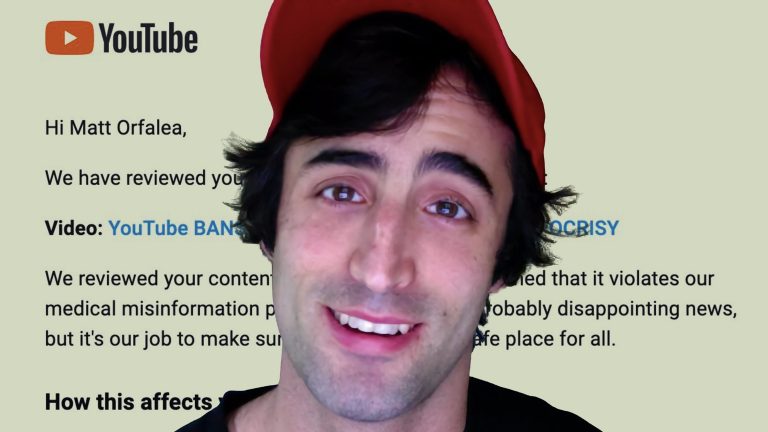
After he published a video discussing YouTube’s censorship last month, video producer Matt Orfalea was censored and had his channel demonetized. Now, YouTube has targeted Orfalea once again and removed another video where he and his guest, independent journalist Alison Morrow, called out the tech giant’s censorship.
In the video, which is titled “YouTube BANS Reporter Exposing YouTube HYPOCRISY,” Orfalea and Morrow recapped the escalating YouTube censorship they have both faced.
This censorship began in June when Orfalea’s YouTube channel was suspended for uploading what he described as “unpublished rough cuts” of a video highlighting YouTube’s censorship of ivermectin.
Orfalea was then demonetized in July after YouTube flagged a seven year old, 13 second parody video for allegedly violating its “violent criminal organizations” policy. After facing backlash, YouTube admitted “error” but did not re-monetize his videos.
A few days after Orfalea was demonetized, he was a guest on Morrow’s channel in a video where she highlighted how mainstream media outlets are allowed to violate YouTube’s “medical misinformation” policy without facing sanctions. This video was censored and then reinstated after YouTube faced pushback for taking it down.
In the “YouTube BANS Reporter Exposing YouTube HYPOCRISY” video, Morrow suggested that her video may have been removed because of Orfalea’s guest appearance and speculated that YouTube’s artificial intelligence (AI) could be flagging people that have previously been sanctioned by YouTube and then censoring videos from other creators that associate with those that have been flagged.
“This is just a perfect example of what’s happening now,” Orfalea added. “Where we have this caste system, this blatant double standard… so clearly, as you’ve described, this is not about protecting viewers from misinformation, this is about allowing, you know, some privileged class of journalists… corporate media and allow them to say things without being challenged.”
Shortly after Orfalea posted this video where he and Morrow criticized YouTube for its censorship, YouTube took it down for allegedly violating the platform’s “medical misinformation” rules.
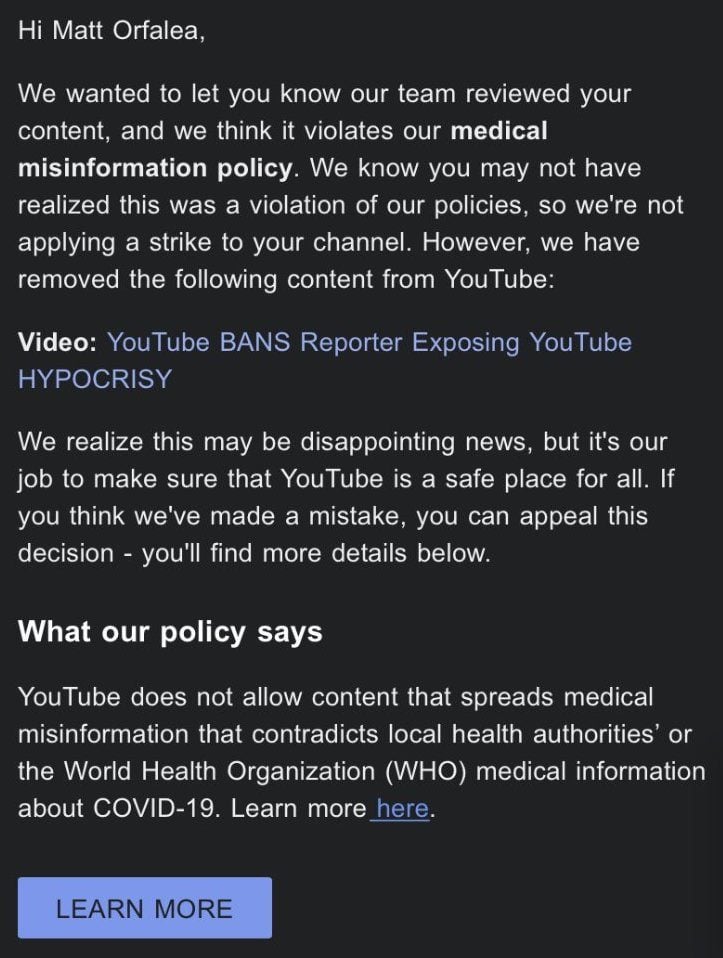
Orfalea appealed but YouTube rejected the appeal and told him: “We reviewed your content carefully, and have confirmed that it violates our medical misinformation policy.”
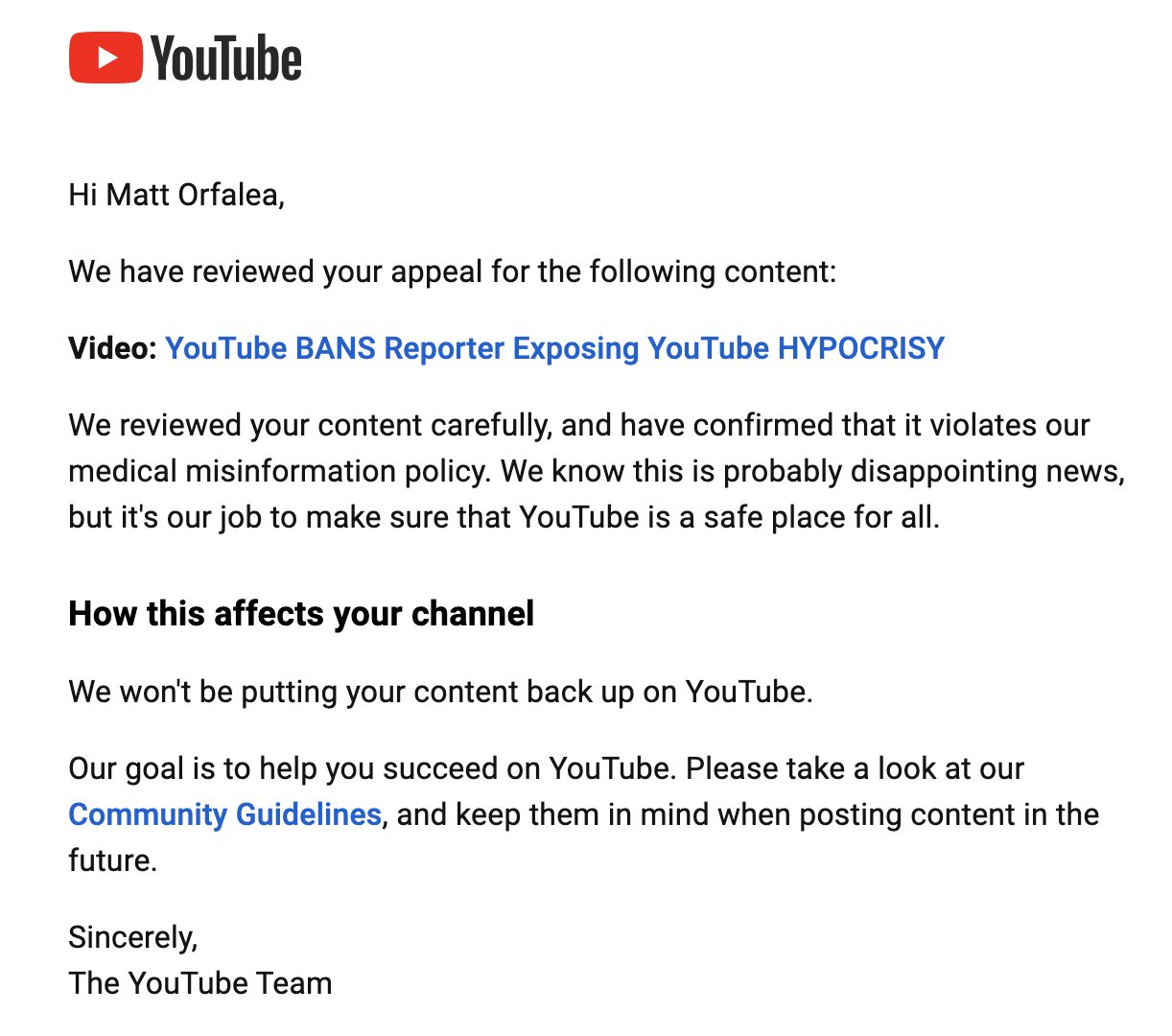
“I’ve been dealing with this insanity for almost a full month now,” Orfalea said after YouTube rejected his appeal. “YT reinstated Alison’s video. So they should reinstate my video, referencing hers, too!”
YouTube’s consistent targeting of Orfalea is reflective of the double standard on YouTube between independent creators and mainstream media outlets that he called out in this now-censored video.
Independent creators are 20x less likely to top coronavirus search results, 14x less likely to be recommended on election related content, and 10x less likely to top search results for some other newsworthy events.
YouTube’s CEO Susan Wojcicki has also admitted that the platform’s recommendation algorithm was changed in response to the media’s radicalization theory and said the platform won’t recommend YouTubers for breaking news.
Related: 🛡 Big Tech’s double standard on “conspiracy theories” when they come from mainstream media
July 14, 2021
Posted by aletho |
Civil Liberties, Corruption, Full Spectrum Dominance, Mainstream Media, Warmongering | YouTube |
Leave a comment
Yossi Cohen, the former chief of Israeli spy agency Mossad, is becoming head of the new office of the Saudi-backed conglomerate SoftBank in Israel, a report says.
Citing unnamed sources, the Israeli business newspaper Globes reported on Friday that SoftBank, a Japanese multinational conglomerate holding company led by Masayoshi Son, was appointing Cohen to head its new office in the occupied Palestinian territories.
Back in May 2017, Tokyo-based SoftBank and the Public Investment Fund of Saudi Arabia (PIF), which is the Arab kingdom’s main sovereign wealth fund, jointly created the Softbank Vision Fund. The joint venture is the world’s largest technology-focused private equity fund with a capital of $93 billion.
Having invested huge sums into companies such as Uber, Alibaba, and TikTok, SoftBank is seen as the world’s leading technology fund.
This is the second investment giant within three months to open a representative office in Israel, after Blackstone.
According to the daily, although Cohen does not have a background in investment, he is a well-known and popular figure in Israel, capable of connecting to Israeli entrepreneurs and opening doors for them in any company, government, or public authority in any territory.
His duties would include managing SoftBank’s activity in the occupied Palestinian territories and looking for investments.
Cohen has served as the head of Mossad since January 2016. He has reportedly served as former Israeli Prime Minister Benjamin Netanyahu’s special envoy for various tasks. Netanyahu reportedly sees him as his preferred successor.
Cohen played an important role in the Israeli regime’s normalization deals with a number of Arab states. He traveled to the United Arab Emirates and Bahrain.
The ex-Mossad chief reportedly joined Netanyahu on a 2020 visit to Saudi Arabia for talks with Crown Prince Mohammed Bin Salman.
July 10, 2021
Posted by aletho |
Corruption, Ethnic Cleansing, Racism, Zionism | Israel, Palestine, Saudi Arabia, Zionism |
Leave a comment
We have previously discussed the concerted and often embarrassing blackout in the media on stories involving Hunter Biden’s influence peddling during his father’s tenure as Vice President. That includes the burying of the laptop story and the growing contradictions over his father’s denial of any knowledge or involvement in his shady business dealings. Even recent reports that Hunter may have paid prostitutes with his father’s account were blacked out by mainstream media which exhaustively pursued any story related to the Trump children and their dealings and life styles. Now, however, there is a major allegation that Hunter used access to his father to seal previously unknown deals with Mexican businessmen, including Carlos Slim. A picture shows Hunter with the businessmen in the Vice President residence with his father.
As in the past, Americans interested in such stories have had to rely on the foreign press or a couple domestic sites for such information.
The new emails include references to the use of Air Force II by Hunter Biden to pursue the deals — a similar pattern revealed with regard to the China dealings. The emails detail a number of visits to Mexico, including a February 2016 flight on Air Force II with his father. On the plane was his business partner Jeff Cooper, who ran Illinois-based SimmonsCooper. That is one of the largest asbestos litigation firms in the country and Hunter was given 3 percent of Cooper’s venture capital firm Eudora Global, according to emails. President Biden’s brother (who featured in past controversial deals) was also reportedly involved in some of these efforts.
These dealings continued into 2018 as Hunter pushed for deals with Slim. One text message from July 24, 2018 reads “Spoke to my dad about ‘Slim ask” and Cooper responds “Oh that sounds SO F’ING GOOD.”
It obviously does not sound quite so good if you are a reporter who has been repeatedly assured by President Biden that he had no knowledge or involvement in any dealings with Hunter. That was previously refuted by various sources. Hunter himself contradicted his father’s repeated denial. Then there are the emails referring to the “Big Guy”, which witnesses say was Joe Biden. Then there is Tony Bobulinski who stated that he personally met with Joe Biden to discuss Hunter’s business dealings. Bobulinski is repeatedly praised by Hunter Biden in the emails and identified as the person in control of transactions for “the family.” He has directly contradicted Joe Biden’s denial of any knowledge or involvement in his son’s dubious dealings.
The new emails contain additional information directly contradicting President Biden. In addition to earlier pictures from golf trips and references to his involvement or knowledge, new material refers to a notable dinner arranged in Washington, D.C.
Hunter arranged for then Vice President Biden to have dinner on April 16, 2015 with his Ukrainian, Russian and Kazakhstani business associates. They appropriately chose a private room at Café Milano, a Georgetown restaurant that brags that it is “Where the world’s most powerful people go.” After the dinner, Hunter received an email from Vadym Pozharskyi, an executive with the Ukrainian energy company Burisma, to thank him for introducing him to his father: “Dear Hunter, thank you for inviting me to DC and giving an opportunity to meet your father and spent [sic] some time together. It’s realty [sic] an honor and pleasure.”
It is clear that Hunter Biden was selling access and influence. It appears that Joe Biden was aware of that effort. That is very serious. If these emails are false, this is a major story. If they are true, this is a major scandal. Presumably, however, this story will result in another run to the nearest ice cream shop for breathless coverage on the current frozen delights of the President.
July 3, 2021
Posted by aletho |
Corruption, Deception | Joe Biden, United States |
Leave a comment
How do you make a potentially dangerous and ineffective drug appear like a miracle of modern science? You could, for instance, enrol only certain people in clinical trials and exclude others or bring the study to a close as soon as you see a spike in the data that implies evidence of effectiveness.
There are many ways to do it.
According to health practitioner and writer Craig Stellpflug in his article ‘Big Pharma: Getting away with murder’(2012), the strategy is to get in quick, design the study to get the result you want, get out fast and make lots of money.
Stellpflug says:
If a study comes up negative for your favorite drug, just don’t publish it! 68 per cent of all drug studies are swept under the carpet to keep those pesky side effects from being reported. Only 32 per cent of studies come up positive and a lot of those studies are ‘shortened’ to limit the long-term findings. Studies cut short were found to overestimate the study drug’s effectiveness and miss dangerous side effects and complications by an average of 30 per cent. This would explain the amazing 85 per cent drug study success rate in the hands of Big Pharma according to the Annals of Internal Medicine.”
Of course, it helps to get the regulatory agencies on board and to convince the media and health officials of the need for your wonder product and its efficacy and safety. In the process, well-paid career scientists and ‘science’ effectively become shaped and led by corporate profit margins and political processes.
And what better way to make a financial killing than by making a mountain out of a molehill and calling it a ‘pandemic’?
COVID-19 VACCINE CONCERNS
The Wall Street Journal recently published an article by two health professors who said politics — not science — is behind the failure of health officials and the media to fully inform the public about the potential risks associated with COVID vaccines.
Although the article is available in full to subscribers only, the Children’s Health Defense (CHD) website provides an informative summary.
The CHD notes that Dr Joseph A Ladapo, associate professor of medicine at the David Geffen School of Medicine, and Dr Harvey A Risch, professor of epidemiology at Yale School of Public Health, wrote that while prominent scientists have raised concerns that the safety risks of Covid-19 vaccines have been underestimated, the politics of vaccination has relegated their concerns to the outskirts of scientific thinking.
The two professors noted that clinical studies do not always tell the full story about the safety of medications and that the health effects often remain unknown until the medicine is rolled out to the general public. Examples include Vioxx, a pain reliever that increased the risk of heart attack and stroke; antidepressants that appeared to increase suicide attempts among young adults; and an influenza vaccine used in the 2009-10 swine flu epidemic that was suspected of causing febrile convulsions and narcolepsy in children.
The authors added that clinical trials often enrol patients who are not representative of the general population and more is learnt about drug safety from real-world evidence. With this in mind, they said the large clustering of side effects following COVID vaccines is concerning as is the silence around these potential signals of harm.
Serious adverse events reported by the Vaccine Adverse Event Reporting System include low platelets, heart inflammation, deep-vein thrombosis and death. However, the two scientists argue this is likely to be a fraction of the total number of adverse events.
They criticise the Centers for Disease Control and Prevention (CDC) and the US Food and Drug Administration (FDA) for ignoring the reported serious COVID vaccine side effects.
The authors acknowledge the risks of COVID vaccines in certain populations, not least children, may outweigh the benefits. They also state that not a single published study has demonstrated that patients with a prior infection benefit from COVID-19 vaccination. Something which is not readily acknowledged by the CDC or Anthony Fauci, an indication, according to the authors, of how deeply entangled pandemic politics is in science.
They conclude that public health authorities are making a mistake and risking public erosion of trust by not being forthcoming about the possibility of harm from the vaccines.
MERCK AND VIOXX
It is revealing that the two scientists refer to Vioxx, which was once popular for treating the symptoms of arthritis. It was removed from the market in 2004 after concerns that it may have injured hundreds of thousands of patients, while possibly killing tens of thousands in the US.
Dr David Graham, whistleblower and senior FDA investigator, criticised the FDA’s approval process of Vioxx (rofecoxib), an anti-inflammatory drug administered orally. In various interviews and congressional hearings, he described the outcome of Vioxx as disastrous and unparalleled in the history of the US. He added that the saga surrounding Vioxx had constituted an unprecedented failure of the nation’s system of drug approval and oversight.
In 2004, Graham argued that the painkiller had caused 88,000 to 139,000 heart attacks in the US – 30-40 per cent of which were fatal – over the previous five years. Nevertheless, manufactured by Monsanto (a company with a proven track record of corrupt practices) and co-marketed by Merck, Vioxx became a leading drug in providing pain relief from the symptoms of various forms of arthritis.
Research presented to the FDA in early 2001 showed that patients taking Vioxx had a higher risk of heart attack compared to those taking some of the older alternatives.
However, the real game-changer came in 2004 when Dr Graham released the findings that found Vioxx increased the chance of heart attack and death from cardiac arrest significantly more than its biggest rival on the market. Dosages of Vioxx in excess of the recommended daily dose of 25 milligrams were also found to more than triple a patient’s risk compared to those who had not taken painkillers.
In September 2004, Vioxx was pulled from the market. But in 2006, more damning findings were revealed by a study that showed that some patients had likely suffered from a heart attack much sooner after starting treatment with Vioxx.
Appearing in the Canadian Medical Association Journal, the study showed that 25 per cent of the patients who had heart attacks while taking Vioxx did so within two weeks of starting the drug. This indicated that Vioxx-related cardiovascular risks may occur much earlier than previously thought.
The FDA was criticised for its close relationship with Merck and witnesses at a senate finance committee hearing described how danger signals of Vioxx went ignored. Indeed, a 2007 article published by the National Institutes of Health alleged that even though scientists at Merck knew that the drug might adversely affect the cardiovascular system, none of the intervention studies submitted to the FDA in 1998 were designed to evaluate such risk.
ROBBER BARONS AND GUINEA PIGS
Merck reported over $11 billion in Vioxx sales during the five years the drug was on the market. To date, the company has paid nearly $6 billion in litigation settlements and criminal fines over Vioxx. Still, in hard-nosed commercial terms, it was a massive success, resulting in a $5 billion gain for the company.
In May 2021, it was reported that Covid-19 vaccines had created at least nine new billionaires. According to research by the People’s Vaccine Alliance, the new billionaires included Moderna CEO Stéphane Bancel and Ugur Sahin, the CEO of BioNTech, which has produced a vaccine with Pfizer. Both CEOs were then worth around $4 billion. Senior executives from China’s CanSino Biologics and early investors in Moderna have also become billionaires.
Although the nine new billionaires are worth a combined $19.3 billion, the vaccines were largely funded by public money. For instance, according to a May 2021 report by CNN, BioNTech received €325 million from the German government for the development of the vaccine. The company made a net profit of €1.1 billion in the first three months of the year, largely thanks to its share of sales from the Covid-19 vaccine, compared with a loss of €53.4 million for the same period last year.
Moderna’s Covid-19 vaccine sales reached $1.7 billion in the first three months of this year and it had its first profitable quarter ever. Moderna is expected to make $13.2 billion in Covid-19 vaccine revenue in 2021. The company received billions of dollars in funding from the US government for development of its vaccine.
Big Pharma has every reason to perpetuate the notion of a deadly global pandemic and to inflate the efficacy of and need for its vaccines. And it, along with its associates in government and at the WHO, has every reason to discredit alternative and arguably more effective treatments like Ivermectin (see the online article ‘The Campaign against Ivermectin: WHO’s Chief Scientist Served with Legal Notice for Disinformation and Suppression of Evidence‘).
There is no need to cover ground here that has been covered extensively elsewhere but it is now abundantly clear that many continue to question the overall official COVID-19 narrative, the fear propaganda, the specific data, the PCR testing protocols, the apparent conflicts of interest and vaccine efficacy.
Moreover, A group of 57 leading scientists, doctors and policy experts recently released a report calling into question the safety and efficacy of the current Covid-19 vaccines. They are calling for an immediate end to all vaccine programmes.
There are hundreds of scientists who have questioned governmental and WHO strategy and who have brought attention to the extremely low risks posed by COVID to the bulk of the population as well as the destructive (ineffective) policies and decisions pertaining to lockdowns and other restrictions.
There are many other top scientists who are questioning the need for mass vaccination and who have also pointed out credible and extremely disturbing side effects (real and potential) of such a strategy, not least Dr Robert Malone, credited with developing mRNA vaccine technology, Dr Byram Bridle, a viral immunologist, and Dr Geert Vanden Bossche, a prominent virologist and vaccine expert.
Unlike Merck and Vioxx, it will be governments (the public) that foot any future indemnity costs of these experimental vaccines that have escaped proper (long-term) testing. And given the scale of the rollout, the damage caused could make the adverse effects of Vioxx seem a mere blip.
Vaccines that were brought to market via emergency authorisation use for an ‘emergency’ constructed on the basis of deaths so often wrongly attributed to COVID-19. Brought to market on the basis of flawed PCR test protocols with magnification cycles primed to create a ‘casedemic’.
To borrow from Dr David Graham: are we currently witnessing something more disastrous and unparalleled in the history of the world, let alone the US: an unprecedented failure of gobal drug approval and oversight?
In the meantime, while billions of vaccinated people serve as human guinea pigs, the newly crowned vaccine kings will make hay while the sun shines (and the fear continues).
July 3, 2021
Posted by aletho |
Corruption, Deception, Science and Pseudo-Science | COVID-19 Vaccine |
Leave a comment
THE behaviour of political and public-health leaders across the world over the past fifteen months has been deplorable: for reasons yet to be confirmed, they have turned themselves into procurers for Big Pharma.
Governments not only funded fast-paced vaccine development but also psychologically prepared their populations to receive them by means of sustained media manipulation. Billions of pounds in public money has been transferred to drug corporations which have been insulated from civil legal challenge in respect of harm or loss arising from their products.
Medical staff have lost a great deal of public trust by colluding with vaccine stakeholders and withdrawing general support. They have delivered experimental gene therapies to people who did not need them but who were cowed into having them, and they have exposed young people, healthy adults and pregnant women to unnecessary risks without their full knowledge or consent in breach of their own ethical and professional standards.
When the UK government granted Pfizer civil legal immunity in December 2020 it enabled a private commercial entity to avoid the already restricted product liabilities that might have given it cause to consider. Regulation 345 of the Human Medicines Regulations (HMR) 2012, gave it blanket protection from civil lawsuits arising from any ‘unforeseen complications’ with Covid jabs.
Such legal immunity is unusual but came from an emergency government consultation in September 2020, after the Department of Health and Social Care under Matt Hancock had determined that changes to civil liability were necessary to ‘better facilitate the widespread use of a Covid-19 vaccine in Britain’.
Emergency approval had already been granted for Pfizer/BioNTech’s two-shot ‘vaccines’ through Regulation 174 of the HMR, which allowed them to avoid statutory licensing procedures, so with civil legal protections, they were unfettered. Crony capitalism and avarice beat prudence and public protection.
The government, likely for political expediency, included Covid jabs on the Vaccine Damage Payments Scheme (VDPS) (Vaccine Damage Payments (Specified Disease) Order 2020, SI 2020/1411). This scheme is taxpayer funded and provides for ‘the very rare possibility where someone is severely disabled as a result of taking a vaccine’.
To qualify for assistance, a claimant must provide medical evidence that proves to the Department of Work and Pensions that on ‘the balance of probability’ there is a ‘causal link between the vaccine and the claimed disability [and] that the resulting disability is severe – up to 60 per cent’.
Those who can prove their cause receive a one-off tax-free payment of £120,000. The test poses two key challenges for claimants, the high threshold of disablement and the relatively low level of compensation.
Consumer Protection Rights and common law rights still apply for people damaged by Covid-19 vaccines but due to the legal definition of product defects and a rule known as the ‘state-of-the-art defence’, it may be very difficult to get compensation: only time and case law will tell.
The very fact that Covid vaccine research was funded by government is curious and may, arguably, make them also liable; that manufacturers’ experimental products were given emergency authorisation is questionable; that immunity against civil action for damages was granted is an egregious betrayal; and the continuing promotion of the jabs, despite growing evidence of harm, is evil.
In both the UK and the US, a condition for the release of any new drug is that there be no other effective treatments available. We all know now that proven therapeutics were available to treat the early symptoms of Covid-19 but that they were, and still are, suppressed. Viable alternatives include ivermectin, hydroxychloroquine and zinc, dexamethasone and other corticosteroids (prednisone, methylprednisolone), and remdesivir.
What distinguishes these remedies from novel ‘vaccines’ is that they are already fully licensed and off-patent. They are relatively cheap to manufacture and administer, and therefore unlikely to bring new long-term income streams to Big Pharma.
All of which brings us unhappily to our question: Why on earth was our government so eager to fund the activity of international drug giants and why did it provide them with tax-funded legal immunities for products that only they will profit from?
It’s not as if Boris Johnson, Matt Hancock or their Sage advisers can claim ignorance of the business practices or track records of these outfits: they all have strong public links to them, either as employees, researchers, directors, business partners, shareholders, or recipients of funding.
In December 2020, Global Justice Now, a UK-based ‘social justice organisation’ published a report which concluded:
‘The current pharmaceutical model is . . . deeply flawed, delivering outcomes which are poor value for money for the public sector, which exacerbate global inequality and which are driven by the objective to make sky-high returns to shareholders, not a healthier population.’
It described the market as dysfunctional with incentives for ‘the most appalling behaviour including aggressive marketing of inappropriate drugs, kickbacks to doctors, claims of testing drugs on children without proper consent, massive price hikes on essential medicines, profiteering, blocking competition, and secrecy’.
In the US, Public Citizen, a non-profit, consumer rights advocacy group, published Twenty Seven Years of Pharmaceutical Industry Criminal and Civil Penalties 1991 through 2017, which detailed the 412 settlements against drug companies that resulted in them paying out $38.6 billion in criminal and civil penalties. A small loss relative to the $711 billion in net profits made by the 11 largest global drug companies during ten of those 27 years (2003-2012).
Pfizer, now the leading Covid mRNA vaccine manufacturer, was found guilty of more transgressions than any other company and forced to pay 34 settlements amounting to $4.7billion: AstraZeneca had to settle just over $1billion on 13 matters, including concealing data.
Johnson & Johnson was ordered to pay $2.8billion in 20 settlements that included unlawful promotion of prescription drugs and unfair practices.
Such penalties are clearly accepted by the companies as a ‘cost of doing business’. They are certainly no incentive to changing behaviour.
Criminal prosecutions of executives of drug companies are extremely rare, as are prosecutions of politicians. Nonetheless, a forensic assessment of who is liable for the risks, damages, and losses brought by Covid -19 ‘vaccines’ is long overdue.
June 30, 2021
Posted by aletho |
Corruption, Timeless or most popular | UK |
Leave a comment
“The lamps are going out all over Europe, we shall not see them lit again in our life-time.” Edward Grey
Several years ago, I wrote a book called Doctoring Data. It was my attempt to help people navigate their way through medical headlines and medical data.
One of the main reasons I was stimulated to write it, is because I had become deeply concerned that science, especially medical science, had been almost fully taken over by commercial interests. With the end result that much of the data we were getting bombarded with was enormously biased, and thus corrupted. I wanted to show how some of this bias gets built in.
I was not alone in my concerns. As far back as 2005, John Ioannidis wrote the very highly cited paper ‘Why most Published Research Findings are False’. It has been downloaded and read by many, many, thousands of researchers over the years, so they can’t say they don’t know:
‘Moreover for many current scientific fields, claimed research findings may often be simply accurate measures of the prevailing bias.’1
Marcia Angell, who edited the New England Journal of Medicine for twenty years, wrote the following. It is a quote I have used many times, in many different talks:
‘It is simply no longer possible to believe much of the clinical research that is published, or to rely on the judgement of trusted physicians or authoritative medical guidelines. I take no pleasure in this conclusion, which I reached slowly and reluctantly over my two decades as an editor of the New England Journal of Medicine.’
Peter Gotzsche, who set up the Nordic Cochrane Collaboration, and who was booted out of said Cochrane collaboration for questioning the HPV vaccine (used to prevent cervical cancer) wrote the book. ‘Deadly Medicine and Organised Crime. [How big pharma has corrupted healthcare]’.
The book cover states… ‘The main reason we take so many drugs is that drug companies don’t sell drugs, they sell lies about drugs… virtually everything we know about drugs is what the companies have chosen to tell us and our doctors… if you don’t believe the system is out of control, please e-mail me and explain why drugs are the third leading cause of death.’
Richard Smith edited the British Medical Journal (BMJ) for many years. He now writes a blog, amongst other things. A few years ago, he commented:
‘Twenty years ago this week, the statistician Doug Altman published an editorial in the BMJ arguing that much medical research was of poor quality and misleading. In his editorial entitled ‘The scandal of Poor Medical Research.’ Altman wrote that much research was seriously flawed through the use of inappropriate designs, unrepresentative sample, small sample, incorrect methods of analysis and faulty interpretation… Twenty years later, I feel that things are not better, but worse…
In 2002 I spent eight marvellous weeks in a 15th palazzo in Venice writing a book on medical journals, the major outlets for medical research, and the dismal conclusion that things were badly wrong with journals and the research they published. My confidence that ‘things can only get better’ has largely drained away.’
Essentially, medical research has inexorably turned into an industry. A very lucrative industry. Many medical journals now charge authors thousands of dollars to publish their research. This ensures that it is very difficult for any researcher, not supported by a university, or a pharmaceutical company, to afford to publish anything, unless they are independently wealthy.
The journals then have the cheek to claim copyright, and charge money to anyone who actually wants to read, or download the full paper. Fifty dollars for a few on-line pages! They then bill for reprints, they charge for advertising. Those who had the temerity to write the article get nothing – and nor do the peer reviewers.
It is all very profitable. Last time I looked the Return on Investment (profit) was thirty-five per-cent for the big publishing houses. It was Robert Maxwell who first saw this opportunity for money making.
Driven by financial imperative, the research itself has also, inevitably, become biased. He who pays the paper calls the tune. Pharmaceutical companies, food manufacturers and suchlike. They can certainly afford the publication fees.
In addition to all the financial and peer-review pressure, if you dare swim against the approved mainstream views you will, very often, be ruthlessly attacked. As many people know, I am a critic of the cholesterol hypothesis, along with my band of brothers… we few, we happy few. In the 1970s, Kilmer McCully, who plays double bass in our band, was looking into a cause of cardiovascular disease that went against the mainstream view. This is what happened to him:
‘Thomas N. James, a cardiologist and president of the University of Texas Medical Branch who was also the president of the American Heart Association in 1979 and ’80, is even harsher [regarding the treatment of McCully]. ”It was worse than that – you couldn’t get ideas funded that went in other directions than cholesterol,” he says. ”You were intentionally discouraged from pursuing alternative questions. I’ve never dealt with a subject in my life that elicited such an immediate hostile response.”
It took two years for McCully to find a new research job. His children were reaching college age; he and his wife refinanced their house and borrowed from her parents. McCully says that his job search developed a pattern: he would hear of an opening, go for interviews and then the process would grind to a stop. Finally, he heard rumors of what he calls ”poison phone calls” from Harvard. ”It smelled to high heaven,” he says.’
McCully says that when he was interviewed on Canadian television after he left Harvard, he received a call from the public-affairs director of Mass. General. ”He told me to shut up,” McCully recalls. ”He said he didn’t want the names of Harvard and Mass. General associated with my theories.’ 2
More recently, I was sent a link to an article outlining the attacks made on another researcher who published a paper which found that being overweight meant having a (slightly) lower risk of death than being of ‘normal weight. This, would never do:
‘A naïve researcher published a scientific article in a respectable journal. She thought her article was straightforward and defensible. It used only publicly available data, and her findings were consistent with much of the literature on the topic. Her coauthors included two distinguished statisticians.
To her surprise her publication was met with unusual attacks from some unexpected sources within the research community. These attacks were by and large not pursued through normal channels of scientific discussion. Her research became the target of an aggressive campaign that included insults, errors, misinformation, social media posts, behind-the-scenes gossip and maneuvers, and complaints to her employer.
The goal appeared to be to undermine and discredit her work. The controversy was something deliberately manufactured, and the attacks primarily consisted of repeated assertions of preconceived opinions. She learned first-hand the antagonism that could be provoked by inconvenient scientific findings. Guidelines and recommendations should be based on objective and unbiased data. Development of public health policy and clinical recommendations is complex and needs to be evidence-based rather than belief-based. This can be challenging when a hot-button topic is involved.’ 3
Those who lead the attacks on her were my very favourite researchers, Walter Willet and Frank Hu. Two eminent researchers from Harvard who I nickname Tweedledum and Tweedledummer. Harvard itself has become an institution, which, along with Oxford University, comes up a lot in tales of bullying and intimidation. Willet and Hu are internationally known for promoting vegetarian and vegan diets. Willet is a key figure in the EAT-Lancet initiative.
Where is science in all this? I feel the need to state, at this point, that I don’t mind attacks on ideas. I like robust debate. Science can only progress through a process of new hypotheses being proposed, being attacked, being refined and strengthened – or obliterated. But what we see now is not science. It is the obliteration of science itself:
‘Anyone who has been a scientist for more than 20 years will realize that there has been a progressive decline in the honesty of communications between scientists, between scientists and their institutions and the outside world.
Yet, real science must be an area where truth is the rule; or else the activity simply stops being scient and becomes something else: Zombie science. Zombie science is a science that is dead, but is artificially keep moving by a continual infusion of funding. From a distance Zombie science looks like the real thing, the surface features of a science are in place – white coats, laboratories, computer programming, PhDs, papers, conferences, prizes etc. But the Zombie is not interested in the pursuit of truth – its citations are externally-controlled and directed at non-scientific goals, and inside the Zombie everything is rotten…
Scientists are usually too careful and clever to risk telling outright lies, but instead they push the envelope of exaggeration, selectivity and distortion as far as possible. And tolerance for this kind of untruthfulness has greatly increased over recent years. So, it is now routine for scientists deliberately to ‘hype’ the significance of their status and performance and ‘spin’ the importance of their research.’ Bruce Charlton: Professor of Theoretical Medicine.
I was already pretty depressed with the direction that medical science was taking. Then COVID19 came along, the distortion and hype became so outrageous that I almost gave up trying to establish what was true, and was just made up nonsense.
For example, I stated, right at the start of the COVID19 pandemic, that vitamin D could be important in protecting against the virus. For having the audacity to say this, I was attacked by the fact checkers. Indeed, anyone promoting vitamin D to reduce the risk of COVID19 infection, was ruthlessly hounded.
Guess what. Here from 17th June:
‘Hospitalized COVID-19 patients are far more likely to die or to end up in severe or critical condition if they are vitamin D-deficient, Israeli researchers have found.
In a study conducted in a Galilee hospital, 26 percent of vitamin D-deficient coronavirus patients died, while among other patients the figure was at 3%.
“This is a very, very significant discrepancy, which represents a big clue that starting the disease with very low vitamin D leads to increased mortality and more severity,” Dr. Amir Bashkin, endocrinologist and part of the research team, told The Times of Israel.’ 4
I also recommended vitamin C for those already in hospital. Again, I was attacked, as has everyone who has dared to mention COVID19 and vitamin C in the same sentence. Yet, we know that vitamin C is essential for the health and wellbeing of blood vessels, and the endothelial cells that line them. In severe infection the body burns through vitamin C, and people can become ‘scrobutic’ (the name given to severe lack of vitamin C).
Vitamin C is also known to have powerful anti-viral activity. It has been known for years. Here, from an article in 1996:
‘Over the years, it has become well recognized that ascorbate can bolster the natural defense mechanisms of the host and provide protection not only against infectious disease, but also against cancer and other chronic degenerative diseases. The functions involved in ascorbate’s enhancement of host resistance to disease include its biosynthetic (hy-droxylating), antioxidant, and immunostimulatory activities. In addition, ascorbate exerts a direct antiviral action that may confer specific protection against viral disease. The vitamin has been found to inactivate a wide spectrum of viruses as well as suppress viral replication abd expression in infected cell.’ 5
I like quoting research on vitamins from way before COVID19 appeared, where people were simply looking at Vitamin C without the entire medico-industrial complex looking over their shoulder, ready to stamp out anything they don’t like. Despite a mass of evidence that Vitamin C has benefits against viral infection, it is a complete no-go area and no-one even dares to research it now. Facebook removes any content relating to Vitamin C and COVID19.
As of today, any criticism of the mainstream narrative is simply being removed. Those who dare to raise their heads above the parapet, have them chopped off:
‘Dr Francis Christian, practising surgeon and clinical professor of general surgery at the University of Saskatchewan, has been immediately suspended from all teaching and will be permanently removed from his role as of September.
Dr Christian has been a surgeon for more than 20 years and began working in Saskatoon in 2007. He was appointed Director of the Surgical Humanities Program and Director of Quality and Patient Safety in 2018 and co-founded the Surgical Humanities Program. Dr. Christian is also the Editor of the Journal of The Surgical Humanities.
On June 17th Dr Christian released a statement to over 200 of his colleagues, expressing concern over the lack of informed consent involved in Canada’s “Covid19 vaccination” program, especially regarding children.
To be clear, Dr Christian’s position is hardly an extreme one.
He believes the virus is real, he believes in vaccination as a general principle, he believes the elderly and vulnerable may benefit from the Covid “vaccine”… he simply doesn’t agree it should be used on children, and feels parents are not being given enough information for properly informed consent.’ 6
When I wrote Doctoring Data, a few years ago, I included the following thoughts about the increasing censorship and punishment that was already very clearly out in the open:
… where does it end? Well, we know where it ends.
First, they came for the communists, and I didn’t speak out because I wasn’t a communist
Then they came for the socialists, and I didn’t speak out because I wasn’t a socialist
Then they came from the trade unionists, and I didn’t speak out because I wasn’t a trade unionist
Then they came for me, and there was no-one left to speak for me
Do you think this is a massive over-reaction? Do I really believe that we are heading for some form of totalitarian stated, where dissent against the medical ‘experts’ will be punishable by imprisonment? Well, yes, I do. We are already in a situation where doctors who fail to follow the dreaded ‘guidelines’ can be sued, or dragged in front the General Medical Council, and struck of. Thus losing their job and income…
Where next?
The lamps are not just going out all over Europe. They are going out, all over the world.
1: https://journals.plos.org/plosmedicine/article?id=10.1371/journal.pmed.0020124
2: https://www.nytimes.com/1997/08/10/magazine/the-fall-and-rise-of-kilmer-mccully.html
3: https://www.sciencedirect.com/science/article/pii/S0033062021000670
4: https://www.timesofisrael.com/1-in-4-hospitalized-covid-patients-who-lack-vitamin-d-die-israeli-study
5: https://www.researchgate.net/publication/14383321_Antiviral_and_Immunomodulatory_Activities_of_Ascorbic_Acid
6: https://off-guardian.org/2021/06/25/canadian-surgeon-fired-for-voicing-safety-concerns-over-covid-jabs-for-children/
June 29, 2021
Posted by aletho |
Book Review, Corruption, Deception, Science and Pseudo-Science, Timeless or most popular | Covid-19, Facebook, United States |
Leave a comment

 Aletho News

