Arrests by US as FIFA mulls giving Israel boot
By Jonathon Cook | The Blog from Nazareth | May 27, 2015
FIFA, world football’s governing body, is due to meet this Friday in Zurich to decide whether to back a Palestinian motion to suspend Israel for its systematic violations of Palestinian footballers’ rights in the occupied territories, including preventing practice sessions and games, arresting players, denying entry to other teams, and bombing grounds, as well as for endemic racism towards non-Jewish players in Israeli football itself. I have written about this in the past: here and here.
Although a 75% majority is needed for the Palestinian motion to carry, there has been a growing sense that the mood at FIFA is shifting the Palestinians’ way. Israel and the US are, of course, deeply worried. Such a move would have strong overtones of the sports boycott against South Africa and further reinforce the idea that the description of Israel as an apartheid state holds. It would also disrupt FIFA tournaments Israel is due to host in the coming months, causing great embarrassment to Israel and FIFA’s president, Sepp Blatter.
Meanwhile, almost everyone quietly acknowledges that FIFA is corrupt from head to toe, and has been for as long as the game has been another branch of the big-business entertainments industry. Just think how impossible it would have been for a body not profoundly infected with corrupt practices to have backed desert emirate Qatar’s bid to host the 2022 tournament – in the middle of its stifling summer.
Today, however, the US decided it was time to call a halt to FIFA’s corruption. It ordered the high-profile arrest and extradition of six senior FIFA officials on corruption charges dating back to the early 1990s. The operation at the FIFA officials’ Zurich hotel, as they waited for Friday’s vote, was covered in detail by leading US media organisations after they were tipped off beforehand. Apparently it has taken the US the best part of 20 years to get round to doing the paperwork to make the arrests.
Doubtless, none of this was designed to have – or will have – the slightest effect on FIFA officials as they contemplate whether to infuriate Israel and the US by booting Israel out of world soccer.
In the meantime, you can try to shore up FIFA’s resolve by signing a petition here.
www.haaretz.com/news/world/1.658271
UPDATE:
Anyone who doubts how seriously Israel is taking the threat of being ousted from FIFA and how actively its supporters are working behind the scenes at the world body should read the comments of Avi Luzon, Israel’s representative to UEFA, European football’s governing body. Ominously, he says UEFA’s support for Israel is sown up and suggests that UEFA will prevent Israel’s suspension whatever the outcome of the vote.
I’ve said it before and I’ll say it again: UEFA will not let Israel be harmed, especially as there is no reason for it. An agreement has been reached on a four-point draft that is acceptable to [Israeli PM Benjamin] Netanyahu, [UEFA president Michel] Platini, [FIFA president Sepp] Blatter and now [Palestinian soccer chief] Jibril Rajoub.
In the worst case scenario, if the Palestinians do not agree to pull the proposal and the congress is held as planned, UEFA will prevent the suspension of Israel in a very clear way. From the conversations with important people, face to face here in Warsaw, I can say without a doubt that concern over Israel’s suspension through a vote will not happen.
Repressive governments donated to Clinton Foundation, arms deals approved by Hillary’s State Dept. – report
RT | May 26, 2015
Nations openly chastised by the US for dismal human rights records donated billions to the Clinton Foundation, while gaining clearance for weapons deals approved by the Hillary Clinton-led US State Department, according to a new report.
As the Obama administration increased military weapons exports, Hillary Clinton’s State Department approved transfer of more than $300 billion worth of arms manufactured by US defense contractors to 20 nations that were or have since become donors of the Clinton Foundation, a major philanthropic organization run by the Clinton family. According to a review of available records of foundation donors by the International Business Times, those countries included governments that have received frequent criticism by the State Department for repressive policies.
“Algeria, Saudi Arabia, Kuwait, the United Arab Emirates, Oman and Qatar all donated to the Clinton Foundation and also gained State Department clearance to buy caches of American-made weapons even as the department singled them out for a range of alleged ills, from corruption to restrictions on civil liberties to violent crackdowns against political opponents,” IBT wrote.
Algeria, Kuwait, Oman, and Qatar were nations that directly donated to the Clinton Foundation during Clinton’s term as secretary of state, even as they were requesting weapons shipments. The donated money represents a loophole in US law regarding political contributions.
“Under federal law, foreign governments seeking State Department clearance to buy American-made arms are barred from making campaign contributions — a prohibition aimed at preventing foreign interests from using cash to influence national security policy,” IBT noted. “But nothing prevents them from contributing to a philanthropic foundation controlled by policymakers.”
The reviewed sales — both commercial and Pentagon-brokered — represent those made during “three full fiscal years of Clinton’s term as secretary of state (from October 2010 to September 2012),” IBT reported. The deals made with the nations in question during this time add up to far more than arms agreements made with the same countries during the last three full fiscal years of George W. Bush’s administration, according to the report.
“The word was out to these groups that one of the best ways to gain access and influence with the Clintons was to give to this foundation,” Meredith McGehee, policy director at the Campaign Legal Center, told IBT. “This shows why having public officials, or even spouses of public officials, connected with these nonprofits is problematic.”
The Clinton Foundation’s donor list has come under closer examination since Hillary Clinton announced she is seeking the Democratic Party’s presidential nomination in 2016. In April, the Clintons acknowledged they have made “mistakes” regarding transparency amid increased public scrutiny concerning donations from foreign entities, especially when Mrs. Clinton was secretary of state, from 2009 to 2013.
Earlier this month, former President Bill Clinton defended his family foundation’s donors.
“I don’t think there’s anything sinister in trying to get wealthy people in countries that are seriously involved in development to spend their money wisely in a way that helps poor people and lifts them up,” Mr. Clinton told NBC News.
The Clinton Foundation signed a foreign donor disclosure agreement just before Hillary Clinton became secretary of state, yet neither the department nor the White House raised issues with potential conflicts of interest regarding the weapons agreements.
IBT reported that in 1995 President Clinton signed a presidential policy directive demanding the State Department take into account human rights abuses when considering the approval of military equipment or arms purchases from US companies. Yet Mrs Clinton’s State Department ignored this stipulation, helping the Obama administration increase weapons transfers.
The State Department, under the aegis of Clinton, hammered the Algerian government in its 2010 Human Rights Report for “restrictions on freedom of assembly and association,” allowing “arbitrary killing,” “widespread corruption,” and a “lack of judicial independence.”
“That year, the Algerian government donated $500,000 to the Clinton Foundation and its lobbyists met with the State Department officials who oversee enforcement of human rights policies. Clinton’s State Department the next year approved a one-year 70 percent increase in military export authorizations to the country,” IBT reported. “The increase included authorizations of almost 50,000 items classified as ‘toxicological agents, including chemical agents, biological agents and associated equipment’ after the State Department did not authorize the export of any of such items to Algeria in the prior year.
“During Clinton’s tenure, the State Department authorized at least $2.4 billion of direct military hardware and services sales to Algeria — nearly triple such authorizations over the last full fiscal years during the Bush administration. The Clinton Foundation did not disclose Algeria’s donation until this year — a violation of the ethics agreement it entered into with the Obama administration.”
IBT also reported that major US weapons manufacturers and financial corporations such as Boeing, Lockheed Martin, and Goldman Sachs paid Bill Clinton lucrative speaking fees “reaching $625,000” just as arms deals they had an interest in were in the works with Mrs Clinton’s State Department.
Hillary Clinton had pledged during her Senate confirmation hearings in 2009 that “in many, if not most cases, it is likely that the Foundation or President Clinton will not pursue an opportunity that presents a conflict.”
US weapons sales tripled in 2011 to a new yearly high of $66.3 billion, according to the New York Times, mostly driven by sales to Persian Gulf nations allied against Iran. This dollar total made up nearly 78 percent of all worldwide arms deals that year, according to the Congressional Research Service.
Reuters reported in January 2013 that the State Department office that has oversight of direct commercial arms sales “was on track to receive more than 85,000 license requests in 2012, a new record.”
The boom in arms sales by the Obama administration has continued to the present day, as Arab allies like Saudi Arabia and United Arab Emirates are using American-made fighter jets against Islamic State and for proxy wars in places like Yemen and Syria.
According to the Times, foreign weapons sales now represent 25 percent to 30 percent of revenue taken in by Lockheed Martin, one of the top US-based arms dealers.
Holder Deadline for Prosecuting Wall Street Executives for Financial Crisis Passes without a Single Charge
By Noel Brinkerhoff and Danny Biederman | AllGov | May 26, 2015
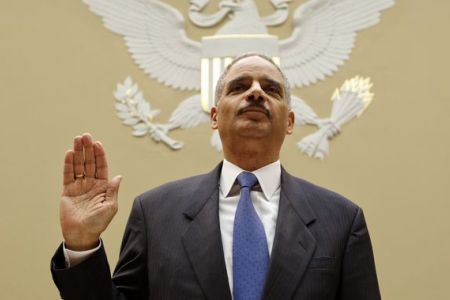
Shortly before Attorney General Eric Holder left office, he gave his prosecutors 90 days to decide whether to indict any Wall Street executives for decisions that caused the 2008 financial crisis.
Holder has now left the building at the Department of Justice (DOJ). Also gone is his deadline for punishing big bankers, none of whom were charged with a crime.
Holder’s shop had six years to build cases against key people at institutions like Citigroup and JP Morgan Chase. It’s not known if prosecutors ever did that. What is known is that the only charges actually filed by DOJ lawyers have been against smaller fish, namely those working at small and medium sized banks, according the Center for Public Integrity (CPI).
The investigative news site reviewed enforcement actions and civil lawsuits filed by the Justice Department, Federal Deposit Insurance Corp. (FDIC) and Securities and Exchange Commission (SEC) and found “these agencies have been far more likely to charge or sue individuals who work at small and medium sized banks, and foreign financial firms, than those that work at domestic banking giants such as J.P. Morgan Chase & Co. or Citigroup.”
CPI’s Alison Fitzgerald reported that none of the five largest banks in the country are involved in criminal cases filed by the Justice Department that pertain to the financial crisis.
“Two defendants who were unsuccessfully prosecuted ran a hedge fund for the now-defunct investment bank Bear Stearns,” she wrote. “About a dozen others are from smaller banks or foreign institutions.”
At the SEC, only four of the more than 100 bank executives named in lawsuits were from the top five banks, according to Fitzgerald. The FDIC has sued nearly 2,000 bank executives, none of whom worked at any of the big Wall Street banks.
“There’s no question that these banks have admitted that they’ve violated laws and regulations,” Independent Community Banker of America CEO Camden Fine told CPI. “These guys on Wall Street get their checkbooks out and write a check. This is an issue of unequal enforcement.”
For his part, Holder recently defended his efforts and that of the DOJ to prosecute individuals at the big banks for criminal wrongdoing. “To the extent that individuals have not been prosecuted, people should understand it is not for lack of trying,” he said.
“Nonsense,” countered former U.S. Assistant Attorney General Jimmy Gurulé. “Charges for white-collar crimes are filed every single day by U.S. attorneys across the country,” he told International Business Times. “Just because they’re more difficult with banks is not a legitimate excuse for bringing zero charges against individuals.”
To Learn More:
Bankers From Major Institutions Still Haven’t Been Held Responsible For Financial Crash (by Alison Fitzgerald, Center for Public Integrity)
Who Caused The Financial Crisis? Prosecutors Face 3-Month Deadline for Bringing Charges in the Subprime Mortgage Mess (by Owen Davis, International Business Times )
Instead of Wall St. Prosecutions, Holder Delivers a Deadline (by William Cohan, New York Times )
Eric Holder’s Last Chance to Prosecute Financial Meltdown Bankers (by Noel Brinkerhoff, AllGov )
American ‘democracy’ at work
By Jay Syrmopoulos | The Free Thought Project | May 25, 2015
Atlanta, Ga. – An investigative team for an Atlanta television station WXIA, exposed massive government corruption when they found a secret meeting at a Georgia resort hotel held by the American Legislative Exchange Council (ALEC).
The stunning investigative report included video footage of corporate lobbyists and legislators admitting that the legislators are paid by the lobbyists to attend the events.
Reporter Brendan Keefe attempted to gain entrance to the conference but was summarily denied access by ALEC staff and was subsequently escorted from the hotel, where Keefe was a paying guest.
In the video, Keefe approaches the conference room and is blocked by a woman who closes the door to the camera. The woman tells Keefe and the camera-person to follow her away from the room, as Keefe asks if there are legislators in the room.
As Keefe persists in questioning why he is not allowed access, he is confronted by Bill Meierling, an ALEC Director of Communications, accompanied by four sheriff’s deputies.
Keefe attempts to interview Meierling when he approaches, but the ALEC representative refuses and threatens to have the reporter “escorted from the building.” The fact that Keefe is a paying guest of the hotel is seemingly irrelevant when big business is attempting to conceal its incestuous relationship with government.
Why all the secrecy if there is nothing to hide?
Don’t Americans have a right to know that their elected representatives don’t actually represent them, but are simply the rubber stamp for corporate America to enact law?
The lack of transparency in the legislative process should raise serious red flags. The secretive process taking place in the video happens all across the country and in reality is how law is made in the U.S.
Prior to the hotel confrontation, Keefe interviewed Georgia State Senator Nan Orrock, a former ALEC member, who exposed the secretive activities taking place.
“(ALEC) is really a corporate ‘bill mill.’ I mean, they’re cranking out legislation and put it in the hands of legislators who go back and file it. … There are votes taken, that have the corporate votes, voting at the same table with the legislators on what bills to pick. That, at its core, just screams out, ‘inappropriate.’ … (Corporations) absolutely vote, and the truth be told, they write the bills,” said Orrock.
The hustle being pulled on the American public is laid bare, and the order followers enforcing it have been exposed.
ALEC is technically listed as a 501(c)(3) organization, for “charitable and educational purposes,” thus giving legislators a tax write-off for any funds received from the organization.
To provide a clearer example of this process, Keefe explains that ALEC will write a model bill, such as the Georgia Asbestos Claims Priorities Act, which effectively shields corporations from being sued by asbestos victims. The bill eventually presented was an almost exact duplicate of an ALEC bill first approved in a secretive closed-door meeting in a Las Vegas casino.
Unsurprisingly, the three Georgia Senators that sponsored the bill had received over $22,000 in ALEC “scholarships” to attend resort meetings around the same time the asbestos bill was initially being forwarded.
How can anyone continue to put faith in the state after realizing exactly how the corrupt legislative process truly works?
Under Shadow of Trade Deal, US Pesticide Lobby Pressured EU to Dump Toxic Pesticide Rules
By Deirdre Fulton | Common Dreams | May 22, 2015
Under pressure from the U.S. and agrochemical industry lobbyists and amid ongoing negotiations for a controversial trade deal, the European Union dropped planned rules that could have led to the banning of 31 pesticides containing hazardous chemicals, a new investigative report has revealed.
The probe, led by the Brussels-based research and watchdog group Corporate Europe Observatory (CEO) and French journalist Stephane Horel, exposes how corporate lobby groups like the American Chemistry Council, CropLife America, and the American Chambers of Commerce, mobilized to stop the EU from taking action on hormone (endocrine) disrupting chemicals (EDCs)—known to have significant health and environmental impacts.
“Hundreds of documents … show unambiguously how science is being manipulated to defend vested interests, manufacture doubt and delay a pioneering regulation.”
—Nina Holland, Corporate Europe Observatory
According to the report—titled A Toxic Affair: How the Chemical Lobby Blocked Action on Hormone Disrupting Chemicals (pdf)—the examination of evidence “sheds light on how corporations and their lobby groups have used numerous tactics from the corporate lobbying playbook: scaremongering, evidence-discrediting, and delaying tactics as well as the ongoing [TransAtlantic Trade and Investment Partnership, or TTIP] negotiations as a leverage.”
Specifically, the Guardian reports: “Draft EU criteria could have banned 31 pesticides containing endocrine disrupting chemicals (EDCs). But these were dumped amid fears of a trade backlash stoked by an aggressive US lobby push.”
The newspaper adds:
On the morning of 2 July 2013, a high-level delegation from the US Mission to Europe and the American Chambers of Commerce (AmCham) visited EU trade officials to insist that the bloc drop its planned criteria for identifying EDCs in favour of a new impact study. By the end of the day, the EU had done so.
The TTIP is a corporate-friendly trade deal, currently being negotiated between the U.S. and the European Union, that is already opposed by environmental, food safety, and labor groups for its lack of transparency, corporate concessions, and negative implications for people and the planet.
Common Dreams has previously reported on efforts by pesticide lobby groups to use ongoing trade negotiations to align regulatory standards by lowering them to U.S. levels rather than increasing them to the stronger safeguards in the E.U.
The new revelations only add fuel to the fire.
“This is yet further evidence that the European Commission is more than willing to trade off, weaken, or delay much needed regulation and protections for the sake of completing this TTIP trade deal,” Samuel Lowe, of Friends of the Earth, told The Independent.
“This investigation tells the story of a major ongoing lobbying battle,” added Nina Holland, CEO campaigner and co-author of the Toxic Affair report. “Hundreds of documents released by the European Commission following freedom of information requests show unambiguously how science is being manipulated to defend vested interests, manufacture doubt and delay a pioneering regulation.”
Four Banks Guilty of Currency Manipulation but, as Usual, No One’s Going to Jail
By Steve Straehley and Noel Brinkerhoff | AllGov | May 22, 2015
Four major banks—Citigroup, JPMorgan Chase, Barclays, and the Royal Bank of Scotland—have agreed to plead guilty in a Connecticut federal court to conspiring to manipulate the price of U.S. dollars and euros exchanged in the foreign currency market. But instead of sending those responsible for the crimes to prison, various government entities are fining the institutions a total of about $5.5 billion, the cost of which the banks will pass on to shareholders.
“For more than five years, traders in ‘The Cartel’ used a private electronic chat room to manipulate the spot market’s exchange rate between euros and dollars using coded language to conceal their collusion,” Attorney General Loretta Lynch said in announcing the settlements Wednesday morning.
In one of the chatroom conversations, a Barclays employee said: “If you ain’t cheating, you ain’t trying.”
Lynch said the currency manipulation “inflated the banks’ profits while harming countless consumers, investors and institutions around the globe — from pension funds to major corporations, and including the banks’ own customers.”
The Justice Department also announced that a fifth bank, Switzerland’s UBS, pleaded guilty to manipulating the London Interbank Offered Rate (LIBOR) and will pay a total of $545 million in fines, according to USA Today.
Legally, guilty pleas such as these would mean the banks would be restricted from conducting certain kinds of business, according to ThinkProgress. However the banks, as they have consistently in the past in other cases, received waivers from the Securities and Exchange Commission to continue business as usual.
The settlement by Lynch’s Justice Department follows the pattern of her predecessor, Eric Holder, who was criticized for not punishing Wall Street enough for its greedy and reckless behavior that caused the 2008 financial crisis.
To Learn More:
Banks to Pay Billions to Settle Charges (by Lorraine Bailey and Dan McCue, Courthouse News Service )
5 Banks Guilty of Rate-Rigging, Pay More than $5B (by Kevin McCoy and Kevin Johnson, USA Today )
Rigging of Foreign Exchange Market Makes Felons of Top Banks (by Michael Corkery and Ben Protess, New York Times )
Megabanks Fined $2 Billion For Criminal Activity, Will Be Able To Continue Business As Usual (by Alan Pyke, ThinkProgress )
Five Major Banks Agree to Parent-Level Guilty Pleas (U.S. Department of Justice)
Big Banks Fined Billions in Foreign Currency Scandal (by Noel Brinkerhoff, AllGov )
World’s Biggest Banks in Fresh Crosshairs of U.S. Justice Department…But Will Anyone Go to Jail? (by Noel Brinkerhoff, AllGov )
Cleveland Police Charged Tamir Rice With “Aggravated Menacing” a Week After Killing Him
By Carlos Miller | PINAC | May 20, 2015
It took two seconds for a Cleveland police officer to shoot and kill 12-year-old Tamir Rice for playing with a pellet gun, claiming he was in fear for his life.
It took another week for police to charge the boy with “aggravated menacing” and “inducing panic,” according to documents published today by the Daily Kos.
But even six months after the controversial shooting that was captured on surveillance video last November, investigators have yet to interview the cop who shot and killed him, a man named Timothy Loehmann who has a history of emotional instability and disciplinary problems.
A man who should have never been hired.
However, that hasn’t stopped Loehmann and his partner, Frank Garmback, from asking a judge to delay a lawsuit filed by Rice’s family until after the “pending investigation” is complete.
Not that they’re doing anything to help that investigation along, refusing to speak to investigators about it.
Nevertheless, the Cuyahoga County Sheriff’s Office, which is handling the investigation, says it is almost done.
According to CNN:
Sheriff Clifford Pinkney provided what he said was a timeline of the investigation, which his department took over in December before beginning its investigation “in earnest” in mid-February. He told reporters that he and his investigators had resolved to leave “zero stones unturned” when the investigation is handed to prosecutors.
The Gray family’s legal team criticized what it said was the torpid pace of the investigation and said the drawn-out process is fueling suspicions that a coverup is in the works.
“It’s been now spanning three seasons, going up on 6 months, and sometimes justice requires just a little more diligence,” family attorney Walter Madison said. “What can be taking so long when you have the entire event there on video? A crime fighter’s dream.”
It is obvious that investigators are doing their usual coverup to protect themselves from any liability, trying to paint Rice as a dangerous menace to society when he was just a kid playing with a toy gun.
The real menace was the cop they hired, as Cleveland.com reported two weeks after the shooting.
A Nov. 29, 2012 letter contained in Tim Loehmann’s personnel file from the Independence Police Department says that during firearms qualification training he was “distracted” and “weepy.”
“He could not follow simple directions, could not communicate clear thoughts nor recollections, and his handgun performance was dismal,” according to the letter written by Deputy Chief Jim Polak of the Independence police.
The letter recommended that the department part ways with Loehmann, who went on to become a police officer with the Cleveland Division of Police.
“I do not believe time, nor training, will be able to change or correct the deficiencies,” Polak said.
Loehmann was forced to resign from the Independence Police Department in December 2012. He was then hired by the Cleveland Police Department in March 2014, which claims they never reviewed his personnel file, essentially placing the public at risk by handing him a badge and a gun.
Seconds after he shot Rice, his partner, Garmback, tackled the boy’s 14-year-old sister, who was running towards her brother, handcuffing her before stuffing her in the back of a patrol car.
Meanwhile, both cops did nothing to save the boy’s life.
‘Broadest spying powers imaginable’: SNP MPs plan to block Tory Snoopers’ Charter
RT | May 12, 2015
Scottish Nationalists are hoping to use their new-found parliamentary leverage to block controversial Tory plans to introduce legislation that would see the further erosion of privacy rights across the UK.
As the first days of parliament get under way, Scottish Nationalist Party (SNP) MPs are planning to rail against Tory plans to revive a Data Communications Bill dubbed the Snoopers’ Charter.
SNP leader Nicola Sturgeon’s Westminster MPs plan to achieve this goal by lobbying moderate Tories, who previously opposed Home Secretary Theresa May’s surveillance agenda.
Among the Conservatives that Sturgeon’s party could court is David Davis, a senior Conservative backbencher who triggered a by-election in 2008 over Tory plans to introduce a policy shift that would see terror suspects detained for up to 42 days without trial.
Speaking to the Telegraph on Tuesday, an SNP MP said surveillance falls into a “tricky civil liberties space for the Conservatives where there are fault lines.
“We think the mass collection of data is wrong. There is a line beyond which it is unacceptable for civil liberties can be impinged,” he added.
‘Suspicionless surveillance’
On Friday, Home Secretary Theresa May told the BBC that ramped up surveillance powers are a “key example” of Tory policy that was blocked by the Liberal Democrats during the previous parliament.
May’s announcement angered privacy rights campaigners who warn of the erosion of civil liberties in an era of mass surveillance.
The Snoopers’ Charter would pave the way for internet and mobile phone firms to retain records of customers’ online browsing habits, use of social media, emails, text messaging and voice calls.
In a climate of increased terror threats, the Conservatives argue it would aid British security officials in monitoring online activity and protect the national interest in the process.
However, the European Court of Justice ruled against the legislation last April, warning it would result in human rights violations. The Court outlined a more moderate data retention program at the time that would aid criminal investigations.
Nevertheless, in July 2014 it emerged the government was seeking to push through emergency legislation, which would flout the Court’s judgment and re-legislate for the blanket retention of data.
As a single majority government – in the absence of the Liberal Democrats – the Conservatives are expected to ramp up online surveillance powers quickly.
The SNP’s opposition to these plans will likely be mirrored by Labour and the Lib Dems. Should a few dozen Conservative MPs back their thinking, May’s plans to revive the Snoopers’ Charter could be blocked.
Speaking to RT on Tuesday, Privacy International’s Legal Director Carly Nyst said the Snoopers’ Charter would give UK authorities some of the “broadest spying powers imaginable.
“These powers are nothing short of blanket, suspicionless surveillance of everyone who uses the internet,” she said.
“Should the Snoopers’ Charter be made law, Britons can expect to have every single website they visit, late night phone call they make and embarrassing Google search they enter logged and retained for 12 months,” she added.
On the question of whether SNP MPs would succeed in blocking the Snoopers’ Charter, Nyst predicted the party’s opposition to the legislation would prove troublesome for May.
“The government has declared its strong intention to see this legislation through; however, it must first overcome strong opposition, not only from the SNP, but from ordinary people across the country,” she said.
“It seems clear that the government is going to have a tough time selling to the British people the falsehood that in order for police in this country to do their job, the government needs to completely erode online privacy and expression.”
Privacy rights & privacy wrongs
Prior to the general election, Britain’s Open Rights Group lobbied stringently for parliamentary candidates to radically reform Britain’s mass surveillance policies.
They demanded the incoming government alter the legal framework governing surveillance to protect citizens from intelligence agencies’ routine snooping.
The group’s Executive Director Jim Killock told the Guardian last month he believes privacy rights could be nullified within a decade if the Conservatives and Labour don’t pursue a different approach to surveillance.
Killock also noted that NSA whistleblower Edward Snowden’s revelatory disclosures on GCHQ mass surveillance had little impact on snooping policy from London to Washington.
Classified US documents leaked by Snowden in 2013 caused international outrage when they uncovered the invasive nature of joint UK-US surveillance programs.
The NSA whistleblower’s disclosures revealed US and UK authorities’ ongoing scrutiny of Britons’ email activity, social network records, web browsing history and mobile phone data.
Tory plans to ramp up mass surveillance in Britain come almost 12 months after a poll revealed widespread opposition to state-sponsored snooping in Britain.
The research revealed the vast majority of those surveyed thought that citizens’ financial, medical, and credit information should remain private.
It also showed an overwhelming majority believed web browsing, mobile phone, telephone and email records should remain beyond the gaze of snoops.
NSA Spying Ruled Illegal, But Will Congress Save the Program Anyway?
By Ron Paul | May 10, 2015
This week the Sixth Circuit Court of Appeals ruled that the NSA’s metadata collection program was not authorized in US law. The PATRIOT Act, under which the program began, was too vague, the court found. But the truth is the Act was intended to be vague so that the government could interpret it in the broadest possible way.
But this is really more of a technicality, because illegality and unconstitutionality are really two very different things. Even if Congress had explicitly authorized the government to collect our phone records, that law would still be unconstitutional because the Constitution does not grant government the power to access our personal information without a valid search warrant.
Even though the court found the NSA program illegal, it did not demand that the government stop collecting our information in this manner. Instead, the court kicked the ball back in Congress’ court, as these provisions of the PATRIOT Act are set to expire at the end of the month and the Appeals Court decided to let Congress decide how to re-authorize this spying program.
Unfortunately, this is where there is not much to cheer. If past practice is any lesson, Congress will wait until the spying program is about to expire and then in a panic try to frighten Americans into accepting more intrusions on their privacy. Senate Majority Leader Mitch McConnell has already put forth a new bill as a stop-gap measure to allow time for a fuller debate on the issue. His stop-gap? A five year re-authorization with no changes to the current program!
The main reform bill being floated, the FREEDOM Act, is little better. Pretending to be a step in the right direction, the FREEDOM Act may actually be worse for our privacy and liberties than the PATRIOT Act!
One silver lining in the court decision is that it should exonerate Ed Snowden, who risked it all to expose what the courts have now found was illegal US government activity. That is the definition of a whistleblower. Shouldn’t he be welcomed back home as a hero instead of being threatened with treason charges? We shouldn’t hold our breath!
This week Snowden addressed a conference in Melbourne, Australia, informing citizens that the Australian government watches all its citizens “all the time.” Australia’s program allows the government to “collect everyone’s communications in advance of criminal suspicion,” he told the conference. That means the government is no longer in the business of prosecuting crimes, but instead is collecting information in case crimes someday occur.
How is it that the Australian government can collect and track “pre-crime” information on its citizens? Last month Australia passed a law requiring telecommunications companies to retain metadata information on their customers for two years.
Why do Australia’s oppressive laws matter to us? Because the NSA “reform” legislation before Congress, the FREEDOM Act, does exactly what the Australian law does: it mandates that US telecommunications companies retain their customers’ metadata information so that the NSA can access the information as it wishes.
Some argue that this metadata information is harmless and that civil libertarians are over-reacting. But, as Ed Snowden told the Melbourne conference, “under these mandatory metadata laws you can immediately see who journalists are contacting, from which you can derive who their sources are.”
This one example of what happens when the government forces corporations to assist it in spying on the people should be a red flag. How can an independent media exist in the US if the government knows exactly whom journalists contact for information? It would be the end of any future whistleblowers.
The only reform of the PATRIOT Act is a total repeal. Accept nothing less.
Featured Video

AIDS Inc. by Gary Null (2007)
or go to
Aletho News Archives – Video-Images
From the Archives
Clash of Civilization, Iran Part II
By Jamal Kanj – Intifada-Palestine.com – January 14, 2011
Israel’s survival kit is: perpetuate conflict, insecurity to rationalize collective hate and finally playing victim.
Devoid of conflict, Israel implodes internally; without hate, Zionism loses its justification; and playing eternal victim to continue blackmailing the West. Absence of this holy trinity, Israel ceases to exist.
From its inception, the house of Zion has mastered exploiting adversarial powers to advance Israel’s cause. For instance, their influence over the Democratic Party in the US began with President Truman’s bid for 2nd term election in 1948.
Responding to strong opposition from Secretary of State General George Marshall and Department experts urging against recognition of Israel, President Truman replied: “I’m sorry gentlemen but I have to answer to hundreds of thousands [Jewish voters] who are anxious for the success of Zionism. I do not have hundreds of thousands of [voting] Arabs among my constituents”
Zionists influence over liberal American politics was matched with the doctrinal school of Conservative theoreticians aligning the Republican Party’s platform with Israel’s objectives. The Neoconservative Zionists, coined Zioncons, invented the “Clash of Civilization” concept to fight Israel’s wars. … continue
Blog Roll
 Aletho News
- 12 Things Your Psychiatrist Was Trained Not to Tell You
- From Unipolar Universalism to Multipolar Civilizational Distinctiveness
- RSF military group defects, joins Sudanese army: State media
- Ireland goalkeeper refuses to play ‘Israel’ as squad weighs boycott
- China pushes back against US on Cuba, Iran
- Ukrainian Soldiers, Potential Mercenaries: Have Gun, Will Travel!
- Burnham’s UN debut… A masterclass in British disinformation
- Iran flights continue despite US aviation sanctions
- Global Tipping Points Lead the World Into a State of Entropy
- The day-after at the White House: USA and Xi Jinping
- If Americans Knew
- Israel forces Gazans to live in constant peril – Daily Update
- Deconstructing Netanyahu’s pants-on-fire UN rant – Daily Update
- Trump betrayed voters with his campaign lies and prioritized a foreign country once he took office
- Netanyahu calls Israel’s war in Gaza ‘opposite of genocide’ in UN speech to near-empty hall
- Settler Kidnappings: Torture, Sexual Abuse and Terrorisation of Palestinian Abductees as Israel Deepens Annexation of West Bank
- Gaza winter nears as 162,000 tents become unusable, raising fears of humanitarian crisis
- Netanyahu says, “It’s the opposite of genocide”; UN says Gaza economy is world’s ‘most severe crisis on record’ – Daily Update
- Israel’s US-Backed Assault on Gaza Has Created the ‘World’s Most Severe Economic Crisis on Record’: UN
- ‘Protecting U.S. Citizens’… From Israel
- ‘This is where I live now, the back of a truck’: a day in the life of a grandmother in Gaza
- No Tricks Zone
- New Study: Earth And Venus Surface Warmth Largely Explained By Convection And Lapse Rate, Not CO2 Or Radiation
- 2025 Nature Paper Claiming Worsening Global Drought Gets RETRACTED …Heavily Flawed
- New Study: ‘Global Drought Shows No Detectable Recent Acceleration Under Climate Warming’
- Economic Masterminds: German Socialists Suggest Taxing Productivity Gains Stemming From Using AI
- The South China Sea Has Not Been Cooperating With The Climate Change Narrative
- Energy Crisis: Germany Enters Heating Season With Historically Low Gas Reserve Fill Levels
- New Study: The Antarctic Ice Sheet Gained Mass From 2020-2024 Due To Staggering Snow And Ice Accumulation
- Study: Ocean Heating Rates From Thousands Of Years Ago ‘Dwarf’ Modern Ocean Heating Rates
- Climate Extremists Target, Attack Large-Scale Power Grid Infrastructure In Germany!
- New Study: Antarctic Ice Melt Has Contributed Less Than 1 Centimeter To Sea Level Rise In The Last 30 Years

