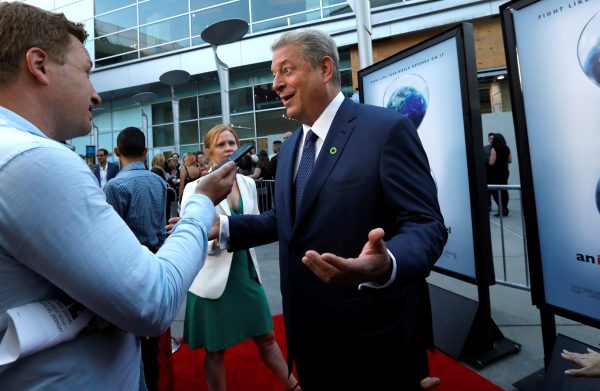
Al Gore stuffed millions into his lockbox while saving the world
By Jon Rappoport | No More Fake News | June 24, 2022
Since climate change has once again risen to the top of the charts, as an issue of “deep concern,” I’m reposting my piece about Al Gore from several years ago:
Freeman Dyson, physicist and mathematician, professor emeritus at Princeton’s Institute for Advanced Study, Fellow of the Royal Society, winner of the Lorentz Medal, the Max Planck Medal, the Fermi Award: “What has happened in the past 10 years is that the discrepancies [in climate change models] between what’s observed and what’s predicted have become much stronger. It’s clear now the models are wrong, but it wasn’t so clear 10 years ago… I’m 100 per cent Democrat myself, and I like Obama. But he took the wrong side on this [climate change] issue, and the Republicans took the right side…” (The Register, October 11, 2015)
Dr. Ivar Giaever, Nobel-prize winner in Physics (1973), reported by Climate Depot, July 8, 2015: “Global warming is a non-problem… I say this to Obama: Excuse me, Mr. President, but you’re wrong. Dead wrong.”
Green Guru James Lovelock, who once predicted imminent destruction of the planet via global warming: “The computer models just weren’t reliable. In fact, I’m not sure the whole thing isn’t crazy, this climate change.” (The Guardian, September 30, 2016)
And these are but a tiny fraction of the statements made by dissident scientists who reject manmade global warming.
The science is only settled in government circles where leaders have climbed on board the Globalist plan to undermine economies all over the world by grossly lowering energy production, as a way to “reduce warming.”
One of the major warming hustlers is, of course, Al Gore.
Consider facts laid out in an uncritical Washington Post story (October 10, 2012, “Al Gore has thrived as a green-tech investor”):
In 2001, Al was worth less than $2 million. By 2012, it was estimated he’d locked up a nice neat $100 million.
How did he do it? Well, he invested in 14 green companies, who inhaled — via loans, grants and tax relief — somewhere in the neighborhood of $2.5 billion from the Federal government to go greener.
Therefore, Gore’s investments paid off, because the Federal government was providing massive cash backup to those companies. It’s nice to have Federal friends in high places.
For example, Gore’s investment firm at one point held 4.2 million shares of an outfit called Iberdrola Renovables, which was building 20 wind farms across the United States.
Iberdrola was blessed with $1.5 billion from the Federal government for the work which, by its own admission, saved its corporate financial bacon. Every little bit helps.
Then there was a company called Johnson Controls. It made batteries, including those for electric cars. Gore’s investment company, Generation Investment Management (GIM), doubled its holdings in Johnson Controls in 2008, when shares cost as little $9 a share. GIM sold when shares cost $21 to $26.
Note: Johnson Controls had been bolstered by $299 million dropped at its doorstep by the administration of President Barack Obama.
On the side, Gore had been giving speeches on the end of life as we know it on planet Earth, for as much as $175,000 a pop. (It wasn’t really on the side. Gore was constantly on the move from conference to conference, spewing jet fumes in his wake.) Those lecture fees can add up.
So Gore, as of 2012, had $100 million.
The man has worked every angle to parlay fear of global-warming catastrophes into a humdinger of a personal fortune. And he didn’t achieve his new status in the free market. The Federal government has been helping out with major, major bucks.
This wasn’t an entrepreneur relying exclusively on his own smarts and hard work. Far from it.
— How many scientists and other PhDs have been just saying no to the theory of manmade global warming?
A letter to The Wall Street Journal signed by 16 scientists just said no. Among the luminaries: William Happer, professor of physics at Princeton University; Richard Lindzen, professor of atmospheric sciences at Massachusetts Institute of Technology; William Kininmonth, former head of climate research at the Australian Bureau of Meteorology.
And then there was the Global Warming Petition Project, or the Oregon Petition, that just said no. According to Petitionproject.org, the petition has the signatures of “31,487 American scientists,” of which 9,029 stated they had Ph.D.s.
Global warming is one of the Rockefeller Globalists’ chief issues. Manipulating it entails convincing populations that a massive intervention is necessary to stave off the imminent collapse of all life on Earth. Therefore, sovereign nations must be eradicated. Political power and decision-making must flow from above, from “those who are wiser.”
Al Gore is one of their front men.
He jets here and he jets there, carrying their messages. He’s their delivery kid.
And for his work, he is paid $100 million — a drop in the bucket.
Globalists want all national governments on the planet to commit to lowering energy production by a significant and destructive percentage in the next 15 years—“to save us from a horrible fate.”
Their real agenda is clear: The only solution to climate change is a global energy-management network. Globalist leaders are in the best position to manage such a system. They’ll mandate FAR LOWER energy-use levels throughout planet Earth, region by region, nation by nation, and eventually, citizen by citizen.
Yes, citizen by citizen.
This is the long-term goal. This is the Globalists’ Holy Grail.
Slavery imposed through energy.
State Department ‘Illegally Obstructing’ Afghanistan Probes, Watchdog Says
By Kyle Anzalone and Will Porter | The Libertarian Institute | June 23, 2022
The US government’s top oversight official for Afghanistan has accused the State Department and the US Agency for International Development (USAID) of stonewalling ongoing investigations, saying they have refused interviews with staff and even failed to provide “basic information” to assist the probes.
In a letter obtained by Politico this week, Special Inspector General for Afghanistan Reconstruction (SIGAR) John Sopko outlined a series of complaints against State and USAID, claiming the agencies are obstructing audits looking into the final months of the war in Afghanistan, the fall of the US-built Afghan government and the transfer of billions in aid.
“The coordinated efforts by State and USAID officials to deny SIGAR access to information and assistance are unprecedented,” Sopko wrote in the letter, which was addressed to Secretary of State Antony Blinken and USAID chief Samantha Power.
He demanded the two officials “cease their illegal obstruction of SIGAR’s oversight work,” insisting that “The billions of US taxpayer dollars that have been spent and continue to be spent in support of the Afghan government and the Afghan people warrant independent oversight, and the law requires it.”
Though Sopko said the two agencies have “historically… supported SIGAR’s mission” and worked with his office willingly, “inexplicably, this long track record of cooperation seems to have abruptly ended. Agency officials now appear to have adopted a premeditated position of obstruction.”
The IG described several examples of obstruction, including the State Department’s refusal to make staffers available for interviews to discuss Afghan refugees and the conditions they endured after fleeing their home country. Most concerning for Sopko, however, was the agencies’ reluctance to provide even “basic information” on American aid programs meant to support Afghans, as SIGAR is conducting an audit to ensure tax dollars aren’t flowing to the Taliban – which now rules Afghanistan – or other militant groups.
The two agencies have pushed back on Sopko’s allegations, arguing that they have cooperated with SIGAR’s probes, though suggested the IG has acted outside the jurisdiction of his office in some cases.
“State and USAID are committed to assisting SIGAR with its important auditing and oversight role,” a department spokesperson said in a separate letter obtained by Politico, adding “We have had concerns about how some of SIGAR’s requests for information relate to their statutory jurisdiction.”
However, while the officials claimed humanitarian aid programs “do not pertain to reconstruction” and therefore fall beyond the scope of SIGAR’s mandate, Sopko said his office has audited such programs for more than a decade without any objections from the government.
“State and USAID legal counsels’ claim that SIGAR’s jurisdiction does not include such matters is not only contrary to the law, but a gross deviation from over 14 years of precedent set by three prior administrations,” the IG wrote.
Met Police Invokes “National Security” about Epstein Meeting with US Senators in the UK

BY WHITNEY WEBB |
UNLIMITED HANGOUT| JUNE 13, 2022
A Freedom of Information request filed by UH in connection with Whitney Webb’s upcoming book was blocked by UK Metropolitan police on “national security” grounds. The request sought information on the two sitting US Senators who met with Jeffrey Epstein at a Wexner-owned residence in the UK, a meeting where Met Police officers had provided security.
In connection with Whitney Webb’s upcoming book on the Jeffrey Epstein scandal, One Nation Under Blackmail, Unlimited Hangout filed a Freedom of Information request asking UK law enforcement and the Ministry of Defence the identity of two sitting US senators who were present at Foxcote House in North Warwickshire, UK on September 1, 2002. UH contributor Johnny Vedmore had previously obtained information from eyewitnesses of that meeting that, not only were two US Senators present at that location that day, but that Metropolitan Police officers had supplied security for the meeting. The FOI request was filed to Metropolitan Police, the UK Ministry of Defence and North Warwickshire Police and only a response from the Metropolitan Police was received.
The motive for UH’s FOI request is as follows. It is known that Jeffrey Epstein, as attested to by Epstein’s flight logs, was present in this part of the UK during this same period (from August 31, 2002 to September 2, 2002) and eyewitnesses saw him attend this specific meeting at this location with two attractive and glamorously dressed women on each arm. One of these women was Nicole Junkermann, a former model and apparent intelligence asset as revealed in Vedmore’s previous investigative work. The other woman was described by eyewitnesses as a tall brunette. Per those eyewitness accounts, Epstein personally escorted the two women into the room where the two senators were waiting.
Notably the house where this meeting took place, Foxcote House, has been owned by the family of Leslie Wexner, specifically his wife Abigail Wexner, since 1999. Wexner’s role in financing much of Jeffrey Epstein’s activities, legal and illegal, is a major focus of Webb’s upcoming book and Wexner has encountered considerable difficulty in explaining away his relationship with Epstein, despite the largely servile posture of mainstream media in this regard.
Given the circumstances, it seems highly likely that this meeting was a high-profile instance of Jeffrey Epstein engaging in the sexual blackmail of sitting American politicians. However, due to the well-known scandal around Jeffrey Epstein, his name was not used in our FOI request in order to avoid potentially “spiking” the response.
Despite the omission of Epstein’s name, Metropolitan Police responded to the request stating that they can “neither confirm nor deny whether it holds” the requested information. Their response goes on to state that confirming or denying “whether any United States of America (USA) senators were afforded protection could undermine the safeguarding of national security.” It also notes that it blocked providing the requested information on four other grounds aside from “national security” (five in total), including “international relations”, “law enforcement”, “health and safety”, and “personal information.” It also states that providing the requested information could place “those who are afforded protection, protection officers and members of the public at risk.”

Screenshot of the response from Met Police
UH has since re-filed a new, related FOI request asking why Metropolitan Police officers were providing protection to a meeting where Jeffrey Epstein was present, since his criminal activities are undeniable.
Google tells Congress the proposed antitrust bill would hinder its censorship efforts
By Didi Rankovic | Reclaim The Net | June 9, 2022
Google continues to lobby and campaign against legislative efforts aimed at curbing its monopolistic power, this time openly, in a blog post.
Google claims that antitrust legislation – whose goal is to loosen the stranglehold it has on the market and competitors – would prevent it from censoring “disinformation.”
In the past months, the tech giant has used other avenues as well, from (🛡 fake) grassroots support that it purports to have, to spending millions on professional lobbyists in Washington DC.
In all this, Google has gone for all sorts of “targeted” arguments in an effort to make sure the bipartisan bills never become law. Lawmakers and voters had the chance to hear that if Google is not allowed to run its business unimpeded, exactly as it’s doing now, anything from innovation to national security would suffer.
And now, no doubt addressing that part of its audience that is particularly concerned with the specter of arbitrarily, if at all, defined “disinformation” as internet’s “greatest ill” – this time in the context of geopolitics – Google claims that the bills under consideration in Congress, would, if passed, prevent it from censoring disinformation.
VP of Google’s Privacy, Safety and Security Royal Hansen, claims that the legislation is a risk for US security, for that of its users, while it doesn’t address problems that “Americans care the most about.”
Despite the context of the writeup, Hansen for some reason mentions “privacy, child safety, and inflation.” This Google exec packs a lot of FUD into just a few sentences, to also warn users that some of their favorite products like Search and Maps will get broken – if Google is made to abide by possible future antitrust laws.
Among many other usual talking points that supposedly outweigh the need to regulate Big Tech’s business models Hansen talks about the danger of “rolling back” Google’s “war on disinformation” – that is, the unprecedented levels of censorship visible particularly on YouTube.
These last years, the topics were mostly Covid and US elections, but those are getting a little old; and so Hansen brings the war in Ukraine into the mix – as another reason why the digital market should not be a fair and level playing field for startups and other competitors.
“By prohibiting us from ‘discriminating’ against competitors, the bill would prevent us from taking action against purveyors of malicious content,” writes the Google exec. “Since Russia invaded Ukraine, we have been able to move quickly to limit Russian propaganda and disinformation, even as that content has migrated to new channels. The proposed legislation could undermine this work.”
Fauci’s COVID origins coverup spook has resurfaced to misdirect us about the origin of money pox
By Meryl Nass, MD | June 7, 2022
Andrew Rambaut (pronounced Rambo—and like Rambo, he is still in the ring, fighting for the globalists, when he should have taken his toys and slunk away long ago—after being beaten up as one of the stooges who produced the fake Nature Medicine paper on COVID’s origins) has long been associated with a group of virology spooks in Tony Fauci and Jeremy Farrar’s network. The field of evolutionary biology is supposed to tell you where new viruses have come from. But of course, it has been kidnapped to provide specious explanations when the biowarriors need to try and explain their concoctions as having natural origins.
Rambaut was also used to dispute the origins of HIV (as described in my friend Ed Hooper’s book The River ) while teamed up with Eddie Holmes, another Fauci flunkie, more than 20 years ago.
Republican members of Congress want to know what Fauci and his henchmen were up to when they concocted a fake natural origin for COVID, as revealed in the Fauci emails.
Rambaut was one of the 5 authors of that paper, and the paper was highly effective for a bit over one year at keeping a lid on COVID’s lab origin. As the members of Congress wrote:
Andersen and three other doctors on this teleconference [including Rambaut] later published a paper titled “the proximal origin of SARS-CoV-2 in Nature Medicine on March 17, 2020. This paper was highly influential in shaping our nation’s response to the pandemic. In the paper, the doctors concluded that “…we do not believe that any type of laboratory-based scenario is plausible.”[11]
… The Andersen paper led the narrative away from COVID-19’s potential lab origins. As Americans, we are deeply concerned by the appearance of discrepancies that largely influenced our understanding and approach to this virus. As Representatives of the American people, we owe it to them to seek and expose the truth about this virus’ origins wherever those efforts may lead.
Now Rambaut has popped up again, like a jack-in-the-box, to explain how the unexplainable 50 single nucleotide polymorphisms (SNP mutations) could have happened naturally. He has another bold theory! There was an evolutionary jump!
And Rambaut proffered yet another theory: the virus has been spreading in humans for years; we just didn’t notice it.
Below is a paper published by Portuguese researchers discusing the newly discovered mutations in money pox. They mention Rambaut’s theory, and Rambaut himself provides the first comment below the paper.
Spooks like Dr. Rambaut don’t do this dirty work for nothing. Just last month, he was made a fellow of the Royal Society.
From Wikipedia:
Science reported on 11 January 2020 that Rambaut was the first to publish the genome of the COVID-19 coronavirus after it was sent to him by Edward C. Holmes.[11][12] Holmes has said that it “took 52 minutes from receiving the code [from his Chinese colleague Professor Yong-Zhen Zhang] to publishing” on Virological.[13][14] The BBC Horizon episode The Vaccine stated: “When Chinese scientists published the genetic sequence of a mystery new virus on January 10th 2020, vaccine scientists around the world immediately sprang into action”.[15]
Rambaut was one of the authors of the scientific paper The proximal origin of SARS-CoV-2,[16] which concluded that “SARS-CoV-2 is not a laboratory construct or a purposefully manipulated virus”.
Rambaut is an attendee of the UK’s Scientific Advisory Group for Emergencies (SAGE).[17]
Perhaps someone else can look up his recent research grants. Were they from NIH or Wellcome? Being rewarded royally with other peoples’ money is another characteristic of the virology spook group.
On the Darknet: Ukrainians flood Europe with NATO arms shipments
Free West Media | June 6, 2022
Since the beginning of the war in Ukraine, the US and other NATO countries have been sending state-of-the-art heavy weapons to Kiev. But many of the weapons systems do not end up at the front – but on the internet.
The Darknet is becoming an online wholesaler for war materiel. And the customers are also based in Europe.
Anti-tank missiles, automatic weapons, ammunition, drones or even mines – the warehouses of Darknet dealers are full. Thousands of weapons systems sent by Western allies to Ukraine can be found for sale on the internet.
Europe soon threatened by rocket launchers?
“It is surprising to say the least that after the fall of Mariupol, the United States was willing to send an additional 40 billion dollars to Ukraine where it had already lost another 14 billion dollars. In reality, two-thirds never reached their destination,” Thierry de Meyssan pointed out.
The FGM-148 Javelin is a man-portable anti-tank guided missile (ATGM). The US developed this weapon system to be able to combat heavily armoured vehicles such as main battle tanks and lighter military vehicles. It is hard to imagine what terrorists with weapons like these could do in a European city centre. Austrian daily eXXpress reported on this serious threat.
How many of these systems are already in Europe – presumably in the hands of criminals or terrorists? Police could eventually face massive problems with armed terrorists. It is easy to see how this could become a major security risk for large cities in Europe.
Darknet sales
It has never been easier to get hold of various NATO shipments – directly from Ukraine – to anywhere in the world to anyone with money. The assortment from Kiev includes rifles, grenades, pistols, body armour. Just one of the listed sellers already had 32 successful transactions to his name.
Already during the Balkan War, authorities witnessed how thousands of handguns had simply disappeared – and were then sold on the black market to criminal organisations or even to terrorists.
High-tech armament and an assortment of automatic weapons can now be ordered from the comfort of a screen. Grenades, incidentally, have been on special offer. If criminals moreover get hold of bullet-proof vests it would make it difficult for the police to stop them in the future.
Executive Director of Europol Catherine De Bolle stated in an interview with Welt am Sonntag recently that her agency was bracing for an influx of illegal weapons into Europe originally shipped to Ukraine by Western countries, including Greece, Sweden, Spain and Germany. She noted that the “weapons from [Kosovo] are still being used by criminal groups today”.
Jihadists and other radicals are already in the war zone, according to the database of the SIS (Schengen Information System).
Weapons outlive conflicts
“It would be prudent to consider the immediate and long-term security implications of arms transfer decisions and apply lessons hard-learned from past armed conflicts,” the US-based think-tank Stimson Center said about this development back in March.
“The United States and its partners may be doing a disservice to the very people they aim to protect without considering the potential risks of the infusion of weapons to the country. While there have been noteworthy pledges of additional military assistance, the lifecycle of an arms transfer is often quite long. Arms promised today may not be available for months or even years to come, at which point the situation on the ground will have evolved. Though these pledges have symbolic value they may have little real effect on the battlefield.”
The think tank furthermore warned: “From Afghanistan to Iraq to Colombia, well-intentioned transfers have a habit of outliving their political contexts, and risk fueling new conflicts, being captured by illicit groups, or contributing to enduring ecosystems of insecurity.”
The authors warned that the strategic risks of transferring arms to an area of active hostilities include exacerbating the conflict, extending the duration thereof, increasing its lethality, and contributing to civilian harm. “Moreover, arms have a long shelf life, and will still be around long after the guns inevitably fall silent,” they concluded.
Grading the uses of the Defense Production Act during COVID Mania
By Jordan Schachtel | June 6, 2022
With President Biden beginning this week by invoking the Defense Production Act (this time, to build solar panels) we figured it’s time to take a look at what happened to the DPA during COVID Mania, and explore how it has been used (abused) since March of 2020.
For starters:
The Defense Production Act is a federal law that was enacted in 1950 after the commencement of the Korean War.
The explanation of the bill, via Congress, goes as follows:
“To establish a system of priorities and allocations for materials and facilities, authorize the requisitioning thereof, provide financial assistance for expansion of productive capacity and supply, provide for price and wage stabilization, provide for the settlement of labor disputes, strengthen controls over credit, and by these measures facilitate the production of goods and services necessary for the national security, and for other purposes.”
In short, these are emergency powers granted to the executive with a precedent for being enacted during an actual war. These powers allow the president to compel private companies to work with the government on developing material goods that are supposed to be used for national security purposes.
During COVID Mania, the DPA has been routinely abused for our manufactured national emergency.
Let’s take a look at how the DPA has been utilized to “fight the virus.”
- March 27, 2020: President Trump defines ventilators and PPE as “essential to the national defense,” and orders GM to start producing ventilators. The move came with bipartisan insistence. We later discovered that ventilators were possibly killing COVID patients.
Grade: F - April 2, 2020: President Trump invokes the DPA to compel several American companies to produce N95 masks. Masks don’t work, though.
Grade: Hysteria Sells - April 28, 2020: President Trump issues an executive order via the DPA to combat food insecurity and “to ensure a continued supply of protein to Americans.”
Grade: Shrug Emoji - January 21, 2021: President Biden invokes the DPA to pursue a “sustainable public health supply chain.”
Grade: Total Scam - March 2, 2021: Biden uses the DPA to give money to Merck so that they can produce more Johnson & Johnson COVID injections
Grade: Facepalm Emoji - September 2021: Biden invokes the DPA to supply fire hose materials to California, citing the climate hoax, because Gavin Newsom’s regime did not effectively manage California’s forests.
Grade: Avoidable Crisis - May 18, 2022: Biden uses the DPA to import baby formula from overseas because American supply became catastrophically short.
Grade: Cringeworthy - June 6, 2022: Biden issues DPA to advance the climate hoax narrative and give government funds to solar panel companies that otherwise would go bankrupt due to the unproductive nature of their businesses.
Grade: Boondoggle
Iraqi Kurdistan rejects federal ruling over oil delivery to Baghdad amid dealings with Israel
Press TV – June 5, 2022
The judicial council of Iraq’s Kurdistan has vehemently opposed a ruling from the Iraqi federal court to hand over the region’s crude supplies to the central government in Baghdad amid secret dealings with Israel.
In February, Iraq’s federal court deemed an oil and gas law regulating the oil industry in Iraqi Kurdistan unconstitutional and demanded that Kurdish authorities hand over their crude supplies.
Kurdistan’s judicial council said in a statement on Saturday that the region’s oil law would remain in force and will not change.
“The actions of the Kurdistan Regional Government (KRG) in relation to oil and gas operations are in accordance with the Iraqi constitution of 2005. The provisions of the oil and gas law issued by the parliament of the Kurdistan region in 2007 do not violate those of the Iraqi Constitution,” the statement said.
The statement said Article 112 of the Iraqi constitution, announced in August 2005, granted the Iraqi government supervision over Kurdistan’s oil and gas fields operating at that time, but the fields that started commercial production after that date did not apply to this article.
The judicial council of Iraq’s Kurdistan also claimed that the entire oil and gas fields currently operating in the region had started commercial production after August 2005.
The KRG, which has been developing oil and gas resources independently of the federal government, enacted in 2007 its own law establishing the directives by which the region would administer those resources.
The ruling from Iraq’s federal court in February also stated that the country’s oil ministry must be allowed to audit all agreements concluded by the KRG with international oil and gas companies.
Kurdish leader Masoud Barzani criticized the ruling at the time as a “purely political” decision aimed to antagonize the KRG.
The Iraqi government and the KRG have been in a long-standing dispute over Baghdad’s share of Kurdish petrol, with the Iraqi government demanding full control of the region’s crude for years.
Under a deal between the two sides, the Kurdish region delivers 250,000 of its more than 400,000 barrels of daily oil output to Baghdad, in return for its share of the federal budget.
Over the past years, multiple reports have revealed that Iraqi Kurdistan is secretly selling oil to Israel at heavily discounted prices and that more than two-thirds of the occupying regime’s oil has been imported from the Kurdistan Regional Government.
London-based Al-Araby Al-Jadeed newspaper said in a report in March 2019 that Israel was buying significant amounts of Iraqi oil from certain parties and “mafias” in the Kurdistan region for prices as low as $16 or $17 dollars.
British daily the Financial Times had earlier reported that Israel had obtained 75 percent of its oil supplies from Iraqi Kurdistan.
Kurdistan’s secret dealings with Israel, which also include the region’s reported cooperation with the Israeli spy agency Mossad, come as Iraq’s parliament has recently passed a law making it illegal for the country to ever normalize its relations with the Tel Aviv regime.
The passage of the law cemented the Arab country’s invariable and age-old policy of refusing to recognize the occupying regime.
Moreover, forces from the regional Kurdish government are involved in the seizure of oil wells in northern Iraq, with state-run North Oil Company reporting in May that Peshmerga forces had occupied some oil fields in Kirkuk region.
Kirkuk’s oilfields had been under Kurdish control since 2014, when the Iraqi army collapsed in the face of Daesh. Iraqi forces took back control of the fields in 2017 following a referendum on Kurdish secession.
Fauci Goes to Princeton

BY MARK OSHINSKIE | BROWNSTONE INSTITUTE | JUNE 3, 2022
Last month, I went to Princeton to protest the University’s “Class Day” speaker, Tony Fauci. It astounded me that students would invite someone who stole over two years of their college experiences and young lives. By selecting Fauci, Princeton students showed that they’re celebrity worshipers, not critical thinkers.
The students certainly didn’t vet Fauci by reading RFK Jr.’s The Real Anthony Fauci, which reveals how corrupt, hostile and destructive this Napoleonic tyrant is. The Princeton grads I know are all Groupthinkers. Most tend not to speak well in English, much less in a second language. Like Fauci, they’re very overrated.
I was among a dozen protesters who displayed signs as we stood on the Nassau Street sidewalk just outside the campus gates. My sign had two sides, One side said, “Vaxxes Did Not Stop the Spread.” The other side said, “Hopkins Study (February, 2022): Fauci Lied.”
Fauci recently claimed that lockdowns, masks, tests and “vaccines” had saved many lives. The Hopkins study shredded this notion and observed that Faucist “mitigation” strategies have caused tremendous, lasting harm.
Many drivers who passed us honked approvingly. Numerous strangers approached and expressed agreement with us or passed by with thumbs up. Some said they bought the fear for a month until they began to change their minds. I’ve heard that often, and never understood it. The powergrab was obvious from Day 1. Why lock down healthy people for the first time in human history when only a tiny fraction of some very old, very sick people had—at least purportedly—died from this infection?
Lockdowners never presented evidence that would have sustained a reasonable burden of proof. Allowing Coronamania to begin, unchallenged, was a massive error. Once this started, it became entrenched.
While many Americans complain, only a tiny percentage will actively protest. I’ve been to half a dozen Corona rallies over the past two years. Most were lightly attended. It’s pathetic that so many Americans have passively tolerated this nonsense.
I asked those who heard the speech and mocked Fauci when we met by the campus entrance if they had booed him. They said they didn’t. When I asked why, they said they didn’t want to upset other people; as if, after having seen the world opportunistically, permanently damaged by 27 months of Faucism, booing would have been indelicate. People accepted profound mistreatment in order to avoid conflict.
After all this time, some fools still buy Coronamania. Some ceremony-goers walked past, wearing masks. A few cast disapproving glances that they mistakenly thought would bother us protesters. Some passersby also muttered unintelligibly. A fellow protester noted, “They always say shit as they’re walking away.”
We protesters were kept too far from the speech to hear it. So I read the text on-line. First, though others have lambasted Fauci’s AIDs work, Fauci portrayed himself as a heroic public servant during that era. Second, he asserted that systemic racism caused Covid to kill more minorities. Finally, he warned that Covid showed us to avoid purveyors of “misinformation.”
Fauci delivered a self-revealing meta-message to college grads: when your work product sucks, gaslight and resort to name-calling and PC demagoguery. His stated concern about misinformation is painfully ironic, as it comes from someone who has lied his way through the past two years and, according to peers, many years prior.
Playing the race card, Fauci pointed out that minorities unfairly had to work during the pandemic because many were “essential workers.” But didn’t Fauci recommend that essential workers should continue working? Do the stats back his facile claim that too many minorities were essential workers; weren’t there tens of millions of White essential workers? And how many healthy, working-age people—of any race or ethnicity—died of Coronavirus? Facts don’t constrain Fauci. He’s the consummate tropester. And he was playing to a trope-hungry crowd.
Further, while I know the vaxxes are ineffective at best, Fauci still inaccurately maintains that the vaxxes work great. He often lied that those who didn’t vaxx had created “a Pandemic of the Unvaccinated.” Yet, during his speech he declined to mention the lower vaxx rates among minorities, despite that the shots were aggressively promoted, and free. A disproportionate number of minorities, cf., majority populations, defied Fauci’s exhortation and astutely knew not to go along.
The Eighteenth Century British writer, Samuel Johnson, and Bob Dylan both said that “Patriotism is the last refuge of a scoundrel.” The same is true of Fauci’s showy anti-racism. To obscure his venal misconduct and terrible record, Fauci touts himself as a champion of minorities. But how many urban/rural minorities does Fauci know? Do you think his kids went to school with Hispanic or Black kids? Doesn’t he think he’s better, and deserves to be paid far more, than minority essential workers?
Fauci also neglected to mention a May 5, 2022 Harvard study that predictably concluded that the Covid school closures he endorsed had disparately harmed minority students.
Hearing the biggest liar since Pinocchio call others “misinformers” is gruesome. Aside from his demonstrably false statements about the vaxxes’ purported effectiveness and safety, and the lockdown and school closure effects, Fauci also said masks worked, although all serious evidence shows they don’t.
Fauci also stated that he didn’t fund gain-of-function research, though he did. He repeatedly relied on high cycle PCR tests to measure “cases,” when even the test’s inventor, Kary Mullis, and the NY Times said that they shouldn’t be. Additionally, Fauci wrongly predicted that motorcycle rallies and college football games would be super-spreader events. All of these assertions—and many more—were obvious misinformation.
A decent attorney or interviewer would easily expose Fauci’s pervasive dishonesty. But he’s hidden himself from those who know what a fraud he is, and the bought media has never asked him any serious questions. He’s repeatedly lied for 27 months while making a series of absurd recommendations that some people, like Princeton grads, still somehow take seriously. A Class Day website photo shows the fully-jabbed graduating sheep giddily bumping elbows with their diminutive Dear Leader.
A brush with someone famous! I must post this on Instagram! Dopamine rush! I am… somebody!
Twenty-seven months into this, a mandated truth-serum injection might have prompted Fauci to make the following remarks, instead of those he actually made:
Esteemed, albeit naive, Class of 2022, et al.:
I know that your college experience sucked. You sat in front of screens most of the time and you could’ve done that at home. Two years that should have been special are gone forever. But eff you all. Your entire generation is expendable. I wanted to oust Trump. He deserved it because he was too stupid to know I was spouting nonsense and he let me run the show.
Two weeks to flatten the curve; wear double masks; take tests that yield up to 90% false positives; avoid funerals and cancel weddings because you might spread “droplets;” ignore natural immunity and take your mandated jabs, even if they’ve not only failed but are injuring and even killing people; and boost up multiple times—I’ll tell you how many. Becauss (I pronounce that word oddly) I’m the Soy-ence! (That word, too).
You believed all that, and much more, without asking any questions. Because that’s what excellent college students, such as those at Princeton, do. It’s more important to have people like you than it is to seek the truth. How do you express that aphorism in Latin? (This is an allusion to a pretentious/whimsical Princeton tradition).
I’ve loved this two-year power trip. I always wanted to be on TV and I got to do that often with fawning, mindless, bought interviewers. I even got to throw a ceremonial first pitch at a baseball game. I’ll bet you didn’t know I consider myself a good athlete.
I’ve become a multi-millionaire working for the government despite doing an awful job. Although I’m elfin, evil and dishonest, people bow down to me because I dish out the grant money that’s the lifeblood of academic sycophants. Whatever you end up doing, try to make and control a lot of cash, congratulate yourself and speak in PC cliches. If you do, you can con people into calling you “successful” and even an “expert” and a “public servant.” Class of 2022, you’re ideally suited to become tools who just might worsen the deep, vast damage I’ve done. But I doubt you can top me.
So long, suckers. As Otter said at the end of that college movie classic, Animal House, “You effed up. You trusted us.”
Remember when they said you were just as likely to get Myocarditis from Covid?
It wasn’t true
The Naked Emperor’s Newsletter | June 2, 2022
“In the current large population study of subjects, who were not vaccinated against SARS-CoV-2, we observed no increase in the incidence of myocarditis or pericarditis from day 10 after positive SARS-CoV-2.”
Remember when you were told to get vaccinated but you had concerns about myocarditis? Remember when the scientists, doctors and people we are meant to trust said not to worry because you were more likely to get myocarditis from Covid? Well, it wasn’t true.
A study published last month in the Journal of Clinical Medicine on MDPI took a look at the incidence of myocarditis and pericarditis in post COVID-19 unvaccinated patients. It was undertaken by the University of Jerusalem and Tel Aviv University and looked at 213,624 adult patients who had a documented positive COVID-19 test.
16,632 patients with a first vaccination received before COVID-19 infection were excluded, leaving 196,992 patients versus 590,976 in the control group, to study. The control group consisted of patients with one or more negative COVID-19 tests and no vaccination.
When the authors looked at the results of their study, they concluded that there was “no statistical difference in the incidence rate of both myocarditis and pericarditis… between the COVID-19 cohort and the control cohort” I.e. COVID-19 did not increase the risk of myocarditis and pericarditis when compared with those who did not get Covid.
These results tie in with a previous study in Nature, which I wrote about in April. This found a greater than 25% Increase in Cardiovascular events in under 40s during Vaccine rollout but NOT during Covid waves.
Numerous other studies have found that the vaccines increase the chances of myocarditis and pericarditis and this is openly acknowledged on government websites and vaccine reference material.
However, up until now, one of the excuses for continuing to give these vaccines was that you were more likely to get myocarditis or pericarditis with a Covid infection. This study shows this to be false.
Once again, a conspiracy theory has come true again.
Featured Video

The Truth About the Trump Shootings with Ken Silva
or go to
Aletho News Archives – Video-Images
From the Archives
Trans ‘milk’ as good as the real thing – NHS
RT | February 18, 2024
The drug-induced nipple secretions of trans women are as good as mothers’ breast milk for babies, the University of Sussex Hospitals NHS Trust claimed in a letter to campaigners made public in a report by British think tank the Policy Exchange on Sunday.
The healthcare trust’s medical director, Rachel James, argued that the off-label prescription drug cocktail men transitioning to female take in order to produce milk was “similar to the natural hormones which encourage lactation to develop when the baby is newly born.”
“The evidence which is available demonstrates that the milk is comparable to that produced following the birth of a baby,” James wrote in the letter, sent to Children of Transitioners last August.
Biological men who wish to lactate must first take hormones to grow milk glands and then take high doses of either domperidone or metoclopramide to stimulate milk production. Neither drug is approved for this use, though they are occasionally prescribed off-label to biological women who have trouble lactating.
However, domperidone’s own manufacturer, Janssen, warns patients the drug “may cause unwanted side effects affecting the heart in a breastfed baby” and “should be used during breastfeeding only if your physician considers this clearly necessary.” … continue
Blog Roll
 Aletho News
- Seyed M. Marandi: U.S. Strike Imminent – Toward Total War in the Middle East
- Russia Voted Under Fire. Washington Is Loading the Tankers.
- 12 Things Your Oncologist Was Trained Not to Tell You
- Anthrax Attacks Paved Way for COVID-Era ‘Junk Drugs and Vaccines’
- How Real Is the Impact of Western Sanctions on Israel?
- France, You Are Guilty: How Paris Turned Western Sahara into the Maghreb’s Powder Keg
- 2025 Nature Paper Claiming Worsening Global Drought Gets RETRACTED …Heavily Flawed
- Your Milk Is Not the Problem
- The Truth About the Trump Shootings with Ken Silva
- ARE PATIENTS BEING PROPERLY INFORMED ABOUT OZEMPIC?
- If Americans Knew
- Salah Sarsour’s Legal Team Says DHS Has Not Met Its Burden to Prove He Is Deportable
- An analysis of tax forms by The Intercept show Kraft’s charity and LLC have donated to Friends of the IDF and AIPAC’s super PAC.
- Israeli attacks kill four Palestinians in Gaza – Daily Update
- Inside Gaza’s death trap of collapsing, bombed-out buildings
- The everyday items Israel bans from Gaza every day
- Inside the siege, the ruined buildings of Gaza – Daily Update
- Debunking The Claim That Macklemore Has A “History Of Antisemitism”
- CPJ demands release of arrested Palestinian-US journalist near Bethlehem
- Robert Kraft: The Billionaire Friend of Netanyahu Pulling The Strings Behind the Macklemore/Ed Sheeran Blow Up
- Columbia Administered Fund Gives Big Money to Pro-Israel Groups
- No Tricks Zone
- 2025 Nature Paper Claiming Worsening Global Drought Gets RETRACTED …Heavily Flawed
- New Study: ‘Global Drought Shows No Detectable Recent Acceleration Under Climate Warming’
- Economic Masterminds: German Socialists Suggest Taxing Productivity Gains Stemming From Using AI
- The South China Sea Has Not Been Cooperating With The Climate Change Narrative
- Energy Crisis: Germany Enters Heating Season With Historically Low Gas Reserve Fill Levels
- New Study: The Antarctic Ice Sheet Gained Mass From 2020-2024 Due To Staggering Snow And Ice Accumulation
- Study: Ocean Heating Rates From Thousands Of Years Ago ‘Dwarf’ Modern Ocean Heating Rates
- Climate Extremists Target, Attack Large-Scale Power Grid Infrastructure In Germany!
- New Study: Antarctic Ice Melt Has Contributed Less Than 1 Centimeter To Sea Level Rise In The Last 30 Years
- Fear Of Debate: Alarmist German Climate Scientist Calls On Mainstream Media To Discredit Skeptic Voices
 Aletho News