Russia claims Ukraine destroying evidence of US-funded bioweapons program

Bacteriological laboratory at the Lvov Regional Laboratory Centre in Lvov, Ukraine, November 9, 2020 © Getty Images / Markiian Lyseiko
RT | March 6, 2022
As Russian troops entered Ukraine, the government in Kiev ordered the“emergency destruction” of pathogens including plague and anthrax at US-funded laboratories near the Russian border, the Ministry of Defense in Moscow claimed on Sunday. Earlier rumors that the Russian military was targeting US-run biolabs were written off as conspiracy theories, but the ministry has promised to back up its claims with documents.
“We have received documentation from employees of Ukrainian biolaboratories on the emergency destruction on February 24 of especially dangerous pathogens of plague, anthrax, tularemia, cholera and other deadly diseases,” read a statement from the ministry.
The statement accused the “Kiev regime” of conducting an “emergency cleansing” to hide evidence of the supposed biological weapons program, which the ministry claimed was funded by the US, and involved the production of “biological weapons components” at at least two laboratories in the cities of Poltava and Kharkov, both of which have seen intense fighting between Russian and Ukrainian forces in recent days.
The documents published by the ministry purportedly include an order from the Ukrainian Ministry of Health to destroy the pathogens, and lists of the germs in question.
RT can not independently verify the authenticity of these documents. Russia’s Defense Ministry said that they are currently being analyzed by radiation, chemical and biological protection specialists.
“In the near future we will present the results of the analysis,” the ministry said, adding that it believes the documents will prove that Ukraine and the US were violating Article 1 of the UN Biological Weapons Convention. The US, Ukraine and Russia are among more than 180 parties to this treaty, and under Article 1 of the agreement, all parties agree “never under any circumstances to develop, produce, stockpile, acquire, or retain” biological weapons.
As of the moment of this article’s publication, Washington has not commented on the ministry’s claims, and neither has Kiev.
In the initial days of Russia’s military offensive last month, claims circulated online that Russia was targeting western-funded biolabs with missile strikes. These allegations were never verified and were derided by western sources as conspiracy theories, although the Pentagon has publicly stated that it works with the Ukrainian government to “consolidate and secure pathogens and toxins of security concern in Ukrainian government facilities,” for “peaceful research and vaccine development,” according to the US embassy in Kiev.
Report of Toddler’s Death Disappears from VAERS and CDC Has No Records as to Why!
Informed Consent Action Network | March 4, 2022
On December 16, 2021, ICAN, through its attorneys, issued a Freedom of Information Act request to the CDC seeking any documents reflecting why a certain VAERS report was no longer available in the VAERS database. The report described an extremely disturbing incident wherein a two-year-old boy “began bleeding out of the mouth, eyes, nose and ears within six hours” of his first dose of Pfizer’s COVID-19 vaccine on November 18, 2021, and died later that night. On February 14, 2022, the CDC finally responded to ICAN’s request, stating: “A search of our records failed to reveal any documents pertaining to your request.”
Significantly, the CDC has made repeated assurances that “COVID-19 vaccines are being administered under the most intensive vaccine safety monitoring effort in the United States’ history.” The CDC’s VAERS Standard Operating Procedures for COVID-19 even states that the “CDC will perform clinical reviews” for certain “Adverse Events of Special Interest,” which include death, “especially in children (<18 years of age) and recipients of newly licensed vaccines).”
But despite all of these claims of about the unprecedented level of “intensive” safety monitoring of these vaccines, the CDC claims to have no records that would explain why a VAERS report describing the horrific death of a toddler suddenly disappeared from the primary government-funded system for reporting adverse vaccines reactions in the United States, VAERS—a system of which the CDC is a co-sponsor.
ICAN intends to get to the bottom of the disappearance of this deeply disturbing report and will persist in holding the CDC accountable for its purported claims of intensive vaccine safety monitoring.
Biden Claims Gun Makers Only Industry That Can’t Be Sued, Fails to Mention Blanket Liability for COVID Vaccine Makers
By Megan Redshaw | The Defender | March 4, 2022
President Biden during Tuesday’s State of the Union address falsely claimed the billion-dollar gun manufacturing industry is the only industry in the U.S. that can’t be sued — when in fact, vaccine makers in the U.S. have total liability protection for injuries or deaths caused by COVID vaccines.
“Repeal the liability shield that makes gun manufacturers the only industry in America that can’t be sued,” Biden said. “These laws don’t infringe on the Second Amendment. They save lives.”
CNN fact-checked Biden’s claim and said it was “false.”
“Gun manufacturers are not entirely exempt from being sued, nor are they the only industry with some liability protections,” CNN said. “Under the 2005 Protection of Lawful Commerce in Arms Act, gun manufacturers cannot be held liable for the use of their products in a crime.”
But gun makers can be held liable for “negligence, breach of contract regarding the purchase of a gun or certain damages from defects in the design of a gun.”
According to CNN:
“Other industries also have some exemptions in liability. For example, vaccine manufacturers cannot be held liable in a civil suit for damages from a vaccine-related injury or death. And for the next four years, pharmaceutical companies developing the Covid-19 vaccines will have immunity from liability under the 2005 Public Readiness and Emergency Preparedness Act.
“Those who claim to have been harmed by vaccines may receive money from the government, not the pharmaceutical company, via the Vaccine Injury Compensation Program.”
Although CNN was correct that vaccine manufacturers cannot be held liable for harm caused by vaccines, those injured by COVID vaccines cannot seek compensation under the National Vaccine Injury Compensation Program (NVICP).
Instead, claims must be submitted through an obscure government program called the “Countermeasures Injury Compensation Program (CICP).” The CICP, which almost never awards money, is the only program that accepts claims related to COVID vaccines and other COVID countermeasures.
There are important differences between the two programs that make it more difficult to get compensation through CICP, which is run by the U.S. Department of Health and Human Services (HHS).
Vaccine makers are exempt from liability, the injured have no recourse
The NVICP, a special, no-fault tribunal housed within the U.S. Court of Federal Claims, handles injury claims for 16 common vaccines. To date, it has awarded more than $4 billion to thousands of people for vaccine injuries.
It is difficult to obtain compensation within the NVICP. Payouts, including attorneys’ fees, are funded by a 75-cent tax per vaccine. There is a $250,000 cap on pain and suffering. The proceedings are often turned into drawn-out, contentious expert battles and the backlog of cases is substantial.
The National Childhood Vaccine Injury Act of 1986 established the NVICP, and U.S. Supreme Court Decision, Russell Bruesewitz et al v. Wyeth et al, guaranteed vaccine manufacturers, doctors and other vaccine administrators almost always have no legal accountability or financial liability in civil court when a government-recommended or mandated vaccine(s) causes permanent injury or death.
As for the CICP, only about 8% of the people who have applied for compensation for vaccine injuries have ever received payouts. The statute of limitations for the CICP is one year from the time of injury and the program does not cover attorney fees.
The agency’s website outlines the parameters of the program, which is authorized by the Public Readiness and Emergency Preparedness (or PREP) Act.
In March 2020, HHS issued a PREP Act Declaration covering “COVID tests, drugs and vaccines,” providing liability protections to manufacturers, distributors, states, localities, licensed healthcare professionals and qualified persons who administer COVID countermeasures.
A PREP Act declaration is specifically for the purpose of providing immunity from liability, which is why people who are injured by COVID vaccines can’t seek redress via the NVICP.
To be compensated by the CICP for a COVID vaccine injury, it must be established, based on “compelling, reliable, valid, medical and scientific evidence,” that the injury or death was directly caused by the vaccine.
The program provides compensation only for medical expenses, lost employment income and survivor death benefits as “the payer of last resort,” covering only what remains unpaid or unpayable by other third parties such as health insurance.
According to Business Insurance Holdings, the CICP has collected 3,321 claims alleging injuries or deaths from COVID vaccines.
A detailed chart of alleged injury claims filed with the CICP includes anaphylactic shock, myocarditis and blood-clotting disorders. Other conditions listed involve claims affecting virtually all major health systems including appendicitis, hearing loss, kidney injury, arthritis and depression.
As of Feb. 1, the CICP had approved only one COVID vaccine-related claim, but that claim has not been paid out.
Since the program’s inception in 2010, 7,033 claims have been filed, but only 29 claims were compensated, with an average payout of around $200,000. The other 452 claims (91.4%) were denied. Ten claims won approval but were deemed ineligible for compensation.
According to the most recent data from the Vaccine Adverse Reporting System, the primary government-funded system for reporting adverse vaccine reactions in the U.S., there have been 24,827 deaths related to COVID vaccines reported as of Feb. 25. Of those deaths, 11,312 cases occurred within the U.S. and 22% occurred within 48 hours of vaccination.
The low number of applicants to the CICP fund for injuries or death from the COVID vaccine suggests people don’t know the program exists.
Families could wait ‘many many years’ for compensation if injury claim approved
According to Sean Greenwood, a vaccine injury attorney in Texas, even if the family does get an approved claim through CICP, they could wait “many many years” to receive compensation.
As The Defender reported Feb. 25, a family whose 21-year-old son developed a life-threatening reaction to Pfizer’s COVID vaccine has been waiting six months to learn if the U.S. government’s CICP will help cover their son’s medical bills.
The family of Kartik Bhakta in August 2021 submitted a claim on behalf of their son. So far, the claim has been ignored. Bhakta’s parents quit their jobs to take care of Bhakta — who is unable to return to medical school — and do not know how they will continue to pay for their son’s medical expenses.
Asked what the family would do if denied assistance, Bhakta’s father replied, “I don’t know. Then why is the government forcing us to take a vaccine if they’re not taking responsibility?”
Kendra Lippy was a healthy 38-year old woman — until she got the Johnson & Johnson (J&J) shot.
Lippy was diagnosed with severe blood clots that subsequently sent most of her organs into failure. She also was left without most of her small intestine and more than $1 million in medical bills that she said the federal government should compensate her for.
Lippy’s case was one of the six that led federal agencies to temporarily pause the J&J shot in mid-April. Her blood clots developed in March. She was hospitalized for 33 days, including 22 days of intensive care.
Lippy wants to see a federal compensation system that is fair to her and others who are harmed by COVID vaccines.
Because the government shielded vaccine makers from liability, she can’t sue J&J. She also doesn’t have a legitimate legal route to sue the government.
Biden extends national emergency to protect COVID vaccine manufacturers
As countries around the world drop COVID restrictions and downgrade the virus to “flu-like status,” Biden on Feb. 18 announced the U.S. national emergency declared in March 2020 for COVID will be extended beyond March 1.
Citing the ongoing risk to “public health and safety” posed by the virus, Biden told House Speaker Nancy Pelosi (D-Calif.) — in a letter released by the White House — there “remains a need to continue this national emergency.”
Biden wrote:
“The COVID-19 pandemic continues to cause significant risk to the public health and safety of the Nation. More than 900,000 people in this Nation have perished from the disease, and it is essential to continue to combat and respond to COVID-19 with the full capacity and capability of the Federal Government. Therefore, in accordance with section 202(d) of the National Emergencies Act (50 U.S.C. 1622(d)), I am continuing the national emergency declared in Proclamation 9994 concerning the COVID-19 pandemic.”
“For this reason, the national emergency declared on March 13, 2020, and beginning March 1, 2020, must continue in effect beyond March 1, 2022,” Biden wrote in a second statement released by the White House for publication in the Federal Register.
The emergency would have been automatically terminated unless, within 90 days prior to the anniversary date of its declaration, Biden notified Congress of his intent to continue it.
Extending the “national emergency” keeps COVID vaccines covered under the PREP act, which allows manufacturers to escape liability for the harms caused by their products.
According to Greenwood, once the government approves the COVID vaccine for children under 5 years old and pregnant women, compensation requests will move over to the NVICP.
It is unknown whether CICP claimants will also be able to file in the NVICP if the COVID vaccine is added to the program.
Megan Redshaw is a freelance reporter for The Defender. She has a background in political science, a law degree and extensive training in natural health.
© 2022 Children’s Health Defense, Inc. This work is reproduced and distributed with the permission of Children’s Health Defense, Inc. Want to learn more from Children’s Health Defense? Sign up for free news and updates from Robert F. Kennedy, Jr. and the Children’s Health Defense. Your donation will help to support us in our efforts.
They lied about everything else, but believe them about this war
By Frederick Edward | TCW Defending Freedom | March 5, 2022
HOW long until we get reports of people pelting Siberian huskies on the street?
Probably not too long. Already there are videos of Russian food shops being vandalised such as this one in Germany.
A friend who runs a Russian language school in Britain has received threats, including that all Russians should leave the UK. That the school employs mostly Ukrainians and the owner’s wife is from Kiev is neither here nor there when you’re caught up in the latest tide of moral righteousness.
Having forgotten utterly about the preoccupations of yesterday – Covid, Partygate (whatever happened to Sue Gray’s report?) – we are now fully at work with our latest, all-consuming passion. War. Lots of it. Each detonation of a mortar round more titillating than the last. I haven’t seen this much unanimity since the first days of the Covid-19 pandemic.
Do you believe what you read in the media? Plucky Ukrainians, incompetent Russians. After a few days, claims that ‘Russia has lost the war’ abound. Stuck in the mud and stranded without fuel. That wars are rarely decided on the opening day seems lost to a world obsessed with only the present moment. There is plenty more time for Ukraine to fall.
But not without additional, unnecessary bloodshed, all encouraged by our politicians and media. Those wishing to volunteer for Kiev are sent away on a bandwagon of positive vibes and profile pictures with superimposed Ukrainian flags. That they are being sent to a probable death is neither here nor there.
The Russians are evil. The West never puts a foot wrong. Ignore the wars of the past – Iraq, Afghanistan, Libya – we are geopolitically chaste and without sin. That Ukraine is of approximately zero geostrategic interest to us does not matter. The forward march of Western hubris in its institutional form cannot be impeded.
Why would Nato not just say Ukraine will remain a buffer state? That nation’s entry into the alliance was so clearly a red line for the strategists of Moscow, nevertheless we courted its favour, assuming that being on the ‘right side of history’ would be enough. When Russia finally did invade, our ignorance leads us to throw our hands up and scream ‘bully!’ at Putin. I do not care much for Putin, but it is for the birds to assume that the West is entirely without blame.
Having been systematically lied to about every imaginable topic, I cannot simply buy our government’s line. Warrior Truss, whose unfamiliarity with the geography of the area should set alarm bells ringing, solemnly plays her role as a second-rate Thatcher-at-war. Johnson, who until yesterday was on the ropes of various scandals, is recast as a latter-day Churchill.
We’re fighting for democracy and freedom. Fighting for it in a corrupt eastern European state, cleft in two by a linguistic and ethnic fault line, and whose elites have bought the ear of the American President and his family.
We’re fighting it from the high horses of the West, which has just spent two years imprisoning its own citizens and demanding they undergo forced medical procedures. From the same West which would not dare comment on Trudeau’s totalitarian seizure of the bank accounts of those who dared disagree with him, nor on the dictatorial powers used daily in the Antipodes.
Forget all of that. We are the good guys. They are the bad guys. The world is black and white. We are not to blame, not one iota. Cheerlead for war and let the stakes get higher. Assume that Russia’s interests are invalid and to be ignored. We’re back to the gilded age of liberal democracies beating the drum of war.
Whatever you do, don’t look back or think about the recent past. Let your minds be firmly occupied by the indulgent orgy of violence, peddled by the same people who conned you so many times before, and who seek to keep us in a perpetual state of crisis. And certainly, never think about the law of unintended consequences.
CHD Says Pfizer and FDA Dropped Data Bombshell on COVID Vaccine Consumers
Children’s Health Defense | March 03, 2022
Washington, DC, — In a 55,000-page set of documents released on Tuesday, the U.S. Food and Drug Administration’s (FDA’s) Center for Biologics Evaluation and Research (CBER) is for the first time allowing the public to access data Pfizer submitted to FDA from its clinical trials in support of a COVID-19 vaccine license. This follows U.S. District Judge Mark T. Pittman’s decision on January 6 to deny the request from the FDA to suppress the data for the next 75 years which the agency claimed was necessary, in part, because of its “limited resources.”
A 38-page report included in the documents features an Appendix, “LIST OF ADVERSE EVENTS OF SPECIAL INTEREST,” that lists 1,291 different adverse events following vaccination. The list includes acute kidney injury, acute flaccid myelitis, anti-sperm antibody positive, brain stem embolism, brain stem thrombosis, cardiac arrest, cardiac failure, cardiac ventricular thrombosis, cardiogenic shock, central nervous system vasculitis, death neonatal, deep vein thrombosis, encephalitis brain stem, encephalitis hemorrhagic, frontal lobe epilepsy, foaming at mouth, epileptic psychosis, facial paralysis, fetal distress syndrome, gastrointestinal amyloidosis, generalized tonic-clonic seizure, Hashimoto’s encephalopathy, hepatic vascular thrombosis, herpes zoster reactivation, immune-mediated hepatitis, interstitial lung disease, jugular vein embolism, juvenile myoclonic epilepsy, liver injury, low birth weight, multisystem inflammatory syndrome in children, myocarditis, neonatal seizure, pancreatitis, pneumonia, stillbirth, tachycardia, temporal lobe epilepsy, testicular autoimmunity, thrombotic cerebral infarction, Type 1 diabetes mellitus, venous thrombosis neonatal, and vertebral artery thrombosis among 1,246 other medical conditions following vaccination.
“This is a bombshell,” said Children’s Health Defense (CHD) president and general counsel Mary Holland. “At least now we know why the FDA and Pfizer wanted to keep this data under wraps for 75 years. These findings should put an immediate end to the Pfizer COVID vaccines. The potential for serious harm is very clear, and those injured by the vaccines are prohibited from suing Pfizer for damages.”
The U.S. government has already purchased 50 million doses of the Pfizer vaccine intended for children under five years of age to be delivered by April 30, 2022 although the FDA has yet to grant an Emergency Use Authorization (EUA) for this age group. The risk of serious injury or death from COVID to healthy children is practically nil and so far, the vaccine is not effective when used in young children.
According to The Guardian, “Pfizer made nearly $37bn (£27bn) in sales from its Covid-19 vaccine last year – making it one of the most lucrative products in history – and has forecast another bumper year in 2022, with a big boost coming from its Covid-19 pill Paxlovid.” President Biden advertised Paxlovid in his State of the Union address on Tuesday, the same day the Pfizer data was released to the public. “We’re launching the ‘Test to Treat’ initiative so people can get tested at a pharmacy, and if they’re positive, receive antiviral pills on the spot at no cost,” Biden said during his speech.
From mid-December, 2020 through February 18, 2022, the U.S. government’s database, the Vaccine Adverse Events Reporting System (VAERS), has received 1,134,984 reports of adverse events, including 24,402 deaths, following COVID vaccination. Additionally, there have been 4,021 cases of myocarditis and pericarditis in the U.S. with 2,475 cases associated with Pfizer, 1,364 cases with Moderna and 171 cases with J&J’s COVID vaccine. These include 643 reports of myocarditis and pericarditis in children aged 12 to 17.
“It would be criminal to expose infants and young children to this extremely risky product,” said Holland. “VAERS data show the catastrophic health impacts the vaccine is having on millions of people, yet Pfizer and other vaccine makers are raking in billions of dollars with no fear of being held accountable for injuries and deaths from their vaccines.”
The FDA’s attempt to suppress these data in support of the pharmaceutical industry’s bottom line isn’t a new phenomenon in this country’s public health system. For more information on pharmaceutical corruption and the tight relationship the industry has with government regulatory agencies, read The Real Anthony Fauci: Bill Gates, Big Pharma and the Global War on Democracy and Public Health by CHD Chair and lead counsel Robert F. Kennedy, Jr.
###
Children’s Health Defense is a 501(c)(3) non-profit organization. Its mission is to end childhood health epidemics by working aggressively to eliminate harmful exposures, hold those responsible accountable, and establish safeguards to prevent future harm. For more information, visit ChildrensHealthDefense.org.
Russian MoD responds to Zaporozhskaya nuclear power station incident
RT | March 4, 2022
The spokesman for the Russian Ministry of Defense, Major General Igor Konashenkov, issued an official statement on Friday morning concerning the shootout and fire that had occurred at Ukraine’s Zaporozhskaya nuclear power plant earlier the same day.
“Last night, an attempt to carry out a horrible provocation was made by Kiev’s nationalist regime on the area surrounding the station,” he announced, claiming the Russian troops patrolling the territory had been attacked by a Ukrainian sabotage group.
According to the spokesman, the Ukrainian forces had attacked Russian soldiers at about 2am local time, opening heavy fire from the training facility next to the power station in order to “provoke a retaliatory strike on the building.”
The Russian patrol had neutralized the group’s firing points, but the saboteurs had then set fire to the training facility as they retreated, Konashenkov said. The blaze was put out by the Ukrainian State Emergency Service’s firefighters. “At the moment of provocation, no staff members were at the facility,” he noted.
In response to the Russian Ministry of Defense’s statement, Ukrainian president Volodymyr Zelensky denied the provocation claims and accused Russian forces of having staged the attack.
The mayor of the nearby town of Energodar had originally reported that the fire had been caused by Russian shelling, and that the blaze had engulfed the power plant itself, but the emergency services dismissed the latter claim.
It was reported on Monday that the facility had been captured by Russian forces, and that staff were keeping operations going and monitoring radiation levels. The International Atomic Energy Agency has offered assurances that there has been no change in those levels in the wake of the incident.
Russia began its military offensive in Ukraine last week, claiming its invasion was aimed at “demilitarizing” and “denazifying” the government in Kiev and stopping what it called the “genocide” in the two breakaway regions of Donetsk and Lugansk. Ukraine has accused Moscow of an unprovoked offensive, with the US and its NATO allies following suit and imposing severe economic sanctions.
International nuclear watchdog passes resolution on Ukraine
RT March 3, 2022
In a resolution passed on Thursday by its board of directors, the International Atomic Energy Agency (IAEA) reportedly “deplored” Moscow’s invasion of Ukraine. Russia has denounced the document, calling it politicized and factually incorrect.
The resolution, which is yet to be published, apparently calls on Russia to allow the Ukrainian authorities to resume control of its nuclear sites. Moscow says the assertion that they are not already in control is incorrect.
There were claims that Russian troops had occupied the site of the destroyed Chernobyl nuclear power plant as they moved from Belarus towards Kiev. The Russian Defense Ministry has denied them, stating that Ukrainian guards remained in control of the facility.
On March 1, Reuters gave a preview of the draft of the damning resolution, which was penned by Poland and Canada on behalf of Ukraine.
The news of the resolution’s passage, with just two votes having been cast against it at the session of the 35-member board, was welcomed by Ukraine. Foreign Minister Dmytro Kuleba claimed in a tweet that it showed the world was “united against Russia’s actions, which threaten Ukraine and all of Europe.”
Russia’s representative at the IAEA, Mikhail Ulyanov, blasted the document, claiming it contained “intentional politically motivated lies and mistakes.” In particular, the assertion that the Ukrainian authorities were not in control of the nation’s nuclear sites was wrong, the official said in a series of tweets.
Moscow was satisfied that “countries whose populations taken together exceed a half of the mankind refused to support the resolution,” Ulyanov added.
China has confirmed that it voted against the resolution. Its representative, Wang Qun, said the document “obviously” overstepped the agency’s mandate to monitor nuclear security, and that by adopting the resolution, it had undermined the IAEA’s position as a professional, non-political organization.
The diplomat complained that some nations had “forcibly pushed” the draft and rejected suggestions submitted by other board members about how to improve the document.
Earlier on Thursday, IAEA Director General Rafael Mariano Grossi confirmed to journalists that all safety precautions the agency had taken in Ukraine remained intact.
Military lab changed mission statement after report questioned value of its work
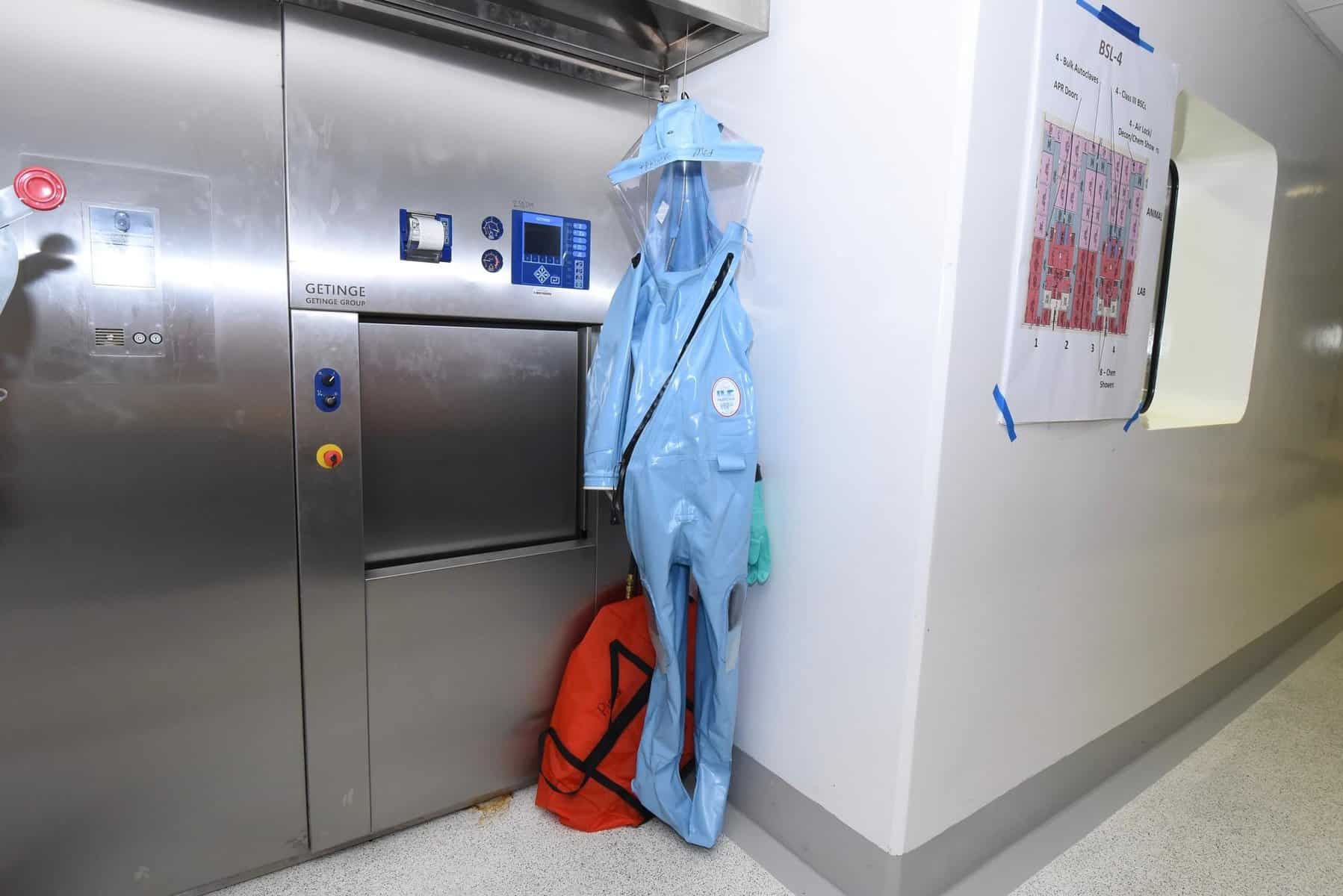
A BSL-4 lab at Fort Detrick is shown. (Courtesy of: the Office of the Maryland Governor)
By Emily Kopp | US Right To Know | March 1, 2022
The Army’s premier biolab changed its mission statement after a 2014 report by high-ranking officials concluded its work has become less useful since its Cold War heyday and no longer delivers medical products for service members.
The report, which had not been previously released, was obtained through a state public records request by U.S. Right to Know.
The challenges at the U.S. Army Medical Research Institute of Infectious Diseases, or USAMRIID, come to light at a time of fierce debate about the degree to which research on novel pathogens contributes tangible benefits. Scientists with different theories about the COVID-19 pandemic’s origins have been tangled in arguments over whether certain work on dangerous pathogens can help predict pandemics or poses unacceptable risks.
Located 50 miles outside of Washington at Fort Detrick, USAMRIID was once charged with responding to the Soviet Union’s biological weapons program, but stopped developing bioweapons in 1969. It now conducts research on biological threats including Ebola, Zika, anthrax and plague, and conducts research for universities and private companies. It employs about 900 military, civilian and contract researchers.
The global biological threat landscape has changed due to gain-of-function technology, the limited capacity of the intelligence community to identify biological threats, and the proliferation of “dual use” research programs that generate pathogens that could be harmful in the wrong hands, the report states.
USAMRIID has in recent years suffered many troubles, including biosafety breaches, a shut down of its high security work, and accusations from Department of Defense leadership of wasting taxpayer funds.
The report by government experts, including former USAMRIID Commander David Franz, describes an agency adrift as America’s first biodefense research facility struggled to deliver on the promises in its mission statement.
The report concludes that the lab’s work may not always generate medical advances, and should not be expected to in the eyes of its funders in Washington.
“The emphasis on products to the warfighter has become less relevant,” the report reads. “Because prophylaxis for ‘biological agents’ (traditional vaccines) requires great specificity and a period of at least weeks before protection is achieved, the era of vaccines for the force, one of USARMIID’s greatest historic strengths, is essentially over.”
The experts behind the report recommended changing the mission of the military lab away from generating vaccines and drugs.
It appears USAMRIID’s leaders listened.
By Jan. 2015 – several months after study’s authors had convened in June 2014 – the vision of the lab had changed on its website from “right product, right time for the Warfighter” to a more general statement about leadership in medical biological defense, according to changes accessed via the WayBack Machine.
“To be the leader in the advancement of medical biological defense with world renowned experts dedicated to protecting our military forces and the nation,” USAMRIID’s vision statement now reads.
In the years since USAMRIID’s 2014 consultants fought to prove its importance to the Pentagon, the lab has faced allegations of “financial mismanagement,” according to a Defense Department letter reported by CQ Roll Call.
Other problems
USAMRIID is one of two facilities at Fort Detrick with laboratories designed to handle the most dangerous pathogens in the world, so-called BSL-4 labs. There are 14 BSL-4 labs in North America.
These labs have come under greater scrutiny amid concerns by Republicans and some independent biosecurity experts that the COVID-19 pandemic may have arisen from a lab accident in China.
USAMRIID has not developed a COVID-19 vaccine candidate, though the lab has tested COVID-19 vaccines in the pre-clinical trial stage, according to Caree Vander Linden, public affairs officer at USAMRIID.
Vander Linden also provided U.S. Right to Know with a spreadsheet of 43 scientific papers produced by the lab about COVID-19. For example, the lab recently announced engineering hamsters to increase their expression of the human ACE2 receptor — a key protein used by SARS-CoV-2 to enter airway cells — to enable the study of more severe disease. Remdesivir, the first therapeutic with approval from the Food and Drug Administration to treat COVID-19, was also developed with the help of USAMRIID.
Vander Linden did not respond to questions about the report and the change of the USAMRIID mission statement. Franz did not respond to requests for comment.
Morale has plummeted since the deadly release of anthrax from the lab in 2001, the 2014 report suggests. That has been worsened by the expansion of work on biorisks at other labs. Now USAMRIID struggles to retain talent. Much of the work at USAMRIID is that of a contract research organization performing tasks for the private sector.
“The concept that USAMRIID is more of an ‘insurance policy’ to deal with the unknown and unexpected than a ‘factory’ to produce medical ‘things’ for the soldier should be understood by all,” it states.
The report criticizes the biosafety regulations at the Fort Detrick lab, saying the routine presence of inspectors is a distraction.
“The heavy regulatory burden … and oversight following the 9-11 attacks and the anthrax letters has diverted both funding and human resources from the research mission,” the report states.
Yet in the years since, serious safety breaches have occurred at USAMRIID. The Centers for Disease Control and Prevention flagged failures to “implement and maintain containment procedures sufficient to contain select agents or toxins” in biosafety level 3 and 4 laboratories, the Frederick News-Post reported, culminating in a shutdown of USAMRIID’s two top security labs and a suspension of its registration with the Federal Select Agent Program.
Though work resumed in November 2019, the lab’s Defense Department funding remained frozen until April 2020.
Both the Biden and Trump administrations have sought cuts to USAMRIID. But members of the Maryland congressional delegation have fought to maintain funding levels.
Congress appropriated $130 million for the expansion of USAMRIID in fiscal 2021.
Unpredictable threats
While USAMRIID once focused on responding to the Soviet Union, new biological threats are more diverse and harder to nail down, according to the report.
“The intelligence community is limited in its ability to identify specific threats,” the report states.
This unpredictability is due in part to so-called “gain-of-function” research, a term used to describe research that can make pathogens more virulent or transmissible.
“Threat agents … might include traditional ones to those that blur the line between chemistry and biology or even those modified through ‘gain of function’ techniques,” the report reads.
Potentially dangerous biological research is now characterized by “small footprint, dual-use offensive capabilities that might be found in a few large and medium nation states,” according to the report.
Two of the 2014 report’s authors – Franz and former director of the National Science Foundation Rita Colwell – have connections to EcoHealth Alliance, a nonprofit under investigation for its gain-of-function work on coronaviruses with the Wuhan Institute of Virology. Colwell is on the board of directors, while Franz was a booster of the organization, according to a 2019 social media post.
Other consultants who coauthored the report include former secretary of the Navy Richard Danzig; former deputy commander-in-chief of United States Strategic Command Robert Hinson; former director of the Biomedical Advanced Research and Development Authority Carol Linden; and former chief of staff of the U.S. Army Dennis J. Reimer; executive director of the Maryland Biotechnology Center Judy Britz; distinguished research fellow at National Defense University Seth Carus; Harvard professor of biologically inspired engineering David Walt; and NIH researcher Richard Whitley.
German insurance executive who warned of the high vaccine side-effect rate revealed by billing data, has been fired

eugyppius | March 1, 2022
Two weeks ago, BKK ProVita chairman Andreas Schöfbeck caused a small uproar by writing to Germany’s vaccine regulator, the Paul-Ehrlich-Institut, to inquire about the high rate of vaccine side-effects evident from BKK billing data.
Representatives from the Paul-Ehrlich-Institut, including its president, Klaus Cichutek, had agreed to meet with Schöfbeck and other BKK officials about their concerns this afternoon. Schöfbeck’s termination was obviously timed to prevent his participation at that meeting, which will now go forward without him.
This is the behaviour of people who have deep confidence in the safety and effectiveness of our Corona vaccines.
Featured Video
Death Spikes & Rising Cancer In Our Youth Explained
or go to
Aletho News Archives – Video-Images
From the Archives
Politicians lie
By Mazin Qumsiyeh | Popular Resistance | August 18, 2013
There is no way to say this truth nicely: Politicians lie. That includes Japanese, American, Egyptian, Israeli, and Palestinian politicians! Is there something more common sense than that? Yet, so many citizens around the world believe their own politicians or wistfully acknowledge lies but think it is part of the job needed to run things. They believe even when politicians contradict themselves blatantly. This phenomenon is rather remarkable. It is a dissonance and disconnect from reality that many seem oblivious to. It is very dangerous because it can lead to accepting rationales for going to war. These can be deadly wars that lead to millions of lives lost as happened in what was called World War 1 and WW2. Even when incredible and declassified evidence abound, politicians continue to lie and old mythologies refuse to die. Here are just a few of the countless lies told to us over the past few decades… continue
Blog Roll
 Aletho News
- RSF military group defects, joins Sudanese army: State media
- Ireland goalkeeper refuses to play ‘Israel’ as squad weighs boycott
- China pushes back against US on Cuba, Iran
- Ukrainian Soldiers, Potential Mercenaries: Have Gun, Will Travel!
- Burnham’s UN debut… A masterclass in British disinformation
- Iran flights continue despite US aviation sanctions
- Global Tipping Points Lead the World Into a State of Entropy
- The day-after at the White House: USA and Xi Jinping
- The Geopolitical Balance in the Red Sea: The UAE Being Displaced by New Players
- Iraqi resistance group vows to stage airport sit-ins over Iran aerial blockade
- If Americans Knew
- Deconstructing Netanyahu’s pants-on-fire UN rant – Daily Update
- Trump betrayed voters with his campaign lies and prioritized a foreign country once he took office
- Netanyahu calls Israel’s war in Gaza ‘opposite of genocide’ in UN speech to near-empty hall
- Settler Kidnappings: Torture, Sexual Abuse and Terrorisation of Palestinian Abductees as Israel Deepens Annexation of West Bank
- Gaza winter nears as 162,000 tents become unusable, raising fears of humanitarian crisis
- Netanyahu says, “It’s the opposite of genocide”; UN says Gaza economy is world’s ‘most severe crisis on record’ – Daily Update
- Israel’s US-Backed Assault on Gaza Has Created the ‘World’s Most Severe Economic Crisis on Record’: UN
- ‘Protecting U.S. Citizens’… From Israel
- ‘This is where I live now, the back of a truck’: a day in the life of a grandmother in Gaza
- In UN Speech, Iran’s President Displays Pictures of Children Killed by US, Brings Attention to Israel’s Nuclear Arsenal
- No Tricks Zone
- New Study: Earth And Venus Surface Warmth Largely Explained By Convection And Lapse Rate, Not CO2 Or Radiation
- 2025 Nature Paper Claiming Worsening Global Drought Gets RETRACTED …Heavily Flawed
- New Study: ‘Global Drought Shows No Detectable Recent Acceleration Under Climate Warming’
- Economic Masterminds: German Socialists Suggest Taxing Productivity Gains Stemming From Using AI
- The South China Sea Has Not Been Cooperating With The Climate Change Narrative
- Energy Crisis: Germany Enters Heating Season With Historically Low Gas Reserve Fill Levels
- New Study: The Antarctic Ice Sheet Gained Mass From 2020-2024 Due To Staggering Snow And Ice Accumulation
- Study: Ocean Heating Rates From Thousands Of Years Ago ‘Dwarf’ Modern Ocean Heating Rates
- Climate Extremists Target, Attack Large-Scale Power Grid Infrastructure In Germany!
- New Study: Antarctic Ice Melt Has Contributed Less Than 1 Centimeter To Sea Level Rise In The Last 30 Years

