The Two Elie Wiesels

Nobel laureate Elie Wiesel, Romanian-born Holocaust survivor and author of the classic novel, “Night.”
Elie Wiesel spoke out eloquently against violence and injustice… except when he endorsed them.
By Kathryn Shihadah | If Americans Knew | November 6, 2017
Elie Wiesel was born in 1928 to a prominent Jewish family in Romania. By the age of 15, he found himself in Auschwitz concentration camp, where his parents and one of his three siblings died. After the liberation of the camp, he spent time in France.
After a short time, Wiesel went to work as a translator for Irgun, a terrorist group that had a reputation for bombing and shooting innocent Arab Palestinians. It was during Wiesel’s Irgun days that the group participated in the 1948 Deir Yassin massacre, in which over 250 unarmed Palestinian civilians were brutally murdered.
For ten years after the war, Wiesel says he would not speak or write about his experiences. Eventually he wrote a memoir, which was later abridged and translated into English as Night. Despite questions about its truthfulness (“in its central, most crucial scene, Night isn’t historically true, and at least two other important episodes are almost certainly fiction”), It has become a classic.
Eventually, Wiesel became a prominent advocate for peace and justice around the world.
His activism included speaking out for Soviet, Ethiopian, Romanian, and Ukranian Jews, as well as Vietnamese boat people, victims of South African apartheid, genocide in Bosnia, Darfur, and Armenia, and other at-risk groups around the world.
In 1986, Elie Wiesel received the Nobel Peace Prize for his work to end violence, oppression, and racism. The Nobel Committee stated: “Wiesel’s commitment, which originated in the sufferings of the Jewish people, has been widened to embrace all repressed peoples and races.” His profound experiences, and his profound response, birthed in him the words of his Nobel Peace Prize acceptance speech:
… When human lives are endangered, when human dignity is in jeopardy, national borders and sensitivities become irrelevant… that place must – at that moment – become the center of the universe… There is much to be done, there is much that can be done. One person… one person of integrity, can make a difference, a difference of life and death.
I swore never to be silent whenever and wherever human beings endure suffering and humiliation. We must always take sides. Neutrality helps the oppressor, never the victim. Silence encourages the tormentor, never the tormented.
No human race is superior; no religious faith is inferior. All collective judgments are wrong. Only racists make them.
In The Watchtower (June 15, 1995), he declared,
The duty of the survivor is to bear testimony to what happened . . . You have to warn people that these things can happen, that evil can be unleashed. Race hatred, violence, idolatries—they still flourish.
Mr. Wiesel must have forgotten his own advice, because in the ensuing years, he missed many opportunities to speak out, to bear testimony – opportunities that were literally right under his nose.
For example, in 1999 he endorsed NATO bombs that were blowing up civilians and journalists in Yugoslavia; in 2003 he advocated for war against Iraq, declaring it a necessary moral act because the situation was “a moral crisis similar to 1938.”
And Wiesel was consistently unmoved when the victims under his nose were Palestinian.
The phenomenon of ignoring Palestinian victims, known in activist circles as PEP—Progressive Except Palestine—is a primary enabler of the ad nauseum occupation of the West Bank, the siege of Gaza, and the systemic oppression of Palestinians within Israel itself. Many groups and individuals that are devoted to justice stop short of defending the oppressed people of the Holy Land.
Mr. Elie Wiesel, the “messenger to mankind,” ought to have been above that kind of limited thinking, but he was not.
Like many, he viewed Israel through rose-colored glasses, despite his first hand knowledge. Wiesel could have, should have spoken out against the oppression of Palestinians, but instead sided with the oppressors. It has become the task of others to correct a Nobel Laureate.
Exhibit A, the Goldstone Report, 2009
 Richard Goldstone
Elie Wiesel chose the wrong side when it came to the Goldstone Report, commissioned by the United Nations. The independent fact-finding team, which began its work in April 2009, was headed by Jewish (and Zionist) South African Richard Goldstone. Its task was to investigate alleged violations of international human rights and humanitarian law during Operation Cast Lead. Although the scope of work was originally to examine Israeli actions only, Goldstone insisted on probing the Palestinian side as well.
The 3-week conflict, also known as the Gaza War and the Gaza Massacre, was Israel’s attempt to stop rocket fire and weapon smuggling by Palestinians. Casualties included over 1,400 Palestinians dead and 13 Israelis – 4 from friendly fire.
Prime Minister Netanyahu called the whole investigation a “kangaroo court,” and Israel refused to cooperate with the team or to grant visas for the investigation.
The report, presented in September 2009, concluded that both the Israeli Defense Forces and Palestinian militants had committed war crimes, charging that Israel’s military campaign was “a deliberately disproportionate attack designed to punish, humiliate, and terrorize… and to force upon it an ever increasing sense of dependency and vulnerability.” It also accused Israel of collective punishment in the years-long economic blockade of Gaza.
The report described “an overall policy aimed at punishing the Gaza population… possibly with the intent of forcing a change [in its support for Hamas].”
(As an aside, the use of violence against civilians to force a political change is the definition of terrorism.)
The report continued:
[T]here appears also to have been an assault on the dignity of the people… in the use of human shields and unlawful detentions… vandalizing of houses… obscenities and often racist slogans, all constituted an overall image of humiliation and dehumanization of the Palestinian population.
The mission further considers that the series of acts that deprive Palestinians in the Gaza Strip of their means of subsistence, employment, housing and water, that deny their freedom of movement and their right to leave and enter their own country, that limit their rights to access a court of law and an effective remedy, could lead a competent court to find that the crime of persecution, a crime against humanity, has been committed.
Israel rejected the report, while Hamas reluctantly accepted it.
Ian Kelly of the US State Department complained that the report (which, keep in mind, addressed a conflict in which Palestinian deaths were 100 times higher than Israeli deaths), “focuses overwhelmingly on Israel’s actions.” Nobel Peace laureate and former prime minister Shimon Pares considered the report a “mockery of history” and accused the team of failing to “distinguish between the aggressor and a state exercising its right to self-defense.”

Israel’s use of white phosphorus in Gaza during Operation Cast Lead was a flagrant violation of the Fourth Geneva Convention. “While the international community might be horrified by the use of phosphorous, this is overlooking the issue that hundreds of half-ton bombs are being dropped on Gaza on civilian targets on a daily basis,” said Raji Sourani, head of the Palestinian Centre for Human Rights (PCHR) in Gaza.
Elie Wiesel joined in the criticism of the Goldstone Report:
One thing is clear to me, that document was unnecessary.
Without explaining his first statement, he added, significantly,
I can’t believe that Israeli soldiers murdered people or shot children. It just can’t be.
(No doubt the families of the 1,400 dead Palestinians – half of them civilians, 252 of them children – would dispute this statement.)
American Jewish journalist Peter Beinart took Wiesel to task for these statements:
Wiesel takes refuge in the Israel of his imagination, using it to block out the painful reckoning that might come from scrutinizing Israel as it actually is… “We are making the lives of millions unbearable,” declares one former Shin Bet head, Carmi Gillon, in the film “The Gatekeepers.” In the West Bank, Israel has become “a brutal occupation force,” notes another, Avraham Shalom. A third, Yuval Diskin, calls the occupation a “colonial regime.”
These men don’t hate Israel; they have dedicated their lives to protecting it. But unlike Wiesel, they are discussing the real Israel, not the one they have constructed in their minds. Why is Elie Wiesel, one of the world’s great champions of human rights, denying the human rights abuses to which even Israel’s own former Shin Bet chiefs have testified?
Rabbi Brant Rosen concurred:
As far as I’m concerned, Justice Richard Goldstone is precisely the kind of courageous Jewish moral hero that Wiesel himself purports to be: someone committed to advocating for universal human rights even when doing so might mean holding our own community painfully to account. As for Wiesel, I’m finding his words and actions increasingly craven. No one begrudges him his opinions – but it’s time he dropped the pretense that he’s somehow beyond the political fray.
Under great pressure from the Jewish community in his home of South Africa, Goldstone eventually backpedaled somewhat on one of the charges. However, he failed to address new evidence that actually reinforced his original findings, as well as a report on Israel’s failure to investigate its violations of the laws of war.
Wiesel declined to acknowledge Israel’s need for censure, expressing that
[Richard Goldstone] has a good name, and I’ve known him for years… He should have refused to head the committee, because of the anti-Israel mandate under which it was established.
This refusal to stand up for the oppressed contradicts the vow he made in his commencement speech at Washington University, St. Louis:
In fact it is the otherness of the other that makes me who I am. I am always to learn from the other. And the other is, to me, not an enemy, but a companion, an ally, and of course, in some cases of grace, a friend. So the other is never to be rejected, and surely not humiliated.
and the words of his Nobel acceptance speech:
None of us is in a position to eliminate war, but it is our obligation to denounce it and expose it in all its hideousness. War leaves no victors, only victims. War dehumanizes, war diminishes, war debases all those who wage it. The Talmud says, “Talmidei hukhamim marbin shalom baolam” (It is the wise men who will bring about peace).
One might expect Mr. Wiesel to lay low for a good, long time after such blatant duplicity. One would be mistaken.
Exhibits B and C: Visit to the White House and public/open letter to Obama, 2010
In May of 2010, Elie Wiesel was invited to the White House for lunch with Israel’s greatest benefactor, the President of the United States. Wiesel, master of persuasion and nuance, decorated for his efforts to end violence, oppression, and racism, had the ear of the leader of the free world.
Wiesel once said,
Mankind needs peace more than ever… Mankind must remember that peace is not God’s gift to his creatures, it is our gift to each other.

According to a recent study, almost 80 percent of IDF forces in the West Bank are there to protect settlements, with the remainder scattered along the Green Line. “[Netanyahu] has been kidnapped by the settler lobby and is pursuing a policy that harms the security of every Israeli,” said Knesset member Erel Margalit in June 2017.
But instead of speaking of peace, he chose as his topic of conversation, “don’t pressure Israel to cease settlement activity in Jerusalem.”
President Obama, who strongly opposed settlements, simply listened politely.
For good measure, Wiesel also undertook a PR campaign in the form of a public letter, which appeared in The International Herald Tribune, The Washington Post, The Wall Street Journal, and The New York Times. He painted an idyllic picture of his homeland of Israel:
“[F]or the first time in history, Jews, Christians and Muslims all may freely worship at their shrines. And, contrary to certain media reports, Jews, Christians and Muslims ARE allowed to build their homes anywhere in the city.”
It didn’t take long for the record to be set straight—by prominent Jewish Jerusalemites—who published a letter of their own in the New York Review of Books, correcting Wiesel’s false statements:
We write to you from Jerusalem to convey our frustration, even outrage… We cannot recognize our city in the sentimental abstraction you call by its name.
We invite you to our city to [see that] Arabs are not allowed to build their homes anywhere in Jerusalem. You will see the gross inequality in allocation of municipal resources and services… Sheikh Jarrah, where Palestinian families are being evicted from their homes to make room for a new Jewish neighborhood… Silwan, where dozens of houses face demolition because of the Jerusalem Municipality’s refusal to issue building permits to Palestinians.
Another Israeli who weighed in on the housing issue was former Israeli Cabinet Minister Yossi Sarid, who addressed Wiesel in Ha’aretz,
Someone has deceived you, my dear friend. Not only may an Arab not build “anywhere,” but he may thank his god if he is not evicted from his home and thrown out onto the street with his family and property.
Israeli Daniel Seidemann, a “one-man early-warning system” for changes in Jerusalem that undermine the peace process, called Wiesel’s words “factually inaccurate” and “morally specious.” He gave specific examples:
So while Wiesel may purchase a home in anywhere in East or West Jerusalem, a Palestinian cannot.
Due to Israeli restrictions, today it is easier for a Palestinian Christian living just south of Jerusalem in Bethlehem to worship in Washington’s National Cathedral than to pray in Jerusalem’s Church of the Holy Sepulcher.
Today a Muslim living in Turkey has a better chance of getting to Jerusalem to pray at the Old City’s al-Aqsa mosque than a Muslim living a few miles away in Ramallah.
Another Israeli who called Wiesel out for inaccuracies was Ha’aretz writer Gideon Levy:
If I were Elie Wiesel, such a famous Holocaust survivor, a Nobel Prize laureate whose voice is heard in high places, I would ask my friend in the White House, for the sake of peace, Israel’s future and world peace: Please, Mr. President, be forceful. Israel depends on you as never before. Isolated as never before, it’s as good as dead without American support. Therefore, Mr. President, I would say to Obama over the kosher meal that was served, be a true friend of Israel and extricate it from its misfortune…
Instead… Wiesel haggled for wholesale postponement… To postpone. Postpone and postpone, like Netanyahu, who sent him, asked him to do.
And finally, both European and American Jewish leaders—some of whom had lived in Israel—circulated petitions garnering thousands of signatories,
The European petition, “A Call To Reason,” signed by over 5,000, stated that
the occupation and the continuing pursuit of settlements in the West Bank and in the Arab districts of Jerusalem . . . are morally and politically wrong and feed the unacceptable de-legitimation process that Israel currently faces abroad.
The American petition, “For the Sake of Zion,” echoed the European document, adding,
[W]e abhor the continuing occupation that has persisted for far too long; it cannot and should not be sustained. [W]e call upon Israel immediately to cease construction of housing in the disputed territories.”
Wiesel was apparently unconvinced, rendering hollow his earlier pronouncement that
the opposite of love is not hate, it’s indifference. The opposite of art is not ugliness, it’s indifference. The opposite of faith is not heresy, it’s indifference. And the opposite of life is not death, it’s indifference. Because of indifference, one dies before one actually dies. To be in the window and watch people being sent to concentration camps or being attacked in the street and do nothing, that’s being dead. (US News & World Reportt, 27 October 1986)
Exhibit D: Ha’aretz ad congratulating settlers in East Jerusalem, 2014
Due to his global fame, Elie Wiesel was offered positions on boards of directors all over Israel. The one he chose to accept was the chair of the board of Elad.
Elad is a right-wing NGO which operates in East (Arab) Jerusalem. The organization has two objectives: to settle Jews in the primarily Arab neighborhood of Silwan, and to operate tourist and excavation sites. The settlement aspect of the project involves expelling Palestinians. Richard Silverstein dubbed Elad’s aggressive settler movement “Jewish jihad, literally a Jewish struggle for dominance of the Holy City.” (For details, read this.)

Israeli police oversee the demolition of a Palestinian home in the East Jerusalem neighborhood of Silwan. Settler organizations Elad and others have worked to take over and demolish Palestinian homes in order to move Jewish families in. (More information here.)
In early October, 2014, Ha’aretz had reported that Elad was in the market for Israeli Jews to temporarily live in 25 recently-purchased apartments in Silwan, guarding them until the new Jewish settlers moved in. The job description: “In principle, you’re supposed to be quiet and simply occupy the compound… As far as we’re concerned, you live in the house, but it’s better if you have a weapon.”
Silwan’s Palestinian residents have, in the last two decades, been subject to eviction, home demolition, and aggressive buy-outs, transforming their neighborhood a Jewish-Israeli controlled enclave. According to Ha’aretz, “Life in the East Jerusalem neighborhood of Silwan has become unbearable, both for the Jewish settlers who would like to be able to leave home without being stoned and the Palestinians who suffer the heavy hand of the police and the settlers’ security guards.”
Wiesel and the organization he headed, Elad, placed the following announcement in Ha’aretz on October 10, 2014:
On the eve of Sukkot, we are happy to congratulate the dozens of Jewish families that are joining the Israeli settlement of Ir David [the settlers’ name for Silwan]. We salute the Zionist work of those who take part in this mission. Strengthening Jewish presence in Jerusalem is the challenge for all of us, and by your act of settlement you make us all stand taller.
Ha’aretz once again put the matter in perspective:
We must reckon with Wiesel’s erasure of others’ suffering as seriously as we embrace the remembrance of our own… The memory of our collective suffering, articulated by Wiesel and others, grants us the ability to see and to understand the collective pain of others… What are we to do with the fact that… Wiesel was head of the board of Elad, an organization at the forefront of expelling Palestinians from their homes in East Jerusalem? That he worked to further a violent religious nationalist agenda?
In fact, Wiesel’s work with Elad was at odds with not only social justice, but even with his own words. In 2011 he had declared at the commencement of Washington University in St. Louis,
The greatest commandment, to me, in the Bible is not the Ten Commandments… My commandment is, “Thou shall not stand idly by.” Which means when you witness an injustice, don’t stand idly by. When you hear of a person or a group being persecuted, do not stand idly by… You must intervene. You must interfere. And that is actually the motto of human rights… And therefore wherever something happens, I try to be there as a witness.
(Except, of course, when the persecuted are Palestinian.)
Exhibit E: Open letter regarding Netanyahu’s speech to Congress, 2015
Early in 2015, as President Obama was hammering out a nuclear agreement with Iran, PM Benjamin Netanyahu wished to bend Congress’ ear to halt the negotiations. Republican House Speaker John Boehner and Senate Majority Leader Mitch McConnell essentially arranged the speech behind Obama’s back, to “make sure that there was no interference.”

Once word got out, President Obama declined to attend the speech. Elie Wiesel then went into action, publishing – with the help of pro-Israel Rabbi Shmuley Boteach – an open letter:
Many centuries ago a wicked man in Persia named Haman advised, “There exists a nation… It is not in our interest to tolerate them.” And the order went out to all the provinces to “annihilate, murder, and destroy the Jews. Now Iran, modern Persia, has produced a new enemy…
Should we not show our support for what might be the last clear warning before a terrible deal is struck [between the US and Iran]?… As one who has seen the enemies of the Jewish people make good on threats to exterminate us, how can I remain silent?… Will you join me in hearing the case for keeping weapons from those who preach death to Israel and America?
Ha’aretz stepped up to challenge Wiesel’s assumptions, pointing out that he
makes two assertions, neither of which he makes any effort to prove. The first is that the United States and Iran are on the verge of “a terrible deal.” What makes the deal, which has not even been struck, “terrible?” Wiesel doesn’t say. The second is that a nuclear Iran would likely mean “‘the annihilation and destruction’ of Israel.” This, too, requires evidence that Wiesel does not provide.
The Ha’aretz authors also point out that Wiesel’s appeal to the biblical story of Esther is flawed because it is incomplete. The account states that after Haman fell from power, Persia’s Jews
“with the stroke of the sword, and slaughter, and destruction… slew of their foes seventy and five thousand.”
If the Book of Esther offers a haunting warning of the violence Jews can suffer, why does it not also warn us of the violence Jews can inflict? And if Wiesel is so alarmed by threats of nuclear annihilation, why does he keep embracing his former patron Sheldon Adelson, who in 2013 urged the United States to drop an “atomic weapon” in the Iranian desert, and then, if the Iranians don’t halt their nuclear program, drop one “in the middle of Tehran” so the Iranians are “wiped out.”
Progressive Jewish American organization J Street reacted strongly to the scheduled speech behind which Wiesel stood so firmly. Responding to Netanyahu’s claim that he would be speaking as a representative of all Jewish people everywhere, the group created a petition entitled “I’m a Jew. Bibi does NOT speak for me.” 20,000 signatures indicated that not all Jews favored his Iran policies or his relationship with the White House.
Wiesel wanted to keep weapons of mass destruction out of the hands of Iran, ignoring the irony of Israel’s own nukes at the ready, and the incongruity of Israel’s de facto “it is not in our interest to tolerate” position toward Palestinians.
But again, Wiesel’s own words were even more haunting than the witness of thousands of other Jews.
There may be times when we are powerless to prevent injustice, but there must never be a time when we fail to protest. The Talmud tells us that by saving a single human being, man can save the world.
Conclusion
We ask, over and over, how a people who have suffered so much could inflict so much suffering on another people. We wonder how a man who has so precisely described evil could not recognize it in front of him, how he could speak so eloquently about compassion but fail to have a morsel of it for his neighbors.
Hussein Ibish, writing for Foreign Policy, makes sense of the moral quagmire of Elie Wiesel’s mind:
[T]he underlying assumption is irredeemably flawed. It presumes that people, whether individuals or collectivities, somehow learn from their negative experiences not to repeat them.
Of course, that is not the case. “Hurt people hurt people.” Maybe Elie Wiesel was too broken by his experiences to see clearly what his Israel was doing. Maybe he deserves a pass.
In that case, it behooves the new generation of Israelis and pro-Israel individuals and groups to do what Wiesel could not: take off the rose-colored glasses; do the hard work of acknowledging past and present wrongs. Do justice, love mercy, and walk humbly. As Wiesel once said,
I have to be self-conscious of what I’m trying to do with my life.
Kathryn Shihadah is a staff writer for If Americans Knew.
Glencore’s secret loan for Israeli billionaire to secure Congo mining rights revealed
RT | November 6, 2017
The world’s biggest mining firm Glencore secretly loaned tens of millions of dollars to an Israeli billionaire after enlisting him to secure a controversial mining agreement in the Democratic Republic of the Congo (DRC), it has been revealed. The details were leaked as part of the Paradise Papers.
A trove of more than 13 million documents from the world’s leading offshore law firms, including Appleby, was released through the International Consortium for Investigative Journalists (ICIJ) on Sunday. The documents lay bare the secretive multi-jurisdictional dealings of Glencore, a scandal-plagued, Anglo-Swiss multinational with mining interests across the globe.
As a friend of the Congolese President Joseph Kabila, Israeli billionaire Dan Gertler’s role has been questioned by anti-corruption campaigners since Glencore floated in London in 2011. His notoriety in the resource-rich but conflict-riven and corrupt DRC spans nearly two decades.
Gertler was cited by a 2001 UN investigation, which said that he had given Kabila $20 million to buy weapons to equip his army against rebel groups in exchange for a monopoly on the country’s diamonds. A 2013 Africa Progress Panel report said a string of mining deals struck by companies linked to him had deprived the country of more than $1.3 billion in potential revenue. Last year, he was implicated in a scheme to bribe Congolese officials on behalf of US hedge fund manager Och-Ziff Capital Management, according to Bloomberg.
According to the Guardian, the Paradise Papers confirm that several times during 2008 and 2009, Gertler was called in to negotiate with DRC authorities over the struggling Katanga copper mine in the southeast of the country, which was hampered by stalled talks to secure a joint-venture agreement with DRC’s state-run miner Gecamines.
In 2009, Glencore, through a loan offer, took effective control of Katanga, but also kept Gertler’s interest in the firm by secretly loaning his company Lora Enterprises $45 million in pledged shares for him to take part in the loan. The loan was granted with the caveat that it would be repayable in the event that an agreement was not made with DRC authorities to secure a contract for a company linked to the firm.
While the details of the loan have been previously reported, the new documents show that Gertler was required to secure certain approvals from the government in return, according to the Guardian.
Daniel Balint-Kurti of the Global Witness campaign group told The Times : “Glencore must explain to the world why it used a secret offshore company to pump millions of dollars to a controversial friend of the Congolese president linked to bribery scandals.”
In a written statement, lawyers for Gertler told the Guardian that neither he nor any company or person related to him received any loan funds directly, and any allegation that the $45 million loan was improper “demonstrates misapprehension of international finance transactions.”
“Mr Dan Gertler is a respectable businessman who contributes the vast majority of his wealth and time to the needy and to different communities, amounting to huge sums of money. He transacts business fairly and honestly, and strictly according to the law,” the statement said.
Gertler’s lawyers said there was no basis for the allegation that Katanga received “preferential terms” in its agreement with the DRC as a result of his involvement.
Glencore has dismissed any allegations of impropriety concerning the loan. The loan was made on commercial terms and “negotiated at arm’s length,” it told Bloomberg.
Why Doesn’t the Born Leader of the Feminist Movement Speak for Me Too?
By Melissa Garriga | CounterPunch | November 6, 2017
“Along Came Hillary”
Twitter had its fun a couple of weeks ago, when the children’s book, Hillary Rodham Clinton: Some Girls Are Born to Lead, resurfaced. The book was originally published in January of 2016, in the middle of Hillary’s campaign for presidency. I don’t recall if the book received much fanfare when released but honestly who can remember every insane moment of the traveling circus known as the 2016 Presidential Election. Among many, over exaggerated accomplishments the book disgustingly attributes to Hillary, the biggest one comes from when Hillary graced the world with her presence. The author suggests that in the 1950s we were living in a man’s world and it wasn’t until Hillary came along (was born) that woman began to become accomplished. As several have pointed out, many great and accomplished women have flourished before tiny Hillary was even conceived. This Daily Wire article perfectly captures the problematic page and gives great examples of the recent reaction.
The rest of the book takes you through Hillary’s life in the same bullshit, ridiculous way it introduces the fierce feminist. But that got me thinking, it’s easy to dress up and over glamorize someone’s past but if you were going to give praise to a powerful and strong feminist today, would little Hillary Rodham Clinton make the cut? And if so, I have to ask, why isn’t she speaking for me too? More specifically, as the magical and wonderful feminist glass-breaker that her undiscerning followers love to adore, why hasn’t she spoken more about #MeToo?
#MeToo
You have to live under a rock (or in the woods) lately to not be aware of the recent revelations of sexual harassment and rape by men in power. Almost daily now, new accusations and stories are being revealed. Women are exposing men from various media, film, music, and political spectra worldwide. Women are using the strength they find in other women coming forward to build up courage to tell their own story. Actress Alyssa Milano started the hashtag #MeToo as a way for women to share (if they can) that they too have been sexually harassed and victimized by a man. The hashtag has spread like wild-fire.
Curiously missing from the national conversation of sexual harassment however is the voice of our leading First Lady of feminism, Hillary Clinton. When the allegations began to stack up against Harvey Weinstein, a major political donor for the Clinton campaign, Hillary responded by admitting she was “shocked’ and “appalled” and she even eventually agreed to give the $26,000 dollars that Weinstein has donated to her campaigns over time.
“Shocked”
Studies estimate that 1 in 3 women have been sexually harassed in the workplace. No one should find this statistic alarming, least of all women. In fact, given that statistic it is easy to say that almost every working woman in the United States probably knows a coworker or has even seen another female coworker being sexually harassed. In many cases sexual harassment is Quid Pro Quo, that is harassment by a person in power, who uses that power to leverage sexual favors and advances. In the cases that are headlining the news now, it is often Quid Pro Quo sexual harassment. What I find peculiar, what we should all find striking, is throughout her professional career, Hillary Clinton has never had a #MeToo moment to share. Surely Hillary, working her way through a man’s world, has met a “Harvey Weinstein” of the legal world, the White House, the United States Senate, or even the US State Department. In fact, statistically speaking, across her career path, she should have either been a victim, seen someone being victimized, or had a co-worker confide their story to her.
But Not Surprising
Even though it is unlikely that Hillary has never experienced a #MeToo situation, it is not surprising in the least that she would not share such an experience. There are many reasons why people do not speak out about being victimized by sexual harassment and/or assault. One reason, they may still be under the thumb of that person and they fear job loss and/or retaliation. However, for Hillary “the girl born to lead”, this is not the case now. In fact, Hillary’s public opinion on sexual harassment seems to offer more sympathy to the perpetrator and not the victim. It suggests that maybe she views sexual harassment with a more conservative perspective – something the girl asked for, a means to a way, men being men. From her days as a defense attorney to her reign as our country’s First Lady, Clinton has defended the guilty men more than the victims. Aside from politicizing, Alicia Machado, during the election and making Pussy Hats a thing, Clinton was never really the fierce feminist for sexual harassment/assault victims, such as young Kathy Shelton and never gave agency to Monica Lewinsky, Juanita Broderick, and the long list of women harassed by her husband.
Feminist Are Made Not Born
The problem with Michelle Markel’s children’s book is its pure fantasy, poorly based off a real-life character. Leaders are not necessarily born ready to lead and feminists are most certainly not born. Through life experiences women become feminists. Women gradually become feminists through obstacles they face and decisions they have to make. They see a path for women, one where you proudly defend equality and a woman’s choice while simultaneously defending the right to not be sexually harrassed/assaulted by those in power. They choose not to go down a path where they sit silently throughout the years and watch a system use and abuse women in the name of professional advancement. Hillary Clinton may have been born a leader but she was not born a feminist leader. Through her silence and defense of sexual misconduct and perpetrators she chose her path, the path that made her born to lead through the establishment she so desired.
Twitter no longer believes in “speaking truth to power” – updated rules
RT | November 6, 2017
Twitter no longer believes in “speaking truth to power,” according to its latest rules update in the midst of US lawmakers’ frantic hunt for “Russian meddling” in social media.
The microblogging site’s rules, under the section “Abusive Behavior,” currently state: “We believe in freedom of expression and open dialogue, but that means little as an underlying philosophy if voices are silenced because people are afraid to speak up.” On November 2, it read “We believe in freedom of expression and in speaking truth to power.”
Incidentally, on November 1, Twitter, along with Google and Facebook, was grilled by US lawmakers in an ongoing witch-hunt for “Russian influence” that may have led to interference in the 2016 presidential election.
In its testimony to the Senate Intelligence Committee earlier this week, Twitter revealed it has used a vast array of tenuous criteria to define accounts as “Russia-linked,” and also admitted it had censored the hashtags #PodestaEmails and #DNCLeaks tweets during the 2016 US presidential election campaign in an effort to limit public exposure to leaked documents describing the Democratic National Committee’s efforts to boost Clinton as the Democratic Party’s preferred candidate during the primaries.
Twitter Associate General Counsel Sean Edgett claimed many of those tweets were “automated” and hidden by anti-spam systems. He also admitted that less than 4 percent of them came from potential “Russian-linked” accounts.
Last week, Twitter also announced it was banning all ads from RT and Sputnik, citing the same allegations of meddling in the 2016 US election. That, despite the company previously trying to engage RT in a special US election advertising package, which RT declined.
The changes to Twitter’s rules were apparently made as part of a November 3 attempt to “clarify” them.
In a statement, the company said that it wanted to make it clear that “context is crucial when evaluating abusive behavior and determining appropriate enforcement actions.”
A separate update will be issued on November 14 with more details on how the company reviews and enforces policies, according to Twitter.
RT has reached out to Twitter for comment on the change to the wording of its policy.
Read more:
Deconstructing the Climate Demagoguery of the Wine Country Wildfire Tragedies
By Jim Steele | Landscapes and Cycles | October 25, 2017
As sure as the winds will blow, climate demagogues hijack every human tragedy to amplify fears of rising CO2 concentrations. Despite that fact other critical factors were keys to understanding the devastation of the Wine Country fires, politicians like Hillary Clinton, Al Gore and Governor Jerry Brown were quick to proclaim climate change had made the fires worse than they would have been.
Climate researcher Kevin Trenberth has long tried to undermine the foundations of science by discarding the null hypothesis. Without formal testing whether a tornado, hurricane or wildfire event is within the expectations of natural variability, Trenberth simply asserts every tragedy is made worse by rising CO2. Accordingly, he is interviewed by climate change propagandists after every weather tragedy. In an interview with InsideClimateNews a few months before the Wine Country wildfires Trenberth continued to proselytize his views, “Whatever conditions exists, they’re always exacerbated by climate change. There’s always that heat variable, the increased risk.”
Indeed heat is always a variable, but usually it has nothing to do with CO2. Sadly, due to his extreme beliefs Trenberth often confuses climate with weather.
Similarly, Daniel Swain who authors a good California Weather Blog, unfortunately strays when he tries to interject CO2-climate change into an otherwise good weather analysis. Writing the fires should also be looked at from “the long-term climate context,” he argued the “record-hottest summer” dried out the vegetation exacerbating the fire conditions. But he too failed to separate natural climate and weather events from his hypothesized contributions from CO2. As will become clear from a more detailed analysis, climate change played no part in the wildfire devastation.
The Ignition Component
Fire danger rating systems analyze 1) an ignition component, 2) a fuel component and 3) a spread component to determine how to allocate fire-fighting resources and when to issue public alerts. Natural fires are caused by lightning, and so good weather models can forecast the short-term probability of lightning fires. Lightning fires are also more likely during warm and moist seasons enhancing their window of predictability. Unfortunately, Cal Fire reports 95% of California fires are unpredictably ignited by humans.
Climate alarmists like Dr. Trenberth have blithely suggested global warming is increasing the fire season stating, “In the West, they used to talk about a fire season, the fire season used to be 60 days, then 90 days, and now they think it’s year-round. There’s no pause.” Tragically that uncritical belief in a climate-related extended fire season has been parroted by lay person and scientists alike. But the facts show the observed extended fire season is due to human ignitions. Blaming climate change is fake news!
In a 2017 paper researchers reported that across the USA from 1992 to 2012, “human-caused fire season was three times longer than the lightning-caused fire season and added an average of 40,000 wildfires per year across the United States. Human-started wildfires disproportionally occurred where fuel moisture was higher.” Furthermore “Human-started wildfires were dominant (>80% of ignitions) in over 5.1 million km2, the vast majority of the United States, whereas lightning-started fires were dominant in only 0.7 million km2.”
We can reduce some human caused ignitions. The Wine Country fires were not ignited by lightning but all observations suggest they were started by downed power lines in high winds. A year ago, California legislators introduced a bipartisan bill aimed at reducing wildfire ignitions from powerlines. Although governor Brown hypes the unsubstantiated dangers of climate change, he vetoed the bill which would have promoted real action to prevent well-known human causes of wildfires. Preventing powerline ignition could have prevented the Wine Country tragedy.
The Fuel Component
Fire ecologists will estimate a fire’s potential intensity by calculating the Energy Release Component (ERC), a measure of the potential heat energy per square foot. ERC is a function of the biomass both dead and alive, and the biomass moisture content. As fuels increase and as fuels dry the ERC increases. Live fuels are modeled such that maximum moisture content coincides with the peak growing season, and declines thereafter as the plants go dormant. Moisture content of dead fuels are modeled according to their diameters.
Depending on their diameters, dead fuels will lose moisture as they equilibrate with their dry surroundings at rates that vary from 1 hour to 1000 hours or more. To aid in firefighting management decisions, fuels are categorized into 4 groups as described in Gaining an Understanding of the National Fire Danger Rating System published by the National Wildfire Coordinating Group
1-Hour Time-lag Fuels “consist of herbaceous plants or round wood less than one-quarter inch in diameter. Also included is the uppermost layer of litter on the forest floor.” The ERC of these fuels and thus the fire danger, can change throughout the day. Dead grass as well as twigs and small stems of chaparral shrubs are 1-hour fuels, and those fine fuels sustained the rapid spread of the Wine Country fires. Assertions that recent and past summer droughts or decades of climate change had dried the fuels and exacerbated the Wine Country fire danger have absolutely no scientific basis. The approach of the hot, bone-dry Diablo Winds would have extracted all the possible moisture from the dead grasses and chaparral twigs within hours, regardless of past temperatures. Trenberth and Swain simply confused rapid weather changes with climate change.
The critical “long-term context” they never discussed is that a century of fire suppression allowed destructive levels of fuel loads to develop, increasing the biomass component of the ERC estimate. As populations grew, so did the demand to suppress every small fire that could threaten a building. Natural small fires reduce the fuel load, whereas fire suppression allows fast drying fuels to accumulate. Unfortunately, fire suppression only delays the inevitable while stocking more fuel for a much more intense blaze. Local officials and preservationists have long been aware of this problem, and controlled burns to reduce those fuels were being increasingly prescribed. Tragically, it was too little too late.

Figure 1: A prescribed control burn in Wine Country
10-Hour Time-lag Fuels are “dead fuels consisting of round wood in the size range of one quarter to one inch in diameter and, very roughly, the layer of litter extending from just below the surface to three-quarters of an inch below the surface.” The fuel moisture of these fuels vary from day to day and modeled moisture content is based on length of day, cloud cover or solar radiation, temperature and relative humidity.
100-Hour Time-lag Fuels are “dead fuels consisting of round wood in the size range of 1 to 3 inches in diameter and, very roughly, the forest floor from three quarters of an inch to four inches below the surface.” Moisture content of these fuels are also a function of length of day (as influenced by latitude and calendar date), maximum and minimum temperature and relative humidity, and precipitation duration in the previous 24 hours.
Much of the chaparral shrubs produce twigs and stems in size ranges of the 1-hr, 10-hr and 100-hr fuels. These fuels were most likely the source of burning embers that high winds propelled into the devastated residential areas. Again, these dried out fuels are the result of a natural California summer drought and short term weather conditions such as the bone-dry Diablo Winds that arrive every year.

Figure 2 Moisture content of 3-8 inch diameter fuels from March to December
1000-Hour Time-lag Fuels are “dead fuels consisting of round wood 3 to 8 inches in diameter or the layer of the forest floor more than about four inches below the surface or both”. These larger fuels are more sensitive to drought conditions that existed months earlier, so it could be rightfully argued that a hotter drier July and August made these fuels more flammable in October and exacerbated the fires.
Fire ecologists planning prescribed burns to reduce fuel loads, wait until the 1000-Hr fuels’ moisture content is reduced to 12% or lower. If these larger fuels are dry, it is certain the smaller fuel categories are dry as well, so that all fuels will be highly flammable. As seen in the graph above (Figure 2) 1000-hr fuels reach that critical dryness threshold by July 1st and remain below that threshold until mid-October when the rains begin to return. Contrary to Trenberth’s blather, California’s fire season has always lasted 90+ days. Undoubtedly the unusually hot and dry 2017 summer would have lowered 1000-hr fuel moisture content even further. Nonetheless those fuels become naturally flammable every summer. Furthermore, these larger fuels were less often burned and thus insignificant factors in regard to the fires rapid spread. The rapid spread of the fires was due to consumption of the rapidly drying fuels.
Swain is fond of finding a “record setting” metric to bolster his climate change assertions. As such, he noted the “record-hot summer had dried out vegetation to record levels” and linked to a graph tweeted by John Badoglio showing October ERC values for the past 30 years were at a record high in 2017 (in part because of delayed rains). However, that “record” was also largely irrelevant. The ERC calculation is heavily biased by the greater biomass of the larger 1000-hr fuels that would indeed get drier as the autumn continued without rain. Still those larger fuels were insignificant contributors to the rapidly spreading fire. As seen below (Figure 3), the grasses have been entirely burnt while the larger shrubs and trees, as well as the woody debris near the base of the trees (in the upper left) have not been consumed. In fact many of the trees are still alive. The potential energy estimated by the “record ERC” was only partially realized. It was the fast-drying dead grass and chaparral shrubs that turned potential ERC into meaningful fiery heat.

Figure 3
The Spread Component
“The spread component is defined as “the theoretical ideal rate of spread expressed in feet-per-minute.” Wind speed, slope and fine fuel moisture are key inputs in the calculation of the spread component, thus accounting for a high variability from day-to-day.” Thus, a combination of dry fuels and high winds typically result in fire-watch and red-flag warnings one day and no warnings days later as the winds subside. Forest rangers are well aware that September and October bring the powerful Diablo Winds of Santa Rosa as well as the Santa Anas of southern California, and with those winds comes the highest fire danger.
Cliff Mass is an atmospheric scientist at the University of Washington and author of the superb Cliff Mass Weather and Climate blogs. An October 16th post provides an excellent summary of the metorological conditions that created the fierce winds driving the Wine Country fires. In essence, a strong approaching wind flow (the Diablo Winds) coupled with a thermal inversion near the top of the mountains that border the Santa Rosa valley, accelerated winds into a 60 to 90 mile per hour downslope wind event, a phenomenon known as a mountain wave. Those high winds snapped power line poles and ignited fires. The regional topography also funneled the winds and fire down the valley, taking dead aim at the heart of Santa Rosa. The topography had guided a similar fire in 1964, the Hanley fire, which was started by a carelessly discarded cigarette. Unfortunately without much concern, most of the burnt homes in the Tubbs fire had been built on top of the burnt grounds of that previous Hanley fire, despite public protests.
Were those high winds perhaps exacerbated by climate change? Highly unlikely!
The Diablo Winds affecting Santa Rosa or the Santa Annas of southern California are driven by cooling seasonal temperatures in the high deserts to the east. The inner continent cools faster than the oceans, setting up a pressure gradient driving the winds toward the coast. The winds then heat adiabatically rising 5 degrees Celsius for every 1000 feet of elevation descent. An adiabatic rise in temperature means no added heat from any source and basic physics tells us temperatures can rise adiabatically simply due to compression. Thus an air mass that originated near Flagstaff Arizona at a 6,900 foot elevation, could adiabatically warm by 30 degrees as it reaches sea level.
The flow direction of winds are largely driven by unequal seasonal changes in temperatures. During the summer the interior heats faster than the oceans, such that a cooling onshore wind reduces interior temperatures. This pattern reverses in the autumn as the interior lands cool faster than the ocean creating an inland high pressure that drives the Diablo and Santa Anna winds toward the coast. Despite declining solar insolation, this autumn wind flow causes coastal California to experience some of its hottest days of the year in September and October, commonly referred to as Indian summer. Similarly a pressure system that inhibited the cooling onshore winds around San Francisco, resulted in a record hot summer temperature. By simultaneously opposing cooling sea breezes while bringing warm winds that were adiabatically 5 to 10 degrees warmer, temperatures rise and relative humidity falls. The result is bone-dry hot Diablo winds that suck the moisture from land and vegetation wherever the winds pass.
To restate the forces driving the winds, the Diablo winds are the result of a pressure gradient resulting from an interior that cools cooler faster than the ocean. If CO2 is warming the earth to any significant extent, then we would expect that warming to prevent the inner continent from cooling as quickly as it did decades ago. Thus CO2-global warming would predict a decline in that pressure gradient and a weakening of these winds.
To summarize, none of the fire components- ignition, fuels, or spread – had been affected by climate changes.

Finally, keen observers will notice that entire blocks of houses, and entire neighborhoods were completely burnt to the ground, in contrast to neighborhood trees that often remained relatively unscathed. This suggests that the high winds rapidly carried burning embers from the grassland and chaparral into these developments. While the trees did not trap the embers, the buildings did. I would expect we will soon hear about investigations inquiring into why these residences were not required to erect more fire safe structures, especially when built in a known fire-prone habitat in a high wind corridor. The simple requirement of constructing eaves in such a manner that prevents the trapping of burning embers and fire-proof roofs may have saved many homes.
Indeed there are many lessons that will allow us to prevent such wildfire disasters in the future if we have accurately determined the causes of these fires. Cliff Mass notes that our short-term weather models had accurately predicted the time and place of the fiercest winds. That information could be used to temporarily shut down the electrical grid where power lines are likely to ignite fires. We can bury power lines below ground. We can remove the high fuels loads that accumulated during a century of misguided fire suppression. Insurance companies can demand higher rates unless proven precautions are undertaken. It is those lessons that Gore, Clinton, Brown should be promoting to inform the public. Trenberth and Swain should be informing the people of the natural weather dangers that are inevitable. There is no evidence that climate change, whether natural or anthropogenic, exacerbated the ignition, fuels or spread components of these deadly fires. And worse, their obsessed belief that rising CO2 concentrations worsen every tragedy only distracts our focus from real life-saving solutions.
Jim Steele is Director emeritus Sierra Nevada Field Campus, San Francisco State University and author of Landscapes & Cycles: An Environmentalist’s Journey to Climate Skepticism
Scientists and media continue to spread misinformation about polar bears & walrus
BY Susan Crockford | Polar Bear Science | November 5, 2017
“Lies” might be a better word to characterize the misinformation that scientists and the media have been busy spreading to the public over the last few weeks. The information is either known to be false (by scientists whose job it is to relay facts honestly) or is easily shown to be false (by journalists whose job it is to fact-check their stories).

Polar bear misinformation
Earlier this month, biologist Nick Lunn was interviewed by the CBC and for the news program The National. He stated outright, without qualification, that Western Hudson Bay polar bear numbers have dropped from about 1200 (in 1987) to about 800 now (a 33% decline).
However, it is not scientifically appropriate to compare these figures because they were based on different types of surveys conducted over different portions of the region (they are also statistically insignificant). Lunn should know better because the published reports (Dyck et al. 2017; Stapleton et al. 2014; Lunn et al. 2016) make it clear these numbers are not comparable.
The official Western Hudson Bay estimate accepted by the PBSG in 2014, and by the IUCN in 2015, is 1030 bears (range 754-1406), based on the survey conducted by Stapleton and colleagues in 2011. Environment Canada considered the subpopulation ‘likely stable’ in 2014, an assessment upheld by the 2016 survey.
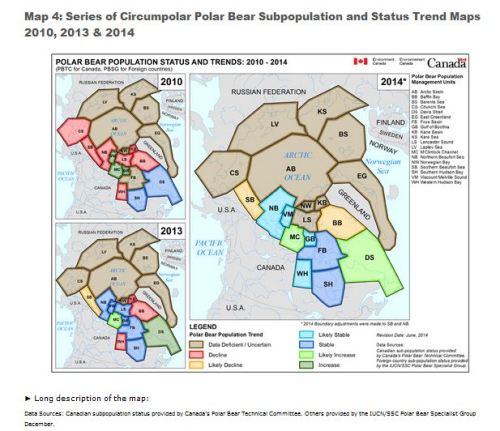
Because even the 2011 and 2016 Western Hudson Bay aerial surveys used somewhat different methods, the only population size numbers (subsets of each total) that can be compared are these:
2011 (949, range 618-1280)
2016 (842, range 562-1121)
The slight apparent decline over 5 years (11%) was not statistically significant (Dyck et al. 2017, pg. 3, 37) and is therefore equivalent to no change.
Similarly, when differences in methodology and statistical significance are taken into account, the estimate for 2016 cannot be said to be different from the 2011 estimate of 1030 bears (Stapleton et al. 2014), which was not statistically different from the estimate of 935 (range 794-1076) calculated in 2004 (Regehr et al. 2007).
‘Likely stable’ is probably the best way to characterize this result.
However, biologist Andrew Derocher has also been guilty of misrepresenting the facts on the Western Hudson Bay population status over the last few weeks:
Western Hudson Bay #polarbears decline >30% & Nunavut increases harvest quota. “almost impossible, to recommend” says Wildlife Director. pic.twitter.com/ogdqZ14HhW
— Andrew Derocher (@AEDerocher) November 3, 2017
And…
Aerial surveys ==> large confidence intervals & we'd need > 50% decline for statistical significance. Not precautionary management to wait https://t.co/cMw61Rwg71
— Andrew Derocher (@AEDerocher) September 14, 2017
— Andrew Derocher (@AEDerocher) September 14, 2017
And…
Western Hudson Bay #polarbear population dropped from 1030 bears to 842 over 2011-2016. 18% decline. Not “slight”. https://t.co/AoVSqWSQjw pic.twitter.com/tmlgYlZ3a1
— Andrew Derocher (@AEDerocher) September 14, 2017
Bottom line: The 2011 estimate of 1030 cannot be compared to the 2016 estimate of 842 (or to the 1987 estimate of 1200) because these numbers were generated using different methods. Lunn and Derocher know this: it’s their job to know. But it’s their job to honestly relay scientific facts to the public, not an interpretation of those facts they’d prefer to be true.
Ironically, all this hype is being promoted as Hudson Bay seems gearing up for the earliest freeze-up in decades (here, here, and here).
In the chart below, grey ice (dark purple) is thick enough for an adult male polar bear to walk on. The new ice could still get blown out into the bay if the wind is right (from the south) but that does not seem likely under conditions of freezing cold temperatures, snow, and west and northwest winds at Churchill (for 5-8 November).

Walrus misinformation

Here is Christopher Booker (The Telegraph, 4 November 2017) on the walrus nonsense being told by the BBC via its news body and its documentary series, “Blue Planet II”.
“… the BBC yet again [claimed] that Arctic ice is rapidly vanishing, supported on BBC News by a clip from David Attenborough’s Blue Planet II series, intoning that, among species most “seriously affected” by global warming, are walruses, showing hundreds of them desperately squeezing on to a melting ice floe.
But there are one or two little problems with this BBC version of the facts. First, far from Arctic ice vanishing, there has been no further downward trend in the extent of its summer melting since 2006. Its lowest point this September was higher than in seven of the past 11 years.
The US Fish and Wildlife Service has found that there are so many more of them than there were 30 years ago that last month that it decided not to list Pacific walruses on its endangered species list.
Secondly, far from walruses being “seriously affected”, an exhaustive survey by the US Fish and Wildlife Service has found that there are so many more of them than there were 30 years ago that last month that it decided not to list Pacific walruses on its endangered species list.
Thirdly, what produced that 2016 spike in CO2 and global temperatures was not “human activity” but the unusual warming of the Pacific Ocean by an abnormally strong El Niño. It is this warming that causes the oceans to “outgas” more CO2, not the CO2 that causes the warming: as even the BBC was told when, in July last year, its website quoted the Met Office under the heading “El Niño likely to boost CO2 in 2016”.
Since that El Niño ended, however, the latest Met Office data show that ocean temperatures have dropped sharply, with global surface temperatures back to where they were in 2002. Which is why the BBC’s reporting of all this last week could scarcely have been a better example of what it likes to scorn as “fake news”.
I couldn’t have said it better myself, except to add that Atlantic walrus, which the Blue Planet II folks filmed for their documentary, also show no evidence of being negatively impacted by climate change or sea ice loss so far.
Such disgraceful journalist practice is no better than the reaction of the CBC Radio here in Canada last month (4 October) to the news that the USFWS would not list walrus as ‘threatened.’
Instead of getting a scientist on to explain to listeners the science backing the decision, it had a spokesperson from the litigious Centre for Biological Diversity advocacy organization on the show to present a boring and quite predictable rant about why she disagreed with the decision. Of course she’s disappointed: she authored the document that forced the USFWS to consider the listing!
Bottom line: Have journalists forgotten how to do their jobs or do they really believe their opinions on certain subjects give them free license to ignore the ethics of their profession?
Actually, I could ask the same question about the polar bear specialists.
References
Dyck, M., Campbell, M., Lee, D., Boulanger, J. and Hedman, D. 2017. 2016 Aerial survey of the Western Hudson Bay polar bear subpopulation. Final report, Nunavut Department of Environment, Wildlife Research Section, Iglolik, NU. http://www.gov.nu.ca/environnement/information/wildlife-research-reports#polarbear
Lunn, N.J., Servanty, S., Regehr, E.V., Converse, S.J., Richardson, E. and Stirling, I. 2016. Demography of an apex predator at the edge of its range – impacts of changing sea ice on polar bears in Hudson Bay. Ecological Applications, in press. DOI: 10.1890/15-1256
Regehr, E.V., Lunn, N.J., Amstrup, S.C. and Stirling, I. 2007. Effects of earlier sea ice breakup on survival and population size of polar bears in Western Hudson Bay. Journal of Wildlife Management 71:2673-2683.
Stapleton S., Atkinson, S., Hedman, D., and Garshelis, D. 2014. Revisiting Western Hudson Bay: using aerial surveys to update polar bear abundance in a sentinel population. Biological Conservation 170:38-47. http://www.sciencedirect.com/science/article/pii/S0006320713004618#
Iran slams Saudi lies over Yemen missile strike
By Adam Garrie Adam Garrie | The Duran | November 5, 2017
Saudi Arabia and Donald Trump have both accused Iran of providing Yemen’s Houthi rebels with the missile that was launched at the Saudi capital Riyadh yesterday evening.
Saudi Arabia in particular, has accused Iran of supplying the Houthis with new missiles capable of longer distances than those previously thought to be in their possession.
However, Saudi’s accusation is inconsistent with the fact that Yemen is totally besieged from both land and sea.
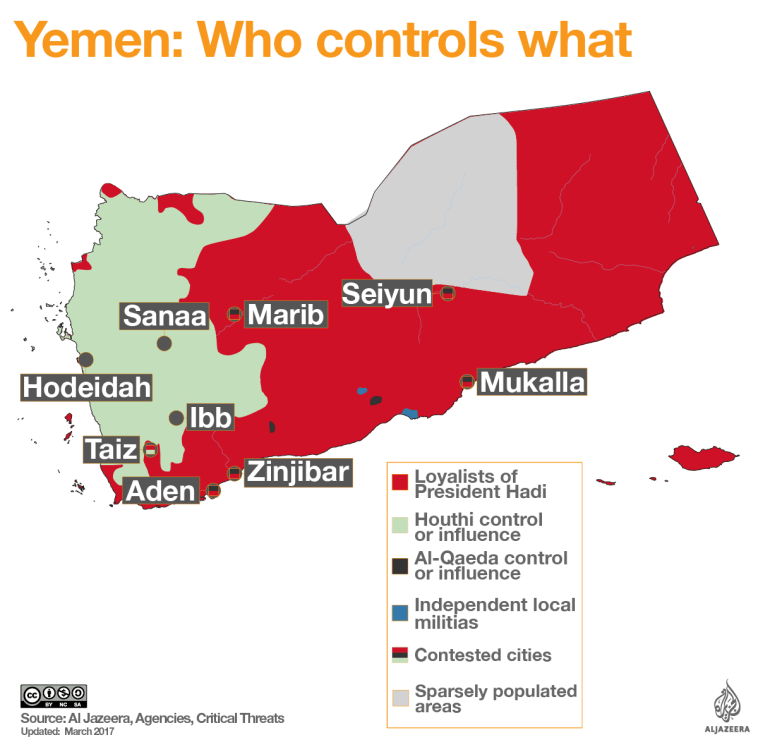
Yemen is bordered by Saudi Arabia and fellow Gulf Cooperation Council Oman, a state which would never allow shipments of Iranian weapons to Houthis and could not easily do in any case as Oman borders areas of Yemen controlled either by the pro-Saudi Hadi government or by anti-Iranian al-Qaeda and ISIS fighters.
Yemen’s north-west maritime borders have been cut off from the world, including from crucial medical and food supplies by a Saudi naval blockade that has caused a man-made famine and a cholera epidemic.
If the UN cannot even get foodstuffs past the Saudi blockade, it goes without saying that Iran could not get ballistic missiles to Houthi controlled areas.
The Houthis themselves claimed that they modified their missiles to achieve longer ranges, a claim which Iran acknowledges as the most likely scenario in respect of yesterday’s launch. Others have stated that the launch was a Saudi false flag, but as the Houthis themselves took credit for the launch and with video emerging which appears to back up Houthi claims, the only remaining credible scenario is that the Houthi fighters were indeed able to modify their missiles to reach Riyadh.
In any case, it would appear that Saudi’s US made defensive missile systems shot the Houthi rocket down, although some reports on social media from the Arab world contradict this.
At the end of the day, the facts hardly matter to the spokesmen and leaders of Saudi, Israel and United States who have all accused Iran of having a direct hand in the missile launch.
The fact of the matter is that while Iranian sympathies and limited support are certainly with the Houthis, the blockade means that this support amounts to very little in terms of material support, including and especially military support.
The facts on the ground and more important on the sea, dictate that accusations of Iran meddling in Yemen are de-facto baseless.
Unlike Syria, in which militants could be supplied on virtually all sides from ISIS controlled Iraq to the large Turkish border as well as the borders with Jordan and Israel, Yemen’s Houthis are not in any such position to be so easily supplied.
The fact that many in the media have conspired to hide this patently obvious reality means that one either is not engaging in honest journalism or one is simply repeating mythical Saudi claims.
Featured Video

Houthis Don’t Have to Conquer Saudi Arabia to Make It Pay
or go to
Aletho News Archives – Video-Images
From the Archives
A Lesser “Grade” of Human
By Michael Hoffman | Revelation of the Method | January 3, 2024
Will the more than 100 Iranians killed by terrorist bombs today be mourned in the West as victims of terrorism? Certainly not. Allied doctrine has it that the killing of Israeli or American civilians is a crime of cosmic proportions, while shedding the blood of “enemy” women and children is perfectly acceptable; indeed commendable.
The West does not memorialize the hundreds of thousands of civilians bombed by the U.S. in Serbia, Iraq, Afghanistan and every major German city 1943-1945. America’s fire-bombing of the city of Tokyo by General Curtis LeMay in March 1945 was followed by Harry Truman’s atomic incineration of Hiroshima and Nagasaki in August of that year. Truman never had a moment of doubt or regret over the murder of more than a 100,000 Asian children, mothers and non-combatant boys and men. It was business as usual for the “noble” Allies during the “Good War.”
In the West human rights signifies passionate concern only for civilians designated as truly human: Israelis first, then Americans and British, followed by their satraps.
This inhumanity is the legacy of Talmudic ideology, beginning with tractate Sanhedrin 57a from 400 A.D., concerning liability for capital punishment: “If a Jew murders a gentile, he is exempt.”
This teaching of contempt was reiterated in the dogma of Chabad Lubavitch founder Rabbi Shneur Zalman in the 18th century. … continue
Blog Roll
 Aletho News
- Houthis Don’t Have to Conquer Saudi Arabia to Make It Pay
- MOE: Nearly 22,000 Students and Education Workers Killed
- Guterres in Islamabad: Genocide, cowardice, and the cage of Imran Khan
- Johnson, Marandi say Yemen holds upper hand over Saudi Arabia
- False flags won’t save aggressors, Iran FM spokesman says
- The Makkah Pact Enters Into Force: The End of American Dominance or Its New Form?
- NATO’s top generals gather in Kiev
- EU’s continuing expansion – greater threat to Russia
- US Senator Murphy says Pentagon denied him entry to US base in Qatar
- Israel expands “incitement” charge to target Palestinian education and memory
- If Americans Knew
- Three Years of Genocide: How America’s Israel-First Media Filtered Out the Truth
- Israeli war chief briefs ministers on potential war against Palestinian Authority
- New Report: Israel Killed nearly 21,000 Palestinian Students and Education Workers in Past Three Years
- Israel’s flailing chatbot army
- Five Palestinians Killed, Others Injured by Israeli Fire in Gaza
- Israel is rewriting the Palestinian curriculum in East Jerusalem to erase Palestinian identity
- Three years of genocide: Israel turned prisons into killing grounds and torture sites
- Three years of genocide. Words fail. Daily Update
- ‘I’d rather die than go back’: A Palestinian teen’s 10-month nightmare in Israeli jail
- How Jared Kushner’s firm’s investment in an Israeli company could be a major conflict of interest
- No Tricks Zone
- New Study: 50 Years Of The Most Aggressive ‘Net Zero’ Policies Can Only Affect The Global Climate By 0.03°C
- US September “Heat” Was No Record…Many Records Set Decades Ago
- Latest European Green Energy Debacle; Portugal’s Largest Flagship Solar Park Insolvent!
- Green Energy Debacle: German Expert Professor Fritz Vahrenholt Warns Of Severe Economic And Social Consequences
- Two More Paleo Reconstructions Affirm Meters-Higher Sea Levels Across Ireland, Brazil 7000-6000 Years Ago
- New Study: Earth And Venus Surface Warmth Largely Explained By Convection And Lapse Rate, Not CO2 Or Radiation
- 2025 Nature Paper Claiming Worsening Global Drought Gets RETRACTED …Heavily Flawed
- New Study: ‘Global Drought Shows No Detectable Recent Acceleration Under Climate Warming’
- Economic Masterminds: German Socialists Suggest Taxing Productivity Gains Stemming From Using AI
- The South China Sea Has Not Been Cooperating With The Climate Change Narrative


