CNN’s ‘Exclusive’ Report on Russia Arming Taliban Debunked By Their Own Expert—Exposed as Propaganda
By Jay Syrmopoulos | Blacklisted News | August 3, 2017

Atlanta, GA – In just the latest example of CNN operating as a deep state propaganda outlet, on July 25, the cable news network published a bombastic report; releasing two exclusive videos intimating that the Russian government was covertly arming the Taliban, which has returned to significant prominence in Afghanistan since the 2014 cessation of NATO combat operations.
The large-scale anti-Russia propaganda operation, meant to indoctrinate Americans into a mindset that demonizes Russia as “the enemy,” and Putin as a dictator, has been pushed en masse to the American public at a steady rate since the end of the 2016 election cycle.
The explosive CNN report, which was widely reported across the media landscape, noted that two separate groups of Taliban fighters have received “improved weaponry … that appears to have been supplied by the Russian government.” The weaponry reportedly included Kalashnikov rifles, heavy machine guns, and sniper rifles. And while many of the weapons in the video appear to be of Russian origin, there is nothing to connect the Russian government to the weapons.
While the news made headlines and was shared widely across social media — the problem is that CNN’s report has lots of bark and no bite. Aside from a flashy headline, the report provided no evidence of the Russian government providing or transferring weapons to the Taliban. This was established according to weapons experts from U.S. Special Operations Command and several non-governmental conflict arms organizations.
“I’ve watched the video and frankly can’t see anything that is particularly unusual,” James Bevan, a weapons specialist, and director of Conflict Armament Research Ltd, told Task & Purpose in an email. “There are Russian weapons, and derivatives of those weapons manufactured in other states, circulating among state and non-state groups in every country in that region.”
According to the report by Task and Purpose :
The weapons experts consulted by Task & Purpose identified the weapons as Kalashnikov variants that have become pervasive among irregular forces; several U.S.-made M249 Squad Automatic Weapons that fire belt-fed 5.56×45mm NATO rounds, including a mid-90s variant with a long barrel and fixed rifle stock and the lightweight MK-49 paratrooper variant with a stub barrel; the TT-30 Tokarev pistol that’s been a staple of the Russian military since the 1930s, and the Soviet-made 7.62 mm general-purpose PK machine gun that’s been in service since 1961.
None of these weapons touted by the Taliban in the CNN video appear particularly modern, and all but the M249 are regular fixtures of the illicit small arms markets that accounted for 60 percent of the weapons flowing into and out of Afghanistan in the decades leading up to the U.S.-led invasion in the aftermath of the 9/11 terrorist attacks.
“I suspect after years in Afghanistan, these are easy to get,” Capt. Jason Salata, said.
Additionally, the CNN report never establishes any type of chain of custody between Russia and the Taliban. Perhaps more importantly, they never noted that one of the Taliban groups had pillaged the equipment from a rival Taliban faction, while the other received a shipment of arms from across the Tajikistan border. CNN admits that the videos presented as “suggesting” a link between the Taliban and Moscow “don’t provide incontrovertible proof of the trade.”
Yet, somehow, they still attempt to stir the anti-Russia media pot and suggest the weapons could be the work of the Russian government. In reality, however, these types of weapons are readily available on the black market across the globe.
“There is nothing immediately visible to suggest the weapons are new or any indication (from the footage) that they are all of the same type and origin,” according to Bevan. “Governments that supply rebel and insurgent forces rarely supply new weapons and frequently refrain from supplying their own weapons stocks. This makes any connection between the manufacturing country and the supplier country problematic.”
Thus the CNN report, which notes that the weaponry appears “stripped of any means of identifying their origin,” essentially relies on the claims of a few Taliban members as the basis for the entire report.
“Unfortunately, CNN did not fully profile erased markings and other efforts to sanitize the weapons,” Bevan added. “This would be a clear indication of organized, state involvement, but also would be unlikely to incriminate any party without further evidence.”
In typical propaganda fashion, every arms expert in the CNN story was a Pentagon or Afghan government official, except for Benjamin King from the Small Arms Survey independent research group, who bluntly told CNN that the photos and videos he was given to analyze contained virtually no evidence of a recent arms transfer, let alone being able to attribute it to a specific state – such as Russia.
“[CNN] made some jumps that you certainly can’t make from the weapons themselves,” King told Task & Purpose. “I certainly wouldn’t have made the claim that they were new imports. The generic Tokarev pistols and PK machine guns are old and could have been there for a long time. One of the rifles was an AK-74, so it could have been there for the last 40 years or so.”
Of course, the U.S. military need only look in the mirror should they want to understand the flow of foreign armaments into Afghanistan, as a declassified Pentagon audit from 2016 revealed that almost half of the 1.5 million firearms supplied to the Iraqi and Afghani military, including almost 1 million M4 and M16s, have turned up ‘missing’ due to shoddy record keeping and regulations.
Even more damning, in 2014, the Special Inspector General for Afghanistan Reconstruction released a report that found that nearly 43% of arms provided to the Afghan National Security Forces likely ended up in the hands of ISIS or the Taliban.
In just the past few weeks, American and Afghan military personnel have faced off with modern weaponry and equipment in enemy hands. Afghan security forces are increasingly facing off against Taliban fighters armed with M4 carbines outfitted with night vision, infrared laser sights and Advanced Combat Optical Gunsight scopes, according to a July 25 report in the Military Times.
Additionally, a recent propaganda video released by the Taliban appeared to show an FN SCAR (Special Operations Forces Combat Assault Rifle) 7.62mm rifle decked out with a AN/PEQ 5 visible laser, which was likely procured during an ambush or raid on a weapons depot.
“Afghanistan is swimming in guns,” King told Task & Purpose. “These things are expected to show up everywhere.”
Many of these weapons are not Russian made, but instead, are usually deployed by Western militaries — and, like everything else in Afghanistan, they end up in Taliban hands sooner rather than later.
But CNN’s report conveniently fails to mention any of this, and attempts to prop up the demonization campaign against Russia, as a likely pretext to gain public support in the methodical and ongoing movement towards a direct conflict with the Russia.
The Israelization of the Middle East Quagmire in the US Media
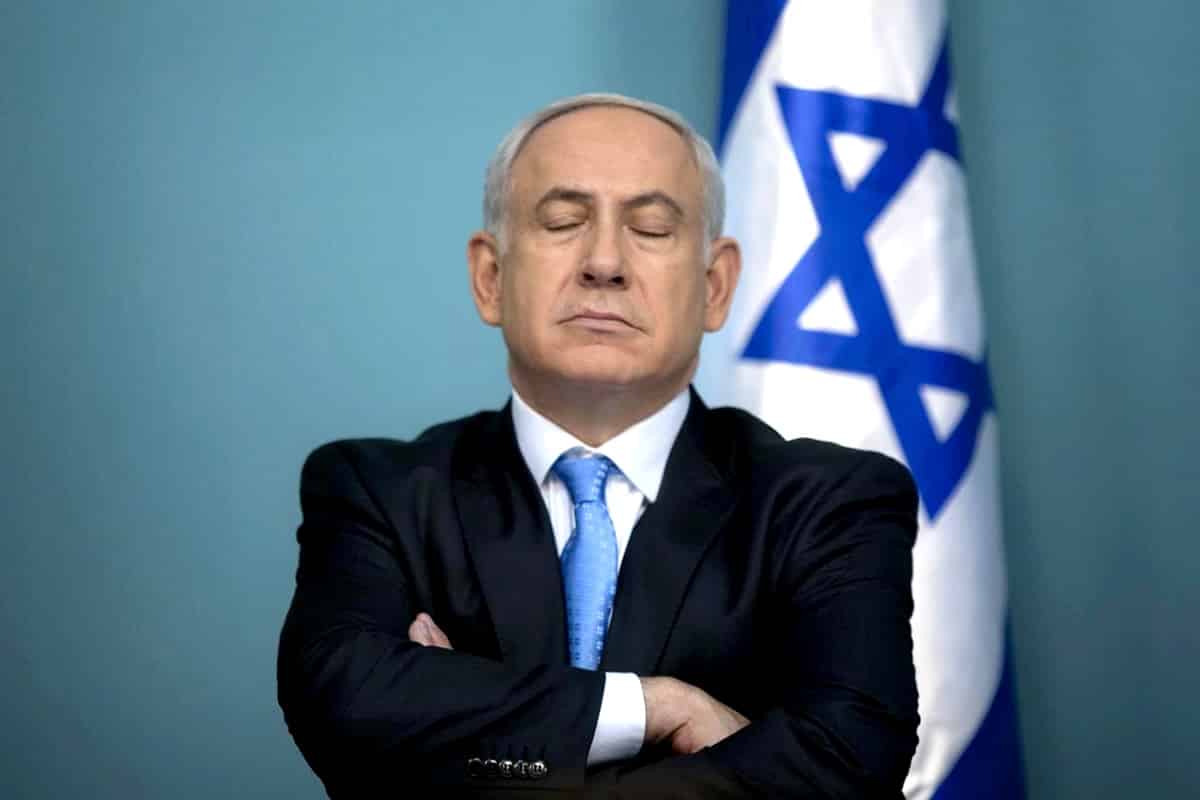
Like other Israeli leaders who preceded him Netanyahu is both an extremist and a terrorist, not to mention a proficient and shameless liar. No American paper or television channel will dare criticize him. He’s the only leader invited to openly propagandize the US Congress.
By M. REZA BEHNAM | Greanville Post | August 2, 2017
Not only is Israel waging a military campaign in the occupied territories, but a second battle is being waged through the American media to ensure continued U.S. support for its expansionist policies.
Israel’s colonizing aims, begun in the 1900s, were laid out in the doctrine of Vladimir Jabotinsky, founder of Revisionist Zionism, now the ideological cradle of today’s ruling Likud Party.
In his writings, “The Iron Wall” and “The Iron Law,” Jabotinsky set out the Zionist rationale for carving a Jewish state out of most of Palestine through force. He wrote, “Zionism is a colonizing adventure and therefore it stands or falls by the question of armed force.
“It is important to build, it is important to speak Hebrew, but unfortunately, it is even more important to be able to shoot. …”
When the 1947 United Nations Special Committee on Palestine partition plan granted 55 percent of Palestine to the future Jewish state, Jews owned 6 percent of the land in Palestine, but they made up only 32 percent of the population. After the 1948 Arab-Israeli war, Israel expropriated approximately 4.2 million acres of Palestinian land, about 78 percent of historic Palestine.
The dispossession continues today, with settlement enterprises covering about 42 percent of the remaining 22 percent. Palestinian cities, towns, homes, orchards and businesses have been systematically destroyed and repopulated by more than 650,000 illegal Jewish settlers.
Israel’s defenders say that the causes of violence go far back in history. However, the raison d’etre of Palestinian violence is not rooted in some inherent hatred of Jews, or historical animosity, or religion. It is about the land.
Without this historical context, today’s news events seem episodic and inconsequential.
After the 1967 Six Day War, Jewish organizations undertook a propaganda campaign to ensure Israel’s legitimacy and cement its relationship with the United States. It included the conflation of Israel with the Holocaust and victimhood and the writing of a mythical history of Palestine as an unpopulated desert that “good” Israelis made bloom.
That uncontested and false tale reverberated in Prime Minister Golda Meir’s outrageous 1969 claim that, “There was no such thing as a Palestinian; they never existed.”
In 1982, the narrative changed with Israel’s invasion of Lebanon. The indiscriminate bombing of Beirut and the death of more than 17,000, mostly civilians, turned the Arabs into victims and the Israelis into victimizers and temporarily sullied the carefully crafted story.
To regain control of public opinion, the American Jewish Congress sponsored a 1983 conference in Jerusalem with the goal of devising a strategy for reselling Israel. Top executives, journalists and academics from Israel and the United States developed talking points that are recognizable in today’s rhetoric, which stresses the following ideas:
* Israel’s strategic importance to the United States.
* Israel’s physical vulnerability.
* Israel’s shared cultural values with the West.
* Israel’s desire for peace.
Participants also understood the importance of an all-out campaign to convince the public that Jewish settlements in the West Bank are not an obstacle to peace. Thousands of illegal Jewish settlements constructed on Palestinian land are a testament to the effectiveness of that strategy.
The conference also produced the Hasbara (propaganda) Project. Its goal was to guarantee that the United States did not waver in its economic and military support, and to make it almost impossible to critique Israel’s actions.
News organizations have come to expect pressure if they go outside the level of acceptable discourse regarding Israel. Hence, they avoid potentially troublesome subjects and punish journalists who expose them. For example, Ariel Sharon, then minister of defense, filed a libel suit after Time magazine accused him of encouraging the massacres at the Sabra and Shatila refugee camps in Lebanon. The lobbying group Americans for a Safe Israel filed a petition with the Federal Communications Commission requesting that NBC’s license be revoked over its reporting of the invasion.
Israel, the size of New Jersey, has an estimated defense budget of $20 billion. It has 4,170 tanks, 1,500 large artillery pieces, 10,185 armored fighting vehicles, 2,000 combat airplanes, 15 to 20 warships, five submarines, 200 to 300 nuclear weapons, 175,000 regular troops and 430,000 reserves.
CBS faced much the same criticism in 2012 after correspondent Bob Simon’s “60 Minutes” report about Palestinian Christians living under Israeli occupation aired. The report challenged the Israeli narrative that Islamic extremists were making Christians’ lives difficult; instead, they complained about the hardships of living under occupation.
The American-born Israeli ambassador, Michael Oren, pressured the president of CBS News to quash the program. It aired only after the ambassador received the time he demanded for a rebuttal. A full-page advertisement in The Wall Street Journal excoriated Simon.
Alternative narratives such as Simon’s are often dismissed as anti-Israel or given the most intimidating and feared of all labels — anti-Semitic. The fear of this slur has been a potent rhetorical device to shield Israel from fault, and has proven fatally effective. The accusation has destroyed the careers and reputations of journalists, academics, politicians and entertainers.
Helen Thomas, a respected member of the Washington press corps, had her 57-year career end after she publicly questioned U.S. support for Israel. An onslaught of well-orchestrated denunciations forced her retirement in 2010. Thomas later remarked, “You cannot criticize Israel in this country and survive.”
President Jimmy Carter, before and after publication of his book, “Palestine: Peace Not Apartheid,” received his share of intimidation and vitriolic accusations of anti-Semitism. Ran Baratz, communications director appointee for Prime Minister Benjamin Netanyahu, accused President Obama of “modern-day anti-Semitism” after the United States reached an agreement with Iran on its nuclear program in July 2015.
Masterfully, Israel has marketed a number of myths that have become a part of the media lexicon. One of the most glaring fabrications sold to Americans is that the struggle is between two peoples with equal resources and claims. In reality it is a conflict between the colonizer, Israel, and the colonized, Palestinians.
Israel, the size of New Jersey, has an estimated defense budget of $20 billion. It has 4,170 tanks, 1,500 large artillery pieces, 10,185 armored fighting vehicles, 2,000 combat airplanes, 15 to 20 warships, five submarines, 200 to 300 nuclear weapons, 175,000 regular troops and 430,000 reserves.
Palestinians have none of these. And unlike Israel, Palestinians have few organized groups to tell their story or to lobby for them before the U.S. Congress. Yet Tel Aviv continues to perpetuate the myth of vulnerability.
Another persistent fallacy is that of gratuitous violence. Words matter; they manage perceptions.
Violent Jewish settlers are referred to as extremists, while Palestinians reacting to occupation are called terrorists. Palestinians “attack,” while Israelis merely “retaliate.”
With a compliant U.S. press, Israel’s propaganda network has successfully linked the terrorist attacks of Sept. 11, 2001, in the United States to Palestinians’ continued rebellion in the territories.
In 2015, Netanyahu suggested a relationship between the carnage in Paris and the Palestinian struggle for freedom, saying “Behind these terrorist attacks stands radical Islam which seeks to destroy us, the same radical Islam that struck in Paris and threatens Europe.”
In another unchallenged remark, the prime minister contended that “ISIS and Hamas are branches of the same political tree.” Whatever one may think of Hamas, it is not the Islamic State. It is an internal resistance movement in a singular battle with Israel.
The association of terrorism with Arabs, Muslims and the Middle East has created an unhealthy climate of indifference and fear in many Americans’ minds.
The media are replete with anti-Arab stereotypes, exemplified by the popular TV program “Homeland,” based on the Israeli series Hatafim (Prisoners of War). Middle Easterners rarely are presented in their full humanity, making them vulnerable to aggression. Racist remarks and vitriol directed at Muslims have become acceptable political theater and commonplace in the rhetoric of some American politicians.
News organizations unquestionably proffer another fiction: that Washington has been an “honest and neutral” interlocutor in Palestine-Israel peace negotiations.
Israel’s viability has been based on the $500 billion in aid it has received from the United States since 1949 and the $6 billion it continues to receive annually. American administrations have vetoed all but one U.N. Security Council resolution critical of Israel. Essentially, the United States has been financing the occupation and rewarding colonial policies.
America has more often than not been an obstacle to peace because of its bias in favor of Israel. The 2000 Camp David meeting is a poignant example. The press praised Prime Minister Ehud Barak for proposing the “most generous offer ever made” to the Palestinians while rebuking President Yassir Arafat for failing to accept Barak’s offer.
Had the press published maps, the prime minister’s proposed Palestinian state would have looked like a collection of balkanized enclaves. All Jewish settlements and roads in the West Bank would remain, and Israel’s control over Palestinian borders, air space and water would stay intact. Palestinians would have been encircled by hundreds of thousands of Jewish settlers on small disconnected islands, or Bantustans, much as they are today.
To further understand the imbalanced standard of reporting, it is useful to look at whose voices are heard.
Pro-Israeli syndicated columnists Thomas Friedman, Charles Krauthammer, George Will, Jonah Goldberg, Max Boot and David Brooks — whose son serves in the Israeli army — dominate newspapers’ op-ed pages. Wolf Blitzer was the editor of the American Israel Public Affairs Committee’s journal Near East Report before joining CNN as its chief political anchor. Such prominent magazines as The New Republic, Atlantic Monthly and Commentary are Israel-centric.
The occupation — with its curfews, 500 checkpoints and harassment by the Israeli army — has made access by journalists to the Palestinian experience almost impossible.
The Committee to Protect Journalists lists the West Bank as one of the worst places to be a journalist. Palestinians who are allowed on rare occasions to speak or write in the mainstream media have to use language acceptable to Israel and America.
Israelis who oppose their government’s policies are excluded as well. Ignored are the growing number of Israelis refusing military service in the occupied territories.
One such group, Breaking the Silence, founded in 2004, has published the chilling stories of abuse and devastation told by 700 former soldiers who served in combat units in the West Bank and Gaza. Peace movements such as Women in Black — Israeli women who gather every Friday on main squares in some cities with signs that read, “Stop the Occupation” in Arabic, Hebrew and English — have received inadequate coverage in the United States.
News companies give little attention to how the rest of the world has responded to the occupation.
The global human rights campaign represented by the Boycott, Divestment and Sanctions movement is growing internationally. The European Union recently announced that some goods produced on land seized by Israel in the 1967 war must be labeled “made in settlements.”
A Palestine Media Watch survey of The Wall Street Journal, The New York Times, Los Angeles Times, The Washington Post and USA Today revealed that of 680 op-ed columns on Palestine and Israel published between September 2000 and December 2005, 214 were written by Israelis and 86 by Palestinians.
A 2004 study of the Associated Press coverage disclosed that Israeli children’s deaths were covered at a rate of 7.5 times greater than Palestinian children’s deaths.
A six-month study of The (Portland) Oregonian by Americans United for Palestinian Human Rights observed that its headlines had reported Israeli children’s deaths to Palestinian’s at a rate of 44 to 1.
The treatment of Palestinians in Israeli prisons is hardly ever reported. The number of Palestinian political prisoners per capita is the highest in the world. More than 9,000 Palestinians are imprisoned by Israel (4,000 without trial). Amnesty International and numerous human rights organizations list torture in Israeli prisons as a major concern.
The right of return for millions of Palestinian refugees, the unequal allocation of water resources, the concrete wall of separation built on Palestinian land are among the myriad of crucial but unexplored news stories.
The media’s tone deafness to the Palestinian condition has contributed to Americans’ support of policies that are contradictory to their interests. Uncritical U.S. support for Israel has fueled anti-Americanism and radicalism throughout the Middle East. What is best for Israel has not always been best for the United States.
American government officials and media rarely ask whether Israel is strategically important to the United States as was once believed during the Cold War years. Close scrutiny suggests it is not.
Gen. David Petraeus, while head of the U.S. Central Command, told the Senate Armed Services Committee in March 2010, “The enduring hostilities between Israel and some of its neighbors present distinct challenges to our ability to advance our interests in the AOR (Area of Operations). …
“The conflict foments anti-American sentiment, due to a perception of U.S. favoritism for Israel. Arab anger over the Palestinian question limits the strength and depth of U.S. partnerships with governments and peoples in the AOR. …”
The Anti-Defamation League was so alarmed by the general’s testimony that it issued a statement condemning it.
News organizations must be held accountable for their lack of skepticism and reliance on officially constructed realities. Journalism functions best when it questions and challenges power.
American politicians and journalists must wake up to the fact that the strife in the Middle East is rooted in the Western and Israeli colonial and imperialist policies of the past and present. Unless acknowledged and reversed, anti-American sentiment and the tumult will continue unabated.
The urgency to speak up and to witness the corrosive reality of the occupation of Palestine and to address its ethical dimensions is greater than ever.
Inside and outside of Israel, neutrality and silence in the face of injustice is not an option.
M. Reza Behnam, Ph.D., a scholar specializing in the politics and cultures of the Middle East, is the author of the award-winning book, “Cultural Foundations of Iranian Politics.”
Trump Battles the CIA: The Korea Ban & Bad Signs in the Market
By Caleb Maupin – New Eastern Outlook – 02.08.2017
The ban on travel to the Democratic People’s Republic of Korea is primarily an attack on the people in the northern part of the Korean Peninsula. It is a move to further isolate the DPRK, and prevent tourist dollars from flowing in, while also preventing fraternization between Americans and citizens of the country. However, the State Department’s decision also has another target in the crosshairs, one much closer to Washington DC.
According to reports in the press, roughly 5,000 US citizens visit the DPRK each year. Most are tourist youth attracted to the mystique and adventure of traveling to a country so widely demonized in the US media. Communist organizations send political delegations and Christian sects such as the Mennonites often send missionaries and aid workers. However, one can be sure that among the 5,000 people who visit the country each year is more than a few American spies, posing as tourists.
When one looks over the recent history of Americans being arrested in North Korea prior to the tragic death of Otto Warmbier, the reasons for the arrest almost always indicate activities that could be described as espionage. Merrill Newman, for example, was a former member of the US military’s “White Tigers” division during the Korean War. The 85 year old man was arrested in the DPRK as he wore a ring with the insignia of this anti-DPRK fighting and intelligence unit. After being arrested he confessed to participating in some of the war crimes against the Korean people during the 1950-1953 war. Newman stated “I did not realize North Korea was still at war” after his eventual release.
The State Department ban on travel to the DPRK is far more extreme than the widely challenged ban on travel to Cuba, enacted as part of the blockade. Officials say that any American who visits DPRK will automatically have their passport invalidated. The constitutionality of such an extreme ban is likely to be challenged.
In the meantime, however, any efforts by the CIA to gather information inside North Korea, or to manipulate or maneuver within its internal affairs, are greatly limited.
Two divisions of the US Federal Government that have long been at odds in issues of foreign policy have been the military and the Central Intelligence Agency. The nature of the two entity’s work lays the basis for their constant disagreement and conflict. The new State Department policy has essentially declared that the DPRK will be handled with military operations, not with “color revolutions,” plots of a coup, manipulation of the youth, or the other shenanigans carried out by the intelligence agencies.
A Longstanding Fight – CIA vs. Pentagon
The US military brass is trained at West Point, and though a great deal of history and background is provided, the focus of their training is military science and the “art of war.” Meanwhile, the Central Intelligence Agency’s administrators come from Harvard, Yale, and Princeton, and are trained in the subtle art of expanding US influence and quietly neutralizing those who challenge it.
The favorite word of those who extol the military and disfavor the CIA is “strength.” The strategies favored by the Pentagon involve demoralizing opponents of US power with “shock and awe” style crushing of enemies. The mass bombing campaigns in Vietnam and Korea did not win credibility and respect for the US internationally, and this was not their intention. The same can be said for Bush’s unilateral invasion of Iraq. The Pentagon does not concern itself with winning friends and influencing people, but with blowing things up, and its favored foreign policy reflects this.
The CIA, on the other hand, tends to favor soft power, negotiations, and internal subversion of global rivals, all done covertly, with the USA looking like a benevolent “Mr. Nice Guy” on the surface. The CIA favors arming and training third party proxies to fight their enemies, while waging a fierce battle in the field of public relations and propaganda.
The clash between the military and the intelligence agencies has played out dramatically in recent US history. It is widely understood that John F. Kennedy began enacting policies that overwhelmingly favored the CIA prior to his death. Kennedy resisted the efforts to escalate military involvement in Vietnam, while funding and emphasizing CIA-linked operations like the Peace Corps. Kennedy’s often quoted the phrase “those who make peaceful revolution impossible make violent revolution inevitable” stated the CIA’s exact strategy for fighting Communism during the Cold War. The CIA favored “reforms” in US aligned third world regimes that made Marxist-Leninist revolution less appealing, while also presenting the US as a benevolent, charitable country that did not seek to intervene in other countries domestic affairs. The CIA worked to make sure that the hands of the USA during the rise of military dictatorships and the toppling of pro-Soviet world leaders were well hidden.
Prior to Kennedy’s assassination, a hard, right-wing mass movement against him, involving the John Birch Society and many Pentagon linked political figures, called the “Camelot” President a traitor and Soviet agent. Many sections of the military thought Kennedy’s “soft power” strategy for confronting Communism, and his ultimate refusal to invade Cuba with US troops after the CIA’s failed “Bay of Pigs” operation, showed weakness. Films like “Dr. Strangelove” widely mocked the well-known fanaticism of the military brass, which distrusted the intelligence agencies and the ability of politicians to make military decisions. Kennedy’s subtle alliance with the Civil Rights Movement, though inconsistent and widely criticized by activists, also threatened a military brass packed with the sons of wealthy southern families.
After the death of Kennedy, the US military seemed to be on top in the power struggle. Richard Nixon’s electoral victory in 1968, and his “secret plan” to win the Vietnam War with massive bombing, showed the military and its allies as the dominant force in setting policy.
But the demoralizing and unpopular war in Vietnam reversed this by the mid-1970s. Nixon found himself listening and depending more on the advice of Henry Kissinger, opening relations with the People’s Republic of China, and eventually being driven from office. Jimmy Carter took office in 1976 calling himself a “student” of CIA strategist Zbiegniew Brzezinski. Under Reagan, the CIA got stronger, with CIA chief George H.W. Bush rising to be Vice President and eventually Reagan’s successor as commander-in-chief.
The often repeated narrative that the US military’s escalation of the arms race was the key factor in defeating the USSR is said with absolute defensiveness by the Pentagon’s right-wing allies. Though the “strong man Reagan” explanation is more widely understood among the US public, within the circles of power in the USA, the CIA takes more credit.
Under the direction of Brzezinski, who boasted that he “gave the USSR a Vietnam” by funneling money and weapons to insurgents in what he called the “Afghan trap,” the CIA manipulated political situations in Eastern Europe causing unrest and a crisis that eventually toppled the USSR. The CIA widely credits itself for terminating the Soviet Union by manipulating internal problems and applying less blatant forms of external pressure.
The CIA is not a “Conservative” Organization
Many leftists and anti-war activists assume that the CIA is staffed with jingoistic conservatives due to the nature of the job. While the rank-and-file of “the company” may attract a more rightist crowd of Mormons and military types, the leaders of the CIA are not conservative in any sense of the word.
John Brennan, the director of the CIA under Barack Obama admits that he voted for Communist Party Presidential Candidate Gus Hall in the 1976 Presidential election. Brennan was stationed in Riyahl for many years, and at the time of his appointment, many voices came forward to allege that he had actually converted to the Wahabbi brand of Islam. The allegations remain unproven.
The CIA strategist who was most influential between the 1960s and the 1990s was Zbiegnew Brzezinski. To call Brzezinski conservative would be deeply mistaken. Zbeignew’s daughter, Mika Brzezinski is a host on liberal leaning MSNBC’s TV program “Morning Joe.”
Brzezinski developed the art of propaganda, presenting the USA to the world as the homeland of Beatles Music, the paintings of Jackson Pollack, and sexual hedonism. In Eastern Europe, Brzezinski’s policies convinced millions of alienated young people that overthrowing the Marxist-Leninist governments would transform their countries into Disneyland playgrounds packed with consumer goods and never ending rock and roll concerts.
In Afghanistan, Brzezinski worked with a young Saudi billionaire named Osama Bin Laden to fight against the People’s Democratic Party. With US made weapons and funding, complimented by heroin revenue, the insurgents poured acid on women’s faces and hanged literacy campaign volunteers. Brzezinski’s slick propaganda work convinced the world that these Wahabbi extremists were actually Che Guevara-esque freedom fighters, battling the “Soviet Empire” for freedom. CBS news was even caught airing staged, fake battle footage.
The figure known as George Soros has become a favored talking point of right-wing activists in the USA. They present him as the sinister bank-roller of leftist activism. Long before Soros was promoting Democrats and Liberals in the USA, he was bank-rolling CIA supported anti-Communist “color revolutions.” Soros is known to have funded anti-communist, pro-capitalist and pro-western protest movements in the USSR, Czechoslovakia, Yugoslavia, and elsewhere.
During the Cold War, the CIA launched a program called the “Congress for Cultural Freedom.” The program funded the art of Jackson Pollack, as well as the Trotskyist magazine Partisan Review. The CIA also launched a project called MK-Ultra which involved distributing hallucinogenic drugs on college campuses.
Obama’s Administration – The White House Stood With Langley
Barack Obama’s grandparents were prominent executives of the Bank of Hawaii. Obama’s grandmother Madelyn Dunham, actually became the first female Vice-President of the bank. The Bank of Hawaii was key in transferring money to US intelligence operations across Asia.
Obama’s mother, Ann Dunham, was married to Lolo Soetoro, a figure in Indonesia who openly supported the 1965 CIA backed coup d’etat against President Sukharno. Soetoro eventually became a military officer under US backed dictator Suharno. It should be noted that the 1965 coup, which Obama’s grandparent’s Bank of Hawaii was involved in financing, was particularly bloody, and involved mass slaughter of ethnically Chinese people. Some estimate that as many as 500,000 people died.
Obama’s family connections aside, his Presidency was very much favorable to the CIA’s strategy for international relations. Obama’s middle name is Hussein. He attended an Islamic elementary school as a child. Long before becoming President, Obama famously had a meeting with Palestinian scholar Edward Said. He maintained a hostile war of words with Israeli Prime Minister Benjamin Netanyahu.
One is reminded of how Napoleon Bonaparte sent out proclamations saying he was a Muslim as he attempted to seize Syria and Egypt for France. To the Arab world, a key region in US foreign policy strategy, Obama gave the illusion of possibly being a Muslim and an ally against Israel.
The fact that a dark skinned man, whose middle name was “Hussein” occupied the White House probably played a key role during the Arab Spring. The uprisings of youth in Islamic countries did not become a repeat of the 1979 Islamic Revolution of Iran, where western capitalism was replaced by a government proclaiming “war of poverty against wealthy” and “Not capitalism but Islam.”
The USA was able to maneuver within the Arab spring to topple the Islamic Socialist government of Libya, and to reduce the Baath Socialist country of Syria to civil war and chaos. Meanwhile, the US backed autocracies in Saudi Arabia, Bahrain, and elsewhere remained thoroughly intact. The continuation of the Yemeni revolution against a pro-Saudi regime now faces an onslaught of bombs and foreign troops.
The establishment of diplomatic relations between the USA and Cuba, with friendly words while intel operatives worked behind the scenes to plot social media unrest with a “Cuban Twitter,” fits the CIA playbook and strategy completely. The JCPOA negotiations with Iran fit into a similar strategy.
In the final weeks of the Obama administration, desperate “Mr. Nice Guy” maneuvers to increase the credibility of the USA on the global stage were carried out. John Kerry gave a speech criticizing Israel, and the US did not protect Israel from a harshly worded resolution at the UN Security Council.
Trump Stands With The Pentagon
Even before Trump took office, his presidential campaign was loaded with subtle hostility to the CIA. Trump castigated the results of US foreign policy, specifically in Syria and Libya where the CIA had been instrumental. During his debate with Hillary Clinton he criticized the funding of rebels in Syria. He repeatedly said that the policies of Obama and Secretary of State Hillary Clinton had created ISIS.
Trump repeated perspectives that would be popular with the military. The key word repeated in Trump’s foreign policy speeches was “strength.” The idea that a huge military budget and direct military interventions make the USA look stronger as a country has long been a talking point of the military brass, against proponents of soft-power and subtle influence.
At times, Trump seemed to be contradictory when talking about foreign policy. It is no secret that among rank-and-file soldiers, and the white, working class, rural communities they often originate in, right-wing isolationist sentiments are widespread. Trump appealed to those sentiments when talking about the bad results of “toppling regimes” and employing the slogan “America First.”
At the same time, he appealed to the Pentagon’s calls for strength, saying that Obama’s “red line” around chemical weapons had “meant nothing.” It may sound contradictory to favor isolationism, while criticizing a president for not making good on threats to attack a country, but it fits into his overall appeal to sentiments within the military.
At the same time that Trump critiqued foreign policy and echoed isolationist talking points, he consistently called for an increase in military spending. In Trump’s foreign policy rhetoric, the isolationism of rank and file soldiers, the Generals’ lust for strength, and the military-industrial complex’s desire for more profits were all re-assured.
The spat between Trump and the CIA is no secret, and is widely acknowledged, even in mainstream US media. The intelligence agencies continue to repeat, without proof, that Trump received assistance from “Russian meddling” in the 2016 elections. A series of leaks from within the administration have found their way to the press.
The Trump administration fought back first by dramatically crippling the CIA’s operations in the Middle East. The executive order banning travel from 6 countries was widely called a “Muslim ban” in the US press. In reality, it targeted all citizens, Muslim or not, from 6 specific countries. (Note: The ban originally included 7 countries, but Iraq was removed from the list.)
Sudan, Iran, Syria, Yemen, Libya, and Somalia are all the site of ongoing conflicts, and in each of these countries US intelligence agencies are working to influence and coordinate with certain forces. As was pointed out by an opponent of the ban on FOX news, the “travel ban” prevents the CIA from rewarding those who do its bidding with visas. A key “soft power” bribe has been taken away from the CIA for its operations in the Middle East.
Trump ultimately shut down the CIA’s training program for anti-government fighters in Syria, according to reports. Trump has accused Obama of wiretapping him during the Presidential campaign.
Trump has even discussed designating the Muslim Brotherhood, an organization that works closely with the CIA around the world, as a Foreign Terrorist Organization. The Muslim Brotherhood was key in undermining and fighting against Arab Socialism during the cold war. More recently, the Muslim Brotherhood was key in aiding US activities to manipulate the Arab spring, and the create turmoil in Libya and Syria.
The Turkish government, which draws its support from the Muslim Brotherhood, is far less friendly to the United States than just a few years ago. The current spat between Saudi Arabia and the Muslim Brotherhood-supporting state of Qatar may reflect difference within the power structure about relations to the Muslim Brotherhood and its use in the fight against independent governments.
Despite presenting himself as an isolationist, Trump ultimately did what Obama was unwilling to do, and launched direct US attacks on the Syrian government. Many in his base were furious, and even longtime hawks like Ann Coulter denounced Trump’s move. However, the more well connected members of the Republican establishment praised it, using the military’s favorite word, calling the bombing a demonstration of “strength.”
As Donald Trump remains President of the United States, the press is solidly against him. This should be no surprise as the US Central Intelligence Agency, not the Pentagon, is primarily involved with influencing media. From the days of “Project Mockingbird” to today, the CIA works very hard to influence and craft public opinion, especially on issues of foreign policy. The flow of ‘anonymous leaks’ from the intel community into the press reflects the longstanding relationship between the intelligence agencies and the media.
The Specter of Economic Crisis, Greatest Danger to Trump
 Right now, spending in the USA is down. Wal-Marts are shutting their doors, and suburban malls, which employed thousands, are becoming a thing of the past. The post-2008 “new normal” of low wage retail jobs replacing good paying jobs for the next generation is rapidly fading away, as retail itself is being pushed aside by online shopping. Jeff Bezos outstripped Bill Gates as the richest man in the United States in terms of directly traceable assets.
Meanwhile, home ownership is still declining. The basic ability of American families to own houses has widely been eroded, home ownership has not been restored to anywhere near the pre-2008 levels. In neighborhoods across the USA, family homes are not being resold to American families, but to renting institutions.
As property values remain low and home ownership drops in suburban and rural areas, another aspect of the “new normal,” the “prosperous urban centers” hopping with young workers in high tech jobs, are also seeing a new decline in property values. Unemployment is low, but so are wages.
In the unfolding atmosphere of eroded spending power and decreasing incomes, banks in the USA are now cutting back lending. When banks stop lending, it is generally based on an understanding that bad times are ahead and they may not be able to collect.
Between 2000 and 2008, Alan Greenspan and the Federal Reserve did everything possible to hold off a crash. Greenspan legalized all kinds of previously illegal credit card and housing mortgage lending, in order to keep the US public spending money they did not have. While the spending power of the US public was drastically reduced by deindustrialization, automation, and shifts in the global economy, Greenspan spent his final years working tireless to keep sales up. Many will recall how George W. Bush urged Americans who wanted to help their country in the aftermath of 9/11 to “go shopping.”
Greenspan’s maneuvers worked only until 2008. With deregulated banking laws, Americans could keep buying houses and maxing out their credit cards, keeping the economy that faced turmoil from 2001 afloat, until the “bubble burst.”
Alan Greenspan was a high ranking member of the Council on Foreign Relations, a think tank often described as “the CIA’s brain.” He did not make his decisions in isolation, but most likely consulted with other figures in the intelligence community about the need to hold off the crisis as long as possible. Greenspan’s decision to legalize credit and keep the public spending, and temporarily hold off the crisis, was not a decision he made by himself.
As the economy crashed and burned in 2007 and 2008, Bush and his cronies, widely viewed as soft on big money, packed their bags, and Barack Obama was able to ride to the White House almost on a white horse, presented as the savior who offered “hope and change.” Greenspan’s efforts did not prevent a the financial crisis, but enabled it to come at a more convenient time, with less political fallout.
However, the political situation facing the USA is far different today. The intelligence community and a large section of the rich and powerful are adamantly opposed to Donald Trump’s presidency, there may not be any specific motivation to work to hold off a financial catastrophe.
If a financial crash were to occur again, Donald Trump would be the ideal scapegoat. The fallout could be blamed on his unpopular presidency which is already routinely ridiculed and demonized by the press.
Will Trump Come Out On Top?
The fact that Trump’s “infrastructure week” contained so few concrete actions may not have hurt Trump at the moment, but a failure to vastly improve the lives of the rust-belt working class that voted for him could be the ultimate undoing of his presidency.
As Trump battles the intelligence community, and seems to side with the Pentagon, he is facing an uphill battle. Allies of the Pentagon brass are disappointed and opponents of Trump are emboldened. However, Trump has proven that he has the ability to unpredictably reverse circumstances that are hostile to him, and come out victorious. The unexpected 2016 elections results are the most concrete example.
If anything was proven by Trump’s surprise victory or the Brexit vote, as well as the rise of Jeremy Corbyn and Scottish Nationalism in the UK, it is that anti-establishment sentiments are stronger and deeper than ever in western countries. People in the west realize that things are deeply wrong and are looking for answers. The answers offered by the status quo, often answers that are engineered and delivered in coordination with the intelligence community, are proving to be unsatisfactory.
In the age of easy access to information, the intelligence community may have both an advantage and disadvantage in the face of their opponents in the US power structure. On the one hand, their deceptions and crafting of public opinion can be more widely and cheaply disseminated than ever before. However, an audience that once had nowhere else to look can easily find alternative views, and debunk their claims. The economic decline and rising police state repression are making the US public more and more partisan toward opposing the establishment and entrenched power that the CIA’s propaganda activities seek to defend.
Trump and his allies in the Pentagon are in a weaker position as they face off with the Intelligence Community, however, the underlying shift in public opinion and the changes in the global economy give them a competitive edge.
A Blacklisted Film and the New Cold War
By Robert Parry | Consortium News | August 2, 2107
Why is the U.S. mainstream media so frightened of a documentary that debunks the beloved story of how “lawyer” Sergei Magnitsky uncovered massive Russian government corruption and died as a result? If the documentary is as flawed as its critics claim, why won’t they let it be shown to the American public, then lay out its supposed errors, and use it as a case study of how such fakery works?

Film director Andrei Nekrasov
Instead we – in the land of the free, home of the brave – are protected from seeing this documentary produced by filmmaker Andrei Nekrasov who was known as a fierce critic of Russian President Vladimir Putin but who in this instance found the West’s widely accepted Magnitsky storyline to be a fraud.
Instead, last week, Senate Judiciary Committee members sat in rapt attention as hedge-fund operator William Browder wowed them with a reprise of his Magnitsky tale and suggested that people who have challenged the narrative and those who dared air the documentary one time at Washington’s Newseum last year should be prosecuted for violating the Foreign Agent Registration Act (FARA).
It appears that Official Washington’s anti-Russia hysteria has reached such proportions that old-time notions about hearing both sides of a story or testing out truth in the marketplace of ideas must be cast aside. The new political/media paradigm is to shield the American people from information that contradicts the prevailing narratives, all the better to get them to line up behind Those Who Know Best.
Nekrasov’s powerful deconstruction of the Magnitsky myth – and the film’s subsequent blacklisting throughout the “free world” – recall other instances in which the West’s propaganda lines don’t stand up to scrutiny, so censorship and ad hominem attacks become the weapons of choice to defend “perception management” narratives in geopolitical hot spots such as Iraq (2002-03), Libya (2011), Syria (2011 to the present), and Ukraine (2013 to the present).
But the Magnitsky myth has a special place as the seminal fabrication of the dangerous New Cold War between the nuclear-armed West and nuclear-armed Russia.
In the United States, Russia-bashing in The New York Times and other “liberal media” also has merged with the visceral hatred of President Trump, causing all normal journalistic standards to be jettisoned.
A Call for Prosecutions
Browder, the American-born co-founder of Hermitage Capital Management who is now a British citizen, raised the stakes even more when he testified that the people involved in arranging a one-time showing of Nekrasov’s documentary, “The Magnitsky Act: Behind the Scenes,” at the Newseum should be held accountable under FARA, which has penalties ranging up to five years in prison.
Browder testified: “As part of [Russian lawyer Natalie] Veselnitskaya’s lobbying, a former Wall Street Journal reporter, Chris Cooper of the Potomac Group, was hired to organize the Washington, D.C.-based premiere of a fake documentary about Sergei Magnitsky and myself. This was one the best examples of Putin’s propaganda.
“They hired Howard Schweitzer of Cozzen O’Connor Public Strategies and former Congressman Ronald Dellums to lobby members of Congress on Capitol Hill to repeal the Magnitsky Act and to remove Sergei’s name from the Global Magnitsky bill. On June 13, 2016, they funded a major event at the Newseum to show their fake documentary, inviting representatives of Congress and the State Department to attend.
“While they were conducting these operations in Washington, D.C., at no time did they indicate that they were acting on behalf of Russian government interests, nor did they file disclosures under the Foreign Agent Registration Act. United States law is very explicit that those acting on behalf of foreign governments and their interests must register under FARA so that there is transparency about their interests and their motives.
“Since none of these people registered, my firm wrote to the Department of Justice in July 2016 and presented the facts. I hope that my story will help you understand the methods of Russian operatives in Washington and how they use U.S. enablers to achieve major foreign policy goals without disclosing those interests.”
Browder’s Version
While he loosely accused a number of Americans of felonies, Browder continued to claim that Magnitsky was a crusading “lawyer” who uncovered a $230 million tax-fraud scheme carried out ostensibly by Browder’s companies but, which, according to Browder’s account, was really engineered by corrupt Russian police officers who then arrested Magnitsky and later were responsible for his death in a Russian jail.

Sergei Magnitsky
Browder’s narrative has received a credulous hearing by Western politicians and media already inclined to think the worst of Putin’s Russia and willing to treat Browder’s claims as true without serious examination. However, beyond the self-serving nature of Browder’s tale, there are many holes in the story, including whether Magnitsky was really a principled lawyer or instead a complicit accountant.
According to Browder’s own biographical description of Magnitsky, he received his education at the Plekhanov Institute in Moscow, a reference to Plekhanov Russian University of Economics, a school for finance and business, not a law school.
Nevertheless, the West’s mainstream media – relying on the word of Browder – has accepted Magnitsky’s standing as a “lawyer,” which apparently fits better in the narrative of Magnitsky as a crusading corruption fighter rather than a potential co-conspirator with Browder in a complex fraud, as the Russian government has alleged.
Magnitsky’s mother also has described her son as an accountant, although telling Nekrasov in the documentary “he wasn’t just an accountant; he was interested in lots of things.” In the film, the “lawyer” claim is also disputed by a female co-worker who knew Magnitsky well. “He wasn’t a lawyer,” she said.
In other words, on this high-profile claim repeated by Browder again and again, it appears that presenting Magnitsky as a “lawyer” is a convenient falsehood that buttresses the Magnitsky myth, which Browder constructed after Magnitsky’s death from heart failure while in pre-trial detention.
But the Magnitsky myth took off in 2012 when Browder sold his tale to neocon Senators Ben Cardin, D-Maryland, and John McCain, R-Arizona, who threw their political weight behind a bipartisan drive in Congress leading to the passage of the Magnitsky sanctions act, the opening shot in the New Cold War.
A Planned Docudrama
Browder’s dramatic story also attracted the attention of Russian filmmaker Andrei Nekrasov, a well-known critic of Putin from previous films. Nekrasov set out to produce a docudrama that would share Browder’s good-vs.-evil narrative to a wider public.
Nekrasov devotes the first half hour of the film to allowing Browder to give his Magnitsky account illustrated by scenes from Nekrasov’s planned docudrama. In other words, the viewer gets to see a highly sympathetic portrayal of Browder and Magnitsky as supposedly corrupt Russian authorities bring charges of tax fraud against them.
However, Nekrasov’s documentary project takes an unexpected turn when his research turns up numerous contradictions to Browder’s storyline, which begins to look more and more like a corporate cover story. For instance, Magnitsky’s mother blames the negligence of prison doctors for her son’s death rather than a beating by prison guards as Browder had pitched to Western audiences.
Nekrasov also discovered that a woman who had worked in Browder’s company blew the whistle before Magnitsky talked to police and that Magnitsky’s original interview with authorities was as a suspect, not a whistleblower. Also contradicting Browder’s claims, Nekrasov notes that Magnitsky doesn’t even mention the names of the police officers in a key statement to authorities.
When one of the Browder-accused police officers, Pavel Karpov, filed a libel suit against Browder in London, the case was dismissed on technical grounds because Karpov had no reputation in Great Britain to slander. But the judge seemed sympathetic to the substance of Karpov’s complaint.
Browder claimed vindication before adding an ironic protest given his successful campaign to prevent Americans and Europeans from seeing Nekrasov’s documentary.
“These people tried to shut us up; they tried to stifle our freedom of expression,” Browder complained. “[Karpov] had the audacity to come here and sue us, paying high-priced libel lawyers to come and terrorize us in the U.K.”
The ‘Kremlin Stooge’ Slur
A pro-Browder account published at the Daily Beast on July 25 – attacking Nekrasov and his documentary – is entitled “How an Anti-Putin Filmmaker Became a Kremlin Stooge,” a common slur used in the West to discredit and silence anyone who dares question today’s Russia-hating groupthink.
The article by Katie Zavadski accuses Nekrasov of being in the tank for the Kremlin and declares that “The movie is so flattering to the Russian narrative that Pavel Karpov — one of the police officers accused of being responsible for Magnitsky’s death — plays himself.”
But that’s not true. In fact, there is a scene in the documentary in which Nekrasov invites the actor who plays Karpov in the docudrama segment to sit in on an interview with the real Karpov. There’s even a clumsy moment when the actor and police officer bump into a microphone as they shake hands, but Zavadski’s falsehood would not be apparent unless you had somehow gotten access to the documentary, which has been effectively banned in the West.
In the documentary, Karpov, the police officer, accuses Browder of lying about him and specifically contests the claim that he (Karpov) used his supposedly ill-gotten gains to buy an expensive apartment in Moscow. Karpov came to the interview with documents showing that the flat was pre-paid in 2004-05, well before the alleged hijacking of Browder’s firms.
Karpov added wistfully that he had to sell the apartment to pay for his failed legal challenge in London, which he said he undertook in an effort to clear his name. “Honor costs a lot sometimes,” the police officer said.
Karpov also explained that the investigations of Browder’s tax fraud started well before the Magnitsky controversy, with an examination of a Browder company in 2004.
“Once we opened the investigation, a campaign in defense of an investor started,” Karpov said. “Having made billions here, Browder forgot to tell how he did it. So it suits him to pose as a victim. … Browder and company are lying blatantly and constantly.”
However, since virtually no one in the West has seen this interview, you can’t make your own judgment as to whether Karpov is credible or not.
A Painful Recognition
Yet, in reviewing the case documents and noting Browder’s inaccurate claims about the chronology, Nekrasov finds his own doubts growing. He discovers that European officials simply accepted Browder’s translations of Russian documents, rather than checking them independently. A similar lack of skepticism prevailed in the United States.
In other words, a kind of trans-Atlantic groupthink took hold with clear political benefits for those who went along and almost no one willing to risk the accusation of being a “Kremlin stooge” by showing doubt.
As the documentary proceeds, Browder starts avoiding Nekrasov and his more pointed questions. Finally, Nekrasov hesitantly confronts the hedge-fund executive at a party for Browder’s book, Red Notice, about the Magnitsky case.
The easygoing Browder of the early part of the documentary — as he lays out his seamless narrative without challenge — is gone; instead, a defensive and angry Browder appears.
“It’s bullshit,” Browder says when told that his presentations of the documents are false.
But Nekrasov continues to find more contradictions and discrepancies. He discovers evidence that Browder’s web site eliminated an earlier chronology that showed that in April 2008, a 70-year-old woman named Rimma Starova, who had served as a figurehead executive for Browder’s companies, reported the theft of state funds.
Nekrasov then shows how Browder’s narrative was changed to introduce Magnitsky as the whistleblower months later, although he was then described as an “analyst,” not yet a “lawyer.”
As Browder’s story continues to unravel, the evidence suggests that Magnitsky was an accountant implicated in manipulating the books, not a crusading lawyer risking everything for the truth.
A Heated Confrontation
In the documentary, Nekrasov struggles with what to do next, given Browder’s financial and political clout. Finally securing another interview, Nekrasov confronts Browder with the core contradictions of his story. Incensed, the hedge-fund executive rises up and threatens the filmmaker.
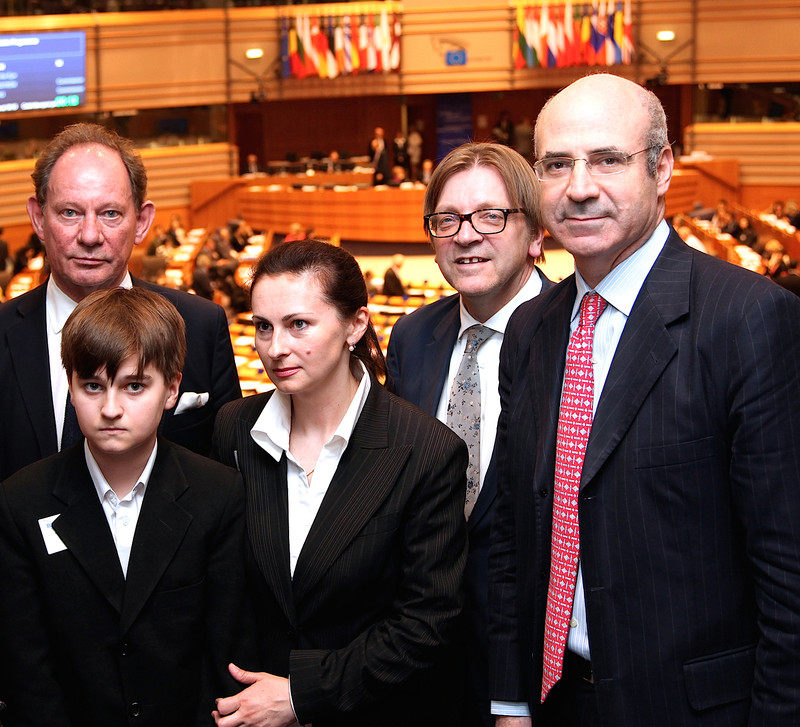
William Browder (right) with Magnitsky’s widow and son,
along with European parliamentarians.
“I’d be very careful going out and trying to do a whole sort of thing about Sergei [Magnitsky] not being the whistleblower, it won’t do well for your credibility on this show,” Browder said. “This is sort of the subtle FSB version,” suggesting that Nekrasov was just fronting for the Russian intelligence service.
In the pro-Browder account published at the Daily Beast on July 25, Browder described how he put down Nekrasov by telling him, “it sounds like you’re part of the FSB. … Those are FSB questions.”
But that phrasing is not what he actually says in the documentary, raising further questions about whether the Daily Beast reporter actually watched the film or simply accepted Browder’s account of it. (I posed that question to the Daily Beast’s Katie Zavadski by email, but have not gotten a reply.)
The documentary also includes devastating scenes from depositions of a sullen and uncooperative Browder and a U.S. government investigator, who acknowledges relying on Browder’s narrative and documents in a related case against Russian businesses.
In an April 15, 2015 deposition of Browder, he, in turn, describes relying on reports from journalists to “connect the dots,” including the Organized Crime and Corruption Reporting Project (OCCRP), which is funded by the U.S. government and financial speculator George Soros. Browder said the reporters “worked with our team.”
While taking money from the U.S. Agency for International Development and Soros, the OCCRP also targeted Ukraine’s elected President Viktor Yanukovych with accusations of corruption prior to the Feb. 22, 2014 coup that ousted Yanukovych, an overthrow that was supported by the U.S. State Department and escalated the New Cold War with Russia.
OCCRP played a key role, too, in the so-called Panama Papers, purloined documents from a Panamanian law firm that were used to develop attack lines against Russian President Vladimir Putin although his name never appeared in the documents.
After examining the money-movement charts published by OCCRP about the Magnitsky case, Nekrasov notes that the figures don’t add up and wonders how journalists could “peddle these wooly maths.” He also observed that OCCRP’s Panama Papers linkage of Magnitsky’s $230 million fraud and payments to an ally of Putin made no sense because the dates of the Panama Papers transactions preceded the dates of the alleged Magnitsky fraud.
The Power of Myth
Nekrasov suggests that the power of Browder’s convoluted story rested, in part, on a Hollywood perception of Moscow as a place where evil Russians lurk around every corner and any allegation against “corrupt” officials is believed. The Magnitsky tale “was like a film script about Russia written for the Western audience,” Nekrasov says.
But the Browder’s narrative also served a strong geopolitical interest to demonize Russia at the dawn of the New Cold War.
In the documentary’s conclusion, Nekrasov sums up what he had discovered: “A murdered hero as an alibi for living suspects.” He then ponders the danger to democracy: “So do we allow graft and greed to hide behind a political sermon? Will democracy survive if human rights — its moral high ground — is used to protect selfish interests?”
But Americans and Europeans are being spared the discomfort of having to answer that question or to question their representatives about the failure to skeptically examine this case that has pushed the planet on a course toward a possible nuclear war.
Instead, the mainstream Western media has hurled insults at Nekrasov even as his documentary is blocked from any significant public viewing.
Despite Browder’s professed concern about the London libel case that he claimed was an attempt “to stifle our freedom of expression,” he has sicced his lawyers on anyone who might be thinking about showing Nekrasov’s documentary to the public.
The documentary was set for a premiere at the European Parliament in Brussels in April 2016, but at the last moment – faced with Browder’s legal threats – the parliamentarians pulled the plug. Nekrasov encountered similar resistance in the United States. There were hopes to show the documentary to members of Congress but the offer was rebuffed. Instead a room was rented at the Newseum near Capitol Hill.
Browder’s lawyers then tried to strong arm the Newseum, but its officials responded that they were only renting out a room and that they had allowed other controversial presentations in the past.
“We’re not going to allow them not to show the film,” said Scott Williams, the Newseum’s chief operating officer. “We often have people renting for events that other people would love not to have happen.”
In an article about the controversy in June 2016, The New York Times added that “A screening at the Newseum is especially controversial because it could attract lawmakers or their aides.”
One-Time Showing
So, Nekrasov’s documentary got a one-time showing with a follow-up discussion moderated by journalist Seymour Hersh. However, except for that audience, the public of the United States and Europe has been essentially shielded from the documentary’s discoveries, all the better for the Magnitsky myth to retain its power as a seminal propaganda moment of the New Cold War.
After the Newseum presentation, a Washington Post editorial branded Nekrasov’s documentary Russian “agit-prop” and sought to discredit Nekrasov without addressing his many documented examples of Browder’s misrepresenting both big and small facts in the case.
Instead, the Post accused Nekrasov of using “facts highly selectively” and insinuated that he was merely a pawn in the Kremlin’s “campaign to discredit Mr. Browder and the Magnitsky Act.”
Like the recent Daily Beast story, which falsely claimed that Nekrasov let the Russian police officer Karpov play himself, the Post misrepresented the structure of the film by noting that it mixed fictional scenes with real-life interviews and action, a point that was technically true but willfully misleading because the fictional scenes were from Nekrasov’s original idea for a docudrama that he shows as part of explaining his evolution from a believer in Browder’s self-exculpatory story to a skeptic.
But the Post’s deception – like the Daily Beast’s falsehood – is something that almost no American would realize because almost no one has gotten to see the film.
The Post’s editorial gloated: “The film won’t grab a wide audience, but it offers yet another example of the Kremlin’s increasingly sophisticated efforts to spread its illiberal values and mind-set abroad. In the European Parliament and on French and German television networks, showings were put off recently after questions were raised about the accuracy of the film, including by Magnitsky’s family.
“We don’t worry that Mr. Nekrasov’s film was screened here, in an open society. But it is important that such slick spin be fully exposed for its twisted story and sly deceptions.”
The Post’s arrogant editorial had the feel of something you might read in a totalitarian society where the public only hears about dissent when the Official Organs of the State denounce some almost unknown person for saying something that almost no one heard.
It is also unlikely that Americans and Europeans will get a chance to view this blacklisted documentary in the future. In an email exchange, the film’s Norwegian producer Torstein Grude told me that “We have been unsuccessful in releasing the film to TV so far. ZDF/Arte [a major European network] pulled it from transmission a few days before it was supposed to be aired and the other broadcasters seem scared as a result. Netflix has declined to take it. …
“The film has no other release at the moment. Distributors are scared by Browder’s legal threats. All involved financiers, distributors, producers received thick stacks of legal documents (300+ pages) threatening lawsuits should the film be released.” [Grude sent me a special password so I could view the documentary on Vimeo.]
The blackout continues even though the Magnitsky issue and Nekrasov’s documentary have become elements in the recent controversy over a meeting between a Russian lawyer and Donald Trump Jr. [See Consortiumnews.com’s “How Russia-gate Met the Magnitsky Myth.”]
So much for the West’s vaunted belief in freedom of expression and the democratic goal of encouraging freewheeling debates about issues of great public importance. And, so much for the Post’s empty rhetoric about our “open society.”
Investigative reporter Robert Parry broke many of the Iran-Contra stories for The Associated Press and Newsweek in the 1980s.
View the film: https://swprs.org/the-magnitsky-act/
James Le Mesurier: The Former British Mercenary Who Founded The White Helmets

British ex-mercenary, and founder of the White Helmets, James Le Mesurier, pictured in Istanbul, Turkey. (Photo: Twitter/James Le Mesurier)
By Whitney Webb | Mint Press News | July 31, 2017
James Le Mesurier, a British ex-mercenary, founded the White Helmets in 2013. The group has been lauded for its “humanitarian” efforts in Syria, but they have actually functioned more as a logistics and propaganda arm of Syria’s al-Qaeda branch, complete with training from Le Mesurier.
Over the past two years, enlightening information has been revealed that thoroughly and unequivocally debunks the “humanitarianism” of the White Helmets in Syria, sometimes referred to as the Syrian Civil Defense.
Since they were founded in 2013, much of Western media has sought to elevate the White Helmets as the “bravest” and most heroic of Syrians. They have been the subject of a Netflix documentary, which won an Oscar, and has consistently been plastered across TV screens in surprisingly well-produced videos showing them removing children from rubble in war-torn areas claimed by Syria’s “rebels.”
However, missing from this unambiguously positive coverage has been the group’s ties to terrorist groups like al-Qaeda, their doctoring of footage, their role in executing civilians and their use of children – both dead and alive – as props for producing pro-intervention propaganda. Also absent is how the White Helmets have received over $123 million from 2013 to 2016 from the U.S. and UK governments, as well as Western NGOs and Gulf state monarchies.
While numerous articles have been devoted to dispelling the propaganda that surrounds the group and detailing their shady ties to known terrorist organizations like Syria’s al-Qaeda branch Al-Nusra Front, significantly less attention has been focused on how the group was created, particularly on the man who founded them – James Le Mesurier, a British private security specialist, and former British military intelligence officer.
Le Mesurier’s role in founding the White Helmets and propagating its mythology to a Western audience was exposed in 2015 thanks to the work of independent journalist Vanessa Beeley.
Beeley, who spoke to MintPress News at length for this report, notes that it was Le Mesurier’s “‘realization that humanitarian aid was more effective at maintaining war than an army” that spurred his creation of the organization in order “to maintain public support for another costly war in a country that is, in reality, posing little to no threat to mainland America” or its allies.
James Le Mesurier: from mercenary to “humanitarian”
Though mainstream narratives have suggested that the White Helmets were trained by the Red Cross, the White Helmets were actually founded in March 2013 by Le Mesurier. He, like many officers in the British military, attended the Royal Military Academy, where he graduated at the top of his class, receiving the Queen’s Medal.
He later served in the British Army and operated in a variety of theaters. Most notably, Le Mesurier served as intelligence coordinator for Pristina City in Kosovo soon after the NATO intervention that led to NATO being accused of war crimes for its targeting of thousands of civilians and media.

Having served the governments of the UK, US, UN and Gulf States, James Le Mesurier was able to very quickly garner financial support from fervent supporters of Syrian regime change. (Sofie Gran/Aspunvik)
By 2000, Le Mesurier left the army and went to work for the United Nations as he had “realized humanitarian aid was more effective” than an army in theaters of war during his time with the British military. He, again, served in a variety of locations, focusing on “delivering stabilization activities through security sector and democratization programs.” According to Le Mesurier, “stabilization activities” refers to the “framework for engagement in ‘fragile’ states” or, in other words, destabilized nations.
Prior to his founding of the White Helmets, Le Mesurier served as Vice President for Special Projects at the Olive Group, a private mercenary organization that has since merged with Blackwater-Academi into what is now known as Constellis Holdings. Then, in 2008, Le Mesurier left the Olive Group after he was appointed to the position of Principal at Good Harbor Consulting, chaired by Richard A. Clarke – a veteran of the U.S. national security establishment and the counter-terrorism “czar” under the Bush and Clinton administrations.
After joining Good Harbor, Le Mesurier became based in Abu Dhabi, where he specialized in risk management, emergency planning, and critical infrastructure protection. He trained a UAE gas field protection force and “ensured the safety” of the 2010 Gulf Cup in Yemen, a regional soccer tournament. But following this work, Le Mesurier claims to have become dissatisfied, wanting to have a more direct impact on the communities he worked in.
He told Men’s Journal in 2014 that it was the idea of using his military training to benefit civilians that truly enthused him: “the idea of being a civilian carrying a weapon and guiding a convoy in a conflict zone — that leaves me cold.”
White Helmets founded through Western funding
When it came time to found the White Helmets in March 2013, Le Mesurier seemed to have simply been in the right place at the right time. According to his own account, he founded the group in Turkey after being “compelled” by Syrians’ wartime stories.

James Le Mesurier in Istanbul, Turkey.
(Photo: Twitter/James Le Mesurier)
Despite founding the White Helmets in Turkey, he raised $300,000 in seed funding provided by the UK, the U.S. and Japan, which Le Mesurier apparently had no trouble scrounging up. The $123 million dollars that was funneled soon after to the organization by the U.S. and UK governments, along with Western NGOs and Qatar, dispels all notion of the organization’s alleged “impartiality” and “non-partisan” stance on the Syrian conflict stated on their website.
He then used it to train 25 “vetted” Syrians “to deal with the chaos erupting around them.” By September of that year, more than 700 “vetted” individuals were believed to have undergone training under Le Mesurier’s supervision.
However, Le Mesurier’s ties to British military intelligence, mercenary groups and involvement in “stabilization activities” and “democratization programs” suggest that his convenient appearance in Istanbul, Turkey is perhaps not too coincidental. As Beeley noted in an interview with MintPress : “there are very few coincidences in the multi-spectrum, hybrid war that has been waged against Syria by the U.S. coalition since 2011.”
Indeed, the White Helmets were founded when the West was losing on both the propaganda and military front regarding the push for regime change and foreign intervention in Syria. More specifically, as Beeley told MintPress, the group’s founding took place just after “the Syrian government had raised concerns about a terrorist chemical weapon attack in Khan Al Asal against the SAA [Syrian Arab Army].”
It should come as no surprise then that, since their founding, the White Helmets have been instrumental in blaming the Syrian government for any and all subsequent chemical weapons attacks in Syria, acting as both witnesses and responders to events that were later proven to be the work of the armed opposition in Syria or staged. As a result, Beeley argued that it’s well within reason to speculate that the White Helmets were explicitly founded with this purpose in mind.
However, it is Le Mesurier himself who shed light on why the White Helmets were formed at such a crucial point for the foreign-funded opposition. As Le Mesurier noted in a speech delivered on June 2015, in “fragile” (i.e. destabilized) states, security actors – such as mercenaries or foreign armies – have the lowest level of public trust. However, Le Mesurier states that in contrast, those professions with the highest level of public trust in such situations are firefighters, paramedics, rescue workers and other similar types of first responders.
Le Mesurier discusses the White Helmets in June 2015:
https://player.vimeo.com/video/132521006?color=c9ff23&title=0&byline=0&portrait=0
Le Mesurier, however, is not the only figure linked to the British military to take such a perspective. UK Admiral Sir Philip Jones, Chief of Naval Staff, stated last year that “the hard punch of military power is often delivered inside the kid glove of humanitarian relief.” It is for this reason that military actions sponsored by the United States and its allies for the past few decades have often been framed as “humanitarian interventions.”
Thus, the White Helmets were seen as a chance to reclaim the trust that the Syrian opposition fighters had lost, as news of their affiliation with terrorist groups began to spread.
In reclaiming that trust in Western audiences, the White Helmets have done nothing to ease the burden of war in Syria, but have fomented it by underpinning the very propaganda that has kept the conflict raging on for over six years, as well as undermined the ability of the Syrian and Russian governments to secure diplomatic alternatives to continued fighting.
Indeed, despite their claim of “impartiality,” the White Helmets were instrumental in Western attempts to bolster international support for Western intervention and a “no-fly zone” in Syria. However, such intervention will bring much more devastation to Syria, something the White Helmets profess to want to end.
Training the White Helmets
While the White Helmets have successfully been framed as a professionally-trained first responder group active in Syria, there is plenty of evidence suggesting that their training was entirely different. First responders and doctors in other countries have been skeptical about the “aid” the White Helmets have delivered.
For instance, Dr. Leif Elinder, a Swedish pediatrician, told the Indicter that “after examination of the video material [of the White Helmets], I found that the measures inflicted upon those children, some of them lifeless, are bizarre, non-medical, non-lifesaving, and even counterproductive in terms of life-saving purposes of children.”
Other medical doctors have stated that other procedures conducted by the White Helmets as seen in the previously mentioned Netflix documentary were performed so poorly they would have killed the children, who were already deceased when the footage was taken.
In addition, first responder groups have also found flaws with the White Helmet’s trained rescues. Questions have been raised such as: how did the White Helmets know the bodies would be exactly where they found them?; Why are no attacks heard or seen in White Helmet videos – only the “aftermath”?; and why have the White Helmets chosen to “recycle” footage of the people they are allegedly helping?
Thus, if the White Helmets were not actually trained in first aid – as the above suggests – what did Le Mesurier and his team actually train them to do?
According to Beeley, Le Mesurier trained the White Helmets as a military group, as they have been found “working side by side with the Nusra Front and other extremist groups such as Nour Al Din Zinki in East Aleppo, where their ‘humanitarian’ centers were invariably alongside Nusra Front or even in the same building.”
Noting the White Helmet’s lack of paramedic expertise and the numerous photographs showing them carrying weapons, she added that this “confirms that their role has been as military and logistical support for their Nusra Front colleagues.”
However, the training received by the White Helmets likely did not stop there.
Beeley strongly believes that they were given extensive training in the production of propaganda – specifically, trained in camerawork and video production in order to produce videos for the media. She noted that “the sheer number of cameras on site at any one of their rescue productions demonstrates that they are well versed in publicity craft.”
Furthermore, Beeley suggested that the White Helmet’s footage used in their documentary also proves this point:
“The Oscar-winning Netflix documentary that recorded their exploits was based entirely on footage taken by the White Helmets themselves and supplied to the producers of the movie who did not leave Turkey and were therefore unable to verify the authenticity of the footage. The quality of video supplied suggests that the White Helmets were using sophisticated equipment and had been well trained in its use.
Thus, this training has enabled the White Helmets to accomplish two major goals for the governments and organizations that have orchestrated its rise to prominence.
First, as Beeley pointed out, it has facilitated “further proxy military intervention and to incite pseudo-humanitarian outrage from the International community and western public.”
Second, it has allowed the atrocities of the extremist factions that work with the White Helmets to be camouflaged by the “humanitarianism” of the group, which has been instrumental in allowing foreign governments to continue arming and funding these extremist, terrorist organizations with complete impunity.
Le Mesurier, for his part, has apparently become tired of the limelight – perhaps as a result of the thorough debunking of the terrorist-linked organization he fostered. Though still listed as an employee of Good Harbor, Le Mesurier has removed himself from the site of MayDay Rescue, a White Helmets-linked organization he founded, and all mention of him has been erased from the White Helmets website.
Fanciful Terrors: Bomb Plots and Australian Airport Security
By Binoy Kampmark | Dissident Voice | July 31, 2017
In the classroom of international security, Australia remains an infant wanting attention before the older hands. During the Paris Peace talks, Prime Minister William Morris (“Billy”) Hughes screamed and hollered Australia’s wishes to gain greater concessions after its losses during the Great War, urging, among other things, a more punitive settlement for Germany.
In the post-September 2001 age, recognition comes in different forms, notably in the field of terrorism. Australian authorities want recognition from their international partners; Australian security services demand attention from their peers. The premise of this call is simple if masochistic: Australia is worth torching, bombing and assailing, its values, however obscure, vulnerable before a massive, inchoate threat shrouded in obscurantism.
Over the weekend, the security services again displayed why adding fuel to the fire of recognition remains a burning lust for the Australian security complex. The inner-city suburb of Surry Hills in Sydney, and the south-western suburbs of Lakemba, Wiley and Punchbowl, witnessed raids and seizures of material that could be used to make an improvised explosive device.
What was notable here was the domesticity behind the alleged plot. Focus was specific to Surry Hills in what was supposedly an attempt to create an IED involving a domestic grinder and box containing a multi-mincer. At stages, those with a culinary inclination might have been confused: were Australia’s best and brightest in the front line of security getting excited about the ill-use kitchen appliances might be put to?
The arrest provided yet another occasion Australian audiences are becoming familiar with: individuals arrested and detained, usually with no prior convictions let alone brush with the law, while the celebratory stuffing is sought to file charges under anti-terrorism laws.
But this was not a time for ironic reflection. Australians needed to be frightened and reassured, a necessary dialectic that governments in trouble tend to encourage. First, comes the fear of death, launched by a sinister fundamentalist force; then comes the paternal reassurance of the patria: those in blue, green and grey will protect you.
Without even questioning the likelihood of success in any of these ventures (would this supposed device have ever gotten onto a plane?), such networks as Channel Nine news would insist that this could be the “13th significant conspiracy to be foiled by Australian authorities since the country’s terror threat level was raised to ‘probable’ in 2014.”
The Herald Sun was already dubbing this a Jihadi “meat mincer bomb plot”, happy to ignore the obvious point that details were horrendously sketchy. The Prime Minister, Malcolm Turnbull, deemed the conspiracy “elaborate”. (The foe must always be elevated to make the effort both worthwhile and free of folly.) The AFP Commissioner, Andrew Colvin, was convinced that this was “Islamic-inspired terrorism. Exactly what is behind this is something we will need to investigate fully.”
Depending on what you scoured, reports suggested that this was a “non-traditional” device which was set to be used for an “Islamist inspired” cause. The usual cadre of experts were consulted to simply affirm trends they could neither prove nor verify, with the “lone wolf” theme galloping out in front.
John Coyne of the Australian Strategic Policy Institute’s Border Security Program, for instance, plotted a kindergarten evolution for his audience: planes were used in September 2001; then came regionally focused incidents such as the Bali bombings, and now, in classic fatuity, “a new chapter arising or a return chapter almost”. “This is much more panned and deliberate, if the allegations are correct.”
Rita Panahi, whose writings prefer opinion to the inconvenience incurred by looking at evidence, cheered the weekend efforts and issued a reminder: “Remember the weekend’s terror raids next time you have to surrender a tube of sunscreen as you pass through airport security a second time, this time barefooted and beltless, and fearful you might miss your flight.”
For Panahi, this was a case that was done and dusted. These were “wannabe jihadis” (dead cert); they had plotted to inflict “mayhem and destruction on Australian soil” (naturally) and Australians needed to understand that an ungainly super structure of intrusive security measures were indispensable to security. Thank the counter-terrorism forces, luck and distance.
Such occasions also provide chicken feed for pecking journalists, many of whom have ceased the task of even procuring their beaks for the next expose. Indeed, some were crowing, including one on ABC 24, that the “disruption” of an “imminent” attack had taken place at speed; that this “cell” had little chance of ever bringing their device to an aircraft. Evidence and scrutiny are ill-considered, and the political classes are permitted to behave accordingly.
The Border Protection Minister, Peter Dutton, never happy to part with anything valuable on the subject of security, refused to confirm whether there had been an international dimension, a tip-off from intelligence agencies, or assistance.
“There will be lots of speculation around what the intent was,” claimed Dutton, “but obviously all of us have been working hard over recent days and we rely upon the expertise of the Federal Police and ASIO and other agencies.” He observed that there was “a lot of speculation around” which he did not wish to add to.
He need not have bothered, given that the opinion makers have formed a coalition of denial and embellishment so vast and enthusiastic so as to make Australia matter in the supposed global jihadi effort. It would come as a crushing disappointment to the infant in that room of international relations to realise otherwise.
Binoy Kampmark was a Commonwealth Scholar at Selwyn College, Cambridge. He lectures at RMIT University, Melbourne and can be reached at: bkampmark@gmail.com.
Pentagon Enjoys Impunity in Spite of the Rapidly Mounting Civilian Death Toll
By Grete Mautner – New Eastern Outlook – 01.08.2017
Somehow most of us grew accustomed to various media sources reporting horrific crimes against civilians committed by US servicemen in various regions of the world on the daily basis.
For instance, yet another air raid launched by US Air Force on July 25 in Afghanistan claimed a number of civilian lives. Eight people fell dead, including women and children. For local residents the fact that the area where the attack occurred is being contested by pro-government forces and various militant groups is yesterday’s news. However, as eyewitnesses argue, this time the strikes were aimed against civilians. There’s been reports that those who were trying to provide first aid to the victims of the air strike were outraged by the number of wounded minors. It’s curious that the contested Nangarhar province is located on the very border with Pakistan, so there are no large cities where hitting one’s designated target may be tricky. Americans have been bombing the area for a long time.
Under the conditions of self-declared military intervention, local authorities are forced to bear with the fact that the death of a single terrorist killed by US and NATO soldiers would be accompanied by a number of civilian lives lost in the process. However, the best the Pentagon has ever done for the relatives of its victims was the offering of pathetic condolences accompanied by a promise to “investigate the incident”. Just a few days ago US aircraft would “mistakenly” bomb an Afghan military base in the province of Helmand, claiming the lives of 17 Afghan policemen.
American air raids usually result in destroyed Afghanistan schools, as it was on July 15, when yet another school was attacked from the sky in the town of Kunduz, and destroyed hospitals, like the one run by Doctors Without Borders that was destroyed by a coalition air strike last October. Back then a total 24 people was murdered, including 12 medical practitioners and three children. Even wedding ceremonies that can be pretty massive in Afghanistan are not immune to such US and NATO attacks, as it happened in November in the southern Afghan province of Kandahar, when a single US air strike would claim a total of 95 civilians lives, while leaving another 50 people injured.
In the first half of 2017 alone a total of 5243 civilians suffered injuries during various skirmishes, with 1,662 of them suffering lethal injuries and 3,581 suffering non-lethal injured, says a report of the United Nations Assistance Mission in Afghanistan (UNAMA). Women and children are still suffering the most from the conflict. According to the above mentioned report, in the first 6 months of 2017, 174 women were killed and 462 injured. UNAMA chief Tadamichi Yamamoto has recently noted that Afghans continue to die, get injured, and be forced to abandon their homes to escape violence.
In Syria and Iraq, the death toll is even higher. The UN and human rights organizations are outraged, since they have long been accusing Washington of neglecting international law and the basic safety of the people they claim to be protecting. But nobody seems to listen.
For instance, the campaign that the West launched to pursue the liberation of Iraq turned out to be no less brutal than the war that was raging in the country. In spite of all sorts of statements that Washington would make about the so-called high precision strikes it would allegedly carry out in Mosul, a number of American media sources would publish satellite images of the city virtually reduced to ruins. According to the Independent, more than 40,000 civilians were killed in the devastating battle to retake Mosul from ISIS – a death toll far higher than was previously estimated.
It is necessary to conduct an independent investigation of the crimes committed against civilians of Iraqi Mosul. This statement was made by the international human rights organization known as Amnesty International. According to the human rights defenders, the US-led coalition conducted a “series of merciless and illegal attacks” in Mosul. In particular, it is asserted that the coalition has been using highly explosive and inaccurate ordinance. As it’s been stressed by the Amnesty International, the battle for Mosul led to a true humanitarian disaster.
But the strikes carry on, as it’s been reported the recent strike carried out by the US-led coalition last week against a prison in Syria’s Rakka, where ISIS would hold its hostages, resulted in a total of 30 people killed.
Syria’s civilian population is dying in hundreds at the hands of US servicemen that have no legal justification to even be present in Syria. The mounting death toll has been carefully tracked by the Airwars portal.
To mislead the international community and hide the true extent of the crimes that are being committed by US servicemen in Iraq, Syria, Afghanistan, thus preventing an international investigation from giving a careful evaluation of the bloody role that Washington played in the destruction of the Middle East, Washington has been routinely accusing Damascus of chemical weapons usage.
Just last June, the White House would announce that US intelligence sources were in possession of reports about the alleged preparations carried out by Syrian authorities to launch a chemical attack. These reports were followed by unfounded accusations against Damascus voiced by the opposition forces.
However, the Chairman of the Joint Chiefs of Staff, Joseph Dunford has been forced to publicly acknowledge that the Pentagon has no grounds to suspect the Syrian government of any instances of chemical weapons use.
However, the international community has every ground to accuse the United States of committing war crimes in Syria, Iraq, Afghanistan, where hundreds of civilians continue to perish due to indiscriminate American air raids, yet, no one has been brought to justice so far.
Turkey, US accuse each other of terror sponsorship in Syria
Press TV – August 1, 2017
Turkey and the United States have been accusing each other of supporting various terrorist groups in Syria.
Brett H. McGurk, the US special envoy to the international coalition against the Daesh terrorist group, has suggested that Turkey facilitates al-Qaeda terrorists in Syria’s Idlib Province.
He said in a speech delivered at a Washington-based think tank on July 29 that Idlib has turned into a “safe zone for al-Qaeda terrorists on the Turkish border,” asking “why and how” a deputy to al-Qaeda’s leader had allegedly managed to travel to the Syrian province.
He said it might not be the best approach for some partners of the US “to send tens of thousands of weapons and turn their faces to the other side as foreign fighters enter this area,” according to reports.
The US, McGurk reportedly said, intended to work with Turkey to have the border closed to recruited militants.
Ankara has strongly denounced McGurk’s “provocative” remarks, accusing Washington of terror sponsorship in Syria by supporting the Kurdish People’s Protection Units (YPG), which Ankara views as the Syrian branch of the Kurdistan Workers’ Party (PKK), a militant group that has been fighting the central Turkish government since 1984.
“Our reaction to the statements of Brett McGurk, in which he associated Turkey with the presence of terrorist organizations in Idlib, was brought to Mr. McGurk’s attention at a high-level démarche, and his statements, which could be characterized as provocative, were protested,” Turkish media on Monday quoted Foreign Ministry spokesperson Huseyin Muftuoglu as saying.
Muftuoglu also said that the US had to end its support for the Kurdish Democratic Party, aka PYD.
A Turkish Foreign Ministry official, who asked not to be named, also told Hurriyet Daily News that Foreign Ministry Deputy Undersecretary Sedat Onal had urged the US envoy to “correct” his statements.
The official added that Onal warned that such remarks could harm mutual cooperation between Turkey and the US, which is seeking cooperation with Ankara for the post-Daesh period in Syria.
Syria has been gripped by militancy since March 2011, when a section of the opposition in the country took up arms against President Bashar al-Assad. A vast mix of foreign terrorists soon blended with the armed opposition, joining the fight against the Syrian government.
What Mainstream Media Got Wrong About Venezuela’s Constituent Assembly Vote
teleSUR | July 30, 2017
Venezuelans voted Sunday for representatives of the National Constituent Assembly, amid what the government has called a targeted media campaign to destabilize the country and destroy its sovereignty.
International media outlets rushed to discredit the vote, sharing grossly misrepresentative accounts of the historic electoral process.
The U.S. newspaper Washington Post, for instance, wrote “the decision to hold the vote appeared set to prolong and deepen the suffering of the people of Venezuela” — despite assurances from Venezuelan President Nicolas Maduro that the purpose of the election was to ease economic and political conflicts with the opposition.
The Washington Post also insisted the nation’s 2.8 million state workers “risked losing their jobs if they did not vote.”
The media outlet went even further, claiming the internal and democratic election represented “a direct challenge” to the administration of U.S. President Donald Trump after it demanded that the government cancel the vote.
It said Maduro “defiantly followed through Sunday with his pledge” to hold the election, “creating a critical new stage in a long-simmering crisis that could mint the Western Hemisphere’s newest dictatorship.”
These inflammatory comments, however, do not acknowledge that the right to call a National Constituent Assembly is included in the country’s Constitution and supported by several articles of its text. Indeed the absolute independence of the members of the Constituent Assembly to make changes to the Constitution is protected under these articles.
Germany’s Deutsche Welle meanwhile said the election “will cement a socialist dictatorship” — ignoring the fact that Venezuelans have the right to call for a Constituent Assembly and that the new Constitution will need to be approved by the people.
The British media outlet BBC referenced the recent deaths during violent protests in Caracas, placing the full responsibility for the clashes on security forces.
But Venezuelan Armed Forces have denied these accusations. In a press conference Sunday, Minister of Defense Vladimir Padrino Lopez said that none of the injuries or deaths could be attributed to the Armed Forces. The article also ignores the eight members of the Armed Forces who were severely injured while protecting Venezuelans’ right to vote.
The CNN, a longtime critic of the Venezuelan government, argued the Constituent Assembly was controlled by Maduro and that the “vote would give the president immense political power.”
This statement fails to take into account that no other state institution may interfere in the new legislative body. Only the 545 officials elected by the citizens from different sectors of society can draft the new Constitution.
CNN also reported that Maduro would replace Venezuela’s National Assembly — a situation that has never been stated in the decree to call for an open and direct vote.
Canada’s Globe and Mail said “voters broadly boycotted” the election, ignoring the numerous of photos and videos of people lining up to vote at dawn and even wading through swamps to reach the voting centers. The article also does not include the countless reports of seniors and people with disabilities eagerly casting votes across the country.
“Caracas was largely shut down with deserted streets and polling stations were mostly empty, dealing a blow to the legitimacy of the vote,” said the Globe and Mail without any evidence.
The Guardian joined the mainstream criticism, calling the election an action that will “seal the demise of the oil-rich nation’s democracy.”
Again, the article failed to acknowledge the thousands of people who fought to earn the opportunity to be candidates in this historical event, including candidates from the LGBT community, student organizations and women and campesino groups.
Finally, the New York Times reported on the election with the headline: “As Venezuela Prepares to Vote, Some Fear an End to Democracy.”
The article reported, “Maduro is pushing a radical plan to consolidate his leftist movement’s grip over the nation,” forgetting that candidates are not voted for according to their political parties but through individual candidacies.
In one of the bluntest accusations, the newspaper argued Maduro “has refused to negotiate with street protesters,” a claim that blatantly ignores Maduro’s ongoing calls for peaceful dialogue and guidance from the Vatican.
It concludes by accusing the president of Venezuela of seeking an “unchecked authority not seen since the juntas that haunted Latin American countries in decades past,” as Maduro and the Bolivarian Revolution have vowed to fight the same external interference that brought the U.S. backed dictatorships to the region in the 60s.
Global Warming Blamed For EU Wildfires
By Paul Homewood | Not A Lot Of People Know That | July 28, 2017
Now why am I not surprised?
Exclusive: The number of forest fires in the EU has trebled so far this year, according to figures obtained by Euronews, affecting an area nearly the size of Luxembourg.
There have been 677 blazes in 2017 – a huge increase on the 215 the bloc saw annually on average over the previous eight years.
Experts have blamed climate change for the rise, saying it has extended the traditional wildfire season and increased the frequency of blazes.
They have warned Europe’s forest fires will rage more often in the future and engulf new areas.
Portugal, Italy and Croatia have battled blazes in recent days amid high temperatures and lower-than-normal rainfall.
It comes less than a month since 64 people died in a forest fire in Portugal, with many victims caught in their cars as they tried to flee.
http://www.euronews.com/2017/07/26/how-europe-s-wildfires-have-more-than-trebled-in-2017
Now you’re no doubt way ahead of me here!
Apparently, the last eight years is the “normal climate”, and 2017 is the new.
Joe, being a suspicious little devil, thought he would check why they used the last eight years as a baseline, and discovered why.
This is the official data from the European Environment Agency, published last November:
https://www.eea.europa.eu/data-and-maps/daviz/burnt-forest-area-in-five-1#tab-dashboard-01
The number of fires since 1980 peaked in the 1990s, and have been relatively low in the last few years.
The trend on burnt acreage is even more stark, showing consistent decline since the 1980s.
I wonder what they’ll blame on global warming next?
The Dawn of an Orwellian Future
By Robert Parry | Consortium News | July 28, 2017
It seems that The New York Times can’t let a good lie lie. Even after being pushed into running an embarrassing correction retracting its false claim that there was a consensus of all 17 U.S. intelligence agencies that Russia hacked Democratic emails and made them public to help Donald Trump defeat Hillary Clinton, the Times is back suggesting exactly that.
The Times’ current ploy is to say the Russian hacking claims are the “consensus” judgment of the U.S. intelligence community without citing a specific number of agencies. For instance, on Friday, the Times published an article by Matt Flegenheimer about the U.S. Senate vote to prevent President Trump from lifting sanctions on Russia and deployed the misleading phrasing:
“The Trump administration has opposed the sanctions against Russia, arguing that it needs flexibility to pursue a more collaborative diplomacy with a country that, by American intelligence consensus, interfered in last year’s presidential election.”
So, instead of explaining the truth – that the Jan. 6 “Intelligence Community Assessment” was the work of a small group of “hand-picked” analysts from three of the agencies under the watchful eye of then-CIA Director John Brennan and beneath the oversight of then-Director of National Intelligence James Clapper – the Times opts to give its readers the misleading impression that there was a “consensus” within the U.S. intelligence community.
In other words, unless a Times reader knows the truth by having read it at a non-mainstream media outlet such as Consortiumnews.com, that reader would continue to believe that all 17 intelligence agencies were in agreement on this foundational point in the Russia-gate affair.
Marginalizing Dissent
And the continuation of this willful deception comes as the Times and other mainstream media outlets make progress in their plans to deploy Internet algorithms to hunt down and marginalize what they deem “fake news,” including articles that challenge the mainstream media’s power to control the dominant news narrative.
A report by the World Socialist Web Site found that “in the three months since Internet monopoly Google announced plans to keep users from accessing ‘fake news,’ the global traffic rankings of a broad range of left-wing, progressive, anti-war and democratic rights organizations have fallen significantly.”
Google’s strategy is to downgrade search results for targeted Web sites based on a supposed desire to limit reader access to “low-quality” information, but the targets reportedly include some of the highest-quality alternative news sites on the Internet, such as – according to the report – Consortiumnews.com.
Google sponsors the First Draft Coalition, which was created to counter alleged “fake news” and consists of mainstream news outlets, including the Times and The Washington Post, as well as establishment-approved Web sites, such as Bellingcat, which has a close association with the anti-Russia and pro-NATO Atlantic Council.
This creation of a modern-day Ministry of Truth occurred under the cover of a mainstream-driven hysteria about “fake news” and “Russian propaganda” in the wake of Donald Trump’s election.
Last Thanksgiving Day, the Post ran a front-page article citing accusations from an anonymous Web site, PropOrNot, that identified 200 Web sites — including such Internet stalwarts as Truthdig, Counterpunch and Consortiumnews — as purveyors of “Russian propaganda.”
Apparently, PropOrNot’s standard was to smear any news outlet that questioned the State Department’s Official Narrative on the Ukraine crisis or some other global hot spot, but the Post didn’t offer any actual specifics of what these Web sites had done to earn their place on a McCarthyistic blacklist.
An Orwellian Future
In early May 2017, the Times chimed in with a laudatory article about how sophisticated algorithms could purge the Internet of alleged “fake news” or what the mainstream media deems to be “misinformation.”
As I wrote at the time, “you don’t need a huge amount of imagination to see how this combination of mainstream groupthink and artificial intelligence could create an Orwellian future in which only one side of a story gets told and the other side simply disappears from view.”
After my article appeared, I received a call from an NPR reporter who was planning a segment on this new technology and argued with me about my concerns. However, after I offered a detailed explanation about how I saw this as a classic case of the cure being far worse than the disease, I was not invited onto the NPR program.
Also, as for the relatively small number of willfully produced “fake news” stories, none appear to have traced back to Russia despite extensive efforts by the mainstream U.S. media to make the connection. When the U.S. mainstream media has tracked down a source of “fake news,” it has turned out to be some young entrepreneur trying to make some money by getting lots of clicks.
For instance, on Nov. 26, 2016, as the anti-Russia hysteria was heating up in the weeks following Trump’s election, the Times ran a relatively responsible article revealing how a leading “fake news” Web site was not connected to Russia at all but rather was a profit-making effort by an unemployed Georgian student who was using a Web site in Tbilisi to make money by promoting pro-Trump stories.
The owner of the Web site, 22-year-old Beqa Latsabidse, said he had initially tried to push stories favorable to Hillary Clinton but that proved unprofitable so he switched to publishing anti-Clinton and pro-Trump articles whether true or not.
While creators of intentionally “fake news” and baseless “conspiracy theories” deserve wholehearted condemnation, the idea of giving the Times and a collection of Google-approved news outlets the power to prevent public access to information that challenges equally mindless groupthinks is a chilling and dangerous prospect.
Russia-gate Doubts
Even if the Russian government did hack the Democratic emails and slip them to WikiLeaks – a charge that both the Kremlin and WikiLeaks deny – there is no claim that those emails were fake. Indeed, all evidence is that they were actual emails and newsworthy to boot.
Meanwhile, U.S. government accusations against the Russian network, RT, have related more to it covering topics that may make the Establishment look bad – such as the Occupy Wall Street protests, fracking for natural gas, and the opinions of third-party presidential candidates – than publishing false stories.
In some cases, State Department officials have even made their own false allegations in attacking RT.
The current Russia-gate frenzy is a particularly scary example of how dubious government conclusions and mainstream media falsehoods can propel the world toward nuclear destruction. The mainstream media’s certainty about Russia’s guilt in the disclosure of Democratic emails is a case in point even when many well-informed experts have expressed serious doubts — though almost always at alternative media sites.
See, for instance, former WMD inspector Scott Ritter’s warning about lessons unlearned from the Iraq debacle or the opinions of U.S. intelligence veterans who have questioned the accuracy of the Jan. 6 report on Russian hacking.
Perhaps these concerns are misplaced and the Jan. 6 report is correct, but the pursuit of truth should not simply be a case of grabbing onto the opinions of some “hand-picked” analysts working for political appointees, such as Brennan and Clapper. Truth should be subjected to rigorous testing against alternative viewpoints and contradictory arguments.
That has been a core principle since the days of the Enlightenment, that truth best emerges from withstanding challenges in the marketplace of ideas. Overturning that age-old truth – by today unleashing algorithms to enforce the Official Narrative – is a much greater threat to an informed electorate and to the health of democracy than the relatively few times when some kid makes up a bogus story to increase his Web traffic.
And, if this new process of marginalizing dissenting views is successful, who will hold The New York Times accountable when it intentionally misleads its readers with deceptive language about the U.S. intelligence community’s “consensus” regarding Russia and the Democratic emails?
Investigative reporter Robert Parry broke many of the Iran-Contra stories for The Associated Press and Newsweek in the 1980s.
Featured Video

Spain train disaster raises questions over Israeli-linked security contractors
or go to
Aletho News Archives – Video-Images
From the Archives
Are There 50,000 ‘Israeli-born’ Individuals Living in the UK?
By Professor David Miller | August 18, 2026
Recent disclosures by the Zionist regime show that some 2,069 British nationals were serving in the IDF as of March 2025, according to Freedom of Information (FoI) requests submitted to the occupation forces (1,686 dual British-Israeli, plus 383 multinational). We cannot tell from the figures how many of these were already settler colonists and intend to stay in the colony, and how many will return or have returned to the UK. Presumably, those returning to the UK will number far fewer than 2,000, since many are known to have become permanently residents of the colony.
Additionally, the IDF figures only provide a snapshot, and do not tell us how many have served in the Jewish supremacist military either before or after March 2025. One way into the question of how many genocidaires are living in Britain is to ask how many current British residents were born in the Zionist colony. There is data on that, as we shall see. … continue
Blog Roll
 Aletho News
- Europe, US face higher heating bills amid Iran war fallout
- The Leak That Arrived Right on Cue
- No, New York Times, California’s Climate Has Always Been a Land of Flood, Drought, and Fire
- Are There 50,000 ‘Israeli-born’ Individuals Living in the UK?
- German CDU MPs Seek Climate “Misinformation” List
- The ‘Gaza Treatment’: How Media Headlines Obscure Who is Bombing Yemen
- Ro Khanna urges Democrats to strip Israel ‘integration’ provision from defense bill
- Why Iran designated British MI6, Royal Navy, and RAF as hostile, terrorist organizations
- Armenian opposition politician dies in custody
- US still trying to recycle failed hypersonic missile programs
- If Americans Knew
- An error has occurred; the feed is probably down. Try again later.
- No Tricks Zone
- German Authorities Start Initiative To Evaluate Public Register For Climate “Disinformation” Spreaders!
- Zonal Asymmetry of Temperature Change in the Antarctic Circumpolar Current
- New Study: The Net Fossil Fuel Contribution To Rising Atmospheric CO2 Has Been Zero For 500 Years
- Germany’s Green Energy Transition Becoming Increasingly Expensive…Another 6 Trillion Euros!
- Sudden Stratospheric Warming, Powerful El Niño Combination May Lead To Extreme Europe Cold, Energy Crisis!
- Two New Studies Find Thwaites Glacier Melt Cannot Be Driven By Human Activity Or A Warming Ocean
- E-Cars Reduce CO2 Emissions By Only 41% Compared To Internal Combustion Engine Vehicles
- Predictions Made By Renowned Climate Professor Over Past Decades Have Been Proven To Be Poor
- New Study Suggests Large Regions Of The Pacific Ocean Have Been Cooling For The Last 80 Years
- Germany’s Green Energy Debacle: High Energy Costs Force Kahla Porzellan to Close After 182 Years!

