Hungary: Paradise for liberals

By István Lovas | OffGuardian | July 11, 2017
Do you wonder what you are going to read in the mainstream press on Hungary tomorrow? I will tell you. The same as yesterday, and the same as in the past almost seven years since Hungary’s right-of-center Fidesz government, led by the Prime Minister Viktor Orbán, was elected.
You will learn that Mr. Orbán is a populist, an autocratic ruler, a menace to Europe, and a politician not hesitating to use anti-Semitic language in order to win over voters of the far-right Jobbik, and cover up uncomfortable truths about whatever is on the agenda in Hungary on that day.
He, of course, has muzzled the media, made the court system a handmaiden of the ruling elite, abolished checks and balances, while he is suffocating the voice of dissenters, creates inordinate fear, chases away half of the country beyond Hungary’s borders, and the rest of the stuff.
Lately, Hungary has been called the safe haven of the European ultra-right. At the time when Hungary’s authorities have arrested and expelled two such figures, such as Nick Griffin and James Dawson, both of them ultra-right British politicians.
In our “free” media world, it is impossible to request corrections from any western media with regard to outright lies that they publish about Hungary, and those lies will be repeated ad nauseam.
So, if you just want to read yet another of the mainstream media mill churning out the same heap of trash, and want to see how Hungary’s regime reminds you of the “darkest period of history”, turn, please, to the Washington Post, the New York Times, The Guardian, the German, the French, and the Austrian mainstream press. Here, in this article, you will find facts. That you have never heard of. Only if you go to Hungary and look around for yourself.
First, let us glance at how the Hungarian press is “muzzled.”
Have you ever heard of any Western voice complaining about the media situation in Serbia, Hungary’s southern neighbor? No. Well, in that country of 7,4 million people, the opposition has a single national political daily newspaper with a circulation of 2,000. The rest is pro-government stuff.
In a sharp contrast to Hungary where the combined circulation of the two national dailies in opposition to the government is clearly superior to that of the two national pro-government dailies.
Out of the six weeklies that you can see at any newsstand, supermarket, or gas station, only two are pro-government.
One million people watch the news program of RTL Klub, a commercial television station owned by a Luxembourg-based media group. The Hungarian public television, controlled strictly indeed by the government, has a viewership that is one tenth of RTL’s. Other than that, Hungarians can switch, in addition to RTL KLub, to ATV or HirTV if they want to be informed how corrupt and horrible their government is. And where expert after expert try desperately to find a reason why Hungarians still overwhelmingly support their horrible incumbent government, and why Fidesz will win handily in next year’s election.
Self-censorship in the opposition media? Come on, there is no country on the face of the earth where you can say things about the Prime Minister or members of the ruling Fidesz party that can appear in an American paper only as three dots.
On June 10th, the 88th Book Festival Week was officially opened in Budapest with the speech of a Hungarian writer called Pál Závada. He started his speech by declaring that he has to speak in the gag press of a one party, autocratic state.
What do you think, who financed the festive event? None other than the government.
The government sponsors almost of all its enemies and dissenters with a magnanimity that is unimaginable in any other country. And they – both the government and the dissenters – are mum about it.
It is a special Hungarian disease that you can call a political Stockholm syndrome that you cannot find anywhere else in the world.
The head of the court system in Hungary is a lady, called Tünde Handó, who selected a judge to a key position, who is the sworn enemy of the incumbent government, and who sentenced an editor-in-chief of the weekly Demokrata to prison for writing something during the previous, socialist-liberal government that was offensive to that government.
The chief Hungarian public prosecutor is a person who has been described by two well-known Hungarian pro-Fidesz journalists, Zsolt Bayer and Péter Csermely, as a stooge of the “other side”. No wonder that practically not a single leading corrupt socialist politician is in prison, including the most rotten figure of all, former Prime Minister Ferenc Gyurcsány, who ordered the police force to remove their ID numbers, and shoot rubber bullets at, and kicking almost to death, innocent passers-bye during a public revolt in the fall of 2016.
The anti-Semitism charge leveled regularly against the Orbán government is the biggest fake news of our times.
Take the Maccabiah Games, the international Jewish multi-sport event held quadrennially in Israel. Except in 2019 when it will be staged in Budapest. At the cost of the Hungarian taxpayers.
There is no gesture, including self-destructing ones, the Hungarian government would not be willing to engage in order to show its unconditional loyalty to Israel and the Jewish people. Hungary’s ambassador in Israel, Andor Nagy, told the Jerusalem Post that anti-Semitism was growing in Hungary when, in fact, it was declining. However, he thought that that such talk would please the daily. And he was not recalled.
The Hungarian government is supporting the Hungarian Jewish community with huge amounts of money, restoring synagogues and cemeteries.
And the country, including the culturally vibrant Jewish quarter of the capital, Budapest, is the safest for its inhabitants and visitors in whole of Europe. It is a district where Jews feel completely secure and at ease, not being afraid, just like in any other corner of Hungary, to stroll while showing their religious identity.
Or take MTI, the official Hungarian news agency. It does not have a single correspondent in China, Hungary’s strategic partner, but it has one in Jerusalem.
In spite of all this, the country and its government will be attacked tomorrow with the assistance of Hungarian Jewish organizations that have accustomed to the idea that any charge of anti-Semitism thrown at the government or the Prime Minister, coming from them or their co-religionists abroad, would surely increase their budget.
The government’s masochistic policy is in evidence in every walk of life.
Hungary’s lobby organization in the U.S., the Hungarian Initiatives Foundation, led by Tamás Fellegi, a figure with a shady past in the United States before 1990, supports Hungary’s most acerbic critics in the United States. Most lately, he has provided substantial financial assistance to a foundation set up by Ann Applebaum, Hungary’s fiercest critic in the Washington Post, with an amount of money that would make any Hungarian voter extremely angry if it were told about it.
Any other questions?
István Lovas is a Hungarian print and television journalist who worked for Radio Free Europe and started his journalistic work with articles that appeared in The Wall Street Journal, and Japan Today.
Asma Al-Assad: How Western Media turned “A Rose in the Desert” into “A Cheerleader for Evil”
By Sarah Abed | The Rabbit Hole | July 8, 2017
In early March 2011, right before the carefully calculated and planned imposed war and invasion in Syria, Vogue Magazine published a surprisingly positive article titled: Asma al-Assad: A Rose in the Desert.
“Asma al-Assad is glamorous, young, and very chic—the freshest and most magnetic of first ladies. Her style is not the couture-and-bling dazzle of Middle Eastern power but a deliberate lack of adornment. She’s a rare combination: a thin, long-limbed beauty with a trained analytic mind who dresses with cunning understatement. Paris Match calls her “the element of light in a country full of shadow zones.” “She is the first lady of Syria”.
The article gave readers an inside view of what life was like for the Assad’s In Syria. It didn’t exaggerate, or misrepresent information and had a seemingly unbiased tone.
“Back in the car, I ask what religion the orphans are. “It’s not relevant,” says Asma al-Assad. “Let me try to explain it to you. That church is a part of my heritage because it’s a Syrian church. The Umayyad Mosque is the third-most-important holy Muslim site, but within the mosque is the tomb of Saint John the Baptist. We all kneel in the mosque in front of the tomb of Saint John the Baptist. That’s how religions live together in Syria—a way that I have never seen anywhere else in the world. We live side by side, and have historically. All the religions and cultures that have passed through these lands—the Armenians, Islam, Christianity, the Umayyads, the Ottomans—make up who I am.”
“Does that include the Jews?” I ask. “And the Jews,” she answers. “There is a very big Jewish quarter in old Damascus.”
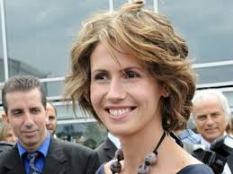 Also included in the article is some background information on the first lady. Asma Akhras was born in London in 1975 to a Syrian-born cardiologist and his wife, a diplomat who had served as first secretary at the Syrian embassy. She went to Queen’s College a private school, graduated from King’s College London, and worked for some time at JP Morgan in Manhattan. She was accepted into the prestigious ivy league school Harvard but instead of attending she accepted a marriage proposal from President Bashar in 2000 after secretly dating for some time.
The article detailed some other information as well, but nothing that would strike the knowledgeable reader as pretentious, over the top, or propaganda material. The response however from other publications written by disgruntled journalists was outrageous. They spoke as if they had more knowledge about conditions in Syria than a journalist that actually went to Syria and wrote about the experience.
Soon after the Vogue article was published the war in Syria began, with a staged uprising in Daraa. Another war against Vogue Magazine and this article, in particular, was waged by many publications, in particular, those that had ties or were sympathetic to the illegal state of Israel.
These publications shamed, insulted, belittled and demanded that this story be retracted or changed to fit the demonization campaign that spawned in mainstream media.
A few years prior in 2009 The Huffington Post published a slide show entitled, “Asma Al Assad: Syria’s First Lady And All-Natural Beauty.”
In 2010 the Harvard Arab Alumni Association’s website promoted an event featuring Asma by praising her as an avid supporter of “a robust, independent and self-sustaining civil society.” Asma convened a conference for the Syria Trust for Development about “the emerging role of civil society in development.”
As reported in Harvard’s Belfer Center for Science and International Affairs website, The First Lady “… opened the conference by declaring that the state wanted to open more space for civil society to work, develop and partner with the government in designing and implementing development-oriented policies. We will learn from our mistakes, she said, and a law will be passed soon — after consultations with civil society — to provide non-governmental organizations the safeguards they need to operate effectively. She challenged them, for their part, to rise to the occasion and achieve higher levels of efficacy and professionalism. Her overall theme of partnership reflected a realization that the government alone could not provide all the expertise or services needed to develop the country at the pace that its citizens expect.“
Syria hosted a conference of Harvard Arab Alumni with Asma leading the event.
The website was enthusiastic about Mrs. Assad’s role in Syrian national life and the connection between her work and that of her husband’s: ‘‘In her role as Syria’s first lady, Her Excellency Asma al-Assad applies her experience, energy, and influence to her country’s social and cultural development. Her role reflects the significant economic, political and social change that is happening in Syria today. Asma al-Assad’s work supports that of President Bashar al-Assad by fostering the emergence of a robust, independent and self-sustaining civil society.’’
Harvard Arab Alumni met in Damascus, “Under the Patronage of H.E. Mrs. Asma al-Assad, The First Lady of Syria.” “We are honored that Harvard Vice Provost for International Affairs, Prof. Jorge Dominguez, will be joining us in Damascus to deliver the Harvard Guest Address.“
In 2010, French Elle voted Asma “the most stylish woman in world politics,” and Paris Match called her “an eastern Diana,” a “ray of light in a country full of shadow zones.”
Even US Politicians appreciated and admired the Assads before this war bloody war was waged on the sovereign nation. Paying them visits and speaking about them in positive and affirmative tones.
Former Speaker of the House Nancy Pelosi stood on Syrian soil in April 2007 and famously declared that “the road to Damascus is a road to peace.” During her visit, Pelosi had an enjoyable shopping tour through Damascus markets.
Even Secretary of State Hillary Clinton bought the Assad-is-a-reformer narrative, telling CBS News on March 27, 2011: “There is a different leader in Syria now. Many of the members of Congress of both parties who have gone to Syria in recent months have said they believe he’s a reformer.”
Senator John Kerry, President Obama’s former informal envoy to Syria. Kerry feverishly pushed to revive diplomatic engagement with the Assad regime. Indeed, he was a frequent guest of Bashar’s; the two men and their wives were known to dine together in Damascus and discuss bilateral relations. He delivered a speech in Washington that heaped praise on Assad for the generosity he personally extended to the former Democratic presidential candidate during his many visits to Damascus.
All seemed well in Syria according to politicians and media alike. Was that all just a front? Were they all lying? Or were they dubbed into believing something that wasn’t true? Maybe they were tricked? Could it be that the Assad’s had put them all under a spell? No, no, no. They were not handed a memo yet that going forward they would be limited to derogatory terms and hate speech however ridiculous or nonsensical it may be when speaking about the Assad’s. It was a requirement or else they would face ridicule much like what happened to Vogue Magazine after they published their article on the first lady. They needed to quickly recant their support, respect, and admiration in order to fit with the new script. New terminology would replace the old, regime and dictator instead of government and president. Also, going forward all mainstream media outlets are required to mention barrel bombs, chemical weapons, and how the US will protect and save poor Syrians who are being bombed by their “brutal dictator” by well.. bombing them. Wait.. what?
Why this sudden change in March 2011? Simply because mainstream media completely flipped it’s script and started to demonize this “Rose in the Desert” along with her husband President Dr. Bashar Al Assad in an all-out propaganda campaign that fit the US/NATO “regime change” narrative. Asma Al-Assad never was nor is she evil. President Bashar Al Assad is not a ruthless dictator but instead they both are very much loved and respected in THEIR country by their people which is all that should matter. Before this invasion took place in 2011 and over 300,000 foreign mercenaries came in from over 80 countries, Syria was one of the safest countries in the world, and the only secular, nonsectarian and united country in the Middle East. For the first ten years of his presidency there were no major issues, no bombings, beheadings by terrorists, none of that so how is this something that President Bashar brought to the country? That is a huge misconception, one of many that the western media has helped instill in the minds of gullible people who have completely refused to use logic and critical thinking or to even question what they are being told.
The agenda in most mainstream media outlets globally soon became to destroy the first Assad’s image by any means possible, with a proliferation of lies and negative press. The same demonization that was used previously by imperialist nations in pursuit of destabilizing yet another country in the region. The modus operandi was the same, create an over the top propaganda media campaign to win the public’s sympathy and wage a “humanitarian intervention” in order to save the people of a country from their corrupt “dictatorship” run government by ousting the elected president, installing a puppet president approved by the US/NATO, stealing their resources, and establishing a long-term military base on the pretense that they are helping to rebuild the nation they themselves unapologetically destroyed. Much like they did with other countries they were “spreading democracy” in prior such as Afghanistan, Iraq, and Libya etc.
The plethora of articles one will find by doing a simple google search that reek of propaganda and are filled to the rim with bias, sectarian hate speech, and outright lies is profound. For the knowledgeable reader, they are simply infuriating to read.
I have included one such propaganda spewing article below published by The Guardian and some interesting information I found about the author as well.
“Asma al-Assad is a cheerleader for evil. Her UK citizenship should be revoked” was written by Nadhim Zahawi.
In this poorly written and utterly pathetic excuse for an article, Zahawi states “The Assad regime has a seemingly infinite capacity for evil, and an inability to be touched by compassion. At the very best he is dangerously deluded about what is happening, and the atrocities he has ordered. But most likely he is a monster.” Even though his article was supposedly about Asma Al-Assad he took whatever invalid and fact-deprived hits that he could at her husband as well.
Interestingly enough Mr. Zahawi a Kurdish Iraqi politician who visited Syria in 2011 and resides in the U.K. also had this to say “Removing Mrs. Assad’s citizenship is not illegal, because she is also a citizen of Syria. The home secretary has the power to do so when she believes it would be “conducive to the public good”. Asma al-Assad should never be welcome in our country again.” On that note, I hope Mr. Zahawi is forbidden to return to Syria as well.
After looking into Mr. Zahawi a little further I found that he is the vice-chair of the All Party Parliamentary Group (APPG) on Kurdistan Region in Iraq, which receives secretarial support from Gulf Keystone Petroleum International, an oil company of which Zahawi is Chief Strategy Officer. Concerns have been raised about how MPs’ independence might be compromised by such links between APPGs and private companies, and specifically about how Zahawi’s connections with the oil industry affect his role as MP. Zahawi has been co-chair or vice-chair of this APPG since it was established in 2008/9. Also worth noting, in November 2013 Zahawi “apologized unreservedly” after The Sunday Mirror reported that he had claimed £5,822 expenses for electricity for his horse riding school stables and a yard manager’s mobile home.[19] Zahawi said the mistake arose because he received a single bill covering both a meter in the stables and one in his house. He would repay the money though the actual overcharge was £4,000.[20] An article in The Independent also drew attention to the number of legitimate but “trivial” items on Zahawi’s expenses.
In January 2011, Zahawi appeared in the Commons debate discussing the end of the Education Maintenance Allowance scheme wearing a musical tie which proceeded to play during his contribution. The Deputy Speaker advised him to be more selective when choosing ties to avoid a musical accompaniment to debate in the chamber.
An investigation by the Guardian has revealed close links between a Conservative MP and two companies based in a tax haven. Nadhim Zahawi has financial ties to Balshore Investments and Berkford Investments, which operate from a lawyer’s’ office in Gibraltar. He does not declare a connection to either company on the MPs’ register of interests.
The same script in mainstream media is used repeatedly yet people still fall for it. Isn’t it time for the masses to recognize this repetition and bring an end to these bankers wars based on lies? We are all of one race, the human race and we need to end these countries destructive imperialist driven plots. World domination by the elite is not in the best interest of humanity.
The United States has been practicing this destructive behavior in toppling sovereign nations for their own benefit since 1898. New imperial influence of U.S. (1898-1917): New territories gained in Spanish American War: Hawaii, Puerto Rico, Guam, Philippines. Up until present day with Afghanistan, Libya, Iraq, Syria, Venezuela, the Philippines etc. At some point, this bloodshed has to end. Sovereignty has to be preserved. Cultures and customs need to be protected against greedy nations who only have their own best interest at heart. Whether it be neo-colonialism, imperialism, economic imperialism, etc. These ruthless regimes will do whatever it takes to complete their bloody missions.
Antikrieg TV -In 2010, the Syria’s First Lady Asma al-Assad talked to diplomats and intellectuals at the Paris Diplomatic Academy. She spoke without notes, about Syria’s history and how that heritage informs daily life.
“Some often ask me how then can Syria remain stable, moderate and influential in a region that is increasingly being surrounded by extremism, ideologism (sic), sectarianism and all other forms of negative perceptions in our society,” she told the gathering. “The typical answer I get is because of military, political, security reasons. Again, I believe I have a different view.
“It’s the very essence of our culture. It’s what our history teaches us of openness and engagement,” she said. “It’s the sense of identity and pride that we have knowing who we are in the world and knowing what we’ve contributed to the world over thousands of years that give us that sense of stability and that sense of moderation.
“Some of you might think I am talking politics. … Trust me, I have no interest in politics,” she continued. “My interests are elsewhere. But living in the region for as long as I have, I realize that politics affects every facet of our lives.”
Many people who have never heard of Syria before it became front page news after this imposed war was launched by outside forces on it’s land, think they have the right to speak ill about a nation that people like myself are originally from. Their profound arrogance is matched by their ignorance. What they may not realize is that they are indirectly contributing to the bloodshed by spreading this false propaganda. It would be better for them to never speak about Syria than for them to carelessly spread information that is nothing more than dirty gossip that they heard on their T.V. If they truly care, they need to educate themselves by reading and watching alternative media sources and listening to independent journalists, that do not have a vested interest in seeing Syria crumble and fall into the hands of the vultures in the West and their allies.
Sarah Abed can be contacted at sarahabed84@gmail.com.
Terror in Europe – Why Terrorists Are Allowed to Strike
By Ulson Gunnar – New Eastern Outlook – 09.07.2017
The London Bridge terror attack saw a repeat of a now familiar narrative in which every suspect involved had been long-known to both British security and intelligence agencies.
The London Telegraph in an article titled, “Khuram Butt, Rachid Redouane and Youssef Zaghba named: Everything we know about the London Bridge terrorists,” would reveal:
The ringleader of the London Bridge massacre never bothered to hide his violent, extremist views. Khuram Butt was so brazen that he openly posed with the black flag of the so-called Islamic State in Regent’s Park in the centre of London for a Channel 4 documentary, entitled The Jihadis Next Door.
Butt and other extremists linked to the banned terror group al-Muhajiroun were even detained by police for an hour over the stunt in 2015 but were released without being arrested.
The al-Muhajiroun terror group is headed by British-based extremist, Anjem Choudary, who for years helped fill the ranks of militant groups fighting governments the US and UK sought to overthrow in Libya, Syria and beyond. Choudary inexplicably escaped the consequences of his open advocacy and material support for known terrorist organizations for years, with the London Guardian in an article titled, “Anjem Choudary: a hate preacher who spread terror in UK and Europe,” going as far as speculating he did so because he was actually an informant or operative working for the British government.
The article would also admit that Butt was under investigation by British intelligence up to the day of the attack:
MI5 and counter-terrorism officers began an investigation into Butt, which remained ongoing even as the 27-year-old launched his terror attack on London Bridge. Butt, who was wearing an Arsenal shirt and a fake bomb strapped to his chest, was shot dead by police on Saturday night.
A second suspect, Rachid Redouane, was repeatedly brought to the attention of police who ignored warnings he was an extremist and a member of the so-called “Islamic State.”
The Telegraph reports that a third suspect, Youssef Zaghba, was also known to police:
He was reportedly arrested at Bologna airport in March 2016 trying to get to Syria and was also understood to be on an Italian anti-terror watch list.
The fact that these three suspects evaded capture and were able to carry out their attack despite being known and even monitored actively by British security and intelligence agencies lends even further credibility to the notion that they and others like them work for the British government, not against it.
Unable to Reach Syria, West’s Dogs of War Bite Local Population
Networks like al-Muhajiroun and the extremists they cultivate help fill the ranks of “moderate rebel” groups the US, UK, other European nations including France, as well as regional allies like Turkey, Jordan, Saudi Arabia, United Arab Emirates and Qatar are arming, funding and providing direct military support for in Libya, Syria, Yemen and beyond.
This fact goes far in explaining why extremists are allowed – for years – to openly advocate violence and recruit members into what is essentially a terrorist organization operating under the nose of British security and intelligence agencies – if not with their collective and eager complicity.
While these terrorists are labeled “moderate rebels” when fighting abroad, they are only labeled as such by the Western media out of necessity in an attempt to differentiate them from the extremists that are in fact fighting the West’s proxy war for it in places like Syria.
Suspects like Youssef Zaghba even attempted to travel to Syria to fight among the ranks of Western-backed militant groups – and failing to do so – participated in armed violence in the UK instead. Had he traveled onward to Syria, it would have been innocent Syrians instead of innocent British civilians terrorized, attacked, maimed and killed.
A Strategy of Terror and Tension
And despite the reality of the US and UK along with other European and Persian Gulf allies openly fueling terrorism at home and abroad, in the wake of tragic events like in London, Manchester, Paris, or Brussels, the very government organizations clearly responsible for presiding over these terrorists and their networks, sometimes for months and even years before an attack, are granted even more power to address a problem of their own intentional creation.
These organizations are able to do so in plain sight of the public specifically because of another conflict they openly orchestrate, pitting the general public against one another along lines of “anti-Islamic” fervor versus social justice advocates.
What both sides of this manufactured and intentionally perpetuated divide fail to realize is that Muslims are dying by the tens of thousands in places like Syria actively fighting against extremism springing not from Islam or the Qu’ran, but from the Pentagon, Westminster, Paris, Brussels, Riyadh, Ankara and Doha. It is not a clash of civilizations, but a manufactured conflict designed to perpetually fill the ranks of mercenaries abroad while exploiting their violence at home to procure more power and wealth through fear, anger and hysteria.
With wars in Afghanistan, Iraq, Syria, Yemen and beyond adding up to trillions for defense contractors and including weapon systems designed to fight them, with the F-35 joint strike fighter alone topping one trillion US dollars and as the West continues to openly act with impunity when and where it pleases despite violating the very international law it claims it is upholding globally, it is clear that, for now, this strategy is working.
If and when the general public understands the truth of why their lives are put in danger and their nation’s resources are being squandered abroad instead of at home for building their own futures, this strategy will be less successful. Until then, it appears that simplistic propaganda still works in convincing the public that governments like in London are simply incapable of arresting terrorists who appear regularly on TV, in the media and who openly operate in public with apparent and otherwise inexplicable impunity.
Fake News on Russia in the New York Times, 1917-2017

By Edward S. Herman | Monthly Review | July-August 2017
It has been amusing watching the New York Times (Times) and its fellow mainstream media (MSM) cohort express their dismay over the rise and spread of “fake news.” They take it as an obvious truth that what they provide is straightforward and unbiased fact-based news. They do offer such news, but they also provide a steady flow of their own varied forms of genuinely fake news, often in disseminating false or misleading information supplied them by the CIA, other branches of government, and sites of corporate power. An important form of MSM fake news is that which is presented while suppressing information that calls the preferred news into question. This was the case with “The Lie That Wasn’t Shot Down,” the title of a January 18, 1988 Times editorial referring to a propaganda claim of five years earlier that the editors had swallowed and never looked into any further. The lie–that the Soviets knew that Korean airliner 007, which they shot down on August 31, 1983, was a civilian plane–was eventually uncovered by congressman Lee Hamilton, not by the Times.
MSM fake news is especially likely where a party line is quickly formed on a topic, with deviationism therefore immediately looking naïve, unpatriotic or simply wrong. In a dramatic illustration, in a book chapter entitled “Worthy and Unworthy Victims,” Noam Chomsky and I showed that coverage by Time, Newsweek, CBS News and the New York Times of the 1984 murder of the priest Jerzy Popieluzko in communist Poland, a dramatic and politically useful event for the politicized western MSM, exceeded their coverage of the murders of 100 religious figures killed in Latin America by U.S. client states in the post-World War II years taken together.1 It was cheap and free of any negative feedback to focus heavily on the “worthy” victim, whereas looking closely at the deaths of the 100 would have required an expensive and sometimes dangerous research effort and would have upset the State Department. But it was a form of fake news to discriminate so heavily with news (and indignation) on a politically useful victim while ignoring large numbers whose murder the political establishments wanted downplayed or completely suppressed.
The Fake News Tradition on Russia in the New York Times
Fake news on Russia is a Times tradition that can be traced back at least as far as the 1917 revolution. In a classic study of the paper’s coverage of the Russian revolution from February 1917 to March 1920, Walter Lippmann and Charles Merz found that “From the point of view of professional journalism the reporting of the Russian Revolution is nothing short of a disaster. On the essential questions the net effect was almost always misleading, and misleading news is worse than none at all….They can fairly be charged with boundless credulity, and an untiring readiness to be gulled, and on many occasions with a downright lack of common sense.”2 Lippmann and Merz found that strong editorial bias clearly fed into news reporting. The editors very much wanted the communists to lose, and serving this end caused the paper to report atrocities that didn’t happen and the imminent fall of the Bolshevik regime on a regular basis (at least 91 times). There was a heavy and uncritical acceptance of official handouts and reliance on statements from unidentified “high authority.” This was standard Times practice.
This fake news performance of 1917-1920 was repeated often in the years that followed. The Soviet Union was an enemy target up to World War II, and Times coverage was consistently hostile. With the end of World War II and the Soviet Union at that point a major military power, and soon a rival nuclear power, the Cold War was on. Anti-communism became a major U.S. religion, and the Soviet Union was quickly found to be trying to conquer the world and needing containment. With this ideology in place and U.S. plans for its own real global expansion of power well established,3 the communist threat would now help sustain the steady growth of the military-industrial complex and repeated interventions to deal with purported Soviet aggressions.
An Early Great Crime: Guatemala
One of the most flagrant cases in which the Russian threat was used to justify U.S.-organized violence was the overthrow of the social democratic government of Guatemala in 1954 by a small proxy army invading from U.S. ally Somoza’s Nicaragua. This action was provoked by government reforms that upset U.S. officials, including a 1947 law permitting the formation of labor unions, and government plans to buy back (at tax rate valuations) and distribute to landless peasants some of the unused land owned by United Fruit Company and other large landowners. The U.S., which had been perfectly content with the earlier 14-year- long dictatorship of Jose Ubico, could not tolerate this democratic challenge and the elected government, led by Jacobo Arbenz, was soon charged with assorted villainies, with the main fake news base of an alleged Red capture of the Guatemalan government.4
In the pre-invasion propaganda campaign the unified MSM leveled a stream of false charges of extreme repression, threats to its neighbors, and the communist takeover. The Times featured these alleged abuses and threats repeatedly from 1950 onward (my favorite, Sidney Gruson’s “How Communists Won Control of Guatemala,” March 1, 1953). Arbenz and his predecessor, Juan Jose Arevalo, had carefully avoided establishing any embassies with Soviet bloc countries, fearing U.S. reactions. But it was to no avail. Following the removal of Arbenz and installation of a right-wing dictatorship, court historian Ronald Schneider, after studying 50,000 documents seized from communist sources in Guatemala, found that not only did the communists never control the country, but that the Soviet Union “made no significant or even material investment in the Arbenz regime” and was too preoccupied with internal problems to concern itself with Central America.5
The coup government quickly attacked and decimated the organized groups that had formed in the democratic era, like peasant, worker and teacher organizations. Arbenz had won 65 percent of the votes in a free election, but the “liberator” Castillo Armas quickly won a “plebiscite” with 99.6 percent of the vote. Although this is a result familiar in totalitarian regimes, the MSM had lost interest in Guatemala and barely mentioned this electoral outcome. The Times had claimed back in 1950 that U.S. Guatemala policy “is not trying to block social and economic progress but is interested in seeing that Guatemala becomes a liberal democracy.”6 But in the aftermath the editors failed to note that the result of U.S. policy was precisely to “block social and economic progress,” and via the installation of a regime of terror.
In 2011, more than half a century after 1954, Elizabeh Malkin reported in the Times that Guatemalan president Alvaro Colom had apologized for that ”great crime [the violent overthrow of the Arbenz government in 1954] …an act of aggression to a government starting its democratic spring.” (“An apology for a Guatemalan Coup, 57 Years Later,” October 20, 2011). Malkin mentions that, according to president Colom, the Arbenz family is “seeking an apology from the United States for its role” in the “great Crime.” There has never been any apology or even acknowledgement of its role in the Great Crime by the editors of the New York Times.
Another Great Crime: Vietnam
There were many fake news reports in the Times and other mainstream publications during the Vietnam war. The claim that the Times was anti-Vietnam-war is misleading and essentially false. In Without Fear or Favor, former Times reporter Harrison Salisbury acknowledged that in 1962, when U.S. intervention escalated, the Times was “deeply and consistently” supportive of the war policy.7 He contends that the paper became steadily more oppositional from 1965, culminating in the publication of the Pentagon Papers in 1971. But Salisbury fails to recognize that from 1954 to the present the paper never abandoned the Cold War framework and language of apologetics, according to which the U.S. was resisting somebody else’s aggression and protecting “South Vietnam.” The paper never applied the word aggression to this country, but used it freely in referring to North Vietnamese actions and those of the National Liberation Front in the southern half of Vietnam.
The various halts in the U.S. bombing war in 1965 and later in the alleged interest of “giving peace a chance” were also fake news, as the Johnson administration used the halts to quiet antiwar protests, while making it clear to the Vietnamese that U.S. officials demanded full surrender. The Times and its colleagues swallowed this bait without a murmur of dissent.8
Furthermore, although from 1965 onward the Times was willing to publish more information that put the war in a less favorable light, it never broke from its heavy dependence on official sources or its reluctance to check out official lies or explore the damage being wrought on Vietnam and its civilian population by the U.S. war machine. In contrast with its eager pursuit of Cambodian refugees from the Khmer Rouge after April 1975, the paper rarely sought out testimony from the millions of Vietnamese refugees fleeing U.S. bombing and chemical warfare. In its opinion columns as well, the new openness was limited to commentators who accepted the premises of the war and would confine their criticisms to its tactical problems and costs–;to us. From beginning to end those who criticized the war as aggression and immoral at its root were excluded from the debate by the Times.9
The 1981 Papal Assassination Attempt. The “Missile Gap,” and “Humanitarian Intervention” in Yugoslavia
Papal Assassination Attempt. A major contribution to Cold War propaganda was provided by fake news on the assassination attempt on Pope John Paul II in Rome in May 1981. This was a time when the Reagan administration was trying hard to demonize the Soviet Union as an “evil empire.” The shooting of the Pope by the Turkish fascist Ali Agca was quickly tied to Moscow, helped by Agca’s confession, after 17 months imprisonment, interrogations, threats, inducements, and access to the media, that the Bulgarians and Soviet KGB were behind it. There was never any credible evidence of this connection, the claims were implausible, and the corruption in the process was remarkable. (See Manufacturing Consent, chapter 4 and Appendix 2). And Agca also periodically claimed to be Jesus Christ. The case against the Bulgarians (and implicitly the KGB) was lost even in Italy’s extremely biased and politicized judicial framework. But the Times bought it, and gave it long, intensive and completely uncritical attention, as did most of the U.S. media.
In 1991, in Senate hearings on the qualifications of Robert Gates to head the CIA, former CIA officer Melvin Goodman testified that the CIA knew [from the start that Agca’s confessions were false because they had “very good penetration” of the Bulgarian secret services. The Times omitted this statement by Goodman in reporting on his testimony. In the same year. with Bulgaria now a member of the Free World, conservative analyst Allen Weinstein obtained permission to examine Bulgarian secret service files on the papal assassination attempt. His mission was widely reported when he went, including in the Times, but when he returned without having found anything implicating Bulgaria or the KGB, a number of papers, including the Times, found this not newsworthy.
Missile Gap. There was a great deal of fake news in the “missile gap” and other gap eras, from roughly 1975 to 1986, with Times reporters passing along official and often false news in a regular stream. An important case occurred in the mid-1970s, at a time when the U.S. war-party was trying to escalate the Cold War and arms race. A 1975 report of CIA professionals found that the Soviets were aiming only for nuclear parity. This was unsatisfactory, so CIA head George H.W. Bush appointed a new team of hardliners, who soon found that the Soviets were achieving nuclear superiority and getting ready to fight a nuclear war. This Team B report was taken at face value in a Times front page article of December 26, 1976 by David Binder, who failed to mention its political bias or purpose and made no attempt by tapping experts with different views to get at the truth. The CIA admitted in 1983 that the Team B estimates were fabrications. But throughout this period, 1975-1986, the Times supported the case for militarization by disseminating lots of fake news. Much of this false information was convincingly refuted by Tom Gervasi in his classic The Myth of Soviet Military Supremacy (New York: Harper & Row, 1986), a book never reviewed in the paper despite the paper’s frequent attention to its subject matter.
Yugoslavia and “Humanitarian Intervention.” The 1990s wars of dismantlement of Yugoslavia succeeded in removing an independent government from power and replacing it with a broken Serbian remnant and poor and unstable failed states in Bosnia and Kosovo. It did provide unwarranted support for the new concept of “humanitarian intervention,” which rested on a mass of fake news. The demonized Serbian leader Slobodan Milosevic was not an ultra-nationalist seeking a “Greater Serbia,” but rather a non-aligned leader on the Western hit list who tried to help Serb minorities in Bosnia, Croatia and Kosovo remain in Yugoslavia as the U.S. and EU supported a legally questionable exodus by several constituent Yugoslav Republics. He supported each of the proposed settlements of these conflicts, sabotaged by Bosnian and U.S. officials who wanted better terms or the outright military defeat of Serbia, the latter of which they achieved. Milosevic had nothing to do with the July 1995 Srebrenica massacre, which involved Bosnian Serbs taking revenge on Bosnian Muslim soldiers who had been ravaging nearby Bosnian Serb villages from their base in Srebrenica under NATO protection. The several thousand Serb civilian deaths were essentially unreported in the MSM, while the numbers of Srebrenica executed victims were correspondingly inflated. The Times’s reporting on these events was fake news on a systematic basis.10
The Putin Era: A Golden Age of Fake News
The U.S. establishment was shocked and thrilled with the 1989-1991 fall of the Soviet Union, and its members were happy with the policies carried out under President Boris Yeltsin, a virtual U.S. client, under whose rule ordinary Russians suffered a calamity but a small set of oligarchs was able to loot the broken state. Yeltsin’s election victory in 1996, greatly assisted by U.S. consultants, advice and money, and otherwise seriously corrupt, was, for the editors of the Times, “A Victory for Russian Democracy” (NYT, ed, July 4, 1996). They were not bothered by either the electoral corruption, the creation of a grand-larceny-based economic oligarchy, or, shortly thereafter, the new rules centralizing power in the office of president.11
Yeltsin’s successor, Vladimir Putin, by gradually abandoning the Yeltsin era subservience was thereby perceived as a steadily increasing menace. His re-election in 2012, although surely less corrupt than Yeltsin’s in 1996, was treated harshly in the media. The lead Times article on May 5, 2012 featured “a slap in the face” from OSCE observers, claims of no real competition, and “thousands of anti-government protesters gathered in Moscow square to chant ‘Russia without Putin’” (Ellen Barry and Michael Schwartz, “After Election, Putin Faces Challenges to Legitimacy”). There had been no “challenges to legitimacy” reported in the Times after Yeltsin’s corrupt victory in 1996.
The process of Putin demonization escalated with the Ukraine crisis of 2014 and its sequel of Kiev warfare against Eastern Ukraine, Russian support of the East Ukraine resistance, and the Crimean referendum and absorption of Crimea by Russia. This was all declared “aggression” by the U.S. and its allies and clients, sanctions were imposed on Russia, and a major U.S.-NATO military buildup was initiated on Russia’s borders. Tensions mounted further with the shootdown of Malaysia Airlines Flight 17 over southeastern Ukraine, effectively, but almost surely falsely, blamed on the “pro-Russian” rebels and Russia itself.12
A further cause of demonization and anti-Russian hostility resulted from the escalated Russian intervention in Syria from 2015 in support of Bashar al-Assad and against ISIS and al-Nusra, an offshoot of al-Qaeda. The U.S. and its NATO and Middle East allies had been committing aggression against Syria, in de facto alliance with ISIS and al-Nusra, for several years. Russian intervention turned the tide, the U.S. (Saudi, etc.) goal of removing Assad was upset and the tacit U.S. allies ISIS and al-Nusra were also weakened. Certainly demonic behavior by Putin!
The Times has treated these further developments with unstinting apologetics–for the February 2014 coup in Kiev, which it never calls a coup, with the U.S. role in the overthrow of the elected government of Victor Yanukovych suppressed, and with anger and horror at the Crimea referendum and Russian absorption, which it never allows to be a defensive response to the Kiev coup. Its call for punishment of the casualty-free Russian “aggression” in Crimea is in marked contrast with its apologetics for the million-plus-casualty–rich U.S. aggression “of choice” (not defensive) in Iraq from March 2003 on. The editors and liberal columnist Paul Krugman angrily cite Putin’s lack of respect for international law,13 with their internalized double standard exempting their own country from criticism for its repeated violations of that law.
In the Times’s reporting and opinion columns Russia is regularly assailed as expansionist and threatening its neighbors, but virtually no mention is made of NATO’s expansion up to the Russian borders and first-strike-threat placement of anti-missile weapons in Eastern Europe, the latter earlier claimed to be in response to a missile threat from Iran! Analyses by political scientist John Mearsheimer and Russia authority Stephen F. Cohen that featured this NATO advance could not make it into the opinion pages of the Times.14 On the other hand, a member of the Russian Pussy Riot band, Maria Alyokhina, was given op-ed space to denounce Putin and Russia,15 and the punk-rock group was granted a meeting with the Times editorial board. Between January 1 and March 31, 2014 the paper had 23 articles featuring the Pussy Riot group and its alleged significance as a symbol of Russian limits on free speech. Pussy Riot had disrupted a church service in Moscow and only stopped upon police intervention, which was at the request of the church authorities. A two year prison sentence followed. In contrast, in February 2014, 84 year old Sister Megan Rice was sentenced to four years in prison in the U.S. for having entered a nuclear weapons site in July 2012 and carried out a symbolic protest action. The Times gave this news a tiny mention in its National Briefing section under the title “Tennessee Nun is Sentenced for Peace Protest.” No op-ed columns or meeting with the Times board for Rice. There are worthy and unworthy protesters as well as victims.
As regards Syria, with Russian help the Assad forces were able to dislodge the rebels from Aleppo, to the dismay of Washington and the MSM. It has been enlightening to see how much concern has been expressed over casualties to civilians in Aleppo, with pictures of forsaken children and many stories of civilian distress. The Times focused heavily on those civilians and children, with great indignation at Putin-Assad inhumanity,16 in sharp contrast with their virtual silence on civilian casualties in Falluja in 2004 and beyond, and recently in rebel-held areas of Syria, and in Mosul (Iraq), under U.S. and allied attack.17 The differential treatment of worthy and unworthy victims has been in full sway in dealing with Syria, displayed again with the chemical weapons casualties and Trump bombing response in April 2017 (discussed below).
A further and important phase of intensifying Russophobia may be dated from the October 2016 presidential debates, where Hillary Clinton declared that Mr. Trump would be a Putin “puppet” as president, and her campaign stressed this threat. This emphasis increased after the election, with the help of the media and intelligence services, as the Clinton camp sought to explain the election loss, maintain party control, and possibly get the election result overturned in the courts or electoral college by blaming the Trump victory on Russia.
The Putin connection was given great impetus by the January 6, 2017 release of a report of the Office of Director of National Intelligence (DNI), on Background of Assessing Russian Activities and Intention in Recent US Elections This short document spends more than half of its space describing the Russian-sponsored RT-TV network, which it treats as an illegitimate propaganda source given its sponsorship and sometimes critical reports on U.S. policy and institutions! RT is allegedly part of Russia’s “influence campaign,” and the DNI says that “We assess the influence campaign aspired to help President-elect Trump’s chances of victory when possible by discrediting Secretary Clinton and publicly contrasting her unfavorably to the President-elect.” There is no semblance of proof that there was a planned “campaign” rather than an ongoing expression of opinion and news judgments. All the logic and proofs of a Russian “influence campaign” could be applied with at least equal force to U.S. media and Radio Free Europe’s treatment of any Russian election, and of course the U.S. intervention in the 1996 Russian election was overt, direct and went far beyond any “influence campaign.”
As regards the DNI’s proof of a more direct Russian intervention in the U.S. election, the authors concede the absence of “full supporting evidence,” but they provide no supporting evidence—only assertions, assessments, assumptions and guesses. It states that “We assess that … Putin ordered an influence campaign in 2015” designed to defeat Mrs. Clinton, and “to undermine public faith in the U.S. democratic process,” but it provides no evidence whatsoever for any such order. It also provides no evidence that Russia hacked the Democratic National Committee (DNC), the e-mails of Clinton and former Clinton campaign manager Podesta, or that it gave hacked information to WikiLeaks. Julian Assange and former British diplomat Craig Murray have repeatedly claimed that these sources were leaked by local insiders, not hacked by anybody. And the veteran intelligence agency experts William Binney and Ray McGovern also contend that the WikiLeaks evidence was surely leaked, not hacked.18 It is also notable that among the three intelligence agencies who signed the DNI document, only “moderate confidence” in its findings was expressed by the National Security Agency (NSA), the agency that would most clearly be in possession of proof of Russian hacking and transmission to WikiLeaks as well as any “orders” from Putin.
But the Times has taken the Russian hacking story as established fact, despite the absence of hard evidence (as with the Reds ruling Guatemala, the “missile gaps,” etc.). Times reporter David Sanger refers to the report’s “damning and surprisingly detailed account of Russia’s efforts to undermine the American electoral system,” but he then acknowledges that the published report “contains no information about how the agencies had … come to their conclusions.”19 The report itself includes the amazing statement that “Judgments are not intended to imply that we have proof that shows something to be a fact.” This is a denial of the credibility of its own purported evidence (i.e., “assessments”). Furthermore, if the report was based on “intercepts of conversations” as well as hacked computer data, as Sanger and the DNI claim, why has the DNI failed to quote a single conversation showing Putin’s alleged orders and plans to destabilize the West?
The Times never cites or gives editorial space to William Binney, Ray McGovern or Craig Murray, who are dissident authorities on hacking technology, methodology and the specifics of the DNC hacks. But op-ed space was given to Louise Mensch’s “What to ask about Russian hacking” (NYT, March 17, 2017). Mensch is a notorious conspiracy theorist with no technical background in this area and who is described by Nathan Robinson and Alex Nichols as best-known for “spending most of her time on Twitter issuing frenzied denunciations of imagined armies of online ‘Putinbots’” and is “one of the least credible people on the internet.”20 But she is published in the Times because, in contrast with the well-informed and credible William Binney and Craig Murray, she follows the party line, taking Russian hacking of the DNC as a premise.
The CIA’s brazen intervention in the election process in 2016 and 2017 broke new ground in secret service politicization. Former CIA head Michael Morell had an August 5, 2016 op-ed in the Times entitled “I Ran the C.I.A. Now I’m Endorsing Hillary Clinton”; and former CIA boss Michael Hayden had an op-ed in the Washington Post just days before the election, entitled “Former CIA Chief:- Trump is Russia’s Useful Fool” (November 3, 2016). Morell had another op-ed in the Times on January 6, now openly assailing the new president (“Trump’s Dangerous Anti-CIA Crusade”). These attacks were unrelievedly insulting to Trump and laudatory to Clinton, even making Trump a traitor; they also make it clear that Clinton’s more pugnacious approach to Syria and Russia is much preferred to Trump’s leanings toward negotiation and cooperation with Russia.
This was also true of the further scandal with former Trump Defense Intelligence nominee Michael Flynn’s call from the Russian Ambassador, which possibly included exchanges about future Trump administration policy actions. This was quickly grasped by the outgoing Obama officials, security personnel and MSM, with the FBI interrogating Flynn and with widespread expressions of horror at Flynn’s action, allegedly possibly setting him up for blackmail. But such pre-inauguration meetings with Russian diplomats have been a “common practice” according to Jack Matlock, the U.S. ambassador to Russia under Reagan and Bush, and Matlock had personally arranged such a meeting for Jimmy Carter.21 Obama’s own Russia adviser, Michael McFaul, admitted visiting Moscow for talks with officials in 2008 even before the election. Daniel Lazare makes a good case that not only are the illegality and blackmail threat implausible, but that the FBI’s interrogation of Flynn also reeks of entrapment. And he asks what is wrong with trying to reduce tensions with Russia? “Yet anti-Trump liberals are trying to convince the public that it’s all ‘worse than Watergate’.”22
So the political point of the Assessment seems to have been, at minimum, to tie the Trump administration’s hands in its dealings with Russia. Some non-MSM analysts have argued that we may have been witnessing an incipient spy or palace coup, that fell short but still had the desired effect of weakening the new administration.23 The Times has not offered a word of criticism of this politicization and intervention in the election process by the intelligence agencies, and in fact the editors have been working with them and the Democratic Party as a loosely-knit team in a distinctly un- and anti-democratic program designed to reverse the results of the 2016 election, while using an alleged foreign electoral intervention as their excuse.
The Times and MSM in general have also barely mentioned the awkward fact that the allegedly Russian-hacked disclosures of the DNC and Clinton and Podesta e-mails described uncontested facts about real electoral manipulations on behalf of the Clinton campaign that the public had a right to know and that might well have affected election results. The focus on the evidence-free claims of a Russian hacking intrusion helped divert attention from the real electoral abuses disclosed by the WikiLeaks material. So here again, official and MSM fake news helped bury real news!
Another arrow in the campaign quiver labeling Trump a knowing or “useful fool” instrument of Putin was a private intelligence “dossier” written by Christopher Steele, a former British intelligence agent working for Orbis Business Intelligence, a private firm hired by the DNC to dig up dirt on Trump. Steele’s first report, delivered in June 2016, made numerous serious accusations against Trump, most notably that Trump had been caught in a sexual escapade in Moscow, that his political advance had been supported by the Kremlin for at least five years, under the direction of Putin, and with the further aims of sowing discord within the U.S. and disrupting the Western alliance. This document was based on alleged conversations by Steele with distant (Russian) officials; that is, strictly hearsay evidence, whose assertions, where verifiable, are sometimes erroneous.24 But it said just what the Democrats, MSM and CIA wanted said, so intelligence officials declared the author “credible” and the media lapped this up, with the Times covering over its own cooperation in this ugly denigration effort by calling the report “unverified” but nevertheless reporting its claims.25
The Steele dossier also became a central part of the investigation and hearings on “Russia-gate” held by the House Intelligence Committee starting in March 2017, led by Democratic Representative Adam Schiff. While basing his opening statement on the hearsay-laden dossier, Schiff expressed no interest in establishing who funded the Steele effort (he produced 17 individual reports), the identity and exact status of the Russian officials who were the hearsay sources, and how much they were paid. Apparently talking to Russians with a design of influencing a U.S. presidential election is perfectly acceptable if the candidate supported by this Russian intrusion is anti-Russian!
The Times has played a major role in this Russophobia-enhancement process, reminiscent of its 1917-1920 performance in which, as noted back in 1920 “boundless credulity, and an untiring readiness to be gulled” characterized the news-making process. While quoting the CIA’s admission that they were showing no hard evidence, but were relying on “circumstantial evidence” and “capabilities,” the Times was happy to spell these capabilities out at great length and imply that they proved something.26 Editorials and news articles have worked uniformly on the supposition that Russian hacking was proved, which it was not, and that the Russians had given these data to WikiLeaks, also unproven and strenuously denied by Assange and Murray. So these reiterated claims are arguably first class “fake news” swallowed as palatable facts.
The Times has run neck-and-neck with the Washington Post in stirring up fears of the Russian information war and improper involvement with Trump. The Times now easily conflates fake news with any criticism of established institutions, as in Mark Scott and Melissa Eddy’s “Europe Combats a New Foe of Political Stability: Fake News,” February 20, 2017.27 But what is more extraordinary is the uniformity with which the paper’s regular columnists accept as a given the CIA’s Assessment of the Russian hacking and transmission to WikiLeaks, the possibility or likelihood that Trump is a Putin puppet, and the urgent need of a congressional and “non-partisan” investigation of these claims. This swallowing of a new war-party line has extended widely in the liberal media (e.g., Bill Moyers, Robert Reich, Ryan Lizza, Joan Walsh, Rachel Maddow, Katha Pollitt, Joshua Holland, the AlterNet web site, etc.).
Both the Times and Washington Post have given tacit support to the idea that this “fake news” threat needs to be curbed, possibly by some form of voluntary media-organized censorship or government intervention that would at least expose the fakery.
The Times has treated uncritically the Schiff hearings on dealing with Russian propaganda, and its opinion column by Louise Mensch strongly supports government hearings to expose Russian propaganda. Mensch names 26 individuals who should be interrogated about their contacts with Russians, and she supplies questions they should be asked.
The most remarkable media episode in this anti-influence-campaign campaign was the Washington Post‘s piece by Craig Timberg, “Russian propaganda effort helped spread ‘fake news’ during election, experts say” (November 24, 2016). The article features a report by an anonymous author or authors, PropOrNot, that claims to have found 200 web sites that wittingly or unwittingly, were “routine peddlers of Russian propaganda.” While smearing these web sites, the “experts” refused to identify themselves allegedly out of fear of being “targeted by legions of skilled hackers.” As Matt Taibbi says, “You want to blacklist hundreds of people, but you won’t put your name to your claims? Take a hike.”28 But the Post welcomed and featured this McCarthyite effort, which might well be a product of Pentagon or CIA information warfare. (And these entities are themselves well funded and heavily into the propaganda business.)
On December 23, 2016 President Obama signed the Portman-Murphy “Countering Disinformation and Propaganda Act,” which will supposedly allow this country to more effectively combat foreign (Russian, Chinese) propaganda and disinformation. It will encourage more government counter-propaganda efforts (which will, by patriotic definition, not be U.S. propaganda) and provide funding to non-government entities that will help in this enterprise. It is clearly a follow-on to the claims of Russian hacking and propaganda, and shares the spirit of the listing of 200 knowing or “useful fools” of Moscow featured in the Washington Post. Perhaps PropOrNot will qualify for a subsidy and be able to enlarge its list of 200. Liberals have been quiet on this new threat to freedom of speech, undoubtedly influenced by their fears of Russian-based fake news and propaganda. But they may wake up, even if belatedly, when Trump or one of his successors puts it to work on their own notions of fake news and propaganda.
The success of the war party’s campaign to contain or overthrow any tendencies of Trump to ease tensions with Russia was dramatically clear in the Trump administration’s speedy bombing response to the April 4, 2017 Syrian chemical weapons deaths. The Times and other MSM editors and journalists greeted this aggressive move with almost uniform enthusiasm,29 and once again did not require evidence of Assad’s guilt beyond their government’s say-so. The action was damaging to Assad and Russia, but served the rebels well. But the MSM never ask cui bono? in cases like this. In 2003 a similar charge against Assad, which brought the U.S. to the brink of a full-scale bombing war in Syria, turned out to be a false flag operation, and some potent authorities believe the current case is equally problematic.30 But Trump moved quickly (and unlawfully) and any further rapproachement between this country and Russia was set back. The CIA, Pentagon, liberal-Democrats and rest of the war party had won an important skirmish in the struggle for and against permanent war.
- Manufacturing Consent (New York: Pantheon, 1988, 2002, 2008), chap. 2.
- Walter Lippmann and Charles Merz, A Test of the News (New York: New Republic, 1920).
- On the Grand Area framework, see Noam Chomsky, “Lecture one, The New Framework of Order,” On Power And Ideology: The Managua Lectures (Boston, South End Press, 1987).
- Edward Herman, “Returning Guatemala to the Fold,” in Gary Rawnsley, ed., Cold War Propaganda in the 1950s (London, Macmillan, 1999).
- Ronald Schneider, Communism in Guatemala, 1944-1954 (New York: Praeger, 1959), 41, 196-7, 294.
- “The Guatemala Incident,” New York Times (ed., April 8, 1950).
- Harrison Salisbury, Without Fear or Favor (New York: Times Books, 1980), 486.
- Richard DuBoff and Edward Herman, America’s Vietnam Policy: The Strategy of Deception (Washington, D.C.: Public Affairs Press, 1966).
- See Manufacturing Consent, chap. 6 (Vietnam).
- Edward S. Herman and David Peterson, “The Dismantling of Yugoslavia,” Monthly Review, October 2007; Herman and Peterson, “Marlise Simons on the Yugoslavia Tribunal: A Study in Total Propaganda Service,” ZNet, April 16, 2005.
- Stephen F. Cohen, Failed Crusade: America and the Tragedy of Post-Communist Russia (New York: W.W. Norton, 2000).
- Robert Parry, “Troubling Gaps in the New MH-17 Report,” Consortiumnews.com. September 28, 2016.
- Paul Krugman says “Mr. Putin is someone who doesn’t worry about little things like international law,” in “The Siberian Candidate,” New York Times, July 22, 2016. The fake news implication is that U.S. leaders do worry about it.
- A version of Mearsheimer’s article “Why the Ukraine Crisis Is the West’s Fault,” published in Foreign Affairs, Sept. 10, 2014, was offered to the Times but not accepted. Stephen Cohen’s 2012 article “The Demonization of Putin” was also rejected by the paper.
- “Sochi Under Siege,” New York Times, February 21, 2014.
- Michael Kimmelman, “Aleppo’s F aces Beckon to Us, To Little Avail,” New York Times,, Dec. 15, 2016. Above this front page article are four photos of dead or injured children, the most prominent one in Syria. The accompanying editorial: “Aleppo’s Destroyers: Assad, Putin, Iran,” December. 15, 2016, omits some key actors and killers.
- Rick Sterling, “How US Propaganda Plays in Syrian War,” Consortiumnews.com, September. 23, 2016.
- William Binney and Ray McGovern, “The Dubious Case on Russian ‘Hacking’,” Consortiumnews.com January 6, 2017.
- David Sanger, “Putin Ordered ‘Influence Campaign’ Aimed at U.S. Election, Report Says,” NYT, January 6, 4017.
- Nathan Robinson and Alex Nichols, “What Constitutes Reasonable Mainstream Opinion,” Current Affairs, March 22, 2017.
- “Contacts With Russian Embassy,” JackAMatlock.com, March 4, 2017.
- Daniel Lazare, “Democrats, Liberals, Catch McCarthyistic Fever,” Consortiumnew.com, February 17, 2917.
- Robert Parry, “A Spy Coup in America?,” Consortiumnews,com, Dec. 18, 2016; Andre Damon, “Democratic Party Floats Proposal for a Palace Coup,” Information Clearing House, March 23, 2017.
- Robert Parry, “The Sleazy Origins of Russia-gate,” Consortiumnews.com, March 29, 2017.
- Scott Shane et al, “How a Sensational, Unverified Dossier Became a Crisis for Donald Trump,” New York Times, January 11, 2017.
- Matt Fegenheimer and Scott Shane,” “Bipartisan Voices Back U.S. Agencies On Russia Hacking,” NYT, January 6, 2017; Michael Shear and David Sanger, “Putin Led a Complex Cyberattack Scheme to Aid Trump, Report Finds,“ NYT January 7, 2017; Andrew Kramer, “How the Kremlin Recruited an Army of Specialists to Wage Its Cyberwar,” NYT, Dec. 30, 2016.
- Robert Parry, “NYT’s Fake News about Fake News,”Consortium news.com, February 22, 2017.
- Matt Taibbi, “The ‘Washington Post’ ‘Blacklist’ Story Is Shameful and Disgusting,” Rolling Stone.com, November 28, 2016.
- Adam Johnson, “Out of 47 Media Editorials on Trump’s Syria Strikes, Only One Opposed,” Fair, April 11, 2017.
- Scott Ritter, “Wag the Dog—How Al Qaeda Played Donald Trump And The American Media: Responsibility for the chemical event in Khan Sheikhoun is still very much in question,” Huffingtonpost.com, April 9, 2017; James Carden, ”The Chemical Weapons Attack in Syria; Is there a place for skepticism?,” Nation, April 11, 2017.
Edward S. Herman is an economist and media analyst with a specialty in corporate and regulatory issues as well as political economy and the media.
US, Israel use German BND in new allegation against Iran
Sputnik – 08.07.2017
The German Intelligence Agency (BND) claims that Iran is “actively seeking products and scientific know-how” from German companies “for developing weapons of mass destruction and missile technology,” but Iranian political observer Hassan Beheshtipour dismissed the accusation as a “US-Israeli conspiracy against Iran” where BND is merely a pawn.
On Thursday, Fox News reported that German intelligence agency BND has prepared a report on Iran, warning that the Islamic Republic “is actively seeking products and scientific know-how for the field of developing weapons of mass destruction as well as missile technology.” For the purpose, the country is “targeting German companies through various fronts.”
The 181-page manual, the broadcaster said, was published last month and released on Tuesday by officials from the heavily industrialized southern German state of Baden-Württemberg. According to it, “in one case, Iran allegedly worked through a Chinese front company to seek ‘complex metal-producing machines’ from a German engineering firm. German intelligence officials blocked the sale when they told the engineering firm the merchandise was slated to be unlawfully routed to Iran.”
Sputnik Iran discussed the issue with Hassan Beheshtipour, Iranian political observer, an expert on nuclear issues and foreign policy contributor for PRESS TV Network, who called the accusations absurd.
“From the ideological point of view, the 181-page report could be regarded as a new attempt of the Israeli and American intelligence services and the Zionist lobby to discredit Iran with the help of Germany. It looks like a new scenario for the implementation of their schemes which they plotted back in 2001 and which they later modified into the anti-Iranian dossier on the nuclear program. However they failed,” Hassan Beheshtipour told Sputnik.
Not a single evidence has been submitted that Iran is trying to develop a nuclear weapon. Moreover, the expert said, it has been proved that Iran’s nuclear research pursues purely peaceful purposes. Therefore the above services decided to concentrate their efforts on [Iran’s] missile program and allege it the capacities of the weapons of mass destruction.
Hassan Beheshtipour pointed out at a number of contradictions which reveal a frame-up.
First of all, Iran was one of the first countries to sharply condemn and oppose the spread of weapons of mass destruction. It actively cooperates with the Organization for the Prohibition of Chemical Weapons (OPCW). It has also stepped up its cooperation with the International Atomic Energy Agency (IAEA) on the various stages of control and inspection, especially after the signing of the nuclear deal. Iran strictly fulfills all the protocols with regards to Non-Proliferation Treaty (NPT) under the full control of IAEA. No doubts have been left with regards to its nuclear program. And there are no doubts that Iran makes no attempts to develop a weapon of mass destruction.
The expert also reminded that Iran’s missile program is of purely defensive, not offensive nature.
With regard to the defensive program, which also includes the missile program, it is even more transparent. Iran repeatedly reiterated that it has the right of self-defense and will neither discuss this issue with anyone nor negotiate on it.
The country’s missile program, he said, falls within the so-called conventional weapons. Iran has condemned at the highest level any production of chemical weapons. This decree of Supreme Leader of Iran, Ayatollah Khamenei has been protocoled in UN. It has been repeatedly referred to during the negotiations on Iran’s nuclear program. Thus Iran, apart from nuclear and chemical weapons, has no other restrictions for its defense industry.
Iran’s defense industry, which also includes the missile program, had taken center stage during the Iran-Iraq war (1980-1988) when the regime of Saddam Hussein was bombing Iranian cities. Iran then was forced to turn to many countries with the request to supply missile weaponry to be able to defend itself. It had no missile engineering at that time. However practically no one (except for 2 countries) responded to its requests. It gave an impulse to Tehran to set up and further develop its missile engineering.
Since then Iran has reached high success in this area, it now possesses its own developments and technologies. Thus it simply does not need any know-how of German or Chinese companies, especially bypassing the sanctions, which are still partially in place.
Thus, the expert said, all the accusations of Iran, put forward in this report, are absolutely absurd. Iran is developing missiles of various ranges purely for its defensive purposes in case of an external attack. The Iranian missile program is of defensive and not of offensive character. It is a mean of containment, and not of aggression, Hassan Beheshtipour finally stated.
How like sarin is a sarin-like substance?
By Tim Hayward | July 8, 2017
The OPCW has analysed samples from Khan Sheikhoun in April containing what they have identified as ‘sarin or a sarin-like substance’. They know that much, even if they are not sure how it got there or who is responsible.
But how much actually is that? Throughout the OPCW report we find the cumbersome expression sarin or a sarin-like substance. Why not just sarin, pure and simple?
All a non-chemist like me can understand from this is that we are dealing with some nasty stuff, but there is no definite confirmation it is sarin pure and simple. Of course, a non-chemist also has no idea how impure a sample or how different a molecule would need to be to count as merely of a substance like sarin; nor would we know how much more impure or different it could be before becoming unlike sarin. So we non-chemists could easily be bamboozled in these matters.
One thing we do know is that the sarin the Syrian government produced and gave up for destruction in 2013 was referred to by all concerned as sarin, pure and simple. To produce sarin with military grade purity is not easy. To produce improvised versions, however, is within the capacity of insurgents in Syria.
Given that there are already open questions about motive, means and opportunity, as I indicated in my previous blog, then if there is doubt about even the weapon as well, the case for blaming Assad looks decidedly uncertain. In fact, regarding the weapon, as I mentioned in the blog before last, the OPCW could not ascertain the method of delivery or therefore the ‘hardware’ used. So it becomes crucial for those who would prosecute a case against Assad to say that the chemical was one the opposition could not have had access to. So crucial has it become that the UK’s Ambassador Adams has said it: ‘There is no evidence to suggest that any party to the conflict in Syria, other than the Syrian Government, has access to a complex nerve agent such as sarin.’
Still, just saying it does not make it true if the report you are relying on does not say it is true. And – it bears repeating – the OPCW does not say anything that clearly rules out the possibility of opposition responsibility for the incident.
It bears repeating because to accept the unsubstantiated claim as a pretext for sending more bombs, death and destruction against the people of Syria would be a heinous act. Anybody who pronounces on the matter without striving to be scrupulously honest and clear about what they are saying will be complicit in that act.

Fatal Courtroom Act Ruins Michael ‘hockey stick’ Mann

By John O’Sullivan | Principia Scientific International | July 4, 2017
Penn State climate scientist, Michael ‘hockey stick’ Mann commits contempt of court in the ‘climate science trial of the century.’ Prominent alarmist shockingly defies judge and refuses to surrender data for open court examination. Only possible outcome: Mann’s humiliation, defeat and likely criminal investigation in the U.S.
The defendant in the libel trial, the 79-year-old Canadian climatologist, Dr Tim Ball (above, right) is expected to instruct his British Columbia attorneys to trigger mandatory punitive court sanctions, including a ruling that Mann did act with criminal intent when using public funds to commit climate data fraud. Mann’s imminent defeat is set to send shock waves worldwide within the climate science community as the outcome will be both a legal and scientific vindication of U.S. President Donald Trump’s claims that climate scare stories are a “hoax.”
As can be seen from the graphs below; Mann’s cherry-picked version of science makes the Medieval Warm Period (MWP) disappear and shows a pronounced upward ‘tick’ in the late 20th century (the blade of his ‘hockey stick’). But below that, Ball’s graph, using more reliable and widely available public data, shows a much warmer MWP, with temperatures hotter than today, and showing current temperatures well within natural variation.

Michael Mann, who chose to file what many consider to be a cynical SLAPP (Strategic Lawsuit Against Public Participation) libel suit in the British Columbia Supreme Court, Vancouver six long years ago, has astonished legal experts by refusing to comply with the court direction to hand over all his disputed graph’s data. Mann’s iconic hockey stick has been relied upon by the UN’s IPCC and western governments as crucial evidence for the science of ‘man-made global warming.’
As first reported in Principia Scientific International (February 1, 2017), the defendant in the case, Canadian climatologist Dr. Tim Ball, had won “concessions” against Mann, but at the time the details were kept confidential, pending Mann’s response.
The negative and unresponsive actions of Dr Mann and his lawyer, Roger McConchie, are expected to infuriate the judge and be the signal for the collapse of Mann’s multi-million dollar libel suit against Dr Ball. It will be music to the ears of so-called ‘climate deniers’ like President Donald Trump and his EPA Chief, Scott Pruitt.
As Dr Ball explains:
“Michael Mann moved for an adjournment of the trial scheduled for February 20, 2017. We had little choice because Canadian courts always grant adjournments before a trial in their belief that an out of court settlement is preferable. We agreed to an adjournment with conditions. The major one was that he [Mann] produce all documents including computer codes by February 20th, 2017. He failed to meet the deadline.”
Punishment for Civil Contempt
Mann’s now proven contempt of court means Ball is entitled to have the court serve upon Mann the fullest punishment. Contempt sanctions could reasonably include the judge ruling that Dr. Ball’s statement that Mann “belongs in the state pen, not Penn. State’ is a precise and true statement of fact. This is because under Canada’s unique ‘Truth Defense’, Mann is now proven to have willfully hidden his data, so the court may rule he hid it because it is fake. As such, the court must then dismiss Mann’s entire libel suit with costs awarded to Ball and his team.
The spectacular rise and fall of climate alarmism’s former golden boy is a courtroom battle with even more ramifications than the infamous Scopes Monkey Trial of 1925. To much fanfare at the time, Mann had sued Ball for daring to publish the damning comment that Mann “belongs in the state pen, not Penn. State.” Dr Ball brilliantly backed up his exposure of the elaborate international money-making global warming scam in his astonishing book, The Deliberate Corruption of Climate Science.
In his books, articles, radio and television appearances, Dr. Ball has been resolute in his generation-long war against those who corrupted the field of science to which he had selflessly dedicated his life. Now aged 79, Ball is on the cusp of utter vindication. Despite the stresses and strains on himself and his family, Tim has stood at the forefront of those scientists demanding more openness and transparency from government-funded researchers.
As Ball explains:
“We believe he [Mann] withheld on the basis of a US court ruling that it was all his intellectual property. This ruling was made despite the fact the US taxpayer paid for the research and the research results were used as the basis of literally earth-shattering policies on energy and environment. The problem for him is that the Canadian court holds that you cannot withhold documents that are central to your charge of defamation regardless of the US ruling.”
Likely Repercussions for Science & Climate Policy
A bitter and embarrassing defeat for the self-styled ‘Nobel Prize winner’ who acted as if he was the epitome of virtue, this outcome shames not only Michael Mann, but puts the climate science community in crisis. Many hundreds of peer-reviewed papers cite Mann’s work, which is now effectively junked. Despite having deep-pocketed backers willing and able to feed his ego as a publicity-seeking mouthpiece against skeptics, Mann’s credibility as a champion of environmentalism is in tatters.
But it gets worse for the litigious Penn State professor. Close behind Dr Ball is celebrated writer Mark Steyn. Steyn also defends himself against another one of Mann’s SLAPP suits – this time in Washington DC. Steyn boldly claims Mann “has perverted the norms of science on an industrial scale.” Esteemed American climate scientist, Dr Judith Curry, has submitted to the court an Amicus Curiae legal brief exposing Mann. The world can now see that his six-year legal gambit to silence his most effective critics and chill scientific debate has spectacularly backfired.
But at a time of much clamor about ‘fake news,’ it seems climate scare stories will have a new angle now that the United States has officially stepped back from the Paris Climate Treaty. President Trump was elected on a mandate to weed out climate fraud so his supporters will point to this legal outcome as vindication for a full purge. It makes a mockery of statements made by Mann last February when PSI’s Hans Schreuder and John O’Sullivan publicly backed their colleague, Dr Ball and endorsed the revelations in his book. Mann reacted by moaning:
“It is difficult to keep up with this dizzying ongoing assault on science.”
The perpetrator of the biggest criminal “assault on science” has now become clear: Dr Mann, utterly damned by his contempt of the court order to show his dodgy data.
There can be little doubt that upon the BC Supreme Court ruling that Mann did commit data fraud, over in Washington DC, the EPA’s Scott Pruitt will feel intense pressure from skeptics to initiate a full investigation into Mann, his university and all those conspiring to perpetuate a trillion-dollar carbon tax-raising sting on taxpayers.
With the scent of courtroom victory invigorating pensioner Ball, he reveals he is determined to go for a second such court win this coming Fall. Then he defends a similar libel lawsuit in Vancouver, filed against him by fellow Canadian climate scientist, Andrew Weaver.
On that case Tim reports:
“The second defamation lawsuit involves Andrew Weaver and is scheduled for court in October 2017. We are not sure what will happen as Weaver, who was a lead author for the computer model chapter of four IPCC Reports (1995, 2001, 2007, and 2013), became a politician. He ran for and was elected leader of the British Columbia Green Party and is a sitting member of the provincial legislature. We must continue to prepare for the trial, but it is the prevailing view in the court system that if a scientist becomes a politician their scientific objectivity is compromised – it is considered the bias of a ’noble cause’.”
As a career-long defender of the scientific method, embracing open and transparent verification of important government research, Ball makes this promise to his loyal supporters:
“Regardless of the outcomes I am planning a major campaign to expose to the world how they used the court system to silence me because I dared to speak out against their claims and actions. I am not particularly bright but I had two major threats, I was qualified, and I had an ability to explain in a way the public could understand. These latter abilities were honed in teaching a science credit for arts students for 25 years.”
Saving a final word for his friends and colleagues at Principia Scientific International (PSI) Dr Ball concluded:
“It goes without saying that I could not have done any of this without the support of people [like Gregg Thomspon] who gave money and John O’Sullivan who gave superb advice from a legal and life experience perspective.”
Dr Ball and his PSI colleagues are among those now calling for governments to set aside proper funding for ‘blue team’ scientists and experts skilled in critically examining claims made by so-called government ‘experts’ where they impact public policy. In the final outcome, these ‘devil’s advocates’ of science (or ‘skeptics’) are the best defense against waste and corruption.
To that end, Australian Astronomer and entrepreneur Gregg Thompson has been crucial in providing resources that helped establish PSI as a registered UK charity devoted to this public service. PSI is urging more charitable donations from ordinary citizens to help further the cause of creating more ‘blue team/red team’ initiatives devoted to monitoring government science and prepared to bravely expose negligence and intentional misconduct on the public dime.
Read Tim Ball’s The Deliberate Corruption of Climate Science
Featured Video
The Search for Truth: Charlie Kirk’s Assassination One Year Later
or go to
Aletho News Archives – Video-Images
From the Archives
US murdering 1 million Iraqis is democracy, Iran giving yogurt to Iraq is “domination”
By Ali Salaam | American Herald Tribune | July 31, 2017
The New York Times, owned by the Zionist Jewish supremacist Ochs-Sulzberger family, has no problem with Iraqi suffering as long as Iran is not the one behind it.
The Iraq War was a genocide of the Iraqi people by Zionist supremacists in the Bush administration. Over 1 million innocent people were killed based on a lie. American soldiers died in an Israeli war and now an average of 22 soldiers commit suicide every day because their consciences cannot cope with the fact they committed crimes in an illegal war that served no purpose other than to benefit Israel, not America.
Benjamin Netanyahu, Prime Minister of the Zionist regime, once said “We are benefiting from one thing, and that is the attack on the Twin Towers and Pentagon, and the American struggle in Iraq.”
Paul Wolfowitz had his sights on Iraq since his time in the first Bush administration. Former Israeli official and Bush administration official Richard Perle had his eyes on Iraq since at least his authorship of the Clean Break white paper. The Zionist regime had their eyes on Iraq since the 1980s when strategist Oded Yinon wrote his white paper in support of dividing the Arab-Muslim world along ethnic and sectarian lines. The global Zionist lobby has had their eyes on Iraq since Theodor Herzl stated that Eretz Israel’s true borders go from the Nile River in Egypt to the Euphrates River in Iraq. … continue
Blog Roll
 Aletho News
- The Search for Truth: Charlie Kirk’s Assassination One Year Later
- ‘Harsh reality’: Iran says France seeks monopoly on power and intimidation, not peace for all
- When Will This White House Madness End?
- Huckabee aide goes to ‘unusual lengths’ to portray ‘Israel’ positively
- Trump Announces Diesel Supply Deal With Putin Following Phone Call
- MEP blasts ‘Euro-Gestapo’ for lecturing Russia on democracy
- Syria May Send Troops to Saudi Arabia Amid War with Ansar Allah
- UK whines about losing billions to ‘Putin tax’
- Baghaei to Rubio: Distorted narratives cannot erase US record of broken commitments
- Houthis Don’t Have to Conquer Saudi Arabia to Make It Pay
- If Americans Knew
- Gaza ceasefire exists in name only, say more than 100 organizations
- Nearly 2 Million in Gaza Need Urgent Shelter Assistance as Winter Looms: IOM Chief Warns
- Suppressing Palestinian resistance: US charity under fire for AI monitoring of Gaza classrooms
- Thousands Are Held in Israeli Torture Camps. This Is What Happens Inside
- Israel puts Gaza’s sick, injured, newborn in peril – Daily Update
- Report claimed Mark Levin used by Israeli government to influence Trump
- Over 2,000 Gazans have died awaiting medical evacuation amid Israel’s continued siege
- How a U.S. Diplomat Suppressed and Altered Reports Critical of Israel
- 5 Palestinians Die from Israeli Strikes in Gaza as Relentless Attacks Continue
- Report: Ceasefire Slows Killing but Leaves Devastation Intact
- No Tricks Zone
- New Study: 50 Years Of The Most Aggressive ‘Net Zero’ Policies Can Only Affect The Global Climate By 0.03°C
- US September “Heat” Was No Record…Many Records Set Decades Ago
- Latest European Green Energy Debacle; Portugal’s Largest Flagship Solar Park Insolvent!
- Green Energy Debacle: German Expert Professor Fritz Vahrenholt Warns Of Severe Economic And Social Consequences
- Two More Paleo Reconstructions Affirm Meters-Higher Sea Levels Across Ireland, Brazil 7000-6000 Years Ago
- New Study: Earth And Venus Surface Warmth Largely Explained By Convection And Lapse Rate, Not CO2 Or Radiation
- 2025 Nature Paper Claiming Worsening Global Drought Gets RETRACTED …Heavily Flawed
- New Study: ‘Global Drought Shows No Detectable Recent Acceleration Under Climate Warming’
- Economic Masterminds: German Socialists Suggest Taxing Productivity Gains Stemming From Using AI
- The South China Sea Has Not Been Cooperating With The Climate Change Narrative

