On April 5, 2017, National Geographic released a preview of its film, Hell on Earth: The Fall Of Syria And The Rise of ISIS, by filmmaker Sebastian Junger and producing partner Nick Quested:
The film itself debuted on April 26, 2017, at the Tribeca Film Festival in New York and on the National Geographic channel on June 11. Junger and Quested persuaded NG to release the preview early, following the suspected chemical attacks in Syria on April 4.
There are, unfortunately, several problems with the footage in both the preview and the film, as well as with the claims made by the filmmakers and National Geographic. The most glaring of these is that the opening scene of the trailer is a total fraud.
The scene shows a missile destroying a residential building with a thunderous explosion. Imposed over the footage are the words, ALEPPO, SYRIA. The clear implication is that the missile is part of a Russian or Syrian Air Force attack in the battle for Aleppo.
But how would the videographer have known where to position the camera in preparation for such an attack? Surprisingly, there is a logical answer to this question, because there are, in fact, circumstances where victims are told in advance the location and time of a missile strike.
Such a location is Gaza, and the time is when Israeli soldiers call the inhabitants of a house by phone and tell them to get out in 15 minutes or be blown up. That is enough time for a neighbor to film the event, and, in fact, it has been done on multiple occasions in Gaza, such as here, here, here, here, here and here.
But in Aleppo, Syria? Who would call in advance? In this case, the explanation is rather different; i.e., that the footage is not from Aleppo at all, but, in fact, from Gaza and only labeled as Aleppo. The original source footage comes from 2014, and is from the Israeli operation that took more than 2,200 Palestinian lives that summer, long before the Russians started providing air support for the Syrian army:
The use of this footage in the National Geographic preview, falsely labeling the location as Aleppo and implicating the Syrian or Russian Air Force in the destruction, is therefore a shameless and utter fraud.
The second discrepancy is that, according to the filmmakers, the footage in the preview is from the feature film. That may have been true on April 5, when the public had not yet seen the full film, but at some point, someone must have brought the fraudulent footage to the attention of National Geographic, so that they could replace it with a new opening footage. When did this happen? Was it before the debut on April 26, or later? It would be good to know.
But the reaction of the filmmakers is disappointing in the extreme. When faced with proof positive that their film contained a blatant fraud, did no one question the extent to which the entire film might be filled with fraud? Anyone who would so obviously falsify would hardly limit it to a single segment. The footage was clearly chosen for its effect, not its accuracy, and its quiet removal is more a cover-up than a correction.
To what extent, for example, are the rescue portions of the preview and film, featuring the White Helmets, also fraud? Respected US Marine intelligence officer and UN weapons inspector Scott Ritter is convinced that the White Helmets are incompetent in rescue operations, and that their videos are fabrications. Recognized documentary filmmaker John Pilger has called them a “complete propaganda construct”. On occasion, the White Helmets have even been forced to admit the same.
To what extent is the featured family merely acting out the events portrayed and not actually living them? To what extent is it all contrived? These are questions that deserve investigation. More important, how true is the reality that the film tries to portray, whether simulated or not (although if simulated, the filmmakers should say so for the sake of their own integrity, rather than pretending it is genuine)?
The fact is that although half the Syrian population has been displaced by war, the majority have never left Syria. When displaced, they have almost invariably left the areas taken over by “rebels” in order to seek refuge in government controlled areas. Why? Is it because the Syrian government; i.e., the “despised” Bashar al-Assad – despite the disastrous economy and in cooperation with Syrian civil organizations – is somehow housing, feeding, clothing, educating and providing health care to these Syrian citizens? In fact, the United Nations High Commission on Refugees reports that, with the Syrian government reasserting its authority in recovered areas of the country, more than 440,000 displaced persons have returned to their homes.
The film also fails to mention that thousands of “rebel” fighters have laid down their arms, accepted Syrian government amnesty and been allowed to return to their homes. It further omits that the US and its allies could have stopped ISIS by merely denying them funding and arms. Russia was the one that largely put an end to the trafficking of stolen Syrian oil, by bombing the massive convoys of trucks across the Turkish border. No mention of that in the film. The US has avoided serious actions against ISIS and al-Qaeda, and treated them as useful hit men in order to destroy the Syrian military. This made us enablers of the terrorists rather than their eliminators.
As for the filmmakers, the New Yorker reports that “[they] couldn’t get into Syria, so … [the film] was shot by Middle Eastern news outfits, and by activists, witnesses, and citizen journalists.” This is reflected in the credits, which include the Aleppo Media Center, Daryaa [sic] Media Center, Halab News Network and Sham News. These are all affiliates of the White Helmets, which in turn is the front organization for the al-Qaeda affiliate in Syria, variously called Jabhat al-Nusra, Jabha Fateh al-Sham and Hayat Tahrir al-Sham. Their lavish funding comes from France, the UK, the US, Qatar and other countries. There is no evidence that any of the footage has been authenticated by the filmmakers themselves, and every reason to think that it has not.
It’s not that the film is totally inaccurate or that it does not do a service by revealing the suffering of refugees. It does. But it also perpetuates the worst western myths about the war, which are feeding a continuation of the suffering and the conflict. The US and its allies are the prime cause of the conflict, not the solution. US policy makers see the destruction of Syria as a positive thing, much as they do Iraq and Libya, and US efforts are directed toward destruction and control, not toward resolution and reconciliation.
If the filmmakers were honest, they would take the evidence of fraud as a sign that they need to review all the footage in the film that they have not authenticated and over which they have not exercised control. Otherwise, they run the risk of being labeled as propagandists and permanently damaging or ruining their credibility as documentary filmmakers.
Paul Larudee is one of the founders of the Free Gaza and Free Palestine Movements and an organizer in the International Solidarity Movement.
All the US has to offer to the people of Syria is not hope but destruction, not peace but war, a war that is no longer—and never was—just about Syria. With the passage of time, the actual nature of the war imposed on Syria has become self-evident. Therefore, what we are hearing from Washington these days is no longer sole emphasis on defeating terror outfits such as ISIS; it is rather an emphasis on extending the war beyond Syria to accomplish at least a regime change in Iran, the kind of which the US and its Arab and European allies have been seeking in Syria. ISIS has already attacked Iran once and there is no guarantee that such attacks wouldn’t take place in future in Iran or elsewhere beyond the Middle East. While the West is projecting ISIS’ extended reach to other regions as an outcome of the organization’s exit from Syria and Iraq, the chaos this extended reach would cause will then serve as an invitation, as it did in the case of both Iraq and Syria, to the US to extend its own military presence in the region. Already we have seen fresh deployment in Afghanistan and resumption of drone strikes in Pakistan, indicating the US’ intention of not leaving the region in the near or even distant future.
In this context, plans for an extended military stay in “Syraq” (Syria and Iraq) and even of extending the scope of the war are already being considered in the official US policy making circles. The Foreign Policy magazine reported in mind June that some policy makers in the White House were pushing for extending the Syrian front as a means to use the scenario to militarily confront Iran and finally settle score with the “nexus of evil.” According to the report,
“Ezra Cohen-Watnick, the senior director for intelligence on the National Security Council, and Derek Harvey, the NSC’s top Middle East advisor, want the United States to start going on the offensive in southern Syria, where, in recent weeks, the U.S. military has taken a handful of defensive actions against Iranian-backed forces fighting in support of Syrian President Bashar al-Assad.”
While the report mentions that the idea hasn’t yet found much support in the Pentagon, there is no gainsaying that within the Pentagon’s Syria strategy, there is enough scope for extending the war to the extent of militarily confronting pro-Assad forces, especially Iran. Its recent glimpse came when the US forces shot down an Iranian drone in Syria few days ago. And as Washington Post recently revealed, the US was already making unprecedented strikes against Assad regime and Iranian-backed militia forces and sending warnings to them that “they will not be allowed to confront or impede the Americans and their local proxy forces.”
On the other hand, the fact that the US is willing to go to any extent to protect the anti-Assad forces fighting under its nose is also evident from the way the US is still opposed to seeing Assad in power as Syria’s legitimate ruler. Two thing clearly point to this fact.
First, Nikki Haley, the US Ambassador to the United Nations, told House Foreign Affairs Committee on June 28 hearing that the US should decide on its role in Syria for the time when ISIS is driven out, “because a healthy Syria is not with Assad.” Ambassador Haley’s latest remarks at the hearing, titled “Advancing US Interests at the United Nations,” could indicate a possible change in America’s future objectives on Syria. She had previously said that Washington’s priorities in Syria had changed with the new administration, and the US would no longer focus on the removal of Assad.
Second thing that adds to this seeming policy shift is the way the White House is involved in propagating about yet another possible chemical attack in Syria by Assad. On June 26, the White House official stated that Syria was planning another chemical weapons attack and “would pay a heavy price” if it came to pass. Ambassador Nikki Haley quickly chimed in on Twitter saying that any further attack would “be blamed on Assad, but also on Russia and Iran who support him killing his own people.”
The above mentioned change in policy and the preparations being made for extending the war to Iran has also found some support within the Republican ranks. It was only few days ago when a Republican senator Tom Cotton was reported to have said that “the policy of the United States should be regime change in Iran.” The CIA has already expanded its Iranian covert operations (read: in the name of ISIS). The US secretary of state Rex Tillerson, in little noticed comments to the US Congress few days ago also called for “peaceful regime change” in Syria. It is, however, not sure what Tillerson meant by “peaceful”, for the history of US regime change interventions is filled with direct military interventions or covert operations.
Is then Iran the next overt target of the US and its allies? The answer to this intriguing development-in-the-making has to be in the affirmative. It is going to be the culmination of Trump’s policy of ‘isolation of Iran’ that he laid down during his recent visit to Saudi Arabia. There is no gainsaying that this extension of the Syrian war would find ready-made support among many Arab-Gulf states, who would see in this policy a ready-made opportunity to cordon off their only chief rival in the entire region. Not only would they jump on the American bandwagon but also willingly funnel billions of dollars, contributing to transforming the whole region into one living-hell, a hell that wouldn’t take much time to knock on their own doors.
The OPCW fact finding mission (FFM) has now reported on the chemical incident in Khan Sheikhoun, Syria, in April 2017. Although heavily trailed in previews, by Bellingcat and others, as presenting virtually a smoking gun implicating the Syrian government, the report itself is so hedged with caveats that one could perhaps say there is so much smoke that we can’t even see a gun.
Certainly, the report cannot specifically verify any weapon involved, as the FFM ‘was unable to retrieve any items from the site which would indicate the means of dispersal of a chemical. After analysing photographs and video supplied by witnesses, the FFM could not establish with a great degree of confidence the means of deployment and dispersal of the chemical.’ (6.19)[1]
I know nothing about chemical weapons but I know a little about how reports get written. A number of people collaborate in piecing together the evidence and analysis that goes into the long document. One voice then has to come clearly through the summary that goes out to press, even though different glosses are possible. Since a certain gloss, given some extra spin, has been making the rounds in the media, I think it worth pointing out how one could interpret it quite differently.
The OPCW tell us they could not visit the site of the reported incident (since it is in the control of very dangerous men) and could not therefore get high value evidence (3.11).[2] The evidence they examined included samples that were sent (via those dangerous men) to Turkey without the FFM being able to document a verifiable chain of custody (3.46).[3] So how the samples came to be contaminated or by exactly what (since it apparently could have been a ‘Sarin-like substance’ or Sarin) is a matter of surmise. They tried to piece together a narrative on the basis of witness statements from people on the ground who were among, if not of, the dangerous men. ‘It was not possible to corroborate’ the narrative that was inferred from those testimonies (5.10); and the narrative was in fact contradicted by statements taken by the Syrian authorities (5.10).
Commentators who had sight of the report during its embargo period, like Bellingcat, worked very quickly to bring out publications aimed at convincing us the report provided a refutation of those of us who are sceptical about the narrative of Syrian Government responsibility for the Khan Sheikhoun incident.
It seems to me, though, that the caveats are extremely significant. Especially given that in order to feel safe in disregarding those caveats one has to put a good deal of faith in the honesty and integrity of the people in control of the area of the incident. I find this hard to do, given that everyone considers them not even safe to visit.
[Readers will notice that in this brief comment I have not referred to the victims of the incident. The cause of death of all those people should presumably be a matter for criminal investigation, which was not the purpose of the OPCW mission. It is a matter of very grave concern indeed.]
[1] All references are to paragraphs in the Report Of The Opcw Fact-Finding Mission In Syria Regarding An Alleged Incident In Khan Shaykhun, Syrian Arab Republic April 2017.
[2] ‘During an investigation, complete, direct, and immediate access to the alleged initiation site provides the greatest opportunity to collect high value evidence.’ (3.11)
[3] ‘Typically, samples from an incident would be collected by the investigating team immediately after the incident, using approved procedures and equipment, including full documentation of the chain of custody of the samples. As noted earlier, the team was constrained due to the inability to access the site of the alleged incident and the amount of time that had passed between the alleged incident and receipt of samples by the team (depending on the source, between 1 week and 2 months after the incident). As a result, the team was unable to:
(a) assess the geography and conditions of the location of the alleged incident; (b) directly select sampling points and items; (c) conduct on-site collection of samples; and (d) implement a complete chain of custody, by the team, for samples from source.’ (3.46)
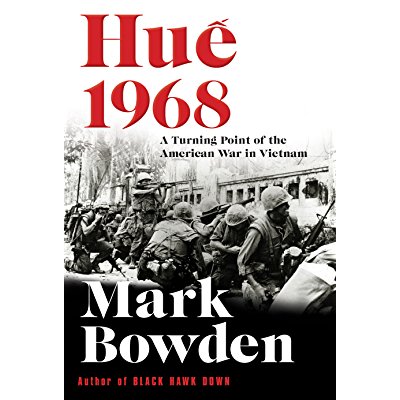
The Battle of Hue in 1968 – the climactic clash of the Tet Offensive, which itself was the turning point of the Vietnam War – exploded the official lies from U.S. commanders about progress toward victory but also delivered a warning about the future costs if the conflict were continued indefinitely.
In that sense, the Battle of Hue has resonance to America’s current “endless war” in Afghanistan and other military interventions in the nearly 16 years since 9/11, conflicts marked by bravery of soldiers on opposite sides as well as the arrogance and careerism of the top brass and feckless politicians.
As author Mark Bowden writes in his epilogue to his new book, Hue 1968, “Alternative history enthusiasts promote the preposterous idea that the U.S. might have won the war if it had thrown itself more heartily into the conflict. As some of the nation’s more recent wars have helped illustrate, ‘victory’ in Vietnam would have been neither possible nor desirable. It would have required a massive and sustained military presence, and a state of permanent war. Hue illustrates just how bitter that war would have been.”
Bowden, author of Blackhawk Down and 12 other books, was a 16-year-old high school student in Philadelphia on Jan. 3l, 1968, when the battle of Hue began. The attack was part of the Viet Cong and North Vietnamese Army (NVA) assault across South Vietnam at the start of the Tet holiday by an estimated 80,000 fighters. They achieved nearly total surprise in most areas, as they did in Hue, one of the most venerated places in Vietnam.
Hue’s population of 140,000 made it South Vietnam’s third largest city, with two-thirds of the population living within the walls of the old city known as the Citadel, three-square-miles surrounded by walls 20 feet high and 30 feet thick. Within the walls was yet another fortified enclave, the historic Imperial Palace, home of the Vietnamese emperors before the French took control in 1883.
A giant Viet Cong flag was raised over Hue’s Citadel and flew for 25 days while battalions of NVA occupied the Emperors Palace and other positions in the Citadel. Yet, this reality was denied and obscured by the top U.S. commander, General William Westmoreland, whom Bowden describes as inept and dishonest:
“General Westmoreland continually and falsely assured political leaders in Washington and the American public that the city had not fallen into enemy hands. This refusal to face facts had tragic consequences for many of the marines and soldiers who fought there. ‘Westy’ denied that his official casualty estimates [of enemy troops] were inflated and said the enemy’s offensive was a sign of desperation.
“He also wrote that many NVA and VC had fought ‘halfheartedly.’ To a man, American veterans I interviewed told me they had faced a disciplined, highly motivated, skilled and determined enemy. To characterize them otherwise is to diminish the accomplishment of those who drove them out of Hue.”
First-Person Account
As an ABC News correspondent in Vietnam, I was personally aware of General Westmoreland’s fabrications starting with his announcement at a Saigon news conference on Jan. 31, that Hue had been recaptured and NVA soldiers forced out.
Later in February, I joined the U.S. Marines of 1st of the 5th battalion as they fought for ten days to advance the last 1,000 yards along the south wall of the Citadel. Bowden’s clear and vivid descriptions of the desperate daily combat brought back painful memories for me.
“The Battle of Hue is a microcosm of the entire conflict,” writes Bowden. “With nearly half a century of hindsight, Hue deserves to be widely remembered as the single bloodiest battle of the war, one of its defining events, and one of the most intense urban battles in American history.”
Despite Westmoreland’s spin, the Battle of Hue and the broader Tet Offensive had a powerful impact on President Lyndon Johnson and some of his top advisers. The intensity of the fighting exposed Westmoreland as an untrustworthy source of information, not just to the press and public but even in his secret communications with the White House.
Westmoreland’s analysis that the enemy attack on Hue was simply a feint to deflect from the fighting at Khe Sahn destroyed his reputation for accurate foresight. Washington lawyer Clark Clifford, replacing Robert McNamara as Secretary of Defense, was ready to reject Westmoreland’s unfailingly upbeat view of the war.
After the first two weeks of Hue fighting Clifford told President Johnson, “On one hand the military has said we had quite a victory out there … on the other hand, they now say it was such a big victory that we need one hundred and twenty thousand more men.”
Shortly after Clifford’s assignment to be Secretary of Defense, Westmoreland’s request for over 100,000 more troops was denied and the General was relieved of command.
“Both sides miscalculated,” writes Bowden. “Hanoi counted on a popular uprising that didn’t come, while Washington, blindsided, refused to believe the truth. The armies on both sides played their roles courageously and to terrible effect. The battle’s clearest losers were the citizens of Hue. The systematic executions of Hue citizens suspected of Saigon sympathies are today denied and are an inconvenient memory for the ruling Communist party of Vietnam.”
Bowden quotes civilian casualty estimates of 4,856 by the Saigon government. He cites the American scholar Douglas Pike who studied the mass graves immediately after the fighting, as being likely closest to the truth with a count of 2,800. Total number of Hue civilians killed by U.S. bombing, crossfire between the two forces, and the executions is recognized as 5,800.
An estimated 80 percent of Hue structures were either destroyed or heavily damaged. A total of 250 American soldiers and Marines were killed and 1,554 wounded. South Vietnamese government troop casualties were put at 458 killed and 2,700 wounded. The Vietcong losses were estimated at between 2,400 and 5,000. The final toll of 25 days of fighting numbers well over 10,000 making it the bloodiest battle of the Vietnam War.
Pro-War Propaganda
Another consequence of the Tet Offensive was the growing hostility among pro-war Americans toward on-scene journalists who described the U.S. military setbacks and contradicted the upbeat assessments from Westmoreland and the military brass, leading to a narrative blaming the press corps for losing Vietnam.
But Bowden disagrees with this complaint, writing: “Journalism has long been blamed for losing the war, but the American reporting from Hue was more accurate than official accounts, deeply respectful, and uniformly sympathetic to US fighting men.”
Instead, Bowden is critical of U.S. military leadership in Hue and documents many examples of bad tactics and particularly misjudging the efficiency of the NVA by sending under-strength units to engage large and entrenched enemy forces.
Bowden’s disdain for senior officers in the battle is at odds with his admiration for the “grunts” on both sides.
“I was moved by the heroism and dedication of those who fought on both sides of the battle,” writes Bowden. “In the worst days of this fight, facing the near certainty of death or severe bodily harm, those caught up in the Battle of Hue repeatedly advanced. Many of those who survived are still paying for it. To me the way they were used, particularly the way their idealism and loyalty was exploited by leaders who themselves had lost faith in the effort, is a stunning betrayal. It is a lasting American tragedy and disgrace.”
Many other books and analyses of the battle have celebrated the valor of U.S. troops while showing little interest in how they were used.
“The conspiracy of denial also explains why this terrible battle has remained, for most Americans, so little known,” writes Bowden. “It has been conscientiously remembered by the US Marine Corps, albeit with more emphasis on the glory than on the leadership blunders that cost so many lives.”
Bowden’s book also may have put to rest fears that history must be written by those who experienced it. In five years of diligent in-depth research, thousands of interviews on both sides of the battle and an ability to analyze his research in terms of what each day’s events meant for the entire war, Bowden has produced a book critics say is the best understanding of the Battle of Hue and its effect on the war.
Some historians say the sweet spot for understanding an historical event is about 50 years – enough time for a measure of perspective, yet while there are still living eyewitnesses. Since the now-unified Vietnam is welcoming Americans, it also was possible for Bowden for the first time to report the battle from both sides.
“Most American veterans were pleased to share their experiences with me,” says Bowden. “The sheer number of interviews gave me multiple perspectives on nearly every event described. I am indebted to previous accounts, Battle for Hue by Keith Nolan; Fire in the Streets by Eric Hammel; The Lost Battalion by Charles Krohn; The Siege of Hue by George Smith; and The Cat from Hue by Jack Lawrence.”
Bowden says he learned a great deal from journalist’s reports written at the time and even more from talking to reporters and photographers who produced them, particularly Gene Roberts, John Olson, and Mike Morrow.
Bowden lists several viewpoints shared by the hundreds of American veterans he interviewed: most were proud of having served; nearly all were angry over the betrayal of their youthful idealism, mostly at American leaders who sent them to fight a war that was judged unwinnable from the start; all felt sorrow for the friends they lost and the horror the war inflicted on everyone involved; many described their difficulties in adjusting to normal life after returning home.
There are also lessons for the present and the future. Urban warfare has become more common since the Battle of Hue as more of the world’s population leaves rural areas. Although untrained in urban warfare, the U.S. Marines — dispatched to reclaim Hue — soon adapted from the jungles and paddies they were used to in Vietnam.
Bowden describes in graphic detail the tactics of avoiding booby-trapped doors and instead smashing through the sides of buildings, clearing room to room, staying off the streets and open areas, hard lessons of the fighting in Hue that the U.S. Marines brought to Iraq in 2004 when they assaulted the city of Fallujah twice.
Today, with U.S.-backed forces battling ISIS militants in Mosul, Iraq, and Raqqah, Syria, the bloody lessons of Hue — and memories of the severe civilian casualties — are relevant again.
Don North is a veteran war correspondent who covered the Vietnam War and many other conflicts around the world. He is the author of Inappropriate Conduct, the story of a World War II correspondent whose career was crushed by the intrigue he uncovered.
Uh oh. Top (former) UN Climate officials (Costa Rican diplomats with no scientific background) are “calculating” that if we don’t stop emitting carbon dioxide by 2020 the earth is doomed! That’s right: three years left to save the planet! Or is that 50 days? 96 months? Or were we doomed 5 years ago? Or was that 17 years ago?…
I actually forced myself to watch the documentary The White Helmets, which is available on Netflix. It is 40 minutes long, is of high quality cinematographically speaking, and tells a very convincing tale that was promoted as “the story of real-life heroes and impossible hope.” It is overall a very impressive piece of propaganda, so much so that it has won numerous awards including the Oscar for Best Documentary Short this year and the White Helmets themselves were nominated for the Nobel Peace Prize. More to the point, however, is the undeniable fact that the documentary has helped shape the public understanding of what is going on in Syria, delivering a Manichean tale that depicts the “rebels” as always good and Bashar al-Assad and his government as un-redeemably evil.
It has been reliably reported that celebrities like George Clooney, Justin Timberlake and Hillary Clinton really like the White Helmets documentary and have promoted it with the understanding that it represents the truth about Syria, but it is, of course, not the whole story. The film, which was made by the White Helmets themselves without any external verification of what it depicts, portrays the group as “heroic,” an “impartial, life-saving rescue organization” of first responders. Excluded from the scenes of heroism under fire is the White Helmets’ relationship with the al-Qaeda affiliated group Jabhat al-Nusra and its participation in the torture and execution of “rebel” opponents. Indeed, the White Helmets only operate in rebel held territory, which enables them to shape the narrative both regarding who they are and what is occurring on the ground. Because of increasing awareness of the back story, there is now a growing movement to petition the Academy of Motion Picture Arts and Sciences to revoke the Oscar based on the complete and deliberate misrepresentation of what the White Helmets are all about.
Exploiting their access to the western media, the White Helmets have de facto become a major source of “eyewitness” news regarding what has been going on in those many parts of Syria where European and American journalists are quite rightly afraid to go. It is all part of a broader largely successful “rebel” effort to manufacture fake news that depicts the Damascus government as engaging in war crimes directed against civilians.
The White Helmets have certainly saved some lives under dangerous circumstances but they have also exaggerated their humanitarian role as they travel to bombing sites with their film crews trailing behind them. Once at the sites, with no independent observers, they are able to arrange or even stage what is filmed to conform to their selected narrative. They have consistently promoted tales of government atrocities against civilians to encourage outside military intervention in Syria and bring about regime change in Damascus. The White Helmets were, for example, the propagators of the totally false but propagandistically effective claims regarding the government use of so-called “barrel bombs” against civilians.
The White Helmets were a largely foreign creation that came into prominence in the aftermath of the unrest in Syria that developed as a result of the Arab Spring in 2012. They are currently largely funded by a number of non-government organizations (NGOs) as well as governments, including Britain and some European Union member states. The United States has directly provided $23 million through the USAID (US Agency for International Development) as of 2016 and almost certainly considerably more indirectly. Max Blumenthal has explored in some detail the various funding resources and relationships that the organization draws on, mostly in Europe and the United States.
Former weapons inspector Scott Ritter has described how the White Helmets are not actually trained to do the complicated rescue work that they depict in their self-made videos, which have established their reputation by ostensibly showing them in action inside Syria, rescuing civilians from bombed out structures, and providing life-saving emergency medical care. As an expert in Hazardous Materials handling with New York Task Force 2 USAR team, Ritter reports that “these videos represent de facto evidence of dangerous incompetence or, worse, fraud… The bread and butter of the White Helmet’s self-made reputation is the rescue of a victim—usually a small child—from beneath a pile of rubble, usually heavy reinforced concrete… The techniques used by the White Helmets are not only technically wrong, but dangerous to anyone who might actually be trapped… In my opinion, the videos are pure theater, either staged to impress an unwitting audience, or actually conducted with total disregard for the well being of any real victims.”
Ritter also cites the lack of training in hazardous chemicals, best observed in the videos provided by the White Helmets regarding their activity at Khan Sheikhun on April 4th. He notes “As was the case with their ‘rescues’ of victims in collapsed structures, I believe the rescue efforts of the White Helmets at Khan Sheikhun were a theatrical performance designed to impress the ignorant and ill-informed… Through their actions… the White Helmets were able to breathe life into the overall narrative of a chemical weapons attack, distracting from the fact that no actual weapon existed….”
But perhaps the most serious charge against the White Helmets consists of the evidence that they actively participated in the atrocities, to include torture and murder, carried out by their al-Nusra hosts. There have been numerous photos of the White Helmets operating directly with armed terrorists and also celebrating over the bodies of execution victims and murdered Iraqi soldiers. The group has an excellent working relationship with a number of jihadi affiliates and is regarded by them as fellow “mujahideen” and “soldiers of the revolution.”
So by all means let’s organize to revoke the White Helmets’ Oscar due to misrepresentation and fraud. It might even serve as a wake-up call to George Clooney and his fellow Hollywood snowflakes. But the bigger take-away from the tale of the White Helmets would appear to be how it is an unfortunate repeat of the bumbling by a gullible U.S. government that has wrecked the Middle East while making Americans poorer and less safe. A group of “moderates,” in this case their propagandists, is supported with weapons and money to overthrow a government with which Washington has no real quarrel but it turns out the moderates are really extremists. If they succeed in changing regime in Damascus, that is when the real nightmare will begin for minorities within Syria and for the entire region, including both Israel and Saudi Arabia, both of which seem intent on bringing Bashar al-Assad down. And the truly unfortunate fact is that the Israelis and Saudis apparently have convinced an ignorant Donald Trump that that is the way to go so the situation in Syria will only get worse and, unless there is a course correction, Washington will again richly deserve most of the blame.
Prime Minister Theresa May is withholding a Home Office report on foreign funding of British terrorist organizations because exposing the truth could sour relations with the UK’s major trading and security partner, Saudi Arabia.
The report, commissioned to investigate foreign states funding extremist groups in the UK, has yet to be made public despite being completed six months ago. The government’s reluctance to share it has left many concerned about how ethical Britain’s ongoing diplomatic relationship with the Gulf kingdom is.
Green Party co-leader Caroline Lucas branded the delay “astonishing.”
“The government is sitting on this report but refusing to publish it or give any reason for their continued secrecy,” the Brighton Pavilion MP said in a statement.
“To defeat terror it’s vital that politicians have full view of the facts, even if they are inconvenient for the government.”
She added that the secrecy surrounding the report “leaves question marks over whether their decision is influenced by our diplomatic ties.”
Home Office sources insist that, although the report does mention Saudi Arabia, the Gulf theocracy is not its main subject.
Prime Minister May has always made clear that Britain’s relationship with the Saudis lies at the core of her diplomatic agenda. She visited Riyadh to discuss strengthening trade ties mere days after triggering the Brexit process.
The report, which was commissioned by May’s predecessor, David Cameron, was due to be submitted by Easter last year. It was originally meant to study the origins and extent of funding received by British extremist groups that involve international forces.
Responding to parliamentary questions on the document and its delays, May argued that “ministers are considering advice on what is able to be published and will report to parliament with an update in due course.”
It is believed some government insiders think the material is too sensitive to be made public.
On Monday evening, outgoing Liberal Democrat leader Tim Farron said: “The government are covering up this report. It’s a scandal that this is sitting in Downing Street gathering dust. What has the prime minister got to hide?
“I believe this report will be deeply critical of Saudi and that is why it is being hidden from the public. The government seems too desperate to keep Saudi Arabia happy rather than stand up to them.”
Other party leaders, Jeremy Corbyn of the Labour Party and Nicola Sturgeon of the Scottish National Party (SNP), have also urged Downing Street to make the findings public.
Green Party leader Lucas said, in the light of the London Bridge and Manchester Arena attacks, the public was “quite rightly asking questions about routes to radicalization, and the funding of terror is central to this.
“I urge Theresa May to reveal immediately whose advice they are following as to whether or not to publish this report, and to do all they can to put the facts into the public domain if it is safe to do so,” she said.”
In response, Home Office minister Sarah Newton said: “The review has improved the government’s understanding of the nature, scale and sources of funding for Islamist extremism in the UK. Publication of the review is a decision for the prime minister.”
Recent hearings by the Senate and House Intelligence Committees reflected the rising tide of Russian-election-hacking hysteria and contributed further to it. Both Democrats and Republicans on the two committees appeared to share the alarmist assumptions about Russian hacking, and the officials who testified did nothing to discourage the politicians.
On June 21, Samuel Liles, acting director of the Intelligence and Analysis Office’s Cyber Division at the Department of Homeland Security, and Jeanette Manfra, acting deputy under secretary for cyber-security and communications, provided the main story line for the day in testimony before the Senate committee — that efforts to hack into election databases had been found in 21 states.
Former DHS Secretary Jeh Johnson and FBI counter-intelligence chief Bill Priestap also endorsed the narrative of Russian government responsibility for the intrusions on voter registration databases.
But none of those who testified offered any evidence to support this suspicion nor were they pushed to do so. And beneath the seemingly unanimous embrace of that narrative lies a very different story.
The Department of Homeland Security (DHS) has a record of spreading false stories about alleged Russian hacking into U.S. infrastructure, such as the tale of a Russian intrusion into the Burlington, Vermont electrical utility in December 2016 that DHS later admitted was untrue. There was another bogus DHS story about Russia hacking into a Springfield, Illinois water pump in November 2011.
So, there’s a pattern here. Plus, investigators, assessing the notion that Russia hacked into state electoral databases, rejected that suspicion as false months ago. Last September, Assistant Secretary of DHS for Cybersecurity Andy Ozment and state officials explained that the intrusions were not carried out by Russian intelligence but by criminal hackers seeking personal information to sell on the Internet.
Both Ozment and state officials responsible for the state databases revealed that those databases have been the object of attempted intrusions for years. The FBI provided information to at least one state official indicating that the culprits in the hacking of the state’s voter registration database were cyber-criminals.
Illinois is the one state where hackers succeeded in breaking into a voter registration database last summer. The crucial fact about the Illinois hacking, however, was that the hackers extracted personal information on roughly 90,000 registered voters, and that none of the information was expunged or altered.
The Actions of Cybercriminals
That was an obvious clue to the motive behind the hack. Assistant DHS Secretary Ozment testified before the House Subcommittee on Information Technology on Sept. 28 (at 01:02.30 of the video) that the apparent interest of the hackers in copying the data suggested that the hacking was “possibly for the purpose of selling personal information.”
Ozment ‘s testimony provides the only credible motive for the large number of states found to have experienced what the intelligence community has called “scanning and probing” of computers to gain access to their electoral databases: the personal information involved – even e-mail addresses – is commercially valuable to the cybercriminal underworld.
That same testimony also explains why so many more states reported evidence of attempts to hack their electoral databases last summer and fall. After hackers had gone after the Illinois and Arizona databases, Ozment said, DHS had provided assistance to many states in detecting attempts to hack their voter registration and other databases.
“Any time you more carefully monitor a system you’re going to see more bad guys poking and prodding at it,” he observed, “because they’re always poking and prodding.” [Emphasis added]
State election officials have confirmed Ozment’s observation. Ken Menzel, the general counsel for the Illinois Secretary of State, told this writer, “What’s new about what happened last year is not that someone tried to get into our system but that they finally succeeded in getting in.” Menzel said hackers “have been trying constantly to get into it since 2006.”
And it’s not just state voter registration databases that cybercriminals are after, according to Menzel. “Every governmental data base – driver’s licenses, health care, you name it – has people trying to get into it,” he said.
Arizona Secretary of State Michele Reagan told Mother Jones that her I.T. specialists had detected 193,000 distinct attempts to get into the state’s website in September 2016 alone and 11,000 appeared to be trying to “do harm.”
Reagan further revealed that she had learned from the FBI that hackers had gotten a user name and password for their electoral database, and that it was being sold on the “dark web” – an encrypted network used by cyber criminals to buy and sell their wares. In fact, she said, the FBI told her that the probe of Arizona’s database was the work of a “known hacker” who had been closely monitored “frequently.”
James Comey’s Role
The sequence of events indicates that the main person behind the narrative of Russian hacking state election databases from the beginning was former FBI Director James Comey. In testimony to the House Judiciary Committee on Sept. 28, Comey suggested that the Russian government was behind efforts to penetrate voter databases, but never said so directly.
Comey told the committee that FBI Counterintelligence was working to “understand just what mischief Russia is up to with regard to our elections.” Then he referred to “a variety of scanning activities” and “attempted intrusions” into election-related computers “beyond what we knew about in July and August,” encouraging the inference that it had been done by Russian agents.
The media then suddenly found unnamed sources ready to accuse Russia of hacking election data even while admitting that they lacked evidence. The day after Comey’s testimony ABC headlined, “Russia Hacking Targeted Nearly Half of States’ Voter Registration Systems, Successfully Infiltrating 4.” The story itself revealed, however, that it was merely a suspicion held by “knowledgeable” sources.
Similarly, NBC News headline announced, “Russians Hacked Two U.S. Voter Databases, Officials Say.” But those who actually read the story closely learned that in fact none of the unnamed sources it cited were actually attributing the hacking to the Russians.
It didn’t take long for Democrats to turn the Comey teaser — and these anonymously sourced stories with misleading headlines about Russian database hacking — into an established fact. A few days later, the ranking Democrat on the House Intelligence Committee, Rep. Adam Schiff declared that there was “no doubt” Russia was behind the hacks on state electoral databases.
On Oct. 7, DHS and the Office of the Director of National Intelligence issued a joint statement that they were “not in a position to attribute this activity to the Russian government.” But only a few weeks later, DHS participated with FBI in issuing a “Joint Analysis Report” on “Russian malicious cyber activity” that did not refer directly to scanning and spearphishing aimed of state electoral databases but attributed all hacks related to the election to “actors likely associated with RIS [Russian Intelligence Services].”
Suspect Claims
But that claim of a “likely” link between the hackers and Russia was not only speculative but highly suspect. The authors of the DHS-ODNI report claimed the link was “supported by technical indicators from the U.S. intelligence community, DHS, FBI, the private sector and other entities.” They cited a list of hundreds of I.P. addresses and other such “indicators” used by hackers they called “Grizzly Steppe” who were supposedly linked to Russian intelligence.
But as I reported last January, the staff of Dragos Security, whose CEO Rob Lee, had been the architect of a U.S. government system for defense against cyber attack, pointed out that the vast majority of those indicators would certainly have produced “false positives.”
Then, on Jan. 6 came the “intelligence community assessment” – produced by selected analysts from CIA, FBI and National Security Agency and devoted almost entirely to the hacking of e-mail of the Democratic National Committee and Hillary Clinton’s campaign chairman John Podesta. But it included a statement that “Russian intelligence obtained and maintained access to elements of multiple state or local election boards.” Still, no evidence was evinced on this alleged link between the hackers and Russian intelligence.
Over the following months, the narrative of hacked voter registration databases receded into the background as the drumbeat of media accounts about contacts between figures associated with the Trump campaign and Russians built to a crescendo, albeit without any actual evidence of collusion regarding the e-mail disclosures.
But a June 5 story brought the voter-data story back into the headlines. The story, published by The Intercept, accepted at face value an NSA report dated May 5, 2017, that asserted Russia’s military intelligence agency, the GRU, had carried out a spear-phishing attack on a U.S. company providing election-related software and had sent e-mails with a malware-carrying word document to 122 addresses believed to be local government organizations.
But the highly classified NSA report made no reference to any evidence supporting such an attribution. The absence of any hint of signals intelligence supporting its conclusion makes it clear that the NSA report was based on nothing more than the same kind of inconclusive “indicators” that had been used to establish the original narrative of Russians hacking electoral databases.
A Checkered History
So, the history of the U.S. government’s claim that Russian intelligence hacked into election databases reveals it to be a clear case of politically motivated analysis by the DHS and the Intelligence Community. Not only was the claim based on nothing more than inherently inconclusive technical indicators but no credible motive for Russian intelligence wanting personal information on registered voters was ever suggested.
Russian intelligence certainly has an interest in acquiring intelligence related to the likely outcome of American elections, but it would make no sense for Russia’s spies to acquire personal voting information about 90,000 registered voters in Illinois.
When FBI Counter-intelligence chief Priestap was asked at the June 21 hearing how Moscow might use such personal data, his tortured effort at an explanation clearly indicated that he was totally unprepared to answer the question.
“They took the data to understand what it consisted of,” said Priestap, “so they can affect better understanding and plan accordingly in regards to possibly impacting future election by knowing what is there and studying it.”
In contrast to that befuddled non-explanation, there is highly credible evidence that the FBI was well aware that the actual hackers in the cases of both Illinois and Arizona were motivated by the hope of personal gain.
The bold warriors of the McResistance are bound and determined to get Trump impeached at any cost, come what may. I mean, so long as it doesn’t inconvenience America’s oligarchs or interfere with the profit margins of the military-industrial complex.
According to Francis Boyle, professor of international law at the University of Illinois College of Law, Trump has already committed impeachable war crimes in Syria. Boyle calls the case for impeachment due to war crimes a “slam dunk”. If Democrats were serious about their determination to give the world President Pence at all costs, they wouldn’t be banging on about the crumbling Russiagate conspiracy theory or Trump’s obnoxious tweets, they’d be focusing on the actual, tangible, provable things that this administration has done in Syria.
They will not do this, though. Trump has dropped his right hand and is currently circling into an opening for a crushing left hook knockout, but Democrats will not throw that punch. Ever. You will never see congressional Russiagate queen Maxine “I’m out to impeach this president” Waters attempt to get Trump impeached with the impeachment case that he has gift wrapped and handed to her by committing war crimes in Syria. You will never see Rep. Jamie “remove Trump from office because of obnoxious tweets” Raskin put together a case for impeachment based on the Trump administration’s unilateral decision to attack the Syrian military, its use of white phosphorus or its relentless slaughter of civilians across the Middle East. You will never see Rachel Maddow or Keith Olbermann rallying the Resistance troops into protest marches over Trump’s bloodbaths in Yemen or Syria. These things will never, ever happen. You will see them focusing on nonsense like Russiagate and mean tweets about Zbigniew Brzezinski’s daughter.
These things will never happen because the Democratic party, as we have discussed before, has become an overwhelmingly neoconservative party, and because the corporate media never misses an opportunity to advocate in favor of US military aggression. We saw this in their shamelessly orgiastic celebration of Trump’s deadly missile strike on a Syrian airfield in April, and we continue to see it in their refusal to unequivocally condemn the senseless military aggression in nations that America never had any business involving itself with in the first place.
This is precisely why I’ve been writing with such venom about the so-called “Resistance”, a title not organically arising from the people but one manufactured in a DC think tank to harness and exploit the healthy inclination toward progressive activism which arose on an organic grassroots level in the Occupy and Bernie Sanders movements. People with more or less healthy impulses, people who claim to want peace, economic justice and social justice, have had those good intentions harnessed by America’s unelected power establishment and geared toward manufacturing support for escalations with Russia and unforgivable corporatist bloodbaths in the Middle East. These deep state parasites have taken something good and healthy in their fellow humans and used the deceit and manipulations of their corporate media propaganda arm to twist those healthy impulses in on themselves and turn them into something sick and evil.
If you are reading this under the mistaken impression that resisting Trump has something to do with the 25th Amendment or investigations into Russian connections, I strongly advise you to begin insistently urging the pundits and politicians you trust and respect to oppose the Trump administration on the basis of war crimes. Push them to put together a case for Trump’s impeachment based on his violations of the Nuremberg charter, the UN charter, and the War Powers Resolution of 1973. Then watch what they do. Not what they say, but what they do. Ignore their words about this and watch their actions. Pay attention when they ignore you or brush you off with a few supportive-sounding words without taking any action. I promise you this is exactly what will happen. You will never, ever see anything remotely like the full-scale mobilization you’ve seen in the Russiagate movement and #TheResistance protests over Trump’s war crimes.
If you try these things and find what I am saying to be true (and you will), please consider the possibility that these people are not your friends. Please consider the possibility that the media you consume which tells you how to perceive world affairs is full of lies and propaganda. Please consider the possibility that a coalition of powerful elites controls your government and uses your country’s immense military might to manipulate world affairs for the purpose of amassing more power. Please consider the possibility of a real resistance replacing the fake one they’ve given you.
If you wish to understand the degree to which a supposedly free western media are constructing a world of half-truths and deceptions to manipulate their audiences, keeping us uninformed and docile, then there could hardly be a better case study than their treatment of Pulitzer prize-winning investigative journalist Seymour Hersh.
All of these highly competitive, for-profit, scoop-seeking media outlets separately took identical decisions: first to reject Hersh’s latest investigative report, and then to studiously ignore it once it was published in Germany last Sunday. They have continued to maintain an absolute radio silence on his revelations, even as over the past few days they have given a great deal of attention to two stories on the very issue Hersh’s investigation addresses.
These two stories, given such prominence in the western media, are clearly intended to serve as “spoilers” to his revelations, even though none of these publications have actually informed their readers of his original investigation. We are firmly in looking-glass territory.
So what did Hersh’s investigation reveal? His sources in the US intelligence establishment – people who have helped him break some of the most important stories of the past few decades, from the Mai Lai massacre by American soldiers during the Vietnam war to US abuse of Iraqi prisoners at Abu Ghraib in 2004 – told him the official narrative that Syria’s Bashar Assad had dropped deadly sarin gas on the town of Khan Sheikhoun on April 4 was incorrect. Instead, they said, a Syrian plane dropped a bomb on a meeting of jihadi fighters that triggered secondary explosions in a storage depot, releasing a toxic cloud of chemicals that killed civilians nearby.
It is an alternative narrative of these events that one might have assumed would be of intense interest to the media, given that Donald Trump approved a military strike on Syria based on the official narrative. Hersh’s version suggests that Trump acted against the intelligence advice he received from his own officials, in a highly dangerous move that not only grossly violated international law but might have dragged Assad’s main ally, Russia, into the fray. The Syrian arena has the potential to trigger a serious confrontation between the world’s two major nuclear powers.
But, in fact, the western media were supremely uninterested in the story. Hersh, once considered the journalist’s journalist, went hawking his investigation around the US and UK media to no avail. In the end, he could find a home for his revelations only in Germany, in the publication Welt am Sonntag.
There are a couple of possible, even if highly improbable, reasons all English-language publications ignored Hersh’s story. Maybe they had evidence that his inside intelligence was wrong. If so, they have yet to provide it. A rebuttal would require acknowledging Hersh’s story, and none seem willing to do that.
Or maybe the media thought it was old news and would no longer interest their readers. It would be difficult to sustain such an interpretation, but at least it has an air of plausibility – except for everything that has happened since Hersh published last Sunday.
His story has spawned two clear “spoiler” responses from those desperate to uphold the official narrative. Hersh’s revelations may have been entirely uninteresting to the western media, but strangely they have sent Washington into crisis mode. Of course, no US official has addressed Hersh’s investigation directly, which might have drawn attention to it and forced western media to reference it. Instead Washington has sought to deflect attention from Hersh’s alternative narrative and shore up the official one through misdirection. That alone should raise the alarm that we are being manipulated, not informed.
The first spoiler, made in the immediate wake of Hersh’s story, were statements from the Pentagon and White House warning that the US had evidence Assad was planning yet another chemical attack on his people and that Washington would respond extremely harshly if he did so.
The US said on Tuesday that it had observed preparations for a possible chemical weapons attack at a Syrian air base allegedly involved in a sarin attack in April following a warning from the White House that the Syrian regime would ‘pay a heavy price’ for further use of the weapons.
And then on Friday, the second spoiler emerged. Two unnamed diplomats “confirmed” that a report by the Organisation for the Prohibition of Chemical Weapons (OPCW) had found that some of the victims from Khan Sheikhoun showed signs of poisoning by sarin or sarin-like substances.
There are obvious reasons to be mightily suspicious of these stories. The findings of the OPCW were already known and had been discussed for some time – there was absolutely nothing newsworthy about them.
There are also well-known problems with the findings. There was no “chain of custody” – neutral oversight – of the bodies that were presented to the organisation in Turkey. Any number of interested parties could have contaminated the bodies before they reached the OPCW. For that reason, the OPCW has not concluded that the Assad regime was responsible for the traces of sarin. In the world of real news, only such a finding – that Assad was responsible – should have made the OPCW report interesting again to the media.
Similarly, by going public with their threats against Assad, the Pentagon and White House did not increase the deterrence on Assad, making it less likely he would use gas in the future. That could have been achieved much more effectively with private warnings to the Russians, who have massive leverage over Assad. These new warnings were meant not for Assad but for western publics, to bolster the official narrative that Hersh’s investigation had thrown into doubt.
In fact, the US threats increase, rather than reduce, the chances of a new chemical weapons attack. Other, anti-Assad actors now have a strong incentive to use chemical weapons in false-flag operation to implicate Assad, knowing that the US has committed itself to intervention. On any reading, the US statements were reckless – or malicious – in the extreme and likely to bring about the exact opposite of what they were supposed to achieve.
But beyond this, there was something even more troubling about these two stories. That these official claims were published so unthinkingly in major outlets is bad enough. But what is unconscionable is the media’s continuing blackout of Hersh’s investigation when it speaks directly to the two latest news reports.
No serious journalist could write up either story, according to any accepted norms of journalistic practice, and not make reference to Hersh’s claims. They are absolutely relevant to these stories. In fact, more than that, the intelligence sources he cites are are not only relevant but are the sole reason these two stories have been suddenly propelled to the top of the news agenda.
Any publication that has covered either the White House-Pentagon threats or the rehashing of the OPCW report and has not mentioned Hersh’s revelations is writing nothing less than propaganda in service of a western foreign policy agenda trying to bring about the illegal overthrow the Syrian government. And so far that appears to include every single US and UK mainstream newspaper and TV station.
U.S. Secretary of Defense James Mattis has said “civilian casualties are a fact of life in this sort of situation,” referring to America’s war against Islamic State.
How can America in clear conscience continue to kill civilians across the Middle East? It’s easy; ask Grandpa what he did in the Good War. Civilian deaths in WWII weren’t dressed up as collateral damage, they were policy.
Following what some claim are looser rules of engagement in place under the Trump administration, U.S.-led coalition air strikes in Iraq and Syria killed 1,484 civilians in March 2017 alone. Altogether some 3,100 civilians have been killed from the air since the U.S. launched its coalition war against Islamic State, according to the NGO Airwars. Drone strikes outside of the ISIS fight killed 3,674 other civilians. In 2015 the U.S. destroyed an entire hospital in Afghanistan, along with doctors and patients inside.
That all adds up to a lot of accidents — accidents created in part by the use of Hellfire missiles designed to destroy tanks employed against individual people, and 500 pound bombs that can clear a football-field sized area dropped inside densely inhabited areas. The policy of swatting flies with sledgehammers, surgical strikes with blunt instruments, does indeed seem to lead to civilian deaths, deaths that stretch the definition of “accident.”
Yet despite the numbers killed, the watchword in modern war is that civilians are never targeted on purpose, at least by our side. Americans would never intentionally kill innocents.
Except we have.
The good guys in World War II oversaw the rapid development of new weapons to meet the changing needs of killing entire cities’ worth of innocents. For example, in Europe, brick and stone construction lent itself to the use of conventional explosives to destroy cities. In Japan, however, given the prominence of wood construction, standard explosives tended to simply scatter structures over a limited area. The answer was incendiary devices.
To fine-tune their use, the U.S. Army Air Force built a full-size Japanese village in Utah. They questioned American architects who had worked in Japan, consulted a furniture importer, and installed tatami straw floor mats taken from Japanese-Americans sent off to internment camps. Among the insights gained was the need for incendiary devices to be made much heavier than originally thought. Japanese homes typically had tile roofs. The early devices tended to bounce right off. A heavier device would break through the tile and ignite inside the structure, creating a much more effective fire.
Far from accidental, firebombing Japan had been planned in War Plan Orange, written long before Pearl Harbor. As far back as the 1920s, U.S. General Billy Mitchell had said Japan’s paper and wood cities would be “the greatest aerial targets the world had ever seen.” Following the outline in War Plan Orange, the efforts were lead by Curtis “Bombs Away” LeMay, who expressed his goal as “Japan will eventually be a nation without cities, a nomadic people.”
LeMay also helped run the U.S. bombing campaign against North Korea during that war, claiming that American efforts killed some 20 percent of the civilian population. The man many call the architect of the Vietnam War, Robert McNamara, worked for LeMay during the WWII firebombing campaign. McNamara as Secretary of Defense went on to order the use of napalm in Vietnam, often against undefended civilian targets. The accidents of civilian deaths in war turn inside tight circles.
The skill with which America tuned its WWII firebombing into an exquisite way to destroy civilians reached its peak on March 10, 1945, when three hundred American B-29 bombers flew virtually unopposed over Tokyo’s most densely populated residential area. They dropped enough incendiary bombs to create a firestorm, a conflagration that burned the oxygen out of the air itself.
What was accomplished? One hundred thousand dead, a million people made homeless. The raid remains the single most destructive act of war ever committed, even after Hiroshima.
The problem, however, for the U.S. with such raids was their inefficiency in killing civilians. The logistics of sending off 300 planes were daunting, especially when an hour or two of unexpected wind or rain could negate much of effort. There was no question firestorms were the very thing to systematically commit genocide in Japan. But what was needed was a tool to create those firestorms efficiently, and to make them weather-proof.
It would only take science a few more months after the Tokyo firebombing to provide that tool. A single atomic bomb meant one plane could do the work of 300. And the bomb would create a fire so powerful and large and hot that weather would have no effect; it was foolproof. There could be no better weapon for destroying whole cities and all of the people in them, and it has only been used by one nation. Twice, because the 85,000 killed in Hiroshima were not enough.
These were tactics of vengeance matched with weapons designed to carry them out as horribly as possible. They worked well: the firebombing campaign over Japan, including the atomic bombings, purposely killed more than one million civilians in just five months in 1945.
It was only after WWII ended, when accurate descriptions from Hiroshima began finding their way back to America, that the idea of firebombing as a way to shorten the war, to spare lives in the long game, came into full flower. The myth, that the atomic bomb was in fact a reluctant instrument of mercy, not terror, was first published in Harper’s Magazine in February 1947 under the name of Secretary of War Henry Stimson. The actual writing was done by McGeorge Bundy, who later as National Security Adviser helped promote the American war in Vietnam that took several million civilian lives.
The majority of Americans, recovering their consciences post-war, were thus nudged into seeing what was actually a continuation of long-standing policy of civilian genocide in Japan as an unfortunate but necessary step toward Japan’s surrender, and thus saved innumerable lives that would have been lost had the war dragged on. This thinking lives on today on politically correct ground under the banner of great powers having to reluctantly put aside what is moral in peace for what is expedient in war. A “fact of life,” according to the U.S. Secretary of Defense.
So look deeper into history if you want to understand the morality-free rise in civilian deaths across America’s battlefields in the Middle East. We don’t like to think of ourselves as the kind of people who willfully kill innocents, but we were pleased by it only a skip back in history; your grandfather flew missions over Japan to burn children to death. Accidents of course happen in war, but there is a dark history of policy that demands skepticism each time such claims are made.
When Justin Trudeau looks in the foreign policy mirror who does he see? Someone very much like Stephen Harper.
On the world stage Canada under Trudeau the Second has acted almost the same as when Harper was prime minister. The Liberals have followed the previous government’s posture on issues ranging from militarism to Russia, nuclear weapons to the Gulf monarchies.
Aping the ancien régime’s position, the Liberals recently voted against UN nuclear disarmament efforts supported by most countries of the world. As such, they’ve refused to attend the ongoing Conference to Negotiate a Legally Binding Instrument to Prohibit Nuclear Weapons, Leading Towards their Total Elimination.
Earlier this month the Liberals released a defence policy that calls for 605 more special forces, which have carried out numerous violent covert missions abroad. During the 2015 election campaign defence minister Jason Kenney said if re-elected the Conservatives would add 665 members to the Canadian Armed Forces Special Operations Command over seven years.
The government’s recent defence policy also includes a plan to acquire armed drones, for which the Conservatives had expressed support. Additionally, the Liberals re-stated the previous government’s commitment to spend upwards of one hundred billion dollars on new fighter jets and naval ships.
Initiated by the Conservatives, last year the Liberals signed off on a government-contracted $15 billion Light Armoured Vehicle sale to Saudi Arabia. Trudeau has also maintained the Harper created Canada-Gulf Cooperation Council Dialogue, which is a platform for foreign ministers to discuss economic ties and the conflicts in Syria, Iraq and Yemen. The GCC includes the monarchies of Saudi Arabia, United Arab Emirates, Bahrain, Oman, Qatar and Kuwait, which have almost all intervened in the devastating Saudi-led war in Yemen.
The Trudeau government has continued to isolate Canada from world opinion on Palestinian rights. They’ve voted against numerous UN resolutions supported by almost the entire world upholding Palestinian rights.
The Harper regime repeatedly attacked Venezuela’s elected government and in recent weeks the Liberals have picked up from where they left off. The Liberals have supported efforts to condemn the Nicolás Maduro government at the Organization of American States and promoted an international mediation designed to weaken Venezuela’s leftist government (all the while staying mum about Brazil’s imposed president and far worse human rights violations in Mexico).
In March the Liberals renewed Canada’s military “training” mission in the Ukraine, which has emboldened far-right militarists responsible for hundreds of deaths in the east of that country. In fact, Trudeau has significantly bolstered Canada’s military presence on Russia’s doorstep. Simultaneously, the Trudeau government has maintained Harper’s sanctions regime against Russia.
Nearly two years into their mandate the Liberals haven’t restarted diplomatic relations with Iran or removed that country from Canada’s state sponsor of terrorism list (Syria is the only other country on the list). Nor has the Trudeau regime adopted any measure to restrict public support for Canadian mining companies found responsible for significant abuses abroad. With regards to Canada’s massive and controversial international mining industry, it has been status quo ante.
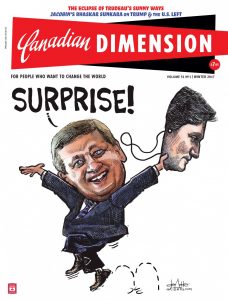
A recent cover of Canadian Dimension magazine provided a cheeky challenge to Trudeau’s bait and switch. Below the word “SURPRISE!” it showed a Justin Trudeau mask being removed to reveal Stephen Harper.
The sober reality is that Trudeau represents a continuation of his predecessor’s foreign policy. I might even need to redo my 2012 book The Ugly Canadian, but this time with the tagline “Justin Trudeau’s foreign policy”.
By Ali Salaam | American Herald Tribune | July 31, 2017
The New York Times, owned by the Zionist Jewish supremacist Ochs-Sulzberger family, has no problem with Iraqi suffering as long as Iran is not the one behind it.
The Iraq War was a genocide of the Iraqi people by Zionist supremacists in the Bush administration. Over 1 million innocent people were killed based on a lie. American soldiers died in an Israeli war and now an average of 22 soldiers commit suicide every day because their consciences cannot cope with the fact they committed crimes in an illegal war that served no purpose other than to benefit Israel, not America.
Benjamin Netanyahu, Prime Minister of the Zionist regime, once said “We are benefiting from one thing, and that is the attack on the Twin Towers and Pentagon, and the American struggle in Iraq.”
Paul Wolfowitz had his sights on Iraq since his time in the first Bush administration. Former Israeli official and Bush administration official Richard Perle had his eyes on Iraq since at least his authorship of the Clean Break white paper. The Zionist regime had their eyes on Iraq since the 1980s when strategist Oded Yinon wrote his white paper in support of dividing the Arab-Muslim world along ethnic and sectarian lines. The global Zionist lobby has had their eyes on Iraq since Theodor Herzl stated that Eretz Israel’s true borders go from the Nile River in Egypt to the Euphrates River in Iraq. … continue
This site is provided as a research and reference tool. Although we make every reasonable effort to ensure that the information and data provided at this site are useful, accurate, and current, we cannot guarantee that the information and data provided here will be error-free. By using this site, you assume all responsibility for and risk arising from your use of and reliance upon the contents of this site.
This site and the information available through it do not, and are not intended to constitute legal advice. Should you require legal advice, you should consult your own attorney.
Nothing within this site or linked to by this site constitutes investment advice or medical advice.
Materials accessible from or added to this site by third parties, such as comments posted, are strictly the responsibility of the third party who added such materials or made them accessible and we neither endorse nor undertake to control, monitor, edit or assume responsibility for any such third-party material.
The posting of stories, commentaries, reports, documents and links (embedded or otherwise) on this site does not in any way, shape or form, implied or otherwise, necessarily express or suggest endorsement or support of any of such posted material or parts therein.
The word “alleged” is deemed to occur before the word “fraud.” Since the rule of law still applies. To peasants, at least.
Fair Use
This site contains copyrighted material the use of which has not always been specifically authorized by the copyright owner. We are making such material available in our efforts to advance understanding of environmental, political, human rights, economic, democracy, scientific, and social justice issues, etc. We believe this constitutes a ‘fair use’ of any such copyrighted material as provided for in section 107 of the US Copyright Law. In accordance with Title 17 U.S.C. Section 107, the material on this site is distributed without profit to those who have expressed a prior interest in receiving the included information for research and educational purposes. For more info go to: http://www.law.cornell.edu/uscode/17/107.shtml. If you wish to use copyrighted material from this site for purposes of your own that go beyond ‘fair use’, you must obtain permission from the copyright owner.
DMCA Contact
This is information for anyone that wishes to challenge our “fair use” of copyrighted material.
If you are a legal copyright holder or a designated agent for such and you believe that content residing on or accessible through our website infringes a copyright and falls outside the boundaries of “Fair Use”, please send a notice of infringement by contacting atheonews@gmail.com.
We will respond and take necessary action immediately.
If notice is given of an alleged copyright violation we will act expeditiously to remove or disable access to the material(s) in question.
All 3rd party material posted on this website is copyright the respective owners / authors. Aletho News makes no claim of copyright on such material.