The Mad Chase for Russia-gate Prey
By Daniel Lazare | Consortium News | June 30, 2017
June is turning out to be the cruelest month for the Russia-gate industry. The pain began on June 8 when ex-FBI Director James Comey testified that a sensational New York Times article declaring that “members of Donald J. Trump’s 2016 presidential campaign and other Trump associates had repeated contacts with senior Russian intelligence officials” was “in the main … not true.”
Then came Republican Karen Handel’s June 20 victory in a special election in Georgia’s sixth congressional district, sparking bitter recriminations among Democrats who had hoped to ride to victory on a Russia-gate-propelled wave of resistance to Trump.
More evidence that the strategy was not working came a day later when the Harris Poll and Harvard’s Center for American Political Studies produced a devastating survey showing that 62 percent of voters see no evidence that the Trump campaign colluded with Russia, while 54 percent believe the “Deep State” is trying to unseat the President by leaking classified information. The poll even showed a small bounce in Trump’s popularity, with 45 percent viewing him favorably as opposed to only 39 percent for his defeated Democratic rival Hillary Clinton.
The mainstream news media also came in for some lumps. On June 23, CNN retracted a story that had claimed that Congress was looking into reports that the Trump transition team met secretly with a Russian investment fund under sanction from the U.S. government. Three days later, CNN announced that three staffers responsible for the blooper – reporter and Pulitzer Prize-nominee Thomas Frank; Pulitzer-winner Eric Lichtblau, late of the New York Times ; and Lex Haris, executive editor in charge of investigations – had resigned.
Adding to CNN’s embarrassment, Project Veritas, the brainchild of rightwing provocateur James O’Keefe, released an undercover video in which a CNN producer named John Bonifield explained that the network can’t stop talking about Russia because it boosts ratings and then went on to say about Russia-gate:
“Could be bullshit, I mean it’s mostly bullshit right now. Like, we don’t have any big giant proof. But … the leaks keep leaking, and there are so many great leaks, and it’s amazing, and I just refuse to believe that if they had something really good like that, that wouldn’t leak because we’ve been getting all these other leaks. So I just feel like they don’t really have it but they want to keep digging. And so I think the president is probably right to say, like, look, you’re witch-hunting me, like, you have no smoking gun, you have no real proof.”
Project Veritas also released an undercover video interview with CNN contributor Van Jones calling the long-running probe into possible collusion between Trump’s 2016 campaign and Russia a “nothing-burger,” a position similar to the skepticism that Jones has displayed in his on-air comments.
True, the Bonifield video was only a medical reporter sounding off about a story that he’s not even covering and doing so to a dirty-trickster who has received financing from Trump and who, after another undercover film stunt, was ordered in 2013 to apologize and pay $100,000 to an anti-poverty worker whose privacy he had invaded.
Good for Ratings
But, still, Bonifield’s “president-is-probably-right” comment is hard to shake. Ditto Van Jones’ “nothing-burger.” Unless both quotes are completely doctored, it appears that the scuttlebutt among CNNers is that Russia-gate is a lot of hot air but no one cares because it’s sending viewership through the roof.
And if that’s what CNN thinks, then it may be what MSNBC’s Rachel Maddow thinks as she also plays the Russia card for all it’s worth. It may also be what The Washington Post has in the back of its mind even while hyperventilating about Russian President Vladimir Putin’s “crime of the century, an unprecedented and largely successful destabilizing attack on American democracy.”
The New York Times also got caught up in its enthusiasm to hype the Russia-gate case on June 25 when it ran a story slamming Trump for “refus[ing] to acknowledge a basic fact agreed upon by 17 American intelligence agencies that he now oversees: Russia orchestrated the attacks [on Democratic emails], and did it to help get him elected.”
The “17-intelligence-agency” canard has been a favorite go-to assertion for both Democrats and the mainstream news media, although it was repudiated in May by President Obama’s Director of National Intelligence James Clapper and CIA Director John Brennan.
So, on June 29, the Times apparently found itself with no choice but to issue a correction stating: “The [Russia-hacking] assessment was made by four intelligence agencies — the Office of the Director of National Intelligence, the Central Intelligence Agency, the Federal Bureau of Investigation and the National Security Agency. The assessment was not approved by all 17 organizations in the American intelligence community.”
This point is important because, as Consortiumnews.com and other non-mainstream news outlets have argued for more than a month, it is much easier to manipulate a finding by hand-picking analysts from a small number of intelligence agencies than by seeking the judgments and dissents from all 17.
Despite the correction, the Times soon returned to its pattern of shading the truth regarding the U.S. intelligence assessment. On June 30, a Times article reported: “Mr. Trump has repeatedly cast doubt on the unanimous conclusion of United States intelligence agencies that Russia sought to interfere in the 2016 race.”
The Times’ phrase “unanimous conclusion” conveys the false impression that all 17 agencies were onboard without specifically saying so, although we now know that the Times’ editors are aware that only selected analysts from three agencies plus the DNI’s office were involved.
In other words, the Times cited a “unanimous conclusion of United States intelligence agencies” to mislead its readers without specifically repeating the “all-17-agencies” falsehood. This behavior suggests that the Times is so blinded by its anti-Trump animus that it wants to conceal from its readers how shaky the whole tale is.
Holes from the Start
But the problems with Russia-gate date back to the beginning. Where Watergate was about a real burglary, this one began with a cyber break-in that may or may not have occurred. In his June 8 testimony before the Senate Intelligence Committee, Comey conceded that the FBI never checked the DNC’s servers to confirm that they had truly been hacked.
COMMITTEE CHAIRMAN RICHARD BURR: Did you ever have access to the actual hardware that was hacked? Or did you have to rely on a third party to provide you the data that they had collected?
COMEY: In the case of the DNC, and, I believe, the DCCC [i.e. the Democratic Congressional Campaign Committee], but I’m sure the DNC, we did not have access to the devices themselves. We got relevant forensic information from a private party, a high-class entity, that had done the work. But we didn’t get direct access.
BURR: But no content?
COMEY: Correct.
BURR: Isn’t content an important part of the forensics from a counterintelligence standpoint?
COMEY: It is, although what was briefed to me by my folks — the people who were my folks at the time – is that they had gotten the information from the private party that they needed to understand the intrusion by the spring of 2016.
The FBI apparently was confident that it could rely on such “a high-class entity” as CrowdStrike to tell it what it needed to know. Yet neither the Democratic National Committee nor CrowdStrike, the Irvine, California, cyber-security firm the DNC hired, was remotely objective.
Hillary Clinton was on record calling Putin a “bully” whose goal was “to stymie, to confront, to undermine American power” while Dmitri Aperovitch, CrowdStrike’s chief technical officer, is a Russian émigré who is both anti-Putin personally and an associate of the Atlantic Council, a pro-Clinton/anti-Russian think tank that is funded by the Saudis, the United Arab Emirates and the Ukrainian World Congress. The Atlantic Council is one of the most anti-Russian voices in Washington.
So, an anti-Putin DNC hired an anti-Putin security specialist, who, to absolutely no one’s surprise, “immediately” determined that the break-in was the work of hackers “closely linked to the Russian government’s powerful and highly capable intelligence services.”
Comey’s trust in CrowdStrike was akin to cops trusting a private eye not only to investigate a murder, but to determine if it even occurred. Yet the mainstream media’s pack journalists saw no reason to question the FBI because doing so would not accord with an anti-Trump bias so pronounced that even journalism profs have begun to notice.
Doubts about CrowdStrike
Since CrowdStrike issued its findings, it has come under wide-ranging criticism. Cyber experts have called its analysis inconsistent because while praising the alleged hackers to the skies (“our team considers them some of the best adversaries out of all the numerous nation-state, criminal and hacktivist/terrorist groups we encounter on a daily basis”), CrowdStrike says it was able to uncover their identity because they made kindergarten-level mistakes, most notably uploading documents in a Russian-language format under the name “Felix Edmundovich,” a reference to Felix E. Dzerzhinsky, founder of the Soviet secret police.
“Raise your hand if you think that a GRU or FSB officer would add Iron Felix’s name to the metadata of a stolen document before he released it to the world while pretending to be a Romanian hacker,” wisecracked cyber-skeptic Jeffrey Carr.
Others noted how easy it is for even novice hackers to leave a false trail. In Seattle, cyber-sleuths Mark Maunder and Rob McMahon of Wordfence, makers of a popular computer-security program, discovered that “malware” found in the DNC was an early version of a publicly available program developed in the Ukraine – which was strange, they said, because one would expect Russian intelligence to develop its own tools or use ones that were more up to date.
But even if the malware was Russian, experts pointed out that its use in this instance no more implicates Russian intelligence than the use of an Uzi in a bank robbery implicates Mossad.
Other loose threads appeared. In January, Carr poured cold water on a subsequent CrowdStrike report charging that pro-Russian separatists had used similar malware to zero in on pro-government artillery units in the eastern Ukraine.
The Ukrainian ministry of defense and the London think tank from which CrowdStrike obtained much of its data agreed that the company didn’t know what it was talking about. But if CrowdStrike was wrong about the Ukraine case, how could everyone be sure it was right about the DNC?
In March, Wikileaks went public with its “Vault 7” findings showing, among other things, that the CIA has developed sophisticated software in order to scatter false clues – which inevitably led to dark mutterings that maybe the agency had hacked the DNC itself in order to blame it on the Russians.
Finally, although Wikileaks policy is never to comment on its sources, Julian Assange, the group’s founder, decided to make an exception.
“The Clinton camp has been able to project a neo-McCarthyist hysteria that Russia is responsible for everything,” he told journalist John Pilger in November. “Hillary Clinton has stated multiple times, falsely, that 17 U.S. intelligence agencies had assessed that Russia was the source of our publications. That’s false – we can say that the Russian government is not the source.”
Craig Murray, an ex-British diplomat who is a Wikileaks adviser, disclosed that he personally flew to Washington to meet with a person who was either the original source or an associate of the source. Murray said the motive for the leak was “disgust at the corruption of the Clinton Foundation and the tilting of the primary election playing field against Bernie Sanders.”
Conceivably, such contacts could have been cutouts to conceal from WikiLeaks the actual sources. Still, Wikileaks’ record of veracity should be enough to give anyone pause. Yet the press either ignored the WikiLeaks comments or, in the case of The Washington Post, struggled to prove that WikiLeaks was lying.
Unstable Foundation
The stories that have been built upon this unstable foundation have proved shaky, too. In March, the Times published a front-page exposé asserting that Trump campaign manager Paul Manafort “had regular communications with his longtime associate – a former Russian military translator in Kiev who has been investigated in Ukraine on suspicion of being a Russian intelligence agent.” But if the man was merely a suspected spy as opposed to a convicted one, then what’s the problem?
The article also noted that Jason Greenblatt, a former Trump lawyer who is now a special White House representative for international negotiations, met last summer with Rabbi Berel Lazar, “the chief rabbi of Russia and an ally of Russia’s president, Vladimir V. Putin.” But an Orthodox Jew paying a call on Russia’s chief rabbi is hardly extraordinary. Neither is the fact that the rabbi is a Putin ally since Putin enjoys broad support in the Russian Jewish community.
In April, the Times published another innuendo-laden front-page story about businessman Carter Page whose July 2016 trip to Moscow proved to be “a catalyst for the F.B.I. investigation into connections between Russia and President Trump’s campaign.”
Page’s sins chiefly consist of lecturing at a Moscow academic institute about U.S.-Russian relations in terms that The New York Times believed “echoed the position of President Vladimir V. Putin of Russia” and, on another occasion, meeting with a suspected Russian intelligence agent in New York.
“There is no evidence that Mr. Page knew the man was an intelligence officer,” the article added. So is it now a crime to talk with a Russian or some other foreign national who, unbeknownst to you, may turn out to be an intelligence agent?
Then there is poor Mike Flynn, driven out as national security adviser after just 24 days in office for allegedly misrepresenting conversations with Russian Ambassador Sergey Kislyak – exchanges during the Trump transition that supposedly exposed him to the possibility of Russian blackmail although U.S. intelligence was monitoring the talks and therefore knew their exact contents. And, since the Russians no doubt assumed as much, it’s hard to see what they could have blackmailed him with. [See Consortiumnews.com’s “Turning Gen. Flynn into Road Kill.”]
Yet the mainstream media eagerly gobbled up this blackmail possibility while presenting with a straight face the claim by Obama holdovers at the Justice Department that the Flynn-Kislyak conversations might have violated the 1799 Logan Act, an ancient relic that has never been used to prosecute anyone in its entire two-century history.
So, if the scandal is looking increasingly threadbare now, could the reason be that there was little or nothing to it when it was first announced during the final weeks of the 2016 campaign?
Although it’s impossible to say what evidence might eventually emerge, Russia-gate is looking more and more like a Democratic version of Benghazi, a pseudo-scandal that no one could ever figure out but which wound up making Hillary Clinton look like a persecuted hero and the Republicans seem like obsessed idiots.
As much as that epic inquiry turned out to be mostly a witch-hunt, Americans are beginning to sense the same about Washington’s latest game of “gotcha.”
The United States is still a democracy in some vague sense of the word, and “We the People” are losing patience with subterranean maneuvers on the part of the Democrats, the neoconservatives, and the intelligence agencies seeking to reverse a presidential election.
Like Benghazi or possibly even the Birthergate scam about President Obama’s Kenyan birthplace, the whole convoluted Russia-gate tale grows stranger by the day.
Daniel Lazare is the author of several books including The Frozen Republic: How the Constitution Is Paralyzing Democracy (Harcourt Brace).
WaPost Wipes Out 1913 Record Temperature
By Paul Homewood | Not A Lot Of People Know That | June 30, 2017
The history revisers are at it again!
From The Washington Post :

A city in southwest Iran posted the country’s hottest temperature ever recorded Thursday afternoon, and may have tied the world record for the most extreme high temperature.
Etienne Kapikian, a forecaster at French meteorological agency MeteoFrance, posted to Twitter that the city of Ahvaz soared to “53.7°C” (128.7 degrees Fahrenheit). Kapikian said the temperature is a “new absolute national record of reliable Iranian heat” and that it was the hottest temperature ever recorded in June over mainland Asia. Iran’s previous hottest temperature was 127.4.
If that 129.2 degrees reading is accurate, it would arguably tie the hottest temperature ever measured on Earth in modern times.
Christopher Burt, a weather historian for Weather Underground, has exhaustively analyzed world temperature extremes and determined the 129.2 degree readings posted in Mitribah, Kuwait on July 21, 2016, and Death Valley, Calif., on June 30, 2013, are the hottest credible temperature measurements that exist in modern records.
It has long been accepted that the highest temperature recorded on Earth was 134F, set at Greenland Ranch, Death Valley in California, way back in 1913. But Weather Underground’s Chris Burt has now taken it upon himself to write that out of the records, as being “essentially not possible”.
Perhaps somebody might tell the real experts at NOAA’s State Climate Extremes Committee (SCEC). They collate all record temperature data for each state.
According to the SCEC website:
The SCEC will compile a list of the extant records listed in Table 1 for each state of the United States. These records will be reviewed to determine their validity and, if found to be acceptable, will be recommended to the NCEI Director for inclusion in the statewide records data set. As of April, 2010 NCEI has reviewed and updated the statewide extremes tables for all-time maximum and minimum temperature, 24-hr precipitation and snowfall, and all-time greatest snow depth.
After reviewing its validity, the SCEC is perfectly happy that the Greenland Ranch still stands.

https://www.ncdc.noaa.gov/extremes/scec/records
Regardless of the Death Valley figure, just how meaningful is this new, supposed record in Iran?
How long, for instance, have temperatures been measured there? We have seen in the UK how “record temperatures” have been gleefully declared by the Met Office at stations, such as Gravesend and Faversham, which turn out to only have records since the 1990s.
Nobody knows whether higher temperatures have actually occurred there, even in the recent past.
We also learn from the WaPost that Ahvaz, where the temperature was set, is a city of 1.1 million, so the Urban Heat Island effect will be massive.
But none of this will stop the usual fraudsters claiming that this is evidence of global warming.
OPCW’s Syrian Sarin Gas Report Based on Doubtful Data – Russian Foreign Ministry
Sputnik – 30.06.2017
MOSCOW – Russia believes the Organization for the Prohibition of Chemical Weapons (OPCW) report on the use of a nerve agent in Syria last spring is based on doubtful data, the Russian Foreign Ministry said Friday.
The OPCW said earlier in the day that its fact-finding mission had established the use of sarin in the April 4 incident in Khan Sheikhoun in the province of Idlib.
“Unfortunately, we are forced to state on the first reading of the document that its conclusions are still based on very doubtful data,” the Russian ministry’s information and press department said.
It noted that the OPCW’s data was “obtained from the same opposition and the same notorious NGOs of the White Helmet type, and not at the site of the tragedy but in a certain ‘neighboring country’.”
“Therefore, it is not surprising that the content of the OPCW special mission’s report is largely biased, suggesting the presence of a political order in this structure’s activity,” the ministry said.
NYT Finally Retracts Russia-gate Canard
By Robert Parry | Consortium News | June 29, 2017
The New York Times has finally admitted that one of the favorite Russia-gate canards – that all 17 U.S. intelligence agencies concurred on the assessment of Russian hacking of Democratic emails – is false.
On Thursday, the Times appended a correction to a June 25 article that had repeated the false claim, which has been used by Democrats and the mainstream media for months to brush aside any doubts about the foundation of the Russia-gate scandal and portray President Trump as delusional for doubting what all 17 intelligence agencies supposedly knew to be true.
In the Times’ White House Memo of June 25, correspondent Maggie Haberman mocked Trump for “still refus[ing] to acknowledge a basic fact agreed upon by 17 American intelligence agencies that he now oversees: Russia orchestrated the attacks, and did it to help get him elected.”
However, on Thursday, the Times – while leaving most of Haberman’s ridicule of Trump in place – noted in a correction that the relevant intelligence “assessment was made by four intelligence agencies — the Office of the Director of National Intelligence, the Central Intelligence Agency, the Federal Bureau of Investigation and the National Security Agency. The assessment was not approved by all 17 organizations in the American intelligence community.”
The Times’ grudging correction was vindication for some Russia-gate skeptics who had questioned the claim of a full-scale intelligence assessment, which would usually take the form of a National Intelligence Estimate (or NIE), a product that seeks out the views of the entire Intelligence Community and includes dissents.
The reality of a more narrowly based Russia-gate assessment was admitted in May by President Obama’s Director of National Intelligence James Clapper and Obama’s CIA Director John Brennan in sworn congressional testimony.
Clapper testified before a Senate Judiciary subcommittee on May 8 that the Russia-hacking claim came from a “special intelligence community assessment” (or ICA) produced by selected analysts from the CIA, NSA and FBI, “a coordinated product from three agencies – CIA, NSA, and the FBI – not all 17 components of the intelligence community,” the former DNI said.
Clapper further acknowledged that the analysts who produced the Jan. 6 assessment on alleged Russian hacking were “hand-picked” from the CIA, FBI and NSA.
Yet, as any intelligence expert will tell you, if you “hand-pick” the analysts, you are really hand-picking the conclusion. For instance, if the analysts were known to be hard-liners on Russia or supporters of Hillary Clinton, they could be expected to deliver the one-sided report that they did.
Politicized Intelligence
In the history of U.S. intelligence, we have seen how this selective approach has worked, such as the phony determination of the Reagan administration pinning the attempted assassination of Pope John Paul II and other acts of terror on the Soviet Union.
CIA Director William Casey and Deputy Director Robert Gates shepherded the desired findings through the process by putting the assessment under the control of pliable analysts and sidelining those who objected to this politicization of intelligence.
The point of enlisting the broader intelligence community – and incorporating dissents into a final report – is to guard against such “stove-piping” of intelligence that delivers the politically desired result but ultimately distorts reality.
Another painful example of politicized intelligence was President George W. Bush’s 2002 National Intelligence Estimate on Iraq’s WMD that removed State Department and other dissents from the declassified version that was given to the public.
Since Clapper’s and Brennan’s testimony in May, the Times and other mainstream news outlets have avoided a direct contradiction of their earlier acceptance of the 17-intelligence-agencies canard by simply referring to a judgment by “the intelligence community.”
That finessing of their earlier errors has allowed Hillary Clinton and other senior Democrats to continue referencing this fictional consensus without challenge, at least in the mainstream media.
For instance, on May 31 at a technology conference in California, Clinton referred to the Jan. 6 report, asserting that “Seventeen agencies, all in agreement, which I know from my experience as a Senator and Secretary of State, is hard to get. They concluded with high confidence that the Russians ran an extensive information war campaign against my campaign, to influence voters in the election.”
The failure of the major news organizations to clarify this point about the 17 agencies may have contributed to Haberman’s mistake on June 25 as she simply repeated the groupthink that nearly all the Important People in Washington just knew to be true.
But the Times’ belated correction also underscores the growing sense that the U.S. mainstream media has joined in a political vendetta against Trump and has cast aside professional standards to the point of repeating false claims designed to denigrate him.
That, in turn, plays into Trump’s Twitter complaints that he and his administration are the targets of a “witch hunt” led by the “fake news” media, a grievance that appears to be energizing his supporters and could discredit whatever ongoing investigations eventually conclude.
Investigative reporter Robert Parry broke many of the Iran-Contra stories for The Associated Press and Newsweek in the 1980s.
The Tide Is Turning on Single Payer, With or Without Bernie Sanders
By Bruce A. Dixon | Black Agenda Report | June 28, 2017
Extracting nuggets of truth from corporate media is an art. For example when you read something in the New York Times or the Chicago Tribune you can be pretty sure this is what our betters would like us to believe. But what you see in some other publications like the Wall Street Journal is a different matter. This is because WSJ is one of the outlets members of the ruling class often use to talk to each other.
So Tuesday’s WSJ op-ed by Elizabeth Warren, in which the Massachusetts senator urged Democrats to campaign on Medicare For All is a sign the tide is turning. Liz Warren is no dummy. She’s up for re-election in 2018. She knows what sells, and she knows that unlike most Republicans, Trump is entirely capable of running simultaneously to the left AND to the right of Democrats.
The Affordable Care Act elegantly painted Republicans into a corner. It was a Republican plan, originally floated by the right wing Heritage Foundation and called Romneycare when it was enacted into law in Massachusetts in the 1990s. When Obama stole the Republican plan to bail out insurance companies it deprived Republicans of contributions from the insurance industry and Big Pharma, and left Republicans with nowhere to go politically. They could rage and rail against Obamacare, but it’s pretty much impossible to imagine a bigger favor than the Democrats did when they passed the Affordable Care Act in 2009.
So the plans pushed by the House and Senate Republican leadership are standard, boilerplate unimaginative things which pursue old Republican goals like turning Medicaid from a program supposedly based upon need into one funded up to a set amount and no more, instituting health savings accounts and using that Medicaid money for more tax breaks for the wealthy. Republicans might not like Obamacare, but they are for the moment unable to whip their own Senate majority behind the plan of their leaders.
Newspapers like the Boston Globe explain Liz Warren’s sudden reversal on single payer by telling us that while Medicare For All was a “fringe idea” nine years ago the public might almost be ready for it now. What no corporate media outlet will tell you is that a majority of House Democrats have now signed on to John Conyers’ current Medicare For All bill. So-called progressive Democrats are known for striking courageous poses when they don’t have majorities to pass them, this is a very different political moment than nine years ago. Physicians for a National Health Plan, the foremost pro-single payer doctors organization, called the House Republican plan a meaner version of Obamacare, putting them in the same territory as Donald Trump, who now admits calling the bill “mean.” Before he became president Donald Trump was on record more than once favoring Medicare For All. it’s a position he’s entirely capable of circling back to. Trump is plenty smart enough to know that if he can assemble a coalition of Democrats and Republicans to deliver Medicare For All before 2020, his re-election will be a lockdown certainty.
So where is the nation’s foremost proponent of Medicare For All, Vermont Senator Bernie Sanders? The answer is nowhere. Early in the year Bernie’s office was telling people to expect a senate version of Medicare For All that might drop in March, or April or May. It’s the end of June now. Maybe Bernie has postponed the push for single payer because Democratic party unity is more important. Bernie just did kick in $100,000 of his followers money to pay for the Democratic party unity tour. Maybe Bernie doesn’t want to shame his fellow Dems – he is the party’s outreach chairman now – by getting too far out in front of them on this. The potential embarrassment is real. California Democrats, firmly in control of their state government killed their own single payer bill not two weeks ago.
Whatever the reason, the fact is there exists NO Medicare For All Senate bill to which Greens, Democrats and others might demand senators affix their name to. Nobody’s holding that up but Vermont Senator and Democratic party outreach chair Bernie Sanders. The US Senate is a good old boys club, and Liz Warren despite her gender is very much a good old boy. Warren will never put Bernie on the spot by introducing her own single payer bill, and neither will any other Senate Democrat.
So the tide is finally turning on Medicare For All. But at this moment Bernie Sanders is blocking that tide.
Bruce Dixon can be reached via email at bruce.dixon(at)blackagendareport.com.
Time for Another False Flag Chemical Weapons Attack in Syria
By Paul Larudee | Dissident Voice | June 27, 2017
The United States has identified potential preparations for another chemical weapons attack by the Assad regime.
— Sean Spicer, White House Press Secretary, June 26, 2017
Fool me once, shame on you. Fool me, you can’t get fooled again.
— George Bush, September 17, 2002
The White House statement raises a number of questions. Who has identified the “potential preparations”? No reference is given, not even a source agency. Does the information come from intelligence sources? Apparently the Pentagon had not even been informed. What is “potential information” and how does it compare with real information?
Of course, the White House has its own direct sources. The Syrian opposition groups who met with John Kerry, Michael Ratney and Jon Finer at the UN in September, 2016 are tight with al-Nusra and other terrorist groups, and would be happy to provide a pretext for another US strike on Syria. No real evidence is required, but they would be happy to fabricate it nonetheless.
Can anyone cite a case of the use, or even the alleged use, of chemical weapons in Syria that has been to the strategic advantage of the Syrian government or its forces? The fact is that every incident has been to their disadvantage, and invariably a pretext for US intervention. Why then, would they use it, especially when they hadn’t done so before Obama drew his famous “red line”?
To the contrary, when British intelligence analyzed traces of the gas, they found it to be inconsistent with samples of Syrian government stocks. Furthermore, Turkish sources have reported the delivery of chemical weapons to opposition fighters. Distinguished MIT researchers Lloyd and Postol demonstrated definitively that the 2013 CW attack in Ghouta could not have come from Syrian government forces.
Similarly, Postol demonstrated multiple inconsistencies in the reports of the April 4, 2017 Khan Sheikhoun attack. More recently, investigative journalist Seymour Hersh uncovered the inside story on that attack, to the effect that US Defense Department sources knew that there were no chemical weapons used in the Syrian Air Force bombing attack on Khan Sheikhoun, and that to the extent that toxic gases caused casualties in that attack, it was the result of what the al-Nusra and Ahrar al-Sham fighters had stored at the site or had deployed as a false flag event, for the purpose of precipitating US intervention.
Postol warned at the time that without proper corroboration of Syrian government culpability, a US attack would motivate the terrorist constructors of the false flag to replicate more such incidents. In this context, the White House statement, based solely on vague allegations, can be interpreted as the start to a manipulation of public perception, so that an upcoming false flag event can appear to be a corroboration of the initial suspicions.
Such are the workings of what military and security forces call “securocratic wars” and specifically “security-based framing”. This is jargon for what used to be called propaganda, but which is now an integrated part of military and security planning for the control of public perception.1
There is plenty of reason for the White House to welcome such a pretext to attack Syria again. The approval ratings for the Trump Administration have never been higher, nor the press more approving, than when US warships fired 59 Tomahawk missiles at Syria’s Shu’ayrat Air Field two days after the Khan Sheikhoun attack. Given the unpopularity and failure of Trump’s domestic initiatives, it is easy to see how he might be tempted to employ similar death and destruction to boost his image again.
Of course, such actions risk a dangerous confrontation with Russia on the Syrian battlefield. Russia has already threatened to target US aircraft and has suspended coordination of flights over the shooting down of a Syrian jet fighter. But Trump is not averse to risk. We should therefore not be surprised to see another false flag killing of innocents blamed on the Syrian military in order to embroil the US further in an illegal war where we don’t belong.
- Halper, War Against the People, chapter 3.
Paul Larudee is one of the founders of the Free Gaza and Free Palestine Movements and an organizer in the International Solidarity Movement.
Hamas accuses Israel of fabricating rocket claim to justify airstrikes in Gaza
Ma’an – June 27, 2017
BETHLEHEM – The Israeli air force launched at least two airstrikes on the besieged Gaza Strip early Tuesday, with the Israeli army saying the attacks targeted two Hamas military infrastructures and were in response to a rocket fired from Gaza late Monday, which allegedly landed in an open area in Israel’s Shaar Hanegev Regional Council that borders northeastern Gaza, causing no injuries or damages.
No injuries were reported as a result of the airstrikes.
Palestinian news agency Wafa cited local sources in Gaza, saying that strikes hit multiple locations across the small Palestinian territory, including northwest of Gaza City, east of the Gaza Valley area, and Nasr neighborhood in the southern Gaza Strip city of Rafah.
The strikes left material damages to a number of homes, the report said.
Separately, Wafa reported that the Israeli army attacked agricultural land east of the Gaza Valley with artillery missiles and another agricultural area east of Deir al-Balah in the central Gaza Strip, reporting no injuries.
“Since the terror organization Hamas is the ruler of the Gaza Strip, it is responsible for any attempt to harm the State of Israel,” the Israeli army said in a statement following the early morning aerial attack.
However, in a statement, the Hamas movement accused Israel of fabricating claims of rocket fire to justify the attack. “The Israeli claim of a rocket being fired from Gaza and issuing a statement on behalf of ISIS to justify the escalation and an attack of resistance positions are part of a dangerous and transparent Israeli game.”
The statement referred to reports in Israeli media that claimed a Salafist group in Gaza affiliated to the so-called Islamic State claimed responsibility for the alleged rocket fire.
Hamas has not claimed responsibility for any rocket attacks since a ceasefire was declared after the 2014 war, and the movement has attempted to clamp down on armed activity by smaller political groups that do launch rockets from the territory.
Israeli officials have nonetheless accused Hamas of “preparing” for another war with Israel and have threatened retaliatory measures against the Gaza Strip as a whole.
The attacks came as Palestinians in the besieged coastal enclave are being forced to cope with just a few hours of electricity a day since Israel agreed to a Palestinian Authority request to dramatically cut electricity supplies to territory.
The Gaza Strip marked the ten-year anniversary of Israel’s siege of the small Palestinian enclave this month, with the humanitarian situation there continuing to alarm rights groups that have denounced the Gaza’s inhuman conditions as “unparalleled in the modern world.”
California Scheming: Single-Payer Betrayed By The Democrats Again
By Jim Kavanaugh | The Polemicist | June 26, 2017
Nothing better illustrates the political bankruptcy of the Democratic Party—for all progressive intents and purposes—than California State Assembly Speaker Anthony Rendon’s announcement on Friday afternoon that he was going to put a “hold” on the single-payer health care bill (SB 562) for the state, effectively killing its passage for at least the year.
The Democratic Party finds itself in a bind in California. They hold the governorship and a supermajority in both houses of the legislature, so they can pass any bill they want. SB 562 had passed the Senate 23-14.
There was enormous enthusiasm among California progressive activists, who, with organizations like Campaign for a Healthy California (CHC,) and the National Nurses United (NNU,) and the California Nurses Association (CNA) were working tirelessly, and hopeful of success. After all, Bernie’s people were taking over the California party from the bottom since the election. I recall a night of drinking last year with an old friend who has been spearheading that effort, as he rebuffed my skepticism, and insisted that this time there would be a really progressive takeover of the California party, and single-payer would prove it. After all, once enough progressive pressure was been put on the legislators, the bill would be going to super-progressive Democratic Governor, Jerry Brown, who had made advocacy of single-payer a centerpiece of his run for President in 1992, saying: “We treat health care not as a commodity to be played with for profit but rather the right of every American citizen when they’re born.” Bernie foretold.
Unfortunately, today that Governor is, according to Paul Song, co-chair of the CHC, “doing everything he can to make sure this never gets on his desk.” And it won’t. Unfortunately, all the Democrats like Rendon, who “claims to be a personal supporter of single-payer,” will make sure that their most progressive governor is not put in the embarrassing position of having to reject what he’s been ostensibly arguing for for twenty-five years, of demonstrating so blatantly what a fraud his, and his party’s, progressive pretensions are.
Thus unfolds the typical Democratic strategy: Make all kinds of progressive noises and cast all kinds of progressive votes, while carefully managing the process so that the legislation the putatively progressives putatively support never gets enacted. Usually, they blame Republican obstructionism, and there certainly is enough of that, and where there is, it provides a convenient way for Democrat legislators to “support” legislation they know will be blocked and wouldn’t really enact themselves if they could.
In the California case, the dissembling is obvious. The Republicans can’t be blamed. The only thing standing in the way of single-payer in California is the Democratic Party. As it was on the national level in 2009, when Obama and the Democrats could have passed any healthcare bill they wanted, just as they passed the Republican-inspired gift to the for-profit health insurance industry, the ACA—without a single Republican vote. It was true-believing capitalist Democrats like Max Baucus, led by Obama and his sidekick Rahm Emanuel (who called leftists “fucking retarded”) who arrested single-payer activists (including doctors) in order to prevent single-payer from even being considered. It was they who strong-armed reluctant Democratic legislators, who had signed an oath not to do so, into passing a bill that leaves 28 million Americans without health insurance, and forces the rest into plans whose premiums rise and networks of coverage shrink every year.
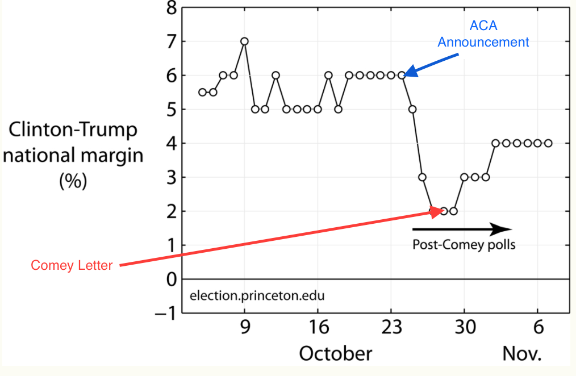
In fact, the perfectly reasonable discontent with that plan probably had more to do with helping Trump win than did any actions of bad-old (as opposed to good-new) James Comey. As Marcy Wheeler pointed out, in an analysis that’s contested but should certainly not be ignored, Hillary’s fatal slide in the polls began before Comey’s notorious letter of October 28th, and coincided with the announcement, four days before, of steep Obamacare premium increases. You decide whether you think Anthony Weiner’s sexting emails, part three, had more effect on voters than anger over being hit with stiff premium increases (22% average, 25% in 20 states, 60% in some) on increasingly crappy policies:
So the Democrats create the ground for Trump by passing a lousy healthcare law that’s sure to piss people off rather quickly, then use the even worse plan that the Republicans come up with to do nothing but trash Trump, while blocking real progressives’ attempts to get the only plan that would actually cover all Americans and save money. In Colorado last November, Democratic Governor John Hickenlooper refused to support a single-payer referendum because he “didn’t want to disrupt” the “strides [made] under Obamacare.” The Democrats’ ACA marched the nation straight into the shoals of Trump and the Republicans’ ACHA, and now the Democrats are blocking the only plan that solves the problems of both.
As Deborah Burger, Co-President of the California Nurses Association put it, Assembly Speaker Rendon, “Acting in secret in the interests of the profiteering insurance companies late Friday afternoon abandons all those people already threatened by Congress and the Trump administration.”
The excuse, of course, from California Democrats and Governor Jerry Brown is that they don’t know how they are going to pay for it, especially on the state level. That would be the same Jerry Brown who explained in 1992 exactly how single-payer would cut costs:
You cut out all the private health insurance. You have one single payer either at the national level or through the 50 states. And that one single payer will be the one that negotiates with the doctors, the hospitals, and the other providers. And since you have only one source of income in the whole medical establishment, you can drive down the cost.
Leaving aside the indispensable point that healthcare, like education and clean water, should be considered a non-discretionary expense, one of the main advantages of single-payer is precisely that it’s the only plan that can cut costs significantly. Not having single-payer will not mean healthcare will cost less; it will cost more every year, for every person and in the aggregate. It just means the for-profit insurance and pharmaceutical companies won’t care. The real problem with single-payer isn’t about costs to the people or to the state; it’s about profits for those companies.
Besides, an economy the size of California has immense power. We’re not talking about Utah. All the hospitals and doctors and pharmaceutical companies are not going to stop selling their goods and services in California. And once single-payer becomes a reality in California, it will catalyze a movement in every other state and on the national level. That—the fact that it will start a wildfire of imitation—and not the fact that it’s too expensive, is what the California Democratic Party is desperate to avoid, and what its donors and lobbyists are ordering it to block.
This is the Democratic Party. Lying losers who will do anything to avoid taking an effective stance for a healthcare policy that would immediately solve one of the worst horrors American families face every day, that would be immediately and concretely helpful to everyone, and, to top it all off, would be immensely popular. The dissembling Democrats are throwing away just about the most popular policy anyone could imagine—something people are literally dying for. As Charles Idelson, spokesman for the NNU, says: “There is broad support for single-payer not only in California, but nationally, even among registered Republicans and Republican and conservative business leaders.”
Passing single-payer in California and fighting for it everywhere else would guarantee the Democrats electoral victories. But they will not do it—they’ll say they will, but they will not—because they are fervent supporters of the capitalist market system in healthcare (and everything else), and they are corrupt agents of the health insurance and pharma industries.
Because it captures and cages the energies of so many well-meaning progressives, the Democratic Party is the most effective obstacle to, and enemy of, single-payer, and it has to be fought. People in wheelchairs and cancer patients and all their healthy friends should be sitting in and obstructing Democrat Rendon’s, as well as any Republican’s, office, until he lets the bill through. Then they should move on to the Democratic governor’s office. And thence to Pelosi’s and Schumer’s offices as well as Graham’s and Ryan’s. This is not a Trump problem, and not a Republican problem, it’s a bipartisan capitalist elite problem.
We have to engage in this kind of fight against all of these politicians. Anyone who thinks such a fight can be avoided in order to play the Democrats’ game of defending the for-profit insurance plan called Obamacare while obsessing about Trump being a Russian spy, is helping to perpetuate this rotten healthcare system. Twenty-eight million people are now without healthcare, and, if the Republicans’ edited version of Obamacare passes (which it probably won’t, because even many Republicans know they can’t get away with making things worse than they are), there’ll be twenty-four million more. There is no time for either of these contemptuous parties and their contemptuous bullshit.
___________________
Related:
The Obamacare Death Spiral, Who’s the Boss? The Obamacare Deception
The Age of No Privacy: The Surveillance State Shifts Into High Gear
By John W. Whitehead | The Rutherford Institute | June 26, 2017
“We are rapidly entering the age of no privacy, where everyone is open to surveillance at all times; where there are no secrets from government.” ― William O. Douglas, Supreme Court Justice, dissenting in Osborn v. United States, 385 U.S. 341 (1966)
The government has become an expert in finding ways to sidestep what it considers “inconvenient laws” aimed at ensuring accountability and thereby bringing about government transparency and protecting citizen privacy.
Indeed, it has mastered the art of stealth maneuvers and end-runs around the Constitution.
It knows all too well how to hide its nefarious, covert, clandestine activities behind the classified language of national security and terrorism. And when that doesn’t suffice, it obfuscates, complicates, stymies or just plain bamboozles the public into remaining in the dark.
Case in point: the National Security Agency (NSA) has been diverting “internet traffic, normally safeguarded by constitutional protections, overseas in order to conduct unrestrained data collection on Americans.”
It’s extraordinary rendition all over again, only this time it’s surveillance instead of torture being outsourced.
In much the same way that the government moved its torture programs overseas in order to bypass legal prohibitions against doing so on American soil, it is doing the same thing for its surveillance programs.
By shifting its data storage, collection and surveillance activities outside of the country—a tactic referred to as “traffic shaping” —the government is able to bypass constitutional protections against unwarranted searches of Americans’ emails, documents, social networking data, and other cloud-stored data.
The government, however, doesn’t even need to move its programs overseas. It just has to push the data over the border in order to “[circumvent] constitutional and statutory safeguards seeking to protect the privacy of Americans.”
Credit for this particular brainchild goes to the Obama administration, which issued Executive Order 12333 authorizing the collection of Americans’ data from surveillance conducted on foreign soil.
Using this rationale, the government has justified hacking into and collecting an estimated 180 million user records from Google and Yahoo data centers every month because the data travels over international fiber-optic cables. The NSA program, dubbed MUSCULAR, is carried out in concert with British intelligence.
No wonder the NSA appeared so unfazed about the USA Freedom Act, which was supposed to put an end to the NSA’s controversial collection of metadata from Americans’ phone calls.
The NSA had already figured out a way to accomplish the same results (illegally spying on Americans’ communications) without being shackled by the legislative or judicial branches of the government.
The USA Freedom Act was just a placebo pill intended to make the citizenry feel better and let the politicians take credit for reforming mass surveillance. In other words, it was a sham, a sleight-of-hand political gag pulled on a gullible public desperate to believe that we still live in a constitutional republic rather than a down-and-out, out-of-control, corporate-controlled, economically impoverished, corrupt, warring, militarized banana republic.
In fact, more than a year before politicians attempted to patch up our mortally wounded privacy rights with the legislative band-aid fix that is the USA Freedom Act, researchers at Harvard and Boston University documented secret loopholes that allow government agents to bypass Fourth Amendment protections to conduct massive domestic surveillance on U.S. citizens.
Mind you, this metadata collection now being carried out overseas is just a small piece of the surveillance pie.
The government and its corporate partners have a veritable arsenal of surveillance programs that will continue to operate largely in secret, carrying out warrantless mass surveillance on hundreds of millions of Americans’ phone calls, emails, text messages and the like, beyond the scrutiny of most of Congress and the taxpayers who are forced to fund its multi-billion dollar secret black ops budget.
In other words, the surveillance state is alive and well and kicking privacy to shreds in America.
On any given day, the average American going about his daily business is monitored, surveilled, spied on and tracked in more than 20 different ways by both government and corporate eyes and ears.
Whether you’re walking through a store, driving your car, checking email, or talking to friends and family on the phone, you can be sure that some government agency, whether the NSA or some other entity, is listening in and tracking your behavior. This doesn’t even begin to touch on the corporate trackers that monitor your purchases, web browsing, Facebook posts and other activities taking place in the cyber sphere.
We have now moved into a full-blown police state that is rapidly shifting into high-gear under the auspices of the surveillance state.
Not content to merely transform local police into extensions of the military, the Department of Homeland Security, the Justice Department and the FBI are working to turn the nation’s police officers into techno-warriors, complete with iris scanners, body scanners, thermal imaging Doppler radar devices, facial recognition programs, license plate readers, cell phone Stingray devices and so much more.
Add in the fusion centers, city-wide surveillance networks, data clouds conveniently hosted overseas by Amazon and Microsoft, drones equipped with thermal imaging cameras, and biometric databases, and you’ve got the makings of a world in which “privacy” is reserved exclusively for government agencies.
Thus, the NSA’s “technotyranny” is the least of our worries.
A government that lies, cheats, steals, sidesteps the law, and then absolves itself of wrongdoing cannot be reformed from the inside out.
Presidents, politicians, and court rulings have come and gone over the course of the NSA’s 60-year history, but none of them have managed to shut down the government’s secret surveillance of Americans’ phone calls, emails, text messages, transactions, communications and activities.
Even with restrictions on its ability to collect mass quantities of telephone metadata, the government and its various spy agencies, from the NSA to the FBI, can still employ an endless number of methods for carrying out warrantless surveillance on Americans, all of which are far more invasive than the bulk collection program.
Just about every branch of the government—from the Postal Service to the Treasury Department and every agency in between—now has its own surveillance sector, authorized to spy on the American people.
And of course that doesn’t even begin to touch on the complicity of the corporate sector, which buys and sells us from cradle to grave, until we have no more data left to mine. Indeed, Facebook, Amazon and Google are among the government’s closest competitors when it comes to carrying out surveillance on Americans, monitoring the content of your emails, tracking your purchases, exploiting your social media posts and turning that information over to the government.
“Few consumers understand what data are being shared, with whom, or how the information is being used,” reports the Los Angeles Times. “Most Americans emit a stream of personal digital exhaust — what they search for, what they buy, who they communicate with, where they are — that is captured and exploited in a largely unregulated fashion.”
It’s not just what we say, where we go and what we buy that is being tracked.
We’re being surveilled right down to our genes, thanks to a potent combination of hardware, software and data collection that scans our biometrics—our faces, irises, voices, genetics, even our gait—runs them through computer programs that can break the data down into unique “identifiers,” and then offers them up to the government and its corporate allies for their respective uses.
All of those internet-connected gadgets we just have to have (Forbes refers to them as “(data) pipelines to our intimate bodily processes”)—the smart watches that can monitor our blood pressure and the smart phones that let us pay for purchases with our fingerprints and iris scans—are setting us up for a brave new world where there is nowhere to run and nowhere to hide.
For instance, imagine what the NSA could do (and is likely already doing) with voiceprint technology, which has been likened to a fingerprint. Described as “the next frontline in the battle against overweening public surveillance,” the collection of voiceprints is a booming industry for governments and businesses alike.
As The Guardian reports, “voice biometrics could be used to pinpoint the location of individuals. There is already discussion about placing voice sensors in public spaces… multiple sensors could be triangulated to identify individuals and specify their location within very small areas.”
Suddenly the NSA’s telephone metadata program seems like child’s play compared to what’s coming down the pike.
That, of course, is the point.
The NSA is merely one small part of the shadowy Deep State comprised of unelected bureaucrats who march in lockstep with profit-driven corporations that actually runs Washington, DC, and works to keep us under surveillance and, thus, under control.
For example, Google openly works with the NSA, Amazon has built a massive $600 million intelligence database for CIA, and the telecommunications industry is making a fat profit by spying on us for the government.
In other words, Corporate America is making a hefty profit by aiding and abetting the government in its domestic surveillance efforts.
At every turn, we have been handicapped in our quest for transparency, accountability and a representative government by an establishment culture of secrecy: secret agencies, secret experiments, secret military bases, secret surveillance, secret budgets, and secret court rulings, all of which exist beyond our reach, operate outside our knowledge, and do not answer to “we the people.”
Incredibly, there are still individuals who insist that they have nothing to fear from the police state and nothing to hide from the surveillance state, because they have done nothing wrong.
To those sanctimonious few, secure in their delusions, let this be a warning.
There is no safe place and no watertight alibi.
The danger posed by the American police/surveillance state applies equally to all of us: lawbreaker and law-abider alike, black and white, rich and poor, liberal and conservative, blue collar and white collar, and any other distinction you’d care to trot out.
As I make clear in my book Battlefield America: The War on the American People, in an age of too many laws, too many prisons, too many government spies, and too many corporations eager to make a fast buck at the expense of the American taxpayer, we are all guilty of some transgression or other.
Eventually, we will all be made to suffer the same consequences in the electronic concentration camp that surrounds us.
Featured Video

The Search for Truth: Charlie Kirk’s Assassination One Year Later
or go to
Aletho News Archives – Video-Images
From the Archives
US murdering 1 million Iraqis is democracy, Iran giving yogurt to Iraq is “domination”
By Ali Salaam | American Herald Tribune | July 31, 2017
The New York Times, owned by the Zionist Jewish supremacist Ochs-Sulzberger family, has no problem with Iraqi suffering as long as Iran is not the one behind it.
The Iraq War was a genocide of the Iraqi people by Zionist supremacists in the Bush administration. Over 1 million innocent people were killed based on a lie. American soldiers died in an Israeli war and now an average of 22 soldiers commit suicide every day because their consciences cannot cope with the fact they committed crimes in an illegal war that served no purpose other than to benefit Israel, not America.
Benjamin Netanyahu, Prime Minister of the Zionist regime, once said “We are benefiting from one thing, and that is the attack on the Twin Towers and Pentagon, and the American struggle in Iraq.”
Paul Wolfowitz had his sights on Iraq since his time in the first Bush administration. Former Israeli official and Bush administration official Richard Perle had his eyes on Iraq since at least his authorship of the Clean Break white paper. The Zionist regime had their eyes on Iraq since the 1980s when strategist Oded Yinon wrote his white paper in support of dividing the Arab-Muslim world along ethnic and sectarian lines. The global Zionist lobby has had their eyes on Iraq since Theodor Herzl stated that Eretz Israel’s true borders go from the Nile River in Egypt to the Euphrates River in Iraq. … continue
Blog Roll
 Aletho News
- The Search for Truth: Charlie Kirk’s Assassination One Year Later
- ‘Harsh reality’: Iran says France seeks monopoly on power and intimidation, not peace for all
- When Will This White House Madness End?
- Huckabee aide goes to ‘unusual lengths’ to portray ‘Israel’ positively
- Trump Announces Diesel Supply Deal With Putin Following Phone Call
- MEP blasts ‘Euro-Gestapo’ for lecturing Russia on democracy
- Syria May Send Troops to Saudi Arabia Amid War with Ansar Allah
- UK whines about losing billions to ‘Putin tax’
- Baghaei to Rubio: Distorted narratives cannot erase US record of broken commitments
- Houthis Don’t Have to Conquer Saudi Arabia to Make It Pay
- If Americans Knew
- Gaza ceasefire exists in name only, say more than 100 organizations
- Nearly 2 Million in Gaza Need Urgent Shelter Assistance as Winter Looms: IOM Chief Warns
- Suppressing Palestinian resistance: US charity under fire for AI monitoring of Gaza classrooms
- Thousands Are Held in Israeli Torture Camps. This Is What Happens Inside
- Israel puts Gaza’s sick, injured, newborn in peril – Daily Update
- Report claimed Mark Levin used by Israeli government to influence Trump
- Over 2,000 Gazans have died awaiting medical evacuation amid Israel’s continued siege
- How a U.S. Diplomat Suppressed and Altered Reports Critical of Israel
- 5 Palestinians Die from Israeli Strikes in Gaza as Relentless Attacks Continue
- Report: Ceasefire Slows Killing but Leaves Devastation Intact
- No Tricks Zone
- New Study: 50 Years Of The Most Aggressive ‘Net Zero’ Policies Can Only Affect The Global Climate By 0.03°C
- US September “Heat” Was No Record…Many Records Set Decades Ago
- Latest European Green Energy Debacle; Portugal’s Largest Flagship Solar Park Insolvent!
- Green Energy Debacle: German Expert Professor Fritz Vahrenholt Warns Of Severe Economic And Social Consequences
- Two More Paleo Reconstructions Affirm Meters-Higher Sea Levels Across Ireland, Brazil 7000-6000 Years Ago
- New Study: Earth And Venus Surface Warmth Largely Explained By Convection And Lapse Rate, Not CO2 Or Radiation
- 2025 Nature Paper Claiming Worsening Global Drought Gets RETRACTED …Heavily Flawed
- New Study: ‘Global Drought Shows No Detectable Recent Acceleration Under Climate Warming’
- Economic Masterminds: German Socialists Suggest Taxing Productivity Gains Stemming From Using AI
- The South China Sea Has Not Been Cooperating With The Climate Change Narrative

