India’s Electricity Transformation
By Paul Homewood | Not A Lot Of People Know That | June 25, 2017
Renewable proponents are getting excited about the latest news from India:

The Indian energy market transformation is accelerating under Energy Minister Piyush Goyal’s leadership.
The most recent and most persuasive evidence is the collapsing cost of solar electricity—a collapse that has gone beyond anyone’s expectations, and the results are in: solar has won.
The global energy market implications are profound.
Recent events have given manifest life to Mark Carney’s landmark 2015 speech in which Carney, the governor of the Bank of England, warned of stranded-asset risks across the coal industry. This month alone has seen the cancellation of 13.7 gigawatts (GW) of proposed coal-fired power plants across India and an admission that US$9bn (8.6GW) of already operating import-coal-fired power plants are potentially no longer viable.
To put an Australian and a global seaborne thermal coal-trade perspective on it, these development strike at the very viability of the Carmichael export thermal coal proposal. They speak as well to a worldwide transition in progress.
India solar tariffs have been in freefall for months. A new 250MW solar tender in Rajasthan at the Bhadla Phase IV solar park this month was won at a record low Rs2.62/kWh,[i] 12 percent below the previous record low tariff awarded across 750MW of solar just three months ago at Rs2.97/kWh.
The Bhalda Phase record lasted two days, with a more recent 500MW Indian solar auction coming in at Rs2.44/kWh, 7 percent below Bhalda Phase.
We see solar pricing continuing to become even more competitive over time.
Several forces are at work.
In December 2016, India released its 10-year Draft National Electricity Plan, calling for the installation of a cumulative 275GW of renewable energy capacity by 2027, as well as 97GW of other zero emissions capacity (primarily large scale hydro, but also nuclear). Relative to a planned total system capacity of 650GW, the plan sees thermal power capacity falling from 69 percent of India electricity-generation mix in March 2016 to 43 percent by 2027.
http://ieefa.org/ieefa-asia-indias-electricity-sector-transformation-happening-now/
We are supposed to believe that solar power is going to rapidly replace coal. But, in fact, the news is not really new at all, and simply confirms what we knew already from India’s Draft National Plan, published in December 2016, and covered here.
But first, some basic facts.
The National Plan called for:
1) An increase in capacity of wind/solar by 2027 of 215 GW, plus 8 GW and 27 GW of nuclear and hydro respectively.
2) Total electricity requirement would rise from the current level of 1400 TWh, to 2132 TWh by 2027.
3) 50 GW of coal capacity was already under construction.
4) Non fossil fuel capacity would account for 56.5% of total capacity by 2027.
5) Wind/solar/bio would provide 24.2% of total generation by 2027.
The renewable commitment simply mirrored that contained in India’s INDC, although that only specified the period up to 2022.
The IEEAFA report acknowledged that the plan looks ambitious but absolutely feasible.
If we plug these capacities in and extrapolate from current load factors (based on BP data), we can take a look at what electricity generation will look like come 2027.
( The figure for fossil fuels is the balancing number).
| Capacity | Load | Twh | Twh | |
| 2027 | Factor % | 2027 | 2016 | |
| Hydro | 73 | 32 | 205 | 129 |
| Nuclear | 14 | 72 | 88 | 38 |
| Wind | 60 | 19 | 100 | 45 |
| Solar | 205 | 19 | 341 | 12 |
| Bio | 10 | 41 | 36 | 16 |
| Sub Total Low Carbon | 362 | 770 | 240 | |
| Fossil Fuels | 279 | 1362 | 1160 | |
| Total Electricity | 641 | 2132 | 1400 |
In other words, under the Plan, there will still be a big increase in power from fossil fuels, nearly all of which will be coal.
Indeed, the Plan itself states this clearly:

So what about all of these cancellations of coal plants? I’m afraid this is all rather fake news.
As the National Plan also states, there is already a surplus of power capacity in the pipeline, from all sources, and this is naturally putting the squeeze on new projects.
But as the Global Coal Plant Tracker revealed, there is nearly three times as much capacity in the pipeline but not started, as there is under construction. Given that the 50 GW under construction is already more than is needed, it is hardly surprising that projects not even started yet are being shelved.
Indeed, as the table shows, a total of 430 GW has already been cancelled or shelved since 2010.
There is simply nothing unusual at all about recent cancellations.

http://et-advisors.com/wp-content/uploads/ETA-Asia-Coal-Juggernaught_final.pdf
But isn’t solar now cheaper than coal?
Unfortunately, we aren’t comparing like with like. Whilst solar power, particularly in a sunny country like India, has a niche role, it cannot provide power reliably as coal does. As such, it can never play a dominant role.
It is worth bearing mind that we aren’t simply talking about day and night here. For three months every summer, most of India sits under the monsoon, beneath thick cloud and heavy rain.
While some solar power will still be generated, output will be much lower than the rest of the year, and at a time when demand tends to be greatest.
The Indian government is well aware of this, and will continue to ensure that sufficient coal power is always available. Indeed the National Plan also builds in enough coal capacity to cover a 30% reduction in Hydro generation, in case of a failure of the monsoon.
However, just as we are seeing here, coal power plants are suffering financially from competition from renewable energy with little or no marginal costs. Coal plants can only be viable if they are allowed to run at economic load factors.
One of the big problems with India’s electricity market is its curious mix of Central Government, State Government and Private power provision.
Just as in the UK, if India’s electricity system had been designed by electrical engineering experts, rather than developed on an ad hoc basis with conflicting objectives, it would not look like it does now.
And it would also be a lot more efficient!
Policing ‘Truth’ to Restore ‘Trust’
By Robert Parry | Consortium News | June 24, 2107
There’s been a lot of self-righteous talk about “truth” recently, especially from the people at The New York Times, The Washington Post and the rest of the mainstream news media. They understandably criticize President Trump for his casual relationship with reality and happily dream about how nice it would be if they could develop algorithms to purge the Internet of what they call “fake news.”
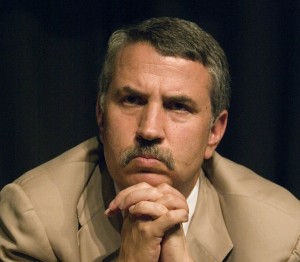
New York Times columnist Thomas L. Friedman
But these “truth-loving” pundits, the likes of star Times columnist Thomas L. Friedman, never seem to reflect on their own responsibility for disseminating devastating “fake news,” such as the falsehoods about Iraq’s WMD, lies that led to the deaths of hundreds of thousands of Iraqis and thousands of American soldiers and spread horrific chaos across the Mideast and into Europe.
Nor does that Iraq experience ever cause Friedman and his fellow pundits to question other Official Narratives, including those relating to the proxy war in Syria or the civil war in Ukraine or the New Cold War with Russia. Meanwhile those of us who ask for substantiating facts or observe that some official claims don’t make sense are subjected to insults as fill-in-the-blank “apologists” or “stooges.”
It seems that any deviation from Officialdom’s pronouncements makes you an enemy of “truth” because “truth” is what the Establishment says is “truth.” And, if you don’t believe me, I refer you to Friedman’s Wednesday’s column.
Friedman leads off the article by quoting himself telling a questioner at a Montreal conference: “I fear we’re seeing the end of ‘truth’.”
But Friedman doesn’t take himself to task by noting how he helped disseminate the Iraq WMD lies and how he flacked for that illegal and disastrous war for years.
If he had ‘fessed up, maybe Friedman could then have explained why he didn’t resign in disgrace and engage in some lifelong penance, preferably including a vow of silence, rather than continuing to spout lots of other nonsense while also continuing to collect a handsome salary and to rack up lucrative speaking fees.
Instead, after wringing his hands over why Americans no longer trust their leaders, Friedman cites another voice of authority, a friend and mentor, Dov Seidman, who complains that “What we’re experiencing is an assault on the very foundations of our society and democracy – the twin pillars of truth and trust. …
“What makes us Americans is that we signed up to have a relationship with ideals that are greater than us and with truths that we agreed were so self-evident they would be the foundation of our shared journey toward a more perfect union – and of respectful disagreement along the way. We also agreed that the source of legitimate authority to govern would come from ‘We the people’.”
Friedman then goes on to share Seidman’s lament that when “we” no longer share basic truths “then there is no legitimate authority and no unifying basis for our continued association.”
The Villains
Friedman identifies the villains in this scenario as “social networks and cyberhacking,” which help “extremists to spread vitriol and fake news at a speed and breadth we have never seen before.” So, it seems those “truth” algorithms can’t arrive soon enough.
However, if you keep reading Friedman’s column, you learn that the real problem is not that “cyberhacking” is generating “fake news,” but rather that it has let Americans see too many ugly truths about their leadership, as happened when WikiLeaks published emails showing how the Democratic National Committee unethically tilted the playing field against Sen. Bernie Sanders; how Hillary Clinton pandered to Goldman Sachs in return for lucrative speaking fees; and how the Clinton Foundation engaged in pay-to-play with rich foreigners.
Friedman’s column acknowledges as much, again citing Seidman: “Social networks and hacking also ‘have enabled us to see, in full color, into the innermost workings of every institution and into the attitudes of those who run them,’ noted Seidman, ‘and that has eroded trust in virtually every institution, and the authority of many leaders, because people don’t like what they see’.”
In other words, the answer to restoring “trust” and to respecting “truth” is to hide ugly realities from the unwashed public. If the people are shielded from the facts, the Establishment will regain its control over “truth” and thus win back the people’s “trust.”
If all this seems upside-down to you – if you think that the real answer is for America’s leaders to behave more responsibly, to let the public in on the real “truth,” and thus to make the people’s “trust” mean something – you must be a “Kremlin stooge.” After all, the current groupthink is that the diabolical Russians slipped WikiLeaks those Democratic emails in a nefarious plot to undermine Americans’ faith in their democracy.
However, if you’re still having trouble with Friedman’s logic, you also must not understand how America’s new media paradigm works. The job of the media is not to provide as much meaningful information as possible to the people so they can exercise their free judgment; it is to package certain information in a way to guide the people to a preferred conclusion.
Pleasant Myths
You see the last thing that Friedman really wants is for the American people to understand their own reality – the good, the bad and the ugly. Instead, we are to have our pretty little heads filled with pleasant myths that make us feel special as we are herded either to the shearing shed or to the slaughterhouse.
For instance, reflect on the history that we hear from Friedman’s friend Seidman about how we “signed up” for those high-minded proclamations in the Declaration of Independence and the U.S. Constitution. The truth is that most of us didn’t “sign up” for anything; we were just born here; and – by the way – the Founders were hypocrites who said and wrote things that they didn’t believe at all.
When slaveholding Thomas Jefferson wrote “We hold these truths to be self-evident, that all men are created equal, that they are endowed by their Creator with certain unalienable Rights, that among these are Life, Liberty and the pursuit of Happiness,” he didn’t believe a word of it. He considered his black slaves inferior beings and thought they deserved none of those “unalienable rights.” He devoted much of his adult life to defending and expanding the institution of slavery, which – by increasing demand for his human chattel – also increased his personal wealth.
When Gouverneur Morris penned the Preamble to the U.S. Constitution, citing “We the People” as the nation’s true sovereigns, he really meant white men of money and means, not poorer white men, nor women, and surely not slaves. His reference to “the People” was another propagandistic affectation.
There may be some irony in the fact that history imparts genuine value to the words of Jefferson and Morris even if they were simply empty propaganda when written. Jefferson’s assertion that “all men are created equal” possessing “unalienable rights” has inspired people around the world – and a literal interpretation of Morris’s florid rhetoric did, in a way, make “We the People” the technical sovereigns of America, as much as today’s ruling elites don’t really believe that either.
Much of what we see from the likes of Friedman is designed to reassert elite control by putting us back in an information-starved dependent state, reliant on the Establishment to parcel out a few morsels of information as it sees fit, the “truth” that the powers-that-be deign to give us. All the better for us to “trust” them.
But the messy behind-the-scenes reality that WikiLeaks and other publishers of “cyberhacked” and leaked material have made available to us – as well as the hypocritical and ambiguous history of the United States – is part of America’s “truth” and thus a reality that should belong to all the people.
Instead, Friedman and other Important People prefer a future in which unpleasant and unpopular truths can be marginalized or erased, all the better to guarantee our “trust” in our leaders.
The Times and the Post, in particular, have consistently conflated any deviation from their preferred groupthinks with “fake news” and “propaganda.” That is why it is particularly troubling when they and other self-proclaimed arbiters of truth, including the pro-NATO propaganda site Bellingcat, sit on Google’s First Draft Coalition and salivate over the prospects of unleashing high-tech algorithms to hunt down and eliminate information that runs counter to what they call the “truth.”
The real truth about truth is that it is almost always complex and often hidden by powerful interests. It requires skepticism, hard work and even courage to reveal it.
Sure, there are occasions when creeps and crazy people purposely make up stuff or ignore reality in pursuit of some nutty conspiracy theory – and that deserves hearty condemnation – but there are many other times when the conventional wisdom is wrong and the people demanding inconvenient facts and asking probing questions turn out to be right.
So, if Friedman and his friends really want to restore trust and truth, they might begin by acknowledging their own flaws and by admitting the times when their groupthinks turned out to be wrong. They also might start respecting the value that dissent has in the difficult pursuit of truth.
Investigative reporter Robert Parry broke many of the Iran-Contra stories for The Associated Press and Newsweek in the 1980s.
Ukrainian regime arrests owner of Russian language news outlet
By Adam Garrie | The Duran | June 23, 2017
The Ukrainian regimes notorious Secret Service, the SBU has arrested the owner of a Russian language news outlet Strana.ua.
Igor Guzhva was arrested while his offices were raided. Authorities loyal to the Poroshenko regime have stated that the charges related to allegations of blackmail, although many see this is yet another attempt to forcibly shut-down domestically owned Russian language news media after a law was passed banning Russian owned media in the country.
The regime authorities are also cracking down on the large domestically owned and produced Russian language media and entertainment sectors.
Strana.ua was harassed by the SBU throughout 2014 and 2015.
This looks increasingly like another politically motivated arrest by a regime engaged in crimes against humanity in Donbass.
The Heathrow Tarmac Strikes Again!
By Paul Homewood | Not A Lot Of People Know That | June 23, 2017

As we know, the Met Office have informed us that Wednesday was the hottest June day since 1976, with a temperature of 34.5C recorded next to the runway at Heathrow.
Apparently the previous hottest June day since 1976 was at Worcester in 1995, with 33.8C set.

This is all very interesting, because I asked the Met Office what the highest temperature was on Wednesday after the Heathrow figure.
This was their reply:

So the next highest temperatures, set at Kew and Northolt which are both close to Heathrow, were 33.8C, the same as in 1995.
Only by using the Heathrow temperature were the Met Office able to claim the “hottest day since 1976”.
Many readers will recall similar shenanigans in 2015, when the tarmac at Heathrow conveniently allowed the Met Office to claim the hottest July day on record.
Unsustainable: 43 Million Tonnes Of Wind Turbine Blade Waste By 2050
2 New Papers Expose The Environmental Nightmare Of Wind Turbine Blade Disposal

By Kenneth Richard – No Tricks Zone – 22. June 2017
… Despite its extremely limited infiltration as a world energy source, it is assumed that a rapid expansion of wind power will ultimately be environmentally advantageous both due to its reputation as a “clean” energy and because of the potential to contribute to reduced CO2 emissions.
Recently, however, the austere environmental impacts and health risks associated with expanding wind energy have received more attention.
For example, scientists have asserted that wind turbines are now the leading cause of multiple mortality events in bats, with 3 to 5 million bats killed by wind turbines every year. Migratory bats in North America may face the risk of extinction in the next few decades due to wind turbine-related fatalities.
Frick et al., 2017
“Large numbers of migratory bats are killed every year at wind energy facilities. … Using expert elicitation and population projection models, we show that mortality from wind turbines may drastically reduce population size and increase the risk of extinction. For example, the hoary bat population could decline by as much as 90% in the next 50 years if the initial population size is near 2.5 million bats and annual population growth rate is similar to rates estimated for other bat species (λ = 1.01). Our results suggest that wind energy development may pose a substantial threat to migratory bats in North America.”
Wind Turbine Blades Last 20 Years…And Then They Are Tossed Into Landfills
Besides reducing wildlife populations, perhaps one of the most underrated negative side effects of building wind turbines is that they don’t last very long (less than 20 years) before they need to be replaced. And their blades aren’t recyclable. Consequently, 43 million tonnes (47 million tons) of blade waste will be added to the world’s landfills within the next few decades.
Liu and Barlow, 2017
“The blades, one of the most important components in the wind turbines, made with composite, are currently regarded as unrecyclable. With the first wave of early commercial wind turbine installations now approaching their end of life, the problem of blade disposal is just beginning to emerge as a significant factor for the future. … The research indicates that there will be 43 million tonnes of blade waste worldwide by 2050 with China possessing 40% of the waste, Europe 25%, the United States 16% and the rest of the world 19%.”
“Although wind energy is often claimed to provide clean renewable energy without any emissions during operation (U.S. Department of Energy, 2015), a detailed ecological study may indicate otherwise even for this stage. The manufacture stage is energy-intensive and is associated with a range of chemical usage (Song et al., 2009). Disposal at end-of-life must also be considered (Ortegon et al., 2012; Pickering, 2013; Job, 2014).A typical wind turbine (WT) has a foundation, a tower, a nacelle and three blades. The foundation is made from concrete; the tower is made from steel or concrete; the nacelle is made mainly from steel and copper; the blades are made from composite materials (Vestas, 2006; Tremeac and Meunier, 2009; Guezuraga et al., 2012). Considering these materials only, concrete and composites are the most environmentally problematic at end-of-life, since there are currently no established industrial recycling routes for them (Pimenta and Pinho, 2011; Job, 2013).”
In a new paper entitled “Unsustainable Wind Turbine Blade Disposal Practices in the United States“, Ramirez-Tejeda et al. (2017) further detail the imminent and unresolved nightmare of wind turbine blade disposal. The environmental consequences and health risks are so adverse that the authors warn that if the public learns of this rapidly burgeoning problem, they may be less inclined to favor wind power expansion. Advocates of wind power are said to be “largely ignoring the issue”. It’s an “issue” that will not be going away any time soon.
In light of its minuscule share of worldwide consumption (despite explosive expansion in recent decades), perhaps it is time to at least reconsider both the benefits and the costs of wind energy expansion.
‘Adverse Environmental Consequences’ For A Rapidly Expanding Wind Power Grid
Ramirez-Tejeda et al. (2017)
“Globally, more than seventy thousand wind turbine blades were deployed in 2012 and there were 433 gigawatts (GW) of wind installed capacity worldwide at the end of 2015. Moreover, the United States’ installed wind power capacity will need to increase from 74 GW to 300 GW3 to achieve its 20% wind production goal by 2030. To meet the increasing demand, not only are more blades being manufactured, but also blades of up to 100 meters long are being designed and produced.”
“The wind turbine blades are designed to have a lifespan of about twenty years, after which they would have to be dismantled due to physical degradation or damage beyond repair. Furthermore, constant development of more efficient blades with higher power generation capacity is resulting in blade replacement well before the twenty-year life span.”
“Estimations have suggested that between 330,000 tons/year by 2028 and 418,000 tons/year by 2040 of composite material from blades will need to be disposed worldwide. That would be equivalent to the amount of plastics waste generated by four million people in the United States in 2013. This anticipated increase in blade manufacturing and disposal will likely lead to adverse environmental consequences, as well as potential occupational exposures, especially because available technologies and key economic constraints result in undesirable disposal methods as the only feasible options.”
Problems With Landfills
“Despite its negative consequences, landfilling has so far been the most commonly utilized wind turbine blade disposal method. … Landfilling is especially problematic because its high resistance to heat, sunlight, and moisture means that it will take hundreds of years to degrade in a landfill environment. The wood and other organic material present in the blades would also end up in landfills, potentially releasing methane, a potent greenhouse gas, and other volatile organic compounds to the environment.”
“The estimated cost to put blade material in landfills, not including pretreatment and transportation costs, is approximately US $60 per ton. [A typical blade may weigh 30-40 tons]. In the United Kingdom, where landfilling organics is not yet prohibited, the active waste disposal cost (which includes plastics) is approximately US $130 per ton.”
Problems With Incineration
“Incineration of blades is another disposal method with potential for energy and/or material recovery. … Combustion of GFRP is especially problematic because it can produce toxic gases, smoke, and soot that can harm the environment and humans. Carbon monoxide and formaldehyde have been reported as residue from thermal degradation of epoxy resin. Another residue is carbon dioxide, which poses concerns regarding greenhouse gas emissions. In addition, about 60% of the scrap remains as pollutant ash after the incineration process, some of which is sent to landfills, potentially contaminating the sites. Possible emission of hazardous flue gasses is also among the issues with incinerating wind turbine blades.”
“One key issue is that all these thermal processing techniques for wind turbine blades would also require fragmentation of the material into smaller pieces through mechanical processing before being fed into the reactors, increasing energy consumption and carbon dioxide emissions.”
Problems With Mechanical Processing
“Mechanical processing is a relatively simpler disposal method that consists of cutting, shredding, and grinding the material to separate the fibers from resins, so it can be repurposed. This process is energy intensive and produces small fiber particles with poor mechanical properties that can only be used as filler reinforcement material in the cement or asphalt industries. … The dust emitted in the grinding process of FRP creates occupational health and safety risks for workers. Inhalation, as well as skin and eye contact can produce moderate irritation to mucous membranes, skin, eyes, and coughing. Occupational exposure and prolonged inhalation of such particles have been found to produce alterations of the cellular and enzymatic components of the deep lung in humans, identified as acute alveolitis.”
Problems With Chemical Degradation
“The last method is chemical degradation, which consists of first mechanically reducing the size of the blades, then degrading them using a chemical solution. … Although no industrial-level chemical recycling of thermoset polymers has been done yet, some hazardous chemicals such as nitric acids and paraformaldehyde have been used in testing and development processes. Occupational exposure to these chemicals can produce harmful respiratory diseases including potential nasal cancer, and dermal health effects.”
Full article at No Tricks Zone
Russia-gate Flops as Democrats’ Golden Ticket

By Robert Parry | Consortium news | June 21, 2017
The national Democratic Party and many liberals have bet heavily on the Russia-gate investigation as a way to oust President Trump from office and to catapult Democrats to victories this year and in 2018, but the gamble appears not to be paying off.
The Democrats’ disappointing loss in a special election to fill a congressional seat in an affluent Atlanta suburb is just the latest indication that the strategy of demonizing Trump and blaming Russia for Hillary Clinton’s 2016 defeat may not be the golden ticket that some Democrats had hoped.
Though it’s still early to draw conclusive lessons from Karen Handel’s victory over Jon Ossoff – despite his raising $25 million – one lesson may be that a Middle America backlash is forming against the over-the-top quality of the Trump-accusations and the Russia-bashing, with Republicans rallying against the image of Official Washington’s “deep state” collaborating with Democrats and the mainstream news media to reverse a presidential election.
Indeed, the Democrats may be digging a deeper hole for themselves in terms of reaching out to white working-class voters who abandoned the party in Pennsylvania, Michigan and Wisconsin to put Trump over the top in the Electoral College even though Clinton’s landslide win in California gave her almost three million more votes nationwide.
Clinton’s popular-vote plurality and the #Resistance, which manifested itself in massive protests against Trump’s presidency, gave hope to the Democrats that they didn’t need to undertake a serious self-examination into why the party is in decline across the nation’s heartland. Instead, they decided to stoke the hysteria over alleged Russian “meddling” in the election as the short-cut to bring down Trump and his populist movement.
A Party of Snobs?
From conversations that I’ve had with some Trump voters in recent weeks, I was struck by how they viewed the Democratic Party as snobbish, elitist and looking down its nose at “average Americans.” And in conversations with some Clinton voters, I found confirmation for that view in the open disdain that the Clinton backers expressed toward the stupidity of anyone who voted for Trump. In other words, the Trump voters were not wrong to feel “dissed.”
It seems the Republicans – and Trump in particular – have done a better job in presenting themselves to these Middle Americans as respecting their opinions and representing their fears, even though the policies being pushed by Trump and the GOP still favor the rich and will do little good – and significant harm – to the middle and working classes.
By contrast, many of Hillary Clinton’s domestic proposals might well have benefited average Americans but she alienated many of them by telling a group of her supporters that half of Trump’s backers belonged in a “basket of deplorables.” Although she later reduced the percentage, she had committed a cardinal political sin: she had put the liberal disdain for millions of Americans into words – and easily remembered words at that.
By insisting that Hillary Clinton be the Democratic nominee – after leftist populist Bernie Sanders was pushed aside – the party also ignored the fact that many Americans, including many Democrats, viewed Clinton as the perfectly imperfect candidate for an anti-Establishment year with many Americans still fuming over the Wall Street bailouts and amid the growing sense that the system was rigged for the well-connected and against the average guy or gal.
In the face of those sentiments, the Democrats nominated a candidate who personified how a relatively small number of lucky Americans can play the system and make tons of money while the masses have seen their dreams crushed and their bank accounts drained. And Clinton apparently still hasn’t learned that lesson.
Citing Women’s Rights
Last month, when asked why she accepted hundreds of thousands of dollars for speaking to Goldman Sachs, Clinton rationalized her greed as a women’s rights issue, saying: “you know, men got paid for the speeches they made. I got paid for the speeches I made.”
Her excuse captured much of what has gone wrong with the Democratic Party as it moved from its working-class roots and New Deal traditions to becoming a party that places “identity politics” ahead of a duty to fight for the common men and women of America.
Demonstrating her political cluelessness, Clinton used the serious issue of women not getting fair treatment in the workplace to justify taking her turn at the Wall Street money trough, gobbling up in one half-hour speech what it would take many American families a decade to earn.
While it’s a bit unfair to personalize the Democratic Party’s problems, Hillary and Bill Clinton have come to represent how the party is viewed by many Americans. Instead of the FDR Democrats, we have the Davos Democrats, the Wall Street Democrats, the Hollywood Democrats, the Silicon Valley Democrats, and now increasingly the Military-Industrial Complex Democrats.
To many Americans struggling to make ends meet, the national Democrats seem committed to the interests of the worldwide elites: global trade, financialization of the economy, robotization of the workplace, and endless war against endless enemies.
Now, the national Democrats are clambering onto the bandwagon for a costly and dangerous New Cold War with nuclear-armed Russia. Indeed, it is hard to distinguish their foreign policy from that of neoconservatives, although these Democrats view themselves as liberal interventionists citing humanitarian impulses to justify the endless slaughter.
Earlier this year, a Washington Post /ABC News poll found only 28 percent of Americans saying that the Democrats were “in touch with the concerns of most people” – an astounding result given the Democrats’ long tradition as the party of the American working class and the party’s post-Vietnam War reputation as favoring butter over guns.
Yet rather than rethink the recent policies, the Democrats prefer to fantasize about impeaching President Trump and continuing a blame-game about who – other than Hillary Clinton, her campaign and the Democratic National Committee – is responsible for Trump’s election. Of course, it’s the Russians, Russians, Russians!
A Problem’s Deep Roots
Without doubt, some of the party’s problems have deep roots that correspond to the shrinking of the labor movement since the 1970s and the growing reliance on big-money donors to finance expensive television-ad-driven campaigns. Over the years, the Democrats also got pounded for being “weak” on national security.
Further, faced with Republican “weaponization” of attack ads in the 1980s, many old-time Democrats lost out to the Reagan Revolution, clearing the way for a new breed of Democrats who realized that they could compete for a slice of the big money by cultivating the emerging coastal elites: Wall Street, Silicon Valley, Hollywood and even elements of the National Security State.
By the 1990s, President Bill Clinton and the Democratic Leadership Council defined this New Democrat, politicians who reflected the interests of well-heeled coastal elites, especially on free trade; streamlined financial regulations; commitment to technology; and an activist foreign policy built around spreading “liberal values” across the globe.
Mixed in was a commitment to the rights of various identity groups, a worthy goal although this tolerance paradoxically contributed to a new form of prejudice among some liberals who came to view many white working-class people as fat, stupid and bigoted, society’s “losers.”
So, while President Clinton hobnobbed with the modern economy’s “winners” – with sleepovers in the Lincoln bedroom and parties in the Hamptons – much of Middle America felt neglected if not disdained. The “losers” were left to rot in “flyover America” with towns and cities that had lost their manufacturing base and, with it, their vitality and even their purpose for existing.
Republican Fraud
It wasn’t as if the Republicans were offering anything better. True, they were more comfortable talking to these “forgotten Americans” – advocating “gun rights” and “traditional values” and playing on white resentments over racial integration and civil rights – but, in office, the Republicans aggressively favored the interests of the rich, cutting their taxes and slashing regulations even more than the Democrats.
The Republicans paid lip service to the struggling blue-collar workers but control of GOP policies was left in the hands of corporations and their lobbyists.
Though the election of Barack Obama, the first African-American president, raised hopes that the nation might finally bind its deep racial wounds, it turned out to have a nearly opposite effect. Tea Party Republicans rallied many white working-class Americans to resist Obama and the hip urban future that he represented. They found an unlikely champion in real-estate mogul and reality TV star Donald Trump, who sensed how to tap into their fears and anger with his demagogic appeals and false populism.
Meanwhile, the national Democrats were falling in love with data predicting that demographics would magically turn Republican red states blue. So the party blithely ignored the warning signs of a cataclysmic break with the Democrats’ old-time base.
Despite all the data on opioid addiction and declining life expectancy among the white working class, Hillary Clinton was politically tone-deaf to the rumbles of discontent echoing across the Rust Belt. She assumed the traditionally Democratic white working-class precincts would stick with her and she tried to appeal to the “security moms” in typically Republican suburbs by touting her neoconservative foreign policy thinking. And she ran a relentlessly negative campaign against Trump while offering voters few positive reasons to vote for her.
Ignoring Reality
When her stunning loss became clear on Election Night – as the crude and unqualified Trump pocketed the electoral votes of Pennsylvania, Michigan and Wisconsin – the Democrats refused to recognize what the elections results were telling them, that they had lost touch with a still important voting bloc, working-class whites.
Rather than face these facts, the national Democrats – led by President Obama and his intelligence chiefs – decided on a different approach, to seek to reverse the election by blaming the result on the Russians. Obama, his intelligence chiefs and a collaborative mainstream media insisted without presenting any real evidence that the Russians had hacked into Democratic emails and released them to the devastating advantage of Trump, as if the minor controversies from leaked emails of the Democratic National Committee and Clinton’s campaign chairman John Podesta explained Trump’s surprising victory.
As part of this strategy, any Trump link to Russia – no matter how inconsequential, whether from his businesses or through his advisers – became the focus of Woodward-and-Bernstein/Watergate-style investigations. The obvious goal was to impeach Trump and ride the wave of Trump-hating enthusiasm to a Democratic political revival.
In other words, there was no reason to look in the mirror and rethink how the Democratic Party might begin rebuilding its relationships with the white working-class, just hold hearings featuring Obama’s intelligence chieftains and leak damaging Russia-gate stuff to the media.
But the result of this strategy has been to deepen the Democratic Party’s reliance on the elites, particularly the self-reverential mavens of the mainstream media and the denizens of the so-called “deep state.” From my conversations with Trump voters, they “get” what’s going on, how the powers-that-be are trying to negate the 63 million Americans who voted for Trump by reversing a presidential election carried out under the U.S. constitutional process.
A Letter from ‘Deplorable’ Land
Some Trump supporters are even making this point publicly. Earlier this month, a “proud deplorable” named Kenton Woodhead from Brunswick, Ohio, wrote to The New York Times informing the “newspaper of record” that he and other “deplorables” were onto the scheme.
“I wanted to provide you with an unsophisticated synopsis of The New York Times and the media’s quest for the implosion of Donald Trump’s presidency from out here in the real world, in ‘deplorable’ country. … Every time you and your brethren at other news organizations dream up a new scheme to get Mr. Trump, we out here in deplorable land increase our support for him. …
“Regardless of what you dream up every day, we refuse to be sucked into your narrative. And even more humorously, there isn’t anything you can do about it! And I love it that you are having the exact opposite effect on those of us you are trying to persuade to think otherwise.
“I mean it is seriously an enjoyable part of my day knowing you are failing. And badly! I haven’t had this much fun watching the media stumble, bumble and fumble in years. I wonder what will happen on the day you wake up and realize how disconnected you’ve become.”
So, despite Trump’s narcissism and incompetence – and despite how his policies will surely hurt many of his working-class supporters – the national Democrats are further driving a wedge between themselves and this crucial voting bloc. By whipping up a New Cold War with Russia and hurling McCarthistic slurs at people who won’t join in the Russia-bashing, the Democratic Party’s tactics also are alienating many peace voters who view both the Republicans and Democrats as warmongers of almost equal measures of guilt.
While it’s certainly not my job to give advice to the Democrats – or any other political group – I can’t help but thinking that this Russia-gate “scandal” is not only lacking in logic and evidence, but it doesn’t even make any long-term political sense.
Investigative reporter Robert Parry broke many of the Iran-Contra stories for The Associated Press and Newsweek in the 1980s.
Ever Closer to War
By Brian CLOUGHLEY | Strategic Culture Foundation | 21.06.2017
The Science and Security Board of the Bulletin of the Atomic Scientists has warned that the likelihood of a catastrophic nuclear war is closer than since 1953. As explained by the Bulletin, in 1947 it devised the Doomsday Clock «using the imagery of apocalypse (midnight) and the contemporary idiom of nuclear explosion (countdown to zero) to convey threats to humanity and the planet».
Each year «the decision to move (or to leave in place) the minute hand of the Doomsday Clock is made by the Bulletin’s Science and Security Board in consultation with its Board of Sponsors, which includes 15 Nobel laureates». In 1953 the Clock was at two minutes to midnight. In the worst years of the cold war it was at 3 minutes to midnight when, in 1984 it was recorded that «US-Soviet relations reach their iciest point in decades. Dialogue between the two superpowers virtually stops. Every channel of communications has been constricted or shut down; every form of contact has been attenuated or cut off…»
And now, in 2017, it is apparent that channels of communication with Russia are being deliberately cut off — and the hands of the Doomsday Clock have been placed at just two-and-a-half minutes from midnight.
Disaster looms.
And as it looms, the United States Senate is heightening its global confrontational approach and announced that it intends to penalise Russia for a number of supposed misdemeanours.
Senator Lindsey Graham told CBS News that the Senate will «punish Russia for interfering in our elections» — concerning which allegation there has not been one shred of proof provided by anyone. All-embracing inquiries are under way, of course, but be assured that if there were the slightest, tiniest, most microscopic morsel of actual proof of any interference, it would by now have been leaked to the media and made headline news.
Senator Graham excelled himself by telling President Trump, via CBS News, that «You’re the commander in chief. You need to stand up to Russia. We’re never going to reset our relationship with Russia until we punish them for trying to destroy democracy. And that starts with more sanctions».
Then the CBS interviewer brought up the subject of the many inquiries into allegations of Trump-Russia plotting and mentioned that a Democrat had said the investigations were a «fishing expedition… What’s your response to that?»
The Senator replied «That’s not your, none of your business. We’re going to do what we think is best. The Russians interfered in our election. They’re doing it all over the world. No evidence yet that the Trump campaign colluded with the Russians. I don’t believe the president colluded with the Russians, just because of the way he behaves. There’s zero evidence that President Trump did anything wrong with the Russians. There’s overwhelming evidence that Russia is trying to destroy democracy here and abroad. And if you forgive and forget with Putin, you’re going to get more of the same and you’re going to entice Iran and China to come in 2018 and 2020».
The US Senate believes there is «zero evidence» that President Trump had help from Russia in his election campaign — which is true — but also thinks there is «overwhelming evidence» that Russia is trying to influence voting in America, although there is not a shred of proof to that effect.
The Senator spoke with the authority, force and majesty of the US Senate, and the world has to accept that his pronouncements represent the wishes of the legislators of his mighty nation which is intent on imposing harsher sanctions on Russia. As observed by Forbes, the new Bill «punishes Russian oil and gas firms even more than the current sanctions regime… Russia has no friends on Capitol Hill».
It is intriguing that the sanctions focus on oil and gas production, and Bloomberg reported that Germany and Austria consider «the measures sought to bolster US economic interests and included an unacceptable intervention in the region’s energy sector». In an unprecedented expression — indeed, explosion — of disapproval, Germany’s Foreign Minister Sigmar Gabriel and Austria’s Chancellor Christian Kern said in a joint statement that «Europe’s energy supply is a matter for Europe, not the United States of America… instruments for political sanctions should not be tied to economic interests» and that the Senate’s amendment heralded a «new and very negative quality in European-American relations».
As London’s Financial Times reported, «the Russia sanctions outline opposition to Nord Stream 2, a pipeline that will double capacity for Gazprom… to supply gas to Europe under the Baltic Sea. The measures could affect European energy companies, including Shell, Engie and OMV, which are financing the pipeline. Shares in all four companies tumbled on Thursday».
Washington’s mission of lucrative destruction was partly achieved, but that’s where we come to the essence of the matter. The part of the Sanctions Bill involving Russia was an add-on to a series of vindictive measures against Iran, but it seemed a good idea to also sanction Russia’s oil and gas production, because nobody would benefit more than the oil and gas companies of the United States.
Bloomberg explained that the Nord Stream pipeline «would compete with US exports of liquefied natural gas to Europe». And the Senate made it plain that the US government «should prioritize the export of United States energy resources in order to create American jobs, help United States allies and partners, and strengthen United States foreign policy».
It’s difficult to see how the Senate’s arrogant dabbling might «help allies and partners,» but those in America who own energy resources and want to continue making vast profits continue to help their allies and partners in the Senate and the House. Without their financial support, many legislators would never have got to Washington.
As recorded by Open Secrets, companies closely associated with oil and gas production gave US politicians over fifty million dollars in 2015-2016 to help their democratic election:
Top Contributors, 2015-2016
| Contributor | Amount |
|---|---|
| Koch Industries | $9,501,803 |
| Chevron Corp | $5,116,216 |
| Ariel Corp | $4,809,612 |
| Stewart & Stevenson | $4,127,231 |
| Western Refining | $4,067,802 |
| Petrodome Energy | $3,000,000 |
| Chief Oil & Gas | $2,977,493 |
| Hunt Companies | $2,709,917 |
| Marathon Petroleum | $2,398,781 |
| Edison Chouest Offshore | $2,198,872 |
| Energy Transfer Equity | $2,164,853 |
| Kinder Morgan Inc | $2,112,160 |
| American Petroleum Institute | $2,085,345 |
| Exxon Mobil | $2,065,787 |
| Occidental Petroleum | $1,855,908 |
| Devon Energy | $1,811,364 |
| Otis Eastern | $1,733,017 |
| Honeywell International | $1,461,284 |
| Anadarko Petroleum | $1,343,741 |
| Red Apple Group | $1,218,312 |
Source: By kind permission of the Center for Responsive Politics
And Senator Lindsay Graham was given a bundle by many commercial organisations, headed by Nelson, Mullins, whose $254,247 in 1993-2016 no doubt helped him along the way. Nelson Mullins, incidentally, has attorneys who «have experience in advising electrical and pipeline providers on legal matters». Then he got $175,605 from SCANA, which is «a $9 billion energy-based holding company, based in Cayce, South Carolina… Its businesses include… natural gas utility operations and other energy-related businesses». Another of Senator Graham’s generous sponsors is the Fluor Corporation ($94,801) which «understands the critical success factors driving onshore oil and gas production and terminal businesses, providing practical solutions to maximize project investment».
It doesn’t matter to these people, or to the legislators they’ve bought with their donations, that the Doomsday Clock has ticked closer to the midnight of Armageddon, and that the hostile approach of the United States is alienating a proud nation that can take only so much before it reacts against Washington’s aggressive confrontation. The sleazy hypocrisy of US legislators is legendary, but it is their ignorance greed and arrogance that are worrying.
While Senator Graham was dancing to the tune of his oil angels, the Washington Post reported that seven percent of American adults believe chocolate milk comes from brown cows. That is «16.4 million misinformed, milk-drinking people». The representative of FoodCorps which encourages sensible nourishment said this was unfortunate, and «We still get kids who are surprised that a French fry comes from a potato, or that a pickle is a cucumber. Knowledge is power. Without it, we can’t make informed decisions».
Just like the US Senate.
Qatar hacked by Arab neighbor states, not Russia, as previously reported by CNN
CNN busted by Qatar for spreading more fake news
By Alex Christoforou | The Duran | June 21, 2017
The reason cited by CNN for the ongoing Saudi-Qatari conflict, in which a coalition of Saudi-led states cut off diplomatic and economic ties with Qatar, originates with a CNN report (via its always handy anonymous sources bullwhip), that Russia is believed to have been behind a Qatar news hack.
CNN propaganda word-play is highlighted in bold…
US investigators believe Russian hackers breached Qatar’s state news agency and planted a fake news report that contributed to a crisis among the US’ closest Gulf allies, according to US officials briefed on the investigation.
The FBI recently sent a team of investigators to Doha to help the Qatari government investigate the alleged hacking incident, Qatari and US government officials say.
Intelligence gathered by the US security agencies indicates that Russian hackers were behind the intrusion first reported by the Qatari government two weeks ago, US officials say. Qatar hosts one of the largest US military bases in the region.
The alleged involvement of Russian hackers intensifies concerns by US intelligence and law enforcement agencies that Russia continues to try some of the same cyber-hacking measures on US allies that intelligence agencies believe it used to meddle in the 2016 elections.
The goal of Russian hackers, according to CNN’s unnamed US officials…
US officials say the Russian goal appears to be to cause rifts among the US and its allies. In recent months, suspected Russian cyber activities, including the use of fake news stories, have turned up amid elections in France, Germany and other countries.
It’s not yet clear whether the US has tracked the hackers in the Qatar incident to Russian criminal organizations or to the Russian security services blamed for the US election hacks. One official noted that based on past intelligence, “not much happens in that country without the blessing of the government.”
The FBI and CIA declined to comment. A spokeswoman for the Qatari embassy in Washington said the investigation is ongoing and its results would be released publicly soon.
Russian officials immediately denied the allegations, and they were correct to do so, as moments ago Qatar announced that the news agency cited by CNN as being “hacked by Russian” was in reality hacked by states linked to the boycott and blockade of Qatar.
According to a report cited by Reuters, Qatar’s attorney general has stated that Arab neighbor states (Saudi Arabia, Egypt, Bahrain and the United Arab Emirates) were responsible for the hacking of Qatar’s state news agency…
Qatar’s attorney general said on Tuesday his country has evidence that the hacking of Qatar’s state news agency was linked to countries that have severed ties with Doha.
Saudi Arabia, Egypt, Bahrain and the United Arab Emirates cut their ties with Doha earlier this month over comments alleged to have been made by the Emir Sheikh Tamim bin Hamad al-Thani and posted briefly on the Qatar News Agency’s website on May 23 which Doha said had been hacked.
The comments quoted Sheikh Tamim as cautioning against confrontation with Iran and defending the Palestinian Islamist group Hamas and Hezbollah, a Lebanese Shi’ite movement allied with Tehran.
U.S. and European officials have said that while U.S government agencies and experts were convinced that the news agency and the Qatari government’s Twitter feed were hacked, they have not yet determined who did the hacking.
“Qatar has evidence that certain iPhones originating from countries laying siege to Qatar were used in the hack,” the Qatari Attorney General Ali Bin Fetais al-Marri told reporters in Doha.
Marri said it was too early to explicitly name the countries responsible for the hacking and declined to comment when he was asked if individuals or states were behind it.
Qatar: ‘Neighbors’ leading economic siege hacked our news agency
Press TV – June 21, 2017
Qatar says it has evidence showing the same “neighboring” countries that are leading a boycott campaign against Doha had a hand in the alleged hacking of its state news agency, an incident that triggered an unprecedented diplomatic crisis in the Persian Gulf region.
Attorney General Ali bin Fetais al-Marri Ali bin Fetais al-Marri told a press conference in Doha on Tuesday that the hacking incident originated in “neighboring countries,” without naming them.
“We have evidence to show that iPhones originating from the countries laying siege to us have been used in this hacking. We have enough evidence to point the finger of blame at these countries,” Marri said.
Last month, the Qatar News Agency (QNA) released comments attributed to Emir Sheikh Tamim bin Hamad Al Thani, describing Iran as an “Islamic power,” praising the Palestinian resistance movement Hamas and criticizing US President Donald Trump.
Qatar said hackers had broken into the QNA website and published the fake news, but the denial did not convince the Riyadh regime and its Persian Gulf Arab allies.
Elsewhere in his remarks, the Qatari attorney general said it was “very soon” to give specific phone numbers for those he said were responsible for the hacking.
He also noted that Qatari investigators had traced the internet service providers used to the Saudi-led allied countries.
“We have sent the information to the countries concerned and we are awaiting their response,” Marri pointed out, adding, “As far as we are concerned, the case is very clear.”
Following the hacking report, Saudi Arabia, the United Arab Emirates, Bahrain and Egypt severed diplomatic ties and cut off transport links with Qatar in early June, accusing Doha of supporting terrorism, an allegation rejected by the Qatari government.
They put 12 organizations and 59 people associated with Qatar on a terror sanctions list.
Marri said the blacklist was “baseless” and stressed that Qatar would legally pursue those who had done harm to it.
Qatar has long been at odds with other Arab countries about the Muslim Brotherhood, which the UAE and Egypt regard as a terrorist group.
Back in March, 2014, Saudi Arabia, the UAE and Bahrain temporarily recalled their ambassadors from Doha after alleging that it has been interfering in their domestic affairs. The diplomatic relations resumed eight months later when Qatar ordered some Muslim Brotherhood members to leave the country.
The recent dispute, however, is said to be the worst to hit the Persian Gulf since the formation of the Persian Gulf Cooperation Council (GCC) in 1981.
Observers say the fresh rift surfaced in the wake of Qatar’s break with past policies and its leaning toward Russia and Iran.
Qatar’s Foreign Minister Sheikh Mohammed bin Abdulrahman Al Thani said lately that Doha would not “surrender,” vowing to keep “the independence of our foreign policy.”
Exploitation of children in propaganda war against Syria continues
By Eva Bartlett | RT | June 19, 2017
In December 2016, filmmakers in Egypt were arrested in the process of staging an Aleppo video with two children: the girl was meant to look injured, and the boy was to vilify both Russia and Syria.
Even the corporate media reported on it, including: “The girl’s dress, covered in red paint, was what caught the attention of a police officer driving by, the ministry said.”
The incidences of fakery and hoaxes, however, does not end there.
Also in December, the scene of a ‘Girl running to survive after her family had been killed’ was said to be in Aleppo. In reality, it was a scene from a Lebanese music video, which someone at some point clearly chose to depict as in Aleppo, for the same anti-Russian, anti-Assad vilification purposes.
In November 2014, a clip dubbed ‘Syrian hero boy’ went viral, viewed over 5 million times already by mid-November. The clip showed what appeared to be a little boy saving his sister from sniper gunfire, and was assumed to have been in Syria.
The Telegraph’s Josie Ensor didn’t wait for any sort of verification of the video which she cited as having been uploaded on November 10, the next day writing: “… it is thought the incident took place in Yabroud – a town near the Lebanese border which was the last stronghold of the moderate Free Syrian Army. Experts tell the paper they have no reason to doubt its authenticity. The UN has previously accused the Syrian regime of ‘crimes against humanity’ – including the use of snipers against small children.”
On November 14, the BBC brought on ‘Middle East specialist’ Amira Galal to give her expert opinion on the clip. She asserted: “We can definitely say that it is Syria, and we can definitely say that it’s probably on the regime frontlines. We see in the footage that there is a barrel, it’s painted on it the Syrian army flag.”
Once again, the so-called ‘experts’ got it wrong. The barrel which Galal referred to had a poor imitation of the flag of Syria painted on it, the flag’s color sequence out of order. The clip she was so certain had been filmed in government areas of Syria was actually produced in Malta by Norwegian filmmakers.
From Video to Twitter Hoaxes
In the propaganda war on Syria, there are convincing lies, and then there are the blindingly clear hoaxes. In the latter realm, the Bana al-Abed Twitter persona takes first prize. The child is being abused by her own family who have seemingly forced her to pretend she can speak English (she cannot).
We were meant to believe that sophisticated and nuanced tweets, often calling for Western intervention, are coming from an English-illiterate seven-year-old girl or her mother — whose husband was a militant in Aleppo.
In a detailed article, Barbara McKenzie looks at the campaign which uses the brand Bana for war propaganda. An excerpt includes: “Bana, the little girl supposedly tweeting from Aleppo, but actually the front for an account run from London, was selected to be the empathetic face of the campaign for a no-fly zone in Syria. Her account was tailored to create the impression of perpetual bombing, perpetual war crimes, on the part of Russia and the Syrian government.”
Bana not only tweeted with impossible frequency from eastern Aleppo, defying any internet lapses those of us who have gone to Aleppo have experienced. Whatever the actual explanation for her alleged preciousness and high-tech abilities, the child was clearly exploited, and continues to be.
Her twitter account continues its advocacy for Western intervention in Syria. Not at all suspicious.
Real Poster Children Brutally Beheaded, Sniped, Starved, Maimed
Effective war propaganda tugs at the heart strings, using many tactics, including adorable children in threatening situations, or dead, and comes hand in hand with condemnations for crimes committed, allegedly, by the villain(s) being caricatured. In the following instances, children being injured or murdered did occur, but the condemnations were muted or not at all.
A few weeks prior to the photo of Omran Daqneesh going viral as the poster child for suffering in Syria, terrorists of the Nour al-Din al-Zenki faction beheaded a boy said to be around 12 years old.
Although the decapitators filmed the entire savage act, posing for gleeful selfies as they tortured the boy prior to murdering him, leaders and media in the US took little notice of the horrific slaughter. Ten days after the questionable events which led to the light injury of Omran, two young boys in the Idlib villages of Foua and Kafraya were shot in their head and neck respectively by a sniper from Jaysh al-Fateh terrorists in the village of Binnish close by. The injuries were serious. They were rendered even more serious given that the villages had been completely surrounded and fully under siege by terrorists since March 2015.
In April 2017, a convoy of children, women, elderly and ill being evacuated from Foua were attacked by a terrorist explosion, with reports over 200 murdered, including 116 children. The attack included luring with potato chips and filming children in the convoy before later blowing them up and claiming to be rescuing them. Not only did these terrorists murder civilians and children, but they staged the scene to then look like heroes.
Indeed, in the West this massacre was called a “hiccup” and little denunciation was made about the vast numbers of dead, let alone the injured.
In October, 2016, Press TV was one of the few outlets to report on another adorable Aleppo boy, Mahmoud, “a six-year-old Syrian boy who was born without arms, and recently lost both of his legs after stepping on a mine planted by militants in Syria’s Aleppo.” The report includes scenes of Mahmoud showing his resilience, adjusting to life without any limbs. But for corporate media, Mahmoud’s were the wrong villains.
Terrorist bombings and snipings have killed children in schools and homes throughout Syria over the years, including the October 2014 terrorist car and suicide bombing of the Akrama Al-Makhzoumi School in Homs, killing at least 41 children by conservative estimates, or up to 48 children by other reports, along with women and other civilians, as well as attacks on Aleppo schools, as I detailed earlier.
In Aleppo and in Damascus, I have visited numerous hospitals and seen endless poster children of suffering in Syria. The differences between these children and those which Western and Gulf media present us, is that these children were murdered, rendered critically-injured, or maimed by the bombs, mortars and snipings of terrorists which the West presents as “moderate rebels”, so their stories will never be front page, much less heard.
The Bitter Truth
The Western and Gulf media work in lockstep with the narratives emanating from Washington on Syria. It is not coincidental that certain photos and stories of Syrian children go viral, while other more damning photos and sordid realities get no notice period.
Regarding the Omran case, we now know that he was not gravely hurt as media tried to imply, that his family have gone back to their lives in Aleppo, and the exploitation and lies around Omran cannot continue.
When I met them on June 6th, they showed no signs of the duress which terrorists and their backers—which include Western corporate media—claim. Instead, some neighbors were over, discussing media fabrications around Omran.
However, the children who are believed to have been exploited and used in the 2013 Ghouta chemical weapons fabrications remain missing and have not gone back to their lives, nor have their families in the Latakia countryside.
In March 2017, physicians with Swedish Doctors for Human Rights, after examining a White Helmet’s video, wrote: “… Swedish medical doctors, specialists in various fields, including pediatrics, have revealed that the life-saving procedures seen in the film are incorrect – in fact life-threatening – or seemingly fake, including simulated resuscitation techniques being used on already lifeless children.”
The article noted that Dr Lena Oske, a Swedish medical doctor and general practitioner, said of an adrenaline injection shown in the video, “If not already dead, this injection would have killed the child!”
While in al-Waer, Homs, on June 9, 2017, speaking with a woman who had returned not long after the last terrorist had been bused out in the government’s reconciliation agreement, she told me a story of her friend from the area. Bearing in mind that this is second hand information (and that I didn’t have time to stay another day to meet the friend in question), I’ll leave her words and this 2012 link as food for thought regarding the use of children, alive or day, for war propaganda against Syria: “In 2014, my friend’s son, Louay was leaving his school. A mortar fell on the street nearby and he was hit with shrapnel. The Red Crescent took him in an ambulance to al-Bour, a nearby aid association, which couldn’t treat him, so he was taken to a government hospital in al-Zahra’a. They tried to save him, but he died.
They took him back to al-Bour where they cleaned him for burial. While my friend was waiting, people from al-Bour carried him onto the street yelling the regime killed him, look what the regime does to children.'”
Later, she saw on both al-Jazeera and al-Arabiya footage of her son, with men blaming the “regime” for killing children in Syria.
But she didn’t agree. The government helped her son and tried to save his life. He was 7 years old.
Eva Bartlett is a freelance journalist and rights activist with extensive experience in the Gaza Strip and Syria. Her writings can be found on her blog, In Gaza.
What Phillip Williamson Forgot To Tell You
By Paul Homewood | Not A Lot Of People Know That | June 17, 2017
The Spectator has published an article by Dr Phillip Williamson, who works at the University of East Anglia as a science coordinator for the Natural Environment Research Council.

Readers of The Spectator will be familiar with the argument that climate change, like Britpop, ended in 1998. Raised on a diet of Matt Ridley and James Delingpole, you may have convinced yourself that climate scientists, for their own selfish reasons, continue to peddle a theory that is unsupported by real-world evidence.
You may also have picked up the idea that the ‘green blob’, as it has been called in these pages, is somehow suppressing the news that global warming is a dead parrot. That was the case made by Dr David Whitehouse, science editor of Lord Lawson’s Global Warming Policy Forum in a Spectator blog in February last year. He accused the world’s media of ignoring a paper in Nature Climate Change which concluded that the rise in global surface temperature had stalled, contrary to the narrative of man-made climate change. In contrast, an earlier paper by the National Oceanic and Atmospheric Administration (NOAA) in Science magazine, which questioned the existence of that hiatus, had been given huge coverage.
Those of us who work in climate research do not, of course, ignore evidence. A study published in Nature Climate Change does not go unnoticed. But the particular paper to which Whitehouse referred does not counter the reality of man-made change. By the time he wrote his piece, the hiatus in global air temperatures had already come to a blistering halt. The years 2014, 2015 and 2016 were the three hottest years on record — an unprecedented run.
But this is only part of the story. Anyone who considers climate change to be all about air temperatures at the Earth’s land surface misses something rather important. The evidence is not just blowing in the wind; it is 500 fathoms deep.
As a land species, it’s hardly surprising that we’re more concerned about what’s going on in the atmosphere than with conditions under the sea — but in the context of global warming that’s a big mistake. Around 93 per cent of the extra heat gained by the Earth over the past 50 years has sunk into the ocean, while 3 per cent has made ice melt, and 3 per cent has warmed the land. Only around 1 per cent has stayed in the atmosphere. So if we just measure air temperatures, we’re looking in the wrong place for climate change. Recent analyses by the World Meteorological Organisation and independent researchers have looked at deep-ocean as well as sea-surface temperatures, and both groups found that significant increases in total ocean heat content began around 1980, continuing more rapidly after 1998.
Not all the heat which is absorbed by the ocean stays there. Changes in circulation in the Pacific involve warm water shifting towards South America, raising air temperatures as it does so. Such El Niño events have contributed to the sharp rise in global air temperatures over the past three years.
The apparent slowdown in global temperature rise in the early years of this century was nothing more than the Earth’s climate system expressing its natural variability. Like the weather in London, the Earth’s climate is fickle: what we see in the climate from year to year is much like what we see in the weather from day to day, or week to week. The years between 1998 and 2013 were the equivalent of a spell of cool weather following a heatwave. Yet all the while, taking air and ocean heat content combined, the Earth was warming. Now that the most recent El Niño event has ended, global air temperatures ought to be falling, but they aren’t. The world saw its third hottest January ever, followed by the second hottest February, March and April. The atmosphere and the ocean are warming in tandem, as predicted by climate models.
It is not easy to measure how much extra heat has entered the ocean as a result of human influences on the climate. Given that seawater is around 1,000 times as dense as air, small increases in water temperature represent a huge amount of heat being absorbed. It’s tough to demonstrate a whole-ocean average temperature increase of less than 0.1°C in about 1.4 billion cubic km of seawater. Tough, but not impossible — steadily, scientists have managed to complete the picture. Four years ago, the Intergovernmental Panel on Climate Change concluded that such ocean warming was ‘virtually certain’. Following new findings of recent weeks and months, the qualifier ‘virtually’ is now unnecessary, putting to bed any contention that global warming ended in 1998 — it is just that for a while the main effect was on water, not air, temperatures.
What happens in the ocean matters, because rising sea temperatures reinforce climate change in several ways. Warmer sea water can release methane trapped on the sea floor. Some of it finds its way to the surface and into the atmosphere, where it acts as a greenhouse gas, trapping heat — at least 30 times more effectively than carbon dioxide. Warmer water also means less sea ice. That matters, because ice reflects the sun’s rays. With less sea ice, the ocean will absorb even more heat. As the ocean warms, it expands, lifting coastal ice-shelves and making it easier for glaciers to slip into the sea. New analyses now suggest that sea levels could rise by up to a metre, and maybe more, in our children’s lifetimes.
Genuine scepticism can be constructive, since science responds to challenges by obtaining new evidence to test ideas. But those who summarily dismiss evidence when it has become overwhelming no longer deserve the name sceptics — it’s then out-and-out denial. There is no hoax; scientists like me gain nothing from exaggeration.
Yet the worst-case scenarios are not inevitable. They can be averted by action to reduce, and eventually end, greenhouse gas emissions. While Donald Trump and others might dismiss inconvenient truths, science is now in no doubt that the planet is warming, and that there is a need to take action on a worldwide basis. The Paris agreement will be the future, whereas the so-called global-warming hiatus is already history.
https://www.spectator.co.uk/2017/06/the-great-myth-of-the-global-warming-pause/
What could have been a constructive essay has depressingly ended up as a cheap propaganda piece.
He grossly misrepresents the position of David Whitehouse and Matt Ridley, to all intents dismissing them as “deniers”. Neither denies the greenhouse effect, but they believe there is a proper debate to be had about climate sensitivity and effects.
But to Williamson, there is only one gospel, and others shall not be heard.
He claims, by the time he [Whitehouse] wrote his piece, the hiatus in global air temperatures had already come to a blistering halt. The years 2014, 2015 and 2016 were the three hottest years on record — an unprecedented run.
This may be true for the widely discredited surface temperature record, but not according to satellite data for the atmosphere, which shows last year as only in a statistical tie with 1998.
It is, of course, Williamson’s prerogative to refer to surface data, but he needs to explain why he chooses to ignore the satellite data. To make no reference at all to data, which would undermine his argument, is not the behaviour one associates with a proper scientist.
He goes on to say, now that the most recent El Niño event has ended, global air temperatures ought to be falling, but they aren’t.
This is totally untrue, global temperatures have fallen back by half a degree and more since the El Nino peaked last year, and are back to levels seen in the years after 2001.
[Click on here for clearer image]
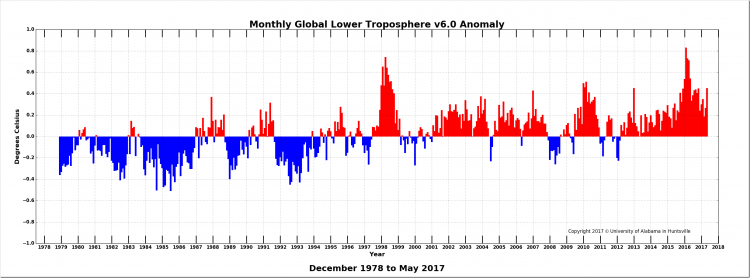
The heart of the Williamson article however concerns oceans and how they are somehow hiding the missing heat.
However, things are not quite as black and white as he makes out.
We only have ARGO data since 2004, which is far too short a period to be drawing conclusions from. Prior to that, we had very little idea what was happening to ocean heat content.
It is certainly debatable just how much we know now.
He states, it’s tough to demonstrate a whole-ocean average temperature increase of less than 0.1°C in about 1.4 billion cubic km of seawater. Tough, but not impossible — steadily, scientists have managed to complete the picture.
In fact, the temperature increase detected is much less than 0.1C, approximately 0.02C since 2004.
It is certainly questionable whether any statistical significance can be attached to such a small amount at all, or whether such a figure is genuinely detectable.
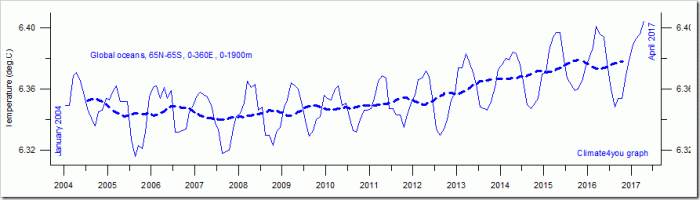
http://climate4you.com/
Then there is the question of just what is causing this increase in ocean temperatures, if it really exists.
He claims that around 93 per cent of the extra heat gained by the Earth over the past 50 years has sunk into the ocean. Unfortunately this is just mumbo jumbo. It is a physical fact that long wave radiation can only penetrate the top few millimeters of the ocean, where any warming would quickly lead to evaporation.
Even if there was a way for this extra heat to be mixed up with the deep ocean, the difference would be too small to detect.
This raises the question of whether other factors are at play in raising ocean temperatures, with the obvious one being the sun. After all, climate scientists have long known that ocean cycles can have major effects on the climate. Not only are they very powerful, but also very long lasting. The idea that man has caused sudden changes in the deep ocean is frankly scientific gibberish.
Williamson’s logic is that the pause in air temperatures, which he seems to accept existed until the 2015/16 El Nino, was because the world’s climate was going through a period of natural cooling, with the oceans holding back the heat (think La Nina).
But this ignores the AMO, which has been running through the warm phase since the mid 1990s. As even NOAA accept, when this happens, global air temperatures rise.
Meanwhile, the PDO has not really got into negative phase yet, partly because of the recent record El Nino.
Neither of these facts are consistent with his argument. Air temperatures have in fact plateaued despite the AMO and PDO.
But perhaps most importantly of all is the longer term trend. Williamson gives us a clue, when he says, “as the ocean warms, it expands”. In other words, sea levels rise.
But we know from tidal gauges all around the world that sea levels have been rising since the late 19thC, and for most of that time at a similar rate as now, and long before man made CO2 had any significant influence.
There is therefore no evidence that what we are seeing now is not just a continuation of that natural trend.
We in fact know very little about these ocean processes, and it is certainly a subject which deserves much greater attention.
Now that would be a good topic for the Spectator, but don’t expect Mr Williamson to be writing it!
FOOTNOTE
It was Phillip Williamson in his role as science coordinator (whatever that means!) who made a formal complaint about one of James Delingpole’s articles about ocean acidification to the UK press regulatory body IPSO last year.
Dellers has his usual forthright account of how IPSO threw out the complaint!
Sounds as if one of Williamson’s jobs is to shut down free speech.
Featured Video

The Search for Truth: Charlie Kirk’s Assassination One Year Later
or go to
Aletho News Archives – Video-Images
From the Archives
US murdering 1 million Iraqis is democracy, Iran giving yogurt to Iraq is “domination”
By Ali Salaam | American Herald Tribune | July 31, 2017
The New York Times, owned by the Zionist Jewish supremacist Ochs-Sulzberger family, has no problem with Iraqi suffering as long as Iran is not the one behind it.
The Iraq War was a genocide of the Iraqi people by Zionist supremacists in the Bush administration. Over 1 million innocent people were killed based on a lie. American soldiers died in an Israeli war and now an average of 22 soldiers commit suicide every day because their consciences cannot cope with the fact they committed crimes in an illegal war that served no purpose other than to benefit Israel, not America.
Benjamin Netanyahu, Prime Minister of the Zionist regime, once said “We are benefiting from one thing, and that is the attack on the Twin Towers and Pentagon, and the American struggle in Iraq.”
Paul Wolfowitz had his sights on Iraq since his time in the first Bush administration. Former Israeli official and Bush administration official Richard Perle had his eyes on Iraq since at least his authorship of the Clean Break white paper. The Zionist regime had their eyes on Iraq since the 1980s when strategist Oded Yinon wrote his white paper in support of dividing the Arab-Muslim world along ethnic and sectarian lines. The global Zionist lobby has had their eyes on Iraq since Theodor Herzl stated that Eretz Israel’s true borders go from the Nile River in Egypt to the Euphrates River in Iraq. … continue
Blog Roll
 Aletho News
- The Search for Truth: Charlie Kirk’s Assassination One Year Later
- ‘Harsh reality’: Iran says France seeks monopoly on power and intimidation, not peace for all
- When Will This White House Madness End?
- Huckabee aide goes to ‘unusual lengths’ to portray ‘Israel’ positively
- Trump Announces Diesel Supply Deal With Putin Following Phone Call
- MEP blasts ‘Euro-Gestapo’ for lecturing Russia on democracy
- Syria May Send Troops to Saudi Arabia Amid War with Ansar Allah
- UK whines about losing billions to ‘Putin tax’
- Baghaei to Rubio: Distorted narratives cannot erase US record of broken commitments
- Houthis Don’t Have to Conquer Saudi Arabia to Make It Pay
- If Americans Knew
- Gaza ceasefire exists in name only, say more than 100 organizations
- Nearly 2 Million in Gaza Need Urgent Shelter Assistance as Winter Looms: IOM Chief Warns
- Suppressing Palestinian resistance: US charity under fire for AI monitoring of Gaza classrooms
- Thousands Are Held in Israeli Torture Camps. This Is What Happens Inside
- Israel puts Gaza’s sick, injured, newborn in peril – Daily Update
- Report claimed Mark Levin used by Israeli government to influence Trump
- Over 2,000 Gazans have died awaiting medical evacuation amid Israel’s continued siege
- How a U.S. Diplomat Suppressed and Altered Reports Critical of Israel
- 5 Palestinians Die from Israeli Strikes in Gaza as Relentless Attacks Continue
- Report: Ceasefire Slows Killing but Leaves Devastation Intact
- No Tricks Zone
- New Study: 50 Years Of The Most Aggressive ‘Net Zero’ Policies Can Only Affect The Global Climate By 0.03°C
- US September “Heat” Was No Record…Many Records Set Decades Ago
- Latest European Green Energy Debacle; Portugal’s Largest Flagship Solar Park Insolvent!
- Green Energy Debacle: German Expert Professor Fritz Vahrenholt Warns Of Severe Economic And Social Consequences
- Two More Paleo Reconstructions Affirm Meters-Higher Sea Levels Across Ireland, Brazil 7000-6000 Years Ago
- New Study: Earth And Venus Surface Warmth Largely Explained By Convection And Lapse Rate, Not CO2 Or Radiation
- 2025 Nature Paper Claiming Worsening Global Drought Gets RETRACTED …Heavily Flawed
- New Study: ‘Global Drought Shows No Detectable Recent Acceleration Under Climate Warming’
- Economic Masterminds: German Socialists Suggest Taxing Productivity Gains Stemming From Using AI
- The South China Sea Has Not Been Cooperating With The Climate Change Narrative

