The plain truth about terrorism
or why the “oops we accidentally let ISIS get our guns” excuse does not work…
OffGuardian | February 7, 2017
We get a few people here saying some variant on “ISIS, al Qaeda etc are all the unlooked-for by-product of the criminal western policy in the Middle East.” It’s one of the would-be middle-of-the-road positions occupied as much through fear of what lies beyond it than for any inherent value it contains. It’s still possible to be considered relatively mainstream and hold this position. Sensible people like Robert Fisk and Noam Chomsky promote it. There’s only one problem with it really, namely that it is not true. Recent leaks/releases of government documents have put it beyond question that the US, its Gulf allies and NATO at very least willingly got behind the creation of extreme jihadist groups and have been funding such groups in their attempts to overthrow the legitimate Syrian government.
So we thought we’d address that claim very quickly with the help of this graphic originally made by professor Tim Anderson. It makes the point more clearly than many paragraphs of text.
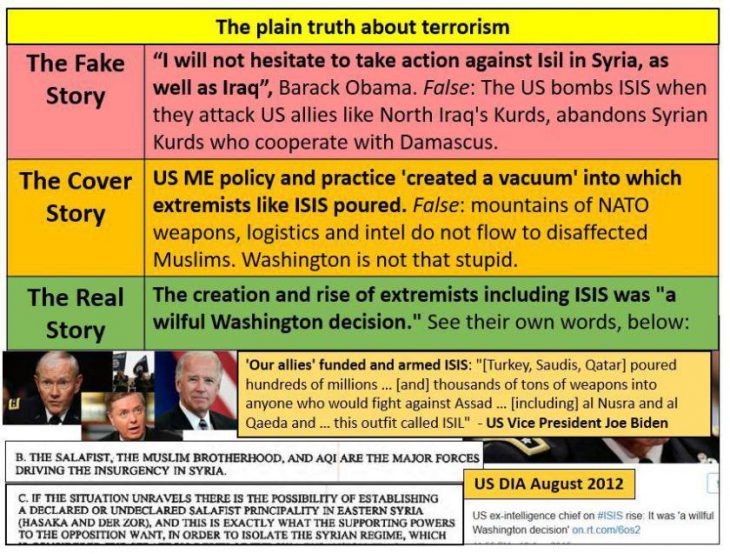
That’s all you need.
Stop making that bogus and unhelpful claim here or anywhere else.
Trident whistleblower calls out MoD’s ‘lame attempt’ to excuse nuke malfunctions

Trident whistleblower William McNeilly. / RT
RT | February 6, 2017
Royal Navy whistleblower William McNeilly has returned fire after the Ministry of Defence (MoD) again tried to discredit him. He labeled it an attempt to cover up the dangers of Britain’s nuclear arsenal.
McNeilly was thrown out of the navy in 2015 after publishing a dossier of potentially catastrophic security and safety issues relating to Britain’s nuclear deterrent.
After reports in January this year of a failed 2016 missile test, which saw senior government figures accused of lying, McNeilly told RT that he himself had been witness to a number of serious mishaps during a Trident patrol a year earlier.
The 2016 test saw a missile which was supposed to be aimed in the direction of Africa veer toward Florida due to an internal systems failure.
The MoD responded to the former weapons engineer’s comments to RT by telling the Independent newspaper: “McNeilly’s claims, from his brief serving time before being discharged, have proved to be factually incorrect, demonstrate a lack of understanding or drew on historic, previously known, events.
“We have absolute confidence in the nuclear deterrent,” they insisted.
The Independent specifically referred to McNeilly’s “claims that there were four unreported Trident missile test failures in 2015…”
McNeilly responded Monday, telling RT: “I have never stated that there were four failed missile launches.
“The Trident report and the information I gave RT made it clear that I was talking about missile tests.”
McNeilly pointed out he had served on a nuclear missile patrol, including on watches in the command center.
“There are multiple missile tests conducted every patrol,” he said.
“The MoD has tried to downplay the information in the Trident report by claiming that I said things that I have never said.”
The truth of the matter, he insisted, was that “I have never said I witnessed four failed missile launches… that is a lame attempt to discredit me and the Trident report by fabricating nonsense.”
Strange bedfellows at ‘anti-racism’ forum
By Yves Engler · February 3, 2017
Why would one of Toronto’s leading anti-racist writers share a stage with three individuals who support an explicitly racist institution?
Recently radio host and Toronto Star columnist Desmond Cole spoke at a forum put on by the Mosaic Institute titled “Canada in a Trump World”. It was about “increased racist and xenophobic attacks” and offered a “dialogue for communities to come together for honest conversation.”
Executive director of the Mosaic Institute and head of the Canadian Jewish Congress between 2005 and 2011, Bernie Farber also spoke. So did former Executive Director of the B’nai Brith league for Human rights, Karen Mock. The chair of the event was Warren Kinsella, a former board member of the Canada-Israel Committee.
All three of these individuals have worked with or expressed support for the Jewish National Fund. An owner of 13 per cent of Israel’s land, the JNF discriminates against Palestinian citizens of Israel (Arab Israelis) who make up one-fifth of the population. According to a UN report, JNF lands are “chartered to benefit Jews exclusively,” which has led to an “institutionalized form of discrimination.” Echoing the UN, a 2012 US State Department report detailing “institutional and societal discrimination” in Israel says JNF “statutes prohibit sale or lease of land to non-Jews.”
In October JSpaceCanada, which Karen Mock chairs, was a “participating organization” with JNF Canada on an event honouring the life of former Israeli president Shimon Peres. Mock also sat on the board of the Canadian Peres Center for Peace Foundation, which raised funds for the Israeli-based Peres Center For Peace. In Israel the Peres Center operated a slew of projects with JNF Canada and other branches of the racist organization.
In 2001 Mock spoke at a Hamilton rally titled “Israel under siege”.
In August Warren Kinsella criticized a Green Party of Canada resolution calling on the Canada Revenue Agency to rescind the JNF’s charitable status because of its “discrimination against non-Jews in Israel.” Alongside Ezra Levant, Kinsella sat on the board of directors of the Canada-Israel Committee, whose personnel were often close to the JNF. In 2014 Kinsella approved of Israel’s invasion of Gaza, which led to the killing of 2,200 Palestinians.
For his part, Bernie Farber called the Alliance of Concerned Jewish Canadians (Independent Jewish Voices predecessor) “a rump on the edge of Jewish society” because it, among other things, called for the Canada Revenue Agency to rescind the JNF’s charitable status. During Farber’s quarter century at the Canadian Jewish Congress the organization and its personnel had many ties to the JNF. In 2015 the Consulate of Israel in Toronto co-hosted an event with Farber’s Mosaic Institute.
Should we laugh or cry at an antiracist forum put on by individuals with ties to an organization practicing discriminatory land-use policies outlawed in this country half a century ago? Does Farber, Mock and Kinsella’s support for an explicitly racist institution concern Desmond Cole or does he have an opinion about Ottawa subsidizing racist land use policies abroad?
Thousands of US airstrikes unaccounted for in Syria, Iraq & Afghanistan – report
RT | February 6, 2017
US Central Command has been misleading the public in its assessment of the overall progress in the war on terror by failing to account for thousands of airstrikes in Afghanistan, Iran, and Syria, a Military Times investigation reveals.
The investigation revealed that open source data of US Air Force strikes does not contain all the missiles fired. That incomplete data, however, continues to be used by the Pentagon on multiple occasions in official reports and media publications.
The publication says that in 2016 alone, American aircraft conducted at least 456 airstrikes in Afghanistan that were not recorded in the database maintained by the US Air Force.
The investigation also revealed discrepancies in Iraq and Syria where the Pentagon failed to account for nearly 6,000 strikes dating back to 2014, when the US-led coalition has launched its first airstrikes against Islamic State (IS, formerly ISIS,ISIL) terrorist targets.
According to the Air Force, coalition jets conducted 23,740 airstrikes through the end of 2016. The US Defense Department, however, puts the number at 17,861 until the end of January 2017.
“The Pentagon routinely cites these figures when updating the media on its operations against the Islamic State and al-Qaida affiliates in Iraq and Syria,” the publication says.
Military Times remains especially puzzled by a statement made by an Air Force official in December who assured the publication that its monthly summary of activity in Iraq and Syria “specifically” represents the entire American-led coalition “as a whole, which is all 20-nations and the US branches.”
“It’s unclear whether this statement was intentionally misleading, or simply indicative of widespread internal ignorance, confusion or indifference about what’s contained in this data,” Andrew deGrandpre, Military Times’ senior editor and Pentagon bureau chief, said in the article.
Military Times says that the “most alarming” aspects of the investigation are that the discrepancies in numbers go back as far as 2001, when the US, under George W. Bush’s administration, struck Afghanistan in response to the 9/11 attacks on American soil.
The publication reveals that the unaccounted-for airstrikes in all three war zones were allegedly conducted by US helicopters and armed drones which are overseen by US Central Command.
“The enormous data gap raises serious doubts about transparency in reported progress against the Islamic State, al-Qaida, and the Taliban, and calls into question the accuracy of other Defense Department disclosures documenting everything from costs to casualty counts,” deGrandpre wrote.
The Pentagon and Army did not immediately respond to requests for comment.
“Those other key metrics include American combat casualties, taxpayer expense and the military’s overall progress in degrading enemy capabilities,” the publication added, wondering whether the military wanted to mislead the American public.
READ MORE:
US report on civilian casualties in Iraq & Syria: ‘Figures plucked out of thin air’
Pentagon acknowledges just 5-10% percent of actual civilian casualties in Syria – Amnesty to RT
Climate scientists versus climate data
By John Bates | Climate Etc. | February 4, 2017
A look behind the curtain at NOAA’s climate data center.
I read with great irony recently that scientists are “frantically copying U.S. Climate data, fearing it might vanish under Trump” (e.g., Washington Post 13 December 2016). As a climate scientist formerly responsible for NOAA’s climate archive, the most critical issue in archival of climate data is actually scientists who are unwilling to formally archive and document their data. I spent the last decade cajoling climate scientists to archive their data and fully document the datasets. I established a climate data records program that was awarded a U.S. Department of Commerce Gold Medal in 2014 for visionary work in the acquisition, production, and preservation of climate data records (CDRs), which accurately describe the Earth’s changing environment.
The most serious example of a climate scientist not archiving or documenting a critical climate dataset was the study of Tom Karl et al. 2015 (hereafter referred to as the Karl study or K15), purporting to show no ‘hiatus’ in global warming in the 2000s (Federal scientists say there never was any global warming “pause”). The study drew criticism from other climate scientists, who disagreed with K15’s conclusion about the ‘hiatus.’ (Making sense of the early-2000s warming slowdown). The paper also drew the attention of the Chairman of the House Science Committee, Representative Lamar Smith, who questioned the timing of the report, which was issued just prior to the Obama Administration’s Clean Power Plan submission to the Paris Climate Conference in 2015.
In the following sections, I provide the details of how Mr. Karl failed to disclose critical information to NOAA, Science Magazine, and Chairman Smith regarding the datasets used in K15. I have extensive documentation that provides independent verification of the story below. I also provide my suggestions for how we might keep such a flagrant manipulation of scientific integrity guidelines and scientific publication standards from happening in the future. Finally, I provide some links to examples of what well documented CDRs look like that readers might contrast and compare with what Mr. Karl has provided.
Background
In 2013, prior to the Karl study, the National Climatic Data Center [NCDC, now the NOAA National Centers for Environmental Information (NCEI)] had just adopted much improved processes for formal review of Climate Data Records, a process I formulated [link]. The land temperature dataset used in the Karl study had never been processed through the station adjustment software before, which led me to believe something was amiss. When I pressed the co-authors, they said they had decided not to archive the dataset, but did not defend the decision. One of the co-authors said there were ‘some decisions [he was] not happy with’. The data used in the K15 paper were only made available through a web site, not in digital form, and lacking proper versioning and any notice that they were research and not operational data. I was dumbstruck that Tom Karl, the NCEI Director in charge of NOAA’s climate data archive, would not follow the policy of his own Agency nor the guidelines in Science magazine for dataset archival and documentation.
I questioned another co-author about why they choose to use a 90% confidence threshold for evaluating the statistical significance of surface temperature trends, instead of the standard for significance of 95% — he also expressed reluctance and did not defend the decision. A NOAA NCEI supervisor remarked how it was eye-opening to watch Karl work the co-authors, mostly subtly but sometimes not, pushing choices to emphasize warming. Gradually, in the months after K15 came out, the evidence kept mounting that Tom Karl constantly had his ‘thumb on the scale’—in the documentation, scientific choices, and release of datasets—in an effort to discredit the notion of a global warming hiatus and rush to time the publication of the paper to influence national and international deliberations on climate policy.
Defining an Operational Climate Data Record
For nearly two decades, I’ve advocated that if climate datasets are to be used in important policy decisions, they must be fully documented, subject to software engineering management and improvement processes, and be discoverable and accessible to the public with rigorous information preservation standards. I was able to implement such policies, with the help of many colleagues, through the NOAA Climate Data Record policies (CDR) [link].
Once the CDR program was funded, beginning in 2007, I was able to put together a team and pursue my goals of operational processing of important climate data records emphasizing the processes required to transition research datasets into operations (known as R2O). Figure 1 summarizes the steps required to accomplish this transition in the key elements of software code, documentation, and data.
 Figure 1. Research to operations transition process methodology from Bates et al. 2016.
Unfortunately, the NCDC/NCEI surface temperature processing group was split on whether to adopt this process, with scientist Dr. Thomas C. Peterson (a co-author on K15, now retired from NOAA) vigorously opposing it. Tom Karl never required the surface temperature group to use the rigor of the CDR methodology, although a document was prepared identifying what parts of the surface temperature processing had to be improved to qualify as an operational CDR.
Tom Karl liked the maturity matrix so much, he modified the matrix categories so that he could claim a number of NCEI products were “Examples of “Gold” standard NCEI Products (Data Set Maturity Matrix Model Level 6).” See his NCEI overview presentation all NCEI employees [ncei-overview-2015nov-2 ] were told to use, even though there had never been any maturity assessment of any of the products.
NCDC/NCEI surface temperature processing and archival
In the fall of 2012, the monthly temperature products issued by NCDC were incorrect for 3 months in a row [link]. As a result, the press releases and datasets had to be withdrawn and reissued. Dr. Mary Kicza, then the NESDIS Associate Administrator (the parent organization of NCDC/NCEI in NOAA), noted that these repeated errors reflected poorly on NOAA and required NCDC/NCEI to improve its software management processes so that such mistakes would be minimized in the future. Over the next several years, NCDC/NCEI had an incident report conducted to trace these errors and recommend corrective actions.
Following those and other recommendations, NCDN/NCEI began to implement new software management and process management procedures, adopting some of the elements of the CDR R2O process. In 2014 a NCDC/NCEI Science Council was formed to review new science activities and to review and approve new science products for operational release. A draft operational readiness review (ORR) was prepared and used for approval of all operational product releases, which was finalized and formally adopted in January 2015. Along with this process, a contractor who had worked at the CMMI Institute (CMMI, Capability Maturity Model Integration, is a software engineering process level improvement training and appraisal program) was hired to improve software processes, with a focus on improvement and code rejuvenation of the surface temperature processing code, in particular the GHCN-M dataset.
The first NCDC/NCEI surface temperature software to be put through this rejuvenation was the pairwise homogeneity adjustment portion of processing for the GHCN-Mv4 beta release of October 2015. The incident report had found that there were unidentified coding errors in the GHCN-M processing that caused unpredictable results and different results every time code was run.
The generic flow of data used in processing of the NCDC/NCEI global temperature product suite is shown schematically in Figure 2. There are three steps to the processing, and two of the three steps are done separately for the ocean versus land data. Step 1 is the compilation of observations either from ocean sources or land stations. Step 2 involves applying various adjustments to the data, including bias adjustments, and provides as output the adjusted and unadjusted data on a standard grid. Step 3 involves application of a spatial analysis technique (empirical orthogonal teleconnections, EOTs) to merge and smooth the ocean and land surface temperature fields and provide these merged fields as anomaly fields for ocean, land and global temperatures. This is the product used in K15. Rigorous ORR for each of these steps in the global temperature processing began at NCDC in early 2014. Figure 2. Generic data flow for NCDC/NCEI surface temperature products.
In K15, the authors describe that the land surface air temperature dataset included the GHCN-M station data and also the new ISTI (Integrated Surface Temperature Initiative) data that was run through the then operational GHCN-M bias correction and gridding program (i.e., Step 2 of land air temperature processing in Figure 2). They further indicated that this processing and subsequent corrections were ‘essentially the same as those used in GHCN-Monthly version 3’. This may have been the case; however, doing so failed to follow the process that had been initiated to ensure the quality and integrity of datasets at NCDC/NCEI.
The GHCN-M V4 beta was put through an ORR in October 2015; the presentation made it clear that any GHCN-M version using the ISTI dataset should, and would, be called version 4. This is confirmed by parsing the file name actually used on the FTP site for the K15 dataset [link]; NOTE: placing a non-machine readable copy of a dataset on an FTP site does not constitute archiving a dataset). One file is named ‘box.12.adj.4.a.1.20150119’, where ‘adj’ indicates adjusted (passed through step 2 of the land processing) and ‘4.a.1’ means version 4 alpha run 1; the entire name indicating GHCN-M version 4a run 1. That is, the folks who did the processing for K15 and saved the file actually used the correct naming and versioning, but K15 did not disclose this. Clearly labeling the dataset would have indicated this was a highly experimental early GHCN-M version 4 run rather than a routine, operational update. As such, according to NOAA scientific integrity guidelines, it would have required a disclaimer not to use the dataset for routine monitoring.
In August 2014, in response to the continuing software problems with GHCNMv3.2.2 (version of August 2013), the NCDC Science Council was briefed about a proposal to subject the GHCNMv3 software, and particularly the pairwise homogeneity analysis portion, to a rigorous software rejuvenation effort to bring it up to CMMI level 2 standards and resolve the lingering software errors. All software has errors and it is not surprising there were some, but the magnitude of the problem was significant and a rigorous process of software improvement like the one proposed was needed. However, this effort was just beginning when the K15 paper was submitted, and so K15 must have used date with some experimental processing that combined aspects of V3 and V4 with known flaws. The GHCNMv3.X used in K15 did not go through any ORR process, and so what precisely was done is not documented. The ORR package for GHCNMv4 beta (in October 2015) uses the rejuvenated software and also includes two additional quality checks versus version 3.
Which version of the GHCN-M software K15 used is further confounded by the fact that GHCNMv3.3.0, the upgrade from version 3.2.2, only went through an ORR in April 2015 (i.e., after the K15 paper was submitted and revised). The GHCN-Mv3.3.0 ORR presentation demonstrated that the GHCN-M version changes between V3.2.2 and V3.3.0 had impacts on rankings of warmest years and trends. The data flow that was operational in June 2015 is shown in figure 3.
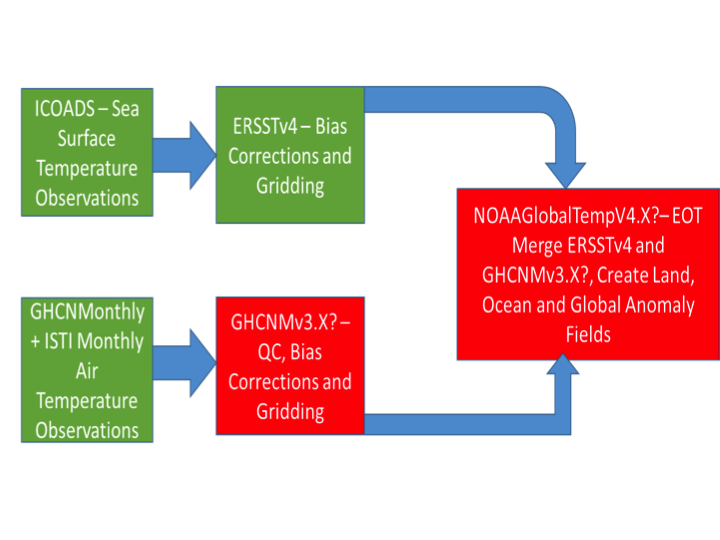 Figure 3. Data flow for surface temperature products described in K15 Science paper. Green indicates operational datasets having passed ORR and archived at time of publication. Red indicates experimental datasets never subject to ORR and never archived.
It is clear that the actual nearly-operational release of GHCN-Mv4 beta is significantly different from the version GHCNM3.X used in K15. Since the version GHCNM3.X never went through any ORR, the resulting dataset was also never archived, and it is virtually impossible to replicate the result in K15.
At the time of the publication of the K15, the final step in processing the NOAAGlobalTempV4 had been approved through an ORR, but not in the K15 configuration. It is significant that the current operational version of NOAAGlobalTempV4 uses GHCN-M V3.3.0 and does not include the ISTI dataset used in the Science paper. The K15 global merged dataset is also not archived nor is it available in machine-readable form. This is why the two boxes in figure 3 are colored red.
The lack of archival of the GHCN-M V3.X and the global merged product is also in violation of Science policy on making data available [link]. This policy states: “Climate data. Data should be archived in the NOAA climate repository or other public databases”. Did Karl et al. disclose to Science Magazine that they would not be following the NOAA archive policy, would not archive the data, and would only provide access to a non-machine readable version only on an FTP server?
For ocean temperatures, the ERSST version 4 is used in the K15 paper and represents a major update from the previous version. The bias correction procedure was changed and this resulted in different SST anomalies and different trends during the last 15+ years relative to ERSST version 3. ERSSTV4 beta, a pre-operational release, was briefed to the NCDC Science Council and approved on 30 September 2014.
The ORR for ERSSTV4, the operational release, took place in the NCDC Science Council on 15 January 2015. The ORR focused on process and questions about some of the controversial scientific choices made in the production of that dataset will be discussed in a separate post. The review went well and there was only one point of discussion on process. One slide in the presentation indicated that operational release was to be delayed to coincide with Karl et al. 2015 Science paper release. Several Science Council members objected to this, noting the K15 paper did not contain any further methodological information—all of that had already been published and thus there was no rationale to delay the dataset release. After discussion, the Science Council voted to approve the ERSSTv4 ORR and recommend immediate release.
The Science Council reported this recommendation to the NCDC Executive Council, the highest NCDC management board. In the NCDC Executive Council meeting, Tom Karl did not approve the release of ERSSTv4, noting that he wanted its release to coincide with the release of the next version of GHCNM (GHCNMv3.3.0) and NOAAGlobalTemp. Those products each went through an ORR at NCDC Science Council on 9 April 2015, and were used in operations in May. The ERSSTv4 dataset, however, was still not released. NCEI used these new analyses, including ERSSTv4, in its operational global analysis even though it was not being operationally archived. The operational version of ERSSTv4 was only released to the public following publication of the K15 paper. The withholding of the operational version of this important update came in the middle of a major ENSO event, thereby depriving the public of an important source of updated information, apparently for the sole purpose of Mr. Karl using the data in his paper before making the data available to the public.
So, in every aspect of the preparation and release of the datasets leading into K15, we find Tom Karl’s thumb on the scale pushing for, and often insisting on, decisions that maximize warming and minimize documentation. I finally decided to document what I had found using the climate data record maturity matrix approach. I did this and sent my concerns to the NCEI Science Council in early February 2016 and asked to be added to the agenda of an upcoming meeting. I was asked to turn my concerns into a more general presentation on requirements for publishing and archiving. Some on the Science Council, particularly the younger scientists, indicated they had not known of the Science requirement to archive data and were not aware of the open data movement. They promised to begin an archive request for the K15 datasets that were not archived; however I have not been able to confirm they have been archived. I later learned that the computer used to process the software had suffered a complete failure, leading to a tongue-in-cheek joke by some who had worked on it that the failure was deliberate to ensure the result could never be replicated.
Where do we go from here?
I have wrestled for a long time about what to do about this incident. I finally decided that there needs to be systemic change both in the operation of government data centers and in scientific publishing, and I have decided to become an advocate for such change. First, Congress should re-introduce and pass the OPEN Government Data Act. The Act states that federal datasets must be archived and made available in machine readable form, neither of which was done by K15. The Act was introduced in the last Congress and the Senate passed it unanimously in the lame duck session, but the House did not. This bodes well for re-introduction and passage in the new Congress.
However, the Act will be toothless without an enforcement mechanism. For that, there should be mandatory, independent certification of federal data centers. As I noted, the scientists working in the trenches would actually welcome this, as the problem has been one of upper management taking advantage of their position to thwart the existing executive orders and a lack of process adopted within Agencies at the upper levels. Only an independent, outside body can provide the needed oversight to ensure Agencies comply with the OPEN Government Data Act.
Similarly, scientific publishers have formed the Coalition on Publishing Data in the Earth and Space Sciences (COPDESS) with a signed statement of commitment to ensure open and documented datasets are part of the publication process. Unfortunately, they, too, lack any standard checklist that peer reviewers and editors can use to ensure the statement of commitment is actually enforced. In this case, and for assessing archives, I would advocate a metric such as the data maturity model that I and colleagues have developed. This model has now been adopted and adapted by several different groups, applied to hundreds of datasets across the geophysical sciences, and has been found useful for ensuring information preservation, discovery, and accessibility.
Finally, there needs to be a renewed effort by scientists and scientific societies to provide training and conduct more meetings on ethics. Ethics needs to be a regular topic at major scientific meetings, in graduate classrooms, and in continuing professional education. Respectful discussion of different points of view should be encouraged. Fortunately, there is initial progress to report here, as scientific societies are now coming to grips with the need for discussion of and guidelines for scientific ethics.
There is much to do in each of these areas. Although I have retired from the federal government, I have not retired from being a scientist. I now have the luxury of spending more time on these things that I am most passionate about. I also appreciate the opportunity to contribute to Climate Etc. and work with my colleague and friend Judy on these important issues.
Postlude
A couple of examples of how the public can find and use CDR operational products, and what is lacking in a non-operational and non-archived product
- NOAA CDR of total solar irradiance – this is the highest level quality. Start at web site – https://data.nodc.noaa.gov/cgi-bin/iso?id=gov.noaa.ncdc:C00828
Here you will see a fully documented CDR. At the top, we have the general description and how to cite the data. Then below, you have a set of tabs with extensive information. Click each tab to see how it’s done. Note, for example, that in ‘documentation’ you have choices to get the general documentation, processing documents including source code, data flow diagram, and the algorithm theoretical basis document ATBD which includes all the info about how the product is generated, and then associated resources. This also includes a permanent digital object identifier (doi) to point uniquely to this dataset.
- NOAA CDR of mean layer temperature – RSS – one generation behind in documentation but still quite good – https://www.ncdc.noaa.gov/cdr/fundamental/mean-layer-temperature-rss
Here on the left you will find the documents again that are required to pass the CDR operations and archival. Even though it’s a slight cut below TSI in example 1, a user has all they need to use and understand this.
- The Karl hiatus paper can be found on NCEI here – https://www.ncdc.noaa.gov/news/recent-global-surface-warming-hiatus
If you follow the quick link ‘Download the Data via FTP’ you go here – ftp://ftp.ncdc.noaa.gov/pub/data/scpub201506/
The contents of this FTP site were entered into the NCEI archive following my complaint to the NCEI Science Council. However, the artifacts for full archival of an operational CDR are not included, so this is not compliant with archival standards.
Biosketch:
John Bates received his Ph.D. in Meteorology from the University of Wisconsin-Madison in 1986. Post Ph.D., he spent his entire career at NOAA, until his retirement in 2016. He spent the last 14 years of his career at NOAA’s National Climatic Data Center (now NCEI) as a Principal Scientist, where he served as a Supervisory Meteorologist until 2012.
Dr. Bates’ technical expertise lies in atmospheric sciences, and his interests include satellite observations of the global water and energy cycle, air-sea interactions, and climate variability. His most highly cited papers are in observational studies of long term variability and trends in atmospheric water vapor and clouds.
NOAA Administrator’s Award 2004 for “outstanding administration and leadership in developing a new division to meet the challenges to NOAA in the area of climate applications related to remotely sensed data”. He was awarded a U.S. Department of Commerce Gold Medal in 2014 for visionary work in the acquisition, production, and preservation of climate data records (CDRs). He has held elected positions at the American Geophysical Union (AGU), including Member of the AGU Council and Member of the AGU Board. He has played a leadership role in data management for the AGU.
He is currently President of John Bates Consulting Inc., which puts his recent experience and leadership in data management to use in helping clients improve data management to improve their preservation, discovery, and exploitation of their and others data. He has developed and applied techniques for assessing both organizational and individual data management and applications. These techniques help identify how data can be managed more cost effectively and discovered and applied by more users.
David Rose in the Mail on Sunday
David Rose of the UK Mail on Sunday is working on a comprehensive expose of this issue [link].
Here are the comments that I provided to David Rose, some of which were included in his article:
Here is what I think the broader implications are. Following ClimateGate, I made a public plea for greater transparency in climate data sets, including documentation. In the U.S., John Bates has led the charge in developing these data standards and implementing them. So it is very disturbing to see the institution that is the main U.S. custodian of climate data treat this issue so cavalierly, violating its own policy. The other concern that I raised following ClimateGate was overconfidence and inadequate assessments of uncertainty. Large adjustments to the raw data, and substantial changes in successive data set versions, imply substantial uncertainties. The magnitude of these uncertainties influences how we interpret observed temperature trends, ‘warmest year’ claims, and how we interpret differences between observations and climate model simulations. I also raised concerns about bias; here we apparently see Tom Karl’s thumb on the scale in terms of the methodologies and procedures used in this publication.
Apart from the above issues, how much difference do these issues make to our overall understanding of global temperature change? All of the global surface temperature data sets employ NOAA’s GHCN land surface temperatures. The NASA GISS data set also employs the ERSST datasets for ocean surface temperatures. There are global surface temperature datasets, such as Berkeley Earth and HadCRUT that are relatively independent of the NOAA data sets, that agree qualitatively with the new NOAA data set. However, there remain large, unexplained regional discrepancies between the NOAA land surface temperatures and the raw data. Further, there are some very large uncertainties in ocean sea surface temperatures, even in recent decades. Efforts by the global numerical weather prediction centers to produce global reanalyses such as the European Copernicus effort is probably the best way forward for the most recent decades.
Regarding uncertainty, ‘warmest year’, etc. there is a good article in the WSJ : Change would be healthy at U.S. climate agencies (hockeyshtick has reproduced the full article).
I also found this recent essay in phys.org to be very germane: Certainty in complex scientific research an unachievable goal. Researchers do a good job of estimating the size of errors in measurements but underestimate chance of large errors.
Backstory
I have known John Bates for about 25 years, and he served on the Ph.D. committees of two of my graduate students. There is no one, anywhere, that is a greater champion for data integrity and transparency.
When I started Climate Etc., John was one of the few climate scientists that contacted me, sharing concerns about various ethical issues in our field.
Shortly after publication of K15, John and I began discussing our concerns about the paper. I encouraged him to come forward publicly with his concerns. Instead, he opted to try to work within the NOAA system to address the issues –to little effect. Upon his retirement from NOAA in November 2016, he decided to go public with his concerns.
He submitted an earlier, shorter version of this essay to the Washington Post, in response to the 13 December article (climate scientists frantically copying data). The WaPo rejected his op-ed, so he decided to publish at Climate Etc.
In the meantime, David Rose contacted me about a month ago, saying he would be in Atlanta covering a story about a person unjustly imprisoned [link]. He had an extra day in Atlanta, and wanted to get together. I told him I wasn’t in Atlanta, but put him in contact with John Bates. David Rose and his editor were excited about what John had to say.
I have to wonder how this would have played out if we had issued a press release in the U.S., or if this story was given to pretty much any U.S. journalist working for the mainstream media. Under the Obama administration, I suspect that it would have been very difficult for this story to get any traction. Under the Trump administration, I have every confidence that this will be investigated (but still not sure how the MSM will react).
Well, it will be interesting to see how this story evolves, and most importantly, what policies can be put in place to prevent something like this from happening again.
I will have another post on this topic in a few days.
Being retired sure is liberating . . .
New Book Details US Attempts to Topple Correa

Cover of Ecaudor in the Sights: The Wikileaks Revelations and the Conspiracy Against the Government of Rafael Correa | Photo: El Telegrafo
teleSUR | February 2017
In his new book, “Ecuador In the Sights: The WikiLeaks Revelations and the Conspiracy Against the Government of Rafael Correa,” released this week in Quito, Norwegian journalist Eirik Vold details attempts by the U.S. government to topple Ecuadorean President Rafael Correa and derail his Citizens’ Revolution.
“Correa was not about to let Washington maintain its dominance through financial institutions like the World Bank and the International Monetary Fund,” Vold told the Andes press agency in explaining the motivation behind years of U.S. efforts to undermine the Ecuadorean president.
The book is largely based on the “Cablegate” documents released by WikiLeaks in 2010, including thousands of secret documents sent from the U.S. Embassy in Quito and the U.S. consulate in Guayaquil.
“There is direct U.S. interference in Ecuador,” Vold told El Telegrafo, adding that “documents show a close relationship between several figures of Ecuadorean political life, the financial sector, and the United States Embassy.”
In the book, Vold outlines how the U.S. looked to thwart Correa from the very beginning, trying to directly prevent his election out of fear of losing the U.S. military base in Manta, the base of CIA operations in the region, as well as control over the U.S. oil company Occidental Petroleum Corp.
After his 2006 election, Correa nationalized the oil company and closed the U.S. base in Manta.
Vold says his book documents multiple attempts by the U.S. to sabotage UNASUR — the regional cooperation body founded in 2007 by progressive governments in Latin America — as well as extensive contacts between the U.S. Embassy and members of the national police force before an attempted 2010 coup, known as 30S.
In 2015, 22 police officers were found guilty of insubordination for their role in the failed coup.
Vold also claims the secret cables identify multiple NGO, media, finance, and political contacts which the U.S. embassy used to attempt to destabilize Correa’s government.
One of those Vold names is current vice presidential candidate Andres Paez. Paez, formerly the president of the left-wing Left Democracy Party, is now running on the right-wing CREO ticket along with former banker Guillermo Lasso.
“The U.S. says in a document he is one of our most trusted contacts. In other documents, it is pointed out that he was considered an ally for imposing free trade agreements, and it is evident that he had meetings at the United States Embassy.”
The Norwegian journalist, who has written extensively about U.S. involvement in Latin America, including a book about Hugo Chavez’s Bolivarian Revolution, said that Ecuador is of particular importance due to its efforts to protect WikiLeaks founder Julian Assange from U.S. persecution, ensuring its role as a “protector of the right to information for the whole planet.”
“We’re talking about a region with the world’s greatest concentration of natural resources, and obviously a region which has been known as the U.S.’s ‘backyard’,” he told Andes. “So U.S. activities are very intense in the region, but they have been maintained, for the last decade, with a more discrete, more covert strategy.”
“The revelations are many, the purpose is one,” he said at a book launch in Quito on Thursday. “That the Ecuadorean public regardless of their political inclination has access to truthful information about the activities of U.S. officials. And local informants in the country who had previously been concealed from them.”
Booming Black Market in Bundeswehr Rifles Funds Iraqi Refugees’ Flight to Europe
Sputnik – 04.02.2017
Last month German media revealed that German weapons supplied to Kurdish Peshmerga in northern Iraq are being sold on the black market, where they may end up in the hands of terrorist groups.
NDR and WDR reporters in the cities of Erbil and Sulaymaniyah in Iraqi Kurdistan discovered German weapons being sold on the black market there, engraved with the initials “Bw,” meaning Bundeswehr.
Weapons on sale included Heckler and Koch G3 rifles on sale for $1450 and $1800, and Walther P1 pistols with an asking price of $1200.
One arms dealer told a reporter that he could procure the Heckler & Koch G36 assault rifle for $5000.
These weapons sales have also financed the flight of refugees from Iraq to Germany, an Iraqi Kurdish refugee living in Germany told the news program.
Former Peshmerga Mustafa S said that he is one of hundreds of fighters who have sold their weapons to finance their escape from Iraq.
“Mustafa S said that he knows around 100 Peshmerga who have sold their weapons in recent months in order to flee. The situation has become unbearable for many. The low oil price, lack of payment from the Iraqi central government and the battle against Daesh, which guzzles about five million dollars daily, have brought the Kurdish regional government to the brink of bankruptcy. (Mustafa) himself had not been paid for five months and did not know how he was going to pay rent, food, and medicine for his disabled daughter. Now, he lives with his wife and their six children in a home for asylum seekers in East Germany,” Tagesschau reported.
Deputy Chairman of the Die Linke opposition party in the German Bundestag Tobias Pfluger called on the government to stop supplying arms to the Peshmerga. He told Sputnik that the deliveries are counter to the German constitution.
“The interesting thing is that the training missions that are connected with these weapons deliveries break several domestic federal laws. German and EU legislation, the War Weapons Control Act and the Foreign Trade and Payments Act, prohibit direct deliveries to war zones,” Pfluger explained.
The German Defense Ministry has delivered an estimated 2,400 tons of arms and munitions to Kurdish Peshmerga fighters since it began to supply the militia in summer 2014. A government spokesman told NDR and WDR that the government of Iraqi Kurdistan is responsible for the weapons’ misuse.
The German Defense Ministry is committed to the “proper verification of supplied weapons,” and their use in accordance with international law.
However, since the Ministry is unable to trace individual arms, “the sale of individual weapons cannot be excluded with absolute certainty.”
Pfluger said that assurances from local forces that the arms will remain in their possession are “worthless.”
“It is completely perverse that they have to sign a so-called confirmation of retention. That is nothing other than a completely worthless piece of paper because we know that the weapons show up on the markets in Iraq and Syria. In this respect, we say that this commitment must be ended, it is an intensification of the war and is in no way something that creates peace there.”
Peace activist and spokesman for Aktion Aufschrei — Stop the arms trade! Jurgen Grasslin told Sputnik Deutschland that German guns have ended up far removed from their intended destination.
“The federal government usually has no idea where their weapons are actually delivered to, when they are exported. My research, based on (studies of) numerous countries and trips to crisis regions and war zones over the past 30 years, shows clearly that weapons roam. Weapons do not stay in the place where they are delivered.”
Grasslin, author of a book entitled “The Black Book of Arms Trading: How Germany Profits from War” (Schwarzbuch Waffenhandel: Wie Deutschland am Krieg verdient), alleges that German arms deliveries constitute “complicity in murder.”
“If Daesh is firing German weapons, and of course weapons from other countries, that is more than a scandal, it is a breach of the law. It is complicity in murder. You are delivering to a war zone. You know that these weapons don’t stay in the hands of the recipients, and that they land in the hands of the worst terrorist groups, for example Daesh. The people who authorize these arms exports must be named, that is namely members of the Bundessicherheitsrat (Federal Security Council) or Federal Government. The first to be named should be Chancellor Angela Merkel and her deputy Sigmar Gabriel, who lead the Bundessicherheitsrat and are thus responsible for these armed forces.”
A Reprise of the Iraq-WMD Fiasco?
By James W Carden | Consortium News | February 3, 2017
The controversy over Russia’s alleged interference in the 2016 presidential election shows no sign of letting up. A bipartisan group of U.S. senators recently introduced legislation that would impose sanctions on Russia in retaliation for its acts of “cyber intrusions.”

Senators John McCain and Lindsey Graham
At a press event in Washington on Tuesday, Sen. Dick Durbin, D-Illinois, called Election Day 2016 “a day that will live in cyber infamy.” Previously, Sen. John McCain, R-Arizona, called the Russian hacks of the Democratic National Committee “an act of war,” while Sen. Lindsey Graham, R-South Carolina, has claimed that there is near unanimity among senators regarding Russia’s culpability.
Despite all this, the question of who exactly is responsible for the providing WikiLeaks with the emails of high Democratic Party officials does not lend itself to easy answers. And yet, for months, despite the lack of publicly disclosed evidence, the media, like these senators, have been as one: Vladimir Putin’s Russia is responsible.
Interestingly, the same neoconservative/center-left alliance which endorsed George W. Bush’s case for war with Iraq is pretty much the same neoconservative/center-left alliance that is now, all these years later, braying for confrontation with Russia. It’s largely the same cast of characters reading from the Iraq-war era playbook.
It’s worth recalling Tony Judt’s observation in September 2006 that “those centrist voices that bayed most insistently for blood in the prelude to the Iraq war … are today the most confident when asserting their monopoly of insight into world affairs.”
While that was true then, it is perhaps even more so the case today.
The prevailing sentiment of the media establishment during the months prior to the disastrous March 2003 invasion of Iraq was that of certainty: George Tenet’s now infamous assurance to President Bush, that the case against Iraq was a “slam drunk,” was essentially what major newspapers and television news outlets were telling the American people at the time. Iraq posed a threat to “the homeland,” therefore Saddam “must go.”
The Bush administration, in a move equal parts cynical and clever, engaged in what we would today call a “disinformation” campaign against its own citizens by planting false stories abroad, safe in the knowledge that these stories would “bleed over” and be picked up by the American press.
WMD ‘Fake News’
The administration was able to launder what were essentially “fake news” stories, such as the aluminum tubes fabrication, by leaking to Michael R. Gordon and Judith Miller of The New York Times. In September 2002, without an ounce of skepticism, Gordon and Miller regurgitated the claims of unnamed U.S. intelligence officials that Iraq “has sought to buy thousands of specially designed aluminum tubes … intended as components of centrifuges to enrich uranium.” Gordon and Miller faithfully relayed “the intelligence agencies’ unanimous view that the type of tubes that Iraq has been seeking are used to make centrifuges.”
By 2002, no one had any right to be surprised by what Bush and Cheney were up to; since at least 1898 (when the U.S. declared war on Spain under the pretense of the fabricated Hearst battle cry “Remember the Maine!”) American governments have repeatedly lied in order to promote their agenda abroad. And in 2002-3, the media walked in lock step with yet another administration in pushing for an unnecessary and costly war.
Like The New York Times, The Washington Post also relentlessly pushed the administration’s case for war with Iraq. According to the journalist Greg Mitchell, “By the Post’s own admission, in the months before the war, it ran more than 140 stories on its front page promoting the war.” All this, while its editorial page assured readers that the evidence Colin Powell presented to the United Nations on Iraq’s WMD program was “irrefutable.” According to the Post, it would be “hard to imagine” how anyone could doubt the administration’s case.
But the Post was hardly alone in its enthusiasm for Bush’s war. Among the most prominent proponents of the Iraq war was The New Yorker’s Jeffrey Goldberg, who, a full year prior to the invasion, set out to link Saddam Hussein and Al Qaeda. Writing for The New Yorker in March 2002, Goldberg retailed former CIA Director James Woolsey’s opinion that “It would be a real shame if the C.I.A.’s substantial institutional hostility to Iraqi democratic resistance groups was keeping it from learning about Saddam’s ties to Al Qaeda in northern Iraq.”
Indeed, according to Goldberg, “The possibility that Saddam could supply weapons of mass destruction to anti-American terror groups is a powerful argument among advocates of regime change,” while Saddam’s “record of support for terrorist organizations, and the cruelty of his regime make him a threat that reaches far beyond the citizens of Iraq.”
Writing in Slate in October 2002, Goldberg was of the opinion that “In five years . . . I believe that the coming invasion of Iraq will be remembered as an act of profound morality.”
Likewise, The New Republic’s Andrew Sullivan was certain that “we would find weapons of mass destruction in Iraq. I have no doubt about that.” Slate’s Jacob Weisberg supported the invasion because he thought Saddam Hussein had WMD and he “thought there was a strong chance he’d use them against the United States.”
Even after it was becoming clear that the war was a debacle, the neoconservative pundit Charles Krauthammer declared that the inability to find WMDs was “troubling” but “only because it means that the weapons remain unaccounted for and might be in the wrong hands. The idea that our inability to thus far find the weapons proves that the threat was phony and hyped is simply false.”
Smearing Skeptics
Opponents of the war were regularly accused of unpatriotic disloyalty. Writing in National Review, the neoconservative writer David Frum accused anti-intervention conservatives of going “far, far beyond the advocacy of alternative strategies.” According to Frum, “They deny and excuse terror. They espouse a potentially self-fulfilling defeatism. They publicize wild conspiracy theories. And some of them explicitly yearn for the victory of their nation’s enemies.”
Similarly, The New Republic’s Jonathan Chait castigated anti-war liberals for turning against Bush. “Have Bush haters lost their minds?” asked Chait. “Certainly some have. Antipathy to Bush has, for example, led many liberals not only to believe the costs of the Iraq war outweigh the benefits but to refuse to acknowledge any benefits at all.”
Yet of course we now know, thanks, in part, to a new book by former CIA analyst John Nixon, that everything the U.S. government thought it knew about Saddam Hussein was indeed wrong. Nixon, the CIA analyst who interrogated Hussein after his capture in December 2003, asks “Was Saddam worth removing from power?” “The answer,” says Nixon, “must be no. Saddam was busy writing novels in 2003. He was no longer running the government.”
It turns out that the skeptics were correct after all. And so the principal lesson the promoters of Bush and Cheney’s war of choice should have learned is that blind certainty is the enemy of fair inquiry and nuance. The hubris that many in the mainstream media displayed in marginalizing liberal and conservative anti-war voices was to come back to haunt them. But not, alas, for too long.
A Dangerous Replay?
Today something eerily similar to the pre-war debate over Iraq is taking place regarding the allegations of Russian interference in the U.S. presidential election. Assurances from the intelligence community and from anonymous Obama administration “senior officials” about the existence of evidence is being treated as, well, actual evidence.
State Department spokesman John Kirby told CNN that he is “100% certain” of the role that Russia played in U.S. election. The administration’s expressions of certainty are then uncritically echoed by the mainstream media. Skeptics are likewise written off, slandered as “Kremlin cheerleaders” or worse.
Unsurprisingly, The Washington Post is reviving its Bush-era role as principal publicist for the government’s case. Yet in its haste to do the government’s bidding, the Post has published two widely debunked stories relating to Russia (one on the scourge of Russian inspired “fake news”, the other on a non-existent Russian hack of a Vermont electric utility) onto which the paper has had to append “editor’s notes” to correct the original stories.
Yet, those misguided stories have not deterred the Post’s opinion page from being equally aggressive in its depiction of Russian malfeasance. In late December, the Post published an op-ed by Rep. Adam Schiff and former Rep. Jane Harmon claiming “Russia’s theft and strategic leaking of emails and documents from the Democratic Party and other officials present a challenge to the U.S. political system unlike anything we’ve experienced.”
On Dec. 30, the Post editorial board chastised President-elect Trump for seeming to dismiss “a brazen and unprecedented attempt by a hostile power to covertly sway the outcome of a U.S. presidential election.” The Post described Russia’s actions as a “cyber-Pearl Harbor.”
On Jan. 1, the neoconservative columnist Josh Rogin told readers that the recent announcement of sanctions against Russia “brought home a shocking realization that Russia is using hybrid warfare in an aggressive attempt to disrupt and undermine our democracy.”
Meanwhile, many of the same voices who were among the loudest cheerleaders for the war in Iraq have also been reprising their Bush-era roles in vouching for the solidity of the government’s case.
Jonathan Chait, now a columnist for New York magazine, is clearly convinced by what the government has thus far provided. “That Russia wanted Trump to win has been obvious for months,” writes Chait.
“Of course it all came from the Russians, I’m sure it’s all there in the intel,” Charles Krauthammer told Fox News on Jan. 2. Krauthammer is certain.
And Andrew Sullivan is certain as to the motive. “Trump and Putin’s bromance,” Sullivan told MSNBC’s Chris Matthews on Jan. 2, “has one goal this year: to destroy the European Union and to undermine democracy in Western Europe.”
David Frum, writing in The Atlantic, believes Trump “owes his office in considerable part to illegal clandestine activities in his favor conducted by a hostile, foreign spy service.”
Jacob Weisberg agrees, tweeting: “Russian covert action threw the election to Donald Trump. It’s that simple.” Back in 2008, Weisberg wrote that “the first thing I hope I’ve learned from this experience of being wrong about Iraq is to be less trusting of expert opinion and received wisdom.” So much for that.
Foreign Special Interests
Another, equally remarkable similarity to the period of 2002-3 is the role foreign lobbyists have played in helping to whip up a war fever. As readers will no doubt recall, Ahmed Chalabi, leader of the Iraqi National Congress, which served, in effect as an Iraqi government-in-exile, worked hand in hand with the Washington lobbying firm Black, Kelly, Scruggs & Healey (BKSH) to sell Bush’s war on television and on the op-ed pages of major American newspapers.
Chalabi was also a trusted source of Judy Miller of the Times, which, in an apology to its readers on May 26, 2004, wrote: “The most prominent of the anti-Saddam campaigners, Ahmad Chalabi, has been named as an occasional source in Times articles since at least 1991, and has introduced reporters to other exiles. He became a favorite of hard-liners within the Bush administration and a paid broker of information from Iraqi exiles.” The pro-war lobbying of the American Israel Public Affairs Committee has also been exhaustively documented.
Though we do not know how widespread the practice has been as of yet, something similar is taking place today. Articles calling for confrontation with Russia over its alleged “hybrid war” with the West are appearing with increasing regularity. Perhaps the most egregious example of this newly popular genre appeared on Jan. 1 in Politico magazine. That essay, which claims, among many other things, that “we’re in a war” with Russia comes courtesy of one Molly McKew.
McKew is seemingly qualified to make such a pronouncement because she, according to her bio on the Politico website, served as an “adviser to Georgian President Saakashvili’s government from 2009-2013, and to former Moldovan Prime Minister Filat in 2014-2015.” Seems reasonable enough. That is until one discovers that McKew is actually registered with the Department of Justice as a lobbyist for two anti-Russian political parties, Georgia’s UMN and Moldova’s PLDM.
Records show her work for the consulting firm Fianna Strategies frequently takes her to Capitol Hill to lobby U.S. Senate and Congressional staffers, as well as prominent U.S. journalists at The Washington Post and The New York Times, on behalf of her Georgian and Moldovan clients.
“The truth,” writes McKew, “is that fighting a new Cold War would be in America’s interest. Russia teaches us a very important lesson: losing an ideological war without a fight will ruin you as a nation. The fight is the American way.” Or, put another way: the truth is that fighting a new Cold War would be in McKew’s interest – but perhaps not America’s.
While you wouldn’t know it from the media coverage (or from reading deeply disingenuous pieces like McKew’s) as things now stand, the case against Russia is far from certain. New developments are emerging almost daily. One of the latest is a report from the cyber-engineering company Wordfence, which concluded that “The IP addresses that DHS [Department of Homeland Security] provided may have been used for an attack by a state actor like Russia. But they don’t appear to provide any association with Russia.”
Indeed, according to Wordfence, “The malware sample is old, widely used and appears to be Ukrainian. It has no apparent relationship with Russian intelligence and it would be an indicator of compromise for any website.”
On Jan. 4, BuzzFeed reported that, according to the DNC, the FBI never carried out a forensic examination on the email servers that were allegedly hacked by the Russian government. “The FBI,” said DNC spokesman Eric Walker, “never requested access to the DNC’s computer servers.”
What the agency did do was rely on the findings of a private-sector, third-party vendor that was brought in by the DNC after the initial hack was discovered. In May, the company, Crowdstrike, determined that the hack was the work of the Russians. As one unnamed intelligence official told BuzzFeed, “CrowdStrike is pretty good. There’s no reason to believe that anything that they have concluded is not accurate.”
Perhaps not. Yet Crowdstrike is hardly a disinterested party when it comes to Russia. Crowdstrike’s founder and chief technology officer, Dmitri Alperovitch, is also a senior fellow at the Washington think tank, The Atlantic Council, which has been at the forefront of escalating tensions with Russia.
As I reported in The Nation in early January, the connection between Alperovitch and the Atlantic Council is highly relevant given that the Atlantic Council is funded in part by the State Department, NATO, the governments of Latvia and Lithuania, the Ukrainian World Congress, and the Ukrainian oligarch Victor Pinchuk. In recent years, it has emerged as a leading voice calling for a new Cold War with Russia.
Time to Rethink the ‘Group Think’
And given the rather thin nature of the declassified evidence provided by the Obama administration, might it be time to consider an alternative theory of the case? William Binney, a 36-year veteran of the National Security Agency and the man responsible for creating many of its collection systems, thinks so. Binney believes that the DNC emails were leaked, not hacked, writing that “it is puzzling why NSA cannot produce hard evidence implicating the Russian government and WikiLeaks. Unless we are dealing with a leak from an insider, not a hack.”
None of this is to say, of course, that Russia did not and could not have attempted to influence the U.S. presidential election. The intelligence community may have intercepted damning evidence of the Russian government’s culpability. The government’s hesitation to provide the public with more convincing evidence may stem from an understandable and wholly appropriate desire to protect the intelligence community’s sources and methods. But as it now stands the publicly available evidence is open to question.
But meanwhile the steady drumbeat of “blame Russia” is having an effect. According to a recent you.gov/Economist poll, 58 percent of Americans view Russia as “unfriendly/enemy” while also finding that 52 percent of Democrats believed Russia “tampered with vote tallies.”
With Congress back in session, Armed Services Committee chairman John McCain is set to hold a series of hearings focusing on Russian malfeasance, and the steady drip-drip-drip of allegations regarding Trump and Putin is only serving to box in the new President when it comes to pursuing a much-needed detente with Russia.
It also does not appear that a congressional inquiry will start from scratch and critically examine the evidence. On Friday, two senators – Republican Lindsey Graham and Democrat Sheldon Whitehouse – announced a Senate Judiciary subcommittee investigation into Russian interference in elections in the U.S. and elsewhere. But they already seemed to have made up their minds about the conclusion: “Our goal is simple,” the senators said in a joint statement “To the fullest extent possible we want to shine a light on Russian activities to undermine democracy.”
So, before the next round of Cold War posturing commences, now might be the time to stop, take a deep breath and ask: Could the rush into a new Cold War with Russia be as disastrous and consequential – if not more so – as was the rush to war with Iraq nearly 15 years ago? We may, unfortunately, find out.
James W Carden is a contributing writer for The Nation and editor of The American Committee for East-West Accord’s eastwestaccord.com. He previously served as an advisor on Russia to the Special Representative for Global Inter-governmental Affairs at the US State Department.
Moscow expects Reuters to clarify its complaints concerning working conditions in Russia

Russian foreign ministry’s spokeswoman Maria Zakharova
TASS – February 3, 2017
MOSCOW – Russia’s Foreign Ministry expects the Reuters news agency to clarify its complaints regarding the working conditions of its journalists in the country, the ministry’s spokeswoman Maria Zakharova said at a briefing on Friday.
“We have seen Reuters Editor-in-Chief Stephen Adler’s message to staff, which concerns covering the new US president’s activities,” Zakharova noted. “Although we do not usually comment on editorial directives, we could not but take notice of one paragraph,” she went on to say. “The implication is that Reuters considers Russia to be one of the countries where the agency has to ‘encounter some combination of censorship, legal prosecution, visa denials, and even physical threats’ to its journalists.”
“We don’t divide journalists into good and bad, we don’t refuse to issue visas, we don’t deprive them of visas or accreditation only because we don’t like their style or find them to be biased,” the Russian Foreign Ministry’s spokeswoman stressed. “I expect Reuters to clarify the matter.”
At the same time, she said that Russia’s Foreign Ministry would have not commented on this message if it had not been made public through the Reuters website and had not mentioned the agency’s work in Russia. The diplomat was confident that Reuters had deliberately posted the message “thus turning it into some kind of a manifesto.”
According to Zakharova, when the Russian Foreign Ministry contacted Reuters, the agency declined to comment. She also pointed out that the Reuters correspondents accredited in Russia took part in closed weekly briefings at the Foreign Ministry as well as in other media events, however, they had not voiced their concerns even once.
Photo Anton Novoderezhkin/TASS
Police lied to me over Umm al-Hiran deaths
By Jonathon Cook | February 2, 2017
Speaking to me for my report last month on the killing by police of Yacoub Abu al-Qiyan during the demolition of his home in Umm al-Hiran, in the Negev, police spokesman Micky Rosenfeld made three allegations against Abu al-Qiyan that he said proved he was a terrorist. All of them have now been shown to be entirely unfounded.
A fourth claim, made against Ayman Odeh, head of the Joint List and the most senior politician among Israel’s 1.7 million Palestinian citizens, has also proved to be untrue.
The Israeli police appear to have been caught out as serial liars. Rosenfeld himself may have not known that he was peddling lies. He may have been simply reading from a script. But others surely knew. Not only did they wilfully mislead journalists, but they dangerously incited against Israel’s large Palestinian minority.
(This would be far from the first time. Only recently, the police, as well as prime minister Benjamin Netanyahu, accused Palestinian citizens of waging an “arson intifada” against Israel in November, when hundreds of fires broke out due to exceptional weather conditions. All of the dozens of Palestinians arrested over the fires were subsequently released, but no apology or retraction has been issued.)
First, Rosenfeld told me Abu al-Qiyan had carried out a deliberate “car-ramming terror attack” on police, which killed one officer. But a police aerial video of the incident shows that police opened fire on the car while Abu al-Qiyan was driving slowly and cautiously to leave his home before the demolition crew began work.
Further, leaks of an autopsy report show that Abu al-Qiyan was shot twice, in the torso and the knee, strongly suggesting that he lost control of the car as he tried to navigate carefully down a steep dirt track. If anyone is responsible for the death of the police officer, Erez Levy, it is his colleagues who opened fire without provocation.
Of equal concern should be the fact that Abu al-Qiyan was left for up to half an hour to bleed to death, while police denied an ambulance access to his village.
Second, Rosenfeld told me that Abu al-Qiyan’s terrorist intent was discernible because, even though the incident occurred before dawn, he had turned off his headlights to avoid detection. But a new video shows his car lights were on, just as one would have expected.
Third, Rosenfeld told me police had definitive proof that Abu al-Qiyan was a supporter of ISIS, and that the evidence would soon be divulged. But two weeks later Israel’s domestic intelligence service, the Shin Bet, have provided no evidence of such a link. All his family deny that he supported ISIS, or even that he held strong political views.
And fourth, Rosenfeld denied Knesset member Ayman Odeh’s claim that police fired a potentially lethal sponge-tipped bullet at his head. Rosenfeld said instead that the Knesset member’s injuries had been caused by stones thrown by the inhabitants of Umm al-Hiran opposing the dozen or so demolitions police were carrying out. Another police spokesperson told the Israeli Maariv newspaper that the police did not even have sponge-tipped bullets in their armoury.

There were multiple problems with that account. Witnesses say there was no stone-throwing at the time Odeh was injured. And the Knesset member is photographed (above) holding the bullet in Umm al-Hiran, after he was shot. There is also a picture (below) of a huge bruise across his back, where he was shot a second time. It is hard to imagine how that injury was caused apart from by an impact with some form of rubber bullet.

And, whatever the police claim, there are well-documented instances of Israeli police using sponge-tipped bullets before, especially in East Jerusalem, but also in the Negev. The shocking thing in this case is that they used these bullets against a Palestinian Knesset member.
Interestingly, when challenged by another journalist, Mairav Zonszein, Rosenfeld denied that he had said Odeh was hit by stones, only that: “During the incident stones were thrown.” Well, my notes from our conversation show him clearly stating that Odeh’s head injury was caused by a stone.
It is past time for the police and the government ministers who for two weeks have incited against Abu al-Qiyan, against the inhabitants of Umm al-Hiran and more generally against Israel’s Palestinian citizens to issue an apology for their serial lies and distortions.
It is also essential that the government set up an independent, judicial-led inquiry to assess what really happened in Umm al-Hiran on the morning of January 18.
Featured Video

The Search for Truth: Charlie Kirk’s Assassination One Year Later
or go to
Aletho News Archives – Video-Images
From the Archives
The 9/11 “Double-Cross” Conspiracy Theory
BY LAURENT GUYÉNOT • UNZ REVIEW • SEPTEMBER 6, 2022
Is it true that “9/11 was an inside job”? Yes, insofar as Israel is “inside” the U.S. But for the 9/11 truthers who have identified Israel as the main perpetrators, “9/11 was an inside job” is at best a half-truth, and at worst an integral part of the Zionist operation, like a secondary flag sewn as a lining under the false flag of Islamism. Victor Thorn (1963-2017) wrote in his book 9/11 made in Israel: The Plot Against America (2011): “In essence, the ‘9-11 truth movement’ was created prior to Sept. 11, 2001 as a means of suppressing news relating to Israeli complicity. . . . The slogan ‘9-11 was an inside job’ was quite possibly the greatest example of Israeli propaganda ever devised.” In milder terms, it is “controlled opposition”.
A genuine truth movement would have pointed to Israel as the prime suspect from the start. From day one, it was obvious who would benefit. … continue
Blog Roll
 Aletho News
- Europe’s mounting social chaos… chickens coming home to roost for proxy war against Russia
- US-Russia Diesel Deal Becomes Massive Defeat for Ukraine
- Hormuz and the Looming Economic Catastrophe
- Dhubab offensive, media blitz and the rapid unraveling of Saudi-backed coalition’s new gambit
- Putin Conveys to Trump Iran’s Vision on Possible Conflict Resolution – Kremlin
- The Search for Truth: Charlie Kirk’s Assassination One Year Later
- ‘Harsh reality’: Iran says France seeks monopoly on power and intimidation, not peace for all
- When Will This White House Madness End?
- Huckabee aide goes to ‘unusual lengths’ to portray ‘Israel’ positively
- Trump Announces Diesel Supply Deal With Putin Following Phone Call
- If Americans Knew
- Israeli forces kill another child in Gaza – Daily Update
- Gaza ceasefire exists in name only, say more than 100 organizations
- Nearly 2 Million in Gaza Need Urgent Shelter Assistance as Winter Looms: IOM Chief Warns
- Suppressing Palestinian resistance: US charity under fire for AI monitoring of Gaza classrooms
- Thousands Are Held in Israeli Torture Camps. This Is What Happens Inside
- Israel puts Gaza’s sick, injured, newborn in peril – Daily Update
- Report claimed Mark Levin used by Israeli government to influence Trump
- Over 2,000 Gazans have died awaiting medical evacuation amid Israel’s continued siege
- How a U.S. Diplomat Suppressed and Altered Reports Critical of Israel
- 5 Palestinians Die from Israeli Strikes in Gaza as Relentless Attacks Continue
- No Tricks Zone
- New Study: 50 Years Of The Most Aggressive ‘Net Zero’ Policies Can Only Affect The Global Climate By 0.03°C
- US September “Heat” Was No Record…Many Records Set Decades Ago
- Latest European Green Energy Debacle; Portugal’s Largest Flagship Solar Park Insolvent!
- Green Energy Debacle: German Expert Professor Fritz Vahrenholt Warns Of Severe Economic And Social Consequences
- Two More Paleo Reconstructions Affirm Meters-Higher Sea Levels Across Ireland, Brazil 7000-6000 Years Ago
- New Study: Earth And Venus Surface Warmth Largely Explained By Convection And Lapse Rate, Not CO2 Or Radiation
- 2025 Nature Paper Claiming Worsening Global Drought Gets RETRACTED …Heavily Flawed
- New Study: ‘Global Drought Shows No Detectable Recent Acceleration Under Climate Warming’
- Economic Masterminds: German Socialists Suggest Taxing Productivity Gains Stemming From Using AI
- The South China Sea Has Not Been Cooperating With The Climate Change Narrative

