Nancy Pelosi says she’s for single payer, refuses to co-sponsor single payer legislation
An Open Letter to Nancy Pelosi from Ralph Nader
Representative Nancy Pelosi
House Minority Leader
United States House of Representatives
233 Cannon House Office Building
Washington, DC 20515
January 17, 2017
Dear Representative Pelosi:
I see you were quoted in The Hill newspaper recently (“Pelosi Rips GOP for Cut and Run Strategy on Obamacare,” by Mike Lillis, January 12, 2017) saying that you are for single payer health insurance. You had this preference before Presidents Clinton and Obama, who ideally agree with you, dismissed single payer as “impractical” given the entrenched and powerful healthcare industry.
A couple of years ago, I wrote an article titled “21 Ways Canada’s Single Payer System Beats Obamacare”.
Within a week or so, your colleague, Congressman John Conyers (D-Michigan), will re-introduce HR 676, the single payer bill in the House.
Will you actively support this much more efficient and comprehensive legislation, with its many advantages proven in other countries, and persuade other House Democrats to also co-sponsor?
Last year, only 63 Democrats co-sponsored.
Obamacare, without a public option, has been a complex patchwork in so many ways — including forcing individuals to purchase inadequate insurance from private health insurance companies — insurance that carries with it high premiums, deductibles, co-pays and forces narrow networks.
For many, Obamacare is quasi-catastrophic insurance with limited choice of doctor and hospital.
If the Republicans repeal Obamacare, Democrats need to be ready and offer to replace it with something that can attract left/right support — single payer, Medicare for All — everyone in, nobody out, free choice of doctor and hospital, no medical bankruptcies, no coercive co-pays or deductibles, with all their accompanying fears and anxieties, and no more deaths due to lack of health insurance.
A December 2015 national Kaiser public opinion poll found that 58 percent of adults in the U. S. supported single payer (Medicare for All), including 81 percent of Democrats, 60 percent of Independents, and 30 percent of Republicans. Imagine the poll numbers when Full Medicare for All starts to be explained, in its clear simplicity, and promoted by a major political party.
Let’s work together to present the American people something both more efficient and responsive that they want and need — Medicare for All and freedom to choose their doctor, clinic and hospital.
Sincerely,
Ralph Nader
PO Box 19312
Washington, DC 20036
#ProgressiveHypocrite of the Month for February 2017: Former Clinton-era Secretary of State Madeleine Albright
A Black Agenda Radio commentary by Bruce A. Dixon | February 1, 2017
 “Progressives” is the name Democrats call themselves when they need to draw attention away from the greedy and murderous one percenters who actually call the shots in their party.
Lazy, hypocritical progressive followers protest the unconstitutional machinations of Republican administrations like those of George W. Bush and Donald Trump while they ignore excuse the same crimes when committed by Democrats like the Clintons or Barack Obama. But Black Agenda Report does not bestow its coveted #ProgressiveHypocrite of the month award on mere followers. We pledge that each and every month our #ProgressiveHypocrite awardees will be leaders in their fields, major players whose recognized game inspires and enables the ordinary hypocrisy of countless partisan Democrats – or as they call themselves, progressives.
Thus we are proud to announce as Black Agenda Report’s very first #ProgressiveHypocrite of the month, for February 2017 is Madeleine K. Albright.
Madeleine Albright got her start as the protégé of notorious cold warrior Zbigniew Brzezinski, who was her dissertation advisor at Columbia. As Jimmy Carter’s National Security Advisor Z-big put Albright on as his special assistant. The next time a Democrat occupied the White House she was UN ambassador in Clinton’s first term and secretary of state in his second. Madeleine Albright famously asserted in a 1996 60 Minutes interview that although the US blockade of Iraq which she vigorously championed killed a half million Iraqi children that “… it was a hard choice but it was worth it…”
After the Clinton administration Albright founded a global consulting firm which became ASG, the Albright Stonebridge Group, representing and advising multinational corporations on six continents on how to enter and dominate local markets, how to privatize public land and public institutions like post offices and electric grids. The fixers at Albright Stonebridge help privatize water and sewer systems and chunks of the natural environment like the broadcast spectrum so outfits like Google and Facebook can own the internet in India and Africa. ASG claims credit for engineering the entry of WalMart into China and Thailand. Albright’s crew has global reach. They can make your corporation’s taxes in Mexico go away. They can rig the regs for Big Pharma in Brazil, they can prevent unfavorable laws affecting your profits in China or Japan and they can negotiate your bribe to the murderous Saudi royal family. They are consiglieri for hire in the global wave of corporate crime.
Albright mentored Susan Rice, the bare knuckled champion of vulture capital in Africa and of the US right to bomb and invade countries for their own protection. For her valued service to the one percent of the one percent, President Obama awarded Madeleine Albright the Medal of Freedom in 2012. She campaigned for Hillary alongside Cory Booker declaring there was “a special place in hell” for women who failed to support other women.
Now at the dawn of the Trump era, Madeleine Albright has been trotted out as the avatar of concern and compassion for Muslims who will be affected by the Islamaphobic policies of Donald Trump. She declared earlier this week that “… there are tears in the eyes of the Statue of Liberty…” and that she would “register as a Muslim” to protest Trump’s evil policies. We at Black Agenda Report recommend that Madeleine Albright register as an Iraqi toddler in the year 1995, when the blockade she championed killed half a million Iraqi children, mostly Muslims.
Thus for her inspirational hypocrisy in the service of Democratic – I mean progressive opposition to Donald Trump we name Madeleine K. Albright the #ProgressiveHypocrite of the month for February 2017.
Russia Calls the West’s Bluff over Real Elections, At Long Last
By Seth Ferris – New Eastern Outlook – 01.02.2017
The world continues to turn upside down. Think the Western democracies are still the authorities on the one thing they are supposed to know about? Think again.
For generations the OSCE, the Organisation for Security and Cooperation in Europe, has been monitoring elections in various countries to ensure they meet Western democratic standards. After each one it publishes a report, which sometimes bears little relation to what people on the ground have seen, and each one of these mysteriously reflects the current political position of the Western powers – if they like a country and its government, they have conducted free and fair elections, if not, the elections are declared wholly or partially invalid.
This practice has often raised criticism, but still the OSCE is being called in to monitor elections all over the globe. Why? Because it is the institution representing countries with a long democratic tradition, and those these have since chosen as their friends. That’s it. It does not have to do anything to justify the vast sums given to it to be the authority on elections, simply be there.
Theoretically the OSCE is the product of a partnership between East and West. But in effect the OSCE is run by Western democracies and those countries it now believes have adopted Western standards since the Cold War. These nations, we are told, understand democracy and can therefore recognise it when they see it.
On 19 January the Head of Russia’s Central Elections Commission, Ella Pamfilova, recommended to the OSCE’s Michael Link that it should adopt a common set of standards for election monitoring. This would enable it to compare one country’s performance with another’s and see whether countries are improving or regressing compared to previous elections. “I consider it very important that the standards of elections monitoring in all OSCE member countries be unified,” she reportedly said.
This statement opened mouths all over the world. So let’s get this straight – the OSCE has been monitoring all these elections without any set standards of what democracy is, what is free and fair, what are the acceptable and unacceptable variables, what are the irreducible minimums or what the rights and responsibilities of governments, election commissions and political parties are? It has continued being regarded as the authority on these questions in spite of this? And now the Russians – the RUSSIANS – have to call for a common set of standards to give the monitors some idea what they are supposed to be doing?
You think, therefore we are
This isn’t about elections. It is about how long you can get away with a con. Since the end of World War Two The West’s policy has been based on lies – it is supposed to believe in certain values, such as democracy and human rights, but goes round depriving the rest of the world of the same values it says are paramount.
Everyone has seen this happen, but the West is still supposed to know more about these values than anyone else. So if other countries want democracy and human rights they automatically turn to the West. If they end up with governments which claim to respect democracy and human rights but do exactly the opposite, and Western monitors telling them that rigged elections are substantially free and fair, is that their own fault or that of the Westerners they asked to prevent these things happening? But still they feel they have nowhere else to turn, because Western democracies must somehow know best, and they won’t be better off any other way.
Russia’s request makes one simple point. If you believe in democracy, you will have developed a sophisticated definition of what it is and why it is so important after such long experience of it. If you have such a definition, every observer who monitors elections will know it and be able to assess the elections against it. Of course there will be some local variations in practice between democratic countries, and some of these might raise the concern of some countries. But there will be a common set of standards already in place against which these too can be judged, and thus everyone sent as a monitor will be able to cite these to acquire credentials as a democrat, even if they’ve played little or no part in actual elections.
This is indeed perfectly logical. If it hasn’t happened, this cannot be because the conditions don’t exist. It is because no one wants to be bound by any definition of what democracy is. The West wants to use the term how it wants, when it wants, and make everything up to fit whatever broader political goals it has. The West pronouncing on whether elections are free and fair is about as credible as Australia saying it is in the northern hemisphere because the cover of the North-South report said so and that was written by Western European politicians.
Power to some other people
Does this process actually achieve anything? It enables selected people to enjoy all-expenses-paid junkets to different countries, where they go around with badges on which technically say “Election Observer” but in reality say “You can’t say anything about me, I’m the expert”. How many of these junkets they get depend on how well they fit the evidence to the pre-existing script about that election. Many observers arrive before polling day and stay afterwards: maybe this is to do with monitoring the pre- and post-election situations, or maybe it is to give them time in various places of ill repute as a payoff for going along with the official script.
Lots of historic examples of election monitoring fraud are available. When India decided it wanted to annex the independent Kingdom of Sikkim in 1975 it persuaded its parliament to abolish the monarchy and then hold a referendum on joining India. Obviously, as Sikkim was already an Indian protectorate, it monitored that referendum to ensure it was free and fair. Very few others were able to find out anything about the referendum until the results came in, which showed 97% support for joining India, despite the fact the alleged number of people could not have physically voted on the day due to the terrain, most of the voters had been imported from India and the observers were also armed troops in many cases.
Similarly, when Viktor Yanukovych was up against Yulia Tymoshenko in the 2010 presidential runoff in Ukraine Mikheil Sakkashvili’s Georgia sent hundreds of observers, as a neighbouring, friendly country. The trouble was, most of these were actually martial artists, or simply thugs, with no experience of organising elections. Saakashvili openly supported Tymoshenko in these elections and had already been happy to use force on his own citizens in Georgia. It would have interesting to quiz these observers about what a “free and fair” election is supposed to mean.
Indeed, the May 2008 Georgian Parliamentary Election had already provided a classic example of vote rigging and fraud which was obvious to anyone from a democratic country. The international observers looked on and saw nothing, and the OSCE rubber stamped the results, with the existence of various spying platforms in Georgia at stake.
What OSCE monitors do has nothing to do with the welfare of the people whose country they are pronouncing upon. It is about exerting control. If the outcome of an election is what the West desires, it is free and fair, and no one can complain because they have no other set of standards to refer to. They can’t call on some other organisation to review the OSCE’s judgment because, although such organisations exist and can act independently, their credibility can be easily exploded.
If someone disagrees with the conclusions of the mighty OSCE, however farcical those conclusions may be, they must have some political motive or be unaware of the full facts. This sort of common thinking, however baseless, is what has enabled the West to get away with this for so long. How it responds to Russia’s request for it to adopt standards it can be held to, which it should have done itself long ago, remains to be seen.
Velvet fist in an iron glove
This sort of control is familiar to anyone who has worked with aid agencies, which, like democratic systems, are designed to help people. Whether these are international or internal to a specific country, the principle is the same: we know everything; you know nothing, so you have to accept whatever we say so we can prevent you ever achieving what you want to achieve.
Eastern Europe is full of aid agencies from Western countries, regardless of the political orientation of that country. Each one brings money to conduct programmes which are supposed to bring greater democracy, rule of law, industrial or agricultural efficiency, human rights etcetera. The process is supposedly simple: benchmarks are set, and if prospective beneficiaries achieve these benchmarks they get the funding to take part in the programme, which involves meeting further benchmarks as they go along.
This results in situations such as the National Democratic Institute in Georgia insisting that the principles of democracy and fairness are “very clear” because it says so, without explaining what these principles actually are, why it therefore produces wildly inaccurate opinion polls at each election for pay and why it never says a word about a president who was democratically elected with 87% of the vote being overthrown in a coup and the state being built ever since on supporting that coup. It results in situations where people who’ve never set foot in a country before try to tell local farmers, with all their accumulated experience, that they have to do things differently, rather than better, to enter shiny Western markets whilst also supporting the rigging of those markets against them to suit other clients elsewhere, who pay better or are more politically reliable.
But the worst aspect is that the pump soon runs dry. The further people get involved in these programmes the more paperwork they have to do. That in itself is onerous, but it comes with strings attached. To keep receiving support they have to become increasingly politically acceptable to the donor, as the aid is not designed to improve the situation on the ground but to serve the broader political objectives of the donor governments. Georgia provides another disgusting example of this: during Saakashvili’s time even staff of the International Red Cross, most of who didn’t support him, had to be seen canvassing for him and his party, flags waving, trumpeting Western progress, when that same government wouldn’t let them rescue people stranded in South Ossetia during the 2008 war.
Internal aid organisations are no different. They also tell prospective clients, which are usually local welfare organisations with their own remit, that they have to adopt all kinds of quality standards to be eligible for any funding, because everyone else has trustworthy quality standards and they don’t. These standards are usually drawn up by people who have never worked in a similar organisation, and the standards themselves are often irrelevant to the organisations which are told to get them.
But the more money they get as a result, the more games they have to play to retain those funds and keep providing services, even though what they do has increasingly less to do with the welfare of their clients. Who is creating the problems their clients face? The same government whose various arms are telling them they have to adopt these systems to function. It is therefore rather obvious which such systems are invented, by whom, and what they are ultimately designed to achieve.
It’s not going to go away
It would be a positive thing if a country like Russia, which has always been told it has to learn from the West because it is deficient, was able to make Western countries adopt better standards. People in Eastern Europe know perfectly well what democracy actually means, which is why they cry out for it and object when they don’t get it. At every election in every Western country there are some offences committed, and no one has ever been able to demonstrate that people, who were originally from “young democracies” or no democracy at all, commit more of these than anyone else.
However it is likely that “Missionary Syndrome” will still hold sway. Whatever fine words the OSCE might come out with about listening to experts; it all depends on where those experts come from. In the 1980s there was a craze for Protestant countries which had formerly been British or German colonies to send missionaries to “the Old Country” to try and get local people going to church again. The common response was, “we sent our missionaries to you, what do you have to teach us?” Even those who agreed with every point being made wouldn’t accept it coming from the mouth of an ex-colonial, because natives of the former imperial power must automatically know more.
Nevertheless, this latest move is yet another example of Russia taking on the mantle the US used to have – Russia is increasingly the power of legality and international agreements, the US increasingly the rogue operator. Everything Russia does which the West objects to was done by the West long before, in defiance of its professed principles, and that is exactly why Russia is doing it. The way to change the game is for all sides to behave legally and properly, but it is Russia, not the US, which is seeking to bring that about.
All this is very alarming to the millions of people brought up with the opposite assumption, which at one time really was justified. Realising this is what is happening is like suddenly discovering you’re the opposite of what you thought you were.
Now that Donald Trump, allegedly a Russian stooge, has taken power in the US there is much cry over the threat Russia poses. That “threat” exists because Western hypocrisy and criminality put it there – and only by doing what it was always supposed to do, with or without Russian prompting, is that “threat” ever going to go away.
Seth Ferris, investigative journalist and political scientist, expert on Middle Eastern affairs.
Trident nuclear missiles have history of failure, US documents show
RT | January 30, 2017
Newly-released US documents show Trident nuclear missiles have a track record of failure. The revelations come weeks after it emerged a British test-fired missile malfunctioned in June 2016 and veered off course towards the US coast.
Documents seen by the Sunday Times reportedly show the Trident system has long been affected by navigational issues, leading to £1.4 billion (US$1.76 billion) being spent on repairs and modifications.
The paper published a section of the report which said: “The Trident II missile is completing its 26th year of deployment and has reached its original design life goal.
“Like any other ageing weapon system, increased maintenance and repair will be required to sustain a safe, reliable and accurate strategic weapons system.”
The UK leases its Trident D5 missiles from the US and they are drawn from the same pool of nukes used by the US Navy.
Despite UK ministers reaffirming their commitment to Trident following reports that missiles veered off course during a June 2016 test, the US document seem to show a long series of malfunctions.
The ageing missile system reportedly suffers consistent problems with its internal gyro guidance system due to the effects of age on the chemicals inside.
After the British government was accused of covering up of the June 2016 incident aboard a British submarine, RT spoke to former sailor and Trident safety whistleblower William McNeilly. He was drummed out of the Royal Navy in 2015 for publishing a dossier on nuclear safety and security failures.
“I warned about this exact event over a year before it happened. I was in the MCC / Missile Control Center during the end of patrol tests in early 2015 and I witnessed with my own eyes the Trident system fail its simulated missile launch tests,” McNeilly said.
The former submariner claims to have seen Trident “fail three out of three WP 186 Missile Compensating Tests” first-hand. He also says a “Battle Readiness Test (BRT) was not even attempted due to seawater in the hydraulic system.”
Following the latest revelations, the Campaign for Nuclear Disarmament (CND) called on the government to come clean on Trident failures.
The group said it isn’t enough for ministers to say they have confidence in the system, given “a catalogue of very serious failures that the government needs to address.”
“Last week we learnt that the government had covered up a misfired Trident missile, and today we found out about consistent reliability issues with the Trident II D5 missiles, as well as another misfired missile in 2011,” CND general secretary Kate Hudson said.
“In the Commons debate on Trident replacement in July 2016, MPs were told by the government they were voting on reliable and safe technology, but it [is] now clear that isn’t true. Trident is unreliable and the head-in-the-sand approach of the government could prove catastrophic if it continues. We are calling for a Trident Inquiry. The public have a right to know the details of these cover-ups and failures.”
‘Dutch investigators incompetent, or attempting to protract MH17 probe’
RT | January 30, 2017
If Dutch investigators couldn’t decipher data from Russia, they could have asked for help, says military expert Aleksandr Tazekhulakhov. The problem here is that the Dutch have attempted to keep Russian representatives out of the MH17 probe, he adds.
Dutch investigators reportedly said they can’t read the radar images received from Russia in October as part of the investigation into the crash of flight MH17 in eastern Ukraine in 2014.
A spokesman for the Dutch prosecutor’s office claimed the format of the data was not up to international standards and further information is needed to understand the images.
“The Dutch prosecutor’s office requested information they needed for the investigations – and we gave it to them,” says Major General Aleksandr Tazekhulakhov, the former deputy head of the Russian Army Air Defense.
“Just let me remind you how it all happened. In July 2014, a few days after the tragedy, Russia sent the Netherlands the necessary video data. Why? Objective monitoring procedures stipulate that radar screens must be recorded on photo and video. But the Dutch prosecutor’s office told us back then that that kind of data can be tampered with and requested for information in another format. There is no other internationally acknowledged and officially accepted format. Russia then gave the data taken directly from the radar station computer, and it cannot be falsified, changed or altered in any way,” he told RT.
Now, Tazekhulakhov says, “all of a sudden we see that after we officially handed over the information in question,” investigators in the Netherlands say that they cannot read it.
“This is either a matter of professional incompetence or a desire to prolong the process of the investigation as much as possible because we understand very well that involving more officials at various levels means more money,” he said.
There could be a very simple solution, according to the military expert: “If they really cannot read a regular file in a regular format, they can ask for our experts and they’ll help.”
“However, here is another problem: the Netherlands is trying to do its best to keep representatives of the Russia Federation out of the investigation. I see only one reason for this – it’s yet another attempt to put the blame on Russia for something, though it’s not even clear what it is,” Tazekhulakhov said.
Dutch journalist Joost Niemoller, and author of MH17: the cover-up deal says it’s “suspicious” it took the investigators several months to realize they couldn’t decipher the data. They claim it’s in an “unusual” format, but, Niemoller says, this is something that could be seen at the very beginning – when one first attempts to open a file.
“Why did it take so long? This makes me very suspicious. These radar images are, or the radar data now, are very important, because the Dutch authorities claim it was a Buk missile shot by the rebels, more or less together with Russians. But the only information, the only so-called proof they have is from Ukrainian secret services and some pictures on the internet,” he told RT.
Go figure: Soros-funded watchdog says populist politicians ‘undermine fight against corruption’
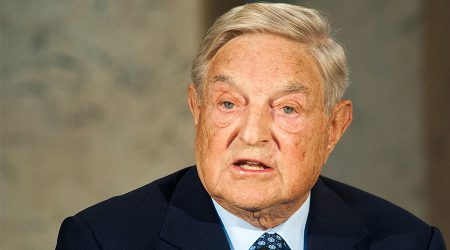
George Soros Image © Maurizio Gambarini / http://www.globallookpress.com
By Robert Bridge | RT | January 30, 2017
With the EU elite threatened by a populist insurgency aiming to end free and easy immigration programs and promote nationalism over globalism, an influential think tank says populism will only – wait for it – fuel the fires of corruption.
Transparency International, a Berlin-based anti-graft group, warned in its annual Corruption Perceptions Index about the purported perils of populism, a political animal that on occasion rolls through nations like a force of nature to contend with the excesses of an out-of-touch, elitist minority.
“Populism is the wrong medicine,” stated TI chair Jose Ugaz, without offering any alternative prescriptions. “In countries with populist or autocratic leaders, we often see democracies in decline and a disturbing pattern of attempts to crack down on civil society, limit press freedom, and weaken the independence of the judiciary.”
“Instead of tackling crony capitalism, those leaders usually install even worse forms of corrupt systems,” Ugaz continued.
With regards to corruption, the watchdog attempts mind-reading by asserting that populist politicians “have no intention of tackling the problem [of corruption] seriously.”
The report takes to task some firebrand politicians, including Donald Trump (USA), Marine Le Pen (France), Jaroslw Kaczynski (Poland) and Victor Orban (Hungary), among others, who are currently topping the popularity charts among their constituents by declaring open season on the moribund establishment.
Transparency International sounded the alarm over these political “con artists” who are “reactive, nativist and often right-wing…” while alleging that these disruptive newcomers “have been able to exploit the disenchantment of people with ‘the corrupt system’ and present themselves as the only ‘way out’ of the vicious cycle described… ”
While deliberating upon the potential risks associated with the new agitators on the block, the report conspicuously failed to mention the reasons why so many voters today are disaffected with the same old run-of-the-mill politicians, who are guilty, it must be said, of far worse crimes than mere corruption.
In all too many cases we are talking about complicity in actual atrocities, from bloody regime change in places like Iraq, Libya, Afghanistan, with efforts underway in Syria, to the wholesale destruction of Western civilization due to the unchecked immigration of war refugees without the consent of the governed. If NATO member states are feeling pangs of guilt over their direct complicity in the serial murders of nation states, forcing the refugees of these war zones onto the territory of their people is undoubtedly not the answer.
In light of these unsavory actions on the part of many NATO countries, concerns over high level corruption may seem a bit exaggerated and misplaced. At the risk of sounding cynical, separating corruption from the world of politics is tantamount to separating the chicken from the egg, and, as the popular riddle reminds us, very difficult to say what came first.
And speaking of corruption. The scale of corruption in the Clinton camp, revealed by WikiLeaks in the run up to the 2016 presidential election, is simply astounding and should be enough to preclude any lectures on good behavior by the folks at Transparency International.
For starters, it was revealed in November that the Clinton Foundation received a $1 million ‘gift’ from Qatar without telling the State Department, thereby breaking an agreement requiring it to reveal all foreign donations. The check was reportedly a gift to former President Bill Clinton in 2011 for his 65h birthday. A meeting was to take place between him and Qatari officials at some point, according to an email published last month, but it is not clear if this ever happened.
At the same time, it was also established that Saudi Arabia and Qatar were not only donating heavily to the Clinton Foundation but were also arming and funding the militants of Islamic State. Now if that isn’t the worst case of political corruption then I don’t know what is.
It is, therefore, no coincidence that populist politicians, simply responding to the market demand for fresh leadership, appeared around the world at just about the same time. The fact that France has its own version of Donald Trump in the form of Marine Le Pen would only come as a surprise to those people who don’t follow world events, or who are not told the truth about them.
Now that so many Western politicians and their affiliated parties are facing the threat of eviction this year (The most influential EU member states are witnessing a fierce struggle in the ranks amid the spectacular rise of anti-establishment, far-right politicians, like Le Pen in France, Geert Wilders in Holland and Frauke Petry in Germany), it is somewhat ironic that Transparency International would release a report warning voters that they are about to be hoodwinked by rabble-rousing, right-wing demagogues.
But there is a simpler explanation for the one-sided nature of this report, and it is due to a massive conflict of interest on the part of its sponsors.
Take it away, George
If you were doing consumer research on a particular product, would you trust the manufacturer of that product to carry out the research, or would you prefer some independent body to handle the job? I think most people would agree that the most reliable, trustworthy method would be to commission some third party with no connections to the company to provide its consensus. That would dramatically reduce the chances of inaccurate results due to something called ‘self-interest.’
And therein lies the glaring problem not only with this report but with Transparency International as a watchdog group.
A brief perusal of its supporter list should remove any doubt as to why Transparency International is extremely wary about populist politicians rocking the European boat of power.
Aside from receiving from a number of foreign governments (Germany, United Kingdom, United States, Ireland, Estonia and Finland, to name a few), TI is sponsored by the some of the most dubious names in democracy today, brought to you by none other than investor and philanthropist George Soros himself.
The Open Society Institute (OSI) and Open Society Initiative for West Africa (OSIWA) ranks just behind the National Endowment for Democracy (NED), a soft power non-profit sponsored by the US government, on the list of TI’s supporters.
Clearly, this is the last organization one should trust for providing an objective look at the rise of new political parties across the world. Indeed, George Soros himself has been largely responsible for the massive influx of refugees to the European Union, going so far as to offer cash incentives to refugees who wish to make the long, dangerous journey from the Middle East to the European continent.
Never mind that none of these displaced peoples, who have every right to our sympathy, will live in the same neighborhood as Mr. Soros, who can well afford all the personal protection that is certainly desirable when embracing such reckless policies. But for the average European citizen, who must accommodate these millions of new people who do not share the same religious, social and cultural predilections, nor in many cases the same high level of education, this social experiment carried out on the whim of a billionaire is the epitome of reckless behavior.
In fact, it should come as no surprise that the TI report singled out Hungarian Prime Minister Victor Orban. Just this month, Szilard Nemeth, a vice president of the ruling Fidesz party, said it would use “all the tools at its disposal” to “sweep out” NGOs funded by the Hungarian-born financier, which “serve global capitalists and back political correctness over national governments.”
But all that pales in comparison to an award that Transparency International bestowed upon none other than former US Secretary of State Hillary Clinton in 2012 for “her emphasis on the importance of increasing transparency and countering corruption as part of US foreign policy, with the award addressed solely to those contributions.” Needless to say, that award drew a lot of raised eyebrows around the world.
There is a breathtaking degree of conflict of interest in this TI report, which, like so many closed halls of power in the EU today, is just begging for the transparent light of day.
Robert Bridge, an American writer and journalist based in Moscow, Russia, is the author of the book on corporate power, “Midnight in the American Empire”, released in 2013.
Japanese embassy pays British think tank to plant anti-China stories
RT | January 30, 2017
The neoconservative Henry Jackson Society (HJS) think tank is on the payroll of the Japanese embassy, charged with drafting in public figures to spread anti-Chinese propaganda, investigators claim.
The Times’ investigation suggests the London-based HJS is paid £10,000 (US$12,500) per month to spread anti-Chinese propaganda, including through public figures like former British Foreign Secretary Malcolm Rifkind.
HJS frames itself as a pro-intervention and pro-capitalist voice, which aims to spread freedom and democracy around the world. It is run by the academic and failed Tory parliamentary candidate Alan Mendoza.
The deal between the think tank and the embassy was reportedly reached to counter the growing cooperation between the UK and China, championed by former Chancellor George Osborne.
The agreement reflects the rising tensions between China and Japan – the latter a close US ally in the Asia-Pacific region.
Rifkind confirmed to the Times over the weekend that he had been asked by HJS in August to put his name to an article called ‘How China could switch off Britain’s lights in a crisis if we let them build Hinkley C’, which criticized a UK-Chinese nuclear power station deal.
The comment piece claimed there may be a risk of a Chinese-funded power station having cyber-backdoors built into it which could present a risk to UK security.
Rifkin told the Times he had not been aware of the links between HJS and the Japanese embassy and said the think tank “ought to have informed me of that relationship when they asked me to support the article they provided. It would have been preferable if they had.”
The report indicates that HJS originally approached the Japanese embassy alongside a PR firm named Media Intelligence Partners (MIP), which is run by a former Tory PR man named Nick Wood.
The Times says it saw an early version of a proposal which would see the think-tank and PR firm develop a communications strategy for the embassy for a fee of £15,000 per month.
This, they said, would allow Japan’s concerns to be placed “on the radar of mainstream UK journalists and politicians.” It includes journalists from major papers like the Telegraph and the Guardian.
Other aims included the creation of “an engaged and interested cadre of high-level politicians” and a focus on the “threat to Western strategic interests posed by Chinese expansionism.”
The actual deal reached was for a lower figure of £10,000 plus expenses, according to the Times.
The Rebranding of the Anti-Syria Left
Part 1: The Anti-Anti-War-Left
By Barbara McKenzie | November 23, 2016
One could argue that for any serious student of the Middle East, using a range of sources, the approved narrative on the Syrian conflict should have been suspect from the outset: the precedents of Iraq and Libya and the accompanying lies, the well-reported lack of interest in revolution on the part of the Syrian people, the quickly developing violence in contrast with the ready accommodations of the government in terms of reform and release of political prisoners, the dominant role of brutal sectarian gangs in a traditionally tolerant and pluralist society. Those trying to find the truth of the Syrian war, however, found themselves opposed from an unexpected quarter.
There is a large body of commentators in the West who define themselves as ‘left’, ‘progressive’ and ‘anti-imperialist’ insofar as they condemn Israel’s crimes against the Palestinians. Their claimed support for the Palestinians is offset by virulently opposing anything that threatens Israel’s interests in other areas, such as investigation into the role of Mossad’s activities outside of Israel. Israel’s interests are likewise to the fore when it comes to drastic change in Syria (seen by Hillary Clinton as essential to Israel’s interests as far back as 2006) – the ‘soft Zionists’ have been promoting the externally created revolution in Syria from the outset.
The Thirdwayers
Sharing most of these characteristics are a group of people who espouse a ‘third way’ whereby ostensible anti-imperialists criticise their governments’ interventionist policies but at the same time have promoted the revolution and been determined opponents of the Syrian government. While in theory they oppose external intervention, they at the same time facilitate such intervention by peddling propaganda to that end.

For five years, people like Max Blumenthal, Ben Norton and Rania Khalek have actively promoted forced regime change in Syria, insisting on the validity of the popular revolution, characterising the Syrian president as a butcher, and alternately vilifying and patronising those who were unconvinced by the NATO narrative.
At the same time there has been no attempt by proponents of the Syrian war to engage with the anti-war activists who have been carrying out and sharing research on the conflict – instead they have contented themselves with unfounded slurs on the intellect and integrity of supporters of Syria.
However, ripples have been going through social media in recent months as these seemingly diehard opponents to the Syrian government have moved to taking a more nuanced view of the conflict. This was quickly picked up by eagle-eyed users of twitter who have been following the war on Syria for years…

In order to consider the significance and extent of this shift in perspective, it is worth looking back at the views espoused by the thirdwayers over the years
The popular revolution
Long after the violent, sectarian and fundamentally un-Syrian nature of the uprising was revealed along with its external impetus, diehards were still promoting the idea of a popular revolution, with a sentimental attachment to the Free Syrian Army well after its use-by date. While atrocity stories to the disfavour of the ‘Assad thugs’ (Syrian Arab Army) were quickly shared, those which show the ‘revolutionaries’ in an unfavourable light were ignored or speedily forgotten: By 2012 there was abundant proof of FSA atrocities, including cannibalism, decapitation and sectarian massacres, but this did not stop Blumenthal tweeting approvingly in August ‘Protest in the occupied Syrian Golan Heights in support of the #Syrian revolution’.
Thus in August 2014, when most people were discarding the fiction of Syria’s moderate rebels, Ben Norton still had a rosy view of the ‘democratic’ revolutionaries: a spate of tweets in their favour on August 18 included such optimistic claims as, ‘Syrian revolutionaries have already liberated cities, and they ran them somewhat democratically’, and on 22 September, ‘Majority of the FSA consists of average Syrians & former SAA members who refused to slaughter civilians & defected’.
As late as February 2015 Ben Norton complained:
Blame Assad for brutally destroying the progressive and secular resistance against his murderous fascist regime […] not Syrians for standing up to bravely fight for not just food, justice, and dignity, but for their very lives.
In 2014 Khalek interviewed Molly Crabapple, artist, writer and fervent supporter of the ‘Syrian revolution’. Both Khalek and Crabapple assume a non-violent inception to the Syrian conflict, ruthlessly crushed by government forces.
Khalek: […] You addressed the fact that there was a segment of the anti-war left that still till now is very dismissive of the Syrian uprising and in some cases excuses Assad for the horrific crimes he’s committing and you got attacked for pointing this out.
Crabapple: […] Many people I deeply respect are anti-intervention for good reasons. Other ones were pro certain sorts of intervention. But I think what is absolutely wrong is to pretend the Syrian revolution didn’t exist, to pretend that these activists weren’t amazing people …
The ‘evil Assad’
Attacking any movement by demonising its leader is a tried and true tactic where there is no legitimate means to an end – one only needs to look at the treatment meted out to Alex Salmond who, in the run-up to the Scottish referendum, was variously compared to Hitler, Mugabe, Nero and Genghis Khan. Likewise vilification of Bashar al Assad has been a major plank of regime change advocates. For more than five years the anti-Syria movement has relentlessly vilified the Syrian president with an incontinent flow of accusations, making full use of language favoured by the most hard-line interventionists: Assad ‘the butcher’, ‘the brutal tyrant’ has been accused of deliberately conducting a reign of terror, of bombing, starving, raping, gassing his own people, deliberately targeting hospitals, blood-banks, schools, bakeries, children and even kittens.
The thirdwayers have been amongst the most determined proponents of the evil Assad narrative: ‘Assad slaughter continues’ BN8/8/14; Assad’s ‘brutal tyranny’ MB 4/10/11; ‘Assad slaughter’ MB22/2/13; ‘Assad’s atrocities’ MB 14/9/13; ‘Assad’s reign of terror’ MB 16/9/14; ‘Assad family’s ongoing legacy of criminal fascism’ MB 18/10/14; ‘Assad the butcher’ RK 15/8/14 ‘Assad’s butchery’ RK 29/7/14; Assad is a mass murdering criminal’ RK 19/7/16; ‘the criminal Assad regime’ RK 18/1/14; civilians are being intentionally starved by the Assad Regime’ RK 19/4/14; ‘Assad is starving, torturing, & killing not just Syrian but also Palestinians’, BN 26/8/14.
From very early in the war many allegations of atrocities and war crimes have been leveled at the Syrian government and then soon shown to be false. Furthermore, substantial research had been carried out revealing the extent of foreign intervention, the billions of dollars of aid to the ‘rebels’, the many thousands of mercenaries pouring in through Turkey. However even in February 21015 Norton was still undeterred. According to his article 56 dead in one day: a Glimpse of Assad’s brutality Assad was responsible both for the early violence:
Since Assad first tried to drown the nonviolent popular uprising against his fascist regime in blood in 2011 …
and its continuation:
… the Syrian regime has dropped thousands upon thousands of bombs on civilian areas—and has engaged in systematic campaigns of torture, starvation, and rape. […] If you want to see why horrible reactionary groups like Al-Nusra and even ISIS have support among some Syrians, try taking a look at the crimes the fascist Assad regime commits on a daily basis. […]
Norton is, therefore, offering a partial justification for joining ISIS.
No possible accusation has been overlooked. Specific claims of atrocities are seized on, never questioned and then, once debunked by others, forgotten. Although the thirdwayers, unlike the hard-line interventionists, may be prepared to discard discredited anti-Assad horror stories, this never seems to impact on the overall theme of Assad the monster. Thus massacres such as those that occurred at Houla, Ghouta and Banias were all immediately blamed on the Syrian government by both the corporate media and the third-wayers, even though subsequently found to have been carried out by insurgents, for either ethnic cleansing or ‘false flag’ purposes. (Blumenthal was still insisting that the Houla massacre was carried out by ‘shabiha’ (derogatory term for local defence forces) in February 2013, see video, below).
Assad is correlated with Israel, or ISIS, or is even worse than ISIS, according to both Rania Khalek

echoing the sentiments expressed by Josie Ensor of the Telegraph a few months earlier

The public knowledge that both the US and Israel are hell-bent on regime change in Syria was turned on its head with claims that the US and Israel supported Assad: ‘”Israel’s preference is for Bashar al Assad to remain in power…”‘, MB 11/12/2012.
US support for the ‘Assad regime was a favourite theme of Ben Norton, who explored this thesis in an article US Government Essentially Sides with Assad. Despite all evidence to the contrary, Norton supports the US administration in its blatant fiction that its priority is going after ISIS:
‘With the Syrian Civil War approaching its fourth whole year, the evidence increasingly suggests that the Obama administration has essentially sided with the Assad regime. […] In October 2014, Foreign Policy noted that “U.S. officials are beginning to see Assad as a vital, de facto ally in the fight against the Islamic State.”’
With the advent of foreign fighters from Central Asia, polio reappeared in Syria, after having been eradicated in 1995 (the strain in Syria is the same as that present in Pakistan, source and transit point for many jihadists fighting in Syria). Despite being engulfed in war the Syrian [government] acted quickly to set in place vaccination programmes (the latest campaign was announced on 16 October). Rania Khalek, however, laid a large part of the responsibility at the door of the ‘regime’, likewise ignoring evidence available at the time which showed that the Red Crescent is frequently blocked by groups such as the ‘Free Syrian Army’.
The insanely high toll [from chronic disease] is largely due to the Assad regime’s criminal use of food and medicine as weapons in his war against his own people.’
The discrediting of the 2011 lie that Gaddafi was giving black mercenaries viagra to encourage them to rape Arab women did not deter Ben Norton from seizing with alacrity on an obscure and short-lived rumour that the Deputy Mufti of the ‘Syrian regime’ advocated rape by the army.

‘Assad worshippers’

[Pro-Assad Bingo, posted by Ben Norton in April 2015]
In parallel with the demonisation of Bashar al Assad is the recurrent theme of contempt for Assad supporters.
Undermining one of NATO’s principle planks and justification for intervention, ie the demonisation of al Assad, is an enormous threat to the NATO narrative. For this reason a major focus of the anti-Syria left has been to undermine, not just the Syrian government, but also the credibility of pro-Syria activists who have questioned the atrocity narrative.
Critics of the anti-Assad narrative are deemed to be stupid and hypocritical. A spate of tweets about the pusillanimity of ‘Assad worshippers issued from Ben Norton in 2014, eg 24 August: ; I just can’t get over the ludicrous degrees Assad defenders are going to to try to defend the mass murderer… it’s almost unbelievable.’; ‘HAHAHAHAHAHA, these Assad-worshiping conspiracy theorists just get more and more absurd. They are completely deranged’. ‘The Western “anti-imperialists” who support (read: worship) Assad so fervently have never met a working-class Syrian’.

Max Blumenthal is equally contemptous of ‘Assad apologists”, informing writer Miri Wood: ‘when non Muslima say takfiri I cringe almost as much as when they defend Assad’s reign of terror 16/9/14. Even Syrians cannot escape Blumenthal’s derision:

Assad supporters have, we are told, a tendency to Islamophobia, ‘I noted a while ago that Islamophobia informed certain Assad apologists’ MB 12/4/13; or fascism and Stalinism, ‘when you see someone defend Assad, remind them that Fascists & far-rightests throughout europe support Assad’ 12/4/13.

In this tweet of March 2016, Norton is referring to the protester top right, who is holding a placard supporting Bashar al Assad. Not everyone was convinced by Norton:

In October 2013 Blumenthal tweeted:

Thus in an impressive use of twitter, he managed to impugn the integrity of an opponent to regime change, indicated that it was ‘Assad’ that was responsible for the Ghouta sarin attack, and played ‘in bed with Israel’ card.
In late 2012 Max Blumenthal noisily resigned from al-Akhbar News, complaining that the outlet was providing a forum for ‘Assad supporters’. As well as publishing a letter of resignation, Blumenthal’s departure from the newspaper was the subject of an interview with The Real News in which, on the basis of his visit to a refugee camp in Jordan, he presents himself as an expert on Syria. The video is 18 minutes and is an education.
In letter and interview Blumenthal reiterates his position on the Syrian war: ‘the Syrian army’s pornographically violent crackdowns on what by all accounts is still a mostly homegrown resistance’, the regime’s responsibility for massacres such as Houla; ‘the Assad regime’s campaign to delegitimise the Syrian opposition by casting it as a bunch of irrational jihadis’. According to Blumenthal, Assad ‘makes Israel look like a champion of human rights’.
There is an interesting attempt to correlate Hezbollah with al Qaeda and ISIS: ‘ironically [the Syrian regime] seem to have little problem with Hezbollah’s core Islamist values’. One wonders what the people of Maaloula, very thankful to be liberated from jihadists with the help of Hezbollah, would make of Blumenthal’s implication.

[Hezbollah fighter saluting the Virgin Mary after the Battle of Maaloula]
In 2014 Norton wrote a spiteful article termed Meet the Anti-Semitic Conspiracy Theorists Who Are Assad’s Biggest Fans. The primary purpose appears to have been to wreak vengeance on a group of social media activists who found it hard to take Norton at his own evaluation:


Norton starts from the fundamental premise that all who oppose the war on Syria are, without exception, devoid of all moral sense.
Those of us with at least some kind of rudimentary moral compass are compelled to oppose draconian tyrants like Syria’s Bashar al-Assad, whose regime regularly engages in brutal state terrorist campaigns of mass bombing, torture, starvation, and rape of civilians, including children.
The article is a fascinating exercise in dishonesty, damning the ‘antisemites’ by association with the anti-war movement and vice-versa, and conflating all members of the group on every point while ignoring all contrary evidence. (Norton’s piece was answered by one of the group.
Regime change the third way
The part played by the NATO countries, the Gulf States, Turkey and foreign mercenaries has been essentially ignored or denied by the thirdwayers, who have stayed with their narrative of a ‘civil war’. They have theoretically been opposed to proposals for open military intervention, or at least the idea of bombing campaigns, whether by the NATO states or Russia.


The narrative hasn’t been totally consistent: a lot of what is tweeted is ambiguous, even irresponsible, often indicating that intervention might actually be the humanitarian option. 


Again, Blumenthal’s angry response in 2014 to an article by Bob Dreyfuss suggesting that Obama give up on regime change in Damascus hardly seems consist with an anti-interventionist viewpoint.

Max Blumenthal’s own credentials as a ‘reporter from the region’ lie in a visit to Jordan to interview refugees. The article chronicles the dire conditions in Zaatari camp, but Blumenthal chooses to end on a call for bombing Syria: ‘Either bomb the regime or you can bomb Zaatari and get it over with for us.’
The group’s principle plank is that the conflict in Syria is a ‘civil war’, a ‘popular revolution’. While being opposed in principle to external intervention, they have facilitated that intervention by promoting NATO propaganda against the Syrian government and in favour of the ‘revolutionaries’, in effect the jihadist extremists who have controlled the insurgency from the beginning. They may not be responsible for the inception of the war, but they share culpability for its continuation.
German Academics Pen Open Letter Slamming Western Interpretation of Syria Crisis
Sputnik – 28.01.2017
In contrast to the West, which has been intent on destroying Syria and other Middle Eastern countries, Russia and Iran are playing a constructive role in preventing the overthrow of Assad and the formation of a fundamentalist Sunni government in the country, a group of German academics have written in an open letter.
A group of German university professors have penned a joint statement criticizing the mainstream media’s portrayal of the roles of Russia and Iran in regulation of the Syrian conflict, Sputnik Deutschland reported.
Called “a statement on the Syrian war,” the declaration was written by the scientific advisory board of the German branch of Attac, an international organization that campaigns for alternatives to globalization.
“Russia and Iran exhausted all the possibilities for a diplomatic and peaceful solution to the conflict; (although) such an attempt seemed be futile at first, they have for the time being ended military attacks and the war in Aleppo. Therefore, we think the attacks on Russia in the mainstream media are absurd,” they wrote.
The statement, written by 14 German university professors, recalls a 2011 interview with former NATO Secretary-General Wesley Clark, who revealed that just weeks after 9/11, the US had plans to not only invade Iraq, but five countries in the Middle East.
The Pentagon published a memo describing “how we’re going to take out seven countries in five years, starting with Iraq and then Syria, Lebanon, Libya, Somalia, Sudan and then finishing off (with) Iran,” Clark revealed.
With that aim in mind, the US has been preparing the conditions for regime change in Syria since 2005, including a media propaganda campaign against the Assad government.
The US also co-operated with Saudi Arabia, Qatar and Israel in the training and funding of an army of Sunni jihadists who were supposed to overthrow the governments in Damascus and then Tehran, as investigative journalist Seymour Hersh reported in 2007.
The researchers agree with the assessment of Professor Gunter Meyer, director of the Center for Research on the Arab World (CERAW) at the University of Mainz, who told Germany’s Heute news program last month that the US bears the “main responsibility” for the Syrian crisis, and that Russia’s operation in support of the Syrian government has thwarted the US plan to overthrow the Syrian government.
“The West, in particular the USA, has provided the rebel jihadists with weapons and also partially trained them. The equipment, personnel and logistics were mainly handled by Turkey, while the financial support came mainly from Saudi Arabia and Qatar. Saudi Arabia has helped Salafist extremists to establish a radical Islamist government in Syria. Here the conquest of Aleppo in 2012 was an important step for the jihadists,” Meyer said.
“Without the military intervention of Russia in September 2015, not only would Aleppo have been completely conquered by the jihadists, but the Assad regime would also have collapsed long ago. The Assad opponents under the leadership of the US would have achieved their goal of the regime change. However, the strongest military forces would have seized power, and this would be Islamic extremists such as the al-Nusra Front, which is part of the Al-Qaeda network, and the Islamic State (Daesh), which is being combated by the international alliance under US leadership. Putin can say to people like the Israeli politicians who declared that a terrorist regime is better than Assad, that he prevented that.”
The evacuation of Aleppo was completed in December after Turkey and Russia brokered a ceasefire deal between government forces and the rebels who had controlled parts of the city since 2012.
The researchers wrote that the efforts of Moscow and Tehran to reach a diplomatic settlement to the conflict in Syria are in contrast to the “regime change” philosophy of the West, where politicians and the media have failed to acknowledge their crucial involvement.”
A few days after the evacuation of Aleppo was declared to have ended, Russia, Turkey and Iran held a meeting where they offered a guarantee that from now on the Syrian conflict would be resolved through diplomatic channels and negotiations.”
“Here, too, we must realize with bitterness that not one Western politician has taken Vladimir Putin, Hassan Rouhani and Recep Tayyip Erdogan at their word and accepted their guarantee as important and constructive. Western politicians do not seem to be able to react to these kinds of peaceful political signals.”
Unfortunately, some civilians lost their lives in the course of the anti-terror operation in Aleppo. However, the Western media failed to provide any sense of balance to their coverage.
“It must be remembered that 40,000 Iraqi civilians — at least four times as many as in Aleppo — have died since August 2014 at the hands of the US-led coalition alone, of whom 15,000 were in the region of Mosul. Since 1980 the US has attacked, occupied or bombed 14 Muslim countries,” the academics wrote.
“We find it very disturbing that the Western media, including the signatories of the anti-Russian declaration, don’t say anything about the fatal US policy of regime change in the Middle East, let alone criticize it. So-called ‘failed states’ are the obvious result of this policy, which are breeding grounds for the further spread of terrorism and the main reason for persistent flows of refugees. We ask, how blind do you really have to be to overlook a reality that is so difficult to deny?”
Liberals Morph from Peaceniks to Warhawks on Government Intelligence Agencies
By Stephen J. Sniegoski • Unz Review • January 28, 2017
During the latter decades of the Cold War with Soviet Russia, the charge of being “unpatriotic” or “anti-American” caused American liberals (excluding those who had to rely on the votes of regular Americans to hold political office) to burst into spasms of ridicule and howls of “Red-baiting,” “war-mongering,” “witch-hunting,” and “fascism.” Sophisticated folks, liberals implied, would never even deign to think of doing anything so gauche as to automatically support their country in its fight against what they sarcastically called the “Red Menace.” America’s very possession of nuclear weapons was considered a danger to all humanity and many liberals flirted with the idea of U.S. unilateral nuclear disarmament. And the slogan of the Democratic candidate for president in 1972, George McGovern, was “Come Home, America” — which meant U.S. military retrenchment that mainstream liberals now lambast as “isolationism.”
During this not-too-long-ago era (at least, it was not too long ago for me, who is too rapidly approaching the biblically allotted three-score and ten), the CIA and the FBI were considered the bête noire in this liberal Weltanschauung. FBI director J. Edgar Hoover, with his penchant for spying on innocent people, was regarded as thoroughly vicious. The CIA was notorious for being involved in the overthrow of nice democratic governments (at least, that is how liberals viewed them) in such countries as Iran, Guatemala, and Chile, and spying on leftist critics in the United States. The villainous nature of the CIA and FBI was a theme in many Hollywood movies of the era.[1]
Now let’s return to the present and the liberal hysteria over purported Russian interference with the U.S. presidential election. The most bandied about charge involves “hacking” the DNC and Podesta emails and providing these to WikiLeaks to denigrate Hillary Clinton, thus preventing her from becoming president. The support for this claim, at least as it has been presented to the America public, rests only on assertions made by the U.S. Intelligence Community, and this dearth of proof was continued in the most recent report from the Office of the Director of National Intelligence (ODNI), “Assessing Russian Activities and Intentions in Recent US Elections,” released to the public on January 6. The report represents the unclassified findings of the intelligence community’s investigation of Russian involvement in the 2016 election. In the words of the report: “Thus, while the conclusions in the report are all reflected in the classified assessment, the declassified report does not and cannot include the full supporting information, including specific intelligence and sources and methods.”[2]
Even some believers, especially those who might know something about cyber technology and the capabilities of America’s intelligence agencies, evinced some concern about the report’s lack of substantiating evidence. For example, Wired, a high-tech webzine that usually follows the current progressive line, published an article titled “Feds’ Damning Report on Russian Election Hack Won’t Convince Skeptics,” in which Robert Graham, an analyst for the cybersecurity firm Erratasec, was quoted as saying: “But knowing what data they [U.S. intelligence agencies] probably have, they could have given us more details. And that really pisses me off.”[3] The thrust of the article is that the lack of substantial proof fails to convince skeptics, not that the intelligence report’s claims could be wrong. This position is rather understandable since skepticism about traditional beliefs such as Christianity is highly lauded by progressives, but skepticism is not allowed to cast doubt on the progressive narrative of the day.
President Obama went somewhat further in his attack on non-believers. In an interview on ABC News on January 6, Obama insinuated, and, in some cases, openly stated that people who express skepticism about the findings and conclusions drawn by the U.S. Intelligence Community are not on America’s “team” and are siding with Putin; in fact, he maintains that they “love” Putin. In short, Obama has come to assume that the American people must not question the sanctity of the U.S. “Intelligence Community.” To do otherwise signifies not merely a lack of patriotism but actual love for America’s alleged number one adversary—Vladimir Putin. “One of the things that I’ve urged the president-elect to do is to develop a strong working relationship with the intelligence community,” Obama stated. “We have to remind ourselves we’re on the same team. Vladimir Putin’s not on our team.” Obama warned that “If we get to a point where people in this country feel more affinity with a leader who is an adversary and view the United States and our way of life as a threat to him, then we’re gonna have bigger problems than just cyber hacking.” It appears to Obama that some politicians and reporters “seem to have more confidence in Vladimir Putin than fellow Americans because those fellow Americans are Democrats.” And he solemnly pontificated: “That cannot be.”[4]
Obama continued with this rather dystopian view: “[I]n this new information age, it is possible for misinformation, for cyber hacking and so forth to have an impact on our open societies, our open systems, to insinuate themselves into our democratic practices in ways that I think are accelerating.” Although “cyber hacking” existed even before Obama entered the White House and “misinformation,” according to the Bible, existed even when Adam and Eve resided in the Garden of Eden, Obama implies that he only now became aware of this possibility.[5]
Now the term “open society” was popularized (at least in intellectual circles) by the philosopher Karl Popper.”[6] and its most prominent proponent today is billionaire George Soros (a student of Popper’s). Soros’ Open Society Institute has as its goal spreading the “open society” world-wide. An open society, as Popper presented it, would be open to all types of ideas with people being free to make their own decisions. Soros, in contrast, expressed a view similar to that of Obama, contending that “Popper failed to recognize that in democratic politics, gathering public support takes precedence over the pursuit of truth. In other areas, such as science and industry, the impulse to impose one’s views on the world encounters the resistance of external reality. But in politics the electorate’s perception of reality can be easily manipulated. As a result, political discourse, even in democratic societies, does not necessarily lead to a better understanding of reality.”[7] The implication is that gatekeepers are needed to protect “truth.” As one critic puts it: “the Open Society Institute embodies Popper’s idea of an open society the way the German Democratic Republic (East Germany) embodied democracy.”[8]
Moving away from the focus on hacking, the recent ODNI report describes the Russian effort to affect the US election as “multifaceted” and devotes almost half of the report to propaganda (despite the negative connotation, propaganda can be true) spread by Russia, especially by its major government-sponsored television network for foreign countries, RT.
Moreover, the intelligence report interprets the alleged Russian effort to aid Trump in the election as only one part of a broader goal to combat the United States’ “liberal democratic order,” stating: “Russian efforts to influence the 2016 US presidential election represent the most recent expression of Moscow’s longstanding desire to undermine the US-led liberal democratic order, but these activities demonstrated a significant escalation in directness, level of activity, and scope of effort compared to previous operations.”[9] Moreover, the report considers any type of criticism of the United States as a “desire to undermine the US-led liberal democratic order.” And the report deals with aspects of this broader goal that are entirely unrelated to any Russian effort to aid Trump. This is of the utmost importance since the media narrative focuses on the idea that Russia aided Trump in the 2016 election but, for proof, relies on a report that deals with a much broader subject. That Russian media provides a negative view of America does not mean that this propaganda played a role in making Trump president. And it is not only the mainstream media but even the leaders of the intelligence community who blur this distinction.
Illustrating the point made above about the report’s concern with Russia’s alleged broader goal is its devotion of considerable space to Russian news stories casting the United States government and economic system in a negative light, but having nothing to do with Trump or the 2016 election. For example, the report observed that “RT aired a documentary about the Occupy Wall Street movement on 1, 2, and 4 November [2016]. RT framed the movement as a fight against ‘the ruling class’ and described the current US political system as corrupt and dominated by corporations. RT advertising for the documentary featured Occupy movement calls to ‘take back’ the government. The documentary claimed that the US system cannot be changed democratically, but only through ‘revolution.’”[10] Although this report disparages the existing economic system in the United States, it could hardly be interpreted as encouraging anyone to vote for billionaire Donald Trump with his proposed agenda that included lower tax rates—especially the corporate tax rate–and a reduction in economic regulation that liberals and Democrats claimed helped only the wealthy.
The study also points out that “RT runs anti-fracking programming, highlighting environmental issues and the impacts on public health. This is likely reflective of the Russian Government’s concern about the impact of fracking and US natural gas production on the global energy market and the potential challenges to Gazprom’s profitability.”[11] That Russia’s alleged favored candidate Trump was pro-fracking whereas Hillary straddled the issue would mean that the RT anti-fracking program could militate against supporting Trump.
The report also maintains that “RT’s reports often characterize the United States as a ‘surveillance state’ and allege widespread infringements of civil liberties, police brutality, and drone use.”[12] Again, this would not seem to generate support for Trump.
The report refers to articles written in 2012 that deal with the U.S. presidential election that year, which did not involve Trump, and reflects the fact the study covers, as the title states, recent U.S. elections, not just the 2016 election. For example, “In the runup to the 2012 US presidential election in November, English-language channel RT America . . . intensified its usually critical coverage of the United States. The channel portrayed the US electoral process as undemocratic and featured calls by US protesters for the public to rise up and ‘take this government back.’”[13]
Still dealing with the 2012 election, the intelligence report stated: “From August to November 2012, RT ran numerous reports on alleged US election fraud and voting machine vulnerabilities, contending that US election results cannot be trusted and do not reflect the popular will.”[14] Oddly, this is almost identical to what the mainstream media has been saying since Trump won the election.
But what about the “fake news” — fictitious articles deliberately fabricated to deceive–that the mainstream media claimed helped Trump, largely by harming Clinton? For example, a Washington Post article, dated November 24, 2016, was titled: “Russian propaganda effort helped spread ‘fake news’ during election, experts say.”[15] CNN, in its article, “The reality behind Russia’s fake news,” dated December 2, made similar claims, relying heavily on the aforementioned Washington Post article. [16]
(After extensive criticism including legal threats from the sites the Washington Post described as Russian propaganda outlets, the Post added its lengthy editor’s note distancing itself from the anonymous group that provided the key claims of Russian “fake news” saying that the Post would not vouch for its validity.) [17]
Even Director of National Intelligence James Clapper referred to the Russians making use of “fake news” during the election. In a Senate Armed Services Committee hearing on “Foreign Cyber Threats to the United States” on January 5. 2017, Senator Jack Reed (Democrat, Rhode Island) asked Clapper about media reports that held that Russia was engaged in the creation of “fake news.” Clapper responded: “This was a multifaceted campaign. So, the hacking was only one part of it, and it also entailed classical propaganda, disinformation, fake news.”[18] When the January 6 ODNI report was released, NBC News even claimed that it mentioned “a series of fake news stories damaging to Clinton, many of which got their start with Russian-backed outlets.” [19]
Considering the many references to “fake news,” even by the Director of National Intelligence, it is astonishing that the January 6 report did not cite any examples of this alleged phenomenon—or even mention it. What stands out is the absence of the term “fake news.” Did “fake news” itself turn out to be “fake news”? Whatever the case, the mainstream media did not seem to notice the absence of “fake news” from the report.
While the Intelligence Community did not make any mention of “fake news” in its report, it did make general claims—assessments by the intelligence community — that held that Russia favored Trump over Hillary Clinton. For example: “We assess the influence campaign aspired to help President-elect Trump’s chances of victory when possible by discrediting Secretary Clinton and publicly contrasting her unfavorably to the President-elect.”[20] The report also states: “RT’s coverage of Secretary Clinton throughout the US presidential campaign was consistently negative and focused on her leaked e-mails and accused her of corruption, poor physical and mental health, and ties to Islamic extremism. Some Russian officials echoed Russian lines for the influence campaign that Secretary Clinton’s election could lead to a war between the United States and Russia.”[21] None of these political views differed from what the anti-Clinton media in the U.S. expressed, so it is not apparent how Russia would add any credibility to these claims. It might even have tended to detract from them, which seems to be the case after the election. And since Russian officials did make the aforementioned claim about war, the mention of it does not seem to reflect any type of bias.
In contrast to the Russian depiction of Clinton, the intelligence report stated that Russian government media outlets RT and Sputnik “consistently cast President-elect Trump as the target of unfair coverage from traditional US media outlets that they claimed were subservient to a corrupt political establishment.”[22] This view was also commonly expressed by the more conservative media in the U.S., even that media which was not supportive of Trump.
RT put forth an extensive refutation of the intelligence report’s claims in an article entitled, “All the ways RT ‘influenced’ American politics ‒ it’s not what the ODNI thinks,” dated January7.[23] In many cases, RT made an effort to show that it also presented news stories that were contrary to those that the report cited—in essence, that its reporting was balanced while the intelligence report “cherry picked” RT stories to fit its narrative. It should be noted that no supporter of the Intelligence Community’s findings, from either the U.S. Intelligence Community itself or the private media, made the effort to rebut RT’s detailed criticism of the report.
It would seem to be self-evident that Russian media would act to promote Russian interests—although information used to achieve this goal might be true–just as US government-sponsored international media is intended to promote the interests of the United States. However, while the intelligence report holds that the Russian media was biased in favor of Trump, it fails to prove that bias. The report, for example, did not come up with any obvious erroneous information, such as the U.S. media’s account of the alleged killing of the incubator babies during Iraq’s invasion of Kuwait in 1990; the WMD story in the run-up to the 2003 war on Iraq; and the recent story about the Russians hacking the Vermont power grid.
The report could have relied upon a statistical analysis of the Russian media’s election reporting. Numerous efforts have been made in the United States to use statistics and computer analysis in assessing media bias. Analyses that stand out tend to conclude that the U.S. media have a liberal bias. They include: The News Twisters (1976) by Edith Efron; T he Media Elite (1986) by Robert Lichter, Stanley Rothman, and Linda Lichter; Press Bias and Politics: How the Media Frame Controversial Issues (2002) by Jim A. Kuypers; and Left Turn: How Liberal Media Bias Distorts the American Mind, (2012) by Tim Groseclose. Many statisticians have found fault with these studies despite their often extensive use of statistical data and comparisons among various media outlets. If this extensive information can be rejected, how could one accept the intelligence report’s claims of Russian media bias where no statistical proof or even standards for determining bias exist? The intelligence report, indeed, not only eschews statistical analysis for its bias claims, but acknowledges that it does not even make a comparison between Russian media and U.S. media, stating that “it does not analyze US political processes or US public opinion.”[24]
Moreover, it is not apparent that the Russian media would affect how any significant number of Americans vote. And the report explicitly states: “We did not make an assessment of the impact that Russian activities had on the outcome of the 2016 election.”[25] With all the uproar about Russian meddling in the US election, and allegations by prominent figures that Trump is not a legitimate president, it would be expected that the report would try to determine if this alleged meddling had any effect on the election’s outcome.
The study does hint that Russian media might have had some effect on voting by using graphs that show it is competitive with leading international media—Al Jazeera English, BBC World, CNN/CNN International. The Economist, however, provides an effective statistical refutation of this claim: “In Twitter and Facebook, RT’s reach is narrower than that of other news networks . . . . Its biggest claim to dominance is on YouTube, where it bills itself as the ‘most watched news network’ on the platform. As the intelligence report fretfully notes, RT videos get 1m views a day, far surpassing other outlets. But this is mostly down to [due to] the network’s practice of buying the rights to sensational footage, for instance of Japan’s 2011 tsunami, and repackaging it with the company logo.”[26] A September 2015 article in The Daily Beast, “Putin’s Propaganda TV Lies about Its Popularity,” states: “As of 2015, RT is still largely absent from cable news rankings.”[27] Moreover, RT’s influence would seem to pale to insignificance compared to the totality of American media.
Considering all the information provided by the U.S. Intelligence Community, it would appear that the entire issue of the alleged Russian meddling in the election turns out to be, to quote the Bard, “full of sound and fury, signifying nothing.”
[1] Maria Lauino, “Hollywood Presents: Government as Villain,” New York Times, February 12, 1995, http://www.nytimes.com/1995/02/12/movies/film-hollywood-presents-government-as-villain.html?pagewanted=all
[2] “Background to ‘Assessing Russian Activities and Intentions in Recent US Elections’: The Analytic Process and Cyber Incident Attribution,” January 6, 2016, p. 1.
[3] Andy Greenberg, “Feds’ Damning Report on Russian Election Hack Won’t Convince Skeptics,” Wired, January 6, 2017, https://www.wired.com/2017/01/feds-damning-report-russian-election-hack-wont-convince-skeptics/
[4] Kevin Liptak, “Obama: ‘Vladimir Putin is not on our team,’” CNN, January 6, 2017, http://www.cnn.com/2017/01/06/politics/obama-vladimir-putin-is-not-on-our-team/
[5] Liptak.
[6] Noted philosopher Henri Bergson actually introduced the term “open society.”
[7] George Soros, Project Syndicate, November 8, 2007, https://www.project-syndicate.org/commentary/from-karl-popper-to-karl-rove—and-back?barrier=accessreg
[8] Jonathan David Carson, “The Left’s Theft of the Open Society and the Scientific Method,” American Thinker, April 24, 2008, http://www.americanthinker.com/articles/2008/04/the_lefts_theft_of_the_open_so.html
[9] Intelligence Community Assessment, “Assessing Russian Activities and Intentions in Recent US Elections,” p. ii.
[10] Assessing, p.7.
[11] Assessing, p.8.
[12] Assessing, p. 7.
[13] Assessing, p. 6.
[14] Assessing, p. 6.
[15] Craig Timberg, “Russian propaganda effort helped spread ‘fake news’ during election, experts say,” Washington Post, November 24, 2016, https://www.washingtonpost.com/business/economy/russian-propaganda-effort-helped-spread-fake-news-during-election-experts-say/2016/11/24/793903b6-8a40-4ca9-b712-716af66098fe_story.html?utm_term=.715bb
[16] Jill Dougherty, “The reality behind Russia’s fake news,” CNN, December 2, 2016,http://www.cnn.com/2016/12/02/politics/russia-fake-news-reality/
[17] Glenn Greenwald, “WashPost Is Richly Rewarded for False News About Russia Threat While Public Is Deceived,” The Intercept, January 4, 2017, https://theintercept.com/2017/01/04/washpost-is-richly-rewarded-for-false-news-about-russia-threat-while-public-is-deceived/
[18] Alex Griswold, “James Clapper Confirms Russia Was Behind Fake News During 2016 Election,” Mediaite, January 5, 2017, http://www.mediaite.com/tv/james-clapper-confirms-russia-was-behind-fake-news-during-2016-election/
[19] Ken Dilanian, “Report: Putin, Russia Tried to Help Trump By ‘Discrediting’ Clinton,” NBC News, January 6, 2017, http://www.nbcnews.com/news/us-news/report-putin-russia-tried-help-trump-discrediting-clinton-n703981
[20] Assessing, p.2.
[21] Assessing, p. 4.
[22] Assessing, p.4.
[23] RT, “All the ways RT ‘influenced’ American politics ‒ it’s not what the ODNI thinks,” January 7, 2017, https://www.rt.com/usa/372890-odni-rt-influenced-election/
[24] Assessing, p. i.
[25] Assessing, p. i.
[26] RT’s propaganda is far less influential than Westerners fear,” The Economist, January 19, 2017, http://www.economist.com/news/europe/21715031-kremlin-backed-network-inflates-its-viewership-youtube-disaster-videos-rts-propaganda
[27] Katie Zavadski, ‘Putin’s Propaganda TV Its Lies About Popularity,” The Daily Beast, September17, 2015, http://www.thedailybeast.com/articles/2015/09/17/putin-s-propaganda-tv-lies-about-ratings.html
Featured Video
The Search for Truth: Charlie Kirk’s Assassination One Year Later
or go to
Aletho News Archives – Video-Images
From the Archives
The 9/11 “Double-Cross” Conspiracy Theory
BY LAURENT GUYÉNOT • UNZ REVIEW • SEPTEMBER 6, 2022
Is it true that “9/11 was an inside job”? Yes, insofar as Israel is “inside” the U.S. But for the 9/11 truthers who have identified Israel as the main perpetrators, “9/11 was an inside job” is at best a half-truth, and at worst an integral part of the Zionist operation, like a secondary flag sewn as a lining under the false flag of Islamism. Victor Thorn (1963-2017) wrote in his book 9/11 made in Israel: The Plot Against America (2011): “In essence, the ‘9-11 truth movement’ was created prior to Sept. 11, 2001 as a means of suppressing news relating to Israeli complicity. . . . The slogan ‘9-11 was an inside job’ was quite possibly the greatest example of Israeli propaganda ever devised.” In milder terms, it is “controlled opposition”.
A genuine truth movement would have pointed to Israel as the prime suspect from the start. From day one, it was obvious who would benefit. … continue
Blog Roll
 Aletho News
- Europe’s mounting social chaos… chickens coming home to roost for proxy war against Russia
- US-Russia Diesel Deal Becomes Massive Defeat for Ukraine
- Hormuz and the Looming Economic Catastrophe
- Dhubab offensive, media blitz and the rapid unraveling of Saudi-backed coalition’s new gambit
- Putin Conveys to Trump Iran’s Vision on Possible Conflict Resolution – Kremlin
- The Search for Truth: Charlie Kirk’s Assassination One Year Later
- ‘Harsh reality’: Iran says France seeks monopoly on power and intimidation, not peace for all
- When Will This White House Madness End?
- Huckabee aide goes to ‘unusual lengths’ to portray ‘Israel’ positively
- Trump Announces Diesel Supply Deal With Putin Following Phone Call
- If Americans Knew
- Israeli forces kill another child in Gaza – Daily Update
- Gaza ceasefire exists in name only, say more than 100 organizations
- Nearly 2 Million in Gaza Need Urgent Shelter Assistance as Winter Looms: IOM Chief Warns
- Suppressing Palestinian resistance: US charity under fire for AI monitoring of Gaza classrooms
- Thousands Are Held in Israeli Torture Camps. This Is What Happens Inside
- Israel puts Gaza’s sick, injured, newborn in peril – Daily Update
- Report claimed Mark Levin used by Israeli government to influence Trump
- Over 2,000 Gazans have died awaiting medical evacuation amid Israel’s continued siege
- How a U.S. Diplomat Suppressed and Altered Reports Critical of Israel
- 5 Palestinians Die from Israeli Strikes in Gaza as Relentless Attacks Continue
- No Tricks Zone
- New Study: 50 Years Of The Most Aggressive ‘Net Zero’ Policies Can Only Affect The Global Climate By 0.03°C
- US September “Heat” Was No Record…Many Records Set Decades Ago
- Latest European Green Energy Debacle; Portugal’s Largest Flagship Solar Park Insolvent!
- Green Energy Debacle: German Expert Professor Fritz Vahrenholt Warns Of Severe Economic And Social Consequences
- Two More Paleo Reconstructions Affirm Meters-Higher Sea Levels Across Ireland, Brazil 7000-6000 Years Ago
- New Study: Earth And Venus Surface Warmth Largely Explained By Convection And Lapse Rate, Not CO2 Or Radiation
- 2025 Nature Paper Claiming Worsening Global Drought Gets RETRACTED …Heavily Flawed
- New Study: ‘Global Drought Shows No Detectable Recent Acceleration Under Climate Warming’
- Economic Masterminds: German Socialists Suggest Taxing Productivity Gains Stemming From Using AI
- The South China Sea Has Not Been Cooperating With The Climate Change Narrative

