Netflix and The White Helmets, ‘Hand in Hand with Al Qaeda’

21st Century Wire | September 15, 2016
Has Netflix revealed itself to be another deep state conscript? The recent Syria White Helmet promotional movie has caused uproar among people awakened to the US, UK state and intelligence agency involvement in this pseudo ‘first responder’ faux NGO outfit that has infiltrated Syria on behalf of its funders and donors based in the US and NATO neocolonialist “regime change” command centres.
Funded to the tune of over $60 million by the US, UK and EU member states, these mercenaries in beige clothing have a base of operations in Turkey, but appear to operate exclusively in terrorist-held zones in Syria, and can also be seen running ‘mop-up’ operations for Al Nusra Front and other terrorist fighting groups.
The ‘White Helmets’ documentary premiered today at the Toronto International Film Festival, and on Netflix streaming website.
The following are a few examples of the comments being left on the Netflix trailer for their White Helmets “documentary”:
“Dear Netflix: STOP SUPPORTING TERRORISTS. The so called White Helmets are a transparent construct of NATO to take over Syria by stealth in the guise of “do gooders”. NO serious journalists who have been to Syria believe they are doing what this film suggests. Only journalists too lazy to think for themselves believe this. NO locals in Syria have seen these white Helmets in their white helmets – except when their very expensive cameras turn up to film them for propaganda.
And shame on any news outlet who has bought any of that footage and bought their story hook line and sinker without investigating their known connections to Al Nusra and Al Qaeda.Syrian men trying to really save children are hindered from doing so by inhumane sanctions and by the White Helmets blocking roads and villages. Local heroes have no supplies, they do not have a 90 million pound budget to get food, and first aid or digging equipment, yet nobody makes a film about these people… the real Syrian people.
Local people say these are mercenaries who wear ordinary clothes, are not Syrian, and are committing atrocities and keeping food and supplies from reaching cities and villages. Paid terrorists loaded with weapons and supplies and a 90 million pound budget from EU and NATO countries who have an obsession with illegally deposing an honestly elected president of a nation state. It is another way to take over a regime… without using bombs.. by stealth, this is a Trojan Horse and these men are not heroes at all but murderers and thieves. ASK THE PEOPLE OF SYRIA. GO TO SYRIA and see for yourself. Do not just use footage made by terrorists and spread it all over the world when it is the opposite of the truth.”

Image creation: Cory Morningstar of Wrong Kind of Green
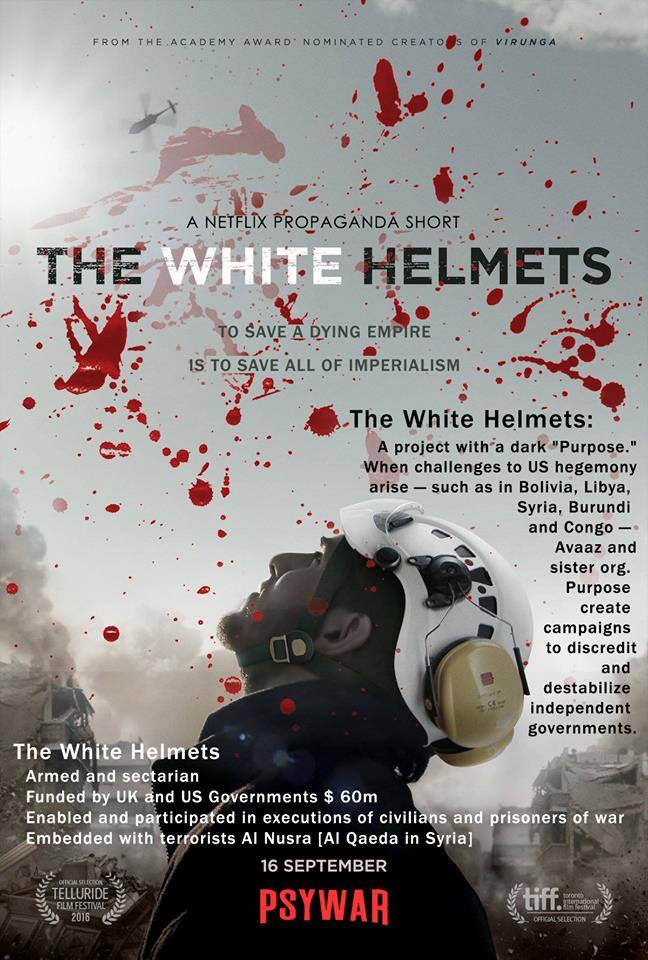
“Soros production, pure propaganda.”
“In Aleppo, the most important thing to remember is that all life is precious”. So precious that the White Helmets are ready to take the dead bodies away after Al-Qaeda executes them, while the camera is still rolling!!”
“When the saint go marching in”, White Helmets are not saints, they are terrorists. When not in front of a camera, they take off their white helmets and strap on their guns.”
“The white helmets are a media blitz project created by the US & UK in which they received monies from the state department & billionaires who made their fortune in the oil and gas industry.”
21WIRE will be bringing you more detailed reports on the Soros funding of the Netflix operation and of course further information on the REAL Syria Civil Defence that journalist Vanessa Beeley has recently met with and interviewed in Syria – in Aleppo, Lattakia, Tartous and the Head Quarters in Damascus.
Here is an excellent alternative to the Netflix official trailer made by Steve Ezzeddine for Hands Off Syria, Sydney. Watch:
For a further reading on the White Helmets and their role in the Dirty War on Syria read 21st Century Wire’s comprehensive compilation of the most important investigations into NATO’s latest fifth column creation: Who are the Syria White Helmets
Billions in Taxpayer Money to Israel: How the NYT Hides Unsavory Facts from View
By Barbara Erickson | TimesWarp | September 15, 2016
Thanks to American taxpayers, Israel has been receiving $3.1 billion in direct military aid each year, and under a new agreement signed this week that amount is set to rise to $3.8 annually. This is a hefty package and major news, but The New York Times has been oddly reticent about it, running a story on page 6 of the print edition and without fanfare online.
This is not a new phenomenon at the Times. Over the past year, as the United States and Israel have negotiated a new 10-year memorandum of understanding concerning military aid, readers have seen few references to the topic, and even with the signing of a new agreement this week, the newspaper maintains its minimalist approach.
The article by Peter Baker and Julie Hirschfeld Davis gives few details of the deal, instead proving a great deal of space to the state of U.S.-Israeli relations. The story reports that the present aid package (signed in 2007 and due to expire next year) amounts to “about $3 billion a year” with additional funds of up to $500 million a year authorized by Congress for missile defense.
We also learn that Israel made some concessions in negotiations, that this week’s deal is “the largest of its kind” and that Israel receives more U.S. money than any other country. But much is missing.
In fact, Israel gets more than half of all U.S. military aid ($3.1 billion out of a total of $5.9 billion), and Israel together with Egypt receives 75 percent of American foreign military assistance. Since the large allotment for Egypt is aimed at maintaining a non-threatening neighbor on Israel’s border, this could also be counted as indirect aid to Israel.
In fact Israel has been receiving well over $3.1 billion. By a conservative estimate, the United States has been giving the country $3.7 billion in direct aid annually with funds for immigrants to Israel, grants for American hospitals and schools, “joint defense projects” with the Department of Defense, and an early disbursement of aid.
The last item on that list refers to a special arrangement: In contrast to other recipients, Israel receives all its funds from the United States in one lump sum within the first month of the fiscal year. The money is then transferred to a Federal Reserve Bank interest-bearing account, allowing Israel to accrue some $15 million annually in interest.
Then there are other perks, such as loan guarantees, “cash flow financing,” and the right to purchase arms directly from companies rather than going through a Department of Defense review.
In addition, donations sent by Jewish and Christian groups to support settlements are tax-exempt. So every dollar donated to support the colonization of Palestinian land means the loss of at least 20 cents that should go into the U.S. treasury. This is an indirect subsidy to Israel that has cost American taxpayers an incalculable amount, at least some tens of millions of dollars.
The Times, however, has shown no interest in revealing the full extent of aid or of pursuing the arguments against pouring so much money into Israel. This week’s story mentions criticism of the aid agreement not until about three quarters into the text, and then it is reduced to three bland paragraphs with quotes from the representative of an anti-occupation organization.
In fact, the opposition goes well beyond such groups. A member of Congress, Rep. Betty McCollum (D-MN), has asked the State Department to investigate Israeli military units for possible violations of the Leahy Act, which prohibits the dispersal of U.S. funds to groups that violate human rights with impunity.
In 2012, 15 leaders of major religious organizations wrote to Congress asking that military aid be made contingent on compliance with American law. Other groups have sponsored billboards in various areas of the country highlighting the incredible largesse the United States provides for Israel.
Moreover, a poll of Americans taken in 2014 revealed that 60 percent believed the United States gives too much aid to Israel, and of that group 34 percent said it received “much too much.” The percentage claiming that our aid package was excessive was even higher (65 percent) among Americans under 34.
Other commentators have noted that Israel is a wealthy country, with universal health care, and is less in need of help than American citizens who struggle to fund their schools, pay for prescription drugs and meet medical fees.
None of this debate appears in the Times, which seems determined to keep the subject well below the radar. Thus we find a lightweight story on the inside pages of the print edition, well behind a more prominent one about Syrian and Israeli skirmishes in the Golan Heights, and an uninformative one-minute video of the signing ceremony on the Middle East page.
Times readers are to remain ignorant of the full, unsavory story about U.S. aid to Israel. If the facts were fully reported, this might inspire unwelcome questions and pushback. Better to say as little as possible and allow Israel to keep collecting its yearly billions from American taxpayers.
Follow @TimesWarp on Twitter.
UK blocks Iran’s gas revenues over bans
Press TV – September 14, 2016
Iran says it has been paid for selling natural gas from a field that it jointly owns with BP in the North Sea but the payments cannot be accessed due to sanctions.
Ali Kardor, the managing director of the National Iranian Oil Company (NIOC), was quoted by the media as saying that the revenues obtained from selling Iran’s share of the products of Rhum gas field have been deposited into an overseas NIOC account, stressing however that the same account is currently frozen.
Kardor added that Iran is currently negotiating with Britain to unfreeze the account which was established at a British bank before the 1979 Islamic Revolution after Iran and BP signed a deal to jointly invest in Rhum field.
The field started producing 190 million cubic feet of natural gas daily in 2005. However, the British government ordered it shut down in 2010 as a result of sanctions against Iran.
Production from the field resumed in 2013 and is presently supporting about five percent of the gas needs of Britain.
In September 2015, Iran’s Deputy Petroleum Minister for International and Commerce Affairs Amir-Hossein Zamaninia told reporters that UK’s Chargé d’Affaires to Iran Ajay Sharma had told him London would pay Iran its share of revenues from Rhum field after the removal of sanctions against Iran.
Zamaninia also discussed the issue with UK’s trade envoy to Iran and chairman of the British-Iranian Chamber of Commerce Lord Norman Lamont this past April. He told reporters that Britain had pledged to remove the barriers on the way of Iran’s access to revenues made from sales of natural gas from the Rhum gas field.
A History of Violence
What mainstream accounts of Venezuela’s “peaceful” opposition leave out
By Gabriel Hetland | Jacobin | September 11, 2016
The media narrative is clear: peaceful demonstrators upset about a collapsing economy and political repression are fighting an oppressive state in Venezuela. The actual history, however, is more murky.
For more than a decade the Venezuelan opposition has used a variety of violent tactics to try to topple the country’s democratically elected government. An April 2002 coup deposed Hugo Chávez for forty-seven hours and led to multiple civilian deaths.
Violent protests in April 2013 targeted government-run health clinics and other public institutions, resulting in at least seven civilian casualties; this occurred following the 2013 presidential election, which the opposition lost but refused to concede to the government. The early 2014 wave of protests resulted in forty-three deaths, half at the hands of the opposition.
During the 2014 protests, opposition activists deliberately targeted state security forces and even strung galvanized wire across intersections, leading to the brutal decapitation of a motorcyclist. Nor can we omit mention of the approximately two hundred peasant leaders killed by ranchers opposed to the 2001 land reform law pushed by Chávez.
This brutal history is almost totally absent from mainstream media depictions of the opposition. The same is true of leading opposition figures’ present-day celebrations of this violence. In mainstream accounts of last week’s protests in Caracas, the opposition is depicted as an essentially peaceful force, seeking to use constitutional means — a recall referendum — to legally put an end to an incompetent, repressive government.
An article on the protests in the Wall Street Journal quotes an opposition supporter saying, “[D]on’t tell me that we didn’t try to demand change peacefully through the constitution.” The article briefly mentions the 2002 coup, but fails to note that leading members of today’s opposition played key roles in that episode. Nor does it make any mention of more recent instances of opposition violence.
A New York Times article on the protests details the deteriorating conditions in Venezuela leading people to protest against the government, and provides ample coverage of claims that the government has repressed dissident politicians and foreign journalists. No mention is made of opposition violence.
A BBC article on the September 1 protests states that “A small group of protesters clashed with riot police as the peaceful rally ended.” The article mentions the 2014 protests and states that, “Forty-three people on both sides of the political divide were killed during those protests.” Like other mainstream articles, however, this piece focuses disproportionately on opposition allegations of instances of government repression.
A piece in Bloomberg on the September 1 protests briefly discusses the 2014 protests, but misleadingly gives readers the impression that “over 40 people were killed” because of a government “crackdown on anti-government protests,” eliding the opposition’s responsibility for many of those deaths.
The takeaway from these and other mainstream media stories about the protests is clear: the opposition is peaceful, and there is no reason to believe the government’s delusional and self-serving claims that it faces a real threat of a violent coup.
Indeed, opposition leaders have repeatedly denied seeking a coup. But statements from these figures, not to mention recent history, indicate that the government may have more reason to worry than mainstream sources allow for.
In May, Henrique Capriles, the opposition presidential candidate in the 2012 and 2013 elections, exhorted the Venezuelan military to “decide whether you are with the constitution or with Maduro.”
Other opposition leaders, such as Jesús Torrealba, have also made public statements that steer clear of explicitly calling on the military to overthrow the government, but still suggest that the military should actively support the opposition against President Maduro. One wonders how government officials in other countries would react if leading opposition figures made similar statements there?
A good test of whether the opposition is as “peaceful” as media accounts suggest is to examine how opposition leaders speak about past episodes of violence. It’s telling that key opposition figures not only fail to express remorse or contrition when events such as the 2002 coup are discussed, but openly celebrate such acts.
During a speech given on August 27, just days before the September 1 protests, Venezuelan National Assembly head and leading opposition figure Henry Ramos Allup repeatedly refers to the coup in an approving matter. In the speech Ramos Allup makes it clear that his only regret is that it did not succeed in ousting Chávez.
No doubt, there is plenty to criticize about the Venezuelan government these days. The government deserves ample blame for mismanaging its currency and failing to confront corruption. State violence that does occur should be condemned and there’s a need for an independent left to grow in the country. But the narratives we’re being sold by the media are giving the opposition a free pass.
Gabriel Hetland teaches at University at Albany and has written about Venezuelan politics for the Nation, NACLA, Qualitative Sociology, and Latin American Perspectives.
The Guardian’s coverage of Clinton’s health
By Kit | OffGuardian | September 12, 2016
OffGuardian has been quiet on the issue of Clinton’s health, about which there has been a whole lot of speculation in the alt-news in recent weeks, and a whole lot of denial in the MSM. Discussing someone’s health can be tricky, you have to tread a fine line between journalism and voyeurism. You have to have a baseline of respect for privacy that, one would hope, would be applied to oneself by others.
However, this isn’t about a private citizen, this is about the physical and mental fitness of the (notionally) most powerful person on the planet… and the absurdity of the current narrative cries out for a response. Stories about Clinton’s health in the Guardian or on CNN simply say “there is no evidence Clinton is sick!” and complain about Trump’s campaign stoking “conspiracy theories” (I was not aware that “Gosh, that old lady doesn’t look well!” was a conspiracy theory… but that’s the media for you).
The problem with the argument that “there’s no evidence Clinton is ill” is, pretty simply, that there’s quite a lot of evidence Clinton is ill.
- First, there are her coughing fits. Over the past couple of years Hillary has had repeated fits of coughing. See here, here and here.
- Secondly, there are her bizarre facial movements/spasms, what some people describe as “seizures”. The famous one here, and the odd one at the DNC.
- Third, there is her memory loss and cognitive problems, see this video, where she appears to freeze up. When she does eventually speak she simply repeats the phrase that was whispered into her ear by a man who appears to be secret service (there has been a lot of speculation as to his identity and/or role).
- Fourth, blood clots. She has had two major blood clots, one in her brain, and is consequently on blood thinners to prevent a third.
- Fifth, apparent weakness and unsteadiness. There are many photographs of Clinton seeming to need assistance standing, balancing, or climbing stairs. In many of her public appearances she is propped up on a stool rather than standing up.
The web is rich with speculation and theorising trying to tie these threads of evidence to a solid hypothesis, plenty of doctors have given their opinions, and some of their ideas seem to have merit. But that is not the point of this article. The point of this article is more to ask a simple question: How far will the media go to persuade people they cannot trust their own eyes? How self-evident must something be before it can no longer be dismissed as a “conspiracy theory”?
No mainstream media source has discussed the possibility that Clinton might be sick, no newspaper or network has offered a refutation of the evidence, or an explanation of her bizarre behaviour. They simply do not discuss it. That is not how a healthy media should work.
For weeks The Guardian has put out opinion pieces such as this, and this, which construct straw-man arguments to dismiss the idea that Clinton might be anything other than perfectly fine.
In her latest in a long line of Clinton-touting nonsense, Jill Abramson repeats that Hillary is “fundamentally honest” (whatever the hell that means), before summing up yesterdays collapse as:
…the candidate appeared to stumble after leaving the 9/11 memorial in New York.”
Which is akin to summarising the plot of Jaws as “Some fishermen appear, from some angles, to get rather too close to a shark”.
At the same time Barack Obama’s biographer, Richard Wolffe, describes the “stumble” in even more benign terms. A “hot wobble” he calls it, before launching into a rather long polemic about how Trump is worse than Hillary in practically every regard (including physically). It was just unfortunate, he says, that Hillary’s perfectly normal “hot wobble” happened to be caught on camera. She is actually totally healthy and fine.
All of which is rather undermined by the presence of an editor’s note which reads:
Editor’s note: shortly after publication of this article, the Clinton campaign revealed she was suffering from pneumonia.”
Friday’s beautifully Orwellian “Facebook Fact-check” (which, for the record, checked no facts) repeated the claim:
Unlike her rival Donald Trump, Clinton has released fairly detailed medical records. There is no evidence to suggest the 68-year-old should be worried about her health.
But Clinton has NOT released “detailed” medical records, rather her doctor – Dr Lisa Bardack – wrote an open letter to the New York Times… over a year ago. Incidentally, this is the same doctor who was shadowing the perfectly healthy candidate all yesterday morning…just in case she got heatstroke allergies pneumonia.
Perhaps the most beautifully timed editorial on the subject was David Ferguson’s, it headlined:
I cough at all the wrong times. Thank God I’m not Hillary Clinton”
Before adding in the sub-head:
Those of us with allergies know only too well what that tickle at the back of the throat feels like. Luckily, no one assumes we’re secretly dying.”
And then finishing on this note:
Sometimes, oh ye right-wing vultures, a cough is just a cough and the female candidate whose health you’ve never cared one iota about before now is probably just fine, suffering from – as her personal physician disclosed in detail – a round of seasonal allergies.
Three hours after this was published, Clinton collapsed in a parking lot. Ten minutes after that, the comments section under Mr Ferguson’s article was closed. It was a farce, and could not have been better timed if it had been deliberate.
Of course, the media’s refusal to deal with the subject of Clinton’s health goes beyond ATL denial, there is also the (now standard) BTL censorship.
In the interest of promoting educated discussion on this subject, I endeavoured to point out the relationship between pneumonia and some neurological diseases, like Parkinson’s, in the CiF comment section:

… Only to find that the Guardian is currently censoring any comment that uses the word “Parkinson’s”, I suggest you try it for yourself.

Interestingly, “Dr Drew” (real name Dr. David Andrew Pinsky), a famous TV doctor in the US, was subject to rather more high-profile censorship when he was fired just a week after airing his totally non-partisan thoughts on Clinton’s health, and the ability of her doctors.
I hope they realise that simply concealing a fact doesn’t change reality. I don’t know whether or not Hillary is ill, but IF Hillary is, in fact, very sick…no amount of censorship or denial is going to keep her alive.
The New York Times is looking for a climate change editor
Drone footage that shows Greenland melting away. Long narratives about the plight of climate refugees, from Louisiana to Bolivia and beyond. A series on the California drought. Color-coded maps that show how hot it could be in 2060.
The New York Times is a leader in covering climate change. Now The Times is ramping up its coverage to make the most important story in the world even more relevant, urgent and accessible to a huge audience around the globe.
We are looking for an editor to lead this dynamic new group. We want someone with an entrepreneurial streak who is obsessed with finding new ways to connect with readers and new ways to tell this vital story.
The coverage should encompass: the science of climate change; the politics of climate debates; the technological race to find solutions; the economic consequences of climate change; and profiles of fascinating characters enmeshed in the issues.
The coverage should include journalism in a variety of formats: video, photography, newsletters, features, podcasts, conferences and more. The unit should make strategic decisions about which forms are top priorities and which are not.
The climate editor will collaborate with many others throughout the newsroom, but will operate apart from the current department structure, with no print obligations. —
To Apply
Applicants should submit a resume, examples of previous work, and a memo outlining their vision for coverage to Dean Baquet and Sam Dolnick by Sept. 19. This vision is the most important part of the application. It should be specific and set clear priorities. Some important questions to wrestle with:
What audiences should we be focusing on?
How will our coverage fit into their lives, and how will they experience it?
How will we distinguish our coverage from other journalism in this space?
What will be the main vehicles for the coverage? Features? News? Videos?
Should there be a signature voice attached to our climate coverage? Who?
How will you make a difficult subject interesting and accessible?
What stories are we willing not to do?
What should the team look like to get it done?
This non-Guild position is open to internal and external candidates. Applications should be sent to nytrecruit@nytimes.com.
US Wants Respite, Not Ceasefire in Syria
By Finian Cunningham | Sputnik | September 11, 2016
Tough negotiations between America and Russia’s top diplomats have managed to produce a tentative ceasefire plan for Syria. But Washington doesn’t really want a ceasefire. More likely, a respite for its regime-change proxies.
After more than 13 hours of intense discussions in Geneva this weekend, on top of months of back-and-forth talks, US Secretary of State John Kerry and Russian Foreign Minister Sergey Lavrov emerged in a joint press conference to announce that a cessation in fighting would begin this week.
A previous attempt at implementing a truce back in February failed within days of that initiative because anti-government insurgents affiliated with the al-Qaeda terrorist network refused to abide by that earlier agreement.
There is no reason why this second ceasefire attempt should otherwise succeed in holding.
There may well be a temporary lull in violence simply because opposition militia will avail of the opportunity to regroup and repair. But the core of the insurgents are dominated by terrorist groups like Jabhat Fatah al Sham (formerly al-Nusra Front) and Daesh and numerous other affiliates.
These proscribed terror groups have no interest in negotiating a political transition in Syria with the incumbent government of President Bashar Assad. Their whole purpose is to overthrow the state and turn it into a so-called caliphate ruled by fear.
This gets to the kernel of why the ceasefire deal worked out by Kerry and Lavrov is fatally flawed.
Arguably, the Russian side is negotiating in good faith with the genuine intention of achieving a peaceful resolution to the nearly six-year-old conflict, which has resulted in 400,000 dead and millions displaced from their homes. But not so the American side.
We must always keep firmly in mind that the conflict in Syria was instigated in the first place by the US and other foreign powers for the objective of regime change against the Assad government – a long-time ally of Russia and Iran.
Recall that former French Foreign Minister Roland Dumas revealed in 2013 that the foreign conspiracy for regime change in Syria was hatched at least two years before the violence erupted in March 2011.
This US-led criminal agenda for regime change has not changed. When John Kerry talks about getting Russia to sign up to a “political transition” he means a process which will culminate in the ouster of the Assad government.
At the Geneva press conference this weekend, the US diplomat clearly said that he was coordinating his efforts with those of the exiled opposition group called the High Negotiations Committee. Days before, the Saudi-backed HNC unveiled yet another “vision” demanding “transition” and Assad’s departure.
On the Geneva meeting this weekend, the Washington Post reported: “Kerry acknowledged the truth of the Russian charge that some opposition groups are fighting in tandem with the [al-Nusra] Front and said it was incumbent on them to now make a choice.”
The paper also noted: “Both Kerry and Lavrov emphasized that outside supporters of all non-terrorist [sic] belligerents would have to bring their allies in line.”
Without this putative separation of “moderates” and “terrorists” then there can be no feasible premise for a substantive cessation of violence. The proposal for US and Russian forces to subsequently cooperate in carrying out air strikes against terror groups is therefore a non-starter.
The confidence for this assertion is because, as Kerry half-acknowledged, there is no distinction between “moderate rebels” and “terrorists”. They are all part of the same regime-change proxy army that the US and its NATO and regional allies orchestrated from the outset of this reprehensible conflict.
Expecting these proxies to somehow sort themselves into “good guys” and “bad guys” is a ludicrous conception of how and why the war was instigated and prosecuted.
Washington and the Western news media engage in euphemisms of how these groups are “intermingled”, “overlap” and “marbled”. But such attempts at differentiation are either deluded or deceitful. For virtually all the anti-government insurgents are integrated into the same terrorist front. That’s why months of Russian admonitions to the US to segregate its supposed moderates from the terrorists have resulted in no separation.
For John Kerry to propose at this late stage for “non-terrorist belligerents” to get onboard with the ceasefire is nothing but a cynical ruse.
So what is Washington really seeking? Part of the proposed deal involves Russian and Syrian forces calling off their offensive against eastern Aleppo – the so-called “lifting of the siege” and supplying “humanitarian aid” to insurgent-held areas.
Cynically, but realistically, those provisions are less about halting violence and humanitarian effort and more about giving the foreign-backed regime-change forces a much needed breathing space.
Ever since Russia sent its forces into Syria at the end of last year, the US-led regime-change war has turned into a losing campaign.
What Washington and its other foreign co-conspirators – Britain, France, Turkey, Israel and Saudi Arabia – badly need is to give their proxies a respite from the withering offensive of the Syrian army and its Russian, Iranian and Hezbollah allies.
A reasonable conjecture is that the Pentagon and CIA war planners – Kerry’s ultimate bosses – want a holding and reorganizing position until Hillary Clinton is elected as the new president. Lame-duck Obama has been too much of a ditherer and not sufficiently gung-ho about regime change in Syria.
Clinton, on the other hand, has vowed to step up American military intervention in Syria. She has called for setting up of no-fly zones and a tougher stance towards Assad and Russia.
But if Syrian and Russian forces continue their rate of attrition against the regime-change proxies, there may be little of these foreign assets left by the time Clinton takes office early next year. Hence, the insurgents must be salvaged from their precipitous defeat – and this is what really pertains to the “ceasefire” that Kerry has appeared so keen to accomplish.
The conjecture of a “holding, reorganizing position” also tallies with the recent invasion by Turkish military forces into northern Syria and the joint US-Turk annexation of territory. It suggests that a greater war effort for regime change is being anticipated for when Clinton takes office. (Assuming Donald Trump’s candidacy can be wrecked by the relentless US media vilification he is being subjected to.)
Which begs the question: why have Russia and the Syrian government apparently gone along with this latest ceasefire arrangement? If, that is, it is a cynical ruse for regime change?
Why don’t Syria and Russia just drive on with their very effective offensive to defeat the terrorist regime-change front?
Perhaps, Syria and Russia have their own calculations for regrouping and refining tactics for resuming even greater offensive power.
Or perhaps, Russia knows all too well, privately, that the Americans are full of claptrap. This latest ceasefire proposal has no chance of working because of the inherent flaws. But Russia’s international reputation has little to lose from “giving peace a chance”. [a likelier conjecture]
So, let Washington’s proposal for “separation” of insurgents fail, fail, and fail again, and let the world come to see the utter fallacy and criminality of American policy.
The trouble, however, is that more delay gives more leverage to a Clinton presidency and what promises to be a far more warmongering next White House administration.
Finian Cunningham is a Master’s graduate in Agricultural Chemistry and worked as a scientific editor for the Royal Society of Chemistry, Cambridge, England. For nearly 20 years, he worked as an editor and writer in major news media organisations, including The Mirror, Irish Times and Independent.
Featured Video

Seyed M. Marandi: US-Iran War Inevitable: Kuwait and Bahrain May Fall
or go to
Aletho News Archives – Video-Images
From the Archives
USS Liberty Massacre: A Pivotal Moment in the Hostile Takeover of America
By Kevin Barrett | Crescent | Dhu al-Qa’dah 24, 1445
In corporate America, hostile takeovers are commonplace. They occur when an aggressor—a larger corporation or rich individuals—seizes control of a smaller corporation without asking permission.
What few recognize is that the United States itself has been subjected to a hostile takeover. Since the aggressor, the illegitimate settler colony known as “Israel,” is much smaller than the US, the takeover has necessarily been surreptitious.
As of June, 2024, Israel’s gradual takeover of the US has become obvious and undeniable—a proverbial “elephant in the living room.” … continue
Blog Roll
 Aletho News
- Seyed M. Marandi: US-Iran War Inevitable: Kuwait and Bahrain May Fall
- Leaders Condemn Ansarallah Attack on Saudi Arabia While Ignoring Illegal War Against Yemen
- Leaked: Britain’s Covert Iraqi Psyops Network
- Yemeni Armed Forces Warn Airlines Against Using Saudi Airports, Exempt Mecca and Medina
- Iran security chief says powers greater than US tried to conquer Iran but ended in ‘dustbin of history’
- Europe’s mounting social chaos… chickens coming home to roost for proxy war against Russia
- US-Russia Diesel Deal Becomes Massive Defeat for Ukraine
- Hormuz and the Looming Economic Catastrophe
- Dhubab offensive, media blitz and the rapid unraveling of Saudi-backed coalition’s new gambit
- Putin Conveys to Trump Iran’s Vision on Possible Conflict Resolution – Kremlin
- If Americans Knew
- Gaza: Ceasefire Anniversary Marks Year of Failed Promises
- The American Conservative: Mike Huckabee Should Resign
- A C-Section in Shackles: A Palestinian Woman’s Harrowing Birth in Israeli Detention
- ‘He’s Desperate’: AIPAC Begins Spending Against Abdul El-Sayed to Boost Mike Rogers:
- Trump, Hormuz, and the Looming Economic Catastrophe
- For three years, Israel has killed a child in Gaza every 71 minutes – Daily Update
- Israeli forces kill another child in Gaza – Daily Update
- Gaza ceasefire exists in name only, say more than 100 organizations
- Nearly 2 Million in Gaza Need Urgent Shelter Assistance as Winter Looms: IOM Chief Warns
- Suppressing Palestinian resistance: US charity under fire for AI monitoring of Gaza classrooms
- No Tricks Zone
- Germany’s Green Energy Debacle: High Energy Costs Force Kahla Porzellan to Close After 182 Years!
- New Study: 50 Years Of The Most Aggressive ‘Net Zero’ Policies Can Only Affect The Global Climate By 0.03°C
- US September “Heat” Was No Record…Many Records Set Decades Ago
- Latest European Green Energy Debacle; Portugal’s Largest Flagship Solar Park Insolvent!
- Green Energy Debacle: German Expert Professor Fritz Vahrenholt Warns Of Severe Economic And Social Consequences
- Two More Paleo Reconstructions Affirm Meters-Higher Sea Levels Across Ireland, Brazil 7000-6000 Years Ago
- New Study: Earth And Venus Surface Warmth Largely Explained By Convection And Lapse Rate, Not CO2 Or Radiation
- 2025 Nature Paper Claiming Worsening Global Drought Gets RETRACTED …Heavily Flawed
- New Study: ‘Global Drought Shows No Detectable Recent Acceleration Under Climate Warming’
- Economic Masterminds: German Socialists Suggest Taxing Productivity Gains Stemming From Using AI

