Recently, the US Department of State has submitted to Congress its annual Report on Adherence to and Compliance with Arms Control, Nonproliferation and Disarmament Agreements and Commitments.
Among other things, Washington has chosen Moscow as the target for unsubstantiated insinuations and lies on the issue of Russia’s compliance with the Convention on the Prohibition of the Development, Production and Stockpiling of Bacteriological (Biological) and Toxin Weapons and on their Destruction (BWC). It is becoming ever more obvious that regular verbal attacks against Russia are used to distract attention from the unseemly role that the US plays within the BWC context.
The reality is that it is the US who seriously damaged the BWC regime by single-handedly ruining the long-lasting multilateral talks on the supplementary BWC protocol that were about to come to an end. The microbiological activity of the member states under the developed protocol would have been subject to on-site inspections by an independent authority. Having derailed the protocol, the US now complains of having no possibility to verify compliance with the BWC.
However, it has nobody to blame but itself for this, including the fact that it has blocked any constructive attempts to step up specific work within the framework of the BWC since 2001.
Against this background, the international community witnesses the Pentagon’s dangerous microbiological activities.
The US Department of Defense has been mailing live anthrax spores all over the world for years. Far from being accidental, this occurred on 195 occasions and reached 12 different countries. As a result, not only US citizens but also populations in other countries were exposed to lethal danger. Until now, the scale of these violations has not been revealed or explained, including the real purpose of the Defense Department’s spore-producing “industrial facilities” and the reason for distributing them to US military bases overseas.
For a further example, the Defense Department has been continuously expanding worldwide its military biological infrastructure. These facilities have sprung up in many countries, and in recent years they are being created increasingly closer to Russian borders. For instance, a high-level bio-safety laboratory was built in Georgia, with Washington and Tbilisi making efforts to conceal the true content and focus of this military unit’s activities. The Pentagon is also trying to introduce similar undercover military medical-biological facilities to other CIS countries.
While accusing developing countries of a lack of progress in implementing the BWC at the national level, the US has consistently kept intact its own laws, which run counter to its international commitments. These include, in particular, reserving the right, in the 1925 Geneva Protocol, to retaliate with chemical or toxin weapons and presidential Executive Order 11850 enabling US armed forces to use “nonlethal” chemical or toxin weapons as warfare agents. Particularly flagrant is applying the 2001 Patriot Act to actually endorse the development of biological weapons with governmental assent.
In the meantime, Russia, along with a few other states, is busy trying to launch multilateral negotiations aimed at strengthening the Biological Weapons Convention as a tool of mutual security. Our US partners should constructively engage in these efforts, instead of judging others and making unsubstantiated allegations.
Dr Alexander Yakovenko is Russia’s Ambassador to the United Kingdom of Great Britain and Northern Ireland, Deputy foreign minister (2005-2011). Follow him on Twitter @Amb_Yakovenko
April 30, 2016
Posted by aletho |
Deception, Militarism, Progressive Hypocrite | Biological Weapons Convention, Obama, Patriot Act, Russia, United States |
Leave a comment
During the 2011 Arab Spring, it was clear to those who bothered to look, that the US State Department and the various arms of soft power attached to it were directly responsible for what was otherwise initially passed off as a spontaneous, region-wide uprising.
Eventually, what was dismissed as “conspiracy theory” regarding the US-backed nature of the uprising, was finally admitted to by the New York Times in an April 2011 article titled, “U.S. Groups Helped Nurture Arab Uprisings,” which admitted that:
A number of the groups and individuals directly involved in the revolts and reforms sweeping the region, including the April 6 Youth Movement in Egypt, the Bahrain Center for Human Rights and grass-roots activists like Entsar Qadhi, a youth leader in Yemen, received training and financing from groups like the International Republican Institute, the National Democratic Institute and Freedom House, a nonprofit human rights organization based in Washington, according to interviews in recent weeks and American diplomatic cables obtained by WikiLeaks.
The New York Times would go on to admit direct ties between the above-mentioned organizations and both the US Congress and the US State Department.
The article would also admit:
Some Egyptian youth leaders attended a 2008 technology meeting in New York, where they were taught to use social networking and mobile technologies to promote democracy. Among those sponsoring the meeting were Facebook, Google, MTV, Columbia Law School and the State Department.
The 2008 meeting wasn’t the only one. And, as it would turn out, Facebook and Google’s role in preparing the ground for the Arab Spring, quite literally years before the “spontaneous” protests erupted, was much more complicated than merely being sponsors of a single event in New York.
Hillary Clinton was serving as US Secretary of State both during and in the lead up to the Arab Spring. She even attended via teleconference one of these “technology meetings” briefly mentioned by the New York Times.
Also attending the meetings were actually staff from the US State Department and various staff from both Google and Facebook. Also in attendance were members of the US media. In other words, the event was not only sponsored by the US government and these two tech-giants, it was organized and conducted by them as well. Their event program (PDF) makes this abundantly clear.
The purpose was clearly to create a unified network combining the US State Department’s direction, the tech-giant’s technical capabilities, and influence of the US media together to overwhelm the information space when finally the time came for the Arab Spring to unfold. And overwhelm it did. The governments of Tunisia, Egypt, Yemen, and Libya fell, with violence and even war breaking out in the latter three, while Syria to this day remains engulfed in violence that began in the wake of the 2011 operation.
More recently, e-mails leaked from then US Secretary of State Hillary Clinton, reveal further details on just how close the tech-giants work with the government. Some could even say they are an extension of the government.
A CBS article titled, “Clinton Emails Show State Department’s Close Relationship With Google,” reveled that:
The latest release of emails sent to and from Hillary Clinton’s private email server reveals a close relationship between Google and the State Department.
A 2012 email recently uploaded onto Wikileaks’ searchable archive came from Google Ideas director Jared Cohen, who formerly worked as an advisor to Secretary Clinton, indicates that Google wanted to help bolster support for those who defected from Syrian President Bashar al-Assad’s military.
It also showed that before launching a “defection tracker” Cohen wanted the State Department to weigh in on the idea and potentially provide feedback.
Not only does the leak expose what appears to be a revolving door between the tech-giant and the US State Department, but it exposes the fact that regardless of who is working where, Google was working in tandem with the State Department. Cohen was actually listed in the above cited event program as Policy Planning Staff of the Office of the Secretary of State meaning that before moving to Google he was working with Google to undermine various foreign governments, and continued to do so after he moved from government to the private sector.
Just Warming Up
Google and Facebook are still very much engaged in information warfare for the US government and the special interests that it serves. Likewise, the US State Department is still very much in the business of subverting foreign nations by recruiting, training, equipping and directing collaborators from targeted nations.
Facebook, for example, has expressed plans to get everyone on the planet on the Internet. The seemingly humanitarian mission is in all actuality an attempt to get the world on Facebook, which through its algorithms and ability to censor, ban and delete accounts at will, would virtually control what the world saw and didn’t see.
More forward-thinking states like Russia and China have noted this reality of the 21st century battlefield and have responded by creating their own domestic versions of Google and Facebook. An arms race of sorts has begun between these competing services both in terms of reach and capabilities for everything from artificial intelligence deep learning algorithms to the ability to control and influence the flow of information over and within borders.
Tech-centric US-funded nongovernmental organizations have begun to spring up alongside their traditional US-funded collaborators in nations around the world, specializing in doing many of the sort of workshops initially conducted by the US State Department, Google and Facebook before the Arab Spring. For nations either not aware of this or incapable of responding to this threat, it could be comparable to a new weapon of war taking to the battlefield one has no defense to or anything which which to strike back with.
This threat will only increase, with the “information war” becoming more and more literal as advances are made in information technology. The US is openly using information technology to augment its hegmonic ambitions around the world, with e-mail leaks confirming what many have already suspected all along. What is more worrisome is the collaborations and technologies being used now that are not being disclosed or “leaked.”
For nations around the world, raising literacy in terms of information technology and the threat it poses can help inoculate their populations from the overwhelming nature of foreign-backed operations like the Arab Spring. By creating and cultivating a domestic information technology sector and recruiting talent before the US does, creating competitive services like Russia’s VK and China’s Baidu not only serves as a means of improving and diversifying one’s economy, but can also serve as an important pillar of national security in the 21st century.
April 30, 2016
Posted by aletho |
Deception, Full Spectrum Dominance | Facebook, Google, Hillary Clinton |
Leave a comment
A few weeks after leaving office, former Secretary of State Hillary Clinton may have breathed a sigh of relief and reassurance when Director of National Intelligence James Clapper denied reports of the National Security Agency eavesdropping on Americans. After all, Clinton had been handling official business at the State Department like many Americans do with their personal business, on an unsecured server.
In sworn testimony before the Senate Intelligence Committee on March 12, 2013, Clapper said the NSA was not collecting, wittingly, “any type of data at all on millions or hundreds of millions of Americans,” which presumably would have covered Clinton’s unsecured emails.
But NSA contractor Edward Snowden’s revelations — starting on June 5, 2013 — gave the lie to Clapper’s testimony, which Clapper then retracted on June 21 – coincidentally, Snowden’s 30th birthday – when Clapper sent a letter to the Senators to whom he had, well, lied. Clapper admitted his “response was clearly erroneous – for which I apologize.” (On the chance you are wondering what became of Clapper, he is still DNI.)
I would guess that Clapper’s confession may have come as a shock to then ex-Secretary Clinton, as she became aware that her own emails might be among the trillions of communications that NSA was vacuuming up. Nevertheless, she found Snowden’s truth-telling a safer target for her fury than Clapper’s dishonesty and NSA’s dragnet.
In April 2014, Clinton suggested that Snowden had helped terrorists by giving “all kinds of information, not only to big countries, but to networks and terrorist groups and the like.” Clinton was particularly hard on Snowden for going to China (Hong Kong) and Russia to escape a vengeful prosecution by the U.S. government.
Clinton even explained what extraordinary lengths she and her people went to in safeguarding government secrets: “When I would go to China or would go to Russia, we would leave all my electronic equipment on the plane with the batteries out, because … they’re trying to find out not just about what we do in our government, they’re … going after the personal emails of people who worked in the State Department.” Yes, she said that. (emphasis added)
Hoisted on Her Own Petard
Alas, nearly a year later, in March 2015, it became known that during her tenure as Secretary of State she had not been as diligent as she led the American people to believe. She had used a private server for official communications, rather than the usual official State Department email accounts maintained on federal servers. Thousands of those emails would retroactively be marked classified – some at the TOP SECRET/Codeword level – by the department.
During an interview last September, Snowden was asked to respond to the revelations about highly classified material showing up on Clinton’s personal server: “When the unclassified systems of the United States government, which has a full-time information security staff, regularly gets hacked, the idea that someone keeping a private server in the renovated bathroom of a server farm in Colorado is more secure is completely ridiculous.”
Asked if Clinton “intentionally endangered US international security by being so careless with her email,” Snowden said it was not his place to say. Nor, it would seem, is it President Barack Obama’s place to say, especially considering that the FBI is actively investigating Clinton’s security breach. But Obama has said it anyway.
“She would never intentionally put America in any kind of jeopardy,” the President said on April 10. In the same interview, Obama told Chris Wallace, “I guarantee that there is no political influence in any investigation conducted by the Justice Department, or the FBI – not just in this case, but in any case. Full stop. Period.”
But, although a former professor of Constitutional law, the President sports a checkered history when it comes to prejudicing investigations and even trials, conducted by those ultimately reporting to him. For example, more than two years before Bradley (Chelsea) Manning was brought to trial, the President stated publicly: “We are a nation of laws. We don’t let individuals make decisions about how the law operates. He [Bradley Manning] broke the law!”
Not surprisingly, the ensuing court martial found Manning guilty, just as the Commander in Chief had predicted. Though Manning’s purpose in disclosing mostly low-level classified information was to alert the American public about war crimes and other abuses by the U.S. government, Manning was sentenced to 35 years in prison.
On March 9, when presidential candidate Clinton was asked, impertinently during a debate, whether she would withdraw from the race if she were indicted for her cavalier handling of government secrets, she offered her own certain prediction: “Oh, for goodness sake! It’s not going to happen. I’m not even answering that question.”
Prosecutorial Double Standards
Merited or not, there is, sadly, some precedent for Clinton’s supreme confidence. Retired General and ex-CIA Director David Petraeus, after all, lied to the FBI (a felony for “lesser” folks) about giving his mistress/biographer highly classified information and got off with a slap on the wrist, a misdemeanor fine and probation, no jail time – a deal that Obama’s first Attorney General Eric Holder did on his way out the door.
We are likely to learn shortly whether Attorney General Loretta Lynch is as malleable as Holder or whether she will allow FBI Director James Comey, who held his nose in letting Petraeus cop a plea, to conduct an unfettered investigation this time – or simply whether Comey will be compelled to enforce Clinton’s assurance that “it’s not going to happen.”
Last week, Fox News TV legal commentator Andrew Napolitano said the FBI is in the final stages of its investigation into Clinton and her private email server. His sources tell him that “the evidence of her guilt is overwhelming,” and that the FBI has enough evidence to indict and convict.
Whether Napolitano has it right or not, it seems likely that Clinton is reading President Obama correctly – no profile in courage is he. Nor is Obama likely to kill the political fortunes of the now presumptive Democratic presidential nominee. Yet, if he orders Lynch and Comey not to hold Hillary Clinton accountable for what – in my opinion and that of most other veteran intelligence officials whom I’ve consulted – amounts to at least criminal negligence, another noxious precedent will be set.
Knowing Too Much
This time, however, the equities and interests of the powerful, secretive NSA, as well as the FBI and Justice, are deeply involved. And by now all of them know “where the bodies are buried,” as the smart folks inside the Beltway like to say. So the question becomes would a future President Hillary Clinton have total freedom of maneuver if she were beholden to those all well aware of her past infractions and the harm they have done to this country.
One very important, though as yet unmentioned, question is whether security lapses involving Clinton and her emails contributed to what Clinton has deemed her worst moment as Secretary of State, the killing of Ambassador Christopher Stevens and three other U.S. personnel at the lightly guarded U.S. “mission” (a very small, idiosyncratic, consulate-type complex not performing any consular affairs) in Benghazi, Libya, on Sept. 11, 2012.
Somehow the terrorists who mounted the assault were aware of the absence of meaningful security at the facility, though obviously there were other means for them to have made that determination, including the State Department’s reliance on unreliable local militias who might well have shared that inside information with the attackers.
However, if there is any indication that Clinton’s belatedly classified emails contained information about internal State Department discussions regarding the consulate’s security shortcomings, questions may be raised about whether that information was somehow compromised by a foreign intelligence agency and shared with the attackers.
We know that State Department bureaucrats under Secretary Clinton overruled repeated requests for additional security in Benghazi. We also know that Clinton disregarded NSA’s repeated warnings against the use of unencrypted communications. One of NSA’s core missions, after all, is to create and maintain secure communications for military, diplomatic, and other government users.
Clinton’s flouting of the rules, in NSA’s face, would have created additional incentive for NSA to keep an especially close watch on her emails and telephone calls. The NSA also might know whether some intelligence service successfully hacked into Clinton’s server, but there’s no reason to think that the NSA would share that sort of information with the FBI, given the NSA’s history of not sharing its data with other federal agencies even when doing so makes sense.
The NSA arrogates to itself the prerogative of deciding what information to keep within NSA walls and what to share with the other intelligence and law enforcement agencies like the FBI. (One bitter consequence of this jealously guarded parochialism was the NSA’s failure to share very precise information that could have thwarted the attacks of 9/11, as former NSA insiders have revealed.)
It is altogether likely that Gen. Keith Alexander, head of NSA from 2005 to 2014, neglected to tell the Secretary of State of NSA’s “collect it all” dragnet collection that included the emails and telephone calls of Americans – including Clinton’s. This need not have been simply the result of Alexander’s pique at her disdain for communications security requirements, but rather mostly a consequence of NSA’s modus operandi.
With the mindset at NSA, one could readily argue that the Secretary of State – and perhaps the President himself – had no “need-to-know.” And, needless to say, the fewer briefed on the NSA’s flagrant disregard for Fourth Amendment protections against unreasonable searches and seizures the better.
So, if there is something incriminating – or at least politically damaging – in Clinton’s emails, it’s a safe bet that at least the NSA and maybe the FBI, as well, knows. And that could make life difficult for a Clinton-45 presidency. Inside the Beltway, we don’t say the word “blackmail,” but the potential will be there. The whole thing needs to be cleaned up now before the choices for the next President are locked in.
Ray McGovern works with Tell the Word, a publishing arm of the ecumenical Church of the Saviour in inner-city Washington. He served as a CIA analyst for 27 years, during which he prepared and briefed the morning President’s Daily Brief for Presidents Nixon, Ford, and Reagan.
April 30, 2016
Posted by aletho |
Corruption, Deception | Hillary Clinton, Obama, United States |
Leave a comment
Now that the Indonesian government has officially opened a probe into what the CIA called “one of the worst mass murders of the 20th century,” it’s time for the U.S. government to come clean about its own involvement in the orchestrated killing of hundreds of thousands of Communists, ethnic Chinese, intellectuals, union activists and other victims during the mid-1960s.
President Joko Widodo this week instructed one of his senior ministers to begin investigating mass graves that could shed light on the slaughter of more than half a million innocents by soldiers, paramilitary forces and anti-Communist gangs.
That orgy of violence followed the killing of six generals on Sept. 30, 1965, which the Indonesian military blamed on an attempted coup by the Indonesian Communist Party (PKI). It marked the beginning of several decades of military dictatorship and further mass murders in East Timor and West Papua.
The PKI, which had some three million members, and millions more sympathizers, was by the early 1960s the strongest political force in the country aside from the military and the revered father of Indonesia’s independence, President Sukarno.
As one CIA adviser warned in 1963, “If the PKI is able to maintain its legal existence . . . Indonesia may be the first Southeast Asia country to be taken over by a popularly based, legally elected communist government.” Two years later, the military-led bloodbath put an end to that threat.
Indonesia’s government, whose leaders include military veterans of that era, still refuses to open criminal investigations into the mass murder, as called for in 2012 by Indonesia’s National Commission on Human Rights.
But some survivors nonetheless welcome the chance to expose truths that have been vigorously suppressed over the years by mass political arrests, press censorship, and pervasive indoctrination programs in the country’s schools.
Hiding Secrets
To help tell the whole story, Indonesia’s human rights commission and major international human rights organizations have called on the Obama administration to declassify U.S. government documents related to the massacres, as it did recently with respect to Argentina’s “dirty war” from 1976-83.
But President Obama, like his predecessors, has so far been reluctant to shed light on tragic events in Indonesia more than half a century ago.
“The extent of America’s role remains hidden behind a wall of secrecy,” complained Joshua Oppenheimer, maker of two acclaimed documentaries about the massacres: “The Act of Killing” and “The Look of Silence.”
“C.I.A. documents and U.S. defense attaché papers remain classified. Numerous Freedom of Information Act requests for these documents have been denied,” he observed. “If the U.S. government recognizes the genocide publicly, acknowledges its role in the crimes, and releases all documents pertaining to the issue, it will encourage the Indonesian government to do the same.”
It’s easy to guess why Washington is so reluctant to bare the truth. The limited number of documents that have been released suggest that U.S. officials goaded Indonesia’s military into seizing power in 1965 and then liquidating PKI supporters throughout the archipelago. The full record could look even uglier.
Indonesia became a focus of U.S. strategic concerns as far back as 1940, when Imperial Japan threatened its immensely valuable rubber plantations, tin mines, and oil wells. President Franklin Roosevelt’s showdown with Tokyo, which culminated in the Pearl Harbor attack, stemmed from his determination to resist the loss of the islands’ strategic resources. Years later, Richard Nixon would call Indonesia “by far the greatest prize in the South-East Asian area.”
Prompted by its appreciation of Indonesia’s value, the Eisenhower administration financed a full-scale but unsuccessful military rebellion in 1958 against the neutralist Sukarno government. The Kennedy administration tried to patch up relations, but President Lyndon Johnson — angered at the regime’s threat to U.S. rubber and oil companies as well as Sukarno’s friendly relations with the PKI — cut off economic aid while continuing training and assistance to the anti-Communist military.
As one senior State Department official testified in executive session before Congress just a few months before the 1965 coup, explaining the administration’s proposal to increase military aid, “When Sukarno leaves the scene, the military will probably take over. We want to keep the door open.”
Prompting the Slaughter
To prompt the army to act against Sukarno, U.S., British, and Australian intelligence operatives planted phony stories about PKI plots to assassinate army leaders and import weapons from Communist China to launch a revolt — elements of a “strategy of tension” that would later be used in Chile.
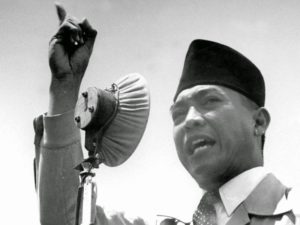
Indonesian President Sukarno.
According to former CIA officer Ralph McGehee, the CIA “was extremely proud” of its campaign and “recommended it as a model for future operations.”
Months after the bloodbath began, the well-connected associate editor of the New York Times, James Reston, would write, “Washington is being careful not to claim any credit” for the coup “but this does not mean that Washington had nothing to do with it.”
The events that triggered the military takeover remain murky even today, thanks to the regime’s systematic suppression of evidence. What seems clear, however, is that the PKI was largely caught unprepared when a group of junior officers — acting either on their own or as part of a “false flag” operation mounted by the anti-Communist General Suharto — killed six generals in the name of stopping a right-wing coup against Sukarno.
Suharto and his colleagues quickly arrested the killers, blamed the PKI for the atrocity, and aroused popular outrage by spreading false stories that the murdered generals had been sexually mutilated.
They also charged that Indonesia’s Communists were targeting Islamic leaders. In response, the country’s largest Muslim organization issued an order to “eliminate all Communists.”
On Oct. 5, 1965, U.S. Ambassador to Indonesia Marshall Green informed Washington that Muslin groups were “lined up behind” the army, which “now has opportunity to move against PKI if it acts quickly. . . Momentum is now at peak with discovery of bodies of murdered army leaders. In short, it’s now or never.”
Green was hopeful: “Much remains in doubt, but it seems almost certain that agony of ridding Indonesia of effects of Sukarno . . . has begun.” To help make sure that came to pass, Green advised telling coup leaders of “our desire to be of assistance where we can,” while remaining in the shadows.
Fanning Flames
Green proposed fanning the flames of popular anger through covert propaganda: “Spread the story of PKI’s guilt, treachery and brutality (this priority effort is perhaps most-needed immediate assistance we can give army if we can find way to do it without identifying it as solely or largely US effort).”
To that end, he later instructed to U.S. Information Agency to use all its resources to “link this horror and tragedy with Peking and its brand of communism; associate diabolical murder and mutilation of the generals with similar methods used against village headmen in Vietnam.”
By mid-October, Green reported that the embassy had discussed strategy with Army and Muslim contacts for a “step-by-step campaign not only against PKI but against whole communist/Sukarno clique.”
Soon he was reporting the good news: the army had executed hundreds of Communists and arrested thousands of PKI cadre, with help from Muslim death squads.
“I, for one, have increasing respect for [the army’s] determination and organization in carrying out this crucial assignment,” he wrote.
To help the army succeed, Green endorsed Washington’s decision to bankroll the military’s clean-up operations against the PKI, adding that “the chances of detection or subsequent revelation of our support . . . are as minimal as any black bag operation can be.”
In addition, by December 1965 the U.S. embassy began sending the Indonesian military lists of PKI leaders — facilitating their liquidation.
“It really was a big help to the army,” said Robert J. Martens, a former member of the U.S. Embassy’s political section. “They probably killed a lot of people, and I probably have a lot of blood on my hands, but that’s not all bad. There’s a time when you have to strike hard at a decisive moment.”
In a December 1965 story, Time magazine offered the first significant account in the American media of the scope of the killing:
“Communists, red sympathizers and their families are being massacred by the thousands. Backlands army units are reported to have executed thousands of Communists after interrogation in remote jails. Armed with wide-bladed knives called ‘parangs,’ Moslem bands crept at night into the homes of Communists, killing entire families and burying the bodies in shallow graves.
“The murder campaign became so brazen in parts of rural East Java, that Moslem bands placed the heads of victims on poles and paraded them through villages. The killings have been on such a scale that the disposal of the corpses has created a serious sanitation problem in East Java and Northern Sumatra where the humid air bears the reek of decaying flesh.
“Travelers from these areas tell of small rivers and streams that have been literally clogged with bodies. River transportation has at places been seriously impeded.”
By February 1996, the U.S. embassy was estimating that at least 400,000 people had already been killed across the country — more than died from the atomic bomb attacks on Hiroshima and Nagasaki.
Media Approval
C.L. Sulzberger of The New York Times remarked in April that “the killing attained a volume impressive even in violent Asia, where life is cheap.”
Speaking for official Washington, in a column titled “A Gleam of Light in Asia,” the New York Times’ James Reston called this bloodbath one of “the more hopeful political developments” in Asia, one that could not have “been sustained without the clandestine aid it has received indirectly from here.”
The full extent of that clandestine aid remains a contested question, but historian Bradley Simpson, in a 2008 study of U.S. relations with Indonesia in the 1960s, observed that “declassification of just a fraction of the CIA’s records demonstrates that the agency’s covert operations in Indonesia were more widespread and insidious than previous acknowledged. These records also reveal that the Johnson administration was a direct and willing accomplice to one of the great bloodbaths of twentieth-century history.”
New Mexico’s Tom Udall declared last year as he introduced a Senate resolution to promote reconciliation on the 50th anniversary of the Indonesian massacres, “the United States and Indonesia must work to close this terrible chapter by declassifying information and officially recognizing the atrocities that occurred. . .
“The United States should stand in favor of continued democratic progress for our vital ally Indonesia and allow these historical documents to be disclosed. Only by recognizing the past can we continue to work to improve human rights across the globe.”
The world is still waiting on President Obama to heed that call.
Jonathan Marshall is author or co-author of five books on international affairs, including The Lebanese Connection: Corruption, Civil War and the International Drug Traffic (Stanford University Press, 2012).
April 29, 2016
Posted by aletho |
Civil Liberties, Deception, False Flag Terrorism, Progressive Hypocrite | Central Intelligence Agency, CIA, Human rights, Indonesia, Lyndon Johnson, Obama, United States |
Leave a comment
Rights activists have called for the bodies of hundreds of Shia Muslims massacred by the Nigerian army last December to be exhumed for further investigation into the exact number of victims.
Residents in the northern city of Kaduna, where the carnage took place, have rejected the official death toll and said a local inquiry into the incident suggests the government figures may be a gross underestimation.
On December 12, Nigerian soldiers attacked Shia Muslims attending a ceremony at a religious center in Zaria, accusing them of blocking the convoy of the army’s chief of staff and attempting to assassinate him.
A day later, Nigerian forces raided the home of Sheikh Ibhrahim al- Zakzaky, who leads the Islamic Movement of Nigeria (IMN), and arrested him after killing those attempting to protect him. Both incidents led to the deaths of hundreds of members of the religious community.
Rights groups say there is evidence Nigerian military had secretly buried hundreds of bodies in mass graves.
Meanwhile, Mohammed Mustapha and Nura Adam, two eye-witnesses, have also painted a horrific picture of the massacre.
Referring to a mass grave outside Kaduna, Mustapha said the local “government claimed they buried 347 people here but we know the actual number is far more than that.”
Mustapha also recalled how earth-moving equipment was brought into the cemetery near the Nigerian Defense Academy in the troubled region on December 14 to dig a pit for the burial.
He also noted that at about 11:00 p.m. (2200 GMT) armed forces cordoned off the narrow path leading to the burial ground shortly before trucks filled with bodies arrived.
“I counted six huge trucks and several military vans laden with dead bodies driving into the cemetery for the mass burial which residents were not allowed to witness,” said Adam.
“It took them five hours to finish the burial, which was an indication that the bodies were more than 347 because it doesn’t take that long to thrown in such a number of bodies into a pit,” he added.
Adam also said the bodies should be exhumed to confirm the exact number of the dead, adding that the world would be “shocked by the true number of those buried.”
However, Abdulhakeem Mustapha, counsel to the Kaduna state commission of inquiry probing the incident, has said local public officials do not have any authority to force the central government in Abuja to take action over the massacre.
“This is an investigative committee. It doesn’t have powers to issue orders,” said Mustapha, adding, “It is going to make its recommendations to the government on what it believes are the best ways to resolve the problem based on its findings.”
Last week, Amnesty International said in a report titled “Unearthing the truth: unlawful killings and mass cover-up in Zaria,” on April 22 that the Nigerian army killed over 350 supporters of Zakzaky and tried to meticulously destroy evidence of the crime by burying the victims in mass graves.
The report also blames Nigerian President Muhammadu Buhari’s administration for failing to probe army crimes against civilians.
Despite Buhari’s pledge to investigate the war crimes, “to date no concrete steps have been taken to end endemic impunity for such crimes,” it pointed out.
Human Rights Watch (HRW) has also slammed the carnage and said Nigerian forces committed several instances of bloodshed against the country’s Shia community in mid-December 2015.
The Nigerian army had also targeted Shias in August 2014 as people were holding a demonstration to condemn Israeli attacks on the Palestinians.
April 29, 2016
Posted by aletho |
Civil Liberties, Deception, Subjugation - Torture | Africa, Human rights, Islamic Movement of Nigeria, Nigeria |
Leave a comment
In their book “Network of Death”, three German journalists revealed illegal arms supplies from Germany to Mexico. However, instead of being praised for their efforts, all three of them may face a court trial on alleged breach of the German Press Act and disclosure of secret information.
The book written by German journalists Daniel Harrich, Danuta Harrich-Sandberg und Jürgen Grässlin revealed illegal arms supplies by German company Heckler & Koch to Mexico. It turned out that the weapons — G36 assault rifles made by the firm — appeared in the Mexican states of Guerrero and Chihuahua, although the supplies to these states were prohibited by German authorities.
In 2005, the German regulatory agency allowed the delivery of 9,000 assault rifles to Mexico between 2006 and 2009 on the condition that they won’t be available in the Mexican states of Guerrero, Jalisco, Chiapas and Chihuahua.
However, it recently became known that the arms not only leaked to these territories, but were also allegedly used during the assault on Ayotzinapa students on September 26, where six people were killed, 25 injured and 43 disappeared.
In their book, journalists not only revealed the fact that the German company illegally delivered G36 assault rifles to Mexico, but also accused German authorities of negligence and complicity in the deal.
“In our latest book, […] we’ve published highly sensitive documents as proof for our assumptions that not only Heckler & Koch is responsible for this, but also the Federal Office on Export and the Federal Ministry of Economics,” Grässlin said in an interview with Sputnik.
According to the journalist, both authorities made the deliveries to Mexico possible, although the German Foreign Ministry had initially prohibited the supply of weapons to the country. In 2010, Grässlin filed an application with a request to start an investigation into the case, but as a result only employees of the company, and none of the authorities were prosecuted.
“The Stuttgart public prosecution office still refuses to prosecute those in the Federal Ministry of Economics and the Federal Export Office responsible and co-responsible for it, and this is a scandal,” Grässlin said.
Instead, surprisingly, the Munich public prosecution office is currently considering an option to prosecute journalists themselves.
Under paragraph 353d of the Criminal Code, the journalists might be charged with “violation of professional and special secrecy”. The law prohibits disclosing messages, documents or any other information from a criminal case. The violation is punishable with a fine or imprisonment of up to one year.
April 29, 2016
Posted by aletho |
Civil Liberties, Corruption, Deception, Full Spectrum Dominance | Germany, Human rights, Mexico |
Leave a comment
By Brandon Turbeville | Activist Post | April 28, 2016
As Saudi war crimes and crimes against humanity continue apace in Yemen, Saudi Arabia is now apparently attempting to gain public support and better reception from the viewing audience by painting itself as an enemy of al-Qaeda and ISIS, despite the fact that the feudal monarchy’s reputation for supporting these very same terror organizations has been documented time and again. From Syria and Libya to Yemen, Saudi Arabia has proven itself repeatedly as a funder, organizer, and supporter of ISIS and al-Qaeda while, at home, it has demonstrated that its own government and ISIS are more alike than they are different.
Still, Saudi Arabia is attempting to show that it is, in fact, the enemy of al-Qaeda by issuing claims that the Saudi “coalition” in Yemen has recently fought a large scale battle against the terror organization and that it was able to capture the city of Mukalla after killing around 800 terrorists.
As AFP reports,
Yemeni troops backed by Arab coalition air strikes killed more than 800 members of al-Qaida in an attack on a southeastern provincial capital held by the group for the past year, the coalition said Monday.
Pro-government forces recaptured an oil terminal as well as the city of Mukalla, which was considered a jihadist stronghold, military sources said.
“The operation resulted… in the death of more than 800 al-Qaida members and some of their leaders, while some others fled,” Arab coalition commanders said in a statement published by SPA, the official Saudi news agency.
AFP notes, however, that the death toll cannot be independently verified and pointed out that no civilian deaths were reported. This latter detail is most questionable to say the least.
What is interesting is that the alleged operation is part of another alleged operation “aimed at securing parts of the country captured by jihadist militants who have exploited a 13-month war between Gulf-backed loyalists and rebels supported by Iran.” The operation itself takes place alongside the UN-brokered ceasefire was enacted on April 11 where jihadist groups are excluded.
What is even more interesting, however, is the description provided by “military officer” sources quoted by the AFP as to the nature of the battle for Mukalla.
As AFP reports,
“We entered the city centre (of Mukalla) and were met by no resistance from Al-Qaeda militants who withdrew west” towards the vast desert in Hadramawt and Shabwa provinces, a military officer told AFP by phone from the city the jihadists seized last April.”
The officer, who requested anonymity, said residents of Mukalla, home to an estimated 200,000 people, had appealed to the jihadists to spare the city the destruction of fighting and to withdraw. Yemeni military sources said Emirati military vehicles were used in the operation and that troops from the Gulf country, a key member of the Saudi-led coalition, were among the forces that entered Mukalla.
AFP could not immediately confirm these reports from officials in the United Arab Emirates.
While it was reported that the coalition members had conducted airstrikes against “AQAP positions” in Yemen, it is important to note that coalition forces admittedly met no resistance when entering Mukalla. Putting aside the fact that the Yemeni people would scarcely be able to tell the difference between AQAP and Saudi Arabian control of their country to begin with, at what point did the Saudis kill 800 AQAP members? Was it in the alleged and unconfirmed airstrikes which apparently kill only terrorists but no civilians?
Is it not extremely convenient that Saudi forces would bomb Yemen back into the Stone Age, allow AQAP to gain vast amounts of territory against Houthi, rebel, and government forces in the process and then retake it from them “without any resistance” shortly after a ceasefire agreement is made that does not include AQAP?
Was the Saudi bombing merely an act of death squad herding or was the Saudi bombing never aimed at AQAP at all? Were the casualties actually civilians simply labeled as terrorists for propaganda purposes? Was there actually a bombing campaign?
What kind of military operation kills 800 militants while, at the same time, faces no resistance from those militants?
All of these questions are relevant and must be asked of any reports suggesting Saudi military action against AQAP in Yemen. While it is impossible to draw concrete conclusions based on the reports currently circulating throughout Western media, considering the nature of the Saudi involvement and their history of supporting terrorism across the world, one must question their motives as well as any claims made by the Saudi government.
Al-Mukalla is a strategic city in the Abyan Governate, a very important territorial gain since it provides access to the coast.
April 29, 2016
Posted by aletho |
Deception, Militarism, War Crimes | al-Qaeda, AQAP, Saudi Arabia, Yemen |
Leave a comment
Since the re-election on the 20th of March of President Denis Sassou-Nguesso for a controversial third term, the government of the Republic of Congo has been criticised by the international community for its alleged bombing of ‘civilian neighborhoods’, following post-election terrorist attacks in the country’s capital, Brazzaville. In reality, however, the West African nation is currently fighting the early stages of a US/French or NATO-backed insurgency – an attempt by NATO to destabilize a country moving closer to the BRICS sphere of influence. In this report, I examine the geopolitical and historical background of a West African political crisis of global significance.
In the aftermath of presidential elections on the 20th of March, which saw the controversial re-election of President Denis Sassou Nguesso with over 60 percent of the vote, there has been increasing instability in the Republic of Congo. Opposition candidates have vociferously contested the election results. This contestation has been encouraged by the French Government, the European Union, and the United States, who have all backed opposition candidates, in particular, Guy-Brice Parfait Kolélas, who came in second during the elections with 15% of the vote.
On the nights of the 4th and the 5th of April, terrorists attacked the country’s capital city Brazzaville killing seventeen people. Six police stations, two customs control stations, and the city hall were burned down. The terrorists were members of the Ninja Nsiloulhou organisation which is headed by Pastor Ntoumi, an old enemy of the president, and supporter of the losing opposition candidate Guy-Brice Parfait Kolélas.
Brutal crackdown on civilians?
On the 5th of April immediately after the attacks, the Congolese military conducted an anti-terrorist operation in the region of Pool, in the South of the country – a stronghold of the Ninja Nsilouhou terrorists and their political representatives. The terrorists had fought against Sassou-Nguesso’s forces during the civil war of 1998 to 2002. The Ninja Nsilouhou militia are composed of sectarian adventurists and mercenaries with connections to American and French intelligence.
Pastor Ntoumi, who is from the majority Congo ethnic group, has formed a new and surprisingly well-equipped army the Forces armées républicaines pour l’alternance au Congo (FARLC), the Republican Armed Forces for Regime Change in Congo. Ntumi’s forces have no economic programme for change. They are, rather, more concerned with ousting the Northern Mbochi from power, the president’s ethnic group, a minority in the country.
Western imperial domination of Africa has traditionally relied on empowering minority ethnicities and tribes. However, over time, many of those regimes have overcome tribal divisions; thus depriving imperialism of the advantages of keeping subject nations divided. Although the Mbochi only constitute 12 percent of the country’s population, they occupy over 40 percent of government posts – a source of ethnic tension currently being instrumentalised by imperialism.
Amnesty International’s history of lies and war propaganda
Given the hostility of Western governments to the reelection of Sassou Nguesso, it should not be surprising to find that the first reaction of the French establishment media to the Congolese government’s crackdown on the Ninja terrorists came in the form of a condemnatory report by Amnesty International. The human rights organisation strongly condemned what it described as the bombing of civilian targets by the Congolese military. However, Amnesty International’s report admits that the organization did not have access to the area in question and that they have not been able to confirm any of the accusations made by their anonymous sources in the Pool region.
The government of the Republic of Congo has issued a firm condemnation of Amnesty International’s report, stating that the dossier is not based on any evidence. Furthermore, Amnesty’s accusations have been contradicted by the Catholic humanitarian organization Caritas – who have also visited Pool and have not documented any military targeting of civilians. One of the lies told by Amnesty International about the Congolese military operation in Pool has already been exposed.
The human rights organisation claimed that a primary school in Soumouna was bombed. However, photographs dated from the 18th of April prove that the school was not bombed. One of the key ‘sources’ for Amnesty’s report is Monsignor Louis Portella, a close confidante of Pastor Ntumi, the aforementioned terrorist tracked by the Congolese military.
Amnesty’s report has provided ammunition for the opposition’s anti-Nguesso rhetoric , who are referring to the anti-terrorist operation in Pool as “genocide.” Although widely considered to be a reliable, objective and respectable organisation, Amnesty International has a long history of legitimising war propaganda on behalf of the United States and its allies.
The human rights group was instrumental in the assassination of Ghanaian leader Kwame Nkumra when he was being targeted by the CIA. Amnesty International have been accused of complicity in Nkumra’s assassination; they have also been accused of complicity in the death of Patrice Lumumba, first president of the Democratic Republic of Congo.
Zbigniew Brzezinski (former U.S National Security Adviser to President Jimmy Carter) was among the former board members of Amnesty International; this was at a time when the human rights organisation was publishing reports condemning the democratic government of Afghanistan. Meanwhile, the CIA-backed Mujahadeen, part of Brzezinski’s ‘Arc of Crisis’ strategy, massacred the Afghan population with little or no criticism from Amnesty International.
Amnesty International’s record in exposing the crimes of Zionism is no better; the organisation helped cover up Israeli massacres in Shabra, Shatila, and Jenin in 1982.
In 1986, the human rights organisation published a damning report against the Sandinista government of Nicaragua which was used by the Reagan administration to justify more aid to the contra terrorists who would eventually destroy that country.
In the run-up to the Gulf War in 1991, Amnesty International colluded with the US military in orchestrating a fake story about Iraqi soldiers taking 312 newborn babies out of incubators in Kuwaiti hospitals and throwing them on the floor. The story, which shocked the world, provided the propaganda the US government needed to bomb Iraq – a bombing followed by crippling sanctions that murdered over 500,000 babies; it was the beginning of the destruction of the Middle East’s wealthiest and most advanced countries. The story was entirely fabricated by the US military. Amnesty International was the key agency behind the fraud – a dirty lie created to justify war and genocide.
Amnesty International colluded in the demonisation of Hugo Chavez by US-backed Putschists in the run-up to the 2002 coup in Venezuela. During years of brutal Apartheid rule in South Africa, Amnesty never condemned the brutal racist system.
In 2011, Amnesty International validated fake reports of ‘African mercenaries’ in Libya who were said to be committing massacres. The reports, entirely fabricated, were used to justify war against Africa’s richest and most democratic nations, resulting in the deaths of hundreds of thousands of people and an ongoing refugee crisis of catastrophic proportions.
Since the outbreak of NATO’s war against Syria, Amnesty International has produced nothing but lies and calumny against the democratic institutions of the Syrian Arab Republic. With a record like that, it is hardly surprising to find Amnesty International publishing another damning report against an African government Western imperialism is attempting to overthrow by force. (Read more here)
Why must Sassou Nguesso go?
Although nominally independent from France since 1958, the republic of Congo did not embark upon a true path of independence until the accession to power of Marien Ngouabi in 1968. For 9 years until his assassination in 1977, Ngouabi laid the basis for Africa’s first socialist state. The charismatic communist leader managed to align the People’s Republic of Congo with both the USSR and China, in spite of the ideological split between the Soviet revisionists and Maoist China.
Ngouabi also formed close links with Cuba. The communist revolutionary, who had an advanced degree in physics, was passionate about education and was arguably the greatest leader of African national liberation; but the dream came to a tragic and abrupt end in 1977 when he was murdered by a group of army officers most likely led by Joachim Yhombi-Obango; the assassination had the blessing of French and American intelligence. Both countries resumed diplomatic relations with Congo-Brazzaville immediately after Ngouabi’s murder.
Opango was deposed in 1978 by Denis Sassou-Nguesso; the new leader collaborated to a large extent with French neocolonial interests – a policy euphemistically referred to as ‘la Françafrique.’ Rumours about Nguesso’s role in the murder of Ngouabi have proliferated over the years, but there is still no conclusive evidence linking him to the communist leader’s death.
With the dissolution of the USSR in 1991, the French government forced the Congolese state to open up to multi-party-ism – a disastrous policy which led to the highly corrupt reign of French puppet Pascal Lissouba until Denis Sassou-Nguesso resumed power again in 2002 after a four-year civil war. Over the last decade, President Nguesso has brought the country closer to China, Russia, Brazil, and Cuba – old cold war allies (Brazil excepted) in anti-colonialist struggle.
Building blocks of independence
Although Denis Sassou-Nguesso is certainly no angel and his regime may be guilty of serious crimes over the years, he does have some notable achievements under his belt; he has managed to restore peace to a war-torn country. His government has also overseen a period of steady economic growth. President Sassou Nguesso has initiated major economic projects designed to build up the country’s industrial base. In the next few months, an oil pipeline between Point Noire, Brazzaville and Oyo will be built by the Russian government. Moscow will also help construct two major hydroelectric dams in Sounda and Cholet. The Sounda region in the isolated north of the country is now connected with a new highway.
The Sassou-Nguesso administration has overseen significant advances in transport provision. Brazzaville’s state-of-the-art Maya Maya airport hosts a largely state-owned airline EC AIR, providing new direct transport routes to major world commercial destinations such as Dubai. The Maya Maya airport is set to become the biggest and busiest airport in Central Africa. The upgrading of the airport was carried out by Chinese company Weihei International, Economic and Technical Cooperative Co.Ltd.
In Pointe Noir, the country’s second principal city, the Augustino Neto airport is currently under construction. On the 22nd of February 2016, the Congolese government signed a contract with the China Road and Bridge Corporation (CRBC), for the construction of a new deep sea port in Pointe Noire. The port is expected to lead to significant economic development in the country. At the contract signing, the Chinese ambassador to the Republic of Congo reiterated his country’s commitment to the industrialization of the Congolese economy.
New road networks are under construction throughout the country. A monumental road and rail bridge is will connect Brazzaville and Kinshasa, as part of the Trans-African Highway Network. The Chinese are reportedly planning the construction of a new railway line from Brazzaville in the South to Ouesso in the North and from Djambala in the centre of the country to Pointe Noire on the coast; the project promises to be a major boost to trade and industrial development.
Many new public administration buildings are under construction in the country’s capital as part of the government’s drive to strengthen the efficiency of state institutions, improving public services and affirming national sovereignty. Sassou-Nguesso’s administration also intends to construct a 4 km bridge across the Congo River connecting Brazzaville to Kinshasa, capital of the neighbouring Democratic Republic of Congo.
The Congolese government plans to reduce dependence on oil export revenues by developing its agricultural industry. Meetings between the Congolese minister of agriculture and his Brazilian counterpart took place in both Brazil and the Republic of Congo in 2008, 2009 and 2010.
Japan has also significantly increased investment in the Congolese Republic agribusiness.
As part of its preparations for hosting the Panafrican Music Festival, new cultural centres, theatres and cinemas are scheduled to be built. The new Sports Complex currently under construction in Kintélé will enable the country to host events of international stature, increasing investment revenue and promoting job creation.
Although modest, the Congolese government has shown some commitment to reducing poverty by building over 10,000 new social units. The country, which currently has only one university named after Marien Ngouabi, is soon to have another when the Denis Sassou Nguesso university is completed in Kintele.
Sassou-Nguesso’s administration has initiated an ambitious project to provide free potable water to the country’s population. The project named ‘Water for All’ is being implemented in conjunction with Brazilian company Asperbras – one of the world’s leading specialists in the provision of public service infrastructure and heavy industry equipment. Asperbras is also constructing fourteen top-class hospitals throughout the country as part of the government’s project ‘Health for All‘.
Since the visit by Brazilian president Lula Ignacio da Silva to Brazzaville in 2007 (he opened Brazil’s first embassy in the country) Brazzaville and Brasilia have strengthened ties. There have been several visits by Congolese ministers to Brazil and the presidents of the two countries have met twice since 2012.
Nguesso’s government has benefited from significant Chinese investment in the oil industry. The Chinese have also invested in the construction of major industrial projects such as the business center in Mpila, and impressive viaducts in Brazzaville and Talangai.
Although the ruling Party of Labour abandoned their adherence to Soviet revisionist Marxism-Leninism in 1992, embracing official social-democracy and multi-party politics, Nguesso has continued to maintain strong ties with left-leaning countries such as Cuba, Brazil, China, and Russia.
The Western media portray Nguesso as a corrupt, power-hungry dictator siphoning off the country’s resources for his own clan or tribe, and some of these accusations may, in fact, be true. But the infrastructural projects mentioned above show that the country is building the basis of national independence through Chinese, Russian, and Brazilian investment in heavy industry. Such investment threatens Western neocolonial interests; those interests require the maintenance of Africa in a state of constant underdevelopment and dependence so that its natural resources can be pillaged by Western corporations.
Nguesso’s ties with Cuba go back to the Cold War era when the Caribbean nation played a key role in African liberation struggles – a fact acknowledged by Nelson Mandela. Cuba’s socially-oriented economy has been subject to incessant demonisation for over half a century by the international corporate press, but not even they can deny the extraordinary achievements of the Cuban government in the provision of free education and health care of the highest standard.
The Republic of Congo’s Party of Labour has shown some fidelity to Ngouabi’s Marxist principles by sending 280 students to Havana to train as doctors. Cuban educators have been invited to the Congo to bring pedagogical methodologies with a view to improving the country’s education system.
The Empire’s strategic horizon: war
In April 2012, the French Ministry of Defense published a report ‘Horizons stratégiques’ that described the future of French interests in Africa. The report stated that competing powers such as China, India, Russia and Brazil, coupled with the rise of Pan-Africanist nationalism, pose the greatest threat to French interests on the continent.
The report indicates that problems such as ethnic conflict and religious terrorism will require the continued military presence of French troops in Africa and that those troops will liaise, not with sovereign states, but local private contractors. In other words, the future of French neocolonial interests in Africa depends on the fomentation of civil wars and the total privatisation of African nation-states.
Over the past 5 years, I have maintained that Western imperialism in this era is proceeding on the basis of leftist symbology. The CIA-backed Arab Spring people-power coups of 2011 testify to that fact. But the Arab Spring was only the beginning. Mathieu Pigasse the director of the Lazard Bank, confidante of President Hollande, and proprietor of the newspaper Le Monde, stated in 2012 that he wanted to see the Arab Spring ideology spread all over Africa. French companies, he argued, would in future only deal with ”civil society” organisations, rather than ”corrupt” African governments. What that ultimately means is that the oligarch Pigasse wants to see all African nation-states erupt in chaos so that their resources can be privatised by Western banks and corporations in the name of freedom, democracy, and the oligarchy’s newest slogan ‘popular revolution’.
The pseudo-leftist opposition media in France have been at the forefront of disinformation about the Republic of Congo. They frequently express outrage at the French government for supporting such a ‘genocidal’ regime in Africa, when in fact the French and U.S. governments are supporting its opponents.
We have already mentioned the lies validated by Amnesty International about Colonel Gaddafi’s recruitment of ‘African mercenaries’ who were reported to have massacred ‘peaceful demonstrators’ during the 2011 insurgency in Libya.
Similar stories have recently been concocted by powerful French interests. But some of those lies have backfired. The former director of the French giant oil company ELF Loïc Le Floch-Prigent and his lawyer Norbert Tricaud have been brought before a French court for defamation after they claimed French mercenary Patrick Klein had been recruited by the Congolese government to massacre political opponents. Klein has denied the accusations and taken Le Floch-Prigent to court for defamation.
It is interesting to note that attorney Norbert Tricaud has managed to recruit the granddaughter of Marien Ngouabi in his campaign to accuse President Denis Sassou-Nguesso of her grandfather’s assassination; yet in his interviews,Tricaud completely ignores the role of the CIA and French intelligence in Ngouabi’s murder. Nor is there any mention of the fact that Ngouabi’s French wife, the grandmother of Tricaud’s client, was in fact a French spy! No French or American officials have ever been prosecuted for the assassination of African leaders, in spite of the fact that the secret agencies of the United States and France were behind the murder of dozens of African revolutionaries and heads of state.
Tricaud claims, in one of his interviews, to be a lawyer engaged in the struggle against slavery and indigenous rights. He refers repeatedly to the government of Sassou-Nguesso as a ‘dictatorship’ notwithstanding the fact that Sassou-Nguesso’s administration was the first in Africa to pass laws giving rights to indigenous pygmy peoples, who for centuries have been enslaved by Bantou colonial settlers. It is important to study the deceptive methodology used by people like Tricaud. He appears to be critical of Western foreign policy of propping up of dictators in Africa, while simultaneously promoting imperial military intervention in the guise of humanitarianism.
On his Facebook page Norbert Tricaud (the man determined to find out who killed the communist revolution Marien Ngouabi) boasts of lobbying on behalf of the ultra-right wing General Mokoko with an advisor of US Secretary of State John Kerry, and various ‘NGOS’. Jean-Marie Michel Mokoko attempted a coup d’Etat against the government of the Republic of Congo earlier this year and claimed to have the French government on his side.
A video posted on line shows Mokoko in the offices of Sylvain Maier planning a coup d’etat against Sassou-Nguesso with DGSE (French secret service) agent. In the film, the French secret service agent warns Mokoko” if you betray me, I’ll kill you” The DGSE agent hands over flight tickets and an envelope of cash to Mokoko. The DGSE agent explains how French intelligence will orchestrate the media coverage of the coup d’etat so as to convince Congolese citizens that Mokoko is a democrat. He also explains how French intelligence will organise the post-coup state of emergency and military curfew, joking that ”most African’s are cowards” and will turn to the Putschists for protection.
Radio France Internationale, French state media, were able to confirm the authenticity of the video and did their best to distract from the disgraceful proof of the French neo-colonial conspiracy by claiming that the document was being used by the dictator to discredit a ‘serious’ opponent.
Also on his Facebook page, Tricaud calls for a ‘humanitarian corridor’ in Pool, to ‘protect civilians’. The phrase ‘humanitarian corridor’ was coined by Dr. Bernard Kouchner in 1968, when France was attempting to create a client state in Biafra, Nigeria. Kouchner, who had set up ‘Doctors without Borders’ called for such a corridor to be established in the country so as to help the civilians allegedly bombed by the Nigerian government. Ultimately thousands of weapons were smuggled in ambulances to the French-backed insurgents.
Norbert Tricaud recently joined a delegation of 19 Congolese politicians to lobby the US congress and the National Endowment for Democracy, a think tank closely linked to the CIA and a chief sponsor of ‘civil society’ led ‘popular uprisings’. These meetings prove that US/French-backed regime change in Brazzaville is now at an advanced stage of planning. Denis Sassou-Nguesso will indubitably become the next African leader to face mass media demonization and information warfare as a proxy war of aggression waged by mercenaries in the pay of France and the United States looks increasingly likely.
Sassou-Nguesso’s emphasis on heavy industry, public infrastructure, strengthening the authority and role of the state, while attracting more investment from emerging global powers, are the factors that have made him an enemy of the Empire. In his inauguration speech, Denis Sassou Nguesso pledged to combat corruption and nepotism. He said this term would be the beginning of a major rupture with the past. The Congolese president may have been referring to the fact that the balance of power in the world is shifting in favour of China, Russia, and the BRICS world order, and that such a seismic shift in the distribution of imperial power is good news for Africa.
Although, French government representative Jean-Luc Borloo unctuously described the president’s speech as a ”monument of vision,” it is clear that the French government and media establishment are backing the pseudo-opposition and their terrorist militia in a desperate attempt to save the old, crumpling, and utterly rotten colonial order.
The current concrete choice facing the people of Congo Brazzaville is relative peace and economic progress under Sassou Nguesso or chaos, war and death under his Western-backed opponents.
Congolese citizens would be well advised to ignore the Western-backed conspiracy theories surrounding Marien Ngouabi’s death and follow instead the path of Sassou Nguesso, who, despite his many shortcomings and alleged crimes, is doing more to revive the spirit of Marien Ngouabi than any of his opponents. The question now is not who killed Ngouabi but who among the country’s youth will fulfill his legacy.
April 28, 2016
Posted by aletho |
Deception | Africa, Central Intelligence Agency, CIA, Denis Sassou-Nguesso, France, Republic of Congo, United States |
Leave a comment
In his first public comments on the US drone campaign in Pakistan, President Obama described it as “a targeted, focused effort at people who are on a list of active terrorists who are trying to go in and harm Americans, hit American facilities, American bases, and so on.” In 2011, then-national security advisor to the president John Brennan said of the CIA drone campaign that “there hasn’t been a single collateral death because of the exceptional proficiency, precision of the capabilities we’ve been able to develop.” Popular American mythology in the Obama era has held that drones are the surgeon’s tool in the endless, global war on terror. American soldiers and spies can knock off terrorists without bogging down the military in ground occupations, or killing civilians.
So says the myth. The reality is starkly different, according to scholar Micah Zenko.
Zenko examined civilian deaths from US military operations and found that drones kill more civilians than do piloted US aircraft—not fewer. “Drones are far less precise than airstrikes conducted by piloted aircraft, which themselves also conduct “precision strikes.” Drones result in far more civilian fatalities per each bomb dropped,” Zenko writes.
Zenko’s analysis shows us that the claims officials have long made about the supposed accuracy of drone strikes are dead wrong. But we don’t know why, in part because the US government refuses to disclose basic information about how it designates drone targets, or under what circumstances commanders order killings. It could be, as Zenko posits, “that the standards that need to be met before authorizing a [drone] strike are less rigid than Obama’s purported principle of “near certainty that the terrorist target is present.” This wouldn’t be surprising given that Obama continued the George W. Bush administration’s practice of “signature strikes” — killing anonymous suspected militants who appear to be associated with terrorists based upon their observable activity.”
If that’s the case, the US public and the victims of drone strikes have a right to know. But government secrecy and judicial evasiveness have conspired to keep us all in the dark about even the most basic legal theories upon which the CIA and military base their drone programs.
That secrecy has recently been reified. Just last week, a Washington D.C. federal appeals court tossed an ACLU lawsuit against the CIA seeking information about its drone operations. The court sided with the government, holding that releasing information about the drone program “could reasonably be expected to damage national security.”
As ACLU attorney Jameel Jaffer said, “Secret law is always invidious, but it’s particularly so here because of the subject matter.” Now we know the stories officials have been telling us for years about the laser-like accuracy of drone strikes are false. But thanks to secret law, we don’t know why.
April 28, 2016
Posted by aletho |
Deception, Progressive Hypocrite, War Crimes | Afghanistan, Africa, Human rights, Obama, Pakistan, United States, Yemen |
Leave a comment
Introduction
The Syrian parliamentary election of 13 April 2016 is demonstrative of the apparent and continuing plurality of Syrian society as manifested within the People’s Council – a parliamentary body which has often been regarded as merely a façade of legitimation for the ruling Baath Party government of President Bashar al-Assad. Plurality within the parliament is of significance insofar as it is indicative of the involvement of a range of religious communities in Syrian political life and runs directly contrary to the prevailing narrative of Syria as a dictatorship dominated by the Alawite religious community, of which the Assad family are members, and to the exclusion of the involvement of other religious communities in political activity.
Elections to the 250 member Syrian People’s Council take place every four years with the country divided into fifteen multiple seat constituencies. Since 2012 and amendments to the country’s constitution Syrian political life has been, in theory, open to participation to a wider array of political parties than the Baath and other permitted parties such as the Syrian Social Nationalist or Syrian Communist parties. Previously the Syrian Baath Party had looked likely to retain power in parliament indefinitely and indeed to dominate either directly by its own MPs or indirectly via allied parties and MPs. However, with the changes there is limitation on presidential office to seven years for any one candidate, no president can rule for more than two seven year terms, the president can now be someone who is not a member of the ruling National Progressive Front coalition, and the constitution no longer has a stipulation that the Baath Party is to be the normative and leading influence in Syrian socio-political life. Such changes may seem relatively minor and indeed the Baath Party will likely remain the de facto power in Syria for some time to come but they are indicative of President Assad’s openness to pursuing gradual reform on a model which is perceived as suitable for Syrian circumstances.
A key aspect of encouraging and maintaining societal stability in Syria since independence from French rule in 1946 has been to ensure that authoritative political leadership is combined with some type of broad representation of the plural religious and ethnic communities resident to Syria and ensure that they have a stake in determining Syria’s development. An important issue has been to ensure that those outside of the Alawite community have opportunities to take on representative roles and to know their contributions to Syrian society are valued. Criticism has focused on the Alawite strength and/or prevalence to many spheres of Syrian life but especially economically and in the security services to the detriment of others. The People’s Council appears to an extent to undermine these critiques as exemplified by the majority of seats being held by Syrians of the majority Sunni Muslim community.
Alawites and plural representation in the People’s Council
The Alawite community broadly identifies itself as part of Shia Islam having emerged in the late ninth/early tenth centuries in western Syria possibly around the figure of the eleventh Shia Imam, Hasan al-Askari. To the external observer it might seem that the Alawites are more a syncretistic movement containing aspects of Christianity and Twelver Shia Islam given, amongst other activities, they celebrate a type of Divine Liturgy including the consecration of wine alongside strong reverence for Ali ibn Abi Talib, the son-in-law and cousin of the Islamic prophet, Mohammed. This combination of — or plurality of — beliefs in part explains why the Assad family has consistently supported the notion of a plural Syria and the general advancement of a paradigm of laïcité for the Syrian state and in which, in theory, no-one religion should predominate to the detriment of another.
The Alawites currently form around ten–fifteen percent of the Syrian population (c.2,000,000 people) and are concentrated in the western coastal provinces of Latakia and Tartus. During the French Mandate in Syria (1923–1946) the Alawites were often strong supporters of French administration as their rule was perceived as a means to secure the Alawite community in a society which was not necessarily comfortable with their presence. Although Alawites consider themselves to be part of the Islamic milieu some Muslims, especially within the Sunni community, do not and find such assertions religiously and politically challenging.
The Alawite influence in the Syrian ruling élite within post-independence Syrian political affairs arose in the early 1970s when Hafez al-Assad (Bashar’s father) came to power as President. In general terms Hafez organised the state such that Sunnis held élite political offices and the Alawites held responsibility for the security services. The perception of the Syrian Baath establishment as a bastion of Alawite and to a lesser extent Christian power has not consistently sat well with the Syrian Sunni majority and it has been suggested that, in reality, they have been denied the opportunity to take a full part in Syrian political life. However, as I have noted, the People’s Council is predominantly Sunni and representative on a proportional level to the extent of almost matching the religious demographics of Syria:

These figures for Syrian MPs by religion were the only available as of 27 April 2016.
Such a balance is important as a means to legitimise the Syrian government’s claims to being the lawful and representative body controlling the Syrian state insofar as it can affirm it represents the interests of the full range of Syrian communities but also demonstrative of Sunni willingness to commit to the existing political establishment and loyalist campaign against Da’esh and other terrorist factions.
It should be noted that within the People’s Council there is a strong diversity of MPs and whilst as might be expected Latakia and Tartus are dominated by Alawite representatives there are also Christian and Sunni MPs in these regions. Moreover, women of Shia, Sunni, Alawite, Druze and Christian background also take a full part in Syrian political life with 29 female MPs (11 percent). Such a scenario were Da’esh to have successfully occupied Syria would, of course, be unthinkable.
Critiquing the Syrian elections
It appears that whether or not the April 2016 Syrian elections were actually entirely free and fair that it is enough for claims and accusations to be advanced to ensure they are characterised as a `sham’ and not reflecting the true results and popular will of the people. Such claims do not appear to more than scratch the surface of what actually took place beyond continuing to follow the set narrative of President Assad as a dictator only interested in advancing Alawite interests and the elections as likely fraudulent with only Baath loyalists actually gaining positions in reality.
This is not to suggest that Syria’s political process and elections are necessarily more than a very basic level of democratic participation. However, the elections did take place and furthermore, the current Syrian government may be many things but it appears, at the very least, to be gradually encouraging the transition to a more representative style of political system. It may not be one which external observers approve of, or, is the ideal of those external powers seeking violent and radical change for Syria but it is a process of political development which is taking place in the Syrian context and as far as the current lawful government is concerned, is perceived as the most likely method to manage Syrian plurality and to ensure some type of peaceful if long-term change in governance can take place with the minimum of extremist political forces further damaging the mosaic of Syrian society.
It is notable that Western states can be far less critical of other Middle Eastern powers with whom they are allied and who appear to have similar political structures to Syria or limited interest in widening political participation. The Kingdom of Bahrain, for example, is a Sunni led and dominated constitutional monarchy. The monarch in effect, however, is the final deciding authority in Bahrain and, for example, directly appoints the members of the Bahrani upper parliamentary house. Moreover, the majority Shia population (65–75 percent) of Bahrain has struggled to gain a strong and active voice in Bahrani socio-political life. This is not to single out Bahrain for criticism — indeed it has, like Syria, begun to transition to a more representative type of governance — but to be aware of the comparative type of narratives which are being pursued in the region with states such as Bahrain portrayed as reliable and honourable allies of the West but the Syrian government as beyond the pale for engagement by Western and Gulf states. Accusations of impropriety in democratic processes being one of the means to continue to critique the rule of President Assad.
We might also compare the democratic representation in Western states such as the United Kingdom, which have been consistently critical of the Syrian government since 2012, with attempts to proportionately represent Syrian communities in the People’s Council. We can note, for example, following the 2015 UK General Election that despite the UK Independence Party and Green Party receiving respectively c. 3,800,000 and 1,100,000 votes both parties have only one MP in the House of Commons. Whereas, the Scottish National Party received c. 1,400,000 votes and have fifty-six MPs. The peculiarities of the UK’s `First Past the Post’ electoral system are such that these results are valid returns, nonetheless, the external observer might ask are these results just, and, do they convey and strengthen confidence in the legitimate representative nature of British democracy?
Conclusion
The results of the 2016 Syrian elections are suggestive of the population’s commitment to the ideal of plurality in Syria through a popular willingness to take part in the elections and gain access to some type of political representation for all Syrians. We can note that a key aspect of critiquing President Assad’s leadership is the notion that he rules as a dictator and this because he favours one section of the population over others on a confessional basis. Notwithstanding that such critiques might be more vigorously and profitably pursued against other states in the Middle East it also speaks to a lack of comprehension as to how the realities of Syria’s plural society affect the type of government and form of rule which is maintained.
Syria under the Assad-Baathist governments cannot be said to hold to a representative system which is readily appreciated or supported by external observers who are used to models found in liberal democratic capitalist societies or that the Syrian system is indeed supported by the majority of the Syrian people. Nonetheless, it is a political system which has been sustained for over half a century. If the status quo in Syria has seen Alawite predominance, other confessions have not been consistently denied the opportunity to take a part in Syrian socio-economic and political life — without at least the acquiescence of the majority of the Syrian Sunni population to Assad-Baathist rule such a paradigm could not and would not have been sustained for so long.
If we are to speak of an Alawite dictatorship or Alawite over-dominance in recent Syrian history the most apparent example is in a “dictatorship of the dead”. A disproportionate burden of Syrian Arab Army casualties in the campaigns against Da’esh and its allies have been borne by the Alawite community with up to a third of Alawite young men having been killed in the conflict. It is possible that the Alawite sacrifices in this regard are such that other Syrian communities are recognizant of the commitment which the Alawites have to maintaining Syrian plurality and sustaining some form of societal stability and peaceful social interaction which has led to Sunni, Christian, Druze and Shia continuing to support President Assad’s government and willingness to engage with the gradually reforming political process.
Kristian Girling is a freelance writer and a Post-doctoral Research Fellow at Heythrop College, University of London.
April 28, 2016
Posted by aletho |
Deception, Mainstream Media, Warmongering, Timeless or most popular | Syria |
Leave a comment
The welfare of the people in particular has always been the alibi of tyrants.
— Albert Camus, 1913-1960
On May 1st, 2003, George W. Bush stood in a dinky little flying suit on the deck of the USS Abraham Lincoln and in a super stage managed appearance told the lie of the century:
Major combat operations in Iraq have ended. In the Battle of Iraq, the United States and our allies have prevailed. And now our coalition is engaged in securing and reconstructing that country.
The illegal occupation and decimation of Iraq continued until December 2011. In June 2014 they returned to bomb again in the guise of combating ISIS. As the thirteenth anniversary of Bush’s ridiculous appearance with a vast “Mission Accomplished” banner behind him, Iraq is largely in ruins, Iraqis have fled the murderous “liberation” and its aftermath in millions, and there are over three million internally displaced.
The nation is pinned between a tyrannical, corrupt US puppet government, a homicidal, head chopping, raping, organ eating, history erasing, US-spawned ISIS – and a renewed, relentless US bombardment. So much for the 2008 US-Iraq State of Forces agreement, which stated that by 31st December 2011 “all United States forces shall withdraw from all Iraqi territory.”
On the USS Abraham Lincoln Bush stated:
In this battle, we have fought for the cause of liberty, and for the peace of the world … Because of you, our nation is more secure. Because of you, the tyrant has fallen, and Iraq is free.
In what has transpired to be monumental irony, he continued:
The liberation of Iraq is a crucial advance in the campaign against terror. We have removed an ally of al-Qaida, and cut off a source of terrorist funding.
There was, of course, no al-Qaida in Iraq, no funding of fundamentalist terrorism under Saddam Hussein. It is the invasion’s conception, birth, now reached maturity from Baghdad to Brussels, Mosul to the Maghreb, Latakia to London.
In Iraq, US terrorism from the air is back in all its genocidal force.
Incredibly on April 23rd, the Independent reported another staggering piece of either disinformation or childish naivety, in a predictably familiar script: “A spokesperson for the US military said all possible precautions were taken to avoid ‘collateral damage’”, but in approaching 7,000 airstrikes the number of confirmed civilian deaths had risen on Planet Pentagon to just – forty one.
In another past its sell by date mantra:
Colonel Patrick Ryder, a spokesperson for Central Command, said the casualties were “deeply regretted” but maintained that the campaign was the “the most precise air campaign in the history of warfare.”
And here’s another familiar one:
In this type of armed conflict, particularly with an enemy who hides among the civilian population, there are going to be, unfortunately, civilian casualties at times.
The Geneva Convention, amongst other Treaties, Principles and Conventions, is specific on the protections of populations in conflict, Colonel Ryder should familiarize himself with the texts.
So another onslaught in a quarter of a century of bombing Iraq is underway – another mass murder with a silly name “Operation Inherent Resolve.”
Here is reality from Dr Souad Al-Azzawi, Award winning environmental scientist who gained her Ph.D from the Colorado School of Mines.
She states of just the onslaught on Mosul, her home, the ancient university city of 1.5 million, that the stated figures from US spokespersons are: “either misinformed about the real situation on the ground, since they are using drones and guided missiles, or airstrikes blindly, intentionally not saying the truth.”
She adds:
I would like to list SOME of what the Americans’ airstrikes have been targeting and killing in Mosul:
Destroyed are all state services buildings, including Municipalities in right and left sides of Mosul. When they bomb at night, all security personnel get killed or injured, also residents of close by areas, and adjacent properties are destroyed.
Bombed and destroyed all communication centers.
Destruction of Dairy Production Factories in both left and right sides of Mosul. Casualties of these two are one hundred deaths and two hundred injuries among civilians who gathered to receive milk and dairy products from the factories.
Dr Al-Azzawi reminds that this is reminiscent of the bombing of the baby milk factory outside Baghdad in 1991 with the claim it was a chemical weapons factory. This writer visited the factory ruins just months later. There were still charred containers of milk powder – the machinery was provided and maintained by a company in Birmingham, England which specialized in infant food production.
* Bombing of Mosul Pharmaceutical Industries.
* Mosul University was bombed with ninety two deaths and one hundred and thirty five injuries. Earlier estimates were higher, but many were pulled from the rubble alive. “They were students, faculty members, staff members, families of faculties, and restaurants workers.”
*Al Hadbaa and Al Khadraa Residential Apartment compounds. Fifty people killed (families) and one hundred injured.
* Hay al Dhubat residential area in the right side of Mosul, two days ago, five women women and four children killed and the whole house destroyed. The father is a respected pharmacist who has nothing to do with ISIL.
* Destruction of houses in front of the Medical College, killed twenty two civilians – eleven in one family.
* Bombing Sunni Waqif Building, twenty deaths and seventy injuries which included those in nearby commercial and residential buildings.
* Car maintenance industrial areas in both left and right sides of Mosul destroyed with civilian’s casualties.
* Bombing of flour factories in both sides of Mosul.
* Rafidain and Rasheed banks and all their branches in both sides of Mosul. Destruction of all commercial and residential areas in the vicinity of these places, with as yet unknown civilian casualties. (My emphasis.)
* Central Bank of Mosul in Ghazi Street, with nearby residential and commercial properties.
* Pepsi factory, currently producing ice cubes only. Three deaths and twelve injuries among the workers.
* The Governor’s house and close by guest house.
* Mosul’s old industrial compound destroyed, with parking area for fuel Tankers and cars. Three days ago, huge explosion of fuel tankers, one hundred and fifty deaths and injuries.
* Urban Planning Directory in Hay al Maliyah bombed.
* Engineering Planning Directory in Hay al Maliyah bombed.
* Food Storages in left side of Mosul bombed.
* Drinking water treatment plants bombed.
* All electrical generation and transformer stations in the left side of Mosul bombed.
* Domez land communications center in left side of Mosul destroyed.
*Al Hurairah Bridge – and many more.
There is a sickening familiarity to some of the targets – food, pharmaceuticals, water treatment plants, electricity generation, communications and educational facilities, bridges (the country, towns and cities are divided by the Tigris and Euphrates rivers) have been favoured targets since 1991. Every time painstakingly and imaginatively restored they have been re-bombed for a quarter of a century.
During the 1990s a Canadian film crew captured footage of US ‘planes dropping flares on harvested wheat and barley, incinerating entire harvests in a country, which due to the strangulating embargo, there were near famine conditions in parts of society.
“When Iraqi civilians looked into the faces of our servicemen and women, they saw strength, and kindness, and good will”, said George W Bush in his “Mission Accomplished” speech.
No, they saw invaders destroying their lives, their families, their history, raping, pillaging. They saw Falluja’s destruction, Abu Ghraib’s horrors and the eleven other secret prisons and nightmares ever ongoing.
On April 25th, Dr Al-Azzawi added:
More war crimes have been committed by American Coalition, yesterday April 24, 2016. The coalition airplanes bombed Rashidiya water treatment plant left side of Mosul city and Yermouk electricity generation station in the right side of Mosul. Through targeting these populations’ life sustaining necessities, the coalition is committing genocidal action towards Mosul residents in the pretext of fighting ISIS.
Also on 25th April, UN Deputy High Commissioner for Human Rights, Kate Gilmore, on returning from a week in Iraq wrote starkly of the government:
Iraqis are crying out for fairness, recognition, justice, appreciation and meaningful participation in shaping their future – a process that goes forward and not backwards … We all have responsibilities towards the people of Iraq. While there is an international military coalition in place, a comparably resourced international coalition of practical compassion is also needed to help with the building blocks towards a sustained peace in Iraq.
In the US military lexicon it seems “compassion” has been replaced by their missiles of choice.
Ms Gilmore also stated that Iraq was being run by a failed government and warned foreign powers not to be “complicit” in its neglect of the plight of normal Iraqis.
Further: “The international community must not allow itself to be made complicit with the failed leadership of Iraq … There is political paralysis in Iraq. There is no government in Iraq”, she stated blisteringly of America and Britain’s illegal, abortive, parliamentary project.
“Our commitment to Liberty is America’s tradition … We stand for human liberty”, concluded Bush on the USS Abraham Lincoln.
Were mistruths ever bleaker? And when will George W. Bush, Charles Anthony Lynton Blair and their cohorts answer for their crimes in a Court of Law?
April 28, 2016
Posted by aletho |
Deception, Illegal Occupation, Militarism, Subjugation - Torture, Timeless or most popular, War Crimes | Iraq, ISIS, United States |
Leave a comment
An ice wall being built at the crippled Fukushima nuclear plant won’t completely prevent groundwater from flowing inside the facility and leaking out into the earth as radioactive water, according to a chief architect of the project.
Chief architect Yuichi Okamura told AP that gaps in the wall and rainfall will still allow for water to creep into the facility and reach the damaged nuclear reactors, which will in turn create as much as 50 tons of contaminated water each day.
“It’s not zero,” Okamura, a general manager at Tokyo Electric Power Co. (TEPCO) said. “It’s a vicious cycle, like a cat-and-mouse game… we have come up against many unexpected problems.”
The wall, which will be 1.5km (1 mile) long, will consist of an underground pipe network stretching 30 meters (100 feet) below the surface, around the reactor and turbine buildings. The pipes are designed to transport refrigerant cooled to -30° Celsius (-22°F) to chill the nearby soil until it freezes.
The barrier is being turned on in sections for tests, and the entire freezing process will take eight months since it was first switched on in late March. The process requires an amount of electricity that would power 13,000 Japanese households.
Despite its current efforts, TEPCO – the operator of the Fukushima plant – has been fiercely criticized by those who say the groundwater issue should have been forecast and dealt with sooner.
Shigeaki Tsunoyama, an honorary professor and former president of University of Aizu in Fukushima, said that building a concrete wall built into the hill near the plant after the disaster would have minimized the contaminated water issue.
Okamura acknowledged that the option of building a barrier at a higher elevation near the plant was considered in the days following the disaster, but defended the actions of TEPCO, stressing that the priority is on preventing contaminated water from escaping into the Pacific Ocean.
Others have criticized the US$312 million wall, which is being built by construction company Kajima Corp., as a waste of taxpayer money.
TEPCO has repeatedly faced criticism for its handling of the Fukushima crisis, which occurred after a massive earthquake and subsequent tsunami led to a meltdown of reactors at the facility in March 2011. The disaster was the worst nuclear accident to take place since Chernobyl in 1986.
The company has admitted that it did not act properly during the disaster, confessing in February that it announced the nuclear meltdowns far too late. It also stated in a 2012 report that it downplayed safety risks caused by the incident, out of fear that additional measures would lead to a shutdown of the plant and further fuel public anxiety and anti-nuclear campaigns.
Despite the ongoing problems encountered following the meltdowns, TEPCO has set 2020 as the goal for ending the plant’s water problem – an aim which critics say is far too optimistic.
However, the water problem is just part of the monumental challenges faced at the facility. Controlling and dismantling the plant is expected to take 40 years. Robots have been tasked with taking photos of the debris, as the radiation levels are too high for humans to complete the job.
April 28, 2016
Posted by aletho |
Deception, Environmentalism, Nuclear Power | Fukushima, Tepco |
Leave a comment