The ‘Enemy’ Within: US, NATO Want to Silence All Reporters They Dislike
Sputnik – 08.09.2015
The United States and its NATO allies treat information as a weapon designed to shape people’s perceptions across the globe and are ready to use any tool in their arsenals to silence those, who are critical of Washington and its friends, veteran war correspondent Don North warned.
The US calls an activity, which involves combining psychological warfare, propaganda and public relations, “strategic communications,” the journalist explained in an opinion piece titled “US/NATO Embrace Psy-ops and Info-War.”
Within this framework, reporters, who prefer to share information based on facts and not on bullet points prepared by the US State Department, are an enemy that has to be dealt with. They could be viewed as “spies” or “unprivileged belligerents” under the Pentagon’s revised “Law of War” manual.
The highly controversial document essentially equates some journalists to al-Qaeda terrorists and maintains that they “could be subject to indefinite incarceration, military tribunals and extrajudicial execution,” the journalist explained.
This trend of treating journalists as adversaries first manifested itself during the Vietnam War and has been a visible component of all America’s military campaigns ever since. It has been significantly reinforced during the Obama administration.
In the last seven years, “the concept of ‘strategic communication’ – managing the perceptions of the world’s public – has grown more and more expansive and the crackdown on the flow of information unprecedented. More than any of his predecessors, President Barack Obama has authorized harsh legal action against government ‘leakers’ who have exposed inconvenient truths about US foreign policy and intelligence practices,” North noted.
Not surprisingly, Washington’s response to foreign media outlets it dislikes involves a combination of propaganda and brutal force. Take Radio Television of Serbia during the Kosovo war or Al-Jazeera during the US invasions of Afghanistan and Iraq for instance. Both broadcasters were branded as disseminating false information and bombed: RTS headquarters were reduced to rubble in 1999 and al-Jazeera’s offices in Kabul (2001) and in Baghdad (2003) were hit by US missiles.
Given recent tensions between the United States and Russia, Washington’s latest media enemy of choice is obviously based in Moscow.
“Since RT doesn’t use the State Department’s preferred language regarding the Ukraine crisis and doesn’t show the requisite respect for the US-backed regime in Kiev, the network is denounced for its ‘propaganda,’ but this finger-pointing is really just part of the playbook for ‘information warfare,’ raising doubts about the information coming from your adversary while creating a more favorable environment for your own propaganda,” North explained.
The concept of controlling and manipulating information to achieve desired outcome transcends US borders.
“This growing fascination with ‘strategic communication’ has given rise to NATO’s new temple to information technology, called ‘The NATO Strategic Communications Center of Excellence’ or STRATCOM, located in Latvia, a former Soviet republic that is now on the front lines of the tensions with Russia,” North observed.
“Radiation is Good for You!” and Other Tall Tales of the Nuclear Industry
By Karl Grossman | CounterPunch | September 8, 2015
The U.S. Nuclear Regulatory Commission is considering a move to eliminate the “Linear No-Threshold” (LNT) basis of radiation protection that the U.S. has used for decades and replace it with the “radiation hormesis” theory—which holds that low doses of radioactivity are good for people.
The change is being pushed by “a group of pro-nuclear fanatics—there is really no other way to describe them,” charges the Nuclear Information and Resource Service (NIRS) based near Washington, D.C.
“If implemented, the hormesis model would result in needless death and misery,” says Michael Mariotte, NIRS president. The current U.S. requirement that nuclear plant operators reduce exposures to the public to “as low as reasonably achievable” would be “tossed out the window. Emergency planning zones would be significantly reduced or abolished entirely. Instead of being forced to spend money to limit radiation releases, nuclear utilities could pocket greater profits. In addition, adoption of the radiation model by the NRC would throw the entire government’s radiation protection rules into disarray, since other agencies, like the EPA, also rely on the LNT model.”
“If anything,” says Mariotte, “the NRC radiation standards need to be strengthened.”
The NRC has a set a deadline of November 19 for people to comment on the proposed change. The public can send comments to the U.S. government’s “regulations” website.
Comments can also be sent by regular mail to: Secretary, U.S. Nuclear Regulatory Commission, Washington, DC 20555-0001, Attention: Rulemakings and Adjudications Staff. Docket ID. Needed to be noted on any letter is the code NRC-2015-0057.
If the NRC agrees to the switch, “This would be the most significant and alarming change to U.S. federal policy on nuclear radiation,” reports the online publication Nuclear-News. “The Nuclear Regulatory Commission may decide that exposure to ionizing radiation is beneficial—from nuclear bombs, nuclear power plants, depleted uranium, x-rays and Fukushima,” notes Nuclear-News. “No protective measures or public safety warnings would be considered necessary. Clean-up measures could be sharply reduced… In a sense, this would legalize what the government is already doing—failing to protect the public and promoting nuclear radiation.”
In the wake of the Manhattan Project, the U.S. crash program during World War II to build atomic bombs and the spin-offs of that program—led by nuclear power plants, there was a belief, for a time, that there was a certain “threshold” below which radioactivity wasn’t dangerous.
But as the years went by it became clear there was no threshold—that any amount of radiation could injure and kill, that there was no “safe” dose.
Low levels of radioactivity didn’t cause people to immediately sicken or die. But, it was found, after a “latency” or “incubation” period of several years, the exposure could then result in illness and death.
Thus, starting in the 1950s, the “Linear No-Threshold” standard was adopted by the governments of the U.S. and other countries and international agencies.
It holds that radioactivity causes health damage—in particular cancer—directly proportional to dose, and that there is no “threshold.” Moreover, because the effects of radiation are cumulative, the sum of several small exposures are considered to have the same effect as one larger exposure, something called “response linearity.”
The LNT standard has presented a major problem for those involved in developing nuclear technology notably at the national nuclear laboratories established for the Manhattan Project—Los Alamos, Oak Ridge and Argonne national laboratories—and those later set up as the Manhattan Project was turned into the U.S. Atomic Energy Commission.
On one hand, Dr. Alvin Weinberg, director of Oak Ridge National Laboratory, declared in New Scientist magazine in 1972: “If a cure for cancer is found the problem of radiation standards disappear.”
Meanwhile, other nuclear proponents began pushing a theory they named “radiation hormesis” that claimed that the LNT standard was incorrect and that a little amount of radioactivity was good for people.
A leader in the U.S. advocating hormesis has been Dr. T. D. Luckey. A biochemistry professor at the University of Missouri-Columbia and visiting scientist at Argonne National Laboratory, he authored the book Hormesis and Ionizing Radiation and Radiation Hormesis and numerous articles. In one, “Radiation Hormesis Overiew,” he contends: “We need more, not less, exposure to ionizing radiation. The evidence that ionizing radiation is an essential agent has been reviewed… There is proven benefit.” He contends that radioactivity “activates the immune system.” Dr. Luckey further holds: “The trillions of dollars estimated for worldwide nuclear waste management can be reduced to billions to provide safe, low-dose irradiation to improve our health. The direction is obvious; the first step remains to be taken.” And he wrote: “Evidence of health benefits and longer average life-span following low-dose irradiation should replace fear.”
A 2011 story in the St. Louis Post Dispatch quoted Dr. Luckey as saying “if we get more radiation, we’d live a more healthful life” and also noted that he kept on a shelf in his bedroom a rock “the size of a small bowling ball, dotted with flecks of uranium, spilling invisible rays” It reported that “recently” Dr. Luckey “noticed a small red splotch on his lower back. It looked like a mild sunburn, the first sign of too much radiation. So he pushed the rock back on the shelf, a few inches farther away, just to be safe.”
At Brookhaven National Laboratory (BNL), set up by the U.S. Atomic Energy Commission in 1947 to develop civilian uses of nuclear technology and conduct research in atomic science, a highly active proponent of hormesis has been Dr. Ludwig E. Feinendegen. Holding posts as a professor in his native Germany and a BNL scientist, he authored numerous papers advocating hormesis. In a 2005 article published in the British Journal of Radiology he wrote of “beneficial low level radiation effects” and asserted that the “LNT hypothesis for cancer risk is scientifically unfounded and appears to be invalid in favor of a threshold or hormesis.”
The three petitions to the NRC asking it scuttle the LNT standard and replace it with the hormesis theory were submitted by Dr. Mohan Doss on behalf of the organization Scientists for Accurate Radiation Information; Dr. Carol Marcus of the UCLA medical school; and Mark Miller, a health physicist at Sandia National Laboratories.
The Nuclear Information and Resource Service points out that the U.S. Environmental Protection Agency or EPA is fully supportive of LNT.
The agency’s reason for accepting LNT—and history of the standard—were spelled out in 2009 by Dr. Jerome Puskin, chief of its Radiation Protection Division.
The EPA, Dr. Puskin states, “is responsible for protecting the public from environmental exposures to radiation. To meet this objective the agency sets regulatory limits on radionuclide concentrations in air, water, and soil.” The agency bases its “protective exposure limits” on “scientific advisory bodies, including the U.S. National Academy of Sciences, the International Commission on Radiological Protection, the United Nations Scientific Committee on the Effects of Ionizing Radiation, and the National Council on Radiation Protection and Measurements, with additional input from its own independent review.” The LNT standard, he writes, “has been repeatedly endorsed” by all of these bodies.
“It is difficult to imagine any relaxation in this approach unless there is convincing evidence that LNT greatly overestimates risk at the low doses of interest,” Dr. Puskin goes on, and “no such change can be expected” in view of the determination of the National Academies of Sciences’ BEIR VII committee. (BEIR is for Biological Effects of Ionizing Radiation.)
BEIR VII found that “the balance of evidence from epidemiologic, animal and mechanistic studies tend to favor a simple proportionate relationship at low doses between radiation dose and cancer risk.”
As chair of the BEIR VII committee, Dr. Richard Monson, associate dean of the Harvard School of Public Health, said in 2005 on issuance of its report: “The scientific research base shows that there is no threshold of exposure below which low levels of ionizing radiation can be demonstrated to be harmless or beneficial.”
A European expert on radioactivity, Dr. Ian Fairlie, who as an official in the British government worked on radiation risks and has been a consultant on radiation matters to the European Parliament and other government entities, has presented detailed comments to the NRC on the petitions that it drop LNT and adopt the hormesis theory.
Dr. Fairlie says “the scientific evidence for the LNT is plentiful, powerful and persuasive.” He summarizes many studies done in Europe and the United States including BEIR VII. As to the petitions to the NRC, “my conclusion is that they do not merit serious consideration.” They “appear to be based on preconceptions or even ideology, rather than the scientific evidence which points in the opposite direction.”
An additional issue in the situation involves how fetuses and children “are the most vulnerable” to radiation and women “more vulnerable than men,” states an online petition opposing the change. It was put together by the organization Beyond Nuclear, also based near Washington, D.C. It is headed “Protect children from radiation exposure” and advises: “Tell NRC: A little radiation is BAD for you. It can give you cancer and other diseases.” It continues: “NRC should NOT adopt a ‘little radiation is good for you’ model. Instead, they should fully protect the most vulnerable which they are failing to do now.”
How might the commissioners of the NRC decide the issue? Like the Atomic Energy Commission which it grew out of, the NRC is an unabashed booster of nuclear technology and long devoted to drastically downplaying the dangers of radioactivity. A strong public stand—many negative comments—over their deciding that radioactivity is “good” for you could impact on their positions.
White House: Russian Military Action Against ISIS in Syria Would be ‘Destabilizing’
By Daniel McAdams | Ron Paul Institute | September 4, 2015
Today’s lesson in how propaganda works: The rumor mill turns a trickle of a story early this week about “thousands” of Russian soldiers deploying to Syria any day — a wholly unsourced story originating on an Israeli website — into a torrent of hyperventilating about the “Russian invasion” of Syria.
Today neocon convicted felon Eliot Abrams took to the Council on Foreign Relations website to amplify the Israeli article (again with no sources or evidence) to a whole new and more dramatic article ominously titled “Putin in Syria.” Abrams adds “reporting” by Michael Weiss, who has long been on the payroll of viscerally anti-Putin oligarch Michael Khodorkovsky, without revealing the obvious bias in the source. Never mind, all Weiss adds to Abrams’ argument is that the Pentagon is “cagey” about discussing Russian involvement in Syria before again referencing the original (unsourced) Israeli article.
See how this works? Multiple media outlets report based on the same totally unsourced article and suddenly all the world’s writing about the Russian invasion of Syria.
Now the White House has gotten into the game. According to an article by Agence France Press, the White House is “monitoring reports” that the Russians are active in Syria.
What reports? The article does not say nor does the White House. Presumably the White House is referring back to the original (unsourced) Israeli article.
But in the category of never let a good “crisis” go to waste, the White House, which began bombing Syria last August in violation of both international and US law, has declared that any Russian involvement in the Syria crisis would be “destabilizing and counterproductive.”
Apparently a year of US bombs is not “destabilizing.”
This is where the hypocrisy is so thick you could cut it with a knife. The US is illegally bombing Syria, illegally violating Syrian sovereignty, illegally training and equipping foreign fighters to overthrow the Syrian government, and has backed radical jihadists through covert and overt programs.
ISIS and al-Qaeda in Syria were solely the products of the 2003 US invasion of Iraq under false pretenses — the lies of the neocons — and after a year of US bombing ISIS seems as strong as ever while scores of civilians are killed by US attacks.
All of this is perfectly fine and should never be questioned. But even the hint that the Russians, who have had to contend with their fair share of radical Islam and are much closer to Syria than the US, may have an interest in joining the fight against ISIS is met with hysterical reproaches by a White House that admits it has no evidence.
What is the White House afraid of? While the stated goal of the Obama Administration is to defeat ISIS, the real, long-term goal is to overthrow Assad. The Russians disagree with the US insistence that Assad’s departure must be the starting point of any political settlement of the crisis. The Russians have long ago come to understand that Assad may be key to saving Syria from the kind of jihadist chaos that has engulfed Libya after its “liberation” by the US and its allies.
That is why the US government is flirting with the (unsourced Israeli) rumors of a massive Russian invasion of Syria. Regurgitated cries that the Russians are coming may serve to divert attention from another failed US intervention in the region.
One might think that if the US was serious about defeating ISIS it would welcome involvement from Russia and Iran, both of which would like nothing more than to see the back of the Islamic State. One might think if the US was serious about defeating ISIS it would rethink its “Assad must go” policy and allow the one force that has the most incentive to defeat ISIS — the Syrian Arab Army.
Yet the US will only work with the same states that have trained, funded, and turned a blind eye to the radical Islamic fighters as they have poured into Syria over the past four years — Saudi Arabia, Qatar, Turkey, etc.
Conspiracy-minded people must be wondering why the US is so reluctant to accept assistance from forces that so earnestly and with such military capacity seek the end of ISIS while partnering with those forces that have done so much to create ISIS.
Iran’s Growing Questions About The Sanctions
By Kaveh L. Afrasiabi | Eurasia Review | September 5, 2015
Iran’s Supreme Leader, Ayatollah Seyed Ali Khamenei, has instructed the Parliament (Majlis) to review and vote on the nuclear deal reached between Iran and the world powers in July, and has also questioned the parts of the deal, known as Joint Comprehensive Plan of Action (JCPOA) that refer to the suspension rather than annulment of Iran sanctions.
Khamenei’s latest statement, raising questions about the JCPOA, comes at a time when various US officials devote most of their energy assuring the skeptics about the “snap back” and the like, instead of clarifying the nature and timeline of their removal of Iran sanctions; this is not to mention the unpleasant language of military threat that has resurfaced in full fury since the breakthrough agreement in Vienna.
With respect to Iran’s parliamentary approval, Ali Larijani, the powerful speaker of Majlis who was recently in New York for an inter-parliamentary meeting, told an Iranian audience that he foresees a more energetic role by Majlis on the nuclear issue in the near future. Larijani, who backs the deal and is considered an important ally of President Hassan Rouhani, will have his work cut out for him, in light of the strong reservations toward the deal by the majority faction known as the Principalists, some of whom have clashed with the members of the negotiation team who have testified at Majlis.
Henceforth, while President Obama has declared victory by securing the Congressional votes that safeguards the nuclear deal from any derailment by the opponents of the deal, the situation in Iran is turning more complicated and casts a cloud of uncertainty on the JCPOA’s future.
One of the thorny issues is the separate agreement between Iran and the International Atomic Energy Agency (IAEA), which is confidential and is key to resolving the disputes over the so-called “Possible Military Dimension” (PMD) issues and concerns raised by the agency. Since this agreement is confidential, it is unclear if the members of Majlis will be privy to information about it, which might be essential to their ultimate verdict on the agreement.
According to the head of IAEA, Yukiya Amano, the PMD agreement is moving forward with Iran’s submission of substantial new information, and the issue is set to be resolved before the year’s end, assuming a smooth progress. Should the IAEA press for access to certain military sites, then this would certainly complicate the prospect of PMD’s resolution in the next three months. And since the IAEA’s certification of Iran’s compliance is key to the removal of sanctions, the whole issue has raised concerns in Iran that the IAEA might be manipulated by certain powers to refrain from giving Iran a ‘clean bill of health’ in order to linger the cloud of suspicion on Iran’s head and also to delay the sanctions’ relief, which is badly needed for the struggling Iranian economy, in light of the declining oil prices.
From Tehran’s vantage point, it is imperative that the other side provides further guarantees that it will stick to the terms of its obligations under the JCPOA and avoid bad-faith implementation that would erode the trust-building between the two sides. Tehran is certainly disquieted by the “liberal imperialist” American discourse that reinterprets the JCPOA as a means of “containing Iran” and uses it as a hammer to knock down Iranian power in the region.
The earlier expectations of the JCPOA as a prelude for the normalization of US-Iran relations has been to some extent evaporated, replaced instead by a new mood of mutual hostility — that is disfunctional for the vested interests of both sides, given the potential for incremental improvement and even select US-Iran cooperation on regional issues provided by the landmark agreement. Khamenei has questioned the hawkish anti-Iran pronouncements of US officials and former officials, which some view as directed for “domestic consumption” only, stating that such statements carry consequences and must be rebuffed by Iran.
In light of the above-said, the adoption and implementation of JCPOA faces many hurdles including in Iran, where the coming parliamentary elections have added sprinkles of political factionalism to the issue. While it remains to be seen how the critics of JCPOA inside the Majlis will utilize the green light by the Supreme Leader, what is clear however is that U.S. policy-makers have yet to jailbreak from the confines of “containment” strategy and its binary divisions, as a result of which the prospects for a genuine evolution of Iran-U.S. relations continues to remain suspended.
The Guardian: “bomb Assad and save the refugees”
By BlackCatte | OffGuardian | September 4, 2015
The Guardian is currently providing us with a good example of what is often called the “problem-reaction-solution” method of controlling public discourse.
Step One: Find, create, emphasise, or de-contextualise a problem
In this case, the “refugee crisis”, currently screaming from the front pages of most mainstream media outlets. The unanimity and hysteria should immediately alert us to a potential agenda. Yes, of course there are thousands of refugees and their plight is appalling. Yes the way they are being received by the EU is predictably callous and racist. But this is what happens when you start imperialist wars, and even the Guardian admits it’s not new. The MSM has been content to ignore the plight of displaced Libyans since 2011, displaced Iraqis since 2003, displaced Syrians and Ukrainian since 2014.
So we need to ask why the western media are suddenly headlining this ongoing human tragedy? Why the blatant attempts to create mass hysteria through manipulation of basic human emotions – fear (of the alleged incoming hordes of displaced people) and outrage (for their plight)?
Is it because the media and its masters are suddenly discovering their humanity and conscience? Well, it’s always possible, but I think we’d be unwise to make that a first assumption. And in fact, a more likely answer presents itself in the Guardian’s response to the crisis it has chosen this moment to define…
Step 2: Reaction
First thing to note is how, in the media narrative, the plight of these displaced people is entirely removed from any real geopolitical context. Note that nowhere in its prurient and emotive rolling coverage of overturning dinghies, private funerals, mass-marches, tent-camps in shopping malls, endless “personal stories” from unsourced individuals, does the Guardian refer to the fact that western war mongering created this crisis in its entirety.
Likewise, in the latest “Guardian View“, the anonymous author offers only elision, flimsy images of unspecified ‘conflicts’ and ‘repressive and failed states’…
There is a wide arc of conflict-ridden, repressive and failed states running from the Middle East, round the Horn of Africa and along the southern Mediterranean coast. There are tens of millions of people living in that region who might reasonably decide that the only future for them and their families lies in Europe….
He mentions Libya has “unravelled” but avoids discussion of how and why. He implies – without compromising himself enough to actually state – that the Syrian refugees are fleeing Assad, not “coalition” bombs….
The optimism of the Arab spring is spent. Colonel Gaddafi was a tyrant, yet Libya has unravelled violently in the aftermath of his removal. The refusal to intervene against Bashar al-Assad gave the Syrian president permission to continue murdering his people
Apparently in New Guardianspeak drone attacks, air strikes and the funding of insane jihadists = “reluctance to intervene”, and it’s our wimpy pacifism that’s causing all the problems out there – not our bombs, drones and lunatic jihadists.
(Not just in Guardianspeak either – in fact a disturbingly similar “this is because we did nothing” meme is being sold by Boris Johnson in the Telegraph. This ‘coincidence’ of opinion pieces is even more suggestive of a pre-planned agenda rollout).
Which neat bit of reality-inversion leads us nicely on to….
Step 3: Solution
“Much more must be done,” screams the Guardian’s headline. But what does this “more” actually mean? The anonymous author – assigned the task of selling this ‘solution’ to the Guardian’s core readership – sets it out obliquely, but obviously enough.
Although it is essential in discussion of the current crisis to remember the legal distinction between refugees – seeking sanctuary from imminent danger – and the wider category of people who migrate in search of a better future for themselves and their families, it is also important to acknowledge that, in places where economic activity, law and order are breaking down, the line between the two categories is technically and ethically hard to draw.
Translation: the problem isn’t going away until we fix the failed states that the refugees/migrants are fleeing from, and of course…
Since Syria’s plight is the most immediate moral and strategic problem, that is where Europe must begin the search for solutions.
Ah, and what might the ‘solutions’ entail, oh non-agenda-driven anonymous Guardian sage?
The increase in refugee numbers heading for the EU describes a collapse of hope among millions of Syrians, many displaced in neighbouring countries, that their home will be safe again in their lifetime. To begin restoring that hope will inevitably mean international intervention of some kind.
“Intervention of some kind”? By western armed forces you mean? Yes indeed he does…
The establishment of credible safe havens and the implementation of a no-fly zone must be on the table for serious consideration. Russia, as the state with most influence over Assad, must somehow be convinced to rein him in. EU powers must be prepared to spend more of their efforts and resources fostering the conditions for ceasefire.
“Implementing a no-fly zone” in a foreign country is basically a declaration of war against that country. So, by amazing coincidence, the solution to the current refugee crisis being so mercilessly hyped in the media, is the very same war with Syria that the PTB have been trying to sell to the masses since 2012. Incredible isn’t it! And about as convincing as a snake oil salesman turning up at your door day after day touting the same cure for different diseases. Want to save the Kurds? Bomb Syria! Want to stop ISIS? Bomb Syria! Want to save the helpless refugees?…
But this time they are hoping we’ll forget our earlier scepticism and buy it, because we’ll be so scared the ‘disposessed’ hordes will get us…
The need for Europe to develop a coherent account of its place in the wider world has often been discussed as the goal once internal matters are settled, but that moment keeps being deferred. Yet the rest of the world is not waiting. Its fearful dispossessed are rattling Europe’s gates.
Right there is the heart of the message. ‘The EU has to get behind the US agenda, support and even assist with an invasion of Syria, maybe also implement other as yet unspecified legislation to bring us inline with the US – or be swamped by the ‘fearful dispossessed’.’
Fear porn in other words, but carefully laced with faux compassion. Everything else you read or see in the MSM is about planting this idea the collective mind. They are trying to create the meme that the refugee crisis is suddenly (and inexplicably, but never mind that), so huge and so impossible to manage, so threatening to European security, to domestic economies and everything else we care about that bombing Assad and thereby starting a proxy war with Russia actually looks like the better alternative.
This – and not any kind of compassion – is why the MSM is wall-to-wall with increasingly implausible, hysterical and unexamined refugee stories. This is why pictures of a little boy’s funeral “emerge” inexplicably on to the pages of the Guardian. The fact his family were not fleeing from Syria, but from Turkey – a NATO member, currently brutalising its own Kurdish population – is not going to make any difference at all.
It’s not a well-deserved crisis of conscience over displaced people, however much we might like to think it is. It’s the final push to get us to approve the Empire’s longstanding bid to wipe out yet another centre of opposition to its hegemony.
update
If there was the smallest doubt about the real agenda behind the “refugee crisis”media meme it’s been entirely eliminated in the hours since this piece was published. Since then we have had BBC revelations that UK ministers are looking to put British troops on the ground in Syria, followed by Jonathan Freedland in the Guardian, echoing the anonymous editorial quoted above almost word for word.
After a few paras of requisite and formulaic sentiment about poor dead little Aylan Kurdi, and a few more of drivel about how austerity Britain with its 40% cuts in public services will find a magic money well to help the displaced people, Freedland delivers the kicker
Action for refugees means not only a welcome when they arrive, but also a remedy for the problem that made them leave. The people now running from Syria have concluded that it is literally uninhabitable: it is a place where no one can live. They have come to that conclusion slowly, after four years of murderous violence. To make them think again would require action a thousand miles away from the level of the district council, an international effort to stop not just the killers of Isis but also Bashar al-Assad’s barrel bombs.
It doesn’t matter that little Aylan’s family had been living in Turkey for three years, or that the Turks have a worse human rights record than Syria when it comes to the Kurds. It’s irrelevant that the barrel bombs are no more Assad’s than the poison gas the tame media also lied about last time they wanted to prime us for war.
Slaughtering the Truth and the False Choice of War on Iran
By Nima Shirazi | Wide Asleep In America | September 2, 2015
Even outspoken supporters of the nuclear deal signed between Iran and the P5+1 (the US, UK, France, China, Russia and Germany) rely on myriad entrenched myths and falsehoods about Iran’s nuclear program to make their case. For instance, the constant claim that the agreement “prevents Iran from building a nuclear weapon” is a facile talking point that assumes an Iranian drive for a bomb that has never actually existed.
What the deal – known formally as the Joint Comprehensive Plan of Action – does is, in exchange for removing sanctions, verifiably limit Iran’s nuclear infrastructure by restricting enrichment levels, expanding monitoring access beyond the legal requirements of the Nuclear Nonproliferation Treaty (NPT) and Iran’s safeguards agreements to affirm the peaceful nature of Iran’s nuclear program, a program that has never been found to have ever been militarized.
Nevertheless, advocates of the accord have consistently argued that without this deal, Iran would inevitably race toward producing the bomb it’s never wanted and has prohibited for decades, and as a result, the United States (or Israel) would be forced to bomb Iranian nuclear and military facilities to save the world from the clutches of evil atomic mullahs.
We’ve heard the same thing for decades, that the “clock is ticking” and “time is running out” to attack Iran or force it to capitulate on its legal nuclear program, lest Iran acquire the atomic arsenal that we’ve been told since the mid-1980s is only “a few screwdriver turns” away and right around the corner.
These are bad facts, built upon a two-pronged foundation of alarmism that promotes the supposed inevitably of two things that will never happen: Iran acquiring a nuclear weapon and a U.S./Israeli military attack on Iran. And with bad facts come worse analysis.
In essence, even the deal’s own supporters buy into ahistorical, Netanyahu-inspired narratives of malevolent Iranian intent and prepare their appeals from there. One of the most striking examples of this egregious practice is a recent opinion piece by Anne-Marie Slaughter in USA Today, a publication with a history of terrible reporting and commentary on Iran.
Slaughter surely has impressive credentials. She’s taught at elite universities, including Harvard and Princeton, served for two years as Hillary Clinton’s director of policy planning in the U.S. State Department and currently heads the New America Foundation, an influential center-left think tank in Washington D.C.
With this résumé, it is both shocking and illuminating how little she seems to understand about Iran’s nuclear program. Slaughter refers to “Iran’s illegal nuclear program,” despite the fact that Iran has the inalienable right to a domestic nuclear program as affirmed by the Nuclear Nonproliferation Treaty (NPT). She is also apparently convinced Iran is engaged in a “quest for a nuclear weapon” (alternatively rendered as “Iran’s illegal pursuit of a nuclear weapon”), which it decidedly is not and for which there is no credible evidence.
And that’s not all. Slaughter’s analysis gets a lot more wrong.
Slaughter’s Imaginary Stockpiles
Here’s Slaughter’s opening gambit:
The opponents of the Iran deal are absolutely right about the existence of an alternative. We could bomb Iran. A sustained attack could destroy its nuclear facilities and presumably a large part of its stockpiled plutonium and highly enriched uranium.
For starters, the argument of either a “deal or war” is a wholly false choice, despite Slaughter’s conclusion that, “Like it or not, those are the only two choices we have.”
In fact, with no deal, Iran would still be a member of the NPT, have a comprehensive safeguards agreement with the IAEA, and continue to call for a nuclear weapons free zone in the Middle East, as it has done for decades. An attack on Iran, a sovereign nation that virtually all intelligence agencies on the planet have determined is not pursuing nuclear weapons, would be a undeniable war crime.
But in her second sentence, Slaughter makes a gigantic, and completely inexplicable, error. Iran has exactly zero “stockpiled plutonium and highly enriched uranium.” This is not a controversial issue; anyone who knows absolutely anything about Iran’s nuclear program knows this.
Before it can be stockpiled, plutonium must first be extracted and reprocessed from the spent uranium fuel of an operational nuclear reactor. Iran has never done this and doesn’t even have a reprocessing plant. Iran has literally never extracted plutonium from a reactor core, let alone stockpiled it, as Slaughter claims.
Iran has also never produced, let alone stockpiled, any “highly enriched uranium” (HEU), which is defined by the IAEA as “uranium containing 20% or more of the isotope 235U.” Only when uranium is enriched to about 90% does it become suitable for weaponization. Prior to the implementation of the November 2013 Joint Plan of Action (JPOA), Iran had been enriching uranium to between 3.5% and 5% 235U for use as fuel in nuclear power plants and to about 19.75% 235U for use in medical research reactors. Since the plan went into effect, Iran ceased all enrichment above 5%, diluted or disposed of its entire stockpile of 19.75% LEU, and converted the vast majority of its remaining stockpile of LEU to a form incapable of being weaponized.
Even the Israeli intelligence community, perhaps the entity most hostile to Iran and likely responsible for the murder of five Iranian scientists, doesn’t claim Iran has any stockpiled plutonium or HEU. In a top-secret 2012 memo, the Israeli Mossad assessed that, although Iran maintained a declared stockpile of LEU, “it does not appear to be ready to enrich it to higher levels.” Furthermore, the cable noted that, without a plutonium reprocessing plant in Iran, the plutonium produced as a byproduct of running the heavy water research reactor in Arak (still under construction), “will not be able to be used for weapons.”
No amount of criminal airstrikes can bomb away material that does not exist. With this little grasp of the issues at stake, the fact that Slaughter was a policy adviser to a Secretary of State for two years is a harrowing thought.
Slaughter’s Bad Facts on the Iran Deal
Slaughter’s comprehension of the deal itself – the deal she herself supports – is similarly tenuous. Regarding sanctions relief and specifically the unfreezing of Iranian assets abroad, she writes, “If, in fact, Iran complies with the terms of this deal, stops pursuing a weapon and completely dismantles its nuclear supply chain, then it is entitled to recover the funds.”
Ok, no. This is wrong. As noted already, since Iran isn’t “pursuing a weapon,” it doesn’t actually have anything to stop doing in that regard.
Beyond this, Iran will absolutely not be “dismantling its nuclear supply chain,” which extends from the mining and milling of natural uranium ore to yellowcake conversion to centrifuge manufacturing and storage facilities to enrichment and fuel production. None of these elements of Iran’s program is being dismantled under the deal; rather, unprecedented monitoring and surveillance access is being granted by Iran to the IAEA at every step of the way, a level of inspections and insight unmatched anywhere in the world.
Slaughter’s Obfuscation of U.S. Role in Failed Iran Diplomacy
Later on in her oped, Slaughter engages in quite a bit of fictional storytelling about her past experience in the State Department:
George W. Bush’s administration spent eight years just trying to get Iran to come to the table to negotiate, without success. In 2010, during my first year working as director of Policy Planning under Secretary of State Hillary Clinton, we thought we had a deal with the Iranians to ship most of their highly enriched uranium to Russia, but it promptly collapsed when the Iranian negotiators took it back to the supreme leader, Ayatollah Khamenei. And all the while, the Iranians moved from hundreds of centrifuges to about 20,000, of ever more sophisticated design. Their supply of highly enriched uranium, just one step away from the fuel needed for a bomb, went up and up.
Again, Slaughter pretends that Iran has produced and maintained a supply of “highly enriched uranium.” It hasn’t, and never has. Also, the link she provides to support the absurd claim that the Bush administration was desperate for diplomacy with Iran is a piece of utter propaganda written by Stephen Hadley, a stalwart neocon who served as Bush’s national security adviser.
Slaughter omits the fact that, in 2002 and 2003, diplomacy between Iran and the EU-3 (Britain, France and Germany) resulted in the suspension of Iran’s nascent enrichment program and voluntary adoption of the stringent Additional Protocol, which allowed the IAEA extensive access to Iran’s program for over two years. In that time, the IAEA consistently affirmed that Iran had never diverted any nuclear material to military purposes.
It was only after Iran’s European negotiating partners, at the behest of the Americans, reneged on their promise to offer substantive commitments and respect Iran’s inalienable right to a domestic nuclear infrastructure that talks dissolved and Iran resumed enrichment. The proposal eventually brought to Iran by Western negotiators on August 5, 2005 has been described as “vague on incentives and heavy on demands,” and even dismissed by one EU diplomat as “a lot of gift wrapping around an empty box.”
Nevertheless, since late 2005, Iran has proven willing time and again to engage in negotiations over its nuclear program and the international sanctions regime. Its numerous proposals over the years have consistently reiterated its willingness to officially ban nuclear weapons development through legislation, cap its level and scope of enrichment, immediately convert its enriched uranium to fuel rods “to preclude even the technical possibility of further enrichment” towards weapons-grade material, “to provide unprecedented added guarantees” to the IAEA that its program would remain peaceful, and open its enrichment program to international partnership.
Iran’s offers were routinely rejected by the United States government, which long maintained the irrational position that Iran capitulate to the American demand of zero enrichment on Iranian soil. “We cannot have a single centrifuge spinning in Iran,” declared George W. Bush’s undersecretary of state for arms control Robert Joseph in early 2006. As recently as this past March, Slaughter’s former boss Hillary Clinton was still indicating her preference for “little-to-no enrichment” in Iran.
What made successful diplomacy with Iran possible was not, as so many still erroneously claim, the devastating sanctions imposed on the Iranian people or even the 2013 election of Hassan Rouhani, it was the Obama administration’s eventual abandonment of the “zero enrichment” demand, opening the door for acknowledging (albeit implicitly) Iran’s right to enrich and for negotiations to move forward productively.Perhaps the most curious comment Slaughter makes, however, is about the 2009 P5+1 nuclear swap proposal, in which she claims the United States and its partners offered “to ship most of [Iran’s] highly enriched uranium to Russia.”
Forgive the repetition, but remember, Iran never had any “highly enriched uranium,” so Slaughter is beginning with a completely false premise. Placing the blame on the Iranian leadership for the failure to implement the deal is also disingenuous. Here’s what really happened:
In June 2009, while it was enriching uranium up to 5% LEU only, Iran announced publicly that it required a new stock of nearly 20% LEU to keep the U.S.-built Tehran Research Reactor (TRR) operational and producing vital medical radioisotopes used to treat nearly a million Iranian cancer patients. In advance of the depletion of its reactor fuel, Iran tried to purchase more enriched uranium on the open market under full IAEA supervision.
Despite the safeguarded TRR presenting no proliferation threat, the United States and its European partners prevented any discussion of such a commercial sale. Instead, in October 2009, they offered a “swap” proposal whereby Iran would ship out most of its stockpiled low-enriched uranium to Russia to be enriched to the requisite 19.75%. This would then be shipped to France where fuel rods that could power the TRR would be produced. Iran would then, theoretically, receive those rods a year after shipping out its stockpile.
Iran agreed in principle to this arrangement, with the intention of hammering out mutually acceptable details at a later date. In late 2009, the deal was still in the works. Iran’s then foreign minister Manouchehr Mottaki reiterated that Iran was “willing to exchange most of its uranium for processed nuclear fuel from abroad” in a phased transfer of material with full guarantees that the West “will not backtrack an exchange deal.”
In reviewing the P5+1 offer, the Iranian press reported, “technical studies showed that it would only take two to three months for any country to further enrich the nuclear stockpile and turn it into metal nuclear rods for the Tehran Research Reactor, while suppliers had announced that they would not return fuel to Iran any less than seven months.”
As the parties discussed final terms, Mottaki suggested Iran initially hand over a quarter of its enriched uranium stockpile in a simultaneous exchange on Iranian soil for an equivalent amount of processed fuel for use in the medical research reactor. The remainder of the uranium would then be traded over “several years,” under an agreed upon and internationally supervised framework.
This proposed timetable was immediately rejected by Western powers. An unidentified senior U.S. official was quoted by Voice of America as claiming that the Iranian counter-proposal was inconsistent with the “fair and balanced” draft agreement. Meanwhile, Secretary of State Hillary Clinton, Slaughter’s boss at the time, urged Iran to “accept the agreement as proposed because we are not altering it,” which is the definition of an ultimatum, not a negotiation. Talks predictably fell apart.
When Iran later renegotiated the swap arrangement with Brazil and Turkey in May 2010, the Obama administration angrily rejected the terms and aggressively pushed more sanctions through the UN Security Council.
Slaughter’s History of Support for Military Intervention
Despite her distressing lack of accurate information about Iran’s nuclear program, Anne-Marie Slaughter’s uneasy embrace of the Iran deal is, at minimum, still a welcome departure from her usual militarist posture.
Five years after supporting the invasion of Iraq, Slaughter was annoyed by the “gotcha politics” of being held accountable for her bad judgment, grousing in The Huffington Post that “debate is still far too much about who was right and who was wrong on the initial invasion.”
In 2011, after leaving the State Department, Slaughter lent her full-throated support to the NATO bombing campaign in Libya, extolling herself as a champion of humanitarianism and democracy and then hailing the operation as an unmitigated success. It’s been anything but.
A year later, she was calling for U.S. allies to arm rebel forces against the Assad government in Syria, writing in The New York Times, “Foreign military intervention in Syria offers the best hope for curtailing a long, bloody and destabilizing civil war.”
In 2013, Slaughter openly lamented her support for the invasion of Iraq a decade earlier. “Looking back, it is hard to remember just how convinced many of us were that weapons of mass destruction would be found,” she wrote in The New Republic. “Had I not believed that, I would never have countenanced any kind of intervention on purely humanitarian terms.”
Slaughter said she had learned her lesson. “Never again will I trust a single government’s interpretation of data when lives are at stake, perhaps especially my own government,” Slaughter resolved. “And I will not support the international use of force in a war of choice rather than necessity without the approval of some multilateral body, one that includes countries that are directly affected by both the circumstances in the target country and by the planned intervention.”
Nevertheless, after penning this mea culpa, Slaughter continued busily advocating unilateral American airstrikes on Syria and pushing for Obama to at least threaten military action against Russia in Ukraine. “A US strike against the Syrian government now would change the entire dynamic,” she wrote for Project Syndicate. “It would either force the regime back to the negotiating table with a genuine intention of reaching a settlement, or at least make it clear that Assad will not have a free hand in re-establishing his rule.” Her calls for the U.S. bombing of Syria, and also Iraq, have since intensified.
Just last week, Slaughter again pressed her case for imposing a no-fly zone over Syria, citing “both moral and strategic reasons.” The direct American military intervention, Slaughter suggests, could be conducted “using sea-based missile systems” and “would force Mr. Assad to reconsider his long-term prospects and, most likely, force him to the negotiating table.”
Claiming that military strikes would inevitably follow the (increasingly impossible) Congressional rejection of the Iran deal is its own form of bellicosity. Deal opponents falsely argue that a “better deal,” not bombing and regime change, is their real goal, but that too is ridiculous.
It is indeed unfortunate that intelligent and influential commentators like Slaughter feel the need to resort to their own fear-mongering and false narratives to support a diplomatic initiative whose benefits need no such bludgeon. Real threat reduction over the Iranian nuclear issue would be far better served by an honest appraisal of the facts, examination of hard evidence and a refusal to engage in selective history.
Without these facts at her fingertips, Slaughter winds up promoting the very thing she supposedly seeks to prevent. She supports the deal, but for all the wrong reasons. If her former boss becomes the next commander-in-chief, Slaughter will almost certainly return to a high-powered position in government. Let’s hope she gets her facts straight before then.
Hamas: PA and Israel are behind anti-Hamas Daesh video

Salah Bardawil
MEMO | September 4, 2015
The Palestinian Authority and Israeli intelligence services are behind messages in which Daesh members make threats against Hamas and accuse it of blasphemy, a senior Hamas leader has said.
In statements to Quds Press, Salah Bardawil downplayed the importance of videos which apparently show Daesh members making threats against Hamas, accusing the Palestinian Authority’s General Intelligence Service and the occupation of spreading them to confuse Hamas and to implement projects which harm the Palestinian cause.
He said the investigations conducted by the Ministry of Interior in Gaza revealed that this is a plot orchestrated by the intelligence that used Daesh’s name to smear Hamas’s name.
Bardawil added that Fatah and the Palestinian Authority are trying to attack Hamas. He added that the movement’s objective is “clear”: Resisting the occupation.
A video thought to have been published by the Islamic State’s Wilayat Damascus division appears to show two masked men warning that Daesh does not differentiate between Hamas, the Palestinian Authority in the West Bank and the Israeli occupation, and it will fight them all.
Texas Police Shot Man in Back, Autopsy Disproves Police Claim Victim “Charged At Officers”
By Cassandra Fairbanks | PINAC | September 2, 2015
The El Paso Police Department has maintained that Erik Salas Sanchez, 22, was shot for charging at police, however, the autopsy report has revealed that he was shot in the back.
 The police claim that Sanchez had threatened them with a “metal object,” and charged at the officers.
The cops allegedly attempted to tase Sanchez, but were unsuccessful, and that is when a 10-year-veteran Texas police officer opened fire with his service weapon.
Sanchez was shot three times, in the right side of his back, the left side of his back, and his buttocks. Quite a feat, as he was allegedly “charging at the officers.”
He was then handcuffed despite the severe injuries, and died soon after at the Del Sol Medical Center.
This west Texas police agency has released few details surrounding the incident which took place on April 29, when police were called to respond to a burglary in Sanchez’ neighborhood.
The fatal encounter did not take place at the residence that was allegedly burglarized however, and police will only say it was “different than the location he was suspected of burglarizing.”
The victim’s mother maintains that the shooting took place outside the home she shared with her son, after police arrived and asked her to come outside.
Erik Sanchez shouted in reply to the cops, which isn’t illegal.
It remains unclear why the El Paso police officers went to the family’s home in the first place.
The Mexican Consulate has also been involved with assisting the family, as Sanchez was a Mexican citizen who was living legally in the United States as many families whose lives straddle the border.
Mexico’s Consul General Jacob Prado is calling for a full investigation of the incident.
The El Paso officer who shot Sanchez was placed on administrative leave for a few days following the incident. We all know that’s just cop speak for paid vacation.
The officer is supposed to remain on administrative duties pending the outcome of the investigation by the Texas Rangers, the El Paso Police, and the District Attorney’s office.
The investigation is anticipated to be complete by “early next year,” according to Prado.
US/NATO Embrace Psy-ops and Info-War
By Don North | Consortium News | September 2, 2015
As reflected in a recent NATO conference in Latvia and in the Pentagon’s new “Law of War” manual, the U.S. government has come to view the control and manipulation of information as a “soft power” weapon, merging psychological operations, propaganda and public affairs under the catch phrase “strategic communications.”
This attitude has led to treating psy-ops – manipulative techniques for influencing a target population’s state of mind and surreptitiously shaping people’s perceptions – as just a normal part of U.S. and NATO’s information policy.

Dr. Stephen Badsey, Professor of Conflict studies, Wolverhampton University, U.K.
“The NATO case and argument is that NATO’s approach to psy-ops is to treat it as an essentially open, truthful and benign activity and that, plus the elimination of any meaningful distinctions between domestic and foreign media institutions and social media, means that psy-ops and public affairs have effectively fused,” said British military historian, Dr. Stephen Badsey, one of the world’s leading authorities on war and the media.
Badsey said NATO has largely abandoned the notion that there should be a clear distinction between psy-ops and public affairs, although NATO officially rules out the dissemination of “black propaganda,” knowingly false information designed to discredit an adversary.
“The long argument as to whether a firewall should be maintained between psy-ops and information activities and public affairs has now largely ended, and in my view the wrong side won,” Badsey added.
And, as part of this Brave New World of “strategic communications,” the U.S. military and NATO have now gone on the offensive against news organizations that present journalism which is deemed to undermine the perceptions that the U.S. government seeks to convey to the world.
That attitude led to the Pentagon’s new “Law of War” manual which suggests journalists in wartime may be considered “spies” or “unprivileged belligerents,” creating the possibility that reporters could be subject to indefinite incarceration, military tribunals and extrajudicial execution – the same treatment applied to Al Qaeda terrorists who are also called “unprivileged belligerents.” [See Consortiumnews.com’s “Pentagon Manual Calls Some Reporters Spies.”]
The revised “Law of War” manual has come under sharp criticism from representatives of both mainstream and independent media, including The New York Times’ editors and the Committee to Protect Journalists, as well as academics such as Dr. Badsey.
“The attitude toward the media expressed in the 2015 Pentagon manual is a violation of the international laws of war to which the USA is a signatory, going back to the 1907 Hague Convention, and including the Geneva Conventions,” said Badsey, a professor of conflict studies at Wolverhampton University in the United Kingdom and a long-time contact of mine who is often critical of U.S. military information tactics.
“But [the manual] is a reflection of the attitude fully displayed more than a decade ago in Iraq where the Pentagon decided that some media outlets, notably Al Jazeera, were enemies to be destroyed rather than legitimate news sources.”
The Vietnam Debate
The Pentagon’s hostility toward journalists whose reporting undermines U.S. government propaganda goes back even further, becoming a tendentious issue during the Vietnam War in the 1960s and 1970s when the war’s supporters accused American journalists of behaving treasonously by reporting critically about the U.S. military’s strategies and tactics, including exposure of atrocities such as the My Lai massacre.
In the 1980s, conservatives in the Reagan administration – embracing as an article of faith that “liberal” reporters contributed to the U.S. defeat in Vietnam – moved aggressively to discredit journalists who wrote about human rights violations by U.S.-backed forces in Central America. In line with those hostile attitudes, news coverage of President Ronald Reagan’s invasion of Grenada in 1983 was barred, and in 1990-91, President George H.W. Bush tightly controlled journalists trying to report on the Persian Gulf War. By keeping out – or keeping a close eye on – reporters, the U.S. military acted with fewer constraints and abuses went largely unreported.
This so-called “weaponizing of information” turned even more lethal during the presidency of Bill Clinton and the war over Kosovo when NATO identified Serb TV as an enemy “propaganda center” and dispatched warplanes to destroy its studios in Belgrade. In April 1999, acting under orders from U.S. Army General Wesley Clark, American bombers fired two cruise missiles that reduced Radio Televizija Srbija to a pile of rubble and killed 16 civilian Serb journalists working for the government station.
Despite this willful slaughter of unarmed journalists, the reaction from most U.S. news organizations was muted. However, an independent association of electronic media in Yugoslavia condemned the attack.
“History has shown that no form of repression, particularly the organized and premeditated murder of journalists, can prevent the flow of information, nor can it prevent the public from choosing its own sources of information,” the group said.
The (London) Independent’s Robert Fisk remarked at the time, “once you kill people because you don’t like what they say, you change the rules of war.” Now, the Pentagon is doing exactly that, literally rewriting its “Law of War” manual to allow for the no-holds-barred treatment of “enemy” journalists as “unprivileged belligerents.”
Despite the 1999 targeting of a news outlet in order to silence its reporting, a case for war crimes was never pursued against the U.S. and NATO officials responsible, and retired General Clark is still a frequent guest on CNN and other American news programs.
Targeting Al Jazeera
During the presidency of George W. Bush, the Arab network Al Jazeera was depicted as “enemy media” deserving of destruction rather than being respected as a legitimate news organization – and the news network’s offices were struck by American bombs. On Nov. 13, 2001, during the U.S. invasion of Afghanistan, a U.S. missile hit Al Jazeera’s office in Kabul, destroying the building and damaging the homes of some employees.
On April 8, 2003, during the U.S. invasion of Iraq, a U.S. missile hit an electricity generator at Al Jazeera’s Baghdad office, touching off a fire that killed reporter Tareq Ayyoub and wounding a colleague. The Bush administration insisted that the attacks on Al Jazeera offices were “accidents.”
However, in 2004, as the U.S. occupation of Iraq encountered increased resistance and U.S. forces mounted a major offensive in the city of Fallujah, Al Jazeera’s video of the assault graphically depicted the devastation – and on April 15, 2004, Defense Secretary Donald Rumsfeld decried Al Jazeera’s coverage as “vicious, inaccurate and inexcusable.”
According to a British published report on the minutes of a meeting the next day between President Bush and UK Prime Minister Tony Blair, Bush suggested bombing Al Jazeera’s headquarters in Qatar but was talked out of the idea by Blair who said it would provoke a worldwide backlash.
During the Iraq War, Dr. Badsey wrote the following observation which I cited in my book on military/media relations, Inappropriate Conduct: “The claim that in 2004 at the first battle of Fallujah the U.S. Marine Corps ‘weren’t beaten by the terrorists and insurgents, they were beaten by Al Jazeera television’ rather than that they [U.S. forces] employed inappropriate tactics for the political environment of their mission, is recognizable as yet another variant on the long-discredited claim that the Vietnam War was lost on the television screens of America.”
Although the notion of Vietnam-era journalists for U.S. media acting as a fifth column rather than a Fourth Estate is widely accepted among conservatives, the reality was always much different, with most of the early Vietnam War coverage largely favorable, even flattering, before journalists became more skeptical as the war dragged on.
In a recent interview on NPR radio, Charles Adams, a senior editor of the new “Law of War” manual, was unable to cite examples of journalists jeopardizing operations in the last five wars – and that may be because there were so few examples of journalistic misconduct and the handful of cases involved either confusion about rules or resistance to news embargoes that were considered unreasonable.
Examining the history of reporters dis-accredited during the Vietnam War, William Hammond, author of a two-volume history of U.S. Army relations with the media in Vietnam, found only eight dis-accreditations, according to military files.
Arguably the most serious case involved the Baltimore Sun’s John Carroll, an Army veteran himself who believed strongly that it was important that the American people be as thoroughly informed about the controversial war as possible. He got in trouble for reporting that the U.S. Marines were about to abandon their base at Khe Sahn. He was accused of violating an embargo and was stripped of his credentials, though he argued that the North Vietnamese surrounding the base were well aware of the troop movement.
Toward the end of the war, some reporters also considered the South Vietnamese government so penetrated by the communists that there were no secrets anyway. Prime Minister Nguyen van Thieu’s principal aide was a spy and everyone knew it except the American people.
During his long career, which included the editorship of the Los Angeles Times, Carroll came to view journalists “almost as public servants and a free press as essential to a self-governing nation,” according to his obituary in The New York Times after his death on June 14, 2015.
Strategic Communication
During the Obama administration, the concept of “strategic communication” – managing the perceptions of the world’s public – has grown more and more expansive and the crackdown on the flow of information unprecedented. More than any of his predecessors, President Barack Obama has authorized harsh legal action against government “leakers” who have exposed inconvenient truths about U.S. foreign policy and intelligence practices.
And Obama’s State Department has mounted a fierce public campaign against the Russian network, RT, that is reminiscent of the Clinton administration’s hostility toward Serb TV and Bush-43’s anger toward Al Jazeera.
Since RT doesn’t use the State Department’s preferred language regarding the Ukraine crisis and doesn’t show the requisite respect for the U.S.-backed regime in Kiev, the network is denounced for its “propaganda,” but this finger-pointing is really just part of the playbook for “information warfare,” raising doubts about the information coming from your adversary while creating a more favorable environment for your own propaganda. [See Consortiumnews.com’s “Who’s the Propagandist? US or RT?”]
This growing fascination with “strategic communication” has given rise to NATO’s new temple to information technology, called “The NATO Strategic Communications Center of Excellence” or STRATCOM, located in Latvia, a former Soviet republic that is now on the front lines of the tensions with Russia.
On Aug. 20, some of the most influential minds from the world of “strategic communications” gathered in Latvia’s capital of Riga for a two-day conference entitled “Perception Matters.” A quotation headlined in all its communications read: “Since wars begin in the minds of men, it is in the minds of men that the defenses of peace must be constructed” – noble sentiments perhaps but not always reflected in the remarks by more than 200 defense and communications experts, many of whom viewed information not as some neutral factor necessary for enlightening the public and nourishing democracy, but as a “soft power” weapon to be wielded against an adversary.
Hawkish Sen. John McCain, R-Arizona, led a delegation of U.S. senators and said STRATCOM was needed to combat Russia and its President Vladimir Putin. “This Center will help spread the truth,” said McCain – although “the truth” in the world of “strategic communications” can be a matter of perception.
~
Don North is a veteran war correspondent who covered the Vietnam War and many other conflicts around the world. He is the author of a new book, Inappropriate Conduct, the story of a World War II correspondent whose career was crushed by the intrigue he uncovered.
Missing From Reports of Yemeni Carnage: Washington’s Responsibility
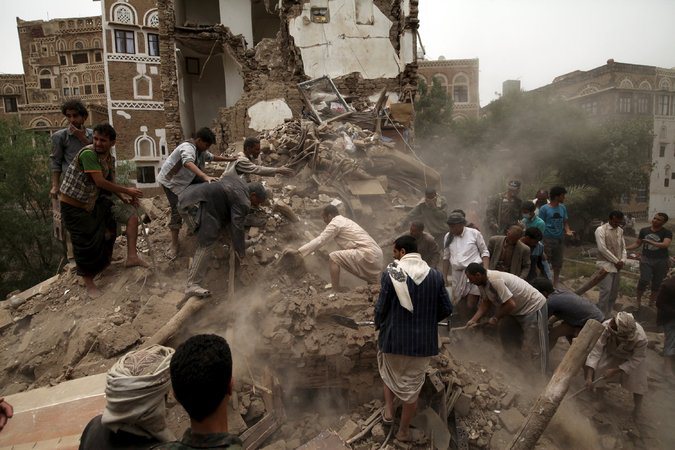
This photo of the aftermath of an airstrike in Sana, Yemen, accompanied a New York Times story (6/24/15) that provided a detailed account of the human toll of the air war—but made no mention of the US’s responsibility. (photo: Mohamed Al-Sayaghi/Reuters)
By Jim Naureckas | FAIR | August 31, 2015
The New York Times (8/30/15) reported on the deaths of civilians in a military assault in Yemen. Wrote reporter Saeed Al-Batati:
Airstrikes by a Saudi-led military coalition killed at least 13 civilians working early Sunday at a water plant in northern Yemen, the plant’s owner said.
The bombings appeared to be the latest in a series of airstrikes by Saudi Arabia or its Arab coalition partners that have hit civilian facilities with no apparent military target nearby.
The Washington Post (8/30/15) briefly covered the story too, using a Reuters wire report that gave a higher death toll:
An airstrike by warplanes from a Saudi-led coalition, which said it targeted a bomb-making factory, killed 36 civilians working Sunday at a bottling plant in the northern Yemeni province of Hajjah, residents said.
Noting that another airstrike had killed four people in Sanaa, Yemen’s capital, the piece continued:
The attacks were the latest in an air campaign launched in March by a Saudi-led alliance in support of Yemen’s exiled government, which is fighting Houthi forces allied with Iran.
Both of these reports left out the information that made this news particularly relevant to the papers’ mostly American readership: The US government is actively backing the air war in Yemen that killed those civilians, as the Times and Post have both reported. The Times (3/26/15) wrote at the start of the Saudi assault:
A spokeswoman for the National Security Council said Wednesday night that the United States was providing intelligence and logistical support for the campaign in Yemen, and that President Obama had authorized a ”joint planning cell” with Saudi Arabia to coordinate American support for the military offensive.

The Washington Post provided a photo of the kind of jets the US had sold to Saudi Arabia—but when such jets were used to kill civilians, they were out of the picture. (photo: Fayez Nureldine/AFP)
And the Post, in a piece headlined “How US Weapons Will Play a Huge Role in Saudi Arabia’s War in Yemen” (3/26/15), noted that the weaponry involved largely comes from the US:
US officials said they will offer intelligence and logistical support to the Saudis, but that’s really only a piece of it: The Saudi military is equipped with billions of dollars in advanced American-made weapons.
But that “huge role” often disappears when the the leading papers are discussing the carnage that results from the air attacks that the US is supporting and supplying. Thus when the Times‘ Rick Gladstone (8/22/15) reported that “Saudi-led airstrikes on a residential district in Yemen’s southwestern city of Taiz had killed more than 65 civilians, including 17 people from one family,” according to Doctors Without Borders, and that the death toll in the war included “hundreds of civilians killed in airstrikes,” Washington’s role in facilitating those deaths went unmentioned.
Featured Video

Why Hamas Really Attacked Israel on Oct. 7
or go to
Aletho News Archives – Video-Images
From the Archives
Israel: Strategic Ally or Liability?
By Stephen Sniegoski | My Catbird Seat | June 12, 2010
The claim that Israel serves as a valuable ally for the United States is made by both pro-Zionists and much of the anti-war and anti-Zionist Left that is influenced by Noam Chomsky. As a result of the Gaza flotilla massacre, which has caused a world-wide uproar against Israel, the value of Israel to the United States is being publicly questioned in more mainstream foreign policy forums. … continue
Blog Roll
 Aletho News
- Why Hamas Really Attacked Israel on Oct. 7
- Declassified UK exposes British man who fought for ‘Israel’ in Gaza
- West’s death cult in a theater near you
- How the Yandex ‘Russian bots’ lie fell apart
- Burnham’s ‘Russia did Brexit’ ruse crumbles
- Estonia making movies and games to encourage war against Russia
- Four in five new UK jobs taken by foreigners – report
- Here’s what Trump’s latest U-turn really means for Russia and Ukraine
- The Houthis Are Not an Iranian Proxy
- Europe’s Energy Hypocrisy, Russian LNG Profits and US Dependence
- If Americans Knew
- Activists Abused By Israel Return to New Freedom Flotilla Mission
- 60 Minutes won’t tell the full truth about Israeli settler violence
- Nearly 50,000 women, girls killed or severely injured in Gaza since October 2023: UN Women
- ADL is working with AI companies to suppress alleged ‘antisemitism’
- Israeli occupation forces using social media surveillance unit to target hundreds of Palestinians in the West Bank
- Israel’s New – and Terrifying – Security Doctrine
- Israeli Attacks Kill Five in Gaza, Including a four-year-old and a woman
- Air Force Major Who Called for Trump’s Impeachment Held in Solitary Confinement
- It’s a Genocide, I’m Into It’: Seinfeld Mocks Protest over Palestinian Children Killed
- Universities fire dozens amid pressure from Zionist billionaires
- No Tricks Zone
- New Study Suggests Large Regions Of The Pacific Ocean Have Been Cooling For The Last 80 Years
- Germany’s Green Energy Debacle: High Energy Costs Force Kahla Porzellan to Close After 182 Years!
- New Study: 50 Years Of The Most Aggressive ‘Net Zero’ Policies Can Only Affect The Global Climate By 0.03°C
- US September “Heat” Was No Record…Many Records Set Decades Ago
- Latest European Green Energy Debacle; Portugal’s Largest Flagship Solar Park Insolvent!
- Green Energy Debacle: German Expert Professor Fritz Vahrenholt Warns Of Severe Economic And Social Consequences
- Two More Paleo Reconstructions Affirm Meters-Higher Sea Levels Across Ireland, Brazil 7000-6000 Years Ago
- New Study: Earth And Venus Surface Warmth Largely Explained By Convection And Lapse Rate, Not CO2 Or Radiation
- 2025 Nature Paper Claiming Worsening Global Drought Gets RETRACTED …Heavily Flawed
- New Study: ‘Global Drought Shows No Detectable Recent Acceleration Under Climate Warming’

