Near the outset of the U.S. Civil War, President Abraham Lincoln made Maj.–Gen. George McClellan General-in-Chief of the Union Amy. McClellan was highly popular among his men and a great organizer who built the Army of the Potomac into a formidable force. Unfortunately for Lincoln, McClellan the meticulous organizer lacked the courage and judgment to be a field commander.
On April 5, 1862, Lincoln ordered McClellan to attack a Confederate force in Yorktown, Va. He had at his disposal 121,500 troops, 44 batteries of artillery and prodigious logistical support. The Confederate contingent in Yorktown, meanwhile, comprised something on the order of 10,000 men. The battle was a rout waiting to happen. It never did. McClellan told Lincoln the enemy was 100,000 strong and refused to attack. This delusion was partly due to Gen. John B. Magruder’s crafty parading of his Confederate soldiers in a circuit to give the illusion of greater numbers and his ordering of logs to be painted black to resemble cannons.
McClellan knew that intelligence estimates of Confederate strength were laughable exaggerations yet he acted as if they were true. Instead of attacking, he chose the do-nothing option of laying siege to Yorktown. In early May, Magruder and the Confederates slipped out to fight another day, leaving McClellan to enter an empty town. He declared victory. The last straw for Lincoln was McClellan’s repeated refusal to hasten after Gen. Robert E. Lee’s retreating army after the Battle of Antietam. On Nov. 5, 1862, Lincoln relieved him of command.
McClellan was an administrator who proved to be more of a coward than a commander, notwithstanding the Washington Post’s risible attempt to rehabilitate him. There may be a lesson here for a certain Canadian leader, one who finds himself at the head of a large force in the run up to a political war.
Two years ago this month, Justin Trudeau was anointed leader of the Liberal Party of Canada, a decision that gave hope to Canadians that somebody might finally put the brakes on Stephen Harper’s totalitarianism.
For one thing, Trudeau has a good pedigree. His father, Pierre Elliot Trudeau, was a respected if not wholly popular prime minister, though his reputation has much improved since his death. Trudeau’s Liberal predecessors, Stéphane Dion and Michael Ignatieff, were, respectively, too bland and too aloof to generate any deep support among the party faithful or offer a viable governing alternative. When you add good looks and youth (41), Justin Trudeau appears to be the ideal prime-minister-in-waiting, especially for young voters.
Opinion polls in the month following Trudeau’s election seemed to confirm that a reversion to Liberal rule was highly likely if not inevitable. In May 2013, voter support for the Liberals had more than doubled since the end of the 2011 election, whereas support for the Harperites had fallen by a third. Some of that Liberal growth even came at the expense of the centre-left New Democratic Party, which lost more than 20% support. Had an election been called at this time, the Liberals would have coasted to majority rule. What a difference two years makes.
By April this year, the Liberals had fallen from 38.6% to 27.6%, and Harper, of all people, was the major beneficiary! The NDP, contrary to expectation, not only did not benefit from Trudeau’s slip but lost ground, confirming that its leader, Thomas Mulcair, is not perceived as a serious rival to Trudeau.
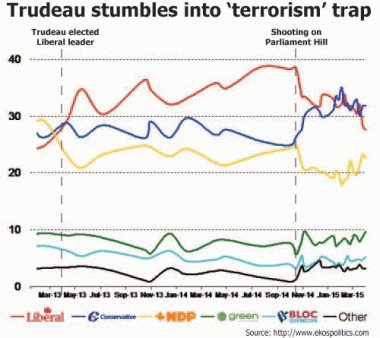 Like McClellan, Trudeau is highly popular. His victory came on the first ballot with 80% of the vote, and Liberal membership grew rapidly almost immediately. Trudeau’s popular appeal really took off in January 2014 and ballooned over the spring and summer.
Then, in mid-October, it all went south. The seminal event was the Oct. 22 shooting of Cpl. Nathan Cirillo, a ceremonial guard on duty on Parliament Hill. It was a bizarre incident, not only because it came out of nowhere, but it received conspicuously comprehensive video coverage. Some of this coverage even managed to catch no fewer than four police cars parked near the site on Parliament Hill with officers standing around as if… waiting for something to happen.
As readers already know, the shooting of Cpl. Cirillo gave Harper the excuse he needed to legislate police-state repression and a host of other unconstitutional measures in the name of “public safety.”
This police-state repression is manifested in Harper’s Protection of Canada from Terrorists Act (Bill C-44) and Security of Canada Information Sharing Act (“Secret Police Act,” Bill C-51) which authorize the state to conduct spying, harassment, arbitrary detention and intimidation and other unconstitutional measures. The main targets are not so much “terrorists” as anyone who criticizes the government, people like environmentalists and Muslim charities. These groups are already subject to malicious audits and have been intimidated into repressing their political activism.
Canada’s McClellan fails test of character
The shooting of Cpl. Cirillo gave Trudeau the perfect opportunity to seize the initiative from Mulcair and the NDP, who represent the Confederacy for analytical purposes: He could condemn the shooting and condemn the Harperites for their conspicuously contrived campaign to demonize the shooter, Michael Zehaf Bibeau, as a terrorist. Moreover, he could call attention to the totalitarian overtones of the shooting and its aftermath.
On the day of the shooting, Trudeau did deliver a speech, but it was stiff and peppered with “values” blathering reminiscent of George W. Bush’s post-Sept. 11 screed. Nevertheless, it had one redeeming virtue—he did not demonize Zehaf Bibeau: “Criminals cannot and will not dictate to us how we act as a nation, how we govern ourselves or how we treat each other. They cannot and will not dictate our values. And they do not get to decide how we use our shared public spaces.”
For his part, Mulcair also steered clear of the terrorism tar pit. On Oct. 29, he also used “criminal” to describe Zehaf Bibeau: “When you look at the history of the individual involved, you see a criminal act, of course. But… I think that we’re not in the presence of a terrorist act in the sense that we would understand it.”
At this point, Mulcair and Trudeau were on the same page regarding the shooting, but Trudeau had a big advantage. His Liberals are far and away richer and more populous than Mulcair’s NDP, and he can tap into overwhelming national hatred for Harper and his anti-terrorism totalitarianism to outmaneuver Mulcair. Since the Bill was announced, Harper’s terrorism smokescreen has lifted and opposition to state totalitarianism tripled in six weeks. Even key business leaders oppose it. All Trudeau had to do was channel this sentiment to become the people’s choice to restore Canada to parliamentary rule.
As expected, Harper and his minions jumped all over Mulcair for daring to be rational, but so did Trudeau! “The RCMP was clear, these were acts of terrorism, [so] these were acts of terrorism,” he said. Instead of lambasting Bill C-51 as unconstitutional and fascist, he tapped into his inner McClellan to adopt the do-nothing approach of proposing amendments that he knew full well would never pass. From a position of strength, Trudeau allowed himself to be outmaneuvered by both Harper and Mulcair thereby placing himself at odds with the electorate and his own party.
Trudeau’s abrupt about-face, and his attack on Mulcair for agreeing with him, makes no sense politically or morally. He does not allow for the possibility that the RCMP might lie, or that it might have abetted the shooting in some way. Currently, Parliament Hill has its own police force, which is loyal to Parliament; Harper wants it replaced by the RCMP, which is loyal to him. The RCMP has even admitted to being party to a smear campaign against former Liberal finance minister Ralph Goodale that helped Harper win his first election. Is it too much of a stretch to suggest that the RCMP came to Harper’s aid again? At any rate, Trudeau had no business taking the RCMP’s judgment on what is or is not “terrorism” at face value.
His uncritical acceptance of the RCMP’s version of events is also disturbing because it raises the possibility that he might have succumbed to political coercion. If so, one of the likely suspects is the Israel Lobby, which has the most to gain from the destruction of Canada’s civil liberties. This view gains credence from Trudeau’s knee-jerk condemnation of the Boycott Divestment and Sanctions campaign, which seeks to isolate Israel politically and economically because of the atrocities it commits in the Middle East. Trudeau claims (wrongly) that the BDS movement, like Israeli Apartheid Week, has no place on Canadian campuses, but this is just standard Lobby propaganda.
Since Trudeau wants to return the Liberals to power, he might have thought it less risky to acquiesce in attacks on Canadians’ constitutional rights than risk offending those who control vast amounts of campaign money and influence. After all, since Harper’s primary loyalty is to Israel, an attack on Harper’s secret-police bill might be construed as an attack on the Lobby. The problem with this scenario, though, is that it is utterly self-defeating—at least half the country and two thirds of Trudeau’s own MPs oppose Bill C-51. Why would Trudeau pick an unnecessary fight with his own party and the voting public unless he lacked the character and confidence to do the right thing?
In the end, Trudeau, like McClellan, succumbed to cowardice. Despite having a decisive advantage over his opponent and Harper set up like a clay pigeon, the expected rout never happened. Instead, Trudeau resorted to timid half-measures and abdicated the role of national saviour-in-waiting to Mulcair. Today, Mulcair and Green Party leader Elizabeth May are the only two national leaders willing to stand up to Harper to defend the Constitution and rule of law. In fact, Green Party support rose by more than 150% over this same period.
Short of a shock caucus revolt, which is distinctly unlikely in an election year, the Liberals are stuck with a McClellan at a time when they need a Ulysses S. Grant.
April 29, 2015
Posted by aletho |
Civil Liberties, Deception, False Flag Terrorism, Full Spectrum Dominance | Canada, Justin Trudeau, RCMP, Zionism |
Leave a comment
The national secular religion of this country consists of a cluster of rarely questioned premises, usually inculcated in childhood, comparable to the articles of a real religious creed.
The first proposition is the idea that we live in a “free” country, as symbolized by the Statue of Liberty idol that towers over New York City’s harbor. The system absolutely insists on this point, incessantly hammering it in. It’s its basic tenet. Indeed it’s presented as “self-evident.” You’re in this country, ergo, you are FREE.
It’s inflicted by osmosis. Every institution transmits it. Those who doubt it are encouraged to think they must be mentally ill. (Of course you’re free, you’re told. And so fortunate to be so! How can anyone question that?)
“Freedom” is emblazoned on our coinage and many state automobile licenses. It’s proclaimed each school day morning by tens of millions of otherwise innocent children obliged to recite religiously that they live in a nation “with liberty and justice for all.”
This particular component of the national creed is perhaps comparable to the opening article of the Apostles’ Creed, which alludes to belief in “God the Father Almighty.” Because belief in the U.S.A. as the global headquarters of “Freedom” is as central to what some call “Americanism” as monotheism is to Christianity.
The Pledge of Allegiance expresses the belief, not just in the goodness of “freedom” in itself, but in the idea that we actually live in a free country. (How often people protest, when someone criticizes their thoughts or behavior, “Well hey, it’s a free country!” And they usually truly believe this.)
“I’m proud to be an American,” country crooner Lee Greenwood boasts, “where at least I know I’m free.” He knows this, without any religious doubt. “Cause the flag still stands for freedom, and they can’t take that away.” (Whoever they are. Presumably people who “hate our freedoms” and are actively conspiring somewhere to invade and enslave us.)
Actually, I suspect that the people of Sweden or Denmark are freer than Lee Greenwood is, or imagines himself to be. But do they know they’re free, with the confidence he exudes?
The second article of the national creed is that the U.S. military (commonly referred to as “our troops”)–wherever and whenever they fight–fight for us, somehow, to “defend our freedoms.” Whenever you attend a ball game (as I do regularly in Fenway Park) you’re told that everyone in the stadium is proud to honor the “servicemen and servicewomen” present–the “heroes” who are “defending our freedoms” in Afghanistan, Iraq, or wherever. We’re expected to applaud them, even in liberal Boston, and indicate our gratitude for whatever it is they did. And if we read in the morning Boston Globe about these heroes killing civilians we should just put it out of mind.
The ball park MC never considers the possibility that there are Red Sox fans there just for the game, who do not see how U.S. troops’ actions in invaded countries defend their freedoms in any way, and who find this insertion of patriotic content into the program really annoying.
Still the crowd rises to its feet on demand, showing deference, accepting the adulation of the troops as a matter of faith. If you just sit there sullenly, refusing to participate, some drunken patriot might hassle you for your traitorous non-enthusiasm. So in this free country it’s best to just stand up to honor the troops and try to maintain your self-respect by being as nonchalant as possible.
Every cable news viewer has seen that endlessly repeated USAA Military Auto Insurance TV commercial, “Thank you Dad.”
“Thank you, Daddy, for defending our country,” says the cute little Latina girl, in one version.
“Thank you for your sacrifice, and thank you for your bravery,” says an African-American women, to her spouse perhaps.
“Thank you, colonel,” says the young white man to his former superior officer.
“Thank you, Daddy,” says the little black girl.
It’s a movingly multi-ethnic crowd, thanking Daddy for his martial valor. Trace Adkin’s “Till the Last Shot’s Fired” is in the background, urging us to “say a prayer for peace” even as the song glorifies the warrior and places priority on his (as opposed to his victims’) peace.
I’m in the fields of Vietnam,
the mountains of Afghanistan
and I’m still hopin’ waitin’
prayin’ I did not die in vain.
Say a prayer for peace for every fallen son.
Set our spirits free. Let me lay down my gun.
… We can’t come home until the last shot’s fired.
It doesn’t seem to make any difference to Adkins what the cause is, or how many people these soldiers killed. They’re heroes–just for doing the unquestionable right thing and firing that last shot (against whoever) as ordered.
The fact is, those who fought in Vietnam and Afghanistan did “die in vain.” Certainly their deaths produced no good for this world. But as suffering servants who sacrifice their lives as commanded, the U.S. military vets occupy the position of Christ in the secular religion. Just as in Christian theology, Jesus is God in human flesh, “our troops” are our (mythical) Freedom personified.
St. Paul writes in his Epistle to the Galatians, “For freedom Christ has set us free.” In the U.S. civic doctrine, the dead troops are the sacrifice necessary to keep us free.
The third proposition in the official state faith is that we live in a democracy, in which the people decide the nation’s fate through exercising their awesome right to vote. This, in the official civic belief system, is the equivalent of the Holy Spirit in Christianity.
Through the ritual of casting a ballot in the hallowed privacy of a voting booth, citizens fulfill their highest civic duty. One is supposed to stand there in that box, in solitude, but in intimate spiritual communication with the benevolent, all-embracing, fatherly state. One is supposed to be grateful to the state for the opportunity to enjoy the right to help determine the future, perhaps by choosing Jed Bush over Hillary Clinton. Or Hillary Clinton over Jed Bush.
One is supposed to leave that sacred space feeling pure and righteous, having performed the highest duty of citizenship. It’s not so important to vote for either one of the two of the viable corporate-sponsored parties (which are really like two factions of a single party, in a one-party dictatorship of the 1%). No. What’s important is to simply vote and, having participated, thereby voted for the system itself.
You’re supposed to leave the ballot box, proud to be an American, because at least you know you voted. You made a difference! You exercised your right. The only downside is that hereafter–whatever happens–you share responsibility. Because you, after all, elected your leaders, didn’t you?
So if you voted for a warmonger who attacks Iran, with hellish consequences, you’ll have to call the inevitable ensuing conflict “our” war, right? Rather than calling it “their” war–the war of the imperialists, from whom you might have appropriately dissociated yourself–just by politely declining the invitation to attend their unpleasant party and play their game.
Voting is fundamentally a statement of faith in the god of Freedom. And in the Christ-like qualities of the divinized warrior who, in this mythology, dies for your precious right to engage in this vapid ritual. Casting a vote in this “democracy” is rather like receiving Holy Communion in the presence of the Holy Spirit.
In the latter rite one reverentially receives and consumes the wine and wafer; in the U.S. civil rite one religiously casts the ballot and swallows the myth.
These three beliefs constitute the Holy Trinity of the national doctrine. They’re indeed all articles of faith, hardly based on reason. After all, how “free” is a country with the world’s highest incarceration rate, with over 700 in jail or prison out of every 100,000?
Almost 7 million adults in this country–nearly 3% of the adult population–are under what’s called “correctional supervision.” With 5% of the world’s population, this free country boasts fully one-quarter of the planetary prison population. 40% of these prisoners are African-American. There are more young black men in prison in this country than in college.
How can anyone speak with a straight face about “freedom” here?
“I wish I knew how it would feel to be free,” sang Nina Simone–quite heretically, in bold opposition to the state faith–in 1967, before fleeing the U.S. in 1970 and ultimately settling in France, which she (among other African-American and other exiles) found somewhat freer at that time.
How “free” are we now really–when all citizens are under electronic surveillance (at a level of sophistication that puts East Germany’s fabled Stasi to shame); while young men of color are routinely harassed by police, while police murders have–if only due to cell phone camera video exposure–become almost daily news stories; while government whistle-blowers are jailed for revealing such phenomena as state-sponsored torture?
And how do U.S. soldiers fight “for us” or “defend our freedoms” by invading countries in wars based on lies?
In my own state of Massachusetts there have been what I suppose can be termed some modest advances in freedom in recent times. (Sunday alcohol sales were allowed in 2004, gay marriage was legally recognized in 2004, marijuana possession was decriminalized in 2008). These changes have a meaningful impact on my community. But none of them had anything at all to do with U.S. troops’ actions abroad. And in fact the U.S. war (based on lies) in Iraq set women’s rights far back in that tortured, mutilated country.
The Democrats and Republicans pretend to have real differences with one another. (Rather like pro wrestlers pretend to truly despise one another before the big fight. It’s all for show.) But seriously: how democratic is a country in which two parties sharing a common faith in capitalist imperialism trade the presidency every so often–always vowing to effect change, even while nothing dramatically changes–while the one percent at the top of society (especially the cancerous tenth of that one percent) relentlessly increases its share of the national wealth?
The recent (2014) empirical study by Princeton professor Martin Gilens and Stanford professor Benjamin Page declares that the U.S. is not in fact a democracy but an oligarchy in which individuals and even mass-based interest groups cannot prevail over the tiny elite that makes decisions. “Average citizens and mass-based interest groups have little or no independent influence” on policy, they conclude. “Democracy” in this country is a joke.
The national secular creed also entails support for a foreign state which has nothing to do with U.S. freedom, and has not been a battlefield of U.S. blood sacrifice, but which does significantly impact the sacrament of voting. Whereas belief in the trinity of Freedom, Our Troops, and Voting is formally non-religious, this support is rooted deeply in religion.
I refer of course to the role of Israel in the national belief system.
Members of Congress have been known to cite Genesis 12:3, in the Old Testament, to explain their votes in favor of Israel under any circumstances whatsoever. This is the passage in which Yahweh (God) tells Abraham, “I will bless those who bless you, and whoever curses you I will curse.” Just the other day Congressman Louis Gohmert (R-TX) declared, “There are many who have been aware of Scripture, and it has been a guide in our relations with Israel.” Enough said!
This sort of ass kissing is politically feasible in a country where, a recent poll showed, 55% of the population believes that God (the Maker of everything) gave what’s now the land of Israel to the Jews in perpetuity. It’s amazing. It would be amusing if the potential ramifications weren’t so horrifying.
President Obama and repeated Congressional resolutions refer to the U.S.’s “eternal support” for Israel. (Notice how such language is never applied to other countries. Despite the “special relationship” U.S. politicians never use such effusive language in referring to ties with the U.K. And recall how France, the U.S.’s oldest ally that gifted it the Statue of Liberty, was vilified as an “enemy” not so long ago–when it refused to support the war on Iraq, based, as that criminal war was, wholly on lies.)
This religious support for Israel in fact produces some amusement in Israel itself, where about a third of the Jewish population considers itself non-religious and takes those Bible fables with a grain of salt. But the support of Christian evangelicals is the key to the U.S.-Israeli relationship. Israeli prime ministers are received like rock stars at Christian events held in support of Israel. Christian Zionist organizations play a major role in the American Israel Public Affairs Committee (AIPAC), the powerful lobby group that serves as a virtual agency of the Israel state.
In his May 2011 speech to Congress, Prime Minister Binyamin Netanyahu received 29 standing ovations–including one when he declared, “Israel will not return to the indefensible boundaries of 1967.” Never mind that no country in the world recognizes Israel’s right to any land (on the West Bank, or in Gaza, Syria, or Lebanon) occupied during that “pre-emptive” war of aggression. Never mind that it is official U.S. policy to demand, along with the rest of the world, for Israel to withdraw to the 1967 borders. The bought-and-paid-for Congress rose to applaud Netanyahu’s insistence of the Jewish right to permanently annex more Arab land.
In his March 3, 2015 address to Congress, by invitation of the Republican leaders in the Senate, Netanyahu devoted all of his time to one topic: the G5+1 talks in Switzerland with Iran, and the need for the Congress to oppose any plans for President Obama’s State Department to sign onto any deal on Iran’s nuclear program. Again, incessant standing ovations!
Not surprising. Sen. Lindsey Graham, Republican from South Carolina and head of the Senate’s Foreign Appropriations Committee, had already told Netanyahu publicly that on Iran “Congress will follow your lead.” How to make sense of such fawning stupidity?
Netanyahu has direly predicted that Iran is close to the production of nuclear weapons since 1992, since before today’s college sophomores were born. He’s been a Chicken Little crying that the sky is falling–that Israel is in imminent, existential danger from Iranian nukes. He will not of course talk about Israel’s nuclear weapons, which the Jewish state has possessed since 1979, when it conducted a joint test with its close ally, the racist apartheid regime in South Africa. (In Israel it is a crime for anyone with knowledge about this to reveal what they know; the nuclear scientist Mordechai Vanunu spent 18 years in prison for revealing details about it to the British press.)
Israel is the only state in the Middle East with nuclear weapons. Its leaders think they have the right to have them, since (for some reason) Israel faces so much hostility from its refugee-flooded neighbors in this harsh world. And they decline to submit their nuclear facilities to UN inspection, while demanding that the world prevent Iran from developing any sort of nuclear program. Even a program like that which Brazil or Argentina might boast of, quite legally.
There is amazingly little discussion in this country of the actual history of the modern state of Israel. About how 33 of the UN ambassadors in 1947 (59% of the total at the time) voted for a plan to partition the British Mandate of Palestine that favored the Jewish immigrants over the 65% Arab majority, allotting the Zionist settlers over half the land.
They don’t realize how unrepresentative the UN was at that time, when half the world remained under colonial occupation.
They don’t know that in 1948 many prominent Jewish rabbis in the world opposed the formation of a specifically Jewish-Zionist state in Palestine.
They don’t realize how the entire Muslim world opposed the unfair partition; how major countries that were not majority Muslim (India, Greece, Cuba) voted against it; and how many others (China, Argentina, Ethiopia, Mexico, Yugoslavia, even the United Kingdom) abstained, feeling queasy about the deal and its potential blowback.
They don’t necessarily know that Zionists in the Irgun brown shirt paramilitary group along with the Stern Gang implemented a strategy of terror to produce mass panic and flight that produced 750,000 Palestinian Arab refugees between April 1948 and January 1949. They’ve never been told about the Deir Yassin massacre in April 1948.
They certainly don’t realize that many of these Palestinians may be the direct descendents of the Judeans of the Roman province where Jesus lived. It’s not like there was ever really a Diaspora in which the wicked Romans drove out all the Jews. They drove out some, while others remained. Of those who stayed, many became Christians over time and stopped self-identifying as Jewish. Later many converted to Islam. Meanwhile Judeans outside Judea, who numbered in millions even before the birth of Jesus, intermarried with others and for a couple centuries there was actually significant conversion to Judaism by gentiles in both the Roman and Parthian empires.
The Jewish Zionist community in contemporary Israel, which officially represents itself as a people who have “returned” to their ancestral land to which they have some sort of “birthright,” may in fact have less DNA in common with the Judeans of Jesus’ time than with modern European populations. The whole business of Abraham talking with the Supreme Being and being told his direct descendents would possess the Land of Israel forever (and so, who cares what happens to the Arabs?) is mythology. The “call of Abraham” is supposed to have occurred around 1000 years before there even was a written Hebrew language.
Christians in this country, who are prone to be much more literalistic in their reading of the Bible than those in Europe, tend to accept (as real historical phenomena) the story of Noah’s Ark, the bondage in Egypt and parting of the Red Sea. They believe that Moses was given the Law by God himself on Mount Sinai, and that during the conquest of Canaan, the walls of Jericho fell miraculously when the Hebrew “chosen people” blew their trumpets. They believe that the sun once remained stationary in the sky to give Joshua the upper hand in a battle for control of Jerusalem (Joshua 10:13).
The Israeli government and Israel Lobby which serves as its unlicensed agent (de facto exempt from U.S. legal oversight) knows that the U.S. public–largely brainwashed by the secular national religion and its own delusions about being itself a Chosen People inhabiting a Promised Land–is extremely receptive to Israel’s incessant religious pitch. They know that politicians competing for votes know they need to show maximum deference to Israel.
In his March 3 address to Congress, as his mesmerized audience sat imbibing his wisdom, Binyamin Netanyahu sermonized:
We’re an ancient people. In our nearly 4,000 years of history, many have tried repeatedly to destroy the Jewish people. Tomorrow night, on the Jewish holiday of Purim, we’ll read the Book of Esther. We’ll read of a powerful Persian viceroy named Haman, who plotted to destroy the Jewish people some 2,500 years ago. But a courageous Jewish woman, Queen Esther, exposed the plot and gave for the Jewish people the right to defend themselves against their enemies.
The plot was foiled. Our people were saved.
The legislators present rose to applaud this allusion to the Bible story, which immediately segued into the claim that “Today the Jewish people face another attempt by yet another Persian potentate to destroy us. Iran’s Supreme Leader Ayatollah Khamenei spews the oldest hatred, the oldest hatred of anti-Semitism with the newest technology…”
The fact is, the story of Queen Esther is a myth. Set in the fifth century BCE but composed around the second century BCE, it describes a situation in which numerous Judeans reside in the city of Babylon in the Persian Empire. The exiles had in fact been permitted to leave by 530 BCE, and to rebuild the Temple in Jerusalem, by the Achaemenid founder Cyrus the Great–a Persian (Iranian) who is actually identified in the Old Testament as “the Lord’s anointed one” (Isaiah: 45:1-7).
This validation as an “anointed one” was, by the way, an honor shared by no other non-Jew in the Bible. Not that you’d expect Netanyahu to point out the positive aspects of the very long relationship between Jews and Iran, which (as you know) has the largest Jewish population outside of Israel in the Middle East. The Jewish minority has representation in the Iranian parliament, and maintains synagogues, Hebrew schools and kosher restaurants. (If you don’t know these facts, thank the U.S. mainstream media.)
In the Book of Esther story, the Persian emperor Ahasuerus (commonly identified with Xerxes, a real person who ruled from 486 to 465 BCE and the fifth in the Achaemenid line) becomes dissatisfied with his current wife. He casts her aside unceremoniously and looks for a new spouse, choosing Esther, a Jew, who conceals her background. She finds favor with the ruler. However, her kinsman Mordecai offends Xerxes’ prime minister, Haman (to whom Netanyahu alluded in his speech) by refusing to bow down before him.
Haman learns that both the queen and Mordecai are Jews. Energized by petty pique, he organizes a plot to massacre all the Jews in the land and seize their property. He tells Xerxes there is a “certain unassimilated nation… throughout the provinces of your realm” whose laws so differ from those of other nations that “it is not in the king’s interest to tolerate them” (Esther 3:8-9). He persuades him to agree to an annihilation campaign.
Again, this is pure fantasy. It never happened. But in the story, a huge pogrom is planned, Mordecai heroically organizes mass prayer and resistance, and Queen Esther at the decisive moment reveals her identity as a Jew to the ruler, and defends her people. Xerxes, egged on by his spouse, has Haman hanged and gives the Jews license to exact revenge on their enemies. Indeed, according to this novelette, Jews during the Feast of Purim slaughter 75,000 Persians (Esther 9:15-16). (None of this is supported by contemporary Persian sources.)
Having observed that this is pure fiction, one can ask why Netanyahu wanted to use it last month in his fiction-riddled presentation to Congress. He must have known that anyone present with a little knowledge of Jewish-Iranian history might have asked: “Excuse me, but doesn’t the Esther story actually tell us that Jews have been in Persia (Iran) for 2,500 years, and that Persian rulers were regarded favorably by ancient Judeans as allies–even ‘God’s anointed’ rather than foes?”
And couldn’t one ask, “How did the Jewish Queen Esther ‘give the right’ to the Jews ‘to defend themselves against their enemies’?” The Jews were allowed to kill the 75,000 Persians in the story because the Persian ruler had given them the right. Netanyahu might not have read the text carefully. But one must suppose that even if he had, he wasn’t trying to give the U.S. audience a rigorous textual exegesis. He was presenting his Likud Party program of continued confrontation with Iran (as a supporter of Palestinian and Lebanese resistance movements) in biblical gift-wrap.
Just by citing an Old Testament work familiar to some Christians–such as those who dominate Congress–Netanyahu plugged into that chord of commonality that many adherents of the national civic religion like to reference when the trinity of Freedom, Holy War, and Voting alone doesn’t quite do the job.
When you’re a U.S. leader and need to get the people on board a new campaign for Mideast war, you can’t just say, “We’re free. But we have to fight to stay free. And we have to vote for the strongest, who will fight hardest for our freedom.” You also need to exploit the religious element and add, “We have to side with Israel, because God said, he would bless those who blessed it, and curse those who didn’t.”
Again, the first three articles in the national civic religion are actually irreligious; they don’t require belief in deities, souls, and afterlives. But the belief in Israel as the Promised Land of a certain bloodline, granted to it in perpetuity by a certain deity in conversations four millennia ago, is an explicitly religious conviction.
Unfortunately these four creedal myths–that we really enjoy freedom; that this countries wars are for freedom; that the act of voting really means “democracy;” and that the U.S. must always as a matter of principle back Israel–constitute a doctrinal whole.
You can presumably lose faith in the fourth while maintaining adherence to the first three, since the latter don’t involve specifically religious beliefs. But polls suggest that the majority of people in this country still accept all four points in the Creed. They would, in the event of an Israeli nuclear strike on Iran–while prizing their freedom, heroic military and parliamentary system–also applaud any Israeli actions in putative defense of the Jews’ “God-given” land.
Even if the Israelis were to deploy nuclear weapons, out of their known arsenal (which U.S. politicians, for some reason, never ever mention) against an Iran which has none, these people would bless rather than curse them. They would see in the action affirmations of “freedom,” heroic military action, and “democracy” alongside adherence to the unquestionable Word of God.
How can one possibly challenge the U.S. state religion–this nonsensical mass of concepts in the service of the 1% including an inordinate share of billionaire Iran-baiting Zionists? Six media corporations (GE, News-Corp, Disney, Viacom, Time Warner, and CBS) control the “news” consumed by the great majority of people in this country. They all promote the national belief system.
Freedom. Our troops. The beauty of the ballot box. God and Israel.
They all instruct their reporters, in the event of a Ferguson-style situation, to spin the story away from any radical critique of systemic police brutality victimizing the non-white poor. Of course they all uphold the freedom of the abused people to demonstrate (“peacefully”); they have to confirm the national creed that the people are somehow, basically, “free” under the existing system.
“Journalists” and talking heads from Lou Dobbs to Al Sharpton unite in urging the people to respond properly, responsibly to events that disturb them (whether it’s war, economic injustice, or police brutality) by registering to vote!
Off the streets and into the polling booth! To elect more Obamas, more saviors! (Even though–let me repeat–Martin Gilens and Benjamin Page have concluded empirically that in the U.S. your vote means very little.)
They all resist criticism of war, and investigative journalism before the next war-based-on-lies occurs. They all get critical as the U.S. enters a morass, and belatedly might even question the premises for a particular war. But they will always, culturally, uphold the warrior as the soul of the nation. Even after a war has itself been discredited, clearly exposed as based on lies, the warrior is upheld as a freedom fighter and social role model.
How to disabuse people of those doctrinal premises? How to persuade them to see Israel rationally–free of religious baggage–as a normal, oppressive settler-state surrounded by neighbors who are (most understandably) indignant about its aggressions since 1948?
It may well be impossible. State religions are hard to crack. Still, the petering out of state faiths in Europe and the collapse of State Shinto in Japan after 1945 suggest that the U.S. secular national religion might also eventually (as that old Persian expression goes) “fade from the page of time.”
I’m hopeful there will come a time when our youth–frustrated with job prospects and housing issues, fed up with police brutality, burdened with student debt, disgusted with wars based on lies, nauseated by the Stasi-like NSA surveillance of their private lives, shocked by the raw statistics showing how wealth is apportioned in this “free” country, disillusioned by their own engagement with the “American dream”–will rebel big time.
Understanding through experience that this is NOT a free country, and that humanity can do much, much better, they will observe matter-of-factly that U.S. military personnel deployed in imperialist wars are NOT heroes.
They will recognize that elections in this society are a ritual to legitimate the status quo, an ideological trap, not the best means to effect real change.
And they will realize that the mystical hold of Israel over the U.S. polity, which does not advantage the individual citizen at all, is rooted in a mythological misreading of the past.
In today’s world that interpretation of past reality necessarily dovetails with anti-Arab racism and ignorant Islamophobia. Senators and Congressmen will tell you quite frankly they’d be happy to “give” Israel the whole West Bank because the Bible tells them that “the Jews” should ultimately have it.
These fine Christian Zionists have no problem with Palestinian dislocation and disenfranchisement. But maybe their day is ending. The day of the U.S. state religion may be ending. The day that the Israeli prime minister citing biblical fairy tales can dictate U.S. policy in the Mideast may be ending as Bibi reaps the whirlwind of his Bible-thumping address to Congress.
A tsunami of disillusionment is, if not inevitable, at least very likely. It’s good to be disabused of illusions or delusions, religious, patriotic or both. May our youth shuffle off the Zionist coil, seeing it for what it is: the ideological prop for more war that has nothing to do with freedom.
Gary Leupp can be reached at: gleupp@granite.tufts.edu.
April 28, 2015
Posted by aletho |
Civil Liberties, Deception, Ethnic Cleansing, Islamophobia, Mainstream Media, Militarism, Progressive Hypocrite, Subjugation - Torture | Israel, United States, Zionism |
Leave a comment
As soon as the framework for a comprehensive nuclear deal between Iran and six world powers was announced in Lausanne, Switzerland on April 2, Vox.com content manager Max Fisher came out strongly in favor of the agreement’s reported details. While his optimism is certainly welcome, his understanding of some key details leaves something to be desired.
Unfortunately, for someone who writes about the Iranian nuclear program as much as he does, Fisher seems not to have a very solid grasp on certain basic facts about the program. Sure, this is tricky, complex stuff, but if you’re in the business of producing what you refer to as “explanatory journalism” – and your entire reporting model is based upon providing clear analysis to a presumably less knowledgeable public – you should probably know what you’re talking about.
Here are just a few of his most recent errors.
‘Covert Nuclear Facilities’
In his “plain English” guide to the framework parameters, as described by the United States State Department, Fisher notes that facilities at Natanz and Fordow will continue to operate, with uranium enrichment continuing at Natanz and non-uranium enrichment and research occurring at Fordow.
Fisher concludes that this is a good deal for those worried about Iranian nuclear capabilities. “International inspectors will have access [to these facilities],” he writes, “so they won’t really function as covert nuclear facilities anymore.”
But, apparently unbeknownst to Fisher, neither Natanz nor Fordow ever actually functioned as secret nuclear enrichment facilities. Ever.
Natanz
While much is often made of the 2002 revelation of Iran’s supposedly clandestine enrichment plant at Natanz, rarely do we hear that the pilot facility was still under construction when it was declared by Iran to the IAEA. Per Iran’s safeguards agreement with the IAEA at the time, however, “Iran did not have to declare that it was building a pilot plant until 180 days before it expected to introduce nuclear material into the plant,” explained a May 2003 article in the Bulletin of the Atomic Scientists. Furthermore, as pointed out at the time by a research analyst at the Arms Control Association, Iran “is not required to allow visits to the Arak and Natanz sites under its current agreements with the IAEA.”
In effect, the United States has long been proud of discovering a construction site that Iran was under absolutely no obligation to announce to the IAEA. Natanz was not operational until June 2006, at which which point it had already been under IAEA safeguards for over three years. Not a single atom of enriched uranium has ever been produced at Natanz outside the purview of IAEA inspectors. Nevertheless, in a separate article published the same day, Fisher claims Natanz “was once used for covert enrichment.”
Fordow
Similarly, the site at Fordow was never a functional enrichment site outside IAEA monitoring. As with Natanz, it was “clandestine” only to the effect that it wasn’t officially declared by Iran to the IAEA before the US intelligence agencies said they already knew about it.
The site was announced by Iran to the IAEA on September 21, 2009, well in advance of the 180 days prior to the introduction of nuclear material as required by Iran’s Safeguards Agreement. At the time, the facility was still under construction and did not actually begin uranium enrichment until early January 2012, roughly 28 months after it had been declared to the IAEA. Upon visiting the facility six weeks after it was announced, then-IAEA Secretary General Mohammed ElBaradei described Fordow as “a hole in a mountain” and “nothing to be worried about.”
When the plant began operation, the IAEA confirmed that “all nuclear material in the facility remains under the agency’s containment and surveillance.” This was the case well before the November 2013 interim deal between the P5+1 and Iran and this remains the case to this day.
While Fisher has written elsewhere that both the Natanz and Fordow “sites are now publicly declared and will be monitored as part of any deal,” meaning “their value (and threat) as covert facilities is gone,” he appears to insinuate that recent negotiations – and namely Iranian concessions extracted by determined American negotiators – are responsible for this positive state of affairs. Natanz has been safeguarded, monitored and inspected by the IAEA for over a decade, Fordow for over four years.
‘Plutonium Plant at Arak’
If you read Vox.com, you’d really think Iran has something called a “plutonium plant at Arak.” The main reason you’d probably think that is because that’s exactly what Max Fisher and other explainers at the site claim as fact over and over again. Here’s Fisher from the other day:
There is so much wrong with Fisher’s understanding of Iran’s Arak facilities it’s difficult to know where to begin. Fisher even changed the original words of the State Department’s “fact sheet” on the deal framework to match his misunderstanding before allowing himself to explain things to his readers. Basically none of Fisher’s sentences in this section make any sense.
What Fisher routinely refers to as Iran’s “plutonium plant” is actually the IR-40 heavy water research reactor, a nuclear reactor at the Arak complex that is still under construction and not yet operational. The half-built reactor is under IAEA safeguards and is visited regularly by inspectors. Nevertheless, it has long been used by Israel and its contingent of hawkish American supporters as an alternate way to fear-monger about Iran’s nuclear program.
In simple terms, heavy water reactors are fueled by natural, rather than enriched, uranium. Heavy water, a non-nuclear form of water, acts as both a moderator and coolant in the fuel process. These reactors are said to pose a potential proliferation threat due to the amounts of plutonium produced as a byproduct of their spent nuclear fuel, material that could then be separated from the irradiated fuel and further processed to weapons-grade levels.
So, to be clear, Iran has not been building a “plutonium plant,” let alone a facility “for making and storing potentially weapons-grade plutonium.” Rather, it has been building a certain type of nuclear reactor that happens to produce plutonium as a byproduct in its spent fuel.
Still, the Arak reactor is not in itself a proliferation risk. Even though plutonium is produced as a byproduct of running the reactor, it must first be separated out from irradiated fuel and reprocessed to weapons-grade material before it poses any actual danger. Iran has no reprocessing plant, and has long agreed not to build one.
Reading Fisher’s explanation, it’s clear he thinks that, once operational, the facility at Arak would have somehow made “weapons-grade plutonium,” but now will only “make nuclear fuel” to power a reactor. He is wrong. The relevant facility at Arak is a reactor; it doesn’t make fuel, it runs on fuel. Whenever it is eventually commissioned, it will be used for medical, scientific and agricultural research.
Beyond this, even before Iran’s current negotiating team was in place following the election of President Hassan Rouhani in June 2013, “Iran encouraged United Nations nuclear monitors to use powerful new detection technologies to dispel international concern that the Persian Gulf country is seeking to build atomic weapons,” reported Bloomberg News.
“We always welcome the agency to have more sophisticated equipment, to have more accuracy in their measurements, so that technical matters will not be politicized,” Iranian Ambassador to the IAEA Ali Asghar Soltanieh told the press in Vienna at the time, adding that Iran “won’t object to IAEA monitors using new technologies to determine whether plutonium is being extracted from spent fuel at its new reactor in Arak.”
In his guide to the nuclear framework, Fisher went to weird lengths to confuse his readership about Arak. The State Department’s own fact sheet notes, “Iran has agreed to redesign and rebuild a heavy water research reactor in Arak, based on a design that is agreed to by the P5+1, which will not produce weapons grade plutonium, and which will support peaceful nuclear research and radioisotope production.” Fisher changed the mention of “a heavy water research reactor” to “plutonium plant,” which appears to be a deliberate decision to make Iran’s safeguarded nuclear program sound undoubtedly nefarious.
Fisher also writes that, under the agreement, Iran “is barred from heavy-water reactor use.” That’s not true. Even though IR-40’s reactor core will be redesigned and rebuilt, it will still be a heavy water reactor. What the framework fact sheet says, however, is specifically that “Iran will not build any additional heavy water reactors for 15 years.” (emphasis mine)
‘Inspections’
As part of the Joint Plan of Action (JPOA) agreed to in November 2013, Iran has granted IAEA inspectors regular access to non-safeguarded, non-nuclear sites such as centrifuge assembly workshops, centrifuge rotor production workshops and storage facilities, and uranium mines and mills at Gchine, Saghand, and Ardakan. Fisher is pleased with this development, explaining that, “Inspectors, by gaining access to not just the core nuclear sites but also secondary things like uranium mills and centrifuge plants, will be in a really good position to make sure Iran isn’t cheating on a deal or trying to build another secret facility somewhere.”
Fisher’s sentence construction here is both curious and revealing. He notes that “by gaining access” to “core nuclear sites” as well as other, non-nuclear sites, inspectors have a clearer picture of the entire Iranian supply chain for its nuclear program. But the nuclear sites in question have always been under safeguards and open to routine inspections since they were declared years ago, prior to any actual nuclear work being done there. This is nothing new; it is not a virtue of the JPOA or any other recent negotiated terms. You wouldn’t know this by reading Fisher’s work.
Furthermore, despite constant insinuations to the contrary, Iran has never refused IAEA inspectors admission to any of its safeguarded nuclear sites. All sites and facilities are under round-the-clock video surveillance, readily accessible to IAEA inspectors, open to routine inspection, and subject to material seals application by the agency.
Even before the JPOA was negotiated, Iran’s was the most heavily-scrutinized nuclear program on the planet and had been for years. Though the IAEA has even deeper access as a result of the interim deal (which will presumably continue for the foreseeable future as part of any final deal), the regular inspection regimen was itself quite intensive and intrusive. Rarely is this noted in mainstream media reports, leading many to the outrageously incorrect conclusion that, prior to the current nuclear talks, Iran operated a wholly unmonitored, clandestine and opaque nuclear program. (This is actual an apt description of Israel’s own nuclear arsenal.) Nothing could be further from the truth.
Nuclear expert Mark Hibbs has explained, “There are IAEA safeguards personnel in Iran 24/7/365,” pointing out that inspectors enter and examine enrichment sites “frequently and routinely,” where they carry out “two kinds of inspections: ‘announced inspections’ and ‘short-notice announced inspections.'” The “announced inspections” are conducted with “24-hour notification” given to Iran, while “Iran’s subsidiary arrangements in fact permit the IAEA to conduct a short-notice inspection upon two hours’ notice.” Each of Iran’s enrichment facilities was already subject to two regular inspections every month. Additionally, two unannounced inspections were conducted every month at both Natanz and Fordow.
Former Iranian nuclear negotiator Seyed Hossein Mousavian, now a lecturer at Princeton University, has noted that, between 2003 and 2012, “the International Atomic Energy Agency (IAEA) has implemented the most robust inspections in its history with more than 100 unannounced and over 4000 man-day inspections in Iran.” In 2012 alone, IAEA investigators spent 1,356 calendar days in Iran, conducting 215 on-site inspections of the country’s 16 declared nuclear facilities, and spending more than 12% of the agency’s entire $127.8 million budget on intrusively monitoring the Iranian program, which includes only a single functional nuclear reactor that doesn’t even operate at full capacity.
IAEA inspectors have also had consistently open access to the gas conversion facility at Esfahan and the light water reactor at Bushehr, despite these facilities not being explicitly covered by Iran’s Safeguards Agreement with the IAEA.
The agency has continued to verify – four times a year for the past dozen years – that Iran has never diverted any nuclear material for military purposes and has also affirmed “it has all the means it needs to make sure that does not happen with Iran’s enriched uranium, including cameras, physical inspections and seals on certain materials and components.”
And that was before the increased scrutiny provided by the JPOA.
‘Breakout Time’
In his post on why the newly-announcement framework – as described by the State Department’s own fact sheet – is such a good deal, Fisher explains the oft-used term “breakout time” to his readers this way:
If Supreme Leader Ayatollah Ali Khamenei woke up tomorrow morning and decided to kick out all of the inspectors and set his entire nuclear program toward building a nuclear warhead — to “break out” to a bomb — right now it would take him two or three months. Under the terms of the framework, his program would be so much smaller that it would take him an entire year to build a single nuclear warhead.
Fisher is wrong about this. “Breakout time” – an arbitrary measure in itself – is not the time it takes to build one nuclear bomb. Rather, it is the time it would hypothetically take Iran to acquire enough highly-enriched uranium (HEU) for one nuclear bomb. As Gary Sick has succinctly explained:
Note that “breakout” does not mean Iran will have a nuclear device. It is the starting point to build a nuclear device, which most experts agree would require roughly a year for Iran to do–and probably another two or more years to create a device that could be fit into a workable missile warhead. Plus every other country that has ever built a nuclear weapon considered it essential to run a test before actually using their design. There goes bomb No. 1.
So when officials, pundits, and interested parties talk about a one-year breakout time for Iran, what they are really saying is that if Iran decides to break its word and go for a bomb, it will take approximately one year to accumulate 27 kilograms of HEU. The hard part follows.
As is common in Fisher’s reporting, uranium enrichment is presented as nearly synonymous with nuclear bomb-making. Fisher essentially conflates the two, thereby drawing conclusions that neither the IAEA nor Western and Israeli intelligence agencies have made. Acquiring uranium enriched to high enough levels for a nuclear bomb is only one component of manufacturing a nuclear weapon, which includes the mastery of the detonation process, requisite missile technology, and making a bomb deliverable.
For over a decade, it has been acknowledged that, in addition to the nine nuclear weapons states (Britain, China, France, Russia, the United States, Israel, India, Pakistan, and North Korea), perhaps “40 countries or more now have the know-how to produce nuclear weapons,” according to former IAEA chief Mohammad ElBaradei.
Nuclear physicist Yousaf Butt had also noted that, “if a nation has a developed civilian nuclear infrastructure—which the NPT actually encourages—this implies it has a fairly solid nuclear-weapons capability. Just like Iran, Argentina, Brazil, and Japan also have a nuclear-weapons capability—they, too, could break out of the NPT and make a nuclear device in short order. Capabilities and intentions cannot be conflated.”
‘Modified Code 3.1’
Fisher writes that, under the proposed deal, “Iran has finally agreed to comply by a rule known as Modified Code 3.1 of the Subsidiary Arrangements General Part to Iran’s Safeguards Agreement, shorthanded as Modified Code 3.1. It says that Iran has to notify inspectors immediately on its decision to build any new facility where it plans to do nuclear work — long before construction starts.”
This is true and Fisher should have left it at that. Instead, he went on to smugly editorialize about Iran’s behavior and it’s here that he revealed his misunderstanding of the actual issues at stake. He writes:
Iran in the past has either rejected this rule or stated that it would only notify inspectors a few months before introducing nuclear material at a facility — a “cover your ass” move in case the world caught them building a new nuclear site. Tehran’s promise to comply may signal that it intends to stop building such covert facilities.
In truth, what Fisher refers to as “a ‘cover your ass’ move” is actually a legally binding stipulation of the original Code 3.1 under Iran’s Subsidiary Arrangements to its Safeguards Agreement with the IAEA, which was implemented in 1976, two years after the initial safeguards.
In 1992, the IAEA modified the code to read that member states would have to notify the agency and provide design information at the planning stage for new facilities, rather than the previously obligatory “no later than 180 days before the introduction of nuclear material to the site.” While most countries accepted the modified code, Iran did not and the original Code 3.1 remained legally in place until February 26, 2003, when Iran agreed to voluntarily implement the modified code, pending ratification by the Iranian parliament. The modified code remained in place for over four years, though it was never ratified.
Days after the adoption of an illegal sanctions resolution by the UN Security Council on March 24, 2007, an outraged Iran suspended its voluntary implementation of the modified code, and reverted to re-implementing the 1976 version of Code 3.1.
While the IAEA disputes Iran’s legal authority to unilaterally revert to the original code, Iran isn’t randomly rejecting official protocol and making up rules as it goes along, despite what Fisher would have his readers believe.
As to Fisher’s claim about Iran building “covert facilities,” that was already addressed above.
Obfuscatory Journalism
Two years ago, researchers at the University of Maryland’s Center for International and Security Studies (CISSM) released the findings of an extensive examination of mainstream media’s coverage of the Iranian nuclear program between 2009 and 2012. “The manner in which news media frame their coverage of Iran’s nuclear program is critically important to public understanding and to policy decisions that will determine whether the dispute can be resolved without war,” the report’s authors wrote.
Among other things, the study found that when media “coverage did address Iranian nuclear intentions and capabilities, it did so in a manner that lacked precision, was inconsistent over time, and failed to provide adequate sourcing and context for claims,” which in turn “led to an inaccurate picture of the choices facing policy makers.”
It also found that “coverage generally adopted the tendency of U.S., European, and Israeli officials to place on Iran the burden to resolve the dispute over its nuclear program, failing to acknowledge the roles of these other countries in the dispute” and that such coverage often “reflected and reinforced the negative sentiments about Iran that are broadly shared by U.S., European, and Israeli publics,” leading to “misunderstandings about the interests involved and narrowed the range of acceptable outcomes.”
Unfortunately, Fisher’s coverage of the Iranian nuclear program and the current negotiations are hardly any different. For a media venture dedicated to “explanatory journalism,” this is even more troubling.
With two months to go before the June deadline for a comprehensive nuclear accord between Iran and the P5+1, Fisher and his Vox colleagues will inevitably publish more articles about the Iranian nuclear program.
Still, here’s hoping that, before he explains anything else about the Iranian nuclear program, Max Fisher finally gets his facts straight.
April 28, 2015
Posted by aletho |
Deception, Mainstream Media, Warmongering | Fordow, Iran, Israel, Max Fisher, Natanz, United States, Vox.com |
Leave a comment
40 Years Later, Will the End Games in Iraq and Afghanistan Follow the Vietnam Playbook?
If our wars in the Greater Middle East ever end, it’s a pretty safe bet that they will end badly — and it won’t be the first time. The “fall of Saigon” in 1975 was the quintessential bitter end to a war. Oddly enough, however, we’ve since found ways to re-imagine that denouement which miraculously transformed a failed and brutal war of American aggression into a tragic humanitarian rescue mission. Our most popular Vietnam end-stories bury the long, ghastly history that preceded the “fall,” while managing to absolve us of our primary responsibility for creating the disaster. Think of them as silver-lining tributes to good intentions and last-ditch heroism that may come in handy in the years ahead.
The trick, it turned out, was to separate the final act from the rest of the play. To be sure, the ending in Vietnam was not a happy one, at least not for many Americans and their South Vietnamese allies. This week we mark the 40th anniversary of those final days of the war. We will once again surely see the searing images of terrified refugees, desperate evacuations, and final defeat. But even that grim tale offers a lesson to those who will someday memorialize our present round of disastrous wars: toss out the historical background and you can recast any U.S. mission as a flawed but honorable, if not noble, effort by good-guy rescuers to save innocents from the rampaging forces of aggression. In the Vietnamese case, of course, the rescue was so incomplete and the defeat so total that many Americans concluded their country had “abandoned” its cause and “betrayed” its allies. By focusing on the gloomy conclusion, however, you could at least stop dwelling on the far more incriminating tale of the war’s origins and expansion, and the ruthless way the U.S. waged it.
Here’s another way to feel better about America’s role in starting and fighting bad wars: make sure U.S. troops leave the stage for a decent interval before the final debacle. That way, in the last act, they can swoop back in with a new and less objectionable mission. Instead of once again waging brutal counterinsurgencies on behalf of despised governments, American troops can concentrate on a humanitarian effort most war-weary citizens and soldiers would welcome: evacuation and escape.
Phony Endings and Actual Ones
An American president announces an honorable end to our longest war. The last U.S. troops are headed for home. Media executives shut down their war zone bureaus. The faraway country where the war took place, once a synonym for slaughter, disappears from TV screens and public consciousness. Attention shifts to home-front scandals and sensations. So it was in the United States in 1973 and 1974, years when most Americans mistakenly believed that the Vietnam War was over.
In many ways, eerily enough, this could be a story from our own time. After all, a few years ago, we had reason to hope that our seemingly endless wars — this time in distant Iraq and Afghanistan — were finally over or soon would be. In December 2011, in front of U.S. troops at Fort Bragg, North Carolina, President Obama proclaimed an end to the American war in Iraq. “We’re leaving behind a sovereign, stable, and self-reliant Iraq,” he said proudly. “This is an extraordinary achievement.” In a similar fashion, last December the president announced that in Afghanistan “the longest war in American history is coming to a responsible conclusion.”
If only. Instead, warfare, strife, and suffering of every kind continue in both countries, while spreading across ever more of the Greater Middle East. American troops are still dying in Afghanistan and in Iraq the U.S. military is back, once again bombing and advising, this time against the Islamic State (or Daesh), an extremist spin-off from its predecessor al-Qaeda in Iraq, an organization that only came to life well after (and in reaction to) the U.S. invasion and occupation of that country. It now seems likely that the nightmare of war in Iraq and Afghanistan, which began decades ago, will simply drag on with no end in sight.
The Vietnam War, long as it was, did finally come to a decisive conclusion. When Vietnam screamed back into the headlines in early 1975, 14 North Vietnamese divisions were racing toward Saigon, virtually unopposed. Tens of thousands of South Vietnamese troops (shades of the Iraqi army in 2014) were stripping off their military uniforms, abandoning their American equipment, and fleeing. With the massive U.S. military presence gone, what had once been a brutal stalemate was now a rout, stunning evidence that “nation-building” by the U.S. military in South Vietnam had utterly failed (as it would in the twenty-first century in Iraq and Afghanistan).
On April 30, 1975, a Communist tank crashed through the gates of Independence Palace in the southern capital of Saigon, a dramatic and triumphant conclusion to a 30-year-long Vietnamese struggle to achieve national independence and reunification. The blood-soaked American effort to construct a permanent non-Communist nation called South Vietnam ended in humiliating defeat.
It’s hard now to imagine such a climactic conclusion in Iraq and Afghanistan. Unlike Vietnam, where the Communists successfully tapped a deep vein of nationalist and revolutionary fervor throughout the country, in neither Iraq nor Afghanistan has any faction, party, or government had such success or the kind of appeal that might lead it to gain full and uncontested control of the country. Yet in Iraq, there have at least been a series of mass evacuations and displacements reminiscent of the final days in Vietnam. In fact, the region, including Syria, is now engulfed in a refugee crisis of staggering proportions with millions seeking sanctuary across national boundaries and millions more homeless and displaced internally.
Last August, U.S. forces returned to Iraq (as in Vietnam four decades earlier) on the basis of a “humanitarian” mission. Some 40,000 Iraqis of the Yazidi sect, threatened with slaughter, had been stranded on Mount Sinjar in northern Iraq surrounded by Islamic State militants. While most of the Yazidi were, in fact, successfully evacuated by Kurdish fighters via ground trails, small groups were flown out on helicopters by the Iraqi military with U.S. help. When one of those choppers went down wounding many of its passengers but killing only the pilot, General Majid Ahmed Saadi, New York Times reporter Alissa Rubin, injured in the crash, praised his heroism. Before his death, he had told her that the evacuation missions were “the most important thing he had done in his life, the most significant thing he had done in his 35 years of flying.”
In this way, a tortured history inconceivable without the American invasion of 2003 and almost a decade of excesses, including the torture and abuse at Abu Ghraib, as well as counterinsurgency warfare, finally produced a heroic tale of American humanitarian intervention to rescue victims of murderous extremists. The model for that kind of story had been well established in 1975.
Stripping the Fall of Saigon of Historical Context
Defeat in Vietnam might have been the occasion for a full-scale reckoning on the entire horrific war, but we preferred stories that sought to salvage some faith in American virtue amid the wreckage. For the most riveting recent example, we need look no further than Rory Kennedy’s 2014 Academy Award-nominated documentary Last Days in Vietnam. The film focuses on a handful of Americans and a few Vietnamese who, in defiance of orders, helped expedite and expand a belated and inadequate evacuation of South Vietnamese who had hitched their lives to the American cause.
The film’s cast of humanitarian heroes felt obligated to carry out their ad hoc rescue missions because the U.S. ambassador in Saigon, Graham Martin, refused to believe that defeat was inevitable. Whenever aides begged him to initiate an evacuation, he responded with comments like, “It’s not so bleak. I won’t have this negative talk.” Only when North Vietnamese tanks reached the outskirts of Saigon did he order the grandiloquently titled Operation Frequent Wind — the helicopter evacuation of the city — to begin.
By that time, Army Captain Stuart Herrington and others like him had already led secret “black ops” missions to help South Vietnamese army officers and their families get aboard outgoing aircraft and ships. Prior to the official evacuation, the U.S. government explicitly forbade the evacuation of South Vietnamese military personnel who were under orders to remain in the country and continue fighting. But, as Herrington puts it in the film, “sometimes there’s an issue not of legal and illegal, but right and wrong.” Although the war itself failed to provide U.S. troops with a compelling moral cause, Last Days in Vietnam produces one. The film’s heroic rescuers are willing to risk their careers for the just cause of evacuating their allies.
The drama and danger are amped up by the film’s insistence that all Vietnamese linked to the Americans were in mortal peril. Several of the witnesses invoke the specter of a Communist “bloodbath,” a staple of pro-war propaganda since the 1960s. (President Richard Nixon, for instance, once warned that the Communists would massacre civilians “by the millions” if the U.S. pulled out.) Herrington refers to the South Vietnamese officers he helped evacuate as “dead men walking.” Another of the American rescuers, Paul Jacobs, used his Navy ship without authorization to escort dozens of South Vietnamese vessels, crammed with some 30,000 people, to the Philippines. Had he ordered the ships back to Vietnam, he claims in the film, the Communists “woulda killed ‘em all.”
The Communist victors were certainly not merciful. They imprisoned hundreds of thousands of people in “re-education camps” and subjected them to brutal treatment. The predicted bloodbath, however, was a figment of the American imagination. No program of systematic execution of significant numbers of people who had collaborated with the Americans ever happened.
Following another script that first emerged in U.S. wartime propaganda, the film implies that South Vietnam was vehemently anti-communist. To illustrate, we are shown a map in which North Vietnamese red ink floods ever downward over an all-white South — as if the war were a Communist invasion instead of a countrywide struggle that began in the South in opposition to an American-backed government.
Had the South been uniformly and fervently anti-Communist, the war might well have had a different outcome, but the Saigon regime was vulnerable primarily because many southern Vietnamese fought tooth and nail to defeat it and many others were unwilling to put their lives on the line to defend it. In truth, significant parts of the South had been “red” since the 1940s. The U.S. blocked reunification elections in 1956 exactly because it feared that southerners might vote in Communist leader Ho Chi Minh as president. Put another way, the U.S. betrayed the people of Vietnam and their right to self-determination not by pulling out of the country, but by going in.
Last Days in Vietnam may be the best silver-lining story of the fall of Saigon ever told, but it is by no means the first. Well before the end of April 1975, when crowds of terrified Vietnamese surrounded the U.S. embassy in Saigon begging for admission or trying to scale its fences, the media was on the lookout for feel-good stories that might take some of the sting out of the unremitting tableaus of fear and failure.
They thought they found just the thing in Operation Babylift. A month before ordering the final evacuation of Vietnam, Ambassador Martin approved an airlift of thousands of South Vietnamese orphans to the United States where they were to be adopted by Americans. Although he stubbornly refused to accept that the end was near, he hoped the sight of all those children embraced by their new American parents might move Congress to allocate additional funds to support the crumbling South Vietnamese government.
Commenting on Operation Babylift, pro-war political scientist Lucien Pye said, “We want to know we’re still good, we’re still decent.” It did not go as planned. The first plane full of children and aid workers crashed and 138 of its passengers died. And while thousands of children did eventually make it to the U.S., a significant portion of them were not orphans. In war-ravaged South Vietnam some parents placed their children in orphanages for protection, fully intending to reclaim them in safer times. Critics claimed the operation was tantamount to kidnapping.
Nor did Operation Babylift move Congress to send additional aid, which was hardly surprising since virtually no one in the United States wanted to continue to fight the war. Indeed, the most prevalent emotion was stunned resignation. But there did remain a pervasive need to salvage some sense of national virtue as the house of cards collapsed and the story of those “babies,” no matter how tarnished, nonetheless proved helpful in the process.
Putting the Fall of Saigon Back in Context
For most Vietnamese — in the South as well as the North — the end was not a time of fear and flight, but joy and relief. Finally, the much-reviled, American-backed government in Saigon had been overthrown and the country reunited. After three decades of turmoil and war, peace had come at last. The South was not united in accepting the Communist victory as an unambiguous “liberation,” but there did remain broad and bitter revulsion over the wreckage the Americans had brought to their land.
Indeed, throughout the South and particularly in the countryside, most people viewed the Americans not as saviors but as destroyers. And with good reason. The U.S. military dropped four million tons of bombs on South Vietnam, the very land it claimed to be saving, making it by far the most bombed country in history. Much of that bombing was indiscriminate. Though policymakers blathered on about the necessity of “winning the hearts and minds” of the Vietnamese, the ruthlessness of their war-making drove many southerners into the arms of the Viet Cong, the local revolutionaries. It wasn’t Communist hordes from the North that such Vietnamese feared, but the Americans and their South Vietnamese military allies.
The many refugees who fled Vietnam at war’s end and after, ultimately a million or more of them, not only lost a war, they lost their home, and their traumatic experiences are not to be minimized. Yet we should also remember the suffering of the far greater number of South Vietnamese who were driven off their land by U.S. wartime policies. Because many southern peasants supported the Communist-led insurgency with food, shelter, intelligence, and recruits, the U.S. military decided that it had to deprive the Viet Cong of its rural base. What followed was a long series of forced relocations designed to remove peasants en masse from their lands and relocate them to places where they could more easily be controlled and indoctrinated.
The most conservative estimate of internal refugees created by such policies (with anodyne names like the “strategic hamlet program” or “Operation Cedar Falls”) is 5 million, but the real figure may have been 10 million or more in a country of less than 20 million. Keep in mind that, in these years, the U.S. military listed “refugees generated” — that is, Vietnamese purposely forced off their lands — as a metric of “progress,” a sign of declining support for the enemy.
Our vivid collective memories are of Vietnamese refugees fleeing their homeland at war’s end. Gone is any broad awareness of how the U.S. burned down, plowed under, or bombed into oblivion thousands of Vietnamese villages, and herded survivors into refugee camps. The destroyed villages were then declared “free fire zones” where Americans claimed the right to kill anything that moved.
In 1967, Jim Soular was a flight chief on a gigantic Chinook helicopter. One of his main missions was the forced relocation of Vietnamese peasants. Here’s the sort of memory that you won’t find in Miss Saigon, Last Days in Vietnam, or much of anything else that purports to let us know about the war that ended in 1975. This is not the sort of thing you’re likely to see much of this week in any 40th anniversary media musings.
“On one mission where we were depopulating a village we packed about sixty people into my Chinook. They’d never been near this kind of machine and were really scared but they had people forcing them in with M-16s. Even at that time I felt within myself that the forced dislocation of these people was a real tragedy. I never flew refugees back in. It was always out. Quite often they would find their own way back into those free-fire zones. We didn’t understand that their ancestors were buried there, that it was very important to their culture and religion to be with their ancestors. They had no say in what was happening. I could see the terror in their faces. They were defecating and urinating and completely freaked out. It was horrible. Everything I’d been raised to believe in was contrary to what I saw in Vietnam. We might have learned so much from them instead of learning nothing and doing so much damage.”
What Will We Forget If Baghdad “Falls”?
The time may come, if it hasn’t already, when many of us will forget, Vietnam-style, that our leaders sent us to war in Iraq falsely claiming that Saddam Hussein possessed weapons of mass destruction he intended to use against us; that he had a “sinister nexus” with the al-Qaeda terrorists who attacked on 9/11; that the war would essentially pay for itself; that it would be over in “weeks rather than months”; that the Iraqis would greet us as liberators; or that we would build an Iraqi democracy that would be a model for the entire region. And will we also forget that in the process nearly 4,500 Americans were killed along with perhaps 500,000 Iraqis, that millions of Iraqis were displaced from their homes into internal exile or forced from the country itself, and that by almost every measure civil society has failed to return to pre-war levels of stability and security?
The picture is no less grim in Afghanistan. What silver linings can possibly emerge from our endless wars? If history is any guide, I’m sure we’ll think of something.
Christian Appy, professor of history at the University of Massachusetts, is the author of three books about the Vietnam War, including the just-published American Reckoning: The Vietnam War and Our National Identity (Viking).
Copyright 2015 Christian Appy

April 27, 2015
Posted by aletho |
Deception, Mainstream Media, Warmongering, Militarism, Timeless or most popular, War Crimes | Afghanistan, Iraq, Middle East, Operation Babylift, Rory Kennedy, United States, Vietnam |
Leave a comment
The Department of Defense (DOD) refuses to detail what it did with $1.3 billion that was supposed to be used on urgent humanitarian and reconstruction projects.
A report (pdf) from Special Inspector General for Afghan Reconstruction (SIGAR) John Sopko pointed out that $2.26 billion had been put into the Commander’s Emergency Response Program (CERP). That funding is meant to be used primarily for small projects estimated to cost less than $500,000 involving such issues as transportation, electricity and education. This year, most of the money will be used for condolence payments when civilians are killed or injured or property is damaged by U.S. forces and to increase security for communities that happen to be located near active U.S. military bases.
However, according to the SIGAR report, the Defense Department is given “broad authority to spend CERP funds notwithstanding other provisions of law. As a result, projects supported by CERP funds are not bound by procurement laws or the Federal Acquisition Regulation.”
The Army’s official guidance on CERP projects is “CERP is a quick and effective method that provides an immediate, positive impact on the local population while other larger reconstruction projects are still getting off the ground. The keys to project selection are: Execute quickly; Employ many people from the local population; Benefit the local population; Be highly visible.”
But the SIGAR report said “DOD could only provide financial information relating to the disbursement of funds for CERP projects totaling $890 million (40%) of the approximately $2.2 billion in obligated funds at that time.” The other $1.3 billion of the CERP money that has been sent to Afghanistan has been spent on projects classified as “unknown.”
What’s worse is that according to the Pentagon’s response to the report, some of the money went to war-fighting instead of helping Afghan civilians. “Although the report is technically accurate, it did not discuss the Counter Insurgency (COIN) strategies in relationship to CERP. In addition, the 20 users [sic] of CERP funds, it was also used as a tool for COIN. CERP funds were, and continue to be used to build goodwill between the people of Iraq and/or Afghanistan and the United States in an effort to gain their support in fighting the insurgency. In many cases CERP’s main effort was the COIN aspect verse the actual project being procured.”
So, from the part of that statement that makes any sense, it would appear that the money was siphoned off from approved uses and into counter insurgency, which is not among the 20 approved uses for CERP funds.
To Learn More:
Pentagon Can’t Account for $1 Billion in Afghan Reconstruction Aid (by James Rosen, McClatchy )
Department of Defense Commander’s Emergency Response Program (CERP): Priorities and Spending in Afghanistan for Fiscal Years 2004-2014 (Special Inspector General for Afghan Reconstruction) (pdf)
Commander’s Emergency Response Program (Center for Army Lessons Learned)
After 6 Years, Obama’s Pentagon Suddenly Declares Details of Afghanistan War “Classified” (by Noel Brinkerhoff, AllGov )
U.S. Wasted $7.6 Billion to Fight Poppy Cultivation in Afghanistan…Which is Now at an All-Time High (by Noel Brinkerhoff, AllGov )
U.S. Wasted $34 Million Pushing Soybeans on Afghanistan (by Noel Brinkerhoff, AllGov )
Pentagon Leads PR Campaign to Counter Critical Inspector General Reports on Afghanistan (by Noel Brinkerhoff and Danny Biederman, AllGov )
Harsh Inspector General Report Says 0 of 16 Afghan Agencies can be Trusted with U.S. Aid (by Noel Brinkerhoff and Danny Biederman, AllGov )
April 27, 2015
Posted by aletho |
Corruption, Deception | Afghanistan, Department of Defense, United States |
Leave a comment
Richard Cordray (former Attorney General of Ohio), the head of the Consumer Finance Protection Bureau (CFPG) and Gary Gensler (a former disaster under Bill Clinton and Goldman Sachs) have been the two great appointments by President Obama in the field of finance. Obama’s other appointments at Treasury, the financial regulatory agencies, and the (non) prosecutors who are supposed to specialize in financial prosecutions have been nightmarishly bad.
Gensler was another Rubinite from Goldman Sachs who, under Bill Clinton, helped destroy Brooksley Born’s effort to protect the nation from the financial derivatives that blew up AIG and much of the financial world through passage of the infamous Commodity Futures Modernization Act of 2000. As Obama’s appointee to chair the Commodity Futures Trade Commission (CFTC), however, Gensler justly earned praise for attempting to restore effective regulation. Gensler was a grave disappointment to Obama’s administration, which thought it was sending a reliably pro-finance Rubinite to run a fairly obscure agency he had helped emasculate. When Gensler showed a spine Obama refused to reappoint him and replaced Gensler with Timothy G. Massad, a Timothy Geithner minion noted for his pro-industry views. Massad’s claim to fame was being one of the principal unprincipled architects of the failed homeowner relief programs. As I pointed out in my first Bill Moyers interview, failing (for the right political reasons) proves you are a reliable “team player” and gets you promoted in Washington, D.C. As Geithner found out, succeeding gets you your walking papers. Jesse Eisinger, as his norm, wrote a great piece about Massad when Obama nominated him in November 2013. An alternative view can be found in the American Banker, which gave prominently space to an op ed praising Massad’s nomination written by the head of a firm that trains CFTC staff.
Massad’s tenure represents a regulatory retreat at the CFTC, but in fairness, as bad as Obama is on financial regulation the Republicans are vastly worse. They are trying to force the wholesale repeal the Dodd-Frank protections on financial derivatives and they have waged an unholy war on the CFTC’s budget to try to make it impossible for the agency to protect the public. The GOP also fought hard to prevent Cordray’s appointment because they (more precisely, their donors), rightly, feared his integrity and skills.
One might think that Obama, and Democratic Party candidates for the presidential nomination would be campaigning on the issue of Republicans being in the pocket of the industry and trying to recreate Bush’s anti-regulatory “Wrecking Crew” (as Tom Frank aptly labeled it) that produced the financial crisis. But leaders of the Democratic Leadership Council (DLC) (aka “new Democrats,” which include both Clintons and Obama – by his own words) cannot bring themselves to channel their inner FDR and take on big finance. (The DLC is defunct as a formal organization, but its political leaders and pro-finance and anti-regulatory dogmas remain intact.) Big finance is the DLC’s financial base. Senator Bernie Sanders may run. If he does the Republican Party’s unholy war on regulation will be one of his primary issues.
Hillary Clinton’s Successful Gensler Gambit
The financial media is abuzz today with the leaked news that Hillary Clinton is hiring Gensler as a senior campaign staffer. From H. Clinton’s perspective, the media buzz was perfect. Bloomberg’s article bears this gushing one sentence summary: “Hillary Clinton will bring on one of Wall Street’s fiercest critics to oversee her campaign’s finances.” The article explains the politics.
“For Clinton, who has been fighting her left flank’s concern that she is too cozy with Wall Street, Gensler is a notable hire. He became known as someone with sharp elbows —even during his negotiations within the Obama administration—in his push for tighter regulation.”
In short, H. Clinton’s campaign got the ideal spin from what could have been a very hostile financial media. Hiring, and leaking, Gensler’s hire was a very smart political move.
Just One Little Catch
But here’s the catch. Gensler is being hired for a job that will take 150% of his available time given H. Clinton’s ability to raise money and the obscene rules that make modern campaign finance a sport in which both parties routinely devise “black box” funding devices to allow the wealthy to rule American politics secretly. This has two critical implications. Gensler will not be working to block the power of the secretive wealthy – he will be doing the opposite, at least 16 hours a day. It also means that he was not hired to advise H. Clinton on the crimes of Wall Street banksters and the vital need for vigorous regulation and prosecutions. Even if he had the desire to fill that role he will have no time to do so and he will be busy secretly catering to the needs of the wealthy and politically dominant criminal class.
Gensler Was No Godzilla When He Led the CFTC
Gensler’s stint at the CFTC is a nice story of redemption. He did try to be a vigorous regulator over great opposition from the industry, much of Congress (including many House Democrats), and Treasury. Gensler’s desire to be an effective regulator was unacceptable to Obama, who in another act of “revealed preferences” refused to reappoint Gensler.
But Gensler is not, remotely, “one of Wall Street’s fiercest critics.” Quick: memory association: what’s Gensler’s “fiercest” criticism of Wall Street? You came up blank, didn’t you? I checked the Wall Street Journal and did a more general web search. The WSJ was happy to see that Obama refused to reappoint him (the cover story is that Gensler did not want to serve another term) and it criticized him as harsh – but I could not find a story quoting any harsh denunciation of Wall Street by Gensler. Given that even life-long banking apologists like Geithner’s replacement as President of FRBNY now routinely refer to the corrupt culture of Wall Street, Geithner is not even one of the harsher critics of Wall Street within the none-too-critical Obama administration.
The “sharp elbows” claim is pure invention by Geithner’s worse than useless minions. Anyone who refused to brownnose the finance industry was considered far too aggressive by Geithner. Geithner and his team launched the same smear at Sheila Bair (FDIC chair) and Neil Barofsky (SIGTARP). We (the S&L regulators) were routinely referred to as “Nazis,” the “Gestapo,” and the “KGB.” The political, dirty tricks, and litigation attacks on us were far more severe and consequential because our actions were sending elites to prison and humiliating their political patrons who rushed to return campaign contributions from those we exposed as frauds.
Back in the S&L days under the team assembled by Federal Home Loan Bank Board Chairman Edwin Gray, the Reagan administration detested us precisely because Gensler (in his CFTC incarnation) would have been somewhere in the middle of the distribution of regulatory vigor. The comparison is conjectural because under Gray’s leadership, which generally became so supportive of regulatory vigor, and the tutelage of Joe Selby and Mike Patriarca (the Nation’s consensus choices as the most effective and vigorous financial regulators), Gensler might have developed into a far more effective regulator. Gensler’s mentor, Robert (“Bob”) Rubin, inflicted a severe impediment to regulatory effectiveness that Gensler had to struggle to try to overcome.
Conclusion
Ignore the media crush on Gensler’s appointment. As campaign CFO for H. Clinton his job is the care and feeding of the DLC’s financial base – the finance industry. H. Clinton’s Gensler gambit is smart politics, but if you think it means she is seeking progressive advice you are being played – successfully.
April 26, 2015
Posted by aletho |
Corruption, Deception, Economics, Progressive Hypocrite | Gary Gensler, Goldman Sachs, Hillary Clinton, Robert Rubin, United States |
Leave a comment
As the fear campaign advances into ever-more delirious extremes, Westerners continue to be submerged in sensationalist headlines about ‘homegrown terrorism’ and ‘ISIS recruits.’
The American, Australian, Canadian, British, French, German and other governments have been on the hunt lately, swooping up a handful of would-be ISIS recruits before they could make their journey to Syria and Iraq. The arrests appear to be part of a stage-managed public relations effort to 1) keep up the false pretense that the West is actually trying to stop people from joining ISIS, when in fact they have been gleefully turning a blind eye to it if not aiding and abetting it, and 2) to justify the growing surveillance state across the West.
ABC News tells us that more than 2000 Westerners, mostly from immigrant communities but also a number of white converts to Islam, have joined ISIS and other terrorist groups fighting to topple the Syrian government. Knowing the high level of surveillance and monitoring that Western agencies already employ against Muslim communities, it beggars belief that all of these individuals simply evaded the all-seeing eye of Western intelligence which includes the “Five Eyes” spy network consisting of the combined espionage might of the US, Canada, UK, New Zealand and Australia. The massive resources of the spy agencies of those countries in conjunction with the data mining brigands of the NSA makes it hard for one to believe that they’re just unable to track and intervene before Western citizens depart for the phony ‘jihad’ against Israel’s adversaries in Syria, Iraq and other parts of the Middle East.
The Intercept revealed that in a recent FBI ‘bust’ of an alleged ISIS sympathizer who was purportedly planning an attack inside the US, the suspect was goaded by FBI informants, as is the case with nearly every major foiled ‘terror plot’ in recent American history. John T. Booker Jr., the Kansas man accused of plotting a terrorist attack on behalf of ISIS, had checked himself into a mental hospital about a year before his arrest. The Intercept reports that the two FBI informants who initiated contact with Booker Jr. “provided the 20-year-old with the materials and support that led to his arrest on Friday on charges stemming from his alleged plans to carry out an attack against Fort Riley in support of the Islamic State.”
This example is merely one of many hundreds of cases involving the FBI’s army of 15,000 plus informants who infiltrate Muslim communities then work to incite and coerce impressionable, dejected young Muslims into completely inept and doomed-to-fail ‘terror plots.’
Canadian authorities have been caught mimicking the FBI’s duplicitous and unethical tactics of fabricating terror plots by way of informants. One recent case involved a bumbling British Columbia couple, John Nuttall and his wife Amanda Korody, who were prodded and pushed into a laughable ‘terrorist conspiracy’ by undercover RCMP agents. The Vancouver Sun reported that the undercover agents “spent more than four months in a futile attempt to have John Nuttall articulate a real [terrorist] plan.” Another Sun report described the ‘terror couple’ as “impoverished addicts” and delineated how an undercover agent coddled and encouraged them every step of the way, making suggestions about explosives and targets.
A story that broke earlier this year unveiled the West’s two-faced gambit as it relates to ISIS. The Turkish government exposed the identity of a Syrian national on the payroll of Canadian intelligence who was acting as a human trafficker for ISIS, escorting dozens of Europeans through Turkey and delivering them to ISIS strongholds in Syria, including three British schoolgirls.
“Turkish news agencies reported … that a foreign intelligence agent detained in that country on suspicion of helping the [three British] girls travel to neighbouring Syria to join ISIL was working for the Canadian government,” stated an Ottawa Citizen report on the scandal. The agent in question, Mohammed Mehmet Rashid, told Turkish authorities that he made routine trips to the Canadian embassy in Jordan where he received his marching orders from CSIS, Canada’s spy agency. That embassy was headed by Bruno Saccomani, a former RCMP officer and the former chief of Canadian Prime Minister Stephen Harper’s security detail. Harper handpicked Saccomani to be the ambassador to Jordan.
Another issue routinely overlooked by mainstream media is that ISIS is not the only violent radical group that Western citizens are bustling to join. Hundreds of Canadians, Americans, Australians and Europeans have joined the Israeli military over the years, participating in the murder of thousands of innocent Palestinian and Lebanese civilians, the mass destruction of property and other war crimes and crimes against humanity.
In an article entitled “Supporting ‘terror tourism’ to Israel gets Canadian tax credits,” Yves Engler, an expert on Canadian foreign affairs, observes that in Canada “[i]t is illegal for Somali Canadians to fight in that country but it is okay for Canadian Jews to kill Palestinians in Gaza. And the government will give you a charitable tax credit if you give them money to support it.” Engler documents the activities of pro-Israel charities operating freely in Canada that recruit young Jews to fight for Israel. “At least 25 volunteers from the Greater Toronto Area fought in Gaza during Israel’s 22-day 2008/2009 assault that left some 1,400 Palestinians dead,” notes Engler, adding that “during Israel’s 2006 attack on Lebanon the Canadian Jewish News reported that ‘Canadian youths leave home to join Israeli army.’”
“The double standard is extreme,” Engler writes, pointing out how Canadians are proscribed from recruiting for foreign militaries under the Foreign Enlistment Act, but this law apparently doesn’t apply to Jews who enjoy a privileged status in Canada and other Western countries.
The Canadian government’s pro-Israel extremism showed its ugly face in 2014 when the Harper administration added IRFAN-Canada, a Muslim charity which helped raise funds for the besieged people of Gaza and the occupied West Bank, to its list of banned ‘terrorist organizations.’ According to the Harper regime’s skewed Zionist logic, Muslim charities that work with the democratically elected leadership of Gaza in order to dispense humanitarian aid to the suffering Palestinians are engaged in ‘supporting terrorism.’ Yet Jewish-Zionist charities are allowed, even aided and abetted by the Canadian state through ‘tax credits’ for donors, to raise funds for the Israeli military and even to recruit radicalized Canadian Jews to fight in Israel’s bloody wars of aggression – but this somehow does not constitute material support for terrorism.
Evidently, in Harper’s pro-Zionist fantasy world ‘terrorist’ is a smear word applied exclusively to the opponents of Israeli imperialism, whereas a state birthed through ethnic cleansing and maintained by way of bribery, blackmail, and state-sponsored mass murder is praised to the heavens merely for allowing its privileged Jewish citizens and disenfranchised Arab subjects to vote for whichever hawkish Zionist politician will continue the policies of terror in the holy land.
Copyright 2015 Brandon Martinez
April 26, 2015
Posted by aletho |
Civil Liberties, Deception, War Crimes, Wars for Israel | Canada, CSIS, FBI, ISIS, Israel, Middle East, Zionism |
Leave a comment
We have yet another example of how we are wasting billions of dollars in Afghanistan where a combination of incompetence and corruption continues to drain the U.S. treasury. This week, SIGAR released two reports showing how, an inspection of the $7.8 million Shorandam Industrial Park in Kandahar is an utter failure and how the money to create a sustainable source of power for Kandahar City has left the city literally in the dark. Once again, there is no indication of any discipline or action taken against those who approve such projects and oversee such failures.
I have previously written about the waste of billions of dollars by the government without any significant discipline of government officials. We have become accustomed to reports of unimaginable corruption and waste in Afghanistan from bags of money delivered to officials to constructing huge buildings immediately torn down to buying aircraft that cannot be used to buildings that seem to “melt away”. Much like our useless campaign against poppy production where we continued to spend billions because no one had the courage to end or change the program.
In this latest case, SIGAR found only one active Afghan business at the park, which was designed to accommodate 48 businesses. Notably, SIGAR inspectors found that they could not full assess the site because there was a lack of electricity and the contract files were mysteriously missing — leaving them also both literally and figuratively in the dark.
The missing contract files are a signature for our contractors in Afghanistan. An inspection of USAID-funded facility at Gorimar Industrial Park in Balkh province also found the files missing.
April 25, 2015
Posted by aletho |
Corruption, Deception | Afghanistan, USAID |
Leave a comment
Nuclear Inspection Agency Demands Transparency from Others, but Not Itself
Some Documents Accessible in U.S. and British Archives Are Locked up in Agency’s Vienna Headquarters
Never Before Published Document Describes IAEA 1996 Transparency Proposal (See Sidebar)
Newly Obtained Document Describes IAEA 1996 Transparency Proposal
The veil has been lifted slightly on the secret 19-year-old transparency policy at International Atomic Energy Agency.
Since the drafting of the essay for this e-book, Freedominfo.org and the National Security Archive’s Nuclear Vault have obtained, from a non-Agency source, the proposal referred to in the essay that was made to the Board of Governors in 1996 for a more liberal disclosure policy.
 The Board did adopt such a derestriction policy, but the policy has never been disclosed. (See the FreedomInfo.org/Nuclear Vault report on IAEA transparency.) Some observers said the policy has not been fully implemented. The Board did adopt such a derestriction policy, but the policy has never been disclosed. (See the FreedomInfo.org/Nuclear Vault report on IAEA transparency.) Some observers said the policy has not been fully implemented.
The eight-page proposal from the IAEA Secretariat is dated February 15, 1996, and titled “Proposal for the Derestriction of Board Documents.” The language of the document is similar to a one-line description of the policy provided previously by an IAEA staffer – the disclosure of “most” Board documents after two years. However, the final policy may not be identical to the proposal.
The Secretariat’s proposal suggests a variety of motivating factors.
It points out that the classification categories being used at the time – “RESTRICTED Distr.” and “For official use only” – “have never been defined and are subject to differing interpretation.” It also notes that “the trend within the United Nations generally, as within the Agency, is towards greater transparency.” Further, the proposal says that Member States handle IAEA documents domestically in accordance with national criteria and thus “no doubt exercise different degrees of restrictiveness.”
The Secretariat’s proposed disclosure policy provides substantial grounds for withholding documents, including “any other documents specified by the Board.”
It states:
8. In the light of the foregoing, it is proposed that, with the exception of the annual Safeguards Implementation Report, documents relating to deliberations of the Board in closed session, documents to whose distribution there is a legal impediment and any other documents specified by the Board, documents of the Board and its Committee be derestricted two years after the year in which they were issued, all such documents issued in or before 1993 being derestricted with immediate effect, all such documents issued in 1994 being derestricted with effect from 1 January 1997, etc. It is further proposed that documents subject to the exception provided for earlier in this paragraph be derestricted by the Board at a later date if the Board decides, in light of information provided by the Secretariat, that the grounds for maintenance of the restriction no longer exists.”
The proposal further specifies six document series to be covered by the policy, such as “GOV/DEC/…”
Transparency Policy History Described
The document provides insights into Agency transparency history.
It recalls that there was a time when some Board and committee documents, marked “PARTICIPANTS only,” were not made available to all Member States.
A footnote describes a progressive change in the Board’s rules to permit more access and involvement by Member States not on the 35-member Board.
Another footnote indicates that the IAEA handled requests for access to documents by referring requesters to the competent authority in the Member State.
T.M. and W.B. |
|
Washington, D.C. April 24, 2015 – The nuclear inspection agency that is central to the current Iran negotiations is flunking international transparency norms, according to a report posted today by Freedominfo.org and the National Security Archive’s Nuclear Vault. Key documents about International Atomic Energy Agency (IAEA) proceedings, found in various national archives and private collections but closed at Agency headquarters in Vienna, are included in today’s posting.
The investigation found that an important transparency policy document (see sidebar) is itself secret, since the IAEA Board of Governors has never officially announced or disclosed its 1996 decision to release its documents after two years – a decision honored more in the breach than in the observance.
In today’s posting, Toby McIntosh and William Burr of the National Security Archive discuss and analyze the IAEA’s failure to create an effective disclosure policy. Despite the Agency’s 1996 decision, essential records such as minutes of the Board of Governor’s meetings have remained closed even from the 1950s when the Agency was created. Moreover, critically important parts of the Agency’s historical archives in Vienna are out of bounds to researchers, creating major obstacles for historians and social scientists attempting to tell the story of this vital organization.
* * * * *
The IAEA’s Lack of Transparency
By Toby McIntosh and William Burr
Several facts serve as metaphors to describe the lack of transparency at the International Atomic Energy Agency.
One telling fact is that a key transparency policy document is itself a secret. The Board of Governors has never officially announced, or disclosed, its 1996 decision to release its documents after two years. Also symbolizing IAEA opacity, and greatly frustrating researchers, is an IAEA rule that limits visits to the Vienna headquarters archives room to only five days a month.
The secret disclosure policy and the unwelcome mat are just two indicators of this important agency’s failings in the area of transparency. But the most significant transparency gap is that the IAEA has no comprehensive policy on disclosing information. There is no formal system to request records, nor are there public procedures or standards for declassifying very old records.
FreedomInfo.org/Nuclear Vault in late November 2014 began asking the IAEA if it has a disclosure policy, and to describe it, but no answers have been provided. In late March 2015, an official said: “Your query has been passed on to a committee that deals with decisions regarding what past documents issued by the Board of Governors are to be made public. It also deals with the issue of document disclosure policy.”
Some thwarted researchers have learned to successfully circumvent the IAEA`s closed archives by going to the archives of IAEA member governments.
Transparency at the agency has declined in recent years, according to some.
“The IAEA has never been very transparent and it seems that in the last four years the transparency that existed has declined,” said Tariq Rauf, former Head of Verification and Security Policy Coordination at the IAEA and the Director of the Stockholm International Peace Research Institute’s Arms Control and Non-proliferation Programme.
One example was the 2014 closure of a major IAEA-sponsored conference. Another backward step was the disappearance of a list of Technical Cooperation projects from the website sometime around 2010.
Andreas Persbo, Director of Vertic, lamented declining transparency at a March 24, 2015, symposium in Washington on “The Politics of Safeguards,” sponsored by the Carnegie Endowment for International Peace. (Vertic is a London-based independent, not-for-profit non-governmental organization working on “building trust through verification.”) Persbo told the audience:
I’ve been going to general conferences now for 10 years, as a nongovernmental representative, and I’ve seen it go from an organisation with remarkable transparency to an organisation that is increasingly closing its doors. And it relates not only to access to documentation information but also access to meetings. Something that once was ingrained in the Vienna spirit, and it is today no longer there, sadly.
Since its creation in the mid-1950s, the IAEA has played an increasingly central role in nuclear energy policy around the world. While one of the Agency’s major purposes has been to promote the civilian use of nuclear power, it has received great prominence from its role in supporting the Nuclear Nonproliferation Treaty (NPT): by maintaining safeguards to ensure that member states do not use civilian facilities for military purposes and by using its investigative powers to determine whether member states have created facilities that are inconsistent with the NPT’s objectives. The IAEA’s major role in the Iraq crisis and the current controversy over Iran are well known, but the Agency’s safeguards monitoring activities had their start decades ago, in the 1960s and 1970s, when the construction of the nuclear nonproliferation system was underway.
“Transparency is an elusive commodity in international nuclear affairs,” wrote Mark Hibbs on June 9, 2014, in the blog Arms Control Wonk. “Routinely cited as a universal virtue and not without a certain sanctimoniousness, this aspiration is sacrificed time and time again on the altar of political expediency,” commented Hibbs, a Berlin-based senior associate in the Nuclear Policy Program of the Carnegie Endowment for International Peace.
Transparency Gaps Seen
The transparency gaps do more than irritate journalists and academics, according to former officials and close observers of the agency.
Oversight of IAEA performance is inhibited by a lack of information, say experts.
No one disputes that the nuclear subject matter at times requires confidentiality for sensitive materials. But by not disclosing less sensitive findings in agency reports and policymaking documents, the IAEA inhibits both informed debate and compliance, some critics said. By not telling its story, the agency undermines itself, argue some supporters of the agency. One former official said, for example, that it would be valuable if the Agency would disclose information about the successful Iraq verification undertaking.
The agency’s secrecy has deep historical roots. Observers and Agency officials say the limits on transparency stem from the sensitive subject matter involved. Deference is given to member nations’ concerns about the confidentiality of their nuclear installations and their own roles in policy discussions. “The members rule, and they don’t want a lot of information that you would think you’d want available, shared,” according to Henry Sokolski, executive director of the Washington-based Non-proliferation Policy Education Center.
“It would be helpful if there were a bit more candor,” he said, recalling being shown a nonpublic report that indicated how frequently observation cameras in one country were out of commission.
According to Anna M. Weichselbraun, a University of Chicago scholar, “I don’t want to say it [the records policy] is to hide the things they do poorly.” But, she continued, “I think they are very afraid of criticism.” She believes that “the agency does incredible work that is not recognized because of a lack of transparency.”
Weichselbraun sees a strong “public interest in having the records derestricted” and she recently argued for more openness in an article published by the Nuclear Proliferation International History Project at the Woodrow Wilson Center for International Scholars in Washington, D.C.
A PhD candidate at the Department of Anthropology at the University of Chicago, Weichselbraun was imbedded in the Agency as an intern in the Safeguards Division while she worked on her dissertation, “Regulating the Nuclear: The Semiotic Production of Technical Independence at the International Atomic Energy Agency,” using “rigorous linguistic anthropological analyses of the actors’ interactional, ritual, and documentary practices.”
The debate about improving safeguards has been marked by “the tone of suspicion and distrust directed at the secretariat, triggered by perceived lack of transparency,” Laura Rockwood, a former IAEA lawyer, wrote August 28, 2014, in Arms Control Today. She is a senior research fellow at the Belfer Center for Science and International Affairs at Harvard University’s John F. Kennedy School of Government.
She recommended “education and communication,” saying:
The biggest challenges to effective safeguards and their further evolution are not technical. They are a lack of knowledge about the history of safeguards and a misrepresentation of the history that capitalizes on that lack of knowledge. It is possible to correct the former and to limit the impact of the latter through education and communication by raising the level of knowledge about safeguards and the history of their evolution. It is incumbent on all parties to understand what has already been achieved in strengthening safeguards so that it is not necessary to reinvent those achievements.
 IAEA headquarters in Vienna, Austria. IAEA headquarters in Vienna, Austria.
Photo credit: photographer unknown, Wikimedia Commons |
|
Another researcher who makes the case for more IAEA transparency is Cindy Vestergaard, a Senior Researcher at the Danish Institute for International Studies, who has been studying “the front end of the fuel cycle” — the steps of mining and milling, conversion, enrichment and fabrication of uranium.
Some of the IAEA’s requirements in this area are spelled out in a nonpublic series of Policy Papers, particularly papers numbered 18 and 21. These policy papers, prepared by IAEA staff, detail adjustments to verification requirements regarding uranium production and were made in response to technological changes. There may be Agency policy papers on other topics that could be of interest to outside experts and researchers.
Vestergaard is not alone among researchers who have obtained these papers unofficially and a top Canadian official has even quoted them in print. Although they do not contain information the disclosure of which would be harmful, they are not available on the IAEA website.
Not making these Policy Papers public impedes research and public discussion of policy, in this case about the chosen starting points for verification. As Vestergaard put it:
“It doesn’t make sense, if this is the starting point that is being clarified, why is it not being made available.”
Board Policy Not Followed
Efforts to follow the workings of the IAEA’s most important policy-making body, the Board of Governors, are inhibited by closed meetings and a dearth of documents.
The 61 foundational rules guiding the operations of the Board, which meets five times a year, discuss related topics — internal circulation of agendas and documents, and the preparation of meeting summaries — but there is no section on disclosure of such information.
In 1996, however, the 22-member Board decided that “most Board documents should be derestricted after two years and could then be made available upon request,” in the words of an agency official.
Inexplicably there is no publicly available record of the 1996 meeting, nor a written statement of the policy.
As a result there is no clarity about what Board documents should be released. The word “most” lacks definition.
Despite the secret decision, in the ensuing 19 years the Board has released very few documents.
One exception has been the release of reports about Iran’s compliance with so-called safeguard inspections. The most recent such report, released March 4, 2015, had been leaked to the media weeks earlier. It is called “Implementation of the NPT Safeguards Agreement and relevant provisions of Security Council resolutions in the Islamic Republic of Iran.” The February 19, 2015, report was later derestricted “at the request of a Member State during the Board meeting,” according to an IAEA official. Other such reports on Iran have been posted online.
IAEA observers believe more safeguards implementation reports [SIR] should be released. At the March Carnegie forum, former IAEA official Rockwood said, “The secretariat has, over the years, made numerous proposals to the Board that it release the SIR. I personally think it should be done.”
Even Board records more than 30 years old have yet to be derestricted, and so are unavailable to the public.
“As these records have all been digitized for internal use, they could easily be made accessible to the public on the IAEA’s website through a dedicated portal with search features,” recommended Weichselbraun.
Persons with experience at the IAEA attributed the Board’s lack of compliance with its own policy to several factors, including:
- A tendency in the IAEA Secretariat to err on the side of caution,
- Lack of staff resources,
- Concerns that the technical nature of the Agency’s work will not be correctly understood, and
- The ability of member states to ask the IAEA to keep confidential information about their country.
There are no publicly available minutes for Board meetings. At the outset of the latest meeting, which began March 2, 2015, the Director General’s statement was released and he held a press conference. At the conclusion of the meetings a press release summarizes the decisions. (See March 5, 2015, release.)
 Cover page of record of IAEA Board of Governors meeting, 12 June 1969 (see Document 3). This and similar documents are off-limits to researchers at the IAEA archives in Vienna, yet are accessible at the U.S. National Archives, among other repositories. Cover page of record of IAEA Board of Governors meeting, 12 June 1969 (see Document 3). This and similar documents are off-limits to researchers at the IAEA archives in Vienna, yet are accessible at the U.S. National Archives, among other repositories. |
|
Special Meeting Closed
In late 2014, the IAEA closed a major symposium that traditionally had been open.
The four-day Symposium on International Safeguards in Vienna in October was attended by more than 700 international experts, but was closed to the press and the public. The papers presented, on topics such as “Challenges in Spent Fuel Verification ,” were later made public.
Access was restricted so that participants would not be “inhibited” during discussion, spokeswoman Gill Tudor said in an e-mail to Bloomberg News. Only the opening and closing ceremonies were open.
Key Committee Sessions Closed
The annual IAEA policymaking gathering, the General Conference, which meets for a week, operates partially open and partially closed.
The Conference plenary sessions are public, but the real work is done in the closed session of the Committee of the Whole, which debates proposed resolutions at greater length, often making amendments.
Detailed summaries of the meetings of the Committee of the Whole are prepared. There were eight such summaries of the 2014 sessions.
The initial draft resolutions are not posted, however. Nor are the revised versions circulated during the Committee’s deliberations. Such modified documents were referenced in one 2014 summary:
69. The representative of AUSTRIA introduced a new version of the relevant draft resolution, GC(58)/COM.5/L.2/Rev.2, which had been prepared in the course of informal consultations.
The summaries are dry, but quite detailed. Compared to the minutes of meetings put out by most other international agencies they are exceptionally detailed. For example:
11. The representative of PAKISTAN reiterated his proposal to delete paragraph 7 (formerly paragraph 6). Failing that, his delegation supported the addition to paragraph 24 proposed by the representative of India. If paragraph 7 was retained, his delegation would be obliged to call for a vote thereon when the draft resolution was considered by the Plenary.
The plenary body, the General Conference (GC), considers the resolutions forwarded by the Committee of the Whole. Summaries (two in 2014) of the General Conference sessions are prepared.
The approved resolutions and other documents are found under the “records” tab of the GC website, sometimes with a time lag.
For example, the minutes of the 58th General Conference Plenary session on Sept. 26, 2014, indicated a discussion and a vote was held about paragraph 7 of GC(58)/COM.5/L.2/Rev.4. The resolution was not available to the public at the time, or in the weeks immediately following. This document and several others were requested by FreedomInfo.org/Nuclear Vault in mid-December 2014. In mid-January 2015, an IAEA official from the public information office located and transmitted them.
The Director General’s National Security Report 2014 is another example of apparently slow public release. It is now available, on the records page for the 2014 GC, held in September, but it is dated July 22. There is no indication on the IAEA website that it was made public in July when distributed to members.
Archives Access Limited
The IAEA’s historical archives consist of some 5,574 linear meters of records — in a variety of media formats. But the Agency has no policy governing how long sensitive records should stay closed or when restrictions should be dropped.
“There is no regular, systematic review and declassification procedure in place,” according to Weichselbraun. “Individual requests for declassification or derestriction in the past have shown that there is a lack of transparency on which records remain classified and for what reasons.”
Researchers can have access to historical records, those over 30 years old, as long as they are not classified. Access to records that are less than 30 years old requires the consent of the Agency’s Director and the consent of the government about which the report was written.
One researcher was given a stack of documents, but without being told that others in the same series had been exempted from release.
The absence of a procedure for the declassification of classified historical records means, for example, that the records of the Safeguards Department, which has administered Agency safeguards at nuclear facilities worldwide since the 1960s, are off limits to researchers. So are the internal records of Board of Governors meetings; as noted, they are closed in Vienna, but meeting records are available in other archives.
For historians of nuclear nonproliferation policy, the records of the Safeguards Department are especially important because the safeguards system has been central to the Agency’s role in supporting the Nuclear Nonproliferation Treaty since the 1970s. While safeguards records can include commercial secrets (e.g. relating to the design of nuclear reactors) which complicates opening up the archival records, it is an insufficient reason for keeping all of them closed.
Further inhibiting research is the lack of “finding aids,” commonly produced by archivists to orient and guide researchers, Weichselbraun pointed out. “In addition, researchers should be able to submit requests for ad hoc declassification reviews that can be tracked. An ad hoc review process should follow a systematic procedure with a timeline of expected outcome, as well as provide justification.” She also said the agency should move from a 30-year restriction period to the 20-year period used in many other international organizations.
And there is the lack of physical access for those who make it to the small records room in Vienna, which has four tables and room for about half a dozen researchers, but which is rarely visited. The Archives also has no virtual presence, not even being mentioned on the IAEA website.
The IAEA limits individual researcher visits to five consecutive days per month. “This is an unreasonably short period for serious scholarly inquiry,” wrote Weichselbraun.
Inadequate resources are provided to the IAEA Archives and staffing needs improvement, she said, commenting that “the persistent shortcomings in providing information about the Archives’ holdings and rules of access raise questions about the Agency’s commitment to transparency.”
 IAEA Board Of Governors IAEA Board Of Governors
Photo credit: Dean Calma, via Wikimedia Commons |
|
Frustrated Historians
The restrictive Archive practices have been a source of frustration to historians.
Jacob Hamblin, an Associate Professor of History at Oregon State University, is one such annoyed scholar, who described his views in a May 2014 article in which he tells of being approached by another historian jealous that he had found some IAEA documents from non-IAEA sources.
“[H]istory is key to making informed contemporary decisions,” Hamblin wrote. “Fortunately some of this documentation is available, scattered in national archives and private collections throughout the world,” he said. “But you won’t find it at the IAEA in Vienna.”
“The IAEA claims it is obliged to withhold documents until all of the countries mentioned in them agree to declassification. In practice, this guarantees permanent secrecy.” Reflecting on the agency’s role, he observed that it “is uncomfortable with historical facts about the quality of its workmanship.”
Working Around Restrictions
Investigators like Hamblin have learned that a good way to get IAEA records is by seeking them in the archives of member governments.
For example, records of Board of Governors meetings from 1958 can be found in the National Archives of both the United States and the United Kingdom, two of the Agency’s members.
The documents of the Board and its committees are distributed to all Member States, to the United Nations, to some of the specialized agencies within the UN system and to certain intergovernmental organizations. They are considered “restricted,” an IAEA official wrote, adding “(but the Agency is of course not in control of how the recipients treat the documents they receive).”
A sampling of the documents found in the records of the US National Archives shows a variety of available documents. (See more detail below.)
Roots of Information Sharing
Information sharing among IAEA members has its origins in the founding document of the Agency.
The exchange of information among members and from members to the IAEA is discussed in Article VIII of the 1957 Statute of the IAEA. The dissemination of that information appears to be encouraged: “The Agency shall assemble and make available in an accessible form the information made available to it….” This is interpreted, however, to mean sharing among the members.
That goal was acknowledged by an IAEA staff member who wrote to FreedomInfo.org/Nuclear Vault:
Article VIII of the statute refers to sharing information about peaceful uses of nuclear energy. One way this is applied is through the IAEA International Nuclear Information System, one of the most successful and comprehensive information systems on the peaceful uses of nuclear science and technology.
A hint of the sensitivity surrounding transparency can be seen in the minutes of a 2010 Committee of the Whole meeting about “Strengthening of the Agency’s technical cooperation activities.”
 Logo of the International Atomic Energy Agency. Logo of the International Atomic Energy Agency. |
|
A representative of the Czech Republic recommended adding the words “as well as the transparency,” so that a section of the policy would read “to continuously improve the effectiveness and efficiency as well as the transparency of the TC programme in accordance with the needs of Member States in all areas of concern.”
The next section of the minutes says:
12. The representative of the PHILIPPINES said that she had doubts about the suggested addition of the words “as well as the transparency”. A call for improved transparency of the TC programme might be taken to imply a lack of faith in the management of Agency technical cooperation projects.
The outcome of the discussion is unclear in the minutes, and a search to find the ultimate document (GC(54)/COM.5/L.11) on the IAEA website was unsuccessful.
When “transparency” appears in IAEA documents, which is fairly rare judging by a search of the IAEA site, it usually refers to communications among members, as it does in this paragraph of a 2010 document, titled “STRATEGY FOR THE TECHNICAL COOPERATION PROGRAMME IN THE EUROPE REGION.”
Transparency: Transparency between Member States and the IAEA and with partners in general in the management of the TCP will promote a sense of common purpose and trust, leading to smooth and effective delivery of the programme. A key element in transparency is good communication.
A LongTerm Strategic Plan (2012-2023) prepared by the Department of Safeguards, includes a section on Communication.
Communication Goal: To increase knowledge of, confidence in and support for IAEA verification among Member States, other stakeholders and the public. The openness and quality of the IAEA’s communications on safeguards and verification matters is of key importance to its Member States and other stakeholders. Their knowledge of safeguards and how they are implemented must be enhanced. It is also important to ensure that the public understands the IAEA’s verification mission. At the same time, the security of safeguards information is of paramount concern. To this end, the Department will:
- Report safeguards conclusions and provide Member States with other information on safeguards and verification matters in a transparent and timely manner;
- Keep Member States and other stakeholders informed of the objectives, processes and measures involved in safeguards implementation and how safeguards implementation is being further developed;
- Keep stakeholders informed of changing proliferation challenges and their impact on safeguards;
- Communicate the IAEA’s global nuclear verification mission to the public; and
- Maintain an appropriate balance between the security and availability of information, further improve physical and information security and enhance the Department’s security culture.
Notwithstanding the references to “increasing knowledge” among the public of IAEA verification systems and keeping “stakeholders informed,” the Agency’s record in implementing these goals leans far too close to nondisclosure.
An Historical Coda
Forty years ago, officials with U.S. government agencies saw the IAEA’s lack of transparency as a problem, especially after India’s May 1974 “peaceful nuclear explosion,” which made many in the general public wonder about the effectiveness of the Agency’s safeguards (even though India’s CIRUS reactor was outside the system). A draft message prepared in September 1974 by staffers at the U.S. Atomic Energy Commission discussed the “need for the Agency to deal in a forth-right way with the concerns” about the lack of publicly available information on safeguards.
As an example, the AEC draft suggested that the Agency could “contribute to a sense of assurance” about the effectiveness of safeguards by “providing detailed data on what is actually done at specific facilities,” while still protecting the proprietary information and commercial secrets of the members.
A message from the U.S. Mission to the IAEA in December 1975 also addressed this problem: the Mission had been “actively pursuing with the IAEA Inspectorate the possibility of obtaining detailed information for the purpose of increasing public knowledge of actions and findings of the IAEA in implementing its safeguards.” The Mission reported that it would be working with the Inspectorate to “encourage the earliest and most effective results,” but it appears that those discussions made no headway.
THE DOCUMENTS
IAEA Documents Found in National Archives
The following examples illustrate two things: that IAEA documents that are not available in Vienna can sometimes be found in overseas archives and they can usefully shed light on how the Agency operates and how its officials have thought about its role over the years.
Document 1: Board of Governors, International Atomic Energy Agency, “Official Record of the Thirty-Ninth Meeting,” 17 January 1958
Source: The National Archives (United Kingdom), Records of Foreign and Commonwealth Office, FO 371 135484 (copy courtesy of Elisabeth R ö hrlich, University of Vienna)
This is an example of an early meeting record of the Agency’s Board of Governors. As the Agency was only months old, discussion focused on organizationalissues, specifically whether to establish a scientific advisory council, and the development of a fellowship and training program which became a core Agency activity over the years. This record is unavailable at the Agency’s Vienna archives because Board of Governors meeting records are closed.
Document 2: Inter-Office Memorandum, Ben Sanders to A.D. McKnight, Inspector General, “Safeguard Tasks Under Non-Proliferation,” 20 February 1967, Confidential
Source: National Archives (College Park, MD). Record Group 84, Records of Foreign Service Posts, Records of U.S. Mission to the International Atomic Energy Agency, Classified and Unclassified Subject Files, 1962-1972, box 5, Def 18-6 Nonproliferation (NPT) (January-March 1967)
Diverse agency information and documents show up in the U.S. National Archives. One such item is a report on safeguards for an NPT. In early 1967, when it was evident that some sort of treaty was in the works, Benjamin Sanders, a career official in the safeguards division, wanted the Agency to be ready. In a report to inspector general Alan McKnight, Sanders estimated what it would take to safeguard the known nuclear facilities of the prospective signatories to a Treaty. Using projections through 1969, he calculated the numbers of facilities in non-nuclear states that would require inspection and how many inspectors would be needed to monitor them. According to the calculations, by 1969, the non-weapons states, including Euratom members, would have 120 reactors along with 24 reprocessing and fuel fabrication plants. To inspect all nuclear facilities in the non-weapons states, including Euratom, the Agency would need 75 inspectors by 1969, some of whom would be resident, living in or near countries with more extensive safeguards requirements. Arguing that “early action” was essential, Sanders wanted the Agency to be ready by 1969; even if a treaty was finalized in 1967, agreements would have to be negotiated, and staff would have to be recruited. “By then the nuclear effort of the countries involved will have proliferated enormously and the urgency of applying [effective] safeguards will be immense.”
Access to documents like this would not be possible at the Agency archives in Vienna.
Document 3: Board of Governors, International Atomic Energy Agency, “Official Record of the Four Hundred and Thirteenth Meeting,” 12 June 1969
Source: National Archives (College Park, MD). Record Group 84, Records of Foreign Service Posts, Records of U.S. Mission to the International Atomic Energy Agency, Board of Governors Meetings, 1961-1972, box 3, IAEA 3 Board of Governors Meeting June 1969
This record of a Board of Governors Meeting recorded several substantive developments and decisions: the reappointment of Sigvard Eklund as Director General (he served the Agency from 1961 to 1981), the possible creation of a special Agency fund of enriched uranium to assist the power reactor programs of non-nuclear weapons states, and the potential role of the Agency in the use of nuclear explosions for peaceful purposes (PNE). The last topic produced some amusing banter; discussing the Agency’s report on the matter, the Italian delegate Carlo Salvetti took exception to the assumption that the Agency would necessarily play a central role in helping states “benefit” from PNEs. “The tone of paragraph 13(b) of the draft report was somewhat reminiscent of the fairy-tale in which the stepmother used to ask the mirror: “Mirror, mirror on the wall. Who is fairest one of all?” The Agency, however, was taking its fairness for granted without even consulting the mirror. The Agency might well become the prettiest girl in the world of peaceful nuclear explosions; it was somewhat early to say that it was already.” The U.S. Representative Henry D. Smyth, author of the Manhattan Project’s Smyth Report, “pointed out that the Agency only wished to enter the beauty contest.”
Document 4: U.S. Embassy Taiwan telegram 8253, “IAEA Inspection of ROC Nuclear Facilities,” 15 December 1976, Confidential
Source: National Archives (College Park), Record Group (RG) 59, Department of State Records, Access to Archival Databases, 1976 State Department telegrams.
The IAEA had expelled Taiwan from membership in 1971, in favor of the People’s Republic of China. The organization nevertheless had safeguards agreements with Taiwan, including a trilateral Taiwan-U.S.-IAEA agreement, which it continued to enforce. In 1972, the IAEA had begun to inspect nuclear facilities in Taiwan, with strong U.S. support because Washington had been concerned about Taiwan’s nuclear ambitions.
This document reproduces the text of the Agency’s interim report of its inspection in July 1975. The information in the document is complex and highly technical in nature but what comes across clearly is that the Agency deployed visual monitoring systems at the Taiwan Research Reactor to ensure that nothing untoward happened (e.g., removal of spent fuel for surreptitious reprocessing into plutonium). The monitoring system originally consisted of cameras, but technical problems led the Agency to replace them with a closed circuit TV system which, according to the inspection report, was “operating very successfully.” With the failure of the cameras the Agency needed to conduct “extensive” gamma radiation measurements of the spent or “irradiated” fuel to ensure that it had been used as the reactor operators claimed and not, for example, in a way that would maximize plutonium production. Other installations were inspected, such as a reprocessing laboratory which could be used to produce plutonium from spent fuel but which was too small “for serious production scale reprocessing.”
The next year IAEA inspectors would detect irregular activities at the Taiwan Research Reactor; led to questions about the 1976 inspection and eventually to the closing of the facility.
Toby McIntosh is Editor of FreedomInfo.org , published by the National Security Archive. William Burr is Senior Analyst at the National Security Archive, where he directs the Archive’s nuclear history documentation project. See the Archive’s Nuclear Vault resources page.
For more information, contact:
Toby McIntosh or William Burr at 202 / 994-7000 or nsarchiv@gwu.edu
These materials are reproduced from http://www.nsarchive.org with the permission of the National Security Archive
April 25, 2015
Posted by aletho |
Deception, Timeless or most popular | IAEA, International Atomic Energy Agency |
Leave a comment
President Obama claims to value “openness” as a core principle of democracy, but the truth is that his administration has been among the most secretive and manipulative in modern times, tailoring what the public hears about foreign crises to what serves his agenda.
In disclosing the deaths of two Western hostages in a U.S. drone strike on an Al-Qaeda compound, President Barack Obama said on Thursday that he had ordered the declassification of the secret operation because “the United States is a democracy committed to openness in good times and in bad.”
But the reality of the past six years has been that his administration has enforced wildly excessive secrecy, selectively declassified material to mislead the American people, and failed to correct erroneous information on sensitive international issues.

A photograph of a Russian BUK missile system that U.S. Ambassador to Ukraine Geoffrey Pyatt published on Twitter in support of a claim about Russia placing BUK missiles in eastern Ukraine, except that the image appears to be an AP photo taken at an air show near Moscow two years ago.
This failure to trust the people with accurate information has arguably done great harm to U.S. democracy by promoting false narratives on a range of foreign conflicts. With all its talk about “public diplomacy” and “information warfare,” the Obama administration seems intent on using half-truths and falsehoods to herd the people into a misguided consensus rather than treating them like the true sovereigns of the Republic, as the Framers of the Constitution intended with the explicit phrase “We the People of the United States.”
For instance, the Obama administration rushed to judgments on pivotal international events – such as the Syrian-sarin case in 2013 and the Malaysia Airlines Flight 17 shoot-down over Ukraine in 2014 – and then refused to update those assessments as new evidence emerged changing how U.S. intelligence analysts understood what happened.
Instead of correcting or refining the record – and pursuing meaningful accountability against the perpetrators of these crimes – the Obama administration has left outdated, misleading accusations in the public domain, all the better to fit with some geopolitical goals, such as delegitimizing the Syrian and Russian governments. In other words, providing the American people with substantive updates on these atrocities and advancing the cause of justice take a back seat to keeping some geopolitical foe on the defensive.
In both the Syrian-sarin case and the MH-17 shoot-down, I’ve been told that U.S. intelligence analysts have not only refined their understanding of the events but – to a significant degree – reversed them. But the original assessments, which were released nine and five days after the events, respectively, were still being handed out to the press many months later. [See Consortiumnews.com’s “A Fact-Resistant Group Think on Syria” and “US Intel Stands Pat on MH-17 Shoot-down.”]
What is perhaps most troubling in both cases, however, is that the killings involved serious crimes against humanity and the perpetrators have not been identified and brought to justice. Whatever new evidence U.S. intelligence has collected could help track down who was responsible but that doesn’t appear to be a priority for President Obama.
In the MH-17 case, the timetable for the next scheduled release of information is on the first anniversary of the shoot-down, which occurred on July 17, 2014. Given that the shoot-down, which killed 298 people, should be an active criminal investigation, it makes little sense to delay disclosures for something as artificial as an anniversary, giving whoever was responsible more time to slip away and cover their tracks.
In the meantime, the U.S. government continues to re-release its initial claims putting blame on foreign adversaries – the governments of Bashar al-Assad and Vladimir Putin – so the assumption may be drawn that the updated analyses go in different directions, possibly implicating U.S. allies, such as Turkey or Saudi Arabia regarding the sarin attack and elements of the U.S.-backed Ukrainian regime in the MH-17 case. Whatever the truth, however, it is hard to justify why the U.S. government has withheld evidence in these criminal cases, whoever is implicated.
Double Standards
Of course, double standards sometimes appear to be the only standards when the U.S. government is involved these days. When ethnic Russians in eastern Ukraine resist a coup that overthrew their elected president in 2014 – and get some help from Russians next door – the Obama administration and the mainstream U.S. news media decry “Russian aggression.”
On Wednesday, the Obama administration declassified its own claims that Russia had deployed air defense systems in eastern Ukraine and had built up its forces along the border with Ukraine, assertions that Russian officials denied, though those denials were not included in the article on Thursday by New York Times’ national security reporter Michael R. Gordon, who treated the allegations essentially as flat fact.
After citing some analysts musing about different explanations for Russian President Putin’s supposed actions, Gordon wrote, “Either way, the new military activity is a major concern because it has significantly reduced the amount of warning that Ukraine and its Western supporters would have if Russian forces and separatists mounted a joint offensive.”
Gordon then quoted State Department spokeswoman Marie Harf saying: “This is the highest amount of Russian air defense equipment in eastern Ukraine since August. … Combined Russian-separatist forces continue to violate the terms of the ‘Minsk-2’ agreement signed in mid-February.”
Though Gordon included no Russian response to these charges, he did mention that Russia had complained about what Gordon called “a modest program” of 300 American troops in Ukraine training national guard units, a program that Russian officials said could “destabilize the situation.” Gordon wrote that the Obama administration, in response to this Russian complaint. “declassified intelligence describing a range of Russian military activities in and near Ukraine.”
But the intelligence appeared to be just U.S. accusations. In Kiev, U.S. Ambassador Geoffrey Pyatt tweeted about “the highest concentration of Russia air defense systems in eastern Ukraine since August” and illustrated his claim by showing a photo of a BUK anti-aircraft missile system. But the photo appeared to be an Associated Press photograph taken of a BUK system on display at an air show near Moscow two years ago, as the Russian network RT noted.
Gordon, who co-authored with Judith Miller the famously bogus Times’ exposé in 2002 about Iraq procuring aluminum tubes for building nuclear bombs, has been an eager conduit for U.S. government propaganda over the years, including his role last year in a page-one Times scoop that cited State Department and Ukrainian government claims about photographs that proved Russian troops were in Ukraine but turned out to be false. [See Consortiumnews.com’s “NYT Retracts Russian Photo Scoop.”]
Yet, while Russia is not supposed to mind the forced ouster of a friendly government on its borders or the presence of U.S. and NATO forces supporting the successor regime, a more sympathetic view is taken when Saudi Arabia intervenes in Yemen’s civil war by bombing the country indiscriminately, reportedly killing hundreds of civilians and devastating ancient cities with priceless historical sites that date back thousands of years.
“They’re worried about their own security – and of course we’ve supported them,” stated White House communications director Jen Psaki. “But, again, we’re trying to redirect this to a political discussion here.” (The New York Times article about this “Saudi resolve” – with a similarly understanding tone toward the Saudis – was co-authored by Gordon.)
This pattern of perverting U.S. intelligence information to bolster some U.S. foreign policy agenda has become a trademark of the Obama administration – along with an unprecedented number of prosecutions of U.S. government whistleblowers who release real information that exposes government wrongdoing or waste. This double standard belies President Obama’s assertion that he values openness in a democracy. [For more on this topic, see Consortiumnews.com’s “President Gollum’s ‘Precious’ Secrets.”]
~
Investigative reporter Robert Parry broke many of the Iran-Contra stories for The Associated Press and Newsweek in the 1980s. You can buy his latest book, America’s Stolen Narrative, either in print here or as an e-book (from Amazon and barnesandnoble.com).
April 25, 2015
Posted by aletho |
Deception, Mainstream Media, Warmongering, Progressive Hypocrite | Marie Harf, MICHAEL R. GORDON, New York Times, Obama, United States |
Leave a comment
In the years before he ran for President in 1968, Richard Nixon’s publicists promoted a New Nixon. It was the same old Tricky Dicky with the rough edges smoothed away.
The old Nixon lost the 1960 presidential election to John Kennedy in 1960; then Pat Brown defeated him in 1962, when he ran for the Governorship of California. The hope after that was, as Nixon himself put it, that the press would no longer “have Nixon to kick around anymore.” Nixon had always had trouble with the press.
But this was not to be. You just can’t keep a good scoundrel down.
The Vietnam War was a bipartisan concoction, from its inception to its ignominious end, but, before 1968, liberal Democrats – JFK and Lyndon Johnson, leading figures in their administrations, and Democratic Senators and Representatives — were the ones leading the way. Vietnam was not just an anti-Soviet and anti-Chinese proxy war; it was a liberal’s war.
Republicans were culpable too, and Nixon was hardly an exponent of peace. But neither he nor the party whose ticket he led had yet taken on the now familiar more-bellicose-than-thou persona of the post-Vietnam GOP.
The more unpopular the war became, the happier Republicans were that Lyndon Johnson, not one of their own, was taking the blame. Democrats were still widely considered the more warlike of the two parties. How could they not be – having brought the United States into the First and Second World Wars and into Korea? Vietnam was their thing.
But then, as now, the Democratic Party was where the liberals were, most of them anyway; and so, the part of the anti-war movement that was electorally inclined, the less radical part, gravitated into their ranks, effectively dividing the party into pro- and anti-war camps.
There were Republican liberals too back then, but a cultural divide already separated the anti-war movement from the GOP; and, with only a few exceptions, Republican liberals and moderates were no more peace-friendly than LBJ. The prospect of turning the GOP into an anti-war party never occurred.
As the 1968 election approached, Nixon said that he had a secret plan for ending the war. He was lying, of course; but, at the time, his claim was not implausible; hadn’t Eisenhower said much the same about Korea, and he was telling the truth.
There were even a few anti-war liberals who voted for Nixon to punish the Democrats, and many more who considered doing so.
The Democrats who led the way in Vietnam, LBJ and the cohort he inherited from Kennedy, were decent enough on domestic policy. By today’s standards, they were outstanding.
Nixon wasn’t bad either. Unlike today’s Republicans and Democrats, but like Eisenhower, he had no interest in dismantling New Deal and Fair Deal advances.
And for getting affirmative action going, for launching various “black capitalism” programs, for floating the prospect of a negative income tax and genuine national health insurance, for breathing life into the environmental movement, for pumping money into scientific research and infrastructure development, and much else, his presidency puts Barack Obama’s and Bill Clinton’s to shame.
Between Nixon and what we can expect from Bill Clinton’s even more retrograde wife, there is no comparison at all.
To get his presidential aspirations back on track, there was therefore no need for him to take a liberal or “populist” turn. This was not what the New Nixon was about.
It was about how he presented himself, his public persona. His publicists understood that that had to be changed – fast.
But, you cannot change a public persona without bringing politics in; not if you are running for President. There must be at least the appearance of substantive change.
And so what made the New Nixon new was his adoption of a more statesmanlike veneer.
The New Nixon was, or was made to seem, more thoughtful than the Old. His anti-Communism was toned down a notch — to appear less paranoid and crass. And, under Henry Kissinger’s tutelage, he learned how to present himself before the world as a geopolitical strategist of uncommon insight.
Of the Old Nixon, people would say: “would you buy a used car from that man?” The New Nixon was less flagrantly sleazy.
The mean-spirited, internally tormented figure voters rejected twice was made over to seem avuncular and wise, an Eisenhower in the rough.
As it turned out, the makeover was not entirely smoke and mirrors. Nixon’s personality was what his detractors knew it to be; there was no changing that. But there was some reality behind the statesman-like veneer that his handlers had him project.
No one would have expected the Old Nixon to lead the opening towards China or to advance détente with the USSR; no one thought he had it in him.
Once in office, it became clear that the man was not as void of vision or as incapable of deep thinking as everyone had believed.
It also became clear that there was more villainy in him than even his most ardent detractors had imagined.
* * *
With her campaign for the presidency in 2016 now officially underway, we are witnessing the roll-out of a New Hillary.
The parallels with Nixon’s makeover are striking.
Clinton’s presidential plans had been thwarted by a more glamorous opponent, just as Nixon’s had been; and she too has always had trouble with the press.
And the New Hillary, like the New Nixon, will be very much like the Old.
There are other uncanny parallels: Barack Obama, the rival who did the Old Hillary in, was, at the time, heralded as the next JFK, the man who defeated Nixon forty-eight years before. Even Caroline Kennedy was on board with that.
For a moment too, there was hope, as they vacated the White House, that, in the new century, we wouldn’t have Clintons to kick around anymore.
Of course, there was never any chance of that – not with Bill being, as the quip went, the bride at every wedding and the corpse at every funeral; and not with Hillary being parachuted into New York state to be its Senator.
That arrangement also conjures up memories of the sixties – of Jack’s brother Bobby, RFK. When Johnson wanted him out of Washington, he too was parachuted into New York to become its Senator.
Massachusetts would have been more appropriate, but brother Teddy was already a Massachusetts Senator, and two Kennedys in the Senate from the same state would be unseemly.
More important to RFK and his minions, adding on to the Kennedy power base in Massachusetts would have been a waste or time and effort. New York was a different story.
Hillary was even less a New Yorker than Kennedy was. She was an Illinois girl, born and bred, who went to college and Law School in New England and then spent her adult life in Arkansas and Washington DC. New York City was just a great place to visit; the rest of the state might as well have been on the dark side of the moon.
This is not the only reason why the parallel with RFK is not exact.
Robert Kennedy had at least been his brother’s Attorney General, and also his closest advisor and most trusted friend. He knew about, and participated in, JFK’s intrigues and assignations; he knew about his brother’s poor health. He was the keeper of the family’s skeletons.
While his brother was alive, the whole world knew that when RFK spoke, he was speaking for the President. He was the Kennedy administration’s unchallenged and unchallengeable consigliere. When need be, he was also the enforcer of his brother’s will.
And he was his brother’s heir apparent. As such, RFK was a power to be reckoned with – not just for his hold over the Democratic Party but, more importantly, over the popular imagination.
With Hillary, there was nothing like that. She did play a role in her husband’s administration – a comparatively minor and not very successful one. It was she, for example, who, more than anyone, set the cause of health care reform back a generation.
Though hardly a Queen of Camelot, her role was more or less like Jackie’s. She and her husband had arrived at a modus vivendi — based on necessity, not trust.
When she spoke, it was with her own voice, not his; and she would be the last, not the first, to know about his intrigues and assignations.
Hillary’s only qualification for the office she sought in New York was that she had been a First Lady, an official wife.
Because she was the wife of a philandering husband, she sometimes did get her way. Aggrieved wives often do, especially when their husbands are in the national spotlight and hanging on by the skins of their teeth. The last thing Bill needed was political embarrassment on Hillary’s account.
But she was never the voice of the Clinton administration, and she was never her husband’s administration’s consigliere.
By the time Robert Kennedy was assassinated, the hopes of a generation were riding on his shoulders. No hopes ride on Hillary’s; none ever have and none ever will.
Therefore, it wasn’t just within “the great right-wing conspiracy” Hillary spoke of that, for all the wrong reasons, people looked forward to seeing the back of her. There were many who shared this hope – for reasons that are eminently sound.
But, as it had been with Nixon, those who hoped hoped in vain. She never really retired from public view.
Her operatives think that a makeover now will get her back on track for winning the office she believes her due.
One wonders how much the Nixon precedent figures in their thinking. It is unclear what, if anything, his makeover had to do with it, but a made over Nixon did finally gain the office that he too believed his due.
For this, the country paid dearly; and Vietnam, Cambodia, Chile and much of the rest of the world suffered egregiously.
We can expect outcomes similarly horrendous, if and when the New Hillary calls the shots. This is yet another parallel waiting to happen.
* * *
Old Hillary cannot be made over in quite the way that Old Nixon was. After her tenure as Secretary of State, promoting her diplomatic prowess is out of the question.
Future historians will fault her handling of America’s affairs almost everywhere the empire’s talons reached – not just in the Muslim world. But her clueless fumbling during the Arab Spring is sure to receive special attention.
On this, her Republican detractors are on to something.
But if the past is any guide, to drive the point home, they will focus only on her role in Libya in 2011 and in the months that followed.
She does indeed have much to answer for about that. So do Obama and his other humanitarian interveners. They brought Libya to ruin. The consequences of their clueless bumbling are still unfolding.
Thanks to Secretary Clinton and her posse, Libya became a failed state. In the Mediterranean today, off the Libyan coast, refugees and asylum seekers are drowning because of what Clinton and the people around her helped bring about.
But the Republican way is to tell only part of the story, and to tell it in ways that mainly reflect their own disingenuousness. Where the Clintons are concerned, this is how it has been since Day One.
Therefore expect Republicans to focus narrowly, if not exclusively, on the deaths of American diplomats (or whatever they were) in the consulate in Benghazi.
This was indeed a disaster, but their concerns are disingenuous because they know, as well as anyone, that the Benghazi consulate was, as the Iranians would say, “a nest of spies” that neither Clinton nor anyone else in the Obama administration can talk about honestly.
It was the same with the famous “missile gap” that JFK would bring up every chance he got when he ran against Nixon. There was no such thing, and Kennedy knew it. He also knew that Nixon couldn’t say this without compromising what he – and his boss, President Eisenhower — took to be the national interest.
This time, the shoe will be on the other party’s foot.
Still, the fact remains: Clinton was in way over her head when the Arab Spring erupted, and almost everything she did was wrong. If only for that, she should never be allowed anywhere near the corridors of power again.
Just as surely as Republicans will make the attack on the Benghazi consulate the issue, Democrats will do their best to make Clinton’s failures at the State Department a non-issue.
They will probably succeed too – well enough to fool most liberals.
But, to that end, the less they say about her diplomacy, the better for them. This is why Clinton’s makeover, unlike Nixon’s, will have little, if anything, to do with foreign affairs.
It will be about her likeability instead.
The Old Hillary was imperious; she exuded a sense of entitlement. The New Hillary is downright personable.
When New Hillary campaigns, instead of just flying in and out of major venues for mega-rallies or hobnobs with plutocrats, she will now sometimes also chat one-on-one with (carefully selected) “ordinary” people. She will brandish the common touch.
She will also take what media pundits call a “populist” line, doing her best to appeal to voters who would prefer Elizabeth Warren – or anybody to Hillary’s left.
These changes run together – “populist,” “popular.” Some well-remunerated marketing genius in Hillary’s employ must think that the two are one and the same, or that the target audience can be duped into thinking that they are.
It will be a hard sell, but the sales campaign will probably succeed with the target audience. Everybody knows that what candidates say bears almost no relation to what they will do – think, for example, of Obama’s “I will close Guantanamo” — but the will to believe becomes indomitable around election time.
Who is in the audience that Hillary’s hucksters are targeting? Apparently, it is social liberals – people who would vote for her, or any Democrat, over any imaginable Republican anyway, but who may, from sheer disgust or learned indifference, not vote at all.
In other words, they are preaching to the choir. This might seem a waste of time and effort; it usually is. But with a Hillary Clinton presidency looming, the choir cannot be counted on to show up at the church. They must be made to want to sing.
Hillary’s hucksters understand this; they know that their first order of business is to remind the Democratic “base,” the social liberal part of it, what makes Democrats worth supporting.
There are too few Democrats on Hillary’s right on economic policy issues to worry about, in any case; and her team is evidently counting on Republicans scaring off most “swing voters.” This happened in 2012, and it is likely to happen again in 2016.
And so the idea is to emphasize Hillary’s social liberalism – in the hope of getting potential voters enthused.
Her handlers have an even more compelling reason too: there is no other way to provide her with a more leftish patina that would not upset the donor class.
* * *
As a rule, advertisers like to appeal to the kinds of consumers known in the days when Nixon was starting his makeover, and when Hillary was still a Goldwater Girl, as “the Pepsi Generation,”
The Pepsi Generation was “with it,” whatever “it” was; and they felt good about themselves and about their world. Optimism was in the air they breathed.
The name lingers – it was a triumph of advertising genius – and the idea behind it continues to guide marketing campaigns.
But, in an age of increasing social insecurity, what works for selling soft drinks is no longer directly transferable to advertising campaigns aimed at selling candidates to voters.
Ronald Reagan’s “morning in America” was its last hurrah.
Since then, a succession of Reaganite (neoliberal, aggressively imperialist) Presidents – Reagan himself, the two Bushes, Bill Clinton and Barack Obama – have superintended such a profound diminution in voters’ expectations that it is no longer possible be with it and perky, or even mildly optimistic, in political contexts.
The one brief exception was America’s – and the world’s – brief Obamamania phase. In retrospect, the predictable shattering of the illusions that sprouted up around Obama’s candidacy in 2008 only accelerated the long term, increasingly pessimistic trend.
But even if optimism no longer sells candidates, being with it still counts for something – or so Hillary’s hucksters believe.
If their campaign launch video — featuring single moms, a multi-racial family and a gay couple about to be married — is any indication, Hillary’s minions seem to have decided to cede the religious Right to Ted Cruz or whichever wing-nut strikes the fancy of America’s most benighted, and to appeal instead to voters who are already on board, but who may not turn out for Hillary even so.
She is plainly not a candidate to get the juices flowing the way Obama did once upon a time; she is way too uncool.
But social liberalism is cool – cool enough, Team Hillary hopes, to bring the faithful out on Election Day.
In the Golden Age of the Pepsi Generation, Democrats aspiring to become their party’s nominee would be courting labor leaders and appealing to rank-and-file workers.
But Hillary and the people around her see no percentage in that; not when the union movement is a pale shadow of its former self, a casualty of the neoliberal age; and not when the leaders of what is left of it are as eager as their predecessors were to do Democrats yeoman service.
In the old days, there was at least a quid pro quo. Democrats did the labor movement favors too.
When Obama ran the first time, this tradition had not yet entirely died out. Candidate Obama was not about to come out against Taft Hartley, but he did endorse the Employee Free Choice Act. Had it been enacted, union organizing would have become easier. Obama said that he would make it a priority.
Needless to say, no one has heard anything from him about it since.
And now, true to form, most labor leaders are falling into place — behind Hillary. Her people see no need to chat them up; they have — or think they have — nowhere else to go.
Count on them instead to give their all while expecting nothing in return — beyond keeping the Republicans at bay. They no longer even ask.
* * *
Is pandering to later-day Pepsi Generation types, while ignoring workers and other traditional Democratic constituencies, a good strategy?
Not as a rule, especially in general elections. But, this time, it hardly matters because it is as plain as can be that the Republican candidate in 2016 will be whacky enough to scare off all but the most reactionary voters. The Democrat, whoever she is, will win no matter what strategy she deploys.
Meanwhile, the Clinton makeover strategy is a good one insofar as its point is to ward off competitors in Democratic primaries and caucuses.
Were any candidate to advance even modestly “populist” economic proposals in a way that seems that they mean it, the full weight of the donor class would come down upon them. This is not something Hillary would do in any case; it goes against her nature.
Therefore the only thing she can do, when she and her advisors find it expedient to take a more liberal or populist turn, is display support for costless (to capitalists) social issues. When, like gay marriage, those issues enjoy widespread support in nearly all sectors of the population outside the religious Right, proclaiming support is a no-brainer.
No surprise, then, that the Clinton campaign led with this gambit. Her handlers have positioned her well.
Even so, a real populist could defeat Hillary-style “populism,” provided word gets out to voters in the early caucus and primary states in time to build what the first President Bush called “the big Mo.” Even in today’s America, this could happen without billionaire backing.
This is why I am inclined to support the candidacy of Jim Webb.
If he plays his cards right, later-day Pepsi Generation types could become the ones with nowhere else to go, while the kinds of voters who made the New and Fair Deals possible, and who propelled the Great Society forward, putting the Democratic party on the side of racial and economic justice, could come back into the fold – not grudgingly, but enthusiastically.
Webb could turn the New Nixon’s Southern Strategy around, bringing not just “white ethnics” but also white Southerners back onto the right side of a class war that never ended – though it looked like it had because, in recent decades, one side, the wrong one, has been consistently getting its way.
Jimmy Carter, the best and the most underrated American President in a very long time, kept the Southern Strategy more or less at bay through the latter half of the seventies. He did it just by being a Southerner and being there.
But Carter ceded too much power to Cold War liberals like Zbigniew Brzezinski and to economists intent on reviving old nostrums that the New Deal once seemed to have laid to rest.
He even let Henry Kissinger talk him into letting the Shah of Iran into the United States for medical treatment, unleashing a chain of events that has diminished his reputation to this day.
Had Carter made peace with the Iranian Revolution, the United States and the world might have been spared Ronald Reagan; and we might not now, three and a half decades later, be facing the prospect of a war with Iran.
Carter’s instincts were decent, except when it came to deciding whose advice to trust. This cost him dearly. And, by diminishing his power, it rendered him all but useless for holding back the Republican tide in the South.
Bill Clinton, for all his efforts to come on as a Bubba to the good old boys while remaining presentable to donors in Manhattan and Beverly Hills, never made a dent in what the New Nixon got going. It wasn’t just the good old boys who saw through him, working people did too.
Hillary was not the only albatross around his neck. There was also his unctuous and transparent phoniness. It is as if he took the Eddie Haskell character on “Leave It to Beaver” for a role model.
He did indeed have Southern roots, but his heart was where the money was, and where the sleaze balls who had it congregated.
In the run up to the 2008 election, John Edwards seemed just the one to turn the Southern Strategy around — until the Obama steamroller and his own horn dog disposition did him in. Like Carter, Edwards was a bona fide Southern liberal, not a poseur like Hillary’s better half.
His strategy was to outflank Hillary from the left. Her other rivals, Joe Biden excepted, had the same idea. But Edwards could appeal to white Southerners, as they could not. In 2008, he might even have been able to do what Al Gore, eight years earlier, could not: pry away a few Southern states, along with their Electoral College votes, from the solidly Republican South.
But even had he turned out to be more like he (briefly) seemed to be, his candidacy would have been more like Elizabeth Warren’s might be, were she to run, than like Jim Webb’s.
Like Warren and Bernie Sanders and Martin O’Malley, Edwards was a zero on foreign policy and on military affairs – the areas where, even with money talking as loudly as it does, Presidents can actually make a difference.
These are Webb’s strong points. He has consistently opposed America’s Middle Eastern wars. And, knowing what war is about, he is no fan of gunboat diplomacy or military brinksmanship. He despises chicken hawks and the wars they foist on the people he cares about. In these respects, he is the true anti-Clinton.
* * *
The main thing, though, is that, contrary to what the hucksters selling Hillary seem to believe, the stars are now lining up right for moving social liberal considerations off dead-center and bringing working class issues back in.
This is because even the voters Team Hillary is targeting, functional equivalents of yesterday’s Pepsi Generation, are discovering that working class issues are their issues too.
This is happening all over the developed world.
It is more visible overseas than it is here because it is easier to gain a purchase on what voters are thinking in democracies that are less undemocratic than ours. The UK is a case in point.
There, as almost everywhere else, big money is much less a factor in determining electoral outcomes than it is in the United States, and the political culture is not quite as bent out of shape by the prevailing party system.
For this reason, Team Hillary would be well advised to take a close look at next month’s parliamentary elections.
Less than eight months ago, the Scottish National Party (SNP) suffered a significant defeat in a referendum on Scottish independence, its signature issue. Now, mainly at Labor’s expense, it is poised to become the third largest party in the British parliament.
Because neither the Conservatives nor Labor are likely to win a majority of seats in their own right, the SNP will wield tremendous influence in the next Parliament; it may even enter the government as Labor’s junior partner.
The reason for its sudden change of fortune is plain: voters are fed up with neoliberal austerity politics; and voting for the SNP is the best way to make this sentiment known.
The SNP is the most left leaning, most Social Democratic, of any of the larger political parties in Great Britain. If it were less intent on breaking up the country it may soon help govern, and if it fielded candidates throughout the entire UK, it might even be able to win outright.
There is a lesson in the SNP’s rise that has implications for the 2016 electoral season already unfolding in the United States.
In all developed countries, including our own, voters are less inclined than they used to be to think that it is acceptable, or even necessary, that only a tiny fraction of the population benefits as productive capacities expand at a dizzying rate, and while everyone else becomes, in varying degrees, worse off – the greatest burdens falling on those who are already the least well off of all.
Try as neoliberal ideologues might, it is a lot harder than it was just a few years ago to convince the general public that this is how it must be.
Voters everywhere are way ahead of the political leaders of their respective countries.
Hillary’s single moms and biracial families, and her gay couples, don’t speak to these concerns, though they are of great importance to people who fall under those descriptions and to others who do not, but care about those who do.
Even if her sales force gets her to declare support for a few Elizabeth Warren – Bernie Sanders type reforms, it will make hardly any difference; and not just because everybody knows that, were she to become President, whatever she says now will be yesterday’s lunch.
It will make hardly any difference because the realization is dawning that tinkering here and there is, at best, a palliative, not a solution. There is something rotten in the system itself, and more and more people are beginning to realize it.
No Democrat, including Webb, is likely to propose anything that would seriously address this rot.
But a Democrat can address one of the fundamental conditions of its possibility: the Democratic Party’s malign neglect of the working class and of the white, rural population in so-called “red” states, the South especially.
This is what a Webb candidacy could do. It is unlikely that anyone else with any chance at all of winning the Democratic nomination could do it nearly as well.
And it is certain that, no matter how “populist” the New Hillary’s guise, she will not – and probably cannot – do it at all.
* * *
There is a good chance that Hillary understands this, but doesn’t care – because it is the average donor, not the average citizen, that she aims to please.
That has always been the Clinton way. But the times are changing – more quickly and more profoundly than Hillary Clinton’s makeover team imagines.
The New Hillary is nevertheless likely to win the nomination and, if she does, she will win the race for the presidency, just as the New Nixon did.
She and her people ought to reflect on all the harm that came out of that; all the murder and mayhem, and all the devastation.
They might also reflect on Nixon’s fate. Theirs could be even worse.
April 24, 2015
Posted by aletho |
Deception, Economics, Militarism, Progressive Hypocrite | Democratic Party, Hillary Clinton, Richard Nixon, Scottish National Party, SNP, Social liberalism, UK, United States |
Leave a comment
From The Blotter (see also here):
“For the first time, a former Orange County, Calif. teenage rock music fan has revealed his role as a top al Qaeda leader.
Adam Gadahn, who disappeared from California seven years ago, appeared unmasked on an al Qaeda tape made public on the internet today.
As previously reported by ABC News, the FBI had concluded that the masked man was Gadahn based on voice analysis of previous al Qaeda tapes. On today’s tape, Gadahn is bearded, wearing a turban.
He denounces U.S. soldiers in Iraq and their alleged murder and rapes of Iraqi citizens.”
Whatreallyhappened writes (I’ve removed links that are in the original):
“The FBI lists Gadahn’s aliases as Abu Suhayb Al-Amriki, Abu Suhayb, Yihya Majadin Adams, Adam Pearlman, and Yayah.
But Adam Pearlmen is his REAL name! Adam is the grandson of the late Carl K. Pearlman; a prominent Jewish urologist in Orange County. Carl was also a member of the board of directors of the Anti-Defamation League, which was caught spying on Americans for Israel in 1993, much as AIPAC has been caught up in the more recent spy scandal.”
I think this information came originally from David Irving, so we should look into it in detail. The man now known as ‘Azzam the American’, and definitely associated with top al Qaeda leaders, was born Adam Pearlman, the son of semi-prominent hippie musician Phil Pearlman. Pearlman had converted to Christianity and changed the family name to Gadahn. Phil Pearlman’s father was in fact prominent urologist Carl Kenneth Pearlman. From Carl Pearlman’s obituary (scroll down):
“He devoted much time to YMCA in Santa Ana. In an effort to aid the plight of world Jewry in the post-war years, he became the first chairman in Orange County of the Bonds for Israel and served as chairman for the United Jewish Welfare Fund.
He served with the Jewish Family Service and the Nursing Home Advisory Committee. He was a member of the board of directors of the Anti-Defamation League and was an honoree of the National Conference of Christians and Jews (now known as the National Conference for Community and Justice).”
The Los Angeles Times is characteristically coy (original story no longer available but it is reprinted here; coy word is in red):
“In 1995, at 17, Adam Gadahn moved out of the family’s Winchester home, his father said, because ‘he wanted out of the country and wanted to be in the city,’ where he lived with relatives in Garden Grove.”
Actually, the detail comes from the Washington Post:
“While living with his grandparents in suburban Santa Ana, he made his first trip to the nearby mosque in 1995. He introduced himself as Yahya – the Arabic name for John the Baptist, revered as a great prophet in Islam.”
It’s an old pattern. Teenaged son rebels from hippie parents, then flees the countryside – and the hippie lack of electricity or indoor plumbing – to live with grandparents. Grandfather is on the board of directors of the Anti-Defamation League, so he almost immediately decides to join a mosque. He then assaults the director of the mosque, and is seen hanging out with ‘radical’ Muslims (and note this extremely odd parallel story, stemming out of the same Garden Grove mosque). He also becomes a bit famous for an internet essay “Becoming Muslim”, which is itself rather odd:
“On the left, conspiracy theorists – no less energized than their right-wing counterparts – got busy, too. They thought it strange, they said, as if the government stitched the story together from scratch. Some kid who never before posted to the Internet drops a deeply personal revelation onto a USC website, a diatribe that is chock full of anti-government, anti-Christian sentiments, and then pretty much disappears from cyberspace. A person doesn’t just post his entire life story on the Web and never post again, they say. You’d think someone like that would have been on the Web all the time; at least you could find him on Islamic faith newsgroups, chatting about the Qur’an.
But Gadahn’s online presence is scant. Since stuff tends to hang around in cyberspace forever, it does raise questions that, other than “Becoming Muslim,” and a few news articles he’s appeared to have edited about jihad, why is Gadahn nowhere to be found?
There are other odd occurrences about “Becoming Muslim,” such as Gadahn’s statements that the U.S. government considered Muslims to be “bloodthirsty, barbaric terrorists.” This is a mostly inaccurate conclusion to have drawn in 1995; though anti-Muslim sentiments in America rose after 9/11, the U.S. government had not previously taken such a hard-line position.”
Gadahn has become a cause célèbre for the American right, a made-to-order American traitor from central casting. What if he really was manufactured? His confused background, with a detour through heavy metal, his moving in with his grandparents (grandfather on the ADL board), his rare internet essay anachronistically written from a Zionist perspective and not the perspective of the American government in 1995 (as if the Zionists had already written the post-September 11 script), his immediate ‘conversion’ to Islam and association with ‘radical’ Muslims – it’s all just a bit too contrived. We have seen other examples of how Israel has infiltrated Islamist organizations (most recently in Lebanon). Have the Zionists infiltrated al Qaeda at its highest levels? Or is it more accurate to look at al Qaeda as a ‘false flag’ Zionist organization?
April 24, 2015
Posted by aletho |
Deception, False Flag Terrorism, Timeless or most popular | Adam Gadahn, al-Qaeda |
Leave a comment