The price of positive reviews of Bahrain’s sham ‘reforms’
By Alastair Sloan | MEMO | November 5, 2014
Not much, as British parliamentary records reveal – the ruling Al-Khalifa family shelled out just £5,400 per head for British parliamentary grandees Baroness Scotland of Asthal, Lord Gulam Noon, Hazel Blears MP, Lord Patel of Bradford and Lord Clive Soley to visit the Kingdom in April.
I’ve recently acquired a copy of the 24 page report the delegation produced following their trip, and it’s a whitewash. Yet to be made public, it’s a perfect case study of Bahraini reputation laundering.
Each of the delegates demonstrates interests that illustrate the cunning of the Al-Khalifas and how they have tried to spin the revolution – firstly through false accusations of terrorism, and secondly that the pro-democracy movement is anything but, instead being secretly influenced by theocratic Iran.
Both are myths but the report shows that the delegates were happy to accept and propagate them nonetheless.
Lord Gulam Noon, for example, is on the record saying: “I personally consider Bahrain as my second home and look forward to settling here.”
“I would describe myself as half Bahraini,” he added.
Noon admitted to me some months ago he was a personal friend of the Al-Khalifas.
Hardly impartial, Noon spins the secret-Iranian-influence lie unashamedly. In an article entitled “Traitors Not Refugees” published in Bahrain during the delegation’s visit, he told a local reporter that the 500 or so Bahraini activists who have fled to London are undesirable.
They “are not refugees or asylum seekers, but are connected with the external agencies that are against the Kingdom.”
“In the UK, we are fully aware of the situation where our judicial system is allowing citizenship too easily,” he went on. “We are trying to review the possibilities of a change in the legal system, as we see that many are abusing this privilege.” Noon offered no evidence for these claims.
Lord Noon also has a quality which is admirable in itself – a strong agenda on terrorism and extremism. Indeed, Noon was briefly caught at the Taj Mahal Hotel in Mumbai during the November 2008 terrorist attack and has advocated since for far tougher measures on extremist preachers in the UK, making frequent overtures in the Lords regarding tough terror laws.
In parallel, it has been a standard tactic of the Bahraini government to smear pro-democracy activists as terrorists. On the day Noon and the other British politicians landed in Bahrain, local human rights activist Abdulhadi Al-Khawaja was serving the 1,025th day of his life sentence, handed down after the 2011 uprising. He, and seven others, had been charged with “organising and managing a terrorist organisation”.
Al-Khawaja’s real crime was defending human rights. He was the co-founder of the Bahrain Centre for Human Rights, not a terrorist. He was a regional representative for human rights group Frontline Defenders, not a bomber. He had previously been invited on a “fact-finding mission” to Iraq by Amnesty International, not Al-Qaeda.
Unfortunately, the wording of the delegation’s report, which is being published by Lord Gulam Noon, lends credibility to these false accusations of terrorism, through its frequent allusions to balancing human rights with “national security”.
You might reject the view that allegations of terrorist tactics are unfounded. The month previous to their visit, three policemen had been killed in a bomb attack for which the government blamed the opposition movement. The report adopts a concerned, but frustratingly unquestioning, tone.
“We were shown some of the weapons confiscated by the police. Unsurprisingly some of them were of Iranian origin, but perhaps more worryingly some had clearly been manufactured locally in a crude but effective way.”
“They included homemade bombs, one of which was thought to be similar… to that which may have been responsible for killing the three police officers… Such manufactured weapons indicate the existence of organised resistance in the Shia villages.”
Aside from whether “unsurprisingly” was an appropriate word to use in an impartial report – here are a few questions for the delegation about that “terror attack”: Consider simply who stood to gain more, the Bahraini regime or the opposition movement if that bomb went off? Wouldn’t the opposition movement lose greatly? Would the international community come to their aid if they resorted to terrorism?
There is a credible theory that this attack wasn’t the fault of the opposition movement. It is more likely that the security services planted the explosives. This point has been raised by an ex-Bahraini lawmaker and is widely believed in the anti-monarchy community.
Another delegate, Hazel Blears MP, is also ripe for exploitation on this point, having staked her career on being “tough” on terrorists.
As the biography that accompanies the report emphasises: Blears served as Police and Counter Terrorism Minister under the Labour government, has “a depth of expertise in national and international security matters”, and implemented the (disastrous) “Prevent” counter-terrorism strategy in the UK.
You might ask why any of this is relevant to assessing human rights abuses.
Perhaps because the Al-Khalifas wanted powerful Britons who see the world through “national security” eyes, who nod when someone smears revolutionaries as terrorists. It’s easy to distract from atrocious human rights abuses when the politician you are presenting to believe themselves to be at the forefront of the “war on terror”.
The report makes clear that Blears, along with Baroness Scotland, was on the trip because of her experience in the “engagement of the wider community”. Blears also had, the report insists, “extensive experience in overseeing community policing developments in the UK”.
Yet the document I’ve seen makes no mention of Bahrain’s cruel policing – in particular its lavish use of teargas. Just a month before the delegation’s visit, South Korea banned all teargas exports to Bahrain for fear they may be misused by security forces. By all accounts, police brutality, including torture, is at its worst not just since 2011, but since the uprising in the nineties.
What of Lord Clive Soley? Maybe he was chosen to lead the delegation because Lord Gulam Noon’s allegiance to the Al-Khalifa cause was too obvious, or perhaps because of his proven track record assisting another Gulf autocracy.
In 2012, the state-run Emirates Center for Strategic Studies and Research (ECSSR) in Abu Dhabi invited Soley to speak about the rule of law. He promptly and profusely praised “the legal framework and the impressive track record of the rule of law in the UAE”.
A report of his speech, published by the ECSSR concluded that “the most important remark in Lord Soley’s lecture was the link between the rule of law and stability in the UAE and the country’s development, economic prosperity and preservation of human rights and freedom.
Yet the United Arab Emirates don’t allow any independent human rights organisations to operate in the country, they are yet to answer to torture allegations against both British citizens and local political activists, and they were reviewed by the US State Department in 2013 as having serious “limitations on citizens’ civil liberties (including the freedoms of speech, press, assembly, association, and internet use)”, and “arbitrary arrests, incommunicado detentions, and lengthy pretrial detentions”.
If Soley is so easy to dupe or willing to be a stooge for the UAE, why not Bahrain? He readily admits to be no expert on the Middle East, his profile on the House of Lords’ website declares his foreign policy focus lie in far-away south east and central Asia. It was only after he attended the delegation visit that he even mentioned Bahrain in his frequent speeches to the Lords on the Middle East.
Lord Patel of Bradford, the final delegate, is a mighty academic and a passable politician – but again, admits on the Houses of Parliament’s website that his specialty is India, not the Middle East. Like Soley he may have been easy to fool.
Strangely, Patel also holds a Professorship at the University of East London (Baroness Scotland holds an honorary degree there). This is an establishment which has already made up its mind on Bahrain. With funding from none other than Lord Gulam Noon (who is also Honorary Chancellor for UoEL), the university already runs an exchange programme with the Bahraini government.
The Bahraini regime invited delegates who were either close friends – Lord Noon, naive – Lord Patel and Lord Soley, pre-disposed through their own beliefs and agenda to believing smears of terrorism – Lord Noon and Hazel Blears, or linked to organisations which already credited Bahrain with engagement – Lord Patel, Baroness Scotland and Lord Noon.
The report they have produced gives an impression of progress. There has been anything but. Human Rights Watch judge that Bahrain has “regressed further in key areas in 2013 and the government made little real progress regarding reforms it claimed to pursue”.
Amnesty International warned that the regime is torturing children. Even the US State Department recently released 49 pages of bruising rebuke. Yet this delegation saw only what the Bahraini dictators wanted them to see, and lavished them with praise. They should be ashamed.
The Kagame-Power Lobby’s Dishonest Attack on the BBC 2’s Documentary on Rwanda
By Edward S. Herman and David Peterson | Monthly Review Zine | November 1, 2014
On October 1, 2014, a remarkable event occurred in Britain. The British Broadcasting Corporation’s BBC 2’s This World telecast Rwanda’s Untold Story, a documentary produced by Jane Corbin and John Conroy that offered a critical view of Rwandan President Paul Kagame and of his and the British and U.S. roles in the 1994 mass killings in Rwanda and beyond.1 Although the documentary adheres to some key longstanding falsehoods of the Anglo-American propaganda system’s treatment of the “Rwandan genocide,” above all the claim that in 1994 leaders of the country’s Hutu majority conspired to commit genocide against its Tutsi minority,2 nevertheless, we believe that the telecast of Rwanda’s Untold Story constituted a first of its kind in the reinterpretation of what really happened in Rwanda in 1994. And this is true not only for the BBC, but also for the rest of the establishment English-language television news media in Britain, the United States, Canada, and elsewhere.
The BBC 2’s reinterpretation works largely by providing airtime to well-informed figures conventionally marginalized within the establishment media. Accordingly, Rwanda’s Untold Story is the story that they tell and that they would have been telling for many years had they and their views not been systematically suppressed and even ridiculed and smeared by the establishment media, historians, and assorted political hacks from within the Kagame-Power Lobby.
Among these newly admitted storytellers are Theogene Rudasingwa and Kayumba Nyamwasa, former high-ranking Rwandan Patriotic Front (RPF) associates of Paul Kagame now forced to live in exile for opposing his rule and seeking his downfall. “The price of being able to express a view that is even mildly critical or dissenting in Rwanda, the price is very high,” Rudasingwa, Kagame’s former chief-of-staff, tells Corbin. “Those who tried, journalists, have been killed, and others imprisoned or simply banished into exile” (51:19). When Corbin asks Nyamwasa, a former top-ranking general under Kagame, whether he was “surprised there wasn’t more protests from the international community over what was happening in the Congo and Rwanda’s part in it,” Nyamwasa replies: “No. I wasn’t surprised. He’s got very powerful people who protect him” (45:50).
Another critic here given a voice is Aloys Ruyenzi, a former member of Kagame’s personal guard. Ruyenzi recounts what he heard at a meeting between Kagame and his closest staff during which Kagame gave the order to shoot down Rwandan President Juvénal Habyarimana’s Falcon 50 jet. Ruyenzi also states that he was in Kagame’s company when, on April 6, 1994, the news of the shoot-down arrived at the RPF’s headquarters in Mulindi, in the far north of the country. “Kagame was happy,” Ruyenzi tells Corbin. “The other commanders were happy too. From that moment, we started to move” (15:15).
Yet another critic is Carla Del Ponte, a former chief prosecutor at the International Criminal Tribunal for Rwanda (ICTR) as well as the International Criminal Tribunal for the Former Yugoslavia, who recounts how she was relieved of her job at the ICTR in 2003 for having opened investigations into RPF crimes and then rebuffed overtures from the United States and Britain to terminate them. “[T]he U.S. didn’t back me up,” she says, “the U.K. followed suit, as always, and my mandate was not renewed” (38:28).
Still another new voice is former FBI counter-terrorism agent James Lyons, who was Commander of Investigations at the ICTR. Lyons tells Corbin that in 1996-1997 his and the late Michael Hourigan’s National Team had found three solid sources claiming knowledge that Kagame was responsible for the Habyarimana assassination. When in early 1997 Hourigan and Lyons presented ICTR Chief Prosecutor Louise Arbour with a memorandum outlining what they had learned, Arbour ordered the investigation terminated and confiscated the memorandum. “Louise Arbour just did a 180-degrees turnaround,” Lyons says, referring to Arbour’s reaction when she learned that his group had evidence implicating Kagame. “Someone above her was telling her this was not a good idea to be investigating Paul Kagame” (39:30).
Among the other BBC 2 guests was the Belgian scholar Filip Reyntjens, a specialist in the history of the Great Lakes region of central Africa; Reyntjens states frankly on camera that he regards Kagame as the “most important war criminal in office today” (48:31). Also the Belgian Colonel Luc Marchal, a former high-ranking member of the United Nations Assistance Mission in Rwanda (UNAMIR) with responsibility for the capital city, Kigali. Marchal describes the overwhelming tension that pervaded Kigali during the months before Habyarimana’s assassination: “Every night in Kigali the background noise was of weapons and shooting and of grenades exploding” (10:16). “In my opinion,” Marchal adds, “the attack on the president’s plane was the trigger to begin the military operation and the armed takeover by the RPF” (15:53).
Perhaps most important of all, the BBC 2 devotes a substantial segment of its documentary to the work of two American professors now at the University of Michigan, Allan Stam and Christian Davenport, who from 1998 on carried out important field research in Rwanda, and who have gone on to develop many powerful and provocative interpretations about what really happened in Rwanda in 1994.3 “What the world believes, and what really happened, are quite different,” a clip from Corbin’s interview with Stam appears twice in the documentary (0:21 and 31:19). (We return to Davenport and Stam’s work below.)
In sum, although we take issue with the BBC 2 documentary’s very loose and inexact use of the term “genocide” when referring to the events in Rwanda in 1994, Jane Corbin and John Conroy’s Rwanda’s Untold Story marks an important, informative, and decisive break from the now-more-than 20 years of false and propagandistic storytelling in the Anglo-American world that has buried the real history of the period. Both the BBC 2’s This World and the documentary’s production staff deserve their audience’s gratitude — not condemnation.
How Dare the BBC 2’s This World Break Ranks with the Rest of the Respectable Media and Bring All of These Ugly, Unmentionable Truths to Light?
Just as it was a remarkable event for Rwanda’s Untold Story to be telecast over the BBC 2 on October 1, so it was entirely predictable that on October 12, a response in the form of an open letter signed by 38 “scholars, scientists, researchers, journalists and historians” was sent to the BBC’s Director-General Tony Hall, taking issue with the documentary in the strongest terms possible. And, as is the conventional practice among members of this group, their open letter features the smear that the documentary engages in “genocide denial,” a derogatory charge that in one form or another (e.g., “genocide deniers,” “deniers”) appears no fewer than 13 times in a letter only 1,266 words long.4
“Genocide denial” and the dissemination of “genocide ideology and sectarianism” are the preferred negative-attack weapons of the Kagame dictatorship, on the basis of which it has denounced, intimidated, imprisoned, driven into exile, and even assassinated many Rwandans as well as foreign nationals over the past 20 years.5 Kagame’s legal system used such charges to arrest the Hutu political figure and chair of the opposition Forces Democratiques Unifiées (FDU)-Inkingi coalition, Victoire Ingabire, in April 2010, removing her from competing against Kagame in the August presidential election, which Kagame won with an incredible 93 percent of the rigged vote. “[I]ngabire asked why there were no memorials to the Hutus who died,” Corbin reports in the documentary. “She got eight years in prison for ‘genocide ideology’” (51:09). To this day, Ingabire languishes in one of Kagame’s prisons, her sentence now bumped up to 15 years; recently her attorney filed a petition with the African Court on Human and Peoples’ Rights, asking it to demand a fair and open retrial for his client. 6 The 38 letter-signers claim to recognize the BBC’s right to “reflect on the contemporary political situation in Rwanda,” which the documentary does at length, but nowhere in their rebuttal do they themselves undertake such reflections. Doesn’t the 38’s silence on the totalitarian nature of Kagame Power, clearly a major political issue for Rwandans both at home and living in exile, make them dictatorship defenders?
When the 38 use the word “genocide” — a term they use no fewer than 27 times in their letter — they refer to one thing specifically: the alleged planned extermination and killing of Rwanda’s minority Tutsi population by its majority Hutu conspirators. But another, much larger area of massacres lies to the west of Rwanda in the neighboring Democratic Republic of Congo (DRC), where, from September 1996 on, many more people have been killed than in Rwanda in 1994. These killings were carried out as an almost immediate extension of the RPF’s 46-month war in Rwanda, and in the case of the DRC there is a wide consensus among specialists that Paul Kagame and forces allied with him (especially the Ugandan People’s Defense Force and locally organized militias) have been the principal killing agents. As Deogratias Bugera, at one time a soldier in Kagame’s RPF during its war in Rwanda, and one of the founders in October 1996 of the Alliance of Democratic Forces for the Liberation of Congo-Zaire (AFDL), a “rebel” front-organization for the RPF in its wars in Zaire-DRC, once told Jason Stearns: “As soon as the RPF conquered Rwanda, they set their sights on invading Zaire, much sooner than most people realize.” 7 As the 38 completely ignore Kagame’s 18-year-long wars and genocide in the DRC, doesn’t their exclusive focus on Rwanda 1994 and the alleged Hutu conspiracy to exterminate the Tutsi make them apologists for the larger follow-up genocide? To the BBC 2’s credit — and in stark contrast to the silence of the 38 who attacked the BBC — the documentary raises precisely this issue. In fact, in a voiceover, Corbin reports: “The UN surveyed 600 alleged massacre sites [in the DRC]. … The UN report concluded: The apparent systematic and widespread attacks on Hutu civilians, if proven, could be characterized as crimes of genocide” (44:48). 8 But the 38 aren’t interested.
Who Shot Down President Habyarimana’s Falcon 50 Jet?
Turning to the mass killings in Rwanda in 1994, the 38 cite three “untenable claims” made in the BBC 2 documentary. The first is a “lie about the true nature of the Hutu power militia.” The second is an “attempt to minimize the number of Tutsi murdered in the genocide.” And the third is an “effort to place the blame for shooting down President Habyarimana’s plane on April 6, 1994 on the Rwandan Patriotic Front.”
Taking this last item first: The 38 claim that a “detailed report published in January 2012 by a French magistrate Judge Marc Trévidic . . . contains evidence from French experts, including crash investigators, who proved scientifically that the missiles that shot down the plane came from the confines of the government-run barracks in Kanombe.”
This is a blatant case of the selective use of evidence, in addition to being misleading in its own narrow framework. First, two French investigative judges are involved in this inquiry, not one: Judge Nathalie Poux as well as Judge Trévidic. Second, no report, preliminary or final, has ever been issued by Trévidic and Poux. The January 2012 report to which the 38 refer, released by Trévidic and Poux, was not written by them but was compiled by five “experts” who had been hired by the investigating judges to analyze certain data from a ballistics and acoustics point of view. 9
Third, and most important, none of the contributors to this nearly 340 page report at any point claims to know the identities of who actually fired the missiles that brought down Habyarimana’s jet, and nowhere in this report does anyone conclude definitively that the “missiles that shot down the plane came from the confines of the government-run barracks in Kanombe,” or in any other government-controlled area. Instead, they calculate “probabilities” for the locus of origination of the missiles which in the aggregate covers such a large range of territory that, as of April 6, 1994, the missiles could have been fired from government-controlled territory on its western edge as well as from territory well outside of government control, in the vicinity of Masaka Hill, to the southeast of Kanombe camp and the airport’s runway, which is exactly where the former RPF figures who have testified on this matter in multiple venues over many years claim the missiles were fired from. 10 In short, the highly-touted findings of the January 2012 analysis are so inconclusive as to the sites from which the fatal missiles were fired and the identity of the shooters that they are surely not the last word on the matter. 11
Also interesting is the fact that the Trévidic-Poux investigation’s own records show that in June 2010 their investigation accepted the sworn testimony of Abdul Ruzibiza, a former lieutenant in the RPF then living in exile in Norway, and the author of the 2005 book Rwanda, L’histoire secrète. 12 Consistent with his earlier testimonies before the investigation led by the French Judge Jean-Louis Bruguière (Trévidic’s immediate predecessor in the same office, from which Bruguière retired in June 2008), his published writings, and his testimonies in trials argued before the ICTR, Ruzibiza shared with Trévidic-Poux’s representatives in Norway his knowledge of the RPF’s reconnaissance of the best site from which to fire the missiles (i.e., the aforementioned Masaka Hill, outside the government-controlled area); who comprised the assassination team and carried out the actual shooting (Deputy-Lieutenant Frank Nziza and Corporal Eric Hakizimana are named); where the missiles that were used that night had come from (they were smuggled from Uganda, through RPF-controlled territory in northern Rwanda, and then to Kigali); where the RPF stored the missiles prior to their use (in the RPF-occupied Conseil National de Développement [CND — National Assembly] complex in Kigali, in violation of the Arusha Accords’ prohibition that weapons in Kigali were to be secured by UNAMIR); and that he was a member of the RPF’s so-called “Network,” a covert team that carried out sabotage, false-flag operations, and assassinations of political figures on all sides so as to sow distrust and heighten tensions. 13 We believe that all of this is very important because, as noted above, Trévidic’s predecessor, Judge Bruguière, also heard the same sworn testimony of Ruzibiza, as had trial chambers of the ICTR; the crucial difference here is that whereas the 2006 Bruguière report made use of Ruzibiza’s testimony, at the time of this writing, Trévidic-Poux have taken no public position on Ruzibiza’s testimony, much less have they attempted to identify who they believe the shooters were. 14
It is also important to note that the Trévidic-Poux investigation exists within a political context unique to France that is ignored by the 38. In May 2007, the right-wing Atlanticist candidate Nicolas Sarkozy succeeded the right-wing Gaullist Jacques Chirac as the new president of France. Chirac had served for 12 years (1995-2007), having succeeded the Socialist Party’s François Mitterrand (1981-1995) to the office. Sarkozy immediately set out to heighten France’s Atlanticist profile among the Western capitals, particularly Washington and London. In early 2010, Sarkozy visited Rwanda’s President Paul Kagame in Kigali, the first visit by a French president to Kigali since the 1980s. Within days of Sarkozy’s return to Paris, French police arrested Agathe Habyarimana, the widow of Rwanda’s late President’s Habyarimana, then living in exile in Paris; she was arrested on the basis of an arrest warrant drawn up in Kigali over her role in the events of 1994. Within weeks of this, Trévidic and Poux named the five ballistics and acoustics “experts” who were to re-examine the evidence that ultimately found its way into Bruguière’s 2006 report and the nine indictments of RPF figures. In other words, the origins of the Trévidic-Poux investigation took place within the context of President Sarkozy’s decision to mend fences with Kagame’s regime and align French with U.S. policy on Rwanda, and this political decision required something official to offset Bruguière’s findings against the RPF. But even now as late as November 2014, Trévidic and Poux have yet to publish a definitive conclusion, in contrast to Hourigan, Bruguière, and the Spanish National Court Judge Fernando Andreu Merelles’ February 2008 indictment of 40 members of the RPF for their alleged murder of hundreds of thousands of Rwandans after the war. 15
The 38 ignore the fact that the long and serious investigation of the shoot-down by Bruguière, which included the sworn testimonies of a number of participants in the planning for the shoot-down, concluded that it was Kagame who had given the orders for it. 16 Bruguière also made the important point that the shoot-down and military conquest of Rwanda were politically necessary for Kagame, as he and his RPF could never have won the free election called for by the 1993 Arusha Peace Accords, given an ethnic Tutsi voting block of some 10 percent of Rwanda’s population, versus an ethnic Hutu voting block closer to 90 percent. Under these circumstances, it would have been impossible for Kagame’s RPF to take power through Rwanda’s legal political channels at any time and in any way — except by military conquest. 17 As Filip Reyntjens tells Jane Corbin in the BBC 2 documentary: “[The RPF] felt they were not going to be able to take power through the ballot, and I think by the end of 1993, the RPF had decided it was going to take power by the bullet” (9:35).
The 38 also bypass the fact that the ICTR sponsored the original investigation of the shoot-down in 1996-1997, carried out by a 20-person, multinational investigative team headed by the late Australian lawyer, Michael Hourigan. The BBC 2 documentary returns to a discussion of this evidence more than once, in the person of James Lyons, Hourigan’s superior at the ICTR. A memo prepared by Hourigan for delivery to ICTR Chief Prosecutor Louise Arbour, based on what his team regarded as three solid RPF sources with firsthand knowledge of the shoot-down, found Paul Kagame ultimately responsible for it. But as noted earlier, this memo was suppressed by Arbour, and no charges have ever been brought against Kagame by the ICTR. 18 Given that the ICTR has strictly observed the principle of “victor’s justice” throughout its 20 year existence, and has indicted, tried, and convicted Hutus alone with only one exception19, (the BBC 2 documentary reports 63 convictions to date [39:56]), this history of prosecutorial suppression at the ICTR strongly suggests that the evidence for a Kagame role in the shoot-down simply was too solid for the ICTR and its major U.S. and U.K. sponsors to permit any further investigation.
Here we should add that the lead signatory of the open letter to the BBC, Linda Melvern, has long claimed that there never was an investigation of the shoot-down by an international organization. Thus in one place, Melvern has referred to the “failure to conduct an international inquiry,” 20 and elsewhere she has alleged that “[t]he international court established by the Security Council . . . is silent on the assassination of Habyarimana.” 21 Although these are outright lies and suppress both actual investigations and the evidence they’ve accumulated, they are the kind of lies that conform well with the biases and deep-seated mendacity of Melvern and her 37 fellow “scholars” (etc).
Among the Many Untold Stories about Life in Paul Kagame’s Rwanda . . .
The list of former Kagame associates who eventually testified to Kagame’s responsibility for the shoot-down is impressively large; Peter Erlinder, the U.S. defense attorney and former lead defense counsel before the ICTR, estimates that the number “now exceeds eight,” 22 but we suspect the total is considerably higher. But any number is especially impressive, given that former members of Kagame’s inner circle who provide such testimony place themselves at great risk, as Kagame and some of his underlings have been regularly engaged in the permanent silencing of critics. (On this, see the treatment in Rwanda’s Untold Story of the December 31, 2013 assassination of Kagame’s former intelligence chief Patrick Karegeya, then living in exile in South Africa [51:40].) Estimates vary of the number of former allies who were later killed on orders from Kagame. Particularly vulnerable and at highest risk are figures who possess “knowledge of the regime’s darkest secrets and had themselves been involved in its crimes,” as Reyntjens puts it. Reyntjens quotes a former RPF member “exiled in Europe” who claims he was ordered to assassinate Kayumba Nyamwasa (who, in fact, has survived four assassination attempts) and could name 17 other former RPF officers “murdered on Kagame’s orders.” Anyone “considered a threat, Hutu and Tutsi alike, were physically eliminated.” Exiles from Kagame Power were eliminated either because they had knowledge of Kagame’s responsibility for the assassinations of the Rwandan and Burundian presidents in April 1994, or because Kagame suspected them of disloyalty and plotting against him, or of leaking sensitive information to the world outside his base of supporters. According to Reyntjens, Ruzibiza claimed the “physical elimination of over twenty military, in addition to several foreigners working in Rwanda who were suspected of having leaked information on RPF abuse. . . .” Kagame is also implicated in the January 2001 assassination of a third head of state, Laurent-Désiré Kabila, Kagame’s handpicked successor to Mobutu after Rwanda and Uganda drove Mobutu from power in May 1997. 23 In 2010, many of the most prominent surviving exiles from Kagame Power went on to found the Rwanda National Congress and called for the end of the Kagame dictatorship, once and for all. But the establishment U.S. and U.K. media have rarely given Kagame’s regime of terror and assassination the attention that it deserves, paralleling the United States’ and Britain’s longtime support of Kagame, and, of course, the 38 slavishly follow the same apologetic silence on this matter.
The 38 attempt to support their belief in “Hutu Power” responsibility for the shoot-down by claiming that this “carefully planned genocide” was followed immediately by “roadblocks . . . all over Kigali” and a rapid targeting of Rwanda’s political opposition, which was allegedly opposed to Habyarimana because they feared power sharing with the RPF under the Arusha Accords.24 This is what we might call streaming lies. As we feature in our recently published book, Enduring Lies: The Rwandan Genocide in the Propaganda System, 20 Years Later, even the U.S.- and U.K.-vetted ICTR uniformly rejects the charge that Hutu political and military figures engaged in a “conspiracy to commit genocide” against the country’s minority Tutsi population prior to the April 6, 1994 shoot-down of the Habyarimana jet. 25 But this has never prevented Linda Melvern and the open letter’s co-signers Roméo Dallaire, Gregory Stanton, Gerald Caplan, Frank Chalk, George Monbiot, Andrew Wallis, et al., from repeatedly asserting that such a conspiracy was fairly adjudicated and determined to be real by the ICTR’s trial and appeals chambers, and this repetition of the “conspiracy to commit genocide” fraud feeds into the lie stream here.
While Melvern and the other 37 claim a readiness to spring into action by the alleged “Hutu Power” conspirators as of April 6, the fact of the matter is that the Hutu military and political leadership was completely unprepared for the post-assassination crisis, the Armed Forces of Rwanda (FAR) were in immediate retreat from the advances of the vastly militarily superior RPF, and were unable to prevent Rwanda from being conquered by the RPF in less than 100 days — let alone putting a stop to localized killing sprees. By contrast, Kagame’s RPF — including armed RPF cells in hiding across the country — was ready to initiate a military offensive at the moment that the shoot-down of Habyarimana’s jet was confirmed. The further lie by the 38 is that the Hutu conspirators carried out their nefarious plans because they feared power-sharing with the RPF and the loss of privileges this would have entailed. But as Bruguière and many others have pointed out, it was Kagame and his RPF that was confronted with losing everything via the free and fair elections scheduled by the Arusha Accords, given the ethnic voting blocks that had prevailed in Rwanda for decades.
The 38 contest the finding of University of Michigan academics Christian Davenport and Allan Stam that more Hutus than Tutsi were killed in Rwanda in 1994, but they refute it solely by mentioning “eye-witness testimony” and by listing the names of alleged research reports by Amnesty International, UNICEF, and others, while failing to cite any specific findings of estimated numbers killed and the ethnic composition of the deaths. The 38 also resort to the conventional accusatory tactic of charging Davenport and Stam with “attempts to minimize the number of Tutsi murdered, a typical tactic of genocide deniers” — when the going gets tough, sling mud.
Davenport and Stam use an aggregating methodology that we find logical and plausible in dealing with a very confusing environment — working from data estimating total pre-April 6, 1994 Tutsi and Hutu members of the population, and post-July 1994 numbers of Tutsi survivors. We use a similar method in Enduring Lies, taking Rwanda census data breakdowns of Tutsi and Hutu numbers as of August 1991, and post-July 1994 estimates of Tutsi survivors ranging from 300,000 to 400,000. Without going into too many details here, we found that, for example, on the assumption of 800,000 total deaths for the period April through July, 1994, plausible estimates of Hutu and Tutsi deaths ranged from between 100,000 and 200,000 Tutsi deaths, and between 600,000 and 700,000 Hutu deaths. 26 We also show, again relying on the logic of Davenport and Stam’s method, the crucial lesson that (quoting from our book) “the greater the total number of deaths, the greater the number of Hutu deaths overall, and the greater the percentage comprised of Hutu.”27
Hence, the following crucial exchange between Corbin and Stam (30:31):
Allan Stam: If a million people died in Rwanda in 1994 — and that’s certainly possible — there is no way that the majority of them could be Tutsi.
Jane Corbin: How do you know that?
Allan Stam: Because there weren’t enough Tutsi in the country.
Jane Corbin: The academics calculated there had been 500,000 Tutsis before the conflict in Rwanda; 300,000 survived. This led them to their final controversial conclusion.
Allan Stam: If a million Rwandans died, and 200,000 of them were Tutsi, that means 800,000 of them were Hutu.
Jane Corbin: That’s completely the opposite of what the world believes happened in the Rwandan genocide.
Allan Stam: What the world believes, and what actually happened, are quite different.
Notice the conditional “if” with which Stam begins his explanation. He could have stated “If 500,000 people died,” or “If 2 million people died,” and their method would have generated different results. It is also notable that the 38 dismiss Davenport and Stam simply as academics who “worked for a team of lawyers defending the génocidaires at the ICTR.” In fact, Davenport and Stam started work in Rwanda under the auspices of the U.S. Agency for International Development, and at one time Stam served in the U.S. Army Special Forces. And the defense counsels before the ICTR often were defending clients eventually found to be innocent of all charges, but here the same clients are found guilty in advance by the 38, who call all of them “génocidaires” and would presumably deny them the right to defend themselves.
The 38 are also pained by the BBC 2’s raising doubts over whether Paul Kagame’s RPF stopped the genocide. They quote Lieut.-General Roméo Dallaire, the Canadian force commander of UNAMIR, as the “authority on this subject.” “Dallaire is categorical,” the 38 write. “‘The genocide was stopped because the RPF won and stopped it’, he says.” 28 This is actually a bit ambiguous because the mass killings could have stopped because the powerful army then conquering Rwanda — the RPF — had won its war and could itself stop doing the killing. We have elsewhere cited the report by Robert Gersony to the United Nations claiming that in several of Rwanda’s southern prefectures he found an “unmistakable pattern” of “systematic and sustained killing and persecution of their civilian Hutu populations by the RPF,” with between 5,000 and 10,000 Hutu killed per month. 29 We should also note that Dallaire is hardly a neutral observer on the recent history of Rwanda, and, in fact, is one of the 38 signatories to the letter to the BBC which, as we are showing throughout, is error-laden and biased. We may also point out that there are not one but two Dallaires — one in his term as force commander of UNAMIR (1993-1994), and the other subsequently acting as a spokesperson for the standard model of the “Rwandan genocide” and an apologist for Kagame Power (1995-). In the earlier role, while biased in favor of the RPF, he at least could recognize and acknowledge the relative weakness and demoralization of the Forces Armées Rwandaises (FAR, the then national army of Rwanda) and the military superiority and readiness of the RPF; about the RPF, Dallaire had reported to the United Nations as early as September 1993 that it “displayed the potential to easily defeat the [FAR].” 30
The 38 devote considerable space to charging the BBC 2 documentary’s producers and guests with “genocide denial,” which they describe as the “final stage” of genocide that “ensures that the crime continues. It incites new killing.” Recall that, after conquering Rwanda in 1994, Kagame invaded Zaire-DRC two years later, with estimated subsequent killings there running into the millions. This was not a result of any “genocide denial,” it was justified on the basis of the need to clean out the “génocidaires.” That is, the new killings were built on the claim of a Hutu genocide of Tutsis that required what turned out to be large-scale massacres of an allegedly genocidal Hutu population that had fled to Zaire-DRC. If the Hutus were the primary victims in 1994, and the April 6, 1994 assassination of President Habyarimana was attributable to Kagame, both of which we believe to be true, these extended killings in Zaire-DRC would be harder to rationalize. By misrepresenting the reality of that history, the 38 help justify this further and larger genocide.
Concluding Note: Many Untold Stories
So, in fact, the 38’s cry of the immorality of “genocide denial” provides a dishonest cover for Paul Kagame’s crimes in 1994 and for his even larger crimes in Zaire-DRC. The 38 thus belong to a sizable contingent of apologists for Kagame Power, who now and in years past have served as intellectual enforcers of an RPF and U.S.-U.K.-Canadian party line. We may note here the amazing claim by the 38 that the events of 1994 “should be treated by all concerned with the utmost intellectual honesty and rigour.” Their own violation of this appeal in their open letter is both systematic and comprehensive.
We have seen that the 38 have a penchant for slander as well as straightforward misrepresentation. It is for committing the grave intellectual and moral crime of providing an alternative but, we believe, entirely credible and evidence-based reinterpretations of what really happened in Rwanda in 1994 that the 38 would like Rwanda’s Untold Story expunged from the BBC archives and its production team sent to the woodshed.
- Jane Corbin and John Conroy, Rwanda’s Untold Story, BBC 2, October 1, 2014. Whenever we cite the time-stamp for something that we take from the documentary (e.g., 51:19), we are referring to the copy of the documentary as posted to the Vimeo website.
- In Rwanda’s Untold Story, the term “genocide” is used repeatedly but without hardly any definition or explanation as to what it means. By all appearances, however, the term refers to an alleged Hutu conspiracy to commit genocide against Rwanda’s Tutsi minority 2, as well as to the execution of this alleged conspiracy during the period from April through July 1994. Thus at one point Jane Corbin, the documentary’s presenter, describes “the genocide” as “the killing of a million people in three months” (13:59). And immediately thereafter, she adds that once the assassination of Habyarimana had occurred, “It quickly became part of the accepted story that extremist Hutus shot down the plane. They wanted to unleash a wave of ethnic killing and rid the country of its Tutsis” (14:09).
- For some of Christian Davenport and Allan Stam’s relevant work, see Rwandan Political Violence in Space and Time, unpublished manuscript, 2004, especially pp. 27-33. Also see their website, Understanding Rwandan Political Violence in 1994, GenoDynamics. And see their “What Really Happened in Rwanda?” Miller-McCune, October 6, 2009:
- Linda Melvern et al., “Rwanda’s Untold Story: Letter to the Director-General of the BBC October 12, 2014″
- Filip Reyntjens, Political Governance in Post-Genocide Rwanda (New York: Cambridge University Press, 2013), Ch. 5, “Dealing with the World and the Region,” pp. 124-162; especially the section “Dealing with Critical Voices,” pp. 127-134.
- “Jailed Rwanda Opposition Figure Lodges Complaint with African Court,” Agence France Presse, October 24, 2014. Also see Rwanda: Eight-Year Sentence for Opposition Leader, Human Rights Watch, October 30, 2012.
- Jason K. Stearns, Dancing in the Glory of Monsters: The Collapse of the Congo and the Great War of Africa (New York: Public Affairs, 2011), p. 77.
- Report of the Mapping Exercise documenting the most serious violations of human rights and international humanitarian law committed within the territory of the Democratic Republic of the Congo between March 1993 and June 2003, UN High Commissioner for Human Rights, August. 2010, esp. para. 500-522. Therein, we read that the RPF and its proxy forces had carried out “systematic and widespread … attacks, which targeted very large numbers of Rwandan Hutu refugees and members of the Hutu civilian population, resulting in their death.” Such attacks, the report continues, “reveal a number of damning elements that, if they were proven before a competent court, could be classified crimes of genocide” (para. 515).
- Claudine Oosterlinck et al, Rapport d’Expertise: Destruction en Vol du Falcon 50 — Kigali (Rwanda), Cour d’Appel de Paris, Tribunal de Grande Instance Paris, Instruction n. 2272/00/13&1314 — Parquet n. 9729523030, January 5, 2012.
- Google map of the Kilagi International Airport and the territory which surrounds it. Immediately south of the airport’s runway are the Kanombe military barracks; much farther to the southeast of the airport’s runway and the Kanombe barracks is the topographic representation of Masaka Hill. According to the analyses of the “experts” released by Trévidic and Poux in January, 2012, all of these locations fall within the range of possible firing sites for the missiles that shot-down the presidential jet on April 6, 1994.
- Barrie Collins, “Shooting Down the ‘Truth’ about Rwanda,” Spiked Online, April 16, 2012.
- Abdul Joshua Ruzibiza, Rwanda, L’histoire secrète (Paris: Editions du Panama, 2005).
- Audition sur Commission Rogatoire Internationale, Joshua Ruzibiza, Devant nous, le mardi 15 juin 2010. … Commissaire de Police Havard AALMO du Kripos, en exécution d’un demande d’entraide pénale de la France en date du 15 décembre 2009 (Numéro du dossier en Norvège: 8911179) a comparu: Joshua RUZIBIZA.
- See the statement titled “Testimony of Abdul Ruzibiza about How Mistakes by both the Rwandan Government and the RPF Led to the Rwandan Genocide of 1994,” as posted to the Hungry for Truth, Peace, and Justice blog on January 9, 2009, specifically the section titled “LAST PHASE: The Assassination of President Habyarimana on April 6, 1994,” para. 5.
- Al Goodman, “Spanish Judge Indicts 40 Rwandan Military Officers for Genocide,” CNN.com/Europe,February 6, 2008
- Judge Jean-Louis Bruguière, Request for the Issuance of International Arrest Warrants, Tribunal de Grande Instance, Paris, France, November 21, 2006, p. 11. The nine RPF figures indicted by Bruguière were: James Kabarebe, Kayumba Nyamwasa, Charles Kayonga, Jack Nziza, Samuel Kanyemere, Rose Kabuye, Jacob Tumwine, Frank Nziza, and Eric Hakizamana (pp. 46-48). Paul Kagame, notably absent from this list of indictees, “enjoys the immunity granted in France to incumbent Heads of State and therefore cannot be prosecuted within the framework of this proceeding” (p. 46).
- Ibid., p. 12. As the Bruguière report puts it: “[D]ue to the numerical inferiority of the Tutsi electorate, the political balance of power did not allow [Kagame] to win elections on the basis of the political process set forth by the Arusha Agreements without the support of the opposition parties. … [I]n Paul Kagame’s mind, the physical elimination of President Habyarimana became imperative as early as October 1993 as the sole way of achieving his political aims.”
- For copies of documents related to Michael Hourigan’s experience as the head of the National Investigative Team on behalf of the Office of the Prosecutor at the ICTR, see Annexe 49 : Le rapport de Michaël Hourigan, enquêteur du TPIR, à la procureure Louise Arbour sur l’attentat du 6 avril 1994 (janvier 1997). This PDF reproduces partially redacted copies of Hourigan’s original 1997 memorandum to Louise Arbour (pp. 2-5); an August 1, 1997 confidential note in which Hourigan assesses his experiences as the head of the National Team (pp. 6-8); a February 7, 2007 report about Michael Hourigan written by Nick McKenzie for The Age (Australia) (pp. 9-13); and the November 27, 2006 Affidavit of Michael Andrew Hourigan used by defense attorneys before the ICTR (pp. 14-20).
- The one exception to the Hutu-only rule at the ICTR was the December 1998 indictment of Georges Henri Yvon Joseph Ruggiu, a Belgian national who had moved to Rwanda, and later became one of Radio Télévision Libre des Mille Collines on-air personalities both before and during the RPF’s final offensive in 1994. Eventually, Ruggui pled guilty to “incitement” related charges. See Judge Navanethem Pillay et al., Judgment, The Prosecutor v. George Ruggui, Case No. ICTR-97-32-I, June 1, 2000
- Linda Melvern, “Expert Refutes Bruguiere Claims,” All Africa, November 27, 2006.
- Linda Melvern, “The Perfect Crime“, Prospect, January 31, 2008.
- Peter Erlinder, The Accidental . . . Genocide (St. Paul, MN: International Humanitarian Law Institute, 2013), n. 49, p. 25.
- Reyntjens, Political Governance in Post-Genocide Rwanda, “The RPF Challenged from Within,” pp. 85-96
- Here we are referring to the Peace Agreement between the Government of the Republic of Rwanda and the Rwandese Patriotic Front, signed at Arusha, Tanzania, on August 4, 1993, U.N. General Assembly (A/48/824-S/26915), December 23, 1993, specifically the two Protocols of Agreement between the Government of the Republic of Rwanda and the Rwandese Patriotic Front on Power-Sharing within the Framework of a Broad-Based Transitional Government, October 30, 1992, and January 9, 1993, pp. 22-58.
- See Herman and Peterson, Enduring Lies, Sect. 7, “The Alleged Hutu ‘Conspiracy to Commit Genocide’ That Never Was,” pp. 43-46; and Appendix I, pp. 78-82.
- Ibid., Sect. 4, “The ‘Rwandan Genocide’ by the Numbers,” pp. 32-35.
- Ibid., p. 34. [↩]
- Here we note that this quote attributed to Roméo Dallaire by the 38 does not derive from the documentary.
- Robert Gersony, “Summary of UNHCR Presentation Before Commission of Experts,” October 11, 1994, pp. 4-8. Gersony had been dispatched to Rwanda on behalf of the UN High Commissioner for Refugees’ Emergency Repatriation Team, and he reported to the UN Commission of Experts in October 1994.
- Report of the Secretary-General on Rwanda (S/26488), September 24, 1993. Dallaire’s Reconnaissance Mission Report was circulated among members of the UN Security Council as an appendix to S/26488, but since it was classified for “UN Eyes Only,” it was not made publicly available at the time. For a copy of Dallaire’s Report, see Peter Erlinder, ed., Report of the UN Reconnaissance Mission to Rwanda — August 1993 (Saint Paul, MN: International Humanitarian Law Institute, 2011), here para. 67, p. 40.
Edward S. Herman is professor emeritus of finance at the Wharton School, University of Pennsylvania, and has written extensively on economics, political economy, and the media. David Peterson is an independent journalist and researcher based in Chicago.
How does the Gates Foundation spend its money to feed the world?
GRAIN | November 4, 2014
“Listening to farmers and addressing their specific needs. We talk to farmers about the crops they want to grow and eat, as well as the unique challenges they face. We partner with organizations that understand and are equipped to address these challenges, and we invest in research to identify relevant and affordable solutions that farmers want and will use.” – First guiding principle of the Gates Foundation’s work on agriculture.1
At some point in June this year, the total amount given as grants to food and agriculture projects by the Bill and Melinda Gates Foundation surpassed the US$3 billion mark. It marked quite a milestone. From nowhere on the agricultural scene less than a decade ago, the Gates Foundation has emerged as one of the world’s major donors to agricultural research and development.
The Gates Foundation is arguably the biggest philanthropic venture ever. It currently holds a $40 billion endowment, made up mostly of contributions from Gates and his billionaire friend Warren Buffet. The foundation has over 1,200 staff, and has given over $30 billion in grants since its inception in 2000, $3.6 billion in 2013 alone.2 Most of the grants go to global health programmes and educational work in the US, traditionally the foundation’s priority areas. But in 2006-2007, the foundation massively expanded its funding for agriculture, with the launch of the Alliance for a Green Revolution in Africa (AGRA) and a series of large grants to the international agricultural research system (CGIAR). In 2007, it spent over half a billion dollars on agricultural projects and has maintained funding at around this level. The vast majority of the foundation’s agricultural grants focus on Africa.
Spending so much money gives the foundation significant influence over agricultural research and development agendas. As the weight of the foundation’s overall focus on technology and private sector partnerships has begun to be felt in the global agriculture arena, it has raised opposition and controversy, particularly around its work in Africa. Critics say that the Gates Foundation is promoting an imported model of industrial agriculture based on the high-tech seeds and chemicals sold by US corporations. They say the foundation is fixated on the work of scientists in centralised labs and that it chooses to ignore the knowledge and biodiversity that Africa’s small farmers have developed and maintained over generations. Some also charge that the Gates Foundation is using its money to impose a policy agenda on Africa, accusing the foundation of direct intervention on highly controversial issues like seed laws and GMOs.
GRAIN looked through the foundation’s publicly available financial records to see if the actual flows of money support these critiques. We combed through all the grants for agriculture that the Gates Foundation gave between 2003 and September 2014.3 We then organised the grant recipients into major groupings (see table 2) and constructed a database, which can be downloaded here.4
Here are some of the conclusions we were able to draw from the data.
1. The Gates Foundation fights hunger in the South by giving money to the North.
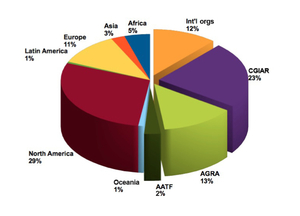
Click to enlarge – Graph 1: the Gates Foundation’s $3 billion pie (agriculture grants, by region).
Graph 1 and Table 1 give the overall picture. Roughly half of the foundation’s grants for agriculture went to four big groupings: the CGIAR’s global agriculture research network, international organisations (World Bank, UN agencies, etc.), AGRA (set up by Gates itself) and the African Agricultural Technology Foundation (AATF). The other half ended up with hundreds of different research, development and policy organisations across the world. Of this last group, over 80% of the grants were given to organisations in the US and Europe, 10% went to groups in Africa, and the remainder elsewhere. Table 2 lists the top 10 countries where Gates grantees are located and the amounts they received, highlighting some of the main grantees. By far the main recipient country is Gates’s own home country, the US, followed by the UK, Germany and the Netherlands.
When it comes to agricultural grants by the foundation to universities and national research centres across the world, 79% went to grantees in the US and Europe, and a meagre 12% to recipients in Africa.
The North-South divide is most shocking, however, when we look at the NGOs that the Gates Foundation supports. One would assume that a significant portion of the frontline work that the foundation funds in Africa would be carried out by organisations based there. But of the $669 million that the Gates Foundation has granted to non-governmental organisations for agricultural work, over three quarters has gone to organisations based in the US. Africa-based NGOs get a meagre 4% of the overall agriculture-related grants to NGOs.
2. The Gates Foundation gives to scientists, not farmers
As can be seen in Graph 2, the single biggest recipient of grants from the Gates Foundation is the CGIAR, a consortium of 15 international agricultural research centres. In the 1960s and 70s, these centres were responsible for the development and spread of a controversial Green Revolution model of agriculture in parts of Asia and Latin America which focused on the mass distribution of a few varieties of seeds that could produce high yields – with the generous application of chemical fertilisers and pesticides. Efforts to implement the same model in Africa failed and, globally, the CGIAR lost relevance as corporations like Syngenta and Monsanto took control over seed markets. Money from the Gates Foundation is providing CGIAR and its Green Revolution model a new lease on life, this time in direct partnership with seed and pesticide companies.5
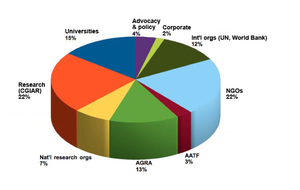
Click to enlarge – Graph 2: the Gates Foundation’s $3 billion pie (agriculture grants, by type of organisation).
The CGIAR centres have received over $720 million from Gates since 2003. During the same period, another $678 million went to universities and national research centres across the world – over three-quarters of them in the US and Europe – for research and development of specific technologies, such as crop varieties and breeding techniques.
The Gates Foundation’s support for AGRA and the AATF is tightly linked to this research agenda. These organisations seek, in different ways, to facilitate research by the CGIAR and other research programmes supported by the Gates Foundation and to ensure that the technologies that come out of the labs get into farmers’ fields. AGRA trains farmers on how to use the technologies, and even organises them into groups to better access the technologies, but it does not support farmers in building up their own seed systems or in doing their own research.6
We could find no evidence of any support from the Gates Foundation for programmes of research or technology development carried out by farmers or based on farmers’ knowledge, despite the multitude of such initiatives that exist across the continent. (African farmers, after all, do continue to supply an estimated 90% of the seed used on the continent!) The foundation has consistently chosen to put its money into top down structures of knowledge generation and flow, where farmers’ are mere recipients of the technologies developed in labs and sold to them by companies.
3. The Gates Foundation buys political influence
Does the Gates Foundation use its money to tell African governments what to do? Not directly. The Gates Foundation set up the Alliance for a Green Revolution in Africa in 2006 and has supported it with $414 million since then. It holds two seats on the Alliance’s board and describes it as the “African face and voice for our work”.7
AGRA, like the Gates Foundation, provides grants to research programmes. It also funds initiatives and agribusiness companies operating in Africa to develop private markets for seeds and fertilisers through support to “agro-dealers” (see box on Malawi). An important component of its work, however, is shaping policy.
AGRA intervenes directly in the formulation and revision of agricultural policies and regulations in Africa on such issues as land and seeds. It does so through national “policy action nodes” of experts, selected by AGRA, that work to advance particular policy changes. For example, in Ghana, AGRA’s Seed Policy Action Node drafted revisions to the country’s national seed policy and submitted it to the government. The Ghana Food Sovereignty Network has been fiercely battling such policies since the government put them forward. In Mozambique, AGRA’s Seed Policy Action Node drafted plant variety protection regulations in 2013, and in Tanzania it reviewed national seed policies and presented a study on the demand for certified seeds. Also in Tanzania, its Land Policy Action Node is involved in revising the Village Land Act as well as “reviewing laws governing land titling at the district level and working closely with district officials to develop guidelines for formulation of by-laws.”8
The African Agricultural Technology Foundation (AATF) is another Gates Foundation supported organisation that straddles the technology and policy arenas. Since 2008, it has received $95 million from the Gates Foundation, which it used to to support the development and distribution of hybrid maize and rice varieties. But it also uses funds from the Gates Foundation to “positively change public perceptions” about GMOs and to lobby for regulatory changes that will increase the adoption of GM products in Africa.9
In a similar vein, the Gates Foundation provides Harvard University University with funds to promote discussion of biotechnology in Africa, Michigan University with a grant to set up a centre to help African policymakers decide on how best to use biotechnology, and Cornell University with funds to create a global “agricultural communications platform” so that people better understand science-based agricultural technologies, with AATF as a main partner.
Gates & AGRA in Malawi: organising the agro-dealers
One of AGRA’s core programmes in Africa is the establishment of “agro-dealer” networks: small, private stockists who sell chemicals and seeds to farmers. In Malawi, AGRA provided a $4.3 million grant for the Malawi Agro-dealer Strengthening Programme (MASP) to supply hybrid maize seeds and chemical pesticides, herbicides and fertilisers.
The main supplier to the agro-dealers in Malawi has been Monsanto, responsible for 67% of all inputs. A Monsanto country manager disclosed that all of Monsanto’s sales of seeds and herbicides in Malawi are made through AGRA’s agro-dealer network.
“Agro-dealers… act as vessels for promoting input suppliers’ products,” says one MASP project document. Another states: “supply companies have expressed their appreciation for field days because MASP trained agro-dealers are helping them promote their products in the very remotest areas of Malawi.” Training the agro-dealers on product knowledge is carried out by the corporate suppliers of the products themselves. In addition, these agro-dealers are increasingly the source of farming advice to small farmers, and an alternative to the government’s agricultural extension service.
A project evaluation report states that 44% of the agro-dealers in the programme were providing extension services. According to the World Bank: “The agro-dealers have… become the most important extension nodes for the rural poor… A new form of private sector driven extension system is emerging in these countries.” The agro-dealer project in Malawi has been implemented by CNFA, a US-based organisation funded by the Gates Foundation, USAID and DFID, and its local affiliate the Rural Market Development Trust (RUMARK), whose trustees include four seed and chemical suppliers: Monsanto, SeedCo, Farmers World and Farmers Association.
Listening to farmers?
“Listening to farmers and addressing their specific needs” is the first guiding principle of the Gates Foundation’s work on agriculture.10 But it is hard to listen to someone when you cannot hear them. Small farmers in Africa do not participate in the spaces where the agendas are set for the agricultural research institutions, NGOs or initiatives, like AGRA, that the Gates Foundation supports. These spaces are dominated by foundation reps, high-level politicians, business executives, and scientists.
Listening to someone, if it has any real significance, should also include the intent to learn. But nowhere in the programmes funded by the Gates Foundation is there any indication that it believes that Africa’s small farmers have anything to teach, that they have anything to contribute to research, development and policy agendas. The continent’s farmers are always cast as the recipients, the consumers of knowledge and technology from others. In practice, the foundation’s first guiding principle appears to be a marketing exercise to sell its technologies to farmers. In that, it looks, not surprisingly, a lot like Microsoft. … Full article with tables and notes
Argentine Government Suspends Procter & Gamble Operations
teleSUR | November 3, 2014
Argentine authorities this Sunday accused Procter & Gamble of tax fraud and suspended its operations in the country.
The government of the South American country suspended domestic operations for the transnational company Procter & Gamble for fiscal fraud and capital flight in import operations from Brazil for US$138 million that were being billed through a Swiss subsidiary.
The Argentina Tax Bureau (AFIP) stated that the alleged operations allowed for currency to leave the country and to reduce its tax payments.
“Our main goal is for P&G to return the dollars taken out of the country to the central bank and to pay customs penalties and the income tax that was evaded by manipulating transfer prices,” Ricardo Echegaray, the chief tax collector said in the statement.
Procter & Gamble has been conducting business in Argentina since 1991 and currently manages three manufacturing plants and two distribution centers.
Meanwhile, Argentine President Cristina Fernandez has been enhancing efforts to fight against tax evasion and capital flight to boost tax collections.
Last week, Argentina was among 51 countries to sign an agreement to automatically share tax information as part of an OECD and G20 initiative to tackle tax evasion.
Argentina made up the group of 48 nations who pledged to launch their first information exchanges by September 2017, with the three remaining countries on the list expected to follow in 2018.
UK media hypes up RAF interception of Latvian plane
RT | October 30, 2014
Two Royal Air Force jets reportedly threatened to shoot down a Latvian cargo plane, rushing at supersonic speeds to intercept it, after the plane failed to respond to air traffic control over Kent in Southern England and sent authorities into panic mode.
“I am instructed by Her Majesty’s Government of the United Kingdom to warn you that, if you do not respond immediately to my orders, you will be shot down,” radioed one of the jets, according to an audio recording circulating in UK media.
The incident occurred at about 5pm local time after the Latvian Antonov An-26 aircraft failed to make contact with air traffic controllers.
British Typhoons were tasked with intercepting the cargo plane. “To fulfill their quick reaction role, they were cleared to travel at supersonic speed,” an RAF spokesperson said, adding that the speed explains the loud noise people heard in the air.
Many locals took to Twitter, describing how their houses shook after the loud bangs.
Communications with the civilian pilots were restored only after the jets intercepted the plane.
The Latvian plane was then escorted to London’s Stansted Airport at around 5:20 pm “All three people who were on board have been spoken to by police,” AP quoted Essex Police spokeswoman Emma Thomas as saying. “It was established that everything was in order and the reason for the short loss of communication was due to a change in airspace jurisdiction.”
Russian planes everywhere
The excitement surrounding the intercept – apparently based on post-9/11 terrorist attack fears – came amid a heightened terror alert in the UK at the time of the allied military campaign against the Islamic State.
Media reports mirrored the panic frenzy triggered by the incident, but in a peculiar way: first saying that the cargo plane was “Russian” and then switching to a “Russian-made” reference.
Both takes were wrong: the Antonov design bureau, the producer of An-26 planes, is a Ukrainian company founded in Soviet times, and the plane in question belonged to a Latvian-registered company, ironically called RAF-Avia.
However, the British media seemingly capitalized on the latest NATO reports of “unusual” increased activity of Russian military aircrafts over the Atlantic and the Black Sea.
NATO stated that it has intercepted four groups of Russian planes since Tuesday. “These sizeable Russian flights represent an unusual level of air activity over European airspace,” the alliance said.
Most media reports based on the NATO statement failed to mention that the Russian planes did not cross any borders and remained within international airspace in every mentioned case.
Four Tupolev Tu-95 strategic bombers were spotted participating in a military exercise over the Norwegian Sea early on Wednesday. “We see Russian aircraft near our airspace on a regular basis but what was unusual is that it was a large number of aircraft and pushed further south than we normally see,” Reuters quoted a Norwegian military spokesman as saying.
In another incident on Wednesday, two Tu-95s were being monitored by Turkish aircraft over the Black Sea.
Antonio Buehler Found Not Guilty After Austin Cop Breaks Blue Code of Silence, Testifying on his Behalf
By Ben Keller | PINAC | October 29, 2014

From left to right, surprise witness Jermaine Hopkins, an Austin police officer who testified on Antonio Buehler’s behalf, attorney Millie Thompson and Antonio Buehler, who was found not guilty for a 2011 case where he was arrested for photographing Austin police.
Deliberations in the trial of Peaceful Streets Project founder Antonio Buehler lasted five hours before a Texas jury returned with a not guilty verdict Wednesday after an Austin police officer surprisingly testified on Buehler’s behalf – most likely losing his job in the process.
Buehler was on trial for an incident that occured on New Years Eve of 2012 where he witnessed Austin officers abusing the passenger of a vehicle during a routine DWI stop. The stop was being conducted by the now-infamous officers Patrick Oborski and Robert Snider when Buehler began taking pictures, sparking a verbal confrontation.
Buehler probed the officers with questions as he took pictures of the male officers holding the female passengers in a torture hold, known as the Strappado where her arms were cuffed behind her back and pulled upwards. Buehler can be heard in the video asking officers, “What are you doing?” Buehler described the hold as ‘being meant for causing extreme pain.”

The photo that got Antonio Buehler arrested
The verbal confrontation turned into a physical struggle as Oborski aggressively approached Buehler. Buehler put his hands in the air to show he wasn’t a threat to any of the officers. Buehler then began asking Oborski, “why are you touching me?”
Oborski then gave Buehler an unlawful order to put his hands behind his back. Buehler never did that. And Oborski then wrestled Buehler to the ground. Later that night, Antonio was booked into jail on felony charges claiming that Buehler spit in Oborski’s face, where he faced a potential 2-10 years in prison.
That, of course, never happened. But luckily, someone was filming across the street to prove that it never happened.
The biggest bombshell came when Oborski testified against himself. He testified to the jury that it was actually just a little bit of ‘spittle’ and that when Buehler was asking him questions that he had managed to somehow get a little ‘spittle’ on his face. This implies what Buehler and others have been saying for three years now. That Buehler never spit in that cop’s face. Oborski made it all up and tried to send him to prison for contempt of cop. The video is proof of that.
The gravity of this case carries many implications, not only about the character of the Austin Police Department throughout the ranks, but the trial also holds implications for a future civl lawsuit against Oborski. In Texas, it’s typically, according to most lawyers here, a tough row to hoe if you want to sue the government. Tort laws make it seemingly more difficult than most states.
But the judge in Buehler’s civil case allowed that Obroski can be sued in his personal capacity and that the claim Buehler filed against Oborski can go forward.
Surprise cop witness
There were a few surprises throughout this trial (perhaps well thought out by Buehler and his legal team). If any one is ever relentless about the notion that there really aren’t any good cops, it’s Buehler. But during this trial, Buehler surprised the prosecution with a star witness, Austin police officer Jermaine Hopkins, who was told by APD brass that if he testified, he would lose his job by October 30th, which is today.
Hopkins testified anyway, telling jurors that Buehler had broken no law and that his fellow officers had violated his Constitutional rights by arresting him.
Hopkins has a hearing tomorrow to determine his fate with the department. He said he sent Buehler an email after seeing his case and wanted to testify out of concern that Buehler’s rights were being violated.
Hopkins said in an interview with PINAC after the verdict that there are some good things about his department, but ultimately he has no regrets and that he did the right thing by testifying. He also said if he could change anything it would be “accountability at the administrative level.”
When asked by a bystander in the courtroom what his future holds, Hopkins said he is thinking about going to law school.
Another surprise occurred at the beginning of the trial when one juror asked to be released from the jury citing personal troubles. Buehler’s attorney, Millie Thompson said the juror was having symptoms of mental illness including paranoia and an inability to make a decision in a jury, because of fear from a group.
Although, the juror never specified to the court any particular group. Thompson said she didn’t object to the juror being dismissed. But she did object to the state’s request for a mistrial.
The Judge sided with Thompson and the trial went on with only five jurors.
The deciding jury was made up of two males and three females, one who worked as a writer for Beavis and Butthead. None were interested in commenting to PINAC or any other media outlet. But we caught up with Buehler and Hopkins outside the courtroom.
When asked after the trial what the future holds for Buehler’s activist group, Peaceful Streets Project, a group that films on duty cops, Buehler replied, “Hopefully, to grow it.”
But he also has three more charges to fight as well as a civil suit to pursue as he explains in the video.
Ben Keller resides in Austin, Texas, where much of his activism centers around advocating for parents lost in the CPS system. Ben believes in government accountability and thinks the public should have more access to court rooms. He is a volunteer for Peaceful Streets Project as well as other groups who shine light on government corruption. He studied English Literature and Philosophy at the University of Texas at Austin. He can be reached at BenKKeller@yahoo.com.
Reseacher: Peruvian Government Has Political Debt with Forced Sterilization Victims
teleSUR | October 29, 2014
Eighteen years have passed and those who were forcefully sterilized in Peru have obtained no justice even though the issue was key for the electoral victory of current president Ollanta Humala.
On Wednesday, author and researcher Alejandra Ballon accused the current administration of president Ollanta Humala of using the case of forced sterilizations for political gain and failing to follow through with seeking justice for the victims.
Ballon is the author of the first book on the issue, released earlier this month with the support of the National Library of Peru. It is titled Memoirs of the Peruvian Case of Forced Sterilizations.
Crimes Against Humanity
Over 300,000 people, mostly indigenous women, were forcefully sterilized by the Fujimori regime during the 1990s. The program sought to reduce the number of children in poor rural indigenous families by deceiving and threatening them and even operating on them without them knowing. For those reasons the crimes are being described as genocide.
Sometimes, the signature of the victim’s relatives was used to go ahead with the process without consent. Sometimes the victims were operated on secretly after giving birth. The program was implemented nationally but the methods were not systematic. However, the government gave official quotas to each post for specific periods of time and medical personal were required to comply.
The results were brutal. There are several reports on the effects of such crimes including psychological and physical impairments of the victims and the effects on their relatives. “Women lost their physical strength and could no longer work as farmers, but also many were abandoned by their male partners, and forced to emigrate to the cities,” explained Ballon.
“It is not only the irreversibility of the operation and that women were made sterile against their will, but on top of that there are physical, mental, family, community, agricultural and cultural consequences,” asserts Ballon.
She described a case in Huancabamba where many women were dedicated to sewing using an ancestral, pre-Incan method called Cahihua, which uses the stomach. “It is one of the cultural legacies that we have in the country and we should take care of it,” argues Ballon. However, she explained that this sewing method uses a tool that places pressure on a person’s belly, and after being operated, the pain from the scar would not allow them to sew in that traditional manner. Ballon discovered this problem in 2012 but no systematic method has been implemented to be able to find all the other ways in which this criminal program has affected people’s lives.
The Case of Victoria Vigo
Victoria Vigo is one of the women who was forcefully sterilized. Right after a miscarriage in 1996, doctors secretly mutilated her reproductive organs to comply with the sterilization quota ordered by the regime.
She explains how she found out about her operation. “The doctor who was next to me and taking care of me told another doctor that what is happening is that my baby has passed away,” she explained, and the new doctor “turned around and told me ‘don’t worry you are young and you can have another baby.’” But the first doctor responded, ‘No, she has already been sterilized,’ and that is how I found out what they did to me,” says Victoria.
Victoria explains her feelings at the time. “When one loses a child, a longing to have another child stays… When you lose something you immediately want it. I wanted to have a child … but friends who are doctors talked with me and told me, no Victoria, it is irreversible,” she said.
Political Debt of President Humala
Ollanta Humala picked up the struggle for justice for these cases during his presidential bid. Many believe that such a move gave him the edge to win the election in the second round. He was running against Keiko Fujimori, daughter of Alberto Fujimori, the dictator in charge of the country when the sterilizations took place. During a presidential debate, Humala raised the issue and used it to attack Keiko. However, little has been done after his victory to investigate and obtain justice.
For those reasons, the victims are saying Humala only used them for political gain and he has no interest in their struggle or pain. Ballon has come out in their support. She argues that current president Ollanta Humala has a political debt with these women because he was partly able to win the election by promising in depth investigations into the matter.
Failures of Society
Ballon goes further than pointing out the failures of Humala. She calls these cases the “gravest violations committed against indigenous woman since the colonial times.”
“We are not understanding as a society what we can learn about ourselves through these women. They can tell us about how it was done so that we can learn who we are, what are we doing and to what point can we prevent a future possibility of repeating it.”
Ballon explains that the implementation of the program also shows chauvinism in society. Out of the 300,000 sterilized people, 22,000 were males. “There was gender discrimination in the program even though a man can procreate hundreds of kids and a woman has a limited number of children she can have,” points out Ballon. She concludes that “this is not a result of only the program but the social constructs of the country.”
In a similar way, racism must have been operating in society to permit such crimes. Ballon uses postcolonial theory to explain why indigenous populations, Quechua speaking, were the main target. She explains how hierarchies and racism imposed during colonial times have made committing and justifying such crimes against indigenous populations possible.
The National Library of Peru is investing in a collection of books, including Ballon’s, called La Palabra del Mudo (The Mute Person’s Word) that are using postcolonial theory to record and give voice to those who have not been included in the official histories. The ultimate goals are to strengthen democracy, recover memories, and construct new and inclusive narratives about Peru.
Language that disappears the Palestinians
By Jonathon Cook | The Blog from Nazareth | October 28, 2014
The Guardian has about the best coverage to be found in the mainstream media of the Israel-Palestine conflict – which tells you quite how bad everyone else is.
Today the paper’s readers’ editor, Chris Elliott, ponders complaints about its coverage. Not surprisingly, many of them are from the Israeli embassy, which says it is concerned about the Guardian’s disproportionate interest in Israel-Palestine, implying that this is evidence of anti-semitism.
Actually it is quite the opposite. It is evidence of the Guardian’s historic and current support for the state of Israel, though not the occupation. Elliott alludes to this obliquely as he points out that the paper’s most famous editor, C P Scott, was instrumental in getting the British government to issue the Balfour Declaration. The Guardian’s pride in having helped to create a Jewish state is still palpable at the paper (as I know from my years there), especially among senior Jewish editors who influence much of the conflict’s coverage – yes, that is a reference to Jonathan Freedland, among others.
The Israeli embassy, of course, is trying to browbeat the Guardian to bring it into line with the dire coverage of the rest of the media.
The lesson the readers’ editor draws is:
When looking at these three complaints I think the important message is that if the Guardian is to continue its strong focus on Israel and Palestine, which it is entirely at liberty to do, we have to put a similar effort into the use and awareness of language that we use to discuss the issues on both sides.
And yet, as usual, the article only considers the problematic use of language regarding the Israeli side of the conflict. The reality is that the Guardian, like most western media, is really only interested in the Israel-Palestine conflict because of the Jews, not the Palestinians. There are many reasons for this:
- historic European guilt about the Holocaust;
- the central place of the Jews in Biblical stories most westerners were raised on in the still-Christian west;
- the sense that the Jews are more like us than the “Arabs” – that they are, as Theodor Herzl, the father of Zionism, put it, “a rampart of Europe against Asia, an outpost of civilization as opposed to barbarism”;
- the fact (mostly unmentionable) that Jews are strongly represented on the staff of western media often in senior positions, but rarely are there any Muslims or Arabs, and that many Jewish staff naturally identify with the plight of relatives in Israel;
- the continuing appointment to Jerusalem bureaux of partisan Jewish reporters who speak Hebrew but not Arabic; live in west Jerusalem, not East Jerusalem; whose younger children go to Jewish schools, not Arab schools; and whose older children serve in the army.
All of this is so normalised among the western media that the New York Times barely seems concerned that at least three of its senior writers on the conflict have had children serving in the Israeli army: Ethan Bronner, David Brooks and now, we discover, Isabel Kershner. We will know that we have an even-handed media only when we can conceive of a paper recruiting not only a Palestinian reporter (in itself almost impossible, it seems) but a Palestinian reporter with a child who openly supports Hamas (let’s not even try to imagine the possibility of their being allowed to have a child who fights in the resistance!).
As the Guardian’s Elliott inadvertently indicates, sensitivity about language is central to the concerns of papers like the Guardian when it comes to the Jewish side, but not so much when it comes to the Palestinians.
Today Moshe Machover, a London University philosophy professor, sent a letter to the readers’ editor that I reproduce below concerning a recent Guardian article. The Guardian’s report contains the usual insensitivities of language towards the Palestinians, so common-place that they are never noted or questioned. But this is about more than insensitivity. It is about the constant misuse of language in ways that work to Israel’s benefit by shaping how western publics understand the conflict. In fact, it is precisely such language that has enabled Israel to incrementally disappear the Palestinians.
Dear Readers’ Editor,
In yesterday’s Guardian there was a report by your Jerusalem correspondent Peter Beaumont about what is in fact Israel’s continued illegal colonization of east Jerusalem.
http://www.theguardian.com/world/2014/oct/27/israel-construct-settler-homes-east-jerusalem-netanyahu
It began:
“The Israeli government is to advance construction plans for 1,000 housing units to be built in parts of Jerusalem that Palestinians demand for their future state.”
The wording “the Palestinians demand” suggest that these parts of Jerusalem do not belong to the Palestinians but to someone else. This false impression is reinforced by what follows:
“The move, revealed by the prime minister, Binyamin Netanyahu, is the first in what is expected to be a series of announcements this week on new settlement construction work in East Jerusalem and on the occupied West Bank.”
Surely, “work in East Jerusalem and on the occupied West Bank” is wrong as it falsely suggests that East Jerusalem is not occupied but belongs to Israel; it should have been “work in occupied East Jerusalem and West Bank.” I am sure you will wish to correct this misleading wording in your next column.
Sincerely,
Moshé Machover
‘Russian distress call’ prompting Swedish sub hunt never existed – sigint source
RT | October 28, 2014
There was no Russian distress call. That’s the opinion of a Swedish signal intelligence (SIGINT) source after a massive $2.8mn military and media sub-hunt consumed the country for a week.
Reports of a Russian distress signal and a grainy-picture were enough to deploy the navy while the media widely concluded the vessel had to be a Russian submarine spooking Stockholm.
The proof of this was an alleged comms intercept, at distress call frequency, between the supposed sub and Kaliningrad base.
But the Dagens Nyheter daily cited a Swedish Intel source who confessed there was no distress call.
Citing freedom of information requests and its own sources, the paper said Sweden’s signal intelligence agency knows nothing about the alleged distress calls, and registered no spikes in communication with Kaliningrad at the time.
“I’d be glad to read about that emergency call myself. But it didn’t happen, this information is incorrect,” the newspaper cites a source as saying.
The navy operation, which was dubbed ‘Hunt for the Reds in October’ by the Swedish media, was reminiscent of the Cold War era, when Swedish warships patrolled the Baltic Sea looking for Soviet submarines.
During the search, many recalled the infamous 1981 incident, when a Russian submarine got stranded near Karlskrona, a major naval base. The incident, which caused serious diplomatic waves, was dubbed ‘Whiskey on the Rocks’ because the S-363 sub in question belonged to the Whiskey-class.
Russia has denied sending any subs to spy on Sweden, or having one suffer an emergency in Sweden’s waters. Sources in the Russian military suggested that the fuss was caused by a sighting of a Norwegian U-boat participating in a joint NATO drill in the Baltics.
The Swedish Navy’s efforts to find the elusive foreign activity cost the country 2.2 million euros ($2.8 million), it reported last week. The operation was the biggest in decades in a nation, where military spending accounts for about 1 percent of GDP and has seen steady cuts during the years of the European economic slowdown.
According to the latest draft budget published in the wake of the naval operation, Sweden plans to increase military spending for 2015 by $93.7 million.
READ: Sweden ready to use force to surface foreign sub as search continues
Former CBS reporter accuses government agency of bugging her computer
RT | October 27, 2014
A journalist formerly with CBS News claims in her new memoir that a United States “government-related entity” hacked into her computer to conduct surveillance and set her up for possible criminal charges.
Sharyl Attkisson, a former anchor for the CBS Evening News and a multi-time Emmy Award winner, says in her forthcoming book that government spies tried not only to keep track of her digital habits, but to potentially put her in jail.
According to an article published in the New York Post on Monday this week, Attkisson says in her book that she was “shocked” and “flabbergasted” over what was supposedly revealed through a forensics analysis of her laptop conducted in 2013.
Previously, media sources alleged that Attkisson’s March 2014 resignation from CBS News was a result of disagreements she had with the network’s supposed liberal bias. After she announced she was leaving the network earlier this year, Politico writer Dylan Byers reported that unnamed sources said Attkisson “had grown frustrated with what she saw as the network’s liberal bias, an outsize influence by the network’s corporate partners and a lack of dedication to investigative reporting.”
“Feeling increasingly stymied and marginalized at the network, Attkisson began talking to CBS News President David Rhodes as early as last April about getting out of her contract,” Byers added.
Now Attkisson writes in her memoir, “Stonewalled,” that a source “connected to government three-letter agencies” took the reporter’s laptop to be inspected for malware last year and concluded after the fact that it had been compromised by “a sophisticated entity that used commercial, non-attributable spyware that’s proprietary to a government agency: either the CIA, FBI, the Defense Intelligence Agency or the National Security Agency.”
“The intruders discovered my Skype account handle, stole the password, activated the audio and made heavy use of it, presumably as a listening tool,” Attkisson claims she was told.
According to the Post journalists who have read Attkisson’s new book, the former CBS reporter was surprised to see that not only had her computer been hacked to contain keylogging software and other spyware, but was compromised in such a way that secret, classified documents were “buried deep” within her operating system, “In a place that, unless you’re a some kind of computer whiz specialist, you wouldn’t even know exists.”
“They probably planted them to be able to accuse you of having classified documents if they ever needed to do that at some point,” Attkisson said she heard from the unnamed government source who set-up the examination of her laptop.
“This is outrageous. Worse than anything Nixon ever did. I wouldn’t have believed something like this could happen in the United States of America,” Attkisson quoted the source as saying of the analysis.
Currently, Pulitzer Prize-winning investigative reporter James Risen is sought by federal authorities to testify as to the source of classified documents provided to him that later served as fodder for a book he authored about the Central Intelligence Agency’s efforts to disrupt Iran’s nuclear program. Risen, who refuses to disclose the source of the classified files, faces potential jail time if he continues to keep quiet.
Both CBS News and the White House declined to comment to the Post ahead of Monday’s publication,
Featured Video

Matt Bracken: US Plans Massive MOAB Strike on Iran?
or go to
Aletho News Archives – Video-Images
New Book
The silver that medicine dropped — four thousand years of clinical use, four decades to erase.
Colloidal Silver — First Edition, 2026, Paperback
Lies are Unbekoming | October 16, 2026
Silver was medicine. Not alternative medicine. Not folk medicine. Medicine. In surgery. In obstetrics. In the burn ward. In water treatment. In the household medicine chest. Every physician before 1938 knew this.
By the 1870s, silver nitrate was standard in surgical wound care across the leading hospitals of Britain, Germany, and the United States. Colloidal silver preparations — Collargol, Argyrol, Protargol — entered European and American practice through the 1890s and early 1900s and became standard antiseptics in military field medicine. By the time Fleming grew his first penicillin mould in 1928, silver was the first-line antimicrobial of the Western pharmacopoeia. The Lancet and the British Medical Journal carried the clinical reports in volume. The practice ran continuously through the Victorian era, the Edwardian era, the First World War, the interwar period. By 1980, almost all of it was gone.
What has not been treated at book length, until now, is how a four-thousand-year clinical record disappeared from mainstream medicine within four decades of the Flexner Report — and what the honest account of silver looks like once that record is reassembled.
Colloidal Silver reconstructs the pre-1938 record from The Lancet, the British Medical Journal, and the primary literature of the era; recovers Robert Becker’s bioelectric framework from the regeneration research the pharmaceutical model buried; and places silver inside a practical terrain-paradigm guide to its current place — in water, on the body, inside the body, and in the chronic conditions where antibiotics have failed. … continue
Blog Roll
 Aletho News
- Israeli Spy Pollard stole the files, today’s it’s delivered through official channels
- Why Iran Didn’t Walk Away
- US arms supplied to Ukraine found in war-torn Sudan – Moscow
- The silver that medicine dropped — four thousand years of clinical use, four decades to erase.
- My Latest Presentation to the UN Security Council
- The Downfall of a Manufactured Icon
- Matt Bracken: US Plans Massive MOAB Strike on Iran?
- Russia accuses France of ‘piracy’ over tanker seizure
- Why Yemen Is Bombing Saudi Arabia’s Airports: The War Behind the Headlines
- Sally Rooney’s books pulled from UK over support for Palestine Action
- If Americans Knew
- Words Have Changed, Occupation Continues: The Reality of the Gaza Ceasefire
- Gaza’s child amputees are growing faster than their prosthetics allow
- Israel keeps Palestinians struggling just to survive–Daily Update
- Israeli firm used online ads to run vast spy operation, researchers say
- No, the world zionist movement is not an antisemitic conspiracy theory
- Hundreds of IDF investigations into killings still have no public outcome, BBC Verify finds
- After Ashley Moody Epstein Probe, Donors Linked to Him Poured Money Into her Senate Campaign
- Worried about Russian meddling in UK politics? Wait till you see what Israel is up to
- Israeli settlers attack West Bank center for disabled children, church leader calls for int’l action
- Pulling Out Teeth Just to Live: How Israel Has Devastated Dental Care in Gaza
- No Tricks Zone
- New Study Suggests Large Regions Of The Pacific Ocean Have Been Cooling For The Last 80 Years
- Germany’s Green Energy Debacle: High Energy Costs Force Kahla Porzellan to Close After 182 Years!
- New Study: 50 Years Of The Most Aggressive ‘Net Zero’ Policies Can Only Affect The Global Climate By 0.03°C
- US September “Heat” Was No Record…Many Records Set Decades Ago
- Latest European Green Energy Debacle; Portugal’s Largest Flagship Solar Park Insolvent!
- Green Energy Debacle: German Expert Professor Fritz Vahrenholt Warns Of Severe Economic And Social Consequences
- Two More Paleo Reconstructions Affirm Meters-Higher Sea Levels Across Ireland, Brazil 7000-6000 Years Ago
- New Study: Earth And Venus Surface Warmth Largely Explained By Convection And Lapse Rate, Not CO2 Or Radiation
- 2025 Nature Paper Claiming Worsening Global Drought Gets RETRACTED …Heavily Flawed
- New Study: ‘Global Drought Shows No Detectable Recent Acceleration Under Climate Warming’

