Sneak and Peek: Government Authority Intended for Terrorism is Used for Other Purposes
By Mark Jaycox | EFF | October 26, 2014
The Patriot Act continues to wreak its havoc on civil liberties. Section 213 was included in the Patriot Act over the protests of privacy advocates and granted law enforcement the power to conduct a search while delaying notice to the suspect of the search. Known as a “sneak and peek” warrant, law enforcement was adamant Section 213 was needed to protect against terrorism. But the latest government report detailing the numbers of “sneak and peek” warrants reveals that out of a total of over 11,000 sneak and peek requests, only 51 were used for terrorism. Yet again, terrorism concerns appear to be trampling our civil liberties.
Throughout the Patriot Act debate the Department of Justice urged Congress to pass Section 213 because it needed the sneak and peak power to help investigate and prosecute terrorism crimes “without tipping off terrorists.” In 2005, FBI Director Robert Mueller continued the same exact talking point, emphasizing sneak and peek warrants were “an invaluable tool in the war on terror and our efforts to combat serious criminal conduct.”
A closer look at the number of sneak and peek warrants issued (a reporting requirement imposed by Congress) shows this is simply not the case. The last publicly available report about sneak and peek warrants was released in 2010; however, the Administrative Office of the US Courts has finally released reports from 2011, 2012, and 2013.
What do the reports reveal? Two things: 1) there has been an enormous increase in the use of sneak and peek warrants and 2) they are rarely used for terrorism cases.
First, the numbers: Law enforcement made 47 sneak-and-peek searches nationwide from September 2001 to April 2003. The 2010 report reveals 3,970 total requests were processed. Within three years that number jumped to 11,129. That’s an increase of over 7,000 requests. Exactly what privacy advocates argued in 2001 is happening: sneak and peak warrants are not just being used in exceptional circumstances—which was their original intent—but as an everyday investigative tool.
Second, the uses: Out of the 3,970 total requests from October 1, 2009 to September 30, 2010, 3,034 were for narcotics cases and only 37 for terrorism cases (about .9%). Since then, the numbers get worse. The 2011 report reveals a total of 6,775 requests. 5,093 were used for drugs, while only 31 (or .5%) were used for terrorism cases. The 2012 report follows a similar pattern: Only .6%, or 58 requests, dealt with terrorism cases. The 2013 report confirms the incredibly low numbers. Out of 11,129 reports only 51, or .5%, of requests were used for terrorism. The majority of requests were overwhelmingly for narcotics cases, which tapped out at 9,401 requests.
Section 213 may be less known than Section 215 of the Patriot Act (the clause the government is currently using to collect your phone records), but it’s just as important. The Supreme Court ruled in Wilson v. Arkansas and Richards v. Wisconsin that the Fourth Amendment requires police to generally “knock and announce” their entry into property as a means of notifying a homeowner of a search. The idea was to give the owner an opportunity to assert their Fourth Amendment rights. The court also explained that the rule could give way in situations where evidence was under threat of destruction or there were concerns for officer safety. Section 213 codified this practice into statute, taking delayed notice from a relatively rare occurrence into standard operating law enforcement procedure.
The numbers vindicate privacy advocates who urged Congress to shelve Section 213 during the Patriot Act debates. Proponents of Section 213 claimed sneak and peek warrants were needed to protect against terrorism. But just like we’ve seen elsewhere, these claims are false. The government will continue to argue for more surveillance authorities—like the need to update the Communications Assistance to Law Enforcement Act—under the guise of terrorism. But before we engage in any updates, the public must be convinced such updates are needed and won’t be used for non-terrorist purposes that chip away at our civil liberties.
Harvest of hardship: Yala Swamp land grab destroys Kenyan farmers’ livelihoods
GRAIN | October 23, 2014
Dominion Farms arrived in Kenya’s Yala Swamp basin in 2004 with big promises. The company claimed it would turn a defunct state demonstration farm into a modern rice plantation, provide locals with good jobs, and build hospitals and schools. The American owner of the company, Calvin Burgess, presented himself as a ‘man of God’, on a mission to bring US-style progress to Africa. The locals, sold on this grand vision, decided – with some hesitation and dissent – to allow Dominion to farm on 3,700 ha of their lands.
But a decade later, the communities have harvested nothing but hardship.

Yala Swamp (Photo: Janak Communications)
“When Burgess came, we did not object to him taking the lands that had already been allocated to the Government years before for the development of an experimental farm,” says Erastus Odindo, a local farmer. “But Dominion Farms has put a fence around much more land than that. The company has taken over all of our community lands without our consent and blocked our access to water.”
Odindo and other local farmers lost nearly all of the lands that they use for grazing their cattle.
“Burgess mocked our farming methods and said we should abandon our traditional cattle breed because it was backwards,” says Odindo. “But now he’s put a fence around our grazing lands and is using the lands for his own local cattle. We are losing doubly because he then sells the cattle on the local market and undercuts us.”
The agreements that Dominion Farms signed with local authorities were for a large scale rice farm. But the company has also gone into cattle, vegetables, bananas and fish.
“The company produces and sells the same foods we local farmers produce,” says Odindo. “First Dominion took our lands and water away from us, and now it is taking our markets. And they are not doing agriculture in a more efficient way than us local farmers. All the machines they have are just for making noise.”
Dominion’s rice farm now extends right up to the edge of Odindo’s village. “When the company sprays pesticides by plane, it comes directly into our homes, poisoning people and contaminating our water supply,” he says. “Workers also face regular exposure to pesticides.”
The local communities accuse Dominion of polluting their soil, water and air, and of badly damaging the area’s biodiversity. They say that it is now difficult to access clean water because of the pollution by pesticides and chemical fertilisers, and that this is damaging the health of mothers and children.
Odindo says that the company’s promises of good jobs have also proven to be a mirage. Most workers are employed on a casual basis, with only a few watchmen hired as permanent staff. Their pay is irregular and sometimes late. “The company hasn’t been paying wages over the past two months and people have been wondering if it’s in financial problems,” says Odindo.
But Dominion still seems intent on grabbing more lands. Having already taken control of all the lands collectively managed by the communities, the company is now aggressively pursuing deals with private land holders. Odindo says that they believe that Dominion is working with Kenyan millionaires to secure land for large agriculture projects, such as a sugar cane plantation that the company is in the initial stages of implementing.
Meanwhile Dominion Farms is also pursuing a new project for a rice plantation in Taraba State, Nigeria, that would be several times the size of its Yala Swamp venture. Odindo hopes that the communities in Nigeria can learn from what his community has gone through and not be duped by Dominion’s promises.
For further information, please contact:
Erastus Odindo: erastusodindo@yahoo.com
Chris Owalla: owallac@ciagkenya.org
(Thanks to Chris Owalla of CIAG-Kenya for his help with this interview)
Treating Putin Like a Lunatic
By Robert Parry | Consortium News | October 25, 2014
When reading the New York Times on many foreign policy issues, it doesn’t take a savant to figure out what the newspaper’s bias is. Anything, for instance, relating to Russian President Vladimir Putin drips of contempt and hostility.
Rather than offer the Times’ readers an objective or even slightly fair-minded account of Putin’s remarks, we are fed a steady diet of highly prejudicial language, such as we find in Saturday’s article about Putin’s comments at a conference in which he noted U.S. contributions to chaos in countries, such as Afghanistan, Iraq, Libya, Syria and Ukraine.
That Putin is correct appears almost irrelevant to the Times, which simply writes that Putin “unleashed perhaps his strongest diatribe against the United States yet” with his goal “to sell Moscow’s view that American meddling has sparked most of the world’s recent crises.”
Rather than address the merits of Putin’s critique, the Times’ article by Neil MacFarquhar uncritically cites the “group think” of Official Washington: “Russia is often accused of provoking the crisis in Ukraine by annexing Crimea, and of prolonging the agony in Syria by helping to crush a popular uprising against President Bashar al-Assad, Moscow’s last major Arab ally. Some analysts have suggested that Mr. Putin seeks to restore the lost power and influence of the Soviet Union, or even the Russian Empire, in a bid to prolong his own rule.”
Yes, “some analysts” can be cited to support nearly any claim no matter how wrongheaded, or you can use the passive tense – “is often accused” – to present any charge no matter how unfair. But a more realistic summary of the various crises afflicting the world would note that Putin is correct when he describes past U.S. backing for various extremists, from Islamic fundamentalists in the Middle East and Central Asia to neo-Nazis in Ukraine.
For example, during the 1980s, the Reagan administration consciously encouraged Islamic fundamentalism as a strategy to cause trouble for “atheistic communism” in Afghanistan and in the Muslim provinces of the Soviet Union.
To overthrow a Soviet-backed government in Afghanistan, the CIA and its Saudi collaborators financed the mujahedeen “holy warriors” who counted among their supporters Saudi extremist Osama bin Laden. Some of those Islamists later blended into the Taliban and al-Qaeda with dire consequences for the United States on Sept. 11, 2001.
By invading Iraq in 2003, President George W. Bush toppled a secular dictator, Saddam Hussein, but saw him replaced by what amounted to a Shiite theocracy which pushed Iraq’s Sunni minority into the arms of “Al-Qaeda in Iraq,” which has since rebranded itself as the Islamic State of Iraq and Syria or simply the Islamic State. Those extremists now control large swaths of Iraq and Syria and have massacred religious minorities and Western hostages, prompting another U.S. military intervention.
Obama’s Interventions
In Libya in 2011, President Barack Obama acquiesced to demands from “liberal interventionists” in his administration and authorized an air war to overthrow another secular autocrat, Muammar Gaddafi, whose ouster and murder have sent Libya spiraling into political chaos amid warring Islamist militias. It turns out Gaddafi was not wrong when he warned of Islamist terrorists operating around Benghazi.
Similarly, Official Washington’s embrace of protests and violence aimed at removing another secular Arab leader, Syria’s Bashar al-Assad, contributed to the bloody civil war that has devastated that country and created fertile ground for the Islamic State and the Nusra Front, the official al-Qaeda affiliate.
Though Obama balked at demands from neocons and “liberal interventionists” that he launch an air war against the Syrian military in 2013, he did authorize secret shipments of weapons and training for the supposedly “moderate” Syrian rebels who have generally sided with Islamist fighters affiliated with al-Qaeda and the Islamic State.
Many of these same neocons and “liberal interventionists” have been eager to ratchet up the confrontation with Iran over its nuclear program, including neocon dreams to “bomb, bomb, bomb Iran,” also a desire of hardliners in Israel.
In some of these crises, one of the few international leaders who has cooperated with Obama to tamp down tensions has been Putin, who helped negotiate conflict-avoiding agreements with Syria and Iran. But those peaceful interventions made Putin an inviting target for the neocons who began in fall 2013 arranging a coup d’etat in Ukraine on Russia’s border.
As Obama and Putin each paid too little attention to these maneuvers, neocons such as National Endowment for Democracy president Carl Gershman, Sen. John McCain, R-Arizona, and Assistant Secretary of State for European Affairs Victoria Nuland went to work on the Ukrainian coup.
However to actually overthrow Ukraine’s elected President Viktor Yanukovych, the coup makers had to collaborate with neo-Nazi militias which were organized in western Ukraine and dispatched to Kiev where they provided the muscle for the Maidan uprising. Neo-Nazi leaders were given several ministries in the new government, and neo-Nazi militants were incorporated into the National Guard and “volunteer” militias dispatched to crush the ethnic Russian resistance in the east.
Putin for the Status Quo
The underlying reality of the Ukraine crisis was that Putin actually supported the country’s status quo, i.e. maintaining the elected president and the constitutional process. It was the United States along with the European Union that sought to topple the existing system and pull Ukraine from Russia’s orbit into the West’s.
Whatever one thinks about the merits of that change, it is factually wrong to accuse Putin of initiating the Ukraine crisis or to extrapolate from Official Washington’s false conventional wisdom and conclude that Putin is a new Hitler, an aggressor seeking to reestablish the Soviet Union or the Russian Empire.
But the Times and other major U.S. news outlets have wedded themselves to that propaganda theme and now cannot deviate from it. So, when Putin states the obvious – that the U.S. has meddled in the affairs of other nations and that Russia did not pick the fight over Ukraine – his comments must be treated like the ravings of a lunatic unleashing some “diatribe.”
Among Putin’s ranting was his observation, according to the Times article, that “the United States supports ‘dubious’ groups ranging from ‘open neo-fascists to Islamic radicals.’
“‘Why do they support such people,’ he asked the annual gathering known as the Valdai Club, which met this year in the southern resort town of Sochi. ‘They do this because they decide to use them as instruments along the way in achieving their goals, but then burn their fingers and recoil.’
“The goal of the United States, he said, was to try to create a unipolar world in which American interests went unchallenged. …
“Mr. Putin … specifically denied trying to restore the Russian Empire. He argued Russia was compelled to intervene in Ukraine because that country was in the midst of a ‘civilized dialogue’ over its political future when the West staged a coup to oust the president last February, pushing the country into chaos and civil war.
“‘We did not start this,’ he said. ‘Statements that Russia is trying to reinstate some sort of empire, that it is encroaching on the sovereignty of its neighbors, are groundless.’”
Of course, all the “smart people” of Official Washington know how to react to such statements from Putin, with a snicker and a roll of the eyes. After all, they’ve been reading the narratives of these crises as fictionalized by the New York Times, the Washington Post, etc.
Rationality and realism seem to have lost any place in the workings of the mainstream U.S. news media.
~
Investigative reporter Robert Parry broke many of the Iran-Contra stories for The Associated Press and Newsweek in the 1980s. You can buy his new book, America’s Stolen Narrative, either in print here or as an e-book (from Amazon and barnesandnoble.com).
Is the CIA Running a Defamation Campaign Against Putin?
The latest hot topic in the Russian media. Russian politicians are talking about it. Historical precedent and behavior of Western media suggests that they are.
RI Interview | October 24, 2014

A major topic in the Russian media is mystification with how Putin is portrayed in the Western media.
Wildly popular at home, and seen as a decent, modest, an admirable person, and Russians don’t understand how there can be such a disconnect with Western impressions.
Recently, leading Russian commentators and politicians have been suggesting that this can only be explained by a deliberate campaign to defame Putin, by governments or other groups.
Yesterday, at a briefing to foreign journalists, Sergey Ivanov, Putin’s chief of staff, arguably the 2nd most powerful man in Russia, spoke of an “information war” consisting of “personal attacks” on Putin.

The western media hit a new low…
The day before another member of Putin’s inner circle, Vyasheslav Volodin, made similar remarks, telling foreign journalists “an attack on Putin is an attack on Russia.”
The logic, they argue, is that by defaming the leader of a country, you weaken his power domestically by undermining popular support for him, and internationally, by rallying popular opinion to support policies against that country. The ultimate goal, they argue, is to weaken the country itself. They also talk about regime change.
They argue that if one looks at the facts, that there is evidence of ongoing character assassination which cannot be explained by a vague popular zeitgeist in the West, but is more likely the result of a dedicated effort to introduce this defamation into the news flow.

Newsweek has been one of the most virulent Putin-bashers for years
The issue of manipulation of news by intelligence services has been in the news recently with revelations that the CIA and German Secret Service (GSS) have long-running programs to influence how media executives and top journalists convey and interpret the news, including direct cash payments.
Here are some examples they point to:
- Portraying him as a scheming dictator trying to rebuild a repressive empire.
- Claiming he personally ordered the murder of a number of journalists, and personally ordered a KGB defector to be murdered with radiation poisoning.
- Frequently citing unsubstantiated rumors he is having an affair with a famous gymnast.
- Allegations that he has stashed away billions for his personal benefit, without providing evidence.
- Recent article in newsweek claiming he leads a luxurious and lazy lifestyle, sleeping late.
- Recent article in NYT focusing on a supposed personal arrogance.
- Hillary Clinton mentioning in speech after speech that he is a bad guy, a bully, that one must confront him forcefully.
- Frequently using pejoratives to describe his person – “a jerk and a thug” (Thomas Friedman this week in the NYT)
- Mis-quoting him on his regret about the collapse of the Soviet Union.
- Articles about a supposed super-luxury villa built for him in southern Russia.
- The over-the top headlines in the western media (they were worst of all in Germany) portraying him personally responsible for murdering the victims of MH17.
- And soft stuff – magazine covers making him look sinister, monstrous, etc.
RI sat down with The Saker, a leading analyst of Russia in international affairs, and asked him what he thinks:
———————————–
So, is there any credence to this line of thinking, or is this conspiracy theorists running wild?
There is no doubt in my mind whatsoever that the US is waging a major psyop war against Russia, although not a shooting war, for now, and that what we are seeing is a targeted campaign to discredit Putin and achieve “regime change” in Russia or, should that fail, at the very least “regime weakening” and “Russia weakening”.

So this is a US government program?
Yes, Putin is absolutely hated by certain factions in the US government two main reasons:
1. He partially, but not fully, restored Russia’s sovereignty which under Gorbachev and Yeltsin had been totally lost … Russia then was a US colony like Ukraine is today … and,
2. He dared to openly defy the USA and its civilizational model.
… a free and sovereign Russia is perceived by the US “deep state” as an existential threat which has to be crushed. … this is a full-scale political assault on Russia and Putin personally.
So what the Russians are saying, that the constant personal attacks against Putin in the global media are partly the result of deliberate efforts by US intelligence services, … basically, planted stories…
Yes, absolutely
It seems like “Operation Mockingbird” all over again… Are you aware of other instances aimed at Putin?
(Editors Note: Operation Mockingbird was a CIA program started in the 1950s to influence the US media, which was gradually exposed by investigative journalists starting in the late 60s, culminating in sensational televised congressional hearings in 1975 which shocked the nation, forcing the program’s termination. Critics maintain that the same tactics have continued since, under different programs. Wikipedia)
Yes, of course. Since this defamation has very little traction with the Russian public … Putin’s popularity is higher than ever before .., there is an organized campaign to convince them that Putin is “selling out” Novorussia, that he is a puppet of oligarchs who are making deals with Ukrainian oligarchs to back-stab the Novorussian resistance…
… So far, Putin’s policies in the Ukraine have enjoyed very strong support from the Russian people who still oppose an overt military intervention…
… but if Kiev attacks Novorussia again – which appears very likely – and if such an attack is successful – which is less likely but always possible – then Putin will be blamed for having given the Ukrainians the time to regroup and reorganize.

Warm and fuzzy…
So you are saying that if the Ukrainian military strengthens its position enough to deliver a serious blow to the East Ukrainians, the US can use this as a method to strike at Putin’s support base…
Yes, that’s right … there are a lot of “fake patriots” in Russia and abroad who will reject any negotiated solution and who will present any compromise as a “betrayal”. They are the “useful idiots” used by western special services to smear and undermine Putin.
Is it limited to government special ops, or are there other groups who might have an interest in doing this?
Yes, well here is something that most people in the west don’t appreciate… there is a major behind-the scenes struggle among Russian elites between what I call the “Eurasian Sovereignists” (basically, those who support Putin) and what I call the “Atlantic Integrationists” (those whom Putin refers to as the “5th column).
The western media talks about this as the struggle between Russian liberals and conservatives, reformers and reactionaries, right?
Well its sort of like that, but not exactly…
The former see Russia’s future in the Russian North and East and want to turn Russia towards Asia, Latin America and the rest of the world, while the latter want Russia to become part of the “North Atlantic” power configuration.
The Atlantic Integrationists are now too weak to openly challenge Putin – whose real power base is his immense popular support – but they are quietly sabotaging his efforts to reform Russia while supporting anti-Putin campaigns.
Regarding the revelations of CIA activities in Germany, do you think this is going on in other countries, in the US?
I am sure that this is happening in most countries worldwide. The very nature of the modern corporate media is such that it makes journalists corrupt.
As the French philosopher Alain Soral says “nowadays a reporter is either unemployed or a prostitute”. There are, of course, a few exceptions, but by and large this is true.
This is not to say that most journalists are on the take. In the West this is mostly done in a more subtle way – by making it clear which ideas do or do not pass the editorial control, by lavishly rewarding those journalists who ‘get it’ and by quietly turning away those who don’t.
If a journalist or reporter commits the crime of “crimethink” he or she will be sidelined and soon out of work.
There is no real pluralism in the West where the boundaries of what can be said or not are very strictly fixed.
Ok, but is it like what has been revealed in Germany, …similar specific operational programs in France, the UK, Italy, Latin America, etc.
Yes, one has to assume so – it is in their interests to have them and there is no reason for them not to.
As for the CIA, it de-facto controls enough of the corporate media to “set the tone”. As somebody who in the past used to read the Soviet press for a living, I can sincerely say that it was far more honest and more pluralistic than the press in the USA or EU today.
Joseph Goebbels or Edward Bernays could not have imagined the degree of sophistication of modern propaganda machines.
If the US is doing it, can’t one assume other governments are too? Are the Russians doing it against western leaders?
I think that all governments try to do that kind of stuff. However, what makes the US so unique it a combination of truly phenomenal arrogance and multi-billion dollar budgets.
The US “deep state” owns the western corporate media which is by far the most powerful media on the planet. Most governments can only do that inside their own country … to smear a political opponent or discredit a public figure, but they simply do not have the resources to mount an international strategic psyop campaign. This is something only the US can do.
So foreign governments are at a great disadvantage in this arena vis-a-vis the US?
Absolutely.
Fragile fact-checking: How the media fell in and out of love with the Sikorski ‘revelations’
By Bryan MacDonald | RT | October 22, 2014
What’s worse than a junior neocon? A junior neocon trying to make a name for himself. Ben Judah’s meteoric rise, aided by his staunch anti-Russian credentials in a climate of fear, has imploded as quickly as it began.
As I learnt the hard way, when you are a young man in a hurry it’s easy to trip up. The first few times you’ll, probably, be forgiven but once it becomes a trend, even the most ardent supporters will abandon you. The fewer redeeming features you possess, the faster it’ll happen. When it has the potential to create an international diplomatic crisis, I can only assume it’s fatal to that once promising career.
On Sunday, the niche US journal Politico published a piece which, briefly, rocked the Russia-related media world. In a rambling, rabble-rousing diatribe by Ben Judah came a, seemingly amazing, scoop – Vladimir Putin had allegedly proposed, in a 2008 Moscow meeting, that Russia and Poland divide Ukraine between them. The source for this, supposed, latter-day Molotov-Ribbentrop pact was given as ex-Polish Foreign Minister Radoslaw Sikorski. Carl Bildt was also included – but the less said about him the better – in a veritable neocon tea party. After reading about the ostensible carve-up, I was wondering what century I was in.
Following some nonsense about Napoleon, Sikorski was quoted as saying: “He (Putin) wanted us (Poland) to become participants in this partition of Ukraine.”
“This was one of the things that Putin said to my prime minister, Donald Tusk, when he visited Moscow. He went on to say Ukraine is an artificial country and that Lwow (sic) is a Polish city and why don’t we just sort it out together? Luckily Tusk didn’t answer. He knew he was being recorded,” Sikorski, supposedly, added.
If true, the only word could have been ‘wow.’ However, I doubted it right away. The author was not credible (previously he’d written a Newsweek lead which read like an audition for a post at Hello! Magazine) and the comment about recording seemed odd. It’s par-for-the-course in bilateral talks, especially in situations of mutual distrust, for both parties to record conversations – and there’s few relationships as chary as Moscow-Warsaw.
This is done to counter misquotations later and I’ve known about the practice since my cub reporter days in Dublin. John Kerry and Sergey Lavrov have become famous this year for their garden walks in Moscow and Paris. They don’t do it because they are horticulture enthusiasts – it’s an opportunity to speak candidly without fear of leaks.
The fictional piece attempts to argue that Vladimir Putin would, somehow, trust a Eurocentric leader like Donald Tusk with such a cunning plan. That raised the alarm. Did Judah and Politico really believe serious analysts would swallow this? No matter what mud is hurled at Putin, it rarely comes with the word ‘stupid’ emblazoned across it.
You don’t rise from being a minor KGB agent in East Germany to head of the FSB by being dopey. You do it by being, extremely, clever. An exceedingly savvy Russian President would hardly make a proposal to divvy up Ukraine to a, noted, pro-Western Polish PM. In fact, unless the Russian intelligence services were having a New Year’s Party that extended into May, Putin would have been well briefed on Tusk.
There are a few more wing-nut positions in the piece. The elected Russian government is described as an “imperialist dictatorship,” Never mind that for a Brit to be accusing anybody of imperialism is beyond parody, it takes some imagination to dream up that kind of nonsense.
Judah goes on to state that “European leaders, intimidated by his charisma and outspoken views on Russia, chose not to appoint him as Europe’s high representative for foreign affairs earlier this year.” It’s clear that it was something a trifle more troubling than Sikorski’s pizzazz that stymied that bid. The clue is in the article.
The desultory screed then gets bogged down with information from Kremlin ‘sources’ – who conveniently agree with the author on his anti-Russia and Putin views. The two are not synonymous – many decent western journalists dislike the current Moscow government but love the country. Judah, clearly, is fond of neither. Anyway, I don’t buy the veracity of these ‘sources’ but, luckily, I have a genuine insider in my circle of acquaintances. I asked him if I was wrong in doubting whether Judah’s ‘moles’ are not skin blemishes or figments of the imagination? “No, I don’t think he has reliable sources there,” was the succinct reply.
On Tuesday, my initial hunch was proven right. Sikorski distanced himself from Judah and claimed “his memory had failed him.” He clarified that there had been no bilateral meeting at all between Tusk and Putin in Moscow in 2008. Information about Putin’s meetings is freely available online and his own website has an archive dating back to the year 2000. There is a record of a February 2008 visit by Tusk to Moscow available there.
Sikorski tweeted that “the interview with Politico was not authorised, and some of my words have been over-interpreted.” These comments might seem odd to foreign ears (not authorised) but experienced journalists know that this is Polish custom – and, indeed, German. It’s known as ‘copy approval’ in the UK, something which is granted more often than people think. It’s quasi standard practice for controversial interviews with big hitters.
Prime Minister Ewa Kopacz, from the same party as Sikorski, criticised him: “I will not tolerate this kind of behaviour. I will not tolerate this kind of standards that Speaker Sikorski tried to present at today’s (news) conference.” This was after the ex-Foreign Minister had, initially, dodged questions before being rolled out again and, finally, opening up. Political opponents want him fired, saying there is no room in politics for what they called “irresponsibility.”
I usually conclude columns of this nature with warning of how dangerous such – often deliberately – erroneous western media commentary is. Not this time. All bar the biggest lunatics in the American press have washed their hands of this nonsense, so there’s no need.
As of midnight Tuesday, London time, Politico had still not retracted any of the allegations their piece made. The article’s foot-note read “Ben Judah is author of Fragile Empire: How Russia Fell In And Out Of Love With Vladimir Putin.” Yes, that 88 per cent approval rating Putin. I’m off now to work on my book – “How America Fell Out Of And Then Into Love With Barack Obama.” Yes, that 40 per cent approval rating Obama.
READ MORE: Sikorski U-turn: Polish ex-FM backtracks on scandalous ‘divide Ukraine’ claim
Bryan MacDonald is a journalist, writer, broadcaster and teacher. He wrote for Irish Independent and Daily Mail. He has also frequently appeared on RTE and Newstalk in Ireland as well as RT.
Open Letter to Samantha Power
teleSUR | October 25, 2014
Dear Ambassador Power:
I recently read your statement decrying the UN General Assembly’s election of Venezuela to the UN Security Council. This statement, so obviously laden with hypocrisy, necessitated this response.
You premise your opposition to Venezuela’s ascendancy to the Security Council on your claim that “From ISIL and Ebola to Mali and the Central African Republic, the Security Council must meet its responsibilities by uniting to meet common threats.” If these are the prerequisites for sitting on the Security Council, Venezuela has a much greater claim for this seat than the U.S., and this is so obvious that it hardly warrants pointing out. Let’s take the Ebola issue first. As even The New York Times agrees, it is little Cuba (another country you decry) which is leading the fight against Ebola in Africa. Indeed, The New York Times describes Cuba as the “boldest contributor” to this effort and criticizes the U.S. for its diplomatic estrangement from Cuba.
Venezuela is decidedly not estranged from Cuba, and indeed is providing it with critical support to aid Cuba in its medical internationalism, including in the fight against Ebola in Africa and cholera in Haiti. And, accordingly, the UN has commended both Cuba and Venezuela for their role in the fight against Ebola. Indeed, the UN Secretary-General’s Special Envoy on Ebola recently stated:
I urge countries in the region and around the world to follow the lead of Cuba and Venezuela, who have set a commendable example with their rapid response in support of efforts to contain Ebola.
By this measure, then, Venezuela should be quite welcome on the Security Council.
In terms of ISIL, or ISIS as some call it, Venezuela has no blame for that problem. Of course, that cannot be said of the U.S. which has been aiding Islamic extremists in the region for decades, from the Mujahideen in Afghanistan (which gave rise to Bin Laden and Al Qaida) to the very radical elements in Syria who have morphed into ISIL. And, of course, the U.S.’s multiple military forays into Iraq — none of which you ever opposed, Ms. Power — have also helped bring ISIS to prominence there. So again, on that score, Venezuela has a much greater claim to a Security Council seat than the U.S.
And what about Mali? Again, it is the U.S. which has helped destabilize Mali through the aerial bombardment of Libya, which brought chaos to both countries in the process. Of course, you personally supported the U.S.-led destruction of Libya so you should be painfully aware of the U.S.’s role in unleashing the anarchy which now haunts Libya and Mali. Venezuela, on the other hand, opposed the U.S.’s lawless assault on Libya, thereby showing again its right to be on the Security Council.
Indeed, while you state quite correctly that “[t]he UN Charter makes clear that candidates for membership on the Security Council should be contributors to the maintenance of international peace and security and support the other purposes of the UN, including promoting universal respect for human rights,” the U.S. is unique in its undermining of all of these goals. It is the U.S. — through its ceaseless wars in countries such as Iraq, Afghanistan, Libya, Yugoslovia, El Salvador, Guatemala, Nicaragua and Vietnam, to name but a few — which has been the greatest force of unleashing chaos and undermining peace, security and human rights across the globe for the past six decades or so. As Noam Chomsky has recently opined — citing an international poll in which the U.S. was ranked by far “the biggest threat to world peace today” — the U.S. is indeed “a leading terrorist state.”
Meanwhile, Venezuela has played a key role in brokering peace in Colombia, and has been a leader in uniting the countries of Latin America and the Caribbean into new and innovative economic and political formations (such as ALBA) which allow these countries to settle their disputes peacefully, and to confront mutual challenges, such as Ebola. It is indeed because of such productive leadership that, as you note in your statement, Venezuela ran unopposed by any of its Latin American neighbors for the Security Council seat.
What’s more, as Chomsky again points out, Venezuela’s Hugo Chavez led “the historic liberation of Latin America” from centuries-long subjugation by Spain and then the U.S. I would submit that it is Venezuela’s leadership in that regard which in fact motivates your opposition to Venezuela’s seat on the Security Council, and not any feigned concern about world peace or human rights.
Russia accuses Sweden of escalating tension in Baltic Sea
RT | October 24, 2014
The Russian Defense Ministry believes the military operation in the Baltic conducted by Sweden in search of possible “foreign underwater activity” can only lead to undermining stability and escalate tension in the region.
“Such unfounded actions of the Swedish Defense Department, fuelled by the Cold War-style rhetoric, are only leading today to escalation of tension in the region,” Ministry spokesman Igor Konashenkov told journalists on Friday.
“It might result not in strengthening of a particular country’s security, but in undermining the principles of the naval economic activity in the Baltic Sea,” he added.
Konashenkov said Russian military officials were anticipating “the culmination of the exciting operation” accompanied by “never-ceasing speculations by the Swedish over detecting a ‘Russian submarine’ in the region of the Stockholm archipelago.”
Sweden started its largest since the Cold War military operation in the Baltic a week ago, explaining that the troops were engaged in search of a possible “foreign underwater activity.”
The Swedish media alleged the operation could be the hunt for a “damaged Russian submarine” in the area.
Moscow has long denied any of its vessels have been damaged. Konashenkov on Friday once again ruled out any possibility of the Swedish military ever finding a Russian submarine in the Stockholm archipelago.
The Swedish military announced on Friday it is curtailing the search operation.
“This means the bulk of ships and amphibious forces have returned to port,” the armed forces said in a statement, cited by Reuters. The military have however said the area would still be monitored by smaller forces.
That’s a U-turn from Thursday’s statement by Swedish Armed Forces spokesman Erik Lagersten, who said that the operation was not scaling down, but was entering a “new phase.”
“The intelligence-gathering operation is continuing just as before,” Lagersten said, according to the Local. “We still believe there is underwater activity.”
On Tuesday, Sweden announced it was ready to use force if it detects any foreign submarine in the waters of the Stockholm Archipelago.
Stockholm has chosen not to prolong the program for military exchange with Moscow, citing Russia’s alleged “challenging” activity in the Baltic Sea, according to Sweden’s draft budget, made public on Thursday.
“This means that Defense Forces’ cooperation with Russia is suspended until further notice,” the text of the budget says.
The draft budget says Sweden has to boost its security. According to the document, Stockholm plans to increase its military spending for 2015 by 680 million kronas (US$93.7 million).
Background: Sweden ready to use force to surface foreign sub as search continues
Boeing reneges on Iran business pledge
Press TV – October 23, 2014
American aircraft-manufacturing giant Boeing has ended a 35-year break in business with Iran, supplying the country’s national flag carrier with a cargo of aircraft-related items.
But the sale did not include spare parts for Iranian aircraft as promised by Washington following last year’s nuclear deal between Iran and six world powers.
“During the third quarter of 2014, we sold aircraft manuals, drawings, and navigation charts and data to Iran Air,” Boeing said in its quarterly report on Wednesday.
This is the first time that the American company has sold safety items to Iran Air since the 1979 Islamic Revolution.
The business deal brought Boeing USD 120,000 in revenue, the report added.
The sales came after the US Treasury Department issued a license in April that allowed Boeing to provide “spare parts that are for safety purposes” to Iran for a “limited period of time.”
Boeing said the plane parts were purchased “consistent with guidance from the US government in connection with ongoing negotiations.”
Boeing, which is still banned from selling new aircraft to the Islamic Republic, said that it could sell more plane parts to Iran Air in the future.
“We may engage in additional sales pursuant to this license,” it added.
In February, two major US aerospace manufacturers, Boeing and General Electric, applied for export licenses in order to sell airliner parts to Iran following an interim nuclear agreement between Tehran and the P5+1 group of world powers in November 2013.
Under the deal dubbed the Geneva Joint Plan of Action, the six countries – the US, France, Britain, Russia, China and Germany – undertook to provide Iran with some sanctions relief in exchange for Tehran agreeing to limit certain aspects of its nuclear activities.
In the past decade, Iran has witnessed several major air accidents blamed on its aging aircraft due to the US sanctions that prevent Iran from buying aircraft spare parts.
Ecuador Slams Human Rights Abuse Claims
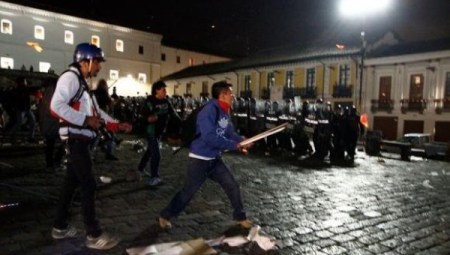
Opposition protesters took sticks and other objects to attack policemen (Photo: ANDES).
teleSUR | October 22, 2014
The Ecuadorian government hit back on Tuesday against a report claiming it repressed protestors during a recent demonstrations.
The Ecuadorian government is challenging a lawyer cited in the report to prove his allegations.
It was responding to accusations made by U.S. based organization Human Rights Watch (HRW).
Interior Minister Jose Serrano announced during a televised interview that the government will sue the lawyer who told HRW that students and protesters detained on September 17 and 18 were tortured by the police.
“This lawyer had the audacity and cynicism to say that the police had tortured them … this individual will have to prove what he said … is effectively true,” Serrano said.
The Interior Minister also clarified that those apprehended were caught on video attacking policemen. All of them confessed to the charges against them.
President Rafael Correa had warned ahead of the September 17 protest that the opposition would try to use similar tactics to those used by the Venezuelan opposition, seeking to generate violent incidents which would then generate controversy and international reactions.
On September 17, opposition activists and government sympathizers both organized mobilizations which were located very close to one another. To avoid a small violent group from reaching the government sympathizers, a group of policemen blocked streets which connected both sites.
Opposition activists attacked the police to try to break into the pro-government rally, with arrests following.
“We had announced ahead (of the protests) that there were groups amongst the protesters which would use vandalism and violent strategies,” Serrano reminded.
According to the official, the International Red Cross was called days before the protests to guarantee that, if any detention was made, the organisation was present in the detention center.
“Mr. Vivanco (Jose Miguel Vivanco, HRW chief for Latin America) will have to show the whole world who is financing him, where are they getting their resources from, and why does he have this particular aversion against Latin America’s progressive governments,” Serrano said.
HRW is increasingly being held account by intellectuals and experts in the United States and the world due to its close relationship with the U.S. State Department.
Journalist Keane Bhatt has previously documented several cases in which HRW members have become senior U.S. State Department officials, in what Bhatt calls a “revolving door policy”.
Nobel Peace Prize Laureates Adolfo Perez Esquivel and Mairead Maguire together with former U.N. Assistant Secretary General Hans von Sponeck and over 100 scholars wrote a letter in May requesting Human Rights Watch to change its policy so as to avoid links with the U.S. State Department.
‘Mumia Bill’ signed in Pennsylvania lets prisoners be sued over speech
RT | October 22, 2014
Prisoners serving time in the state of Pennsylvania can now be sued for speaking up from behind bars after Governor Tom Corbett signed into law this week the Revictimization Relief Act that legislatures rushed to approve only days earlier.
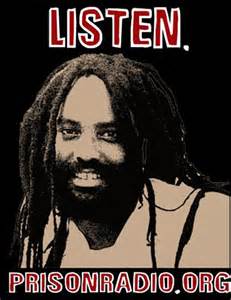 The bill, signed on Tuesday by Corbett, a Republican, allows victims of “a personal injury crime” to sue the perpetrator if that offender “perpetuates the continuing effect of the crime on the victim.”
State Rep. Mike Vereb, a Republican and a co-author of the act, announced earlier this month that he’d be rallying lawmakers to support the bill after former death row inmate Mumia Abu-Jamal was allowed to record a commencement speech that was played for graduates of Goddard College during an October 5 ceremony.
Abu-Jamal, 60, is currently serving a life sentence at a prison facility in Frackville, PA for the 1981 murder of a Philadelphia cop, Officer Daniel Fulkner, but he has maintained his innocence throughout his incarceration, including three decades spent awaiting execution before prosecutors agreed in 2011 to drop the death penalty. Prior to the start of his prison sentence, Abu-Jamal was considered a renowned activist and journalist, and has since published several books and thousands of essays from behind bars.
“The nation is in deep trouble, largely because old thinking, both domestically and globally, has led us into the morass that the nation now faces, which may be encapsulated by references to place-names that ring in our minds: Gaza; Ferguson; and Iraq—again!” a group of 21 graduating students from Goddard, Abu-Jamal’s alma matter, were told in the tape-recorded commencement speech. “These are some of the challenges that abide in the world, which it will be your destiny to try and analyze and resolve. As students of Goddard, you know that those challenges are not easy, but they must be faced and addressed.”
Vereb sent a letter to his colleagues in the Pennsylvania House three days before that address was given, writing in it that he was “utterly outraged that such a reprehensible person would be able to revictimize Officer Daniel Faulkner’s family with this kind of self-promoting behavior.”
The Pennsylvania legislature unanimously approved Vereb’s bill days after the address was given, and Gov. Corbett signed the act on Tuesday, 11 days after the Goddard speech, from a makeshift stage erected in Philadelphia only a few feet from the location where Faulkner was gunned down during a traffic stop 33 years ago. Nevertheless, the Washington Post reported that Corbett said in a statement that the law “is not about any one single criminal,” but rather “was inspired by the excesses and pious hypocrisy of one particular killer.”
“Maureen Faulkner, Danny’s wife, has been taunted by the obscene celebrity that her husband’s killer has orchestrated from behind bars,” Corbett said at the signing, according to a CBS News affiliate.
“This unrepentant cop killer has tested the limits of decency,” the Washington Times quoted Corbett as saying as protesters jeered nearby. “Gullible activists and celebrities have continued to feed this killer’s ego.”
Free speech advocates see no issue with Abu-Jamal’s communique from confinement, though, and say that the law signed this week is a serious blow to First Amendment protections.
“This bill is written so broadly that it is unclear what is prohibited,” Reggie Shuford, the executive director of the American Civil Liberties Union’s Pennsylvania office, said in a statement offered to Reuters. “That can’t pass constitutional muster under the First Amendment.”
Samantha Kolber, a spokesperson for Goddard, told the Patriot-News that the school was “surprised” by Corbett’s signing and said Vereb’s bill “is suggesting that people are not capable of making choices about what speech they will listen to and how they will react to that speech.”
Speaking to the Philadelphia Inquirer, protester Johanna Fernandez said during Corbett’s public signing this week that the governor’s decision to speedily make Vereb’s bill a law was a “Hail Mary pass” from his administration only a month before Election Day since polls suggest that Corbett may lose the governor’s seat. “The establishment of Philadelphia is using Mumia’s case to silence all prisoners in the state,” Fernandez said. “What they’re doing is, they’re essentially inflecting collective punishment on all prisoners in order to silence Mumia.”
On Monday, Abu-Jamal himself weighed in on the debate and the politics surrounding Corbett’s decision to speedily sign the bill during an interview with Noelle Hanrahan of Prison Radio Project.
“This is a political stunt by a failing politician who is seeking support by using fear,” Abu-Jamal said this week. “Politicians do it all the time. But this is unconstitutional: Tom’s latest attempt to stroke and build up his political campaign, his failing political campaign.”
According to the activist-turned-inmate, he gave his address to Goddard after students there wrote and requested he speak. Marc Lamont Hill, a professor at Morehouse College, tweeted Wednesday that “Even if you don’t support Mumia, you should be outraged at this attack on First Amendment Rights.”
Featured Video

Matt Bracken: US Plans Massive MOAB Strike on Iran?
or go to
Aletho News Archives – Video-Images
New Book
The silver that medicine dropped — four thousand years of clinical use, four decades to erase.
Colloidal Silver — First Edition, 2026, Paperback
Lies are Unbekoming | October 16, 2026
Silver was medicine. Not alternative medicine. Not folk medicine. Medicine. In surgery. In obstetrics. In the burn ward. In water treatment. In the household medicine chest. Every physician before 1938 knew this.
By the 1870s, silver nitrate was standard in surgical wound care across the leading hospitals of Britain, Germany, and the United States. Colloidal silver preparations — Collargol, Argyrol, Protargol — entered European and American practice through the 1890s and early 1900s and became standard antiseptics in military field medicine. By the time Fleming grew his first penicillin mould in 1928, silver was the first-line antimicrobial of the Western pharmacopoeia. The Lancet and the British Medical Journal carried the clinical reports in volume. The practice ran continuously through the Victorian era, the Edwardian era, the First World War, the interwar period. By 1980, almost all of it was gone.
What has not been treated at book length, until now, is how a four-thousand-year clinical record disappeared from mainstream medicine within four decades of the Flexner Report — and what the honest account of silver looks like once that record is reassembled.
Colloidal Silver reconstructs the pre-1938 record from The Lancet, the British Medical Journal, and the primary literature of the era; recovers Robert Becker’s bioelectric framework from the regeneration research the pharmaceutical model buried; and places silver inside a practical terrain-paradigm guide to its current place — in water, on the body, inside the body, and in the chronic conditions where antibiotics have failed. … continue
Blog Roll
 Aletho News
- Spanish firm sells Latvia vehicles equipped with Israeli tech despite arms embargo
- Saudi Arabia under fire… Yemen is burning down the House of Saud
- Israeli Spy Pollard stole the files, today’s it’s delivered through official channels
- Why Iran Didn’t Walk Away
- US arms supplied to Ukraine found in war-torn Sudan – Moscow
- The silver that medicine dropped — four thousand years of clinical use, four decades to erase.
- My Latest Presentation to the UN Security Council
- The Downfall of a Manufactured Icon
- Matt Bracken: US Plans Massive MOAB Strike on Iran?
- Russia accuses France of ‘piracy’ over tanker seizure
- If Americans Knew
- Israeli settlers brutally attack Palestinians and Washington Post female photographer, 65
- Words Have Changed, Occupation Continues: The Reality of the Gaza Ceasefire
- Gaza’s child amputees are growing faster than their prosthetics allow
- Israel keeps Palestinians struggling just to survive–Daily Update
- Israeli firm used online ads to run vast spy operation, researchers say
- No, the world zionist movement is not an antisemitic conspiracy theory
- Hundreds of IDF investigations into killings still have no public outcome, BBC Verify finds
- After Ashley Moody Epstein Probe, Donors Linked to Him Poured Money Into her Senate Campaign
- Worried about Russian meddling in UK politics? Wait till you see what Israel is up to
- Israeli settlers attack West Bank center for disabled children, church leader calls for int’l action
- No Tricks Zone
- New Study Suggests Large Regions Of The Pacific Ocean Have Been Cooling For The Last 80 Years
- Germany’s Green Energy Debacle: High Energy Costs Force Kahla Porzellan to Close After 182 Years!
- New Study: 50 Years Of The Most Aggressive ‘Net Zero’ Policies Can Only Affect The Global Climate By 0.03°C
- US September “Heat” Was No Record…Many Records Set Decades Ago
- Latest European Green Energy Debacle; Portugal’s Largest Flagship Solar Park Insolvent!
- Green Energy Debacle: German Expert Professor Fritz Vahrenholt Warns Of Severe Economic And Social Consequences
- Two More Paleo Reconstructions Affirm Meters-Higher Sea Levels Across Ireland, Brazil 7000-6000 Years Ago
- New Study: Earth And Venus Surface Warmth Largely Explained By Convection And Lapse Rate, Not CO2 Or Radiation
- 2025 Nature Paper Claiming Worsening Global Drought Gets RETRACTED …Heavily Flawed
- New Study: ‘Global Drought Shows No Detectable Recent Acceleration Under Climate Warming’

