Human Rights Watch Should Stick to the Facts on Venezuela
By Mark Weisbrot | CEPR Americas Blog | April 10, 2014
Despite the fact that the New York Times had to run a correction on February 26 for claiming that Globovisión in Venezuela was “[t]he only television station that regularly broadcast voices critical of the government,” Daniel Wilkinson of Human Rights Watch (HRW) repeats the same error in the New York Review of Books yesterday, writing that:
Two of the four private stations voluntarily dropped their critical coverage; a third was forced off the air; and the fourth was hounded by administrative sanctions and criminal charges until the owner sold it last year to investors reportedly linked to the governments, who have dramatically curtailed its critical content.
In fact, the stations he claims have “dropped their critical coverage,” Venevisión and Televen, regularly run coverage that is critical of the government, as documented here.
Since the claim that these stations have “dropped their critical coverage” is demonstrably false, the NYRB, like the New York Times, should run a correction.
The fourth station he refers to is Globovisión. During the run-up to last April’s presidential elections, according to a Carter Center study, Globovisión gave nine times as much coverage to opposition presidential candidate Henrique Capriles as to governing party candidate Nicolás Maduro. Readers who are familiar with right-wing TV in the United States will note that this would not be possible for Fox News, for example, to get away with. So, if Globovisión “dramatically curtailed” its anti-government bias – Wilkinson offers no data — because it was bought by someone who wanted to practice mainstream journalism, the station could still have a lot of room to trash the government.
In fact, on February 17, in the heat of the recent protests, Globovisión ran an interview with opposition leader María Corina Machado in which she denounced the government for a series of alleged crimes and argued that people had the right to overthrow it. This casts a bit of a shadow over Wilkinson’s further claim that “while some news programs have interviewed opposition leaders and government critics, they do so under the legal and political constraints imposed by the government.”
It’s too bad that Wilkinson ignored or perhaps didn’t read the Carter Center’s report on the Venezuelan media during the vigorously contested 2013 presidential election campaign. The data from the report, taking into account audience share, indicate that TV media coverage was pretty evenly split between the two candidates. This contradicts the exaggerated picture that he paints in this article of an “authoritarian” government seeking to “control how the news gets reported on Venezuelan TV.”
The 2,800-word article – which provides few links or sources to back up dozens of allegations – contains a number of exaggerations and inaccuracies. For example, in describing the protests he writes that “Most of these have been peaceful, though in many places protesters have barricaded streets, and some have thrown rocks and Molotov cocktails.” This contradicts daily news reports in the major international media. Some of the large daytime marches have been peaceful, but every night for nearly two months there have been violent protests where the participants throw rocks and Molotov cocktails at security forces and sometimes neighbors who try to clear or pass through barricades. Not to mention the occasional shootings by protesters. He doesn’t mention it, but half of the 39 fatalities he refers to have apparently been caused by protesters.
Now, don’t get me wrong. It is the job of human rights groups to denounce and expose all human rights abuses committed by governments (and non-state actors too), and I would not criticize a human rights organization for being too harsh on any government. And if Wilkinson wants to ignore or pretend he can’t see that this is another attempt to overthrow a democratically elected government taking place, that’s his prerogative too. But why the gross exaggerations and false statements? Aren’t there enough things to complain about without making things up?
HRW can get away with outrageous double standards if they want. They barely lifted a finger when a U.S.-backed coup overthrew the democratically-elected government of Haiti in 2004. The perpetrators of the coup killed thousands of people, and officials of the constitutional government were put in jail. This did not raise a tiny fraction of the concern at HRW as compared to the “independence of the judiciary” in Venezuela, which of course was not more independent before their enemy Chávez was elected.
In 2008, more than 100 scholars and experts signed a letter documenting and “highlighting exaggerations and inaccuracies” in a “politically motivated” report by HRW on Venezuela. It is clear that HRW did not take any steps to correct their bias or carelessness with the facts. That is a shame. Of course, there is no political price to pay in the U.S. for exaggerating or making false statements about a government that Washington wants to destabilize. But it does not serve the cause of human rights; and it undermines the good work that HRW does in other countries when they are seen as a partisan ally of a U.S.-backed attempt at “regime change.”
Really they should stick to the facts.
George Monbiot in the Guardian lobster pot
By Jonathon Cook | April 8, 2014
Back in February the Guardian quietly announced a deal with the global consumer goods corporation Unilever. Here is the beginning of the Guardian’s press release:
Guardian News and Media today officially launches Guardian Labs – its branded content and innovation agency – which offers brands bold and compelling new ways to tell their stories and engage with influential Guardian audiences. The official launch of the new commercial proposition is marked by the announcement of a pioneering seven-figure partnership with Unilever, centred on the shared values of sustainable living and open storytelling. … The new Unilever partnership will create a bespoke engagement platform to increase awareness of, and foster debate about, sustainability issues, and ultimately encourage people to live more sustainable lives.
I wonder how many of those who proudly declare themselves “Guardian readers” recognised their beloved newspaper in that statement.
In fact, it makes perfect sense for Unilever – a corporation whose brand “positioning” depends on its customers identifying it as a responsible and caring business, despite the evidence to the contrary – to team up with the Guardian, another corporation whose brand positioning has already persuaded most of its customers that it is a responsible and caring business.
Today the Guardian columnist George Monbiot does something pretty brave for a Guardian columnist: he alerts his readers to the existence of this arrangement and gently questions what it represents, in an article bewailing the fact that “corporations have colonised our public life”.
Here is what he says:
I recognise and regret the fact that all newspapers depend for their survival on corporate money (advertising and sponsorship probably account, in most cases, for about 70% of their income). But this, to me, looks like another step down the primrose path. As the environmental campaigner Peter Gerhardt puts it, companies like Unilever “try to stakeholderise every conflict”. By this, I think, he means that they embrace their critics, involving them in a dialogue that is open in the sense that a lobster pot is open, breaking down critical distance and identity until no one knows who they are any more.
It’s worth noting how rarely journalists criticise the nature of the media they work in. Maybe that is not so surprising: few businesses, the media included, are happy having their flaws paraded in public. But what Monbiot has done here is to appear brave while really shrinking from the truth. He criticises the Guardian while really not criticising it.
Monbiot’s implication in the nice metaphor above is that Unilever is the the lobster pot, while the poor Guardian is the lobster in danger of being “stakeholderised”. Or, in another metaphor he uses, the Guardian is the one being led up the primrose path.
What he encourages his readers to infer is that the Guardian is the victim in this deal, being seduced and violated by Unilever. The reality is that Unilever and the Guardian are both wolves in sheep’s clothing. The arrangement works to the benefit of them both. In Monbiot’s reckoning, the Guardian is “public life” being colonised by Unilever. In fact, the Guardian is no more public life than Unilever. Both have colonised the public space, in the interests of maximising profits whatever the consequences to the public good and the planet. (And please, no one try to claim that my argument is refuted by the fact that the Guardian loses money. It is not a charity. Its goal is not to lose money; its goal is to find a strategy, like the one with Unilever, to revive its fortunes in a dying industry.)
In fact, the lobster pot metaphor would be much more apt to describe Monbiot’s relationship with the Guardian. The newspaper has “embraced” him, “breaking down his critical distance and identity until he no longer knows who he is”. Now if he told us that, I really would be cheering him for his honesty.
www.theguardian.com/commentisfree/2014/apr/08/corporations-public-life-unilever
Anti-Iran Hardliners Seek New Excuse
By Paul R. Pillar | Consortium News | April 8, 2014
There exists, right now, a problem with one side’s obligations not being fulfilled as provided for under the preliminary agreement, known as the Joint Plan of Action, that Iran reached with the United States and its negotiating partners (the P5+1) last November. This lack of fulfillment endangers the process of negotiating a final agreement.
It is an understandable source of consternation to the other side, which will increasingly doubt the first side’s ability and willingness to make good on its commitments, including in any final deal. Hardliners on the second side will pounce on any non-fulfillment of the terms of the JPA as a reason to scuttle the whole process.
So is Iran not living up to its commitments under the JPA? Well, we do have hardliners on our own side eager to pounce. In fact, they are so eager that they are trying to pounce even though there isn’t anything to pounce on.
Senators Robert Menendez, D-New Jersey, and Mark Kirk, R-Illinois, who led the recent unsuccessful effort in Congress to impose additional deal-busting sanctions after conclusion of the JPA, have sent a letter to President Barack Obama that bemoans indications of some increased Iranian oil sales and says “If Iran moves forward with this effort to evade U.S. sanctions and violate the terms of oil sanctions relief provided for in the JPA” the United States should in effect renounce its obligation under the JPA to — this is the wording of the JPA — “pause efforts to further reduce Iran’s crude oil sales.”
The senators make it sound as if Iran has some obligation under the agreement to knuckle under to sanctions, don’t they? Otherwise how could Iran “violate” what they are talking about? But Iran has no such obligation.
All the obligations in the preliminary agreement concerning sanctions are obligations of the P5+1 (including that very mild “pause efforts” clause, which does not entail rolling back the existing oil sanctions). All of Iran’s obligations involve restrictions on its nuclear program. According to the International Atomic Energy Agency, Iran so far is in compliance with those obligations.
No, the current problem in implementing the agreement involves another part of the P5+1′s side of the deal, not Iran’s side. Specifically, it involves the unfreezing in installments of a small portion ($4.2 billion out of an estimated $100 billion) of the Iranian money that already was earned from prior oil sales and is sitting in non-Iranian banks.
Iran has been unable to withdraw much of the money that it was supposed to have gained access to by now. It appears the problem is not direct violation of the agreement by the U.S. Treasury or any of the other governments involved. Instead, the banks that are to handle the funds are so deathly afraid of running afoul, however inadvertently, of any continuing sanctions that Treasury is enforcing that they have not made the money move.
The fear is understandable, given how huge and complex the sanctions regime has become and also how huge have been fines that Treasury has levied on transgressors. The marvelous sanctions machine is so powerful that it continues to exude power and have effects even after a switch has been turned off. Treasury needs to do more than just saying “go,” and more than it has done so far to put banks into their comfort zone, for the JPA to be implemented the way it was supposed to be.
Iranian President Hassan Rouhani had a big enough challenge domestically as it was to sell a preliminary agreement that gave the P5+1 most of what it wanted in restricting the nuclear program while getting only modest sanctions relief in return. His selling task is made all the harder when even that modest relief is not properly implemented. And there certainly are hardliners on his side ready to pounce on any such developments.
This issue is a reminder of how an Iranian belief that the West and especially the United States will come through with positive action if Iran makes desired concessions is just as important as (and given how the issue has evolved, has become even more important than) an Iranian belief that it will be hit with still more negative consequences if it does not concede.
The current problem also underscores how much work — political, not just administrative — on the U.S. side remains to be done to prepare for the undoing of sanctions that will be part of any final agreement, and that necessarily will be substantially greater than the minor sanctions relief in the JPA.
Members of Congress are still talking about piling on more sanctions when they ought to be discussing how to take sanctions off the pile. We have already seen how hard it is to redirect the sanctions machine. Aircraft carriers do not turn around on a dime, and neither do sanctions, especially ones as complicated and extensive as the ones on the Iranian pile.
Even if the more optimistic projections of when a deal will be struck in Vienna do not prove true, it is not too soon for Congress and the administration to be working diligently on this and for it to be a subject of public discussion.
New Federal Indictment Over Iran Sanctions Breach Demonstrates Reach of Nuclear Disinformation

United States Attorney for the District of Massachusetts Carmen Oritz
By Nima Shirazi | Wide Asleep in America | April 6, 2014
A brief news story posted by Reuters at 3pm on Friday afternoon reported that Sihai Cheng, a Chinese national is facing criminal charges brought by the U.S. government for allegedly having conspired to export “pressure transducers,” sensors that translate the application of pressure into electrical signals, to Iran in violation with sanctions that restrict trade of scientific equipment and technology to that country.
Cheng was arrested at Heathrow airport two months ago and the indictment was brought by Boston field offices of the FBI, Department of Homeland Security, Department of Commerce, and the Department of Justice’s Massachusetts District Attorney.
Following the publication of the Reuters report, the news traveled fast with outlets like Bloomberg News, AFP, Telegraph, and BBC all picking it up, and inevitably tying the news to the ongoing international nuclear negotiations taking place between six world powers and Iran.
Pressure transducers have myriad industrial and scientific uses; their use in the translating pressurized gas in centrifuges to an analog electrical signal is but one of these applications. A statement released by the U.S. Attorney’s office declares, “Pressure transducers can be used in gas centrifuges to enrich uranium and produce weapons-grade uranium.”
Unmentioned is the fact that, not only can transducers be used for thousands of other reasons, but also that Iran’s enrichment of uranium is legal, Iran’s enrichment facilities are under strict IAEA monitoring and inspection, and Iran has never even been accused of enriching uranium to weapons-grade levels. It’s like arresting someone over trading light bulbs, which can be used in automobiles, which can be used to run people over.
The prosecution of people accused of breaching the aggressive U.S.-led sanctions regime is nothing new; just last month, Mohammad Reza Nazemzadeh, a prolific and respected medical research scientist in Michigan was inexplicably indicted for trying to send a refurbished coil for an MRI machine to a hospital in Iran. However, certain language used in press reports to describe the indictment of Cheng – in bold below – is curious.
Reuters reported that Cheng had “supplied thousands of parts that have nuclear applications to Eyvaz, a company involved in Iran’s nuclear weapons program, in violation of U.S. sanctions on Iran, federal prosecutors said.”
Bloomberg News used the same formulation:
From November 2005 to 2012, Cheng allegedly supplied thousands of parts that have nuclear applications to Eyvaz, an Iranian company involved in the development and procurement of parts for Iran’s nuclear weapons program.
“Iran’s nuclear weapons program.” Read that again. “Iran’s nuclear weapons program.” The ubiquity of this phrase in the press and political speechifying belies the fact that Iran does not actually have a nuclear weapons program and is thus, not only deliberately deceiving, but patently false.
It should now go without saying that, for years now, the United States intelligence community and its allies have long assessed that Iran is not and never has been in possession of nuclear weapons, is not building nuclear weapons, and its leadership has not made any decision to build nuclear weapons. Iran’s uranium enrichment program is fully safeguarded by the IAEA and no nuclear material has ever been diverted to a military program. Iranian officials have consistently maintained they will never pursue such weapons on religious, strategic, political, moral and legal grounds.
This assessment has been reaffirmed year after year by the U.S. Director of Intelligence James Clapper, most recently in mid-February before the Senate Armed Services Committee. The intelligence has maintained for nearly seven years a high level of confidence that Iran has no nuclear weapons program.
Nevertheless, this phraseology goes frequently unchallenged in the mainstream media – despite repeated appeals by ombudsmen and public editors for more careful and measured writing by their reporters.
The reports of the Cheng case, however, are a bit more revealing. The specific claim referencing an Iranian “nuclear weapons program” did not originate with the Reuters wire service or Bloomberg‘s own cribbed report. In fact, the phrase in its entirety came from the U.S. Attorney’s own press release about the indictment, which was posted Friday by the “Boston Press Release Service,” and has still (as of this writing) not appeared on the website for the U.S. Attorney for the District of Massachusetts.
That the offending phrase – “Iran’s nuclear weapons program” – was literally copied-and-pasted directly from a government statement by professional reporters for major news outlets, without a shred of skepticism, scrutiny or fact-checking, is sadly par for the course in a media landscape wherein the press simply parrot the government line as a matter of policy.
“The indictment alleges that between in or about November 2005 and 2012, Cheng supplied thousands of parts that have nuclear applications, including U.S. origin goods, to Eyvaz, an Iranian company involved in the development and procurement of parts for Iran’s nuclear weapons program,” the release reads.
The government prosecutor responsible for the indictment is Massachusetts’ U.S. Attorney Carmen Ortiz, who herself has a sordid history of overly-aggressive prosecution, in one case leading to the suicide of computer programmer and online activist Aaron Swartz in January 2013.
In this indictment, Ortiz has thus made an assumption about Iranian actions and intentions that directly contradicts the consensus of 16 American intelligence agencies. Furthermore, the prosecution itself is part of the Obama administration’s own economic war on Iran.
Just two weeks after Iran and the P5+1 signed their Joint Plan of Action in late November 2013, the U.S. State and Treasury Departments specifically named Eyvaz Technic Manufacturing Company among companies targeted “for evading international sanctions against Iran and for providing support for Iran’s nuclear program.”
The recent indictment and accompanying press release present a clear indication that the decades-long disinformation campaign about Iran’s nuclear program is far more powerful and sustaining than facts and evidence. And that’s bad news when the propaganda comes straight from the Department of Justice.

‘100% sure Berkut police didn’t shoot people in Kiev’ – ex-Ukrainian interior minister
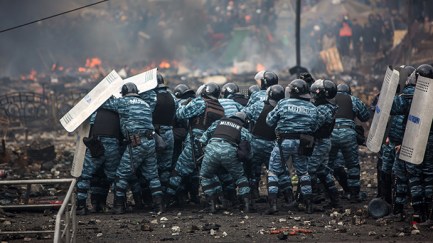
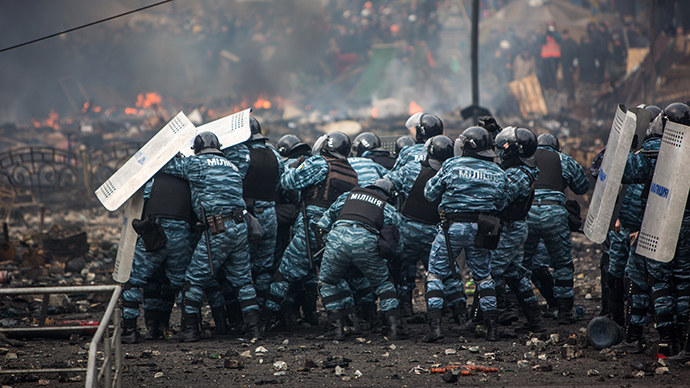
Police officers on Maidan Nezalezhnosti square in Kiev, where clashes began on February 19, 2014 (RIA Novosti / Andrey Stenin)
RT | April 5, 2014
Berkut riot police were targets – not shooters – during the Maidan standoff, ex-Ukrainian Interior Minister Vitaly Zakharchenko said, adding that a fair investigation of the tragic events in Kiev is impossible under the biased, coup-imposed government.
During his interview with Russia’s Channel One, Zakharchenko stressed that he is “100% sure that it wasn’t the police” who used firearms against the people during the February Maidan standoff.
“Berkut riot police were without their service weapons. On February 18 and 1,986 police officers were wounded by gunshots. Fourteen of them died. They were internal troops, military, Berkut, and traffic police, who were shot at their post checkpoint,” he said.
On February 20, Berkut forces and internal troops encountered point shooting in Kiev’s center and “that’s why they actually, began retreating,” the former interior minister explained.
“It’s clear for any reasonable person that if it were the law enforcement officers who opened fire, they would’ve probably been advancing. That would’ve been the reason to use firearms. Meanwhile, they began retreating after the killing of their troops began,” he said.
According to Zakharchenko, the servicemen that were brought to Kiev hospitals had gunshot wounds from 9mm pistols, hunting rifles, buckshots, and smooth-bore weapons.
The ex-minister stressed that the snipers – who fired at both police and demonstrators – were stationed in three buildings, which were under the control of Maidan protestors.
“It was a provocation staged with only one motive – to launch another attack on law enforcement, launch an attack aimed at seizing the governmental buildings and institutes. That’s the logic behind all those events,” he said.
February 20 became the bloodiest day of the Ukrainian coup, with 42 people killed in Kiev.
Zakharchenko believes the self-proclaimed government in Kiev is biased, and is therefore incapable of pursuing a fair investigation of the shootings in country’s capital.
He added that no one is investigating the gunshot wounds received by law enforcement officers during the Maidan standoff.
“Without a nonpartisan international investigation team that would undertake a thorough inquiry into the events that occurred in Ukraine, we won’t get such an objective investigation,” the ex-minister said.
According to Zakharchenko, Western nations – which fully supported the Ukrainian coup – were aware that Maidan radicals had firearms in their possession.
“I had meetings with various international representatives, including the US ambassador to Ukraine, as well as with EU ambassador Jan Tombinski. I repeatedly called them and said that there were firearms at Independence Square,” he said.
The identity of the ‘Maidan snipers’ is a hot topic in Ukraine and abroad. Twelve Berkut officers were detained earlier this week for allegedly being part of the so-called ‘Black Company,’ which was given sniper rifles to provide cover for its retreating comrades on February 20.
Coup-appointed Prime Minister Arseny Yatsenyuk says that ousted President Yanukovich is the one who should answer for the killings of Maidan protesters.
Meanwhile, a phone conversation leaked last month between EU foreign affairs chief Catherine Ashton and Estonian Foreign Minister Urmas Paet contains strong suspicion that the snipers were hired by Maidan leaders.
In his interview, Zakharchenko also criticized the National Guard – the new security force put together by the coup-imposed Ukrainian authorities. The force was created from interior troops and Maidan self-defense forces.
“There is a feeling that they came up with this National Guard in order to create… something like stormtroopers to legalize the militants who don’t want to surrender their weapons, so that they’d carry the real power – thus matching them against the police and the army and restoring order with its own revolutionary forces,” he said.
The National Guard has already recruited 30,000 soldiers, according to Kiev.
RIA Novosti is citing sources in the Ukrainian Defense and Interior Ministries, who say the creation of the National Guard is treated by them as a symbol of distrust from Kiev authorities.
But Zakharchenko has serious doubts about the National Guard’s ability to work effectively.
“Well, I just can’t understand, for example, how they will execute guard duties or how this will look like at all. How can they ensure the rule of law if they were engaged in debacles, if they killed law enforcement officers, attacked them and burned with Molotov cocktails. How much trust will the population have towards those guards? Whom will they be defending?” he said.
Zakharchenko served as Ukraine’s interior minister from November 7, 2011 to February 21, 2014, when parliament removed him from office.
~
5 unanswered questions surrounding Kiev killings
AGW has most of the characteristics of an “urban legend”
By Roy W. Spencer, Ph. D. | Watts Up With That? | October 24, 2009
About.com describes an “urban legend” as an apocryphal (of questionable authenticity), secondhand story, told as true and just plausible enough to be believed, about some horrific…series of events….it’s likely to be framed as a cautionary tale. Whether factual or not, an urban legend is meant to be believed. In lieu of evidence, however, the teller of an urban legend is apt to rely on skillful storytelling and reference to putatively trustworthy sources.
I contend that the belief in human-caused global warming as a dangerous event, either now or in the future, has most of the characteristics of an urban legend. Like other urban legends, it is based upon an element of truth. Carbon dioxide is a greenhouse gas whose concentration in the atmosphere is increasing, and since greenhouse gases warm the lower atmosphere, more CO2 can be expected, at least theoretically, to result in some level of warming.
But skillful storytelling has elevated the danger from a theoretical one to one of near-certainty. The actual scientific basis for the plausible hypothesis that humans could be responsible for most recent warming is contained in the cautious scientific language of many scientific papers. Unfortunately, most of the uncertainties and caveats are then minimized with artfully designed prose contained in the Summary for Policymakers (SP) portion of the report of the UN’s Intergovernmental Panel on Climate Change (IPCC). This Summary was clearly meant to instill maximum alarm from a minimum amount of direct evidence.
Next, politicians seized upon the SP, further simplifying and extrapolating its claims to the level of a “climate crisis”. Other politicians embellished the tale even more by claiming they “saw” global warming in Greenland as if it was a sighting of Sasquatch, or that they felt it when they fly in airplanes.
Just as the tales of marauding colonies of alligators living in New York City sewers are based upon some kernel of truth, so too is the science behind anthropogenic global warming. But there is a big difference between reports of people finding pet alligators that have escaped their owners, versus city workers having their limbs torn off by roving colonies of subterranean monsters.
In the case of global warming, the “putatively trustworthy sources” would be the consensus of the world’s scientists. The scientific consensus, after all, says that global warming is… is what? Is happening? Is severe? Is man-made? Is going to burn the Earth up if we do not act? It turns out that those who claim consensus either do not explicitly state what that consensus is about, or they make up something that supports their preconceived notions.
If the consensus is that the presence of humans on Earth has some influence on the climate system, then I would have to even include myself in that consensus. After all, the same thing can be said of the presence of trees on Earth, and hopefully we have at least the same rights as trees do. But too often the consensus is some vague, fill-in-the-blank, implied assumption where the definition of “climate change” includes the phrase “humans are evil”.
It is a peculiar development that scientific truth is now decided through voting. A relatively recent survey of climate scientists who do climate research found that 97.4% agreed that humans have a “significant” effect on climate. But the way the survey question was phrased borders on meaninglessness. To a scientist, “significant” often means non-zero. The survey results would have been quite different if the question was, “Do you believe that natural cycles in the climate system have been sufficiently researched to exclude them as a potential cause of most of our recent warming?”
And it is also a good bet that 100% of those scientists surveyed were funded by the government only after they submitted research proposals which implicitly or explicitly stated they believed in anthropogenic global warming to begin with. If you submit a research proposal to look for alternative explanations for global warming (say, natural climate cycles), it is virtually guaranteed you will not get funded. Is it any wonder that scientists who are required to accept the current scientific orthodoxy in order to receive continued funding, then later agree with that orthodoxy when surveyed? Well, duh.
In my experience, the public has the mistaken impression that a lot of climate research has gone into the search for alternative explanations for warming. They are astounded when I tell them that virtually no research has been performed into the possibility that warming is just part of a natural cycle generated within the climate system itself.
Too often the consensus is implied to be that global warming is so serious that we must do something now in the form of public policy to avert global catastrophe. What? You don’t believe that there are alligators in New York City sewer system? How can you be so unconcerned about the welfare of city workers that have to risk their lives by going down there every day? What are you, some kind of Holocaust-denying, Neanderthal flat-Earther?
It makes complete sense that in this modern era of scientific advances and inventions that we would so readily embrace a compelling tale of global catastrophe resulting from our own excesses. It’s not a new genre of storytelling, of course, as there were many B-movies in the 1950s whose horror themes were influenced by scientists’ development of the atomic bomb.
Our modern equivalent is the 2004 movie, “Day After Tomorrow”, in which all kinds of physically impossible climatic events occur in a matter of days. In one scene, super-cold stratospheric air descends to the Earth’s surface, instantly freezing everything in its path. The meteorological truth, however, is just the opposite. If you were to bring stratospheric air down to the surface, heating by compression would make it warmer than the surrounding air, not colder.
I’m sure it is just coincidence that “Day After Tomorrow” was directed by Roland Emmerich, who also directed the 2006 movie “Independence Day,” in which an alien invasion nearly exterminates humanity. After all, what’s the difference? Aliens purposely killing off humans, or humans accidentally killing off humans? Either way, we all die.
But a global warming catastrophe is so much more believable. After all, climate change does happen, right? So why not claim that ALL climate change is now the result of human activity? And while we are at it, let’s re-write climate history so that we get rid of the Medieval Warm Period and the Little Ice age, with a new ingenious hockey stick-shaped reconstruction of past temperatures that makes it look like climate never changed until the 20th Century? How cool would that be?
The IPCC thought it was way cool… until it was debunked, after which it was quietly downgraded in the IPCC reports from the poster child for anthropogenic global warming, to one possible interpretation of past climate.
And let’s even go further and suppose that the climate system is so precariously balanced that our injection of a little bit of that evil plant food, carbon dioxide, pushes our world over the edge, past all kinds of imaginary tipping points, with the Greenland ice sheet melting away, and swarms of earthquakes being the price of our indiscretions.
In December, hundreds of bureaucrats from around the world will once again assemble, this time in Copenhagen, in their attempts to forge a new international agreement to reduce greenhouse gas emissions as a successor to the Kyoto Protocol. And as has been the case with every other UN meeting of its type, the participants simply assume that the urban legend is true. Indeed, these politicians and governmental representatives need it to be true. Their careers and political power now depend upon it. And the fact that they hold their meetings in all of the best tourist destinations in the world, enjoying the finest exotic foods, suggests that they do not expect to ever have to be personally inconvenienced by whatever restrictions they try to impose on the rest of humanity.
If you present these people with evidence that the global warming crisis might well be a false alarm, you are rewarded with hostility and insults, rather than expressions of relief. The same can be said for most lay believers of the urban legend. I say “most” because I once encountered a true believer who said he hoped my research into the possibility that climate change is mostly natural will eventually be proved correct.
Unfortunately, just as we are irresistibly drawn to disasters – either real ones on the evening news, or ones we pay to watch in movie theaters – the urban legend of a climate crisis will persist, being believed by those whose politics and worldviews depend upon it. Only when they finally realize what a new treaty will cost them in loss of freedoms and standard of living will those who oppose our continuing use of carbon-based energy begin to lose their religion.
Related article
- What Defines A Scientist? (wattsupwiththat.com)
The Age of the Oligarchs
By Robert Parry | Consortium News | April 4, 2014
The chaos in Ukraine can be viewed, in part, as what happens when a collection of “oligarchs” – sometimes competing, sometime collaborating – take control of a society, buying most of the politicians and owning the media. The political/media classes become corrupted by serving their wealthy patrons and society breaks down into warring factions.
In that sense, Ukraine could be a cautionary tale for the United States and other countries that are veering down a similar path toward vast income inequality, with billionaire “oligarchs” using their money to control politicians and to pay for propaganda through media ventures.
Depending on your point of view, there may be “good oligarchs” and “bad oligarchs,” but the concept of oligarchy is antithetical to democracy, a system in which governance is supposed to be driven by the informed consent of the majority with respect for minority rights. Instead, we’re moving toward a competition among oligarchs with the “people” mostly as bystanders to be manipulated one way or the other.
On Wednesday, a 5-4 majority of the U.S. Supreme Court lifted limits on total amounts that an individual can contribute during a campaign cycle, an extension of the 2010 ruling on Citizens United allowing the rich to spend unlimited sums on political advertising. It was another step toward an American oligarchy where politicians, activists and even journalists compete to satisfy one “oligarch” or another.
Regarding political spending, that can mean the energy tycoon Koch Brothers financing the Tea Party or Americans for Prosperity to tear down government regulations of businesses. Or it can mean casino kingpin Sheldon Adelson staging his own “primary” in which Republican hopefuls compete to show who would do the most for Israel. Or – from a liberal perspective – it can be billionaire investor Tom Steyer pressing for action on man-made climate change.
On the Right, there also have been vast investments in propaganda – from books, magazines and newspapers to talk radio, TV and the Internet – by the likes of Rupert Murdoch and Richard Mellon Scaife, an imbalance countered, in only a relatively small way, by a few liberal “oligarchs” who have started their own big-budget Web sites.
And, despite the appearance of a few “left-of-center” U.S. sites, there continues to be a lock-step consensus – across the nation’s media – regarding most international conflicts, such as the recent crises in Syria and Ukraine. In those cases, these liberal “oligarchic” sites are as likely to go with the conventional wisdom as the right-wing “oligarchic” sites.
So, if you want to find critical reporting on U.S. interference in Ukrainian politics or a challenging analysis of U.S. claims about the Syrian chemical weapons attack, you’re not likely to find them at ProPublica, which is backed by ex-subprime mortgage bankers Herbert and Marion Sandler and is edited by well-paid traditional journalists from the mainstream press, like Stephen Engelberg, formerly of the New York Times. Nor at FirstLook.org funded by eBay founder Pierre Omidyar.
Though both ProPublica and FirstLook do some fine work on certain topics – such as the environment and privacy rights, respectively – they haven’t shown much willingness to get in the way of U.S. foreign-policy stampedes as they run out of control. Presumably, that would make their funders nervous and possibly put their larger business interests at risk.
Another new media “oligarch,” Washington Post owner and Amazon founder Jeff Bezos, has shied away from reining in “the neocons who brought us the Iraq War.” He has left neocons like Fred Hiatt and Jackson Diehl in charge of the opinion section of Official Washington’s hometown newspaper. Their positions on Syria and Ukraine have been predictable.
And, of course, other mainstream outlets – like the New York Times, the Daily Beast and the major TV networks – have completely fallen into line behind the conventional wisdom. Most coverage of the Syrian civil war and the Ukraine crisis couldn’t have been more submissive to the U.S. government’s propaganda themes if the stories had been written by Radio Liberty or the CIA.
Anyone looking for journalistic skepticism about the mainstream U.S. narrative on these touchy issues has had to seek out Internet sites like Consortiumnews.com which relies on mostly small donations from readers.
But the broader problem is the debilitating impact on democracy when the political/media process takes on the form of some super-hero movie in which super-human combatants do battle – crashing from building to building – while the regular humans mostly watch as powerless spectators as the chaos unfolds.
The Ukraine Mess
In Ukraine’s case, this process was telescoped in time because of the break-up of the Soviet Union in 1991, which was followed by the triumphal intervention of Western “free-market” advisers who descended on Kiev – as well as Moscow – with self-confident prescriptions of privatization and deregulation.
Very quickly, well-connected operatives were scoring mind-boggling deals as they gained control of lucrative industries and valuable resources at bargain-basement prices. Billionaires were made overnight even as much of the population descended to near starvation levels of poverty and despair.
In Russia, strong-willed nationalist Vladimir Putin emerged to put some brakes on this process, banishing some oligarchs like Boris Berezovsky into exile and jailing others like Mikhail Khordorkovsky. However, in Ukraine, the oligarchs continued buying politicians and finally created a crisis of confidence in government itself.
Though public resentment of political corruption was a driving force in the large protests that set the stage for the overthrow of elected President Viktor Yanukovych on Feb. 22, the manipulation of that popular anger may end up impoverishing Ukrainians even more by entrenching oligarchic control even further.
Not only has the Washington-based International Monetary Fund moved to impose “macroeconomic reforms” that will slash spending on Ukraine’s already scant social programs, but “oligarchs” are moving to take direct control of the government.
For instance, the coup regime in Kiev appointed billionaire steel magnate Serhiy Taruta as governor of the Donetsk region in eastern Ukraine where many ethnic Russians live. Taruta quickly moved to suppress pro-Russian sentiment.
As part of the crackdown, the Kiev regime arrested Pavel Gubarev, who had called himself the “people’s governor.” Mikhail Dobkin, a pro-Yanukovych former regional governor who indicated he would seek the presidency, was arrested on sedition charges.
Governor Taruta also has called for some of the IMF’s more draconian demands to be put off until after political resistance to the new order in Kiev has faded.
“People are concerned with one thing,” Taruta told the Washington Post in a flattering story about his leadership. “If we show we can provide help and support, we will calm the situation down. Three to four months from now is the time to talk about financial reform in Ukraine.”
That would mean delaying the harshest elements of the IMF plan until after the scheduled presidential election on May 25, meaning that the voters will have already gone to the polls before they get a taste of what’s in store for them. By then, they may have another billionaire industrialist, Petro Poroshenko, as their new president. He is now the leading candidate.
According to Forbes magazine, there are now about 1,600 billionaires in the world, worth a total of around $6.6 trillion. The writing seems to be scribbled on the walls of Ukraine as well as the United States and around the globe that we are entering the Age of the Oligarchs.
Related article
- Business model of Yatsenyuk is to build oligarchic corporation out of Ukraine (voiceofrussia.com)
Senate Report Shows CIA Agents Used Torture Techniques Not Approved By DOJ Or CIA
By Mike Masnick | Techdirt | April 4, 2014
While the Senate Intelligence Committee has finally started the process of declassifying at least some of the $40 million, 6,300 page report about the CIA’s torture efforts, we’re getting more and more leaks about what’s in the report. Previous leaks showed that the torture program was completely useless and that the CIA simply lied about its effectiveness (in fact, taking information gleaned by others through normal interrogations, and claiming they got it via torture). The latest leak highlights how, despite claims by the CIA’s supporters, that the torture was done in “good faith” and was approved by the DOJ and the CIA, it turns out (of course), that the CIA’s torturers actually went much further than they were approved to go.
CIA officers subjected terror suspects it held after the Sept. 11 attacks to methods that were not approved by either the Justice Department or their own headquarters and illegally detained 26 of the 119 in CIA custody, the Senate Intelligence Committee has concluded in its still-secret report, McClatchy has learned.
The spy agency program’s reliance on brutal and harsh techniques _ much more abusive than previously known _ and its failure to gather valuable information from the detainees, harmed the U.S.’s credibility internationally, according to the committee’s findings in its scathing 6,300 page report on the CIA’s interrogation and detention program.
So, again, we have evidence that the CIA tortured people, did so beyond any actual authority (as sketchy as such an authority might be), got nothing of value from the torture, and then repeatedly lied about the torture and the value of it to Congress and the American public. And… no one is going to jail over this. Well, except for the guy who blew the whistle. In fact, many of those responsible for the torture program are still in positions of power. This is a total disgrace.
USAID Subversion in Latin America Not Limited to Cuba
By Dan Beeton | CEPR Americas Blog | April 4, 2014
A new investigation by the Associated Press into a U.S. Agency for International Development (USAID) project to create a Twitter-style social media network in Cuba has received a lot of attention this week, with the news trending on the actual Twitter for much of the day yesterday when the story broke, and eliciting comment from various members of Congress and other policy makers. The “ZunZuneo” project, which AP reports was “aimed at undermining Cuba’s communist government,” was overseen by USAID’s Office of Transition Initiatives (OTI). AP describes OTI as “a division that was created after the fall of the Soviet Union to promote U.S. interests in quickly changing political environments — without the usual red tape.” Its efforts to undermine the Cuban government are not unusual, however, considering the organization’s track record in other countries in the region.
As CEPR Co-Director Mark Weisbrot described in an interview with radio station KPFA’s “Letters and Politics” yesterday, USAID and OTI in particular have engaged in various efforts to undermine the democratically-elected governments of Venezuela, Bolivia, and Haiti, among others, and such “open societies” could be more likely to be impacted by such activities than Cuba. Declassified U.S. government documents show that USAID’s OTI in Venezuela played a central role in funding and working with groups and individuals following the short-lived 2002 coup d’etat against Hugo Chávez. A key contractor for USAID/OTI in that effort has been Development Alternatives, Inc. (DAI).
More recent State Department cables made public by Wikileaks reveal that USAID/OTI subversion in Venezuela extended into the Obama administration era (until 2010, when funded for OTI in Venezuela appears to have ended), and DAI continued to play an important role. A State Department cable from November 2006 explains the U.S. embassy’s strategy in Venezuela and how USAID/OTI “activities support [the] strategy”:
(S) In August of 2004, Ambassador outlined the country team’s 5 point strategy to guide embassy activities in Venezuela for the period 2004) 2006 (specifically, from the referendum to the 2006 presidential elections). The strategy’s focus is: 1) Strengthening Democratic Institutions, 2) Penetrating Chavez’ Political Base, 3) Dividing Chavismo, 4) Protecting Vital US business, and 5) Isolating Chavez internationally.
Among the ways in which USAID/OTI have supported the strategy is through the funding and training of protest groups. This August 2009 cable cites the head of USAID/OTI contractor DAI’s Venezuela office Eduardo Fernandez as saying, during 2009 protests, that all the protest organizers are DAI grantees:
¶5. (S) Fernandez told DCM Caulfield that he believed the [the Scientific, Penal and Criminal Investigations Corps’] dual objective is to obtain information regarding DAI’s grantees and to cut off their funding. Fernandez said that “the streets are hot,” referring to growing protests against Chavez’s efforts to consolidate power, and “all these people (organizing the protests) are our grantees.” Fernandez has been leading non-partisan training and grant programs since 2004 for DAI in Venezuela.”
The November 2006 cable describes an example of USAID/OTI partners in Venezuela “shut[ting] down [a] city”:
11. (S) CECAVID: This project supported an NGO working with women in the informal sectors of Barquisimeto, the 5th largest city in Venezuela. The training helped them negotiate with city government to provide better working conditions. After initially agreeing to the women’s conditions, the city government reneged and the women shut down the city for 2 days forcing the mayor to return to the bargaining table. This project is now being replicated in another area of Venezuela.
The implications for the current situation in Venezuela are obvious, unless we are to assume that such activities have ended despite the tens of millions of dollars in USAID funds designated for Venezuela, some of it going through organizations such as Freedom House, and the International Republican Institute, some of which also funded groups involved in the 2002 coup (which prominent IRI staff publicly applauded at the time).
The same November 2006 cable notes that one OTI program goal is to bolster international support for the opposition:
…DAI has brought dozens of international leaders to Venezuela, university professors, NGO members, and political leaders to participate in workshops and seminars, who then return to their countries with a better understanding of the Venezuelan reality and as stronger advocates for the Venezuelan opposition.
Many of the thousands of cables originating from the U.S. embassy in Caracas that have been made available by Wikileaks describe regular communication and coordination with prominent opposition leaders and groups. One particular favorite has been the NGO Súmate and its leader Maria Corina Machado, who has made headlines over the past two months for her role in the protest movement. The cables show that Machado historically has taken more extreme positions than some other opposition leaders, and the embassy has at least privately questioned Súmate’s strategy of discrediting Venezuela’s electoral system which in turn has contributed to opposition defeats at the polls (most notably in 2005 when an opposition boycott led to complete Chavista domination of the National Assembly). The current protests are no different; Machado and Leopoldo López launched “La Salida” campaign at the end of January with its stated goal of forcing president Nicolás Maduro from office, and vowing to “create chaos in the streets.”
USAID support for destabilization is no secret to the targeted governments. In September 2008, in the midst of a violent, racist and pro-secessionist campaign against the democratically-elected government of Evo Morales in Bolivia, Morales expelled the U.S. Ambassador, and Venezuela followed suit “in solidarity.” Bolivia would later end all USAID involvement in Bolivia after the agency refused to disclose whom it was funding in the country (Freedom of Information Act requests had been independently filed but were not answered). The U.S. embassy in Bolivia had previously been caught asking Peace Corps volunteers and Fulbright scholars in the country to engage in espionage.
Commenting on the failed USAID/OTI ZunZuneo program in Cuba, House Oversight and Government Reform Chairman Jason Chaffetz (R-UT) commented that, “That is not what USAID should be doing[.] USAID is flying the American flag and should be recognized around the globe as an honest broker of doing good. If they start participating in covert, subversive activities, the credibility of the United States is diminished.”
But USAID’s track record of engaging in subversive activities is a long one, and U.S. credibility as an “honest broker” was lost many years ago.
Related article
U.S. Nuclear Waste Dirty-Bombs New Mexico with Plutonium
By William Boardman | Reader Supported News | March 30, 2014
It was Valentine’s Day when the nation’s only radioactive nuclear waste facility first released radioactive particles including Plutonium and Americium into the atmosphere of New Mexico and beyond, including Texas, Oklahoma, and Mexico. Earlier that same day, the New Mexico Environment Department opened the public comment period on an application to modify and expand that nuclear waste facility, which the department said it planned to allow.
The first thing the U.S. government and the government contractor running the supposedly secure radioactive waste project did immediately when faced with the first-time-ever release of radioactivity from the underground site was – not tell anyone, anything. They told no one the truth for four days, even though the truth didn’t seem all that bad, as such things go. Unless contradictory data emerged, this would seem to be a brief release of a relatively small amount of very dangerous isotopes from nuclear weapons waste stored half a mile underground in a salt deposit. While the full scope of the release remains unknown weeks later, it seems clear that this was no Fukushima, except for the operators’ default to instant deceit.
The next day, February 15, 2014, the U.S. Dept. of Energy, which is responsible for the project issued “Event News Release No. 1,” a reassuring press release about “a radiological event” (not further defined), misleadingly stating that “a continuous air monitor detected airborne radiation in the underground” (NOT a release into the air). [emphasis added]
The press release expanded on its false reassurance by saying: “Multiple perimeter monitors at the [facility’s] boundary have confirmed there is no danger to human health or the environment. No contamination has been found on any equipment, personnel, or facilities.” No one was exposed, the press release implied, and added further details to reinforce the “no danger to human health or the environment” claim that is so often the first thing the nuclear industry says about any “event,” regardless of what people may or may not know to be true. Other press releases maintained this official story for several days.
Nuclear industry lies are rational in terms of protecting interests
According to that story, “there were no employees working underground at the time,” and the 139 employees at the surface had to be “cleared by radiological control technicians” and test negative for contamination before they were allowed to leave the site, something of an odd precaution for radiation that was reported only underground. The official story did not mention that the underground part of the facility had been closed down for the previous nine days, since February 5, when a 29-year-old salt truck had caught fire, forcing the evacuation of all 86 employees then working underground.
To be fair to the folks running the underground nuclear repository, which bears the anodyne name Waste Isolation Pilot Plant (WIPP), when the continuous air monitoring system first detected radioactivity being released on February 14, 2014, the system automatically shut down air exchange with the outside, at least according to the U.S. Dept. of Energy (DOE), which describes the facility this way:
“WIPP, a cornerstone of DOE’s [nuclear waste] cleanup effort, is the nation’s first repository for the permanent disposal of defense-generated transuranic radioactive waste left from research and production of nuclear weapons. Located in southeastern New Mexico, 26 miles east of Carlsbad, WIPP’s facilities include disposal rooms excavated in an ancient, stable salt formation, 2,150 feet (almost one-half mile) underground. Waste disposal began at WIPP on March 26, 1999.”
The waste isolation mine was designed to last 10,000 years without leaking. As of 2014, WIPP had more than 1,000 employees and a $202 million annual budget.
Among the details that remain unclear about this WIPP accident are how long it took the system to detect the release and how much Plutonium and Americium were released. The government’s initial position was none. That wouldn’t last long.
On February 17, the Carlsbad Environmental Monitoring and Research Center (CERMC) posted on its Facebook page that it “is currently processing and analyzing ambient air filters from our air samplers located near the WIPP facility. We should have results by the end of the week which will give some indication as to whether any radiation was released into the environment. Hopefully CEMRC will get its filters from the exhaust air shaft at the WIPP site soon so we can analyze those for radionuclides as well. Lastly, remember that adults living within a 100-mile radius of the WIPP site can receive a free whole body count to see what types and levels of radiation are in their lungs and/or whole body…”
Government admits radioactive release, says: don’t worry, be happy
It wasn’t until February 19 that the Energy Dept. issued a press release acknowledging the reality of the airborne release of radioactivity. And this was only after that day’s edition of the local newspaper, the Current-Argus in Carlsbad, had already reported on the Carlsbad Environmental Center’s news release about higher than normal levels of radioactivity including Plutonium and Americium. The government belatedly confirmed the report, without apology, instead putting a positive spin on it, even though officials had been denying it (or perhaps had not known about it) for days. Under the headline “Radiological Monitoring Continues at WIPP” – even though the radiation was detected a half mile away – the new DOE release said:
“Recent laboratory analyses by Carlsbad Environmental Monitoring and Research Center (CEMRC) found some trace amounts of americium and plutonium from a sampling station located on the WIPP access road. This is consistent with the fact that HEPA [high-efficiency particulate absorption] filters remove at least 99.97% of contaminants from the air, meaning a minute amount still can pass through the filters. As noted by the CEMRC, an independent environmental monitoring organization, the levels found from the sample are below the levels established by the Environmental Protection Agency to ensure public health is protected.”
The Carlsbad Environmental Center, a division of the College of Engineering at New Mexico State University, is a quasi-governmental agency. Besides monitoring the waste project, the center has been a contractor for government labs – the Los Alamos National Laboratory and the Sandia National Laboratory – as well as the Nuclear Waste Partnership, a private contractor. The center also works with the U.S. Dept. of Homeland Security on issues relating to conventional explosives used to spread radioactive materials (or, in the words of the website: “issues involving Homeland Security particularly those involving radiation dispersal devices (RDDs or dirty bombs).”
Radiation reached Carlsbad by February 24, but officials did not say this publicly until March 10. A week later they denied the report, saying the Carlsbad radiation came from somewhere other than the waste plant. They didn’t say where.
Dirty bomb or accident – different intent, same effects
Anyone making a dirty bomb would be delighted to use Plutonium as a terror weapon, because Plutonium is very deadly, and remains deadly for a long time (Plutonium 239 has a half-life of 24,000 years). A lot of Plutonium will kill you very quickly at close range, especially if it’s been made into a bomb, which the U.S. proved pretty definitively at Nagasaki in 1945. But even a tiny amount of Plutonium, inhaled and lodged in your lungs, can kill you slowly. In that sense, what happened at the nuclear waste isolation facility was that its operators managed to set off a small dirty bomb. No wonder they claimed no one was exposed.
Talking about dirty bombs or even RDDs is not a preferred public relations approach for most of the nuclear industry, even when their facilities actually become radiation dispersal devices (RDDs). The spin is always about how safe everyone is and how trivial the level of radiation exposure is. The public relations pattern with the New Mexico waste project release is standard – and fundamentally dishonest, as it has been always. On February 24, the Energy Dept. produced another press release with the benign headline, “WIPP Reports New Environmental Monitoring Date” with text that included:
“Dose assessment modeling, which calculates potential radioactivity exposure to people, from the release data showed a potential dose of less than one millirem at each of the environmental sampling locations. A person receives about 10 millirems from a single chest x-ray procedure. The average person living in the United States receives an annual dose of about 620 millirem from exposure to naturally occurring and other sources of radiation.”
Even though the basic assertions here may be factually true in a narrow sense, the implied argument – that there’s nothing to be concerned about – is a lie. First note the use of “potential” – twice – which makes clear that the “dose of less than one millirem” – which could potentially be much more – has little meaning for understanding reality. The statement is careful NOT to use “maximum” or any other limiting word. The first sentence implies a full body dose, the next sentence executes a bait and switch, referring to a chest X-ray which delivers a targeted dose. The last sentence pretends to put it all in perspective by trivializing the earlier doses in the context of an average annual dose of 620 millirem.
Plutonium: one millionth of a gram, officially “safe,” can be lethal
In this press release and thousands like it, the government lies with an apparently reasonable tone, good enough to persuade the New York Times and others. But it’s a big lie, because governments know that no radiation exposure is good for anyone, that any exposure is a risk. The honest discussion would be over how much radiation a person can tolerate and remain healthy for a reasonable time. There are many correct answers to that depending on the particular conditions of exposure. It is dishonest to conflate “naturally occurring and other sources of radiation” because “other sources” are mostly from nuclear medicine, power plants and warheads – all sources created by deliberate human choice.
The deeper lie is in the suggestion that, since a person gets 620 millirem a year, what harm can come from a little bit (or a lot) more? The answer is that great harm can come from very limited exposure, although that’s not necessarily likely. The official “acceptable” body dose of Plutonium is less than one millionth of a gram, and even this amount can eventually be lethal, because Plutonium that gets into the human body doesn’t all come out. It tends to concentrate in the blood, muscle and bone. Americium behaves similarly in the human body. Another official lie embedded in government language is the suggestion that 620 millirem is somehow “safe.” It’s not. It’s already too great an exposure, and the effects of radiation are cumulative.
A particularly articulate internet post, Bobby1’s Blog of Februray 22 (and later revisions), challenged the official story as to both the amount of radioactive material released, how far it had spread, and the danger it posed.
But the official spin works. Matthew Wald of the Times has been writing about nuclear issues for years, yet on February 25 he still managed to start his piece with error-filled credulity: “Almost two weeks after an unexplained puff of radioactive materials forced the closing of a salt mine in New Mexico that is used to bury nuclear bomb wastes, managers of the mine are planning to send workers back in and are telling nearby residents that their health is safe.” The mine was already closed when the so-called “puff” of Plutonium and Americium created conditions that no one can honestly call “safe.” The rest of his piece reads like Wald is also on the DOE payroll.
Energy Dept. said no one was contaminated – that was false
On February 26, in a letter to residents of the Carlsbad area, DOE field manager Jose Franco made what appears to be the first official admission that workers at the waste pilot plant had suffered internal radioactive contamination. Franco wrote that “13 Waste Isolation Pilot Plant (WIPP) employees that were on site the evening of February 14 were notified that they have tested positive for radiological contamination.” Previously the agency had said there were 139 employees on site at the time of the release, and no external radiation was detected on any of them.
“It is premature to speculate on the health effects of these preliminary results, or any treatment that may be needed,” Franco wrote, adding that the contamination was “likely at very low levels” and “predominantly americium-241, material which is consistent with the waste disposed of at the WIPP. This is a radionuclide used in consumer smoke detectors and a contaminant in nuclear weapons manufacturing.”
Franco said it would probably take weeks to establish a credible estimate of the contamination dose these 13 employees received. The Times of February 27 carried the story on page A16 and online with Matthew Wald downplaying its importance. Local media gave the development more scrutiny, since the implications were clear: among other things, officials had no idea why there was a Plutonium release, they had no idea how much Plutonium was released, they had no idea how far the Plutonium had traveled, and they had no idea how many people had been contaminated (the number of contaminated employees later rose to 17, and then to 21).
Actually the detected level of Plutonium was millions of times higher than officials first acknowledged
On March 2, another articulate online post, Pissin’ On The Roses, presented a cogent argument that the Plutonium release had been much greater than the official story allowed. Basing the conclusion on public and leaked documents, the blog argues that the numbers are inconsistent and make sense only by assuming that the radioactive release lasted about 33 minutes: “When we ‘followed the math’, the story didn’t square with what the public was told, ie ‘the release was less than EPA reportable requirements’ (supposedly 37bq/m^3 for Plutonium). In fact, the math showed levels thousands of times greater than EPA reportable requirements for Plutonium.” But there was no report to the EPA.
Almost a month later, Southwest Research and Information Center, an independent organization that focuses on health, environmental, and nuclear issues, used Energy Dept. data to reach a similar, but more extreme conclusion: that the release actually lasted more than 15 hours.
Asking questions is a problem: we might find the wrong answers
Actually, the U.S. Environment Protection Agency (EPA) was stalling, apparently reluctant to get involved with protecting the environment around the government’s only underground nuclear weapons waste storage site, now that it had begun releasing radiation for the first time. On February 27, New Mexico’s two U.S. Senators wrote directly to EPA administrator Gina McCarthy, asking for the EPA’s independent assessment of the “event,” as well as deployment of EPA assets to New Mexico to assess the situation independently. Senators Martin Heinrich and Tom Udall, both Democrats, noted that since “the Environmental Protection Agency (EPA) is the primary regulatory authority in regard to any releases of radioactive materials to the environment from the Waste Isolation Pilot Plant,” the EPA should do more than merely monitor the Energy Dept. and other agencies involved.
The EPA stonewalled. In effect, the Democratic administration in Washington had this answer for two Democratic senators: Drop dead. The EPA said it at greater length, but not until March 5, and then in a letter from the regional administrator, not the administrator in Washington. “We are still evaluating the situation,” wrote Ron Curry, without ever saying why the primary regulatory authority was refusing to “conduct independent studies.”
“As you know, the EPA’s primary regulatory responsibility is to ensure that any releases of radioactive material from the WIPP facility are below the EPA exposure limits for members of the public,” the regional bureaucrat began, launching a paragraph of denial and irresponsibility. Curry said that the EPA would “inspect” the work of others and, so far, “it is very unlikely that any exposures would approach these regulatory limits or represent a public health
concern.” EPA doesn’t know this, EPA has no independent way of knowing this, and as of March 5, EPA had no interest in knowing this independently, even as the primarily responsible regulator.
Besides, Curry added, “we note that the available information supports the conclusion that nearly all of the radioactive material was retained within the filtration system… [and] that radiation levels have declined significantly….”
Translation: that’s what we’ve been told officially and that’s good enough for us.
Also on March 5, the Energy Dept. issued a press release asserting more apparently good news: “Follow-up testing of employees who were exposed… shows exposure levels were extremely low and the employees are unlikely to experience any health effects as a result…. [tests] came back negative for plutonium and americium, the two radioactive isotopes that were detected in preliminary bioassays.” The release does not offer an explanation for this reported atypical behavior of ingested Plutonium and Americium.
Area residents received a letter from DOE dated March 5 containing an identical reassurance. It also expressed hope that workers might be able to re-enter the mine the following week, for the first time since the February 5 salt truck fire.
Fear of more Plutonium? Expert says: Don’t lick your iPhone charger!
During February, in response to continued rising public concern, the Energy Dept. started holding regular public meetings. On March 6, five nuclear waste officials appeared at a sparsely attended public forum billed by the Energy Dept. as a “WIPP Recovery Town Hall Meeting” at the Civic Center in Carlsbad. The almost 90-minute session (recorded by DOE with low quality audio) featured David Klaus from the Department of Energy (DOE), David Huizenga from DOE’s Office of Environmental Management, Joe Franco from the DOE Carlsbad Field Office, Farok Sharif from Nuclear Waste Partnerships [he was later removed from the job and replaced] and Fran Williams from Energy Dept. contractor UCOR, who told the audience flatly: “There are no health impacts to you, to your family, the members of your community from the event.”
Williams, Director of Environmental, Safety, Health and Quality for Oak Ridge National Laboratory’s contractor UCOR has 35 years of experience in her field, health physics and occupational medicine. Although the “Town Hall” received little coverage, Williams made the most news with her comments 57 minutes into the meeting, about radiation levels in the region: “They’re down at the levels of licking your iPhone charger. I’m not trying to be funny; I’m trying to equate radiation exposure to something that you can understand…. I hope that helps. ”
“Many left Thursday night’s meeting [March 6] with the Department of Energy uneasy,” reported Albuquerque TV station KRQE. “They pleaded for more information about the underground radiation leak last month that seeped radiation outside, but many remain frustrated and concerned for their safety.
The DOE tried to reassure people they are safe even though the underground storage areas remained sealed off.”
The next night (March 7) the local Republican Congressman, Rep. Steve Pearce, held his own town hall meeting. The long time backer of the Waste Isolation Pilot Plant (whose private contractors contributed to his campaigns) promised to ask tough questions. Pearce said, “I will hold their feet to the fire.”
Other than his meeting with Energy Secretary Ernest Moniz and New Mexico’s two senators the day before, Pearce’s involvement in events at WIPP appears largely limited to cheerleading, as in his February 5 press release saying everything was fine after the fire and his February 15 press release saying everything was fine after the release of radioactivity.
Radioactive waste isolated for 10,000 years – until it’s not
More than three weeks after the detection of airborne Plutonium, no one had been able to re-enter the salt mine to assess conditions underground or to determine the cause of the accident. WIPP was built without underground surveillance cameras. Officials at the Energy Dept. and other agencies have refused to speak publicly about the issues or to answer reporters’ questions on the record. Even their public bromides began to diverge, with DOE suggesting that WIPP would be operational in the near future, while the NM Environmental Dept. issued a legal notice saying WIPP would “be unable to resume normal activities for a protracted period of time.”
On March 8, the Albuquerque Journal News published a story that said, “No one knows yet how or why a waste drum leaked at southeast New Mexico’s Waste Isolation Pilot Plant on Valentine’s Day, triggering alarms, exposing workers and setting off a cascade of events that could cripple the nation’s radioactive waste disposal system.”
Reviewing Dept. of Energy records, the Journal concluded that there were only two likely scenarios for the February 14 accident:
(1) If a waste drum’s contents overheated, that might cause a spontaneous explosion that spread radioactive debris. Planners in 1997 contemplated this possibility before WIPP opened, and gave odds of it happening as 10,000 to 1.
(2) If the roof in one of the salt cavern rooms fell, that might rupture one or more waste drums and lead to the spread of radioactive debris. Planners gave the odds of that happening as one in a million.
The most likely cause of an accident, planners thought, would be mishandling of waste drums by workers, but there were no workers underground on February 14.
The next day, March 9, DOE announced that remote testing of areas not in the path of the radiation release showed “no detectable radioactive contamination
in the air or on the equipment lowered and returned to the surface. Air quality results were also normal. These results were expected….” DOE suggested that workers might be sent down the mine before the end of the week.
The Energy Dept also announced that four more workers had been contaminated by ingesting Plutonium or Americium at “extremely low levels,” bringing the total to 17 workers contaminated. [On March 27, DOE would announce four more being tested for contamination, raising the total to 21.] The DOE also announced that there would be no workforce layoffs during “recovery efforts” for which there is no estimated end point.
A fire suppression system is useful when there’s a fire
One of the problems for the workers underground on February 5, when the 29-year-old salt truck caught fire, was that the truck’s onboard automatic fire suppression system had been deactivated. Emergency teams put out the fire and evacuated the tunnels without any injuries other than six workers needing treatment for smoke inhalation. Rep. Pearce promptly issued a press release calling it a “minor fire” that posed no threat to public health or safety, which appeared true at the time.
But the deactivated fire protection on the truck turned out to be just the first of a host of shortcomings and failures relating to the waste plant, problems that are still being uncovered.
“This accident was preventable” was the understated conclusion of the Accident Investigation Board in the Dept. of Energy in its 187-page report released March 13. The Board’s four-week investigation included at least two pre-accident visits to the mine, which has been inactive since February 5. The Board praised the workers and their supervisors for responding quickly, knowledgeably, and cooperatively to minimize the emergency. The Board found extensive fault with management’s performance over a longer period of time, finding that maintenance programs were ineffective, fire protection was inadequate, preparedness was inadequate, emergency management was ineffective – and that these criticisms had been made before, some more than once. According to one news report:
“At a community meeting in Carlsbad on Thursday to preview the report, the lead investigator, Ted Wyka, praised the 86 workers who were half-mile underground in the mine when the fire started, saying they ‘did everything they could’ to tell others to evacuate.
“But a number of safety systems and processes failed, Mr Wyka said. Emergency strobe lights were not activated for five minutes and not all workers heard the evacuation announcement. One worker also switched the air system from normal to filtration mode, which sent smoke billowing through the tunnels.”
New Mexico’s senators, in a joint statement, found the Board’s report “deeply concerning” and urged DOE management to take the critique seriously and fix the shortcomings. For his part, Rep. Pearce “applauded” the DOE for “a candid, transparent report” that demonstrated how poorly they had been doing their job for many years.
Senators Heinrich and Udall have written to Labor Secretary Thomas Perez, asking why his agency has failed to carry out its responsibility under federal mine safety law, which requires the Mine Safety and Health Administration “to inspect WIPP no less than four times a year.” Records show that WIPP was inspected twice – instead of 12 times – in the past three years
With WIPP closed, Los Alamos waste has to be trucked to Texas
The Los Alamos National Laboratory has been a disaster waiting to happen for years, a disaster that almost happened in 2011 as wildfires approached the facility where radioactive waste was stored in roughly 20,000 steel drums above ground. The fires were held back, but the waste is still there, scheduled for “permanent” storage at the underground waste plant before the next fire season in the summer. Now that can’t happen because WIPP is leaking, and closed.
On March 20, the Energy Dept and its contractor, Nuclear Waste Partnership, announced plans to truck the Los Alamos waste to West Texas for temporary storage at Waste Control Specialists, another government contractor. DOE “has committed to the state of New Mexico to removing several thousand cubic meters of TRU waste from LANL by June 30, 2014. The waste will be moved to WIPP for final disposal once the site reopens. “
According to DOE, it has already moved most of the Los Alamos waste, which “consists of clothing, tools, rags, debris, soil, and other items contaminated with small amounts of radioactive elements, mostly plutonium.”
On March 21, the New Mexico Environment Department withdrew its temporary permit that would have allowed the waste plant to expand. That’s the same permit that the department said on February 14 that it would approve at the end of the 60-day public comment period. The permit would have allowed WIPP to build two new disposal vaults in the salt mine. According to the news release:
“NMED [NM Environment Dept.] cannot move forward on the WIPP’s request to open additional underground storage panels and for the other requested permit modifications until more information is known about the recent events at the WIPP,” said Environment Secretary Ryan Flynn. “Just as NMED needs more information to make informed decisions on permit modifications, the public also needs more information about the radiation release in order to provide informed input during the public comment period. Once NMED has all of our questions answered, we will proceed with consideration of a revised draft Permit.”
With so many other questions to be answered, the question of whether WIPP will ever re-open gets harder to answer with any certainty. There have been numerous reports, by DOE and others, of further radioactive leaks from the site – none of them known to be large and all considered officially “safe.” As Arnie Gundersen at Fairewinds notes, DOE says that when the WIPP ventilation system is set on filtration mode, its air filters collect 99.97% of all the radioactive particles headed for the atmosphere. Accepting that capture rate as correct, Gunderson points out that, mathematically, if the filters are 99.9% effective (which he doubts), that means that out of every 1,000 minutes there is one unfiltered minute. In other words, the radioactive leak continues, albeit slowly, even when the filters work at peak capacity (which is not a constant). Just since February 14, Gundersen calculates, perfectly functioning filters would still have allowed another half hour of contamination into the environment.
Nuclear supporters continue to minimize any danger. Plutonium and Americium are heavy elements, the argument goes, so they fall to the ground quickly. And they stay there unless there’s a lot of wind. No one knows now just how much Plutonium or Americium the waste plant has already emitted, or how much it will emit. But anyone who cares to know knows that this is spring in the southwest, when the winds pick up and dust storms have already happened this year.
USAID Caught Using Tweets to Try and Overthrow a Government
The Hummingbird Tweet: An Espionage Tale

By Alfredo Lopez | This Can’t Be Happening | April 3, 2014
For two years, starting in 2010, the United States Agency for International Development ran a social networking service — similar to Twitter — for the Cuban people. Its long-term objective was to foment popular revolt against the government and destabilize the country.
They called it “ZunZuneo” (Cuban slang for a hummingbird’s “tweet”) and launched it under absolute secrecy about who was really running it. “There will be absolutely no mention of United States government involvement,” according to a 2010 memo from one of the companies supposedly running the service. “This is absolutely crucial for the long-term success of the service and to ensure the success of the mission.”
The “mission” was to reach a critical mass of Cuban users by offering tweets on sports, entertainment and light news over the service and signing recipients up through word of mouth — you call a phone number and your phone is hooked up. With that critical mass in place, the tweets would start getting more political: inspiring Cuban citizens to organize “smart mobs” — mass gatherings called at a moment’s notice to spark a kind of a “Cuban Spring” or, as one USAID document put it, “renegotiate the balance of power between the state and society.”
At one point there were 40,000 Cubans getting ZunZuneo tweets but the project was abandoned in 2012 when the initial funding ran out and the people who own the real Twitter refused to take it on.
The story, an investigative report by the Associated Press, is probably not surprising to most people in this country. After the NSA revelations, what could possibly surprise us? And besides, it would not be the first time that USAID was found doing the nefarious work of the CIA at undermining governments. But it is an embarrassing revelation about how our government is using the Internet and about how “hot” the Cold War remains.
There are also some serious legal issues.
One of the main organizers of the project — Joe McSpedon of the USAID — met with officials from a variety of fronting “sponsor companies” to launch the project in 2009-2010.
From the start, the program’s objective was clear: to de-stablize the government of Cuba, and destabilizing governments is something the United States is proficient at. There are few areas of the world whose history doesn’t include an attempt, often successful, by United States to overthrow a government. In fact, in Venezuela, Ukraine and various parts of Africa, South America and the “Middle East”, such efforts are currently ongoing. In most of these cases, the propaganda-preparing and deceit-dispensing USAID plays a central role.
But some U.S. Congressional officials seemed to think this went further. Vermont Democrat Senator Patrick Leahy, who chairs the Appropriations Committee’s State Department and Foreign Operations Subcommittee, called the program “dumb, dumb, dumb” today on MSNBC. He denied knowing anything of the program but said that, if he had, “I would have said, ‘What in heaven’s name are you thinking?’”
White House Press Secretary Jay Carney insisted that the government was only thinking of improving Cuban’s lives and had done everything “by the law”.
But that’s questionable. The program’s initial recruitment drive was based on a list of a half million Cuban cellphone users apparently stolen from Cuba’s most prominent cellphone company. An employee of that company apparently gave up the information to USAID. Those are stolen phone numbers and also involved an invasion of privacy, which is illegal under any law.
The USAID staffers also set up a series of “front” companies in Spain, Mexico and possibly other countries, to act as the new service’s sponsors. The service, with those companies displaying phony ads and messages on its website, then texted the half million stolen numbers with an offer to join up. That goes way beyond “false advertising” and is absolutely illegal in most countries, including the United States.
Finally, there is the intent of the program (the real reason that USAID wanted to hide its role). You can insult other leaders and even threaten them under international law, but you can not, ever, intervene to overthrow another country’s government. That the United States does this all the time only means that it’s breaking the law all the time.
The exposure of the Zunzuneo story is likely to lead to a new look at the role of USAID in other parts of the world where there are seemingly “popular” risings against elected governments, such as Ukraine and Venezuela.
The truth is that this Zunzuneo program actually addressed a real need, or at least took advantage of one. Cuban communications officials have been reluctant to open Internet access to the country. Then there are the problems of a still developing infrastructure (electricity and phone wires are still in scarce supply). Plus there is the lack of home computers, which only exacerbates the problem. With cell phones now available to many Cubans, the thirst for an information source over the Internet is increasingly being felt.
Which is one good reason many other Latin American leaders, some of them friends of Cuba, are advising the Cuban government to make connectivity a priority in their country. Without an on-line connection to the rest of the world, exploitative criminals like those at the USAID can make their moves.
Related articles
- ‘Cease illegal activity against Cuba’: Havana slams Washington for ‘Twitter’ program (rt.com)
- US Secretly Created ‘Cuban Twitter’ To Stir Unrest (mintpressnews.com)
Israel identified it’s enemies as perpetrators of 9/11 within hours of the attacks
Highlights from the BBC’s flagship news and current affairs programme, Newsnight, broadcast less than 10 hours after the attacks on September 11.
Notable for statements by Richard Perle, who appears keen throughout to imply a connection with Iraq and Iran — thus sticking to the Project for the New American Century script, of which he is co-author.
Bush and top administration officials issued 935 false statements about the national security threat from Iraq in the two years following the 2001 terrorist attacks. These statements were part of an orchestrated campaign that effectively galvanized public opinion and, in the process, led the U.S. to war under decidedly false pretenses.
935 LIES to start bloody and vicious wars to destroy Israel’s enemies. Richard Pearle is an agent of influence for Israel.
Related article
Featured Video

John Mearsheimer Talking Iran with Iran
or go to
Aletho News Archives – Video-Images
New Book
The silver that medicine dropped — four thousand years of clinical use, four decades to erase.
Colloidal Silver — First Edition, 2026, Paperback
Lies are Unbekoming | October 16, 2026
Silver was medicine. Not alternative medicine. Not folk medicine. Medicine. In surgery. In obstetrics. In the burn ward. In water treatment. In the household medicine chest. Every physician before 1938 knew this.
By the 1870s, silver nitrate was standard in surgical wound care across the leading hospitals of Britain, Germany, and the United States. Colloidal silver preparations — Collargol, Argyrol, Protargol — entered European and American practice through the 1890s and early 1900s and became standard antiseptics in military field medicine. By the time Fleming grew his first penicillin mould in 1928, silver was the first-line antimicrobial of the Western pharmacopoeia. The Lancet and the British Medical Journal carried the clinical reports in volume. The practice ran continuously through the Victorian era, the Edwardian era, the First World War, the interwar period. By 1980, almost all of it was gone.
What has not been treated at book length, until now, is how a four-thousand-year clinical record disappeared from mainstream medicine within four decades of the Flexner Report — and what the honest account of silver looks like once that record is reassembled.
Colloidal Silver reconstructs the pre-1938 record from The Lancet, the British Medical Journal, and the primary literature of the era; recovers Robert Becker’s bioelectric framework from the regeneration research the pharmaceutical model buried; and places silver inside a practical terrain-paradigm guide to its current place — in water, on the body, inside the body, and in the chronic conditions where antibiotics have failed. … continue
Blog Roll
 Aletho News
- Pharma- and Gates-Funded GAVI Seeks to Assure Parents
- John Mearsheimer Talking Iran with Iran
- Inside Bill C-22, Canada’s Patriot Act.
- China’s FM: Palestinian cause is ‘greatest injustice of the century’
- US sympathy for Palestinians surpasses support for Israelis
- Israeli rabbi permits occupiers to steal Palestinian olive harvest in West Bank
- Spanish firm sells Latvia vehicles equipped with Israeli tech despite arms embargo
- Saudi Arabia under fire… Yemen is burning down the House of Saud
- Israeli Spy Pollard stole the files, today’s it’s delivered through official channels
- Why Iran Didn’t Walk Away
- If Americans Knew
- NPR investigation finds evidence of widespread fraud at mall kiosks tied to Israeli skincare brand
- Tucker Carlson exposes Israeli Lies about the Oct 7th attack, Charlie Kirk, and the U.S.
- Israel has detained thousands of Palestinian children since Oct 7th – over half spent time in solitary, many uncharged
- Israeli Analysis: Is Netanyahu Planning an ‘October Surprise’ Attack Before Israel’s Election?
- Israeli settlers brutally attack Palestinians and Washington Post female photographer, 65
- Words Have Changed, Occupation Continues: The Reality of the Gaza Ceasefire
- Gaza’s child amputees are growing faster than their prosthetics allow
- Israel keeps Palestinians struggling just to survive–Daily Update
- Israeli firm used online ads to run vast spy operation, researchers say
- No, the world zionist movement is not an antisemitic conspiracy theory
- No Tricks Zone
- New Study Suggests Large Regions Of The Pacific Ocean Have Been Cooling For The Last 80 Years
- Germany’s Green Energy Debacle: High Energy Costs Force Kahla Porzellan to Close After 182 Years!
- New Study: 50 Years Of The Most Aggressive ‘Net Zero’ Policies Can Only Affect The Global Climate By 0.03°C
- US September “Heat” Was No Record…Many Records Set Decades Ago
- Latest European Green Energy Debacle; Portugal’s Largest Flagship Solar Park Insolvent!
- Green Energy Debacle: German Expert Professor Fritz Vahrenholt Warns Of Severe Economic And Social Consequences
- Two More Paleo Reconstructions Affirm Meters-Higher Sea Levels Across Ireland, Brazil 7000-6000 Years Ago
- New Study: Earth And Venus Surface Warmth Largely Explained By Convection And Lapse Rate, Not CO2 Or Radiation
- 2025 Nature Paper Claiming Worsening Global Drought Gets RETRACTED …Heavily Flawed
- New Study: ‘Global Drought Shows No Detectable Recent Acceleration Under Climate Warming’

