Liberals should stop and frisk Bill de Blasio
By Charles Davis | False Dichotomy | November 7, 2013
Over at The Nation, a debate is raging over whether students at Brown University acted inappropriately when they shouted down New York police chief Ray Kelly, preventing him from delivering an undoubtedly dull lecture about the power and glory of stopping and frisking brown people in New York City with no more probable cause then, “they’re brown and shifty eyed.”
Columnist Katha Pollitt is one who thinks the students Went Too Far. Her particularly patronizing entry in the debate, “Campus Leftists, Use Your Words,” begins by creating a false choice between heckling assholes like Ray Kelly and “informational picketing, holding a teach-in or other counter event, [and] campaigning for a speaker’s of one’s own.” One can do all of those things, actually, while still heckling assholes like Ray Kelly.
But Pollitt’s broader point is that “campus leftists” – children – didn’t win any converts by appearing to bully a poor police chief. It may have been emotionally satisfying, but radical tactics like those only suggest the left lacks for ideas. So what should have those college hot heads done? Vote Democrat and write letters to the editor and good wholesome stuff like that:
It’s fashionable on the left to mock liberalism as weak tea—and sometimes it is. But you know what is getting rid of stop-and-frisk? Liberalism. A major force in the campaign against stop-and-frisk was the NYCLU, which carries the banner of free speech for all. And Bill de Blasio, who just won the mayoral election by a landslide, has pledged to get rid of the policy and Ray Kelly too. Those victories were not won by a handful of student radicals who stepped in with last-minute theatrics. They were won by people who spent years building a legal case and mobilizing popular support for change.
This is wrong and I don’t just say that as a radical leftist who thinks liberalism is weak tea compared to my anarcho-espresso. It is factually wrong. Bill de Blasio, the next mayor of New York City, has not in fact “pledged to get rid of the policy” of stop-and-frisk. What he has pledged to do is rather different. And very liberal.
Under the heading, “Fighting for Meaningful Stop-and-Frisk Reform,” de Blasio’s campaign website informs us that he “has pushed for real reforms in stop-and-frisk” and called on Mayor Michael Bloomberg “to immediately end the overuse and abuse of this tactic.” So de Blasio isn’t looking to “get rid” of anything but, if we’re being cynical – and since we’re dealing with politicians we should be – the public anger over stop-and-frisk. His issue is that the tactic is being overused and abused, not that it’s being used at all. He also boasts that he backed an initiative “which significantly expanded the number of NYPD officers on the streets.” Anyone know what the NYPD’s been up to lately?
Like other successful politicians, de Blasio campaigned in such a way that supporters of all stripes could see what they wanted. If you don’t like stop-and-frisk, you maybe read his condemnations of its “abuse” as a condemnation of the program as a whole – and he took advantage of that, benefiting from a public sick of Mike Bloomberg the same way Barack Obama took advantage of a public sick of George Bush, his mere election seen as repudiation of what came before. By now, we really ought to know better; we ought to know we should wait for concrete action before celebrating a promise; we ought to know those promises, even as weak as they may be, are made to be broken.
Meanwhile, prisoners at Guantanamo Bay that aren’t stuck inside being force-fed can expect partly cloudy skies and highs in the upper 80s over the next week, with a slight chance of rain.
Rousseff slams US failure to apologise over spying
BRICS POST | November 7, 2013
Brazilian President Dilma Rousseff said Wednesday that Washington’s refusal to tender an apology for the spying led to her cancelling her crucial state visit to the United States.
“I was going to travel. We said there was only one way to solve the problem, and it was an apology for what happened and a promise that it would not happen again,” she said in a local radio interview.
The trip was initially scheduled to begin on October 23.
The lack of apology from Washington created an impasse, she said, adding that she did not want to run the risk of having a new spying scandal break during her visit, which would be an embarrassment for both sides.
Rousseff also reiterated her charges against the US, saying the NSA surveillance program is economic espionage borne out of commercial and strategic interests.
She said reports of the NSA intercepting communication of state-oil giant Petrobras have belied US claims of the PRISM program being directed to thwart terrorism.
In Wednesday’s interview, Rousseff also responded to a recent story in the Brazilian daily Folha de Sao Paulo, accusing Brazil’s intelligence agency of spying on diplomats from Russia, Iran and Iraq in 2003 and 2004.
She said the agency’s operations did not involve privacy violations as no phone calls or emails were tapped.
Rousseff had attacked the United States in her opening speech at the United Nations General Assembly (UNGA) in September.
“Brazil, Mr President, knows how to protect itself. We reject, fight and do not harbour terrorist groups,” she said.
“As many other Latin Americans, I fought against authoritarianism and censorship and I cannot but defend, in an uncompromising fashion, the right to privacy of individuals and the sovereignty of my country,” she added.
Earlier on Tuesday Brazil made public a draft bill that will allow the government to prevent internet companies like Google and Facebook from storing data about Brazilian citizens outside the country.
Simultaneous revelations regarding the UK embassy housing a secret listening post in Berlin made Germany summon the British Ambassador to respond to the allegations.
With inputs from Agencies
Related article
Johnson & Johnson To Pay $2.2 Billion To Settle Deceptive Marketing Claims
By Chris Morran | Consumerist | November 4, 2013
For nearly a decade, various state and federal agencies have been looking into Johnson & Johnson’s marketing of the drugs Risperdal, Invega, Natrecor, and others, claiming the company was putting consumers at risk by paying kickbacks to doctors and pharmacists to suggest these drugs to patients and for pushing unapproved uses for these medications. Today, the Justice Dept. announced that J&J will pay out more than $2.2 billion to settle these claims.
The DOJ alleges that Johnson & Johnson subsidiary Janssen Pharmaceuticals violated the Food, Drug, and Cosmetic Act by introducing the anti-psychotic drug Risperdal — which had only been approved for the treatment of schizophrenia — into the market for unapproved uses, like the treatment of dementia and other non-schizophrenic conditions.
Johnson & Johnson and Janssen Pharmaceuticals are also accused of promoting Risperdal and another anti-psychotic, Invega, to doctors and nursing homes as a way to control behavioral disturbances in elderly dementia patients, children, and the mentally disabled. The drug makers allegedly failed to mention — or downplayed — possible side effects of Risperdal, like the risk of stroke in elderly patients.
Additionally, the DOJ accuses the companies of paying kickbacks to doctors in order to urge them to prescribe these drugs, while also kicking back money to the nation’s largest long-term care pharmacy in order to get pharmacists to recommend off-label use of Risperdal for nursing home patients who exhibited behavioral symptoms associated with Alzheimer’s Disease and dementia.
In addition to this being against the law and unethical, it meant that millions of dollars in Medicare and Medicaid payments were being paid out on prescriptions that should never have been written.
“Through these alleged actions, these companies lined their pockets at the expense of American taxpayers, patients, and the private insurance industry,” said U.S. Attorney General Eric Holder in a statement. “They drove up costs for everyone in the health care system and negatively impacted the long-term solvency of essential health care programs like Medicare.”
Holder says that J&J and Janssen will plead guilty to misbranding Risperdal, and will pay $400 million in criminal fines and forfeitures, in addition to $1.2 billion to resolve their civil liability under the False Claims Act. Johnson & Johnson will pay an additional $149 million to resolve claims relating to alleged kickbacks to a long-term care pharmacy.
But wait. There’s more.
Another J&J subsidiary, Scios, has been accused of promoting the heart drug Natrecor for off-label use without credible scientific evidence that it would have any health benefit. Scios pleaded guilty in 2009 to misbranding Natrecor and paid a criminal fine of $85 million, and along with J&J has agreed to pay an additional $184 million to resolve the latest allegations.
“Put simply, this alleged conduct is shameful and it is unacceptable,” says Holder. “It displayed a reckless indifference to the safety of the American people. And it constituted a clear abuse of the public trust, showing a blatant disregard for systems and laws designed to protect public health.”
“Today we reached closure on complex legal matters spanning almost a decade. This resolution allows us to move forward and continue to focus on delivering innovative solutions that improve and enhance the health and well-being of patients around the world,” said Michael Ullmann, Vice President and General Counsel, Johnson & Johnson, in a statement.
Sun Sets on U.S. Wind Industry
Lisa Linowes | Wind Action | November 4, 2013
The U.S. wind power market staggered this year adding less than seventy (70) megawatts of new wind in the first three quarters. This is down from 4,743 megawatts installed during the same period in 2012.
Only three states reported wind expansions:
- California – Pattern Renewables added 42.7 MW to its controversial Ocotillo Wind Energy Facility;
- Colorado – Tri-State expanded its Colorado Highlands Wind Farm by 23.8 MW; and
- Alaska – Just 2 MW added.
The American Wind Energy Association (AWEA) wasted no time blaming the precipitous drop in installations on uncertainty surrounding the wind production tax credit (PTC), the federal incentive most often credited for market growth in the sector.
That’s a convenient excuse that might resonate with sympathetic members of Congress, but it’s not accurate.
Wind’s Bubble Bursts
AWEA’s CEO Tom Kiernan bellyached last week that his people were exhausted by the “boom-bust” behavior sparked each time the industry faced possible withdrawal of the PTC. He showed no remorse that big wind was still economically impotent despite decades of public handouts meant to stimulate self-growth. Instead he dug in and insisted the PTC be extended.
This is indicative of an industry that’s been coddled for too long and asked to show little in return. And why should it?
Every megawatt-hour generated by an eligible project during its first ten years of operation earns the production tax credit regardless of the location of the plant, the time of day and year when the energy is produced, or whether the energy is even needed. At $23/MWh, the PTC on a pre-tax basis ($35/MWh) equals or exceeds the wholesale price of electricity in many parts of the country. NO other form of reliable electric generation receives a federal subsidy as generous and condition-free as the PTC.
But wind didn’t falter in 2013 because of Congressional indecision.
We’ve long known that Section 1603, the cash grant program enacted under The American Recovery and Reinvestment Act of 2009 (ARRA), fueled a wind bubble that was certain to burst, and it did.
Under 1603, roughly 30,000 megawatts of new wind was installed, more than doubling the wind capacity in the country. As much as 90% of the 13,000+ MW of wind installed last year alone can be attributed to Section 1603, not the PTC.
In order to receive the grant, projects needed to be in-service by the end of 2012. Developers raced to meet the deadline which flushed the industry’s project pipeline. It will take several years before additional proposals reach the shovel-ready stage.
Forecasting Wind Growth Based on RFPs
Despite no growth, AWEA touted the rosy potential for new wind development by pointing at the number of utilities announcing RFPs (requests for proposal) for new renewables this year. Over 4,000 MW of new wind proposals are pending according to the trade group.
But RFPs and/or signed power contracts for the energy do not mean facilities will be built.
Consider the situation in New England as an example.
In September, four utilities in the Commonwealth of Massachusetts announced joint contracts to acquire 565 MW of new wind capacity from six wind projects to be sited in Maine and New Hampshire. Of the six projects, only one (Oakfield) has been approved for construction but the permit is under appeal in U.S. Federal Court.
Of the remaining five, one was withdrawn (Fletcher Mountain), and two (Passamaquoddy Wind Project and Peskotmuhkati Wind Project) were reported in breach of the utility contracts for failure to deliver the required development security payments.
Another (Bingham) was informed in August of serious environmental concerns by the Maine Department of Inland Fisheries and Wildlife. And the one New Hampshire project (Wild Meadows) is experiencing intense opposition from environmental groups and the host and surrounding communities. At this point, it’s not clear whether any of these projects will be built.
There are many other project proposals in the U.S. we can point to which are equally speculative but are likely still included in AWEA’s rosy forecast.
Other Challenges in the Wind
There are other significant challenges facing wind development which will make adding new projects more difficult. These include the lack of transmission capacity, record-low natural gas prices, and a growing, more organized public opposition to the towers.
Press reports about wind are increasingly negative and the PTC is starting to sound less like government ‘investment’ and more like corporate cronyism and government waste. Investors are rightfully worried about an industry that is subject to the whims of Congress and public opinion.
We are also learning lessons from the European Union which is several years ahead of the U.S. in terms of wind deployment.
Last month, CEOs from ten utilities in Europe responsible for nearly half of the energy capacity in the European Union argued for an end to wind and solar subsidies which they say are driving up energy prices for consumers and destroying Europe’s competitiveness. E.ON CEO Johannes Teyssen commented that the “subsidies are reaching a level which is totally unbearable. … This industry is the biggest kid on the block now, not a child any longer. And no longer needs a child’s nutrition.”
We agree!
Related articles
- Wind tax credit could be blown off (politico.com)
- BigWind moves to the back of the handout line (saveourskylineohio.com)
America’s Lead Iran Negotiator Misrepresents U.S. Policy (and International Law) to Congress
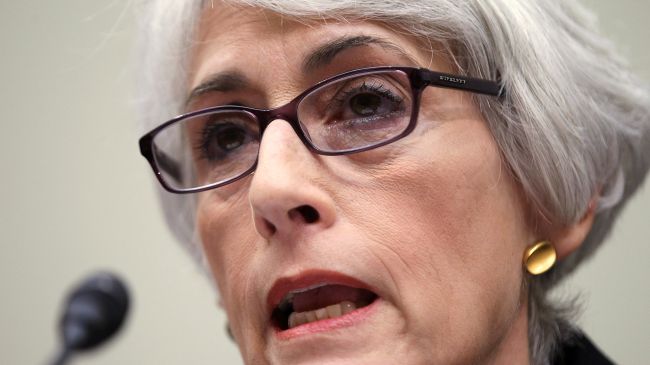
By Flynt Leverett and Hillary Mann Leverett | Going to Tehran | November 3, 2013
Last month, while testifying to the Senate Foreign Relations Committee, Wendy Sherman—Undersecretary of State for Political Affairs and the senior U.S. representative in the P5+1 nuclear talks with Iran—said, with reference to Iranians, “We know that deception is part of the DNA.” This statement goes beyond orientalist stereotyping; it is, in the most literal sense, racist. And it evidently was not a mere “slip of the tongue”: a former Obama administration senior official told us that Sherman has used such language before about Iranians.
–If a senior U.S. government official made public statements about “deception” or some other negative character trait being “part of the DNA” of Jews, people of African origin, or most other ethnic groups, that official would—rightly—be fired or forced to resign, and would probably not be allowed back into “polite society” until after multiple groveling apologies and a long period of penance.
–But a senior U.S. official can make such a statement about Iranians—or almost certainly about any other ethnic group a majority of whose members are Muslim—and that’s just fine.
Of course, it’s not fine. But that’s the America we live in.
Putting aside Sherman’s glaring display of anti-Iranian racism, there was another egregious manifestation of prejudice-cum-lie in her testimony to the Senate Foreign Relations Committee that we want to explore more fully. It came in a response to a question from Senator Marco Rubio (R-Florida) about whether states have a right to enrich under the Nuclear Non-Proliferation Treaty (NPT). Here is the relevant passage in Sherman’s reply:
“It has always been the U.S. position that Article IV of the Nuclear Non-Proliferation Treaty does not speak about the right of enrichment at all [and] doesn’t speak to enrichment, period. It simply says that you have the right to research and development.”
Sherman goes on to acknowledge that “many countries such as Japan and Germany have taken that [uranium enrichment] to be a right.” But, she says, “the United States does not take that position. We take the position that we look at each one of these [cases].” Or, as she put it at the beginning of her response to Sen. Rubio, “It has always been the U.S. position that Article IV of the Nuclear Non-Proliferation Treaty does not speak about the right of enrichment at all” (emphasis added).
Two points should be made here. First, the claim that the NPT’s Article IV does not affirm the right of non-nuclear-weapons states to pursue indigenous development of fuel-cycle capabilities, including uranium enrichment, under international safeguards is flat-out false.
Article IV makes a blanket statement that “nothing in this Treaty shall be interpreted as affecting the inalienable right of all the Parties to the Treaty to develop research, production and use of nuclear energy for peaceful purposes without discrimination.” And it’s not just “countries such as Japan and Germany”—both close U.S. allies—which affirm that this includes the right of non-weapons states to enrich uranium under safeguards. The BRICS (Brazil, Russia, India, China, and South Africa) countries and the Non-Aligned Movement (whose 120 countries represent a large majority of UN members) have all clearly affirmed the right of non-nuclear-weapons states, including the Islamic Republic of Iran, to pursue indigenous safeguarded enrichment.
In fact, just four countries in the world hold that there is no right to safeguarded enrichment under the NPT: the United States, Britain, France, and Israel (which isn’t even a NPT signatory). That’s it.
Moreover, the right to indigenous technological development—including nuclear fuel-cycle capabilities, should a state choose to pursue them—is a sovereign right. It is not conferred by the NPT; the NPT’s Article IV recognizes states’ “inalienable right” in this regard, while other provisions bind non-weapons states that join the Treaty to exercise this right under international safeguards.
There have been many first-rate analyses demonstrating that the right to safeguarded enrichment under the NPT is crystal clear—from the Treaty itself, from its negotiating history, and from subsequent practice, with at least a dozen non-weapons states building fuel-cycle infrastructures potentially capable of supporting weapons programs. Bill Beeman published a nice Op Ed in the Huffington Post on this question in response to Sherman’s Senate Foreign Relations Committee testimony, see here and, for a text including references, here. For truly definitive legal analyses, see the work of Daniel Joyner, for example here and here. The issue will also be dealt with in articles by Flynt Leverett and Dan Joyner in a forthcoming special issue of the Penn State Journal of Law and International Affairs, which should appear within the next few days.
From any objectively informed legal perspective, denying non-weapons states’ right of safeguarded enrichment amounts to nothing more than a shameless effort to rewrite the NPT unilaterally. And this brings us to our second point about Sherman’s Senate Foreign Relations Committee testimony.
Sherman claims that “It has always been the U.S. position that Article IV of the Nuclear Non-Proliferation Treaty does not speak about the right of enrichment at all [and] doesn’t speak to enrichment, period.” But, in fact, the United States originally held that the right to peaceful use recognized in the NPT’s Article IV includes the indigenous development of safeguarded fuel-cycle capabilities.
In 1968, as America and the Soviet Union, the NPT’s sponsors, prepared to open it for signature, the founding Director of the U.S. Arms Control and Disarmament Agency, William Foster, told the Senate Foreign Relations Committee—the same committee to which Sherman untruthfully testified last month—that the Treaty permitted non-weapons states to pursue the fuel cycle. We quote Foster on this point: “Neither uranium enrichment nor the stockpiling of fissionable material in connection with a peaceful program would violate Article II so long as these activities were safeguarded under Article III.” [Note: In Article II of the NPT, non-weapons states commit not to build or acquire nuclear weapons; in Article III, they agree to accept safeguards on the nuclear activities, “as set forth in an agreement to be negotiated and concluded with the International Atomic Energy Agency.”]
Thus, it is a bald-faced lie to say that the United States has “always” held that the NPT does not recognize a right to safeguarded enrichment. As a matter of policy, the United States held that that the NPT recognized such a right even before it was opened for signature; this continued to be the U.S. position for more than a quarter century thereafter.
It was only after the Cold War ended that the United States—along with Britain, France, and Israel—decided that the NPT should be, in effect, unilaterally rewritten (by them) to constrain the diffusion of fuel-cycle capabilities to non-Western states. And their main motive for trying to do so has been to maximize America’s freedom of unilateral military initiative and, in the Middle East, that of Israel.
This is the agenda for which Wendy Sherman tells falsehoods to a Congress that is all too happy to accept them.
Related articles
The role of the BBC in the Syrian conflict
“The following report contains disturbing images”
This is how the BBC website introduces a report by its BBC Panorama’s Syria correspondents Ian Pannell and Darren Conway on August the 30th, 2013. The story contained a video, ostensibly shot near Aleppo, Northern Syria, by an anonymous school headmaster, and documenting the aftermath of a napalm attack on his school, supposedly perpetrated by the Syrian armed forces on August 26th. According to the story, the “evil” forces of Bashar al-Assad, at a time when they had just about established their strategic advantage over the anti-government rebel forces and the foreign mercenaries they had been fighting for over two years, had found nothing better to do than attack a school, a target which presented no military interest whatsoever, with napalm – no less – just so the international media, and BBC Panorama in particular, could pick the story and broadcast it to Western audiences, in perfect timing to coincide with the British Parliament’s vote on the so-called “humanitarian intervention” in Syria, which was being pushed for by Prime Minister David Cameron, ostensibly to prevent precisely this kind of atrocities.
Were Assad’s forces really that stupid? Of course not.
It did not take long before several international commentators and observers pointed out the many implausibilities in the video and the story in general. Among them, Italian author Francesco Santoianni, showed how incongruent the whole story was, sparking the suspicion that the entire video might have been a fabrication. What follows is his analysis.
First of all, Napalm is a substance which generates temperatures between 800 and 1,200 degrees Celsius: in other words, no one has ever survived direct exposure. These physical characteristics mean that when Napalm was utilised in theatres of war, it was primarily used to defoliate areas covered with thick vegetation, and not urban areas, where white phosphorus is more often used, as the United States Armed Forces did in Falluja in 2005, and the Israeli Defence Forces did in Gaza in 2008. Nevertheless, the BBC expected its viewers to believe that Assad’s forces had employed the obsolete napalm on a school. Of course, a school with no teaching resources in sight, but somehow a swimming pool in the back. Oh, and a swing. Case closed: it MUST be a school. Although, we are told by our sources in Syria that the school year did not start until September 15: so what exactly were all those people doing in a locked-up school?
In the video, we were also shown a pair of winter shoes – not clear how they ended up there: it was after all August – and a woman’s shoe. Was all this footwear worn by the victims? How did it remain intact?
Almost every British newspaper which reported the story informed us that “The attack killed more than ten pupils and left many more seriously injured”: and yet, despite the warning against graphic images, we are not shown the bodies, or the grieving parents.
There is – to be sure – a child, seeing shaking in one scene. His skin is actually intact, and so is his hair: certainly not consistent with napalm, or anything like it. And what is the white stuff on his body? Surely, it cannot be the chemical fired from the fighter jets – that wouldn’t have left his hair intact – therefore we must assume that it’s some kind of first-aid ointment, of sorts? Whoever administered it could not even be bothered to remove the watch from the kid’s wrist. In fact, no one seems to be attending this child: the only person with some kind of interest is the cameraman.
Somewhat less convincing is a couple, seen in the video going through the well-rehearsed motions of cursing in Arabic. There is a problem though: the woman’s face is covered in that same white stuff: and the couple has just arrived to the so-called hospital, so it cannot be “some kind of first-aid ointment”. It must be the “napalm-like chemical”. We are expected to believe that a “napalm-like” chemical, fired from a fighter jet, somehow ended up sprayed on this woman’s face leaving her veil intact?
We also see what is supposed to be a makeshift hospital. On the floor, five adult males are shaking – three of them still have their clothes perfectly intact, of course – although one of them at some point stands up and walks off, having presumably decided that he’s had enough.
By the way, we keep seeing paramedics from the so-called charity Hand in Hand for Syria supposedly handling chemical burns victims without any gloves on – but wearing gas masks, for some reason. And even a dust mask: what’s that? The woman in question is of course Dr. Rola, the star of this video [segment introducing Dr. Rola]
Then, of course, we get the obligatory segment showing a distraught local, venting his powerless rage at the International Community, invariably denounced as inefficient and perennially locked in futile negotiations. The Public Relations rules dictate that such a character must be somehow connected with the tragedy (no details given), and that, when he addresses the camera, he must not speak in the local language – which would only sound like terrorist gibberish to most Western audiences: rather, he has to produce an impromptu speech in an impeccable English, so impeccable to the point of sounding scripted and well-rehearsed, or even read off a prompter. After all, these PR rules did work for Libya.
All these absurdities were exposed almost immediately after the release of the video on the BBC’s channels. So why talk about them again now?
Well, one reason is that the BBC itself, presumably after receiving dozens of complaints from viewers who didn’t appreciate their intelligence being insulted, decided to salvage what little they could from the story, and delete the biggest blooper of all. And this is where it gets creepy. Because what follows leads one to believe that this was not the case of the BBC naively buying into a story packaged and sold to them by the anti-Assad PR machine (it wouldn’t have been the first time), but rather that the BBC itself actively created a product that was intended to steer the public opinion towards a more interventionist position. For such a product, there can only be one definition: propaganda.
What happened was that Human Rights activist Craig Murray, among others, realised that, between the first and the second release of the video, something was different in the lines spoken by Dr. Rola. Listen to the original one, containing references to napalm.
The reference to napalm has disappeared in the redacted version.
Both audio clips have the same identical sound quality: of course, there is very little that cannot be accomplished with the kind of technology that’s available to the British Broadcasting Corporation, thanks in part to the fact that Dr. Rola was wearing her exaggerated dust mask, which conveniently did away with all the challenges involved in dubbing, lip-synch, etc. However, the redacted audio clip must have been added at a much later stage, for reasons we have just explored, which prompts us to ask: how can we even be sure that the original audio clip was not scripted and recorded in a studio? Also, Robert Stuart, writing on the Media Lenses Forum, points out that Dr Saleyha Ahsan, featured in the new version of the video, is a filmmaker with a military background: a former Captain in the Royal Army Medical Corps and a freelance current affairs journalist. Was she involved in packaging this product?
The background of Dr. Rola herself is also interesting. Of course, she’s no stranger to the BBC:here she can be seen appearing on a political programme, advocating for the bombing of Syria.
Also of interest is the fact that the Charity Hand in Hand for Syria, where Dr. Rola supposedly works as a volunteer medic, happens to sport a flag of the French colonial era on its logo – a flag now adopted by the Anti-Assad Coalition. This is an affiliation which the BBC did not see fit to disclose to its viewers.
For those who still believe in whatever is left of the BBC’s reputation for upholding the mediatic standards of fair and balanced reporting, here is some useful information about another so-called “charity”. The BBC Media Action (formerly the BBC World Service Trust), with its catchy slogan: “Transforming Lives through Media around the World”.
In an interesting report available on its website, BBC Media Action explains: “In 2008, BBC Media Action launched its three-year project ‘Socially Responsible Media Platforms in the Arab World’ with funding from the UK Foreign and Commonwealth Office. Syria News was the official Syrian partner, endorsed by the Ministry of Information on behalf of the BBC. The project aimed to set up an interactive online training platform, the Ara2 [opinions] Academy, for Syria’s journalistic and blogging communities, creating networks between the two. This reflected the changing status of bloggers in the regional media and responded to their aspiration to be seen as credible social commentators. The project also supported Syria News as an example of a sustainable independent media organisation, with managerial staff taking part in study tours in London and in business development training. BBC Media Action did not work with a local partner on blogger training, as this could have alienated and excluded parts of the blogging community. Instead, the BBC collaborated with an informal network of bloggers from across the country and recruited mentors for the distance learning system (the Ara2 Academy) who were trained at workshops in London and Damascus”.
One could not have wished for a clearer description of a Trojan horse, funded by one government in order to destabilize another. Just to go over the timeline again: the three-year BBC Action Syria Project started in 2008. The “Syrian uprising” began in February 2011.
Related article
Ex-DHS Director Michael Chertoff: The Public Spying On Famous People With Their Smartphones Is A Bigger Issue Than NSA Spying
By Mike Masnick | Techdirt | November 1, 2013
Former director of Homeland Security (and current profiteer off of any “security” scare) Michael Chertoff has penned quite an incredible op-ed for the Washington Post, in which he argues that the real threat to privacy today is not the NSA spying on everyone, but rather all you people out there in the public with your smartphones, taking photos and videos, and going to Twitter to post things you overheard more important people say. Seriously. It starts out by claiming this is a “less-debated threat”:
So it is striking that two recent news stories illustrate a less-debated threat to privacy that we as a society are inflicting on ourselves. Last week, a passenger on an Acela train decided to tweet in real time his summary of an overheard phone conversation by Gen. Michael Hayden, a former director of the National Security Agency (NSA) and the CIA (and my current business partner). The same day, a photo was published of Maryland Attorney General Douglas Gansler at a summer party where he was surrounded by underage youths who apparently were drinking.
But he then goes on to argue that this kind of thing is more troubling than the NSA revelations, which Chertoff suggests is no big deal:
Of course, the delicious irony is obvious: In one case, the former NSA chief becomes a victim of eavesdropping. In the other, a politician critical of teen drinking fails to intervene when he is surrounded by it. But both stories carry a more troubling implication. The ubiquitousness of recording devices — coupled with the ability everyone has to broadcast indiscriminately through Twitter, YouTube and other online platforms — means that virtually every act or utterance outside one’s own home (or, in Gansler’s case, inside a private home) is subject to being massively publicized. And because these outlets bypass any editorial review, there is no assurance that what is disseminated has context or news value.
It would appear that Chertoff seems to believe that there should be no expectation of privacy for the things you actually do in private — generating metadata about who you call, where you go, what websites you visit, etc. But, stuff that you actually do in public should never be “broadcast” because it might embarrass famous people.
And, yes, it’s the famous people being embarrassed that seems to most concern Chertoff:
If a well-known person has an argument with a spouse or child at a restaurant, should it be broadcast? If a business personality expresses a political opinion at a private party, should that opinion (or a distortion of it) be passed on to the rest of the world? If a politician buys a book or a magazine at an airport, should a passerby inform everyone?
See? Think of those poor well-known people, having people telling others about what they do. What a shame! Incredibly, he argues that it’s this exposing of the public actions of famous people that creates real chilling effects — and not the NSA’s spying, which he calls “exaggerated.”
Are we creating an informant society, in which every overheard conversation, cellphone photograph or other record of personal behavior is transmitted not to police but to the world at large? Do we want to chill behavior and speech with the fear that an unpopular comment or embarrassing slip will call forth vituperative criticism and perhaps even adversely affect careers or reputations? Do we need to constantly monitor what we say or do in restaurants, at sporting events, on public sidewalks or even private parties?
I don’t know what clueless PR flack thought this was a good strategy, but the clear connotation is hard to miss: Look, we the powerful people get to spy on everyone, but the second you turn the tables and spy on us and the things we do in public, what a horrible shame! Something must be done!
Britain’s GCHQ shepherding mass surveillance operations throughout Europe
RT | November 2, 2013
British intelligence agency GCHQ has helped counterpart entities in France, Germany, Spain, and Sweden develop methods of mass surveillance of internet and phone traffic in the last five years, a new report reveals.
Documents supplied by former National Security Agency contractor Edward Snowden to the Guardian show the UK Government Communications Headquarters’ (GCHQ) enormous influence throughout Europe. The documents detail how the agency developed and promoted spying processes, built relationships with telecommunication companies, and evaded national laws that constrain the surveillance powers of intelligence agencies.
In the wake of outrage expressed over the past week across Europe regarding newly exposed NSA surveillance of European countries – including intercepted communications and the monitoring of phones belonging to officials such as German Chancellor Angela Merkel – documents released Friday by the Guardian show major European countries’ culpability in mass surveillance efforts shepherded by the GCHQ.
The GCHQ is part of the ‘Five Eyes’ intelligence-sharing partnership between Australia, Britain, Canada, New Zealand, and the United States.
US intelligence officials said the monitoring that received so much indignation from powers like Germany and France was carried out by those countries’ own intelligence agencies and later shared with the US.
In June, the Guardian revealed the GCHQ’s Tempora program, in which the agency tapped into transatlantic fiber-optic cables to execute bulk surveillance. Germany’s justice minister, Sabine Leutheusser-Schnarrenberger, said at the time that the program sounded “like a Hollywood nightmare” and warned that free societies and actions hidden under “a veil of secrecy” are not compatible.
A nation-by-nation scorecard
In a 2008 survey of European partners, the GCHQ marveled at Germany’s capabilities to produce Tempora-like surveillance. The British service said the Federal Intelligence Service (BND) had “huge technological potential and good access to the heart of the internet – they are already seeing some bearers running at 40Gbps and 100Gbps.” The term ‘bearers’ refers to the fiber-optic cables. Gigabits per second (Gbps) measures the speed at which data runs through them.
The documents also show the British were advising German counterparts on how to change or evade laws that restricted advanced surveillance efforts. “We have been assisting the BND (along with SIS [Secret Intelligence Service] and Security Service) in making the case for reform or reinterpretation of the very restrictive interception legislation in Germany,” the survey says.
The report also lauds the GCHQ’s French partner, the General Directorate for External Security (DGSE), especially for its cozy relationship with an unnamed telecommunications company.
“DGSE are a highly motivated, technically competent partner, who have shown great willingness to engage on IP [internet protocol] issues, and to work with GCHQ on a ‘cooperate and share’ basis.”
The GCHQ expressed desire to benefit from the DGSE’s relationship with the company.
“We have made contact with the DGSE’s main industry partner, who has some innovative approaches to some internet challenges, raising the potential for GCHQ to make use of this company in the protocol development arena.”
The GCHQ’s work with its French counterpart led to improved capabilities to carry out bulk surveillance, despite growing commercial emphasis on encryption.
“Very friendly crypt meeting with DGSE in July,” British officials said. French intelligence officials were “clearly very keen to provide presentations on their work which included cipher detection in high-speed bearers. [GCHQ’s] challenge is to ensure that we have enough UK capability to support a longer term crypt relationship.”
New opportunities in future partnerships
GCHQ ties to Spain’s intelligence service, the National Intelligence Centre (CNI), were bolstered by Spain’s connections to an unnamed British telecom company, giving them “fresh opportunities and uncovering some surprising results.
“GCHQ has not yet engaged with CNI formally on IP exploitation, but the CNI have been making great strides through their relationship with a UK commercial partner. GCHQ and the commercial partner have been able to coordinate their approach. The commercial partner has provided the CNI some equipment whilst keeping us informed, enabling us to invite the CNI across for IP-focused discussions this autumn,” the survey said. It reported that the GCHQ “have found a very capable counterpart in CNI, particularly in the field of Covert Internet Ops.”
When Sweden passed a 2008 law allowing its National Defence Radio Establishment (FRA) to execute Tempora-like surveillance via fiber-optic cables, the GCHQ said in the report that “FRA have obtained a…probe to use as a test-bed and we expect them to make rapid progress in IP exploitation following the law change.” The GCHQ went on to express delight in future partnerships with FRA after the law passed.
The survey found strong ties between the GCHQ and Dutch external and internal intelligence services MIVD and AIVD, respectively.
“Both agencies are small, by UK standards, but are technically competent and highly motivated,” British officials said.
The GCHQ also helped AIVD in handling legal constraints to spying.
“The Dutch have some legislative issues that they need to work through before their legal environment would allow them to operate in the way that GCHQ does. We are providing legal advice on how we have tackled some of these issues to Dutch lawyers.”
Contrary to the other nations’ positive marks, the GCHQ country-by-country scorecard shows Italy’s intelligence agencies to be riddled with internal strife.
“GCHQ has had some CT [counter-terrorism] and internet-focused discussions with both the foreign intelligence agency (AISE) and the security service (AISI), but has found the Italian intelligence community to be fractured and unable/unwilling to cooperate with one another,” the report said.
A follow-up six months later noted the GCHQ still saw legal constraints in Italy as hampering AISI’s ability to cooperate.
This latest disclosure calls into question how involved the countries were in the overall surveillance of global citizens and world leaders led by the NSA and GCHQ.
Featured Video

Trump asks Iran not to retaliate after he strikes Pickaxe Mountain
or go to
Aletho News Archives – Video-Images
Book Review & Summary
Calling of an Angel: The True Story of Rene Caisse and an Indian Herbal Medicine Called Essiac (1988)
Dr. Gary L. Glum – 30 Q&As – Book Review & Summary
Lies are Unbekoming | October 17, 2026
On June 10, 1975, Dr. Chester Stock, a vice president at Memorial Sloan-Kettering Institute for Cancer Research, wrote to a Canadian nurse named Rene Caisse: “Enclosed are test data in two experiments indicating some regressions in sarcoma 180 of mice treated with Essiac.” The sentence sat in a letter from one of the world’s largest private cancer research centers, concerning an herbal tea an elderly English woman had learned from an Ojibwa medicine man at a northern Ontario mining camp in the 1890s. The tests were terminated the following year after Sloan-Kettering admitted, in sworn affidavit three years later, that they had prepared the injectable solution improperly from the dried material supplied — freezing and thawing the herb rather than boiling it as Rene had instructed. By the time Calling of an Angel was published in 1988, Rene Caisse had been dead for a decade, having treated thousands of cancer patients across fifty-six years in her Bracebridge, Ontario kitchen, never charging a fee, and refusing every offer — from Memorial Sloan-Kettering, the National Cancer Institute, Merck, Parke Davis, and private corporations dangling contracts up to $1 million — to release her formula before the medical establishment admitted her remedy had merit. … continue
Blog Roll
 Aletho News
- Trump asks Iran not to retaliate after he strikes Pickaxe Mountain – w/ Prof. Marandi
- Vice President J.D. Vance’s Deceptive ‘Antiwar’ Campaign Speech
- Iran: Palestinians’ rights must not be compromised in Gaza’s future; US, Israel to blame for Hormuz situation
- Ongoing tales of Syrian chemical weapons
- Moscow blasts UN for ignoring torture of Russian POWs
- Millions of Books Could Have Been Destroyed in Lebanon During Israeli Bombings
- Moscow warns of ‘hunt for Russians’
- Calling of an Angel: The True Story of Rene Caisse and an Indian Herbal Medicine Called Essiac (1988)
- South Korean Assistance to the U.S. in the War with Iran: Between Allied Duty and National Interests
- Pharma- and Gates-Funded GAVI Seeks to Assure Parents
- If Americans Knew
- Israeli soldiers debunk Israel’s talking points
- In West Bank, Israeli settlers are totally out of control – Daily Update
- NPR investigation finds evidence of widespread fraud at mall kiosks tied to Israeli skincare brand
- Tucker Carlson exposes Israeli Lies about the Oct 7th attack, Charlie Kirk, and the U.S.
- Israel has detained thousands of Palestinian children since Oct 7th – over half spent time in solitary, many uncharged
- Israeli Analysis: Is Netanyahu Planning an ‘October Surprise’ Attack Before Israel’s Election?
- Israeli settlers brutally attack Palestinians and Washington Post female photographer, 65
- Words Have Changed, Occupation Continues: The Reality of the Gaza Ceasefire
- Gaza’s child amputees are growing faster than their prosthetics allow
- Israel keeps Palestinians struggling just to survive–Daily Update
- No Tricks Zone
- New Study Suggests Large Regions Of The Pacific Ocean Have Been Cooling For The Last 80 Years
- Germany’s Green Energy Debacle: High Energy Costs Force Kahla Porzellan to Close After 182 Years!
- New Study: 50 Years Of The Most Aggressive ‘Net Zero’ Policies Can Only Affect The Global Climate By 0.03°C
- US September “Heat” Was No Record…Many Records Set Decades Ago
- Latest European Green Energy Debacle; Portugal’s Largest Flagship Solar Park Insolvent!
- Green Energy Debacle: German Expert Professor Fritz Vahrenholt Warns Of Severe Economic And Social Consequences
- Two More Paleo Reconstructions Affirm Meters-Higher Sea Levels Across Ireland, Brazil 7000-6000 Years Ago
- New Study: Earth And Venus Surface Warmth Largely Explained By Convection And Lapse Rate, Not CO2 Or Radiation
- 2025 Nature Paper Claiming Worsening Global Drought Gets RETRACTED …Heavily Flawed
- New Study: ‘Global Drought Shows No Detectable Recent Acceleration Under Climate Warming’

