CIA Murder Claims Are Credible, but Too Late
By RYAN ABBOTT | Courthouse News | July 23, 2013
WASHINGTON – A federal judge dismissed claims that the CIA dosed a bioweapons scientist with LSD in 1953, killed him and made it look like a suicide.
Eric and Nils Olson say their father, Frank Olson, died shortly after expressing his disillusionment with his work as a CIA bioweapons expert during the early years of the Cold War. Olson had allegedly been involved in the highly classified MKUltra program, which sought to develop chemical and biological materials for clandestine operations. The program included testing LSD as a truth serum and a mind-control agent on human subjects.
Numerous works of investigative journalism and requests under the Freedom of Information Act ultimately brought the MKUltra project to light, and U.S. District Judge James Boasberg acknowledged that “the public record supports many of the allegations that follow, farfetched as they may sound.”
“Although mention of LSD (lysergic acid diethylamide) conjures in the popular imagination the 1960s escapades of Ken Kesey and his Merry Pranksters … government study of its effects predates this by a decade,” Boasberg wrote.
The Olsons said their father “witnessed extreme interrogations in which the CIA committed murder using biological agents that Dr. Olson had developed.”
CIA officials allegedly believed that any misgivings Dr. Olson had about the work might drive him to commit security violations.
The Olsons said the CIA then spiked a bottle of Cointreau with LSD at an agency meeting, dosing their father without his knowledge and making him a “guinea pig for this ‘experiment’ into the effects of LSD on humans.”
The agency then shipped Olson to New York City, telling his family that he required psychiatric treatment and could be dangerous, his sons claimed.
A doctor allegedly met Olson at the New York hotel room he shared with another CIA colleague, Robert Lashbrook, and gave him bourbon and several sedatives.
“The men had two martinis each before bed that evening,” the sons said. “At approximately 2:30 in the morning on Saturday, November 28, Dr. Olson fell thirteen stories to his death from the window of room 1018A – the hotel room he was sharing with Dr. Lashbrook.”
They added: “The circumstances surrounding Dr. Olson’s wrongful death are substantially similar to a ‘secret assassination’ technique described in a manual that, upon information and belief, the CIA published the year of Dr. Olson’s death. The manual suggested ‘[f]or secret assassination … the contrived accident is the most effective technique’ because ‘[w]hen successfully executed, it causes little excitement and is only casually investigated.”
Judge Boasberg again refused to cast doubt on the allegation.
“Indeed, this would be the precise modus operandi the CIA is alleged to have employed here,” he wrote.
Though the Olsons settled with the government in 1976, accepting $187,500 each for waiving their claims, CIA Director William Colby piqued their interest 18 years later, shortly before his own death under suspicious circumstances.
Colby apparently sent Eric Olson a message in 1993 that indicated there was more to tell about his father’s death.
The family exhumed Olson’s body and discovered a bruise on his skull that a forensic scientist attributed to a blow to the head prior to the fall.
After prosecutors reclassified Olson’s cause of death from suicide to “unknown,” the family has pressured the CIA to reveal more and ultimately filed suit in November 2012.
Boasberg concluded Wednesday, however, that the 1976 settlement wipes out the negligent supervision claim against the agency. The rest of the claims then fail under the statute of limitation.
The sons say the CIA cover-up of their father’s death also caused their mother’s descent into alcoholism, and that their “replacement father figure” sexually molested them for years.
“Concluding that most of the allegations are both untimely and waived by a prior settlement agreement, and that any timely or preserved claims fall outside of the United States’ waiver of sovereign immunity, the court will grant the Government’s motion,” Boasberg ruled.
The ginned-up Syrian death toll
left i on the news | July 21, 2013
Today the U.N. claims that “5000 people a month” are dying in Syria. As I have before, I have to demonstrate why I find this claim utterly non-credible. 5000/month would be 167 every single day. Now we don’t know what the standard deviation might be, but we have to assume it would be reasonably large, which would mean that some days would be much lower, while on other days, we could easily expect 300 or more to be killed in a single day, if the 5000/month were to be believable.
So let’s look at a report from today, when major battles are being reported. Looking through the article, we find (claims of) six mediators shot in Homs, eight Nusra front militants killed by Kurds, nine people killed at a checkpoint, and “several” regime fighters killed. All in all fewer than 30 were reported killed on a day when major battles are being fought. Is it remotely credible that an average of 167 are being killed every single day? Just yesterday we read about 40 people being killed in a single bombing in Iraq; when is the last time we read about an event in Syria which killed even that many people? And when was the last time we read about a day when more than 200 people died in Syria in just a single day? For my part, the answer would be: never.
I don’t know what the statistics are, and I’ll also state clearly that they make no difference whatsoever to my stand, which is: Hands off Syria! No U.S. intervention in Syria. However, because these numbers are being used (and, in my opinion, “ginned up”) to justify ever-increasing intervention in Syria, it is important to understand them, and rebut them, if they are false. Which, in my opinion, is without question.
Related articles
- Kurdish leader says Syria Kurds not after forming own government (alethonews.wordpress.com)
- Syrian Kurds to declare autonomy from Damascus (timesofisrael.com)
Avaaz: Imperialist Pimps of Militarism, Protectors of the Oligarchy, Trusted Facilitators of War
Part one, section one of an investigative report by Cory Morningstar | Wrong Kind of Green | September 10, 2012
“I wish you a refreshing bath of conscience, I wish that you may be able to try out looking at others eye to eye, I wish that the spring of truth makes life more humane for you.” – Excerpt from the profound message to Avaaz by poet Gabriel Impaglione of Argentina
The Art of Social Engineering | The Art of Social Genocide
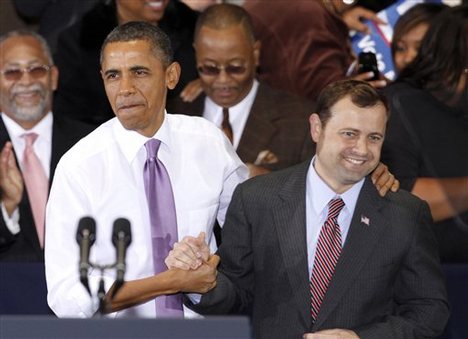
Image: U.S. President Barack Obama with Avaaz co-founder and former U.S. Representative Tom Perriello.
The Ivy League bourgeoisie who sit at the helm of the non-profit industrial complex will one day be known simply as charismatic architects of death. Funded by the ruling class oligarchy, the role they serve for their funders is not unlike that of corporate media. Yet, it appears that global society is paralyzed in a collective hypnosis – rejecting universal social interests, thus rejecting reason, to instead fall in line with the position of the powerful minority that has seized control, a minority that systematically favours corporate interests.
This investigative report examines the key founders of Avaaz, as well as other key sister organizations affiliated with Avaaz who, hand in hand with the Rockefellers, George Soros, Bill Gates and other powerful elites, are meticulously shaping global society by utilizing and building upon strategic psychological marketing, soft power, technology and social media – shaping public consensus, thus acceptance, for the illusory “green economy” and a novel sonata of 21st century colonialism. As we are now living in a world that is beyond dangerous, society must be aware of, be able to critically analyze, and ultimately reject the new onslaught of carefully orchestrated depoliticization, domestication of populace, propaganda and misinformation that is being perpetrated and perpetuated by the corporate elite and the current power structures that support their agenda. The non-profit industrial complex must be understood as a mainspring and the instrument of power, the very support and foundation of imperial domination.
Within part I of this investigative report:
- The Simulacrum
- Modus Operandi: The 21st Century NGO
- 2004: The Soft Power Imperative | 2011: Mission Accomplished
- Introduction: The Non-profit Industrial Complex: Imperialist Pimps of Militarism, Protectors of the Oligarchy, Trusted Facilitators of War
- Historical Amnesia
- Corporate “Green” Pedophilia
- The Commerce of Trust
- The Cat is Out of the Bag
- New York City Occupy Wall Street Embraces Otpor and Bombing for Peace
- The WikiLeaks Connection
- Unidentified “Freedom of Speech”
- 15M – Europe’s Occupy Movement
- The Commerce of Exploitation: Change.org
- Indoctrinated Subservience & Whitism
- Avaaz’s Founder and MoveOn.org Announce the U.S. “Spring”
Part II:
- Bread and Circuses
- Avaaz: The Emperor of the NGO Network
- Did Libya’s Citizens Demand Foreign Intervention?
- The Avaaz Gate-Keepers
- Avaaz Co-Founder and Executive Director: Ricken Patel
- Avaaz Co-founder: Tom Perriello
- Indoctrination of the Youth is Essential
- The Humanitarian Industrial Complex: The Ivory Towers Within the Dark Triad
- The Empire
- Avaaz Co-founder: Tom Pravda
- Avaaz Co-founder: David Madden
- Avaaz Co-founder: Eli Pariser
- Avaaz Co-founder: Jeremy Heimans
Part III:
- Behavioural Change
- May 2010: Avaaz’s Co-Founders Seek a Purpose-Driven Consumer Life | Behavioral Economics
- The Behavioral Economics of Hatred
- Purpose
- Res Publica
- Avaaz Founding Board Member: Ben Brandzel
- Purpose: James Slezak
- MoveOn.org
- GetUp
- The 21st Century Social Movements
- The Non-Profit Industrial Complex Finally Finds “Success”
- Avaaz Co-founder: Andrea Woodhouse
- Avaaz Co-founder: Paul Hilder
- The Avaaz “Core Campaign Team Members”
The Simulacrum
“As regards the ‘foundations’ created for unlimited general purposes and endowed with enormous resources, their unlimited possibilities are so grave a menace, not only as regards to their own activities and influence but also the numbing effect which they have on private citizens and public bodies, that if they could be clearly differentiated from other forms of voluntary altruistic effort, it would be desirable to recommend their abolition.” – Senator Frank Walsh, 1915
In his Sophist, Plato speaks of two kinds of image-making. The first is a faithful reproduction, a precise copy of the original. The second is distorted intentionally in order to make the copy appear correct to viewers. Plato gives the example of Greek statuary, which was crafted larger on top than on bottom so that viewers from the ground would see it correctly, whereas if they could view it in scale, they would realize it was malformed.
This latter representation serves as a visual art metaphor for the non-profit industrial complex. A semblance of entities, united in an ideology encompassing truth, justice and ethics – which is false. This is the simulacrum, distorted in such a way that it appears accurate unless viewed from the proper angle. This report aims to allow you, the reader, to view the matrix from such an angle. By denying the reliable input of our senses while accepting the non-profit industrial complex’s manipulative constructs of language and “reason,” global society has arrived at a grossly distorted copy of ethics and intrinsic worth – a warped simulacrum of thespian complexity, a vast work of superficial depth.
Modus Operandi: The 21st Century NGO
“What a cluster-fuck of disinformation this world has become. The sinister forces of greed and avarice are, through consolidation of wealth and power, more powerful than ever. Humankind has a huge uphill battle to wage.” — Comment at How Avaaz is Sponsoring Fake War Propaganda from Syria
The 21st century NGO is becoming, more and more, a key tool serving the imperialist quest of absolute global dominance and exploitation. Global society has been, and continues to be, manipulated to believe that NGOs are representative of “civil society” (a concept promoted by corporations in the first place). This misplaced trust has allowed the “humanitarian industrial complex” to ascend to the highest position: the missionaries of deity – the deity of the empire.
Modus operandi (plural modi operandi) is a Latin phrase, approximately translated and backronymed as “mode of operation.” The term is used to describe someone’s habits or manner of working, their method of operating or functioning. In English, it is frequently shortened to M.O.
The expression is often used in police work when discussing a crime and addressing the methods employed by the perpetrators. It is also used in criminal profiling, where it can help in finding clues to the offender’s psychology. It largely consists of examining the actions used by the individual(s) to execute the crime, prevent its detection and/or facilitate escape. [Source: Wikipedia]
2004: The Soft Power Imperative | 2011: Mission Accomplished
“Existing soft power initiatives and agencies, particularly those engaged in development and strategic communications, must be reinvigorated through increased funding, human resources and prioritization. Concurrently, the U.S. government must establish goals, objectives and metrics for soft power initiatives. Furthermore, the U.S. government can better maximize the effectiveness of soft power instruments and efforts through increased partnerships with NGOs. By providing humanitarian and development assistance in areas typically inaccessible to government agencies, NGOs are often able to access potential extremist areas before the government can establish or strengthen diplomatic, developmental or military presence, including intelligence.” — Joseph S. Nye, former US assistant secretary of defense, June 2004
The non-profit industrial complex represents a rich portfolio of soft power tools readily available to the ruling elite. Today we witness the near complete metamorphosis of the complex having successfully morphed into the absolute idyllic clearinghouse for the collective and coordinated imperialist agenda shared by a broad spectrum of government institutions, dominated by the financial industrial complex, corporate power and hegemonic rule – all under the guise of a global conscience reflective of “civil society” via self-appointed NGOs.
Joseph S. Nye (quoted above) is a former US assistant secretary of defense, former chairman of the US National Intelligence Council and professor at Harvard University. A world renowned scholar of international relations, Nye co-founded the liberal institutionalist approach to international relations, theorizing that states and other international powers possess more or less “soft power” (a term first coined in the 1980s). In a 2004 article titled The Rising Power of NGO’s, Nye peddled his soft-power theory as the quintessential element that must be employed in order to protect the American public from “terrorists.” Of course, Nye neglected to include the fact that the true “terrorists” are those who hold power within our very own EuroAmerican governments/establishments, waging violence upon sovereign, resource-rich states. It’s an easy sell as it enables one to conveniently deny their assent to (our own) state-sponsored terrorism and continued collective and voluntary servitude as well-behaved, rapturous consumers under the influence of American (non) culture.
If a state can present its power as legitimate in the eyes of others, it will encounter far less resistance to its foreign policies and agendas. Further, if the Western states’ (non) culture and (illusory) ideology are desirable, other states will more willingly acquiesce. This is an area where the NGOs excel. They do so by never referring to their own “leaders” as dictators or fascists, yet more than willing to apply these derogatory terms to leaders targeted for regime change. Simultaneously, while reporting on human rights abuses or environmental violations in states exploited by industrialized capitalism, the NGOs neglect to comment on their own states’ escalating assault on “democracy.” Most important, the non-profit industrial complex certainly does not address the fact that industrialized and globalized capitalism (imposed by hegemonic rule) is the crux of most all suffering and ongoing crisis in the very states they criticize and deem culpable. A continuous subtle undertone of support/belief in their own states’ democracy is achieved simply by never opening a dialogue on the legitimacy of power structures within their own (imperialist) states.
In essence, soft power is “the universalism of a country’s culture and its ability to establish a set of favourable rules and institutions that govern areas of international activity [that] are critical sources of power” or, more simply, the ability to attract and co-opt rather than coerce and rather than using force or money as a means of persuasion. This is where states such as Bolivia (and Libya until its recent annihilation) are very real threats to the American superpower. States such as Bolivia and Libya (past-tense) serve the people to advance themselves to a more enlightened, more democratic existence in a very real sense, while democracy and freedoms in the Americas mean little more than “freedom to shop” and buy as much sweatshop junk as one can(not) afford. If corporate-owned/controlled media and corporate-funded/controlled educational institutes actually educated the American public on intellectual enlightenment and progressive advances in other countries – Americans would truly wonder what the fuck was going on. Rather, we are kept in the dark; doped up by big pharma and stupefied by Big Brother, all while such states and leaders are continually vilified and demonized in the media (both corporate and foundation-funded “progressive”), all while NGOs remain silent on their own accelerating fascist governments. American “exceptionalism” is, undoubtedly, the biggest lie ever told sold.
Introducing the Non-Profit Industrial Complex: Imperialist Pimps of Militarism, Protectors of the Oligarchy, Trusted Facilitators of War

Packaging – Uncle Sam is the best in packaging and selling illusions.
“I am convinced that some NGOs, especially those funded by the U.S.AID, are the fifth column of espionage in Bolivia, not only in Bolivia, but also in all of Latin America.” — Evo Morales, February 2012
In 2001, it was George W. Bush who propelled an illegal invasion of Iraq by way of relentless pounding of repetitive messaging of discovered weapons of mass destruction in Iraq coupled with incessant images of the Twin Towers being destroyed. This psyop (or psychological operation, a new form or warfare) reverberated throughout a mainstream media that obediently fed the lies to the masses. The role of the media was absolutely essential. Yet, in spite of Bush calling for the invasion of Iraq, citizens of the globe, in united cohesion, held the largest mass protests and peace vigils the world had ever witnessed.
Today, however, the push to invade under the guise of humanitarianism is no longer a message from predominantly imperialist governments alone. Rather, there is a new game in town. Flash forward one decade to 2011 and the push for war no longer comes from the lone vacuity of despised war criminals such as George Bush or his charismatic alter-ego, Barack Obama. Rather, the message is now being spoon-fed to global society via the “trusted” NGOs, with Avaaz, Amnesty International and Human Rights Watch at the forefront, as documented prior to and during the attack on and subsequent occupation of Libya, and more recently, the destabilization of Syria. [One of many reports of such malfeasance include “HUMAN RIGHTS” WARRIORS FOR EMPIRE | Amnesty International and Human Rights Watch“, by Glen Ford, Black Agenda Report.]
“While much was made of the United Nations decision to establish a Human Rights Council in 2006, those who’ve witnessed the evolution of this institution are well aware that the UN was designed by (and functions to serve) the interests of modern states and their supplicants, not the Indigenous nations they rule. For those attached to charitable organizations like Human Rights Watch and other pashas of the piety industry, this is a bitter pill to swallow.” — Jay Taber, Obstacles to Peace, 13 July 2012
“The UN Human Rights Council stands as one of the significant obstacles to dynamic political development in the Fourth World. Many individuals and the peoples they represent in the Fourth World have come to believe that the UN Human Rights Council will relieve their pain from the violence of colonialism. It cannot, and it will not.” — Dr. Rudolph Ryser, Chair of the Center for World Indigenous Studies
A decade later, thanks to the non-profit industrial complex awash in an influx of money that flows like the river Nile, partnered with the corporate media complex, it is now “the people” – having been swayed by fabrications, omissions and lies – who lead the demand for invasion of these sovereign states. And, most ironic, it is not the so-called “right” at the vanguard; rather, it is the “progressive left.”
Historical Amnesia
“False reality” requires historical amnesia, lying by omission and the transfer of significance to the insignificant. In this way, political systems promising security and social justice have been replaced by piracy, “austerity” and “perpetual war”: an extremism dedicated to the overthrow of democracy. Applied to an individual, this would identify a psychopath. Why do we accept it? — John Pilger, award–winning journalist, in History is the Enemy as “Brilliant” Psy-ops Become the News, 21 June 2012
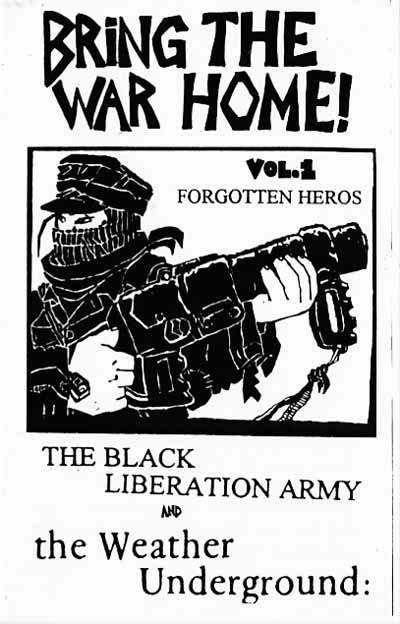

Huey P. Newton, Bobby Seale, Eldridge Cleaver, David Hilliard, Fred Hampton, and Erica Huggins – forgotten heroes indeed. The Black Panthers, who emerged on the scene in 1966, drew much inspiration from the ideologies of Malcolm X. Rejecting pacifism and reformism, under the leadership of Fred Hampton, the Panthers recognized the necessity of militant action and self-defense (“by any means necessary”) against racists and the state. The Panthers were effective in organizing the struggle towards a true revolutionary faction, with the state full-well recognizing the very real potential the Panthers held to gain mass support for their revolutionary movement. The state was terrified at this very real threat. It must be noted that during this same time period, white youth were demonstrating against the Vietnam war while 45% of Blacks fighting in Vietnam proclaimed they would be prepared to take up arms within their own state to secure justice for the American people. Considering that in 1960 almost half of America’s population was under 18 years of age, the ample surplus of youth made the threat of a widespread revolt against the status quo a very real possibility. By 1967, the rise in militancy and “Black Power” drew a very tactical response from very anxious foundations. Rockefeller and Ford created the National Urban Coalition (NUC) with the intent of transforming “Black Power” into “Black capitalism.” This was the vehicle designed/created to crush the building momentum that was confronting/challenging the prevailing system of economic control and oppression. By 1970, as Black capitalism took hold, foundations were funneling over $15 million into “moderate” Black organizations in order to effectively deflect the Black Power movement into non-threatening channels. With Black Power successfully transitioning itself into Black capitalism, American corporations utilized the opportunity to cast themselves in a liberal, progressive light by financing Black Power conferences.
The evidence that the Panthers’ revolutionary movement was a very real threat to the American state is indisputable: the FBI (under J. Edgar Hoover) declared the Panthers the number one threat to the internal security of the US. The state tried to eradicate the Panthers “by any means necessary,” gunning down scores of Panthers in the street.
Martin Luther King, Jr. was also closely affiliated with the Rockefellers via the 1957 founded Southern Christian Leadership Council (SCLC), which received money from the church and the Rockefellers. Although quite radical, elites considered SCLC moderate and “workable” because of its stance on nonviolence (which protects the state), alongside goals of integration rather than revolution. However, by the late 1960′s, Martin Luther King, Jr. had embraced militancy and radical positions espoused by both the Panthers and Malcolm X. As Martin Luther King, Jr.’s refusal to compromise increased, the foundation funding decreased. A respected man of such stature, speaking out, thus educating a vast public of the oppression caused by the capitalist system/racism, was indeed (and remains so today) a great threat to the powers that dominate. Thus, King was assassinated. Today, in united cohesion, the states work ardently with “progressive” (foundation-funded) media and the non-profit industrial complex, in ensuring that the King legacy is continually and relentlessly sanitized, watered down and co-opted to serve the elitist agenda. The pacifist doctrine, fondly funded by hegemonic rule, is continuously pumped through and circulated throughout the gentrified “movement” like fluoride in the city water – a neutral benevolence of slow poison we drink in voluntary servitude. [June 27, 2012: Black On The Old Plantation | Civil Rights Organizations Enslave Themselves to Corporate Funding]
“We do not fight racism with racism. We fight racism with solidarity. We do not fight exploitative capitalism with black capitalism. We fight capitalism with basic socialism. We fight imperialism with proletarian internationalism.” — Bobby Seale, a founder of the Black Panthers
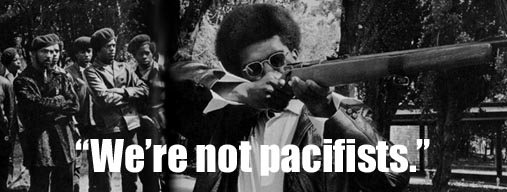
While Huey P. Newton advocated armed struggle, his ideology did not mean that the end product would be a world in which violence reigns. Rather, Newton believed that the oppressed must use guns as the means to a peaceful end of the oppression. He quoted Mao Tse-tung: “We are advocates of the abolition of war, we don’t not want war; but war can only be abolished through war, and in order to get rid of the gun it is necessary to take up the gun.” Within the Panther Party, the gun was not upheld as a means of violence, rather, it was a symbol for empowerment and self-determination. [Huey P. Newton :: Philosophy :: Armed Self-Defense]
In October of 1969, hundreds of youth clad in football helmets marched through an elite shopping district of Chicago. Utilizing lead pipes, they shattered shop windows and demolished parked cars. This was the first demonstration known as the “Days of Rage” – organized by a group who called themselves the Weather Underground. Outraged by the war on Vietnam and the rampant racism in America, the Weather Underground waged a strategic low-level war against the state that continued throughout much of the seventies. The Underground had the state on the run. Members of the Underground bombed state property including the Capitol building (never incurring a single casualty) and even broke Timothy Leary out of prison all while successfully evading one of the largest FBI manhunts ever conducted in US history.
Weather Underground Bombs the Capitol, Pentagon, and State Department (Running time 10:00)
Today, most all the past revolutionary leaders of the Weather Underground, now conformed, apologize for their “tactics,” having been isolated and framed as “violent” by the co-opted left and status quo. [http://youtu.be/S6kPGh0w_-c]
It was during this time of true revolutionary uprising that money and “opportunities” began to siphon into the movements. The art of co-optation had begun with the only weapon (palatable to the public) the oligarchy possessed – money. This money would serve to indulge, thus co-opt, inflated egos scouted from within the left. Co-opting was an absolute necessity for the state to protect the dominant power structures from true systemic change that would effectively transfer power to the people. Examples of revolutionary movements in history, as evidenced in The Weather Underground, the Panthers and others, demonstrate unequivocally that the left became more jingoistic for war only after an influx of money began pouring in from the state and plutocrats via their foundations, which were in many cases set up for this very purpose.
A case in point: Roy Innis of the Congress of Racial Equality/CORE (who advocated “Black control of Black communities” in order to allow for the manifestation of “Black capitalism”) was named a Ford Foundation fellow and became a board member of the Rockefeller/Ford-created NUC/National Urban Coalition. Ford granted CORE Cleveland $175,000 in 1967 to help elect Carl Stokes, who was very much pro Black-capitalism.
Lesser known are the events led by CIA operant Gloria Steinem. The “Black Feminist” movement was created, funded and manipulated by the CIA from the very beginning with Steinem leading the charge. Steinem planted faux “Black feminists” in revolutionary Black Power movements/grassroots organizations in order to instill division and hatred and, ultimately, to dismantle the growing movement. Steinem’s “success” would assist the state’s crushing of the Black Power movement itself. [Read: BLACK FEMINISM, THE CIA AND GLORIA STEINEM]
Throughout the world, there are organizations identifying themselves as the Black Panthers and other true revolutionary movements in existence. However, blinded by the shiny veneer of the big NGOs, few people are aware that such revolutionary movements even exist today. It is the job of the non-profit industrial complex, while waving the pacifist bible in one hand, to deliberately ensure that these groups are not only marginalized, but ignored altogether. Such movements, which have to potential to disrupt (or even dismantle) the power structures that enslave us, must remain invisible or framed in a negative light – if co-opting them is not possible, that is.
And that is something that the Western culture has perfected: co-optation. Forrest Palmer writes: “I am writing a blog post called ‘Malcolm X on a postage stamp.’ It is exactly what you see here [http://www.movements.org/pages/team]. If you know that something is happening at the grassroots and you can’t stop it, the West accepts it, places their handpicked leaders in the forefront who appease the masses into thinking what they are doing is still ‘revolutionary,’ negotiate with the ‘leaders’ ensuring they acquiesce to the state, compromise and either end up with things status quo or so watered down that the compromise doesn’t help the masses at all, but instead helps the state. The best example of a singular event of this: The March on Washington. It went from a black mass rebellion to a benign walk in the park masquerading as a movement. They had all their speeches proofread by the state, including King’s ‘great’ I Have a Dream speech. If the speeches weren’t what the state wanted, they either changed them (John Lewis) or weren’t allowed to speak (James Baldwin).”
“Malcolm predicted that if the civil rights bill wasn’t passed, there would be a march on Washington in 1964. Unlike the 1963 March on Washington, which was peaceful and integrated, the 1964 march Malcolm described would be an all-Black ‘non-violent army’ with one-way tickets.” [Wikipedia, speaking of Malcolm X and his speech The Ballot or the Bullet.]
And so it goes. Malcolm X was assassinated on 21 February 1965. And while our brothers and sisters in Africa, the Middle East and the Global South continue to be grossly exploited or altogether annihilated by the imperialist forces, the movement is ever-so acquiescent. Five hundred dollars a day for lodging at the Rio+20 Summit has never been so easy for those within the champagne circuit. And with a Democratic administration and a Black American president in the White House, the modern civil rights movement and dominant left organizations have never found it so easy to remain silent, with little to no criticism from civil society who, self-appointed, they falsely claim to represent.
“While in the US those puppets have traditionally taken on the form of talking heads on corporate and public television, they are increasingly represented in the form of NGO PR puppets employed in the moral theatrics industry…. As the credibility of politicians and pundits plummets, it is these PR puppets that are increasingly responsible for bolstering public support for militarism in general and militarized humanitarian intervention in particular.” — Jay Taber, Intercontinental Cry; Pious Poseurs, 24 June 2012
Although now seemingly normalized, one must consider it slightly ironic that it is in fact no longer the dominant “progressive left” beating the drums against war. [Exceptions include legitimate grassroots groups such as Peacelink in Italy.] Rather, as in the case of climate change, it is primarily the countries seeking to free themselves from the chains of imperialist enslavement that vocally oppose the escalating destabilization campaigns, inclusive of the most recent, in Syria. On 16 February 2012, the 12 sovereign states who voted against the resolution to condemn Syria at the United Nations included North Korea, China, Russia, Iran and Syria, along with states who primarily compose ALBA; Bolivia, Belarus, Cuba, Ecuador, Venezuela and Nicaragua. And it is not coincidence that most all the leaders of all these same states, who continue the struggle for autonomy, are all similarly vilified and demonized by the corporate-media complex, joined recently by the non-profit industrial complex. It is critical to note that the imperialist powers (inclusive of the UN) do not criticize or demonize or withdraw their support from such leaders on any ethical or moral ground. Denunciation of state leaders and emotive language is merely theatre. Rather, the imperialist states strategically set out to destroy any state leader that is unwilling to be controlled by US interests and foreign policy. A case in point is unwavering support of the Saudi royal family responsible for atrocious human rights violations to which the imperialist countries turn a blind eye.
Demonization is a key psyop, directly sponsored by the US Pentagon and intelligence apparatus to influence and sway public opinion and build consensus in favour of invasion. [Prof. Michel Chossudovsky] A recent example can be extracted from the failed 2011 destabilization campaign against the Morales government in Bolivia led by US-funded NGOs including the “Democracy Centre,” which declared: “But the abuses dealt out by the government against the people of the TIPNIS have knocked ‘Evo the icon’ off his pedestal in a way from which he will never fully recover, in Bolivia and globally.” [Further reading: U.S. Funded Democracy Centre Reveals Its Real Reason for Supporting the TIPNIS Protest in Bolivia: REDD $$$. ¿Por qué se defiende el tipnis?, http://youtu.be/RPiw3cDotHA]
A similar situation (developing nations, rather than the “environmental movement,” taking the lead) has taken place on the issue of climate change. ALBA nations, with Bolivia at the forefront, led while the non-profit industrial complex purposely and grossly undermined the strong positions necessary to mitigate the climate emergency. The climate justice movement was acquiescent and thus kowtowed to the “big greens”; “big greens” such as Avaaz, 350.org and Greenpeace who had partnered with HSBC, Lloyds Bank, nuclear giant EDF, Virgin Group, Shell (via TckTckTck partner, the Corporate Leaders Group on Climate Change) and other corporate giants constituting the “TckTckTck campaign” whereby “the objective was to make it become a movement that consumers, advertisers and the media would use and exploit” (Havas Press Release). There was no justice to be found, only a cohesive hypocrisy amongst the professional left that flourished like a cancer.
Next: Part one, section II.
Avaaz Investigative Report Series [Links]|Further Reading: Part I | Section I | Part I | Section II | Part I | Section III | Part II | Section I | Part II | Section II
Kurdish leader says Syria Kurds not after forming own government
Press TV – July 21, 2013
A senior Syrian Kurdish leader has rejected earlier reports that Kurds are planning to establish an independent Kurdish government in northern Syria.
China’s Xinhua news agency on Sunday quoted Salih Muslim, the leader of the Democratic Union Party (PYD), as saying, “There is no intention among the Kurds to form their own government, nor to secede from Syria.”
On Saturday, Qatar-based al-Jazeera news network quoted Muslim as saying that Syria’s Kurds were planning to create a “temporary autonomous government to administer their regions in the north.”
The Syrian government has granted the Kurds a certain level of autonomy since 2012 and they are now controlling security of the region.
In recent months, Kurdish fighters, who are opposed to foreign interference in Syria, have been battling foreign-backed militants in the north.
This comes as clashes continued between PYD-linked Kurdish militants and foreign-backed Takfiri militants around several villages in northeastern Syria near the border with Turkey on Saturday.
The Kurdish militants took control of a checkpoint and also seized light weapons, ammunition, a vehicle mounted with a heavy machinegun, and a mortar launcher.
On July 17, the Kurdish fighters took control of the town of Ras al-Ain in the border province of Hasakah, forcing out the al-Qaeda-linked militants.
Foreign-sponsored militancy has taken its toll on the lives of many people, including large numbers of Syrian soldiers and security personnel, since March 2011.
Western powers and their regional allies including the Israeli regime, Turkey, Saudi Arabia and Qatar are supporting anti-Syria militant groups, including al-Qaeda-linked terrorists.
Venezuela’s Maduro Responds to Obama’s Nominee for UN Envoy
By Ryan Mallett-Outtrim | Venezuelanalysis | July 19, 2013
Mérida – Venezuelan President Nicolas Maduro has described comments made by US President Barack Obama’s nominee for envoy to the United Nations as “despicable”, and demanded an apology.
Yesterday Maduro criticised the nominee Samantha Power’s testimony to the US Senate Committee on Foreign Relations. During the speech, Power called for a “contesting” of what she described as a “crackdown on civil society being carried out in countries like Cuba, Iran, Russia, and Venezuela.”
“Power says she’ll fight repression in Venezuela? What repression?” Maduro responded on Venezuelan television.
“There is repression in the United States, where they kill African-Americans with impunity, and where they hunt the youngster Edward Snowden just for telling the truth,” he stated. His comments come in the wake of a Florida jury acquitting George Zimmerman on 13 July for the killing of Trayvon Martin.
He also called for an “immediate correction by the US government”.
“And the U.S. government says they want to have good relations? What tremendous relations they want,” Maduro stated.
Following his victory in the 14 April presidential elections, Maduro called for closer relations with the US. In June, his foreign minister Elias Jaua met US Secretary of State John Kerry. Kerry described the meeting as the “beginning of a good, respectful relationship”.
After the talks, Jaua told Telesur that the Maduro administration is open to a more positive relationship “based on the premise of mutual respect, non-interference in internal affairs and the proper treatment of disagreements”.
“If this is respected then we can move forward in relations with US,” Jaua stated. Today, Jaua announced that the government had issued a letter of protest to the US embassy in Caracas. According to Jaua, the letter asked if there is still “willingness” in Washington to improve relations, “as expressed by the Secretary of State John Kerry”.
Since then, Maduro has criticised the US for its pursuit of whistleblower Edward Snowden, to whom he has offered asylum.
Yesterday, he stated that Power’s comments were being applauded by the “fascist right” in Venezuela. Power’s speech also received positive feedback from a number of committee members, including some Republicans.
Along with calling for more “efficiency and a greater focus on promoting freedom”, Power stated that the UN needs US “leadership” and fairness.
“There cannot be one standard for one country and another standard for all others,” she stated, before criticising the General Assembly and Human Rights Council for passing “one-sided resolutions” against Israel.
“Just as I have done the last four years as President Obama’s UN adviser at the White House, I will stand up for Israel and work tirelessly to defend it,” she said.
ProPublica and the Fear Campaign Against Iran

By Jim Lobe | LobeLog | July 18, 2013
Last Thursday, the highly respected, non-profit investigative news agency ProPublica featured a 2,400-word article, “The Terror Threat and Iran’s Inroads in Latin America”, by its award-winning senior reporter, Sebastian Rotella, who has long specialized in terrorism and national-security coverage. In support of its main thesis that Iran appears to be expanding its alleged criminal and terrorist infrastructure in Venezuela and other “leftist, populist, anti-U.S. governments throughout the region,” Rotella quotes the Director of National Intelligence (DNI), Lt. Gen. James Clapper (ret.), as telling a Senate hearing last year that Iran’s alliances with Venezuela and other “leftist, populist, anti-U.S. government” could pose
…an immediate threat by giving Iran – directly through the IRGC, the Quds Force [an external unit of the IRGC] or its proxies like Hezbollah – a platform in the region to carry out attacks against the United States, our interests, and allies.
Now, there is a serious problem with that quotation: Clapper never said any such thing. Indeed, the exact words attributed to the DNI were first spoken at a House Foreign Affairs Committee hearing entitled “Ahmadinejad’s Tour of Tyrants and Iran’s Agenda in the Western Hemisphere” (page 2) by none other than the Committee’s then-chair, Florida Republican Rep. Ileana Ros-Lehtinen, whose hostility toward Iran is exceeded only by her views on Cuba and Venezuela.* It is, after all, one thing to have the head of the U.S. intelligence community tell Congress that the threat of an attack against the United States from various “platforms” in Latin America is “immediate.” It’s quite another for a far-right Cuban-American congresswomen from Miami to offer that assessment, particularly given her past record of championing Luis Posada Carriles and the late Orlando Bosch, both of whom, according to declassified CIA and FBI documents, were almost certainly involved in the 1976 mid-air bombing of a Cuban civilian airliner, among other terrorist acts.
I personally have no doubt that the misattribution was unintentional and merely the product of sloppiness or negligence. But negligence matters, particularly when it is committed in pursuit of a thesis that Rotella has long propagated (more on that in upcoming posts) and that comes amid an ongoing and well-orchestrated campaign against Iran that could eventually result in war, as Israeli Prime Minister Binyamin Netanyahu reminded us yet again Sunday. Of course, such a glaring mistake also detracts from the credibility of the rest of the article, much of which is based on anonymous sources whose own credibility is very difficult to assess.
The Iranian threat and anonymous sourcing
Most of the article concerns a hearing with the rather suggestive title, “Threat to the Homeland: Iran’s Extending Influence in the Western Hemisphere”, which was held July 9 by the Subcommittee on Oversight and Management Efficiency of the Republican-led House Homeland Security Committee with the apparent purpose of rebutting a still-classified State Department report, which included a two-page unclassified appendix concluding that Iran’s influence in the region is actually on the wane. In addition to reporting on the hearing, however, Rotella provides some original reporting of his own in the lede paragraphs, setting an appropriately dark and menacing tone for the rest of his story:
Last year, Iranian President Mahmoud Ahmadinejad visited his ally President Hugo Chavez in Venezuela, where the firebrand leaders unleashed defiant rhetoric at the United States.
There was a quieter aspect to Ahmadinejad’s visit in January 2012, according to Western intelligence officials. A senior officer in the Iranian Revolutionary Guards Corps (IRGC) traveled secretly with the presidential delegation and met with Venezuelan military and security chiefs. His mission: to set up a joint intelligence program between Iranian and Venezuelan spy agencies, according to the Western officials.
At the secret meeting, Venezuelan spymasters agreed to provide systematic help to Iran with intelligence infrastructure such as arms, identification documents, bank accounts and pipelines for moving operatives and equipment between Iran and Latin America, according to Western intelligence officials. Although suffering from cancer, Chavez took interest in the secret talks as part of his energetic embrace of Iran, an intelligence official told ProPublica.
The senior IRGC officer’s meeting in Caracas has not been previously reported.
The aim is to enable the IRGC to be able to distance itself from the criminal activities it is conducting in the region, removing the Iranian fingerprint,” said the intelligence official, who requested anonymity because he is not authorized to speak publicly. “Since Chavez’s early days in power, Iran and Venezuela have grown consistently closer, with Venezuela serving as a gateway to South America for the Iranians.”
The bold face, added for emphasis, is designed to illustrate Rotella’s heavy reliance on anonymous “intelligence officials”, none of whose nationalities are specified. In the context of an investigative report, that failure begs a series of questions that bear on the credibility of the account.
For example, does he include Israelis in his definition of “Western officials” or “Western intelligence officials?” After all, it would be one thing to cite a Swedish intelligence official who may tend to be somewhat more objective in describing Iranian-Venezuelan intelligence cooperation; it’s quite another to quote an Israeli “official” responsible to a government that has been aggressively promoting a policy of confrontation with Iran for many years now. And if his sources agreed to talk to Rotella only on the condition of being identified as “Western officials” or “Western intelligence officials”, why did they do so? (Indeed, the only identified “Western intelligence official” quoted — or misquoted — by Rotella in the entire article is Clapper.) Identifying at least the nationality of the officials with whom Rotella spoke with would help readers assess their credibility, but he offers no help in that regard.
Moreover, given the details about the meeting provided by Rotella’s sources, why was the senior IRGC officer who set up the purported joint intelligence program with the Venezuelans not named? That omission sticks out like a sore thumb.
But the problems in Rotella’s article go beyond the misattribution of the Ros-Lehtinen quote or his heavy reliance on anonymous sources. Indeed, it took all of about 30 minutes of Googling (most of which was devoted to tracking down the alleged Clapper quote) to discover that the story also includes distortions of the record in relevant criminal proceedings and a major error of fact in reporting the testimony of at least one of the hearing’s four witnesses — all of whom, incidentally, share well-established records of hostility toward Iran.
But before going into the results of my Google foray, let’s hear what a former top U.S. intelligence analyst had to say about Rotella’s article. I asked Paul Pillar, a 28-year CIA veteran who served as the National Intelligence Officer for the Near East and South Asia from 2000 to 2005 (which means he was in charge of the analysis of those regions for the CIA and all other U.S. intelligence agencies), if he could read it. This was his emailed reply:
The article certainly seems to be an effort to go out of the way to raise suspicions about Iranian activities in the hemisphere, by dumping together material that is either old news or not really nefarious, and stringing it together with innuendo. Almost all of the specifics that get into anything like possible terrorist activities are old. The Iranian efforts to make diplomatic friends in Latin America by cozying up with the regimes in Venezuela and elsewhere that have an anti-U.S. streak is all well known, but none of that adds up to an increase in clandestine networks or a terrorist threat. The closest the article gets in that regard is with very vague references to Venezuela being used by “suspected Middle Eastern operatives” and the like, which of course demonstrates nothing as far as Iran specifically is concerned. Sourcing to an unnamed “intelligence officer” is pretty meaningless.
As we will try to show in subsequent posts by Marsha Cohen and Gareth Porter (who both contributed substantially to this post), Pillar’s assessment could apply to a number of Rotella’s articles, especially about the Middle East and alleged Iranian or Hezbollah terrorism, going back to his years at the Los Angeles Times. What virtually all of them have in common is the heavy reliance on anonymous intelligence sources; a mixture of limited original reporting combined with lots of recycled news; a proclivity for citing highly ideological, often staunchly hawkish neoconservative “experts” on Middle East issues from such think tanks as the Washington Institute for Near East Policy (WINEP), the Foundation for the Defense of Democracies (FDD), the American Enterprise Institute (AEI) and the American Foreign Policy Council (AFPC) without identifying them as such; a surprising deference (considering his status as an investigative reporter) toward “official” accounts or reports by friendly security agencies, some of which work very closely with their Israeli counterparts (see, for example, this 2009 story about an alleged plot against the Israeli embassy in Azerbaijan about which Gareth plans to write a post); and a general failure to offer critical analysis or alternative explanations about specific terrorist incidents or groups that are often readily available from academic or other more independent and disinterested regional or local specialists.
Iran in Latin America
In the meantime, it’s also important to set the context for Rotella’s latest article. It came amid an intense campaign over the past couple of years by Iran hawks, including individuals from the various neoconservative think tanks cited above, to highlight the purported terrorist threat posed by Iran and Hezbollah from their Latin American “platforms,” as Ros-Lehtinen put it. Those efforts culminated in legislation, the “Countering Iran in the Western Hemisphere Act of 2012,” approved overwhelmingly by Congress last December. Among other provisions, it required the State Department to report to Congress on Iran’s “growing hostile presence and activity in the Western Hemisphere,” along with a strategy for neutralizing it, within six months. That report, only a two-page annex of which was publicly released, was submitted at the end of last month.
To the disappointment of the bill’s chief sponsors, notably the Republican chairman of the subcommittee, Rep. Jeff Duncan, the report concluded that, despite an increase in Tehran’s “outreach to the region working to strengthen its political, economic, cultural and military ties, … Iranian influence in Latin America and the Caribbean is waning.” And while the rest of the report remains classified, its contents reportedly were consistent with those of the State Department’s 2013 Country Reports on Terrorism, also released last month, which found no evidence of Iranian or Hezbollah terrorist plotting or operations in the Americas, in contrast to what it described as a sharp increase of such activity in Europe, the Middle East and Asia during the past year.
Duncan, who, incidentally, spoke on a panel on Evangelical Christian support for Israel at AIPAC’s annual conference last year, and who in 2011 became the only member of Congress given a 100-percent rating on the Heritage Action for America legislative scorecard, expressed outrage at these conclusions, accusing the State Department of failing to “consider all the facts.” In particular, he charged that the State Department had not taken into account new evidence “documenting Iran’s [ongoing] terrorism activities and operations in the Western Hemisphere” compiled by an Argentine prosecutor, Alberto Nisman, in a 502-page report released (perhaps not entirely coincidentally) just one month before the State Department was due to submit its study.
The Nisman Report and the AMIA bombing
In 2006, Nisman, the chief prosecutor in the case of the 1994 bombing of the Argentine-Israeli Mutual Association (AMIA) building, released an even longer controversial report on that case in which he concluded that the bombing had been ordered by Iran’s top leadership and carried out by Hezbollah operatives under the direction of Iran’s cultural attaché at its Argentine embassy, Mohsen Rabbani. (Gareth wrote his own critique of the 2006 report for the The Nation in 2008, joining many Argentine journalists and researchers in questioning Nisman’s theory of the case. Last week he published a related story for IPS that noted the diminished credibility of Nisman’s primary source, a former Iranian intelligence operative named Abdolghassem Mesbahi. He plans a new series on the subject to begin later this month.) The State Department report, Duncan said at the hearing, “directly contradicts the findings from Mr. Nisman’s three-year investigation, which showed clear infiltration of the Iranian regime within countries in Latin America using embassies, mosques, and cultural centers.”
Indeed, according to Nisman’s new report, Iran, through Rabbani and other operatives, has established “clandestine intelligence stations and operative agents” throughout Latin America, including in Guyana, Brazil, Chile, Colombia, Paraguay, Suriname, Trinidad & Tobago and Uruguay and, most especially in the Tri-Border Area (TBA) of Argentina, Brazil, and Paraguay, a region about which Rotella wrote rather darkly when he was Buenos Aires bureau chief for the Los Angeles Times in the late 1990’s. (In fact, a 15-year-old article on the TBA as a “Jungle Hub for World’s Outlaws” and a refuge for terrorists was cited by WINEP’s Matthew Levitt in written testimony submitted at last week’s hearing. Long one of Rotella’s favorite sources, Levitt, the subject of a rather devastating — albeit pay-walled — profile by Ken Silverstein in Harper’s Magazine last year, has been a major figure in the U.S.- and Israeli-led campaign to persuade the European Union to list Hezbollah as a terrorist entity, a campaign that has been boosted by Rotella’s work, as reflected in this article published by ProPublica last April. The symbiotic relationship between the two men may be the subject of a subsequent LobeLog post.)
Nisman, whose new report has been promoted heavily by neoconservative media and institutions over the past six weeks (see, for example, here, here, here, and here), had been invited by the chairman of the Homeland Security Committee, Texas Rep. Michael McCaul, to testify at last week’s hearing. But, as noted by Rotella in the article, “his government abruptly barred him from traveling to Washington”, a development which, according to McCaul, constituted a “slap in the face of this committee and the U.S. Congress” and was an indication that Argentine President Cristina Fernandez de Kirchner had no intention to “pursue justice and truth on Iranian involvement in the AMIA bombing.”
(In his message to me, Pillar noted that there were other good reasons why Kirchner would not want to see Nisman “being used as a prop in Duncan’s hearing …[given] other equities …regarding relations with Washington,” including the ongoing lawsuit against Argentina by a group of hedge funds — led by Paul Singer, a billionaire and major funder of hard-line pro-Israel organizations — that have sponsored full-page ads in the Washington Post and other publications highlighting, among other things, Argentina’s allegedly cozy relationship with Iran.)
In his article, Rotella, who appears to have accepted without question the conclusions of Nisman’s 2006 report on the AMIA bombing, also offers an uncritical account of the prosecutor’s latest report, quoting affirmations by Duncan, McCaul, as well as the four witnesses who testified at the hearing, that the report’s main contentions were true — Iran and Hezbollah are indeed building up their terrorist infrastructure in the region. “The attacks in Buenos Aires in the 1990s revealed the existence of Iranian operational networks in the Americas,” Rotella’s writes. “The Argentine investigation connected the plots to hubs of criminal activity and Hezbollah operational and financing cells in lawless zones, such as the triple border of Argentina, Brazil and Paraguay and the border between Colombia and Venezuela.”
The Nisman Report and the JFK Bomb Plot
After noting U.S. Treasury designations in 2008 of two Venezuelans as terrorists “for allegedly raising funds for Hezbollah, discussing terrorist operations with Hezbollah operatives, and aiding travel of militants from Venezuela to training sessions in Iran”, Rotella provides the purported Clapper quote about Venezuela and its allies offering “a platform in the region to carry out attacks against the United States, our interests, and allies”, suggesting (falsely) that the DNI himself endorsed Nisman’s view that Iran was behind a plot to attack JFK airport six years ago:
The aborted 2007 plot to attack JFK (airport) was an attempt to use that platform, according to the Argentine special prosecutor. A Guyanese-American Muslim who had once worked as a cargo handler conceived an idea to blow up jet fuel tanks at the airport. He formed a homegrown cell that first sought aid from al Qaida, then coalesced around Abdul Kadir, a Guyanese politician and Shiite Muslim leader.
The trial in New York federal court revealed that Kadir was a longtime intelligence operative for Iran, reporting to the Iranian ambassador in Caracas and communicating also with Rabbani, the accused AMIA plotter.
‘Kadir agreed to participate in the conspiracy, committing himself to reach out to his contacts in Venezuela and the Islamic Republic of Iran,’ Nisman’s report says. ‘The entry of Kadir into the conspiracy brought the involvement and the support of the intelligence station established in Guyana by the Islamic regime.’
Police arrested Kadir as he prepared to fly to Iran to discuss the New York plot with Iranian officials. He was convicted and sentenced to life in prison.
But this account of the case is tendentious, to say the least, and here I am relying on Gareth’s research into the case which he covered in an IPS story last week. While Rotella claimed that the would-be terrorist “cell” had “coalesced around” Kadir, the original criminal complaint that was submitted to the U.S. district court in New York on which the arrests of the four men accused in the plot were based makes clear that Kadir was a secondary participant at the time the arrest was made. In addition, the complaint made no mention of any ties between Kadir and Iran.
Moreover, Rotella’s assertion that the trial revealed Kadir to have been “longtime intelligence operative for Iran” is unfounded, apparently based on nothing more than a set of personal letters Kadir had sent by ordinary mail to Rabbani and the Iranian ambassador to Venezuela and the fact that some contact information for Rabbani was found in Kadir’s address book.
But Kadir’s letters to Rabbani were clearly not the work of an Iranian intelligence operative. They consisted of publicly available information about the political, social and economic situation in Guyana, where Kadir was a member of parliament. Indeed, the fact that they were sent by regular mail — and the lack of any known replies by the addressees — suggests that Kadir’s relationship to Iranian intelligence was even more distant and less interactive than that of George Zimmerman’s to the Seminole County Sheriff’s office in Florida.
During the subsequent trial in 2010, the prosecution tried to play up the letters and even asked Kadir if he was a spy for Iran, which he denied strongly. No other evidence implicating Iran in the plot was introduced. Even the U.S. Attorney’s press release issued after Kadir’s sentencing (and discoverable within milliseconds on Google) offers no indication that Iran had any knowledge of the plot at the time of his arrest. Finally, if indeed the U.S. government had acquired any evidence that Rabbani or any other Iranian official had a role in the plot, as asserted by Nisman, it seems reasonable to ask why he wasn’t indicted along with Kadir and the three others? Yet, in spite of all these factors, Rotella appears to accept Nisman’s argument that the Iranian government had a role in the case and that Kadir was its “long-time intelligence operative” presumably in charge of its “intelligence station” in Guyana.
Rotella next cites the purported testimony (of unknown origin) of Fernando Tabares, the former director of Colombia’s intelligence agency who
…described a mission by an Iranian operative to Colombia via Venezuela in 2008 or 2009. Working with Iranian officials based at the embassy in Bogota, the operative, according to Nisman’s report, ‘was looking at targets in order to carry out possible attacks here in Colombia,’ Tabares testified.
Apart from the vagueness of this account about the unidentified Iranian operative and his mission — as well as the absence of any corroborating evidence — Rotella omitted the easily discoverable fact (via Google) that Tabares himself was sentenced in 2010 to eight years in prison for abuse of trust and illegal wire-tapping, a detail that may reflect on the former intelligence chief’s credibility.
Iranian migrants (refugees?) to Canada
A couple of paragraphs later, Rotella cites the testimony of Joseph Humire, “a security expert” and one of the four witnesses who testified at last week’s hearing. According to Rotella, Humire, executive director at the Center for a Secure Free Society
…cited a report last year in which the Canadian Border Services Agency described Iran as the top source of illegal migrants to Canada, most of them coming through Latin America. Between 2009 and 2011, the majority of those Iranian migrants passed through Caracas, where airport and airline personnel were implicated in providing them with fraudulent documents, according to the Canadian border agency.
But Rotella misreports Humire’s testimony. Humire did not say that Iran was the top source of illegal migrants to Canada; he said Iran was the top source country of improperly documented migrants who make refugee claims in Canada — a not insignificant difference, particularly because the number of Iranian asylum-seekers who come to Canada each year averages only about 300, according to the CSBA report, which noted that 86% won their asylum claims. In addition, the report, a heavily redacted copy of which was graciously provided to me by Humire, indicates that, between 2009 and 2012, more of these migrants flew into Canada from Mexico City and London than from Caracas.
Moreover, the picture painted by the redacted CSBA report is considerably less frightening than that offered by either Rotella or, for that matter, Humire’s testimony.
Many of these migrants use “facilitators” to enter Canada, according to the report. “…Information provided by the migrants on their smugglers suggest possible links to organized criminal elements both within and outside of Canada…Many people seeking refuge in Canada use fake documents and rely on middlemen to help them flee persecution in their homelands.“
“While Iranian irregular migrants mainly enter Canada to make refugee claims, it is possible that certain individuals may enter with more sinister motives”, the report cautioned, observing that 19 Iranian immigrants had been denied entry on security grounds since 2008.
So, instead of the flood of Iranian operatives pouring into Canada as suggested by Rotella, what we are talking about is a relatively small number of Iranians who are seeking asylum from a repressive regime. And, like hundreds of thousands of other refugees around the world, they rely on traffickers who provide them with forged or otherwise questionable documents. A few of these may be entering Canada for “more sinister motives”, but Rotella offers no concrete evidence that they have done so.
Yet Rotella follows his brief — if fundamentally flawed — summary of Humire’s remarks about Iranian asylum-seekers in Canada with his own riff, going “out of the way to raise suspicions about Iranian activities,” as Pillar notes, and returning once again to those anonymous “security officials” as his sources.
Humire’s allegations are consistent with interviews in recent years in which U.S., Latin America and Israeli security officials have told ProPublica about suspected Middle Eastern operatives and Latin American drug lords obtaining Venezuelan documents through corruption or ideological complicity.
“There seems to be an effort by the Venezuelan government to make sure that Iranians have a full set of credentials,” a U.S. law enforcement official said.
Last year’s secret talks between Iranian and Venezuelan spies intensified such cooperation, according to Western intelligence officials who described the meetings to ProPublica. The senior Iranian officer who traveled with the presidential entourage asked Venezuelan counterparts to ensure access to key officials in the airport police, customs and other agencies and “permits for transferring cargo through airports and swiftly arranging various bureaucratic matters,” the intelligence official said.
Venezuelan leaders have denied that their alliance with Iran has hostile intent. They have rejected concerns about flights that operated for years between Caracas and Tehran. The State Department and other U.S. agencies criticized Venezuela for failing to make public passenger and cargo manifests and other information about secretive flights to Iran, raising the fear of a pipeline for clandestine movement of people and goods.
The flights have been discontinued, U.S. officials say.
ProPublica’s high standards
I personally believe that ProPublica, since it launched its operations in 2008, has performed an invaluable public service in providing high-quality investigative journalism at a time when the genre risked (and still risks) becoming virtually extinct. As a result, readers of the agency have come to expect its articles not only to compile existing information that is already publicly available in ways that connect the dots, but also provide significant, previously unpublished material with important insights into the events of the day in ways that seriously challenge conventional wisdom as defined by mainstream media and, as ProPublica’s mission statement puts it, “those with power.” The question posed by Rotella’s latest article — as well as other work he has published on alleged Iranian and Hezbollah terrorism — is whether it meets the mission and high standards that ProPublica readers expect.
Given the misattribution of a quotation critical to the story’s thesis; the prolific use of anonymous “Western intelligence sources” and the like; the citation of sources with a clear ideological or political axe to grind; the omission of information that could bear on those sources’ credibility; the more or less uncritical acceptance of official reports that are known to be controversial but that generally reflect the interests of the axe-grinders; and the failure to confirm misinformation that can be quickly searched and verified, one can’t help but ask whether Rotella’s work meets ProPublica’s standards.
That question takes on additional and urgent importance given the subject — alleged terrorist activities by Iran and Hezbollah — Rotella specializes in. All of us remember the media’s deplorable failure to critically challenge the Bush administration’s allegations — and those of anonymous “Western intelligence sources”, etc. — about Saddam Hussein’s links to Al Qaeda and other terrorist groups, as well as his vast and fast-growing arsenal of weapons of mass destruction (WMD), including a supposedly advanced nuclear-weapons program. We now face, in many respects, a comparable situation with respect to Iran. Bearing that history in mind, any media organization — but especially one of ProPublica’s stature and mission — should be expected to make extraordinary efforts not only to verify its information, reduce its reliance on anonymous sources and avoid innuendo, but also to aggressively challenge “official” narratives or those that are quite obviously being promoted as part of a campaign by parties with a clear interest in confrontation — even war — with Iran. The stakes are considerable.
Gareth Porter and Marsha Cohen contributed substantially to this report.
*Today, shortly before this blog post was published and one day after I contacted the DNI press office to confirm that the quotation had been misattributed to DNI Clapper, ProPublica issued the following correction: “Due to an error in testimony by a congressional witness, this story initially misattributed a statement made by Rep. Ileana Ros-Lehtinen, R-Fla., to James Clapper, the Director of National Intelligence. The story has been revised to correct the attribution and incorporate Clapper’s actual statement to a Senate committee.” In my view, the wording of the correction, suggesting that the misattribution was the fault of a witness, underlines the importance of meticulous fact-checking when dealing with such a charged issue. As noted above, Clapper was the only identified Western intelligence official cited in the article, and his quotation — or non-quotation — is critical to the overall credibility of the underlying thesis: that Iran and Hezbollah are building a terrorist infrastructure in the Americas aimed at the U.S. While the quote in question is now properly attributed to Ros-Lehtinen (who was never mentioned in the original version), the implicit suggestion that she has serious expertise on the issue, in my opinion, makes the article’s underlying thesis even less credible.
Further weakening the thesis is the introduction in the article’s corrected version of the Arbabsiar case (the alleged 2011 plot to kill the Saudi ambassador in Washington) about which Rotella was initially skeptical but which he and/or his editors have now seen fit to include in the story. But citing the Arbabsiar case begs a serious question: If Iran, the Quds Force and Hezbollah have built up all these terrorist hubs and smuggling networks throughout Latin America and the Caribbean (and even into Canada), why would Quds Force commanders resort to recruiting a totally inexperienced, obviously unstable Iranian-American failed used-car salesman (now described by Rotella as “an Iranian-American operative”) to make contact with the Zetas to arrange the assassination? Conversely, if the Quds commanders felt they had to resort to Arbabsiar to establish contact with the Zetas to get the job done, then the existence of the terrorist infrastructure depicted in Rotella’s article looks even more doubtful than it did in the original story.
UPDATE: Apparently, the witness who misattributed the Ros-Lehtinen/Clapper quote was AFPC’s Ilan Berman (who most recently misattributed the quote in a usnews.com op-ed co-authored with Netanel Levitt on July 15). Berman, a leading figure in the continuing sanctions campaign against Iran, suggested shortly after the 2003 U.S. invasion of Iraq that Washington should pursue regime change in Iran.
Photo Credit: Prensa Miraflores
Related article
Featured Video
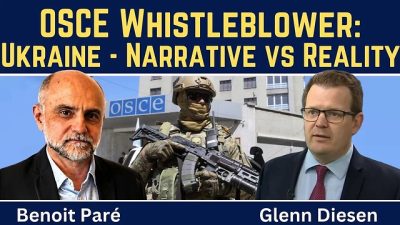
Benoit Paré: OSCE Whistleblower: The Ukraine War – Narratives vs. Reality
or go to
Aletho News Archives – Video-Images
New Book
The Food Book — First Edition, 2026, Paperback
Lies are Unbekoming | November 18, 2026
 Traditional food was food. Not organic food. Not slow food. Not wellness food. Food. Bone broth was food. Raw milk was food. Fermented vegetables were food. Butter was food. Eggs were food. Honey was food. Liver was food.
Weston Price travelled from 1931 to 1936 across fourteen populations — Swiss villagers in the Lötschental valley, Gaelic communities in the Outer Hebrides, Inuit in Alaska, Native Americans in northern Canada, Māori in New Zealand, Masai in Kenya, Melanesians in the South Pacific, Peruvian Indians in the Andes. He photographed their faces. He measured their dental arches. He weighed their vitamin and mineral intake. He published the results in 1939 in Nutrition and Physical Degeneration. The pattern was consistent across every population. The generation raised on ancestral foods had broad faces, straight teeth, strong bone structure, and virtually no chronic disease. The generation raised on refined flour, refined sugar, and canned goods did not.
What has not been treated at book length, until now, is the whole shelf — the twenty works that, taken together, describe what the traditional kitchen was, what industrial food replaced it with, and what the body does when the replacement runs for a century.
The Food Book reads twenty of those works as a single library: Weston Price and Sally Fallon on the tradition that was lost; Francis Pottenger on what cooking does to a species over four generations; Sandor Katz on fermentation as an ecology; William Dufty on the two-and-a-half-century history of refined sugar; William Campbell Douglass on raw milk; James DiNicolantonio on the inversion of the salt argument; Max Gerson on cancer; Ulric Williams on medicine as a cartel; William Engdahl on seed sovereignty; Stephen Harrod Buhner on what plants do, chemically, that pharmaceuticals disrupt. … continue
Blog Roll
 Aletho News
- UK Military Admits Carrying Out Cyberattacks Against Russia
- The Food Book — First Edition, 2026, Paperback
- Benoit Paré: OSCE Whistleblower: The Ukraine War — Narratives vs. Reality
- UK forced to admit ordering backdoor access to Apple users’ data
- It’s not about China or national security. It’s about which foreign entity is allowed to spy on Americans
- Banning Palestine activists from the West will not save Israel’s image
- Iran rejects unlimited IAEA inspections amid continued military threats
- A Bridge Too Far
- David Barnea in the Bundestag – Mossad as a model for Germany’s Intelligence Services?
- Rome blasts Kiev after Italian lawmakers added to ‘kill list’
- If Americans Knew
- An error has occurred; the feed is probably down. Try again later.
- No Tricks Zone
- Argentina’s Perito Moreno Glacier Joins Antarctica and Arctic In Defying Doomsday Melt Claims
- New Study: Barents Sea Temperatures Were Warmer And Sea Ice Less Extensive In The 1700s Than Today
- German Authorities Start Initiative To Evaluate Public Register For Climate “Disinformation” Spreaders!
- Zonal Asymmetry of Temperature Change in the Antarctic Circumpolar Current
- New Study: The Net Fossil Fuel Contribution To Rising Atmospheric CO2 Has Been Zero For 500 Years
- Germany’s Green Energy Transition Becoming Increasingly Expensive…Another 6 Trillion Euros!
- Sudden Stratospheric Warming, Powerful El Niño Combination May Lead To Extreme Europe Cold, Energy Crisis!
- Two New Studies Find Thwaites Glacier Melt Cannot Be Driven By Human Activity Or A Warming Ocean
- E-Cars Reduce CO2 Emissions By Only 41% Compared To Internal Combustion Engine Vehicles
- Predictions Made By Renowned Climate Professor Over Past Decades Have Been Proven To Be Poor

