EU preparing $55 billion bailout for Kiev – Bloomberg
RT | June 20, 2023
The European Commission wants member states to cough up €50 billion ($55 billion) to bankroll the Ukrainian government, so it can pay wages and pensions, and commence reconstruction projects, sources cited by Bloomberg have said.
The terms of the proposed bailout are subject to change pending an official announcement on Tuesday, the outlet reported on Tuesday. The package will be financed by direct contributions from member states, as opposed to borrowing from the market.
The aid will be provided in the form of grants, concessional loans and guarantees rather than some “burdensome reconstruction instrument,” the outlet said, adding that the money would be provided between 2024 and 2027.
The Ukrainian budget has been receiving cash injections from Western sponsors to keep it running. Washington and its allies have pledged to help Kiev “for as long as it takes” to defeat Russia, including through the provision of non-military support.
The US alone provided $26.4 billion in budgetary aid between January 2022 and February 2023, according to the Council on Foreign Relations think tank. The aid package announced by the US Agency for International Development (USAID) on February 24 was worth $9.9 billion.
Critics of the policy have claimed Ukraine has a lengthy record of grafting and argued that the money could have been spent by Western nations at home to solve their own immediate problems. Bloomberg sources suggested that the EU funding would be made conditional on Kiev delivering reforms “to improve the rule of law and address corruption.”
According to Reuters, the European Commission is set to publish a report this week about Kiev’s effort, which will state that it has met two of the seven conditions to start membership negotiations. The milestones reportedly relate to judicial reform and media regulation.
Britain will maintain sanctions to ensure war-affected Russians cannot receive aid
By Ahmed Adel | June 20, 2023
The UK has passed legislation that will allow sanctions against Russia to remain in effect until Moscow pays compensation to Ukraine, the British Foreign Office said on June 19. The British Foreign Office also stated that the European country’s law allows sanctioned Russians to transfer their frozen assets for Ukrainian reconstruction.
“The Government is taking powers to maintain Russian sanctions until compensation is paid to Ukraine and is introducing a route for frozen Russian assets to be donated for Ukrainian reconstruction, under new legislation announced by Foreign Secretary James Cleverly today,” the British Foreign Office announced.
In addition, the ministry pointed out that the UK will create a fund that will allow sanctioned Russians to transfer their frozen assets to the reconstruction of Ukraine.
“This will be a voluntary process whereby sanctioned individuals may apply for funds to be released for the express purpose of supporting Ukraine’s recovery and reconstruction. There will be no coercion of individuals to encourage them to transfer funds, nor any offer of sanctions relief in return for making a donation,” the Office audaciously added, although it does highlight the British entitlement of wanting Russians to release their funds for a purpose but without guarantees.
On June 18, the Daily Mail reported that the UK government and Russian businessman Roman Abramovich, who owned the English Premier League football club Chelsea until 2022 when he was forced to sell it due to the British sanctions campaign against Russia, could not agree on the distribution of funds received from the sale of the club as the billionaire wanted the funds to be sent not only to Ukrainians but also to Russians affected by the conflict. The UK government and the European Commission opposed Abramovich’s desire to send funds to Russians.
At the time of the forced sale, Abramovich’s press office said he “wanted the proceeds to be transferred to a charitable foundation for the needs of the victims on both sides of the conflict between Russia and Ukraine.”
This latest provocation by Britain comes as the country’s Ministry of Defence released a video on June 14 revealing the advanced long-range drones that will be sent to Ukraine in the coming weeks. The video shows several types of drones, including one firing a torpedo over water and another being catapulted from the deck of a vessel.
“We announced a £92m air defence package, to be provided through the second procurement round,” the video’s caption said.
Despite the publication of the video, the British authorities did not provide details about the equipment. However, it is speculated that autonomous aircraft with a range of more than 200 kilometres will be sent to Kiev. It is worth noting that the UK recently supplied Storm Shadow cruise missiles to Ukraine with a range of over 250 kilometres.
Western countries imposed comprehensive sanctions on Russia after it started a special military operation in Ukraine in February 2022, and provided constant support packages to Kiev in the conflict. However, it has been their economies, especially the British, that have suffered from these sanctions.
British Prime Minister Rishi Sunak was warned that the UK could be in recession next year as high inflation pushes interest rates to more than 5% before the next general election. With rising borrowing costs on mortgages and loans for millions of households, economists believe the Bank of England could be forced to drive Britain’s economy into a recession to deal with inflation.
Former IMF deputy director Mohamed El-Erian said the Bank of England would be forced to raise interest rates for longer, leading to a recession or near zero growth.
“The risk we now have, you put all that together – sticky inflation, the Bank having to go higher, borrowing costs going up – all that translates into a higher threat of stagflation. I use stag as shorthand for insufficient economic growth. It can be recession, it can be zero growth. This is not about abstract numbers; it’s about something that hits the poor particularly hard,” El-Erian said.
Yet, despite these significant economic problems, the UK establishment continues its centuries-long policy of opposing and challenging Russia, this time in the context of Ukraine. Already having imposed self-detrimental sanctions and funded Ukraine with billions of pounds, the UK will now roll out a major expansion to its cyber defence programme in Ukraine. It will be boosted by an injection of up to £25 million and a two-year expansion.
As demonstrated, London is concocting all sorts of methods, with endless money streams, to challenge Russia despite British citizens facing a once-in-a-lifetime economic crisis. Not only does this prolong the war and suffering, but it also shows Britain’s obsession with challenging Russia, so much so that it cannot even tolerate Russians affected by the war being supported with the frozen funds of Russian billionaires.
Ahmed Adel is a Cairo-based geopolitics and political economy researcher.
Ukraine drone attack on Russian oil pipeline to EU failed, official says
RT | June 17, 2023
Ukrainian drones have attempted to strike the Druzhba pipeline that delivers Russian oil to several European countries, Bryansk Region governor Alexander Bogomaz has said. He added that the attack was thwarted by Russian air defenses.
On his Telegram channel on Saturday, Bogomaz wrote: “Last night, air defense units of the Russian armed forces… repelled the Ukrainian military’s attack on the oil-pumping station ‘Druzhba’.” According to the official, a total of three UAVs were brought down.
Last month, the Washington Post claimed, citing leaked Pentagon documents, that back in February Ukrainian President Vladimir Zelensky had suggested to Deputy Prime Minister Yulia Sviridenko that Kiev “should just blow up the [Druzhba] pipeline,” which pumps oil to Hungary and other states.
According to the report, Zelensky described the destruction of “Hungarian [Prime Minister] Viktor Orban’s industry” as one of his goals.
While Zelensky dismissed the allegations as “fantasies,” Hungarian Foreign Minister Peter Szijjarto several days later accused Kiev of “virtually attacking Hungary’s sovereignty” by supposedly plotting to undermine the security of Budapest’s energy supply.
Around that same time, a loading station of the Druzhba oil pipeline in Bryansk Region was shelled by Ukrainian forces, with three fuel storage tanks, all of them empty, damaged as a result.
In March, Transneft, the pipeline operator, reported that several drones had dropped explosives in the vicinity of an oil-pumping station. Multiple incidents of shelling had taken place before that as well.
The Druzhba (Friendship) pipeline is one of the largest oil-transport networks in the world, spanning some 4,000 kilometers (2,485 miles) and transporting oil from Russia to Ukraine, Belarus, Poland, Hungary, Slovakia, the Czech Republic, Austria and Germany.
Bryansk Region, which is adjacent to Ukraine, has repeatedly been targeted by cross-border strikes.
In March, a Ukraine-based neo-Nazi unit conducted a sortie into the region.
Anglo-Saxons control collective West – Moscow
The US and the UK strong-arm their own followers, Russian FM Lavrov has said.
RT | June 16, 2023
London and Washington run the show in the “rules-based world order,” trying to dictate policy to their own allies as well as countries outside the West, Russian Foreign Minister Sergey Lavrov told RT on Friday.
Russia fully understands that building relations with other countries needs to be based on mutual benefits and equal partnerships, Lavrov said in an interview with RT at the St. Petersburg International Economic Forum (SPIEF).
“This is not what we see in the West these days. The Anglo-Saxons are basically running the show, controlling the rest of the collective West. They are using the current situation, which they created through Ukraine – this war against Russia – to remove competition,” Lavrov elaborated.
“They see us as a competitor, they see China as a competitor. Their doctrinal documents clearly state that. But they are also removing their competition in continental Europe. It’s obvious. The economic and social processes in Germany are grim. Other countries are not much better off,” the Russian foreign minister added.
The only Western state benefiting from the current situation is the US, Lavrov said, “and the UK is always somewhere around, helping America reach its selfish goals.”
According to Lavrov, the “Anglo-Saxons and their allies” are currently trying to pressure countries around the world to side with them against Russia, including the Arab world, using methods he can only describe as “rude.”
“You see, when they talk about these ‘rules’ on which the international order must be based, what they really mean is their diktat,” Lavrov told RT. “Colonial instincts – live at the expense of others. Nothing else.”
Lavrov took particular exception to Western proclamations that their support for Kiev is “defending democracy” and that Ukraine is fighting for “Western values” in the conflict with Russia.
“First of all, if they really see it that way, I cannot but be convinced that they are holding on to Nazi views. Because saying that Western values are being protected in Ukraine is the same as saying that Nazism is your mode of existence,” the diplomat told RT. As for democracy, he added, “they only speak about democracy when they teach others how to live,” but not when it comes to respecting the sovereign equality of other states, per the UN Charter.
US imposes fresh sanctions on North Korea despite Treasury warning
Press TV – June 15, 2023
The United States has imposed fresh punitive measures on North Korea, targeting the country’s missile program despite a recent warning from the Treasury that sanctions are pushing many countries to seek alternatives to the dollar for settlements.
The US Treasury Department issued the punitive action on Thursday after South Korea earlier said its neighbor fired two short-range missiles, Reuters reported.
The South Korean military said North Korea fired two short-range missiles off its east coast on Thursday after Pyongyang warned of an “inevitable” response to the military drills staged by several thousand South Korean and US troops on the Korean Peninsula.
The Treasury in a statement said it imposed sanctions on two North Korean nationals, accusing them of being involved in the procurement of equipment and materials for the country’s ballistic missile program.
“The United States is committed to targeting the regime’s illicit procurement networks that feed its weapons programs,” said the Treasury’s Under Secretary for Terrorism and Financial Intelligence, Brian Nelson.
The sanctions also targeted a Beijing-based representative for the Second Academy of Natural Sciences, which the US claimed is responsible for research and development for North Korea’s advanced weapons systems. His wife was hit with sanctions as well.
The Treasury in the statement said North Korea continues to use a network of representatives abroad to import components necessary for its nuclear and ballistic missile programs.
Earlier in the day, South Korean and US troops held joint live-fire exercises in the region. A total of 2,500 troops took part in the maneuvers in Pocheon, northeast of Seoul.
President Yoon Suk Yeol of South Korea personally watched the live-fire exercises. He said the drills were the largest of their kind ever held with the United States.
North Korea released a statement on Thursday, with a defense ministry spokesperson saying the exercises were “targeting the DPRK (North Korea) by massively mobilizing various types of offensive weapons and equipment.”
“Our response to this is inevitable,” said the statement, carried by the official Korean Central News Agency.
It said the drills were “escalating the military tension in the region.”
North Korea has been under harsh sanctions by the United States and the United Nations Security Council for years over its nuclear and ballistic-missile programs.
US Treasury Secretary Janet Yellen admitted during her annual appearance on Tuesday before the House Financial Services Committee that US sanctions were pushing many countries to seek alternatives to the dollar for settlements.
Asked about the risk of de-dollarization, Yellen acknowledged that the use of the dollar in the global economy is diminishing.
“It’s not surprising that countries that are fearing they can be affected by our sanctions are looking for alternatives to the dollar. It’s something that we simply have to expect,” she stated.
Green Party Headquarters’ Heat Pump Debacle: 5 Million Euros Cost, Still No Heat!
By P Gosselin | No Tricks Zone | June 13, 2023
The energy follies of Germany’s current Socialist/Green government continue to compound unabated. It turns out the coalition partner Greens cannot even get renewable energy to work at their own party headquarters in Berlin.
How can the Greens demand everyone else convert to a heat pump when they can’t even get their own to work?
While the Greens of the Socialist-Green coalition government are pushing to ban fossil fuel furnaces from every home and building in Germany and forcing them to install heat pumps in their place, it has emerged that the Greens themselves cannot even manage to get their own heat pump up and running at their Berlin party headquarters! Oh, the irony.
According to media outlets, the Green Party headquarter in Berlin-Mitte has been a big messy heat pump construction jobsite “for years” – since 2019. Costs have run into the millions!
And still no heat after 5 million euros in costs
“Here at the Green Party headquarters in Berlin, construction has been going on for years. The heat pump is still not running,” reports RTL.
“The Greens are experiencing first-hand how complicated it is to heat an old building with a heat pump,” RTL continues. “The renovation costs a total of five million euros. The heat pump is there, but does not heat.”
Refuse to learn from their own debacle
Der Spiegel reports on the heat pump debacle and how “heating the old building in a renewable way is not that easy”.
Apparently the work is far more complicated than the Greens previously thought as the project entails major renovation works, excavation, permits, expert personnel and special equipment. And now after having endured the construction, installation and cost woes for years, it remains a mystery today why the Green Party would want the rest of the country to experience the same nightmare.
Dragging on for years, costing millions
“In 2019, the Greens, chaired by Annalena Baerbock and Robert Habeck, decided to rebuild their party headquarters in Berlin and modernize it in terms of energy, reports RND news. “The gas boiler in the party’s old building was to make way for a modern heat pump, among other things. However, the measures were not carried out quickly, and have been dragging on for three and a half years, as the news magazine Spiegel reported. So this is not exactly a showcase example for quick and unbureaucratic energy-efficient renovation. Doesn’t the transition to renewable energies and heating demanded by the Greens even work within the party headquarters’ own four walls?”
The Greens have become the country’s number one laughing stock. Little wonder they’ve lost almost half of their supporters over the recent months.
Washington Trying to Blackmail Armenians in Karabakh Into US-Brokered Talks: Here’s Why
By Ilya Tsukanov – Sputnik – 14.06.2023
The dispute between Armenians and Azerbaijanis over the landlocked mountainous region of Nagorno-Karabakh has been a source of severe tensions between the Caucasus nations, with several conflicts fought over the territory over the past 35 years. Moscow has worked tirelessly to mediate the crisis.
Washington is reportedly making a concerted, behind-the-scenes push to interfere directly in negotiations between Azerbaijan and the ethnic Armenian-led unrecognized Republic of Nagorno-Karabakh, including by blackmailing the Armenian side with the threat of a fresh round of violence in the region.
Informed sources cited by Russian media indicated that US officials – which until recently had limited their “mediation” efforts to talks between Azerbaijan and Armenia proper, are now trying to force their way into the sensitive negotiations between Baku and Stepanakert (Nagorno-Karabakh’s self-proclaimed capital).
“In the form of an ultimatum, Washington is forcing Nagorno-Karabakh representatives to agree to a meeting with the Azeri side in the near future in a third country under the supervision of American curators. Moreover, the Karabakh leadership has been told that if they refuse, they will be threatened with something close to an Azerbaijani ‘counter-terrorist operation’ in the region,’” the sources indicated.
The “ultimatum” has reportedly been received negatively in Stepanakert overall, but got support from Sergey Ghazaryan, the self-proclaimed republic’s foreign minister.
The past few weeks have seen a flurry of US and EU diplomatic activity in the Southern Caucasus, with Armenia and Azerbaijan’s foreign ministers meeting in Washington with Secretary of State Antony Blinken in early May, and Armenian Prime Minister Nikol Pashinyan and Azerbaijani President Ilham Aliyev holding talks in Brussels mediated by European Council chief Charles Michel the same month. In late May, Pashinyan, Aliyev, and Russian President Vladimir Putin held trilateral talks in Moscow. Pashinyan and Aliyev got into an argument much reported on in Western media about transport corridors during the Eurasian Economic Union Summit, with Putin intervening to quell the dispute.
US and EU mediators spoke of “significant progress” in the Armenian-Azeri talks, but few details were made public. However, on May 22, Pashinyan made the bombshell announcement that Yerevan would be ready to recognize Nagorno-Karabakh as part of Azerbaijan if the security of its ethnic Armenian population was guaranteed. This move was sharply criticized by some observers as a de-facto concession by Yerevan to leave the Karabakh issue “practically to the mercy of Western sponsors,” with autonomy guarantees for the region left off the table.
Moscow deployed a 2,000 troop-strong peacekeeping contingent to Nagorno-Karabakh three years ago after the September-November 2020 war, with these forces patrolling the Lachin corridor connecting Armenia proper to Nagorno-Karabakh. Russia’s strategy has revolved around seeking to maintain the status quo, ensuring the safety and security of the local civilian population, and preventing any further hostilities from breaking out.
Concerted Push to Eject Russia From Region
Retired Russian Foreign Ministry senior advisor Alexander Ananiev fears US and its allies and sympathetic actors in Yerevan and Baku have decided to try to remove Russia from its mediation role, and to eliminate Russia’s presence in the Southern Caucasus generally (including through the removal of the Russian military base in Armenia proper, and Yerevan’s withdrawal from Russian-led integration processes and defense agreements).
“Yerevan, with a geopolitical turn away from Russia, wants to receive the support of the West, but, in accordance with the ‘post-Soviet traditions’, not to lose anything from Russia in economics terms. For Baku, it’s important to distance itself from Moscow due to sanctions and the desire to gain a foothold as an important energy supplier to the European Union,” Ananiev wrote in a recent article in a major Russian international affairs journal.
‘Perfect’ Timing
Stanislav Tarasov, a veteran Russian political scientist specializing in Caucasus affairs, points out that the timing of the reported US “mediation effort” in Nagorno-Karabakh lines up perfectly with the signing of a major railway construction agreement by Russian and Iranian officials last month to bring the ambitious North South Transport Corridor one step closer to reality.
“The West offers nothing, have no solution of their own. They play on contradictions between Yerevan and Baku which Moscow is trying to neutralize or eliminate,” Tarasov told Sputnik.
“America’s interests are very simple. First, they would potentially like to use the South Caucasus as a springboard for ‘containing Iran.’ So far, this has not been achieved, although they did manage to carry out an operation to complicate ties between Azerbaijan and Iran. Second, they have managed to preserve a hotbed of regional tension via the Karabakh conflict. Third, the implementation of the North-South Corridor’s transit routes requires huge investments –investments which do not flow to an area facing the potential threat of war. This means Russia will seek to resolve this situation… while the West will try to destabilize it, so that Russia can’t break through the Southern Caucasus and unblock its communications,” the observer explained.

North South Transport Corridor (NSTC)
For Russia, the opening of new trade and transit routes is particularly vital today, Tarasov said, owing to the breakdown in economic relations with the West after the escalation of the Ukraine crisis, which deprived Moscow of key routes for global trade.
Consequently, “in order to block Russia in this region, the West began to put spokes in the wheels, including relating to the peace processes formed which emerged after the Second Karabakh War, but which, unfortunately, could not be fully resolved at the time,” he said.
German FM slammed by Brazilian internet users for comments on Ukraine
By Ahmed Adel | June 14, 2023
German Foreign Minister Annalena Baerbock was severely criticised on Brazilian social media for saying during her official visit to Brazil that poor mothers in the Latin American country do not care about international conflicts because they focus “on the price of rice and beans in the supermarket.”
During her speech at the Getúlio Vargas Foundation in São Paulhhfo, Baerbock suggested that low-income Brazilians would not be concerned about international events as they were focused on guaranteeing their subsistence.
“I would like to say clearly: I fully understand that you here in Latin America perceive the threat of this war differently than we do in Europe, but also question, ‘Where is Ukraine again?’ I fully understand that a mother from Itaquera or Campinas says: ‘For me, the price of rice and beans in the supermarket this week is more important than what happens in a country 11,000 kilometres away’,” said Baerbock.
The reaction was immediate on social media and YouTube channels, with Brazilians applauding the mothers of Itaquera and Campinas for focusing on maintaining life and not sending weapons to sow death.
An article in Folha de São Paulo, in turn, questioned the European commitment to Latin America: “Funny that Europe remembers that Latin America exists only when they are roasting from global warming or are at war. Apart from that, we know very well how they see us.”
Robinson Farinazzo, a Reserve officer of the Brazilian Navy, joined the outrage on his Arte da Guerra channel. He criticised the German minister’s attempt to commit Brazil to the European conflict.
“The West invested $124 billion and gathered a coalition of 28 countries against Russia, sending all kinds of weapons, mercenaries, satellites and, even so, they do not solve the problem. And now they are trying to push the problem to Brazil? Have pity,” said Farinazzo.
“Europe’s problems are not the world’s problems. These stuck-up people, with their noses in the air, have to understand that,” he added.
The reserve officer also noted that Baerbock “left Brazil empty-handed” since she was not even received by Brazilian President Luiz Inácio Lula da Silva or Foreign Minister Mauro Vieira, who was on an official trip to France.
Baerbock fulfilled her agenda in São Paulo and Brasília by meeting with the Secretary General of the Itamaraty (Brazilian Foreign Ministry), Maria Laura da Rocha. The Itamaraty published a joint communiqué expressing commitment to bilateral cooperation and the fight against climate change, demonstrating that Baerbock could not win any concessions from Brazil regarding Ukraine.
During the trip, the German foreign minister called on Brazil to align with Western countries on geopolitical matters, particularly the Ukraine war and China. In return, a closer relationship with Europe was offered. However, this blackmailing is useless since China, and not Germany, is Brazil’s leading trade partner.
“Security and development are not opposites. They depend on each other,” Baerbock said at the Digital Democracy Festival in São Paulo, pointing to the global impact of rising food prices due to the war.
“Let’s reach out and shape a future together that all of us can benefit from,” she added.
The EU-Mercosur trade deal has not been ratified despite being in the works since 1999. Baerbock said at the festival that the main keys to the rapprochement of “like-minded democratic states” would “make it clear that democracies when they work together, can solve global challenges.”
A summit of European, Latin American, and Caribbean leaders on July 17 could invigorate the fruition of the EU-Mercosur trade deal, and it is clear that Baerbock is attempting to leverage this against Brazil so it capitulates and provides aid to Ukraine. However, Brazil is unlikely to be pressured into changing its foreign policy course.
The EU- Mercosur agreement is expected to be signed by the end of this year, whether Baerbock attempts to add unofficial clauses or not. This was effectively confirmed by European Commission President Ursula von der Leyen in her meeting with Lula in Brasília on June 12.
During this meeting, Lula drew attention to the fact that Europe has adopted unilateral laws and rules to impose sanctions on international trade without considering previously established strategic partnerships, as in the case of Brazil. Von der Leyen sidestepped this point and praised Lula, saying he “brought Brazil back to where it belongs – a major global player, a leader in the democratic world.”
In any case, Lula and Brazil do not need platitudes from Germany and the EU. Brazil will instead steer its course without being beholden to any power. This will frustrate the West, but as Latin America’s biggest power, Brazil is responsible for leading by serving its interests first and not the West’s. For this reason, Brasília’s relations with Moscow and Beijing will remain strong despite constant Western pressure.
Ahmed Adel is a Cairo-based geopolitics and political economy researcher.
Surging New England Energy Prices: No Surprise
By Steve Goreham | Master Resource | May 30, 2023
“New England home heating and electricity prices are on the rise with no end in sight. Consumers paid record high energy bills last winter, even though the winter was not unusually cold. Shortages of natural gas and green energy policies will drive New England prices higher and raise the chance of electricity blackouts.”
Residential energy bills in New England this year were the highest in history. The combination of electricity and natural gas heating bills exceeded $1,000 per month for an average-sized house in Massachusetts, even though winter temperatures in New England were warmer than average.
Eighty percent of homes in New England, which includes Connecticut, Maine, Massachusetts, New Hampshire, Rhode Island, and Vermont, heat with fuels from oil and gas. The hydrocarbon fuel share of home heating is natural gas (39%), fuel oil and kerosene (33%), and propane or liquid petroleum gas (8%). Homes also use electricity (16%) and other sources (4%) for heat.
Natural gas is also the leading fuel for generation of electricity. New England power comes from natural gas (43%), nuclear (21%), imports (17%), hydroelectric (6%), renewables (12%), and other generators (1%). But New England residents now pay higher prices for natural gas than the rest of the nation and gas prices are rapidly rising.
For the last decade, the State of New York blocked the construction of natural gas pipelines as part of efforts to decarbonize. For example, the Constitution Pipeline project was cancelled in 2019 after an eight-year battle. Plans called for the pipeline to connect natural gas fields in Pennsylvania to the gas network in Schoharie County, just west of Albany, New York. Because New York is blocking pipeline delivery, New England is forced to import liquified natural gas (LNG) for home and electrical power generation.
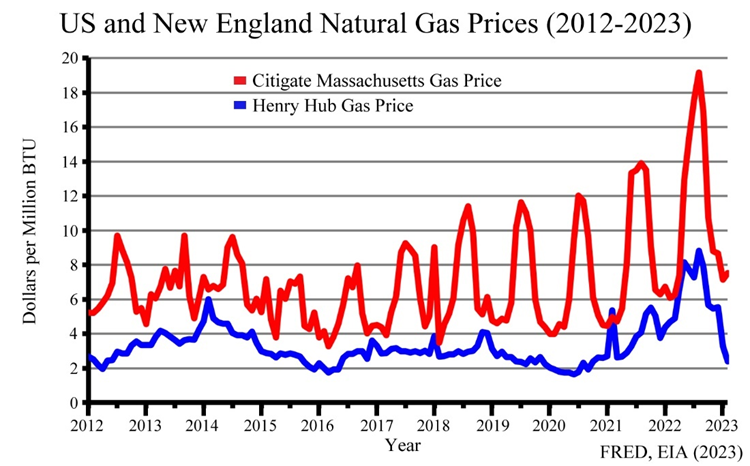
New Englanders now pay more than twice the price for natural gas than most other US residents pay, and that gap is growing. During peak periods, the Citigate Massachusetts price for gas now rises to more than $10 per million BTU, much higher than the US average Henry Hub typical price of $3-4 per million BTU. Because pipeline capacity is low, New England must import up to 30 percent of its gas by LNG tanker and pay high world market prices. During the recent global energy crisis, Massachusetts was paying $40-$50 per million BTU for imported LNG.
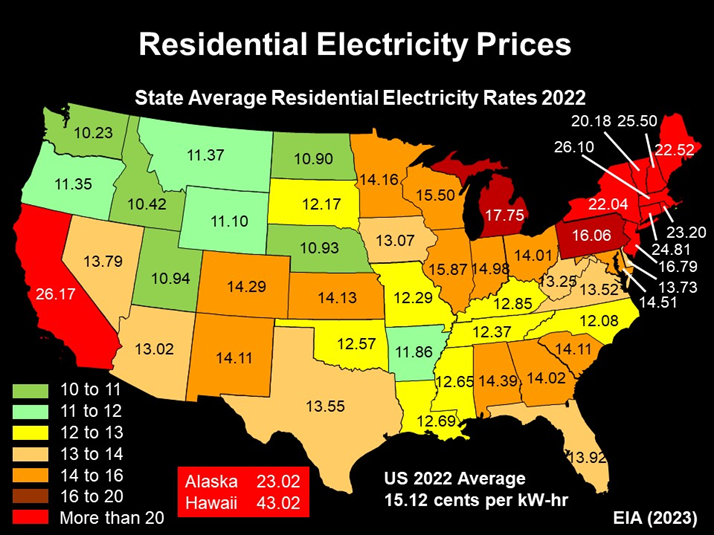
New England electricity prices are also among the highest in the nation. In 2022, power prices for all six of the New England states were over 20 cents per kilowatt-hour, and all in the top ten for state electricity prices. Massachusetts residential customers paid 26.1 cents per kW-hr, surpassed only by prices in Hawaii and California.
The risk of electricity blackouts in New England is rising. The Interstate Natural Gas Association of America sent a letter to President Joe Biden last November, warning that the region “does not have sufficient pipeline infrastructure” and is “at risk of an energy shortfall.” ISO New England, the non-profit organization responsible for reliable electricity in New England, wrote a similar warning letter to Energy Secretary Jennifer Granholm last summer, stating, “during the coldest days of the year, New England does not have sufficient infrastructure to meet the region’s demand for natural gas for both home heating and power generation.” But government leaders and environmental groups oppose further expansion of natural gas infrastructure.
The Federal Energy Regulatory Commission and ISO New England have proposed a shift in LNG pricing to allow purchase and stockpiling of natural gas in New England to prevent a winter fuel shortage. This price shift would raise consumer prices and is opposed by New England states and environmental groups. The pipeline capacity shortage and inadequate gas stockpiles have set the stage for electricity blackouts in the region during the next severe winter.
New England state governments remain committed to construction of offshore wind turbines and providing incentives for electric heat pumps as part of a misguided effort to fight climate change. But these programs, if completed, will not make the grid more reliable and will further boost energy costs.
New England homeowners, better get yourself a backup electric generator and prepare for further rises in home heating and electricity prices.
Is a new conflict brewing near Ukraine? Clampdown on anti-NATO opposition figures has raised tensions

Yevgenia Gutsul of Moldova’s opposition Sor Party, elected head of the autonomous Gagauzia region, at a rally in Comrat, Autonomous Territory of Gagauzia, Moldova. © Sputnik / Rodion Proca
By George Trenin | RT | June 12, 2023
In Moldova, a conflict has broken out between the state authorities and the autonomous region of Gagauzia, where elections were held last month. Disturbed by the fact that two candidates seen as favorable to Moscow competed in the runoff, the Moldovan authorities initiated eight processes on suspicion of illegal financing of the candidates and investigated the activities of the Gagauz Election Commission. Allegations of election violations and threats that the election results would not be recognized by Moldova have caused the authorities of the autonomous region to retaliate. At the end of May, Gagauz politicians delivered an ultimatum to the central authorities and some even expressed readiness to hold an independence referendum.
What caused the conflict between Moldova’s central and regional authorities? And can Ukraine’s neighbor, Gagauzia, really break away from Moldova?
Who are the Gagauz people and what is Gagauzia?
The Gagauz are a relatively small ethnic group (numbering about 250,000 people), most of whom live in Moldova. Historians don’t have a single opinion concerning their origin, but what is known for sure is that the Gagauz people came to their current lands from the Balkans, fleeing from the many wars that shook the peninsula in the 19th century. The Gagauz are Orthodox Christians but their language belongs to the Turkic family. Ethnically, the Gagauz are closer to Bulgarians than to Moldovans and Romanians who make up most of Moldova’s population.
This difference spurred the Gagauz people – who never had an independent republic or autonomous region, even at the time of the Soviet Union – to establish their own state. When Soviet Moldova embarked on a course towards independence and unification with Romania in 1989, the Gagauz people declared their autonomy.
In 1990, together with the better-known Transnistria, the Gagauz did not accept Moldova’s pro-Western and pro-Romanian course. Plans to unite Moldova and Romania sparked a conflict, and the two regions decided to break off and become independent.
While Transnistria engaged in a prolonged armed conflict to defend its independence (and consequently became an unrecognized state), Gagauzia, following a five-year-long political crisis, agreed to be an autonomous region within Moldova. Russia and Turkey helped in this process and acted as intermediaries.
However, such diplomacy and compliance eventually turned against Gagauzia. Some 30 years after the agreements with Moldova were signed, the autonomous region’s authorities became alarmed that Chisinau no longer wished to comply with the pact and intended to terminate it.
Autonomy under siege
“We see that Gagauzia’s authority is being consistently weakened and can no longer just sit and watch this happening,” said the Chairman of the Gagauz Parliament Dmitry Konstantinov on May 24. At the same time, he requested legal confirmation of the region’s autonomous status from Moldova.
The situation was sparked by the harsh reaction of the Moldovan authorities to the elections in Gagauzia, which took place in May. The two top candidates who competed in the runoff both criticized Chisinau’s current political course and proposed strengthening ties with Russia.
The first candidate was Grigory Uzun – a member of the Party of Socialists of the Republic of Moldova (PSRM), who was backed by the party’s leader, Moldova’s ex-president Igor Dodon. Uzun said, “Gagauzia has always gravitated towards expanding ties with its eastern neighbors, but the current Moldovan authorities aim exclusively at partnering with the West, without other options. But this is the wrong approach.” In a pre-election interview, Uzun also added that Moldova and Russia have “a common history, religion, and culture” and the two countries “simply must be friends.”
In the runoff, Uzun’s opponent, 34-year-old Evghenia Gutul, outpolled him by 4% of the vote and won the election. The elected leader was also quite clear about her position regarding Russia. She plainly stated that her party, Sor, is a “pro-Russian party,” promised to open a representative office of the Gagauz Autonomy in Moscow, and to unblock exports of agricultural products to Russia.
For Moldova’s current leaders who actively support a pro-Romanian and pro-Western course, such views held by the head of one of its regions are absolutely unacceptable. Moldova didn’t hesitate to make this known during the election campaign.
On the eve of the elections for the post of bashkan (governor of Gagauz, the highest political position in the region), law enforcement agencies repeatedly raided the offices of the candidates and members of the Sor opposition party. After Gutul’s victory was announced, members of the National Anti-Corruption Center (NAC) raided the building of the Central Election Commission (CEC), located in the capital Comrat. According to reports, during the searches on May 16 the NAC looked for materials confirming the “bribery of voters.”
Immediately after the elections in Gagauzia, Moldovan Prime Minister Dorin Recean said they should not be recognized as legitimate. Moreover, deputies from the ruling Party of Action and Solidarity (PAS) said the elected Bashkan Evghenia Gutul would not become a member of the Moldovan government since they didn’t need her there.
A couple of days later, the Moldovan presidential administration nevertheless stated that President Maia Sandu would sign a decree making the elected bashkan of Gagauzia part of the Moldovan government in compliance with all legal procedures. However, this did not lessen the negativity sparked by the previous statements and actions of the Moldovan authorities.
A nationwide issue
The conflict escalated further. On May 21, representatives of the Sor party and local activists held several rallies in Comrat in defense of the election results. They demanded that authorities stop pressuring the opposition, the media, and all those who criticize and disagree with the central party and President Maia Sandu, and called for the preservation of Moldova’s neutrality and the cessation of its process of withdrawal from the CIS. On the same day, the party’s leader Ilan Shor announced rallies in three cities – Balti, Comrat, and Orhei – where a “referendum on the country’s external vector” would be proposed.
The deep involvement of the Sor party in the regional issue isn’t just tied to the fact that its candidate won the election in Gagauzia. It also has a lot to do with the unprecedented pressure that the Sor party has been dealing with lately.
Just four days before the elections, the court started proceedings on verifying the constitutionality of the Sor party. The decision of the Constitutional Court is supposed to seal the fate of the opposition party and determine whether it should be shut down for the first time in the country’s 30-year history.
At first, the court said it would hear the case on May 17. But since then, the verification has been postponed several times. Eventually, the judges announced that they were going to postpone the hearing until June 12.
In fact, the Moldovan government appealed to the court to consider the constitutionality of the Sor party last year, but the legal proceedings began only a few days before the runoff election. According to the opposition leaders, this was because the Sor party supported and led the protests against rising food and fuel prices. The opposition criticized the ruling coalition for not wanting to negotiate more favorable prices for raw materials with Russia.
However, despite increasing pressure on the opposition in Gagauzia and Moldova, the ruling Party of Action and Solidarity didn’t put forward any candidate of its own to run for the post of governor in Gagauzia.
“Gagauzia is a region that traditionally supports strong ties with Russia and is largely indifferent to the European integration course declared by Chisinau. So it is obvious that the candidate from the Party of Action and Solidarity would have received the minimum number of votes, at best 100 or 200,” Sergei Manastyrli, head of Chisinau’s Balkan Center for Analysis, Research and Forecasting, told RBC.
The European Union is also attempting to exert pressure on Moldovan parties that favor practical relations with Russia. Recently, the EU began forming a “blacklist” of Moldovan oppositionists and oligarchs. Five Moldovan citizens are about to be sanctioned and their assets will be frozen. All of them are accused of supporting the Russian Federation. The list is topped by the chairman of the Sor party Ilan Shor, its deputy chairman Marina Tauber, and the former leader of the Democratic Party of Moldova, oligarch Vladimir Plahotniuc.
The ‘fifth column’
Pro-Russian sentiments in Gagauzia and Moldova in general are largely driven by economic factors – and it’s not just a matter of discounted energy resource prices, which Moscow traditionally offers to friendly states.
Russia has always been the main market for the autonomous region’s exports, mainly for products of the wine industry. While there are restrictions in place on the import of products from Moldova, products from Gagauzia have easier access to the Russian market. Moldova’s ruling party, however, opposes any joint projects with Russia and tries to limit contacts between the autonomous region and Russia. Apparently, Chisinau has totally different views about Gagauzia’s pro-Moscow sympathies.
In light of the recent scandals, the head of the Gagauz Community of the Republic of Moldova, Nikolai Terzi, also had a say in the conflict. He has accused Moldovan President Maia Sandu of considering all Gagauz residents a “fifth column.”
“I attempted to make a number of proposals on bringing the central government and the Gagauzia ATU closer together to work on the development and strengthening of the state of Moldova, and on finding ways to strengthen the central government’s positions in the region. But I was interrupted by the president, who said that Gagauzia is someone’s ‘fifth column.’ In response to my question whether this is true for the whole of Gagauzia, I received an affirmative answer,” said Terzi.
The head of the People’s Assembly of Gagauzia, Dmitry Konstantinov, said he once asked President Maia Sandu why she was in no hurry to visit Gagauzia. According to Konstantinov, her answer was, “We know that you are waiting for the Russians to come.”
Former leader of Gagauzia Mihail Formuzal is skeptical about Evghenia Gutul’s ability to exert considerable influence on the current situation, due to limited authority.
“Even though this position makes her a part of the Moldovan government, she will be a purely decorative element there. She can speak and object, but she has only one vote, while there are 21 people in the government,” he notes. Formuzal adds that “Gagauzia has no real autonomy,” since “Chisinau can control any ministry.” Gagauzia can only speak out about problems within its authority.
He also mentioned that Chisinau could threaten the authorities in Comrat by cutting the funding for road construction.
“Chisinau uses such methods regardless of the government in power. This also happened when I was the bashkan. Some prime ministers did not provide Comrat with money for road construction at all,” Formuzal said.
So far, instead of economic measures, Moldovan authorities prefer to deal with the mounting dissatisfaction in Gagauzia by funding numerous pro-Western NGOs and mass media. According to Formuzal, unprecedented amounts of money are being allocated for these purposes.
“These media resources receive millions of lei in funding. Chisinau is throwing crazy money at this! They harshly criticize the pro-Russian views held by the majority of the Gagauz people, propose joining the European Union and push forward European values. They are very goal-oriented and systematic in their work, which is carried out in both the Russian and Gagauz languages. The staff is selected from among the locals. Generally, they are very successful. I predict that in another eight to ten years of such intensive work, we may have a pro-Western bashkan,” he says.
Despite this, he believes that, presently, the people of Gagauzia are not interested in the ruling party’s pro-European agenda since the standard of living is on the decline.
“Gagauz residents remember how a cubic meter of gas used to cost six lei when the leaders in Chisinau could find a way to get along with Russia. But now we have to pay 30 lei per cubic meter. In such circumstances, how can you explain to people the benefits of liberal democratic reforms? Will they improve your quality of life? Absolutely not!” says Formuzal. He also notes that “people do not see anything positive coming from Chisinau and so treat it with extreme negativity.”
What’s next?
On May 27, a large congress of Gagauz public representatives was held in Comrat. It was attended by local parliamentary deputies of the current and previous convocations, mayors, local councilors, public figures, and the head of the autonomous region.
The congress accused the central authorities, headed by President Maia Sandu, of escalating the situation, violating the rights of Gagauz residents, provoking conflicts, and creating a split in society.
Even the current governor of Gagauzia, Irina Vlah, who is often accused of excessive sympathy towards the central authorities, spoke out in a rather tough manner:
“For the first time in all the years of Gagauzia’s existence, the central government is consistently escalating the situation, provoking conflicts, and setting the Moldovan people against the residents of the [Gagauz] autonomy. The PAS party and President Sandu, set on developing her cult of personality, have split our Moldovan society with their policy. The desire to limit the authority of the autonomous region will lead to an escalated conflict between the central and regional authorities. Starting a fire is easy, putting it out is a lot harder.”
Following the congress, a resolution was adopted that outlined precise requirements for the central authorities. The elected representatives of the Gagauz people demanded several things from Moldova: to give the Law on the Special Legal Status of Gagauzia constitutional status; to align Gagauzia’s autonomous status with the legislation of the Republic of Moldova; to stop illegally blocking the region’s right to exercise authority, as per the Law on the Special Legal Status of Gagauzia; and to stop revoking Gagauz laws in Moldovan courts.
Moreover, the congress wanted Moldova to restore the customs service, the tax inspectorate and other abolished regional structures, to reinstate the prosecutor of Gagauzia as a member of the Supreme Council of Prosecutors, and provide Gagauzia with a quota in the parliament – all within three months.
The most radical demand was to ban the activities of political parties that propose the cessation of Moldova’s status as an independent state. This is a clear hint at the ruling party and President Maia Sandu, who have repeatedly supported the idea of forming a single state out of Moldova and Romania.
The resolution ends with a warning: “We declare that if the central authorities of the Republic of Moldova continue to ignore the legitimate requirement of respecting the competency and authority of Gagauzia and fail to ensure the political and legal status of the Autonomy in the Constitution, the central authorities of the Republic of Moldova will be held fully responsible.”
The resolution did not mention the specific measures that the Gagauz authorities would take, but speaking at the congress, Deputy Nicolai Dudoglo outlined the possible outcome of this conflict:
“Now that all the politicians of Gagauzia are united, Chisinau cannot use them [in its interests]. If Chisinau continues its rhetoric and does not begin a dialogue with Comrat, we should hold a referendum on the independence of Gagauzia. It’s time for a man-to-man conversation.”
Featured Video

ARE PATIENTS BEING PROPERLY INFORMED ABOUT OZEMPIC?
or go to
Aletho News Archives – Video-Images
New Book
Breast Cancer: Before You Consent
A new Unbekoming paperback
Lies are Unbekoming | September 18, 2026
Peter Gøtzsche reviewed every randomised mammography screening trial ever conducted for the Cochrane Collaboration. Cochrane’s headline is that, assuming a 15% mortality reduction, one woman in 2000 avoids dying of breast cancer over ten years. Ten are overdiagnosed and treated. Two hundred experience false alarms.
But that headline assumes the reduction. When Gøtzsche looked only at the trials with adequate randomisation — the higher-quality ones — the reduction disappeared. No effect on breast cancer mortality. No effect on all-cause mortality.
This is the Cochrane finding, published in the establishment’s own database of systematic reviews.
No woman being asked to consent to a mammogram this week knows it.
That is why the new Unbekoming paperback exists. … continue
Blog Roll
 Aletho News
- ARE PATIENTS BEING PROPERLY INFORMED ABOUT OZEMPIC?
- US lawmaker blocks $2.8 billion weapons sale to Israel: Report
- Yemeni army claims responsibility for strikes on sensitive sites in Saudi capital, Aramco facilities in Yanbu
- Iran Judiciary issues indictments against 159 US, Israeli officials for assassination of Leader, commanders
- Turkiye revokes Iranian bank license under US sanctions campaign
- US-Denmark Agreement on Greenland Is ‘PR Stunt’ Ahead of Midterms
- Araghchi: Military intervention cannot create security; coercion cannot bring peace
- Fraud Squared
- Breast Cancer: Before You Consent
- Iran’s Plan to Shut Down AI in the Persian Gulf
- If Americans Knew
- Inside Gaza’s death trap of collapsing, bombed-out buildings
- The everyday items Israel bans from Gaza every day
- Inside the siege, the ruined buildings of Gaza – Daily Update
- Debunking The Claim That Macklemore Has A “History Of Antisemitism”
- CPJ demands release of arrested Palestinian-US journalist near Bethlehem
- Robert Kraft: The Billionaire Friend of Netanyahu Pulling The Strings Behind the Macklemore/Ed Sheeran Blow Up
- Columbia Administered Fund Gives Big Money to Pro-Israel Groups
- Deportation Case of Palestinian Activist Salah Sarsour Tests First Amendment
- ‘We Will Not Forget’: Palestinians Mark 44 Years since Sabra and Shatila
- Why do we let Zionists decide what we can and can’t say?
- No Tricks Zone
- New Study: ‘Global Drought Shows No Detectable Recent Acceleration Under Climate Warming’
- Economic Masterminds: German Socialists Suggest Taxing Productivity Gains Stemming From Using AI
- The South China Sea Has Not Been Cooperating With The Climate Change Narrative
- Energy Crisis: Germany Enters Heating Season With Historically Low Gas Reserve Fill Levels
- New Study: The Antarctic Ice Sheet Gained Mass From 2020-2024 Due To Staggering Snow And Ice Accumulation
- Study: Ocean Heating Rates From Thousands Of Years Ago ‘Dwarf’ Modern Ocean Heating Rates
- Climate Extremists Target, Attack Large-Scale Power Grid Infrastructure In Germany!
- New Study: Antarctic Ice Melt Has Contributed Less Than 1 Centimeter To Sea Level Rise In The Last 30 Years
- Fear Of Debate: Alarmist German Climate Scientist Calls On Mainstream Media To Discredit Skeptic Voices
- End-Of-August Arctic Sea Ice Extent Hasn’t Fallen In 20 Years, Official Data Show!
 Aletho News