Western economic warfare backfired, new depression likely to come
What awaits Europe with Nord Stream pipelines possibly gone forever?
By Uriel Araujo | September 30, 2022
Now that the Nord Stream pipeline might have been sabotaged by Washington, as promised by US President Joe Biden on January 7, and is possibly gone forever (according to German authorities), it is time to consider the possible impacts.
The energy crisis in the EU has always been pushed by American interests. Moreover, the US has been engaging in economic warfare and even weaponizing the dollar for too long, but it has been clear for months now that its current economic and financial war against Russia has backfired – and once again, mostly upon Europe. Such economic wars in fact may dangerously spiral out of control, and are considered to be one of the causes of the 1929 crisis in the post-Versailles world.
Philip Pilkington, an Irish economist who works in investment finance, famous for his contributions on the empirical estimate of general equilibrium and other fields, has made quite interesting observations about the possible deindustrialization of Europe as a consequence of economic warfare. He remarks on how in the post-pandemic world debts in the West have been accumulating and, on top of that, the current conflict in Ukraine has brought extra energy costs.
After the conflict ends – or becomes a “frozen conflict” – or after good diplomacy is reestablished, Russia could start to once again supply gas to Europe as usual – this is how many analysts reasoned. However, now that the pipelines are gone, the price of energy in the continent is to remain tremendously high for years to come. With permanent high energy prices making manufacturing not economically viable anymore (thus decreasing European purchasing power), one should expect to see the bloc shutting out exports to revive an uncompetitive industry while increasing energy investments. These are Pilkington’s main points and it might be worth delving into them.
Pilkington argues that high energy costs will make the European industry largely uncompetitive because manufacturers will have no choice but to also raise the price of goods, which in turn, will not be able to compete with cheaper foreign goods. The economist goes on to argue that, in this scenario, with many manufacturers out of business, the result will be the loss of key jobs, with less employed people spending money and a new economic depression.
Thus, Pilkington reasons, the United States will not be able to “reshore” European manufacturing for too long because there simply won’t be anyone in the continent to buy the products the US ships to European shores. This crisis will thus affect Americans too, because as exports to Europe fall, US workers also lose their jobs. What could EU states do in such a scenario? The Irish economist writes quite convincingly that a tariff solution would be the most obvious one: by raising tariffs, these countries will be able to “render international products as expensive as the domestic products suffering from energy cost inflation.”
The result of that can only be more economic chaos for the West, while Europe “shuts itself off” and becomes a kind of a “black hole”, in a repetition of the 1920 events which resulted in the Great Depression, writes Philip Pilkington.
However, the global situation today has changed much, with the BRICS+ alliance, apparently aimed at “decoupling from the Western economy.” For a while, the rise in commodity prices has been perceived as a result of Western sanction policies, and this has forced the global south to look for parallel mechanisms and alternatives. Therefore, these emerging powers have the potential to build a “separate economic bloc”, which means the West would suffer the most from the economic chaos, as BRICS+ “has a relatively clean bill of economic health”.
All of this is a quite likely scenario and one should also consider the political implications. The economic crisis will in all likelihood bring back protectionism, and it might come accompanied by a 1930-like political climate. This in turn can only strengthen the populist camp in Europe. Populist and so-called “far-right” tendencies have been growing in the continent for years and the time seems to be just right for speeding up this phenomenon.
One remembers defeated French Presidential candidate Marine Le Pen promised to pull France out of NATO during this years’ elections. Meanwhile, in August, Hungary had once again the lowest energy prices in the EU. Over 8,700 sanctions have been imposed on Moscow, and yet they have hurt Europe more than Russia as Hungary’s Prime Minister Viktor Orban has been a strong critic of such sanctions. In fact, whether one likes the man or not, he has oftentimes been the voice of reason in the bloc. Now, the German eurosceptic Alternative für Deutschland (AfD) political party is heavily focusing on attacking European elites and opposing the German government’s sanctions against Russia. This trend is everywhere across the EU.
It is about time Europe assert its sovereignty, however such a political stance is largely marginalized in the continent. Thus, although a European populist wave should increase skepticism about NATO and the EU itself, it will also increase political instability and turmoil. To sum it up, in the worst post-Nord Stream scenario, one can then expect a deindustrialized and isolated Europe going through a serious political and economic crisis.
Uriel Araujo is a researcher with a focus on international and ethnic conflicts.
Should Europeans ‘Thank’ the Americans for Destroying Nord Stream?
By Robert Bridge | Strategic Culture Foundation | September 29, 2022
With an investigation continuing into the destruction of the Nord Stream gas pipeline that provided energy supplies to Europe from Russia, there appears to be just one prime suspect, and that should surprise nobody.
Following the sabotage of the Nord Stream 1 and 2 gas pipelines, former Polish Foreign Minister Radoslaw Sikorski already seemed to know the identity of the perpetrator when he tweeted out: “Thank you, USA.”
At first glance, it seemed that Sikorski was speaking sarcastically, berating Washington for carrying out an attack that will have severe repercussions for the people of Europe. After all, how could anyone see any good coming from the termination of Europe’s primary source of gas reserves with winter just around the corner? It was Sikorski’s homeland of Poland, after all, that urged its citizens to collect firewood in the face of dwindling gas reserves.
In fact, the Polish diplomat was speaking one-hundred percent literally, thanking the United States for plunging the continent deeper into the abyss. This has been the attitude of European leaders from the start of Russia’s special military operation in Ukraine: ‘we will accept our self-destruction as scripted by Washington policymakers so long as the baddies in Moscow hear our virtue-signaling whimpers and screams.’ European capitals are about to learn the hard way that virtue signaling does not put food on the table or heat homes.
Judging by the rising temperature in Europe, however, last seen in Italy where a far-right leader has come to power on the wave of voters fed up with high electricity bills and loose immigration, the phrase ‘Thank you, USA’ may eventually be chiseled into Europe’s tombstone.
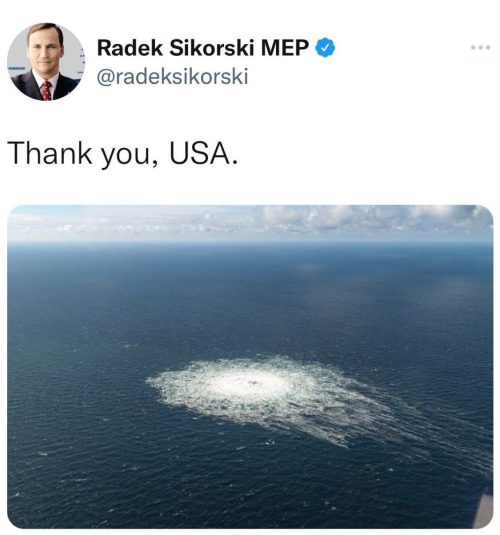
But first, the big question: was the United States really responsible for the destruction of Nord Stream, as Sikorski seems to believe? Well, if we were are to take bumbling Joe Biden at his word, then the answer would seem to be yes.
“If Russia invades, that means tanks or troops crossing the border of Ukraine, again, then there will be — there will be no longer a Nord Stream 2,” the U.S. leader told reporters two weeks before Russia began its Ukrainian mission. “We will bring an end to it.”
When asked to specify, Biden responded, “I promise you, we’ll be able to do it.”
There are other clues that point to American complicity.
On September 2, an American helicopter with the call sign FFAB123 was observed maneuvering in the area of the Nord Stream pipelines. According to the site ads-b.nl, six aircraft used this call sign that day, of which the tail numbers of three were established. All of them were Sikorsky MH-60S. By overlaying the FFAB123 route on the scheme marking the areas of the explosions, it is observable that the helicopter either flew along the Nord Stream-2 route, or exactly between the points where the ‘accident’ occurred.
Meanwhile, on Twitter, there are screenshots of other American aircraft flights as of September 13th in exactly the same area. In June there was an article in Sea Power magazine where the Americans boast of experiments in the field of underwater drones that they set up at the BALTOPS 22 exercises – in the area of Bornholm Island, the Danish island where the explosions were reported to have occurred.
“Experimentation was conducted off the coast of Bornholm, Denmark, with participants from Naval Information Warfare Center Pacific, Naval Undersea Warfare Center Newport, and Mine Warfare Readiness and Effectiveness Measuring all under the direction of U.S. 6th Fleet Task Force 68,” Sea Power reports.
Such an “experiment” would have required the deep-sea equipment needed for reaching the depths where the Nord Stream pipelines are located.
Finally, here’s one last tantalizing piece of information for all of the ‘coincidence theorists’ out there. On the day after Nord Stream 1 and 2 went offline, Poland, Norway and Denmark’s leaders attended the opening ceremony of the new Baltic Pipe, which will transport natural gas from Norway via Denmark and through the Baltic Sea to, yes, Sikorski’s ferociously Russophobic homeland of Poland. Yes, just a coincidence.
However, the main motivating factor for Washington having a hand in destroying Nord Stream is the awesome powers – both financial and political – that it will reap. The economic crisis in Europe is already forcing companies and corporations to consider relocating to the U.S., which is providing a better business environment and more or less affordable electricity bills.
And after the destruction of Nord Stream, the economic situation on the continent will deteriorate significantly. Even though the NS-II was not launched, there was the chance of its launch, and this “chance” had a considerable effect on the market. Now, without its main energy supplier, Europe is doomed while America will soar.
The economic destruction of Europe makes it totally dependent on the U.S. economically, politically, and militarily, turning it into a toothless tiger with no political will and independence. At the same time, Europe will become almost completely dependent on the U.S. for its (prohibitive) gas. The United States plans to supply at least 15 billion cubic metres (bcm) of liquefied natural gas (LNG) to European Union markets this year as Europe seeks to wean itself off Russian gas supplies.
In other words, the transformation of the EU into a banana republic – albeit it one in the northern hemisphere with winter quickly approaching – has already begun.
Europe, you really should have heeded the advice of Henry Kissinger, who understands the nature of the U.S. better than anyone: “To be an enemy of the U.S. is dangerous, but to be a friend is fatal.”
Who wins from demolishing the EU’s gas lifelines?
By Rachel Marsden | Samizdat | September 29, 2022
Speculation abounds since both Nord Stream 1 and 2 pipelines, designed to carry cheap Russian gas to Europe, were damaged this week in what officials widely describe as deliberate acts of sabotage. Who could be responsible? Incidents buried in the past may provide a clue.
Speculation abounds, and typically in a direction colored by the preexisting biases of the person speculating – which is hardly helpful.
Let’s start with the end result and work backwards. The outcome ultimately means that Europe’s economic impetus for ever seeking peace with Russia has been seriously undermined, if not literally destroyed. Someone has taken it upon themselves to demolish the remaining bridges between the two. Until now, there was always a chance of reconciliation. Russian President Vladimir Putin said himself recently that all the EU needed to do to pull itself out of its self-imposed energy crisis was to push the button on its gas supply from Russia and drop the anti-Russian sanctions that prevent it from doing so.
People in the streets of German cities protesting against Berlin’s blind following of Brussels’ anti-Russia sanctions also knew that was the answer. But now that option has been taken off the table. The EU is now adrift amid a deepening energy crisis and someone burned its last sails. It’s clear that Europe itself wouldn’t benefit from that. Nor does it benefit at all from any of its own anti-Russian sanctions. But who gave Brussels that idea, to harm its own economy in the first place?
At the onset of the Ukrainian conflict, it was Washington that egged on the EU to mirror measures that Washington itself had adopted in an effort to deprive Moscow of revenues to fuel its interests and objectives in Ukraine. The problem is that the EU’s economy was far more entwined with Russia’s than America’s. Any sense that US President Joe Biden and his administration may have given EU leaders, that they’d be there to help the bloc soften the blow of its self-sacrificial sanctions, has since been replaced by a harsh, pragmatic reality. US shale executives have explained to Western media that they simply lack the capacity to ramp up production for Europe’s winter crunch, even amid the growing rationing, deindustrialization, and risk of blackouts.
So, pressure has recently been increasing on EU member states to achieve a rapid diplomatic, peaceful resolution. But any reconnection of Nord Stream gas would have been a blow to US economic ambitions, which eventually include turning the EU into a dependent liquefied natural gas client. To that end, US officials have even tried to market their natural gas in the past as “freedom molecules,” in contrast to the “authoritarian” Russian gas.
Biden himself said of Nord Stream 2 during a press conference on February 7, before the Ukraine conflict had even popped off, that “we will bring an end to it,” despite it being out of American control. But even long before that, the US was sanctioning and bullying European companies into halting construction on Nord Stream 2 under the pretext of saving Europe from Russia. It’s worth noting that Europe didn’t really have problems with Russia this century until the US decided to make Ukraine an outpost for the State Department.
Not only did Gazprom, Russia’s state-owned operator of the pipeline, persist against all odds to finish it, but it’s really the only leverage that Moscow has in Europe. Attributing to Moscow the recent sabotage of their own economic interests in Europe seems absurd. The damage done to the pipelines now means that to prevent them from being completely filled with sea water and destroyed, Russia is forced to keep pumping gas through them and into the sea at their own expense. What exactly does Moscow gain from any of this? Conversely, what does Washington gain? Nothing less than Brussels’ full dependence, which proved elusive when Europe could split its interests between the east and west.
As for who possesses the technical ability to execute underwater pipeline sabotage, both Russia and the US do. Much has been made in the past of the potential for cutting undersea cables – defined as an act of war by UK defense chief Admiral Sir Tony Radakin. The US actually has a history in such operations, having tapped into undersea cables to spy on the Soviet Union in the 1970s Operation Ivy Bells, according to public records about Operation Ivy Bells. Washington also has sabotaged Soviet gas pipelines before, albeit indirectly – according to Thomas C. Reed, a former Air Force secretary who served on the National Security Council in 1982, when then-US President Ronald Reagan allegedly approved a plan for the CIA to sabotage components of a pipeline operated by the Soviet Union. The objective was to prevent Western Europe from importing natural gas from the Soviets. Sound familiar?
Time and inquiry will uncover the culprit eventually – if we’re lucky. EU officials are vowing to get to the bottom of it. “All available information indicates leaks are the result of a deliberate act. Deliberate disruption of European energy infrastructure is utterly unacceptable and will be met with a robust and united response,” Tweeted the bloc’s chief diplomat, Josep Borrell. Perhaps investigators could pay a visit to Radoslaw Sikorski, European Parliament member and former Polish foreign minister, who tweeted a photo of the disaster aftermath along with the note, “Thank you, USA.”
But if it indeed turns out that Washington committed what some consider to be an act of war against Europe’s economy, will Brussels have the heart to really confront it? Or will Brussels continue to find justifications to remain complicit in its own demise?
Rachel Marsden is a columnist, political strategist, and host of independently produced talk-shows in French and English. rachelmarsden.com
‘US Wants to Destroy EU as Economic Player’: Analysts Mull Ramifications of Nord Stream Breakdown
Samizdat – 28.09.2022
The Nord Stream 1 and 2 natural gas pipelines have been effectively rendered inoperable this week due to an incident that may have been an act of sabotage.
As the Nord Stream and Nord Stream 2 natural gas pipelines are currently incapable of transporting natural gas from Russia to Europe, experts ponder who is going to benefit from this catastrophe.
Vladimir Demidov, an international analyst of energy and natural resource markets, told Sputnik that the parties who oppose negotiations between Germany and Russia definitely benefit from the Nord Stream breakdown.
As these negotiations may lead to sanctions against Russia being partially lifted – potentially in exchange for gas shipments during winter – those who want to keep these sanctions in place could also be regarded as an interested party, he added.
“This is an act of aggression on a planetary level,” Demidov remarked. “A country or a bloc destroying infrastructure of another country. And we’re not talking about domestic infrastructure here, but infrastructure that connects countries and supplies about 30 percent of the natural gas Europe uses.”
Russian National Energy Security Fund analyst Igor Yushkov also observed that neither Russia nor Germany were interested in the pipeline’s destruction: for Berlin, Nord Stream presented an option to stave off a potential “energy collapse” during winter, while Moscow invested a lot of money into the project.
Both Demidov and Yushkov observed that Europe will now have to purchase natural gas from the United States, the largest liquefied natural gas supplier while it looks like Russia was essentially squeezed out from the European natural gas market.
“The natural gas from the US is going to become more expensive and Europe would still have to buy it because there is no other gas,” Demidov said. “A very amusing diversification has occurred in Europe: they switched from key supplier of the ‘bad’ gas from Russia to the ‘freedom’ gas from the United States that costs at least twice as much.”
He also pointed at former Polish Foreign Minister Radoslav Sikorsky, who “thanked” the United States on social media for the Nord Stream breakdown, with Demidov arguing that when people of such caliber make such statements, it looks as if they are trying to make the truth look like a joke.
“I have a feeling that the United States really wants to destroy the European Union as a global economic player,” he said.
Second energy protest roils Czechia
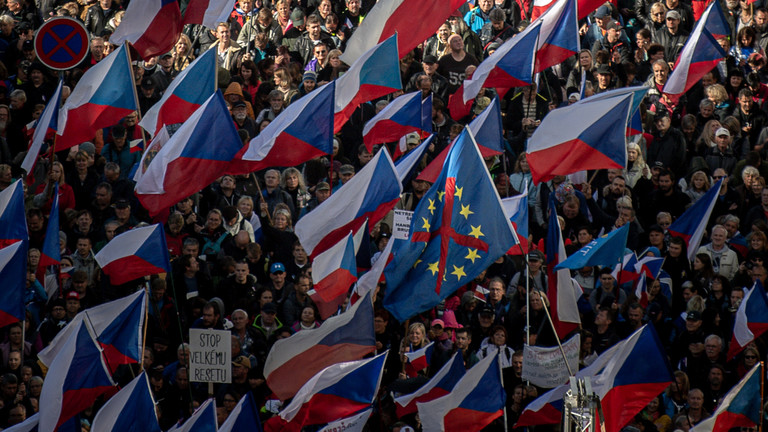
Protest against the Czech government at Wenceslas Square in Prague, Czechia, September 28, 2022. © Lukas Kabon / Anadolu Agency via Getty Images
Samizdat | September 28, 2022
A crowd numbered in the tens of thousands gathered in Prague on Wednesday to protest against the Czech government, NATO, and the European Union. Demonstrators called for Czechia’s neutrality and protested Prime Minister Petr Fiala’s policy of sanctioning Russia, which has driven up energy prices.
Meeting on St. Wenceslas’ Day – a public holiday celebrating Czech statehood – the crowd took to Prague’s main square, named after the medieval saint, and chanted slogans against the EU, NATO and Fiala’s cabinet. Prague police would not give a specific figure of the estimated crowd size, calling it only “tens of thousands.”
The protest was organized by a group called ‘Czech Republic First,’ which Reuters described as a coalition of “far-right and fringe groups and parties including the Communists.” CRF opposes the EU and NATO and has called for Czechia’s military neutrality.
“A government has two duties: to ensure our security and economic prosperity. This government does not fulfill either of these duties,” said one unidentified speaker at the rally, according to Reuters.
A demonstrator named Pavel Nebel accused the government of being “absolutely anti-Czech” and serving only the EU, NATO, and “American power” at the expense of Czech interests.
The organizers called for another protest on October 28 and said they intend to ask President Milos Zeman to disband the government and call for early elections, according to Lidove Noviny. It was the second such rally this month, after some 70,000 people took part in the September 3 protest, according to police. Similar rallies in other Czech cities drew hundreds of participants.
“People should not be taken advantage of by manipulators who offer simple but unrealistic solutions in the squares,” Interior Minister Vit Rakusan told Lidove in response to the protest.
Fiala had dismissed the September 3 demonstrations as “pro-Russian,” accusing their organizers of listening to “Russian propaganda and disinformation campaigns.” His government has diligently followed the lead of Brussels in imposing trade embargoes against Moscow over the conflict in Ukraine, which has translated into skyrocketing prices of energy normally imported from Russia.
Czechia had joined NATO in March 1999, just days before the US-led bloc attacked Yugoslavia. It became a member of the EU in May 2004.
Slovak Economy on Verge of Collapse as Energy Prices Soar – Prime Minister
Samizdat – 28.09.2022
Slovak Prime Minister Eduard Heger said on Wednesday that energy crisis and rising electricity prices could put the country’s economy on the verge of collapse unless the European Union provides more financial help.
Heger said that money allocated from an EU windfall tax, which is put on “abnormally high profits” of energy companies, should be equally distributed and Slovakia should receive 1.5 billion euros ($1.5 billion). The prime minister also hopes for additional help from Brussels that could provide Slovakia with 5 billion euros more from unused regional development funds to reduce energy bills for businesses.
“Otherwise [Slovakian businesses] will be closing and could actually collapse the whole economy,” Heger was quoted by the Financial Times as saying, adding that Slovak companies providing energy supplies would have to be nationalized if Brussels did not help.
Since 2021, energy prices in EU countries have been surging as part of a global trend. After the beginning of Russia’s military operation in Ukraine in February 2022 and the adoption of several packages of sanctions against Moscow by the EU, energy prices have accelerated the growth, placing energy security high both on the global and national agenda and pushing many European governments to resort to contingency measures.
Germany secures just one tanker of LNG from UAE
Samizdat | September 27, 2022
German utility RWE has inked a deal with Abu Dhabi National Oil Company (ADNOC) for delivery of liquefied natural gas (LNG), the company announced on Sunday.
The deal so far covers only one tanker: a shipment amounting to 137,000 cubic meters of LNG to be delivered by Abu Dhabi National Oil company to RWE in late December or by early 2023, Bloomberg reported, citing the company’s announcement. Separately, RWE also announced it will partner with UAE-based company Masdar to explore offshore wind energy projects and supply 250,000 tons of diesel per month in 2023 to Germany’s fuel distributor Wilhelm Hoyer.
The deal also includes a memorandum of understanding for more LNG deliveries next year, but the document is non-binding and it is unclear how many more LNG deliveries Germany may expect.
The agreement was signed during German Chancellor Olaf Scholz’s trip to Abu Dhabi during a tour of the Gulf countries.
“We need to make sure that the production of LNG in the world is advanced to the point where the high demand that exists can be met without having to resort to the production capacity that exists in Russia,” Scholz told reporters prior to the deal’s announcement.
After the UAE, Scholz visited Qatar. However, according to Scholz’s statement issued after the meeting with the Qatari emir, no agreements on LNG supplies have been made there. The two countries have been in talks over LNG supplies for several months now, so far to no avail, as Berlin is reluctant to enter into long-term contracts with Doha.
Europe’s Biggest Enemy Isn’t Russia Nor Islamic Terrorism, but Israel
By Martin Jay | Strategic Culture Foundation | September 25, 2022
When Joe Biden took office, many pundits said that at least relations between the U.S. and EU would be restored. But the Iran deal is the ultimate test of just how much he loves the old continent.
Just how far will Israel go to scupper the so-called Iran deal from being signed by both Iran and the West? And will it play a fair game or use underhand and covert tactics to achieve its goal of the deal never being signed? Recently, we have seen the talks in Vienna progress as even the Americans say that certain key negotiating points have been taken out of the deal from the Iranians which has made the negotiations move closer to an agreement; we have also seen though Israel pulling out all the stops, from a PR and lobbying perspective at least.
And then there is the murky subject of skullduggery to destroy the talks. If you’re one of these people who believes in fairies at the bottom of the garden or that certain toothpastes can make your teeth whiter, then you might not buy into Israel using Mossad to derail the deal. Attacks on U.S. forces for example in Iraq, supposedly carried out by Iran-backed militias would normally have most people pointing the finger at Iran, proclaiming that Tehran is not at all serious about the deal but just playing along for time so that it can roll out a nuclear bomb. Then there is the curious case of the Salman Rushdie attack, which, again, many would point out could be attributed to the Iranians who still have a very much ‘alive’ fatwa against the British writer. Indeed, even the Supreme Leader is reported to have made a comment against Rushdie when he heard of the knife attack.
Given even the Israeli media have speculated that Mossad did it, it would be easy to conclude an open and shut case right?
Yet the author believes, like the 9/11 attacks in New York, which was the dirty work of Mossad, that these previous attacks can also be attributed to the Israelis who may well be plotting a bigger attack in the U.S. which Iran can be framed for; in fact, Americans are so ignorant of Islam or anything to do with the Arab world, that such an attack doesn’t even need to be linked to Iran but simply “Islamic terrorists” which might have tenuous links with Tehran.
There is no limit for Israel in terms of how far it can go to block the deal as the elite there believes that the Iran deal would exponentially boost Tehran’s power given the impact of sanctions relief on the economy. But the emergence of Iran as a regional player, economically, will always be a threat to Israel especially as it throws the spotlight on the once pariah state and many will see the fraud of hatred between Israel and Iran for what it is. Just as for decades the West goaded the Gulf States about Iran, installing fear to such a point that it was America and the UK who cleaned up on weapons sales, Israel needs to keep this yarn alive that Iran is the threat both for internal politics with their own people and also to justify the obscene amount of military aid which is sent to Israel each year. But any hack in Lebanon who has connections with Hezbollah will tell you that this threat is phoney and that both sides have enormous respect for one another; in reality both sides are fooling their own people into buying into the threat of an attack as it’s good for political support. The recent claims by Matthew Levitt in the Israeli media for example that Hezbollah wants to start some skirmishes with Israel can’t be taken seriously from those who are close to the Shiite group in Lebanon who say simply that Hezbollah is too scared to do such a thing off its own bat; being directed by the Supreme Leader in Iran though is another matter.
Hezbollah and Indeed Israel’s game of smoke and mirrors in Lebanon makes some pundits question whether Iran is really serious about reaching out for a deal with the west to lift its sanctions, or just playing us all along to win time? Surely Israel can’t have it both ways as its desperate antics of late tend to contradict themselves.
Hezbollah serves Israel well as the latter can focus more of defence spending and other such border initiatives in preference for being held more accountable for its governance. For Hezbollah it’s exactly the same. The threat of Israel launching an attack, once again, is the very bedrock of Hezbollah support in Lebanon. Without that threat, the Shia group may well lose half of its support overnight. This is one of the reasons why Israel continues to bomb Syria, targeting Iranian and Hezbollah activities: to keep the dream alive. It’s another reason why Hezbollah has a despondent enthusiasm towards Lebanon securing gas drilling rights close to Israel’s maritime border.
Yet in this time of Europe’s economies diving into recessions, we should ask ourselves what is the bigger picture? If Israel fails to derail the Iran talks and once again the Iranians get a deal which appeases the Americans, then certainly their economy in Iran will return to the billion dollars a month trade with the EU. One minor detail though which is overlooked and carefully airbrushed out of mainstream media’s narrative is the impact on Europe if the deal goes ahead. Cheap Iranian oil being sent to most EU countries which are really suffering from the shortages of oil and gas and its present market price could be a godsend and would enrage the Israelis even further. Europeans and even the British would look at Iran through a more favourable prism. Many would argue that Iran should be brought back in from the cold, in preference to the loathing of Putin and the hatred generally towards Russia. At least we can talk to the Iranians, many will argue. This notion cannot have escaped the attention of the EU dogs of war in Brussels who seem to be detached from all realities about the Ukrainian war and their sanctions towards Russia. Is it that they are banking on cheap oil from Iran saving EU economies? Biden too must have been advised of how things will pan out. But cheap oil for EU countries doesn’t favour the U.S. directly whereas letting the Europeans sink in their own demise will actually boost the U.S. economy according to the Washington Post, So much for the special relationship with Europe. For both Israel and Washington.
Industrialist: ‘The Americans control everything in the background’
Free West Media | September 26, 2022
German industrialist Wolfgang Grupp, the CEO of textile giant Trigema, does not understand why Germans suddenly see Vladimir Putin as a mortal enemy. He believes that the US is controlling everything in the background and are the only winners of this war.
The head of the textile manufacturer has taken a stand on the Ukraine war in an interview with BW24.de. Grupp told the portal, “I don’t understand how you can be best friends with Mr Putin for 20 years, be 100 percent dependent on him and within two months you are mortal enemies! That doesn’t make sense.”
Something must have been going on for some time, Grupp suggested. The company patriarch believes that “the Americans are controlling everything in the background so that it remains a world power.” The US, he said, was the only winner in this war.
Grupp: ‘Supplying weapons to Ukraine with great fanfare’
Grupp goes on to say in the interview: “If we deliver weapons to Ukraine with great fanfare for billions and at the same time say: No problem, the citizens and the economy have to pay for it. These are statements that I cannot understand.” He said he had never experienced “ending a dispute by giving one a bigger knife and the other a bigger axe.”
Grupp instead insists on negotiations with Putin. Otherwise, he said, the war could not be ended. His company, said the entrepreneur, has a high financial burden due to the war. Recently he said in an interview with FOCUS online that his costs for gas had increased tenfold in the past two years. He told BW24.de that he was being “punished” for switching to gas.
No slave labour
The textile industry has been mired in controversy because it uses slave labour, overseas sweatshops and a “fast fashion” business model that encourages huge waste and unsustainable consumption. Grupp has avoided these issues through a long-term commitment to manufacturing textiles entirely in Germany – and more specifically, in Burladingen, Schwabia, where its factory is based.
Unlike the vast majority of other textile firms and international clothing brands, Trigema does not outsource any of its production overseas and only imports responsibly sourced cotton. Trigema has been wholly owned by Grupp for more than 50 years.
Grupp is free to voice such an opinion because being the sole owner using 100 percent of his own capital means Grupp is not beholden to any influence from banks or shareholders. It is Germany’s largest manufacturer of t-shirts, sweatshirts and tennis clothing.
‘Old values’
Grupp is considered a man of conservative values such as responsibility, respect and decency. He is personally liable for Trigema – which is somewhat of a rarity these days.
With reference to current corporatist notions, the company patriarch, who turned 80 this year, explained: “Cash in when things are going well and leave losses to the taxpayer in difficult times, that certainly shouldn’t be done!
“Our world is so crazy. I appreciate the old values, I’m traditional. I am responsible for everything, I guarantee jobs.”
Greens bring ‘war and poverty’
The Scholz administration is clinging to its ideological aberrations. In a bill intended to implement an EU directive, the Treasury Department earlier underwrote a 66 billion loan authorization for KfW to provide support to energy companies.
The KfW is a German state-owned investment and development bank, based in Frankfurt. As of 2014, it is the world’s largest national development bank and Germany’s third largest bank in terms of its balance sheet.
Martin Reichardt, AfD state chairman of Saxony-Anhalt and member of the federal executive board, exposed the government’s justification for the additional credit authorization as scandalous: “The credit authorization is necessary so that the confidence of business and the public in the federal government’s packages of measures is not damaged.” The damage to citizens however is huge.
“Those who vote for the Greens choose war and poverty,” according to Reichardt.
The crisis is picking up speed
Fifty percent of trading companies are threatened by the government’s policies. Every second company in Germany is now facing existential hardships. This was the result of a recent survey by the German Retail Association (HDE) among 900 companies in the retail sector.
The main reason for the development is energy costs, which have risen by an average of 150 percent since the beginning of the year. Stefan Genth, General Manager of the HDE, explains: “On the one hand, energy prices are rising enormously, on the other hand, most of them cannot simply pass the costs on to customers due to the tough competition.”
In addition, there are the additional cost increases due to the Russia sanctions – they too are a direct consequence of the policy of the federal government.
Only 14 percent of those surveyed can add some or all of the rising energy costs to consumer prices. Almost a quarter of the survey participants expect to have to close their own business within the next twelve months. The situation is particularly tense among bicycle dealers, dealers in household appliances and consumer electronics.
Meanwhile, the food industry is already warning of the acute danger of food shortages. “There are significant supply gaps in the daily food supply for people in Germany. The situation is more than serious,” an open letter from the industry warned, which was initiated by the German Frozen Food Institute (DTI) and the Association of German Cold Stores and Cold Logistics Companies (VDKL). Five other industry associations signed the letter, which was addressed to Chancellor Scholz, Federal Minister of Economics Habeck and Minister of Agriculture Özdemir.
The companies now fear that production lines will soon come to a standstill and that refrigerated logistics centers for food distribution will be closed. “The food industry is currently experiencing the worst crisis since the end of the Second World War,” it continued. “The situation is tense and the load limit has been reached, so the companies have to reduce their ranges in an emergency.”
Here, too, the dramatic rise in prices for electricity and gas supply due to sanctions is cited as the reason for the catastrophic situation.
Russian methanol industry shutting down – Kommersant
Samizdat | September 26, 2022
Methanol output in Russia has fallen to minimum levels necessary to keep production plants functioning, business daily Kommersant reported on Monday.
Suspension of trade with customers in Europe and a drop in domestic demand are forcing producers to dramatically reduce output and sell their produce to China at a knockdown price, the paper writes, citing its sources.
In 2020 Russia was the world’s fourth-largest methanol supplier, accounting for 10% of global exports, according to economic data portal TrendEconomy. Among top methanol importers are China, the US and India.
Methanol, the simplest alcohol, can be obtained from natural gas and has a variety of industrial uses. It’s a chemical building block for plastics, paints and building materials and also widely used in the car industry and as a fuel.
There are nine methanol producers in Russia with a combined output of 4.5 million tons a year with nearly half going for export, according to Kommersant. Last year the sector saw rapid growth against a backdrop of high global prices, and Russian companies had plans for further expansion. Russia’s main customer was the EU, and though methanol itself was not targeted by sanctions, transporting it by sea via EU ports became problematic due to shipping restrictions imposed by the bloc. Demand for methanol in China has slowed as well due to the country’s zero-Covid policy and subsequent lockdowns.
Methanol producers want to avoid closing plants completely as restarting them would be costly, however, some factories have already been partially shuttered, Kommersant writes.
UK to double military spending amid cost-of-living crisis
Samizdat | September 25, 2022
Britain will boost its military spending considerably in the coming years, Defence Secretary Ben Wallace has revealed, despite the fact the nation is facing an economic crisis stemming from Covid-19 measures and London’s sanctions on Moscow.
In an interview with the Sunday Telegraph published on Sunday, Wallace said the British government will shell out at least £52 billion ($56.5 billion) to shore up the military, which is “actually going to grow.” The plans are in keeping with Prime Minister Liz Truss’ campaign promise to boost defense spending.
According to the official, Britain’s annual defense budget will amount to £100 billion by 2030.
Wallace also took aim at former Chancellor of the Exchequer Rishi Sunak and the Treasury for what he described as a “corporate raid” of the armed forces which started back in the 1990s. He claimed that the Treasury had even tried to “stipulate the size of the Army.”
“My department has been so used to 30 or 40 years of defending against cuts or reconciling cuts with modern fighting, they’re going to have to get used to a completely different culture,” the defence secretary noted.
Wallace expressed confidence, however, that Sunak’s successor in the office, Kwasi Kwarteng, would show more understanding toward the military’s needs.
The defence secretary, who retained his post after Liz Truss defeated Sunak in the race to become prime minister in early September, told journalists that the new leader’s willingness to spend more on the military was one of the key factors for him in deciding which candidate to back for prime minister.
“The reason I supported Liz Truss was that the risks we were prepared to tolerate in the middle of the decade are not risks I want to tolerate any more in light of Russian aggression,” Wallace said.
Addressing world leaders at the UN General Assembly in New York, Truss reiterated her campaign pledge to spend 3% of GDP on defense by 2030.
According to Bloomberg, the new prime minister reversed former PM Boris Johnson’s plans to slash the military by 9,500 personnel.
Commenting on the changes, which are expected to be unveiled by the end of 2022, Downing Street clarified that they were needed to “stand firm against coercion from authoritarian powers like Russia and China.”
The decision comes despite the UK government’s interest payable on debt hitting the highest level on record, as reported by the Office for National Statistics (ONS) earlier this week. Inflation, food, and energy prices have also soared, while the British pound and consumer confidence have hit the lowest levels in decades.
Featured Video
Seyed M. Marandi: Toward Total War in the Middle East
or go to
Aletho News Archives – Video-Images
From the Archives
The Geopolitics behind the War in Yemen (I)
By Mahdi Darius NAZEMROAYA | Strategic Culture Foundation | 30.03.2015
The United States and the Kingdom of Saudi Arabia became very uneasy when the Yemenese or Yemenite movement of the Houthi or Ansarallah (meaning the supporters of God in Arabic) gained control of Yemen’s capital, Sanaa/Sana, in September 2014. The US-supported Yemenite President Abd-Rabbuh Manṣour Al-Hadi was humiliatingly forced to share power with the Houthis and the coalition of northern Yemenese tribes that had helped them enter Sana. Al-Hadi declared that negotiations for a Yemeni national unity government would take place and his allies the US and Saudi Arabia tried to use a new national dialogue and mediated talks to co-opt and pacify the Houthis.
The truth has been turned on its head about the war in Yemen. The war and ousting of President Abd-Rabbuh Manṣour Al-Hadi in Yemen are not the results of «Houthi coup» in Yemen. It is the opposite. Al-Hadi was ousted, because with Saudi and US support he tried to backtrack on the power sharing agreements he had made and return Yemen to authoritarian rule. The ousting of President Al-Hadi by the Houthis and their political allies was an unexpected reaction to the takeover Al-Hadi was planning with Washington and the House of Saudi. … continue
Blog Roll
 Aletho News
- Pakistan-Iran talks secure LNG shipment to Islamabad through Hormuz
- Black Sea grain crisis puts global wheat supplies under pressure
- IRGC air defenses destroy another US MQ-1 drone over Strait of Hormuz
- Imran Khan’s entire immediate family detained in Pakistan ahead of mass protest demanding his release
- EU nation detains former presidential frontrunner
- Leaked: Britain’s Sham Conviction Of Hashim Thaci
- Seyed M. Marandi: U.S. Strike Imminent – Toward Total War in the Middle East
- Russia Voted Under Fire. Washington Is Loading the Tankers.
- 12 Things Your Oncologist Was Trained Not to Tell You
- Anthrax Attacks Paved Way for COVID-Era ‘Junk Drugs and Vaccines’
- If Americans Knew
- Israeli Attacks in Gaza Kill at Least Seven Palestinians Over Three Days, including Woman and Child
- Trump’s militarization of Washington DC as he pursues Israel’s war against Iran
- Why Israel Fears This Searing New Documentary
- Huckabee aide solicited cash gifts from Israelis
- This isn’t sci-fi, AI is already killing people
- ‘The Most Brutal Thing’: Investigation Reveals Execution of Elderly Woman in Rafah
- Inside Israel’s ‘soft’ ethnic cleansing plan for Gaza through the eyes of its victims
- New online database tracks pro-Israel political donations in the United States
- Israeli president pardons soldier convicted for killing wounded Palestinian
- Singer Ed Sheeran says his ‘heart broken’ by Gaza devastation, addresses Macklemore controversy
- No Tricks Zone
- 2025 Nature Paper Claiming Worsening Global Drought Gets RETRACTED …Heavily Flawed
- New Study: ‘Global Drought Shows No Detectable Recent Acceleration Under Climate Warming’
- Economic Masterminds: German Socialists Suggest Taxing Productivity Gains Stemming From Using AI
- The South China Sea Has Not Been Cooperating With The Climate Change Narrative
- Energy Crisis: Germany Enters Heating Season With Historically Low Gas Reserve Fill Levels
- New Study: The Antarctic Ice Sheet Gained Mass From 2020-2024 Due To Staggering Snow And Ice Accumulation
- Study: Ocean Heating Rates From Thousands Of Years Ago ‘Dwarf’ Modern Ocean Heating Rates
- Climate Extremists Target, Attack Large-Scale Power Grid Infrastructure In Germany!
- New Study: Antarctic Ice Melt Has Contributed Less Than 1 Centimeter To Sea Level Rise In The Last 30 Years
- Fear Of Debate: Alarmist German Climate Scientist Calls On Mainstream Media To Discredit Skeptic Voices
 Aletho News