Bank of Russia explains why country’s frozen reserves were kept abroad
Samizdat | September 2, 2022
The Central Bank of Russia (CBR) explained on Friday why half of the country’s foreign currency reserves were being held abroad, which enabled their seizure by Western governments.
Foreign exchange reserves were deliberately divided into two halves, one of which was dollar and euro assets, CBR’s first deputy chairman Dmitry Tulin told business daily RBK. Those assets were actively used in domestic money circulation, so the regulator had to play the role of a “wholesale warehouse,” he explained.
“The fact that, by the beginning of 2022, the international reserves were divided, as they say, into “two piles” – one for peacetime and the other for emergency situations, is a consequence of the work that has been systematically carried out since 2015,” Tulin said, noting that “there was no way not to keep part of the reserves in dollars and euros, because these currencies were most actively used … for settlements in foreign trade.”
According to Tulin, who oversees the supervision of the banking sector at the CBR, “if there’s constant capital turnover, there should be reserves.”
The deputy chairman drew an analogy with the retail sector, noting that a store, in order to operate smoothly and satisfy customer demand, needs to keep stocks. “There are small warehouses at shops and large warehouses at wholesale bases. The role of a wholesale warehouse for conducting operations in foreign currencies in our economy was performed by the Central Bank, which held the state foreign exchange reserves,” Tulin said.
In March, nearly half of Russia’s foreign reserves – worth $300 billion – were frozen as part of the sanctions imposed by the US, the EU, and their allies over the conflict in Ukraine.
The regulator then explained that keeping gold and foreign exchange reserves in the country would have been like having no reserves at all, as such assets protect the economy against external crises. Reserves in US dollars and euros help the country pay its debts and keep trade going, so nothing could have been done to prevent a freeze of its assets, the bank said. According to Russian Foreign Minister Sergey Lavrov, the asset freeze by the West essentially constitutes theft.
The West Claims Russia Is “Weaponizing Energy” By Slowing Exports, After Pledging to Isolate Moscow
By Kyle Anzalone | The Libertarian Institute | September 1, 2022
The White House accused Russia of weaponizing energy by reducing gas exports to Europe. On Wednesday, Moscow announced that Nord Stream 1 would close, citing sanctions and maintenance as the cause. While Washington’s European partners have attempted to reduce their dependence on Russian energy exports, the continent’s leaders are warning their people of coming hardships.
In response to Russia’s invasion of Ukraine, President Joe Biden announced a full-scale economic war designed to cripple Moscow’s economy. Yet the Russian currency has strengthened during the six months since the war started, and America’s European allies are experiencing spiking energy prices.
Biden’s sanctions regime was intended to isolate Russia and disable the country’s war machine. However, Moscow is now cutting exports to Europe, and Western officials are complaining about the impacts of Russia’s economic war.
The charge of “weaponized energy” was made by National Security Council coordination for strategic communications John Kirby. Markus Soeder, the premier of the German state of Bavaria, said, “Putin is playing a game with Nord Stream 1 and Nord Stream 2. I think it’s a kind of game. Our problem right now is that we are not in a position to adequately respond to this game.” But, Berlin elected to keep the Nord Stream 2 pipeline closed in February.
Maria Tadeo, the European correspondent for Bloomberg Television, says Putin believes he has gained the upper hand in the economic war and is now attempting sanctions Jiu Jitsu on the West. “By now it is no secret that Russia wants to force a volte-face on sanctions by weaponizing energy,” she wrote.
With the current gas price in Europe at ten times the average, David Stockman, Director of the Office of Management and Budget under President Ronald Reagan, concluded that the sanctions war was a failure. He writes, “The fact is, the Sanctions War has been an abysmal failure in terms of punishing the Russian economy and Putin’s ability to preserve in Ukraine.”
Stockman said things are unlikely to get better for Europeans this winter. “Moreover, in the midst of soaring heating and electric bills, consumers may face a double whammy of high electric bills plus blackouts too,” the former Congressman wrote.
Some European leaders agree with Stockman about the dismal winter ahead. In a speech, French President Emmanuel Macron warned about the coming of “the end of abundance.” He continued, “our freedom — the system of freedom, which we are used to living in — has a cost. And at times, if it needs to be defended, that could entail sacrifices to reach the end of certain battles we must carry out.”
Germany Foreign Minister Annalena Baerbock stated the policy will not change even if suffering Europeans demand relief. “If I give the promise to people in Ukraine – ‘We stand with you, as long as you need us’ – then I want to deliver.” She continued, “No matter what my German voters think, but I want to deliver to the people of Ukraine.”
While the US and its European allies have cut some imports from Moscow, over $6 billion in Russian goods entered American ports in the past six months. The White House is encouraging American importers to buy fertilizer from Russian sellers. The AP found that American and European companies are importing metal from a Russian firm that produces parts for Moscow’s fighter jets.
India Declines to Commit to US-Proposed Price Cap on Russian Oil
Samizdat – 02.09.2022
US Deputy Secretary of Treasury Wally Adeyemo held wide-ranging talks with Indian officials, including Finance Minister Nirmala Sitharaman, on August 26, trying to persuade India to join the move. The discussion on the price cap is likely to continue next week during the visit of India’s Commerce and Industry Minister Piyush Goyal’s to the US.
India has not committed to the US’ proposal of capping Russian oil prices during the recent visit of US Deputy Secretary of Treasury Wally Adeyemo, three government officials in Delhi told Sputnik.
Last Friday, Adeyemo claimed that Delhi showed “great interest” in capping oil prices, a step Washington has been pushing for in a bid to curb Russia’s export revenues in response to Moscow’s special military operation in Ukraine.
“US sought our words on the proposal of oil capping. Why should we say anything about this? It is up to them to sort out [certain] issues before making any conclusion,” one official told Sputnik, indicating that energy trade dominated the recent discussions between the two strategic partners.
The official added that talks also included the issue of a consensus among OPEC countries and some other geopolitical issues, such as the ongoing talks on the revival of the 2015 Iran deal.
“Will Gulf countries agree on price capping [given that] the step will negatively impact the business interests of OPEC? Will the US remove sanctions on Iranian oil exports? And top among them is [the question of] how Russia [will] react to the proposal,” the official underlined.
Another government official approached by Sputnik said that India will continue to prioritize its national interests, which the Modi government has repeatedly underscored in response to western criticism of a massive jump in India’s purchases of Russian oil.
India imports 85 percent of its oil, and “discounted” Russian oil has helped Delhi provide relief to 1.3 billion people from double-digit inflation. India also needs lower oil imports bill to control its ballooning trade deficit.
“It is their words, not ours. We can’t guide anyone to speak in a particular manner,” a third official, who was involved in the delegation-level talk with the US, told Sputnik, indicating discussions about the price cap were held, but it was Washington who was behind the initiative.
Arindam Bagchi, an Indian Foreign Ministry spokesperson, replied to Sputnik on Thursday, saying that the discussion with the US was held on issues such as “G20 priorities, climate finance, terror financing, energy security, energy trade, and issues related to the IMF.”
On Friday, G7 finance ministers agreed to introduce price capping for international purchases of Russian oil.
The ministers also said that the G7 will develop “targeted mitigation mechanisms” to ensure that vulnerable countries will still have access to energy markets, including “from Russia.”
Earlier, Kremlin spokesman Dmitry Peskov stated that the G7’s plans for a price cap “will substantially destabilize” oil markets. He said that Russia will supply oil to those countries that operate according to market conditions.
Energy crisis worsening in Finland
Government declares “war economy” due to consequences of unnecessary anti-Russian sanctions
By Lucas Leiroz – September 2, 2022
The side effects of anti-Russian sanctions are becoming increasingly unbearable for Western countries. Finland has activated maximum alert levels due to the energy crisis, initiating exceptional measures to manage supply difficulties. The head of government even stated that the country would be experiencing a “war economy”, despite the fact that Finland is obviously not at war with any other state. This scenario reveals the disastrous path that the West chose to follow by its own decision.
On 1 September, Finnish Prime Minister Sanna Marin described the economic situation in her country in the midst of the gas supply crisis as a “war economy”. Interestingly, in her speech, Marin blamed Russian President Vladimir Putin for the crisis, despite the fact that the decision to sanction Moscow was taken unilaterally by Western countries. According to her, the gas crisis is occurring because the Russian government is using energy as a weapon in the current conflict.
“We seem to be living in a war economy. This is not a normal economic situation”, she said during a press conference.
She also added that this is the third calamity her country has faced since she took power in 2019:
“The first [crisis] was the pandemic, the second was the tide of war coming in Europe, and the third is the energy crisis, which both Finland and all other European countries in the grip of, due to the war and the fact that Putin is using energy as a weapon against Europe”.
Marin did not explain exactly how the gas was being used as a weapon by the Russians. She just blamed Putin in a generic and unjustified way. In fact, her words sounded like a desperate attempt to make a kind of scapegoat for the impending crisis that will damage her country. Marin just tried to evade her responsibility as the Finland’s head of government, pointing to the president of a foreign country as the cause of the problems.
However, it is necessary to emphasize that there is no validity in Marin’s rhetoric. Russia initially had no intention of using energy as a strategic point in its international disputes. On the contrary, it was the West itself that imposed a series of sanctions to which Moscow was forced to respond with some measures, such as demanding payment in rubles, controlling prices and even banning sales in some more serious cases.
If the West had not taken the initiative to try to “punish” Russia for starting the special operation in Ukraine, Moscow would certainly have kept the European energy supply intact. All Russian actions arose in response to Western provocations. The problem is that European countries do not seem to have acted with prudence and strategy, they simply adhered to the American plan to sanction Russia even though they are dependent on Russia’s energy resources and lacking alternative sources of gas. Now, Marin tries to “blame” the Russians, but imposing sanctions and even asking for NATO membership was her government’s unilateral initiative.
The Finnish case is quite emblematic and sums up well the abyss that Europe has chosen for itself. Before the escalation of the Ukrainian conflict, the Nordic country depended on Moscow for the supply of 70% of its natural gas and 35% of its oil, in addition to 14% of its electricity. Without the partnership with Moscow, Helsinki would simply not have been able to meet the energy demands of the production chains and the population, but even so, the country chose to sanction Russia, ban imports and denied any form of dialogue. There is no way to analyze these facts and conclude that Russian President Vladimir Putin is the one “to blame” for the crisis. The responsibility undoubtedly lies with the Finnish government itself.
On the “war economy” situation, in fact, an unprecedented crisis threatens Helsinki. And the most curious thing is that the government takes measures that will only worsen the situation even more, instead of seeking improvement. Finland was one of the first states to impose restrictions on the entry of Russian tourists, halving the number of visas. Under the recently announced new rules, only 500 visas can be granted per day to Russian citizens, 100 of which are reserved for tourists and 400 for work, study and family trips. It is important to remember that more than 20% of all Finnish tourism income comes from Russian citizens. According to official sources, the country will lose more than 600 million euros with the new visa rules.
In addition, Finland remains firm in its application to join the Western military alliance. In fact, the more the country is affected by tensions with Russia, the more it seems to be willing to worsen these tensions. Moscow at no time showed any sign of threat to Helsinki, but the Nordic country appears to be absolutely influenced by the fallacious Western rhetoric that the operation in Ukraine will “expand” throughout Europe, so it prefers to go into recession and economic crisis instead of simply being diplomatic with Russia.
For now, Marin will certainly continue to try to make Putin the scapegoat for her administration’s mistakes. But that won’t convince the public for long. The PM has been heavily criticized for both mismanagement and scandals in her private life. Her popularity is likely to drop further as the country sinks into a “war economy” without being at war.
Lucas Leiroz is a researcher in Social Sciences at the Rural Federal University of Rio de Janeiro; geopolitical consultant.
Europe Has No Real Alternatives To Russian Gas: Ex-Aramco EVP
By Tyler Durden | Zero Hedge | September 1, 2022
Echoing what Zoltan Pozsar said in his latest must read note, the former executive vice president at Saudi Aramco, Sadad Al-Husseini, told CNBC on Monday that there’s not enough capacity in the world to replace Russia’s gas supply to the European Union, while Moscow has plenty of markets to sell its energy to.
“The US doesn’t have the LNG capacity to replace Russia’s exports to Europe,” he said, noting that power bills across the EU are set to soar this winter. He did not comment on China reselling Russian LNG to Europe although we expects others will soon.
According to Al-Husseini, the lack of freely available supply could lead to serious problems on the global energy market. “This situation is a new world, and it’s not a very good one for energy,” he warned.
“In any case, there isn’t enough LNG capacity in the world to make up for the Russian exports to Europe,” the former executive said, adding that, “It will take years for the EU to find resources to replace Russian supply.”
He also said that while Russia may lose Europe as an end-market, there are “plenty of alternative markets” for Russian energy, including China, Japan, or India, that eagerly flount Western sanction, realizing that the Biden admin is increasingly toothless in punishing sanctions violators.
Meanwhile, Europe does not have alternative energy sources, he said, “while the US is maxed out already, North Africa has got problems,” and OPEC is also running out of spare capacity.
“So, it’s a global problem,” he said.
The official suggested that, while the Russian economy may suffer under Western sanctions, the rest of the world will be suffering with them.
However, he stressed that “Russia may recover a lot sooner than Europe.”
Government’s green energy policy is a “national disaster”
Net Zero Watch | September 1, 2022
London – Net Zero Watch has condemned the Government’s green energy policies as “a national disaster.”
This follows the announcement that a major offshore windfarm will not activate an agreement to sell power at a much lower cost to the grid.
The Times has reported that the Hornsea 2 windfarm, which had a contract to sell power at £73 per megawatt hour, will instead sell in the open market, where prices have averaged £200 per megawatt hour this year, and reached £508 last week.
Britain’s struggling energy consumers are likely to end up paying a billion pounds extra for Hornsea’s electricity over the next 12 months.
The new Prime Minister should urgently look into the legal options for cancelling or revoking these poorly written contracts, the spirit of which are being grotesquely abused to the huge disadvantage to British consumers.
By 2026, there could be more than 16GW of offshore windfarms exploiting the perverse loophole (Moray East, Hornsea 2, Triton Knoll, InchCape, Seagreen Phase 1, Neart na Gaoithe, Dogger Bank A, Dogger Bank B, Dogger Bank C, Sofia, Hornsea 3, Norfolk Boreas, Moray West and East Anglia Three.)
Assuming they deliver 50% of capacity each year, and the differential between market price and CfD price remains at £130/MWh, the cost to consumers will be £9billion per year, at a cost of £337 per household.
Onshore windfarms, solar, and remote island windfarms will raise that figure still higher.
Reacting to the news, Net Zero Watch Director Benny Peiser said:
In the midst of the worst energy crisis since World War II, wind companies are milking the system by using a perverse loophole.
And just a few weeks ago, Kwasi Kwarteng signed the contract for Hornsea 3, which contains the same loophole, as does the contract for every other offshore windfarm on the horizon.
The Government is putting every household on the hook for hundreds of pounds more, every year. Energy policy is lurching from one rip-off to another. It’s a national disaster.”
Finnish Prime Minister Declares Transition to ‘War Economy’ Amid Energy Crunch
By Ilya Tsukanov – Samizdat – 01.09.2022
Finland has joined its European Union allies in shooting itself in the foot economically by unilaterally slashing energy purchases from Russia. Helsinki added to its troubles by restricting visas for Russians – who ordinarily make up a big chunk of the country’s income from tourism.
Finnish Prime Minister Sanna Marin has compared the exceptional energy crisis being faced by her country to a “war economy.”
“We seem to be living in a war economy. This is not a normal economic situation,” Marin said, adding that the current crunch is the third calamity faced by her government since she came into office in 2019.
Marin laid the blame for the crisis at Russian President Vladimir Putin’s feet.
“The first [crisis] was the pandemic, the second was the tide of war coming in Europe, and the third is the energy crisis, which both Finland and all other European countries in the grip of, due to the war and the fact that Putin is using energy as a weapon against Europe,” Marin said.
The Finnish prime minister did not elaborate on how the Russian president, who has repeatedly said that Moscow remains ready to sign new long-term gas contracts with European countries, is responsible for the energy crunch pummeling the Nordic nation.
Economists expect the Finnish economy to slide into a recession in 2023 amid a downturn caused in part by a spike in energy prices and the country’s rejection of low-priced and reliable Russian supplies after refusing to pay in rubles.
Before the escalation of the Ukrainian crisis, Finland depended on Russia for nearly 70 percent of its natural gas and 35 percent of its oil, as well as 14 percent of its electricity. Along with the halt in imports of Russian gas, Helsinki joined its EU partners in banning Russian oil.
Tourism Losses
Helsinki poured salt on its economic wounds by placing restrictions on Russian tourists by cutting visa applications in half from an average of 1,000 per day to 500 per day starting September 1, and setting quotas on tourism visas to about 100, with the rest reserved for family ties, work and study.
Finnish authorities sounded the alarm about the potential implications of the loss of Russian tourists at the beginning of the summer. Russians typically make up about 20 percent of the country’s tourism earnings and its 15 billion euros-a-year in revenue. Earlier this year, Travel/Visit Finland director Kristiina Hietasaari estimated that the sector could lose over 600 million euros without Russian travelers.
In addition to curbing Russian energy purchases and cutting access to Russian tourists, Finland has applied for NATO membership, and is expected to become a formal member of the bloc together with Sweden if and when all 30 of the alliance’s current members ratify the Nordic nations’ bids for entry. Russian officials have emphasized that Moscow has no qualms with either Finland or Sweden when it comes to security matters, but warned that if NATO infrastructure was deployed near Russia, Moscow would respond in kind to “create the same threats in the territories from which they threaten us.”
Russia warns G7 about oil supplies
Samizdat – September 1, 2022
Russia will embargo countries that support the Washington-proposed price cap on its oil, Deputy Prime Minister Alexander Novak said on Thursday.
“In my opinion, this is a complete absurdity… To those companies or countries that will impose restrictions, we will not supply our oil and oil products, because we are not going to work under non-market conditions,” he told reporters, commenting on a plan to limit prices on Russian oil currently being discussed by the Group of Seven (G7) countries.
Establishing a price ceiling on Russian oil is conceived as a means of slashing Moscow’s revenues from exporting the commodity while avoiding shutting the country’s crude out of the market. The proposal is due to be discussed at a meeting of G7 finance ministers on Friday.
According to Novak, such a plan would jeopardize the market mechanisms of “such an important industry as oil,” and could only lead to the destabilization of both the industry and the oil market.
“And European and American consumers will be the first to pay for it, while they are already paying high prices today because of the destabilizing measures [their governments] are implementing. In particular, the sanctions restrictions,” Novak said.
The official added that Russia is currently pumping as much oil as it has the ability to produce and sell at the moment, but if global market conditions stabilize and Russian producers could be confident in finding buyers, output could be raised. He noted that Russian oil producers are preparing for the upcoming EU oil embargo due to take effect in December, but they plan to maintain current levels of production regardless.
Russia has enough gas for at least 100 years – Gazprom
Samizdat | August 31, 2022
Russia has huge natural gas reserves that could last for more than a century, the head of state-owned Gazprom, Alexey Miller, said on Wednesday at the International Business Congress.
“Our consumers, Russian citizens, will have access to [this] cheap, reliable energy resource. It is especially important to note that they could be optimistic about the country’s gas future. Why? Because we are provided with reserves for 100 years ahead,” Miller said, noting that some of Gazprom’s fields will still be providing gas even in 2120.
The energy giant’s chief executive attributed such an optimistic forecast to the development of the vast resources in Russia’s northern Yamal Peninsula, adding that Gazprom is currently preparing to launch the Kharasavey gas field and has also started developing the deep deposits of the Bovanenkovo field.
Russia holds the world’s largest natural gas reserves, estimated at 48 trillion cubic meters.
Who Owns UK’s Offshore Wind Farms?
By Paul Homewood | Not A Lot Of People Know That | August 30, 2022
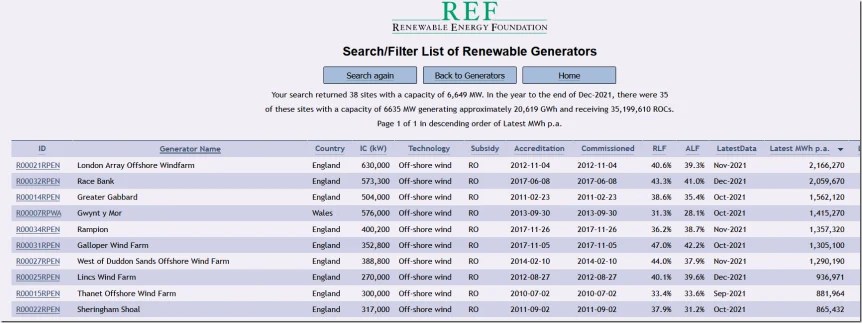
https://ref.org.uk/generators/search.php
I wrote yesterday about the ownership of the London Array offshore wind farm, To recap, London Array is jointly owned by the German owned RWE, the Canadian investor CDPQ, Orsted the Danish state owned energy company and he strategic investment company of the Government of Abu Dhabi, MASDAR. At current wholesale prices, London Array is making about £800 million a year more than they would have at 2019 prices.
None of the consortium are retail electricity suppliers in the UK, so would be shielded from any windfall tax on or nationalisation of energy suppliers, as has been suggested.
I thought I would look at some of the other big wind farms, which are subsidised by ROCs. The chart above is provided by the Renewable Energy Foundation, and I have listed below the owners of the eight other wind farms with capacity of 300 MW and over.
Race Bank – Macquarie, Orsted, Sumitomo Bank
Greater Gabbard – RWE Renewables, SSE Renewables
Gwynt y Mor – RWE Renewables, Stadtwerke Munchen, UK Green Investment Bank
Rampion – RWE Renewables, Enbridge, Offshore Wind Company
Galloper – RWE Renewables, Siemens, Macquarie, ESB, Spring Infrastructure
West Duddon – Scottish Power, Orsted
Thanet – Vattenfall
Sheringham – Equinor, Statkraft, UK Green Investment Bank
In short, they are nearly all wholly owned by a mix of foreign energy companies, banks and other infrastructure investors. As with the London Array, all of these wind farms/owners would be unaffected by taxes on energy retailers, with the exception of SSE and Scottish Power.
The combined output of these eight and London Array is about 16 TWh a year. At current prices of £375/MWh, the excess profit now being “earned” is around £5 billion a year.
Europeans Paying for Brussels’ ‘Irrational and Absurd’ Energy Policy While US Profits: Kremlin
By Ilya Tsukanov – Samizdat– 30.08.2022
The European Union and individual bloc members have taken a series of measures in recent months to reduce reliance on Russian oil, gas and coal. These efforts sent energy prices skyrocketing, and are threatening to plunge the bloc into a cold winter. Russian President Vladimir Putin has characterized European policymakers’ actions as “suicidal.”
Ordinary Europeans are being made to pay for their leaders’ “irrational” policies in relation to Russia, while Brussels’ American allies get rich from an energy bonanza, presidential spokesman Dmitry Peskov has said.
“Step by step, unfortunately, both Brussels and individual European countries are demonstrating their absolute lack of reason,” Peskov told reporters on Tuesday.
“This is demonstrated in such anti-Russian impulses, outbursts of hatred for our country, through absolutely irrational and even absurd actions in the the energy field, for which the publics of European countries – the EU, Britain and so on, have to pay, but which make it possible for American companies to turn a profit, for example,” Peskov said.
Asked to comment on Brussels’ potential discussions of banning tourist visas for Russians, the Kremlin spokesman suggested that the possibility of even discussing such ideas at the EU level demonstrates the “set of irrational bordering on insanity” prevalent among the bloc’s political elites.
The United States and the European Union dramatically reduced purchases of Russian coal, oil and gas in the spring after Moscow launched a special operation to “demilitarize” Ukraine amid fears of an imminent push by Kiev to crush the fledgling Donbass republics. The measures have since been complemented by additional restrictions, including sanctions targeting equipment used by the Nord Stream 1 pipeline, and the closing down of overland pipelines running through Poland and Ukraine delivering energy to Europe. The Nord Stream 2 pipeline, which was completed late last year and prepared for operation, remains dormant.
The deficit in Russian energy has resulted in a dramatic spike in prices, with European consumers forced to pay through the nose for utilities, while countries scramble to find alternative sources to fill up underground gas reserves to prepare for winter.
President Putin has characterized Brussels’ policies as “suicidal,” saying the self-imposed energy crisis will undermine the EU’s competitiveness vis-a-vis the United States and China.
Iran opens $1bn worth of projects in gas-rich Bushehr region
Press TV – August 29, 2022
Iran’s Oil Ministry has launched some $1 billion worth of development projects in the gas-rich region of Bushehr in the south of the country.
Oil Minister Javad Owji and his senior aides traveled to Bushehr’s port city of Asaluyeh on Monday to inaugurate several key projects that they said will boost Iran’s capacity to produce and process natural gas.
Asaluyeh, located on the western-most coast of the Persian Gulf, is home to some huge gas processing and petrochemical facilities that feed on the natural gas supplied from South Pars, the world’s largest gas field that is shared between Iran and Qatar.
The projects opened on Monday included several power plant units that will boost electricity supply to gas refineries as well as to Iran’s single natural gas liquefaction plant, known as Iran LNG.
The Oil Ministry’s news service Shana said the government had spent more than $450 million to bring on line a first unit of the Be’sat combined cycle power plant with a capacity of 160 megawatts (MW).
It said Iran’s Oil Pension Fund had invested some $360 million to finish three more units of a 1,130 MW power plant that supplies electricity to the Iran LNG project.
Other projects included a $12-million pipeline for transferring condensates from Asaluyah refineries to a storage facility in the region and a $74-million project for thiol treatment from condensates produced in several South Pars refineries.
Oil Minister Owji said the projects opened in Bushehr on Monday will create some 5,000 permanent jobs for the people of the region.
He said the government had already started works on some $2 billion worth of new development projects related to the South Pars gas field and its subsidiaries.
Featured Video
Seyed M. Marandi: Toward Total War in the Middle East
or go to
Aletho News Archives – Video-Images
From the Archives
The Geopolitics behind the War in Yemen (I)
By Mahdi Darius NAZEMROAYA | Strategic Culture Foundation | 30.03.2015
The United States and the Kingdom of Saudi Arabia became very uneasy when the Yemenese or Yemenite movement of the Houthi or Ansarallah (meaning the supporters of God in Arabic) gained control of Yemen’s capital, Sanaa/Sana, in September 2014. The US-supported Yemenite President Abd-Rabbuh Manṣour Al-Hadi was humiliatingly forced to share power with the Houthis and the coalition of northern Yemenese tribes that had helped them enter Sana. Al-Hadi declared that negotiations for a Yemeni national unity government would take place and his allies the US and Saudi Arabia tried to use a new national dialogue and mediated talks to co-opt and pacify the Houthis.
The truth has been turned on its head about the war in Yemen. The war and ousting of President Abd-Rabbuh Manṣour Al-Hadi in Yemen are not the results of «Houthi coup» in Yemen. It is the opposite. Al-Hadi was ousted, because with Saudi and US support he tried to backtrack on the power sharing agreements he had made and return Yemen to authoritarian rule. The ousting of President Al-Hadi by the Houthis and their political allies was an unexpected reaction to the takeover Al-Hadi was planning with Washington and the House of Saudi. … continue
Blog Roll
 Aletho News
- Israeli lobby seeks to bind US fate to ‘Israel’: Araghchi
- Pakistan-Iran talks secure LNG shipment to Islamabad through Hormuz
- Black Sea grain crisis puts global wheat supplies under pressure
- IRGC air defenses destroy another US MQ-1 drone over Strait of Hormuz
- Imran Khan’s entire immediate family detained in Pakistan ahead of mass protest demanding his release
- EU nation detains former presidential frontrunner
- Leaked: Britain’s Sham Conviction Of Hashim Thaci
- Seyed M. Marandi: U.S. Strike Imminent – Toward Total War in the Middle East
- Russia Voted Under Fire. Washington Is Loading the Tankers.
- 12 Things Your Oncologist Was Trained Not to Tell You
- If Americans Knew
- Israeli Attacks in Gaza Kill at Least Seven Palestinians Over Three Days, including Woman and Child
- Trump’s militarization of Washington DC as he pursues Israel’s war against Iran
- Why Israel Fears This Searing New Documentary
- Huckabee aide solicited cash gifts from Israelis
- This isn’t sci-fi, AI is already killing people
- ‘The Most Brutal Thing’: Investigation Reveals Execution of Elderly Woman in Rafah
- Inside Israel’s ‘soft’ ethnic cleansing plan for Gaza through the eyes of its victims
- New online database tracks pro-Israel political donations in the United States
- Israeli president pardons soldier convicted for killing wounded Palestinian
- Singer Ed Sheeran says his ‘heart broken’ by Gaza devastation, addresses Macklemore controversy
- No Tricks Zone
- 2025 Nature Paper Claiming Worsening Global Drought Gets RETRACTED …Heavily Flawed
- New Study: ‘Global Drought Shows No Detectable Recent Acceleration Under Climate Warming’
- Economic Masterminds: German Socialists Suggest Taxing Productivity Gains Stemming From Using AI
- The South China Sea Has Not Been Cooperating With The Climate Change Narrative
- Energy Crisis: Germany Enters Heating Season With Historically Low Gas Reserve Fill Levels
- New Study: The Antarctic Ice Sheet Gained Mass From 2020-2024 Due To Staggering Snow And Ice Accumulation
- Study: Ocean Heating Rates From Thousands Of Years Ago ‘Dwarf’ Modern Ocean Heating Rates
- Climate Extremists Target, Attack Large-Scale Power Grid Infrastructure In Germany!
- New Study: Antarctic Ice Melt Has Contributed Less Than 1 Centimeter To Sea Level Rise In The Last 30 Years
- Fear Of Debate: Alarmist German Climate Scientist Calls On Mainstream Media To Discredit Skeptic Voices
 Aletho News