German Green Party Minister Calls For Tax on Meat
By Paul Joseph Watson | Summit News | August 29, 2022
Even as the people of Germany struggle with a serious cost of living crisis, they are being told by a Green Party minister that there should be a new tax on meat.
Yes, really.
With Germans already facing soaring food inflation and energy bills as a result of gas shortages caused by the war in Ukraine, the last thing they need is another tax to pay.
But that doesn’t seemingly concern Federal Minister of Food and Agriculture Cem Özdemir (Greens), who complained that people were eating the wrong food.
“We should eat less meat overall and make sure it comes from animals that are kept in a species-appropriate manner,” said Özdemir, adding that the country should be “adapting meat consumption to planetary boundaries and for the sake of our health.”
“It is healthier, good for the climate, and helps the global food situation because areas get freed up that we previously needed for cultivating animal feed,” the minister asserted.
Özdemir said that too much cheap meat was being produced, vowing to address this apparent problem with a new tax on meat products.
The agenda to levy a new tax on meat in the name of alleviating climate change has long been a desire of globalist technocrats.
Back in March, Bloomberg News received a massive backlash for offering ‘tips’ to Americans who might struggle with the rising cost of living which included letting their pets die and eating lentils instead of meat.
As we reported earlier this year, a group of environmental economists in Germany demanded that huge taxes be imposed on meat products to fight climate change, with calls for beef to be 56 per cent more expensive.
As we previously highlighted, the World Economic Forum published two articles on its website which explored how people could be conditioned to get used to the idea of eating weeds, bugs and drinking sewage water in order to reduce CO2 emissions.
Despite insisting that everyone else reduce their living standards and ration their meat eating to save the planet, during last year’s Cop 26 summit, attendees enjoyed a menu full of animal-based dishes that were at least double the carbon footprint of the average UK meal.
Another Green Party official recently caused controversy by suggesting Germans use washcloths instead of taking showers, as well as buying expensive eco-heating systems that are unaffordable for the average person.
Germany wants EU unanimity rule scrapped
Samizdat | August 29, 2022
German Chancellor Olaf Scholz on Monday called on EU members to abandon the right to veto in favor of majority voting in a number of key areas. Such a move could facilitate the bloc’s future expansion.
Speaking at the Charles University in Prague, Scholz argued that changing voting practices may help to grow the EU, given that currently any bloc member can veto the accession of a candidate country. He also suggested introducing majority voting on a number of pressing matters, including sanctions and human rights.
“Where unanimity is required today, the risk of an individual country using its veto and preventing all the others from forging ahead increases with each additional member state,” the German chancellor said.
According to Scholz, “the principle of unanimity only works for as long as the pressure to act is low,” citing the example of Russia’s military offensive in Ukraine, which has challenged the way the EU approaches policymaking.
The German leader also wants the EU to switch to majority voting in areas such as taxation and foreign policy, adding that he knows “full well that this would also have repercussions for Germany.”
Scholz noted that Berlin supports enlargement of the EU, adding that he believes that the western Balkan countries, as well as Ukraine, Moldova, and Georgia would eventually join the bloc and that this will inevitably bring more differences among members.
Hungary Urges Foreign Ambassadors to Act Like Diplomats, Not Viceroys
By Ilya Tsukanov | Samizdat | August 29, 2022
Hungary has stood alone among its neighbors in refusing to slap new sanctions on Moscow, and has rejected demands by Brussels to rapidly cut dependence on Russian energy supplies. Budapest has also denied access to its territory for Western arms delivery to Ukraine, saying the security crisis can only be resolved through talks.
Hungary will independently determine what policies it will pursue, and foreign ambassadors should do their duty instead of lecturing Budapest, Foreign Minister Peter Szijjarto has urged.
“We do not send viceroys to other countries, but ambassadors…and receive ambassadors, not viceroys,” Szijjarto said in a meeting with Hungarian diplomats.
“And in the future we will not tolerate it if a representative of some other country decides that that they can teach us about a different or better life. Thanks very much, but we aren’t asking for that. We can determine ourselves how we should live in Hungary. The Hungarian electorate regularly decides this question in elections,” the foreign minister said.
Szijjarto warned foreign diplomats stationed in Budapest that any ambassador who sees themselves as a viceroy rather than a diplomat will “have difficulties,” because Hungary will not bow to any “bad compromises.”
Hungary, Szijjarto said, has based its foreign policy on mutual respect, and will continue to do so. “This means that we have behaved as representatives of a national government with a thousand year history and the corresponding self-confidence, giving respect to our partners and expecting the same respect in return.”
Hungary summoned Estonia’s ambassador to Budapest earlier this month over what Hungary’s Foreign Ministry characterized as “unacceptable’ comments made by politicians in Tallinn, who have criticized Hungary over its foreign policy vis-à-vis Ukraine and Russia.
Budapest has demonstrated its domestic and foreign policy independence for more than a decade, with the government of Prime Minister Viktor Orban getting into spats with Brussels on a broad range of issues from immigration to a move to kick a George Soros-funded university out of the country.
After the escalation of the Ukraine crisis in February, Hungary hesitated in signing on to the raft of new European Union sanctions against Russia, refused to allow convoys of NATO military equipment to use the country to transfer weapons to Kiev, and has continued to buy Russian oil and gas, warning that the Central European country’s economy would collapse otherwise.
Last month, summarizing the impact of months of Brussels’ policy, Orban reveled in the correctness of his approach, comparing the West’s policy vis-à-vis Russia to a “car with flat tires on all four tires” and pointing out that sanctions had made no change in Moscow’s course, but only cost Europe four governments.
Orban also warned last month that Europe would be turned into a “war economy” by October if Brussels didn’t change course on its “ineffective” sanctions against Russia and weapons deliveries to Ukraine. “You do not usually put out fires with flamethrowers,” he stressed.
Hungary’s unique approach to the Ukrainian crisis also stems in part from Budapest’s bad blood with its neighbor over its treatment of ethnic Hungarian Ukrainians following the 2014 Maidan coup, after which the minority gradually lost its right to receive an education in its native tongue.
In June, a vicious back-and-forth war or words broke out between Ukrainian and Hungarian officials after Hungarian parliamentary speaker Laszlo Kover suggested that Ukrainian President Volodymyr Zelensky was suffering from a “mental problem” accounting for his government’s undiplomatic approach to asking Western countries for help against Russia.
Johnson Predicts Harsh Months for UK Due to ‘Eye-Watering’ Energy Bills
Samizdat – 28.08.2022
Outgoing UK Prime Minister Boris Johnson said in an op-ed that a few coming months will be tough for the British due to high energy prices.
“The months ahead are going to be tough, perhaps very tough,” Johnson wrote in an article, published by Daily Mail newspaper on Saturday. “Our energy bills are going to be eye-watering,” he said, adding “for many of us, the cost of heating our homes is already frightening.”
According to Johnson, the beginning of Russia’s special operation in Ukraine significantly affected the energy markets. However, he claims that the UK will emerge from the crisis stronger and more prosperous.
The UK prime minister said, referring to the confrontation with Russia, that “in this brutal arm-wrestle, the Ukrainian people can and will win. And so will Britain.”
The outgoing prime minister promised that whoever will be his successor, they will announce new measures of financial support for fellow citizens to tackle surging electricity prices.
On Friday, the UK energy regulator Ofgem announced an 80% increase in the energy price cap to 3,549 pounds ($4,194) per year starting October 1 due to rising global energy prices. Since its last revision in April, the energy price cap has stood at 1,971 pounds. In October 2021, the price cap was 1,277 pounds.
Ofgem chief executive Jonathan Brearley warned that energy prices are likely to continue to rise, and called on the country’s future prime minister to take new measures to tackle the problem.
Natural gas pipelines reach Zabol in Iran’s far east
Press TV – August 28, 2022
Natural gas pipelines have reached Iran’s far eastern city of Zabol near the border with Afghanistan as Iran’s Oil Ministry pushes ahead with an ambitious plan to make natural gas available to almost the entire population in the country.
Oil Ministry authorities and local officials attended a ceremony in Zabol on Sunday to celebrate the city’s connection to the Lane 7 of Iran’s nationwide gas pipeline network.
Reports in the local media said that the government had spent 2.5 trillion rials ($85 million) to finish the 219-kilometer gas pipeline connecting the provincial capital of Zahedan to Zabol, a large population center located 20 kilometers from the Iran-Afghanistan border.
Authorities said the arrival of gas to Zabol will enable all villages and towns in the relatively impoverished region to access natural gas through pipelines.
The inauguration came as the Oil Ministry launched several major gas projects, including the connection to the gas pipelines of 16 towns, some 1,091 villages and 1,959 manufacturing units.
Oil Minister Javad Owji said the gas projects opened on Sunday had cost the government some 10 trillion rials ($335 million).
Iran has one of the largest natural gas supply networks in the world. Official figures show that natural gas is currently available to more than 87% of the population in the country through a pipeline network that is more than 37,000 kilometers in length.
The Iranian government has an ambitious plan to further expand the pipeline network to supply natural gas to almost the entire population, including all villages with more than 20 households.
Hungary Says There Are EU Countries That Silently Oppose Anti-Russian Sanctions
Samizdat – 28.08.2022
Hungarian Minister of Foreign Affairs and Trade Peter Szijjarto has stated that Budapest is not alone in its reluctance to slap sanctions on Russian energy exporters, but that other countries, who are under the influence of the “liberal mainstream,” don’t dare to pursue policies based on their own interests.
Speaking at the TRANZIT public forum in Tihany, Hungary on Saturday, Szijjarto said that he would like to clarify that his country is “not even willing to negotiate any further sanctions” pertaining to the oil and gas sector.
“And I want to say that we are not alone in this,” the top Hungarian diplomat stressed, recalling an episode during a recent EU ministerial meeting, which focused on “the issue of limiting oil from Russia.”
According to Szijjarto, during the gathering, “several colleagues” approached him and said, “Peter, you are against it [sanctions on Russian oil exports], right? We are with you.”
“Those who tell the truth are under such amazing pressure from the liberal mainstream that if there is no political stability of a certain level and, as a result, political courage in the country, they simply do not dare to act in their own interests,” the Hungarian foreign minister pointed out.
During the speech, Szijjarto also gave his thoughts on how long Europe will hinge on Russian oil and gas. He argued that “as long as gas cannot be transported by train or in a backpack, Europe will not be able to get rid of dependence on Russian energy resources.”
Last month, Hungarian Prime Minister Viktor Orban insisted that while the sanctions had failed to destabilize Moscow, “Europe is in trouble, economically and politically, and four governments have become victims: UK, Bulgarian, Italian and Estonian.”
“People will face a sharp increase in prices. And the better part of the world deliberately did not support us as well — China, India, Brazil, South Africa, the Arab world, Africa — everybody is aloof from this [Ukraine] conflict, they are interested in their own affairs,” Orban added.
Also in July, Russian President Vladimir Putin admitted that sanctions damage the country’s economy and many risks still remain, but that these restrictive measures inflict more damage on those who imposed them.
Sanctions against Russia were slapped by the US and its allies in late February, shortly after Moscow launched its special operation to demilitarize and de-Nazify Ukraine. In the wake of the West’s anti-Russian restrictive measures, inflation skyrocketed in many Western countries, driving energy prices there to record numbers.
US wants India to imitate Europe’s self-sabotaging energy policy
India continues long and fruitful relationship with Russia despite Western pressure
By Ahmed Adel | August 26, 2022
Indian Foreign Minister S Jaishankar confidently boasted recently that the world has accepted India’s energy policy and bilateral relations with Russia. Jaishankar’s statement prompted US State Department spokesperson Ned Price to say that it is going to be a long-term proposition for New Delhi to reorient foreign policy away from Moscow – but despite the QUAD alliance, India is unlikely to abandon its relations with Russia.
When asked about India increasing its imports of Russian oil and fertilisers and potentially buying the Russian S-400 air defence systems, Price said on August 24: “It is not for me to speak about another country’s foreign policy. But what I can do is point out what we have heard from India. We have seen countries around the world speak clearly, including with their votes in the UN General Assembly against Russia’s aggression in Ukraine.”
“But we also recognise, as I was saying just a moment ago, that this is not flipping a light switch. This is something that, especially for countries that have historical relationships with Russia. Relationships that, as is the case with India, extend back decades, it is going to be a long-term proposition to re-orient foreign policy away from Russia,” he added.
Although the US and European Union have imposed heavy sanctions on Russia since the military operation in Ukraine began on February 24, India took the opportunity to instead raise oil imports from Russia, ignoring criticism from the West and refusing to go down the path of European self-sabotage.
Berlin recently approved a set of energy-saving measures for the winter which will limit the use of lighting and heating. Germany’s Economy Minister Robert Habeck told reporters that his country wanted to free itself “as quickly as possible from the grip of Russian energy imports.” Instead, Germany finds itself in a position of needing to lower energy use instead of behaving as the EU’s leading country.
Starting from September, public buildings, apart from hospitals and the like, will have heating at a maximum of 19C; public monuments and buildings will also not be lit up for aesthetic reasons; businesses could be banned from keeping their shops illuminated at night; private swimming pool heating could also be banned; and, coal and oil cargo will be given priority over passenger travel on railways.
“We have a shortage situation on the rails right now,” German Transport Minister Volker Wissing said. “That means that if additional fuel transports are temporarily necessary, we would have to prioritize them.”
This European self-sabotage, all for the sake of pretending to defend liberalism in the form of Kiev’s authoritarian regime and on instructions from Washington, is a situation that India wants to completely avoid as it continues to progress and develop into a major power.
In May, Russia overtook Saudi Arabia to become India’s second-biggest supplier of oil, behind Iraq, as refiners snapped up Russian crude available at major discounts. Indian refiners bought about 25 million barrels of Russian oil in May, ignoring all condemnation from the West and refusing to abandon its decades-old relationship with Moscow, especially as Indians do not forget the West’s endless support and backing of Pakistan.
Jaishankar stressed on August 23 that India had not been defensive about its purchases of Russian oil but made the US and others realize instead that the government had the “moral duty” to ensure that the people got the “best deal” – something that European governments do not concern themselves with.
Rather than capitulating to the endless pressures from the West, India has unapologetically steamed ahead with its bilateral relations with Russia. Cards based on Russia’s Mir payment system will soon be accepted at ATMs and Point-of-Sale terminals in India as discussions to construct a new financial system independent of the West, that can bypass sanctions on Russia, continue.
Russia also announced its intentions to build the next generation armoured vehicles and submarines in joint collaboration with India. This comes as the delivery of the second regiment of the S-400 missile defence system is already underway.
With India pushing ahead in strengthening relations with Russia in the energy, financial and military sector, the West is forced to exaggerate minor events as if it were a major shift in New Delhi’s foreign policy. Western media exaggerated the significance of India voting for the first time against Russia during a “procedural vote” at the United Nations Security Council on Ukraine. The 15-member UN body invited Ukrainian President Volodymyr Zelensky to address a meeting through a video tele-conference on August 24, something that was only opposed by Moscow and abstained by Beijing.
So far, New Delhi has abstained at the UNSC on Ukraine, with the recent vote being the only exception. This has annoyed the Western powers, led by the US, but this has not stopped them from making a big deal out of India voting to allow Zelensky to speak at the UNSC meeting. This of course does not reflect or signify any Indian foreign policy shift, but is rather a desperate attempt to portray non-existent cracks in New Delhi-Moscow ties. Instead, New Delhi will continue its decades-long cooperation with Moscow, one that has been long and fruitful.
It is recalled that Jaishankar said in June that “Europe has to grow out of the mindset that Europe’s problems are the world’s problems, but the world’s problems are not Europe’s problems.” Soon Europe will realize, especially Germany, that its energy and financial crisis, spurred on by an ill-thought out Russophobic policy, will certainly not be India’s problem, especially with winter just around the corner.
Ahmed Adel is a Cairo-based geopolitics and political economy researcher.
Siemens Energy Has Trouble Selling Off Turbine Business in Russia
Samizdat – 26.08.2022
MOSCOW – Siemens Energy might not be able to sell its turbine business to Russian company Inter RAO as its local subsidiaries, Siemens Gas Turbine Technologies (SGTT) and Siemens Energetika, fall under a recent law banning sale of shares to investors from unfriendly countries, newspaper Kommersant reported Friday, citing sources.
Siemens Energy’s two subsidiaries in Russia were put on the ban list tentatively, according to the report.
Negotiations between Siemens and Inter RAO were conducted even before the publication of the decree, and the parties were planning to sign an agreement in the coming weeks, according to the newspaper. Although Inter RAO has already submitted a request to the government to exclude SGTT from the list of companies subject to the ban, there is a possibility that the deal will be frozen.
Siemens Energy announced in its third quarter financial report on August 8 that it had started the restructuring of its business activities in Russia, which are expected to be completed by the end of 2022. In the third quarter, Siemens’ losses from the gas and electricity segment amounted to 200 million euros ($199.5 million).
Russian President Vladimir Putin signed a decree on August 5 that specifically bans the sale of foreign shares in strategic Russian companies, primarily in the energy sector, unless authorized by the Russian government.
SGTT is a joint venture between Siemens AG which owns 65% and Russian energy equipment manufacturer Power Machines that owns 35%. SGTT produces, sells and does maintenance service of gas turbines with a capacity above 60 megawatt for the Russian and CIS markets. According to the company, the localization level of the 2000E gas turbine, one of the most popular in the Russian market, reaches 52%.
Sanctions against Russia damage Western business
By Lucas Leiroz | August 26, 2022
The West itself appears to be the party most harmed by the sanctions it has chosen to impose against Russia. As well known, the US, UK and EU are facing a wave of inflation with all-time highs. And in the same sense, the business world is collapsing in Western countries. The business losses with the end of participation of some Western companies in the Russian market are extremely significant and are causing serious problems for the economy of many countries, with losses accumulating exorbitant amounts.
It is estimated that American, European, British, and Japanese companies have already lost more than 70 billion dollars since February. The losses are a consequence of the packages of sanctions imposed by Western countries on Moscow in response to the start of the special military operation in Ukraine. Many corporations withdrew from Russia or had their activities frozen, losing insertion in the powerful market of consumption, work and raw materials offered by Russia.
As expected, the most affected sector is the energy one, whose losses are estimated at almost 55 billion dollars, generating a series of problems for Western societies. Relations between Russia and Western Europe in the energy sector have always been a central strategic point in the international economic balance and now seem more threatened than ever. However, other sectors are also in similar situations.
Agricultural commodity, food and tobacco markets achieved losses of almost 8 billion dollars. In the same sense, in the technology and IT sector, 5 billion dollars of losses have already been accumulated. And there is also the vital banking sector, whose side effects of anti-Russian financial coercive measures have already led to a loss of 3,7 billion dollars – most of this amount belonging to Société Générale, the only banking group to have left Russia completely so far.
With regard specifically to the energy sector, the European and British companies most affected were BP, Linde, Uniper and Total Energies, whose billions of dollars in assets were harmed as a result of the suspension of the Nord Stream 2 gas pipeline and other Russian-European projects of cooperation. The process of disintegration of the Russian and European energy markets will not be so easily completed, as it is necessary to reverse a scenario of decades of cooperation, which will undoubtedly take time.
For example, BP, which announced its unconditional withdrawal from the Russian market in February, still remains one of Rosneft’s main partners, owning 19.75% of its shares. However, the process of disintegration has progressively advanced. BP itself revealed a loss of more than 25 billion dollars due to the freezing of its activities in Russia, pointing to a scenario that indicates a path towards the end of the cooperation in the near future.
American and Japanese energy companies are heading in the same direction. ExxonMobil, Mitsui & Co and Mitsubishi Corporation were some of the companies that had the most losses in recent months, mainly as a result of the effects that the coercive measures had on the Sakhalin-I and Sakhalin-II projects. Obviously, other energy companies were also affected by the packages of sanctions, albeit on a smaller scale, showing a scenario of generalized losses for this sector’s businesses.
For Russia, however, the deficits are much smaller and almost never imply real losses, but market restructurings. In energy, Russian oil and gas production remains strong and active, unaffected by the departure of some Western companies. The withdrawal of these companies makes room for other markets, such as the Chinese and Indian, which are the ones that have stood out in the search for Russian oil and gas in recent months. Meanwhile, Western companies lose important sources of supply that will not be easily resolved.
As for market sectors in which Russian consumption was of interest to Western companies, there are even fewer losses. The corporations that withdrew from Russia left their physical production structures there, which could be used by Moscow, generating employment for the Russian population, internal circulation of capital and economic progress.
For example, McDonald’s lost more than one billion dollars with its adherence to anti-Russian measures, but its withdrawal from the local market made room for the nationalization of the company’s production structures, and a Russian national company was created to sell fast food for Russian citizens. The same is currently happening with other Western companies that have left the Russian market. In short, the West lost a rich consumer market and handed over to Moscow all the necessary means for Russians themselves to supply their population with such goods and services.
In practice, all these facts simply mean damage to Western business. Entrepreneurs do not appear to have been consulted by heads of state on whether or not sanctions were in their best interest. The measures were simply imposed unilaterally to meet NATO’s geopolitical plans, without considering the opinion of companies that generate jobs for Western citizens. Currently, there are still plans to completely ban the entry of Russian citizens into Europe, which according to estimates will generate losses of more than 20 billion euros, harming the entire European market.
In fact, western sanctions, if not reversed, will lead the world into a global recession in which the most affected will be the western countries themselves. To avoid this, the business sector must mobilize to demand an end to sanctions.
Lucas Leiroz is a researcher in Social Sciences at the Rural Federal University of Rio de Janeiro; geopolitical consultant.
Macron says the end of abundance is here
By Thomas Lambert | The Counter Signal | August 24, 2022
President Emmanuel Macron has warned the French populace that the end of abundance is here, and they should get used to living with less.
“What we are currently living through is a kind of major tipping point or a great upheaval… we are living the end of what could have seemed an era of abundance… the end of the abundance of products of technologies that seemed always available … the end of the abundance of land and materials including water,” he said in an interview. [emphasis added]
“This overview that I’m giving, the end of abundance, the end of insouciance, the end of assumptions — it’s ultimately a tipping point that we are going through that can lead our citizens to feel a lot of anxiety,” he continued. “Faced with this, we have a duty, duties, the first of which is to speak frankly and clearly without doom-mongering.”
However, while it looks like Macron may be right when he proclaims the “end of abundance” for some people, this is not the case for everyone.
Macron’s statements come the same month that corporate profits hit record highs amidst a nationwide housing crisis.
As reported by the Daily Times, “France’s CAC 40 stock index, which includes the country’s largest companies, just reported its best quarter ever.”
“From a profit perspective, 73 billion euros represents a 26% increase over 2013. Record-breaking inflation, energy shortages, economic growth nearing recession, and the most difficult times for the average French household since the 2008 financial crisis have all contributed to this year’s record.”
Similarly, dividends paid out by large French companies in the second quarter reached a record 44.3 billion Euros (a 32.7% increase), which was significantly higher than the European average.
Clearly, not everyone is suffering from the same lack of “abundance.”
As for “doom-mongering,” which Macron said people should avoid, it’s not surprising that he sees this as an issue as it largely stems from statements made and actions taken in recent months.
In July, Macron told the public sector to cut down on its energy use and asked the private sector to do the same amidst an energy crisis that could’ve been avoided. This cut in energy use includes, amongst other things, turning off the streetlights at night and passing a new law regulating air conditioning.
Meanwhile, supermarkets have already begun cutting down on their energy use thanks to soaring prices, going so far as signing an agreement to reduce heating in their stores this winter.
Anyone can see why the average person would be concerned about the state of France and where things are going. And unfortunately for the French people, it doesn’t appear the government, nor the financial elite who have made record profits amidst the decline, are doing anything tangible to remedy the situation. Instead, the President is quite literally telling people that they should get used to never having the same quality of life that they used to enjoy.
Southeast Asia at Energy-Climate Crossroads
By Vijay Jayaraj | RealClear Energy | August 10, 2022
Southeast Asia is at the crossroads of choosing between a climate agenda hostile to fossil fuels and the energy security its population desperately needs.
Central to the question is the use of coal. The fuel is especially critical in the production of electricity for the 700 million people of the 10 countries making up the Association of Southeast Asian Nations (ASEAN): Brunei, Cambodia, Indonesia, Laos, Malaysia, Myanmar, Philippines, Singapore, Thailand and Vietnam.
Electricity demand in Southeast Asia grew by 22 percent between 2015 and 2021, greater than the global average. The International Energy Agency predicts that “energy demand in the region is set to grow by around 3 percent a year to 2030, with three-quarters of the increase being met by fossil fuels…The net oil import bill, which stood at $50 billion in 2020, is set to multiply in size rapidly.”
Contributing to the energy bill is the global phenomenon of inflation. In June, the highest rates of inflation in ASEAN were in Thailand (7.7 percent), Vietnam (3.4 percent), Philippines (6.1 percent) and Indonesia (4.3 percent), mainly due to rising energy and food prices.
Adding to the pressures of higher demand for electricity and more expensive fuel is growing pressure from international political bodies to reduce fossil fuel consumption. Propositions such as the Paris agreement and the net zero agenda have captured the imaginations of the political elite with ASEAN countries within the grasp of the climate-crazy octopus.
Disregarding fossil fuels’ contribution to its economic growth in the last decade, Vietnam has espoused the net zero pledge. In its new National Power Development Plan, the country indicated its desire to reduce “coal-fired plants to less than 10 percent of the total capacity by 2045,” in addition to halting construction of new coal plants. With nearly 70 percent of all electricity coming from fossil fuels, Vietnam has absurdly declared war on coal.
Vietnam is ranked at a dismal 134th in global ranking for per capita energy consumption. Its “peak demand during 2022 – 2025 will rise by 2,830 megawatts (MW) annually on average while power generation will increase by only 1,565 MW per annum.” The decision to reduce coal consumption at this juncture is suicidal, running counter to the country’s objective of economic growth.
However, not all ASEAN countries have been as irresponsible as Vietnam. Because of the post-pandemic increase in energy demand, many ASEAN members are reversing decisions to reduce fossil fuel consumption.
Among them is Indonesia, one of the biggest producers of coal in Asia and a major exporter to other countries. Indonesia is reporting a 4 percent increase in coal mining during the 2nd quarter of 2022 following a ban on Russian coal. A further increase is expected to be prompted by a broader ban to be instituted by the EU in August. Indonesia’s largest energy infrastructure company has now acquired a Thai state-owned energy firm, expanding its coal mining business to Thailand and ensuring continuous coal production there.
Some in ASEAN are installing innovative fuel-saving artificial intelligence systems in their coal plants to make them more efficient, thus indicating that their reliance on coal power is here to stay.
Perhaps, the ASEAN countries will model neighboring India and China, which continue to increase fossil fuel consumption to meet energy demand. China, for example, approved a coal mine project worth $458 million in the Inner Mongolia region as recently as July.
The worst mistake would be to decommission ASEAN coal-fired power plants. Even the economic powerhouses of Europe like Austria, Germany and the UK have reopened coal plants to ensure energy security.
If common sense prevails, most ASEAN countries will adopt clean-coal technology, which provides remarkably low pollutant emissions and less dust. In fact, its safety and efficiency are so recognized that Japan is exporting its technology to other countries. India, which is the second largest consumer of coal, has opened a National Centre for Clean Coal Research and Development.
A 2020 report by the CO2 Coalition, found that clean-coal technology “virtually eliminates health hazards from sulfur dioxide, nitrogen oxides, and particulate matter,” thus reducing the outdoor pollution problem that is so common in low-income and mid-income economies like those in ASEAN.
Still in the grip of energy poverty, ASEAN countries that deprive themselves of affordable fossil fuels risk becoming the next Sri Lanka.
Vijay Jayaraj is a Research Associate at the CO2 Coalition, Arlington, Va., and holds a master’s degree in environmental sciences from the University of East Anglia, England. He resides in Bengaluru, India.
The Completely Fraudulent “Levelized Cost Of Electricity”
By Francis Menton | Manhattan Contrarian | August 18, 2022
My last post on Tuesday reported on the Soho Forum climate change debate that had taken place the previous day. Debater Andrew Dessler, arguing in favor of rapid reductions in human greenhouse gas emissions by the method of vastly increasing electricity production from wind and solar generators, had heavily relied on the assertion that wind and solar are now the cheapest ways to generate electricity. An important slide in his presentation showed comparative costs of generation from various sources, with wind and solar clearly shown as least expensive. At the bottom of the slide, the acronym “LCOE” was legible.
LCOE stands for Levelized Cost of Electricity. I first encountered this term a couple of years ago, and thought that I should get on top of it to understand its significance. It took me about a half hour to figure out that this metric was completely inapplicable and invalid for purposes of comparing the costs of using dispatchable versus non-dispatchable generators as the predominant sources to power an electrical grid that works. The reasons are not complicated, but do take some minutes of thought if the matter has not previously been explained to you. In Tuesday’s post, I asked as to Dessler’s reliance on this LCOE metric:
[I]s he aware of this [inapplicability of LCOE] and therefore intentionally trying to deceive the audience? Or, alternatively, is he innumerate, and does not understand how this works quantitatively?
Some commenters on the post were quite harsh in their judgments of Dessler. They argued for the inference of intentional deception, on the basis that no one claiming expertise in this field could really be so obtuse as to think LCOE was a valid metric for the purpose for which Dessler was using it.
So today I thought to look at how others go about comparing the costs of generation of electricity from wind and solar versus dispatchable sources like fossil fuels or nuclear. I can’t say that I was surprised to learn that LCOE is everywhere as the metric of choice for the comparison. Moreover, it is almost impossible to find any discussion of why LCOE is completely misleading when comparing the cost of a grid powered predominantly by dispatchable sources to the cost of a grid powered predominantly by intermittent wind and solar sources backed up by storage.
Consider, for example, the International Renewable Energy Agency, going by the acronym IRENA. IRENA is a UN offshoot, launched in 2009 and based in Abu Dhabi, that currently has 168 member countries including all the big ones. IRENA’s mission is to advocate for and promote “renewables” as the way to go for the world’s energy system. Surely, with all the big countries (and most of the small ones) backing its efforts, IRENA’s utterances can be relied upon as definitive.
IRENA puts out annual reports on the costs of renewable power generation. The latest one, titled “Renewable Power Generation Costs in 2021,” just came out in July. Here is the press release, dated July 13, 2022. Excerpt from the press release:
New IRENA report shows almost two-thirds of renewable power added in 2021 had lower costs than the cheapest coal-fired options in G20 countries. . . . IRENA’s new report confirms the critical role that cost-competitive renewables play in addressing today’s energy and climate emergencies by accelerating the transition in line with the 1.5°C warming limit and the Paris Agreement goals. . . . “Renewables are by far the cheapest form of power today,” Francesco La Camera, Director-General of IRENA said. “2022 is a stark example of just how economically viable new renewable power generation has become.”
Amid the excited claims that renewables are “by far the cheapest” sources of power, the term LCOE does not appear anywhere in the press release. To find that that is the metric being used to make these “by far the cheapest” claims, you need to go to the main Report. Excerpt:
The global weighted average levelised cost of electricity (LCOE) of new utility-scale solar PV projects commissioned in 2021 fell by 13% year-on-year, from USD 0.055/kWh to USD 0.048/kWh. . . . The global weighted average LCOE of new onshore wind projects added in 2021 fell by 15%, year-on-year, from USD 0.039/kilowatt hour (kWh) in 2020 to USD 0.033/kWh.
Here is the featured chart, showing that costs of power from solar PV cells have now fallen well below the costs of power from natural gas:
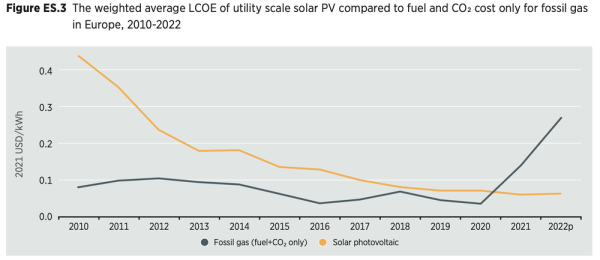
You can see right there that here in 2022 power from natural gas is at least three times as expensive as power from solar PV cells. But the title of the chart gives away that the metric for comparison is LCOE.
Look around for others making cost comparisons of ways to produce electricity, and you will find more and more of same. From Bloomberg, June 30, 2022, “Renewable Power Costs Rise, Just Not as Much as Fossil Fuels”:
The costs for renewable plants plunged for a decade as production of solar and wind equipment surged and technologies improved, but the supply-chain chaos triggered by the pandemic ended those steady declines last year, according to BNEF’s biannual survey of the levelized cost of energy. . . . New onshore wind now costs about $46 per megawatt-hour, while large-scale solar plants cost $45 per megawatt-hour. In comparison, new coal-fired plants cost $74 per MWh, while gas plants are $81 per MWh.
From the Guardian, June 23, 2021 (citing last year’s report from IRENA — also based on LCOE):
Almost two-thirds of wind and solar projects built globally last year will be able to generate cheaper electricity than even the world’s cheapest new coal plants, according to a report from the International Renewable Energy Agency (Irena). . . . Francesco La Camera, Irena’s director general, said . . . “ “Today renewables are the cheapest source of power.”
So it’s not just Dessler. Some big international agency of “experts” adopts LCOE for making these cost comparisons, and everybody just nods along without ever putting in the 30 or so minutes of critical thinking that would be needed to figure out that this is completely wrong.
To reiterate points previously made, the LCOE metric assumes that wind and solar generators are essentially the same kind of thing as dispatchable fossil fuel-powered generation plants. Just build about the same amount of nameplate capacity, and everything will work out just fine. But in fact a predominantly wind/solar system requires vastly more infrastructure to make a fully-functioning reliable grid: some combination of a 4x or 5x overbuild of generators, vastly more transmission lines, and 20 or 30 days of battery storage. These elements could easily multiply the cost of electricity to the consumer by a factor of 5 or 10 or more. Nobody knows, because there is no functioning demonstration project from which reasonably precise costs can be extrapolated. And frankly, there never will be such a demonstration project, because the costs are so enormous that it can never be done. Meanwhile, everyone just nods along as if LCOE comparisons are meaningful.
Featured Video
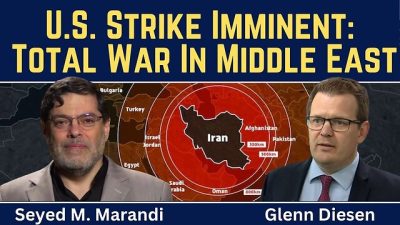
Seyed M. Marandi: Toward Total War in the Middle East
or go to
Aletho News Archives – Video-Images
From the Archives
The Geopolitics behind the War in Yemen (I)
By Mahdi Darius NAZEMROAYA | Strategic Culture Foundation | 30.03.2015
The United States and the Kingdom of Saudi Arabia became very uneasy when the Yemenese or Yemenite movement of the Houthi or Ansarallah (meaning the supporters of God in Arabic) gained control of Yemen’s capital, Sanaa/Sana, in September 2014. The US-supported Yemenite President Abd-Rabbuh Manṣour Al-Hadi was humiliatingly forced to share power with the Houthis and the coalition of northern Yemenese tribes that had helped them enter Sana. Al-Hadi declared that negotiations for a Yemeni national unity government would take place and his allies the US and Saudi Arabia tried to use a new national dialogue and mediated talks to co-opt and pacify the Houthis.
The truth has been turned on its head about the war in Yemen. The war and ousting of President Abd-Rabbuh Manṣour Al-Hadi in Yemen are not the results of «Houthi coup» in Yemen. It is the opposite. Al-Hadi was ousted, because with Saudi and US support he tried to backtrack on the power sharing agreements he had made and return Yemen to authoritarian rule. The ousting of President Al-Hadi by the Houthis and their political allies was an unexpected reaction to the takeover Al-Hadi was planning with Washington and the House of Saudi. … continue
Blog Roll
 Aletho News
- Israeli lobby seeks to bind US fate to ‘Israel’: Araghchi
- Pakistan-Iran talks secure LNG shipment to Islamabad through Hormuz
- Black Sea grain crisis puts global wheat supplies under pressure
- IRGC air defenses destroy another US MQ-1 drone over Strait of Hormuz
- Imran Khan’s entire immediate family detained in Pakistan ahead of mass protest demanding his release
- EU nation detains former presidential frontrunner
- Leaked: Britain’s Sham Conviction Of Hashim Thaci
- Seyed M. Marandi: U.S. Strike Imminent – Toward Total War in the Middle East
- Russia Voted Under Fire. Washington Is Loading the Tankers.
- 12 Things Your Oncologist Was Trained Not to Tell You
- If Americans Knew
- Israeli Attacks in Gaza Kill at Least Seven Palestinians Over Three Days, including Woman and Child
- Trump’s militarization of Washington DC as he pursues Israel’s war against Iran
- Why Israel Fears This Searing New Documentary
- Huckabee aide solicited cash gifts from Israelis
- This isn’t sci-fi, AI is already killing people
- ‘The Most Brutal Thing’: Investigation Reveals Execution of Elderly Woman in Rafah
- Inside Israel’s ‘soft’ ethnic cleansing plan for Gaza through the eyes of its victims
- New online database tracks pro-Israel political donations in the United States
- Israeli president pardons soldier convicted for killing wounded Palestinian
- Singer Ed Sheeran says his ‘heart broken’ by Gaza devastation, addresses Macklemore controversy
- No Tricks Zone
- 2025 Nature Paper Claiming Worsening Global Drought Gets RETRACTED …Heavily Flawed
- New Study: ‘Global Drought Shows No Detectable Recent Acceleration Under Climate Warming’
- Economic Masterminds: German Socialists Suggest Taxing Productivity Gains Stemming From Using AI
- The South China Sea Has Not Been Cooperating With The Climate Change Narrative
- Energy Crisis: Germany Enters Heating Season With Historically Low Gas Reserve Fill Levels
- New Study: The Antarctic Ice Sheet Gained Mass From 2020-2024 Due To Staggering Snow And Ice Accumulation
- Study: Ocean Heating Rates From Thousands Of Years Ago ‘Dwarf’ Modern Ocean Heating Rates
- Climate Extremists Target, Attack Large-Scale Power Grid Infrastructure In Germany!
- New Study: Antarctic Ice Melt Has Contributed Less Than 1 Centimeter To Sea Level Rise In The Last 30 Years
- Fear Of Debate: Alarmist German Climate Scientist Calls On Mainstream Media To Discredit Skeptic Voices
 Aletho News