Canada announces millions in funding for COVID isolation site
By Thomas Lambert | The Counter Signal | August 22, 2022
The Trudeau government has announced $4.2 million in additional funding to keep a Windsor-Essex ‘voluntary’ isolation site afloat until March 2023.
In a new release, the Government of Canada said that isolation remains one of the best ways to slow the spread of COVID despite it being over two years since COVID began and there being little to no evidence to support such a position.
The government continues, saying that the isolation site will be used to accommodate foreign agri-workers who can’t find a place to isolate when they enter Canada. “These workers tend to live in close accommodations and work in congregate settings, which makes it difficult to isolate, if required,” reads the news release.
“As Essex continues to welcome thousands of incoming agricultural workers in the coming weeks and months, this critical federal funding will provide spaces for those who are unable to isolate safely in the community,” said Windsor-Tecumseh MP Irek Kusmierczyk.
“Thank you to Health Minister Jean-Yves Duclos and the federal government for recognizing the unique challenges our community faces and always standing up for Windsor-Essex.”
According to the news release, the $4.2 million given to the County of Essex will allow the site to operate 50 rooms for foreign agri-workers until March 31, 2023. ($84,000/room)
The site, formerly operated by the City of Windsor, was previously allotted $4.8 million for the same purpose, with funding lasting until June 30, 2022.
While unvaccinated foreign nationals are still prohibited from entering Canada thanks to the country’s vaccine mandate, an exemption exists for agricultural and food processing workers, marine crew workers, those making medical deliveries, and those that work with medical equipment.
However, despite the exemption, agri-workers still have to follow testing and quarantine requirements upon arrival, including a mandatory (not voluntary) quarantine requirement.
Thus, with flu season on the horizon, it looks like foreign-born agri-workers will be the first to feel the squeeze of the government’s renewed effort to bring back COVID measures.
What it would take to convince the government to end such measures permanently, rather than merely suspend them in certain areas, is anyone’s guess, and the government has made no indication they will ever admit the pandemic is over despite criticism internally and abroad.
Austria: FPÖ demands speedy referendum on sanctions
Free West Media | August 21, 2022
VIENNA – Current surveys suggest that the majority of Austrians are fed up with the ineffective sanctions and would rather overturn them today than tomorrow. But the people’s call for help is ignored by the aloof political elite. “Great Reset” Minister Karoline Edtstadler declared that there was “no alternative” to sanctions, while the ruling ÖVP negates reality and considers sanctions to be “effective”.
The leaders of the Greens and NEOS denounce critics as uncritical of president Putin or “traitors” or “useful idiots” of the Kremlin. Some even consider the majority of citizens to be “Russian collaborators”.
FPÖ leader Herbert Kickl said that in terms of ending sanctions, time was of the essence: “We have no time to lose. The heating season is fast approaching.” A referendum on anti-Russian sanctions, which the Austrian leaders are currently supporting to the country’s detriment, was needed as soon as possible, he added.
Instead of lifting sanctions, the government has so far relied on absurd energy saving tips for people.
According to Kickl: “These sanctions have no effect on the war, but they fuel inflation and hurt the local economy.” The situation reminded him of the Corona crisis: “Here, too, the government talked people into things that weren’t right for two years before they finally switched to the FPÖ line of reasoning.” Recently, not least because of the resistance of people on the streets, the government has had to recognize reality and stop the harassing compulsory jabbing and the absurd quarantine rules.”
But “in the case of sanctions, we no longer have two years, but a maximum of two months,” Kickl said. “If sanctions, which amount to a gunshot in the knee, are not ended, then the coming winter threatens to be very uncomfortable for many people.” The proposed referendum is also intended to give the “reasonable forces within the ÖVP” the chance to show their colours and act for the benefit of the people.
Turkey says it will enforce anti-Russia sanctions
Samizdat | August 21, 2022
Turkish Deputy Finance Minister Yunus Elitas has told US Deputy Treasury Secretary Wally Adeyemo that Ankara won’t allow the “breaching” of American sanctions on Moscow but that its “balanced” position on the Ukraine conflict remains unchanged.
Elitas and Adeyemo spoke by phone on Friday, several weeks after the Financial Times reported that Western officials are “increasingly alarmed” at Turkey’s growing trade ties to Russia, and are considering ways to retaliate if these ties help Russia bypass EU and US sanctions.
According to a readout of Friday’s call from the US Treasury Department, “Adeyemo raised concerns that Russian entities and individuals are attempting to use Turkey to evade sanctions put in place by the United States and 30 countries.”
Adeyemo also “reiterated the United States’ interest in the success of the Turkish economy” and “the integrity of its banking sector.” This statement could be perceived as a threat, considering that the officials quoted by the FT suggested that Western nations could potentially instruct their corporations and banks to pull out of Turkey over the supposed sanctions evasion.
The Turks appear to be cooperating. According to its own readout of the call, Turkey’s Finance Ministry said that “Elitas confirmed that Turkey’s position has not changed regarding the current processes and sanctions, but that it would not allow the breaching of sanctions by any institution or person.”
Turkish President Recep Tayyip Erdogan has previously described his position on the conflict in Ukraine as “balanced.” While Turkey has condemned Russia over the conflict and has sold some weapons to Ukraine, it is the only NATO member that has not sanctioned Moscow or closed its airspace to Russian flights.
Turkey continues to import Russian oil and gas, and following a meeting between Erdogan and Russian President Vladimir Putin earlier this month, the countries agreed to increase their bilateral trade to $100 billion by 2030 and cooperate on energy projects and counterterrorism initiatives. Erdogan and Putin also agreed that Turkey would pay for some of its gas imports from Russia in rubles.
Erdogan has also positioned himself as a middleman between Ukraine and Russia. Turkey hosted ultimately unsuccessful peace talks in March but later helped broker an agreement to resume shipments of grain to world markets via the Black Sea.
Negative effects persist a year after US withdrawal from Afghanistan: Chinese FM
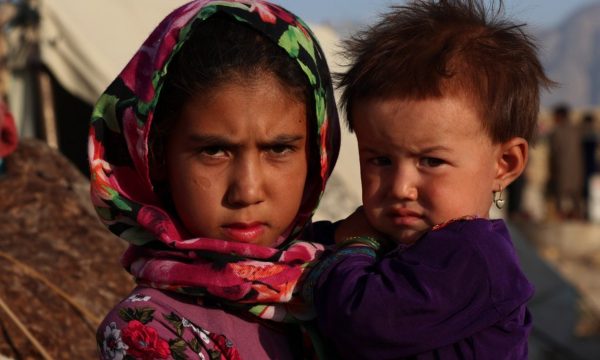
An Afghan girl holds her little sister at a displaced person camp in Mazar-i-Sharif, capital of northern Balkh province, Afghanistan, on July 22, 2021. Photo:Xinhua
Global Times | August 19, 2022
Afghanistan is a living example of US belligerence, and the negative impacts of US aggression against Afghanistan still persist a year after the US withdrawal, according to Chinese Foreign Ministry spokesperson Wang Wenbin on Friday.
The US’ two-decade invasion of Afghanistan has reduced the country to rubble, ruined the future of an entire generation of Afghans, killed 174,000 people including more than 30,000 civilians, and displaced tens of millions. Even though the US troops have left, Afghanistan is yet to emerge from the long shadow of the invasion, Wang said.
Millions of Afghans are struggling on the verge of death. About three million Afghan children are too poor to go to school. And 18.9 million people face acute food shortage. The US must take responsibility for all of this, said Wang.
Zhu Yongbiao, executive director of the Research Center for the Belt and Road and director of the Center for Afghanistan Studies at Lanzhou University, echoed this opinion. The US is responsible for Afghanistan’s misshapen economy and the rampant drug abuse, Zhu told the Global Times on Friday.
The US has not made developing Afghanistan its main goal, but has used it as an “experimental place,” which is the fundamental reason for the problems in Afghanistan, Zhu said.
The problems Afghanistan is facing are “comprehensive and systematic,” but the root cause of these problems is connected with the US’ 20-year-long invasion of Afghanistan, according to Zhu.
Afghanistan is a living proof of the failure of the US program of “democratic transformation”. The two-decade war in Afghanistan has cost the US more than $2 trillion, claimed over 2,400 US soldiers’ lives, and injured more than 20,000 US soldiers, only to end with the biggest US military debacle since the Vietnam War. People compare the “Kabul moment” to the “Saigon moment,” according to the spokesperson.
The US public also paid a dear price. According to US non-profit organizations, since 2001, 114,000 US veterans, or 18 per day, have taken their own lives, and nearly 40,000 veterans have become homeless, said Wang.
The “Kabul moment” put on full display the US’ hypocrisy on democracy and human rights and its true colors of relying on power politics and bullying practices, Wang said.
The US has failed in Afghanistan, but it has yet to abandon its policy of interference. It still frequently meddles in other countries’ internal affairs in the name of democracy and human rights, and continues to peddle the so-called “democracy versus authoritarianism” narrative to stoke division and confrontation around the world. This would only lead the US to new and greater failures, Wang noted.
Afghanistan Forms Committee to Launch Practical Work on TAPI Gas Pipeline: Official
Samizdat – 20.08.2022
Afghanistan has established a committee to launch practical work on the Turkmenistan–Afghanistan–Pakistan–India Pipeline (TAPI) after a pause following the Taliban (under UN sanctions over terrorism) takeover, Esmatullah Burhan, a spokesman for the Afghan Ministry of Mines and Petroleum, said on Saturday.
“A ministerial committee has been formed. The Ministry of Finance carries out the financial affairs of this committee,” Burhan was quoted as saying by Afghan broadcaster TOLO News. The body will be headed by acting Afghan First Deputy Prime Minister Abdul Ghani Baradar, according to the report.
In addition, Afghanistan intends to send a delegation to Turkmenistan in the near future to discuss the implementation of the TAPI project, the broadcaster said, citing the foreign ministry.
“We will have a visit to Turkmenistan, and we will talk about the gas prices and implementation of projects in Herat and also the industrial parks,” Afghan foreign ministry spokesman Shafay Azam was quoted as saying.
In February 2021, the Taliban pledged not to jeopardize the TAPI project after a meeting of the movement’s delegation with Turkmen Foreign Minister Rashid Moradov. However, last year, the chaotic security situation in Afghanistan still hampered the pipeline’s construction.
TAPI’s construction was launched in 2015. The 1,814-kilometer (1,127 miles) pipeline will transport natural gas from Caspian Sea deposits in Turkmenistan via Afghanistan and Pakistan to India. The annual capacity of the pipeline is expected to reach 33 billion cubic meters (1.1 trillion cubic feet).
Russia’s energy export revenues forecast to soar
Samizdat | August 19, 2022
Russia will see a 38% year-on-year increase in energy earnings due to higher oil export volumes, coupled with rising natural gas prices, Reuters reported on Wednesday, citing a document from the German Economy Ministry.
According to the report, the country’s revenues are expected to jump to $337.5 billion this year, which will help shore up the Russian economy in the face of Western sanctions.
The document predicted that energy export earnings will ease to $255.8 billion next year, but will still be higher than the 2021 figure of $244.2 billion.
According to the forecast, the average gas export price will more than double this year to $730 per thousand cubic meters, before gradually falling until the end of 2025.
The document pointed out that Moscow has started to gradually boost its oil production following the sanctions-related curbs and as a result of increased purchases by Asian buyers.
Moscow has also improved its forecasts for output and exports until the end of 2025.
Overall, the German Economy Ministry forecast cited by Reuters suggested that the Russian economy is coping well with the sanctions regime and will contract by less than expected.
Venezuela Stops Oil Shipments To Europe As Alternatives To Russian Energy Dry Up
Tyler Durden | Zero Hedge | August 19, 2022
The writing is on the wall for Europe in terms of this coming winter – It’s going to get ugly. With natural gas imports from Russia cut by 80% through Nord Stream 1 along with the majority of oil shipments, the EU is going to be scrambling for whatever fuel sources they can find to supply electricity and heating through the coming winter. Two sources that were originally suggested as alternatives were Iran and Venezuela.
Increased Iranian oil and gas exports to the west are highly dependent on the tentative nuclear deal, but as Goldman Sachs recently suggested, such a deal is unlikely anytime soon as deadlines on proposals have not been met and the Israeli government calls for negotiators to ‘walk away.’
Venezuela had restarted shipments to Europe after 2 years of US sanctions under a deal that allows them to trade oil for debt relief. However, the country’s government has now suspended those shipments, saying it is no longer interested in oil-for-debt deals and instead wants refined fuels from Italian and Spanish producers in exchange for crude.
This might seem like a backwards exchange but Venezuela’s own refineries are struggling to remain in operation because of lack of investment and lack of repairs. Refined fuels would help them to get back on their feet in terms of energy and industry. Some of Venezuela’s own heavy oil operations require imported diluents in order to continue. The EU says it currently has no plans to lift restrictions on the oil-for-debt arrangement, which means Europe has now lost yet another energy source.
Sanctions on Venezuela along with declining investments have strangled their oil industry, with overall production dropping by 38% this July compared to a year ago. Joe Biden’s initial moves to reopen talks with Maduro triggered inflated hopes that Venezuelan oil would flow once again and offset tight global markets and rising prices. Europe in particular will soon be desperate for energy alternatives, which will probably result in a scouring of markets this autumn to meet bare minimum requirements for heating.
If this occurs and no regular sources of energy can be found to fill the void left by Russian sanctions, prices will rise precipitously in the EU. Not only that, but with European countries buying up energy supplies wherever they can find them, available sources will also shrink for every other nation including the US. Get ready for oil and energy prices to spike once again as winter’s chill returns.
Russian gas transit to EU via Nord Stream to be halted – Gazprom
Samizdat | August 19, 2022
Russian energy giant Gazprom announced on Friday that transit of natural gas to the European Union via the Nord Stream 1 pipeline will be halted from August 31 to September 2 for maintenance.
“On August 31, the only working Trent 60 gas compressor unit will be shut down for three days for maintenance,” the company stated, noting that all repairs will be carried out jointly with specialists from the German manufacturer, Siemens.
Gazprom added that “Upon completion of work and the absence of technical malfunctions of the unit, gas transportation will be restored to the level of 33 million cubic meters per day,” representing roughly 20% of the pipeline’s full capacity.
The unit is the last one of the pipeline’s six turbines that was operational, with the rest in need of an overhaul. One of the turbines is currently stranded in Germany due to sanctions, after returning from repair works in Canada.
Russian gas supplies to the EU via Nord Stream 1 dropped to 20% of the maximum level last month. According to Gazprom, five turbines need to be operating to pump gas at full capacity.
European gas prices spiked after Friday’s announcement, jumping 7% to above $2,600 per thousand cubic meters.
UNSC Sanctions on Hiring of Workers From North Korea Do Not Apply to Donbas
Samizdat – 18.08.2022
The UN Security Council sanctions against North Korea do not apply to the Donbas republics, Director of the Department of International Organizations at the Russian Foreign Ministry Pyotr Ilyichev said in an interview with Sputnik.
Earlier, the head of the Donetsk People’s Republic (DPR), Denis Pushilin, said the republic is negotiating with Pyongyang on the arrival of builders from North Korea. In July, North Korea recognized the independence of the DPR and Lugansk People’s Republic (LPR).
“The recruitment of labor from North Korea is subject to international restrictions established by UN Security Council resolutions. However, it must be taken into account that they apply to the member states of the world organization, which the people’s republics of Donbas are not,” Ilyichev said.
He said Russia will not force Donbas and North Korea to avoid cooperation.
No longer a pariah? Russia and China could be about to ‘normalise’ North Korea
By Timur Fomenko | Samizdat | August 18, 2022
At the beginning of this week the North Korean Central News Agency (KCNA) reported that Russian President Vladimir Putin had exchanged letters with Supreme Leader Kim Jong Un.
The report stated both countries had agreed to “expand the(ir) comprehensive and constructive bilateral relations with common efforts”.
Matching the anniversary of Korean independence on August 15th, Putin’s outreach comes as Russia seeks new partners away from the West. It also follows reports that North Korean expatriate workers would be assisting in the reconstruction of liberated territories in the Donetsk and Lugansk People’s Republics, to which it recently granted diplomatic recognition.
But it’s also an indication that the world has changed, significantly. Only a few years ago Russia, as well as China, were at least somewhat willing to cooperate with the United States in imposing sanctions on the DPRK in the bid to curb its nuclear and missile development.
That situation no longer exists. The outbreak of the conflict in Ukraine, combined with America’s bid to try and contain the rise of China, now means we exist in a multipolar international environment where multiple great powers are competing for influence.
This breaks down the space for cooperation over common issues, but also increases the need for strategic thinking among the competitors. In the eyes of Moscow, this makes their calculus concerning North Korea even more important than it was before, drawing parallels to the Cold War era.
We should not forget that it was the Soviet Union that enabled the creation of the DPRK in the first place. It was following the closing days of World War II that a strategic contest for influence in East Asia began to emerge between the US and the USSR over the former territories of Imperial Japan. As the Red Army marched south, an agreement was made to divide the Korean Peninsula at the 38th parallel.
Although the original agreement was designed only to make the division temporary, geopolitical frictions soon saw it become permanent, and rival Korean states emerged. The US-backed Republic of Korea in the South, and the Soviet- and China-supported Democratic People’s Republic of Korea (DPRK) in the North, headed by former Red Army captain and guerrilla fighter Kim Il-sung.
The two young nations went to war in 1950, again supported by their respective superpower backers. Active fighting in that conflict ended three years later, but a formal peace agreement has not been signed to this day. And while Koreans on both sides of the divide wish for reunification, the scale of foreign involvement in the 1950s war stands as a reminder the peninsula is seen as a strategically critical landmass linking the continent of mainland Eurasia to the eastern seas.
Great powers have always seen it as a chess piece in the bid to dominate North East Asia. This had led to a tug of war which over the centuries has included the Ming and Qing Dynasties, the Russian Empire, the Empire of Japan and the United States, the People’s Republic of China and the Soviet Union.
But for the last three decades, since the end of the original Cold War, North Korea found itself increasingly isolated as China and Russia, for a period of time, both sought ties with the West, as well as the much more lucrative and successful South Korea. US unipolarity meant there was little interest from Moscow or Beijing in opposing America’s wishes to curb Pyongyang’s nuclear trajectory, which it sees as its last hope for regime survival.
But now a new paradigm is emerging, and just like in the times of old the DPRK, it’s seen yet again as a strategically indispensable bulwark against American power and military hegemony on Russia’s own border periphery, not least against its US-backed neighbors such as Japan.
In such an environment, there is no longer any benefit for Russia in cooperating with the US on the North Korean issue. The horse of “North Korea denuclearization” has long bolted, and instead the presence of a nuclear armed DPRK with ICBM capability is another thorn in Washington’s side, which if removed, only expands US power.
Thus, when America demanded another sanctions resolution against North Korea at the UN Security council earlier this year, both Russia and China vetoed it for the first time in over 15 years. It is a sign of the world we live in.
Moving on from here, Russia is likely to deepen its military and economic ties with North Korea, primarily because of its strategic and political worth.
In this view, history has completed a full circle and as the US shores up its allies to confront Moscow and Beijing, the theme of “bloc politics” re-emerges.
EU gas prices are seven times higher than in US
Samizdat | August 18, 2022
European natural gas prices are trading at levels equivalent to about $70 per million British Thermal Unit (BTUs), which is roughly seven times higher than prices in the United States, CNN reported on Wednesday, citing Lipow Oil Associates.
Analysts told the outlet that Europe’s natural gas crisis is contributing to higher prices in America, noting however that it’s not the main driver. US natural gas prices have surged to levels unseen since 2008, closing at $9.33 per million BTU on Tuesday.
“Higher global prices are trickling down to the US. Natural gas has become a global commodity with the emergence of LNG,” said Rob Thummel, senior portfolio manager at Tortoise Capital Advisors.
The United States has stepped up its exports of LNG to Europe in an effort to mitigate the impact of declining flows from the continent’s major natural gas supplier, Russia.
“Every spare molecule we can find, we are shipping to the Eurozone,” Robert Yawger, vice president of energy futures at Mizuho Securities, said.
European gas prices have quadrupled since the start of the year on thinning Russian flows. This week, the cost of gas futures on the TTF hub in the Netherlands exceeded $2,600 per thousand cubic meters for the first time since March. Prices are forecast to spike 60% this winter, exceeding $4,000 per thousand cubic meters.
Featured Video
Seyed M. Marandi: Toward Total War in the Middle East
or go to
Aletho News Archives – Video-Images
From the Archives
The Geopolitics behind the War in Yemen (I)
By Mahdi Darius NAZEMROAYA | Strategic Culture Foundation | 30.03.2015
The United States and the Kingdom of Saudi Arabia became very uneasy when the Yemenese or Yemenite movement of the Houthi or Ansarallah (meaning the supporters of God in Arabic) gained control of Yemen’s capital, Sanaa/Sana, in September 2014. The US-supported Yemenite President Abd-Rabbuh Manṣour Al-Hadi was humiliatingly forced to share power with the Houthis and the coalition of northern Yemenese tribes that had helped them enter Sana. Al-Hadi declared that negotiations for a Yemeni national unity government would take place and his allies the US and Saudi Arabia tried to use a new national dialogue and mediated talks to co-opt and pacify the Houthis.
The truth has been turned on its head about the war in Yemen. The war and ousting of President Abd-Rabbuh Manṣour Al-Hadi in Yemen are not the results of «Houthi coup» in Yemen. It is the opposite. Al-Hadi was ousted, because with Saudi and US support he tried to backtrack on the power sharing agreements he had made and return Yemen to authoritarian rule. The ousting of President Al-Hadi by the Houthis and their political allies was an unexpected reaction to the takeover Al-Hadi was planning with Washington and the House of Saudi. … continue
Blog Roll
 Aletho News
- Israeli lobby seeks to bind US fate to ‘Israel’: Araghchi
- Pakistan-Iran talks secure LNG shipment to Islamabad through Hormuz
- Black Sea grain crisis puts global wheat supplies under pressure
- IRGC air defenses destroy another US MQ-1 drone over Strait of Hormuz
- Imran Khan’s entire immediate family detained in Pakistan ahead of mass protest demanding his release
- EU nation detains former presidential frontrunner
- Leaked: Britain’s Sham Conviction Of Hashim Thaci
- Seyed M. Marandi: U.S. Strike Imminent – Toward Total War in the Middle East
- Russia Voted Under Fire. Washington Is Loading the Tankers.
- 12 Things Your Oncologist Was Trained Not to Tell You
- If Americans Knew
- Israeli Attacks in Gaza Kill at Least Seven Palestinians Over Three Days, including Woman and Child
- Trump’s militarization of Washington DC as he pursues Israel’s war against Iran
- Why Israel Fears This Searing New Documentary
- Huckabee aide solicited cash gifts from Israelis
- This isn’t sci-fi, AI is already killing people
- ‘The Most Brutal Thing’: Investigation Reveals Execution of Elderly Woman in Rafah
- Inside Israel’s ‘soft’ ethnic cleansing plan for Gaza through the eyes of its victims
- New online database tracks pro-Israel political donations in the United States
- Israeli president pardons soldier convicted for killing wounded Palestinian
- Singer Ed Sheeran says his ‘heart broken’ by Gaza devastation, addresses Macklemore controversy
- No Tricks Zone
- 2025 Nature Paper Claiming Worsening Global Drought Gets RETRACTED …Heavily Flawed
- New Study: ‘Global Drought Shows No Detectable Recent Acceleration Under Climate Warming’
- Economic Masterminds: German Socialists Suggest Taxing Productivity Gains Stemming From Using AI
- The South China Sea Has Not Been Cooperating With The Climate Change Narrative
- Energy Crisis: Germany Enters Heating Season With Historically Low Gas Reserve Fill Levels
- New Study: The Antarctic Ice Sheet Gained Mass From 2020-2024 Due To Staggering Snow And Ice Accumulation
- Study: Ocean Heating Rates From Thousands Of Years Ago ‘Dwarf’ Modern Ocean Heating Rates
- Climate Extremists Target, Attack Large-Scale Power Grid Infrastructure In Germany!
- New Study: Antarctic Ice Melt Has Contributed Less Than 1 Centimeter To Sea Level Rise In The Last 30 Years
- Fear Of Debate: Alarmist German Climate Scientist Calls On Mainstream Media To Discredit Skeptic Voices
 Aletho News