Energy crisis forces EU aluminum plant to shut down
Samizdat | August 18, 2022
The Slovalco aluminum smelter in Slovakia announced on Wednesday it will shut down primary production by the end of September.
“The decision to terminate primary aluminum production at Slovalco comes in response to adverse framework conditions and high electricity prices, which show no signs of improvement in the short term,” the plant’s majority owner, Norsk Hydro, said in a statement.
It explained that the Slovalco casthouse in central Slovakia is continuing its recycling operation, serving customers in the region with 75,000 tons of recycled aluminum annually.
The plant’s CEO told media that the Slovalco plant was a key supplier for Slovak and other European companies. After stopping production, Europe will be forced to import aluminum from countries including Russia and China, he added.
Slovalco’s shutdown follows a similar decision this week to cease production at a zinc smelter in the Netherlands.
World order looks different from Moscow, Beijing
BY M. K. BHADRAKUMAR | INDIAN PUNCHLINE | AUGUST 17, 2022
The Chinese Defence Ministry announced today its participation in the Vostok 2022 strategic command and staff exercise in Russia, which is slated for August 30-September 5. The low-key statement in Beijing said China will send some troops and the participation is within the framework of the two countries’ annual cooperation plan.
The statement mentioned that “India, Belarus, Tajikistan, Mongolia and other countries will also participate.” It said the Chinese participation “aims to deepen pragmatic and friendly cooperation with the militaries of the participating countries, enhance the level of strategic coordination among all participating parties, and enhance the ability to deal with various security threats.”
In what can be construed as an oblique reference to the conflict in Ukraine and the big power tensions in general, Beijing stated that the exercise is “unrelated to the current international and regional situation.”
Vostok is one of the capstone events of the Russian Armed Forces’ annual training cycle to test national preparedness for large-scale, high-intensity warfare against a technologically advanced peer adversary in a multidirectional, theatre-level conflict.
Vostok 2018 involved approximately 300,000 troops –- as well as 1,000 fixed-wing aircraft and helicopters, 80 ships, and 36,000 tanks, armoured and other vehicles — and was unprecedented in scale. And Russian, Chinese and Mongolian forces were the sole participants and was hyped up as a carefully orchestrated Russian-Chinese military demonstration.
It seems the Chinese participation will be scaled down, notwithstanding the gathering storms on the horizon for both Russia and China. The Chinese announcement comes a day after Russian President Vladimir Putin used exceptionally harsh language to condemn the “Western globalist elites,” accusing them of provoking chaos, “fanning long-standing and new conflicts and pursuing the so-called containment policy” in the pursuit of an agenda “to keep hold onto the hegemony and power that are slipping from their hands.” Putin alleged, “They need conflicts to retain their hegemony.”
The speech while addressing the 10th Moscow Conference on International Security in Moscow on Tuesday, also contained some pointed references to the Asia-Pacific region. Putin said:
“NATO is crawling east and building up its military infrastructure… US has recently made another deliberate attempt to fuel the flames and stir up trouble in the Asia-Pacific. The US escapade towards Taiwan is not just a voyage by an irresponsible politician, but part of the purpose-oriented and deliberate US strategy designed to destabilise the situation and sow chaos in the region and the world. It is a brazen demonstration of disrespect for other countries and their own international commitments. We regard this as a thoroughly planned provocation.
“They want to shift the blame for their own failures to other countries, namely Russia and China, which are defending their point of view and designing a sovereign development policy without submitting to the diktat of the supranational elites.
“We also see that the collective West is striving to expand its bloc-based system to the Asia-Pacific region, like it did with NATO in Europe. To this end, they are creating aggressive military-political unions such as AUKUS and others.”
Significantly, Putin called for “a radical strengthening of the contemporary system of a multipolar world.” He said, “ All these challenges are global, and therefore it would be impossible to overcome them without combining the efforts and potentials of all states…
“Russia will actively and assertively participate in such coordinated joint efforts; together with its allies, partners and fellow thinkers, it will improve the existing mechanisms of of international security and create new ones, as well as consistently strengthen the national armed forces and other security structures by providing them with advanced weapons and military equipment. Russia will secure its national interests, as well as the protection of its allies.”
Notably, however, the Chinese commentaries generally steer clear of bracketing the Taiwan question and the conflict in Ukraine as analogous, as symptomatic of the birth throes of a multipolar world. In a commentary today, the senior editor with People’s Daily, Ding Yang once again flagged that the real danger is that the US and China may “sleepwalk into conflict.”
He wrote that the US is “like a runaway horse running wildly to the precipice of war,” but the aim is how to profit from a war, or rather “how to profit from someone else’s war.” Ding took a Marxian perspective that the US policy is driven by the interests of US capital and “Washington sees China as an enemy because it has moved the US cheese.”
As he sees it, at its core the US strategy is “to squeeze China out of the global market and manufacturing chain.” Thus, even with regard to Taiwan, “One of the main aims is to create tensions and further pulling Taiwan Semiconductor Manufacturing Company into the US chip siege against China.”
Ideology, human rights, etc., are only alibis for the capital competition for markets. Plainly put, it unnerves the US that “Chinese capital is also starting to go global.”
Deng is confident that “If we follow the logic of capital development as they see it, what matters is that Chinese manufacturing will eventually push them out of the global industrial chain, leaving them with no money to make and no work to do. So the first thing they want to do is to maximise their share of the Chinese market.”
“Then the next thing to do is inevitably to implement a global stranglehold on Chinese capital and Chinese manufacturing.” This is where the danger lies, as “the option of war is an inherent part of US capital export and expansion.”
But China’s advantage is that “in contrast to the historical path of Western capital’s global expansion, there is a logic of “common development” behind Chinese capital going abroad.”
Interestingly, the government newspaper China Daily reported today that China’s holdings of US Treasuries have been further reduced through July, but China is only one of many other countries doing so, including Japan, reacting to the Fed’s tightening cycle.
But “the decline may gradually decelerate.” The point is, it is “unrealistic” for China to give up on US debt holdings so long as the US Treasuries remain a critical international reserve asset! This is diametrically opposite the revisionist path Russia took.
Cost of keeping Britons out of energy poverty revealed
Samizdat | August 15, 2022
The UK government will need to spend a further £12 billion ($14.5 billion) on a support package for households to keep pace with higher-than-expected energy prices, the Institute for Fiscal Studies (IFS) said in a report on Monday.
According to the research, the money is required if the government still wants to provide the same level of aid it set out this spring.
In May, former UK Chancellor Rishi Sunak announced that the government’s aim was to make up for half of the cost of energy price increases to households. The effect of that support has shrunk as energy costs continue to soar. In May, energy prices were expected to rise by 95% in 2022-23, but are now expected to rise by 141%, according to the report.
The IFS said the cost of living is now expected to be 11.3% higher this financial year than last, with inflation peaking in the last quarter of 2022 at 13.1%.
The think tank warned that the poorest households will experience inflation of an “eye-watering” 18% in October due to energy price growth, compared to 11% for the richest households.
“The government is still playing catch up as inflation and the cost of energy continue to spiral upwards,” IFS Director Paul Johnson said. “Just achieving what they wanted to achieve back in May will cost an additional £12 billion, and a package on that scale will still leave many households much worse off.”
Pelosi’s visit was a wake up call for China: Appeasing the US will never work
By Timur Fomenko | Samizdat | August 10, 2022
China’s announcement that it was suspending eight channels for cooperation and dialogue with the US following House Speaker Nancy Pelosi’s visit to Taipei appears to mark a break with the country’s previously overly indulgent approach to Washington’s caprice. The Americans’ reaction, meanwhile, was as predictable as it was revealing.
Washington unsurprisingly condemned the cutting of ties and insisted it did nothing wrong in giving the go-ahead for Pelosi’s visit.
Such a reaction might tell us a few things about US President Joe Biden’s China policy as a whole. In short, it can be described as ‘having your cake and eating it’. The US believes it can get away with treating China as an enemy in most areas but still selectively solicit cooperation in the pursuit of US interests in others. This stems from the unilateralist nature of American foreign policy, which strives to maximize its own advantages at all costs and never offer concessions in negotiations with adversaries.
But finally, the US went too far, and China has made clear that it has now had enough. Cooperation can now only be conditional on respecting China’s core interests. Some say this has been long overdue.
Why so? Because for a long time, China was perhaps way too patient with the United States. As Washington continually meted out malice, Beijing still believed the relationship could somehow be salvaged, repaired or rekindled, and kept showing the Americans good will they didn’t deserve.
China believed engagement was the answer. This is a product of the country’s post-Deng Xiaoping foreign policy doctrine, which above all emphasizes stability and taking only calculated risks. China reasoned that its development and rise would be jeopardized if it confronted the hegemon that sought to contain it.
This idea was great in the 1980s and 1990s, when China was not a threat to the US, and the Americans believed it was destined to liberalize. But that ‘end of history’ world doesn’t exist anymore.
And China has been slow to respond to that – meaning that its foreign-policy assumptions have recently led it to make strategic missteps again and again. During the first year of the Trump administration, Beijing decided to engage with Trump and give him what he wanted on the issue of North Korea, rolling out the red carpet for him in the Forbidden City, believing it would temper the feared anti-China turn his administration had promised previously.
It didn’t work. Once Trump got what he wanted from Xi on North Korea sanctions, he commenced his anti-China foreign policy the following year in 2018. He unleashed the trade war, he blacklisted Huawei and scores of other Chinese companies, while his administration rolled out the Xinjiang narrative to taint China’s engagement with the West.
But China still held firm to engagement, focusing on negotiating a trade deal with Trump. This seemed to work in January 2020. Then Covid-19 came, hitting the US hard, and the Trump administration’s hostility to China went off the charts. The opportunity was taken to permanently shift US foreign policy into an adversarial cold-war mode.
What did Beijing do? Seeing an election on the horizon, it waited. Trump after all, the Chinese reasoned, was just a bad spell, erratic and destabilizing, and the US surely would become reasonable again once he was gone. They decided to wait him out and pursue an all-out effort to engage Biden instead, again hoping to rekindle the relationship.
It was wrong again. The Biden administration not only immediately embraced Trump’s entire foreign policy but actually expanded it. China attempted to engage, but nothing changed and displays of relentless hostility continued. Every meeting the Biden administration pursued with China was accompanied by an announcement of new sanctions both before and after it.
The American rendering of China as new cold-war style adversary was now a permanent consensus and feature of US foreign policy that goes far beyond one man. Worse still, Washington began to ‘multilateralize’ this approach and co-opt allies into joining in.
China, of course, knew this but was naïve or too optimistic in believing the reality could be averted. It was not until late 2021 that it began to ‘wake up’ to this new normal. Yet, it has taken until Pelosi’s Taiwan trip for China to find the strength to come out with “we can no longer have business as usual” but even then, some people still think the Chinese are bluffing, prompting an online meme described as “China’s final warning,” which was a form of ridicule the Soviet Union used against China for issuing ‘final warnings’ it never followed up on.
Yet there is nonetheless a sense that this time things are different. China’s military exercises have been relentless, with claims that they will become ‘the new normal’. That’s because even if China has been duly lenient with the US in the past, it now sees Washington as taking the liberty to trample on the commitments it had taken on to normalize its relationship with Beijing.
If China is forced to back away from its lines in the sand, it becomes an enormous loss of face and political prestige. While economics have also been a primary consideration of China’s foreign policy, the pendulum is now swinging towards the realization that the US has to be confronted, rather than simply lived with. It doesn’t respect China’s interests, only its own.
Therefore, how can dialogue and engagement be unconditional? So far, this bilateral relationship has functioned only on the premise of “Hi China, we hate you, we’re going to accuse you of genocide, we’re going to blacklist your companies, we’re going to build military alliances against you, break our commitments on Taiwan… oh, please help us on climate change… nothing in return.” And China’s patience is apparently at its end.
Russia-Turkey reset eases regional tensions
BY M. K. BHADRAKUMAR | INDIAN PUNCHLINE | AUGUST 9, 2022
The 4-hour meeting on Friday at Sochi between President Vladimir Putin and President Recep Erdogan promises to be a defining moment in regional politics. The single biggest takeaway from the Sochi meet is, of course, the “win-win” economic partnership between Russia and Turkey that helps Russia, on the one hand, to continue to interact with the world market circumventing Western sanctions, while, on the other hand, is a boon for the Turkish economy.
Turkey is a member of the European Uinion’s Customs Union and it is no secret that there is a lot of Russian money floating around in the wake of the western sanctions. If that money can be turned into investments in Turkey to set up production units with western technology and market access, creating jobs and revving up the country’s economy, it is a “win-win”. This is one thing.
At Sochi, Putin and Erdogan agreed on phasing out the use of dollar in their transactions. Part of Turkey’s purchase of Russian gas will be settled in rubles, which will of course strengthen the Russian currency. Equally, the Sochi meeting tasked 5 Turkish banks to accept Russia’s Mir payment system, which Moscow developed following Russia’s exclusion from the SWIFT.
At its most obvious level, the Mir system enables Russian nationals, especially tourists, to freely visit Turkey. Indeed, the West’s prying eyes can also be kept out. A Bloomberg News report last week suggests that sensitive money transactions that are beyond western scrutiny may already be taking place. Basically, Turkey helps Russia to mitigate the effect of western sanctions while taking care that it won’t face any collateral sanctions either!
Quite obviously, all this is only possible within a matrix of political understanding. The 4-hour conversation in Sochi was almost entirely conducted in one-on-one mode. Erdogan cryptically remarked later that his talks with Putin would benefit the region. He did not elaborate.
Conceivably, there are three major areas where the matrix will be felt in immediate terms— Syria, Black Sea and Transcaucasia. Turkish and Russian interests crisscross here.
In the Black Sea, Turkey, as the custodian of the Montreux Convention Regarding the Regime of the Straits (1936), has a key role to play with regard to the passage of warships in times of war through the the Dardanelles strait, the Sea of Marmara, and the Bosporus strait. The current implications are self-evident.
Again, in Transcaucasia, Turkey can play a stabilising role, which Moscow expects, given Ankara’s influence in Baku. However, when it comes to Syria, a complex tapestry appears. The Turkish press has reported that Erdogan is planning to have a call with Syrian President Bashar al-Assad.
Putin has been encouraging Erdogan to think on these lines as the best way to address Turkey’s border security issues in northern Syria — by directly communicating with Assad instead of launching military incursions.
Putin’s vision is that the moribund Adana Agreement (1998) still has a lot of unused potential, where Damascus had guaranteed the containment of militant Syria-based Kurdish separatist groups. The “Adana spirit” evaporated once the Obama administration lured Erdogan into its regime change project in 2011 to overthrow Assad. Until that time, Erdogan and Assad, including their families, had enjoyed a warm friendship.
However, circumstances today are propitious for a rapprochement between Erdogan and Assad. First, Assad has successfully beaten back — thanks to Russian and Iranian backing — the US-led jihadi project in Syria. Damascus has liberated most of the regions from jihadi groups and the residual issue concerns the US occupation of a third of Syrian territory in the north and east.
Assad has consolidated the government’s staying power for years to come. Second, Assad is steadily gaining regional acceptance too among Syria’s Arab neighbours. Syria is seeking membership of the SCO alongside Egypt, Saudi Arabia, Bahrain and the UAE. Third, Turkish-American relations have soured in recent years since the CIA-backed military coup in 2016 to overthrow Erdogan.
One main factor today is the US’ politico-military alliance with the militant Syrian Kurds who are its foot soldiers and aspire to establish a Kurdish homeland in northern Syria bordering Turkey under American protection. Erdogan is deeply suspicious of US intentions.
Fourth, stemming from the above, Turkey sees eye to eye with Moscow and Tehran (and Damascus) in their demand for the vacation of US occupation of Syria (which is neither mandated by the UN nor is at Syrian invitation.) Fifth, Russia and Iran have contacts with Syrian Kurdish groups but a reconciliation between the Kurds and Damascus cannot gain traction so long as the US military presence continues.
Quite obviously, any endeavour to cut this Gordian knot will have to begin with the reconciliation between Erdogan and Assad. It is in Turkish interests to strengthen Damascus and promote a Syrian settlement, which will ultimately make the US occupation of Syria untenable and open the pathway for pacifying the Kurdish regions in northern Syria.
Meanwhile, in a development that has bearing on Syria’s security, Russia today launched an Iranian military satellite from its Baikanur Cosmodrome. It is a Russian-built Kanopus-V Earth-observation satellite that will boost Iran’s capability to conduct continuous surveillance on locations of its choosing, including military facilities in Israel.
Moscow negotiated the satellite deal in secret with Iran’s elite Islamic Revolutionary Guard Corps (which is involved in Syria) and experts from Moscow have trained IRGC’s ground crews in the satellite’s operation.
Russia’s ties with Israel have sharply deteriorated lately due to Israel’s involvement in Ukraine as a participant in Pentagon’s “coalition of the willing”. Moscow is probably expelling the hugely influential Jewish Agency, which has kept an office in Moscow since the Gorbachev era.
Moscow’s criticism of Israeli missile strikes against Syria has noticeably sharpened lately. Russian-Israeli relations will languish for the foreseeable future. Israel seems acutely conscious of its growing isolation. President Isaac Herzog reached out to Putin today but it turned out to be an inconclusive conversation. Moscow will be extra-vigilant, given the Biden Administration’s strong nexus with Israeli PM Lapid.
Suffice to say, together with Israel’s fraught ties with Moscow and Ankara and the deep antagonism toward Tehran, a Turkish-Russian-Iranian condominium in Syria is the last thing that Israel wants to see happening at the present juncture. Israel is the odd man out, what with the Abraham Accords losing its gravitas.
Putin’s initiatives to create axis with Turkey and Iran respectively mesh with the broader trend of the region reshaping itself through processes dominated by the countries within the region against the backdrop of the US retrenchment.
Ukraine halts Russian oil supply to EU
Samizdat | August 9, 2022
Ukraine’s state oil pipeline operator Ukrtransnafta has stopped pumping Russian crude through the southern branch of the Druzhba system to the EU, RIA Novosti news agency reported on Monday, citing Russia’s Transneft.
According to the report, transit supplies have been halted to Hungary, the Czech Republic and Slovakia.
Igor Demin, spokesperson for the president of Transneft, told the agency that transit through Belarus in the direction of Poland and Germany continues.
Demin explained that Russia cannot make payments for transit due to EU sanctions, although the Ukrainian company is insisting on 100% prepayment for its oil transportation services.
“When making a payment for transit through the territory of Ukraine, the funds were returned to the account of Transneft,” he said, adding, “Gazprombank, which services payments, notified us that the payment was returned in accordance with the EU regulations, that is, the seventh package of sanctions.”
Transneft stressed that it is working on alternative payment options for oil transit services via Ukraine, and has sent an appeal to Gazprombank.
Druzhba, which is one of the longest pipeline networks in the world, carries crude some 4,000 kilometers from the eastern part of European Russia to refineries in the Czech Republic, Germany, Hungary, Poland and Slovakia.
There is No Food Crisis – If Only We Stopped Burning it as ‘Green’ Biofuel
BY DAVID CRAIG | THE DAILY SCEPTIC | AUGUST 8, 2022
We’ve all been bombarded daily with horror stories about how food prices are being forced up and hundreds of millions of the world’s poorest risk starvation because the Russian invasion of Ukraine has prevented exports of grain and sunflower oil.
Well, let me give you some figures our politicians and the mainstream media don’t want to mention. They don’t mention these figures because these figures undermine the disastrous global-warming, climate-catastrophist, Net-Zero policies being forced on us by our rulers.
The U.S. produces abut 384 million metric tonnes of corn each year and around 50 million tonnes of wheat. Ukraine produces about 38 million tonnes of corn each year and around 33 million tonnes of wheat. Around 20 million tonnes of Ukraine’s wheat is exported each year.
Conclusion 1: The U.S. produces an awful lot more food than Ukraine.
But let’s look at how all the USA’s corn and wheat is actually used. Over a third of the USA’s corn – that’s more than 128 million tonnes of the USA’s corn production – is used to make biofuels rather than being used for human consumption.
It’s more difficult to find out how much of the U.S.’s 38 million tonnes of wheat is used for biofuels, but it may be as much as a quarter. However, we do know that in the European Union, 12 million tonnes of grain, including wheat and maize, is turned into ethanol – around 7% of the bloc’s production. It’s estimated that this is enough food to feed around 150 million people if it wasn’t being used for transport fuel.
Also just in the EU, 3.5 million tonnes of palm oil is used to make biodiesel. That’s almost the amount of sunflower oil coming out of Ukraine and Russia combined.
Conclusion 2: We’re burning food rather than using it to feed people.
You may have noticed that last year the petrol you buy changed from something called ‘E5’ to ‘E10’. E5 petrol is petrol containing 5% biofuel and E10 is, of course, petrol containing 10% biofuel.
According to calculations done by scientists at Princeton University, if the U.S. and Europe were to decrease their use of ethanol made from grain by 50% – that would mean just moving back from E10 petrol to E5 petrol – they would effectively have sufficient extra crops to replace all of Ukraine’s exports of grain.
If our rulers were to completely scrap the biofuel mandates they have imposed on us, the world would be awash with food and food prices would fall significantly. Then the only reason for hungry people would be distribution problems caused by mismanagement, corruption and conflict.
When the EU first mandated that 2.5% of all fuel sold in the EU should be made from biofuels, worldwide food prices shot up – wheat, for example, doubled in price – and the UN’s Rapporteur for Food said: “It is a crime against humanity to convert agricultural productive soil into soil which produces food stuff that will be burned into biofuel.”
He further argued that biofuels would only lead to further hunger in a world where an estimated 854 million people – one out of six in 2007 – already suffered from the scourge; 100,000 people died from hunger or its immediate consequences every day; and every five seconds, a child died from hunger
We’re now at 10% biofuels and, if I have understood correctly, following new climate change legislation passed in the U.S. last week, the biofuel content of petrol may be increased even further. This will mean diverting more potential food to fuel production at a time of world food shortages and rocketing food prices.
This is madness. But it get worse. Biofuels are less efficient than fossil fuels – you get fewer miles or kilometres per litre or gallon and they damage car engines more than fossil fuels. Moreover, the huge amounts of energy required to produce biofuels mean that they are probably more environmentally-damaging than fossil fuels.
Scrapping the biofuels mandates in the U.S. and EU isn’t something that would take years or months to implement. It could be done this week and the results – more food availability and falling food prices – would happen immediately.
So, why won’t our rulers do this? Moreover, why do they seem to be moving in the opposite direction – by pushing ever more food into fuel production?
It could just be utter incompetence. Or it could be fear of a storm of criticism by the ever more vociferous climate-catastrophist lobby. It could be that they are trapped by their own save-the-planet virtue-signalling. Or it could be the classic reaction of politicians and bureaucracies – the more evidence emerges that their policies are misguided, the more they double down on those policies as they can never admit that they got it wrong.
However, for the conspiracy theorists, there’s a fifth possibility – that our rulers are acting together to deliberately restrict food production, push up food prices and impoverish us all as a means of increasing their control over us.
You can choose which of the five possibilities – incompetence, fear of the climate catastrophists, feeling trapped by their own subservience to the climate-catastrophist cult, doubling down on misguided policies or conspiracy against us – you believe is the most credible explanation of the current food crisis.
David Craig is the author of There is No Climate Crisis, available as an e-book or paperback from Amazon.
Here Are The Winners And Losers In The ‘Inflation Reduction Act’
By Tyler Durden | Zero Hedge | August 8, 2022
As Democrats pat themselves on the back after the Senate finally passed their massive tax, climate, and healthcare bill – the “Inflation Reduction Act” which Senate Majority Leader Chuck Schumer called “one of the most significant pieces of legislation passed in a decade,” Bloomberg has compiled a list of winners and losers.
Not only did none of the billions in tax increases Democrats threatened high-earners with last year make it into the final version of the bill, their plans to ‘tax the 1%’ turned out to be nothing more than a big virtue signal.
Private equity fund managers
As we noted on Friday, the landmark bill only passed after AZ Sen. Kyrsten Sinema insisted on keeping the carried-interest loophole that allows investment managers (like her former bosses) to shield the majority of their income from higher taxes.
The private equity industry was able to gain an additional win shortly before the final passage of the bill when a handful of Democrats broke with their party to vote on a Republican amendment that created a carveout for private equity-owned companies in the corporate minimum tax. -Bloomberg

Manchin and Sinema were big winners – after having held their party hostage for more than a year over this legislation, “The entire contents of the bill were essentially cherry-picked by Manchin and then tweaked to fit Sinema’s preferences,” according to the report.
The two were also able to score direct benefits for their states – with Manchin securing an agreement to permit the completion of the Equitrans Midstream Corp.’s Mountain Valley Pipeline, and Sinema – who was able to secure $4 billion in drought relief for western states.
The IRS And The Green agenda
The bill will give $80 billion to the IRS over the next 10 years to expand its audit capabilities, as well as a bevy of technology upgrades.
Meanwhile, electric carmakers got an extension of a popular $7,500 per vehicle customer tax credit for EVs, but will have to comply with strict battery and critical minerals sourcing requirements demanded by Sinema and Manchin – which could render the credits useless for years.
Solar and hydrogen companies, such as Sunrun and Plug Power, Inc. will also benefit from generous tax credits, while operators of nuclear reactors such as Southern Co., Constellation Energy Corp., Public Service Enterprise Group Inc. and Energy Harbor Corp. could benefit from a $30 billion production tax credit.
Medicare, Obamacare Enrolees
The final version of the bill caps seniors’ out-of-pocket prescription drug expenses to $2,000 per year, and enables Medicare to negotiate the prices on 10 medications four years from now. Th bill also kicks the can on a massive increase in Obamacare premiums that were set to happen in January for many middle income Americans, which will now happen in three years.
LOSERS:
Republicans who thought Manchin and Sinema wouldn’t cave on their promises to raise taxes during a recession.
The GOP was confident they had beaten back Biden’s tax and climate agenda and were stunned in late July when Schumer and Manchin announced a deal. While still the favorites to gain seats in the midterm elections, passage of the bill is a major setback for the GOP’s policy aims. It does, however, give them a new issue to campaign on in the fall campaigns. -Bloomberg
Other losers include tech companies – that will bear the brunt of two major tax increases in the bill; a 15% minimum tax on financial statement profits, and a new levy on stock buybacks which have allowed companies like Alphabet’s Google and Meta’s Facebook to minimize their tax burden over the years.
SALT – the ability to deduct state and local taxes, a $10,000 cap which coastal Democrats were hoping to repeal.
Bernie Sanders – who Bloomberg notes wanted $6 trillion in spending, making the $437 billion in new spending a far cry from success. Excluded from the bill is all proposals for new social programs, including tuition-free-college, child care, housing spending and an expanded-child monthly tax credit.
Protests Erupt in Bangladesh as Government Raises Fuel Prices While Seeking IMF Loans
Samizdat – 07.08.2022
Bangladesh has approached the International Monetary Fund (IMF) for a multibillion-dollar loan, making it the third South Asian country – after Sri Lanka and Pakistan – to have sought financial help from the multi-lateral lender in the past two months.
Sporadic protests erupted in several of Bangladesh’s cities on Saturday in response to a significant rise in oil and gas prices. After the price rise, public transport fares also rocketed up to 35 percent. Several organizations related to transportation have suspended their operations for 24 hours and declared their sales would resume on Monday.
The Bangladesh Tank-Lorry Owners’ Association and the Petrol Pump Owners’ Association staged a 24-hr strike on Sunday. They stopped collecting fuel from the Padma, Meghna, and Jamuna depots – major oil repositories for the country in the Khulna division.
“The strike started at 8am and will continue until 8am on Monday,” Md Farhad Hossain, an official of Bangladesh Tank-Lorry Owners’
The association has been demanding 7.5 percent commission on the present fuel price.
The Sheikh Hasina government on Friday raised the diesel price by 34 Taka ($0.36) to 114 Taka ($1.20) per liter, and the octane price by 46 Taka (0.49 USD) to 135 Taka ($1.42) per liter.
Protesters alleged that instead of lowering fuel prices as the rest of the world was, the government had raised costs to “appease the IMF”, which “is unacceptable and anti-people.”
“We urge the government to return fuel prices to their previous rates immediately,” said Bangladesh Jatri Kalyan Samity, a group working for the welfare of commuters, in a statement.
Bangladesh is reportedly seeking $4.5Bln in loans from the IMF as the country’s forex reserves plummeted below $40Bln.
On 3 August, the US-led lender said it would work with Dhaka to design an IMF-supported reform program that would be required for the loan.
“As part of the policy response, Bangladesh’s request for a Resilience and Sustainability Trust and an accompanying IMF-supported program will provide safeguards in the event of further deterioration of external conditions,” the Fund added.
Bangladesh reported a fall in export earnings because of dwindling consumer demand in the west. European Union registered a 3 percent fall in consumer demand this week.
Bangladesh’s appeal to the IMF comes as Sri Lanka and Pakistan have also been negotiating financial aid. The economic slowdown and inflation has also hit these south Asian economies.
Why the Gulf states’ SCO membership is a big deal
BY M. K. BHADRAKUMAR | INDIAN PUNCHLINE | AUGUST 7, 2022
Washington has backtracked from the dissimulation by US National Security Advisor Jake Sullivan that Washington had intelligence suggesting Iran was preparing to provide Russia with “several hundred” drones to use in Ukraine, with training sessions set to begin in July.
On July 26, NSC spokesman John Kirby, clarified his boss’ remark by admitting to Al Arabiya, “We’ve seen no indications of any sort of actual delivery and/or purchase of Iranian drones by the Russian Ministry of Defence.”
Interestingly, Al Arabiya buttonholed Kirby at all. For, Sullivan’s fake news (probably based on Israeli disinformation) came at his special briefing on President Biden’s visit to Jeddah. Al Arabiya’s dogged downstream pursuit of the “fake news” suggests that Riyadh knew Sullivan making a crude attempt to to hustle the Crown Prince Mohammad bin Salman in directions that would have made Biden’s trip a roaring success.
Biden had three overlapping objectives: one, to rally Saudi leadership behind his containment strategy against Russia and China; two, to break up the OPEC+ alliance between Saudi Arabia and Russia so that a coordinated counterpoint ceases to be in the world oil market that is beyond American control; and, three, to assemble an anti-Iran military military alliance of Gulf states and Israel to give verve to Abraham Accords which has patently lost its fizz.
Biden drew blank on all three counts: Saudis will pursue their friendly relations with Russia and China and its normalisation with Tehran. Prince Mohammed spoke with President Putin within the week of Biden’s visit where they discussed further expansion of trade and economic cooperation and significantly, also underscored “the importance of further coordination within OPEC+”.
Traditionally, Saudi actions speak far better than words. So, when the OPEC+ held a virtual meeting last Wednesday, it concluded that:
- There is “severely limited availability of excess capacity” among oil producing countries resulting from “chronic underinvestment in the oil sector”;
- It is a matter of “particular concern… (that) insufficient investment into the upstream sector will impact the availability of adequate supply in a timely manner to meet growing demand beyond 2023.”
- The importance of maintaining consensus and the “cohesion” of OPEC and OPEC+ (that is, OPEC plus Russia principally) cannot be overstated.
Plainly put, it rejects the July 3 G7 Foreign Ministers’ Statement on Energy Security, which envisages imposing comprehensive embargo on all services for “transportation of Russian seaborne crude oil and petroleum products globally” unless Moscow sells oil at a price to be agreed in consultation with the West.
Simply, the West is once again contemplating a crackdown on a major oil producing country for geopolitical reasons, which would have profound impact on the world oil market. The paradox here is that, unlike in the case of Iran or Venezuela, the West desperately needs Russian oil’s continued flow into the world oil market but is capping the price at which Moscow can sell so that its income from oil exports cannot sustain the special military operations in Ukraine.
Indeed, the West is acting in the spirit of George Kennan’s famous dictum in the early 1950s that oil “belongs to us” because it lubricated the West’s prosperity. The G7 statement is no doubt precedent-setting. As the pressure on world’s resources becomes more acute, this predatory approach harkens back to the colonial era (when India was frog-marched by Imperial Britain to supply cotton to the textile mills in Britain and buy back textiles at prices determined by the colonial master.)
It can extend to resources other than oil as well. China, for example, produces roughly two-thirds of the world’s lithium-ion batteries, whereas, the US only produces 1% of global lithium supply and 7% of refined lithium chemicals — versus China’s 51% — and is about 70% dependent on imported lithium (which has such critical uses in industries ranging from mobile phones, laptops, digital cameras and electric vehicles to aircraft, high-speed trains and satellites.
To be sure, the G7 move to seize control of Russia’s oil exports rings alarm bells all across the oil-producing countries of the Gulf region. The geopolitical message is: ‘Fall in line, or else.’ Now, this comes at a time when the EU is desperately eyeing access to cheap and reliable supply of oil. (Japan just announced that its “sanctions from hell” against Russia will not apply to the Sakhalin 2 gas and oil project!)
Against such a tumultuous backdrop with the industrial powers inclining toward brandishing their latent colonial instincts of a bygone era, the Gulf states become highly vulnerable. The Gulf states already are shell-shocked about the banditry that the EU and US resorted to against Russia by confiscating its reserves in the Western banking system and appropriating the private assets of wealthy Russians.
There is also an added dimension. Tomorrow, what prevents the “Collective West” from resorting to such pressure tactics to enforce “regime change” in the Gulf region on the pretext of advancing democracy and human rights? After all, it is no secret that the former Crown Prince Muhammad bin Nayef was Washington’s preferred choice to succeed King Salman. Make no mistake, Biden’s fist bump with Prince Mohammed is not the last word on Saudi succession.
Indeed, Prince Mohammed’s suggestion (while Biden was still in Jeddah) that Saudi Arabia and Iran should now step up their contacts to the political level becomes highly significant. Even more so, Saudi Arabia’s interest in SCO membership (so soon after Iran’s admission to the grouping.)
Along with Saudi Arabia, a host of other West Asian countries have approached the SCO for membership. The Russian daily Izvestia reported on Thursday that the SCO plans to sign memoranda on granting dialogue partnership to Egypt, Syria, Qatar, Saudi Arabia and Bahrain at the forthcoming summit in Samarkand. Interestingly, Crown Prince Mohammed bin Salman has been invited to the event.
According to Izvestia, as an exception, the UAE has sought SCO membership on an expeditious basis, although the grouping’s established practice so far has been to start with a “dialogue partner”. Izvestia quoted a source close to the SCO organising committee that the SCO has had consultations internally and “the main understanding that dominates is that the SCO is interesting, the SCO attracts, and therefore the most important thing for us is not to wallow in bureaucracy, but to find solutions that will allow us to respond adequately… And react by adapting the rules to new conditions.”
Clearly, Biden’s offer of a military alliance not only had no takers in the Arab world but they seem petrified. If as the Bible says, there are three brands of deception — vanity, flattery, and blasphemy — and Satan uses all three, Biden’s offer contains elements of all three. And if the SCO offers an antidote to the poisoned chalice, why not?
Sanctions on Russia ‘irresponsible’, adviser to Brazil’s Lula says
Samizdat | August 6, 2022
Celso Amorim, Brazil’s former foreign minister and current foreign policy adviser to presidential frontrunner Luiz Inacio Lula da Silva, has condemned the West’s sanctions on Russia and said that should Lula take office, Brazil would chart a different course.
In an interview with Bloomberg published on Friday, Amorim claimed that the West’s response to Russia’s military operation in Ukraine – sanctions on Russia and billions of dollars worth of weapons for Ukraine – have made nuclear war a real possibility.
“For the first time since the Cuban missile crisis we see articles about the risk of nuclear weapons published on a weekly basis,” he said, arguing that “it’s irresponsible not to seek peace.”
Amorim’s argument mirrors that of Lula himself. Back in May the former Brazilian leader told Time magazine that he sees Ukrainian President Vladimir Zelensky as equally responsible for the conflict in Ukraine, and condemned Washington for encouraging him to oppose Russia.
“The United States has a lot of political clout. And Biden could have avoided [the conflict], not incited it,” Lula argued at the time.
From the perspective of the US, Amorim questioned the logic of driving Russia into a deeper partnership with China, another economic and military rival of America.
“I have nothing against China,” he stated, adding that both are part of the BRICS group, but said that he “can’t understand the interest of the US in strengthening the China-Russia relationship.”
This relationship aside, Amorim told Bloomberg that an economy as large as Russia’s is “too big and strategic” to isolate, and that Lula’s administration would not pursue such policies if the two-term leftist president is elected in October. Speaking to Time in May, Lula said that “many different countries” are having to “foot the bill” for Washington’s hardline anti-Russia policies, and that if he is elected, “Brazil will again become a protagonist on the international stage and we will prove that it’s possible to have a better world.”
Lula is currently polling 11 points ahead of incumbent President Jair Bolsonaro, according to an aggregate compiled by the US-based Americas Society. Should he triumph in October, Amorim will likely be influential in setting his administration’s foreign policy, having served as Brazil’s foreign minister during Lula’s two terms in office from 2003 until 2010.
Bolsonaro has not followed the US’ lead on Ukraine either. Despite Brazil voting in the UN General Assembly to condemn Russia over the conflict, the president has refused to sanction Moscow and announced his intention to keep purchasing fertilizer from Russia and sign a new deal to import Russian diesel.
Like Lula, Bolsonaro also partly blamed Kiev for the conflict. Ukrainians, he said in February, had “trusted a comedian with the fate of a nation,” referring to Zelensky.
Eight-Day Strike Over Below-Inflation Pay Offer Looms at UK’s Biggest Container Port
By James Tweedie – Samizdat – 05.08.2022
The bank of England warned on Thursday that the British economy was headed for a recession in the fourth quarter of the year, while think-tank the Resolution Foundation predicted inflation could hit 15 percent by the start of 2023.
Dockworkers at the UK’s biggest consumer goods port are set to strike later this month over pay — as inflation soars amid sanctions on Russia.
More than 1,900 members of Unite, Britain’s largest trade union, will walk out at Felixtowe port on the North Sea in Suffolk for eight days from Sunday August 21 to Monday August 29.
That was after employer Felixstowe Dock and Railway Company, a subsidiary of Hong Kong-based CK Hutchison, refused to increase its pay offer of seven per cent. Dockworkers accepted a rise of 1.4 percent in 2021.
“Strike action will cause huge disruption and will generate massive shockwaves throughout the UK’s supply chain,” said Unite national officer for docks Bobby Morton, but insisted that “this dispute is entirely of the company’s own making.”
“It has had every opportunity make our members a fair offer but has chosen not to do so,” Morton said. “Felixstowe needs to stop prevaricating and make a pay offer which meets our members’ expectations.”
Further talks between the union and management are scheduled for Monday.
The bank of England warned on Thursday that the British economy was headed for a recession in the fourth quarter of the year, while think-tank the Resolution Foundation predicted inflation could hit 15 percent by the start of 2023.
Unite general secretary Sharon Graham said the firm and its parent company were “massively profitable and incredibly wealthy,” and “fully able to pay the workforce a fair day’s pay”.
“The company has prioritised delivering multi-million pound dividends rather than paying its workers a decent wage,” Graham charged. “Unite is entirely focused on enhancing its members’ jobs, pay and conditions and it will be giving the workers at Felixstowe its complete support until this dispute is resolved and a decent pay increase is secured.”
Workers in other sectors are threatening or have already taken industrial action over pay as the cost of living has soared — driven by a combination of massive government relief payments during the COVID-19 lockdown and the embargo on energy imports from Russia as retaliation for its special military operation in the Ukraine.
Rail Unions RMT and ASLEF held strikes in June and July, with more on the cards as talks with employers remain deadlocked.
Even doctors have threatened to walk out over their demand for a 30 percent rise this year.
Featured Video
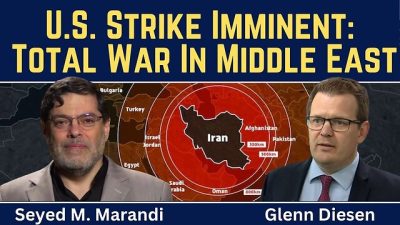
Seyed M. Marandi: Toward Total War in the Middle East
or go to
Aletho News Archives – Video-Images
From the Archives
The Geopolitics behind the War in Yemen (I)
By Mahdi Darius NAZEMROAYA | Strategic Culture Foundation | 30.03.2015
The United States and the Kingdom of Saudi Arabia became very uneasy when the Yemenese or Yemenite movement of the Houthi or Ansarallah (meaning the supporters of God in Arabic) gained control of Yemen’s capital, Sanaa/Sana, in September 2014. The US-supported Yemenite President Abd-Rabbuh Manṣour Al-Hadi was humiliatingly forced to share power with the Houthis and the coalition of northern Yemenese tribes that had helped them enter Sana. Al-Hadi declared that negotiations for a Yemeni national unity government would take place and his allies the US and Saudi Arabia tried to use a new national dialogue and mediated talks to co-opt and pacify the Houthis.
The truth has been turned on its head about the war in Yemen. The war and ousting of President Abd-Rabbuh Manṣour Al-Hadi in Yemen are not the results of «Houthi coup» in Yemen. It is the opposite. Al-Hadi was ousted, because with Saudi and US support he tried to backtrack on the power sharing agreements he had made and return Yemen to authoritarian rule. The ousting of President Al-Hadi by the Houthis and their political allies was an unexpected reaction to the takeover Al-Hadi was planning with Washington and the House of Saudi. … continue
Blog Roll
 Aletho News
- Israeli lobby seeks to bind US fate to ‘Israel’: Araghchi
- Pakistan-Iran talks secure LNG shipment to Islamabad through Hormuz
- Black Sea grain crisis puts global wheat supplies under pressure
- IRGC air defenses destroy another US MQ-1 drone over Strait of Hormuz
- Imran Khan’s entire immediate family detained in Pakistan ahead of mass protest demanding his release
- EU nation detains former presidential frontrunner
- Leaked: Britain’s Sham Conviction Of Hashim Thaci
- Seyed M. Marandi: U.S. Strike Imminent – Toward Total War in the Middle East
- Russia Voted Under Fire. Washington Is Loading the Tankers.
- 12 Things Your Oncologist Was Trained Not to Tell You
- If Americans Knew
- Israeli Attacks in Gaza Kill at Least Seven Palestinians Over Three Days, including Woman and Child
- Trump’s militarization of Washington DC as he pursues Israel’s war against Iran
- Why Israel Fears This Searing New Documentary
- Huckabee aide solicited cash gifts from Israelis
- This isn’t sci-fi, AI is already killing people
- ‘The Most Brutal Thing’: Investigation Reveals Execution of Elderly Woman in Rafah
- Inside Israel’s ‘soft’ ethnic cleansing plan for Gaza through the eyes of its victims
- New online database tracks pro-Israel political donations in the United States
- Israeli president pardons soldier convicted for killing wounded Palestinian
- Singer Ed Sheeran says his ‘heart broken’ by Gaza devastation, addresses Macklemore controversy
- No Tricks Zone
- 2025 Nature Paper Claiming Worsening Global Drought Gets RETRACTED …Heavily Flawed
- New Study: ‘Global Drought Shows No Detectable Recent Acceleration Under Climate Warming’
- Economic Masterminds: German Socialists Suggest Taxing Productivity Gains Stemming From Using AI
- The South China Sea Has Not Been Cooperating With The Climate Change Narrative
- Energy Crisis: Germany Enters Heating Season With Historically Low Gas Reserve Fill Levels
- New Study: The Antarctic Ice Sheet Gained Mass From 2020-2024 Due To Staggering Snow And Ice Accumulation
- Study: Ocean Heating Rates From Thousands Of Years Ago ‘Dwarf’ Modern Ocean Heating Rates
- Climate Extremists Target, Attack Large-Scale Power Grid Infrastructure In Germany!
- New Study: Antarctic Ice Melt Has Contributed Less Than 1 Centimeter To Sea Level Rise In The Last 30 Years
- Fear Of Debate: Alarmist German Climate Scientist Calls On Mainstream Media To Discredit Skeptic Voices
 Aletho News